Why We’re Underestimating American Collapse

The Strange New Pathologies of the World’s First Rich Failed State

By Umair Haque

Source: Information Clearing House

You might say, having read some of my recent essays, “Umair! Don’t worry! Everything will be fine! It’s not that bad!” I would look at you politely, and then say gently, “To tell you the truth, I don’t think we’re taking collapse nearly seriously enough.”

Why? When we take a hard look at US collapse, we see a number of social pathologies on the rise. Not just any kind. Not even troubling, worrying, and dangerous ones. But strange and bizarre ones. Unique ones. Singular and gruesomely weird ones I’ve never really seen before, and outside of a dystopia written by Dickens and Orwell, nor have you, and neither has history. They suggest that whatever “numbers” we use to represent decline — shrinking real incomes, inequality, and so on —we are in fact grossly underestimating what pundits call the “human toll”, but which sensible human beings like you and I should simply think of as the overwhelming despair, rage, and anxiety of living in a collapsing society.

Let me give you just five examples of what I’ll call the social pathologies of collapse — strange, weird, and gruesome new diseases, not just ones we don’t usually see in healthy societies, but ones that we have never really seen before in any modern society.

America has had 11 school shootings in the last 23 days. That’s one every other day, more or less. That statistic is alarming enough — but it is just a number. Perspective asks us for comparison. So let me put that another way. America has had 11 school shootings in the last 23 days, which is more than anywhere else in the world, even Afghanistan or Iraq. In fact, the phenomenon of regular school shootings appears to be a unique feature of American collapse — it just doesn’t happen in any other country — and that is what I mean by “social pathologies of collapse”: a new, bizarre, terrible disease striking society.

Why are American kids killing each other? Why doesn’t their society care enough to intervene? Well, probably because those kids have given up on life — and their elders have given up on them. Or maybe you’re right — and it’s not that simple. Still, what do the kids who aren’t killing each other do? Well, a lot of them are busy killing themselves.

So there is of course also an “opioid epidemic”. We use that phrase too casually, but it much more troubling than it appears on first glance. Here is what is really curious about it. In many countries in the world — most of Asia and Africa — one can buy all the opioids one wants from any local pharmacy, without a prescription. You might suppose then that opioid abuse as a mass epidemic would be a global phenomenon. Yet we don’t see opioid epidemics anywhere but America — especially not ones so vicious and widespread they shrink life expectancy. So the “opioid epidemic” — mass self-medication with the hardest of hard drugs — is again a social pathology of collapse: unique to American life. It is not quite captured in the numbers, but only through comparison — and when we see it in global perspective, we get a sense of just how singularly troubled American life really is.

Why would people abuse opioids en masse unlike anywhere else in the world? They must be living genuinely traumatic and desperate lives, in which there is little healthcare, so they have to self-medicate the terror away. But what is so desperate about them? Well, consider another example: the “nomadic retirees”. They live in their cars. They go from place to place, season after season, chasing whatever low-wage work they can find — spring, an Amazon warehouse, Christmas, Walmart.

Now, you might say — “well, poor people have always chased seasonal work!” But that is not really the point: absolute powerlessness and complete indignity is. In no other country I can see do retirees who should have been able to save up enough to live on now living in their cars in order to find work just to go on eating before they die — not even in desperately poor ones, where at least families live together, share resources, and care for one another. This is another pathology of collapse that is unique to America — utter powerlessness to live with dignity. Numbers don’t capture it — but comparisons paint a bleak picture.

How did America’s elderly end up cheated of dignity? After all, even desperately poor countries have “informal social support systems” — otherwise known as families and communities. But in America, there is the catastrophic collapse of social bonds. Extreme capitalism has blown apart American society so totally that people cannot even care for one another as much as they do in places like Pakistan and Nigeria. Social bonds, relationships themselves, have become unaffordable luxuries, more so than even in poor countries: this is yet another social pathology unique to American collapse.

Yet those once poor countries are making great strides. Costa Ricans now have higher life expectancy than Americans — because they have public healthcare. American life expectancy is falling, unlike nearly anywhere else in the world, save the UK — because it doesn’t.

And that is my last pathology: it is one of the soul, not one of the limbs, like the others above. Americans appear to be quite happy simply watching one another die, in all the ways above. They just don’t appear to be too disturbed, moved, or even affected by the four pathologies above: their kids killing each other, their social bonds collapsing, being powerless to live with dignity,or having to numb the pain of it all away.

If these pathologies happened in any other rich country — even in most poor ones — people would be aghast, shocked, and stunned, and certainly moved to make them not happen. But in America, they are, well, not even resigned. They are indifferent, mostly.

So my last pathology is a predatory society. A predatory society doesn’t just mean oligarchs ripping people off financially. In a truer way, it means people nodding and smiling and going about their everyday business as their neighbours, friends, and colleagues die early deaths in shallow graves. The predator in American society isn’t just its super-rich — but an invisible and insatiable force: the normalization of what in the rest of the world would be seen as shameful, historic, generational moral failures, if not crimes, becoming mere mundane everyday affairs not to be too worried by or troubled about.

Perhaps that sounds strong to you. Is it?

Now that I’ve given you a few examples — there are many more — of the social pathologies of collapse, let me share with you the three points that they raise for me.

These social pathologies are something like strange and gruesome new strains of disease infecting the body social. America has always been a pioneer — only today, it is host not just to problems not just rarely seen in healthy societies — it is pioneering novel social pathologies have never been seen in the modern world outside present-day America, period. What does that tell us?

American collapse is much more severe than we suppose it is. We are underestimating its magnitude, not overestimating it. American intellectuals, media, and thought doesn’t put any of its problems in global or historical perspective — but when they are seen that way, America’s problems are revealed to be not just the everyday nuisances of a declining nation, but something more like a body suddenly attacked by unimagined diseases.

Seen accurately. American collapse is a catastrophe of human possibility without modern parallel . And because the mess that America has made of itself, then, is so especially unique, so singular, so perversely special — the treatment will have to be novel, too. The uniqueness of these social pathologies tell us that American collapse is not like a reversion to any mean, or the downswing of a trend. It is something outside the norm. Something beyond the data. Past the statistics. It is like the meteor that hit the dinosaurs: an outlier beyond outliers, an event at the extreme of the extremes. That is why our narratives, frames, and theories cannot really capture it — much less explain it. We need a whole new language — and a new way of seeing — to even begin to make sense of it.

But that is America’s task, not the world’s. The world’s task is this. Should the world follow the American model — extreme capitalism, no public investment, cruelty as a way of life, the perversion of everyday virtue — then these new social pathologies will follow, too. They are new diseases of the body social that have emerged from the diet of junk food — junk media, junk science, junk culture, junk punditry, junk economics, people treating one another and their society like junk — that America has fed upon for too long.
The Global Elite is Insane Revisited

By Robert J. Burrowes

In 2014 I wrote an article titled ‘The Global Elite is Insane’. I want to elaborate what I explained in the earlier article so that people have a clearer sense of what we are up against in our struggle to create a world of peace, justice and ecological sustainability.

Of course, as I explained previously, it is not just the global elite that is insane. All those individuals – politicians, businesspeople, academics, corporate media editors and journalists, judges and lawyers, bureaucrats…. – who serve the elite, including by not exposing and resisting it, are also insane. And it is important to understand this if we are to develop and implement effective strategies to resist elite violence, exploitation and destruction but also avert the now-imminent human extinction driven by their insane desire for endless personal privilege, corporate profit and political control whatever the cost to Earth’s biosphere and lifeforms (human and non-human alike).

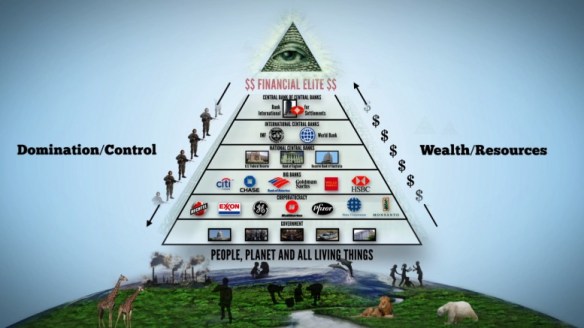
But first, who constitutes the global elite? Essentially, it is those extremely wealthy individuals – notably including the Rothschild family, Jeff Bezos, Bill Gates, Warren Buffett, Amancio Ortega, Mark Zuckerberg, Carlos Slim, the Walton family and the Koch brothers – as well as the world’s other billionaires and millionaires. See ‘Bloomberg Billionaires Index’.

Testament to their secretly and long-accumulated wealth and power, a 2012 investigation concluded that rich individuals and their families have as much as $32 trillion of hidden financial assets – which excludes non-financial assets such as real estate, gold, yachts and racehorses – in offshore tax havens. See the Tax Justice Network.

If this sum was devoted to programs of social uplift then starvation, poverty, homelessness and other privations would vanish immediately and environmental restoration projects as well as research, development and implementation of visionary sustainability initiatives would flourish instantly. The idea of an ‘underdeveloped’ or ‘developing’ national economy would vanish from the literature on Africa, Asia and Central/South America.

In addition to these individuals, however, the global elite includes the major multinational corporations, particularly including the following – although, it should be noted, this list simplifies the picture considerably by ignoring the conglomerate nature of many of these corporations and not including many of the (more difficult to identify) private corporations that should be listed in any comprehensive presentation:

* the major weapons manufacturers (such as Lockheed Martin, Boeing, BAE Systems, Raytheon, Northrop Grumman and General Dynamics)

* the major banks (including Industrial & Commercial Bank of China, China Construction Bank, HSBC Holdings, JPMorgan Chase, Mitsubishi UFJ Financial Group and Bank of America) and their ‘industry groups’ like the International Monetary Conference

* the major investment companies (including BlackRock, Capital Group Companies, FMR, AXA, and JP Morgan Chase)

* the major financial services companies (including Berkshire Hathaway, AXA, Allianz and BNP Paribas)

* the major energy corporations including coal companies (such as Coal India, Adani Enterprises, China Shenhua Energy, China Coal Energy, Mechel, Exxaro Resources, Public Power, Glencore and Peabody Energy) as well as the oil and gas corporations (such as Saudi Aramco, Gazprom, Rosneft, PetroChina, ExxonMobil, Lukoil, BP, Royal Dutch Shell, Petrobras, Chevron, Novatek, Total S.A. and Eni)

* the major media corporations (including Alphabet [Google owner], Comcast, Disney, AT&T, News Corporation, Time Warner, Fox, Facebook, Bertelsmann and Baidu)

* the major marketing and public relations corporations (including Edelman, W2O Group, APCO Worldwide, Deksia, BrandTuitive, Fearless Media, and Citizen Group)

* the major agrochemical (pesticides, seeds, fertilizers) giants (including Bayer, Syngenta, Dow, Monsanto and DuPont)

* the major pharmaceutical corporations (including Johnson & Johnson, Roche, Pfizer, Novartis, Sanofi and GlaxoSmithKline)

* the major biotechnology (genetic mutilation) corporations (again including Johnson & Johnson, Roche, Pfizer and Novartis)

* the major mining corporations (including Glencore Xtrata, BHP Billiton, Rio Tinto, Vale, Anglo American, China Shenhua Energy, Freeport McMoRan Copper & Gold, and Barrick Gold)

* the major nuclear power corporations (including Areva, Rosatom, General Electric/Hitachi, Kepco, Mitsubishi, Babcock & Wilcox, BNFL, Duke Energy, McDermott International, Southern, NextEra Energy, American Electric Power, and Westinghouse)

* the major food multinationals (including Cargill, Archer Daniels Midland Company [ADM], Nestlé, PepsiCo, Coca-Cola, Unilever, Danone, General Mills, Kellogg’s, Mars, Associated British Foods and Mondelez)

* the major water corporations (including Veolia, Suez Environnement, ITT Corporation, United Utilities, Severn Trent, Thames Water, American Water Works).

Of course, the global elite also includes elite fora where various combinations of elite individuals from the corporate, political, media and academic worlds gather to plan their continuing violence against, and exploitation of, the Earth and its inhabitants. This is intended to consolidate and extend t heir control over populations, markets and resources to maximize their privilege, profit and power at the expense of the rest of us and life generally. Among intergovernmental organizations, it includes the United Nations, the World Bank and the International Monetary Fund.

A quick perusal of the agenda of such elite gatherings – including the World Economic Forum, the Bilderberg Group and the Trilateral Commission – reveals a comprehensive lack of interest, despite rhetoric and the occasional token mention, of pressing issues ranging from the threat of nuclear war and the climate catastrophe to the many ongoing wars, deepening exploitation within the global economy, extensive range of environmental threats and the refugee crisis, each of which they generated and now continue to deliberately exacerbate. See, for example, the agenda of the recent WEF meeting in Davos.

Primary servants of the global elite include political leaders in major industrialized countries (who legislate to progressively expand elite power, profit and privilege, such as Donald Trump’s recent tax cuts for the wealthy at the expense of social programs), the judges and lawyers (who defend elite power using the elite-designed and manipulated legal system: ever heard of a wealthy individual convicted in court and given any serious punishment or of any major corporation genuinely held to legal account for its exploitation of indigenous peoples or destruction of the natural environment?), as well as corporate media editors and journalists, entertainment industry personnel, academics, industry organizations (such as the European Round Table of Industrialists) that represent the interests of major corporations, so-called ‘think tanks’ (such as the Council on Foreign Relations and the Brookings Institution) and ‘philanthropic trusts’ (such as the Rockefeller, Carnegie and Ford foundations) all of which justify, ignore or divert attention from elite violence and exploitation.

Importantly too, primary servants of the global elite include those who work within elite-directed agencies, notably including those in the so-called ‘intelligence community’ (such as the US CIA, British MI6, Russian SVR RF, Chinese Ministry for State Security and Israeli Mossad), who perform elite functions in relation to spying, surveillance and secret assassinations (particularly of grassroots activists), ostensibly under the direction of national governments. But it also includes many lower-level servants such as those who work as political lobbyists or in the bureaucracy as well as the education, police and prison systems.

So why do I claim that the elite and those who serve them are insane?

Any dictionary will offer a simple definition of ‘sanity’ along the lines of ‘soundness of judgment or reason’ and ‘the ability to think and speak in a reasonable way and to behave normally’.

But if we use this definition of sanity then, obviously, ‘sanity’ must be interpreted to mean that it is ‘sound judgment, reasonable and normal’ to further perpetrate the violence and exploitation that are overwhelmingly characteristic of our world. After all, most people powerlessly accept this incredibly violent state of affairs and, if they discuss it, do so in terms of its merits, politically, economically, morally or otherwise. Few people argue, simply, that violence is just insane.

So I would like to propose a more rigorous definition of sanity: Sanity is the capacity to consider a set of circumstances, to carefully analyze the evidence pertaining to those circumstances, to identify the cause of any conflict or problem, and to respond appropriately, both emotionally and intellectually, to that conflict or problem with the intention of resolving it, preferably at a higher level of need satisfaction for all parties (including those of the Earth and all of its living creatures).

Clearly, my proposed definition of sanity is designed to imply that any conceptions we have of ‘sound judgment’, ‘reasonable’ and ‘normal’ mean that they are qualities we associate with individuals who possess the desirable capacity to improve the overall state of human affairs, whether an interpersonal relationship or geopolitically. This means, as an absolute minimum, the capacity to reduce violence or exploitation in one context or another.

You might, of course, accuse me of writing a definition of ‘sanity’ that serves my agenda to dramatically improve world order in the direction of peace, justice and sustainability. And you are right! But whose interest does it serve to have sanity defined as behavior that involves ‘sound judgment’ and is considered ‘reasonable and normal’ in the context of perpetuating extraordinary violence?

Alternatively, you might argue that my definition of insanity is too broad. Surely, you might say, we can account for many of the behaviors outlined above in terms of different belief systems, ideologies and religions. Doesn’t a person who believes in killing people to win wars (or for other reasons) just have a worldview different from those who believe that people should resolve conflict nonviolently? Doesn’t a capitalist just have a worldview different from those who believe that people should share resources equally? Doesn’t a person who believes in the unlimited accumulation of wealth just have a worldview different from those who believe in ecological sustainability?

But there is a more fundamental issue here. As I explained in my original article, cited at the beginning of this one: Do you really believe that someone who is capable of perpetrating extraordinary violence, inequity and biosphere-threatening behavior – and thus clearly incapable of experiencing and expressing the love, compassion, empathy and sympathy that would drive a nonviolent approach to the world – is sane? Given that emotional qualities such as love, compassion, empathy and sympathy are an evolutionary gift to those not seriously damaged during childhood, what happened to those individuals who do not possess them? See Why Violence?’ and Fearless Psychology and Fearful Psychology: Principles and Practice.

Or, to explain it based on my longer definition of sanity highlighted above: Casual observation of the state of our world, including the primary threat of near-term human extinction through climate catastrophe or nuclear war – see ‘On Track for Extinction: Can Humanity Survive?’ – clearly reveals that none of the elite is paying considered attention to the perilous state of our world, analyzing the evidence in relation to it, identifying the cause(s) driving it or responding powerfully to end it. Why is this?

In essence, it is because one manifestation of their insanity drives them to deny reality to make huge profits from weapons production used to kill people, the burning of climate-destroying fossil fuels, environmental destruction (through, for example, mining and rainforest logging), commercial farming based on the poisoning and genetic mutilation of foods, the mass production and sale of poisoned, processed and nutritionally-depleted foods, the consumption of health-destroying and dependency-creating drugs, and control over the sale of water, once considered a human right. Moreover, insanity makes the elite do everything in its power to maintain this highly profitable state of affairs. See ‘Profit Maximization is Easy: Invest in Violence’.

Moreover, of course, there is no evidence of committed elite engagement in efforts to end the many local wars (from which they make huge profits), end corporate exploitation of human beings (which kills, through starvation alone, 100,000 people every day but from which they make huge profits) and nonhuman beings (which drives 200 species of life to extinction daily but from which they make huge profits) or end local environmental destruction in a myriad ways (from which they make huge profits).

So, in summary, given our ongoing rush to extinction, it is clear that those who exacerbate this threat through failure to consider and act with awareness (as well as encourage aware action by others) fail to satisfy the definition of sanity that I offered above. In short: Gambling on the future of humanity is not sane.

As an aside, it should be noted: Often enough too, the elite can rely on a largely insane population to mindlessly consume the latest consumer product, no matter how unnecessary, or they can rely on their marketing and advertising agents to persuade those of us who show the slightest reluctance to buy the latest inanity.

So with an insane global elite and its many insane servants as well as a largely insane consumer population, what can those of us who have the sanity to respond powerfully to the many threats to our survival do?

Well, if you want a child who is emotionally and intellectually engaged with the world and therefore capable of responding powerfully to their circumstances (which includes being able to resist the lure of serving the elite and being suckered by its marketing), then terrorizing the child into obedience is not the way to go about it. So, you might like to consider making ‘My Promise to Children’.

If you are sane enough to investigate the evidence and to act intelligently and powerfully in response to it, I encourage you to do so. One option you have if you find the evidence in relation to one or more of the threats mentioned above compelling, is to join those participating in ‘The Flame Tree Project to Save Life on Earth’.

If you are self-aware enough to know that you are inclined to avoid ‘difficult issues’ and to take the action that these require, then perhaps you could tackle this problem at its source by ‘Putting Feelings First’. Unfortunately, as mentioned above, few of us had a childhood that nurtured our sanity.

If you want to mobilize people to campaign effectively on the climate, war, rainforest destruction or any other elite-driven violence that threatens our future, consider developing a comprehensive nonviolent strategy to do so. See Nonviolent Campaign Strategy.

And if you want to participate in the worldwide effort to end the insanity we call violence in all of its manifestations, you are welcome to consider signing the online pledge of The Peoples Charter to Create a Nonviolent World.

Elite insanity, if not stopped, will drive us out of existence. If you believe that the elite and their servants will ‘see the light’ before it is too late, I invite you to seek out the evidence to justify your belief. I have found none.

I also see no evidence that individual members of the elite will do the emotional healing necessary to be able to act sanely in response to the extinction-threatening crisis it has generated.

So it is up to those of us who can think and act sanely to stop the rush to extinction before it is too late.

Are you one of those people?


Biodata: Robert J. Burrowes has a lifetime commitment to understanding and ending human violence. He has done extensive research since 1966 in an effort to understand why human beings are violent and has been a nonviolent activist since 1981. He is the author of Why Violence? His email address is flametree@riseup.net and his website is here.

Robert J. Burrowes
P.O. Box 68
Daylesford, Victoria 3460
Australia

Email: flametree@riseup.net

Websites:
Nonviolence Charter
Flame Tree Project to Save Life on Earth
‘Why Violence?’
Feelings First
Nonviolent Campaign Strategy
Nonviolent Defense/Liberation Strategy
Anita: Songs of Nonviolence
Robert Burrowes
Global Nonviolence Network

“If poor people knew how rich rich people are, there would be riots in the streets”

By Staff, Anticap.wordpress.com

Source: Popular Resistance

Chris Rock may be right. Still, Americans are well aware that economic inequality in their country is obscene, even though they often underestimate the growing gap between the poor and the rich.

But it’s Frank Rich, who conducted the interview with the American comedian, who made the more perceptive observation:

For all the current conversation about income inequality, class is still sort of the elephant in the room.

All the experts agree—from Thomas Piketty and the other members of the World Inequality Lab team to John C. Weicher of the conservative Hudson Institute—that inequality in the United States, especially the unequal distribution of wealth, has been worsening for decades now. Both before and after the crash of 2007-08. And there’s no sign that things are going to get better anytime soon, unless radical changes are made.

But, as it turns out, even the experts underestimate the degree of inequality in the United States. The usual numbers that are produced and disseminated indicate that, in 2014 (the last year for which data are available), the top 1 percent of Americans owned one third (35 percent) of total household wealth while the bottom 90 percent had less than half (45.3 percent) of the wealth.

According to my calculations, illustrated in the chart at the top of the post, the situation in the United States is much worse. In 2014, the top 1 percent (red line) owned almost two thirds of the financial or business wealth, while the bottom 90 percent (blue line) had only six percent. That represents an enormous change from the already-unequal situation in 1978, when the shares were much closer (28.6 percent for the top 1 percent and 23.2 percent for the bottom 90 percent).

Why the large difference between my numbers and theirs? It all depends on how wealth is defined. Both the World Inequality Lab and the Federal Reserve (in the Survey of Consumer Finances) include housing and retirement pensions in household wealth—and those two categories comprise most of the so-called wealth of most Americans. They just don’t own much in the way of financial or business wealth. They live in their houses and they retire based on contributions from their wages and salaries over the course of their work lives. They produce but don’t take home any of the surplus; therefore, they just don’t have the ability to amass any real wealth.

For the small group at the top, things are quite different. They do get a cut of the surplus, which they use, not only to purchase housing and put aside in their pensions, but to accumulate real wealth, for themselves and their families. If we take out housing and pensions and calculate just the shares of financial or business wealth—and, thus, equities, fixed-income claims, and business assets—the degree of inequality is much, much worse.

Yes, rich people in the United States are very rich—even more than either regular Americans or the experts believe.

But that’s not the real elephant in the room. The big issue that everyone is aware of, but nobody wants to talk about, is class. And that’s the reason there should be, if not riots, at least a sustained political movement to transform the existing economic and social structures in the United States.

The Singular Pursuit of Comrade Bezos

By Malcolm Harris

Source: Medium

It was explicitly and deliberately a ratchet, designed to effect a one-way passage from scarcity to plenty by way of stepping up output each year, every year, year after year. Nothing else mattered: not profit, not the rate of industrial accidents, not the effect of the factories on the land or the air. The planned economy measured its success in terms of the amount of physical things it produced.

— Francis Spufford, Red Plenty

But isn’t a business’s goal to turn a profit? Not at Amazon, at least in the traditional sense. Jeff Bezos knows that operating cash flow gives the company the money it needs to invest in all the things that keep it ahead of its competitors, and recover from flops like the Fire Phone. Up and to the right.

— Recode, “Amazon’s Epic 20-Year Run as a Public Company, Explained in Five Charts


From a financial point of view, Amazon doesn’t behave much like a successful 21st-century company. Amazon has not bought back its own stock since 2012. Amazon has never offered its shareholders a dividend. Unlike its peers Google, Apple, and Facebook, Amazon does not hoard cash. It has only recently started to record small, predictable profits. Instead, whenever it has resources, Amazon invests in capacity, which results in growth at a ridiculous clip. When the company found itself with $13.8 billion lying around, it bought a grocery chain for $13.7 billion. As the Recode story referenced above summarizes in one of the graphs: “It took Amazon 18 years as a public company to catch Walmart in market cap, but only two more years to double it.” More than a profit-seeking corporation, Amazon is behaving like a planned economy.

If there is one story on Americans who grew up after the fall of the Berlin Wall know about planned economies, I’d wager it’s the one about Boris Yeltsin in a Texas supermarket.

In 1989, recently elected to the Supreme Soviet, Yeltsin came to America, in part to see Johnson Space Center in Houston. On an unscheduled jaunt, the Soviet delegation visited a local supermarket. Photos from the Houston Chronicle capture the day: Yeltsin, overcome by a display of Jell-O Pudding Pops; Yeltsin inspecting the onions; Yeltsin staring down a full display of shiny produce like a line of enemy soldiers. Planning could never master the countless variables that capitalism calculated using the tireless machine of self-interest. According to the story, the overflowing shelves filled Yeltsin with despair for the Soviet system, turned him into an economic reformer, and spelled the end for state socialism as a global force. We’re taught this lesson in public schools, along with Animal Farm: Planned economies do not work.

It’s almost 30 years later, but if Comrade Yeltsin had visited today’s most-advanced American grocery stores, he might not have felt so bad. Journalist Hayley Peterson summarized her findings in the title of her investigative piece, “‘Seeing Someone Cry at Work Is Becoming Normal’: Employees Say Whole Foods Is Using ‘Scorecards’ to Punish Them.” The scorecard in question measures compliance with the (Amazon subsidiary) Whole Foods OTS, or “on-the-shelf” inventory management. OTS is exhaustive, replacing a previously decentralized system with inch-by-inch centralized standards. Those standards include delivering food from trucks straight to the shelves, skipping the expense of stockrooms. This has resulted in produce displays that couldn’t bring down North Korea. Has Bezos stumbled into the problems with planning?

Although OTS was in play before Amazon purchased Whole Foods last August, stories about enforcement to tears fit with the Bezos ethos and reputation. Amazon is famous for pursuing growth and large-scale efficiencies, even when workers find the experiments torturous and when they don’t make a lot of sense to customers, either. If you receive a tiny item in a giant Amazon box, don’t worry. Your order is just one small piece in an efficiency jigsaw that’s too big and fast for any individual human to comprehend. If we view Amazon as a planned economy rather than just another market player, it all starts to make more sense: We’ll thank Jeff later, when the plan works. And indeed, with our dollars, we have.

In fact, to think of Amazon as a “market player” is a mischaracterization. The world’s biggest store doesn’t use suggested retail pricing; it sets its own. Book authors (to use a personal example) receive a distinctly lower royalty for Amazon sales because the site has the power to demand lower prices from publishers, who in turn pass on the tighter margins to writers. But for consumers, it works! Not only are books significantly cheaper on Amazon, the site also features a giant stock that can be shipped to you within two days, for free with Amazon Prime citizensh…er, membership. All 10 or so bookstores I frequented as a high school and college student have closed, yet our access to books has improved — at least as far as we seem to be able to measure. It’s hard to expect consumers to feel bad enough about that to change our behavior.


Although they attempt to grow in a single direction, planned economies always destroy as well as build. In the 1930s, the Soviet Union compelled the collectivization of kulaks, or prosperous peasants. Small farms were incorporated into a larger collective agricultural system. Depending on who you ask, dekulakization was literal genocide, comparable to the Holocaust, and/or it catapulted what had been a continent-sized expanse of peasants into a modern superpower. Amazon’s decimation of small businesses (bookstores in particular) is a similar sort of collectivization, purging small proprietors or driving them onto Amazon platforms. The process is decentralized and executed by the market rather than the state, but don’t get confused: Whether or not Bezos is banging on his desk, demanding the extermination of independent booksellers — though he probably is — these are top-down decisions to eliminate particular ways of life.

Now, with the purchase of Whole Foods, Bezos and Co. seem likely to apply the same pattern to food. Responding to reports that Amazon will begin offering free two-hour Whole Foods delivery for Prime customers, BuzzFeed’s Tom Gara tweeted, “Stuff like this suggests Amazon is going to remove every cent of profit from the grocery industry.” Free two-hour grocery delivery is ludicrously convenient, perhaps the most convenient thing Amazon has come up with yet. And why should we consumers pay for huge dividends to Kroger shareholders? Fuck ’em; if Bezos has the discipline to stick to the growth plan instead of stuffing shareholder pockets every quarter, then let him eat their lunch. Despite a business model based on eliminating competition, Amazon has avoided attention from antitrust authorities because prices are down. If consumers are better off, who cares if it’s a monopoly? American antitrust law doesn’t exist to protect kulaks, whether they’re selling books or groceries.

Amazon has succeeded in large part because of the company’s uncommon drive to invest in growth. And today, not only are other companies slow to spend, so are governments. Austerity politics and decades of privatization put Amazon in a place to take over state functions. If localities can’t or won’t invest in jobs, then Bezos can get them to forgo tax dollars (and dignity) to host HQ2. There’s no reason governments couldn’t offer on-demand cloud computing services as a public utility, but instead the feds pay Amazon Web Services to host their sites. And if the government outsources health care for its population to insurers who insist on making profits, well, stay tuned. There’s no near-term natural end to Amazon’s growth, and by next year the company’s annual revenue should surpass the GDP of Vietnam. I don’t see any reason why Amazon won’t start building its own cities in the near future.

America never had to find out whether capitalism could compete with the Soviets plus 21st-century technology. Regardless, the idea that market competition can better set prices than algorithms and planning is now passé. Our economists used to scoff at the Soviets’ market-distorting subsidies; now Uber subsidizes every ride. Compared to the capitalists who are making their money by stripping the copper wiring from the American economy, the Bezos plan is efficient. So, with the exception of small business owners and managers, why wouldn’t we want to turn an increasing amount of our life-world over to Amazon? I have little doubt the company could, from a consumer perspective, improve upon the current public-private mess that is Obamacare, for example. Between the patchwork quilt of public- and private-sector scammers that run America today and “up and to the right,” life in the Amazon with Lex Luthor doesn’t look so bad. At least he has a plan, unlike some people.

From the perspective of the average consumer, it’s hard to beat Amazon. The single-minded focus on efficiency and growth has worked, and delivery convenience is perhaps the one area of American life that has kept up with our past expectations for the future. However, we do not make the passage from cradle to grave as mere average consumers. Take a look at package delivery, for example: Amazon’s latest disruptive announcement is “Shipping with Amazon,” a challenge to the USPS, from which Amazon has been conniving preferential rates. As a government agency bound to serve everyone, the Postal Service has had to accept all sorts of inefficiencies, like free delivery for rural customers or subsidized media distribution to realize freedom of the press. Amazon, on the other hand, is a private company that doesn’t really have to do anything it doesn’t want to do. In aggregate, as average consumers, we should be cheering. Maybe we are. But as members of a national community, I hope we stop to ask if efficiency is all we want from our delivery infrastructure. Lowering costs as far as possible sounds good until you remember that one of those costs is labor. One of those costs is us.

Earlier this month, Amazon was awarded two patents for a wristband system that would track the movement of warehouse employees’ hands in real time. It’s easy to see how this is a gain in efficiency: If the company can optimize employee movements, everything can be done faster and cheaper. It’s also easy to see how, for those workers, this is a significant step down the path into a dystopian hellworld. Amazon is a notoriously brutal, draining place to work, even at the executive levels. The fear used to be that if Amazon could elbow out all its competitors with low prices, it would then jack them up, Martin Shkreli style. That’s not what happened. Instead, Amazon and other monopsonists have used their power to drive wages and the labor share of production down. If you follow the Bezos strategy all the way, it doesn’t end in fully automated luxury communism or even Wall-E. It ends in The Matrix, with workers swaddled in a pod of perfect convenience and perfect exploitation. Central planning in its capitalist form turns people into another cost to be reduced as low as possible.

Just because a plan is efficient doesn’t mean it’s good. Postal Service employees are unionized; they have higher wages, paths for advancement, job stability, negotiated grievance procedures, health benefits, vacation time, etc. Amazon delivery drivers are not and do not. That difference counts as efficiency when we measure by price, and that is, to my mind, a very good argument for not handing the world over to the king of efficiency. The question that remains is whether we have already been too far reduced, whether after being treated as consumers and costs, we might still have it in us to be more, because that’s what it will take to wrench society away from Bezos and from the people who have made him look like a reasonable alternative.

The political logic of the junk food revolution

By Jonathan Cook

Source: TruePublica

Here is an article on food whose political implications are really worth considering. We already know that people in western societies, particularly the US and UK, are eating far too much junk food, and that this leads to an epidemic of obesity, heart disease and cancer.

But the latest research not only reveals the extent that “ultra-processed” foods have come to dominate our diets in Europe – now comprising more than half of what Britons eat, for example – but raises the question of what effects the consumption of this much junk food will have on our behaviours.

The nutritionists here are reluctant to offer even well-informed speculation, which always seems to be the case with publicly funded scientists until things have moved beyond a critical point. Think of smoking and climate change: we usually learn much later that the corporations’ own pet-scientists had done the research decades earlier proving or predicting exactly what was coming.

But there are hints from the nutritionists to the Guardian of what might be going on:

“People are missing out not only on vitamins and minerals but also bioactive compounds found in natural foods such as phytoestrogens and fibre.

And then you get salt and starch and sugar and fat and all these additives. We are consuming every day an amount of new substances that are these flavours and colours and emulsifiers and we don’t have any idea as to what will be the problem of these items,” [Professor Carlos Monteiro from the University of Sao Paulo in Brazil, who led the research team] said. …

Other cumulative effects of eating these industrially-made substances are not yet known. “The honest answer is we don’t know what is going on,” said Monteiro.’

Here is an educated guess, based in part on experience and in part on the economic and political logic of our current junk food revolution. (Those of us who eat these industrial substances rarely enough that they do not dominate our diets still have a sense of what happens to us on the occasions we do.)

These lab-created, nutritionally empty substances that our bodies have not evolved to digest not only make us physically sick, but emotionally and mentally sick too: addicted, depressed, lazy, sluggish, docile and anxious.

In fact, a mess of emotions that transforms us into the perfect consumers, buying more of this cheap, harmful “food”. That boosts both the profits of food and other corporations and the electoral fortunes of crowd-pleasing, money-grubbing, vacuous politicians who wish to serve those corporations.

That is how an advanced capitalist system – premised on a psychopathic drive by the strongest to maximise profits by exploiting the weakest – will naturally evolve. It needs to make us as dependent, as passive and docile, as possible.

The Military Industrial Complex Strikes Again: War Spending Will Bankrupt America

By John W. Whitehead

Source: The Rutherford Institute

Why throw money at defense when everything is falling down around us? Do we need to spend more money on our military (about $600 billion this year) than the next seven countries combined? Do we need 1.4 million active military personnel and 850,000 reserves when the enemy at the moment — ISIS — numbers in the low tens of thousands? If so, it seems there’s something radically wrong with our strategy. Should 55% of the federal government’s discretionary spending go to the military and only 3% to transportation when the toll in American lives is far greater from failing infrastructure than from terrorism? Does California need nearly as many active military bases (31, according to militarybases.com) as it has UC and state university campuses (33)? And does the state need more active duty military personnel (168,000, according to Governing magazine) than public elementary school teachers (139,000)?”— Steve Lopez, Los Angeles Times

Mark my words, America’s war spending will bankrupt the nation.

For that matter, America’s war spending has already bankrupted the nation to the tune of more than $20 trillion dollars.

Now the Trump Administration is pushing for a $4.4 trillion budget for fiscal year 2019 that would add $7 trillion to the already unsustainable federal deficit in order to sustain America’s military empire abroad and dramatically expand the police state here at home. Trump also wants American taxpayers to cover the cost of building that infamous border wall.

Truly, Trump may turn out to be, as policy analyst Stan Collender warned, “the biggest deficit- and debt-increasing president of all time.”

For those in need of a quick reminder: “A budget deficit is the difference between what the federal government spends and what it takes in. The national debt, also known as the public debt, is the result of the federal government borrowing money to cover years and years of budget deficits.”

Right now, the U.S. government is operating in the negative on every front: it’s spending far more than what it makes (and takes from the American taxpayers) and it is borrowing heavily (from foreign governments and Social Security) to keep the government operating and keep funding its endless wars abroad.

This is how military empires fall and fail: by spreading themselves too thin and spending themselves to death.

It happened in Rome. It’s happening again.

Not content to merely police the globe, in recent decades, America has gradually transformed its homeland into a battlefield with militarized police and weapons better suited to a war zone.

Since taking office, President Trump—much like his predecessors—has marched in lockstep with the military. Now Trump wants $716 billion to expand America’s military empire abroad and billions more to hire cops, build more prisons and wage more profit-driven war-on-drugs/war-on-terrorism/war-on-crime programs that eat away at the Fourth Amendment while failing to make the country any safer.

Even the funds requested for infrastructure will do little to shore up the nation’s crumbling roads, bridges, railways, highways, power grids and dams.

No matter how your break it down, this is not a budget aimed at perfecting the Union, establishing justice, insuring domestic tranquility, providing for the common defense, promoting general welfare, or securing the blessings of liberty for the American people.

No, this is a budget aimed at pandering to the powerful money interests (military, corporate and security) that run the Deep State and hold the government in its clutches.

So much for Trump’s campaign promises to balance the budget and drain the swamps of corruption.

The glaring economic truth is that at the end of the day, it’s the military industrial complex—and not the sick, the elderly or the poor—that is pushing America towards bankruptcy.

As investigative journalist Uri Friedman puts it, for more than 15 years now, the United States has been fighting terrorism with a credit card, “essentially bankrolling the wars with debt, in the form of purchases of U.S. Treasury bonds by U.S.-based entities like pension funds and state and local governments, and by countries like China and Japan.”

The illicit merger of the armaments industry and the Pentagon that President Dwight D. Eisenhower warned us against more than 50 years ago has come to represent perhaps the greatest threat to the nation’s fragile infrastructure today.

Having been co-opted by greedy defense contractors, corrupt politicians and incompetent government officials, America’s expanding military empire is bleeding the country dry at a rate of more than $15 billion a month (or $20 million an hour)—and that’s just what the government spends on foreign wars.

That does not include the cost of maintaining and staffing the 1000-plus U.S. military bases spread around the globe.

Incredibly, although the U.S. constitutes only 5% of the world’s population, America boasts almost 50% of the world’s total military expenditure,  spending more on the military than the next 19 biggest spending nations combined.

In fact, the Pentagon spends more on war than all 50 states combined spend on health, education, welfare, and safety.

War is not cheap.

Although the federal government obscures so much about its defense spending that accurate figures are difficult to procure, we do know that since 2001, the U.S. government has spent more than $1.8 trillion in the wars in Afghanistan and Iraq (that’s $8.3 million per hour).

That doesn’t include wars and military exercises waged around the globe, which are expected to push the total bill upwards of $12 trillion by 2053.

Mind you, these ongoing wars—riddled by corruption, graft and bumbling incompetence—have done little to keep the country safe while enriching the military industrial complex—and private defense contractors—at taxpayer expense.

Just recently, for example, a leading accounting firm concluded that one of the Pentagon’s largest agencies “can’t account for hundreds of millions of dollars’ worth of spending.”

Just consider the fact that it costs American taxpayers $2.1 million per year for each soldier deployed in Afghanistan.

Imagine what you could do with that money if it were spent on domestic needs here at home.

Unfortunately, that’s not going to happen anytime soon, not as long as the money interests in Washington keep calling the shots and profiting from the spoils of war.

War has become a huge money-making venture, and America, with its vast military empire, is one of its best buyers and sellers. Not only does the U.S. have the largest defense budget, it also ranks highest as the world’s largest arms exporter.

The American military-industrial complex has erected an empire unsurpassed in history in its breadth and scope, one dedicated to conducting perpetual warfare throughout the earth.

For example, while erecting a security surveillance state in the U.S., the military-industrial complex has perpetuated a worldwide military empire with American troops stationed in 177 countries (over 70% of the countries worldwide).

In the process, billions have been spent erecting luxury military installations throughout the world.

For example, the U.S. Embassy built in Iraq, dubbed “Fortress Baghdad,” covers 104 acres and boasts a “city within a city” that includes six apartment buildings, a Marine barracks, swimming pool, shops and 15-foot-thick walls. Camp Anaconda in Iraq, like many U.S. military bases scattered across the globe, was structured to resemble a mini-city with pools, fast food restaurants, miniature golf courses and movie theaters.

While most Americans can scarcely afford the cost of heating and cooling their own homes, the American government spends $20 billion annually just to provide air conditioning for military installations in Iraq and Afghanistan.

In essence, what we’re doing is “we’re air conditioning the desert over there in Afghanistan, Iraq, and other places,” noted retired brigadier general Steven Anderson, a former chief logistician for Gen. David Petraeus in Iraq.

Think about that for a minute.

There’s a good reason why “bloated,” “corrupt” and “inefficient” are among the words most commonly applied to the government, especially the Department of Defense and its contractors.

For instance, a study by the Government Accountability Office found that $70 billion worth of cost overruns by the Pentagon were caused by management failures. To put that in perspective, that equates to one and a half times the State Department’s entire $47 billion annual budget.

Fraud is rampant.

A government audit, for example, found that defense contractor Boeing has been massively overcharging taxpayers for mundane parts, resulting in tens of millions of dollars in overspending. As the report noted, the American taxpayer paid:

$71 for a metal pin that should cost just 4 cents; $644.75 for a small gear smaller than a dime that sells for $12.51: more than a 5,100 percent increase in price. $1,678.61 for another tiny part, also smaller than a dime, that could have been bought within DoD for $7.71: a 21,000 percent increase. $71.01 for a straight, thin metal pin that DoD had on hand, unused by the tens of thousands, for 4 cents: an increase of over 177,000 percent.

Price gouging has become an accepted form of corruption within the American military empire.

And if you think gas prices at home can get high, just consider what the American taxpayer is being forced to shell out overseas: once all the expenses of delivering gas to troops in the field are factored in, we’re paying between $18-30 per gallon for gas in Iraq and Afghanistan.

Incredibly, despite reports of corruption, abuse and waste, the mega-corporations behind much of this ineptitude and corruption continue to be awarded military contracts worth billions of dollars.

The rationale may keep changing for why American military forces are in Afghanistan, Iraq and elsewhere, but the one that remains constant is that those who run the government are feeding the appetite of the military industrial complex.

What began in 2001 as part of an alleged effort to root out al Qaeda has turned into a goldmine for the military industrial complex and its army of private contractors.

Just consider: the Pentagon in 2008 spent more money every five seconds in Iraq than the average American earned in a year.

Yet Congress and the White House want taxpayers to accept that the only way to reduce the nation’s ballooning deficit is by cutting “entitlement” programs such as Social Security and Medicare?

As Martin Luther King Jr. recognized, under a military empire, war and its profiteering will always take precedence over the people’s basic human needs.

Simply put, we cannot afford to maintain our over-extended military empire.

Money is the new 800-pound gorilla,” remarked a senior administration official involved in Afghanistan. “It shifts the debate from ‘Is the strategy working?’ to ‘Can we afford this?’ And when you view it that way, the scope of the mission that we have now is far, far less defensible.”

Or as one commentator noted, “Foreclosing the future of our country should not be confused with defending it.”

Inevitably, military empires collapse.

As Cullen Murphy, author of Are We Rome? and editor-at-large of Vanity Fair writes:

A millennium hence America will be hard to recognize. It may not exist as a nation-state in the form it does now—or even exist at all. Will the transitions ahead be gradual and peaceful or abrupt and catastrophic? Will our descendants be living productive lives in a society better than the one we inhabit now? Whatever happens, will valuable aspects of America’s legacy weave through the fabric of civilizations to come? Will historians someday have reason to ask, Did America really fall?

The problem we wrestle with is none other than a distorted American empire, complete with mega-corporations, security-industrial complexes and a burgeoning military. And it has its sights set on absolute domination.

Eventually, however, all military empires fail.

At the height of its power, even the mighty Roman Empire could not stare down a collapsing economy and a burgeoning military. Prolonged periods of war and false economic prosperity largely led to its demise. As historian Chalmers Johnson predicts:

The fate of previous democratic empires suggests that such a conflict is unsustainable and will be resolved in one of two ways. Rome attempted to keep its empire and lost its democracy. Britain chose to remain democratic and in the process let go its empire. Intentionally or not, the people of the United States already are well embarked upon the course of non-democratic empire.

I would suggest that what we have is a confluence of factors and influences that go beyond mere comparisons to Rome.

It is a union of Orwell’s 1984 with its shadowy, totalitarian government—i.e., fascism, the union of government and corporate powers—and a total surveillance state with a military empire extended throughout the world.

As we have seen with the militarizing of the police, the growth of and reliance on militarism as the solution for our problems both domestically and abroad affects the basic principles upon which American society should operate.

We must keep in mind that a military empire will be ruled not by lofty ideals of equality and justice but by the power of the sword. Those in the military are primarily trained to conduct warfare, not preserve the peace.

Here’s the kicker, though: if the American empire falls and the American economy collapses—and with it the last vestiges of our constitutional republic—it will be the government and its trillion-dollar war budgets that are to blame.

Of course, the government has already anticipated this breakdown.

That’s why the government has transformed America into a war zone, turned the nation into a surveillance state, and labelled “we the people” as enemy combatants.

For years now, the government has worked with the military to prepare for widespread civil unrest brought about by “economic collapse, loss of functioning political and legal order, purposeful domestic resistance or insurgency, pervasive public health emergencies, and catastrophic natural and human disasters.”

Having spent more than half a century exporting war to foreign lands, profiting from war, and creating a national economy seemingly dependent on the spoils of war, the war hawks long ago turned their profit-driven appetites on us, bringing home the spoils of war—the military tanks, grenade launchers, Kevlar helmets, assault rifles, gas masks, ammunition, battering rams, night vision binoculars, etc.—and handing them over to local police, thereby turning America into a battlefield.

As I make clear in my book Battlefield America: The War on the American People, this is how the police state wins and “we the people” lose.

More than 50 years ago, President Dwight Eisenhower warned us not to let the profit-driven war machine endanger our liberties or democratic processes.

We failed to heed his warning.

As Eisenhower recognized in a speech given to the American Society of Newspaper Editors, on Apr. 16, 1953, the consequences of allowing the military-industrial complex to wage war, exhaust our resources and dictate our national priorities are beyond grave:

“Every gun that is made, every warship launched, every rocket fired signifies, in the final sense, a theft from those who hunger and are not fed, those who are cold and are not clothed. This world in arms is not spending money alone. It is spending the sweat of its laborers, the genius of its scientists, the hopes of its children. The cost of one modern heavy bomber is this: a modern brick school in more than 30 cities. It is two electric power plants, each serving a town of 60,000 population. It is two fine, fully equipped hospitals. It is some fifty miles of concrete pavement. We pay for a single fighter plane with a half million bushels of wheat. We pay for a single destroyer with new homes that could have housed more than 8,000 people… This is not a way of life at all, in any true sense. Under the cloud of threatening war, it is humanity hanging from a cross of iron.”

Ecuador Endangered

By John Seed

The tropical Andes of Ecuador are at the top of the world list of biodiversity hotspots in terms of vertebrate species, endemic vertebrates, and endemic plants. Ecuador has more orchid and hummingbird species than Brazil, which is 32 times larger, and more diversity than the entire USA.

In the last year, the Ecuadorean government has quietly granted mining concessions to over 1.7 million hectares (4.25 million acres) of forest reserves and indigenous territories. These were awarded to transnational corporations in closed-door deals without public knowledge or consent.

This is in direct violation of Ecuadorean law and international treaties, and will decimate headwater ecosystems and biodiversity hotspots of global significance. However, Ecuadorean groups think there is little chance of stopping the concessions using the law unless there is a groundswell of opposition from Ecuadorean society and strong expressions of international concern.

The Vice President of Ecuador, who acted as Coordinating Director for the office of ‘Strategic Sectors’, which promoted and negotiated these concessions, was jailed for 6 years for corruption. However, this has not stopped the huge giveaway of pristine land to mining companies.

From the cloud forests in the Andes to the indigenous territories in the headwaters of the Amazon, the Ecuadorean government has covertly granted these mining concessions to multinational mining companies from China, Australia, Canada, and Chile, amongst others.

The first country in the world to get the rights of Nature or Pachamama written into its constitution is now ignoring that commitment.

They’ve been here before. In the 80’s and 90’s Chevron-Texaco dumped 18 billion gallons of crude oil there in the biggest rainforest petroleum spill in history. This poisoned the water of tens of thousands of people and has done irreparable damage to ecosystems.

Now 14% of the country has been concessioned to mining interests. This includes a million hectares of indigenous land, half of all the territories of the Shuar in the Amazon and three-quarters of the territory of the Awa in the Andes.

Please sign the petition and contribute to the crowdfund which will help Ecuadorean civil society’s campaign to have these concessions rescinded.

As founder and director of the Rainforest Information Centre (RIC), I’ve had a long history of involvement with Ecuador’s rainforests.

Back in the late ‘80’s our volunteers initiated numerous projects in the country and one of these, the creation of the Los Cedros Biological Reserve was helped with a substantial grant from the Australian Government aid agency, AusAID. Los Cedros lies within the Tropical Andes Hotspot, in the country’s northwest. Los Cedros consists of nearly 7000 hectares of premontane and lower montane wet tropical and cloud forest teeming with rare, endangered and endemic species and is a crucial southern buffer zone for the quarter-million hectare Cotocachi-Cayapas Ecological Reserve. Little wonder that scientists from around the world rallied to the defense of Los Cedros.

In 2016 a press release from a Canadian mining company alerted us to the fact that they had somehow acquired a mining concession over Los Cedros! We hired a couple of Ecuadorean researchers and it slowly dawned on us that Los Cedros was only one of 41 “Bosques Protectores” (protected forests) which had been secretly concessioned. For example, nearly all of the 311,500 hectare Bosque Protector “Kutuku-Shaimi”, where 5000 Shuar families live, has been concessioned. In November 2017, RIC published a report by Bitty Roy, Professor of Ecology from Oregon State University and her co-workers, mapping the full extent of the horror that is being planned.

Although many of these concessions are for exploration, the mining industry anticipates an eightfold growth in investment to $8 billion by 2021 due to a “revised regulatory framework” much to the jubilation of the mining companies. Granting mineral concessions in reserves means that these reserves aren’t actually protected any longer as, if profitable deposits are found, the reserves will be mined and destroyed.

In Ecuador, civil society is mobilising and has asked their recently elected government to prohibit industrial mining “in water sources and water recharge areas, in the national system of protected areas, in special areas for conservation, in protected forests and fragile ecosystems”.

The indigenous peoples have been fighting against mining inside Ecuador for over a decade. Governments have persecuted more than 200 indigenous activists using the countries anti-terrorism laws to hand out stiff prison sentences to indigenous people who openly speak out against the destruction of their territories.

Fortunately, the new government has signalled an openness to hear indigenous and civil society’s concerns, not expressed by the previous administration.

In December 2017, a large delegation of indigenous people marched on Quito and President Moreno promised no NEW oil and mining concessions, and on 31 January 2018, Ecuador’s Mining Minister resigned a few days after Indigenous and environmental groups demanded he step down during a demonstration. On 31 January, The Confederation of Indigenous Nationalities of Ecuador, CONAIE, announced their support for the platform shared by the rest of civil society involved in the anti-mining work. Then on 15 February CONAIE called on the government to “declare Ecuador free of industrial metal-mining”, a somewhat more radical demand than that of the rest of civil society.

But we will need a huge international outcry to rescind the existing concessions: many billions of dollars of mining company profits versus some of the most biologically diverse ecosystems on Earth and the hundreds of local communities and indigenous peoples who depend on them.

PLEASE SIGN THE PETITION TO SUPPORT THEIR DEMANDS.

From 2006, under the Correa-Glas administration, Ecuador contracted record levels of external debt for highway and hydroelectric dam infrastructure to subsidize mining. Foreign investments were guaranteed by a corporate friendly international arbitration system, facilitated by the World Bank which had earlier set the stage for the current calamity by funding mineralogical surveys of national parks and other protected areas and advising the administration on dismantling of laws and regulations protecting the environment.

After 2008, when Ecuador defaulted on $3.2 billion worth of its national debt, it borrowed $15 billion from China, to be paid back in the form of oil and mineral exports. These deals have been fraught with corruption. Underselling, bribery and the laundering of money via offshore accounts are routine practice in the Ecuadorean business class, and the Chinese companies who now hold concessions over vast tracts of Ecuadorean land are no cleaner. Before leaving office Correa-Glas removed much of the regulation that had been holding the mining industry in check. And the corruption goes much deeper than mere bribes.

The lure of mining is a deadly mirage. The impacts of large-scale open pit mining within rainforest watersheds include mass deforestation, erosion, the contamination of water sources by toxins such as lead and arsenic, and desertification. A lush rainforest transforms into an arid wasteland incapable of sustaining either ecosystems or human beings.

Without a huge outcry both within Ecuador and around the world, the biological gems and pristine rivers and streams will be destroyed.

But it doesn’t have to be this way. Civil society needs an open conversation with the state. Ecuador has enormous potential to develop its economy based on renewable energy and its rich biodiversity can support a large ecotourism industry. In 2010 Costa Rica banned open-pit mining, and today has socioeconomic indicators better than Ecuador’s. Costa Rica also provides a ‘Payment for Ecosystem Services’ to landholders, and through this scheme has actually increased its rainforest area (from 20% to just over 50%).

Ecuador’s society and government must explore how an economy based on the sustainable use of pristine water sources, the country’s incomparable forests, and other natural resources is superior to an economy based on short term extraction leaving behind a despoiled and impoverished landscape. For example, studies by Earth Economics in the Intag region of Ecuador (where some of the new mining concessions are located) show that ecosystem services and sustainable development would offer a better economic solution let alone ecological and social.

The Rainforest Information Centre is launching a CROWDFUND to support Ecuadorean NGO’s to mobilise and to mount a publicity and education campaign and to help advance a dialogue throughout Ecuador and beyond: ‘Extractivism, economic diversification and prospects for sustainable development in Ecuador’.

We have set the crowdfund target at A$15,000 and Paul Gilding, ex-CEO of Greenpeace International is getting the ball rolling with an offer to match all donations $ for $ so that every $ that you donate will be matched by Paul. Donations are tax-deductible in Australia and the US.

When you sign the PETITION you will reach not just to the President of Ecuador and his cabinet. The petition is also addressed to the other actors who have set the stage for this calamity, being:

  • The World Bank who funded a project which collected geochemical data from 3.6 million hectares of Western Ecuador including seven national protected areas and dozens of forest reserves thus doing the groundwork for the mining industry.
  • The international governments and NGO’s who funded the creation and upkeep of these Bosques Protectores and indigenous reserves and other protected sites and who now need to persuade Ecuador to prevent their good work from being undone.
  • The governments of the countries whose mining companies are preparing this devastation.

Australian senator Lee Rhiannon (who was part of helping us create Los Cedros 30 years ago) wrote to the Canadian Environment Minister on our behalf and the Canadian Embassy has expressed concern about the bad name Cornerstone is giving the other Canadian mining projects. They have asked us for a meeting to discuss the reports of bad business practices by the company. Likewise, the Chinese government is beginning to develop some guidance which will come into effect in March 2018. We are lobbying the Australian government to put pressure on BHP, Solgold and other Australian companies preparing to mine protected forests and indigenous reserves in Ecuador.

Visit Ecuador Endangered for more links to the history and causes of Ecuador’s mining crisis. There you will find research, detailed reports and news updates. Contact information can be found for those wanting to be involved in the campaign, which is being run entirely by volunteers. To let the Ecuadorean Government, World Bank and mining companies know you want them to invest in a sustainable future for all, a petition can be found here.


Please join, follow and share this campaign on Social Media.


Biodata: John Seed is the founder and director of the Rainforest Information Centre in Australia. He has been campaigning to save the world’s rainforests since the 1970s.


FOR PRINT MEDIA: A LONGER VERSION OF THIS ARTICLE REPLETE WITH HYPERLINKS MAY BE FOUND AT www.rainforestinfo.org.au/forests/ecuador/article.htm

Time To Make Life Hard For The Rich

By Hamilton Nolan

Source: Splinter

It is time for polite, respectable, rational people to start saying what has become painfully obvious: It is time to stop respecting the rich, and start stealing from them. In earnest.

Inequality is eating America alive. It has been growing for decades. To say that “the American dream is dead” is no longer a poetic exaggeration—it is an accurate description of 40 years of wage stagnation and declining economic mobility that has produced a generation that cannot expect to live better than their parents did. Not because of devastating war or plague, but because of a very specific set of rules governing a very specific economic system that encourages the accumulation of great wealth among a tiny portion of the population, to the detriment of the vast majority of people. Our political and business leaders have chosen to embrace a system that favors capital over labor. A system in which the more you already have, the more you make, and the less you have, the harder it is to build wealth. It is a system designed to increase inequality. It is functioning exactly as designed. And now, it is about to get worse.

How long are people supposed to tolerate being smacked in the face? By the rich? Who already have more than enough? It is not as though the fact that inequality is a crisis is a fact that snuck up on anyone. Economists have seen the trend for decades, and the general public has been well aware of it since at least the financial crisis. Obama called it “the defining challenge of our time.” Thomas Piketty became a rock star by writing a very dry book about it. It’s not an underground thing. It is well known and well understood by the people in control of the institutions with the power to change it. The response to this dire situation by the Republican Party, which a wholly owned subsidiary of the American capital-holding class, has been to pass a tax bill that will horribly exacerbate economic inequality in this country. It is a considered decision to make a bad situation worse. It is a deliberate choice—during a time when the rich already have too much—to take from the poor in order to give the rich (including members of Congress and the President) more. That is not a metaphor. That is the reality. That is what the Republican party is about to accomplish on behalf of the donor class, calling it “middle class tax relief” in the face of mathematical proof to the contrary. Even to my cynical ass, the sheer fuck you-ness of this action towards the majority of the country is breathtaking. This is not just a failure to solve a severe problem; it is the expenditure of vast amounts of political capital to make the severe problem worse so that a tiny handful of people will get wealthier than anyone needs to be.

Ideally, in a democracy, elected leaders reflecting the interests of the people would pass taxes and regulations to reverse the growing inequality here. For that to happen, we would need to end gerrymandering and reform campaign finance and probably abolish the Senate and the Electoral College, and that’s just for starters. It is not imminent, in other words. Our broken political system, which is designed to reward money with political power, is actually moving in the opposite direction of a solution. Who is suffering because of this? Most Americans. Certainly the bottom 50% are acutely suffering—money that would have been in their paychecks has been instead funneled upwards into the pockets of the rich. Every desperate family that has found themselves coming up short for rent or food or medicine, every American who has downgraded her dreams and aspirations because they became financially implausible, has been directly harmed by the political and economic class war perpetuated by the rich, even if they cannot see the perpetrators with their own eyes. I think that people have been more than patient in the face of this slow-moving crisis. In 2009, when the markets crashed and millions were laid off, nobody rioted and kidnapped the financiers and burned their homes. The outcome of that lack of direct action is the situation we find ourselves in today.

Violence against people is morally wrong and a bad way to solve problems. But capital is different. One thing that would help to create the political environment conducive to solving the inequality problem would be to make the cost of accumulating all that capital too high to be worth it. In other words, to create a downside to being too rich. I have personally stood in a room full of hedge fund titans and billionaire investors warning one another explicitly that inequality must be addressed lest the U.S. become a place like Latin America, where rich people are forced to live behind walls, surrounded by armed guards, because of the very real risks from the rage of the poor. Rich people in this country do not want to live like that. If they see that they must stop being so greedy in order to enjoy their own freedom, they will stop being so greedy. Those conditions have to be created by people who want justice.

Our situation is absurd. Not since the Gilded Age has it been more clear that a few people have too much. Furthermore, the people with too much are investing in political clout to give themselves more. It’s just wrong. If the government won’t help, we have to help ourselves. Sticking up a billionaire on the street for $100 is not going to do it. But one can imagine other ways that angry Americans might express their dissatisfaction with our current division of wealth: A large-scale online attack against the holdings of the very rich; yachts sunk in harbors; unoccupied vacation homes in the Hamptons mysteriously burned to the ground. Sotheby’s auctions swarmed by vandals, Art Basel attacked by spraypaint-wielding mobs, protests on the doorsteps of right-wing think tanks, venomous words directed at millionaires as they dine in fancy restaurants. People have a right to life and safety, but property does not. A life spent screwing the little people so that you can acquire lots of stuff loses its allure when you know that all that stuff will be smashed to pieces by angry little people. It is not hard to put together a list of those who should be targeted—Forbes publishes it every year. Likewise, public campaign finance records give us a pretty good idea of exactly who is funding the politicians who are perpetuating this economic war on behalf of the rich.

It is nice to imagine a grand, well-targeted computer hack that would neatly transfer billions of dollars out of the accounts of, say, the Walton family and into a charity account that would disburse the money to the poor in untraceable ways. That seems far-fetched. Realistically, what people can do now is to start thinking about ways to make it uncomfortable to be too rich. Socially uncomfortable and otherwise. When the accumulation of great wealth ceases to be a praiseworthy endeavor and instead becomes viewed as a sick, greedy pastime whose only reward is the hatred of your fellow citizens and the inability to live comfortably without fear of your excessive property being destroyed, rich people will rethink their goals. Until then, inequality will keep rising, and everything, for most people, will continue to slowly, slowly get worse.