The Con of Diversity

By Chris Hedges

Source: OpEdNews.com

In 1970, when black students occupied the dean’s office at Harvard Divinity School to protest against the absence of African-American scholars on the school’s faculty, the white administration was forced to respond and interview black candidates. It asked James Cone, the greatest theologian of his generation, to come to Cambridge, Mass., for a meeting. But the white power structure had no intention of offering Cone a job. To be black, in its eyes, was bad enough. To be black, brilliant and fiercely independent was unpalatable. And so the job was given to a pliable African-American candidate who had never written a book, a condition that would remain unchanged for the more than three decades he taught at Harvard.

Harvard got what it wanted. Mediocrity in the name of diversity. It was a classic example of how the white power structure plays people of color. It decides whom to promote and whom to silence. When then-Maj. Colin Powell helped cover up the 1968 massacre of some 500 civilians at My Lai in Vietnam he was assured a glittering career in the Army. When Barack Obama proved obedient to the Chicago political machine, Wall Street and the Democratic Party establishment he was promoted to the U.S. Senate and the presidency.

Diversity in the hands of the white power elites — political and corporate — is an advertising gimmick. A new face, a brand, gets pushed out front, accompanied by the lavish financial rewards that come with serving the white power structure, as long as the game is played. There is no shortage of women (Hillary Clinton, Nancy Pelosi and Donna Brazile), Latinos (Tom Perez and Marco Rubio) or blacks (Vernon Jordan, Clarence Thomas and Ben Carson) who sell their souls for a taste of power.

Ta-Nehisi Coates in his book “We Were Eight Years in Power: An American Tragedy” writes that “Barack Obama is directly responsible for the rise of a crop of black writers and journalists who achieved prominence during his two terms.” But this was true only for those black writers like Coates and Michael Eric Dyson who were obsequious cheerleaders for Obama. If, like Cornel West, you were black and criticized Obama you were isolated and attacked by Obama surrogates as a race traitor.

“For those who didn’t support Obama it was the lonely time,” said Glen Ford, the executive editor of the Black Agenda Report, when we spoke recently. “It’s like A.D. and B.C. Before Obama time, my politics reflected that of a black commentator, probably within a respectable black political spectrum. I’m looking at a fax, ‘NAACP September 8, 2007. NAACP regional leader.’ I got this after giving a keynote speech in Little Rock, Ark., in commemoration of the events in Little Rock in ’57. You see what I’m saying? I could do that, even as late as 2007. Then Obama happened. It was a wonderful time for people who endorsed Obama. If you didn’t endorse Obama, you were verboten in the community. All of a sudden you were ostracized.”

The absence of genuine political content in our national discourse has degraded it to one between racists and people who don’t want to be identified as racists. The only winners in this self-destructive cat fight are corporations such as Goldman Sachs, whose interests no American can vote against, along with elite institutions dedicated to perpetuating the plutocracy. Drew G. Faust, the first woman president of Harvard University, whose appointment represented a triumph for diversity, upon her retirement was appointed to the board of Goldman Sachs, a role for which she will receive compensation totaling over half a million dollars a year. A new and “diverse” group of Democratic Party candidates, over half of whom have been recruited from the military, the CIA, the National Security Council and the State Department, is hoping to rise to political power based on the old con.

“It’s an insult to the organized movements of people these institutions claim to want to include,” Ford said. “These institutions write the script. It’s their drama. They choose the actors, whatever black, brown, yellow, red faces they want.

“I don’t think a black left should be investing any political capital or energy into getting Barack Obamas into a Harvard,” Ford said, “or believing it can transform Harvard or any of these ruling-class universities from the inside out, any more than it can transform the Democratic Party from the inside out.”

Ford points out that “diversity” has been substituted by the white power elites for “affirmative action.” And, he argues, diversity and affirmative action are radically different. The replacement of affirmative action with diversity, he says, effectively “negates African-American history as a legal basis for redress.”

Once the Supreme Court in its 1978 Bakke decision outlawed “quotas” for racial minorities, ruling institutions were freed from having to establish affirmative action programs that would have guaranteed a space for those traditionally excluded. The Trump administration’s recent reversal of an Obama-era policy that called on universities to consider race as a factor in admissions is an attempt to eradicate even diversity. President Trump and his racist enablers, including Education Secretary Betsy DeVos, are resegregating America.

“You do not take a man who for years has been hobbled by chains, liberate him, bring him to the starting line of a race, saying, ‘You are free to compete with all the others,’ and still justly believe you have been completely fair …” President Lyndon Johnson said in 1965 to the graduating class of Howard University. “This is the next and more profound stage of the battle for civil rights. We seek not just freedom but opportunity — not just legal equity but human ability — not just equality as a right and a theory, but equality as a fact and as a result.”

Johnson’s call, along with that of Martin Luther King Jr., was swiftly sabotaged by white, liberal elites, who divorced racial justice from economic justice. White liberals could live with laws prohibiting desegregation but not with giving up some of their financial and social privilege.

“White liberals are not seeking justice,” Ford said. “They’re seeking absolution. Anything that absolves them of responsibility for what this society has done, they welcome it. They’re hungry for it.

“The legal, as well as moral, basis for affirmative action lay in the culpability of the United States and all of its layers of government in the enslavement and Jim Crow ‘hobbling’ of African-Americans — a unique history of oppression of a specific people that requires institutional redress,” Ford has written. “Otherwise, the legacies of these crimes will reproduce themselves, in mutating forms, into infinity. Once the specificity of the Black American grievance was abandoned, affirmative action became a general catch-all of various historical wrongs. Stripped of its core, affirmative action morphed into ‘diversity,’ a vessel for various aggrieved groups that was politically versatile (and especially useful to the emerging Black deal makers of electoral and corporate politics), but no longer rooted in Black realities. The affirmative action of Dr. King and President Johnson was a species of reparations, a form of redress for specific and eminently documentable harms done to African Americans, as a people. It was understood as a social debt owed to a defined class.”

“‘Diversity,'” Ford wrote, “recognizes no such debt to a particular people, or to any people at all. Rather, its legal basis is the ‘compelling interest’ of public institutions in a diversified student body (or faculty).”

Diversity does not force the white power structure to address racial injustice or produce results within the black underclass. This feint to diversity was abetted, Ford points out, by black elitists who found positions for themselves in the power structure in exchange for walking away from the poor and marginalized.

Ford calls these black elitists “representationalists” who “want to see some black people represented in all sectors of leadership, in all sectors of society. They want black scientists. They want black movie stars. They want black scholars at Harvard. They want blacks on Wall Street. But it’s just representation. That’s it.”

The plague of diversity lies at the core of our political dysfunction. The Democratic Party embraces it. Donald Trump’s Republican Party repudiates it. But as a policy it is a diversion. Diversity has done little to ameliorate the suffering of the black underclass. Most blacks are worse off than when King marched in Selma. African-Americans have lost over half of their wealth since the financial collapse of 2008 because of falling home-ownership rates and job loss. They have the highest rate of poverty at 27.4 percent, followed by Hispanics at 26.6 percent and whites at 9.9 percent. And 45.8 percent of black children under six live in poverty, compared with 14.5 percent of white children in that age group. Forty percent of the nation’s homeless are African-Americans although blacks make up only 13 percent of our population. African-Americans are incarcerated at more than five times the rate of whites.

Diversity does not halt the stripping away of our civil liberties, the assault on our ecosystem or the punishing effects of mandated austerity and deindustrialization. It does not confront imperialism. Diversity is part of the mechanics of colonialism. A genuine revolutionary, Patrice Lumumba, was replaced with the pliant and corrupt Mobutu Sese Seko. Both were black. But one fought the colonial tyrants and the other served them. A political agenda built solely around “diversity” is a smokescreen for injustice.

The victory by Alexandria Ocasio-Cortez over the powerful Democratic Rep. Joe Crowley in a Democratic primary in Brooklyn last month is not a victory for diversity, although Ocasio-Cortez is a woman of color. It is a victory of political substance over the empty rhetoric of the Democratic Party. Ocasio-Cortez defied the party establishment as an avowed member of the Democratic Socialists of America. She could not even get a pre-election endorsement from Bernie Sanders, her mentor. She calls for Medicare for all, the abolishment of ICE, a federal jobs program and an end to the wars in the Middle East and has denounced Israel’s massacre of unarmed Palestinians. She stands for something. And it is only when we stand for something, including reparations for African-Americans, that we have a chance to dismantle corporate tyranny.

“I’ve always felt, in the early ’60s when I was just a kid, that the silent partner, sometimes reluctant although still a partner, in the civil rights movement were the corporations who wanted a unified market,” Ford said. “Jim Crow was a big anomaly in terms of creating a more unified market in the United States. You can’t have an Atlanta skyline, with its magnificent elevators, with Jim Crow. Not only would Atlanta not be an international city, it couldn’t be a national city with Jim Crow. The corporate forces wanted to break down Jim Crow and explicit color discrimination. It standardized the market. This is what capitalists do. The Democratic Party is not behaving any differently than the corporations over the past 50 years.

“I’m not worried by the Trump phenomenon,” Ford said. “That doesn’t scare me. It’s disconcerting. But it doesn’t scare me. I’m far more afraid of the space that it gives to the corporatists. It’s to their advantage. Trump defines the white man’s party’s space. It’s big. It’s no joke. It can win presidential elections. It can win again. It needs money from corporate Republicans, but it doesn’t need anything else from them. The white man’s party more clearly defines the space the Democrats claim. It’s everybody who is not an overt racist.

“I don’t think Trump will ever beat Obama’s records in terms of deportation,” Ford went on. “We should be fighting U.S. immigration policy. But that isn’t Trump. We should be organizing against Amazon taking over a whole city. But that isn’t Trump. Will Trump’s next pick for the Supreme Court be different from any pick that a Republican would make? In fact, because he’s crazy, he might f*ck up and make a bad pick for himself. He ain’t deep enough to pick the worst guy. He hasn’t read the Federalist Papers.”

 

Dismantling A Society: How Empires Feed Off the Republic

By RS Anthion

Source: CounterPunch

“It is patently ridiculous for the United Nations to examine poverty in America.”

-Nikki Haley (1)

Nikki Haley released a ferocious rebuke of a UN report detailing poverty in the United States. As if she could will away or dismiss its findings simply by how angry she denounced it. The life expectancy in the United States sits at 78.6 years (2) whilst Cubans can expect to live to 79.5 according to the World Health Organisation(3). Cuba is of course a country that has been economically embargoed by the United States for over half a century. Nikki Haleys ferocious retort comes amid a United Nations report examining poverty in the United States. 40 million Americans live in poverty, 18.5 million americans live in extreme poverty and 5.3million live in “third world conditions of absolute poverty” (4).

“The Special Rapporteur wasted the UN’s time and resources, deflecting attention from the world’s worst human rights abusers and focusing instead on the wealthiest and freestcountry in the world.”

-Nikki Haley.

It probably needs repeating that the United States imprisons more people (both total and as a percentage of their population) than anywhere else on the planet. Americans are 5 percent of the population whilst having 25 percent of the worlds prisoners. This doublespeak has become the norm. The US ambassador can say straight faced the US is the “freest country in the world” whilst having the highest percentage of its population in prison. Significantly higher than Russia, China or Iran.(7)

This is a myth of American empire, that freedom only exists in the United States. And if freedom exists elsewhere then the US is the “freest”.

The UN report does indeed paint a bleak picture for the average man or woman in the US and it’s no surprise that Nikki Haley has reacted with such venom at this UN report.

Because this strikes at the heart of one of the other ‘myths of American empire’. That each successive generation will live better than the previous one which fuelled the idea of ‘American exceptionalism’. That their form of government and ideology was something to be celebrated and even lifted up as the ‘messianic nation’ (ie. exported across the globe). But the precise definition of a nation in decline is when the generation after you lives worse than the previous generation. So the US ruling elite, a ruling class that has been doing victory laps since Reagan in removing workers rights/protections and labour laws, is caught in a dichotomy. A contradiction where they still try to propagandise their population into the messianic nation worthy of justifying imperialism (“bringing democracy” or “humanitarian intervention”) whilst the working class of the United States slips further into poverty.

“The United States is a land of stark contrasts. It is one of the world’s wealthiest societies, a global leader in many areas, and a land of unsurpassed technological and other forms of innovation. Its corporations are global trendsetters, its civil society is vibrant and sophisticated and its higher education system leads the world. But its immense wealth and expertise stand in shocking contrast with the conditions in which vast numbers of its citizens live. About 40 million live in poverty, 18.5 million in extreme poverty, and 5.3 million live in Third World conditions of absolute poverty.4 It has the highest youth poverty rate in the Organization for Economic Cooperation and Development (OECD), and the highest infant mortality rates among comparable OECD States. Its citizens live shorter and sicker lives compared to those living in all other rich democracies, eradicable tropical diseases are increasingly prevalent, and it has the world’s highest incarceration rate, one of the lowest levels of voter registrations in among OECD countries and

the highest obesity levels in the developed world. 5. The United States has the highest rate of income inequality among Western countries.5 The $1.5 trillion in tax cuts in December 2017 overwhelmingly benefited the wealthy and worsened inequality. The consequences of neglecting poverty and promoting inequality are clear. The United States has one of the highest poverty and inequality levels among the OECD countries, and the Stanford Center on Inequality and Poverty ranks it 18th out of 21 wealthy countries in terms of labour markets, poverty rates, safety nets, wealth inequality and economic mobility. But in 2018 the United States had over 25 per cent of the world’s 2,208 billionaires. 6 There is thus a dramatic contrast between the immense wealth of the few and the squalor and deprivation in which vast numbers of Americans exist. For almost five decades the overall policy response has been neglectful at best, but the policies pursued over the past year seem deliberately designed to remove basic protections from the poorest, punish those who are not in employment and make even basic health care into a privilege to be earned rather than a right of citizenship. 6. The visit of the Special Rapporteur coincided with the dramatic change of direction in relevant United States policies. The new policies: (a) provide unprecedentedly high tax breaks and financial windfalls to the very wealthy and the largest corporations; (b) pay for these partly by reducing welfare benefits for the poor; © undertake a radical programme of financial, environmental, health and safety deregulation that eliminates protections mainly benefiting the middle classes and the poor; (d) seek to add over 20 million poor and middle class persons to the ranks of those without health insurance; (e) restrict eligibility for many welfare benefits while increasing the obstacles required to be overcome by those eligible; (f) dramatically increase spending on defence, while rejecting requested improvements in key veterans’ benefits; (g) do not provide adequate additional funding to address an opioid crisis that is decimating parts of the country; and (h) make no effort to tackle the structural racism that keeps a large percentage of non-Whites 7 in poverty and near poverty”

Ultimately the empire “feeds off the republic” (to quote Michael Parenti). So when the US has spent an estimated either $3.6 trillion (based on a Brown University study) or $5.6 trillion (according to the associated press) on war in Afghanistan, Iraq, Pakistan and Syria(5). This money isn’t plucked from thin air. US tax payers have to pay that back and is the source of Americans increased poverty. The $2 trillion discrepancy between the associated press and the Brown university study is testament to the open corruption in military contracts. The money has been funnelled through so many private contractors looking to milk the tax payers for all their worth there’s a 2 trillion margin of error when estimating what has actually been spent.

Eisenhowers A Chance For Peace speech in 1953 seems more relevant than ever.

“Every gun that is made, every warship launched, every rocket fired signifies, in the final sense, a theft from those who hunger and are not fed, those who are cold and are not clothed.
This world in arms is not spending money alone. It is spending the sweat of its laborers, the genius of its scientists, the hopes of its children. The cost of one modern heavy bomber is this: a modern brick school in more than 30 cities. It is two electric power plants, each serving a town of 60,000 population. It is two fine, fully equipped hospitals. It is some fifty miles of concrete pavement. We pay for a single fighter with a half-million bushels of wheat. We pay for a single destroyer with new homes that could have housed more than 8,000 people. . . . This is not a way of life at all, in any true sense. Under the cloud of threatening war, it is humanity hanging from a cross of iron.”

The United States is currently at war with 7 different nations (Iraq, Syria, Afghanistan, Pakistan, Yemen, Somalia and Libya) all the while leaving it’s citizens to the ravages of the free market: whether that’s the burgeoning opiod crisis, the children drinking lead contaminated water or the 40 million Americans in poverty.

Alexander Zinoviev berating Gorbachev and Yeltsin on TV in 1990. His errily prophetic vision of Russia came true. When capitalism was restored to Russia under Yeltsin in the 90s Russia experienced what economists would later call the “Russian Cross” whereby the death rate shot up and the birth rate slowed to a crawl (creating a cross on a graph). The return of capitalism meant a death spiral of every social ill; alcoholism, domestic abuse, drug abuse and homelessness. The return of orthodox Christianity to fill the power void. The wholesale sell off of public services that had once been owned by the collective people to the fortune 500.

The brilliant thinker and Soviet dissident who later came to regret being a tool for western interest spoke in a brilliantly prophetic interview in 1999 in which he asserted the end of communism in the east meant the end of democracy in the west. That the glue for any kind of pluralism in media/politics etc. came from the united front against communism to the east. Since the fall of communism he asserts a kind of democratic totalitarianism has arisen. And who can argue it hasn’t? Voter turnout is worse each year as people realise no party in a First Past the Post system will represent their interests. Princeton University long released a peer review paper that the United States is an oligarchy. That the average person in the US has little to no effect on the policies and laws that are ratified by the courts. That’s perhaps why 54 percent of citizens in democracies believe their voice doesn’t have an impact on political decisions, and 64 percent think their government doesn’t act in their interest.

“Q: Don’t you think that people can have their own opinions, and that they can vote and thus express themselves?

ANSWER. First of all, even now people don’t vote that often, and they will vote even less in the future. With regard to public opinion in the West it is shaped by the media. Suffice it to recall the universal approval of the war in Kosovo. Remember the Spanish war! Volunteers from all over the world traveled to that country to fight on one side or the other. Remember the war in Vietnam. But these days, people are so well shepherded that they react only the way that the purveyors of propaganda want them to.

Q: So, the role of Gorbachev was not positive?

A: I look at things from a slightly different angle. Contrary to common belief, Soviet communism did not collapse because of internal reasons. Its collapse is certainly the greatest victory in the history of the West. An unheard of victory which, let me say it again, can establish a unitary power monopoly on a planetary scale. The end of communism also signalized the end of democracy. The modern epoch is not only post-communist, it is also post-democratic! Today we are witnessing the establishment of democratic totalitarianism, or, if you will, totalitarian democracy.

Q: Does not it all sound a little absurd?

A: Not at all. Democracy requires pluralism and pluralism implies an existence of at least two more or less equal forces which oppose each other and at the same time influence each other. During the Cold War there was world democracy, global pluralism, with two opposing systems: capitalist and communist, plus other countries with an amorphous system which belonged to neither. Soviet totalitarianism was sensitive to Western criticism. In turn, the Soviet Union influenced the West, in particular through the latter’s own communist parties. Today we live in a world dominated by one single force, one ideology and one pro-globalization party. All of this together began to take shape during the Cold War, when superstructures gradually appeared in various forms: commercial, banking, political and media organizations. Despite their different fields of activity, what they had in common was essentially their transnational scope. With the collapse of communism they began to rule the world. Thus, Western countries ended up in the dominant position, but at the same time they are now in a subordinate position as they gradually lose their sovereignty to what I call the supra-society. The planet-wide supra-society consists of commercial and non-commercial organizations whose influence extends far beyond individual states. Like other countries, the Western countries are subordinated to these supranational structures. This is despite the fact that the sovereignty of states was also an integral part of pluralism and hence of democracy on a global scale. Today’s ruling supra-power suppresses sovereign states. The European integration unfolding in front of our very eyes is also leading to the disappearance of pluralism within this new conglomerate in favor of supranational power.

Q: But do not you think that France and Germany remain democracies?

A: Western countries got to know true democracy during the Cold War. Political parties had genuine ideological differences and different political programs. The media also differed from each other. All this had an impact on the lives of ordinary people contributing to the growth of their wealth. Now this has come to an end. A democratic and prosperous capitalism with socially oriented laws and job security was in many ways thanks to a fear of communism. After the fall of communism in Eastern Europe, a massive attack on the social rights of citizens was launched in the West. Today the socialists who are in power in most European countries are pursuing policies of dismantling the social security system, destroying everything that was socialist in the capitalist countries. There is no longer a political force in the West capable of protecting ordinary citizens. The existence of political parties is a mere formality. They will differ less and less as time goes on. The war in the Balkans was anything but democratic. Nevertheless, the war was perpetrated by the socialists who historically have been against these kinds of ventures. Environmentalists, who are in power in some countries, welcomed the environmental catastrophe caused by the NATO bombings. They even dared to claim that bombs containing depleted uranium are not dangerous for the environment, even though soldiers loading them wear special protective overalls. Thus, democracy is gradually disappearing from the social structure of the West. Totalitarianism is spreading everywhere because the supranational structure imposes its laws on individual states. This undemocratic superstructure gives orders, imposes sanctions, organizes embargos, drops bombs, causes hunger. Even Clinton obeys it. Financial totalitarianism has subjugated political power. Emotions and compassion are alien to cold financial totalitarianism. Compared with financial dictatorship, political dictatorship is humane. Resistance was possible inside the most brutal dictatorships. Rebellion against banks is impossible.

Q: What about a revolution?

A: Democratic totalitarianism and financial dictatorship rule out the possibility of social revolution.

Q: Why?

A: Because they combine omnipotent military power with a financial stranglehold. All revolutions received support from outside. From now on this is impossible because there are no sovereign states, nor will there be. Moreover, at the lowest level the working class has been replaced with the unemployed class. What do the unemployed want? Jobs. Therefore, they are in a less advantageous position than the working class of the past.

Q: Would it be correct to say that the intensifying radicalization in the West will leads to its own destruction?

A: Nazism was destroyed during total war. The Soviet system was young and strong. It would have continued to thrive, had it not been destroyed by outside forces. Social systems do not destroy themselves. They can only be destroyed by an external force. It’s like a ball rolling on a surface: only the presence of an external obstacle could break its movement. I can prove it like a theorem. Today, we are dominated by a country with enormous economic and military superiority. The new emerging world order is drawn to unipolarity. If the supranational government manages to achieve this by eliminating all external enemies, then a unified social system can survive until the end of time. Only a person can die from their illness. But a group of people, even a small group, would try to survive through reproduction. Now imagine a social system comprising billions of people! Its capacity to anticipate and prevent self-destructive phenomena will be limitless. In the foreseeable future, the process of erasing differences across the world cannot be stopped, since democratic totalitarianism is the last phase of the development of Western society, which began with the Renaissance.” (6)

In a world where capitalist-liberalism is disintegrating right before our eyes; where ‘human rights’ are justified in bombing the poorest people on earth, that “humanitarian intervention” is used straight faced by world leaders and their sycophantic media cheerleaders in the mainstream media and a world where most of humanity only has debt peonage and decreased living standards to look forward to.

It certainly does look like humanity has been nailed to an iron cross.

The world is in desperate need of a liberating ideology, in which true media and political pluralism can thrive instead of the circus currently on offer. One where we’re not in thrall to capital or beholden to the fortune 500 who rule every aspect of our lives.

Notes.

(1) http://thehill.com/policy/international/un-treaties/393659-nikki-haley-ridiculous-for-un-to-analyze-poverty-in-america

(2) https://edition.cnn.com/2017/12/21/health/us-life-expectancy-study/index.html?no-st=1529923969

(3) http://www.who.int/countries/cub/en/

(4) United Nations Generaly Assembly, 4 May 2018 http://undocs.org/A/HRC/38/33/ADD.1

(5) http://www.newsweek.com/trump-says-us-spent-7-trillion-middle-east-mistake-iraq-cost-88-billion-804215

(6) https://russia-insider.com/en/history/russian-thinker-1999the-end-communism-russai-signalized-end-democracy-west-alexander

(7)https://www.washingtonpost.com/news/fact-checker/wp/2015/07/07/yes-u-s-locks-people-up-at-a-higher-rate-than-any-other-country/?utm_term=.ab39c81fabff

Invisible Architecture III: The Psychogeography of Hyperspace

By Rococo Modem Basilisk

Source: Modern Mythology

Ordinarily, when we discuss psychogeography, we operate at the scale of a city: we discuss how people are drawn through a walkable space, at a speed in which they can be affected by each piece of passing scenery and make a detour to examine it. But, at the same time the Lettrists were wandering Paris and laying the groundwork for Disneyland in the micro-scale, at the macro-scale holes were being punched through the fabric of the United States in the form of highways.

Habitual migration patterns break the close association between culture and geography. There’s a psychogeographic wormhole between Fairfield County, CT and south Florida, and used to be one between there and upstate NY. If you live in Fairfield County (or certain parts of NYC) you’re liable to be culturally closer to some parts of south Florida than to many points in-between, not because of natural rock formations or bodies of water, but because highways have made it possible to pass through the middle without interacting with it.

Areas of transience — the hyperspace of psychogeography — are not ‘non-places’ with ‘non-culture’. They have a uniquely warped kind of culture, in the same way tourist-dependent places do. Some people spend large amounts of their lives there: long-haul truckers, jet-setting businessmen, touring bands or comedians or authors. The attempt at producing a consistent experience across geography produces an experience that can only exist in hyperspace.

Our own psychogeographic hyperspace is not as psychedelic as the one in Cordwainer Smith’s A Game of Rat and Dragon, but it is stranger, in a Ligottian way.

Why do they have ice machines? Why do they have pools? Why are airplanes and airports trapped in a perpetual 1963 idea of what luxury looks like? Path dependence has made the culture of our hyperspace deeply strange: there are low upper limits on quality of manufacture and high lower limits on quality of service, and the assumed transitory state of most inhabitants means bonds cannot be formed.

When new ideas are integrated here at all, they slot into existing structures — structures that don’t exist outside, in the world that is normal for most of us. Wifi passwords come with the keycard; a robot kiosk in front of the check-in desk prints tickets, as the clerk who formerly printed tickets watches.

These liminal spaces are only forgettable for people who have destinations. They’re also populated by residents, or commuters from geographically — nearby places, who fill the service jobs. What’s it like to have a diner with no regulars? This situation is capitalism-optimized. If you are a resident of psychogeographic hyperspace — nomadic or not — you are dog-fooding the experience that Rand thought was natural to man: separation of orbits, mediated by impersonal monetary transactions. It looks like endless beige hotels with broken ice machines.

What are the attributes of this Randian New Man who lives as hyperspace nomad? Sleep deprivation, boredom, and a dependence on stimulants. Gas stations in hyperspace cater to truckers, abnormally large DVD and pornography selections and every variety of pick-me-up not yet banned. Airports, whose nomads are of a higher caste and have less private space or scheduling freedom, focus more on overpriced convenience food, mediocre reading material, and headphones, and pillows. A Cinnabon could not survive outside of hyperspace, even if it grew up in the shallows of the shopping mall, but in this ecosystem, sheltered from competitors and provided with a steady stream of easy prey, it thrives.

The culture of hyperspace is not a psychogeography, except in a fairly minor sense: everywhere is the same, or tries to be. The few deviations, like Denver International Airport, are notable because deviation is so rare. There is an international internet radio station specifically for airports, and I have heard it play the same playlist in three states. (It never played Brian Eno.) However, like the hyperspace of fiction, it is a strange world that fills the gaps as we jump from one point to another without travelling in-between.

Transit systems are not the only holes in psychogeography. Communications systems also create them. Just as the prevalence of snowbirds and Adirondack cottages make it possible for small segments of northern New York and southern Florida to influence Manhattan finance and vice versa, arbitrary decisions or early-mover advantages gave Los Angeles cultural power over film, Cleveland cultural power over radio, and Atlanta cultural power over podcasting.

Communications technologies have their own hyperspace-cultures, although the geographic centralization of the big players has a larger impact on how they manifest than in the case of hotels. Twitter is the internet equivalent of a trucker-optimized gas station, and caters to journalists — the long-haul truckers of the information landscape. Facebook is the internet equivalent of a Holiday Inn: a premium-mediocre imitation of homeyness that is endearing in its complete failure to be convincing but ultimately irritating if you try to stay too long. (Facebook’s ice machine is always broken, and always loud.) The film industry is a bit like any airport: perpetually stuck in a cheap imitation of an imagined luxurious past, adapting poorly to the cosmopolitanism produced by globalization while profiting through its monopoly on the means of that globalization.

The culture of any hyperspace, because the means of association are limited to the Randian, will be corporate in its manifestation: customer service, marketing, selection, returns, free coupons as a means of apology. It differs from non-hyperspace because these are the only forms of communication truly available. This diner has no regulars with whom the waitress can be frank, only strangers perpetually passing through. It can get away with being shallow and having nothing under its surface, because only very rarely will someone stay long enough to peel it back.

Monuments to the Ego

By

Source: CounterPunch

Some rich bourgeoisie newcomers have perpetrated yet the latest in a series of atrocities upon the small valley where we live, entailing an assault on the sensibilities of virtually everyone and everything living there. Adding insult to injury, this has all been done with apparent utter disregard for us, our neighbors, our dirt road, the wildlife, the native vegetation, and everything sacred and beautiful.

The newcomers scalped the hillside they’ve occupied, smoothed out the offending topographic wrinkles, tore up all the untidy native shrubs, hacked a bench in the slope, erected a large garish pole barn, chiseled out an impractically steep access road, covered every flat or otherwise traversed surface with thick coats of coarse and fine gravel, revegetated the raw soil with non-native plants, propagated massive amounts of weeds, and displaced the deer and elk…meanwhile afflicting all of the neighbors below their lofty perch with the endless noise of heavy equipment suited for construction of interstate highways and a ceaseless caravan of over-sized dump trucks kicking up billowing clouds of dust while assaulting us with their jake brakes. And, no doubt, these naïve newcomers will panic when they realize that mountain lions and bears prowl the ridge where they live, with resulting fatal consequences for any large carnivore ranging nearby.

Perhaps not surprisingly, one of the favorite pastimes among us and other long-term residents is grousing about the rich newcomers, especially the ugly monstrosities they’ve built in highly-visible places. Our nearest neighbor, a salt-of-the earth kind of guy, has a talent for naming the $1 million-plus edifices, including The Ugly House, The Chicken Coop, The Atrocity, and, most recently, The Abortion Clinic.  But the most compelling comment was delivered by yet another long-time neighbor, who billed all of these overbuilt ugly piles with-a-view as simply “monuments to the ego.”

Ego and Egotism…

Ego is an interesting concept upon which to hang the rapine pillaging in our little valley…as well as throughout the human-occupied world. Freud and Buddha would have us believe that all humans have an ‘ego’ (Anatta to the Buddhists), whether as a literal reality or simply as a useful partitioning of the psyche. By these conceptions, ego entails a way of orienting to the world that engenders survival and practical action by the ‘self’.

But, importantly, Freud allows for a curbing effect of the super-ego that embodies ethical concerns and cultural constraints, usually in service of some greater collective good. Likewise, Buddhists distinguish between the Small Self, entailing ego-based motivations, and the Greater Self that, like the super-ego, embodies evolution towards a maturity manifesting compassion and cognizance of connection with other beings. In both instances, ego unchecked by the super-ego or by evolution towards a Greater Self manifests as greed, selfishness, arrogance, fear, and hedonism, with resulting indifference, dishonesty, ruthlessness, and even cruelty exhibited towards others—especially others who are alien or otherwise different.

And Our Moral Universe

Another way of framing all of this is through the lens of moral universes. A person driven wholly by crass motivations originating in the brainstem and ego has a moral universe collapsed into the cesspit of Small Self. This is to say, essentially no moral universe. Expanding outward from this problematic condition are those who deploy notions of fairness, obligation, concern, and benevolence only to family members—as in the Mafia. Next beyond are those with a moral orientation that additionally encompasses those who are of identical or similar identity—national, tribal, ethnic, racial, gender, or the like. And, at the doorstep of enlightenment and transcendence, are those who extend moral concerns and deportment towards all humans—even towards non-human sentient beings.

Scholars such as Peter Singer and Shalom Schwartz have expounded on the importance of an every-expanding moral universe to the welfare and dignity of all humans, even of non-humans with varying degrees of manifest sentience. A world comprised solely of ego-driven humans operating with little restraint or related regard for the effects of their actions on others would be a truly horrific, eventually uninhabitable, place. As Steven Pinker has argued, our small Earth has become a more hospitable and charitable place largely because ever more people are regarding ever more beings of ever greater difference with ever more benevolence, despite what one might think reading vitriolic trash published in outlets such as Breitbart.

The Larger Psycho-Sociological Context

In the end, though, unchecked egotism and all the ills that flow from it flourishes only to the extent that such a condition is sanctioned, even encouraged, by culture, society, and institutions. People obviously shape all of these derivations of basic human behaviors, but human behaviors are in turn powerfully shaped by the higher-order social-psychological phenomena within which they are embedded, creating the potential for powerfully wicked—or powerfully benevolent—synergies.

Of relevance here, culture, society, and institutions ineluctably invoke the nature of our somewhat benighted nation and the more overtly benighted nature of the individualistic capitalist enterprise we have so enthusiastically embraced and codified.

Contradictions of Capitalism

Neoconservatives and their lapdog economists would have us believe that unchecked unfettered capitalism under-girds the best of all possible worlds. Moreover, freely but selectively quoting the likes of John Locke and Adam Smith, they would further have us believe that unbridled greed and unqualified self-interest, channeled by the invisible hand of free markets, is the surest means of furthering the well-being of all humans. Indeed, the Princes of Capitalism who run amuck on Wall Street proudly and unabashedly profess their greed and fundamental disregard for others, assuming that we who hear such professions somehow know it ends well for the rest of us due to the transformative magic of markets.

Never mind peoples’ unequal access to markets. Never mind inequalities in power and privilege. Never mind unequal access to information. Never mind the fundamentally irrational behavior of humans. Never mind the distorting effects of artificial demand created by manipulative advertising. Never mind the chronic gross distortion of markets by hidden (or not so hidden) subsidies created by power elites beholden to wealth elites. Never mind…ad nauseam. We have no free markets.

Despotism…

In the end, people who are wealthy or powerful become ever more wealthy and powerful at the expense of everyone else. Despotism reigns in the sense that an ever smaller minority of people amass an ever greater portion of values, while everyone else becomes comparatively more impoverished. It is no coincidence that we have seen a trend, not only in the United States, but in most developed or developing countries, towards the amassing of more and more wealth in the hands of a mere 1%—even 0.1%—of the populace.

As the radical thinker and economist Charles Eisenstein pithily observed, the modern business enterprise operates on the basis of shifting costs onto others as a normal part of making profits; in other words, by privatizing profits while socializing costs. Put another way, profits—the fundamental underpinning of the capitalist enterprise—are axiomatically created by passing as many costs as possible onto the affected human community, the natural environment, and future generations, often in ways that are fundamentally destructive. The French economist Thomas Piketty offered a complementary argument in his book Capital in the Twenty-First Century, holding that ‘trickle down’ from wealth elites to the comparatively impoverished masses is, in reality, inconsequential and little more than cover for this despotic capitalist enterprise.

And the Problem of Externalities

But concern about the imperfections and problematics of capitalism are not limited to radical or revisionary economists. Indeed, the likes of John Locke and Adam Smith were acutely aware that, despite the hidden hand of markets, the monetary capitalist systems they championed would generate social costs and income inequalities that required rectification by governments.

Some of these social costs have been termed ‘externalities’ by succeeding generations of economists—an externality being a cost or benefit generated by a private economic transaction or activity, but incurred by those who did not chose to partake of the outcome. Classic examples of such externalities include air and water pollution, spillover effects of development on surrounding property values, and the loss of finite biota caused by profit-making enterprises.

Our society has, reasonably enough, responded to these sorts of externalities with laws that zone development, control pollution, and protect endangered species. Whether overtly or tacitly, most people realize that we do, in fact, live in community where considerations of the commonwealth occasionally weigh heavily in the scale of considerations. Indeed, every credible economic or political philosopher or theorist since Locke and Smith and afterwards, Marx, has viewed capitalism and property, not as ends in themselves, but rather as candidate means (dubious means, in the case of Marx) of uplifting humanity and enhancing the well-being and dignity of all—of promoting a flourishing commonwealth; something that many contemporary politicians, economists, and bourgeois capitalists seem to miss.

As it is, the pervasive systemic problem of privatized profits and socialized costs remains, especially in a society such as ours that is wedded to the justifying myth of capitalism and, in the minds of some, the virtues of unchecked greed and individualism—and where those who profit so much from displacing the costs of their activities onto society hold such sway over politicians. This insidious system continues to spawn the sorts of people who show up in our little valley with ill-gotten (by definition) wealth to manifest their ego in various physical obscenities.

Property…

The notion of ‘property’ is yet another pillar of Smith’s capitalism that factors into on-going devastation of the natural world by societies that have succumbed to the capitalist premise. More to the point, private property rights plays a central role in not only the unfolding ecological holocaust, but also in simultaneously catalyzing and justifying damage to human communities.

On the face of it, ‘property’ seems a benign or even beneficial concept. The term is generally understood in reference to anything owned or possessed by someone. Adam Smith even advanced the notion that one’s own labor and physical body are property held, by right of ‘natural law’, exclusively by the salient embodied person. Yet the notion of property has, in fact, been extended to possession of one human by another, most egregiously in the form of overt slavery, but historically (and, in places, still) even in application to dependent children and adult women.

And Its Problems

These latter extensions to other humans highlight an intrinsic, even potentially fatal, problem with the notion of ‘property’. Relegation of anything to the category of property constitutes the ultimate instrumentalization and related erasure of intrinsic worth. Through this, property has no rights, no prerogatives, and no claim to considerations of well-being and health.

Relegation of inanimate physical objects to the category of property is perhaps not problematic, but any application to another life form, especially one with plausible sentience immediately raises moral questions. Does a dog deserve consideration of its health and well-being, despite being property? Some people would say ‘no’, but our society has answered a resounding ‘yes’ through the passage, for example, of animal welfare laws and even serious consideration of whether chimpanzees deserve rights. But, then, do elk and bears and lions deserve consideration of their welfare? Do ecosystems have ‘health’ and, if so, do even these abstract entities warrant moral concern, especially when it comes to fostering and preserving ‘health’?

I hold that the manner in which a person orients to such issues offers a profound commentary on their ego maturity and moral universe—Small versus Greater. And, in fact, orientations towards living property end up being entangled with precepts of capitalism and consideration of ‘the other’ in choices people make regarding their use of property, specifically whether they care at all about the negative impacts their choices may have on others, whether human, animal, vegetal, or even spiritual. People with small souls and a small moral universe will probably not give a damn, and even actively resist any societal requirements that they be held accountable for the harm they cause, often by deploying the justifying rhetoric of libertarianism and the primacy of individual freedom.

Inanities of Property Rights

All of this comes to a head in considerations of private property rights, although it is worth first noting that property can be held privately, publicly, or communally, and also simply by societal consent without rising to the level of a ‘right’. But there are some ideologues and yahoos (not mutually exclusive) who hold that the only credible sort of property is private, and that all private property is axiomatically held by the owner as a ‘right’.

Such simple-minded constructions hardly pass the laugh test. On the face of it, public property has more intrinsic merit than private property simply because it is held in trust to explicitly serve the greater good of society. The same could be said for communal property, but with ‘the greater good’ reckoned at the scale of a given community.

Insofar as being a ‘right’ is concerned, Debbie Becher cogently observed in a 2015 article that “…social theorists have long understood that property is not the ownership of a thing or a set of individual rights, but a set of social agreements about what ownership entails…Property rules involve government intimately not only in creating value but also in determining who deserves which valuable resources.”

Notice ‘social agreements’, the role of ‘government’, and the invocation of ‘deserve’. None of this bespeaks a ‘right’ in the conventional sense that we think of such things, especially in application to human health and happiness (see my article on Human Dignity and Micheline Ishay’s book The History of Human Rights), although our society paradoxically—even perversely—holds that rights attach to our property but not to our health. In fact, property is held solely by the consent of society and ultimately (whether acknowledged or not) in service of promoting the commonwealth of human well-being and dignity.

Rich and Not-So-Rich Yahoos

Yet our country is filled with people who think that they not only have an absolute right to their property, but that this supposed ‘right’ gives them the prerogative to mete out use, abuse, destruction, and harm without restraint or consideration of impacts on other humans—much less impacts on other sentient beings, and certainly not impacts on the health and wholeness of the ecosystems they exploit.

Such seems to be the case with our new neighbors wreaking havoc upstream in yet the latest exhibition of stunted moral development by newly-arrived rich folk. Although these people are by no means the only ones.

Metamorphosis?

We all suffer sooner or later living in a world of unchecked greed, selfishness, and self-centeredness—understood by some to be the equivalent of ‘individualism’. This is especially true in a country such as ours where simple-minded conceptions of capitalism and private property encourage, if not sanctify, abusive relations with the land, other people, and other life forms. Under such auspices, people are prone to the fallacy of conflating ‘freedom’ with possession, which can never lead to contentment.

No doubt, most of us want the greatest scope of free choice possible, as well as assurance that the physical goods we depend upon and hold dear will be secure from depredation. Yet, more assuredly, I would hold that most of us—albeit inchoately—want to be part of a commonwealth of human dignity. Inescapably, such a commonwealth requires that we curb our actions out of respect for others and with due consideration of harm we may cause. Sadly, our society seems to be exhibiting less rather than more of such dignified self-restraint.

There are perhaps only a few ways that the current death spiral of our living Earth can be checked. The spiritually dead look to technological fixes. A highly virulent and contagious disease specific to humans might save the rest of life on this planet, but only through erasure of our species. More hopefully, we humans might evolve towards greater benevolence, generosity, and concern, not only for other humans, but for all of life.

But such evolution depends on the rapid expansion of our collective moral universe beyond the frontiers of humankind. To do so, though, requires that we transcend our delusional fixation with patently destructive ideologies, of which capitalism and private property rights are currently one of the most potent. Closer to home for me, I hope to live long enough to see the end of people scraping, gouging, chiseling, hacking, tearing, and uprooting the naked living Earth simply to build yet another monument to their ego.

Another Reason Young Americans Don’t Revolt Against Being Screwed

By

Source: CounterPunch

8 Reasons Young Americans Don’t Fight Back: How the US Crushed Youth Resistance” was originally published in 2011, then republished on several Internet sites, and has become one of my most viewed articles. The eight reasons include: student-loan debt; various pacifying effects of standard schooling; the psychopathologizing and medicating of noncompliance; surveillance; television; and fundamentalist religion and fundamentalist consumerism. Over the last seven years, many young people have told me that they appreciate that article, but they have urged me to detail a hugely important pacifying source which I had not included.

First, to be clear, not all young people are completely broken. The general state of acquiescence by young people was recently interrupted by their short-lived burst of dissent in the form of large rallies for gun control, in reaction to fears of being murdered in their classrooms. But that was an exception to the general rule of resignation to eating shit.

A longer period of dissent occurred during Occupy, in which many young people protested against their financial subjugation by the 1%. However, one lesson that young people learned from Occupy is that their rulers only pay lip service to democracy—and so mere dissent has little impact. Young people today are correct to recognize the impotence of mere dissent if it is unaccompanied by a withdrawal of cooperation with the ruling class’s capacity to turn a profit. But because young people have been broken in so many ways, decreasing numbers of them have the individual strength, class consciousness, and group cohesiveness that is required to move beyond dissent to the kind of constructive disobedience (for example, a labor strike) that can create greater justice for them.

It’s not that young people in the United States are ignorant of the reality that they are being financially screwed; they know they have been screwed, they expect to be screwed even worse, and most of them passively accept this reality.

Young people are not ignorant of their increasingly crippling student-loan debt. At last look, 70% of college students graduate with significant debt; the average student-loan debt at $37,172, and the average monthly payment at $393 (and this doesn’t include their credit card debt). Add this to the reality that many young people with student-loan debt never even graduate college; and even among those who do graduate, many of them find only low-paying jobs.

The majority of young people feel so beaten down that they have also passively accepted that they will get screwed out of Social Security benefits. A 2015 Gallup poll asked “Do you think the Social Security system will be able to pay you a benefit when you retire?” Among those 18 to 29 years of age, 64% said no. Yet, most are resigned to having money deducted from their paychecks for benefits that they believe they will never receive.

Since my 2011 article was published, many millennials have informed me that they are being broken by something that I hadn’t originally included: the Internet, which many of them tell me is the most important aspect of their lives. From these young people, I have learned how the Internet creates fears, lowers self-esteem, and divides them—all of which weakens their capacity to resist injustices.

Fear is a great way to break people, and the Internet—similar to other areas that I had previously detailed—creates fear. Facebook, Twitter, Instagram, Tumblr, Snapchat, and other so-called “social media” create the fear of permanent shame and shunning. Millennials repeatedly see how a single error in judgment on social media will not be forgotten and can haunt forever—and destroy lives. While many young students voice concern about a shooting in their school, my experience is that they are more viscerally terrified of something being posted on social media by them or about them that can damage their attractiveness to their peers or to future employers. For young people, denial over their life being ruined on social media is impossible—most never unplug from it.

The Internet heightens a fear-based consciousness. People have different private fears and, as George Orwell detailed, their greatest fears can be exploited to break them. For many young people, their greatest fear is being “doxxed”—having private information about them published on the Internet so as to hurt them. For other young people, their greatest fear is “FoMo”—the fear of missing out—which is intensified on social media where they are constantly bombarded with images of others doing “cool” stuff. One young woman recently told me, “You don’t know how crazy we are. I saw a party on Instagram that looked really cool, and I had FoMo over it, even though I know the guy who posted it always makes parties look cooler than they really are.”

Many young people tell me that the constant barrage of their peers’ self-promotions on social media makes them feel inferior; and low self-esteem—like fear—debilitates the strength to resist. One young man recently explained to me that millennials are always aware of their “digital selves” which can be measured in metrics such as “likes”; and that comparing themselves to others routinely results in low self-esteem. Of course, some young people do attempt rebellion, but effective rebellion, they tell me, requires completely extricating from social media, which would be an extremely radical action.

Not only does the Internet create fear and low self-esteem but also divides, which of course allows the 1% to more easily conquer the 99%. The Gilded Age robber barron Jay Gould reportedly bragged, “I can hire one half of the working class to kill the other half.” Millenials have educated me on the various divides among the 99% that have been created and perpetuated on the Internet.

Every millennial young man tells be about the Internet war between “social justice warriors” and “red pillers.” Young people who care about justice for historically oppressed groups (such as women, people of color, and LGBT folks) are mocked as social justice warriors by those who call themselves red pillers who feel that, today, white males are the oppressed group. In an Internet world absent of face-to-face contact, there is only mutual venom. Absent is a mutual grasping that each side is in the 99%, that each side cares about injustice, and that the financial hell for all of them has been created by the 1%—not by each other.

Screen addiction subverts the in-person contact necessary for face-to-face dialogue and solidarity, and the Internet is even more addictive than television, as young people are virtually never away from their smart phones, laptops, or other screens. Walk into any coffee shop, and you’ll often see many young people in close proximity with one another but locked into their own screens and not looking at each other.

Several of my millennial young male informants tell me that they are afraid to risk face-to-face contact, afraid to be seen as violating a woman’s privacy, afraid to be viewed as a creep. I joked with one young guy, “Are you afraid that if you walk over to some pretty young woman in a coffee shop and tell her that you like her shoes, then you’ll be accused of ‘rape-staring’ and have your life ruined on the Internet, and end up being falsely labeled all over the Internet as a sex offender?” The young man laughed and said, “I know that you are exaggerating, but that’s the kind of shit that many of us millennial guys think about, as we have become pathetic.”

Having young men and young women in the 99% being afraid of one another may be even more of a coup for the 1% than their historical successes at getting ethnic and racial groups to hate one another. With this fear and hate among the 99%, it is impossible to have the solidarity and strength necessary to effectively revolt in an organized way against the 1%.

The Internet technology need not necessarily be a pacifying force as, for example, the Internet was effectively utilized during the Arab spring to foment rebellion and organize resistance. Similarly, some of the other pacifying forces that I originally detailed need not be pacifying. Teachers could inspire resistance against illegitimate authorities rather than indoctrinate compliance to any and all authorities. And my fellow mental health professionals could embrace liberation psychology rather than pathologize and medicate rebellion.

My experience is that young people, in general, are becoming increasingly pained and weakened by multiple oppressive forces, and older people who give a damn about them can help. The 1% will always attempt to seize powerful technologies and institutions to pacify all of us—especially young people. To manage these technologies and institutions, the 1% needs technocrats, administrators, and guards; thus, what would help is what Howard Zinn called a “revolt of the guards.” However, if technicians, teachers, mental health professionals, and other guards never even admit to ourselves our societal role—as guards who maintain the status quo—then we guards will never consider a revolt. Many older people are guards, and they can choose to revolt and help young people gain the strength necessary to resist injustices.


Bruce E. Levine, a practicing clinical psychologist often at odds with the mainstream of his profession, writes and speaks about how society, culture, politics and psychology intersect. His most recent book is Resisting Illegitimate Authority: A Thinking Person’s Guide to Being an Anti-Authoritarian―Strategies, Tools, and Models(AK Press, September, 2018). His Web site is brucelevine.net

The U.S. Economy In Two Words: Asymmetric Gains

By Charles Hugh Smith

Source: Of Two Minds

The Status Quo is in trouble if the bottom 95% wake up to the asymmetric gains that are the only possible output of our hyper-financialized economy.

The core dynamic of the U.S. economy in this era is asymmetric gains: the gains in income, wealth and power are increasingly concentrated in the top slice of the economy and society, while the income, wealth and power of the majority stagnate or decline.

The Status Quo must paper over this widening gulf with threadbare narratives that no longer match reality: for example, we’re an ownership society. We sure are: the vast majority of the nation’s productive assets are owned by the top 5%.

The U.S. economy has changed, but the transformation is largely invisible to the average participant and conventional economist. The previous iteration of the economy expired in the 1970s, an era of stagflation (stagnant growth and rising inflation that eroded the purchasing power of most households), higher energy costs and increasing global competition, an era in which the “external costs” of industrial-scale pollution finally came home to roost and the early stages of digital technologies began impacting human labor.

Stocks and bonds were destroyed in the 1970s. Investing capital in industrial production no longer generated outsized profits.

The 1980s ushered in a New Economy based on financial magic: the outsized profits flowed to those with access to credit and the tools of financialization: buying assets with borrowed money, selling the assets off in the global marketplace and reaping enormous gains by producing no goods or services.

We now inhabit a hyper-financialized economy in which the only way to get ahead is to speculate. For the middle class, this means speculating in housing: if you hit the jackpot and your house soars in value, then leverage this new wealth into the cash needed to buy a second property–or extract the equity to fund a more luxe lifestyle.

Entrepreneurs seek to generate “value” only as a means of cashing out via an initial public offering or selling their company to a global corporation. The “value” sought now is the perception of value–the magic of future promise that boosts valuations into the millions, or better yet, billions.

How many entrepreneurs are looking forward to owning their company ten years hence? Very few, as “the long haul” has no value in a hyper-financialized economy. If you don’t cash out in six months, your Big Idea might be worthless, leapfrogged by some other Big Idea.

In a hyper-financialized economy, hype is the most valuable skill. Those who can raise $100 million in capital for a fancy juicer win, as do those who sell the Big Idea to global corporations desperate not to miss out on the Next Big Thing.

In a hyper-financialized economy, future income is pulled into the present and monetized to benefit the top dogs. We borrow from the future to fund the inefficiencies of today. It’s a great system, and the Status Quo has the answer to everything: the government can never go broke because all it has to do is print more money.

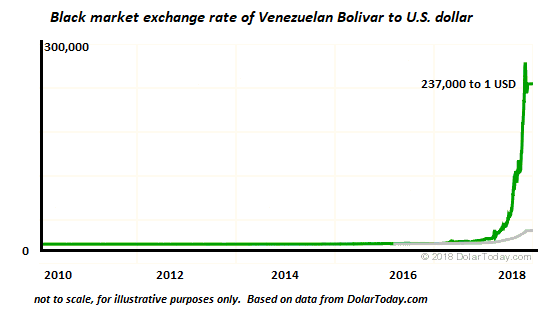
What a swell idea. Isn’t that what Venezuela has done for the past decade? And how did that work for them? If you think that destroying the purchasing power of “money” is a winner, then by all means, go on believing that the government can never go broke because all it has to do is print more money.

Here’s my favorite chart of asymmetric gains. The vast majority of the gains reaped since the 2008-09 Global Financial Meltdown have flowed to the top .1%. This is not a bug, it is a feature of hyper-financialization. Indeed, it is the only possible output of the current system.

Meanwhile, the bottom 95% live in an economy where wages go nowhere and costs are soaring. The financial media cheers when wages (supposedly) rise by 2%, but nobody dares measure the impact of rising costs in services such as healthcare and higher education.

The Status Quo is in trouble if the bottom 95% wake up to the asymmetric gains that are the only possible output of our hyper-financialized economy. Hype and propaganda are the key tools of the present era, as these are required to disconnect perception from reality. How long the disconnect will last is anyone’s guess, but when the two reconnect, all that is solid now will melt into thin air.


Why America is the World’s First Poor Rich Country

Or, How American Collapse is Made of a New Kind of Poverty

By Umair Haque

Source: Eudaimonia

Consider the following statistics. The average American can’t scrape together $500 for an emergency. A third of Americans can’t afford food, shelter, and healthcare. Healthcare for a family now costs $28k — about half of median income, which is $60k.

By themselves, of course, statistics say little. But together these facts speak volumes. The story they are beginning to tell is this.

America, it seems, is becoming something like the world’s first poor rich country. And that is the elephant in the room we aren’t quite grasping. After all, authoritarianism and extremism don’t arise in prosperous societies — but in troubled ones, which are growing impoverished, like America is today. What do I mean by all that?

Let’s begin with what I don’t mean. I don’t mean absolute poverty. Americans are not living on a few dollars a day, by and large, like people in, for example, Somalia or Bangladesh. America’s median income is still that of a rich country, around $50k, depending on how it’s counted. Nor do I really mean relative poverty — people living below median income. While that’s a growing problem in America, because the middle class is imploding, that is not really the true problem these numbers hint at, either.

America appears to be pioneering a new kind of poverty altogether. One for which we do not yet have a name. It is something like living at the knife’s edge, constantly being on the brink of ruin, one small step away from catastrophe and disaster, ever at the risk of falling through the cracks. It has two components — massive inflation for the basics of life, coupled with crushing, asymmetrical risk. I’ll come to what those mean shortly.

The average American has a relatively high income, that of a person in a nominally rich country. Only his income does not go very far. Most of it is eaten up by attempting to afford the basics of life. We’ve already seen how steep healthcare costs are. But then there is education. There is transport. There is interest and rent. There is media and communications. There is childcare and elderly care. All these things reduce the average American to constantly living right at the edge of ruin — one paycheck away from penury, one emergency away from losing it all.

But this isn’t true for America’s peers. In Europe, Canada, and even Australia, society invests in all these things — and the costs of basic necessities societies don’t provide are regulated. For example, I pay $50 dollars for broadband and TV in London — but $200 for the same thing in New York — yet in London, I get vastly more and better media for my money (even including, yes, American junk like Ancient Aliens). That’s regulation at work. And when basic goods like healthcare or elderly care or education are provided and managed at a social scale, that is when they are cheapest, and often of the best quality, too. Hence, healthcare costs far less in London, Paris, or Geneva — and life expectancy is longer, too.

So if you are earning $50k in America, it is a very different thing than earning $50k in France, Germany, or Sweden — in America, you must pay steeply for the basics of life, for basic necessities. Thus, incomes stretch much further in other countries, which enjoy a vastly higher quality of life, even though people there earn roughly the same amount, because they pay vastly less for basic necessities. Americans are rich, but only nominally — their money doesn’t buy nearly as much as their peers does, where it matters and counts most, for the basics of life.

What happens when societies don’t understand all the above? Well, a strange thing has happened to the American economy. While it’s true that things like TVs and Playstations have gotten cheaper, the costs of the basics of life have skyrocketed. All the things that really elevate people’s quality of life — healthcare, finance, education, transport, housing, and so on — have come to consume such a large share of the average household’s income that they have little left to save, invest, or spend on anything else. And what’s worse, while the basics of life have seen massive inflation, wages and incomes (not to mention savings and benefits and safety nets and opportunities) for most have stagnated. The result is an economy — and a society — that’s collapsing.

Yet all that is the straightforward effect of giving, for example, hedge funds control over drugs, or speculators control over housing, healthcare, and education — they will of course maximize profits, whereas investing in these things socially, or at least regulating them, minimizes real costs, and maximizes accessibility, affordability, and quality.

So the average American, who is left high and dry, must borrow, borrow, borrow, just to maintain a decent quality of life — because handing capitalism control of the basics of life has caused massive, skyrocketing inflation in necessities, while flatlining his income. Healthcare didn’t used to cost half of median income even a decade ago, after all — but now it does. So what happens when, in a decade or two, healthcare costs all of median income? How can an economy — let alone a society — function that way?

Well, what happens if the average American steps over the line? Misses a mortgage payment, gets ill and is unable to pay a few bills on time, can’t pay the costs of healthcare? Then they are punished severely and mercilessly. Their “credit rating” (note how banks and hedge funds don’t have them) is ruined. They can easily find themselves out on the street, without finance, without a second chance, without access to any kind of redress or support . And then they are rejected, shunned, and ostracized. They might not have an address anymore — so who will hire them? They are no longer a part of society — they have fallen through the cracks, and finding one’s way back is often next to impossible. Asymmetrical risk — corporations and lobbies and banks bear no risk at all, precisely because the average American bears them all now.

So Americans aren’t just absolutely or relatively poor, but poor in a new way entirely. First, the basics of life exploded in price, to the point that they are now unaffordable for many, maybe most, households. Second, Americans bear the risks of paying those unaffordable costs to an extreme degree, bearing the risks that institutions should, and so those risks are now ruinously high. A bank or hedge fund or corporation might go bankrupt, and liquidate its assets, and its owners stay rich — but if an American’s credit rating is ruined, loses his job, cannot pay his bills, or even if he declares bankruptcy, he falls through the cracks, hounded, embattled, institutionally black-marked. He finds himself outside society, with little way to get back in. Little wonder then that Americans work so much harder than anywhere else — they are always one step away from losing it all, from genuine ruin, but their peers in truly rich countries aren’t.

Marx probably would have called this immiseration. Neo-Marxist theorists call it precarity. And while there’s truth in both those ideas and perspectives, I think they miss three vital points.

We don’t see America as a poor country, but we should begin to. Americans live fairly abysmal lives — short, lonely, unhappy, full of work and stress and despair, compared to their peers. That is because they cannot afford better ones — predatory capitalism coupled with total economic mismanagement of social investments has made the basics of life ruinously unaffordable. In this way, it’s effectively a poor country — yes, there’s a tiny number of ultra-rich, but they are outliers now, off the map of the normal. Because it’s not just any kind of poverty, yesterday’s poverty, or even poverty as we are used to thinking about it.

America is pioneering a new kind of poverty. The kind of poverty that’s developed in America isn’t just bizarre and gruesome — it’s novel and unseen. It isn’t something that we understand well, economists, intellectuals, thinkers, because we have no good framework to think about it. It’s not absolute poverty like Somalia, and it’s not just relative poverty, like in gilded banana republics. It’s a uniquely American creation. It’s extreme capitalism meets Social Darwinism by way of rugged self-reliance crossed with puritanical cruelty.

The kind of poverty America’s pioneering today isn’t absolute, or even relative , but something more like perfectly tuned poverty, strategic poverty, basic poverty— nominally well-off people whose money doesn’t go far enough to make them actually live well, constantly living at the edge of ruin, and thus forced to choke down their bitter anger and serve the very systems which oppress and subjugate with more and more indignity and fear and servility by the year.

America’s still an innovator today. Unfortunately, what it’s innovating now is a new kind of poverty. Yet poverty is poverty. What happens in societies where poverty is growing? Authoritarianism rises, as people lose faith in democracy, which can’t seem to offer them working social contracts. Authoritarian soon enough becomes fascism — “this country, this land, its harvest — it is only for the true volk!”, the cry goes up, when there is not enough to go around. And the rest of the dark and grim story of the fall into the abyss you should know well enough by now. It ends in words we do not say.

Still, history, laughing, has told this tale to us many times. And it is telling it to tomorrow, again, in the tale of American collapse.

Neo-Liberalism and the Retreat of Democracy

By David Schultz

Source: CounterPunch

Democracy across the world is under siege. This according to the latest Freedom House report documenting that for 2017, “democracy faced its most serous crisis in decades” as seventy-one countries experienced declines in freedom or fair government, including the United States, and only thirty-five an improvement. This was the twelfth consecutive year of decline in democracy world-wide.

The question is why? Why has confidence in democracy retreated? Freedom House does not provide an answer, but there is a reason. It is democracy’s marriage to neo-liberal capitalism has fostered the conditions leading to its own undoing, similar to the way Karl Marx once described in the Communist Manifesto the “gravedigger thesis” (What the Bourgeoisie therefore produces, above all, are its own grave diggers”) where capitalism would produce the conditions that would undermine its own existence.

From the 1960s until the early 1990s democracy was in the upswing internationally. African de-colonization produced initially popularly elected governments. In South America the demise of strongmen led to a wave of democratic regimes. And the fall of the Berlin Wall in 1989 and the break up of the USSR in 1991 produced the dismantling of communist authoritarian or totalitarian governments that made it possible for Francis Fukuyama to proclaim that democracy had won and emerged as the last grand global political meta-narrative.

Yet several problems upset this rosy picture. Most prominently, it was the marriage of these new emerging democracies with free market capitalism and the victory of neo-liberalism. Internationally as post-colonial and post-communist countries emerged, international organizations such as the World Bank and the IMF forced them to adopt market reforms, often pushing them into what was then called “shock therapy.” Shock therapy involved rapid privatization of state owned enterprises and rapid dismantling of welfare states. This shock therapy was often accompanied by significant corruption as a few rich oligarchs emerged who came to own these newly privatized state enterprises.

Simultaneously, emerging democracies were rapidly pushed into what sociologist Immanuel Wallerstein would call the world-capitalist system. This system turned politically to right in the 1970s and 1980s as Margaret Thatcher in the United Kingdom and Ronald Reagan in the United States pushed neo-liberalism or market fundamentalism as an alternative to the Keynesian welfare state that had dominated the west since the 1930s. It was adopted both for ideological reasons and because of what political economist James O’Connor would call the fiscal crisis of the state tht affect economics across the world in the 1970s. This was a crisis of declining profit among private businesses and therefore declining revenue for states to fund welfare programs. Something had to give, and it was the welfare state.

Neo-liberalism is a political economic theory of the state committed to the laissez-faire market fundamentalism ideology that traces back to Adam Smith and David Ricardo. It includes a belief in comparative advantage, a minimalist state, and market freedom, and is, as articulated in the 1990s and 2000s, driven by finance capital. At the state level, neo-liberalism defines a theory of public administration. If neo-liberalism includes a commitment to market fundamentalism, then that also means that it is dedicated to a politics of limited government. This includes privatization, deregulation, and a scaling back of many traditional functions that capitalist and communist states had performed since at least World War II. But neo-liberalism as a theory transcends the state, providing also an international economic theory committed to free trade and globalism.

This emergence of neo-liberalism in the 1970s and its linkage to democracy is central to the crisis affecting the latter. As neo-liberalism retrenched the welfare state and pushed globalism it was accompanied by a dramatic increase in economic inequality in the world, as Thomas Piketty has pointed out. This occurred in the US and much of the western world. But it also impacted newly emerging democracies in Africa, Eastern Europe, and South America. Pressures for shock therapy market reforms, austerity, and open borders meant export of jobs to other countries, dismantling of social safety nets, and other economic pressures placed on governments and ruling parties.

Politically voters turned on globalism and free trade. This happened here with Trump voters in 2016, but also in Brexit in the UK. But many voters also blamed immigrants for the loss of jobs or social unrest in places ranging from France, to Italy, to Hungary. The increasing economic gap between rich and poor and, more importantly, the erosion of the economic conditions of the working class soured them on democracy. This paved the way for the emergence of strongmen as political leaders, the rise of far-right nationalist parties, and disenchantment with democracy and democratic structures to deliver the economic goods.

What we see today then in terms of the decline in support for democracy across the world is a product of its marriage to neo-liberalism. Capitalism and democracy always had an uneasy co-existence, but the neo-liberal democracy variant demonstrates the powerful contradictions in them. Either their linkage is producing outright rejection of democracy or a populist, rightist version that is merely democracy in form but not in substance.