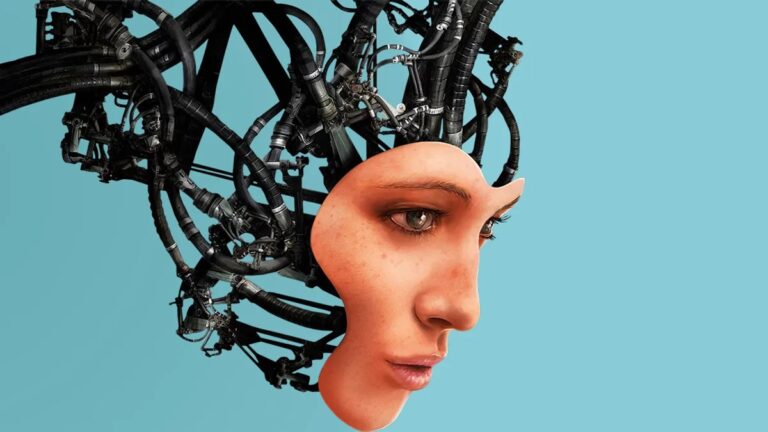
Transhumanism and the Philosophy of the Elites

By Danica Thiessen

Source: PANDA

In 2004, when Foreign Policy asked eminent scholar Francis Fukuyama to write an article answering the question, What is the world’s most dangerous idea?, he responded with a piece titled Transhumanism. Fukuyama argued that the transhumanist project will use biotechnology to modify life until humans lose something of their ‘essence’, or fundamental nature. Doing so will disrupt the very basis of natural law upon which, he believes, our liberal democracies are founded (Fukuyama, 2004). For Fukuyama, these losses lay unrecognised beneath a mountain of promise for a techno-scientific future of imaginative self-improvement. 

Currently, the Fourth Industrial Revolution, in which transhumanism plays a central guiding role, is shaping the policies of global corporations and political governance (Philbeck, 2018: 17). The converging technologies of this revolution are nanotechnology, biotechnology, information technology, cognitive sciences (NBIC), and artificial intelligence (Roco and Bainbridge, 2002). The political class and the new technology elite routinely tell us that ‘the age of AI has arrived’ (Kissinger et al., 2021). Simultaneously, modern humans have also become increasingly dependent on advanced technologies and the complex systems they enable. These changes have presented new challenges to old questions, namely: what does it mean to be human? And what future do we want for ourselves?

From the hype of super-intelligence to self-assembling nanobiology, the world can seem increasingly science-fictional. Contemporary technological society is “harder and harder to grasp”, is full of “disruptions…that move ever faster”, and is confronting us with “situations that seem outrageously beyond the scope of our understanding” (Schmeink, 2016: 18). 

This paper aims to further our critical engagement with an ideology that is emerging across influential sectors of society. With this aim in mind, I will make three essential arguments: Firstly, transhumanism is a movement based on a techno-scientific belief system that is striving towards the technological enhancement of biology and, in this regard, is self-consciously promoting bio-social engineering. Secondly, the technologies of transhumanism have the potential to bring tremendous financial and political gains to corporations and governments who are not incentivised to seek out nor address their potential dangers. Thirdly, the discontent towards transhumanism is diverse and comes overridingly from the threat to traditional values, nature-based ways of life, freedom, equality, and the loss of bodily autonomy to the will of those who operate these powerful systems. 

Much of the current scholarship on transhumanism focuses on the intellectual contribution of the movement, with minimal work assessing socio-political impacts. This neglect is worrying since, within the reality of global capitalism, transhumanism may be overridingly motivated by economic and political forces as it may be by ideology. Furthermore, perhaps only a minority of humans may be able to access certain NBIC technologies or utilise them for profits (McNamee and Edwards, 2006: 515).  Of course, the socio-economic ramifications may be culturally and politically disruptive in unanticipated ways. It is this overwrought relationship—of transhumanism, the global economy, profitable science, human nature, and traditional belief systems—that demand further critical examination.

Transhumanism: A brief history 

Transhumanism is a predominantly Anglo-American movement that has flourished since the 1980s in “American circles of science fiction fans” and with “computer experts and techno-geeks” (Manzocco, 2019: 36). Today, California’s Silicon Valley, with its culture of technological optimism and imaginative entrepreneurship, is the hub of transhumanist thought and innovation. Though scholars have noted that there is no single definition of transhumanism, the essence of transhumanist ideology is to use science and technology to re-design and re-shape the human condition away from randomness, imperfectability, and decay, towards order, perfectibility, and control (Bostrom, 2005: 14).

This ideology emerged in early 20th Century Britain. There is a clear continuity of ideas between current proponents of transhumanism and those who were writing before the Second World War of the potential of science to shape the trajectory of nature, while fostering international cooperation and governance. They included British scientists and thinkers such as Julian Huxley (credited with first using the word Transhumanism in the 1950s), his brother Aldous, and his grandfather Thomas Huxley, as well as their colleagues J.B.S. Haldane, H.G. Wells, J.D. Bernal, and Bertrand Russell. These influential thinkers and internationalists were writing and working on promoting political and scientific outlooks that would form the basis of a century of scientific transhumanist thought (Bostrom, 2005: 4-6; Bohan, 2019: 74-108). The subjects they explored still attract transhumanists today: behavioural conditioning, genetic control, technological augmentation, artificial foods and wombs, space travel, life extension, and total disease control. These and other themes circle around the assertion that nature, including human nature, operates optimally under scientific adjustment and management (Bohan, 2019: 99-100). 

Early transhumanists (or proto-transhumanists) viewed techno-scientific advancement as a cure for ‘primitive’ human nature (anger, violence, excess fertility), physical limitations (disease and possibly death), political ignorance, and international conflict. It was the Enlightenment ideal of mastery over nature, including human populations, that Aldous Huxley so aptly demonstrated in his dystopian novel, Brave New World. Huxley’s novel, written in 1931, illustrates a scientific dystopia where transhumanist aims (genetic engineering, anti-aging interventions, biotechnology and enhancement drugs) are used to manage society implicitly through pleasure rather than explicitly through force. Huxley’s depictions were based less on his prophetic abilities and more on his intimate knowledge of the possibilities of social engineering as discussed and promoted by the scientific minds with whom he mingled. His later essay, Over-population, surmises that his novel’s projections were “coming true much sooner than” anticipated (Huxley, 1960: 1). 

Notably, Aldous’s brother, Julian Huxley, also wrote about the ills of global overpopulation while promoting the genetic control (‘improvement’) of populations through eugenics (Hubback, 1989; Huxley, 1933). His 1957 essay, Transhumanism, claimed that man was the “managing director” of “evolution on this earth” (Huxley, 2015:12-13). He was very involved with Britain’s Eugenics Society for over three decades, serving as Vice-President and then President, as well as supporting “campaigns for voluntary sterilization…and for negative eugenics measures against persons carrying the scientific stigma of ‘mental defect’” (Weindling, 2012: 3). Julian Huxley was the first Director-General of UNESCO and founder of the World Wildlife Fund (Byk 2021: 141-142). In this role, he promoted the ideology of an international, scientifically-founded welfare state to further his aim of liberating “the concept of God from personality” because “religions as all human activities is always an unfinished work” (Byk, 2021:149), (Huxley, 1957:10). Julian Huxley’s work and writing envisioned an international social engineering project based on rational scientific management that promised to elevate humanity towards global peace (Sluga, 2010; Byke, 2021:146).

Philosophical and Spiritual Transhumanism: Towards a Technological Utopia

Transhumanism has a wide variety of interpretations, similar to how a major religion is expressed with a divergence of commitment, beliefs and motivations. In fact, many scholars consider transhumanism to be a novel, emerging religion with significant parallels to Christian eschatology (deGrey et al., 2022; O’Gieblyn, 2017). The vast majority of transhumanists do not accept a monotheistic ‘God’ or the moral restraints of traditional religions, but instead endow “technology with religious significance,” leading scholars to define it as “a secularist faith” (Tirosh-Samuelson, 2012: 710). 

While not all transhumanists partake in techno-spiritual views, transhumanists essentially view technology as the redemption for fallible biology. For some, these perspectives were inspired by the philosophical work of Pierre Teilhard de Chardin (1881-1955). Tielhard de Chardin was a palaeontologist and Jesuit who believed that a “worldwide network would be woven between all men about earth” and that a “God-like entity” would form from a future “conscious, collective, omniscient mind—the Omega Point” (Bohan, 2019:92). The concept of technological ‘transcendence’ has continued to be central to Transhumanism in conversations about the worldwide web, the Internet of Bodies, artificial intelligence, and the ‘Singularity’, which is the belief that human-machine intelligence will grow exponentially and reach a point where humanity will be thrust into a posthuman age (Bohan, 2019:96; Kurzweil, 2005). The belief that humans (or rather posthumans) can become immortal and ‘god-like’ in a future machine-dominated age—complete with astral travel and digital telepathic communication—is why, in its philosophical form, many scholars understand transhumanism as a techno-materialist religious movement. 

In an attempt to consolidate such a complex movement, transhumanist philosopher Nick Bostrom—current head of the Future of Humanity Institute at Oxford University, and transhumanism’s most legitimate academic—co-founded the World Transhumanist Association in 1998 (Bostrom, 2005:12-13). Out of this work, the Transhumanist Declaration was drafted. It consists of bold statements such as: Humanity will be radically changed by technology in the future. We foresee the feasibility of redesigning the human condition. The Declaration concludes with: Transhumanism advocates for the well-being of all sentience whether in artificial intellects, humans, posthumans, or non-human mammals. The Declaration makes it clear that transhumanism is an unprecedented social engineering project promoting the desirability of using “technology to push the boundaries of what it means to be human and to transcend our biological condition”, as described by Mark O’Connell, author of To Be a Machine (Mayor, 2018). 

Two American transhumanist philosophers who have worked, since the 1980s, to spread transhumanist ideas, are Max More and Natasha Vita-More. They are entrepreneurs in the cryonics industry, which deep-freezes human corpses (called ‘patients’) with the aim of future revival (McKibbin, 2019:184-185). Vita-More, in a recent interview, emphasised that the essence of transhumanism is, “a transition of being human-animal into becoming more mechanised using different devices and technologies to enhance humans into whatever they feel that they are.” This very Californian-esque promise of becoming ‘whatever you want to be’ could result in a more mechanised, or augmented, version of you. We already see the emergence of this new ‘becoming whoever you want’ phraseology in the popular acceptance of enhancement chemicals, biotechnology, and videogames. A pantheon of new technologies is on the horizon: exoskeletons, virtual reality, robotics, body-changing pharmaceuticals, remote-controlled nanotechnology, artificial foods, brain implants and synthetic organs. Adopting these technologies is a part of what Max More describes as becoming the Overhuman, otherwise known as the Posthuman: if you are Transhuman you are essentially a transitional human

In The Overman in the Transhuman, More attributes attitudes in transhumanism to Nietzsche’s philosophy, arguing that the overhuman is the “meaning-giving” concept meant to “replace the basically Christian worldview” of Nietzsche’s time (and, to a lesser extent, our times). More holds that the current “relevance of the posthuman” is that it ultimately gives meaning to scientifically-minded people” (More, 2010:2). In this influential paper, More asks the reader to “take seriously Nietzche’s determination to undertake ‘a revaluation of all values’” (More, 2010:3). Since a modern overhuman upgrade will depend on human gene editing and other biotechnology applications (such as Elon Musk’s Neuralink) becoming legally available, More’s call to ‘reevaluate values’ is understandable. Issues raised on both sides of the academic debate concern which values and traits would be genetically chosen, and to what extent human enhancement will be voluntary (Levin, 2018). 

While earlier Anglo-American eugenicists argued for the removal of anti-social genes by sterilisation, some modern transhumanist proponents have argued that moral bioenhancement, through selective gene editing, should become compulsory (Persson and Savulescu, 2008). Many notable transhumanists argue for procreative bioenhancement of offspring by the parents (Levin, 2018:38). Transhumanist advocates Ingmar Persson and Julian Savulescu believe moral enhancement should become obligatory like “education and water fluoridation,” since “those who should take them are least likely to be inclined” (Persson and Savulescu, 2008: 22). Transhumanist Niel Levy argues that “cognitive enhancement could be required,” much as vaccines currently are (Levy, 2013:38). Scholar Susan Levin writes that allowing a techno-scientific transhumanist vision to shape the “form that society takes” may lend itself to “socio-political requirements that would clash with…liberal democracy” (Levin, 2018:50). She also argues that when transhumanists use “public health analogies and reasoning” to “justify vigorous enhancement” they are putting into serious question their commitment to autonomy (Levin, 2018:48). In this way, the coercive vaccine mandates used during the Covid-19 pandemic can be interpreted as an early warning signal for how future bio-enhancements are likely to be accompanied by forceful moralistic and utilitarian arguments.

Ingmar Person, Julian Savulescu, and Niel Levy are prominent ethicists at the University of Oxford; all three advocate for mandatory genetic enhancement despite the trail of 20th century trauma wrought by grandiose social- and eugenic engineering projects. Does this suggest that a moral framework based on utilitarian arguments and flawed metaphysics remains fundamentally unchanged in public health governance since the last century? In his recent book God and Gaia: Science, Religion and Ethics on a Living Planet, scholar Michael Northcott argues that a growing “post-human agenda” has become central to policies around public health—referred to as “biosecurity”—which has very little to do with authentic “human health or health of the environment” (Northcott, 89). The consequences of this ideology became apparent during the recent mandating of the experimental gene-altering vaccines, and could represent what Northcott refers to as “automatism”. This is when we are culturally obligated to “use new technologies regardless of the possible consequences” because of a utilitarian ethic of the “managerial goal of efficiency” (Northcott, 2022: 114). To underestimate the suffering caused by one-size-fits-all public health measures is inadequate scholarship, yet despite this, only a minority of academics have openly questioned the use of coercive genetic therapy during the Covid-19 pandemic. 

A clash between individual rights and a movement that aims to “re-design the human condition” seems inevitable. In the words of transhumanist scholar Nick Bostrom, “human nature is a work-in-progress, a half-baked beginning that we can learn to remould in desirable ways” (Bostrom, 2005: 3). As the co-founder of the World Transhumanist Association, David Pearce said,

“…if we want to live in paradise, we will have to engineer it ourselves. If we want eternal life, then we’ll need to re-write our bug-ridden code and become god-like…only high-tech solutions can ever eradicate suffering from the living world”.DOEDE, 2009: 47

It is human nature that often comes into direct conflict with massive social engineering projects. Understanding transhumanism as a bio-social engineering project of unprecedented scale is a useful perspective in that it focuses the potential conflicts as value-based and ideological rather than as a direct result of specific scientific advances (Broudy and Arakaki, 2020). Furthermore, the term ‘social engineering’ is in itself inadequate, in that a utopia that aims to phase out Homo sapiens, while making way for the new, enhanced posthuman, is historically unprecedented (Bauman, 2010), and is possibly an energetic form of nihilism or an expression of ‘losing oneself’ to an intoxication with machine power, inspired by what scholars identify as “machine fetishism” (Geisen, 2018: 6). Yet, the surprising willingness to martyr one’s physical self to attain paradise has always been particular to our species (Pugh, 2017). 

Corporate Transhumanism: The Pursuit of Wealth and Power

In congruence with the scholarly work available, I have focused on the ideas of philosophical and academic transhumanists, but transhumanism is an ideology reaching far beyond discourse. Though under-discussed in the academic literature, the movement is advanced by corporate and political transhumanists, and transhumanist scientists. Massive corporate and state investment in NBIC technologies rely on specialised scientists working in the military, elite universities, and corporate laboratories to push the frontiers of reality with robotics, artificial intelligence and biotechnology (Mahnkopf, 2019: 11). These scientists are designing technologies with such potential that the world’s most powerful players, such as the Chinese Communist Party and the US Department of Defense (DOD), are deeply involved. In January 2023, Harvard University’s esteemed chemist Charles Leiber was on trial for lying to the DOD about his involvement with the Wuhan University of Technology over his work on “revolutionary nanomaterials.” In his Harvard laboratories, Leiber and his assistants have created nanoscale wires that can record electrical signals from neurons (Silver, 2022). Nanowire brain implants were designed by Leiber to “spy on and stimulate individual neurons” (Gibney, 2015:1). In an age where neurotechnology and mind-machine interfaces are changing the nature of warfare, the contested power-potential of transhumanist techno-science is quickly apparent (DeFranco, 2019).

The transhumanist vision for the future should not be viewed outside of the ‘technological arms race’ or a competitive, utilitarian mindset that informs business, war-making, and our cultural esteem of scientific research. This suggests that more research understanding corporate and political transhumanists is critical in analysing how this group is actively involved with determining humanity’s future. Political leaders with a sharp sense for power understand that machine intelligence and enhancement may determine the world’s winners and losers (Kissinger et al., 2021). As Vladimir Putin articulates: “Artificial Intelligence is the future, not only for Russia, but for all of humankind. It comes with colossal opportunities but also threats that are difficult to predict. Whoever becomes the leader in this sphere will become the ruler of the world” (Karpukhin, 2017). The elite fascination with transhumanist technologies concerns the potential power inherent in the technology itself—and in who creates and controls it. The influential historian and speaker, Yuval Noah Harari, expressed this view in his 2021 Davos Summit presentation where he said that technology “might allow human elites to do something even more radical than just build digital dictatorships. By hacking organisms, elites may gain the power to re-engineer the future of life itself. Because once you hack something, you can usually geo-engineer it.”

Harari is a frequently featured speaker at the World Economic Forum (WEF) and associated events. The WEF is currently acknowledged as one of the “most significant case studies of private authority with global impact” (Vincent and Dias-Trandade, 2021: 711). Criticised as being a “transnational elite club, with high media visibility” and a neoliberal “agenda-setting power,” the WEF can be understood as an “instrument for global geopolitical domination” (Vincent and Dias-Trandade, 2021: 711). At the very least, it is a forum where heads of state, CEOs of multi-billion-dollar companies, and academics who intelligently promote strategic values, are encouraged to collaborate and shape the global future. On WEF and other media collaborative platforms, Harari eloquently argues for humanity to “break out of the organic realms to the inorganic realm” with the creation of a new type of machine human so much more sophisticated than us that our current form will be more drastically different from it than “Neanderthals” or “chimpanzees” are from us today (BBC, 2016). Perhaps this epochal vision is received with welcome at the WEF because it boldly asserts a future dystopia for those who choose to ignore this high-tech revolution. It may act as a motivational warning to “acculturate” or “disappear.” 

Scholar Kasper Schiølin (2020) believes WEF agenda setting is accomplished through strategic political and corporate marketing and the discourse of “future essentialism” where the “fabrication of power” and of an inevitable global destiny is reinforced by “sociotechnical imaginaries” and “epochalism.” Future essentialism is the construct of narratives that use “historical analysis…speculative estimates…and hard statistics” to disseminate an idea of a “fixed and scripted…future” that can be “desirable if harnessed” but also “dangerous if humanity fails” to accept the vision. “Epocholism” is an attempt to capture “The Spirit of the Age” and promote a feeling that the current times are of unsurpassed historical significance. These strategies, Schiølin (2020:553) convincingly argues, are how the “WEF produces a moral-political universe around The Fourth Industrial Revolution (4IR).” Is it possible that these techniques can create a narrative of urgency, significance, and global opportunity that can persuade us (or our leaders) to participate in a transnational, transhumanist future?

Klaus Schwab is the founder of the WEF and the one responsible for conceptualising and promoting this revolution, which was announced in his 2016 book The Fourth Industrial Revolution. Schwab (2017) describes the 4IR as a social re-setting (named the ‘Great Reset’) enabled by “a range of new technologies that are fusing the physical, digital and biological worlds, impacting all disciplines, economies and industries, and even challenging ideas about what it means to be human.” Analyses of the 4IR conclude that the rate of technological change is supposed to “accelerate” and be “exponential”, covering the Internet of Things (IoT), AI, automation, genetic engineering of humans and natural biology, nanomedicine, smart cities (where sensors are embedded all over the environment), a sci-fi enabled military, and algorithms with political agency (Trauth-Goik, 2021: 3). 

Political scientist Klaus-Gerd Giesen convincingly argues that transhumanism is the “dominant ideology” of the 4IR, having become a “grand narrative” for politicians while “advancing the interests of multinational tech giants” (Geisen, 2018: 10). Giesen views this revolution as a “significant rupture in the evolution of capitalism” as well as the tradition of humanism, arguing that “transhumanist machinism” is “fundamentally anti-human—not least because the machine is by definition inhuman” (Geisen, 2018: 6). With global 5G networks, the Internet of Things and of Bodies, and the convergence of the NBIC technologies, the “body as market” (Geisen, 2018: 10), or what Céline Lafontaine defines as the corps-marché (Céline, 2014), is complete. The sheer mass of consumption will exponentially rise with marketable ‘smart’ products: “wearable tech, autonomous vehicles, biochips, bio sensors” and other new materials (Mahnkopf, 2019: 2). This is a materially focused future where consumer upgrades are baked into the system, so it’s no wonder that corporate monopolies such as Amazon, Apple, Facebook, Google, and Microsoft, the “new industrial kings” are actively promoting this revolution (Mahnkopf, 2019: 14).

In his book, Falter: Has the Human Game Begun to Play Itself Out?, the environmentalist Bill McKibben writes that, “the Silicon Valley tycoons are arguably the most powerful people on earth” (McKibben, 2019: 183). North American West Coast transhumanist visionaries are an avant-garde community of ultra-rich technologists, businesspeople and inventors who are idolised by the media and who collaborate extensively with the US State to advance their aims. Eric Schmidt illustrates the collaboration common between US State defence organs, academia, and giant technology corporations (Conger and Metz, 2020). With a net worth of $23 billion, Schmidt was the Executive Chairman of Google and is now the current Chairman of the National Security Commission on Artificial Intelligence (NSCAI) for the US Department of Defense, where he advised President Biden to reject a ban on AI-driven autonomous weapons (Shead, 2021). Schmidt believes that artificial intelligence will “govern society” and be “perfectly rational”, outdating and rendering useless human intuition and knowledge. As with most tech billionaires, Schmidt has set up a private charity, Schmidt Futures, and has so far donated a billion dollars towards his AI educational aims (Philanthropy News Digest, 2019). While he admits that he did not design Google to regulate ‘misinformation’ more effectively, censorship is increasing with the accelerated abilities of AI (working with humans) to moderate and remove content on the Internet (Desai, 2021).

Many of our most influential technologies come from programmes at the US Defense Advanced Research Projects Agency (DARPA). DARPA funds ‘blue sky’ technology research and is credited with inventing the Internet, GPS, virtual reality, and drones. The agency is now set on advancing human augmentation both in and off the battlefield, with the goal of mastering brain-computer neural-interfaces (Krishnan, 2016). Arati Prabhakar is the former head of DARPA, and Chief Science Advisor to President Biden. Prabhakar, like the prior head of DARPA, Regina Dugan, moves between working with technology companies in Silicon Valley and the US Department of Defense. Like most, she is enthusiastic about a transhumanist future of augmentation, and advocates for this as a matter of national security. And yet, she also admits that this “will bring surprises that we may not like. For generations we have thought about technologies that change our tools – but this is about technology that changes us.”  We already have ample evidence that our current technologies, particularly wireless devices and chemicals, are physically changing our human (and planetary) biology, but the aims of DARPA and the DoD are more ambitious and revolve around the complete mastery of evolution (including the human genome) and natural systems (including the human population) using technology (Carr, 2020). This is exemplified in the recent, far-reaching US Executive Order for Advancing Biotechnology, which states that “we need to develop genetic engineering technologies” to “write circuitry for cells and predictably program biology in the same way in which we write software and program computers.” The order states that this is to “help us achieve our societal goals.” These societal goals are central to what the White House identifies as the “bioeconomy” where “computing tools and artificial intelligence” will help us “unlock the power of biological data”, scale up production, and reduce “obstacles for commercialization” (Biden, 2022).

In March 2022 at the World Government Summit, Elon Musk, a self-identified transhumanist, and the world’s wealthiest individual, spoke bluntly from the podium. He announced that he sees the upcoming AI apocalypse as a human-extinction event. What is the solution? “We must all become cyborgs if we are to survive the inevitable robot uprising.” This may be marketing, since Musk’s Neuralink is poised to start human trials of brain implantable chips” (Neate, 2022). Radically enhanced human cognition should, Musk predicts, counterbalance the dangers posed by super-intelligent machines. If the richest man on earth prophesied a mass AI extermination event and an inevitable posthuman future from the platform of the World Government Summit, should we dismiss it as just another tech business strategy?

In her analysis of the 4IR, Birgit Mahnkopf (2019:2) writes that a “system of physical-to-digital technologies embodied in machines and equipment…would enable sensing, monitoring, and control of the entire economy.” This is occurring against a backdrop of increasing global inequality and centralisation of wealth. It is estimated that eight men own as much as half the monetary wealth of the other eight billion humans (The New York Times, 2017). Schwab and other elites understand the social and political implications of their technological ideology and the rules of the ‘winner-takes-all’ market economy that will continue to consolidate gains from disruptive technologies. Universal basic income and social credit systems (with a resource-based economy and central bank digital currencies, or CBDCs) are presented as solutions to managing popular resistance and social unrest. 

The WEF represents the fusion of transhumanist goals within global governance. As Schwab notes, the organisation has been very effective at ‘penetrating the cabinets’ of national governments. As Harvard scholar Kasper Schiølin (2020:549) astutely observes, the “4IR is justified as kings and emperors once justified their authority as divine and natural in uncertain times.” Hence, it may be that the potential problems from transhumanist ideologies come, not so much from the prospect of an AI take-over, but from the elites’ use of the culture and technologies of transhumanism. It may be that these risks overwhelm liberal democracies long before sentient AI does. 

The Discontents

Few intellectuals note the opposition to transhumanism better than the transhumanists themselves. Nick Bostrom writes that resistance comes from:

“Ancient notions of taboo; the Greek concept of hubris; the Romanticist view of nature; certain religious interpretations of the concept of human dignity and of a God-given natural order; Karl Marx’s analysis of technology under capitalism; various Continental philosophers’ critique of technology, technocracy, and the rationalistic mindset that accompanies modern technoscience; foes to the military industrial complex and multinational corporation; and objectors to the consumerist rat-race.”BOSTROM, 2005:18

Bostrom’s summary is a panorama of human expression, literature, thousands of years of culture, religion, philosophy and human meaning-making. Modern literature on philosophy, culture and technology, from Jacques Ellul, Jerry Mander, Neil Postman and Wendell Berry to Jürgan Habermas and Martin Heidegger, offer poignant critiques that are relevant to opposing transhumanist visions of the future, and remind us of the value of community, embodied wisdom, and traditions, and the effects of technological systems. The difference in writing styles is noteworthy: while pro-transhumanist writing tends to be utilitarian and have a tone of scientific authority, ‘bioconservatives’ will often use narrative, symbols, and a writing style considered traditionally beautiful in human culture. 

What is noticeable is that the opposition to transhumanism is broad, ill-defined and diverse. Nick Bostrom notes that “right-wing conservatives, left wing environmentalists and anti-globalists” are all pushing back against central transhumanist aims (Bostrom, 2005: 18). Firstly, there are the well-published intellectual and academic opponents that engage in a forceful scholarly debate with transhumanism over issues such as biotechnology, threats to liberal democracy, and scientific materialism (Leon Kass, 2000 and Francis Fukyama, 2003), and the environmental and social costs of transhumanism (Bill McKibbin, 2019). Also noteworthy are the bioethicists, George Annas, Lori Andrews and Rosario Isasi, who have advised making “inheritable genetic modification in humans a ‘crime against humanity’” (Annas, et al., 2002: 154-155). These scholars fear the posthuman potential for inequality and war, warning that, “the new species, or ‘posthuman’, will likely view the old ‘normal’ humans as inferior, even savages, and fit for slavery or slaughter…it is the predictable potential for genocide” (Annas, et al., 2002: 162).  The common factor amongst these academics is that they believe biological engineering (of humans) would be disruptive to values, rights, and equality, and would threaten liberal democracy itself. These men have been labelled bio-conservatives or, more dismissively, Neo-Luddites, for rejecting the legitimacy of a posthuman future (Agar, 2007:12).

The second group that is emerging as anti-transhumanist are the environmentalists, non-conformists, primitivists, and anarchists committed to Wild Nature with forceful anti-industrial sentiments. In North America, this includes elements of the Deep Green Movement (Bilek, 2021), represented by various writers, artists, activists, ecologists, organic farmers, herbalists and healers, forest-dwellers and hunter/gatherers, spiritualists, and various alternative people, off-grid or nomadic, who refuse to live within a mechanised, industrial system, and may intentionally attempt to sabotage it. As an eclectic group, they have significant influence over specific geographical areas, tend to identify with traditional local indigenous values, and deeply resent Western consumerist culture, war, global corporations, pollution, and industrial infrastructure (Tsolkas, 2015). Notably, some ecofeminists have written that biotechnology is a dangerous “extension of traditional patriarchal exploitation of women” in promoting the reshaping of natural human bodies (Bostrom, 2005: 18).

The third group that has rapidly developed increasing opposition to transhumanism is religious groups. Besides the Mennonite and Amish communities, who maintain ‘old world’ lifestyles across significant sections of the United States, there is a rising anti-transhumanist sentiment and increasing religious fervour amongst some Evangelical Christians across North America. The New York Times reported on the increasing politicisation of evangelical congregations, with defiant unifying songs that repeated, “We will not comply” in the chorus (Dias and Graham, 2022). The language these groups use to describe transhumanism is often symbolic, archetypal and apocalyptic, and understood as an epic battle between light and darkness. For example, speaker and writer, Thomas Horn, has been preaching about the dangers of transhumanism to Christian congregations for over a decade. His books have titles such as Pandemonium’s Engine: How the End of the Church Age, the Rise of Transhumanism, and the Coming of the Ubermensch (Overman) Herald Satan’s Imminent and Final Assault on the Creation of God. Suspicions of ‘Satanic technology’, and anti-transhumanist sentiments may have been a part of the reason why Evangelical Christians were the demographic most unlikely to cooperate with Covid vaccination mandates in the United States (Lovett, 2021; Porter, 2021).

The tragic situation in Ukraine suggests that ideologically-driven wars may increase with the growing animosity between religious and transhumanist world views, or this may be used in war propaganda. The Russian Orthodox Church, with well over one hundred million members, considers the invasion of Ukraine as a battle of light and darkness, with ‘Holy Russia’ fighting against an unholy NATO alliance (Klip and Pankhurst, 2022). The Church Patriarch, Kirill of Moscow, has taken a strong position against biotechnology—including “gene therapy”, “cloning” and “artificial life extension”—and views the Russian Orthodox Church as defending the traditional family against the liberalism of the West (Stepanova, 2022: 8). Addressing the leaders of Russia at the recent 24th World Russian People’s Council, the orthodox believer and philosopher Alexander Dugin proclaimed, “this war is not only a war of armies, of men…it is a war of Heaven against Hell…the Archangel Michael against the devil…the enemy came to us…in the face of LGBT, Transhumanism—that openly Satanic, anti-human civilization with which we are at war with today.” It may be that an influential number of religious Russians believe that they are not fighting against Ukraine at all, but rather rescuing it from the Satanic hold of the Transhumanist West (Siewers, 2020).

The fourth major group that is exhibiting overwhelming anti-establishment sentiments towards what is perceived as the ‘elites’ and their ‘transhumanist agenda’ are the politically and economically disenfranchised working classes and displaced farmers. Known in academic circles as ‘populists’ (Mazarella, 2019: 50), this group has recently displayed significant anger over extended ‘lockdowns’; losing the freedom to travel and to access decent healthcare (in the US); and experiencing unemployment and poverty. Their physically non-compliant behaviour, seen in mass demonstrations, notably across Europe and with the Canadian truckers, has been met with discursive and physical violence from increasingly irritated political leaders and media corporations. These ‘populists’ often reject transhumanism as an elitist ideology that they fear will lead to further loss of bodily autonomy, increased surveillance, political disempowerment, and a reduction of dignified employment to robots and automation (Mazarella, 2019: 130-134). These fears are not altogether unfounded since, according to the WEF, the 4IR is proposed to lead to significant worldwide job losses, perhaps up to 70% (Mahnkopf, 2019: 7). Steven Bannon, the instrumental ‘populist’ of Trump’s 2016 election force, uses religious polemics to rally resistance against what he sees as a rising transhuman globalist agenda. His popular show, the War Room, features broadcasts such as Descent into Hell: Transhumansim and the New Human Race. The outrage this group has towards 4IR transformations and transhumanism cannot be underestimated: within the US many working class families, though not all, also hold values of egalitarian weapons ownership, and their discourse exudes a willingness to engage in violent confrontation over threats to bodily autonomy (Sturm and Albretch, 2021: 130).

The United States’ most infamous anti-transhumanist/anti-technologist came, not from religious circles, but from within the radical environmental movement and academia. Theodore Kazcynski, a mathematical genius and professor at UC Berkeley, conducted an anti-technology terrorist campaign that spanned 17 years, killing three people and injuring 23 (Fleming, 2022). He blackmailed the FBI into publishing his 35,000-word thesis titled Industrial Society and its Future in the Washington Post and New York Times, which led to his capture. Since spending 25 years in solitary confinement, he has published volumes about how to conduct a revolution against the scientific elite. In one volume, The Anti-Tech Revolution: Why and How, he writes,

“The techies themselves insist that machines will soon surpass human intelligence and natural selection will favour systems that eliminate them (humans)—if not abruptly, then in a series of stages so that the risk of rebellion will be eliminated.”KAZCYNSKI, 2016: 79

Kazcynski reacted with terrorism to what he considered an existential threat posed by technology to humans and his greatest love, Wild Nature. His fear was a loss of freedom and masculine human nature, as well as the transformation of society into a controlled Brave New World, something he viewed as inevitable without a revolution (Moen, 2019: 3). In fact, it is arguable that the United States was already too similar to the Brave New World for Kazcynski, since he depicts “fighting industrial society” as “structurally similar to escaping a concentration camp” (Moen, 2019: 3).

Bill Joy, founder of Sun Technologies, authored an influential essay at the dawn of the 21st century, Why the Future Doesn’t Need Us, advocating for the relinquishment of developing “AI, nanotechnology and genetics because of the risks” (Joy, 2000). Interestingly, Joy argues for the legitimacy of Kazcynski’s logic about the threats of advanced technologies, despite Kazcynski having “gravely injured” one of his friends, a computer scientist, with a bomb. Parts of Kazcynski’s writing that shifted Joy’s views included the following: 

“The human race might easily permit itself to drift into a position of such dependence on machines that it would have no practical choice but to accept all of the machines’ decisions. As society and problems that face it become more and more complex and machines become more and more intelligent, people will let machines make more of their decisions for them…eventually a stage may be reached in which the decisions necessary to keep the system running will be so complex that human beings will be incapable of making them intelligently. At that stage, the machines will effectively be in control. People won’t be able to just turn the machines off, because they will be so dependent on them that turning them off would amount to suicide.”JOY, 2000: 48-49

This scenario is not too hard to imagine since it is quickly becoming our modern predicament. There is an implicit and explicit consensus in much transhumanist and anti-transhumanist thought, by Musk, Kazcynski, Joy and many others, that this phenomenon is leading, and will continue, to this logical end. The other scenario that Bill Joy quoted in his essay, again from Kazcynski, was:

“On the other hand, it is possible that human control over machines may be retained. In that case the average man may have control over certain private machines of his own…but control over large systems of machines will be in the hands of a tiny elite—just as it is today, but with two differences. Due to improved techniques the elite will have greater control over the masses; and because human work will no longer be necessary the masses will be ‘superfluous’, a useless burden on the system. If the elite is ruthless they may simply decide to exterminate the mass of humanity. Or if they are humane they may use propaganda or other psychological or biological techniques to reduce the birth rate until the mass of humanity becomes extinct, leaving the world to the elites.”JOY, 2000: 48-49

Interestingly, the scenarios do not seem mutually exclusive, at least for a time. 

Scholar Ole Martin Moen has noted similarities between Kazycinski, Nick Bostrom and Julian Savulescu in their projections of a future crisis (Moen, 2018: 5). Like Kazcinski, Bostrom has argued that transhumanist technologies expose humanity to a significant risk of eradication (Bostrom, 2019). Savulescu, also like Kazcyinski, argues in Unfit for the Future: The need for moral enhancement, that evolved human nature combined with transhumanist technologies will lead to catastrophic consequences (Persson and Savulescu, 2012). Kazcinski, who believed these outcomes were logical, reacted with violence because his highest ethic was one of authentic, uncontrolled freedom (Moen, 2018:5-6). His life is a warning that some human natures may be entirely incompatible with a techno-scientific future. In fact, the transhumanist vision of human extinction and a ‘posthuman’ future may actually promote anxiety and violence in some humans.

Conclusion

Martin Heidegger has warned that those who seek to use technology’s influence without realising the immense power that the technology has over them, are trapped into becoming extensions of machines rather than free actors. They are “framed like men with advanced computational devices into seeing all of reality as computational information” (Doede, 2009:49). For thousands of years, human existence and meaning-making has accumulated from “birth and death, flood and fire, sleep and waking, the motions of the winds, the cycles of the stars, the budding and falling of the leaves, the ebbing and flowing of the tides” (Powys, 1930: 73), and it seems fitting to question if our highly evolved human tissues and ‘natures’ are strengthened or undermined by advanced technology. Is it possible that human flourishing is encouraged by the ancient struggle with the limitations of our own animal natures, rather than by conforming to the constructs of complex technology? With transhumanism, who is in control and who benefits? 

It may be fair to say that transhumanism is a bio-social engineering project that ultimately concentrates power in machines, and humans who behave with machine-like characteristics. Large sections of the earth’s population, such as various religious groups, the working class, indigenous peoples, and other nature-based humans, may resent undemocratic announcements from forums like the WEF that, with the 4IR, industrialization is accelerating towards genetic engineering, robotic automation and virtual living. Furthermore, we may risk promoting an existential crisis and extreme reactions in those who dislike being told that the future belongs to the posthuman rather than to themselves and their offspring. It is a contested future and one that is entirely unwritten.  


References

Agar, N. (2007). Whereto transhumanism?: the literature reaches a critical mass. The Hastings Center Report37(3), 12-17.
Akhtar, R. (2022). Protests, neoliberalism and right-wing populism amongst farmers in India. The Journal of Peasant Studies, 1-21.
Annas, G. J., Andrews, L. B., & Isasi, R. M. (2002). Protecting the endangered human: toward an international treaty prohibiting cloning and inheritable alterations. American Journal of Law & Medicine28(2-3), 151-178.
Baumann, F. (2010). Humanism and transhumanism. The New Atlantis, 68-84.
BBC (2016) Yuval Noah Harari: “We are probably one of the last generations of Homo sapiens.” Available: https://www.bbc.com/news/av/uk-37171171
Bilek, J. (2021). The Gender Identity Industry, Transhumanism and Posthumanism. Deep Green Resistance News Service. Available: https://dgrnewsservice.org/resistance-culture/radical-feminism/the-gender-identity-industry-transhumanism-and-posthumanism/ 
Bohan, E. (2019). A history of transhumanism. Doctoral dissertation, Ph.D. thesis submitted for examination November 2018. Macquarie University.
Bostrom, N. (2005). A history of transhumanist thought. Journal of Evolution and Technology14(1).
Bostrom, N. (2005). Transhumanist values.  Journal of Philosophical Research30 (Supplement), 3-14.
Bostrom, N. (2019). The vulnerable world hypothesis. Global Policy10(4), 455-476.
Broudy, D., & Arakaki, M. (2020). Who wants to be a slave? The technocratic convergence of humans and data. Frontiers in Communication, 37.
Byk, C. (2021). Transhumanism: from Julian Huxley to UNESCO. Jahr: Europski časopis za bioetiku12(1), 141-162.
Carr, N. (2020). The shallows: What the Internet is doing to our brains. WW Norton & Company.
Céline, L. (2014). Le corps-marché. La marchandisation de la vie humaine à l’ère de la bioéconomie.
Conger, K., & Metz, C. (2020). ‘I Could Solve Most of Your Problems’: Eric Schmidt’s Pentagon Offensive. New York Times. Available: https://www.nytimes.com/2020/05/02/technology/eric-schmidt-pentagon-google.html 
DeFranco, J., DiEuliis, D., & Giordano, J. (2019). Redefining neuroweapons. Prism8(3), 48-63.
Desai, S. (2021). Misinformation is about to get so much worse. The Atlantic. Available: https://www.theatlantic.com/technology/archive/2021/09/eric-schmidt-artificial-intelligence-misinformation/620218/ 
deGrey, A., Bauman, W. A., Cannon, L., Checketts, L., Cole-Turner, R., Deane-Drummond, C., et al. (2022). Religious transhumanism and its critics. Rowman & Littlefield.
Dias, E., & Graham, R. (2022). The growing religious fervor in the American right: ‘This is a Jesus movement’. The New York Times. Available: https://www.nytimes.com/2022/04/06/us/christian-right-wing-politics.html 
Doede, B. (2009). Transhumanism, technology, and the future: Posthumanity emerging or sub-humanity descending?. Appraisal7(3).
Fleming, S. (2022). The Unabomber and the origins of anti-tech radicalism. Journal of Political Ideologies27(2), 207-225.
Fukuyama, F. (2003). Our posthuman future: Consequences of the biotechnology revolution. Farrar, Straus and Giroux.
Fukuyama, F. (2004). Transhumanism. Foreign policy, (144), 42-43.
Gibney, E. (2015). Injectable brain implant spies on individual neurons. Nature522(7555), 137-138.
Giesen, K. G. (2018). Transhumanism as the Dominant Ideology of the Fourth Industrial Revolution. Journal international de bioethique et d’ethique des sciences, (3), 189-203.
Hubback, D. (1989). Julian Huxley and eugenics. In Evolutionary Studies (pp. 194-206). Palgrave Macmillan, London.
Hughes, J. J. (2012). The politics of transhumanism and the techno‐millennial imagination, 1626–2030. Zygon®47(4), 757-776.
Huxley, A. (1960). Brave new world and brave new world revisited. Harper & Row, Publisher, Inc.
Huxley, J. (1933). What I Dare Think. Chatto & Windus.
Huxley, J. (1957). Religion Without Revelation.(New and Revised Edition.). Max Parrish.
Huxley, J. (2015). Transhumanism. Ethics in Progress6(1), 12-16.
Joy, B. (2000). Why the future doesn’t need us (Vol. 8, No. 4, pp. 47-75). San Francisco, CA: Wired.
Kaczynski, T. J. (2016). Anti-tech Revolution: Why and how. Fitch & Madison Publishers.
Karpukhin, S. (2017) Putin: Leader in artificial intelligence will rule the world. CNBC. Available: https://www.cnbc.com/2017/09/04/putin-leader-in-artificial-intelligence-will-rule-world.html 
Kass, L. R. (2000). Triumph or tragedy? The moral meaning of genetic technology. The American Journal of Jurisprudence45(1), 1-16.
Kass, L. R., & Kass, R. (2002). Human cloning and human dignity: the report of the president’s Council on Bioethics. Public Affairs.
Kardaras, N. (2016). Glow kids: How screen addiction is hijacking our kids—and how to break the trance. St. Martin’s Press.
Kilp, A., & Pankhurst, J. G. (2022). Soft, Sharp, and Evil Power: The Russian Orthodox Church in the Russian Invasion of Ukraine. Occasional Papers on Religion in Eastern Europe42(5), 2.
Kissinger, H. A., Schmidt, E., & Huttenlocher, D. (2021). The age of AI: and our human future. Hachette UK.
Krishnan, A. (2016). Military neuroscience and the coming age of neurowarfare. Taylor & Francis.
Kurzweil, Ray. (2005). The Singularity is Near. Penguin Books Ltd.
Levin, S. B. (2018). Creating a Higher Breed: Transhumanism and the Prophecy of Anglo-American Eugenics. In Reproductive Ethics II (pp. 37-58). Springer, Cham.
Levin, S. B. (2020). Posthuman Bliss?: The Failed Promise of Transhumanism. Oxford University Press.
Levy, N. (2013). There may be costs to failing to enhance, as well as to enhancing. The American Journal of Bioethics13(7), 38-39.
Lovett, I. (2021). White Evangelicals Resist COVID-19 Vaccine Most among Religious Groups. The Wall Street Journal. Available: https://www. wsj. com/articles/white-evangelicals-resist-COVID-19-vaccine-most-among-religious-groups-11627464, 601.
Mahnkopf, B. (2019). The ‘4th wave of industrial revolution’—a promise blind to social consequences, power and ecological impact in the era of ‘digital capitalism’. EuroMemo Group.
Mayor, S. (2018). Transhumanism: five minutes with… Mark O’Connell. British Medical Journal. (361:k2327).
Mazocco, R. (2019). Transhumanism—Engineering the Human Condition. Springer Praxis Books.
Mazzarella, W. (2019). The anthropology of populism: beyond the liberal settlement. Annual Review of Anthropology48(1), 45-60.
McKibben, B. (2019). Falter. Black Inc..
McNamee, M. J., & Edwards, S. D. (2006). Transhumanism, medical technology and slippery slopes. Journal of Medical Ethics32(9), 513-518.
Moen, O. M. (2018). The Unabomber’s ethics. Bioethics33(2), 223-229.
More, M. (2010). The overhuman in the transhuman. Journal of Evolution and Technology21(1), 1-4.
Neate, R. (2022) Elon Musk’s brain chip firm Neuralink lines up clinical trials in humans. The Guardian. Available: https://www.theguardian.com/technology/2022/jan/20/elon-musk-brain-chip-firm-neuralink-lines-up-clinical-trials-in-humans
Northcott, M. S. (2022). God and Gaia: Science, Religion and Ethics on a Living Planet. Taylor & Francis.
O’Gieblyn, M. (2017) God in the Machine: My strange journey into transhumanism. The Guardian. Available: https://www.theguardian.com/technology/2017/apr/18/god-in-the-machine-my-strange-journey-into-transhumanism 
Persson, I., & Savulescu, J. (2012). Unfit for the future: The need for moral enhancement. OUP Oxford.
Persson, I., & Savulescu, J. (2008). The perils of cognitive enhancement and the urgent imperative to enhance the moral character of humanity. Journal of Applied Philosophy25(3), 162-177.
Philbeck, T., & Davis, N. (2018). The fourth industrial revolution. Journal of International Affairs72(1), 17-22.
Philanthropy News Digest (2019). Schmidts Commit $1 Billion to Develop Talent for the Public Good. Available: https://philanthropynewsdigest.org/news/schmidts-commit-1-billion-to-develop-talent-for-the-public-good 
Porter, T. (2021) How the evangelical Christian right seeded the false, yet surprisingly resilient, theory that vaccines contain microchips. Business Insider. Available: https://www.businessinsider.com/how-evangelical-right-pushed-microchip-vaccine-conspiracy-theory-2021-9 
Powys, J.C. (1930). The Meaning of Culture. Jonathan Cape.
Roco, M. C., & Bainbridge, W. S. (2002). Converging technologies for improving human performance: Integrating from the nanoscale. Journal of Nanoparticle Research4(4), 281-295.
Schmeink, L. (2016). Dystopia, Science Fiction, Posthumanism, and Liquid Modernity. Biopunk Dystopias. Genetic Engineering, Society and Science Fiction. Liverpool: Liverpool University Press, 18-70.
Schiølin, K. (2020). Revolutionary dreams: Future essentialism and the sociotechnical imaginary of the fourth industrial revolution in Denmark. Social Studies of Science50(4), 542-566.
Shead, S. (2021) U.S. is ‘not prepared to defend or compete in the A.I. era,’ says expert group chaired by Eric Schmidt. CNBC. Available: https://www.cnbc.com/2021/03/02/us-not-prepared-to-defend-or-compete-in-ai-era-says-eric-schmidt-group.html 
Schwab, K. (2017). The fourth industrial revolution. Currency.
Siewers, A. K. (2020). Totalitarian transhumanism versus Christian theosis: From Russian Orthodoxy with love. Christian Bioethics: Non-Ecumenical Studies in Medical Morality26(3), 325-344.
Silver, A. (2022). What Charles Lieber’s conviction means for science. Nature601(7894), 493-494.
Sluga, G. (2010). UNESCO and the (one) world of Julian Huxley. Journal of World History, 393-418.
Stepanova, E. A. (2022). “Everything good against everything bad”: traditional values in the search for new Russian national idea. Zeitschrift für Religion, Gesellschaft und Politik, 1-22.
Sturm, T., & Albrecht, T. (2021). Constituent Covid-19 apocalypses: contagious conspiracism, 5G, and viral vaccinations. Anthropology & Medicine28(1), 122-139.
The New York Times (2017) World’s 8 Richest Men have as much Wealth as Bottom Half, Oxfam says. The New York Times. Available: https://www.nytimes.com/2017/01/16/world/eight-richest-wealth-oxfam.html  
Tirosh‐Samuelson, H. (2012). Transhumanism as a secularist faith. Zygon®47(4), 710-734.
Tolstoy, A., & McCaffray, E. (2015). Mind games: Alexander Dugin and Russia’s war of ideas. World Affairs, 25-30.
Trauth-Goik, A. (2021). Repudiating the fourth industrial revolution discourse: a new episteme of technological progress. World Futures77(1), 55-78.
Tsolkas, P. (2015). No system but the ecosystem: Earth first! and Anarchism. Available: https://anarchiststudies.org/no-system-but-the-ecosystem-earth-first-and-anarchism-by-panagioti-tsolkas-1/.
Vicente, P. N., & Dias-Trindade, S. (2021). Reframing sociotechnical imaginaries: The case of the Fourth Industrial Revolution. Public Understanding of Science30(6), 708-723.
Weindling, P. (2012). Julian Huxley and the continuity of eugenics in twentieth-century Britain. Journal of Modern European History10(4), 480-499.
Wells, H. G. (1940). The New World Order—Whether it is Attainable, How it can be Attained, and What Sort of World a World at Peace Will Have to Be. London: Seeker and Warburg.
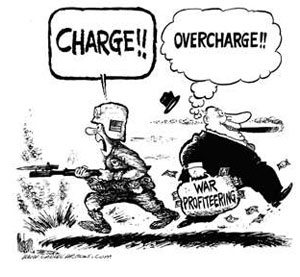
The Ultimate All-American Slush Fund

How A New Budget Loophole Could Send Pentagon Spending Soaring Even Higher

By Julia Gledhill and William D. Hartung

Source: TomDispatch

On June 3rd, President Joe Biden signed a bill into law that lifted the government’s debt ceiling and capped some categories of government spending. The big winner was — surprise, surprise! — the Pentagon.

Congress spared military-related programs any cuts while freezing all other categories of discretionary spending at the fiscal year 2023 level (except support for veterans). Indeed, lawmakers set the budget for the Pentagon and for other national security programs like nuclear-related work developing nuclear warheads at the Department of Energy at the level requested in the administration’s Fiscal Year 2024 budget proposal — a 3.3% increase in military spending to a whopping total of $886 billion. Consider that preferential treatment of the first order and, mind you, for the only government agency that’s failed to pass a single financial audit! 

Even so, that $886 billion hike in Pentagon and related spending is likely to prove just a floor, not a ceiling, on what will be allocated for “national defense” next year. An analysis of the deal by the Wall Street Journal found that spending on the Pentagon and veterans’ care — neither of which is frozen in the agreement — is likely to pass $1 trillion next year.

Compare that to the $637 billion left for the rest of the government’s discretionary budget. In other words, public health, environmental protection, housing, transportation, and almost everything else the government undertakes will have to make do with not even 45% of the federal government’s discretionary budget, less than what would be needed to keep up with inflation. (Forget addressing unmet needs in this country.)

And count on one thing: national security spending is likely to increase even more, thanks to a huge (if little-noticed) loophole in that budget deal, one that hawks in Congress are already salivating over how best to exploit. Yes, that loophole is easy to miss, given the bureaucratese used to explain it, but its potential impact on soaring military budgets couldn’t be clearer. In its analysis of the budget deal, the Congressional Budget Office noted that “funding designated as an emergency requirement or for overseas contingency operations would not be constrained” by anything the senators and House congressional representatives had agreed to.

As we should have learned from the 20 years of all-American wars in Afghanistan and Iraq, the term “overseas contingency” can be stretched to cover almost anything the Pentagon wants to spend your tax dollars on. In fact, there was even an “Overseas Contingency Operations” (OCO) account supposedly reserved for funding this country’s seemingly never-ending post-9/11 wars. And it certainly was used to fund them, but hundreds of billions of dollars of Pentagon projects that had nothing to do with the conflicts in Iraq or Afghanistan were funded that way as well. The critics of Pentagon overspending quickly dubbed it that department’s “slush fund.”

So, prepare yourself for “Slush Fund II” (coming soon to a theater near you). This time the vehicle for padding the Pentagon budget is likely to be the next military aid package for Ukraine, which will likely be put forward as an emergency bill later this year.  Expect that package to include not only aid to help Ukraine fend off Russia’s ongoing brutal invasion but tens of billions of dollars more to — yes, of course! — pump up the Pentagon’s already bloated budget.

Senator Lindsey Graham (R-SC) made just such a point in talking with reporters shortly after the debt-ceiling deal was passed by Congress. “There will be a day before too long,” he told them, “where we’ll have to deal with the Ukrainian situation. And that will create an opportunity for me and others to fill in the deficiencies that exist from this budget deal.”

Senate Majority Leader Chuck Schumer (D-NY) made a similar point in a statement on the Senate floor during the debate over that deal. “The debt ceiling deal,” he said, “does nothing to limit the Senate’s ability to appropriate emergency/supplemental funds to ensure our military capabilities are sufficient to deter China, Russia, and our other adversaries and respond to ongoing and growing national security threats.”

One potential (and surprising) snag in the future plans of those Pentagon budget boosters in both parties may be the position of House Speaker Kevin McCarthy (R-CA). He has, in fact, described efforts to increase Pentagon spending beyond the level set in the recent budget deal as “part of the problem.” For the moment at least, he openly opposes producing an emergency package to increase the Pentagon budget, saying:

“The last five audits the Department of Defense [have] failed. So there’s a lot of places for reform [where] we can have a lot of savings. We’ve plussed it up. This is the most money we’ve ever spent on defense — this is the most money anyone in the world has ever spent on defense. So I don’t think the first answer is to do a supplemental.”

The Massive Overfunding of the Pentagon

The Department of Defense is, of course, already massively overfunded. That $886 billion figure is among the highest ever — hundreds of billions of dollars more than at the peak of the Korean or Vietnam wars or during the most intensely combative years of the Cold War. It’s higher than the combined military budgets of the next 10 countries combined, most of whom are, in any case, U.S. allies. And it’s estimated to be three times what the Chinese military, the Pentagon’s “pacing threat,” receives annually. Consider it an irony that actually “keeping pace” with China would involve a massive cut in military spending, not an increase in the Pentagon’s bloated budget.

It also should go without saying that preparations to effectively defend the United States and its allies could be achieved for so much less than is currently lavished on the Pentagon.  A new approach could easily save significantly more than $100 billion in fiscal year 2024as proposed by Representatives Barbara Lee (D-CA) and Mark Pocan (D-WI) in the People Over Pentagon Act, the preeminent budget-cut proposal in Congress. An illustrative report released by the Congressional Budget Office (CBO) in late 2021 sketched out three scenarios, all involving a less interventionist, more restrained approach to defense that would include greater reliance on allies. Each option would reduce America’s 1.3-million-strong active military force (by up to one-fifth in one scenario). Total savings from the CBO’s proposed changes would, over a decade, be $1 trillion.

And a more comprehensive approach that shifted away from the current “cover the globe” strategy of being able to fight (though, as the history of this century shows, not always win) wars virtually anywhere on Earth on short notice — without allies, if necessary — could save hundreds of billions more over the next decade. Cutting bureaucracy and making other changes in defense policy could also yield yet more savings. To cite just two examples, reducing the Pentagon’s cohort of more than half-a-million private contract employees and scaling back its nuclear weapons “modernization” program would save significantly more than $300 billion extra over a decade.

But none of this is even remotely likely without concerted public pressure to, as a start, keep members of Congress from adding tens of billions of dollars in spending on parochial military projects that channel funding into their states or districts. And it would also mean pushing back against the propaganda of Pentagon contractors who claim they need ever more money to provide adequate tools to defend the country.

Contractors Crying Wolf

While demanding ever more of our tax dollars, the giant military-industrial corporations are spending all too much of their time simply stuffing the pockets of their shareholders rather than investing in the tools needed to actually defend this country. A recent Department of Defense report found that, from 2010-2019, such companies increased by 73% over the previous decade what they paid their shareholders. Meanwhile, their investment in research, development, and capital assets declined significantly. Still, such corporations claim that, without further Pentagon funding, they can’t afford to invest enough in their businesses to meet future national security challenges, which include ramping up weapons production to provide arms for Ukraine.

In reality, however, the financial data suggests that they simply chose to reward their shareholders over everything and everyone else, even as they experienced steadily improving profit margins and cash generation. In fact, the report pointed out that those companies “generate substantial amounts of cash beyond their needs for operations or capital investment.” So instead of investing further in their businesses, they choose to eat their “seed corn” by prioritizing short-term gains over long-term investments and by “investing” additional profits in their shareholders. And when you eat your seed corn, you have nothing left to plant next year.

Never fear, though, since Congress seems eternally prepared to bail them out. Their businesses, in fact, continue to thrive because Congress authorizes funding for the Pentagon to repeatedly grant them massive contracts, no matter their performance or lack of internal investment. No other industry could get away with such maximalist thinking.

Military contractors outperform similarly sized companies in non-defense industries in eight out of nine key financial metrics — including higher total returns to shareholders (a category where they leave much of the rest of the S&P 500 in the dust). They financially outshine their commercial counterparts for two obvious reasons: first, the government subsidizes so many of their costs; second, the weapons industry is so concentrated that its major firms have little or no competition.

Adding insult to injury, contractors are overcharging the government for the basic weaponry they produce while they rake in cash to enrich their shareholders. In the past 15 years, the Pentagon’s internal watchdog has exposed price gouging by contractors ranging from Boeing and Lockheed Martin to lesser-known companies like TransDigm Group. In 2011, Boeing made about $13 million in excess profits by overcharging the Army for 18 spare parts used in Apache and Chinook helicopters. To put that in perspective, the Army paid $1,678.61 each for a tiny helicopter part that the Pentagon already had in stock at its own warehouse for only $7.71.

The Pentagon found Lockheed Martin and Boeing price gouging together in 2015. They overcharged the military by “hundreds of millions of dollars” for missiles. TransDigm similarly made $16 million by overcharging for spare parts between 2015 and 2017 and even more in the following two years, generating nearly $21 million in excess profits. If you can believe it, there is no legal requirement for such companies to refund the government if they’re exposed for price gouging.

Of course, there’s nothing new about such corporate price gouging, nor is it unique to the arms industry. But it’s especially egregious there, given how heavily the major military contractors depend on the government’s business. Lockheed Martin, the biggest of them, got a staggering 73% of its $66 billion in net sales from the government in 2022. Boeing, which does far more commercial business, still generated 40% of its revenue from the government that year. (Down from 51% in 2020.)

Despite their reliance on government contracts, companies like Boeing seem to be doubling down on practices that often lead to price gouging. According to Bloomberg News, between 2020 and 2021, Boeing refused to provide the Pentagon with certified cost and pricing data for nearly 11,000 spare parts on a single Air Force contract. Senator Elizabeth Warren (D-MA) and Representative John Garamendi (D-CA) have demanded that the Pentagon investigate since, without such information, the department will continue to be hard-pressed to ensure that it’s paying anything like a fair price, whatever its purchases.

Curbing the Special Interest Politics of “Defense”

Reining in rip-offs and corruption on the part of weapons contractors large and small could save the American taxpayer untold billions of dollars. And curbing special-interest politics on the part of the denizens of the military-industrial-congressional complex (MICC) could help open the way towards the development of a truly defensive global military strategy rather than the current interventionist approach that has embroiled the United States in the devastating and counterproductive wars of this century.

One modest step towards reining in the power of the arms lobby would be to revamp the campaign finance system by providing federal matching funds, thereby diluting the influential nature of the tens of millions in campaign contributions the arms industry makes every election cycle. In addition, prohibiting retiring top military officers from going to work for arms-making companies — or, at least, extending the cooling off period to at least four years before they can do so, as proposed by Senator Warren — would also help reduce the undue influence exerted by the MICC.

Last but not least, steps could be taken to prevent the military services from giving Congress their annual wish lists — officially known as “unfunded priorities lists” — of items they want added to the Pentagon budget. After all, those are but another tool allowing members of Congress to add billions more than what the Pentagon has even asked for to that department’s budget.

Whether such reforms alone, if adopted, would be enough to truly roll back excess Pentagon spending remains to be seen. Without them, however, count on one thing: the department’s budget will almost certainly continue to soar, undoubtedly reaching $1 trillion or more annually within just the next few years.  Americans can’t afford to let that happen.

Julian Assange’s Imprisonment Is The Intellectual Imprisonment of Us All

By Eric Zuesse

Source: The Duran

Julian Assange has been imprisoned since 2012 because he had provided, to whistleblowers who were in government and who saw and could supply to his WikiLeaks organization, items of evidence which indicated that their government was breaking its own laws, protection of their personal identity, which confidentiality they could then rely upon for their personal safety, to protect those whistleblowers against retaliation by their government. No regular ‘news’-medium could or would reliably do that, but Assange and his WikiLeaks organization could, and they always did. This is why governmental whistleblowers did go to them for this purpose.

The power that a government has to ‘classify’ documents is the power that it has to hide evidence from its public and so to rule its population as being their subjects instead of (authentically) their citizens: it is the ability to BE a dictatorship. (It might arguably be acceptable when a democracy is being invaded by a foreign country, but never — other than that — can there be governmental secrecy to protect itself unless the government is a dictatorship — NOT a democracy — in which case the Government is, itself, being the enemy of its own population.) Without such secrecy against the public, the government would be a democracy, because then the population would be voting in an authentically free information-environment where there exists uncensored information to the public, so that each individual can make one’s OWN individual judgments regarding what is true, and what is false. But, otherwise, a government is a dictatorship.

This power (classifying governmental information) is also a government’s power of legal impunity so that it can violate its own laws and know that the voting public will not know that it did. That routine power of classifying information is the intellectual imprisonment of the nation’s entire population.

Julian Assange is not a subject (‘citizen’) of the U.S. Government, nor is he a subject of the UK Government, nor is he a subject of the other two Governments (Sweden and Ecuador) that have participated in assisting America and Britain to place and keep him in varying forms of (now super-max) imprisonment for over a decade, but they have done it, during all of this time, and never yet has he been tried and convicted of anything other than his having jumped bail in 2012 on a phony rape charge that even its alleged victim admitted had been false; so, in effect, if not in reality, his very imprisonment is an example of those governments’ dictatorships — it has already been long-term imprisonment without trial. ONLY a dictatorship does that. Only a dictatorship can do that.

Assange is instead a subject of the Australian dictatorship, which has done nothing at all to assist him or to protest his being raped by ‘law’ in those foreign lands. The fact that there are not revolutions overthrowing and replacing the Governments in each one of the countries that has participated in this ‘legal’ rape of Assange is testimony to the effectiveness of the intellectual imprisonment of each one of those nations’ populations.

Assange has been in various forms of imprisonment by UK for the last ten years without his ever having been convicted of anything except that in 2012 he was sentenced to 50 weeks in prison for jumping bail (on sexual charges against him that even the alleged accuser denied were true). And yet he remains now in solitary confinement (“23 hours a day locked in their cells”) in a super-max British prison, because the U.S. Government won’t stop its demand that he be extradited to the U.S. (and killed here — imprisoned for up to 175 years — instead of in Britain). His only ‘crime’ was his publishing only truths, especially truths that cut to the core of exposing the U.S. regime’s constant lying. So, this blatant and illegal injustice against an international hero (virtually everywhere except in the United States) is today one prominent disproof of the U.S. and UK lies to the effect that they are democracies. On 26 September 2021, Yahoo News reported (based largely on reporting in Madrid’s El Pais on 5 January 2021) that the Trump Administration felt so embarrassed by some information that had been WikiLeaked, they drew up detailed plans to kidnap Assange at the Ecuadorian Embassy in London to “rendition” him for possible execution by America. The plans, including “meetings with authorities or approvals signed by the president,” were finally stopped at the National Security Council, as being too risky. “Discussions over kidnapping or killing Assange occurred ‘at the highest levels’ of the Trump administration”, even without any legal basis to try him in the United States. So: the Trump Administration then prepared an indictment against Assange (to legalize their extradition-request), and the indictment became unsealed or made public on the same day, 11 April 2019, when Ecuador’s Government allowed UK’s Government to drag Assange out into UK super-max solitary-confinement imprisonment, and this subsequently produced lie-based U.S. & UK tussles over how to prevent Assange from ever again being able to reach the public, either by continuing his solitary confinement, or else by, perhaps, poisoning him, or else convicting him of something and then executing him. On 4 January 2021, a British judge nixed Assange’s defense case: “I reject the defence submissions concerning staying extradition [to U.S.] as an abuse of the process of this court.” Earlier, her handling of Assange’s only ‘trial’, which was his extradition hearing, was a travesty, which would have been expected in Hitler’s courts, and which makes clear that UK’s courts can be just as bad as Nazi courts had been. However, the U.S. regime’s efforts to grab Assange continued on. Barack Obama, Donald Trump, Joe Biden, and the overwhelmingly compliant U.S. Congress, are all to blame for that dictatorial regime’s pursuit against that champion of truth-telling; and the same blame applies to the leadership in UK. On 10 December 2021, BBC bannered “Julian Assange can be extradited to the US, court rules”. Blatantly, both America and England lie in order to refer to themselves as being democracies. In fact, America has the world’s highest percentage of its residents in prisons. It’s the world’s #1 police-state. Is that because Americans are worse than the people in other countries, or is it instead because the thousand or so individuals who collectively control the nation’s Government are, themselves, especially psychopathic? Evidence will now be linked-to on that question: America has been scientifically examined more than any other country has, in regards to whether it is an aristocracy, or instead a democracy, and the clear and consistent finding is that it’s an aristocracy. And it clearly is that at the federal level. (Here is a video summarizing the best single study of that, and it finds America to be an aristocracy, because it’s controlled by the richest few). And Norway’s aristocracy had also been part of this scandal. It is an international scandal, and keeps getting worse.

On June 19th, Chris Hedges headlined “The Imminent Extradition of Julian Assange & the Death of Journalism” and documented that the alleged ‘assurances’ that the U.S. regime had provided to the UK regime on the basis of which the latter dictatorship would be transferring Assange to a super-max prison in the United States, had as many holes in it as a ton of Swiss cheese.

ONLY in barbaric dictatorships is any of this even possible, but here it is real.

Assange’s ‘trial’ will be the trial of ‘democracy’ in whatever nation it will be executed.

—————

Investigative historian Eric Zuesse’s new book, AMERICA’S EMPIRE OF EVIL: Hitler’s Posthumous Victory, and Why the Social Sciences Need to Change, is about how America took over the world after World War II in order to enslave it to U.S.-and-allied billionaires. Their cartels extract the world’s wealth by control of not only their ‘news’ media but the social ‘sciences’ — duping the public.

15 Questions That Are More Useful Than “What Presidential Candidate Should Americans Vote For?”

By Caitlin Johnstone

Source: CaitlinJohnstone.com

People keep asking me to weigh in on the US presidential race and its candidates, which is what always happens whenever there’s a US presidential race on because media saturation makes it so central in the minds of Americans it’s often the main issue they want to talk about, even if they’re fairly aware.

I really don’t have anything to say about who Americans should vote for, other to repeat what I’ve said already about the fact that you can’t vote your way out of a mess you never voted yourself into in the first place.

But what I can do instead is offer my American friends some questions to ask that would probably be much more helpful to them and their nation than the question “Which presidential candidate should we vote for?”

Here are 15 such questions:

1. Why does nothing change no matter who we vote for?

2. Why does US foreign policy always continue along the same trajectory regardless of the president’s party or platform?

3. What keeps our voting population split right down the middle into two political factions of equal size, with neither side ever gaining enough of a majority to democratically change society in any meaningful way?

4. Why does the stalemate described in #3 always seem to benefit the rich, the powerful, and the war-horny?

5. Why is it that the most consequential US government policies like plutocratic influence, privatization, globalization, ecocidal capitalism and nuclear brinkmanship are never on the ballot? Why do these things keep happening, against our interests, without our ever voting for them or electing anyone who campaigned on the pledge to enact them?

6. If our federal government’s behavior never changes no matter who we elect, could it be that there are other bodies involved in government policy-setting whom we did not elect, and who remain in positions of influence regardless of the comings and goings of our official elected government?

7. If the above is the case, then who is it? Who’s really calling the shots in this country?

8. Could it be that everything we’ve been told about our country, our government, our political processes and our world is untrue?

9. If so, what are the implications of the fact that our schools and our media have been feeding us lies since we were small?

10. What forces would be responsible for keeping all these lies flowing throughout our society? What might keep an ostensibly free press spinning more or less the same lies throughout the western world day after day, year after year, generation after generation?

11. Is it possible that our entire electoral system is a sham designed to give the public the illusion of control so that they’ll let oligarchs and empire managers run the country undisturbed?

12. If the electoral system is a sham, then how do we enact the changes we so desperately need?

13. Is it possible that there are other ways to effect change in the United States which don’t involve casting a pretend vote in a fake election?

14. Could it be that those other means of forcing change are precisely what the charade of casting pretend votes in fake elections is meant to divert us from?

15. Should we perhaps spend less energy bickering about who should get sworn into the White House a year and a half from now, and more energy examining other possible avenues toward advancing meaningful change?

FBI Make-Work Entrapment Schemes: Creating Criminals in Order to Arrest Them

By John & Nisha Whitehead

Source: The Rutherford Institute

“Whoever fights monsters should see to it that in the process he does not become a monster.”— Friedrich Nietzsche

We’re not dealing with a government that exists to serve its people, protect their liberties and ensure their happiness.

Rather, we are the unfortunate victims of the diabolical machinations of a make-works program carried out on an epic scale whose only purpose is to keep the powers-that-be permanently (and profitably) employed.

Case in point: the FBI.

The government’s henchmen have become the embodiment of how power, once acquired, can be so easily corrupted and abused. Indeed, far from being tough on crime, FBI agents are also among the nation’s most notorious lawbreakers.

Whether the FBI is planting undercover agents in churches, synagogues and mosques; issuing fake emergency letters to gain access to Americans’ phone records; using intimidation tactics to silence Americans who are critical of the government, or persuading impressionable individuals to plot acts of terror and then entrapping them, the overall impression of the nation’s secret police force is that of a well-dressed thug, flexing its muscles and doing the boss’ dirty work.

Clearly, this is not a government agency that appears to understand, let alone respect, the limits of the Constitution.

Indeed, this same government agency has a pattern and practice of entrapment that involves targeting vulnerable individuals, feeding them with the propaganda, know-how and weapons intended to turn them into terrorists, and then arresting them as part of an elaborately orchestrated counterterrorism sting.

Basically, it works like this: in order to justify their crime-fighting superpowers, the FBI manufactures criminals by targeting vulnerable individuals and feeding them anti-government propaganda; then, undercover agents and informants equip the targeted individuals with the training and resources to challenge what they’ve been indoctrinated into believing is government corruption; and finally, the FBI arrests the targeted individuals for engaging in anti-government, terrorist activities.

This is what passes for the government’s perverse idea of being tough on crime.

For example, undercover FBI agents pretending to be associated with ISIS have been accused of seeking out online and befriending a 16-year-old with brain development issues, persuading him to secretly send them small cash donations in the form of gift cards, and then the moment Mateo Ventura, turned 18, arresting him for providing financial support to an Islamic terrorist group.

If convicted, the teenager could spend up to 10 years in prison.

Yet as The Intercept explains, “the only ‘terrorist’ he is accused of ever being in contact with was an undercover FBI agent who befriended him online as a 16-year-old… This law enforcement tactic has been criticized by national security researchers who have scrutinized the FBI’s role in manufacturing terrorism cases using vulnerable people who would have been unable to commit crimes without prolonged government assistance and encouragement… the Ventura case may indicate that authorities are still open to conjuring terrorists where none existed.”

In another incident, the FBI used an undercover agent/informant to seek out and groom an impressionable young man, cultivating his friendship, gaining his sympathy, stoking his outrage over injustices perpetrated by the U.S. government, then enlisting his help to blow up the Herald Square subway station. Despite the fact that Shahawar Matin Siraj ultimately refused to plant a bomb at the train station, he was arrested for conspiring to do so at the urging of his FBI informant and used to bolster the government’s track record in foiling terrorist plots. Of course, no mention was made of the part the government played in fabricating the plot, recruiting a would-be bomber, and setting him up to take the fall.

These are Machiavellian tactics with far-reaching consequences for every segment of the population, no matter what one’s political leanings, but it is especially dangerous for anyone whose views could in any way be characterized as anti-government.

As Rozina Ali writes for The New York Times Magazine, “The government’s approach to counterterrorism erodes constitutional protections for everyone, by blurring the lines between speech and action and by broadening the scope of who is classified as a threat.”

For instance, it was reported that the FBI had been secretly carrying out an entrapment scheme in which it used a front company, ANOM, to sell purportedly hack-proof phones to organized crime syndicates and then used those phones to spy on them as they planned illegal drug shipments, plotted robberies and put out contracts for killings using those boobytrapped phones.

All told, the FBI intercepted 27 million messages over the course of 18 months.

What this means is that the FBI was also illegally spying on individuals using those encrypted phones who may not have been involved in any criminal activity whatsoever.

Even reading a newspaper article is now enough to get you flagged for surveillance by the FBI. The agency served a subpoena on USA Today / Gannett to provide the internet addresses and mobile phone information for everyone who read a news story online on a particular day and time about the deadly shooting of FBI agents.

This is the danger of allowing the government to carry out widespread surveillance, sting and entrapment operations using dubious tactics that sidestep the rule of law: “we the people” become suspects and potential criminals, while government agents, empowered to fight crime using all means at their disposal, become indistinguishable from the corrupt forces they seek to vanquish.  

To go after terrorists, they become terrorists.

To go after drug smugglers, they become drug smugglers.

To go after thieves, they become thieves.

For instance, when the FBI raided a California business that was suspected of letting drug dealers anonymously stash guns, drugs and cash in its private vaults, agents seized the contents of all the  safety deposit boxes and filed forfeiture motions to keep the contents, which include millions of dollars’ worth of valuables owned by individuals not accused of any crime whatsoever.

It’s hard to say whether we’re dealing with a kleptocracy (a government ruled by thieves), a kakistocracy (a government run by unprincipled career politicians, corporations and thieves that panders to the worst vices in our nature and has little regard for the rights of American citizens), or if we’ve gone straight to an idiocracy

This certainly isn’t a constitutional democracy, however.

Some days, it feels like the FBI is running its own crime syndicate complete with mob rule and mafia-style justice.

In addition to creating certain crimes in order to then “solve” them, the FBI also gives certain informants permission to break the law, “including everything from buying and selling illegal drugs to bribing government officials and plotting robberies,” in exchange for their cooperation on other fronts.

USA Today estimates that agents have authorized criminals to engage in as many as 15 crimes a day (5600 crimes a year). Some of these informants are getting paid astronomical sums: one particularly unsavory fellow, later arrested for attempting to run over a police officer, was actually paid $85,000 for his help laying the trap for an entrapment scheme.

In a stunning development reported by The Washington Post, a probe into misconduct by an FBI agent resulted in the release of at least a dozen convicted drug dealers from prison.

In addition to procedural misconduct, trespassing, enabling criminal activity, and damaging private property, the FBI’s laundry list of crimes against the American people includes surveillance, disinformation, blackmail, entrapment, intimidation tactics, and harassment.

For example, the Associated Press lodged a complaint with the Dept. of Justice after learning that FBI agents created a fake AP news story and emailed it, along with a clickable link, to a bomb threat suspect in order to implant tracking technology onto his computer and identify his location. Lambasting the agency, AP attorney Karen Kaiser railed, “The FBI may have intended this false story as a trap for only one person. However, the individual could easily have reposted this story to social networks, distributing to thousands of people, under our name, what was essentially a piece of government disinformation.”

Then again, to those familiar with COINTELPRO, an FBI program created to “disrupt, misdirect, discredit, and neutralize” groups and individuals the government considers politically objectionable, it should come as no surprise that the agency has mastered the art of government disinformation.

The FBI has been particularly criticized in the wake of the 9/11 terrorist attacks for targeting vulnerable individuals and not only luring them into fake terror plots but actually equipping them with the organization, money, weapons and motivation to carry out the plots—entrapment—and then jailing them for their so-called terrorist plotting. This is what the FBI characterizes as “forward leaning—preventative—prosecutions.”

The FBI has also repeatedly sought to expand its invasive hacking powers to allow agents to hack into any computer, anywhere in the world.

Suffice it to say that when and if a true history of the FBI is ever written, it will not only track the rise of the American police state but it will also chart the decline of freedom in America: how a nation that once abided by the rule of law and held the government accountable for its actions has steadily devolved into a police state where justice is one-sided, a corporate elite runs the show, representative government is a mockery, police are extensions of the military, surveillance is rampant, privacy is extinct, and the law is little more than a tool for the government to browbeat the people into compliance.

This is how tyranny rises and freedom falls.

The powers-that-be are not acting in our best interests.

Almost every tyranny being perpetrated by the U.S. government against the citizenry—purportedly to keep us safe and the nation secure—has come about as a result of some threat manufactured in one way or another by our own government.

Think about it.

Cyberwarfare. Terrorism. Bio-chemical attacks. The nuclear arms race. Surveillance. The drug wars. Domestic extremism. The COVID-19 pandemic.

In almost every instance, the U.S. government (often spearheaded by the FBI) has in its typical Machiavellian fashion sown the seeds of terror domestically and internationally in order to expand its own totalitarian powers.

Consider that this very same government has taken every bit of technology sold to us as being in our best interests—GPS devices, surveillance, nonlethal weapons, etc.—and used it against us, to track, control and trap us.

Are you getting the picture yet?

The U.S. government isn’t protecting us from threats to our freedoms.

The U.S. government is creating the threats to our freedoms. It is, as I make clear in my book Battlefield America: The War on the American People and in its fictional counterpart The Erik Blair Diaries, the source of the threats to our freedoms.

How Did Someone Like Me Get Shadow-Banned?

By Charles Hugh Smith

Source: Of Two Minds

It seems there are many reasons to get shadow-banned, but unfortunately we’re never told what “crime” we committed nor are we given a chance to defend ourselves from the “indictment” in whatever “court” found us “guilty.” As in a nightmarish tale right out of Kafka, the powers making the charges, declaring the verdict “guilty as charged” and imposing the penalty are completely obscured.

Those found “guilty” discover their secret “conviction” and “sentence” when their livelihood is destroyed (i.e. they’re demonetized) and their online presence suddenly diminishes or vanishes.

I call this being sent to Digital Siberia. As with the real gulag, most of those convicted in the secret digital Star Chamber are innocent of any real crime; their “crime” was challenging the approved narratives.

Which leads to my question: why was little old marginalized-blogger me shadow-banned? Those responsible are under no obligation to reveal my “crime,” the evidence used against me, or offer me an opportunity to defend myself against the charges, much less file an appeal.

My astonishment at being shadow-banned (everyone in Digital Siberia claims to be innocent, heh) is based on my relatively restrained online presence, as I stick to the journalistic standards I learned as a free-lancer for mainstream print media: source data, excerpts and charts from mainstream / institutional sources and raise the questions / build the thesis on those links / data.

I avoid conspiracy-related topics (not my interest, not my expertise) and hot-button ideological / political cleavages (us vs. them is also not my interest). My go-to source for charts and data is the Federal Reserve database (FRED) and government agencies such as the Census Bureau, Bureau of Labor Statistics, IRS, etc., and respected non-governmental organizations (NGOs) such as the Pew Research Center, RAND, investment banks, etc.

Given my adherence to journalistic standards, I wonder: how did someone like me get shadow-banned?

The standard cause (or excuse) for being overtly banned is “distributing misinformation.” This charge is never specific; something you posted “violates our community standards,” or equivalent broad-brush language.

Shadow-banning is even more pernicious because you’re not even notified that your visibility to others has been restricted or dropped to zero. You see your post, but nobody else does.

What are the precise standards for declaring a link or statement as “misinformation?” As the twitter files revealed, what qualifies as “misinformation” is constantly shifting as a sprawling ecosystem of censors share information and blacklists. This report is well worth reading: The Censorship-Industrial Complex: Top 50 Organizations To Know (Zero Hedge).

Not only do we not know what qualifies as “misinformation,” we also don’t know what Big Tech algorithms are flagging and what their response is to whatever’s been flagged. My colleague Nate Hagens, who is equally scrupulous about using authoritative sources, posted this comment last year:

“It’s both funny and scary. It was explained to me today that the new Facebook/Meta algorithm downrates users who have cookies w evidence of visiting non-mainstream news sources/blogs. Even when one uses proxy servers and incognito mode, if you frequent e.g. Aljazeera or other news sites instead of CNN or FOX the algorithms categorizes your FB content (even if it’s a chicken soup recipe) as ‘non-mainstream’.
Big brother is watching (and not even thinking).
Those ideas/voices outside the status quo aren’t on equal footing- and the status quo (material growth/cultural values) is what’s leading us down the current path, without a map or plan.”

The systems that shadow-ban us are completely opaque. Who’s to say that a knowledgeable human reviews who’s been banned or shadow-banned? Given the scale of these Big Tech platforms and Search Engines, is that even possible?

It’s well known that YouTube constantly changes its ranking algorithms so they are harder to game, i.e. manipulate to advance one’s visibility.

It’s also known that simply posting a link to a site flagged as “misinformation” is enough to get your post excommunicated and your site flagged in unknown ways with unknown consequences.

What I do know is that Of Two Minds was publicly identified as “Russian Propaganda” by a bogus organization with no supporting data, PropOrNot in 2016. This front’s blacklist was prominently promoted by the Washington Post on page one in 2016, more or less giving it the authority of a major MSM outlet.

One might ask how a respected, trusted newspaper could publish a list from a shadowy front without specifying the exact links that were identified as “Russian Propaganda.” Standard journalistic protocol requires listing sources, not just publishing unverified blacklists.

Clearly, the Washington Post should have, at a minimum, demanded a list of links from each site on the blacklist that were labeled as “Russian Propaganda” so the Post journalists could check for themselves. At a minimum, the Post should have included inks as examples of “Russian Propaganda” for each site on the list. They did neither, a catastrophic failure of the most fundamental journalistic standards. Yet no one in the media other than those wrongfully blacklisted even noted or questioned this abject failure.

In effect, the real propaganda was the unsourced, un-investigated blacklist on the front page of the Washington Post.

How did I get on a list of “Russian Propaganda” when I never wrote about Russia or anything related to Russia?

There are two plausible possibilities. One is “guilt by association.” I’ve been interviewed by Max Keiser since 2011, and Max and his partner Stacy Herbert posted their videos on RT (Russia Today) and an Iranian media outlet. Needless to say, these sources were flagged, as was anyone associated with them. So perhaps merely having a link to an interview I did with Max and Stacy was enough to get me shadow-banned. (Shout-out to Max and Stacy in El Salvador.)

Alternatively, perhaps questioning the coronation of Queen Hillary in any way also got me on the blacklist.

Once on the blacklist, then the damage was already done, as the network of censors share blacklists without verifying the “crime”–a shadowy “crime” without any indictment, hearing or recourse, right out of Kafka.

Shadow-banning manifests in a number of ways. Readers reported that they couldn’t re-tweet any of my tweets. Another reader said the Department of Commerce wouldn’t load a page from my site, declaring it “dangerous,” perhaps with the implication that it was a platform for computer viruses and worms–laughable because there is nothing interactive on my sites and thus no potential source for viruses other than links to legitimate sources and adverts served by Investing Channel.

Users of platforms such as Twitter and Facebook have probably noticed that your feed is populated by the same “friends” or “folks you follow.” In other words, the feed you’re presented with is curated by algorithms which sort and display posts / tweets / search results according to parameters that are invisible to users and regulators.

It’s easy to send flagged accounts to Digital Siberia, and trouble-free to leave them there until the trouble-maker goes broke.

It’s impossible to chart the extent of the shadow-banning, or who’s doing it, sharing blacklists, etc. This entire ecosystem of censorship is invisible. Recall that in the Soviet gulag, having an “anti-Soviet dream” was enough to get you a tenner (10-year sentence) in the gulag. Here, posting a flagged link will get you a tenner in Digital Siberia.

When Your Own Government Confirms It Paid Censors To Silence You…

In today’s zeitgeist, merely mentioning the possibility that the COVID-19 virus escaped from a lab resulted in an instant ban in 2020. How could the possibility that it escaped from a nearby lab dedicated to viral research be labeled as “disinformation” when the facts were not yet known?

The answer is of course that the lab-escape theory was “politically sensitive” and therefore verboten.

You see the problem: what’s deemed “politically sensitive” changes with the wind, and so the boundaries of what qualifies as “misinformation” have no visible or definable edge. Virtually anything consequential can suddenly become “politically sensitive” and then declared “misinformation.” When the guidelines of what’s a “crime” and the processes of “conviction” are all opaque, and there is no hearing or recourse to being “convicted” of a shadow-“crime,” we’ve truly entered a Kafkaesque world.

How did someone like me get shadow-banned? There is no way to know, and that’s a problem for our society and our ability to solve the polycrisis we now face.

I joke that what got me shadow-banned was using Federal Reserve charts. Perhaps that’s not that far from reality.

Traitor to the Constitution: The U.S. Government Is the Real Criminal

By John & Nisha Whitehead

Source: The Rutherford Institute

“The most dangerous man to any government is the man who is able to think things out for himself, without regard to the prevailing superstitions and taboos. Almost inevitably he comes to the conclusion that the government he lives under is dishonest, insane and intolerable.”—H.L. Mencken

And so it continues.

This entire fiasco—indicting Donald Trump for allegedly violating both the Espionage Act and obstructing justice by improperly handling classified records—is merely the latest in a never-ending series of distractions, distortions, and political theater aimed at diverting the public’s attention from the sinister advances of the American Deep State.

Don’t allow yourselves to be distracted, diverted or mesmerized by the cheap theater tricks.

This indictment spectacle is Shakespearean in its scope: full of sound and fury, signifying nothing.

Nothing is the key word here.

Despite the wall-to-wall media coverage, this is all just smoke and mirrors.

Mark my words: the government is as corrupt and self-serving as ever, dominated by two political factions that pretend to be at odds with each other all the while moving in lockstep to maintain the status quo.

If you really want to talk about who’s guilty of treason, set your sights higher: indict the government for overstepping its authority, abusing its power, disregarding the rule of law, and betraying the American people.

When we refer to the “rule of law,” that’s constitutional shorthand for the idea that everyone is treated the same under the law, everyone is held equally accountable to abiding by the law, and no one is given a free pass based on their politics, their connections, their wealth, their status or any other bright line test used to confer special treatment on the elite.

When the government and its agents no longer respect the rule of law—the Constitution—or believe that it applies to them, then the very contract on which this relationship is based becomes invalid.

This abuse of power has been going on for so long that it has become the norm, the Constitution be damned.

There are hundreds—make that thousands—of government bureaucrats who are getting away with murder (in many cases, literally) simply because the legislatures, courts and the citizenry can’t be bothered to make them play by the rules of the Constitution.

Unless something changes in the way we deal with these ongoing, egregious abuses of power, the predators of the police state will continue to wreak havoc on our freedoms, our communities, and our lives.

For too long now, the American people have played politics with their principles and turned a blind eye to all manner of wrongdoing when it was politically expedient, allowing the government to wreak havoc with their freedoms and act in violation of the rule of law.

“We the people” are paying the price for it now.

We are paying the price every day that we allow the government to continue to wage its war on the American People, a war that is being fought on many fronts: with bullets and tasers, with surveillance cameras and license readers, with intimidation and propaganda, with court rulings and legislation, with the collusion of every bureaucrat who dances to the tune of corporate handouts while on the government’s payroll, and most effectively of all, with the complicity of the American people, who continue to allow themselves to be easily manipulated by their politics, distracted by their pastimes, and acclimated to a world in which government corruption is the norm.

It’s the nature of the beast: power corrupts.

Worse, as 19th-century historian Lord Acton concluded, absolute power corrupts absolutely.

We’ve been losing our freedoms so incrementally for so long—sold to us in the name of national security and global peace, maintained by way of martial law disguised as law and order, and enforced by a standing army of militarized police and a political elite determined to maintain their powers at all costs—that it’s hard to pinpoint exactly when it all started going downhill, but we’re certainly on that downward trajectory now, and things are moving fast.

The republic has fallen.

The Deep State’s plot to take over America has succeeded.

The American system of representative government has been overthrown by a profit-driven, militaristic, corporate oligarchy bent on total control and global domination through the imposition of martial law here at home and by fomenting wars abroad.

Even now, we are being pushed and prodded towards a civil war, not because the American people are so divided but because that’s how corrupt governments control a populace (i.e., divide and conquer).

These are dangerous times.

These are indeed dangerous times but not because of violent crime or terrorism or illegal immigration.

No, the real danger that we face comes from none other than the U.S. government and the powers it has granted to its standing armies to rob, steal, cheat, harass, detain, brutalize, terrorize, torture and kill American citizens with immunity.

The danger “we the people” face comes from masked invaders on the government payroll who crash through our doors in the dark of night, shoot our dogs, and terrorize our families.

This danger comes from militarized henchmen on the government payroll who demand absolute obedience, instill abject fear, and shoot first and ask questions later.

This danger comes from greedy, power-hungry bureaucrats on the government payroll who have little to no understanding of their constitutional limits.

This danger comes from greedy politicians and corporations for whom profit trumps principle.

Consider, if you will, all of the dastardly, devious, diabolical, dangerous, debilitating, deceitful, dehumanizing, demonic, depraved, dishonorable, disillusioning, discriminatory, dictatorial schemes inflicted on “we the people” by a bureaucratic, totalitarian regime that has long since ceased to be “a government of the people, by the people and for the people.”

  • Americans have no protection against police abuse.
  • Americans are little more than pocketbooks to fund the police state.
  • Americans are no longer innocent until proven guilty.
  • Americans no longer have a right to private property.
  • Americans no longer have a say about what their children are exposed to in school.
  • Americans are powerless in the face of militarized police.
  • Americans no longer have a right to bodily integrity.
  • Americans no longer have a right to the expectation of privacy.
  • Americans can no longer rely on the courts to mete out justice.
  • Americans no longer have a representative government.

I haven’t even touched on the corporate state, the military industrial complex, SWAT team raids, invasive surveillance technology, zero tolerance policies in the schools, overcriminalization, or privatized prisons, to name just a few, but what I have touched on should be enough to show that the landscape of our freedoms has already changed dramatically from what it once was and will no doubt continue to deteriorate unless Americans can find a way to wrest back control of their government and reclaim their freedoms.

Indictments, impeachments and elections will not save us.

History may show that from this point forward, we will have left behind any semblance of constitutional government and entered into a totalitarian state where all citizens are suspects and security trumps freedom.

Even with its constantly shifting terrain, this topsy-turvy travesty of law and government has become America’s new normal.

From Clinton to Bush, then Obama to Trump and now Biden, it’s as if we’re caught in a time loop, forced to re-live the same thing over and over again: the same assaults on our freedoms, the same disregard for the rule of law, the same subservience to the Deep State, and the same corrupt, self-serving government that exists only to amass power, enrich its shareholders and ensure its continued domination.

There can be no denying that the world is indeed a dangerous place, but it’s the government that poses the gravest threat to our freedoms and way of life, and no amount of politicking, parsing or pandering will change that.

It is easy to be diverted, distracted and amused by political circuses and entertainment spectacles.

What is far more difficult to face up to is the reality of life in America, where “we the people” are at a distinct disadvantage in the face of the government elite’s power grabs, greed and firepower.

The Constitution doesn’t stand a chance against a federalized, globalized standing army protected by legislative, judicial and executive branches that are all on the same side.

As I make clear in my book Battlefield America: The War on the American People and in its fictional counterpart The Erik Blair Diaries, no matter what political views they subscribe to: suffice it to say, they are not on our side or the side of freedom.

That is the real betrayal.

Neocon Warmonger Advocates Nukes to Nazis in Ukraine

Violent Russian-hating Nazis wouldn’t nuke Moscow, would they?

By Kurt Nimmo

Source: Kurt Nimmo Substack

Maybe you may remember Michael Rubin. He worked with Douglas Feith’s Office of Special Plans (OSP), a neocon pro-war outfit set-up in the Pentagon by then Secretary of Defense Donald Rumsfeld. The OSP’s objective was to create a series of false pretenses to invade Iraq in 2003.

According to Karen Kwiatkowski, a retired Air Force Lieutenant Colonel whose assignments included duties as a Pentagon desk officer, the Office of Special Plans represented a “subversion of constitutional limits on executive power and a co-option through deceit of a large segment of the Congress.”

Rumsfeld and vice president Dick Cheney used the OSP to publicize “hot garbage” from a cast of dubious characters produced by Ahmed Chalabi’s Iraqi National Congress, including “Curveball” (Rafid Ahmed Alwan al-Janabi, a German intelligence asset pretending to be an Iraqi chemical engineer).

The lies that killed over a million Iraqis were dismissed as “intelligence failures” and swept under the rug. Bush, Cheney, Rumsfeld, Feith, Rubin, and other neocons were never held responsible for the massive war crimes they perpetuated.

On June 9, Rubin, a “senior fellow” at the American Enterprise Institute (and former “fellow” at the Council on Foreign Relations), penned “Can Biden Deter a Russia Nuclear Attack on Ukraine? Yes, if He Gives Ukraine Tactical Nukes.

Rubin demands the nazified post-coup government of Ukraine receive nukes. Rubin believes the 1994 Budapest Memorandum (exchanging Soviet-era nukes deployed to Ukraine in exchange for sovereignty) was a monumental error. “The simple fact is this: United States maintains nuclear weapons because they are an effective deterrent against other nuclear states. Ukraine should have the same right,” Rubin writes.

Rubin and his neocon co-conspirators are not interested in “an effective deterrent” in Ukraine; they are interested in destroying the Russian state, the same as they destroyed the Iraqi state. However, Iraq, despite neocon lies, never had nuclear weapons (and the chemical weapons they did possess were supplied US corporations). Russia controls the largest arsenal of nukes in the world.

The non-proliferation mafia might howl with outrage, but the West must gear its nuclear policy toward reality, not wishful thinking or an empty façade of a treaty regimen by which revisionist states no longer abide.

Please read between the lines. According to this entitled “senior fellow,” the neocon “reality” envisions nuclear war as the most effective way to overthrow Putin and dismember the Russian Federation. Rubin, of course, does not call directly for nuclear war. However, his demand that Ukraine be allowed to acquire nuclear weapons will result in precisely that outcome. Imagine Ukraine’s Azov Battalion neo-nazis using nukes to target the Kremlin instead of hit-or-miss drones.

Rubin’s clarion call for nuclear destruction was crossposted on 19FortyFive, a “center-right” website that has produced neocon propaganda subsequently picked up by The New York Times, Newsweek, The Washington Post, The Hill, Reuters, and Voice of America (CIA propaganda), among others. It should be noted that 19FortyFive was until very recently a “regional defense publication.”

With the Ukrainian counter-offensive underway, the threat that Russia might use tactical nuclear weapons is increasingly a likelihood. It would be unfair to blame Kyiv. There is no moral equivalence. Russia invaded Ukraine; not the other way around. So long as Ukraine was on the verge of victory, Putin would arrive at this point of nuclear retaliation.

Nonsense. Zelenskyy’s “counter-offensive” has thus far failed miserably, a fact even the war propaganda media is obliged to admit. Thus, Russia does not need to use nuclear weapons. Rubin, however, is able to make his bogus claim thanks to the fiction of Russian desperation over defeat, a false narrative telegraphed daily by a mendacious and cynically fantasist corporate propaganda media.

As should be expected, Rubin completely ignores the fact Russia went into eastern Ukraine to prevent the ethnic cleansing and slaughter of ethnic Russians. For the neocons, responsible for massive war crimes in the Middle East (Iraq, Syria, Libya), human life is expendable. Disease, malnutrition, infant mortality, DU-produced cancer—these are the preferred tools for regime change and the destruction of targeted societies resistant to neoliberal serfdom.

Rubin believes the prospect of USG nukes handed over to Russian-hating neo-nazi ultranationalists in Ukraine will save the day and prevent military action “not only against Ukraine but also against Moldova and the Baltic States,” a claim that is utter BS.

Meanwhile, more rational Americans, while small in number, are increasingly concerned about the escalatory behavior of the USG, under the sway of vicious and murderous neocons, which will put an end to not only civilization but all life on planet Earth.