
Saturday Matinee: Jin Roh

Jin Roh: The Wolf Brigade The Perfect Rainy Day Film

By Darrion Rilley

Source: Medium

Like every young anime fan, you relied on Reddit, Tumblr, or YouTube as your source of information when looking for new anime to watch; in particular, I was a fan of the ultraviolent Wicked City-type films. No one in my sphere of influence watched anime like that, but as a person who was raised young on 80s ultraviolent action flicks and cheesy slasher flicks. Most anime I watched did not scratch that itch I had. One day, while browsing YouTube, I saw a recommendation from my favorite anime reviewer. He just made a review on a little film named Jin Roh: The Wolf Brigade, a hidden late 90s gem that almost nobody talked about.

Jin Roh: The Wolf Brigade was released in Japan on June 3rd, 2000, and did not hit America until it was licensed by Bandai Entertainment and Viz Media for an English release, hitting theaters on May 25th, 2001. The Film chronologically is the third film in Mamoru Oshiis Kerberos Saga beginning in 1987. The Kerberos Saga ranges through various installments, such as live-action films, radio dramas, an original manga run, and a feature-animated film.

When I first experienced the film for myself, I was upset that something this beautiful felt hidden and almost forgotten by mainstream anime fans nowadays. However, my opinion changed when I showed my friends the film; rewatching it with new viewers fresh for the experience made me realize why Jin Roh is such an underrated gem in the first place.

Based on Mamoru Oshii’s original manga Kerberos Panzer Cop. Jin Roh takes place in an alternate timeline. Set in an alternate 1950s Japan, where after World War 2, Germany won the war, occupied Japan, and eventually denazified, leaving the country in economic and political ruin. The film follows Kazuki Fuse. A member of the Capital Police menacing paramilitary unit nicknamed Kerberos equipped with MG-42 machine guns and specialized nightmare-inducing Protect Gear that looks straight from a sci-fi movie.

We follow Fuse as he is embroiled in a web of political intrigue and personal turbulence after failing to stop a member of the terrorist group known as The Sect from detonating satchel charges that cause a blackout. The incident damages Kerberos’ reputation. Fuse, deeply haunted by guilt, is reprimanded for failing to stop the bomber and sent back to basic training for re-evaluation. Fuse, still remorseful, visits the courier’s grave, meets Kei Amemiya, a woman who claims to be the courier’s older sister, and develops a friendship. However, Kei is eventually revealed not to be the suicide bomber’s sister but a former member of the Sect who is being used as a pawn by the Capital Police to discredit Kerberos and disband the unit once and for all.

Jin Roh is unlike other anime like Akira or Ghost in the Shell, but it is as influential as the two. However, the film does not bombard the senses with a visual feast for the viewer. Even though many animators, including the director, worked on anime such as Paranoia Agent, Evangelion, Patlabor 2, and so on, the real magic comes in its sound design and soundtrack.

It is something you’ll quickly come to appreciate. The film’s attention to realism and subtlety in its sound design helps create a realistic environment; it’s purposeful and not distracting. Things sound squishy when they should; Fuze reassembling his MG-42 sounds real and so damn crisp to the ear; even the sound of a Molotov hitting the ground shows the care and level of detail that went into making every sound heard realistic.

I’m not discrediting the visuals because what you see visually is also curated and adds to the experience. Characters are distinct, and the world is visually stunning; on my second viewing, I realized I never noticed most of the weapons, uniforms, and vehicles seen are German or German-influenced. The Mauser C96 is the Kerberos standard sidearm. Capitol Police are seen carrying MP40s, and when Fuse is sent back to basic for training, we see members of the unit training with Sturmgewehr 44 rifles. It is what makes this film so distinct. There’s noticeable love and attention to detail carefully considered when developing the movie. I never understood why it was so underrated until I rewatched it with my friends. Watching the emotional roller coaster, my friends went on made me realize something. Jin Roh is meant to be a rainy-day film.

It should be a hidden gem. It’s a cozy watch, especially with the soundtrack composed by Hajime Mizoguchi in collaboration with Yoko Kanno. Even though the soundtrack is used sparsely compared to other films, it hits. There’s not a punch pulled when it comes to composing the soundtrack. It is orgasmic. It is why even though the film may not be as acclaimed as Akira, it’s memorable. And that’s what the legacy of this movie is supposed to be. Jin Roh is a memorable viewing experience.

While scenes can feel like they drag, they serve a purpose. The movie doesn’t care about your expectations as a viewer; hell, within the opening scene and throughout the film, it makes it a matter of fact. Surprisingly going as far as spoiling how the film will end with visual clues and off-screen exposition. It’s something sprinkled throughout with imagery of wolves or that Fuse figuratively and almost literally being a wolf.

The scene in the sewers with the wolf brigade still gives me chills. It is revealed the wolf brigade has been fully aware of the Public Security plan and used it as an opportunity to flush out those trying to eliminate the unit. Fuse himself is a deep-cover operative. Well aware of what’s going on. A wolf in sheep’s clothing. It is even more heartbreaking in the end. Just like the tale of Little Red Riding Hood, the wolf devoured Little Red Riding Hood. Fuse, distraught, realizes he has no other choice and kills Kei, cleaning up all loose ends.

Jin Roh on the surface, may be boring to some, or the use of the wolf and little red riding hood may be pretentious to others. Except, it is safe to say that is purely personal bias. Jin Roh is a stunning film. I encourage any anime fan who has not graced their screens with the movie, should. It should be watched and celebrated with other great pieces of animation. As the sea of new anime rises. Gems like Jin Roh are bound to be forgotten or passed over. The next time you are looking for a visually stunning; masterfully made; and well-curated film, watch Jin Roh: The Wolf Brigade. You won’t regret it.

Watch Jin Roh on tubi here: https://tubitv.com/movies/460471/jin-roh-dubbed

Gaza: The End of the Jewish Joy Ride?

By Michael Lesher

Source: Off-Guardian

You almost want to feel sorry for Israel’s professional apologists in mainstream media these days. Their job, a fetid one at best, has been especially trying lately.

First they assure us that Israel has no intention of committing a genocide – and right away they’re refuted by Israel’s own prime minister, who loudly demands the extermination of every man, woman and child in Gaza, not to mention its president’s equally public insistence that Palestinian civilians are legitimate military targets.

Then they struggle to excuse Israel’s bloody attack on one Gaza hospital, only to end up watching Israel’s killing machine obliterate literally all of them. (Not to mention making a mockery of the excuses by providing no evidence that there was ever a “Hamas command center” under al-Shifa, the first of those destroyed hospitals, to begin with.)

Then they try to divert attention from Israeli atrocities by yelping about “mass rape” supposedly committed by the Palestinian fighters who burst from the Gaza concentration camp on October 7. But the ink is hardly dry on their indignant op-eds before their masters in the Chosen State confess that they have no victim testimonies, no forensic evidence and no reliable witnesses to back up any of the claims.

What’s an apologist to do?

Well, if you’re a staff writer at the Atlantic – where rationalizing Israeli crime is a specialty of the house – you can fall back on the lamest canard of all: that the public disgust stirred by Israel’s worst-yet mass murder campaign against Palestinians is really a product of rising “anti-Semitism.”

And sure enough, Atlantic’s April number sports a feature story to that effect by one Franklin Foer with the lachrymose title “The Golden Age of American Jews is Ending” – because, don’t you see, Americans couldn’t possibly have a respectable motive for getting worked up over a genocide.

Mind you, it takes some high-octane chutzpah to pretend that today’s Big Story is the end of an era for American Jews, at the very moment when American-made bombs and artillery shells are pulverizing Gaza and exterminating its population (half of which consists of children), to the applause of virtually every Jewish communal organization the world over, including inside the US.

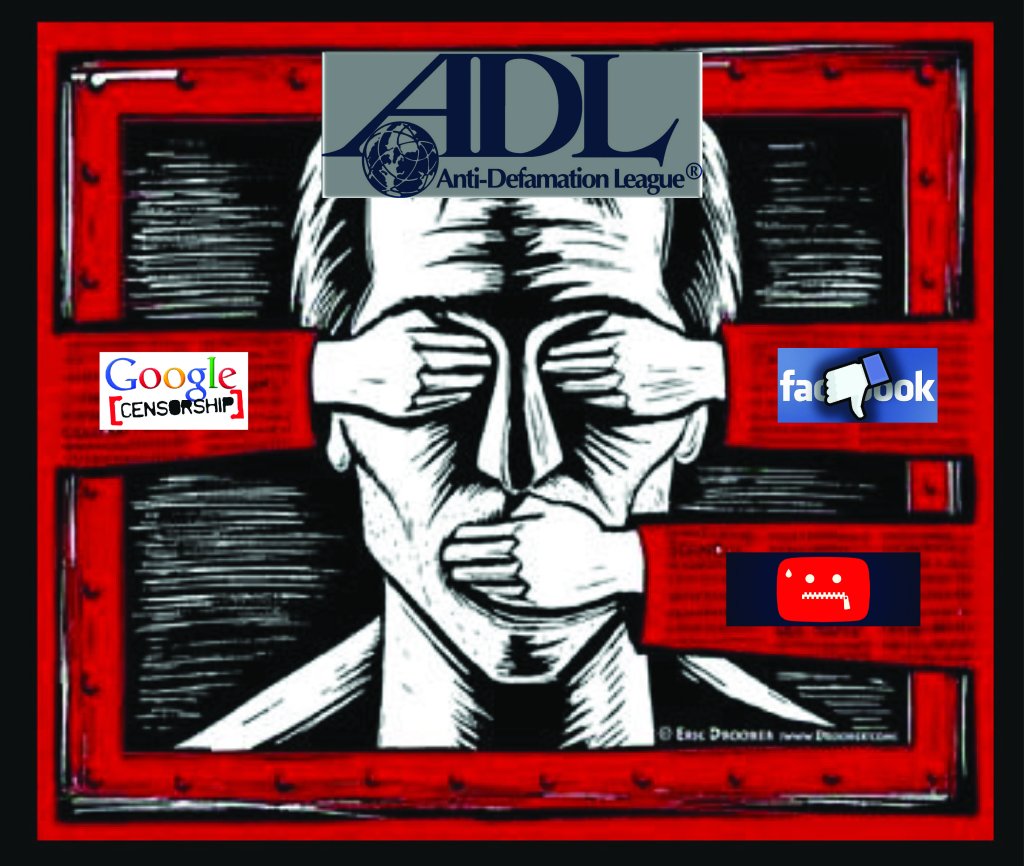
But Foer doesn’t lack chutzpah. He’s not only prepared to claim victimhood for Jewish genocide supporters on the grounds that their sachems haven’t been able to stifle all public dissent. He also wants you to believe that the decline of American Jewish power isn’t due to public backlash against bullying by Jewish organizations (think AIPAC, or the sadly misnamed Anti-Defamation League); nor to the exposure of illegal spending sprees with government funds by various Hasidic institutions; nor even to the racist blood lust expressed by almost every prominent Orthodox rabbi in the US since Israel’s genocidal campaign began last October.

No, according to Foer, the real trouble is what he calls “anti-Semitism on the right and the left” – which I guess means “everywhere,” in the US at least. And he’s even prepared to insist that this “anti-Semitism” is not only bad for the Jews; it threatens the American republic, too.

“Over the course of the 20th century, Jews invested their faith in a distinct strain of liberalism that combined robust civil liberties, the protection of minority rights, and an ethos of cultural pluralism,” Foer claims. But now, “that era is drawing to a close. America’s ascendant political movements – MAGA on one side, the illiberal left on the other – would demolish the last pillars of the consensus that Jews helped establish.” Ah, the unaccountable ingratitude of those goyim! I mean – what’s a little genocide between friends?

Setting to one side Foer’s self-righteous reading of American political history, any claim that today’s United States is awash in anti-Semitism is obviously silly. Quite apart from opinion polls – which tell a tale very different from Foer’s – popular culture is a convenient point of reference in such matters, and it’s hard to see how a society permeated with Jew-hatred would have showered no fewer than twenty Oscar nominations last year on films that celebrate already-famous American Jews. And then there’s the large number of American Jews who have participated in the anti-genocide protests that so trouble Foer – a datum that, standing alone, suffices to refute his imputation of anti-Jewish bigotry to the protesters.

But Foer is right about one thing. A privileged chapter in diaspora Jewish history is coming to an end – though not for the reason he gives. The simple truth (though Foer cannot admit it) is that the American public is getting tired of being bullied by a greedy and hypersensitive Jewish elite that, like a spoiled child, has insisted on having its way for years in everything from Mideast policy to the distribution of government benefits, and is now finally overplaying its hand.

And if that Jewish “leadership” really has squandered its measure of imperially-funded impunity by embracing a genocide – at a moment when the fabric of US politics is too strained for an ultra-divisive issue and too cash-poor to give away the extra billions that Israel is demanding to finance its crimes – it is quite possible that Foer has stumbled onto another truth as well: that the wreckage from the fall of the Jewish elite will doom whatever is left of American democracy.

To make sense of these claims, a short summary of recent history is in order. It is well known that since the end of World War II Jews in the West have come to enjoy a degree of freedom, prosperity and political influence that is without precedent in the Jewish diaspora.

Unsurprisingly, American Jews have generally welcomed this development. And given the horrors that preceded it, culminating in the genocide of Europe’s Jewish population in the 1940s, it’s not hard to understand why Jewish elites in the US focused at first on securing their hard-won position in any way they could, taking advantage of new opportunities and assimilating themselves to preexisting power structures.

But after 1967, as Israel settled into a new role as one of Washington’s key client states, what had been prudence morphed into braggadocio. Norman Podhoretz set the tone, vowing that henceforth American Jews would “resist any who would in any way and to any degree and for any reason whatsoever attempt to do us harm” – a boast that meant in practice (to quote the superb scholar Norman Finkelstein) that “American Jewish elites could strike heroic poses as they indulged in cowardly bullying.”

Less privileged constituencies may be forgiven for not seeing that period as a “golden age,” as Foer does, but you can reject his twisted perspective and still agree that the postwar joy ride of Jewish “leadership” is probably coming to an end.

After all, why shouldn’t it?

Today’s United States is not the United States of 1945, nor even the United States of 1967. The American public now is as deeply divided as in the last decades of the 18th century, when armed rebellions and secession plots were recurring realities. The presidential election scheduled for this November – assuming it happens at all (the Democratic Party seems to be trying to convert the balloting system into a prearranged election-by-lawfare) – is likely to exacerbate differences rather than resolve them, with potentially disastrous results. Worse, given the massive attack on civil rights that was launched four years ago on the pretext of a COVID-19 “medical emergency” – an attack that included the deliberate undermining of the electoral process in many states – it is not even clear whether the necessary conditions for democracy exist any longer in the US.

Meanwhile, consumer prices have skyrocketed, workers are suffering massive layoffs, and the small business economy, crippled by the COVID coup, has been unable to compensate for the damage.

Why should a citizenry in such straits continue to give preferential treatment to an overbearing Jewish elite that 1) clearly doesn’t need it, and 2) flaunts its allegiance to a foreign power even as it demands favors from American institutions at every opportunity? (Anyone who needs an introduction to the fraudulent practices this elite will resort to, and the extent to which it has entangled US government in its chicanery, need only read Norman Finkelstein’s copiously documented The Holocaust Industry for some useful details.) By any standard, American Jews have enjoyed an extraordinary run over the last fifty years; it’s about time we were treated just like everybody else – no worse, but no better either.

The (mis)behavior of Jewish “leadership” is exacerbating the problem. Instead of absorbing the message of the writing on the wall and prudently lowering its profile, it is going for broke, intensifying its financial and political demands in support of Israel’s genocidal slaughter – the worst possible issue seized at the worst possible moment. Not even warning growls from old allies like Senate Majority Leader Chuck Schumer have had any noticeable effect. Like Shakespeare’s Richard III, Jewish “leaders” seem intent on plunging ahead toward their own inevitable destruction.

And I fear that they will not fall alone. Gaza is far from being Joe Biden’s only problem this year. But as the Palestinian death toll soars, and the pictures of shredded or starving children become ever more numerous and intolerable, the Gaza genocide could end up being the last straw that breaks the back of Biden’s reelection propaganda.

Genocide Joe’s problem with Gaza is that there is no real escape from it: Biden cannot ignore the issue but also cannot afford to resolve it. If he grows an embryonic conscience and finally brings Israel to heel (at least temporarily), he will pay a heavy price with Jewish voting blocs in November. If he doesn’t, a regional Mideast war could be in the offing, and I doubt that any American administration could survive the fallout from such a debacle.

I am not about to shed any tears for Joe Biden or for the Democratic Party. But if the current government collapses, what will replace it? An ad hoc coalition around the former Narcissist-in-Chief? A caretaker administration effectively under the sway of US intelligence agencies? A COVID coup-inspired government by executive fiat? The prospects are not encouraging.

Meanwhile, the 1,000 American troops now being sent to Israel/Palestine – ostensibly to build a “humanitarian port” for Gaza – may end up, for all I know, as a striking force behind a coup designed to oust Netanyahu and to put the US directly in control of a client state gone rogue. No one familiar with the CIA’s record can rule out such a possibility. But how will an American working class that already resents the billions of dollars annually thrown away on “aid” to Israel (while average American families can’t pay the rent and the heating bill at the same time) react to the idea of turning the Jewish State into an expensive US protectorate? What if those American troops start dying in new wars in Lebanon or Iran? How much can Americans be expected to pay for Israel’s rapaciousness?

I certainly do not know where any of this will lead. But I’m finding it very hard to imagine a happy ending to the story. I’ve already mentioned my doubts about whether the presuppositions required of a democracy exist in today’s United States. One of those presuppositions is the assumption of shared goals (Lessing, following Aristotle, went so far as to describe this as “friendship”) between the members of differing political factions. But can I really acknowledge any sort of common cause with a supporter of genocide? To be honest, I’m still not sure I can use a word like “friendship” to describe my relationship to someone who, just a few years ago, denied my right of movement, my right to be governed by democratic processes, my right to speak my mind without being censored, my right not to be a human guinea pig, and even my right to breathe freely. And I can’t forget that there were many, many such people.

What I’m finding really ominous is that so many enemies of American freedom over the last four years are now quietly cozying up to Israel’s genocide lest they upset the Democratic Party applecart – and are demanding that the American public do the same. Rebecca Solnit, one of those “progressive feminists” who helped to publicize every democracy-destroying lie of the COVID coup, from masks to coerced human medical experimentation, doesn’t mince words about the dangers of Republican politicians: according to her, they have “abandoned all ethics and standards, and will happily violate the oaths they took to uphold the constitution”; in fact, she claims that “[v]iral Trumpism has already merged with conspiracy theories such as QAnon, with anti-vaccine cults, with white supremacists and neo-fascists.” But the prolific Ms. Solnit has gone strangely tongue-tied about the slaughter-plus-systematic-starvation of more than a million children in Gaza.

Gloria Steinem, another “progressive” who bailed on the “my body, my choice” principle as soon as a Democratic Party administration demanded the injection of federal employees with untested drugs, was quick to denounce Palestinians over charges of sexual violence that were probably fabricated. But she too has been practically silent about the slaughter in Gaza, not to mention the well-documented sexual violence committed by Israelis against female Palestinian prisoners. And so on, and so on, and so on.

I mention these examples because I think they expose, like a lantern in a shadowy room, the cruel emptiness belied by all the liberal gesturing. The tragic truth is that the Democratic Party and its mouthpieces are not offering us an alternative to Donald Trump. They are using Trump’s name as hunters use beaters, to induce frightened prey to stampede into their nets. They are not, as some critics believe, political ideologues; they are really more like political parasites, forced to feed on the vital energies and principles of others because they have none themselves.

That is where Democratic Party apologists meet the crime-rationalizing rhetoricians of American Jewish “leadership.” Even genocide, the most heinous of all crimes against humanity, doesn’t move such people, because where they should have hearts capable of empathy with suffering or of anger at injustice, all they’ve really got is a craving for power and a dread of losing it.

And so it turns out that the Jewish elites who are hell-bent on maintaining their undeserved privileges – so much so that they’ll embrace Nazi crimes to do it – are forcing the pitiful hollowness of America’s political elites into public view. That is the real disaster that Franklin Foer, who wants to keep both elites in power, cannot see. His pastiche of anodyne falsehoods is intended to divert public attention from the horror of Israel’s intensifying crimes in occupied Palestine. But he is really laying the groundwork for the radical disillusionment of the American public – a disillusionment that could bring down the entire political process when a generation of its victims realizes how recklessly and how cynically it has been deceived.

Yes, the American Jewish joy ride is probably about to end – and with a bang, not a whimper. The real questions are all about what happens next. How many Americans (and others) are going to be hurt in the crash? How many will get out of the way in time? How many will be ready with aid for the victims when the debris finally settles?

And what will be left – after so much cruel and needless damage – of what we used to call “the land of the free, the home of the brave”?

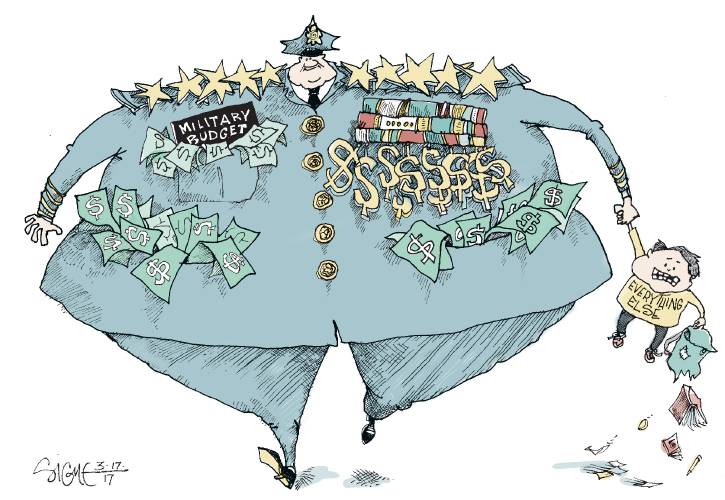
Our Real National Security Budget

$2 Trillion, Here We Come.

Signe’s second toon du jour SIGN17e Military

By Andrew Cockburn

Source: Spoils of War

The Biden Administration has just published its proposed budget, generating copious commentary, much of it displaying a commensurate degree of misunderstanding, especially regarding our gargantuan national security spending. To get at the truth of the matter, I consulted my friend Winslow Wheeler, who has been observing the insalubrious intricacies of the budget process over the past fifty years as a senior aide to Senators from both parties as well as a senior analyst for the General Accounting Office and directing the Center for Defense Information.

The defense budget has just been posted by the administration is being described as approaching a trillion dollars. Is that accurate?  :

No. It’s actually a lot more than that. In fact it’s beginning to inch up on $2 trillion. 

How so?

The problem is that when most people look at the defense budget, they don’t count everything that we spend even for the Pentagon. But in addition to that, there are hundreds of billions of dollars outside of the Pentagon’s budget that we spend for national security. Things like the nuclear weapons activities in the Department of Energy; that’s $37 billion$26 billion for retired military pensions and healthcare and $12 billion for the Selective Service, the National Defense Stockpile, and a strange and suspicious looking category for the international activities of the FBI in something called “Defense Related Activities.”

Do we have any idea what that last one is for?

It has always been classified. In the 50 years I’ve been watching the defense budget, it’s never been explained other than some occasional hints. One year they admitted to a lot of money being spent by the FBI in, wait for it, Taiwan, and so it’s very unclear exactly what this is, but it’s always counted as part of so-called defense related activities.  

The expenses that I have just been describing come to $970 billion, but that leaves out a lot.. Add in about $800 billion for the Department of Veterans Affairs, the State Department and its associated agencies, the Department of Homeland Security. And we know now from our Republican friends that border protection is a dire national security issue. Add all that together. Then you can calculate the share for the interest on the debt that we pay each year. All those activities I’ve just described come to 21% of all federal spending. Calculating in that percentage as a the amount it contributes to the debt burden gives you $254 billion.. And so you add all of that up together and you get $1.767 trillion.

Jesus Christ.  What about CIA and other intelligence spending?

All the intelligence agencies are in the Pentagon budget except for the intelligence agencies for the State Department, Coast Guard and  the Department of Homeland Security. Those are the few other things that are not in the Pentagon budget that are distributed in the other agencies that I’ve described.  When they last published the total amount for the intel budget it was over $120 billion, but it’s all embedded in these various agencies.

Since the budget was published, there’s been some wailing and lamentation that because of irksome spending restraints, this budget  actually represents a cut or at least restraint on defense spending. What’s your view on that?

Well, last yea the budget deal that then-Speaker Kevin McCarthy negotiated with the Democrats for the Pentagon allowed only a 1% increase in defense spending. But because of the screwy way that we actually calculate things, if you put together everything we spent just for the Pentagon without all those other items I mentioned, last year, it looks like we will have spent $968 billion, while for 2025, Biden’s requesting $921 billion. So yes, that’s a cut. But that doesn’t include the supplementals that Biden will request later this year for the Pentagon, for Ukraine, Israel, God knows what, that will get us back into competition with 2024. The reason why 2024 is higher than the Biden request is because it had 60 billion worth of emergency supplementals that Congress is about to approve and that money is counted in my total. But because of the broken accounting rules that we use for the budget, that money’s not counted when you calculate the deal that McCarthy made with the Democrats, and that’s emergency money that doesn’t count on budget cap.

For years we had the Overseas Contingency Operations defense spending, the so called war budget, which was the extra money the military got for actually fighting wars in Afghanistan and elsewhere. Are we getting back to that?

Yes.  The politically-derived budget caps don’t apply to that money.  And it’s a lot more than just for the wars; lots of billions for goodies for everybody added each year thereIt’s all part of the hocus pocus ways that Congress allows itself to appropriate money so it can pretend that it’s using restraint, but actually is exploiting all kinds of loopholes to increase whatever cap or restraint they pretend that they’ve added to the defense budget.

What’s the next budgetary legislative stage that we’re going to endure?

:We haven’t finished with 2024 yet, because Congress  has gotten into this habit of never passing budgets on time. And it also helps the Speaker of the House and the Majority Leader of the Senate discipline members so they don’t get out of the line on things. We do these things called continuing resolutions that keep the money flowing but only at the level approved in the previous year. And we’re in that situation for the Defense Department for 2024. Next week or the week after, they’re going to resolve that and pick a final total for 2024, which will include most, but probably not all of the emergency supplemental that Biden requested for Ukraine, Israel, Taiwan, and defense industrial base spending. So that number will become final in two or three weeks. We have barely begun on the 2025 consideration in Congress that will take the next three, four months and we’ll have another continuing resolution because they won’t pass things in time for the beginning of the fiscal year on October 1st, and we’ll go through this charade once again. And because this is an election year, it’ll be all that more sloppy, painful, and unappealing to observe.

Then when they do it, Chuck Schumer and whoever is the Speaker of the House will pat themselves on the back and say, ‘well, we’ve done a great job. Who says we can’t do anything. We just got the budget finally passed.’ But that will be months late yet again.

Are there items tacked onto the defense bills that have nothing to do with defense? 

Yes. There’s two bills. One is the National Defense Authorization Act, which is the bill that goes to the House and Senate Armed Services Committees. That’s a policy bill. It doesn’t make money actually available to be spent, but it pretends it does. It has lots of numbers in it; it’s a tar baby for all kinds of crazy stuff or politically driven stuff because the legislative process is so broken.  Members don’t have an opportunity to do stuff on the floor of the House and Senate and especially in the Senate because the Majority Leader exploits the rules to make amendments impossible. The National Defense Authorization Act is one of those bills where they actually get a chance to do amendments and they do all kinds of crazy stuff, lots of stuff that has absolutely nothing to do with national defense.  Last year they had 600 amendments for that bill.

Whew.

But they don’t really get debated. This is yet another way that the Majority Leader, Chuck Schumer, controls things. If you’re a Senator, you have to supplicate Schumer to get him to accept your amendment. That will then will get into a package that he’s blessed and it’ll be adopted wholesale by the Senate with perfunctory debate and members giving staff-written speeches about ‘this is a wonderful bill. It includes my important amendment to increase ice block cutting in Minnesota’ and all kinds of other crazy stuff. Every one of these will have been approved by Schumer or his agents as politically acceptable. If you are a dissenter and have a problem with how things are done in the Pentagon or anywhere else, you will not get Schumer’s blessing and your amendment will not be added to his package to be dumped into the National Defense Authorization Act, and you’ll be out in the cold. We go through essentially the same process with the appropriations bill, which is the one that actually makes the money available to all these agencies. Yet again, Schumer controls the process where if he likes the smell of your amendments and it’s okay with the prevailing political dogma that week or that month or for the last decade, it’ll get included. And if you have something that that Chuck Schumer doesn’t like, your amendment will be out in the cold.

Was it always like this?

When the Senate described itself as the world’s greatest deliberative body back in the 1970s and eighties, it would have a process where a bill would come up on the floor in the Senate, and the Senate took great pride in the fact that it had unlimited amendments, and you could offer an amendment on anything you wanted to all of these bills, whether it’s the National Defense Authorization Act or the FAA Authorization Act, and there would be a proper debate, and then the Senate would vote and the majority of those senators present in voting would prevail.

Today it’s a fundamentally broken process because of the automatic filibuster, which allows the party leaders to totally control things. Unless a Senator can somehow put together sixty votes to override a filibuster, Schumer and McConnell can simply prevent your amendment from even coming to the floor, let alone get debated. It’s also a corrupt process because if you legislate in ways that Chuck Schumer, or whoever is the leader, doesn’t like or your idea is a pain in the ass for the Democratic, or Republican, caucus, you will be on the outs.  Furthermore, Schumer, and McConnell control a large portion of the money that you need for your reelection campaign. And if you don’t behave yourself, you’ll be on the outs, not just on getting your amendment adopted, but you’ll be on the outs so far as getting any of his money is concerned. And for the money that he doesn’t directly control, he’ll be sending the message to the big political donors, ‘don’t give anything to Senator So and So. He’s not one of us; he’s not a good boy.’  That’s the way we do business these days.

Getting back to the defense bill, I saw an item this morning that the Navy is saying they all have to cut back Virginia class submarine production from two to one next year because of their terrible financially straitened circumstances. How do we read that?

There’s two things going on there. One is that the Navy has requested a gigantic ship-building budget, something like $45 billion. The problem is that navy ships are so expensive these days that you can’t fit much dirt into that bag. Those submarines are about $3 billion apiece. Aircraft carriers, and we’re paying for two more, are about $13 billion apiece. They have a brand new ‘low cost’ frigate that’s getting into production this year. Those come in at $1 billion apiece. When you have ships that cost these amounts, even with a gigantic budget, like $45 billion, you can’t buy many of them. The second thing that’s going on is the Navy is tickling the system. They’re saying, ‘Oh dear, we can only afford one sub this year because we’re so stretched running. And isn’t that just terrible?’ So they’re tickling Congress where it feels good, and they’re saying, ‘okay, when you add money, add money for another submarine.’

So does that mean the budget will grow beyond what the President has asked for?

The Biden request is a floor, not a ceiling.

And the other game that goes on is they are actually limited in a relative sense in the billions of dollars that they can add on each year. So the staff on the appropriations committee and the two armed services committees, they go looking for things to cut in the accounts in the Pentagon budget where nobody’s paying much attention. So they can then plow that money back into the stuff that the Navy wants for these submarines, or that Senator X, Y, or Z wants for a research and development program that just happens to be performed in his, or her, state and just happens to be from that company that gave him a healthy political contribution last year.  One of the things the staffs love to cut is training money for the Air Force and others,  because they’ll declare the request to have been excessive. They’ll add that few hundred million dollars to the pot for goodies that members of Congress want. An added problem, of course, is that the Air Force is already way, way behind on trending hours for pilots, and that account needs more money, not less money. There are all kinds of other games that the staff at these committees play to pretend they’re taking out unuseful money, and paying for the oh, so wonderful ideas that members of Congress want for their special requests.

Thank you. At least we’ve been warned.

The Language of Force: How the Police State Muzzles Our Right to Speak Truth to Power

By John & Nisha Whitehead

Source: The Rutherford Institute

“If the state could use [criminal] laws not for their intended purposes but to silence those who voice unpopular ideas, little would be left of our First Amendment liberties, and little would separate us from the tyrannies of the past or the malignant fiefdoms of our own age. The freedom to speak without risking arrest is ‘one of the principal characteristics by which we distinguish a free nation.’”—Justice Neil Gorsuch, dissenting, Nieves v. Bartlett (2019)

Tyrants don’t like people who speak truth to power.

Cue the rise of protest laws, which take the government’s intolerance for free speech to a whole new level and send the resounding message that resistance is futile.

In fact, ever since the Capitol protests on Jan. 6, 2021, state legislatures have introduced a broad array of these laws aimed at criminalizing protest activities.

There have been at least 205 proposed laws in 45 states aimed at curtailing the right to peacefully assemble and protest by expanding the definition of rioting, heightening penalties for existing offenses, or creating new crimes associated with assembly.

Weaponized by police, prosecutors, courts and legislatures, these protest laws, along with free speech zones, bubble zones, trespass zones, anti-bullying legislation, zero tolerance policies, hate crime laws, and a host of other legalistic maladies have become a convenient means by which to punish individuals who refuse to be muzzled.

In Florida, for instance, legislators passed a “no-go” zone law making it punishable by up to 60 days in jail to remain within 25 feet of working police and other first responders after a warning.

Yet while the growing numbers of protest laws cropping up across the country are sold to the public as necessary to protect private property, public roads or national security, they are a wolf in sheep’s clothing, a thinly disguised plot to discourage anyone from challenging government authority at the expense of our First Amendment rights.

It doesn’t matter what the source of that discontent might be (police brutality, election outcomes, COVID-19 mandates, the environment, etc.): protest laws, free speech zones, no-go zones, bubble zones, trespass zones, anti-bullying legislation, zero tolerance policies, hate crime laws, etc., aim to muzzle every last one of us.

To be very clear, these legislative attempts to redefine and criminalize speech are a backdoor attempt to rewrite the Constitution and render the First Amendment’s robust safeguards null and void.

No matter how you package these laws, no matter how well-meaning they may sound, no matter how much you may disagree with the protesters or sympathize with the objects of the protest, these proposed laws are aimed at one thing only: discouraging dissent.

This is the painful lesson being imparted with every incident in which someone gets arrested and charged with any of the growing number of contempt charges (ranging from resisting arrest and interference to disorderly conduct, obstruction, and failure to obey a police order) that get trotted out anytime a citizen voices discontent with the government or challenges or even questions the authority of the powers-that-be.

These assaults on free speech are nothing new.

As Human Rights Watch points out, “Various states have long-tried to curtail the right to protest. They do so by legislating wide definitions of what constitutes an ‘unlawful assembly’ or a ‘riot’ as well as increasing punishments. They also allow police to use catch-all public offenses, such as trespassing, obstructing traffic, or disrupting the peace, as a pretext for ordering dispersals, using force, and making arrests. Finally, they make it easier for corporations and others to bring lawsuits against protest organizers.

Journalists have come under particular fire for exercising their right to freedom of the press.

According to U.S. Press Freedom Tracker, the criminalization of routine journalism has become a means by which the government chills lawful First Amendment activity.

Journalists have been arrested or faced dubious charges for “publishing,” asking too many questions of public officials, being “rude” for reporting during a press conference, and being in the vicinity of public protests and demonstrations.

For instance, Steve Baker, a reporter for Blaze News, was charged with four misdemeanors, including trespassing and disorderly conduct charges, related to his sympathetic coverage of the Jan. 6 riots. Dan Heyman, a reporter for the Public News Service, was arrested for “aggressively” questioning Tom Price, then secretary of the Department of Health and Human Services during an encounter in the West Virginia State Capitol.

It’s gotten so bad that merely daring to question, challenge or hesitate when a cop issues an order can get you charged with resisting arrest or disorderly conduct.

For example, Deyshia Hargrave, a language arts teacher in Louisiana, was thrown to the ground, handcuffed and arrested for speaking out during a public comment period at a school board meeting.

Fane Lozman was arrested for alluding to government corruption during open comment time at a City Council meeting in Palm Beach County, Fla.

College professor Ersula Ore was slammed to the ground and arrested after she objected to the “disrespectful manner” shown by a campus cop who stopped her in the middle of the street and demanded that she show her ID.

Philadelphia lawyer Rebecca Musarra was arrested for exercising her right to remain silent and refusing to answer questions posed by a police officer during a routine traffic stop. (Note: she cooperated in every other way by providing license and registration, etc.)

Making matters worse, the U.S. Supreme Court issued a ruling in Nieves v. Bartlett that protects police from lawsuits by persons arrested on bogus “contempt of cop” charges (ranging from resisting arrest and interference to disorderly conduct, obstruction, and failure to obey a police order) that result from lawful First Amendment activities (filming police, asking a question of police, refusing to speak with police).

These incidents reflect a growing awareness about the state of free speech in America: you may have distinct, protected rights on paper, but dare to exercise those rights, and you risk fines, arrests, injuries and even death.

Unfortunately, we have been circling this particular drain hole for some time now.

More than 50 years ago, U.S. Supreme Court Justice William O. Douglas took issue with the idea that merely speaking to a government representative (a right enshrined in the First Amendment) could be perceived as unlawfully inconveniencing and annoying the police.

In a passionate defense of free speech, Douglas declared: 

Since when have we Americans been expected to bow submissively to authority and speak with awe and reverence to those who represent us? The constitutional theory is that we the people are the sovereigns, the state and federal officials only our agents. We who have the final word can speak softly or angrily. We can seek to challenge and annoy, as we need not stay docile and quiet. The situation might have indicated that Colten’s techniques were ill-suited to the mission he was on, that diplomacy would have been more effective. But at the constitutional level speech need not be a sedative; it can be disruptive.

It’s a power-packed paragraph full of important truths that the powers-that-be would prefer we quickly forget: We the people are the sovereigns. We have the final word. We can speak softly or angrily. We can seek to challenge and annoy. We need not stay docile and quiet. Our speech can be disruptive. It can invite dispute. It can be provocative and challenging. We do not have to bow submissively to authority or speak with reverence to government officials.

In theory, Douglas was right: “we the people” do have a constitutional right to talk back to the government.

In practice, however, we live in an age in which “we the people” are at the mercy of militarized, weaponized, immunized cops who have almost absolute discretion to decide who is a threat, what constitutes resistance, and how harshly they can deal with the citizens they were appointed to “serve and protect.”

As such, those who seek to exercise their First Amendment rights during encounters with the police are increasingly finding that there is no such thing as freedom of speech.

Case in point: Tony Rupp, a lawyer in Buffalo, NY, found himself arrested and charged with violating the city’s noise ordinance after cursing at an SUV bearing down on pedestrians on a busy street at night with its lights off. Because that unmarked car was driven by a police officer, that’s all it took for Rupp to find himself subjected to malicious prosecution, First Amendment retaliation and wrongful arrest.

The case, as Jesse McKinley writes in The New York Times, is part of a growing debate over “how citizens can criticize public officials at a time of widespread reevaluation of the lengths and limits of free speech. That debate has raged everywhere from online forums and college campuses to protests over racial bias in law enforcement and the Israel-Hamas war. Book bans and other acts of government censorship have troubled some First Amendment experts. Last week, the Supreme Court heard arguments about a pair of laws — in Florida and Texas — limiting the ability of social media companies such as Facebook to ban certain content from their platforms.”

Bottom line: what the architects of the police state want are submissive, compliant, cooperative, obedient, meek citizens who don’t talk back, don’t challenge government authority, don’t speak out against government misconduct, and don’t resist.

What the First Amendment protects—and a healthy constitutional republic requires—are citizens who routinely exercise their right to speak truth to power.

Yet there can be no free speech for the citizenry when the government speaks in a language of force.

What is this language of force?

Militarized police. Riot squads. Camouflage gear. Black uniforms. Armored vehicles. Mass arrests. Pepper spray. Tear gas. Batons. Strip searches. Surveillance cameras. Kevlar vests. Drones. Lethal weapons. Less-than-lethal weapons unleashed with deadly force. Rubber bullets. Water cannons. Stun grenades. Arrests of journalists. Crowd control tactics. Intimidation tactics. Brutality. Contempt of cop charges.

This is not the language of freedom. This is not even the language of law and order.

Unfortunately, this is how the government at all levels—federal, state and local—now responds to those who choose to exercise their First Amendment right to speak freely.

If we no longer have the right to tell a Census Worker to get off our property, if we no longer have the right to tell a police officer to get a search warrant before they dare to walk through our door, if we no longer have the right to stand in front of the Supreme Court wearing a protest sign or approach an elected representative to share our views, if we no longer have the right to protest unjust laws by voicing our opinions in public or on our clothing or before a legislative body, then we do not have free speech.

What we have instead is regulated, controlled, censored speech, and that’s a whole other ballgame.

Remember, the unspoken freedom enshrined in the First Amendment is the right to challenge government agents, think freely and openly debate issues without being muzzled or treated like a criminal.

Americans are being brainwashed into believing that anyone who wears a government uniform—soldier, police officer, prison guard—must be obeyed without question.

Of course, the Constitution takes a far different position, but does anyone in the government even read, let alone abide by, the Constitution anymore?

The government does not want us to remember that we have rights, let alone attempting to exercise those rights peaceably and lawfully. And it definitely does not want us to engage in First Amendment activities that challenge the government’s power, reveal the government’s corruption, expose the government’s lies, and encourage the citizenry to push back against the government’s many injustices.

Yet by muzzling the citizenry, by removing the constitutional steam valves that allow people to speak their minds, air their grievances and contribute to a larger dialogue that hopefully results in a more just world, the government is creating a climate in which violence becomes inevitable.

When there is no First Amendment steam valve, then frustration builds, anger grows and people become more volatile and desperate to force a conversation.

As John F. Kennedy warned, “Those who make peaceful revolution impossible will make violent revolution inevitable.”

As I point out in my book Battlefield America: The War on the American People and in its fictional counterpart The Erik Blair Diaries, the government is making violent revolution inevitable.

A Low-Trust Society Is an Impoverished Society

By Charles Hugh Smith

Source: Of Two Minds

The sole remaining reservoirs of trust in American life are personal networks, local enterprises and local institutions.

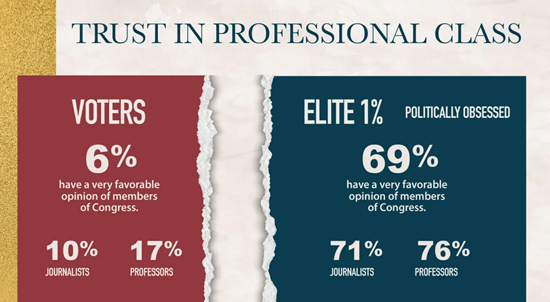
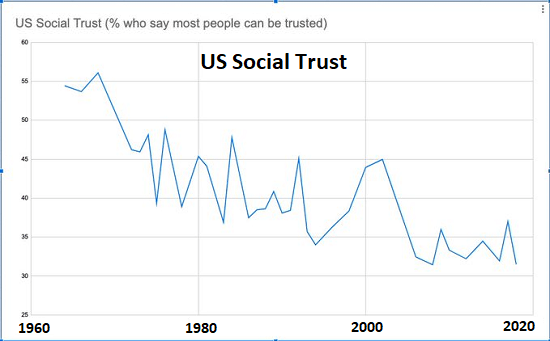
It’s not exactly news that social trust has declined significantly in the United States. Surveys find that public trust in institutions and the professional classes that dominate those institutions has cratered. (see chart below) Social trust–our confidence that other people are trustworthy–has also fallen to multi-decade lows.

This was not the case in decades past. Americans maintained high levels of trust in their institutions, government and fellow citizens. The decline in social trust is across the entire spectrum: our trust in institutions, professional elites and our fellow Americans has declined precipitously.

The causes of this decay of social trust can be debated endlessly, but several factors are obvious:

1. Institutions forfeited the trust of the citizenry by withholding / editing realities to serve the interests of hidden agendas and insiders’ careers. The Vietnam War was pursued on fabrications, as was the second Gulf War to topple Saddam. Watergate eroded trust on multiple levels, as did the Church Committee’s investigation of America’s security agencies’ domestic spying / over-reach.

2. The managerial / professional elites at the top of the nation’s institutions no longer put the citizenry’s interests above their own. The public’s trust has eroded as institutions are primarily viewed as vehicles for self-enrichment and career advancement: healthcare CEOs pay themselves millions, higher education is bloated with layers of non-teaching administration, defense contractors and the Pentagon have greased the revolving door to the benefit of incumbents and insiders, and so on, in an endless parade of self-serving cloaked with smirking PR claims of “serving the public.”

The shift from a high-trust society to a low-trust society is consequential economically, politically and socially. Low-trust societies have stagnant economies, as nobody trusts anyone they don’t know personally or through personally trusted networks, and nobody trust institutions to function effectively or fulfill their stated mission to serve the public good.

Faced with incompetent, unaccountable, corrupt bureaucracies and a culture overflowing with scams, frauds, imposters and get-rich-quick schemes, people give up and drop out. Rather than start a business and accept all the risks just to get dumped on or ripped off, they don’t even try to start a business. Given the financial insecurity that is now the norm, they decide not to get married or have children.

The vast trading networks of the Roman Empire were based on personal trusted networks and trust in Rome’s functionaries / institutions. The owners of trading ships dealt with trusted captains and merchants, who then paid duties to Roman functionaries in Alexandria and other major trading ports.

In other words, tightly bound personal trusted networks work well as long as the state institutions that bind the entire economy are trusted as fair and reliable–not perfect, of course, but efficient and “good enough.”

But when public institutions are viewed as unfair, unreliable, corrupt or incompetent, the entire economy decays. Even personal trusted networks cannot survive in an economy of unfair, unreliable, corrupt or incompetent state bureaucracies and private institutions.

The American economy is now dominated by enormous privately owned and managed monopolies and cartels that are the private-sector equivalent of self-serving state bureaucracies. Big Tech, Big Pharma, Big Healthcare, Big Ag, Big Finance, etc., are even worse than state bureaucracies because there are no legal requirements for transparency or recourse. Try getting a response from a Big Tech corporation when you’ve been shadow-banned or sent to Digital Siberia.

The sole remaining reservoirs of trust in American life are personal networks, local enterprises and local institutions. These are not guaranteed, of course; in many locales, even these reservoirs have been drained. But in other locales, enterprises and institutions such as the county water utility, the local newspaper, the local community college, etc. continue to earn the trust of the public by performing the services they exist to provide effectively and at a reasonable cost.

The larger the institution and the greater its wealth and power, the lower the social trust–for good reasons. The greater the influence of the managerial elites, the greater the disconnect from the everyday experiences of the citizenry and customers, and the more extreme the self-serving PR.

Sure, I trust Big Tech, Big Pharma, Big Healthcare, Big Finance–to rip me off, profiteer, send me obfuscating bills, jack up junk fees, make it impossible to contact them, and send me to Digital Siberia if I complain.

The divide between the elites and the commoners should prompt us to examine the low-trust path we’re sliding down:

In a society in which everything is phony, low quality or fraudulent, you’re taking a chance trusting anyone you don’t know personally–and even that can be risky now that self-aggrandizing flim-flam is the last remaining path to financial security for non-elites.

A low-trust society is an impoverished society, economically stagnant and socially threadbare. That’s where we are now, and the more fragmented, greedy, self-serving, desperate and deranged we become, the lower the odds that we’ll find the means to rebuild trust.

Sadly, we already know that anyone claiming to “rebuild trust” is spouting PR designed to mask self-enrichment. We also know that the vast army of well-paid flacks, factotums, enforcers, happy-story apologists, lackeys, toadies and sell-out minions are declaring “everything’s great!”

Just mumble, “Uh, sure” and continue to Tune in (to degrowth), drop out (of hyper-consumerism and debt-serfdom) and turn on (to self-reliance and relocalizing capital and agency).

Rule by Criminals: When Dissidents Become Enemies of the State

By John & Nisha Whitehead

Source: The Rutherford Institute

In these days of worldwide confusion, there is a dire need for men and women who will courageously do battle for truth.”— Martin Luther King Jr.

When exposing a crime is treated as committing a crime, you are being ruled by criminals.

In the current governmental climate, obeying one’s conscience and speaking truth to the power of the police state can easily render you an “enemy of the state.”

The government’s list of so-called “enemies of the state” is growing by the day.

Wikileaks founder Julian Assange is merely one of the most visible victims of the police state’s war on dissidents and whistleblowers.

Five years ago, on April 11, 2019, police arrested Assange for daring to access and disclose military documents that portray the U.S. government and its endless wars abroad as reckless, irresponsible, immoral and responsible for thousands of civilian deaths.

Included among the leaked materials was gunsight video footage from two U.S. AH-64 Apache helicopters engaged in a series of air-to-ground attacks while American air crew laughed at some of the casualties. Among the casualties were two Reuters correspondents who were gunned down after their cameras were mistaken for weapons and a driver who stopped to help one of the journalists. The driver’s two children, who happened to be in the van at the time it was fired upon by U.S. forces, suffered serious injuries.

There is nothing defensible about crimes such as these perpetrated by the government.

When any government becomes almost indistinguishable from the evil it claims to be fighting—whether that evil takes the form of war, terrorism, torture, drug trafficking, sex trafficking, murder, violence, theft, pornography, scientific experimentations or some other diabolical means of inflicting pain, suffering and servitude on humanity—that government has lost its claim to legitimacy.

These are hard words, but hard times require straight-talking.

It is easy to remain silent in the face of evil.

What is harder—what we lack today and so desperately need—are those with moral courage who will risk their freedoms and lives in order to speak out against evil in its many forms.

Throughout history, individuals or groups of individuals have risen up to challenge the injustices of their age. Nazi Germany had its Dietrich Bonhoeffer. The gulags of the Soviet Union were challenged by Aleksandr Solzhenitsyn. America had its color-coded system of racial segregation and warmongering called out for what it was, blatant discrimination and profiteering, by Martin Luther King Jr.

And then there was Jesus Christ, an itinerant preacher and revolutionary activist, who not only died challenging the police state of his day—namely, the Roman Empire—but provided a blueprint for civil disobedience that would be followed by those, religious and otherwise, who came after him.

Indeed, it is fitting that we remember that Jesus Christ—the religious figure worshipped by Christians for his death on the cross and subsequent resurrection—paid the ultimate price for speaking out against the police state of his day.

A radical nonconformist who challenged authority at every turn, Jesus was a far cry from the watered-down, corporatized, simplified, gentrified, sissified vision of a meek creature holding a lamb that most modern churches peddle. In fact, he spent his adult life speaking truth to power, challenging the status quo of his day, and pushing back against the abuses of the Roman Empire.

Much like the American Empire today, the Roman Empire of Jesus’ day had all of the characteristics of a police state: secrecy, surveillance, a widespread police presence, a citizenry treated like suspects with little recourse against the police state, perpetual wars, a military empire, martial law, and political retribution against those who dared to challenge the power of the state.

For all the accolades poured out upon Jesus, little is said about the harsh realities of the police state in which he lived and its similarities to modern-day America, and yet they are striking.

Secrecy, surveillance and rule by the elite. As the chasm between the wealthy and poor grew wider in the Roman Empire, the ruling class and the wealthy class became synonymous, while the lower classes, increasingly deprived of their political freedoms, grew disinterested in the government and easily distracted by “bread and circuses.” Much like America today, with its lack of government transparency, overt domestic surveillance, and rule by the rich, the inner workings of the Roman Empire were shrouded in secrecy, while its leaders were constantly on the watch for any potential threats to its power. The resulting state-wide surveillance was primarily carried out by the military, which acted as investigators, enforcers, torturers, policemen, executioners and jailers. Today that role is fulfilled by the NSA, the FBI, the Department of Homeland Security and the increasingly militarized police forces across the country.

Widespread police presence. The Roman Empire used its military forces to maintain the “peace,” thereby establishing a police state that reached into all aspects of a citizen’s life. In this way, these military officers, used to address a broad range of routine problems and conflicts, enforced the will of the state. Today SWAT teams, comprised of local police and federal agents, are employed to carry out routine search warrants for minor crimes such as marijuana possession and credit card fraud.

Citizenry with little recourse against the police state. As the Roman Empire expanded, personal freedom and independence nearly vanished, as did any real sense of local governance and national consciousness. Similarly, in America today, citizens largely feel powerless, voiceless and unrepresented in the face of a power-hungry federal government. As states and localities are brought under direct control by federal agencies and regulations, a sense of learned helplessness grips the nation.

Perpetual wars and a military empire. Much like America today with its practice of policing the world, war and an over-arching militarist ethos provided the framework for the Roman Empire, which extended from the Italian peninsula to all over Southern, Western, and Eastern Europe, extending into North Africa and Western Asia as well. In addition to significant foreign threats, wars were waged against inchoate, unstructured and socially inferior foes.

Martial law. Eventually, Rome established a permanent military dictatorship that left the citizens at the mercy of an unreachable and oppressive totalitarian regime. In the absence of resources to establish civic police forces, the Romans relied increasingly on the military to intervene in all matters of conflict or upheaval in provinces, from small-scale scuffles to large-scale revolts. Not unlike police forces today, with their martial law training drills on American soil, militarized weapons and “shoot first, ask questions later” mindset, the Roman soldier had “the exercise of lethal force at his fingertips” with the potential of wreaking havoc on normal citizens’ lives.

A nation of suspects. Just as the American Empire looks upon its citizens as suspects to be tracked, surveilled and controlled, the Roman Empire looked upon all potential insubordinates, from the common thief to a full-fledged insurrectionist, as threats to its power. The insurrectionist was seen as directly challenging the Emperor.  A “bandit,” or revolutionist, was seen as capable of overturning the empire, was always considered guilty and deserving of the most savage penalties, including capital punishment. Bandits were usually punished publicly and cruelly as a means of deterring others from challenging the power of the state.  Jesus’ execution was one such public punishment.

Acts of civil disobedience by insurrectionists. Much like the Roman Empire, the American Empire has exhibited zero tolerance for dissidents such as Julian Assange, Edward Snowden and Chelsea Manning who exposed the police state’s seedy underbelly. Jesus was also branded a political revolutionary starting with his attack on the money chargers and traders at the Jewish temple, an act of civil disobedience at the site of the administrative headquarters of the Sanhedrin, the supreme Jewish council.

Military-style arrests in the dead of night. Jesus’ arrest account testifies to the fact that the Romans perceived Him as a revolutionary. Eerily similar to today’s SWAT team raids, Jesus was arrested in the middle of the night, in secret, by a large, heavily armed fleet of soldiers.  Rather than merely asking for Jesus when they came to arrest him, his pursuers collaborated beforehand with Judas. Acting as a government informant, Judas concocted a kiss as a secret identification marker, hinting that a level of deception and trickery must be used to obtain this seemingly “dangerous revolutionist’s” cooperation. 

Torture and capital punishment. In Jesus’ day, religious preachers, self-proclaimed prophets and nonviolent protesters were not summarily arrested and executed. Indeed, the high priests and Roman governors normally allowed a protest, particularly a small-scale one, to run its course. However, government authorities were quick to dispose of leaders and movements that appeared to threaten the Roman Empire. The charges leveled against Jesus—that he was a threat to the stability of the nation, opposed paying Roman taxes and claimed to be the rightful King—were purely political, not religious. To the Romans, any one of these charges was enough to merit death by crucifixion, which was usually reserved for slaves, non-Romans, radicals, revolutionaries and the worst criminals.

Jesus was presented to Pontius Pilate “as a disturber of the political peace,” a leader of a rebellion, a political threat, and most gravely—a claimant to kingship, a “king of the revolutionary type.” After Jesus is formally condemned by Pilate, he is sentenced to death by crucifixion, “the Roman means of executing criminals convicted of high treason.”  The purpose of crucifixion was not so much to kill the criminal, as it was an immensely public statement intended to visually warn all those who would challenge the power of the Roman Empire. Hence, it was reserved solely for the most extreme political crimes: treason, rebellion, sedition, and banditry. After being ruthlessly whipped and mocked, Jesus was nailed to a cross.

Jesus—the revolutionary, the political dissident, and the nonviolent activist—lived and died in a police state. Any reflection on Jesus’ life and death within a police state must take into account several factors: Jesus spoke out strongly against such things as empires, controlling people, state violence and power politics. Jesus challenged the political and religious belief systems of his day. And worldly powers feared Jesus, not because he challenged them for control of thrones or government but because he undercut their claims of supremacy, and he dared to speak truth to power in a time when doing so could—and often did—cost a person his life.

Unfortunately, the radical Jesus, the political dissident who took aim at injustice and oppression, has been largely forgotten today, replaced by a congenial, smiling Jesus trotted out for religious holidays but otherwise rendered mute when it comes to matters of war, power and politics.

Yet for those who truly study the life and teachings of Jesus, the resounding theme is one of outright resistance to war, materialism and empire.

What a marked contrast to the advice being given to Americans by church leaders to “submit to your leaders and those in authority,” which in the American police state translates to complying, conforming, submitting, obeying orders, deferring to authority and generally doing whatever a government official tells you to do.

Telling Americans to blindly obey the government or put their faith in politics and vote for a political savior flies in the face of everything for which Jesus lived and died.

Will we follow the path of least resistance—turning a blind eye to the evils of our age and marching in lockstep with the police state—or will we be transformed nonconformists “dedicated to justice, peace, and brotherhood”?

As Martin Luther King Jr. reminds us in a powerful sermon delivered 70 years ago, “This command not to conform comes … [from] Jesus Christ, the world’s most dedicated nonconformist, whose ethical nonconformity still challenges the conscience of mankind.”

Ultimately, as I make clear in my book Battlefield America: The War on the American People and in its fictional counterpart The Erik Blair Diaries, this is the contradiction that must be resolved if the radical Jesus—the one who stood up to the Roman Empire and was crucified as a warning to others not to challenge the powers-that-be—is to be an example for our modern age.

Saturday Matinee: Death Machine

THE DAILY DIG: DEATH MACHINE (1994)

“DEATH MACHINE” HAS ALL THE WORKINGS TO BE A CULT SCI-FI HORROR FILM, RIPE FOR REDISCOVERY AND A PROPER US RELEASE FINALLY.

By Bobby Lisse:

Source: Morbidly Beautiful

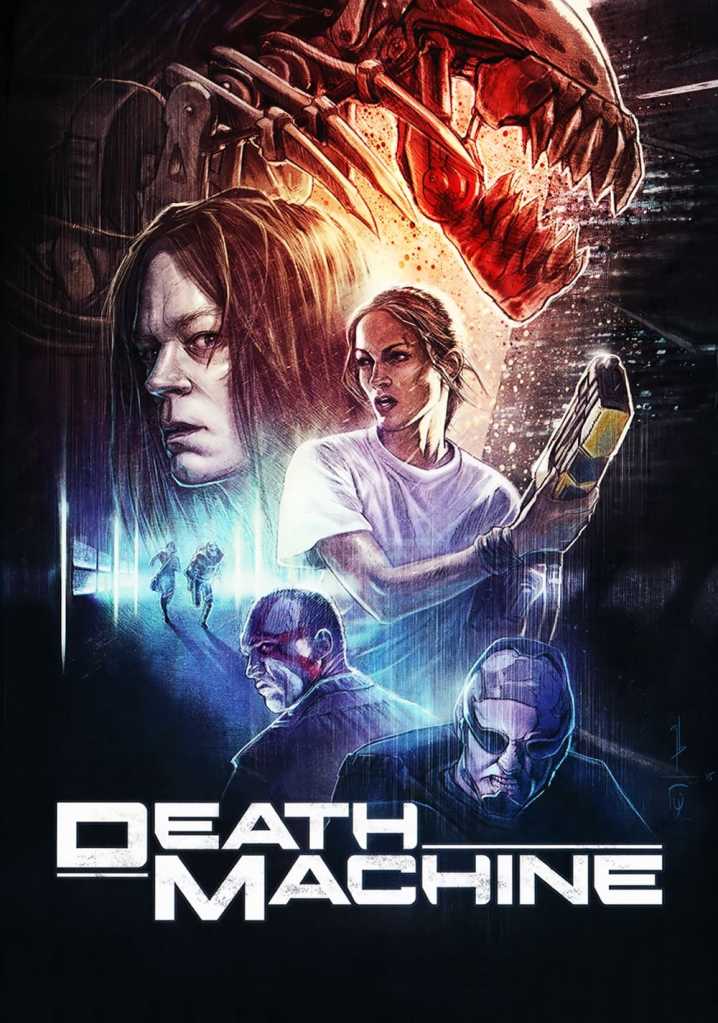
A weapons manufacturer tries to cover up its mistakes with a super soldier program while a morally sound executive does her best to uncover their evil plot and the scientist behind it all plots to maim and destroy it all. Let’s dig into 1994’s “Death Machine”, directed by Stephen Norrington!

AS I SEE IT

The directorial debut from Stephen Norrington, and reportedly the effort that landed him the director’s chair for BladeDeath Machine is a good movie with an arsenal of flaws.

Set in the future, which is now past, 2003, we follow the company Chaank that provides military weapons. Their failed Robocop-like super-soldier suit has malfunctioned and caused a slaughter of civilians. Now they’re back to the drawing board, so to speak, though the bottom line is always more important. In steps Scott Ridley who instructs the board they will just be pivoting.

The mad scientist behind the creation, Jack Dante, secretly creates a psycho-death bot named Warbeast. And once the fun starts, this metal death force shreds everyone in its path.

The story has interesting points, such as the evil corporation, the righteous humanist alliance, and the mad genius hellbent on domination. But the acting and script fall off a cliff a little more than halfway through the film. The sets are great, and the animation on the Warbeast is chaotic and amazing, which makes sense because the Director used to cut his teeth in creature effects on films like Aliens and Alien 3. 

The homages are off the charts.

Some of the examples I picked up on were sound effects from DoomMasters of the Universe toys that decorate Dante’s office, a Daffy Duck impression from Brad Dourif, a battle cry from Street Fighter, as well as the Warbeast resembling a Mouser from Teenage Mutant Ninja Turtles. The names of the characters as well are tributary. Some are identical: John Carpenter, Scott Ridley (Ridley Scott), Jack Dante (Joe Dante), Weyland, Yutani (Alien).

There was too much whimsy and cheeky humor inserted for the tone of the film and could have used some fine-tuning. But I feel it was just on the cusp of being a classic sci-fi/horror.

FAMOUS FACES

Brad Dourif (Dante): you know him, you love him, he’s everyone’s favorite good guy. He always brings the same quality of maniacal energy and really excels as the bad guy, but no role was as iconic and great as that of our friend Chuck in Child’s Play. 

He has since become a Rob Zombie regular (31 and Three from Hell), but Richard Brake (Ridley) showed he has the propensity for villainy in what I felt was an underappreciated role. He really stood out, and it was a shame he was killed off so early as he seemed to have an insurmountable level of maddening bravado.

William Hootkins (John Carpenter) is probably most famous as Porkins (Red Six) in Star Wars. He also played Eckhart in Tim Burton’s Batman.

Rachel Weisz has a brief cameo in this her first feature, and would later go on to star in The Mummy series and marry James Bond.

OF GRATUITOUS NATURE

The inclusion of the heartbreaking and gut-wrenching story of Cale’s daughter getting her arm flayed in a garbage disposal does nothing for the greater good of the story. It affords Pouget an opportunity to display another emotion in her repertoire. At this point, however, the script already jumped the shark.

HEARTTHROB

Ely Pouget (Hayden Cale) is a great leading lady for this genre, and her skills are emphasized in the first half of the film. She’s got Ripley’s bad-ass woman card in my opinion, and she’s beautiful to boot. She seems to have hardly aged since 1994 in most recent photographs as well.

RIPE FOR A REMAKE

This is one of those odd, hardly heard of, 90’s films that deserved better. I know it’s been given numerous cuts and a so-called definitive cut, but it could really stand to use some sound editing and unbiased clipping. It’s not sacred ground, but I would rather it see a clean pass rather than a clean slate.

SPAWNS

No progeny to report.

WHERE TO WATCH

An uncut Blu-ray was released in Germany (the version I watched). If you don’t feel like paying up for it, you can stream on Amazon Prime, Roku, Vudu, or Plex.

BANNING TIKTOK IS NOT ABOUT FIGHTING CHINA, IT’S ABOUT PROTECTING WESTERN NARRATIVES AND ISRAEL’S WAR CRIMES IN THE MIDDLE EAST

By Timothy Aleander Guzman

Source: Silent Crow News

The US government claims that TikTok is a national security threat because China can collect data on its users for “intelligence gathering.” Give me a break! The House of Representatives passed a bill to ban TikTok unless Byte Dance, the Chinese parent company “divests” from the app within six months or so, in other words, they are forcing Byte Dance to sell TikTok within a certain time period in order for it to operate in the US.  Former Treasury Secretary, Steven Mnuchin said on CNBC’s “Squawk Box” that he is putting together an investor group to supposedly buy TikTok. 

The reality is that they are not going after TikTok because of China’s “intelligence gathering” on US citizens, it is because Western governments, Israel and their mainstream media networks are being exposed for their lies and propaganda more than ever before by various alternative media websites, blogs, social media, and video-sharing platforms such as TikTok.

China’s “Intelligence Gathering” vs. Israel’s War Crimes

It is most likely that the US congress is scapegoating China mainly to protect Israel’s reputation in the last bastion of its supporters in the United States were there are more than 170 million TikTok users.  In one way or another Israel’s war crimes in Gaza and beyond has been exposed on TikTok and it does not look good for the self-described “Jewish State.” 

Last January, the US-based TIME magazine reported on the reality of how the world views Israel and its actions in the Middle East, “New data shared with TIME magazine business intelligence company Morning Consult shows that support for Israel around the world has dropped significantly since the war in Gaza began.”  Morning Consult found that Israel’s standing in world opinion has dropped dramatically, “Net favorability—the percentage of people viewing Israel positively after subtracting the percentage viewing it negatively—dropped globally by an average of 18.5 percentage points between September and December, decreasing in 42 out of the 43 countries polled.”   

From China to South Korea, even in the UK and several countries in Latin America all had a somewhat positive view of Israel, but when the war on Gaza began, opinion polls on Israel’s favorability status collapsed:

China, South Africa, Brazil, and several other countries in Latin America all went from viewing Israel positively to negatively. And many rich countries that already had net negative views of Israel—including Japan, South Korea, and the U.K.—saw steep declines. Net favorability in Japan went from -39.9 to -62.0; in South Korea from-5.5 to -47.8; and in the U.K. from -17.1 to -29.8

Sonnet Frisbie, the deputy head of political intelligence at Morning Consult said that “the data shows just how tough of a road Israel has right now in the international community.”  Of course, the US population still holds a favorable opinion of Israel, “The U.S. remains the only rich country that still had net positive views of Israel. Net favorability dropped just 2.2 percentage points, from a net favorability of 18.2 to a net favorability of 16 from September to December” the report said. 

Al Jazeera‘Israel has lost the war of public opinion,’ by Imam Omar Suleiman published last year said that “In a new media landscape dominated not by Western media giants but by Instagram reels, TikTok videos and YouTube shorts, Israel’s ongoing war on the besieged Gaza Strip is more than televised.” 

Israel’s crimes have been exposed due to the internet including alternative media networks and various social media platforms since the Zionist controlled mainstream media failed to do its job which should not be a surprise to anyone. 

Platforms such as TikTok has more than 170 million users in the US which is a concern for both the US and Israeli governments who propagandize the US population on a daily basis on the situation of Palestine through their control of the mainstream media and Hollywood:

Audiences across the world, and especially young people, have been watching the devastation caused by Israel’s indiscriminate bombardment of the Palestinian enclave on their preferred social media platforms, in real-time, for over a month. Anyone with internet access has seen countless videos of babies torn apart by bombs, women crushed under tonnes of concrete and mothers cradling the dead bodies of their children

Suleiman said that “Israel, of course, still continues with its usual efforts – and more – to control the narrative about its bloody wars and decades-old occupation.”  He pinpoints how Israel is losing the information war:

Yet, despite all these efforts, thanks largely to social media, Israel is no longer able to conceal the truth about its conduct in Palestine. It can no longer control the narratives and the public opinion on Palestine. As mainstream media loses its ability to single-handedly decide what Western and, to a certain extent, global audiences get to witness about the situation in Palestine, the brutality of Israel’s occupation has been laid out in the open for everyone to see

The Times of Israel published an article based on Israel’s obvious concerns regarding TikTok, Major US Jewish group backs bipartisan bill that could see TikTok banned’ said that “One of the most prominent Jewish groups in the country has thrown its support behind a fast-advancing bill that could lead to the massively popular video app TikTok being banned in the United States.” 

The world knows that both Democrats and Republicans in the US Capital are in the pockets of Jewish lobbying groups are moving forward in efforts to ban TikTok because its a “Chinese owned app” and it is collecting data on American citizens. 

In my opinion, why would China spy on US citizens since most people in the US are in debt or are too busy watching reality TV, celebrity news or sports, in fact, many could not even find China or any other Asian country on a map.  It’s a harsh statement, but it’s a fact.  Besides there are companies (some are based in the US including Amazon) who have been selling your data for some time now. It’s no secret.

The article states that “Politicians backing the bill, who include leaders from both parties, have centered their criticism of TikTok on national security concerns related to the app’s Chinese ownership and data collection practices.”  Representative Cathy McMorris Rodgers, a Republican from Washington said that “It is very important that it is targeted and specific to the national security threat” and that “This is not related to content. This is about the threat because of the data that has been collected.” So, the ban on TikTok is not related to the content? That’s pure nonsense.  The Times of Israel at least stated the facts on why the US and Israel is really interested in banning the platform:

Jewish Federations of North America, representing hundreds of organized Jewish communities, said its support for the bill is rooted in concerns about antisemitism on the platform. The Jewish Federations and the Anti-Defamation League have accused TikTok of allowing antisemitism and anti-Israel sentiment to run rampant

The Jewish Federations of North America (JFNA) wrote a letter to the US Congress claiming that “The single most important issue to our Jewish communities today is the dramatic rise in antisemitism” and that “Our community understands that social media is a major driver of the drive-in antisemitism and that TikTok is the worst offender by far.” 

Banning TikTok is about censorship.  It is a fact that Israel’s war crimes and the destructive nature of the US war machine is getting exposed more than ever before. US lawmakers are giving Byte Dance which is managed by Shou Zi Chew, a Singaporean citizen, about six months to divest US assets from the app, or they will face a ban.  If the ban of TikTok moves forward, then free speech in the US is completely dead.  But that does not mean all social media platforms or even websites will be in danger for the foreseeable future because there will be other apps and platforms that the US, EU, and Israeli political establishment won’t be able to control. 

Banning TikTok will Only Motivate Us to Create Other Platforms    

Social Media platforms such as YouTube, Facebook, and Twitter (although owned by Elon Musk) have been completely hijacked by the government censorship regime.  The Western political establishment, Globalist bankers, Zionists, Multi-national corporations such as Big Oil and Big Pharma and others around the world are facing an information war that they are clearly losing. 

The internet has given us the tools to fight the mainstream media and their lies.  Several social media platforms have grown to be a vital tool to challenge government and corporate propaganda such as TikTok, but there are also other various types of online-video platforms such as RumbleBit ChuteOdysee (part of LBRY, a blockchain based file-sharing and payment network) and we must include instant messaging services such as Telegram and VK where you can post articles and videos as well. 

The point here is that regardless of how certain governments such as the US and the European Union who have banned foreign media companies such as Russia’s RT News and Iran’s Press TV, they also have plans to ban social media platforms, but it won’t work.      

They believe that banning TikTok will prevent people from getting the truth especially to what is happening in Palestine, but they are wrong, it will only help motivate people to create new platforms and other ideas, they will create new channels of information that would get out to the public.  Whether they ban TikTok or not, the genie is out of the bottle, the truth can never be suppressed.