
The World Wants to Be Deceived

By Edward Curtin

Source: Behind the Curtain

My title comes from a 19th century author whose name does not matter nor would it mean much if I mentioned him.  It’s an old truth that has not changed a bit over the centuries.  I think, however, it would be more linguistically accurate to say that most people want to be deceived, for the world, the earth doesn’t give a damn, as the French poet Jacques Prévert reminds us in “Song in the Blood”:

There are great puddles of blood on the world
where’s it all going all this spilled blood
is it the earth that drinks it and gets drunk
funny kind of drunkography then
so wise . . . so monotonous . . .
No the earth doesn’t get drunk
the earth doesn’t turn askew
it pushes its little car regularly its four seasons
rain . . . snow
hail . . . fair weather
never is it drunk
. . . . . . . . . . . . . . . .
It doesn’t give a damn
The earth

But people, the thinking reeds as Pascal called us, we, who through the support of wars and violence of all sorts, care just enough to want to be deceived as to what we are doing by making so much blood that is inside people get to the outside for the earth to drink.

I could, of course, quote liberally from truth tellers down through history who have said the same thing about self-deception with all its shades and nuances. Those quotations are endless.  Why bother?  At some very deep level in the recesses of their hearts, people know it’s true.  I could make a pretty essay here, be erudite and eloquent, and weave a web of wisdom from all those the world says were the great thinkers because they are now dead and can no longer detect hypocrisy.

For the desire to be deceived and hypocrisy (Greek hypokrites, stage actor, a pretender) are kissing cousins.  I write this to try to say something of value about the mass idiocy of the media’s daily barrage of lies and stupidities that pass for news on the front pages and newscasts of the corporate media.  And the people who believe them.

It is not easy.  No matter how obviously absurd the claims about Chinese “spy” balloons, the shooting down of unidentified flying objects, reports of how Russia is losing the war in Ukraine, all the support for presidents and prime ministers who shill for the war industries, etc. – a list that could be extended indefinitely on a daily basis – these media are relentless in presenting government propaganda juxtaposed with trivia.

When you think they must realize they have gone too far since even a moron could see through their fabrications, they double down.  And I am referring only to what they do report, not what they omit – e.g. how the U.S. has restricted aid to the earthquake victims in Syria or Seymour Hersh’s report on the U.S. blowing up the Nord Stream pipelines, two examples of terror by a terrorist state that must be protected at all costs.  This is the protection racket by omission and commission.

Maybe an anecdote would help. A week ago, I ran into an old friend at a coffee shop.  Hersh’s article, aspects of which I question, had just come out and I asked him if he had seen it.  He said he hadn’t but didn’t know anything about such pipelines being blown up.  I was stunned.  A devout consumer of mainstream media, yet he somehow missed this major September 2022 event in the U.S. war against Russia that was reported widely by the media he relies upon.  Those media went on to suggest that Russia blew up its own pipelines, a claim beyond ridicule but one that was part of its war propaganda narrative.  My friend is a guy who has strong opinions about everything and finds NPR, The Guardian, The New York Times, CNN, etc. to be credible news sources.  How could he have missed one of the major stories of 2022, one that The New York Times, etc. was reporting on into December, still suggesting that Russia did the deed?  How could he have missed the pipeline story whose reverberations spread through all aspects of the U.S. war against Russia via Ukraine when it was referenced in so many reports of gas and oil prices, a cold winter for Europe, and so many other issues?  Its ramifications are manifold and have been reported as such, but he had never heard of it.  I was stunned.

I wanted to quote him Dylan’s facetious words from “The Ballad of the Thin Man”: “’Cause something is happening/And you don’t know what it is/Do you, Mister Jones?”  But I did not.

I have spent a week wondering how it is possible that he didn’t know anything about the pipeline explosions.  I am sure he wasn’t lying to me.  So how explain it?

In the interim, as I have been trying to comprehend these matters, the Super Bowl with its mesmeric half-time spectacle replete with crotch grabbing has come and gone, and I have read an interesting article by Ethan Strauss, a sports journalist, “Why America Needs Football. Even its Brutality” that raises important questions.

Much has been written about football’s violence and the injuries it causes, the most recent example being the near fatal injury to Damar Hamlin of the NFL’s Buffalo Bills that garnered headlines for weeks (even though why he suffered cardiac arrest has been left unanswered since that would raise the COVID vaccine problem, which is also taboo).  Strauss notes the many arguments calling for the banning of football – the war game – because of its violence.  He notes that it is very true that football is very violent but that this is part of its great appeal.  He writes:

And the NFL gives Americans that war, as spectacle, week after week.

Today, at 6:30 p.m., eastern time, begins the biggest spectacle of them all: the Super Bowl, where we channel those ancient animal spirits into a highly commercialized event that ends with fireworks and a shiny trophy.

We should celebrate that.

He doesn’t argue for the celebration of war, which he opposes, but for the war-like game of football.  To Malcolm Gladwell’s statement in support of the banning of football as “a moral abomination” – “This is a sport that is living in the past that has no connection to the realities to the game right now and no connection to American society.” – he responds quite rightly that Gladwell is wrong:

In 2022, 82 of the top 100 TV shows in America were NFL games, and the top 50 most viewed sporting events were football games or events that immediately followed football games. By contrast, in 2016, only 33 of the top 50 were football-related. The country has lost interest in so much else, but football remains a huge draw and, in fact, is gaining relative market share.

Americans love violence, not just the military propaganda that precedes the Super Bowl game, but the smashing hits that players make and take in the games.  It is hard to deny.  Strauss goes on to show how over ninety percent of former NFL players who suffer from daily lifelong pain say they would do it again.  The violence is intoxicating and Americans get drunk on it.  It is the American Way.

I don’t agree with all of Strauss’s points or assumptions, especially his imperative that “we have war within us, whether or not there’s one to wage,” but he clearly is right that despite all the rhetoric about how terrible violence is, there is something about it that Americans love.  D. H. Lawrence’s point a century ago still applies: “The essential America soul is hard, isolate, stoic, and a killer.  It has never yet melted.”

But this killer soul must be hidden behind a wall of deceptions as the U.S. warfare state ceaselessly wages wars all around the world.  It must be hidden behind feel good news stories about how Americans really care about others, but only others that they are officially allowed to care about.  Not Syrians, Yemenis, Russian speakers of the Donbass, Palestinians, et al.  The terrorist nature of decades upon decades of U.S. savagery and the indifference of so many Americans go hand-in-hand but escape notice in the corporate media.  The major theme of these media is that the United States government is the great defender of freedom, peace, and democracy.  Every once in a while, a scapegoat, one rotten apple in the barrel, is offered up to show that all is not perfect in paradise.  But essentially it is one massive deception.

There’s a make-believe quality to this vast spectacle of violent power and false innocence that baffles the mind.  To see and hear the corporate masked media magicians’ daily reports is to enter a world of pure illusion that deserves only sardonic laughter but sadly captivates so many adult children desperate to believe.  This is so even as the propagandists’ trial balloons are popped in the society of the comedic spectacle.

But back to my friend I mentioned earlier. He hates violence in all its forms, is strongly opposed to war, and has a most compassionate heart, yet he remains devoted to the media that have lied us – and continue to do so – into war after war, a media that clearly fronts for the warfare state.  I still can’t explain how he knew nothing about the pipeline explosions.  Nor can I explain his allegiance to the media that lie to him daily.

Even as his government, led by that very media, leads the world toward nuclear annihilation, he remains true to his media informants.

I am stunned.

In the Blood

Born in a normal time,
The periodic slaughter of millions
By the civilized nations of the earth
I grew to adulthood half-crazed
With fear and numbed wonder.

I always wished to believe otherwise,
That people were good at heart,
Wanted to live in mutual peace
And tend the green earth as if
It were a garden
As if pity vivified all living things.

Somehow the blood that was in me
Said otherwise,
Spoke truth to the power
Of my wish,
While everywhere around me lay the lie.

But my blood, this blood that became me
While millions were being butchered
And Bing Crosby crooned I’m dreaming
Of a white Christmas,
This red blood said otherwise.

Do not accept the way they say
“Good Morning”
And the way they nod as they pass,
As though they didn’t want to kill
Each other.

Do not believe their eyes
And the way they pray to the skies
To save them.
Do not believe their beliefs,
All lies woven to deceive.
For at heart they truly hate
The green earth.

Do not believe the way they say
“Good Evening”
For they wish the darkest night
To descend upon us,
The nothingness of their knowledge
To swallow all.

That is what will release them,
That is all.

Thus my blood spoke to me,
A child of a sanguine century,
Born in a normal time,
The periodic slaughter of millions
By the civilized nations of the earth.

And despite all appearances,
I have never believed them.
Never.  Not at all.
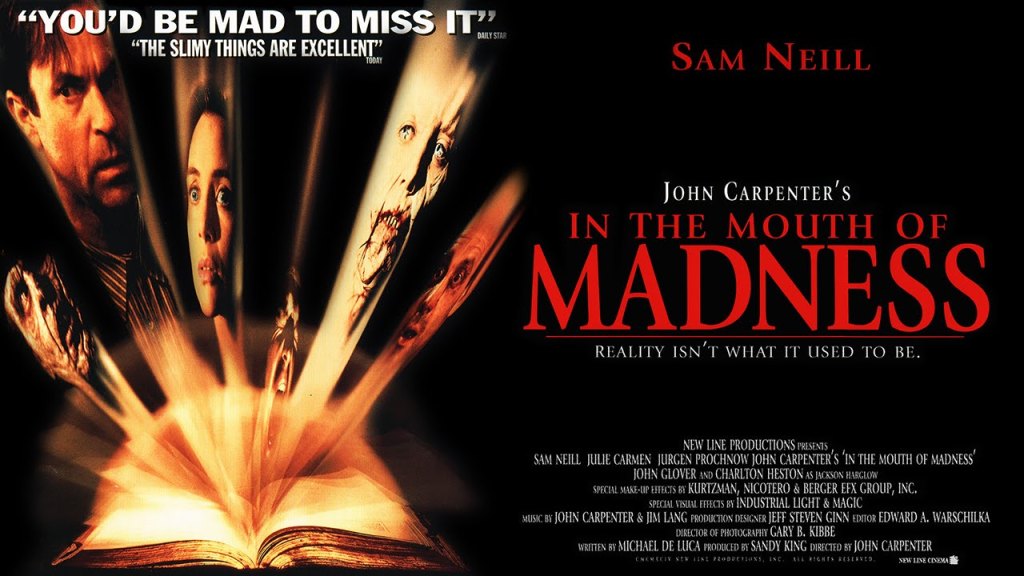
Saturday Matinee: In the Mouth of Madness

That Time John Carpenter Went Meta With ‘In the Mouth of Madness’

As always, Carpenter was light years ahead of his time.

By Nick L.

Source: Collider

One of John Carpenter’s more endearing traits is his aversion to self-effacing clowning. This is not at all to suggest that Carpenter’s films aren’t funny — rather, it’s that the living genre legend often opts to play familiar B-movie scenarios completely straight, whether it be a terse gangland standoff rendered as a modern-day Western showdown (Assault On Precinct 13, one of the most influential films of the 20th century) or a masked killer, bereft of any overwrought psychological motive, terrorizing the inhabitants of a sleepy all-American suburb (Halloween, of course). While Carpenter has dabbled in satire (They Live) and high-concept fantasy (Big Trouble In Little China) over the course of his now decades-spanning career, the grounded nature of his approach is often its own reward. The Escape From New York director has all but perfected an economical, tough-minded creative ethos that has gone on to influence an entire generation of filmmakers dabbling in sci-fi, horror, and beyond.

Going Meta Before It Was Cool

In the Mouth of Madness, Carpenter’s glorious 1994 cult masterpiece, might be the most conspicuous exception to this rule. The story of an insurance investigator who begins losing his grip on reality while probing the mysterious disappearance of a lucratively popular horror author named Sutter Cane, In the Mouth of Madness is an unabashedly meta exploration of the creative act as a form of hypnosis. It is not only a film whose central plot conceit is unique to the moral panic that defined so much of the decade in which it was released (the idea that exposure to certain “corrupt” media could warp one’s brain and possibly even compel one to commit violent acts, etc.), it’s also a cutting cautionary tale about surrendering to artifice and fantasy, and a clever-but-never-obnoxious social lampoon about what it means to be considered the master of a low trade.

Of course, John Carpenter knows a thing or two about being unfairly labeled as the master of a low trade. Carpenter, who is known for his tell-it-like-it-is demeanor, once quipped: “In England, I’m a horror director. In Germany, I’m a filmmaker. In the U.S., I’m a bum.” Films like the Jeff Bridges-starring Starman and the memorably nasty high school bloodbath Christine might be considered totemic cult items today, but many of Carpenter’s more beloved works were initially decried as trash in their time. As such, Carpenter and screenwriter Michael De Luca (yes, that Michael De Luca) turn In the Mouth of Madness’ most important character, Sutter Cane, into the Ernest Hemingway of airport novels. Clearly, the obvious allusion with Cane is Stephen King (or perhaps, to a lesser extent, Clive Barker), right down to the fact that Mouth of Madness eventually makes a narrative detour to Hobb’s End: a kind of bastardized stand-in for King’s own sleepy, creepy fictional borough, Castle Rock.

Third Film of the Apocalypse Trilogy

In The Mouth Of Madness opens with Sam Neil’s John Trent being admitted to a psychiatric hospital. He appears to have gone stark-raving mad, as evidenced by the demented look in his eyes, and the vaguely occult-looking marks he’s scrawled onto his face. In a gesture that feels borrowed from a tale by H.P. Lovecraft (Carpenter’s reverence for Lovecraft is well-documented at this point), Trent begins to recall the tale of how exactly he went mad. We learn that when Trent worked in insurance, his employer (Charlton Heston) tasked him with looking into the matter of Sutter Cane. For all intents and purposes, Cane appears to have vanished off the face of the earth. After its ghoulish prologue, Mouth of Madness settles into a more deliberately routine rhythm, only to disappear further and further down the proverbial rabbit hole as Trent and a colleague, Cane’s editor (memorably played by Julie Carmen), find themselves lost among the otherworldly horrors of Hobb’s End.

In The Mouth Of Madness is the third and final film in John Carpenter’s “Apocalypse Trilogy,” which also includes The Thing and the criminally underappreciated Prince of Darkness. In all three films, evil manifests as a primarily unseen, invisible force, often contorting familiar things like dogs, books, and human bodies into horrifying and hitherto-unseen new shapes. In The Thing, Kurt Russell and his motley crew of researchers hole up in icy Arctic seclusion, fending off the malevolent energy of a shapeshifting, violently hostile alien parasite. In Prince Of Darkness, a group of college students occupy an incredibly menacing old church, where they proceed to unearth a tube of neon-green liquid that, if mishandled, could unleash the very literal fury of the devil. Both movies are steeped in Lovecraftian imagery and primordial terror, and both amplify the built-in claustrophobia of their settings to phantasmagoric degrees.

In The Mouth Of Madness is a funnier, sillier, more stylistically gonzo effort than its two predecessors in the trilogy, mostly because it purports to stand outside the nuts and bolts of its superficial narrative, to some degree, and actually comment on the art of what it means to scare people for a living. There is something wickedly ingenious about the idea of a popular novel whose contents are so unholy that reading it would cause one to spiral into a kind of monstrous abyss. If that idea alone were all the movie were interested in, In the Mouth of Madness would still rank as one of Carpenter’s more enjoyable late-career works. And yet, as always, the director is keen to dig deeper into the subtextual resonance of his story, turning what might otherwise be a spooky ’90s chiller — the type of thing you might have caught a rerun of on TBS sometime back in the 2000s — into a cheeky, compelling commentary on the horror pantheon itself, and Carpenter’s place in it.

We live in an era where people willingly and enthusiastically sign themselves over to fictional “universes.” Whether it’s Marvel, Star Wars, Game of Thrones, or perhaps something more obscure, we now inhabit an epoch in which individuals willingly give themselves up to elaborate forms of corporate mythology. In some cases, this sort of fanboy devotion can swallow you whole. In the Mouth of Madness is concerned with this very subject. It is no wonder the film was greeted with such indifferent critical notices upon its release: as always, Carpenter was light years ahead of his time. The scariest thing about In the Mouth of Madness is that, in the world Carpenter hath created, Sutter Cane himself isn’t even seen as a mere writer of trash books — when he’s finally revealed, he is tellingly and literally depicted as a prophet.

Dictators Bent on Building Military Empires: The Cost of the Nation’s Endless Wars

By John & Nisha Whitehead

Source: The Rutherford Institute

“Autocrats only understand one word: no, no, no. No you will not take my country, no you will not take my freedom, no you will not take my future… A dictator bent on rebuilding an empire will never be able to ease the people’s love of liberty. Brutality will never grind down the will of the free.”—President Biden

Oh, the hypocrisy.

To hear President Biden talk about the Russia’s aggression against Ukraine, you might imagine that Putin is the only dictator bent on expanding his military empire through the use of occupation, aggression and oppression.

Yet the United States is no better, having spent much of the past half-century policing the globe, occupying other countries, and waging endless wars.

What most Americans fail to recognize is that these ongoing wars have little to do with keeping the country safe and everything to do with propping up a military industrial complex that has its sights set on world domination.

War has become a huge money-making venture, and the U.S. government, with its vast military empire, is one of its best buyers and sellers.

America’s part in the showdown between Russia and the Ukraine has already cost taxpayers more than $112 billion and shows no signs of abating.

Clearly, it’s time for the U.S. government to stop policing the globe.

The U.S. military reportedly has more than 1.3 million men and women on active duty, with more than 200,000 of them stationed overseas in nearly every country in the world.

American troops are stationed in Somalia, Iraq and Syria. In Germany, South Korea and Japan. In Saudi Arabia, Jordan and Oman. In Niger, Chad and Mali. In Turkey, the Philippines, and northern Australia.

Those numbers are likely significantly higher in keeping with the Pentagon’s policy of not fully disclosing where and how many troops are deployed for the sake of “operational security and denying the enemy any advantage.” As investigative journalist David Vine explains, “Although few Americans realize it, the United States likely has more bases in foreign lands than any other people, nation, or empire in history.”

Incredibly, America’s military forces aren’t being deployed abroad to protect our freedoms here at home. Rather, they’re being used to guard oil fields, build foreign infrastructure and protect the financial interests of the corporate elite. In fact, the United States military spends about $81 billion a year just to protect oil supplies around the world.

The reach of America’s military empire includes close to 800 bases in as many as 160 countries, operated at a cost of more than $156 billion annually. As Vine reports, “Even US military resorts and recreation areas in places like the Bavarian Alps and Seoul, South Korea, are bases of a kind. Worldwide, the military runs more than 170 golf courses.”

This is how a military empire occupies the globe.

After 20 years of propping up Afghanistan to the tune of trillions of dollars and thousands of lives lost, the U.S. military may have finally been forced out, but those troops represent just a fraction of our military presence worldwide.

In an ongoing effort to police the globe, American military servicepeople continue to be deployed to far-flung places in the Middle East and elsewhere.

This is how the military industrial complex, aided and abetted by the likes of Joe Biden, Donald Trump, Barack Obama, George W. Bush, Bill Clinton and others, continues to get rich at taxpayer expense.

Yet while the rationale may keep changing for why American military forces are policing the globe, these wars abroad aren’t making America—or the rest of the world—any safer, are certainly not making America great again, and are undeniably digging the U.S. deeper into debt.

War spending is bankrupting America.

Although the U.S. constitutes only 5% of the world’s population, America boasts almost 50% of the world’s total military expenditure, spending more on the military than the next 19 biggest spending nations combined.

In fact, the Pentagon spends more on war than all 50 states combined spend on health, education, welfare, and safety.

The American military-industrial complex has erected an empire unsurpassed in history in its breadth and scope, one dedicated to conducting perpetual warfare throughout the earth.

Since 2001, the U.S. government has spent more than $4.7 trillion waging its endless wars.

Having been co-opted by greedy defense contractors, corrupt politicians and incompetent government officials, America’s expanding military empire is bleeding the country dry at a rate of more than $32 million per hour.

In fact, the U.S. government has spent more money every five seconds in Iraq than the average American earns in a year.

Future wars and military exercises waged around the globe are expected to push the total bill upwards of $12 trillion by 2053.

Talk about fiscally irresponsible: the U.S. government is spending money it doesn’t have on a military empire it can’t afford.

Unfortunately, even if we were to put an end to all of the government’s military meddling and bring all of the troops home today, it would take decades to pay down the price of these wars and get the government’s creditors off our backs.

As investigative journalist Uri Friedman puts it, for more than 15 years now, the United States has been fighting terrorism with a credit card, “essentially bankrolling the wars with debt, in the form of purchases of U.S. Treasury bonds by U.S.-based entities like pension funds and state and local governments, and by countries like China and Japan.”

War is not cheap, but it becomes outrageously costly when you factor in government incompetence, fraud, and greedy contractors. Indeed, a leading accounting firm concluded that one of the Pentagon’s largest agencies “can’t account for hundreds of millions of dollars’ worth of spending.”

Unfortunately, the outlook isn’t much better for the spending that can be tracked.

A government audit found that defense contractor Boeing has been massively overcharging taxpayers for mundane parts, resulting in tens of millions of dollars in overspending. As the report noted, the American taxpayer paid:

$71 for a metal pin that should cost just 4 cents; $644.75 for a small gear smaller than a dime that sells for $12.51: more than a 5,100 percent increase in price. $1,678.61 for another tiny part, also smaller than a dime, that could have been bought within DoD for $7.71: a 21,000 percent increase. $71.01 for a straight, thin metal pin that DoD had on hand, unused by the tens of thousands, for 4 cents: an increase of over 177,000 percent.

That price gouging has become an accepted form of corruption within the American military empire is a sad statement on how little control “we the people” have over our runaway government.

Mind you, this isn’t just corrupt behavior. It’s deadly, downright immoral behavior.

Americans have thus far allowed themselves to be spoon-fed a steady diet of pro-war propaganda that keeps them content to wave flags with patriotic fervor and less inclined to look too closely at the mounting body counts, the ruined lives, the ravaged countries, the blowback arising from ill-advised targeted-drone killings and bombing campaigns in foreign lands, or the transformation of our own homeland into a warzone.

That needs to change.

The U.S. government is not making the world any safer. It’s making the world more dangerous. It is estimated that the U.S. military drops a bomb somewhere in the world every 12 minutes. Since 9/11, the United States government has directly contributed to the deaths of around 500,000 human beings. Every one of those deaths was paid for with taxpayer funds.

The U.S. government is not making America any safer. It’s exposing American citizens to alarming levels of blowback, a CIA term referring to the unintended consequences of the U.S. government’s international activities. Chalmers Johnson, a former CIA consultant, repeatedly warned that America’s use of its military to gain power over the global economy would result in devastating blowback.

The 9/11 attacks were blowback. The Boston Marathon Bombing was blowback. The attempted Times Square bomber was blowback. The Fort Hood shooter, a major in the U.S. Army, was blowback.

The U.S. military’s ongoing drone strikes will, I fear, spur yet more blowback against the American people.

The war hawks’ militarization of America—bringing home the spoils of war (the military tanks, grenade launchers, Kevlar helmets, assault rifles, gas masks, ammunition, battering rams, night vision binoculars, etc.) and handing them over to local police, thereby turning America into a battlefield—is also blowback.

James Madison was right: “No nation could preserve its freedom in the midst of continual warfare.” As Madison explained, “Of all the enemies to public liberty war is, perhaps, the most to be dreaded because it comprises and develops the germ of every other. War is the parent of armies; from these proceed debts and taxes… known instruments for bringing the many under the domination of the few.”

We are seeing this play out before our eyes.

The government is destabilizing the economy, destroying the national infrastructure through neglect and a lack of resources, and turning taxpayer dollars into blood money with its endless wars, drone strikes and mounting death tolls.

Clearly, our national priorities are in desperate need of an overhauling.

At the height of its power, even the mighty Roman Empire could not stare down a collapsing economy and a burgeoning military. Prolonged periods of war and false economic prosperity largely led to its demise. As historian Chalmers Johnson predicts:

The fate of previous democratic empires suggests that such a conflict is unsustainable and will be resolved in one of two ways. Rome attempted to keep its empire and lost its democracy. Britain chose to remain democratic and in the process let go its empire. Intentionally or not, the people of the United States already are well embarked upon the course of non-democratic empire.

This is the “unwarranted influence, whether sought or unsought, by the military-industrial complex” that President Dwight Eisenhower warned us more than 50 years ago not to let endanger our liberties or democratic processes.

Eisenhower, who served as Supreme Commander of the Allied forces in Europe during World War II, was alarmed by the rise of the profit-driven war machine that emerged following the war—one that, in order to perpetuate itself, would have to keep waging war.

We failed to heed his warning.

As I make clear in my book Battlefield America: The War on the American People and in its fictional counterpart The Erik Blair Diaries, war is the enemy of freedom.

As long as America’s politicians continue to involve us in wars that bankrupt the nation, jeopardize our servicemen and women, increase the chances of terrorism and blowback domestically, and push the nation that much closer to eventual collapse, “we the people” will find ourselves in a perpetual state of tyranny.

Nord Stream Sabotage Backfires With Historic Demolition of U.S. Image and Lies Over Ukraine War

Washington is a war-criminal state par excellence along with its European Quislings.

Source: Strategic Culture Foundation

The Hersh report is a devastating revelation of U.S. and NATO international terrorism as well as Western media complicity. It exposes the lawlessness of U.S. government, the total disregard by Washington for its so-called European allies, the supine nature of European governments, Germany in particular, and the real geopolitical reasons behind the war in Ukraine, and subsequently the shocking servility of Western media in refusing to cover what is an astounding act of criminality.

This is an explosive story in more ways than one and indeed in more ways than we can perhaps even calculate at this stage. Only one week after its publication, the fallout and reverberations continue to amplify. Such is the parlous and pathetic state of Western journalism, Hersh was obliged to publish his account on his resources, knowing that mainstream outlets would not touch it. That systematic media censorship and exposure of propaganda functioning is itself a huge scandal that will grow further. This is while the European Union sanctions and bans Russian media, even though Russian media have been vindicated by Hersh’s revelations while Western media is shown to be an utter disgrace.

On September 26, 2022, the Nord Stream pipelines were blown up. European states have since acknowledged that, albeit with muted reports. For its part, Russia has from the outset blamed Western powers for an act of terrorism. Washington initially made the preposterous claims that Russia had carried out the attacks in revenge against Europe. And Western media went along with the ridiculous ride.

There is no disputing that the damage was deliberate sabotage. The 1,222-kilometer undersea civilian infrastructure was the biggest of its kind in the world, involving a consortium of companies from Russia, Germany, France and the Netherlands. It took more than a decade to construct at an estimated cost of over €12 billion. The enormous loss of natural gas volumes from the explosion could also be monetized in billions of euros.

State-Sponsored Terrorism

So, without even attributing specific culpability, this sabotage constitutes an egregious act of state-sponsored terrorism that violates international law on numerous counts. And yet Western media have acted like the proverbial monkeys who see no evil, hear no evil, and speak no evil.

At the time of the spectacular event, many critical observers immediately suspected foul play. In our Strategic Culture Foundation weekly editorial of September 30, the headline stated: “Blatantly Obvious Who Gains From Nord Stream Sabotage”.

We postulated back then only days after the incident that a plausible cause was “deliberate sabotage” by the United States and its NATO allies.

“If that’s the case, then it is an act of terrorism against civilian infrastructure and a grievous blow to Russia’s national interests. It could be construed as a criminal act of war,” we wrote.

Our editorial cited U.S. President Joe Biden’s own words of warning issued at a White House press conference when he spoke on February 7, 2022. Biden appeared to stray off script and cryptically asserted to reporters that the Nord Stream would be “brought to an end” if Russia were to intervene militarily in Ukraine, as Russia did two weeks later on February 24 (as a result of deadly NATO provocations, we should add).

“His [Biden’s] cryptic assertion, over-riding European governments, suggests that a contingency plan had already been authorized to take out the Nord Stream. And, it seems, the nefarious action duly went ahead this week,” we wrote.

(We modestly take pride in the objective perspicacity of our assessment. And yet this online journal is smeared and banned by the United States and European governments as a Russian propaganda tool.)

Seymour Hersh’s investigative report published last week corroborates what many observers had suspected at an early stage. The irrefutable fact is the Nord Stream gas pipelines were blown up by U.S. military forces. Not only that, but the Americans were aided and abetted by NATO member Norway, and quite possibly by other NATO members including Poland, Denmark and Britain.

This is an earth-shattering scandal. The repercussions are going to keep cascading and cascading. Hersh has followed up with promises of more indicting details in forthcoming articles. Other journalists are now corroborating his details about U.S. navy divers planting explosives under the cover of NATO war games in the Baltic Sea last June. Hersh claims that some of the C4 bombs did not detonate as planned. That means there could still be evidence to be found on the seabed conclusively implicating the United States.

Then there was the earlier report by Swedish divers who had inspected the site in the aftermath of the explosions. Did they try to clean up the crime scene? The Swedish authorities have refused to disclose the contents of their report. They have a case to answer, as do the Danes, the Norwegians, the Brits and most of all the Americans.

Russia has called for a United Nations Security Council meeting to convene next week on the subject, based on the latest investigative report by Seymour Hersh. China has also called for an independent international commission to study the matter.

Questions are also urgently required from the German government on what it knew about the sabotage. As our columnist Martin Jay pointed out this week, Chancellor Olaf Scholz was in the White House on February 7 last year when Biden made his clumsy threat to take out the Nord Stream. The implication is that Scholz knew in advance of the demolition plan.

Western Media’s Damning Silence

We are talking here about multiple malfeasance and cardinal crimes. Terrorism, destruction of sovereign property, aggression and incitement of war, treason and an orchestrated media cover-up involving supposed bastions of Western journalism. The New York Times and Washington Post have so far ignored the Hersh report. Western media have stubbornly refused to investigate this urgent story. How damning is that?

Internationally renowned legal expert Professor Francis Boyle has assessed (in email correspondence with SCF) that a prosecution case can be brought against the United States over the Nord Stream incident under the auspices of the International Criminal Court. The U.S. is not a signatory to the foundational Rome Statute but the incident occurred in territory belonging to European states that are. Whether such a prosecution proceeds and whether the UN Security Council takes action later this week are moot points. But at the very least, the whole scandal is blowing up in the court of international public opinion.

Seymour Hersh (now aged 85) is to be commended for his journalistic service. We may quibble about some details in his report. Has he covered the full picture of all the actors involved? Perhaps not. His report is not a geopolitical analysis and some of his premises suggest he is not critical of the U.S. or NATO involvement in the war in Ukraine. These reservations are relatively minor to his main point of understanding what actually took place.

Those caveats aside, however, one can say that Hersh’s report is a blockbuster. His lifetime work is impeccable. He uncovered the My Lai massacre in Vietnam in 1968 when hundreds of men, women and children were murdered gratuitously by American troops. Hersh also exposed in 2004 the torture practices by the US military in Iraq at the infamous Abu Ghraib prison.

Historic Impact

Hersh’s reporting in the past has had a historic impact. It mobilized public understanding and opinion about the nefarious nature of U.S. wars in Southeast Asia and the Middle East.

As many analysts and our own weekly editorials at SCF have repeatedly pointed out, the war in Ukraine is a bigger geopolitical cause than the absurd narrative put out by Western governments and news media about “defending Ukraine and Western freedom from Russia aggression”. We have consistently analyzed that the expansion of NATO, the weaponization of Ukraine, and the current conflict are all about the American imperialist ambition for hegemonic control. Destroying normal relations between Europe and Russia and most especially destruction of the strategically important energy trade are all part of the objective. Pursuing that objective has created a most dangerous war that could escalate into a nuclear conflagration.

As eminent American commentator Jeffrey Sachs has noted, the criminal conduct of Washington regarding the blowing up of the Nord Stream is totally characteristic of U.S. criminal behavior that has been practiced over many decades since World War Two. The difference now is that this criminality directly impinges on many more people’s lives – from the danger of catastrophic war to the economic misery caused by wanton American aggression.

The Hersh article – despite the Western media shamefully ignoring it thereby exposing their own criminal complicity in U.S. terrorism – has made the world more aware than ever of the rogue state that is the United States and its capitalist, imperialist dynamics.

Inciting war in Europe, antagonizing a nuclear Russia with unprecedented aggression, inflicting mass poverty and hardship on European civilians, and lying about it all the time through its propaganda media. Washington is a war-criminal state par excellence along with its European Quislings.

As Russian President Vladimir Putin remarked several weeks ago, the historic situation is revolutionary.

HOW TO DISCOVER YOURSELF THROUGH YOUR OWN PHILOSOPHY

By Mickey Z.

Source: Waking Times

“Be yourself; everyone else is already taken.” ~Oscar Wilde

There are now over eight billion people on the planet. We each have a different psychophysiological reaction to any given stimuli, no matter how minute the difference. From forks to forklifts, spoons to spoonerisms, folklore to philosophy. Every single one of us perceives everything differently.

The way I perceive the concept of something as simple as a tree is fundamentally different than the way every single other person perceives the “same” concept. This is due to our historically unique experiences with “trees.”

The memories we form influence our experience of perceiving trees. I may have fallen out of a tree and broken my arm. You may be blind and can only touch or smell a tree. I may have chopped down twenty trees to build a house. You may have crashed into a tree and totaled your car. The point is, every single historical interaction with a tree has formed a unique interpretation of “tree” in our psychophysiology.

The same thing applies to abstract concepts such as love, God, and philosophy. We each have historically unique experiences regarding these abstract concepts as well.

Which brings me to the point of this article: we should own up to the fact that we each have a devastatingly unique perception of all things, including philosophy. And rather than merely piggyback, kowtow, or place all our eggs into a single historical philosophy forsaking our individuality, we should make our individuality foremost and create our own philosophy out of the mulch, fodder, and compost of past philosophies.

We should double down on our uniqueness and fatten our individuality on the food of philosophies past.

Most people settle upon one established philosophy (religion, ideology, worldview), unaware that they have a unique perception of what that philosophy is. It is already the case that we perceive the concept of philosophy in a fundamentally different way than others do even within the same philosophy. Developing our own unique philosophy is simply becoming aware and honoring our unique perception.

It’s a matter of awareness and honor. Becoming aware of our unique perception of all things puts us into an existential pickle: We either admit it and honor it, or we deny it and dishonor it. If you choose the former, read on. If you choose the latter, not even the one-dimensional philosophy you lean on like a cripple can save you from yourself.

Here are five ways to discover yourself through your own philosophy…

1.) Practice self-inflicted philosophy:

“To go wrong in one’s own way is better than to go right in someone else’s.” ~Dostoevsky

What does it mean to inflict yourself with philosophy? It means being ruthless with your perception of reality. No excuses. No mercy. No self-pity. It means forcing your head over the edge of the abyss. No rose-colored glasses. No pie-in-the-sky delusions. No safety nets. Just you and the eternal darkness. Just you and the rawness of nihilism. Just you and the existential angst.

You’re faced with the bleeding-meat realness of reality, a snarling darkness puking up all things. It forces you into a vital confrontation, demanding you think rather than believe. Full-frontal, no punches pulled, it grabs you by the throat and asks you, point blank, “Are you ready to accept that everything you believed was a lie?”

Self-inflicted philosophy forces you to perceive reality with a clean slate. It gets down to brass tacks. It’s philosophy in action. It digs down to the roots of the human condition. It cuts deep into the pulsing blister of the mortal wound. It reveals the lodestone. It’s your ticket to staying ahead of the curve because it exposes how everything is on the curve. No exceptions.

As Marcus Aurelius said, “All that exists is the seed of what will emerge from it. You think the only seeds are the ones that make plants or children? Go deeper.”

2.) See the world from the shoulders of multiple giants:

“If I have seen further, it is by standing on the shoulders of giants.” ~Isaac Newton

Don’t be afraid of becoming an autodidact. Read a lot. Connect the dots. Stay curious. Seek the shoulders of giants. Seek help, expertise, guidance, and wisdom from others. Become a sponge for higher knowledge. Soak it up. Ring it out. Repeat. Learn; unlearn; relearn.

Don’t cling. Never settle. Putting down roots on a giant’s shoulder is a death knell for your uniqueness. Jump! Take a leap of courage out of faith. Stay loose. Stay flexible. Create a scaffolding between giants. Keep your curiosity ahead of your certainty.

Don’t get caught up in the hype. Don’t allow their destiny to prevent your own. Rather, use their destiny to invigorate your own hero’s journey.

What does this mean? It means staying out of your own way. It means allowing for guideposts, other points of view, and a healthy sense of detachment. It means sojourning, not standing, on the shoulders of multiple giants to see further than they did. It means employing self-interrogation strategies as pivot points in order to better navigate the labyrinth of life.

When you sojourn on the shoulders of giants, you are effectively building a bridge to the Overman. You rise above the outdated past to embrace the updated future.

3.) Interrogate the knowledge:

“As anywhere else in the world, the unwritten law defeated the written one.” ~Herman Hesse

The flipside of sojourning on the shoulders of giants is the ability to be circumspect with the knowledge gained. To truly be original one must be able to “entertain a thought without accepting it (Plato).” This means you must take the knowledge gained and interrogate your perception of it lest you become stuck in a belief.

Human ingenuity, like human evolution, is a flowing process of change and mutation. The key to maintaining the process is to allow reimagination despite past imaginings.

The stale and outdated past must give way to a fresh and updated future. Otherwise, there is only stagnation, devaluation, and de-evolution. Therefore, you must have the wherewithal to question everything you’ve learned to the nth degree.

The best way to do this is to honor what validates Universal Law and discard what doesn’t. A deep enough interrogation of the knowledge you gained from sojourning on the shoulders of giants should reveal its validity in relation to the benchmark of health.

When you use health as a benchmark, you realize that health is not a matter of opinion. Rather, it is dictated by an indifferent universe with universal laws that apply to everyone, despite our interests, biases, opinions, or beliefs. And this applies to everyone not only physically, but mentally and spiritually as well.

But health will only get you so far. It can teach you moderation and temperance. But it won’t get you outside the box, the comfort zone, the domesticated bliss, the indoctrination, the cultural conditioning, or the dogmatic mental paradigm. Only audacity and courage can do that.

It doesn’t take courage to blindly follow the dictates of the giants who came before you (manmade laws), but it does take courage to question them (using universal laws). Be audacious. Be courageous. Interrogate your knowledge.

4.) Blend it all together with your unique soul-signature imagination:

“Your time is limited, don’t waste it living someone else’s life.” ~Steve Jobs

If given a choice between the path most travelled and the path least travelled, choose neither. Choose your own path instead.

Don’t fall into the trap of following someone else’s plan. Deconstruct, analyze, and scrutinize their plan, then improvise it. Infuse it with your own essence. Take the knowledge gained from standing on the shoulders of giants and run it through the sieve of your imagination. Customize your life to your own fitting.

Take this piece from this ideology and that piece from that ideology, but then connect it all to your own unique perspective. Be creative. Think outside the box. Push your culturally prescribed comfort zone as far as it will go. It’s all yours for the making.

You are a pivot with a point of view. You are a wave crashing onto the shores of eternity. You are a unique emergence from the universal interdependent spirit molecule. You are the cosmos becoming aware of itself. And you are vital for the progressive evolution of the interconnectedness of all things, whether you realize it or not.

Don’t let anything else lay your uniqueness low, whether spiritually or psychologically. This is your life. This is your story to tell. As Nietzsche said, “The individual has always had to struggle to keep from being overwhelmed by the tribe. If you try it, you will be lonely often, and sometimes frightened. But no price is too high to pay for the privilege of owning yourself.”

Indeed. No price is too high to pay for the privilege of discovering yourself through your own philosophy. No price is too high to pay for the privilege of self-mastery.

5.) Recycle the mastery:

“To attain knowledge, add things every day. To attain wisdom, remove things every day.” ~Lao Tzu

When it’s all said and done, mastery is just as illusory is it is useful. Don’t allow it to kill your quest for truth. Let the life-death-rebirth process come alive inside you. Resurrect Beginner’s Mind. Keep the flow state flowing. Keep the fountainhead resonating. Keep the Truth Quest always ahead of the “truth.”

As Scott Adams said, “Awareness is about unlearning. It is the recognition that you don’t know as much as you thought you knew.”

For a true seeker there is no settled state, there is no final stage. There is always something more to learn. There is always an answer to question. Mastery is always recyclable. The journey is always the thing, or it is nothing. The sword is always sharpened dullness. The diamond is always pressurized coal. As James Hillman said, “the pearl is also always grit, an irritation as well as a luster.”

Mastery must be discarded on the funeral pyre of muscle memory lest it become the dogma that kills your journey. Feel the mastery, love it, relish being in awe and overwhelmed with gratitude for it. Then let it go. Surrender “mastery” to Cosmos. Practice detachment. When you’re attached to nothing, you’re connected to everything.

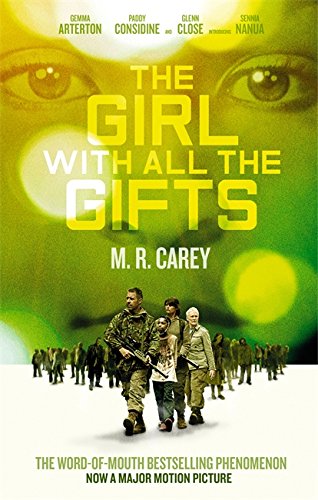
Saturday Matinee: The Girl With All the Gifts

By Brian Tallerico

Source: RogerEbert.com

In many ways, Melanie (Sennia Nanua) is just another ordinary girl. She goes to school every day, where she’s grown affection for her teacher Ms. Justineau (Gemma Arterton). And she’s at that age where she’s figuring out what’s important to her, and how to navigate through the world of adults around her. But Melanie is not an ordinary girl. She will soon be a mindless, soulless zombie, a braindead creature who responds only to a desire to kill and eat people around her. In fact, with the right triggers—like if the adults around her forget to wear their scent-disguising lotion—she could become that right now. Just when you thought the zombie genre was out of ideas, along comes Colm McCarthy’s smart and engaging “The Girl with All the Gifts,” a film with echoes of George A. Romero, Danny Boyle, and Robert Kirkman but one that also feels confidently its own creation, a unique take on responsibility, adulthood, and a new chapter in evolution.

Melanie isn’t alone. She lives with a number of other zombie-children like her in a bunker beneath a military facility, where she’s being studied and experimented on by Dr. Caroline Caldwell (Glenn Close), in the hope that they could provide the antidote for what has essentially ended normal human existence. Melanie is one of several second-generation flesh-eaters called “hungries,” babies who literally ate their way out of their parents but are not behaving in precisely the same way as the brain-dead speedsters that have destroyed humanity. Whenever a child is found in the wild, they’re taken to this facility, where Dr. Caldwell can experiment on them and Sgt. Eddie Parks (Paddy Considine) can work to control them. Said control involves leg, arm and head restraints whenever the children are anywhere near that oh-so-enticing human flesh.

But Melanie seems so normal and is clearly learning empathy. The good doctor sees that as well, and even starts to loosen some of the restraints keeping Melanie more of an object than a person. Then one day Dr. Caldwell comes for Melanie, ready to dissect her and see exactly what she can learn from this unique child the hard way. Before Dr. Justineau can save her, all hell breaks loose and the facility is overrun. A small group of survivors is forced to travel to another sanctuary city in the hope that it’s still being run by people who don’t eat flesh. Melanie goes with them, and proves to be pretty useful.

One of the major strengths of “The Girl with All the Gifts” is evident early in McCarthy’s tactile, believable world-building. Much as Romero paid close attention to such details, the set design, costumes, and the world of “Gifts” feels lived-in and genuine. And it’s a nature-based aesthetic (dirt on walls, costumes that look worn, etc.) that continues and even strengthens once this ragtag crew is forced from safety and into the dangerous world. There’s a visceral, emotional impact to the horror and action of “The Girl with All the Gifts” that resonates because the characters and the world they live in feels real to us. It’s hard to overstate how important this to a horror movie, especially one set in a post-apocalyptic world. If we don’t believe the world is genuine, we won’t care what happens in it.

Of course, performance goes a long way to amplify this believability as well, and it’s not often you see a horror film with a cast this strong. Close could have gone showy with her doctor with a heart of ice but she plays it straight, again conveying the believability of the moment more than the B-movie archetype this character could have become. Considine and Arterton perfectly convey authority and warmth, respectively, although they’re good enough to make these people into more than mere plot devices. And Nanua is a find, again never giving her performance with a knowing wink. So she’s a zombie child who could be the evolutionary key to the future—this just happens to be her reality.

The traveling band aspect of “The Walking Dead,” the cities and landscapes empty of human existence of “28 Days Later,” the military aspect of “Day of the Dead”—it’s easy to pick apart the influences of “The Girl with All the Gifts.” But just as Melanie marks something altogether new in this world—a zombie with a conscience—the film about her feels inspired by what came before but also good enough to inspire those that come after.

Sy Hersh and The Way We Live Now

By Craig Murray

Source: Craig Murray Blog

It is a clear indicator of the disappearance of freedom from our so-called western democracies, that Sy Hersh, arguably the greatest living journalist, cannot get this monumental revelation on the front of the Washington Post or New York Times, but has to self-publish on the net.

Hersh tells the story of the US destruction of the Nordstream pipelines in forensic detail, giving dates, times, method and military units involved. He also outlines the importance of the Norwegian armed forces working alongside the US Navy in the operation.

One point Sy does not much stress, but it is worth saying more about, is that Norway and the USA are of course the two countries who have benefitted financially, to an enormous degree, from blowing up the pipeline.

Both not only have gained huge export surpluses from the jump in gas prices, but Norway has directly replaced Russian gas to the tune of some $40 billion per year. From 2023 the United States will appear in that list in second place behind Norway, following the opening in the last two months of two new Liquefied Natural Gas terminals in Germany, built to replace Russian gas with US and Qatari supplies.

So Russia lost out massively financially from the destruction of Nordstream and who benefited? The USA and Norway, the two countries who blew up the pipeline.

But of course, this war is nothing to do with money or hydrocarbons and is all about freedom and democracy…

To return to Hersh’s account, particularly interesting are the series of decisions taken to avoid classification of the operation in various ways which would require it to be reported to Congress. In terms of United States history, this ought to be a big deal.

For the Executive to commit what is an act of war without the approval of the Legislature is fundamentally unconstitutional. But that is one of those quaint remnants of democracy that the neo-liberal elite consensus can quietly sidestep nowadays.

Hersh sets out the well known background in compelling detail,  including the fact that, from Biden down, the Americans effectively announced what they were going to do, openly.

But what most worries me about the entire story is the unanimous complicity of the mainstream media in ignoring the completely obvious.

The media line, parroted here relentlessly by the BBC and corporate media, was  that the Russians had probably themselves blown up the pipeline on which they had expended such great resources and three decades of intense diplomatic activity, and which was to be the key to Russia’s single most valuable source of income for the next 40 years.

This was always quite literally incredible. You would have to be deranged to believe it.

It actually taught me not just that we truly are in the realm of totalitarianism and the Big Lie, but I learnt something very important about how the Big Lie works.

The secret is not that people genuinely believe an outrageous claim. The secret is that people do genuinely believe that they are in a battle of good against evil, and it is necessary to accept the narrative being promoted, in the interests of fighting evil.

Don’t question, just follow. If you do question, you are promoting evil.

I am sure that is how it works.

State and corporate stenographer journalists are actually intelligent individuals. If they thought about it, they would realise that the narrative that Russia blew up its own pipeline is obvious nonsense.

But they are convinced it is morally wrong to think about it.

Which is why none of them challenged the equally mad claims that Russia was repeatedly shelling its own forces occupying the Zaporizhzhia nuclear power station, and indeed is why none of them challenged the utterly risible official version of the Skripal story.

I previously told the anecdote from when I worked in the Foreign and Commonwealth Office and asked a good friend if he really believed the misinformatioin on Iraqi WMD with which he was involved.

He replied by referring to the video game Championship Manager (now renamed Football Manager), which we used to play together. He said when he was in the game, it was immersive, he was manager of Liverpool, and it fully absorbed him.

Similarly, when he walked through the FCO gates, the world of the intelligence reports was immersive and Iraq did have these WMDs inside that world. He worked in the “reality” of the FCO. Once he left in the evening, he lived in a different reality, the world of us in the pub.

I do know of one or two journalists bright enough to detach their professional output from what they really think, in a similar way. (I once had a conversation along these lines with Jeremy Bowen in Tashkent.)

Most however don’t think like this. They simply think that all right thinking people support the historic struggle against the evil Russians, so it must be right to read out the propaganda without thinking too much about it.

Those of us critical of the aggressive promotion of war in Europe, are not only barred from all mainstream media and confined to corners of the internet, and even then heavily suppressed on social media (which is why Sy Hersh’s article does not have the scores of millions of readers it merits).

We can’t even obtain freedom of assembly.

Two established left wing venues have cancelled the No 2 Nato meeting I am addressing in London on 25 February. Conway Hall’s reasons for cancellation included threats to funding and fears for the safety of staff.

We are now reduced to a guerrilla meeting, the Central London venue for which will not be announced until the evening before.

Is this really a democracy, where it is not possible for dissidents to hold a public meeting without secrecy, subterfuge and hiding from supporters of the state?

I do urge you to come along on the day, whatever your views on the subject, to support the right to freedom of speech.

I have a different view from perhaps all of the other speakers, on the legitimacy of Russia’s invasion of Ukraine, which I oppose.

But I also oppose NATO expansion which is an underlying cause of the war, and indeed oppose the existence of NATO itself.

NATO is a war machine which sucks resources from working people to benefit the military industrial complex, and unleashes devastating destruction on developing states which do not make their natural resources available to western billionaire elites.

It is also a fundamental node of the propaganda apparatus which manipulates and controls our society, particularly as counter narrative and dissident thought is now rigorously and systematically excluded.

There is no longer an Overton window of permitted debate. It has narrowed and should be renamed the Overton letterbox.

One of those small difficult ones right down at the bottom of the door.  With a very fierce spring, and snarling dogs guarding it.