Saturday Matinee: Taking Liberties

“Taking Liberties” (2007) is a British documentary directed by Chris Atkins. Using a mix of animation, news footage and interviews, it examines how Labour has overreacted to the terror threat, using it as an excuse to weaken civil liberteis including the right to protest, right to freedom of speech, right to privacy, right not to be detained without charge, presumption of innocence until proven guilty, and protections against torture. In short, it’s a cinematic chronicle of the origin of the modern British surveillance state under the Blair ministry.

‘$2.5 TRILLION THEFT’ – STUDY SHOWS RICHEST 1% OF AMERICANS HAVE TAKEN $50 TRILLION FROM BOTTOM 90% IN RECENT DECADES


The median U.S. worker salary would be around twice as high today if wages kept pace with economic output since World War II, new research revealed.

By Brett Wilkins

Source: Common Dreams

New research published Monday found that the top 1% of U.S. income earners have taken $50 trillion from the bottom 90% over the past several decades, and that the median worker salary would be around twice as high today as it was in 1945 if pay had kept pace with economic output over that period.

The study’s authors, Carter C. Price and Kathryn Edwards of the RAND Corporation, examined income distribution and economic growth in the United States from 1945 to the present. The researchers found stark differences between income distribution from 1945 to 1974 and 1975 to 2018.

According to the study—which was funded by the Seattle-based Fair Work Center—the median salary of a full-time U.S. worker is currently about $50,000. Adjusted for inflation using the consumer price index, workers at or below the current median income now earn less than half of what they would have if incomes had kept pace with economic growth. This means that if salaries had kept pace with economic output, the median worker pay would be between $92,000 and $102,000 today, depending on how inflation is calculated.

Had the more equitable distribution of the roughly 30-year postwar period continued apace, the total annual income of the bottom 90% of American workers would have been $2.5 trillion higher in 2018, or an amount equal to about 12% of GDP.  In other words, the upward redistribution of income has enriched the 1% by some $47 trillion—which would now be more than $50 trillion—at the expense of American workers.

David Rolf, a Seattle labor organizer, president of the Fair Work Center, and founder of Service Employees International Union (SEIU) Local 775, is more blunt. He calls this “the $2.5 trillion theft.”

“From the standpoint of people who have worked hard and played by the rules and yet are participating far less in economic growth than Americans did a generation ago, whether you call it ‘reverse distribution’ or ‘theft,’ it demands to be called something,” Rolf, who helped lead the fight for a $15 hourly minimum wage in Seattle and beyond, told Fast Company.

Remarkably, the study found that workers at all income levels would be better off today if income kept pace with output. Full-time, prime-age workers in the 25th percentile, for example, would be earning $61,000 instead of $33,000. Workers in the 75th percentile, who in 2018 earned $81,000, would be making $126,000. Even 90th-percentile workers, who earn $133,000, would be making $168,000 under the more equitable distribution.

On the other hand, had the economic pie been divided more equitably, the income of the top 1% would fall from around $1.2 million to a still-affluent $549,000.

“We were shocked by the numbers,” said Nick Hanauer, a venture capitalist and self-described “zillionaire” who, along with Rolf, came up with the idea for the study. “It explains almost everything,” Hanauer told Fast Company. “It explains why people are so pissed off. It explains why they are so economically precarious.”

Sen. Bernie Sanders (I-Vt.), who made correcting economic inequality a pillar of both of his presidential bids, lamented the “h-u-g-e redistribution of income in America” in a Monday tweet.

The researchers’ findings, which come amid a deadly coronavirus/Covid-19 pandemic, shine light on the injustice of an economy—by far the wealthiest in the history of civilization—in which essential workers struggle mightily, and often in vain, to survive while the richest people grow ever richer at their expense.

According to Americans for Tax Fairness, the total wealth of U.S. billionaires increased by $792 billion, or 27%, during the first five months of the Covid-19 pandemic. During this period, Amazon CEO Jeff Bezos, the world’s wealthiest person, has become the world’s first multi-centibillionaire, with a net worth now surpassing $200 billion. Meanwhile, his employees struggle to make ends meet, and Amazon workers who speak out against poor pay and hazardous working conditions during the pandemic have been fired and derided by company executives.

Compared to other most-developed nations, the U.S. has done a relatively poor job of taking care of its people during the pandemic. In addition to the U.S. being the only developed nation without universal healthcare, its workers have received less in direct payments and government support than people in many comparable countries.

The gap between the richest and poorest U.S. households is now wider than it has ever been in the past 50 years, according to the most recently available data from the U.S. Census Bureau. The pandemic has only exacerbated the situation, as around half of lower-income American households have reported a job or wage loss due to Covid-19.

Internationally, the U.S. ranks 39th out of over 150 nations in income inequality, according to Gini coefficient data compiled by the CIA, placing it roughly on par with nations like Peru and Cameroon. Among Organization for Economic Cooperation and Development (OECD) nations, the U.S. has the seventh-highest level of income inequality.

The U.S. has the highest poverty rate among the world’s most-developed nations, and the fourth-highest poverty rate among OECD nations after South Africa, Costa Rica, and Romania. According to UNICEF, the U.S. also has the second-highest rate of childhood poverty in the developed world behind Romania, with more than one in five U.S. children—and over one in four Latinx children, and nearly one in three Black and Native American children—living in poverty.

This year, more than 54 million Americans, or roughly one in every six people—including 18 million children—may experience food insecurity, according to the nonprofit group Feeding America.

New Pentagon-Google Partnership Suggests AI Will Soon Be Used to Diagnose Covid-19

Google recently teamed up with the Pentagon as part of the new, AI-driven “Predictive Health” program. Though only focused on “predictive cancer diagnoses” for now, Google and the military have apparent plans to expand the AI model for automating and predicting Covid-19 diagnoses.

By Whitney Webb

Source: Unlimited Hangout

At the beginning of September, Google Cloud announced that it had won a project from the Pentagon’s relatively new Defense Innovation Unit (DIU) to “prototype an AI-enabled digital pathology solution at select DoD [Department of Defense] facilities.” This prototype, per a Google Cloud press release, combines “augmented reality telescopes” with “AI-enabled” cancer detection tools that will allegedly improve the accuracy of “predictive cancer diagnoses.” It is the second DIU contract Google has won this year, with the first being related to combatting “cyber threats.”

The initial implementation of this Pentagon-funded, Google-created “digital pathology solution” will take place “at select Defense Health Agency (DHA) treatment facilities and Veterans Affairs hospitals in the United States,” and the program includes “future plans to expand across the broader U.S. Military Health System,” according to Google.

The initiative is part of a larger DIU-led program called “Predictive Health” that is also partnered with the joint AI effort of the US military and US intelligence community, the Joint Artificial Intelligence Center, and JAIC’s “Warfighter Health” initiative. The JAIC, which is currently led by a former Silicon Valley executive, is providing much of the funding for Predictive Health, while its related “Warfighter Health” initiative more broadly seeks “to field AI solutions that are aimed at transforming military health care.”

In addition to its stated goal of improving the accuracy of cancer diagnoses, the implementation of this Google-DIU AI-driven medical diagnosis tool aims to show “frontline health practitioners” that such tools “can improve the lives” of US troops, according to Google executives. As Mike Daniels, vice president of Global Public Sector at Google Cloud, noted in a statement, Google is “partnering with DIU to provide our machine learning and artificial intelligence technology to help frontline healthcare practitioners learn about capabilities that can improve the lives of our military men and women and their families.” Google also stated that the use of their tool at military health facilities would also “lower overall healthcare costs.”

The Google-DIU effort to outsource human doctor decision-making to a tailor-made artificial intelligence algorithm is, for now, only focused on the diagnosis of cancers. However, last Thursday, less than two weeks after winning the DIU contract, Google announced that it was donating $8.5 million to several organizations to advance the development and use of AI  “for monitoring and forecasting” Covid-19. That money is part of a larger $100 million donation from Google for financing “solutions” to Covid-19 that was announced in May.

Further evidence that Google soon plans to offer AI-driven “predictive diagnoses” for Covid-19 came in August, when Google Cloud partnered with Harvard’s Global Health Institute to provide “Covid-19 Public Forecasts,” which “provide a projection of Covid-19 cases, deaths, and other metrics over the next 14 days for US counties and states.” The announcement of the Google-Harvard collaboration coincided with an announcement from the National Institutes of Health (NIH) would begin “harness[ing] AI for COVID-19 diagnosis, treatment, and monitoring.”

Notably, other tech companies that have produced “predictive diagnosis” AI models for Covid-19 also began first by offering AI-created “forecasts” of “likely” Covid-19 outbreaks. For instance, the Israeli intelligence–linked Diagnostic Robotics initially offered AI-driven predictive “forecasts” of cities and districts to guide lockdown policy in Israel and the US state of Rhode Island before then teaming up with the US-based company Salesforce to develop a platform that uses AI to “predict” which individuals are likely to be diagnosed with Covid-19 and then uses AI to monitor and even “treat” those individuals.

Furthermore, in partnership with researchers at Mount Sinai healthcare centers in New York, tech giant Microsoft has already aided the development of an AI algorithm that “rapidly diagnoses” Covid-19. Mount Sinai’s AI model, supported by a recent grant from Microsoft’s “AI for Health” initiative, “was as accurate as an experienced radiologist in diagnosing the disease,” according to one of the lead researchers behind the model’s development. While its development was aided by Microsoft, the core of the Mount Sinai AI model is TensorFlow, which was developed by Google and is Google AI’s second-generation system for machine learning.

In addition, both Google and Microsoft are part of a Europe-based effort aimed at “automating diagnoses” for Covid-19 via an AI algorithm that analyzes CT scans, which is similar in several ways to the Mount Sinai AI model. Thus, it seems highly likely that Google’s efforts to offer AI-powered “predictive diagnoses” will soon expand to include tools that use algorithms to diagnose Covid-19, not just cancer.

The Merging of the Pentagon, the CIA, and Silicon Valley

Established in 2015, the Defense Innovation Unit of the Department of Defense officially exists to transfer “leading-edge commercial capabilities to the military faster and more cost-effectively than traditional defense acquisition methods” and to accelerate “the adoption of commercial technology throughout the military and [grow] the national security innovation base.” As the DIU makes clear on its website, the “national security innovation base” it seeks to “grow” consists of private tech companies, namely those based in Silicon Valley, that provide “advanced commercial solutions” to “national security challenges.” This, of course, includes the tech companies that already double as contractors for the national security state, such as Google, Microsoft, and Amazon, among numerous others.

The DIU boasts offices in Silicon Valley, Boston, Austin, and at the Pentagon itself and is largely led, not by career military men, but by former Silicon Valley executives. For instance, its current director—Michael Brown—is the former CEO of cybersecurity giant Symantec and, prior to that, led the Quantum corporation. In another example, the leader of the DIU’s artificial intelligence portfolio is Jeff Klugman, a former top executive at TiVo, the Quantum corporation, and Hewlett-Packard.

A year after the DIU was created, it was followed by the Defense Innovation Board (DIB), which is composed of “leaders from across the national security innovation base” and provides recommendations that “have been used to inform DoD leadership strategy and action, as well as congressional legislation.” Like the DIU, Silicon Valley is well represented on the DIB, as its members include former Google CEO Eric Schmidt and LinkedIn founder Reid Hoffman as well as top executives from Google, Microsoft, and Facebook.

Notably, just months before the DIU-led Predictive Health program was launched, the DIB noted in March 2020 that the Pentagon “owns the largest repository of disease- and cancer-related medical data in the world,” asserting further that “if the entire repository were leveraged to its fullest potential, it would advance diagnosis and treatment for thousands of illnesses, saving lives across DoD and the global population.” The DIB then specifically suggested that “artificial intelligence and machine learning models may help pathologists sort through this massive dataset more quickly and effectively to provide better care for patients in and out of the military,” adding that these troves of medical data should be used “to support DoD reform and modernization efforts in the field of AI/ML [Artificial Intelligence / Machine Learning].”

In other words, the Silicon Valley–dominated DIB called for what is now the Predictive Health program just months before the Silicon Valley–dominated DIU formally announced it. Also noteworthy is that Google—whose former CEO, current vice president, and several other Google-tied researchers and businessmen serve on the DIB—is the very company that won the DIU contract to have its AI models serve as the foundation for the Predictive Health program. This, of course, means that Google’s AI models will benefit immensely from the Pentagon’s “unique” and massive medical datasets, which the DIB previously stated was something that the Pentagon “must treat . . . as a strategic asset.”

It is also important to point out the considerable overlap between the Pentagon’s Defense Innovation Board and the National Security Commission on Artificial Intelligence. The NSCAI is chaired by Eric Schmidt (also on the DIB) and includes representatives from Google, Microsoft, Facebook, and Amazon as well as the current and former leaders of the CIA’s In-Q-Tel.

The official purpose of the NSCAI is “to consider the methods and means necessary to advance the development of artificial intelligence, machine learning, and associated technologies to comprehensively address the national security and defense needs of the United States.” As I previously reported for The Last American Vagabond, the vice-chair of NSCAI, Robert Work—former Deputy Secretary of Defense and senior fellow at the hawkish Center for a New American Security (CNAS)described the commission’s purpose as determining “how the U.S. national security apparatus should approach artificial intelligence, including a focus on how the government can work with industry to compete with China’s ‘civil-military fusion’ concept [my emphasis].”

For this reason, the NSCAI unites the US intelligence community and the military, which is already collaborating on AI initiatives via the Joint Artificial Intelligence Center and Silicon Valley companies. Notably, many of those Silicon Valley companies—like Google, for instance—are not only contractors to US intelligence, the military, or both but were initially created with funding from the CIA’s In-Q-Tel, which also has a considerable presence on the NSCAI. Thus, while the line between Silicon Valley and the US national-security state has always been murky, now that line is essentially nonexistent as entities like the NSCAI, DIB, and DIU, among several others, clearly show. Whereas China, as Robert Work noted, has the “civil-military fusion” model at its disposal, the NSCAI and the US government respond to that model by further fusing the US technology industry with the national-security state.

It is also certainly interesting that, just like the DIB, the NSCAI called for what would become the DIU’s Predictive Health program a few months before it was formally announced. In a NSCAI paper from June 2020 titled “The Role of AI Technology in Pandemic Response and Preparedness: Recommended Investments and Initiatives,” the commission recommends investments and initiatives aimed at using AI for diagnosing illnesses, including Covid-19. This seems to suggest that the Silicon Valley–led but Pentagon-housed DIU is the body that actually creates the government-industry partnerships and initiatives that are first planned out by the DIB and the NSCAI.

It’s All About the Data

While Google has stated that one of their main goals in participating in the Predictive Health program is showing health-care practitioners how AI can “improve lives,” the DIU was decidedly more direct regarding their intent in implementing this “predictive diagnosis” program. For instance, an article on the Google-DIU pilot program at DefenseOne, citing military officials, notes that the “enormous amount of healthcare data, unique to the Department of Defense, also presents a rare opportunity for the Department to train new machine learning tools.” It then adds that “there are 9.6 million beneficiaries in the Defense Health System, which means a lot of data to improve the accuracy of [AI] models.”

DIU’s chief medical officer, Niels Olsen, who created the Predictive Health program, recently stated that massive quantities of data planned to be obtained by the program and used for developing improved AI algorithms was a critical component of the project. In a Pentagon press release, Olsen stated that “the more data a tool has available to it, the more effective it is. That’s kind of what makes DOD unique. We have a larger pool of information [i. e., medical data] to draw from, so that you can select more diverse cases.”

Thus, the implementation of the Predictive Health program is expected to amass troves upon troves of medical data that offer both the DIU and its partners in Silicon Valley the “rare opportunity” for training new, improved AI models that can then be marketed commercially. This may explain part of the interest in partnering this initiative with the Defense Health Agency (DHA), which “owns the largest repository of disease- and cancer-related medical data in the world” through its management of the Joint Pathology Center, which was noted by the DIB in its March 2020 publication. In addition, as previously mentioned, Google will now be able to access that trove of sensitive data to refine its AI “health-focused” algorithms, thanks to it having won the DIU contract earlier this month.

Notably, the relatively new Predictive Health program builds on past DIU initiatives, such as an AI algorithm that predicts illnesses “48 hours before symptoms show.” That algorithm was developed by the Defense Threat Reduction Agency, the DIU, and the health IT company Royal Phillips. The Phillips team that developed that algorithm is now “refin[ing] the model at military hospitals and clinics managed by the Veterans Affairs Department.” According to the DTRA’s Edward Argenta, the focus of the program is to eventually use the AI algorithm to analyze data from devices that remotely monitor individual health, specifically “a wearable device that might sit on your body—like a watch-based one or a chest strap one.”

While various “innovation-focused” agencies at the Pentagon have been busy developing their own algorithms after harvesting mass amounts of medical data from military members and their families, a web of intelligence-linked tech companies, including those represented on the DIB and NSCAI, have gained access to the jackpot of medical data through partnering with the “Covid-19 Healthcare Coalition.”

According to its website, the Covid-19 Healthcare Coalition was established as “a coordinated public-interest, private-sector response to the Covid-19 pandemic, convening healthcare organizations, technology firms, nonprofits, academia, and startups.” The coalition, which was launched by the intelligence and defense contractor MITREalso includes tech giants like Google, Microsoft, Palantir, Salesforce, and Amazon and allows its member organizations to “collaborate, collect, analyze, visualize, and share data and insights.” With access to the data from partnered health-care institutions, such as the Mayo Clinic and the Cedars-Sinai Health System, these tech companies are “helping” the coalition “unlock large-scale analytics for Covid-19.” Institutions tied to the US government, and the NSCAI in particular, such as the CIA’s In-Q-Tel, are also members of the Covid-19 Healthcare Coalition.

Notably, the recent advances in US-based efforts to “predict” or “automate” Covid-19 diagnoses are all tied to this very coalition. Indeed, all of the companies and institutions mentioned thus far in this report have engaged in developing these tools, as Diagnostic Robotics, Salesforce, Google, Microsoft, Amazon, and Mount Sinai Medical Center are all coalition members.

Google, in the press release regarding its recent partnership with the DIU, noted that the prototype of the AI model set to make “predictive cancer diagnoses” had been “developed from [unspecified] public and private datasets,” making it possible—if not likely—that the private datasets were obtained through Google’s membership in this massive, yet relatively unknown, coalition of health-care institutions, tech companies, and US intelligence–linked entities like MITRE and In-Q-Tel.

This apparent obsession with medical data may explain the dramatic uptick in hacks of hospitals in the United States, which have been considerable in recent months and have largely targeted patient data. It is worth pointing out that the increase in these attacks seeking patient data coincides with the DIB-NSCAI policy recommendations regarding training AI algorithms on troves of medical data for automated and predictive diagnoses, among other applications.

Notably, the “solutions” offered to many of the health-care institutions that have been hacked have come from government-promoted yet opaque groups that are deeply tied to US and allied intelligence agencies as well as Silicon Valley. These “volunteer groups,” such as “the CTI League” and “the Cyber Alliance to Defend Our Healthcare,” offer their services for free but, notably, gain access to the patient data they are tasked with guarding. Are such groups, given their deep ties to Silicon Valley and intelligence agencies, helping acquire even more data to satisfy the Silicon Valley and national-security state’s endless hunger for more and more data?

The Economy Continues To Unravel Despite All Stimulus Measures

By Brandon Smith

Source: Alt-Market.com

Since the pandemic lockdowns were first implemented in the US I have been more concerned with the government and central bank response than the virus itself. As I have noted in past articles, the pandemic restrictions and subsequent economic and social crisis events they help to create will cause far more deaths than Covid-19 ever will. Not only that, but the actions of the Federal Reserve continue to con the American public into believing that there is some kind of “plan” to stop the crash that THEY engineered.

The only agenda of the Fed is to increase the pain in the long term; they have no intention of actually preventing any disaster.

This is evidenced in comments by voting members of the Fed, including Neel Kashkari who recently argued for the enforcement of hard lockdowns for at least six weeks in the US, all because the US savings rate was going up. Meaning, because Americans are saving more in order to protect themselves from economic fallout, Kashkari thinks we should be punished with an economic shutdown that would force us to spend whatever we have been able to save.

Do you see how that works?

Fed members and government officials demand hard lockdowns, depleting public savings and destroying small businesses. Then, the public has to beg the Fed and the government for more and more stimulus measures so that they can survive. The people and the system become dependent on a single point of support – fiat money creation and welfare. Yet, the evidence suggests that this strategy is failing to do much of anything except stall the inevitable for a very short time.

If the goal was really to reduce the pain of the pandemic as much as possible, then the strategy should be to keep the economy as open as possible and let the virus run its course.  By initiating lockdowns, all we are doing is extending the economic damage over the span of years instead of months.  We can deal with the comparatively minimal deaths associated with the virus; we cannot handle the disaster that is about to befall the financial system.

The small business sector appears to be the most fragile element of the economy right now. The PPP loans that were supposed to shore up small businesses failed miserably, with data showing only 13% to 19% of applicants getting a loan of any kind. Over 64% of small businesses that received a loan are also worried about being approved for loan forgiveness. In other words, of the few small business owners that got a PPP loan more than half do not have the ability to pay the loan back if they end up not qualifying for exemption.

This problem does not seem to be affecting the corporate sector, however. International companies are enjoying incredible cash infusions from the Fed through overnight loans as well as Fed stimulus propping up stock markets (at least for now). Tech companies in particular are enjoying a rush of investment as the assumption in the daytrading world is that the central bank will not allow these companies to fail.

Maybe they are right, but stock markets today DO NOT reflect the health of our system in any way. Stock tickers are a placebo, a Pavlovian trigger for the public, a tool to make people believe that the situation is improving merely because share values are going up. This is not the case.

Small businesses in the US account for around 50% of all employment and job creation. They are a vital part of the economy. Yet, government and central bank measures seem to have left them out in the cold to die.

To be sure, the $600 weekly unemployment enhancement created through the CARES Act passed in March did boost consumer spending, primarily on durable goods such as computers, TVs, cellphones, etc. Spending on services declined though, which is where the majority of small businesses make their money. And, considering the fact that most durable goods are manufactured overseas, this means that the majority of stimulus dollars that went to consumers did not go into the US economy, but foreign exporters like China.

Now, the unemployment enhancement has ended and its return is in question. It will be interesting to see if the boost to purchases of goods will continue without that extra $600 weekly stimulus. Consumer spending rose in July by 1.9%, but this was already a weak print compared to the increases during the previous two months.

Unemployment numbers have declined due to soft reopenings in numerous states, and at the very least some part time jobs appear to be returning, but nowhere near the level needed to erase the millions of jobs lost since February after the initial lockdowns began. If you count U-6 measurements and unemployed people who have been removed from the rolls for being jobless for too long, the REAL unemployment rate is closer to 30% of working age Americans. This is essentially Great Depression levels of joblessness.

US GDP has continued to decline by 32% according to the Bureau of Economic Analysis (despite statistical rigging by the Fed and government agencies), and while it’s possible that stimulus slowed the effects of GDP loss, there is no indication what the trillions of dollars created by the Fed have actually bought other than a few months of time and a massive bubble in the stock market.

The economy cannot survive extreme lockdown conditions for any length of time, let alone almost two more months. And, if you want to know what it means when elites in government and central banking call for a “hard lockdowns”, just look at Level 4 restrictions in places like Australia and New Zealand, where only one person can leave home at any given time, can only travel 3 miles from home and only for food and supplies, and anyone caught not wearing a mask is subject to arrest or a $10,000 fine.

This mother in Melbourne, Australia was arrested because of a Facebook post calling for protests over the lockdown restrictions.  She later had to take the post down and offered an apology, saying she did not know it was illegal to post such statements on social media:

Yeah, this kind of Orwellian response will do wonders for any economic recovery, and this is what Kashkari is calling for in the US.  It’s almost as if the Fed and certain politicians WANT a financial collapse in America…

The REAL solution is to stop the lockdown restrictions altogether. If the goal is truly to protect as many American lives as possible for the “greater good”, then the pandemic response must stop. Luckily, it seems that more and more people are beginning to see through the facade and are rejecting the restrictions. Even in Europe and Australia there have been some signs of protest and rebellion. The problem is that, at least in terms of the economy, it may be too late.

We have to consider the fact that once a large portion of the business sector (like small businesses) takes a massive hit like the one they have suffered over the past several months, many such businesses and jobs will simply not come back. There are many reasons for this, but primarily it’s a matter of debt. The average small business owner carries almost $200,000 in debt for 3-5 years before he reaches profitability or breaks even. This is assuming that there are no major economic catastrophes in that time.

With the pandemic, the riots, the restrictions, etc., businesses will have to take on much more debt with little guarantee of recovery in the next few years let alone the next few months.  Chapter 11 business bankruptcies in the US rose over 26% in the first half of 2020 alone.

Even if lockdown restrictions were completely eradicated tomorrow, a large number of businesses would go bankrupt anyway.  The “Retail Apocalypse” has been growing over the past decade, LONG before the coronavirus was on issue.  Thousands of businesses shut down last year and tens of thousands more are slated to close this year.   The virus and lockdowns simply accelerated the existing decline.

This is why large banks are cutting off loans to business owners and consumers right now; they know exactly where all this is headed.

Banks act as middlemen for the PPP loans financed by the Fed, yet those loans are not getting to most businesses. Banks have also cut credit card lending in the past few months, and general lending has crashed. All of this despite low interest rates for banks receiving stimulus injections from the Fed. Where is all of the money going? They are keeping it for themselves, buying up hard assets as well as propping up the stock market. As noted above, the elites have NO INTENTION of saving the economy, only themselves.

If the stimulus is not getting to the main-street economy then the only purpose it serves is to give the public a false sense of comfort.  The people who gain the most from the ongoing pandemic chaos are establishment elites that want severe restrictions on personal liberty.  Not to mention, the virus and lockdowns offer a convenient scapegoat for the financial crisis that was already brewing due to central bank mismanagement of stimulus, inflation and interest rates. The bottom line is, the banks do not want the crisis to end.  Why would they?  The longer the panic continues, the more they benefit.

From Blue Shirts to Brown

By Alan Hamilton

Source: Off-Guardian

On at least 3 or 4 occasions in the past week we’ve had to smash the windows of people in cars and pull them out of there so they could provide their details – because they weren’t telling us where they were going; they weren’t adhering to the chief health officer’s guidelines, they weren’t providing their name and their address.”
Shane Patton, Victorian Chief Police Officer 04/08/2020

On Saturday 5th of September a national day of protest occurred in cities around Australia against the unnecessary and draconian lockdowns that have been occurring across the country and which are still occurring in Victoria. Similar protests have occurred in cities around the world, most especially in Europe.

These protests are a legitimate and rational response to despotic and often unconstitutional laws that unscientifically characterize every member of society as a bio-security risk to everyone else. They are also a protest against law enforcement bureaucracies that identify responsible, civic-minded citizens as criminals if they dare to question such laws or even worse, step out of their homes in defiance of the lockdown to register their dissent.

The Australian protests occurred peacefully and without incident in most places, including Brisbane where I participated. But it was not the case in Victoria where a State of Disaster has been declared due to the ‘extraordinarily high’ number of active Covid cases there.

On the eve of the nationwide protests, mainstream news reported on the harrowing state of affairs in Victoria which was suffering from hundreds of active cases but, as it turns out, had only 20 people in intensive care suffering from covid-related illnesses. This is in a state of 6.35 million people that has 58 metropolitan hospitals and 69 rural hospitals and District Health services.

Despite the ‘extraordinarily low’ incidence of people who were actually sick from Covid 19, the Victorian Premier decided that new case numbers (>100 per day) were just too high to tolerate anyone leaving their homes for any reason other than the four exemptions provided by the government.

What he neglected to mention when insisting on preserving his lockdown was that most new cases are occurring in the under-30 age bracket: a demographic that is almost always asymptomatic to SARS CoV-2 and which has more chance of dying in a motor vehicle accident than of Covid19.

Undeterred by inconvenient truths like this, the Premier announced he had to protect the public from the potentially catastrophic medical emergency that would doubtless result from masked people walking down St Kilda Road to the Cenotaph in a socially distanced manner, so he banned all participation in the national day of protest.

Just days earlier the Assistant Police Commissioner for the North West Metro Region, Luke Cornelius, warned everyone in Victoria against participating in the Saturday protests. He referred to people who planned to protest against lockdowns as “boof heads”, calling them an “anti-vax, anti-mask, tinfoil hat-wearing brigade who were batshit crazy”.

This oddly extreme language from one of the State’s most senior police officers is not accidental. It serves a specific purpose.

In order to get ordinary well-adjusted police officers – who may have joined the force out of a desire to be of public service – to brutalize a population whose only crime is that they object to being locked in their homes for 23 hrs a day for months on end, you need to demonize dissent. If your officers on the ground can identify in any way with the people they are being told to terrorize, they might not follow orders.

This is a perennial problem for martial leaders everywhere. It’s particularly problematic when the rules being enforced are arbitrary or unjust. Hence the need to malign.

As Saturday rolled around, the police were out in force across Victoria on horseback with cuffs, batons, tasers and guns ready to intimidate, arrest and fine anyone unfortunate enough to attract their attention within the vicinity of a protest in any town in the State – even those towns where not a single case of Covid-19 has been recorded.

And here we get to the crux of the SARS-CoV-2 scam. Sure, there’s a virus out there. It’s real and it certainly kills people but we know enough about it now to know that the draconian response taken by Premier Danial Andrews is scientifically indefensible. So why is he persisting with the lockdowns?

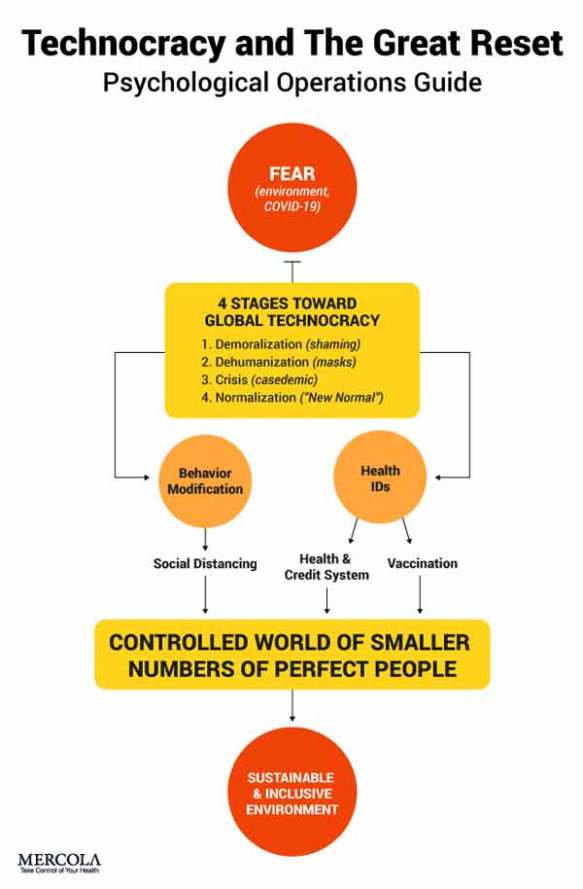
My personal opinion is that the global program of lockdowns is a mechanism for reorganizing societies around the world along the lines of the World Economic Forum’s ‘Great Reset” agenda and all that this entails. It seems Daniel Andrews is fully on board with this agenda. But make no mistake, its coming to your state and country next.

I believe that sustained lockdowns are a “Stanley Milgram-style” experiment designed to see just how far bureaucrats in authority will exceed the moral limits of their power and how much abuse the Australian public will tolerate before they push back.

As part of this experiment, the algorithms that once monitored every nuance of our social media interactions to make frighteningly accurate predictions about us have been extended to track and predict our off-line experience as well. It should come as no surprise that both the Azure and AWS cloud eco-systems have expanded by 50% since the beginning of the pandemic.

The purpose of all this surveillance is not to better understand us as potential marketing targets (the standard explanation) but rather to better control us as victims in a system of profound inequality. Such a system is already in place across much of the world and under the guise of a health pandemic, it is rapidly being expanded to developed countries as well.

So far as I can see the whole experiment is going spectacularly well for the globalists, billionaires, and authoritarians, and very poorly for free citizens everywhere: mostly due to the effectiveness of media propaganda in driving public passivity.

A SCIENTIFIC DICTATORSHIP

Many medical practitioners are aware that Victoria’s management of the SARS CoV-2 pandemic is based on highly selective medical advice which doesn’t stand up to serious scientific scrutiny.

Recently a group of doctors wrote an excellent letter to the Premier advocating an alternative response to disease management, noting that more than 41,000 people die every year in Victoria, roughly 10,000 each from cardiovascular disease and cancer, yet in 7 months of a supposed pandemic less than 600 Victorians have died of Covid-19: 90% of them over 65 years of age and most with multiple co-morbidities.

The problem with the doctor’s alternative advice is that it assumes the government is merely mistaken or misinformed in its policymaking and implementation. The idea that the exercise of political power in Victoria has become pathological never seems to occur to them – despite a wealth of evidence supporting such a notion.

When governments pass laws that are extreme or unjust or which by-pass constitutional constraints, it is rarely by accident. As doctors they ought to be the first to appreciate what a pathological exercise of power means to the cultural and institutional bonds that hold a society together:

  • As bio-security increasingly substitutes for health care, doctors will find that the personal confidences of their patients are no longer inviolate and that the Hippocratic obligations they once held so dear can be easily compromised by legal mandates to force-medicate people regardless of need or consequence.
  • When politicians rule by executive decree the police force morphs from a public service comprised of citizens in uniform to the enforcement arm of a political clique. When this happens, public trust in the police is lost and this loss of legitimacy results in a loss of respect. Eventually this loss of respect becomes mutual and the police start to despise the people they victimize and abuse the power they have. The opening quote being a perfect example.
  • Similarly with the military: when the exercise of our democratic rights is pathologized by those in power, our servicemen and women eventually find they’re being asked to apply, at home, the counter-insurgency training and urban warfare tactics they learned for battlefields abroad. This is something that has occurred since the time of Thucydides and it’s happening again.
  • Even the tools we use to make sense of the world, such as the scientific method, cease to function properly when our governments become toxic. Once everyone in a society has been force-vaccinated by government decree, it will become legally impossible to prove a link between mandated vaccines and any potential vaccine-related injury. Not because the manufacturers will have immunity from liability (they will), but because there will no longer be a non-vaccinated control group left against which randomized double-blind control studies can be conducted.

Not one of these developments is accidental. All of them are known, predictable outcomes of policy decisions being taken today. And these policy decisions rob everyone of their integrity; health workers, academics, the police and the military.

When those in power have a pathological relationship to the people they rule, you know you are on a road to perdition. We can see such a pathology evolving among our politicians most clearly in Victoria with its home invasions, curfews and lock downs but it is also evident in the overreach of governments around the country.

Western Australia’s recent dispute with mining magnate, Clive Palmer, over the State’s Covid border closure is a case in point. According to the WA Law Society the Government’s anti-Palmer legislation violates several of the fundamental legal principles that underpin the rule of law in a civilized society. Such overreach is also apparent in the ASIO Amendment Act 2020, introduced into Federal Parliament by Peter Dutton in May this year – right at the height of the Covid panic while most members were not even in Canberra.

This legislation is the latest in a succession of Bills that have been passed by our Federal government since 9/11 (85 and counting) which have vastly expanded the powers of law enforcement and security agencies in Australia while limiting public oversight. The legislation effectively criminalizes the free exercise of our basic democratic freedoms.

The Dutton amendment extends powers normally applied to terrorists, to any group or person engaged in any kind of civil disobedience or protest that could possibly result in ‘politically motivated violence’. That would include the anti-lock down protests that I participated in last week.

Among a raft of frightening provisions this bill allows police and intelligence agencies to track, apprehend and question children as young as 14 yrs of age as though they were terrorists. It suspends the rules of habeas corpus and allows the State to arbitrarily restrict a defendant’s access to legal representation.

This is the sort of legislation you’d expect to find in China or Saudi Arabia, not Australia.

The permanent changes to our society that are now in place in Australia following the SARS CoV-2 pandemic mean we qualify as proto-fascist State by any measure of political freedom. This thought is anathema to most Australians and would be vociferously denied by paid-off mainstream media pundits – but probably not constitutional lawyers – because the legislative reality is that we are now much closer to full-blooded fascism than we are to the liberal democracy that existed when I was born in 1963. And we are a very far cry from the nation our diggers returned to in 1945.

The only way we will arrest and/or reverse this trend is if we all take direct, non-violent, physical (not digital) action to exercise our civic and democratic rights at every opportunity we can. The time to speak up and stand up is now. It will be too late tomorrow.

Reporters Claim Facebook is Censoring Information on Julian Assange Case


“90% of my traffic has just been cut off by what seems to be a general algorithm command of some kind to downplay Assange.” “I think it is as simple as that.”

By Alan Macleod

Source: Mint Press News

Craig Murray, the former British ambassador to Uzbekistan and longtime confidant of Julian Assange, has been fastidiously reporting on the Australian publisher’s extradition hearing to the United States. Yet few people have been reading it. This, according to Murray, is because of a deliberate decision by online media giants to downplay or suppress discussion of the case. On his blog, Murray wrote that he usually receives around 50 percent of his readers from Twitter and 40 percent from Facebook links, but that has dropped to 3 percent and 9 percent, respectively during the hearing. While the February hearings sent around 200,000 readers to his site daily, now that figure is only 3,000.

To be plain that is very much less than my normal daily traffic from them just in ordinary times. It is the insidious nature of this censorship that is especially sinister – people believe they have successfully shared my articles on Twitter and Facebook, while those corporations hide from them that in fact it went into nobody’s timeline,” he added.

Asked about the situation by former New York Times reporter Chris Hedges, Murray explained that

Anybody who is at all radical or takes any view of anything that is outwith the official establishment view gets used to occasional shadow banning, but I have never seen anything on this scale before.”

“90% of my traffic has just been cut off by what seems to be a general algorithm command of some kind to downplay Assange,” he added. “I think it is as simple as that.”

There has been considerable public interest in the court proceedings, but very little mainstream attention given to them. To be fair, British authorities have made it inordinately difficult to cover the case, allowing only a small handful of journalists into the Old Bailey court system, where they can watch a live television link up but cannot bring in recording devices. An online stream can only be watched if one registers and signs in between exactly 9:30 and 9:40 a.m., and if they suffer even a momentary lapse in wifi connection, they are shut out of the session. The court system has also blocked human rights groups, including Amnesty International, from monitoring proceedings.

Still, considering the implications for the future of journalism, the lack of coverage might surprise some. The New York Times, the flagship outlet of American print media (and a Wikileaks partner) printed only two articles on the subject and has not mentioned Assange in over two weeks. Its broadcast journalism equivalent CNN, meanwhile, has not touched the issue at all.

Online media creators have, for many years, lived with the threat of algorithmic suppression or demonetization of content on sensitive or controversial issues. YouTube regularly cuts all advertising on videos on the Syrian Civil War, fracking, or other topics on which advertisers might not wish to promote scrutiny. Even airsoft and paintball enthusiasts have learned not to use words like “shoot” and “gun” in their titles, lest the platform demonetizes their content.

Perhaps more alarmingly, however, Silicon Valley tech giants are becoming increasingly closely intertwined with the state department, to the point where it is often difficult to tell where one ends, and another begins. “What Lockheed Martin was to the twentieth century…technology and cyber-security companies [like Google] will be to the twenty-first,” wrote Google executives Eric Schmidt and Jared Cohen in their book, “The New Digital Age: Reshaping the Future of People, Nations and Business.” For example, Facebook is now in a close partnership with the Atlantic Council, who essentially decides for them what content to promote in people’s news feeds and what content is discarded as fake news, misinformation, or low quality. The problem is that the Atlantic Council is a NATO cutout, and a government-funded organization whose board of directors is a who’s who of deep state officials, including virtually every living ex-C.I.A. director, Bush-era cabinet members like Condoleezza Rice and Colin Powell, and military generals like Wesley Clark and David Petraeus. Thus, an organization like this deciding what the world sees on their screens is barely one step removed from total government control of the flow of information.

The U.S. government also frequently directly interferes with content appearing on prominent social media. Earlier this year, Facebook announced that it would remove all comments or posts in praise of recently-slain Iranian General Qassem Soleimani from all its platforms. This was done to comply with the Trump administration’s designation of the Iranian Revolutionary Guard Corps (which Soleimani led) as a terrorist organization. The problem is that Soleimani was Iran’s most popular political figure, with an over 80 percent approval rating, and that Instagram is used by around one-third of the entire Iranian population. Thus, Iranians speaking in their local language were barred from sharing a majority opinion with their country folk because of a decision by Donald Trump.

The Middle East is a particularly contentious area of the world. Yet when news broke that the British Army’s online psychological operations brigade had managed to become a senior Twitter executive, responsible for Middle Eastern content, media largely ignored it, raising even more questions. Algorithm changes have also hammered independent alternative media outlets — often precisely the ones most likely to cover the Assange case — drastically reducing their search engine traffic flow.

Former C.I.A. chief Leon Panetta (an honorary director of the Atlantic Council) recently admitted that Assange is being prosecuted as a warning to journalists. “All you can do is hope that you can ultimately take action against those that were involved in revealing that information so you can send a message to others not to do the same thing,” he told a German documentary crew. While the message is being heard loud and clear by journalists, the public is far less aware that anything is going on, thanks, in part, to online suppression of news about the case. Judge Vanessa Baraitser is scheduled to pronounce judgment on the media “trial of the century” on January 4, after the U.S. presidential election. Murray will doubtless be there. But will anyone read what he has to say?

The End of Reality?

By Edward Curtin

Source: Behind the Curtain

In 1888,  the year before he went insane, Friedrich Nietzsche wrote the following in Twilight of the Idols:

We have got rid of the real world: what world is left?  The apparent world perhaps? … But no!  Along with the real world we’ve done away with the apparent world as well.

So, if you feel you also may be going insane in the present climate of digital screen life, where real is unreal but realer than real, the apparent is cryptic, and up is down, true is false, and what you see you don’t, it has a history.  One hundred and thirty-two years ago, Nietzsche added that “something extraordinarily nasty and evil is about to make its debut.”  We know it did, and the bloody butcher’s bench known as the twentieth century was the result. Nihilism stepped onto center stage and has been the star of the show ever since, straight through to 2020.  Roberto Calasso puts it this way in Literature and the Gods:

Here we are, announces Nietzsche, and it would be hard not to hear a mocking ring in his voice.  We thought we were living in a world where the fog had lifted, a disenchanted, ascertainable, verifiable world.  And instead everything has gone back to being a ‘fable’ again.  How are we to get our bearings … This is the paralysis, the peculiar uncertainty of modern times, a paralysis that all since have experienced.

Obviously, we haven’t gotten our bearings.  We are far more adrift today on a stormy electronic sea where the analogical circle of life has been replaced by the digital, and “truths” like numbers click into place continuously to lead us in wrong, algorithm-controlled directions. The trap is almost closed.

Of course, Nietzsche did not have the Internet, but he lived at the dawn of the electric era, when space-time transformations were occurring at a rapid pace.  Inventions such as photography, the phonograph, the telephone, electricity, etc. were contracting space and time and a disembodied “reality” was being born.  With today’s Internet and digital screen life, the baby is full-grown and completely disembodied.  It does nothing but look at its image that is looking back into a lifeless void, whose lost gaze can’t figure out what it’s seeing.

Take, for example, the phonograph, invented by Thomas Edison in 1878.  If you could record a person’s voice, and if that person died, were you then listening to the voice of a living person or one who was dead?  If the person whose voice was recorded was alive and was miles away, you had also compressed earthly space. The phonograph suppressed absence, conjured ghosts, and seemed to overcome time and death as it captured the flow of time in sound.  It allowed a disembodied human voice to inhabit a machine, an early example of downloading.

“Two ruling ambitions in modern technology,” writes John Durham Peters in his wonderful book, Speaking into the Air, “appear in the phonograph: the creation of artificial life and the conjuring of the dead.”

Many people started to hear voices, and these people were not called deluded. Soon, with the arrival of cinema, they would see ghosts as well.  Today, speaking ghosts are everywhere, hiding in hand-held devices. It’s Halloween all year round as we are surrounded by electronic zombies in a screen culture.

This technological annihilation of space and time that was happening at a frenetic pace was the material background to Nietzsche’s thought.  His philosophical and epistemological analyses emerged from German intellectual life of his time as well, where theologians and philosophers were discovering that knowledge was relative and had to be understood in situ, i.e., within its historical and social place or context.

Without going into abstruse philosophical issues here, suffice it to say, Nietzsche was suggesting that not only was God dead because people killed him, but that knowledge was a fiction that changed over time and was a human construction.  All knowledge, not just science, had to be taken “as if” it were true.  This was a consoling mental trick but falsely reassuring, for most people could not accept this, since “knowledge” was a protection racket from pain and insanity. It still is. In other words, not only had people murdered God, but they had slain absolutes as well. This left them in the lurch, not knowing if what they knew and believed were really true, or sort of true – maybe, perhaps. The worm of uncertainty had entered modern thought through modern thought.

While the average person did not delve into these revolutionary ideas, they did, through the inventions that were entering their lives, and the news about Darwin, science, religion, etc., realize, however vaguely, that something very strange and dramatic was under way. Life was passing from substance to shadow because of human ingenuity.

It is similar to what so many feel today: that reality and truth are moving beyond their grasp as technological forces that they voluntarily embrace push everyday life towards some spectral denouement.  An inhuman, trans-human, on-line electronic life where everything is a parody of everything that preceded it, like an Andy Warhol copy of a copy of a Campbell’s soup can with a canned mocking laugh track that keeps repeating itself.  All this follows from the nineteenth century relativization of knowledge, or what at least was taken as such, for to say all knowledge is relative is an absolute statement.  That contradiction goes to the heart of our present dilemma.

This old feeling of lostness is perhaps best summarized in a few lines from Mathew Arnold’s 19th century poem, “Dover Beach”:

The Sea of Faith
Was once, too, at the full, and round earth’s shore
Lay like the folds of a bright girdle furled.
But now I only hear
Its melancholy, long, withdrawing roar,
Retreating, to the breath
Of the night-wind, down the vast edges drear
And naked shingles of the world.

But that was then.  Today, the Joker’s sardonic laughter would suffice.

***

I am sitting outside as I write, sipping a glass of wine before dinner.  Although New England fall weather is approaching, a nasty mosquito is buzzing around my head.  I hear it.  I am in killer mode since these bastards love to bite me.  This is real life.  If I went into the house and connected to the Internet on the computer screen – news, social media, anything – I would be entering another dimension.  Screen life, not real life. The society of the spectacle. No real mosquitoes, no wine, no trees swaying in the evening breeze.

In his novel, The Sun Also Rises, written between Nietzsche’s time and now, Ernest Hemingway, a man who surely lived in the physical world, writes of how Robert Cohn, the boxing champion from Princeton University, wants Jake Barnes, the book’s protagonist, to take a trip with him to South America.  As they sit and talk in Paris, Barnes says no, and tells Cohn, “All countries look just like the moving pictures.”

Whether Hemingway was being ironic or not, or simply visionary, I don’t know.  For in the 1920s, before passports and widespread tourism, there were many places you could only see if you traveled to them and they would never appear in moving pictures, while today there is almost no place that is not available to view beforehand on the internet or television.  So why go anywhere if you’ve already seen it all on a screen? Why travel to nowhere or to where you have already been?  Déjà vu all over again, as Yogi Berra put it and everyone laughed.  Now the laugh is on us.

***

This is neither an argument nor a story.  It’s real.  I am trying to get my bearings in a disorienting situation. Call it a compass, a weather-vane, a prayer.  You can call me Al or Ishmael.  Call me crazy.  Perhaps this writing is just an “as if.”

***

About fifteen years ago, I was teaching at a college where most communication was done via email.  I was, as they say, out of the loop since I didn’t do email. I was often asked why I didn’t, and I would repeatedly reply, like Melville’s Bartleby, because “I prefer not to.”  Finally, in order to keep my job, I succumbed and with the laptop computer they provided me, I went “on-line.”  There were 6,954.7 emails in my in-box from the past three years.  In those three years, I had performed all my duties scrupulously and hadn’t missed a beat.  Someone showed me how to delete the emails, which I did without reading any, but I had entered the labyrinth. I went electronic.  My reality changed. I am still searching for Ariadne’s thread.

***

But I am not yet a machine and refuse the invitation to become one.  It’s a very insistent invitation, almost an order.  Neil Postman (Oh such a rich surname!) sums it up well in Technopoly: The Surrender of Culture to Technology:

The fundamental metaphorical message of the computer, in short, is that we are machines – thinking machines, to be sure, but machines nonetheless.  It is for this reason that the computer is the quintessential, incomparable, near perfect machine for Technopoly.  It subordinates the claims of our nature, our biology, our emotions, our spirituality.  The computer claims sovereignty over the whole range of human experience, and supports its claim by showing that it ‘thinks’ better than we can…John McCarthy, the inventor of the term ‘artificial intelligence’…claims that ‘even machines as simple as thermostats can be said to have beliefs…What is significant about this response is that it has redefined the meaning of the word ‘belief’ … rejects the view that humans have internal states of mind that are the foundation of belief and argues instead that ‘belief’ means only what someone or something does … rejects the idea that the mind is a biological phenomenon … In other words, what we have here is a case of metaphor gone mad.

Postman wrote that in 1992, before the computer and the internet became ubiquitous and longer before on-line living had become de rigueur – before it was being shoved down our throats as it is today under the cover of COVID-19.

There is little doubt that we are being pushed to embrace what Klaus Schwab, the Executive Chairman of the World Economic Forum (WEF), calls COVID-19:The Great Reset, that involves a total acceptance of the electronic, on-line life.  On-line learning, on-line news, on-line everything – only an idiot (from Greek, idiotes, a private person who pays not attention to public affairs) would fail to see what is being promoted.  And who controls the electronic life and internet?  Not you, not I, but the powers that be, the intelligence agencies and the power elites. Goodbye  body, goodbye blood – “I don’t think we should ever shake hands ever again, to be honest with you,” said Dr. Anthony Fauci, the director of the National Institute of Allergy and Infectious Diseases (NIAID) in support of human estrangement.

Peter Koenig, one of the most astute investigators of this propaganda effort, puts it this way:

The panacea of the future will be crowned by the Pearl of the Fourth Industrialization – Artificial intelligence (AI). It will be made possible by a 5G electromagnetic field, allowing the Internet of Things (IoT). Schwab and Malleret [Schwab’s co-author] won’t say, beware, there is opposition. 5G could still be blocked. The 5G existence and further development is necessary for surveillance and control of humanity, by digitizing everything, including human identity and money.

It will be so simple, no more cash, just electronic, digital money – that is way beyond the control of the owner, the truthful earner of the money, as it can be accessed by the Global Government and withheld and / or used for pressuring misbehaving citizens into obeying the norms imposed from above. You don’t behave according to our norms, no money to buy food, shelter and health services, we let you starve. No more travel. No more attending public events. You’ll be put gradually in your own solitary confinement. The dictatorial and tyrannical global commandeering by digital control of everything is the essence of the 4th Age of Industrialization – highly promoted by the WEF’s Great Reset.

***

Like everything, of course, this push to place life under the aegis of cyberspace has a history, one that deifies the machine and attempts to convince people that they too are machines without existential freedom.  Thus the ongoing meme pumped out for the past three decades has been that we are controlled by our brains and that the brain is a computer and vice versa. Brain research has received massive government funding. Drugs have been offered as the solution to every human problem. So-called diseases and disorders have been created through the Diagnostic and Statistical Manual of  Mental Disorders (DSM) and matched to pharmaceutical drugs (or the revers) for scandalous profits. And the mind has been reduced to a figment of deluded  imaginations. People are machines; that’s the story, marvelous machines.  They have no freedom.

If one wishes an example of techno-fascism, there is one from the art world. Back in the 1920s and 1930s there was an art movement known as Futurism.  Its leader proponent was an Italian Fascist, friend of Mussolini, Filippo Tommaso Marinetti.  The futurists claimed that all life revolves around the machine, that the machine was god, that it was beyond human control and had to be obeyed.  They extolled war and speed and claimed that humans were no more significant than stones.  Patriotism, militarism, strength, method, and the kingdom of experts were their blueprint for a corporate fascist state.  The human eye and mind would be re-educated to automatically obey the machine’s dictates.

Now we have cyberspace, digital machines, and the internet, an exponential extension of the machine world of the 1930s and the rise of Mussolini, Fascism, and Hitler.  That this online world is being pushed as the new and future normal by trans-national elite forces should not be surprising.  If human communication becomes primarily digitally controlled on-line and on screens, those who control the machines will have achieved the most powerful means of mind control ever invented. That will be MKULTRA on a vast scale.  Surveillance will be complete.

Yes, there are places on the internet where truth is and will be told, such as this site where you are reading this; but as we can see from today’s growing censorship across the web, those power elites and intelligence forces who  control the companies that do their bidding will narrow the options for dissenting voices. Such censorship starts slowly, and then when one looks again, it is a fait accompli. The frog in the pan of slowly heating cold water never realizes it is being killed until it is too late. Free speech is now being strangled. Censorship is widespread.

The purpose of so much internet propaganda is to confuse, obsess, depress, and then repress the population. The overlords accomplish this by the “peculiar linking together of opposites – knowledge with ignorance, cynicism with fanaticism – [which] is one of the chief distinguishing marks of Oceanic society,” writes Orwell in Nineteen Eighty-Four.  “The official ideology abounds with contradictions even where there is no practical reason for them.”  One look into one’s life will suffice to see how the overlords have set people against each other.  It’s a classic tactic.  Divide and conquer. Trump vs. Biden, Democrats vs. Republicans, whites vs. blacks, liberals vs. conservatives. Pure mind games. Contradictions every day to create social disorientation.  Orwell describes Doublethink as follows:

Doublethink means the power of holding two contradictory beliefs in one’s mind simultaneously, and accepting both of them.  The Party intellectual knows in which direction his memories must be altered; he therefore knows he is playing tricks with reality; but by the exercise of doublethink he also satisfies himself that reality is not violated.  The process has to be conscious, or it would not be carried out with sufficient precision, but it also has to be unconscious, or it would bring with it a feeling of falsity and hence of guilt…To tell deliberate lies while genuinely believing them, to forget any fact that has become inconvenient, and then, when it becomes necessary again, to draw it back from oblivion for just as long as it is needed, to deny the existence of objective reality and all the while to take account of the reality which one denies – all this is indispensably necessary…If one is to rule, and to continue ruling, one must be able to dislocate the sense of reality. [author’s emphasis]

Nietzsche said that along with the real world we have done away with the apparent as well.  Digital online life has accomplished that.  It has allowed the rulers – through the media who are the magicians who serve them – to create counterfeit news and doctored videos at will, to present diametrically opposed points of view within the same paragraph, and to push breaking news items so fast that no one half-way sane could keep up with their magic shows. Nietzsche obviously didn’t foresee this technology, but he sensed the madness that the relativity of knowledge and the technology of his day would usher in.

***

The popular 1990s term “Information Superhighway,” meaning the internet and all digital telecommunications, was the perfect term to describe this lunacy. Get on that highway and go as fast as you can while trying to catch the meaning of all the information flashing past you as you speed to nowhere.  For not only does censorship, propaganda, disinformation, mixed messages, and contradictions line the road you are traveling, but contextless information overload is so heavy that even if you were stopped in a traffic jam, there is too much information to comprehend.  And if you think this Superhighway is a freeway, think again, for the cost is high. No one puts out their hand and asks you to pay up; but the more you travel down this road you’ll notice you are missing a bit of flesh here and some blood there.  And without a speed pass, you are considered road kill.

To make matters much worse, they say we need 5G to go much faster.

Paul Virilio, who has devoted himself to the study of speed (dromology), puts it this way in Open Sky:

The speed of the new optoelectronic and electroacoustic milieu becomes the final void (the void of the quick), a vacuum that no longer depends on the interval between places or things and so on the world’s very extension, but on the interface of an instantaneous transmission of remote appearances, on a geographic and geometric retention in which all volume, all relief vanishes.

***

And yet I don’t have a simple answer to the internet dilemma. You are reading it on-line and I am posting it there.  It is very convenient and quick. And yet…and yet….

Can we just walk away from it?  Maybe.  Perhaps like those few who, in Ursula K. Le Guin’s excruciating story, “The Ones Who Walk Away From Omelas,” we may decide the price for our conveniences and so-called happiness is too high and that there are hidden victims that this techno-scientific “progress” creates beneath its veneer of efficiency.  Others, us, our children, all children, who are reaching out not for speed and machines, but for the human touch that the on-line propagandists hope to destroy.  In Le Guin’s story, the price nearly all the citizens of Omelas are willing to pay for their happiness and comfort is the imprisonment of a single child.  Perhaps we should consider what we are doing to all the world’s children and their futures.

My friend Gary recently sent me this letter.  I believe it sums up what many people feel. There is a vast hunger for reality and truth. The analog life. How to live it – the question hangs in the air as the artificial intelligence/digital controllers try to reduce us to machines.

Although apparently it isn’t clear if Twain ever said this, it’s still a great quote:  (“If you don’t read the newspaper, you’re uninformed.  If you do, you’re misinformed.”)  To which “amen” is the only appropriate response.

I continue to daily stay abreast of events through the web, and these days much of what passed for “progressive media” simply regurgitates the covid madness as if it had been delivered on stone tablets – rather than by the same MSM that lie to us daily about literally ANYTHING of any importance.

There are days I wonder “why” I continue to bother to follow the unfolding madness as if it made some “difference.”  I could certainly play guitar more, and I might even get it together to write a few pieces on the nature of our collective madness, for which I have studiously assembled copious notes.  I really don’t need any more information or examples – I think I have things covered on that front.

Instead I find myself daily doing the little dance we’re all familiar with – uncomfortable with being “uninformed” – yet at almost every turn finding myself being routinely – “misinformed” – and so having to sift through the endless debris to have any chance at developing any coherent understanding of the world.

So yes, I totally get the draw of just saying to hell with the internet.  After years of shifting through the endless propaganda operations our generation has been subject too, I have no doubt you and I see through most the nonsense for what it is before we even have the proof in hand.  Once the rose-colored glasses of ‘American exceptionalism’ are off, one can almost sense and see through the lies in real time even as they are being uttered.

Reading Gary’s words reminded me of those of the Trappist monk Thomas Merton’s definition of the Unspeakable:

It is the void that contradicts everything that is spoken even before the words are said, the void that gets into the language of public and official declarations at the very moment when they are pronounced, and makes them ring dead with the hollowness of the abyss.  It is the void out of which Eichmann drew the punctilious exactitude of his obedience…

Yes, real time, real life – as we do our little dances.

Can we do our little dances and preserve reality?  I’m not sure.