Our Vanishing World: Rainforests

By Robert J. Burrowes

Rainforests are a crucial feature of Earth’s biosphere. Apart from being critical to Earth’s climate and vital carbon sinks, the major player in Earth’s hydrological (water) cycle, a massive producer of oxygen and home to most of the world’s species, rainforests are the home of a large indigenous human population. They are also the source of many vital resources, including medicines, used by humans around the world.

However, the vast range of ecological services that rainforests have provided ongoingly for the 400 million years of their existence, and which have been critical to the survival of homo sapiens since we first walked the Earth 200,000 years ago, are not measured and valued by accountants and economists: Have you ever seen a balance sheet or set of national accounts that includes an entry for ‘Value of ecological services taken from nature and on which life and our entire production of goods and services depend’?

Because these services have been available without the need for human management or intervention, and given the primitive conception of accounting and economics that humans use, the ecological services of rainforests are given no monetary value. Hence, essential ecological services are treated as worthless by virtually everyone in the industrialized world. As a result, modern industrialized humans have decided to systematically destroy the rainforests in order to extract a vast amount of short-term profit for the benefit of a few and the temporary satisfaction of many. So if we do not value ecological services such as oxygen and water generation as well as climate and weather-moderating capacities, what is it that we do value by destroying rainforests?

A small proportion of rainforest is logged to provide attractive rainforest timbers – such as teak, mahogany, ebony and rosewood – for a variety of decorative purposes, including making furniture, which can last hundreds of years.

However, a much wider range and vastly greater quantity of rainforest trees are cut or burnt down for purposes such as the following: acquiring timbers used in construction, clearing land to establish cattle farms so that many people can eat cheap hamburgers, clearing land to establish palm oil plantations so that many people can eat processed (including junk) foods based on this oil, clearing land to establish palm oil and soy bean plantations so that some people can delude themselves that they are using a ‘green biofuel’ in their car (when, in fact, these fuels generate a far greater carbon footprint than fossil fuels), mining (much of it illegal) for a variety of minerals (such as gold, silver, copper, coltan, cassiterite and diamonds), and logging to produce woodchips so that some people can buy cheap paper, including cheap toilet paper.

In essence then: We trade the essential life-giving and sustainably-available ecological services of Earth’s rainforests, also home to indigenous peoples and countless wildlife, for hamburgers and other processed junk foods, carbon-intensive ‘biofuels’, paper and some building and furniture materials, as well as some minerals. Obviously, some humans are far from clever at ‘making deals’.

But if you think that is bad, consider this: ‘by one estimate, a hectare of livestock or soy is worth between $25 and $250, while the same hectare of sustainably managed forest can yield as much as $850’ harvesting, depending on the location, such products as medicinal plants, rubber, nuts and fruits while benefitting from a range of ecotourism services and research opportunities. See ‘Rainforest on Fire: On the Front Lines of Bolsonaro’s War on the Amazon, Brazil’s Forest Communities Fight Against Climate Catastrophe’. Of course, you have to know how to manage the forest sustainably to yield this much income but that sort of intelligence is rare and invariably escapes those focused on destruction for short-term profit.

So how bad is this rainforest destruction? Well, worldwide we are currently destroying rainforests for these unsustainable and mainly short-term products at the rate of 80,000 acres each day. See ‘Measuring the Daily Destruction of the World’s Rainforests’.

Moreover, beyond the devastating impact this has on indigenous peoples, forcing increasing numbers of them to leave their destroyed homes in the rainforest to try to survive elsewhere, this rainforest destruction is also the key driver of species extinctions globally with one million species of life on Earth threatened with extinction. As reported in the recent Global Assessment Report on Biodiversity and Ecosystem Services researched and published by the Intergovernmental Science-Policy Platform on Biodiversity and Ecosystem Services (IPBES) – the scientific body which assesses the state of biodiversity and the ecosystem services this provides to society – ‘Nature is declining globally at rates unprecedented in human history. The IPBES Global Assessment ranks, for the first time at this scale, the 5 direct drivers of change in nature with the largest global impact. So what are the culprits behind nature’s destruction?’ Number 1. on the IPBES list is ‘Changes in land and sea use, like turning intact tropical forests into agricultural land’.

Let me briefly illustrate the nature and extent of this destruction by discussing rainforests in just three locations (the Brazilian Amazon, the Democratic Republic of the Congo and Indonesia/West Papua) where the destruction of rainforest was greatest in 2018 – see ‘The World Lost a Belgium-sized Area of Primary Rainforests Last Year’ – and which are representative of elsewhere around the planet where even World Heritage listed areas are ongoingly under threat.

The Brazilian Amazon

While the Amazon in South America occurs in several countries, two-thirds of it lie within the borders of Brazil. Unfortunately, since his fraudulent election in 2018, the neofascist, corrupt and insane president Jair Bolsonaro – see the definition of sanity, which Bolsonaro does not come close to meeting, in ‘The Global Elite is Insane Revisited’ – has promptly eliminated years of painstaking effort by committed indigenous and environmental activists to convince previous governments to protect the Brazilian Amazon from the worst corporate and other depredations.

For just a taste of the documentation on Bolsonaro’s actions in accord with elite interests and to the detriment of indigenous and environmental well-being, see ‘Bolsonaro Caps Natives’ Lands, Pleasing Farmers in One of First Acts’, ‘Rainforest on Fire: On the Front Lines of Bolsonaro’s War on the Amazon, Brazil’s Forest Communities Fight Against Climate Catastrophe’, ‘Bolsonaro’s Clearcut Populism. “The Barbarism has Begun”’, this report from Amazon Watch: ‘Complicity in Destruction II: How northern consumers and financiers enable Bolsonaro’s assault on the Brazilian Amazon’ and ‘Amazon Deforestation Accelerating Towards Unrecoverable “Tipping Point”’.

The key drivers of rainforest destruction in the Amazon are soy production and cattle ranching. Brazilian soy accounted for 14.3% of the country’s total exports, generating $31.0 billion in 2017, while cattle exports accounted for about $5.4 billion. Because Brazil leads the world in exports of both of these commodities, it is the world market for these products that is driving these industries to aggressively expand activities to the detriment of the rainforest and indigenous peoples.

But the Amazon is huge, you might say: Does it matter if we destroy some of it for soy and cattle farming? Well, one recent study suggested that deforestation of 20–25% of the Amazon would be the tipping point beyond which it would cease to be a functioning rainforest ecosystem and this, as you might expect, would be catastrophic. Moreover, recent severe droughts appear to be ‘the first flickers of this ecological tipping point’ suggesting that it is already imminent. See ‘Amazon Tipping Point’.

So, to reiterate, the key driver of rainforest destruction in the Brazilian Amazon is consumer-generated demand for certain products in other parts of the world. And while the US and European countries play critical roles in destruction of the Amazon, China is the largest importer of agricultural products from Brazil so its government and consumers are complicit too. For example, as China’s demand for Brazilian soy surges due to the trade war between the United States and China, ‘it could drive further ecological catastrophe: 13 million hectares (50,000 square miles) in the Amazon and Cerrado could ultimately be cleared to meet this additional demand.’ See ‘Complicity in Destruction II: How northern consumers and financiers enable Bolsonaro’s assault on the Brazilian Amazon’.

The point then, is this: governments and ordinary people (in their role as consumers) in other parts of the world can play a vital role in defending the Amazon and its indigenous peoples – see, for example, Brazil’s Indigenous People Articulation – by choosing what they buy from Brazil. Boycotting rainforest timber, beef and soy bean products are powerful options to consider. But don’t forget, there is no point simply identifying and boycotting Brazilian timbers, beef and soy beans. If you want impact on the total market (to prevent one country’s timber, beef and soy beans being substituted for another’s), then you must boycott them all (unless you can clearly identify the source of the product as local and sustainable). Obviously, this takes commitment. The future of the Amazon depends largely on enough of us making that commitment.

The Democratic Republic of the Congo in Central Africa

The rainforests of the Congo Basin in central Africa are the second largest on Earth. Much of this rainforest lies within the borders of the Democratic Republic of the Congo, crippled by corrupt government for decades and a new president elected earlier this year who has inherited a corrupt and inefficient state apparatus. See ‘Democratic Republic of the Congo: Overview of corruption and anti-corruption’.

Unfortunately, therefore, rainforests in the Congo have long been under siege on several fronts. With rebel soldiers (such as the Rwanda-backed M23), miners and poachers endlessly plundering inadequately protected national parks and other wild places for their resources, illegal mining is rampant, over-fishing a chronic problem, illegal logging (and other destruction such as charcoal burning for cooking) of rainforests is completely out of control in some places, poaching of hippopotami, elephants, chimpanzees and okapi for ivory and bushmeat is unrelenting (often despite laws against hunting with guns), and wildlife trafficking of iconic species (including the increasingly rare mountain gorilla) simply beyond the concern of most people.

The Congolese natural environment – including the UNESCO World Heritage sites at Virunga National Park and the Okapi Wildlife Reserve, together with their park rangers – and the indigenous peoples such as the Mbuti (‘pygmies’) who live in them, are under siege. In addition to the ongoing mining, smaller corporations that can’t compete with the majors, such as Soco, want to explore and drill for oil. For a taste of the reading on all this, see ‘Virunga National Park Ranger Killed in DRC Ambush’, ‘The struggle to save the “Congolese unicorn”’, ‘Meet the First Female Rangers to Guard One of World’s Deadliest Parks’ and ‘The Battle for Africa’s Oldest National Park’.

Unfortunately too, as with rainforests elsewhere, ‘What Happens in the Congo Basin Doesn’t Stay in the Congo Basin’: it impacts on regions across Africa playing a part, for example, in recent droughts in Ethiopia and Somalia causing millions of people to depend on emergency food and water rations. See ‘Congo Basin Deforestation Threatens Food and Water Supplies Throughout Africa’.

As with the Amazon, you have some powerful options to consider if you want to save the Congolese rainforests and their indigenous peoples. Again, refusing to buy rainforest timbers, conflict minerals and wildlife products is a good start but remember that key minerals in your computer and mobile phone are illegally sourced from the Congo so your thoughtful consideration of minimizing how many of these devices you own can play a part too. For a fuller account of this exploitation and its destructive impact on the rainforests and its indigenous peoples, with references to many other sources, see ‘500 years is long enough! Human Depravity in the Congo’.

Indonesia and West Papua

Indonesia has the most extensive rainforest cover in Asia – and is home to hundreds of distinct indigenous languages and over 3,000 animal species including Sumatran tigers, pygmy elephants, rhinoceros and orangutans – but the forests are being systematically degraded and destroyed. Rainforest cover has steadily declined since the 1960s when 82 percent of the country was covered with forest; it is less than 50 percent today. The rainforest is being destroyed by logging, mining, large-scale agricultural plantations (especially for palm oil), colonization, and subsistence activities like shifting agriculture and cutting for fuelwood. Much of the remaining cover consists of logged-over and degraded forest although large areas, including of the island of Kalimantan/Borneo (shared with Malaysia and Brunei), have been stripped bare.

Logging for tropical timbers and pulpwood (to make paper) is the biggest cause of rainforest destruction in the country where as much as 75 percent of the logging is illegal. Indonesia is the world’s largest exporter of tropical timber, which generates more than $US5 billion annually. And more than 48 million hectares (55 percent of the country’s remaining rainforests) are concessioned for logging. Destruction of the rainforest in Indonesia has opened up some of the most remote places on Earth to development: as rainforests in less remote locations have been decimated, timber corporations have stepped up practices on the island of Kalimantan/Borneo and the occupied West Papau, where great swaths of forests have been cleared in recent years. In fact, 20 percent of Indonesia’s logging concessions are in West Papua, despite ongoing resistance by West Papuans.

Unfortunately, the fastest and cheapest way to clear rainforests for plantations is by burning. Hence, every year ‘hundreds of thousands of hectares go up in smoke as developers and agriculturalists feverishly light fires before monsoon rains begin to fall. In dry years – especially during strong el Niño years – these fires can burn out of control for months on end, creating deadly pollution that affects neighboring countries and causes political tempers to flare’. See Indonesian Rainforests’.

Mining operations, including for coal, also have a devastating impact on the rainforests and their peoples. See ‘New report exposes World Bank links to destructive coal mining in Indonesia’. By far the worst of these projects, however, is the gigantic gold, silver, and copper mine in occupied West Papua, run by Freeport-McMoRan. As widely documented, the mining company has dumped appalling amounts of waste into local streams, rendering downstream waterways and wetlands ‘unsuitable for aquatic life’. Relying on large payments to Indonesian police and military officers, the mining operation is ‘protected’; this has resulted in many West Papuans being killed.

The waste from the mine, estimated by Freeport at 700,000 tons each day, covers several square miles and Government surveys have found that tailings from the mines have produced levels of copper and sediment so high that almost all fish have disappeared from vast areas of wetlands downstream from the mine.

Like other powerful corporations in Indonesia (and elsewhere), Freeport-McMoRan is well aware that there is little official interest in its abuses of local people and the environment as long as corrupt officials are given sufficient incentive to ignore them. As elsewhere in many parts of the world, therefore, corporate access to resources includes serious human rights abuses and persistent conflicts between companies and local communities which is ignored by corrupt politicians. See Indonesian Rainforests’.

Apart from the rainforest itself and the millions of people who live in them, destruction of the rainforest threatens the habitat of iconic species like Sumatran tigers and orangutans, as well as many others, and plays a part in destroying the climate too.

But the damage does not stop with the issues noted above. Forests across the world are being destroyed to make fabrics for clothing we wear every day. Fabrics like rayon, viscose and modal are all made from trees and, every year, more than 120 million trees are cut down to make clothing. This is done by companies such as Forever 21, Under Armour, Foot Locker, Prada Group and Michael Kors. You can join the Rainforest Action Network in campaigning to get these laggard companies to adopt responsible sourcing policies for their forest-based fabrics. See ‘Does your clothing contain rainforest destruction?’

Bizarrely, while its incredible rainforests, along with its coral reefs and beaches, play a part in attracting tourists from across the world to see Indonesia’s charismatic native species – such as orangutans, Sumatran tigers, Komodo dragons, whale sharks, sea turtles and manta rays – and to experience its adventure and dive destinations, this tourism also contributes significantly to the destruction as rainforests make way for tourist facilities.

So, as with Brazil and the Congo, you can boycott rainforest products from Indonesia and other countries where rainforests are being destroyed. Along with suggestions made earlier, responsible choices about the clothing you wear and the tourist destinations you choose (or boycott) will all make a difference.

The ‘Big Picture’ Fight for the Rainforests: What can we do?

A great deal. Halting rainforest destruction might be a complex undertaking but it is imperative if we are to have any prospect of preserving life on Earth. So I hope that you will consider the many options I have offered above and those I mention now and do as many as you can, even if you are already working on other critical issues such as the climate and the struggle to end war and the threat of nuclear war.

If you want easy options, you can support the campaign efforts of organizations that defend rainforests, indigenous peoples and wildlife such as the Rainforest Action Network, the Rainforest Information Centre, the Rainforest 4 Foundation and Rainforest Rescue which work closely with indigenous and local communities while campaigning against the governments and corporations destroying rainforests, as well as the banks and insurance companies that support this destruction.

If you recognize the pervasiveness of the fear-driven violence in our world, which also drives the massive over-consumption of resources by people in industrialized countries – see ‘Love Denied: The Psychology of Materialism, Violence and War’ – then consider addressing this directly starting with yourself – see ‘Putting Feelings First’ – and by reviewing your relationship with children. See ‘My Promise to Children’ and ‘Nisteling: The Art of Deep Listening’.

If you want to understand and address the fundamental cause of violence in our world, see Why Violence? and Fearless Psychology and Fearful Psychology: Principles and Practice.

If you wish to campaign strategically in support of indigenous peoples and local communities in their struggles to halt the destruction of Earth’s rainforests. See Nonviolent Campaign Strategy.

The governments and corporations that profit from the destruction of the rainforests are deeply entrenched and not about to give way without strategically focused campaigns to make it untenable and unprofitable for them to do so. This will include convincing key personnel, whether company directors of corporations involved in rainforest destruction, cargo ship owners, trade unionists (in many industries) and the many other agents involved in the rainforest destruction-to-customer supply chain, as well as ordinary consumers of rainforest products, to make conscious choices about the products they supply, use and/or buy. So strategy is imperative if we are to get corrupt and/or conscienceless governments and corporations, as well as people further removed from the source of the destruction, to end their role in rainforest destruction before it is too late.

The big deforestation drivers are timber, palm oil, cattle and soy while mining, oil drilling, clothing and dam construction all play significant roles too, depending on the country. And, as reported by the CDP (formerly the Carbon Disclosure Project): ‘The ABCD (The Archer Daniels Midland Company [ADM], Bunge, Cargill and Louis Dreyfus Company) trader companies have a large impact on countless commodity supply chains. For example, they represent up to 90% of the global grain trade. With a wide array of clients that go from Nestlé to McDonald’s, their role in managing deforestation risk is crucial’ and, so far, grossly inadequate. See ‘Revenue at risk: Why addressing deforestation is critical to business success’ which contains a long list of hundreds of companies (on pages 39-46) which are making zero effective effort to end their rainforest-destroying business practices.

Given the strategic sophistication necessary to tackle this complex problem effectively, if you want to view a 15 minute video of (or read a couple of short articles about) the inspirational Melbourne Rainforest Action Group (MRAG) that successfully led a national campaign from 1988 to 1991 to halt imports of rainforest timber into Australia, you can view it here: ‘Time to Act’.

In those cases where corrupt elites control or occupy countries, such as those controlling Brazil, the Democratic Republic of the Congo and West Papua, it might be necessary to remove these corrupt governments as part of the effort – see Nonviolent Defense/Liberation Strategy – thus helping to restore the political space for local populations to defend rainforests and their rights.

You might also consider joining the global network of people resisting violence in all contexts by signing the online pledge of The Peoples Charter to Create a Nonviolent World.

But if you do nothing else while understanding the simple point that Earth’s biosphere, including its rainforests, cannot sustain a human population of this magnitude of whom more than half endlessly over-consume, then consider accelerated participation in the strategy outlined in The Flame Tree Project to Save Life on Earth.

Or, if none of the above options appeal or they seem too complicated, consider committing to:

The Earth Pledge

Out of love for the Earth and all of its creatures, and my respect for their needs, from this day onwards I pledge that: 

  1. I will listen deeply to children (see explanation above)
  2. I will not travel by plane
  3. I will not travel by car
  4. I will not eat meat and fish
  5. I will only eat organically/biodynamically grown food
  6. I will minimize the amount of fresh water I use, including by minimizing my ownership and use of electronic devices
  7. I will not buy rainforest timber
  8. I will not buy or use single-use plastic, such as bags, bottles, containers, cups and straws
  9. I will not use banks, superannuation (pension) funds or insurance companies that provide any service to corporations involved in fossil fuels, nuclear power and/or weapons
  10. I will not accept employment from, or invest in, any organization that supports or participates in the exploitation of fellow human beings or profits from killing and/or destruction of the biosphere
  11. I will not get news from the corporate media (mainstream newspapers, television, radio, Google, Facebook, Twitter…)
  12. I will make the effort to learn a skill, such as food gardening or sewing, that makes me more self-reliant
  13. I will gently encourage my family and friends to consider signing this pledge.

Feeling overwhelmed? Still prefer something simpler?

I wish I could, in all sincerity, offer you that option. If it were still 1990, I would. But the time for simple actions to make a difference is long past and time is now incredibly short. See ‘Human Extinction by 2026? A Last Ditch Strategy to Fight for Human Survival’.

In essence, you have a choice: understand and act on the crucial importance of rainforests before we destroy their integrity and lose them completely. Or help to accelerate the human rush to extinction as a consequence of failing to do so.


Biodata: Robert J. Burrowes has a lifetime commitment to understanding and ending human violence. He has done extensive research since 1966 in an effort to understand why human beings are violent and has been a nonviolent activist since 1981. He is the author of Why Violence? His email address is flametree@riseup.net and his website is here.


‘Deaths of despair’ soaring among Gen Z & millennials: ‘It’s the economy, stupid’

By Helen Buyniski

Source: RT.com

Young Americans are killing themselves in record numbers, the victims of a confluence of economic and sociological factors that have singled them out – even above a nationwide surge in so-called “deaths of despair.”

Suicide rates among teens and young adults aged 15 to 24 – the older end of “Generation Z” – spiked in 2017, reaching their highest point since 2000, according to a study published Tuesday in the Journal of the American Medical Association (JAMA). They’ve risen 51 percent in the past 10 years, buoyed by rising rates of anxiety and depression along with social media and drug use, and the figures may be even higher, since some intentional overdoses are not counted as suicides.

Young men saw the steepest rise in deaths, according to the JAMA study, though women are catching up to them at an alarming pace. Teens and young adults report higher rates of anxiety and depression than previous generations, and multiple studies in recent years have shown that social media use exacerbates both conditions, creating a self-perpetuating feedback loop that can have tragic consequences.

But Generation Z is simply following in the footsteps of its predecessors. The much-maligned millennial generation, defined by the Census Bureau as those born between 1982 and 2000 (meaning some are included in the JAMA study), are also killing themselves in record numbers. Drug-related deaths among ages 18 to 34 have increased 108 percent since 2007, while alcohol-related deaths are up 69 percent and suicides are up 35 percent, according to a report published last week by Trust for America’s Health. While millennials have long been written off as entitled, spoiled snowflakes, the media and society are belatedly realizing that they aren’t just layabouts unmotivated to exit their parents’ basement – this “despair” has a cause, and it’s primarily economic.

The rise of millennial and Gen Z “deaths of despair” can be traced to the yawning gap between reality and expectations. Raised on the myths of the American Dream, these are the first Americans to experience a markedly lower standard of living than their parents, the Baby Boomers who grew prosperous on the fruits of the postwar economic boom. The national debt has ballooned, driven by two decades of an unwinnable war whose cost is poised to top $6 trillion, and the Pentagon’s budget has swollen to an unprecedented size even as cuts to social services have decimated what little social safety net Americans could once count on. Multiple rounds of tax cuts for the wealthy and corporations destroyed the government’s revenue base, and perhaps unsurprisingly, economic inequality has grown to exceed even the rates seen during the Great Depression.

And even these concerns are beside the point for a generation that left college already shackled with student loan debt that can run into the hundreds of thousands of dollars and cannot be canceled even by declaring bankruptcy. Millennials who graduated in the aftermath of the 2008 crash entered the “real world” to find no jobs waiting for them. Lucky if they could find an unpaid internship or a waitressing gig, they were forced to retreat back into their parents’ basements, a crushing blow for anyone but particularly for a generation told since birth that they were special, that they could do anything they wanted, that the world was their oyster.

The US, perhaps uniquely in the developed world, views poverty as a sin, and many millennials suffer in silence, believing they are the only ones in their peer group to “flunk out” of the “real world.” Instead of finding support from friends and family, they take advantage of the ready availability of alcohol and opioids, a factor that has caused the number of “deaths of despair” to skyrocket. Some economically-depressed states, like West Virginia, have seen drug overdoses increase more than fivefold in the last 12 years, according to a report published earlier this month by the Commonwealth Fund, and many more have seen their number double and triple. That pharmaceutical companies flooded the market with opioids at the same time the rise of social media devastated the quality and complexity of human relationships is a particularly deadly coincidence.

Since 1996, the average net worth of “consumers” under 35 has declined 35 percent, according to management consultancy Deloitte. Advertisers are starting to realize that targeting this group, while it may seem like a savvy marketing decision – they constitute a quarter of the US population, after all – doesn’t make sense, since they can’t afford to buy anything. Student debt is up 160 percent since 2004 for the under-30 population, and the home-ownership rate for millennials is only 37 percent – fully eight percentage points lower than their parents. Fully 89 percent would like to own a home, according to a survey conducted last year, but nearly half have zero dollars in savings – let alone the 20 percent most mortgages require for a down payment.

Young people aren’t the only ones afflicted by the “deaths of despair” phenomenon. Life expectancy nationwide is down for the third year in a row, and a report from Trust for America’s Health published last year projects that this “epidemic” – which they define as drug and alcohol deaths plus suicide – is on track to kill more than 1.6 million people by 2025 if it continues to grow at its current rate. As the Baby Boomers start to retire only to find they cannot live on their meager savings – assuming they still have any – they, too, are killing themselves more often, with suicide rates up 40 percent from 2007 to 2015.

This is not only a young people’s problem, nor is it an easy one to solve, but acknowledging the systemic poverty afflicting the “richest country in the world” – where two-thirds of the population doesn’t have enough saved to cover a $500 crisis – is a good place to start.

The Limited Mind: Why Fear is Driving Humanity to Extinction

By Robert J. Burrowes

I have previously written many articles describing one or more aspects of the dysfunctional nature of the typical human mind, together with an explanation of how this came about and what we can do about it. See, for example, many of the articles republished in ‘Key Articles’ and the source documents Why Violence?’ and Fearless Psychology and Fearful Psychology: Principles and Practice.

I have also explained that it is this dysfunctional psychological foundation that generated the behaviors, as well as the political, economic, legal and social institutions (such as capitalism), that are driving the multifaceted and existential crisis in which humanity now finds itself.

Moreover, on that basis, my own focus has significantly evolved from the research and nonviolent activism that occupied me for several decades to now include an ongoing effort to have this psychological dysfunctionality addressed as a central feature of our efforts to understand and transform dysfunctional political, economic, legal and social institutions as well as to understand and end war (including the threat of nuclear war), the environmental crisis (including the climate catastrophe) and all other ongoing conflicts that bedevil humanity.

You may believe that psychology is unimportant to your understanding of conflict or that it is the realm of specialists but, in fact, it is crucial to any deeper and complete understanding of the origin and unfolding of our crisis and it is far from complicated simply because any psychological dysfunctionality can be explained in straightforward language which is readily understood by most people. For a sample, try ‘The Disintegrated Mind: The Greatest Threat to Human Survival on Earth’.

But because only the rarest psychologist and psychiatrist understands human psychology – as I have explained in ‘Defeating the Violence of Psychiatry’ – most of the literature on psychology and psychiatry is virtually incomprehensible, not to mention inaccurate. This lack of understanding has four immediate and disastrous outcomes.

First, it leads to groups of psychological symptoms being linked together and then given an arbitrary label (so that the fields of psychology/psychiatry can sound as if they know what they are talking about while excluding those who do not comprehend their jargon).

Second, it provides cover for the pharmaceutical industry to profit massively from the manufacture and sale of drugs that theoretically suppress key symptoms of, rather than cure, the psychological dysfunction that has been ‘diagnosed’.

Third, it precludes accurate diagnosis and treatment of any dysfunction: obviously, if a problem is not understood it cannot be responded to powerfully so that the issue is resolved. (Of course, it is more profitable for practitioners and the pharmaceutical industry if any dysfunction is not resolved but simply requires ongoing – that is, endless – ‘therapy’/drugs.)

Fourth and most fundamentally of all, it limits the domain of what is considered psychological dysfunctionality to those with ‘identifiable’ mental illnesses. But psychological dysfunctionality goes well beyond those considered to have a mental illness and is simply an outcome of the fact that mental health, like physical health, has many dimensions that require appropriate attention for the human organism to function optimally.

So, beyond the many examples I have offered previously in the articles I cited above (and others not cited but also available on the ‘Feelings First’ website), I would now like to describe further common examples of psychological dysfunctionality that are impeding both activists and those they are trying to mobilize in the effort to save Earth’s biosphere and avert human extinction, particularly given the timeframe in which this must now happen. See ‘Human Extinction by 2026? A Last Ditch Strategy to Fight for Human Survival’.

As a result of the ‘socialization’ (more accurately labeled ‘terrorization’) to which all children are subjected throughout their childhood and adolescence (which involves inflicting unending ‘visible’, ‘invisible’ and ‘utterly invisible’ violence on them during these periods) – see Why Violence?’ – the typical young human being obediently (or, often enough, unconsciously) acquires the set of attitudes, beliefs and values (as well as the consequent behaviors) that are approved by the significant adults (and predominant institutions) in their life. These attitudes, beliefs and values, however, are often so deeply entrenched by the (unconscious) fear that holds them in place that they are never subjected to serious scrutiny by the individual: whether functional or otherwise, they are accepted without question and, over time, acquire the status of ‘incontrovertible fact’ (as the individual perceives them).

The most obvious (and highly negative) consequence of being terrorized into accepting the attitudes, beliefs and values of the significant adults (and predominant institutions) around them is that the capacities to analyze a problem or conflict (often including its roots in the nature of their society), to seek out relevant (and perhaps complex) evidence to understand the issues arising from it, to plan a strategy so that underlying drivers of the problem or conflict are addressed in depth and to then behave strategically (often in concert with others) to achieve this outcome are simply never developed beyond the most superficial levels (sufficient, say, for a socially approved career, whether trade or professional).

As a result, the typical human being is simply going through the routine of ‘growing up’ (which also critically involves being further terrorized into becoming a submissive citizen and worker/soldier at school for a decade or more: see ‘Do We Want School or Education?’), choosing post-secondary education and/or an approved job doing what someone else tells you, and then doing that job (or an equivalent) for decades (usually having a partner and children in the process and perhaps some hobby as well).

Fundamentally, humans are terrorized into taking on the ‘socially-constructed delusional identity’ that their society imposes on them and then calling it ‘me’. Their personal life journey is now so utterly obliterated from their awareness that the idea of seeking out their own unique destiny never even occurs to them. Of course, some people (in industrialized societies at least) are compensated for their sacrifice: wages, entertainment, travel and other trinkets. But, for most, these trinkets are given in sparing quantities and for many others around the world (in deliberately ‘underdeveloped’ countries), not at all.

Terrorized into believing that this is all that life has to offer, only the rarest individual aspires to more. Endless consumption of goods and services (no matter the quality, beauty or functionality) – see ‘Love Denied: The Psychology of Materialism, Violence and War’ – at the expense of the Earth, becomes the reason for living. Because life itself no longer has meaning.

So here we are, a human population that is so devoid of self and planetary awareness that we are on the brink of precipitating our own extinction. Do you really believe that this is where we would be if we were all psychologically functional? Manipulated and controlled by an unaccountable global elite that is utterly insane – see ‘The Global Elite is Insane Revisited’ – using its many agents, including governments, to easily deceive us into consuming ever more in pursuit of capitalism’s ‘God’ – endless economic growth (that is, corporate profit, power and privilege) – the bulk of the human population submissively unaware (except of the latest scandal or sports result) and most activists (who purport to be trying to do something about the perilous state of the world) incapable of thinking, planning and acting strategically to struggle for outcomes that are so desperately needed. See, for example, ‘Why Activists Fail’.

So what can we do?

Well, given that the enormous psychological dysfunctionality of most humans is the primary driver of our accelerating rush to extinction – again, see ‘Human Extinction by 2026? A Last Ditch Strategy to Fight for Human Survival’ – I encourage you to seriously consider incorporating strategies to address this dysfunctionality into any effort you make to improve our world.

For most people, this will include starting with yourself. See ‘Putting Feelings First’.

For virtually all adults, it will include reviewing your relationship with children and, ideally, making ‘My Promise to Children’. Critically, this will include learning the skill of nisteling. See ‘Nisteling: The Art of Deep Listening’.

For those who feel psychologically capable, consider campaigning strategically to achieve the outcomes we need. See Nonviolent Campaign Strategy or Nonviolent Defense/Liberation Strategy. The global elite is deeply entrenched – fighting its wars, exploiting people, destroying the biosphere, invading/occupying resource-rich countries – and not about to give way without a concerted effort by many of us campaigning strategically on several key fronts.

If you recognize the pervasiveness of the fear-driven violence in our world, consider joining the global network of people resisting it by signing the online pledge of The Peoples Charter to Create a Nonviolent World.

But if you do nothing else while understanding the simple point that Earth’s biosphere cannot sustain a human population of this magnitude of whom more than half endlessly over-consume, then consider accelerated participation in the strategy outlined in The Flame Tree Project to Save Life on Earth.

Or, if this feels too complicated, consider committing to:

The Earth Pledge

Out of love for the Earth and all of its creatures, and my respect for their needs, from this day onwards I pledge that:

  1. I will listen deeply to children (see explanation above)
  2. I will not travel by plane
  3. I will not travel by car
  4. I will not eat meat and fish
  5. I will only eat organically/biodynamically grown food
  6. I will minimize the amount of fresh water I use, including by minimizing my ownership and use of electronic devices
  7. I will not buy rainforest timber
  8. I will not buy or use single-use plastic, such as bags, bottles, containers, cups and straws
  9. I will not use banks, superannuation (pension) funds or insurance companies that provide any service to corporations involved in fossil fuels, nuclear power and/or weapons
  10. I will not accept employment from, or invest in, any organization that supports or participates in the exploitation of fellow human beings or profits from killing and/or destruction of the biosphere
  11. I will not get news from the corporate media (mainstream newspapers, television, radio, Google, Facebook, Twitter…)
  12. I will make the effort to learn a skill, such as food gardening or sewing, that makes me more self-reliant
  13. I will gently encourage my family and friends to consider signing this pledge.


Conclusion

There is a great deal wrong with our world, which continues to get worse every day. And, as should be obvious from my argument above, if we as a species do not start to remove the (largely unconscious) fear that limits our minds and governs our behavior, we will continue contributing to this predicament rather than resolving it.

I am well aware that this point is not where the typical individual wants to start and that is assuming the point is even understood. After all, because most fear is unconscious, it is easy for people to fail to identify their own dysfunctional behavior (or to rationalize it by believing in the ‘importance’ of what they do). So while you may like to believe that we do not have to ‘start’ with this point, collectively speaking, we cannot ignore it either, if human survival is our aim.

The key issue is that for our strategy to mobilize people in this great struggle for survival to be effective, we must also be mobilizing parents, teachers, religious leaders and other adults to reconsider and profoundly revise their relationship with children. This is because every child who is not dysfunctionalized becomes a powerful agent for change. If we do not do this, we will continue to undermine the overall struggle, even if we precipitate some interim victories along the way.

My own preoccupation is ending violence, averting human extinction and building anew and sustainably our relationships with the Earth and each other. What about you?


Biodata: Robert J. Burrowes has a lifetime commitment to understanding and ending human violence. He has done extensive research since 1966 in an effort to understand why human beings are violent and has been a nonviolent activist since 1981. He is the author of Why Violence? His email address is flametree@riseup.net and his website is here.

Jeff Bezos’s Corporate Takeover of Our Lives

Illustration by Mike Faille

How Amazon’s relentless pursuit of profit is squeezing us all—and what we can do about it

By David Dayen

Source: In These Times

AMAZON IS AN ONLINE RETAILER. It also runs a marketplace for other online retailers. It’s also a shipper for those sellers, and a lender to them, and a warehouse, an advertiser, a data manager and a search engine. It also runs brick-and-mortar bookstores. And grocery stores.

There are over 100 million Amazon Prime subscribers in the United States—more than half of all U.S. households. Amazon makes 45 percent of all e-commerce sales. Amazon is also a product manufacturer; its Alexa controls two-thirds of the digital assistant market, and the Kindle represents 84 percentof all e-readers. Amazon created its own holiday, Prime Day, and the surge in demand for Prime Day discounts, followed by a drop afterward, skewed the nation’s retail sales figures with a 1.8% bump in July 2017.

Oh, it’s also a major television and film studio. Its CEO owns a national newspaper. And it runs a streaming video game company called Twitch. And its cloud computing business, Amazon Web Services, runs an astonishing portion of the Internet and U.S. financial infrastructure. And it wants to be a logistics company. And a furniture seller. It’s angling to become one of the nation’s largest online fashion designers. It recently picked up an online pharmacy and partnered with JPMorgan Chase CEO Jamie Dimon and Warren Buffett to create a healthcare company. And at the same time, it’s competing with JPMorgan, pushing Amazon Pay as a digital-based alternative to credit cards and Amazon Lending as a source of capital for its small business marketplace partners.

To quote Liberty Media chair John Malone, himself a billionaire titan of industry, Amazon is a “Death Star” moving its super-laser “into striking range of every industry on the planet.” If you are engaging in any economic activity, Amazon wants in, and its position in the market can distort and shape you in vital ways.

Elizabeth Warren’s proposal to break up Amazon, along with the FTC’s new oversight and investigation, has spurred a conversation on the Left about its overwhelming power. No entity has held the potential for this kind of dominance since the railroad tycoons of the first Gilded Age were brought to heel. Whether you share concerns about Amazon’s economic and political power or you just like getting free shipping on cheap toilet paper, you should at least know the implications of living in Amazon’s world—so you can assess whether it’s the world you want, and how it could be different.

BOOKSELLERS WERE THE FIRST TO FIND THEMSELVES AT THE TIP OF AMAZON’S SPEAR, at the company’s founding in 1994. Years of Amazon peddling books below cost shuttered thousands of bookstores. Today, Amazon sells 42 percent of all books in America.

With such a large share of the market, Amazon determines what ideas reach readers. It ruthlessly squeezes publishers on wholesale costs; in 2014, it deliberately slowed down deliveries of books published by Hachette during a pricing dispute. By stocking best-sellers over independents and backlist copies, and giving publishers less money to work with, Amazon homogenizes the market. Publishers can’t afford to take a chance on a book that Amazon won’t keep in its inventory. “The core belief of bookselling is that we need to have the ideas out there so we can discuss them,” says Seattle independent bookseller Robert Sindelar. “You don’t want one company deciding, only based on profitability, what choice we have.”

These issues in just the book sector are a microcosm of Amazon’s effect on commerce.

The term “retail apocalypse” took hold in 2017 amid bankruptcies of established chains like The Limited, RadioShack, Payless ShoeSource and Toys “R” Us. According to frequent Amazon critic Stacy Mitchell, “more people lost jobs in general-merchandise stores than the total number of workers in the coal industry” in 2017.

Amazon isn’t the only cause; private equity looting must share much of the blame, and a shift to e-commerce was always going to hurt brick-and-mortar stores. But Amazon transformed a diverse collection of website sales into one mammoth business with the logistical power to perform rapid delivery of millions of products and a strategy to underprice everyone. That transformation accelerated a decline going back to the Great Recession (and much earlier for booksellers). Analysts at Swiss bank UBS estimate that every percentage point e-commerce takes from brick-and-mortar translates into 8,000 store closures, and right now e-commerce only has a 16 percent market share.

Take Harry Copeland (or, as he calls himself, “Crazy Harry”) of Harry’s Famous Flowers in Orlando, Fla., at one time a 40-employee retail/wholesale business. Revenue at his operation has shrunk by half since 2008, equal to millions of dollars in gross sales. “The internet … killed us,” Harry says. “I was in a Kroger, this guy walks up and says, ‘I want to apologize. It’s so easy to go on the internet.’ I said, ‘I did your wedding, I did flowers for your babies, and you’re buying [flowers] on the internet?’ ” Even Harry’s own employees receive Amazon packages at the shop every day. In January, tired of the fight, Harry sold his shop after 36 years in business.

Amazon was particularly deadly to the original “everything stores,” the department stores like Sears and J.C. Penney that anchor malls. When the anchor stores shut down, foot traffic slows and smaller shops struggle. Retailers are planning to close more than 4,000 stores in 2019; the 41,201 retail job losses in the first two months of this year were the highest since the Great Recession.

Dead malls trigger not only blight but also property tax losses. The broader shift to online shopping also transfers economic activity from local businesses to corporate coffers, like Amazon’s headquarters in Seattle.

Some of these failed retail spaces have been scooped up, ironically, by Amazon’s suite of physical stores, such as Whole Foods. Amazon also skillfully pits cities against one another and wins tax breaks for its warehouse and data center facilities, starving local budgets even more.

Amazon, of course, argues it is the best friend small business ever had. Jeff Bezos’ 2019 annual letter indicated that 58% of all sales on the website are made by over 2 million independent third-party sellers, who are mostly small in size. In this rendering, Amazon is just a mall, opening its doors for the little guy to access billions of potential customers. “Third-party sellers are kicking our first-party butt,” Bezos exclaimed.

It was a line I repeated to several merchants, mostly to snickers. Take Crazy Harry. In late 2017, Amazon reached out with the opportunity for Harry’s Famous Flowers to sell through its website. Sales representatives promised instant success. “We went live in November,” he says. “I made three transactions, [including] one on Valentine’s Day and one on Christmas.” The closest delivery to his shop was 34 miles away. By the time Harry paid his $39.99 monthly subscription fee for selling on Amazon and a 15% cut of sales, his check came to $6.92. “The gas was $50,” he says.

It wasn’t hard to find the source of the trouble: When Harry searched on Amazon under “flowers in Orlando,” his shop didn’t come up. Without including his name in the search, there was no way for customers to find him. Before long, Harry closed his Amazon account.

Crazy Harry’s troubles could be a function of Amazon running a platform that’s too big to manage. Two million Americans, close to 1% of the U.S. population, sell goods on Amazon. “There’s so much at stake for these sellers,” says Chris McCabe, a former Amazon employee who now runs the consulting site eCommerceChris.com. “They’ve left jobs [to sell on Amazon]. They are supporting themselves and their families.”

Third-party sellers have been a great deal for Amazon—unsurprisingly, since Amazon sets the terms. Sellers pay a flat subscription fee and a percentage of sales, and an extra fee for “Fulfillment by Amazon,” for which Amazon handles customer service, storage and shipping through its vast logistics network. Fee revenue grew to nearly $43 billion in 2018, equal to more than one out of every four dollars that third-party sellers earned.

In other words, Amazon is collecting rent on every sale on its website. This strategy increases selection and convenience for customers, but the sellers, who have nowhere else to go, can get squeezed in the process. Once on the website, sellers are at the mercy of Amazon’s algorithmic placement in search results. They must also navigate rivals’ dirty tricks (like fake one-star reviews that sink sellers in search results) and counterfeit products. And if you get past all that, you must fight the boss level: Amazon, which has 138 house brands. Armed with all the data on sellers’ businesses, Amazon can easily figure out what’s hot and what can be cheaply produced, and then out-compete its own sellers with lower prices and prioritized search results.

Any failure to follow Amazon’s always-changing rules of the road can get a seller suspended, and in that case, Amazon not only stops all future sales, but refuses to release funds from prior sales. And all sellers must sign mandatory arbitration agreements that prevent them from suing Amazon. Several consultants I interviewed talked of sellers crying on the phone, finding themselves trapped after upending their lives to sell on Amazon.

WHILE RETAIL WORKERS LOSE JOBS, AMAZON PICKS UP SOME OF THE UNEMPLOYMENT SLACK, hiring personnel to assemble its packages, make its electronics, and deliver its goods, with a U.S. workforce of more than 200,000, and another 100,000 seasonal workers—though 2018 research from the Conference Board confirmed the jobs created by e-commerce companies like Amazon do not make up for the loss of millions of retail jobs.

Plus, the experience of being a cog in Amazon’s great machine is, shall we say, unhealthy. We know much about the horrors of being an Amazon warehouse worker in the United States. These workplaces are aggressively anti-union. Amazon sets quotas for how many orders are fulfilled, monitoring a worker’s every move. Poor performers may be fired, typically over email. The daily monotony and pressure to perform has pushed workers to suicidal despair. A Daily Beast investigation found 189 instances between October 2013 and October 2018 of 911 calls summoning assistance to deal with suicide attempts or other mental-health emergencies at Amazon warehouses. And even these grunt jobs are insecure; Amazon had to reassure people this year that it wouldn’t turn over all warehouse jobs to robots, even as it rolled out machines that box orders.

Amazon’s other jobs, while less scrutinized than the warehouse workers, can be just as brutal. Thousands of delivery drivers wear Amazon uniforms, use Amazon equipment and work out of Amazon facilities. But they are not technically Amazon employees; they work for outside contractors called delivery service partners. These workers do not qualify for the guaranteed $15 minimum wage Bezos announced to much fanfare last year.

Contracting work out lets Amazon dodge liability for poor labor practices, a trick used by many corporations. At one such contractor in the mid-Atlantic, TL Transportation, one former employee (who requested anonymity) described the work as “running, running, running, rushing. There was no break time.” According to pay stubs, TL built two hours of overtime into its base rate, which is illegal under U.S. labor law. Other workers reported they always worked longer than the time on their pay stubs. Driver Tyhee Hickman of Pennsylvania testified to having to urinate into bottles to maintain the schedule.

Amazon runs plenty of air freight these days as well, through an “Amazon Air” fleet of planes branded with the Amazon logo—but these are also contracted out. At Atlas Air, one of three cargo carriers with Amazon business, pilots have been working without a new union contract since 2011. Atlas pays pilots 30% to 60% below the industry standard, according to Captain Daniel Wells, an Atlas Air pilot and president of the Airline Professionals Association Teamsters Local 1224. Planes are understaffed. “We’ve been critically short of crews,” Wells says. “Everyone is scrambling to keep operations going.”

The go-go-go schedule leaves little time for mechanics; planes go out with stickers indicating deferred maintenance. One Atlas Air flight carrying Amazon packages crashed in Texas in February, killing three workers.

EVEN WHILE DRIVING WORKERS AT A FRENETIC PACE, Amazon doesn’t always deliver on its promise of convenience and efficiency. Many products no longer arrive in 48 hours under Prime’s guaranteed two-day shipping. It’s so challenging to reach customer service that Amazon sells a book on its website about how to do that. Whole Foods shoppers who have groceries delivered get bizarre food substitutions without warning.

Even as two-day shipping is creaking, Amazon has announced a move to one-day shipping, which will strain its systems even further while forcing competitors to adjust. Amazon’s one-day shipping announcement alone caused retail stocks to plummet on April 26, before any changes were implemented.

This feedback effect reveals how Amazon is not merely riding the wave of online retail’s convenience; only a company with ambitions as vast as Amazon’s could influence Fortune 500 business models across America.

Some retailers have given in. Walmart quickly announced its own next-day shipping. Kohl’s sells Amazon Echo devices. Target has bought up competitors to compete with Amazon on a larger scale. Call it concentration creep; one giant business triggers the need for others to get big, too. Corporate America is at once terrified of Amazon and reshaping itself to imitate it.

Take Amazon’s ever more sophisticated ploys to modify consumer behavior. With “personalized pricing,” Amazon uses the data of what someone has paid in the past to test what that person is willing to pay. The price of an item featured in the “buy” box on Amazon’s website may change multiple times per day, and can be tailored to individual shoppers. Amazon has charged more for Kindles based on a buyer’s location, and has steered people to higher-priced products where it makes a greater profit, rather than cheaper versions from outside sellers.

Now, even big-box stores have electronic price tags that retailers can “surge price” when demand increases. Amazon’s Whole Foods stores have become a testing ground for advancing this technique. Prices shown on electronic tags are tested, combined with discounts for Prime members, and relentlessly tweaked.

The potential damage to society from personalized pricing is significant, notes Maurice Stucke, a professor at the University of Tennessee. “It’s not just price discrimination, but also behavioral discrimination,” he says. “Getting people to buy things they might not have otherwise purchased, at the highest price they’re willing to pay.”

Amazon has plenty of options for this behavioral nudging, from listing a fake higher price and crossing it out to make it look like the customer is getting a deal, to its work on a facial recognition system using phone or computer cameras to authenticate purchases. With this tool, Amazon could theoretically read faces and increase prices when someone shows excitement about a product. Amazon has already licensed facial recognition software to local police units for criminal investigations, to outcry from privacy groups.

Then there’s Alexa, Amazon’s digital assistant, a powerful tool for manipulation. Alexa was designed to “be like the Star Trek computer,” said Paul Cutsinger, Amazon’s head of voice design education, at a developer conference earlier this year. Users can ask Alexa to play music and podcasts, answer questions, run health and wellness programs, set appointments, make purchases, even raise the temperature in the shower.

Psychologist Robert Epstein, who has pioneered research into search engine manipulation, has done preliminary studies on Alexa. “It looks like you can very easily impact the thinking and decision-making and purchases of people who are undecided,” Epstein says. “That unfortunately gives a small number of companies tremendous power to influence people without them being aware.” For example, Alexa can suggest a wine to go with the pizza you just ordered. It can also encourage you to set up a recurring purchase, the price of which may then go up based on Amazon’s list price.

The influence only increases as Alexa takes in more data. We know that Alexa is constantly watching and listening to users, transcribing what it hears and even transmitting some of that data back to a team of human listeners at Amazon, who “refine” the machine’s comprehension. The surveillance doesn’t only happen on Alexa, but in the smart home devices it integrates with, and on the website where Amazon tracks search and purchase activity. Amazon even has a Ring doorbell and in-home monitor, which sends information back to Amazon. There is no escape. “Devices all around us are watching everything we do, talking to each other, sharing data,” Epstein says. “We’re embedded in a surveillance network.”

EVEN AS IT’S INFLUENCING OUR BEHAVIOR, Amazon is transforming our physical world. José Holguín-Veras, a logistics and urban freight expert at Rensselaer Polytechnic Institute, estimates that in 2009, there was one daily internet-derived delivery for every 25 people. By 2017, he calculates, this had tripled. “The number of deliveries to households is now larger than the number of deliveries to commercial establishments,” Holguín-Veras says. “In skyscrapers in New York City where 5,000 people live, it’s 750 deliveries a day.”

Think of the difference between one trip to the grocery store for the week, and five or ten trips from the warehouse to your house. Our streets are too narrow and our traffic too plentiful to handle that additional traffic without crippling congestion. Plus, every idling car, and every extra delivery truck on the road, spews more carbon into the atmosphere. Our cities are not designed for the level of freight that instant delivery demands.

More deliveries also means more people staying indoors. “One thing I think about is how much we overlook the community and democracy value of running errands,” says Stacy Mitchell of the Institute for Local Self-Reliance. “These exchanges—chatting with someone in line, bumping into a neighbor on the street, talking with the store owner—may not be all that significant personally. But this kind of interaction pays off for us collectively in ways we don’t think about or measure or account for in policy-making.”

In These Times asked Frank McAndrew of Knox College, who has researched social isolation, whether Amazon’s perfect efficiency could be alienating. He wasn’t ready to make a definitive statement but did see some red flags. “I do think we’re sort of wired to interact with real people in face-to-face situations,” McAndrew says. “When most of our interactions take place virtually, or with Alexa, it’s not going to be satisfying.”

FOR MOST OF OUR HISTORY, Americans didn’t require a personal digital assistant to answer our every whim. Why are we now reordering our social and economic lives, so one man can accumulate more money than anyone in the history of the planet?

One answer is that Amazon has paid as much attention to capturing government as it has to captivating customers. Amazon’s lobbying spending is among the highest of any company in America. After winning a nationwide procurement contract, over 1,500 cities and states can buy office items through the Amazon Business portal; a federal procurement platform is on the way. Amazon Web Services has the inside track on a $10 billion cloud contract to manage sensitive data for the Pentagon, something it already does for the CIA. That’s part of the reason why Amazon moved its second headquarters (after an absurd, game show-style bidding war that gave the company access to valuable data on hundreds of cities’ planning decisions) to a suburb of Washington, D.C., the seat of national power.

Making the directors of the regulatory state dependent on your services is a genius move. What political figure would dare crack down on the behavior of a trusted partner like Amazon?

In fact, Amazon has relied on government largesse since day one. No sales taxes for online purchases gave it a pricing advantage over other sellers (while a 2018 Supreme Court ruling changed that, the damage had been done). No carbon taxes helped Amazon build energy-intensive businesses dependent on fossil fuels for transportation and server farms. A lack of antitrust enforcement created a path for Amazon to super-size into an e-commerce monopoly. Weak federal labor rules let Amazon stamp out collective bargaining and rely on independent contractors. Mandatory arbitration locked third-party sellers inside Amazon’s private appeals process. Favorable tax law allowed Amazon to apply annual losses in previous years to its past two tax returns, paying no federal taxes on billions in income.

Of course, these rules helped all corporate giants and made executives filthy rich, often at the expense of workers. But Amazon tests the laissez-faire system in unique ways. In a future where Amazon broadens its control over our lives such that citizens have nowhere else to shop, businesses have nowhere else to sell, workers have nowhere else to toil, and governments have no other way to function, then who actually holds the power in our society? Avoiding that dark future requires leaders with the political will to stop it.

Elizabeth Warren’s plan to break up Amazon would rein in what she sees as unfair competition by preventing Amazon from selling products while hosting a website platform for other sellers. Warren also suggests splitting off Whole Foods and the online retailer Zappos, which Amazon bought in 2017 and 2009, respectively.

Fostering competition is a good start, but regulation must also prevent Amazon from bullying suppliers and partners. Lawmakers must force Amazon to pay for the externalities associated with its carbon-intensive delivery network. The company must pay a living wage to its workers, including its so-called independent contractors. It must be accountable to the legal system rather than a corporate-friendly arbitration process. It must not profit from spying on its customers.

If Amazon has caused this much upheaval today, when online shopping is still only 16 percent of retail sales, the future is limitless and grim. We have time to reverse this transfer of power and make it our world instead of Amazon’s. It’s an opportunity we cannot afford to squander.

Zuck’s New Scam

Don’t buy into Facebook’s pivot to privacy

By Lizzie O’Shea

Source: The Baffler

THE RHETORIC AT FACEBOOK—the largest social media platform in the world—is changing. In 2010, Mark Zuckerberg claimed that privacy was no longer a “social norm.” Today, the same man is asserting that “the future is private.” This was the buzz phrase at the company’s developer conference last month, F8, as the platform reoriented away from the newsfeed toward private chats, groups, and stories. Has Mark Zuckerberg been occupied by a parasitic fungus and become a zombie?

There is something stunning about this cultural shift in a corporation that holds such significant global power. It shows that when people speak up and agitate around privacy and data mining it can have a material effect. The idea that people don’t care about privacy, that they are willing to give it all away for the convenience of free services, has been debunked. Facebook specifically has been unable to ignore the waves of criticism it has experienced of late. The capitalist behemoths of the digital age often seem untouchable, and it is easy to forget that they operate in a social context. Like any powerful actor in society, Facebook is subject to the influence of organized people who will not shut up.

Nonetheless, it’s also important to be wary: savvy marketing is not the same as progress. The company is still fundamentally motivated by growth and profit. The presentations at F8 were focused on getting people onto Facebook-owned apps (including Instagram and WhatsApp) and building a sticky web around this engagement so they need never leave. You will shortly be able to buy things, find a date, even apply for a job—all directly through Facebook. Throughout these processes, Facebook will be able to grow its library of behavioral surplus, and in doing so, continue to expand its core business as the most effective and sophisticated supplier of advertising space in human history.

This context can help us better understand Zuckerberg’s privacy turn. Lest you feel uncomfortable about living more of your digital life through Facebook, they want to remind you that they are sufficiently forward thinking and benevolent to respect your privacy. As your adherence to the platform inches toward total, you can be sure the Facebook team is creating “a place where you are safe and supported.”

Well, sorry, Mark, your idea of privacy isn’t the same as mine. Privacy is too often framed in these discussions in highly superficial terms. It is about tinkering with the ways users engage with a platform as a matter of consumer choice. Mark wants you to be able to easily exclude people from seeing your messages and stories—unless that person happens to be him. This vision of privacy doesn’t hold any power because it does not challenge the definitive power framework for users of social media.

Privacy has necessarily become an expansive concept in the digital age, given the myriad ways in which technology occupies more of our personal spaces. To that end: the right to privacy includes the right to exist outside of the market. It is the right to enjoy spaces without feeling as though your presence is being used by marketers to predict your future.

In her recent book, Surveillance Capitalism, Shoshana Zuboff, writes about how these platform collect data and feed it into sophisticated algorithms, to be fabricated into prediction products that anticipate what you will do now, next, and later. Our participation becomes fodder for the “behavioral futures market,” and in turn, this has an influence on our psychology and sense of self. Private groups on Facebook might be slightly more comforting cyber spaces, but the essential topography remains the same. The fancy developer conferences and user products continue to be funded in a specific way. The logic of surveillance capitalism cannot be circumnavigated via a new company slogan. If anything, Zuckerberg’s privacy talk is an endorsement of this model. As Bernard Harcourt points out, “the watching works best not when it is internalized, but when it is absentmindedly forgotten.”

It need not be so: we can expropriate this moment. A better understanding of privacy will not be limited to design concepts generated by highly profitable social media platforms. It needs to encompass how privacy is an essential component of our agency as human beings. Agency, to be explored and expressed fully, requires that we have space outside the influence of capitalism—to have freedom from market forces seeking to manipulate our unconscious. Privacy demands that human emotions like shame, joy, guilt, and desire be explored without someone seeking to profit from the process without us noticing.

The unconscious exists as “neither individual nor collective,” writes the philosopher Mladen Dolar, but rather “precisely between the two, in the very establishment of the ties between an individual (becoming a subject) and a group to which s/he would belong.” In other words, there is a dialectic process at play between the social forces that shape us and our own personality. The baron capitalists of the data era seek to monetize this space—the right to privacy is the theoretical foundation for resistance. We need to elevate privacy to its full rhetorical potential, and recognize how it is both paradoxically individual and collective, and is defined not by consumer choice but agency. And privacy is therefore something that Facebook cannot offer—unless the company is prepared to change their entire business model.

HOW THE AMERICAN CULTURE OF CONVENIENCE IS KILLING US

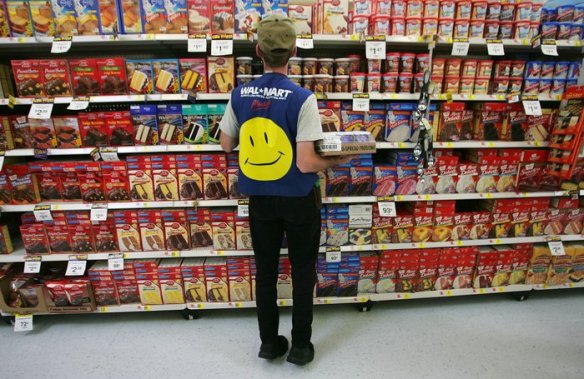
TROY, OH – MAY 11: An employee restocks a shelf in the grocery section of a Wal-Mart Supercenter May 11, 2005 in Troy, Ohio. Wal-Mart, America’s largest retailer and the largest company in the world based on revenue, has evolved into a giant economic force for the U.S. economy. With growth, the company continues to weather criticism of low wages, anti-union policies as well as accusations that it has homogenized America’s retail economy and driven traditional stores and shops out of business. (Photo by Chris Hondros/Getty Images)

By Daisy Luther

Source: Waking Times

In the United States, we are lucky to have massive convenience at our fingertips. I was talking to one of the instructors for the urban survival course, who is from Sweden, on a car ride. He was blown away by some of the things I told him about the levels of convenience and comfort in the United States. Things I completely took for granted don’t even exist there. I thought some of you might be interested in hearing about some of the insights we discussed.

Before I left for the course, I was walking my dogs a mile or two every day with my dogs, but that was about it. I thought it was enough but I learned during the field exercises that it wasn’t even close to the physicality required during an SHTF situation. But I digress. Let’s get back to convenience.

A caveat before people respond indignantly and tell me about all the inconvenience with which they deal every day: this is an opinion piece. Obviously many people in America still work out hard and have manual jobs. But when two-thirds of American adults and 30% of American children are overweight or obese, you have to see that you are not in the majority.

And it’s the majority here that I’m discussing. Between a combination of low-quality food and extremely sedentary lifestyles, the majority are killing themselves with convenience.

The American Culture of Convenience

The first thing that struck me when I landed in the Balkans was how different their lifestyle is from ours in the United States. But the longer I’ve been here, the more obvious it has become.

In the United States, depending on where you live, everything is dropped in your lap.

Food can be quickly acquired by shouting your order into a microphone and driving around a building, all without you having to leave your car. And if you live in a larger town or city, with the advent of services like GrubHub and DoorDash, the food delivered to your home is no longer the domain of pizza chains. You can have your choice of practically any restaurant in town brought right to your door within 45 minutes.

But it isn’t just about food. Instacart offers pick-up services from a wide variety of stores, including places like chain grocers, Wal-Mart, and Target. All you have to do is drive up, let them know by phone that you’ve arrived, and pop your trunk. Poof. Your shopping is done. In some cities, you can even use services like Instacart to have these things brought to your door.

Amazon has brought us practically anything else we could want with two-day shipping, regardless of where you live in the country. Gone are the days of scouring half a dozen stores to locate the whatchamacallit you needed. A quick search on Amazon and One-Click ordering and it’s yours within 48 hours and you never moved off your comfy chair.

If you need to go somewhere you don’t even have to drive yourself or take public transit. Uber or Lyft will happily send somebody to pick you up and drive you anywhere you need to go for a reasonable price, and you can watch the approach of your driver from the convenience of your phone.

Entire billion dollar industries are evolving to make our lives more convenient and easy every single day. Imagine how stunned our hunter-gatherer ancestors would be to discover we don’t even have to leave the house to be clothed and fed in epic abundance.

We don’t walk much, either.

And speaking of drive-thrus and driving to the store to get your Instacart packages, we drive everywhere. Part of this is because of the way suburbia is developed. It’s rare to live in a neighborhood where you can walk to the market, the bakery, and the wine store. So instead of walking to get our goods, we drive there, dash in, and get back in our cars. Those in big cities probably walk far more than those in suburbia, and for those in the country, it depends if they actually have a place to walk and whether they’re taking care of a large property.

And if we’re not walking to run our errands, we’re not carrying stuff. We get as close as possible with our cars if heavy groceries need to be lugged in and we carry as little as we can if we’re heading somewhere. When you walk the dogs, you might take your phone and some poop bags but you’re generally not taking it as a training opportunity and strapping on a pack.

Then there are the stairs.

Even two-story buildings in the United States have elevators much of the time because everything, by law, has to be easily accessible to every person. (And no, I’m not saying that people in wheelchairs need to try to haul themselves up the stairs. I’m discussing a trend.) But it goes even further than that. Adding elevators to your home is a growing trend in both the United States and Canada. New home builders are including elevators in the original design of some homes.

On the other hand, in Europe, they don’t have elevators in many buildings with fewer than five floors. I walked up and down more stairs in the past month than I have in the past year at home combined, and I live in a three-story house.

And the list of conveniences that would blow the minds of people I met in the Balkans goes on.

It’s an agoraphobic’s paradise in the United States.

You can get all sorts of mobile services that come to your door – everything from hairstyling to dog grooming. Other people mow our lawns, clean our homes, service our vehicles, and take care of us in general. There are even people who hire others to walk their dogs. Some people definitely need help with physical tasks but able-bodied people should be able to do a little yard work, shouldn’t we? Especially if we’re preparing for some kind of apocalypse.

In many areas, things are perfectly level, the sidewalks are carefully maintained (because who wants to ask for trouble in our litigious society), and a slight incline is considered a “hill” that people avoid to make their dog walk a little easier.

You can get meal kits brought to your door with every single ingredient you need to make a gourmet meal, right down to the seasonings accurately doled out in little packages. You can have fresh fruits and vegetables dropped off at your door by your local CSA. You can get subscription services of all types with the delivery of things like cosmetics, fitness gear, food from exotic locales, wine, candy, home decor items, socks, and dog paraphernalia.

Looking at it from the perspective of the area where I’ve been spending time, it’s simply mind-boggling that all of these riches are brought to you at the click of a button.

And it’s killing us.

As I mentioned earlier in this article, the obesity rate in the United States is staggering. A lot of it is our food. Thanks to subsidization by the USDA, many of the foods that are cheap are highly processed with low-quality ingredients. The NY Times reports:

At a time when almost three-quarters of the country is overweight or obese, it comes as no surprise that junk foods are the largest source of calories in the American diet. Topping the list are grain-based desserts like cookies, doughnuts and granola bars. (Yes, granola bars are dessert.)

That’s according to data from the federal government, which says that breads, sugary drinks, pizza, pasta dishes and “dairy desserts” like ice cream are also among Americans’ top 10 sources of calories.

What do these foods have in common? They are largely the products of seven crops and farm foods — corn, soybeans, wheat, rice, sorghum, milk and meat — that are heavily subsidized by the federal government, ensuring that junk foods are cheap and plentiful, experts say.

Between 1995 and 2010, the government doled out $170 billion in agricultural subsidies to finance the production of these foods, the latter two in part through subsidies on feed grains. While many of these foods are not inherently unhealthy, only a small percentage of them are eaten as is. Most are used as feed for livestock, turned into biofuels or converted to cheap products and additives like corn sweeteners, industrial oils, processed meats and refined carbohydrates. (source)

And even when we try to clean up our diets, foods are genetically modified, produce is doused in pesticides, and it’s packaged in all sorts of hormone-disrupting material that leaches in when you heat it up.

But it’s not just the crappy food. A lot of folks in the United States just do not get off their butts. And – I hate to say it – but I’m talking to a lot of people in the survival and preparedness world. Sitting at a keyboard or phone typing all day while Netflix plays in the background is sedentary to a deadly degree. On average Americans sit for 8.2 hours per day and this does not include the average 7-ish hours a day we’re sleeping.  And when we’re not sitting, it doesn’t mean we’re doing things that are good for us. We spend a great deal of time standing in line and driving in our cars. And the trend toward inactivity is only increasing.

Meanwhile, obesity contributes to many diseases such as:

  • High blood glucose (sugar) or diabetes.
  • High blood pressure (hypertension).
  • High blood cholesterol and triglycerides (dyslipidemia, or high blood fats).
  • Heart attacks due to coronary heart disease, heart failure, and stroke.
  • Bone and joint problems, more weight puts pressure on the bones and joints. This can lead to osteoarthritis, a disease that causes joint pain and stiffness.
  • Stopping breathing during sleep (sleep apnea). This can cause daytime fatigue or sleepiness, poor attention, and problems at work.
  • Gallstones and liver problems.
  • Some cancers.

The National Institute of Health is incredibly concerned about the future of overweight, sedentary Americans.

More recent evidence points to differential roles for body fat distribution patterns, in addition to excess overall adiposity, in elevating risk of many major chronic diseases. The large numbers of children entering adulthood overweight, together with increased weight gain in adulthood, portend an enormous burden in terms of human suffering, lost productivity, and health care expenditure in the coming decades. (source)

And – since it’s the purview of this website – imagine if the SHTF and you were too overweight and sedentary to go out and acquire the supplies you need to survive. Imagine what will happen when your medication runs out and you have a preventable disease brought on by your sedentary lifestyle. Imagine how your family will feel watching you suffer.

You need to add more movement to your life.

Unless you are among the 23% of Americans who meet the national exercise guidelines, you need to add more movement to your life. I suspect that there are a lot of people who believe they are disabled because getting started on a movement program is hard. It really does hurt, I know. But there’s a very good chance as you begin to move more it will become far easier. Don’t give in to it if your doctor says, “Oh, you’re disabled” and hands you a sticker for your car unless you really, truly are. If there’s even a glimmer of doubt in your mind, try to move just a few more steps each day. Instead of using the scooter to shop, push a cart to give yourself something to lean on. You aren’t training for a marathon – 10 extra steps a day will add up if you keep on pushing. But, MOVE.

The best way to increase movement is to decrease convenience. I don’t mean that you need to suddenly become a hunter-gatherer but you need to get off your duff. (To get started, check out this article or Bug Out Boot Camp and of course, always contact your doctor before beginning an exercise program. Blah, blah, blah.)

You need to carry heavy things instead of getting them delivered. You need to climb the stairs instead of taking the elevator or escalator. You need to actually go inside the store to do your shopping instead of sitting in your car, waiting for stuff to get loaded into your trunk. Park at the back of the parking lot, or better yet, at a store further away. Quit ordering from Amazon and buy things locally so you can walk around the store. Look for the hills and walk up and down them instead of avoiding them. If you want to eat restaurant food, go to the dad-gum restaurant. Find a place to walk to every day – maybe the post office, a coffee shop, or the dog park – and make it part of your routine.

It’s not unusual in other parts of the world to walk 8, 10, or even more miles, every single day. You don’t need to start there but maybe you should strive to get there. Once you’re in your groove, it should only take an hour or so to walk 4 miles. Using your feet as transportation is one of the healthiest things you can do.


Saturday Matinee: Koyaanisqatsi

Young Life Out Of Balance: The Impact and Legacy of ‘Koyaanisqatsi’

By Michael Grasso

Source: We Are the Mutants

Throughout the latter half of the 1970s, ex-seminarian/political activist Godfrey Reggio and cinematographer Ron Fricke shot, assembled, and edited film footage from all over the United States—from the yawning chasms of southwestern American deserts to the teeming mechanized metropolises of New York and Los Angeles—creating a feature film that would speak to the overwhelming complexity of late 20th century life in the West. This film, Koyaanisqatsi, debuted at American film festivals in 1982 and quickly became an arthouse (and eventual home video) favorite. The frequently eerie score for the film, composed by Philip Glass, provides the only aural accompaniment for this 86-minute montage showing the collision of nature and technology, of mankind and the planet. The word koyaanisqatsi, Hopi for “corrupted life” or “life out of balance,” provided a mission statement for the film; while Reggio has been cagey about not wanting to either imply or explicitly provide any specific meaning for the film, both the title and the Hopi prophecies of doom sung over the film’s final act make Koyaanisqatsi‘s point of view more or less explicit: something is dreadfully and fundamentally wrong with the way the settler inhabitants of America and the industrialized world as a whole relate to both the planet and themselves.

Koyaanisqatsi arrived with much fanfare as part of the PBS “Great Performances” anthology series in March of 1985. Given my love of all things PBS, I was absolutely there to see it in one of its initial broadcasts or repeats in ’85 or ’86. I’d heard about it most likely due to the hype around the film’s arrival on broadcast television for the first time. I do remember watching it at night, alone, possibly while my parents were out or in bed. When I found Koyaanisqatsi on a streaming service this year, I realized that I hadn’t watched it in its entirety since I was 10 years old. As I watched, I found myself thinking about how 10-year-old Mike responded to these overwhelming images. The process of meaning-making for a 10-year-old kid watching a film containing a sophisticated symbolic critique of modern life fascinated me. I decided to watch Koyaanisqatsi in 2019 with a close eye towards the images and sounds that had stuck with me subconsciously in the intervening third of a century, the sequences that offered today’s me a direct connection to my younger self. In childhood I was surrounded by films, cartoons, and other educational programming that transmitted the profundity and complexity of human existence and the universe directly into my growing brain. What did Koyaanisqatsi‘s sensory bombardment, its sometimes overwhelming contrasting of nature and technology mean to me then? And how did that meaning change for me as an adult, now fully conscious of and conversant with the issues Reggio raises?

It’s absolutely the first 15 minutes of the film that I remember most vividly from childhood. It begins with the juxtaposition of ancient petroglyphs at Horseshoe Canyon in Utah against slow-motion, almost abstract closeups of the Apollo 11 launch in 1969. This kind of meaning-through-montage connected with me on an intimate level at the age of 10; this was precisely the kind of respect for the pageant of human “progress” that electronic media teachers such as Carl Sagan had inculcated in me in my early years. Sagan did not necessarily privilege the Western, “scientific” worldview in his works; understanding that the ancient astronomers of the American West were precisely as clever as their European and Asian counterparts was an important part of Sagan’s pedagogy. And in this sweeping montage of the natural environment of the American West, Reggio offers a simultaneously calming and stunning view of the untouched majesty of nature. This is the same “blank screen” of desert that would thrill Baudrillard during his sojourn in North America at about exactly the same time. Even on a relatively tiny 1980s television screen, these aerial shots were breathtaking; it wouldn’t be until I first saw an IMAX projection in 1987 when the Omni Theater opened at Boston’s Museum of Science that I felt something similarly awe-inspiring.

These images of nature and the elements—earth and clouds and crashing waves—soothe the viewer; Glass’s musical accompaniments for these sections are tellingly titled “Organic” and “Cloudscape.” But just as we are lulled into a sense of security and a naturally human sense of awe at the landscape, Reggio (and Glass) throw us violently out of our idyll, showing us what man has done to these landscapes. We see engineering on a massive scale: strip mining, power plants with huge cooling lakes, massive dam projects. Glass’s hectic, pulsing aria, titled “Resource,” says it all. Natural rhythms and flows are subsumed under black clouds of pollution from earth-moving equipment; natural landscapes carved by millions of years of river and wind are carved into regularly-repeating, Cartesian geometry. “Resource” is horrifying, punishing: every trumpet blast announces the coming of something horrible. Again I am reminded of Cosmos: Sagan opines in Episode 5, “Blues for a Red Planet,” where Sagan imagines how an alien species will be able to determine that an intelligent species inhabits Earth—by how we change and adjust our natural environment. To Sagan, this is a largely joyful sign of our ingenuity and a necessary contrast with the natural “canals” of Mars. To Reggio, these marks are a constant, painful scarring, and his depiction of them on-screen has an immediate and negative emotional impact on the viewer, even a young one. Pollution was, of course, something I’d been made aware of from an early age: not just from the constant bombardment of PSAs on television, but from the plumes rising from the smokestacks every time I’d cross the Tobin Bridge in the family station wagon to go into Boston.

For much of “Resource” we are denied the opportunity to see sky: despite the grandeur of the landscapes, the camera angles and editing completely remove the context of said landscape with its cycles with nature and climate. The only blue we are offered is the reflection of the sky in the slightly sinister pools of the power plants’ cooling waters. And it’s here that we start to see humans for the first time as well, first dwarfed by the enormity of the dams and power plants around them, then briefly a few individuals populating the background of a sequence in a metal foundry. These figures are the reason behind all the scarring and carving of industry. Here is mankind. The glowing metal of the foundry reminds us of the original technological myth: fire tamed by Promethean man.

And there Reggio brings forth the myth’s ultimate expression: nukes. Stock footage of nuclear explosions would not be a symbol that needed much in the way of interpreting for a 10-year-old still scared bone-deep of the prospect of nuclear war. In this section we begin to see how all of these technological “advances” impact humanity. We see beachgoers enjoying a hot sunny beach—but with a huge looming power plant behind them. We see the mighty Boeing 747 taxiing on a runway, another testament to human ingenuity—sheathed and shimmering in an uncanny petroleum haze. Highways and cloverleaf overpasses are shown, overflowing with traffic; new cars are lined up in a holding yard, soon juxtaposed with Soviet tanks, American fighter jets, ICBMs, and more Apollo footage. Production and consumption, the war machine, and the nuclear arms race: all part of the same insane global system. The film footage of cluster bomb blasts, de rigueur as a signifier of the American war machine since the days of Vietnam and thus intimately familiar to 1985 me from various expressions on television and in pop culture, have a new and shocking impact when shown as part of the unnatural system that digs resources from the ground and turns them into immediate, instant death.

For many, the segment near the center-point of the film where the viewer is treated to an aerial survey of the abandoned Pruitt-Igoe housing projects in St. Louis is the film’s most brutal and emotional. Bookended in Koyaanisqatsi by other images of the failure of social housing in the South Bronx, and very much of a piece with the worldwide midcentury penchant for Brutalist “urban renewal”, the tale of Pruitt-Igoe would be resolutely familiar to an adult in the early 1980s. For me at 10, a sheltered white kid who’d grown up entirely in the suburbs, the sequence’s eerie ruined majesty held complete mystery. What were these huge repeating buildings shaped like boxes? Why were they in such disrepair? And why were they being totally and completely annihilated with explosives in such a dramatic fashion? I was insulated through much of my youth (by express design of the white power structure, as it turns out) from the living and educational conditions of Black Americans in both my own home city of Boston and around the country. The wages of centuries of American apartheid were nothing but a vague unease at the periphery of my consciousness. The power demonstrated in both choosing to build and choosing to destroy these buildings, over a period of a mere three decades—little more than one human generation—was accurately and shockingly conveyed by the film, but its ultimate meaning was lost to me. As an adult, with all the context and knowledge present upon my re-viewing of the film, “Pruitt-Igoe” stands as a testament to midcentury liberalism’s best intentions, naturally sabotaged by the white violence inherent in American capitalism. This is the one sequence of Koyaanisqatsi that I look back on today and wish I’d had an adult—a wise, sensitive adult—to guide me through.

At the film’s halfway point, we really begin to see mass man. At first in slow motion, urban crowd “B-roll” shots of a type I would have been intimately familiar with from television in 1985, shot in slow-motion, cut with close-ups of individual human beings in front of vivid backgrounds: the whooshing of an urban subway, a military officer in front of a jet engine, a group of casino workers with the lights of Las Vegas flashing behind them. In a concerted way, these “portraits” arrest us as viewers after the sensory assault of the first 40 minutes of the film, getting us to begin seeing the individuals behind the mass movements and incomprehensible destruction we’ve seen so far. As an adult I find them almost unbearably poignant; I found myself wondering what happened to all these folks after Reggio and Fricke finished filming them. As a kid, their slightly outdated fashions (from the mid-to-late-’70s, by the looks of it) consigned them to the more recent past of the only context I could understand: sitcom reruns in syndication, that forever-lagging-behind-the-present that ensured I was in some ineffable way a nostalgic even at the age of 10.

“The Grid” is the section of Koyaanisqatsi where Reggio and Fricke first use time-lapse photography for, I would argue, its greatest achievement in film history. As much as we’ve been given a key to understanding the impact of technology and so-called progress on the natural world, this section, full of glittering cityscapes and the pulsating grid of traffic in Los Angeles at night, are heartbreakingly beautiful. The flow of traffic through midtown Manhattan, so expertly regulated by traffic lights, is yet somehow unnatural; these highway and street scenes, sped up, remind us (and certainly would have reminded the young me who’d grown up with educational programming) of microphotography of blood cells in arteries and capillaries, but somehow off: constantly halting and resolutely inorganic. In contrast, one of the film’s trademark shots (featured on the home video box and posters) of the moon’s movement through the sky as it is eclipsed by an office block is so sure in the lens of Fricke’s innovative time-lapse cameras, so machine-precise, far outstripping in elegance and power the stuttering processes of automobile and pedestrian traffic regulated by human-created technology.

Possibly the most homely, familiar, and comforting section of the film involves the juxtaposition of manufacturing, industry, and food processing with the crazy-quilt of consumption that completes industrial capitalism’s cycle. Hot dogs and Twinkies, blue jeans and televisions and automobiles roll off of assembly lines; as an adult in 2019 all I could think was “look at all those human workers!” There were so few robots in sight in each of these sequences, and the factory workers themselves looked so humble yet so proud. I also thought back to me at age 10, and how Mister Rogers’ Neighborhood would have primed me to look at these time-lapse sequences of production as something wondrous, something to be proud of. The flip side of all this production is seen in Koyaanisqatsi‘s views of Americans enjoying their leisure time: playing video games (I spotted Ms. Pac-Man, Q*bert, and Defender among many other video cabinets in the arcade sequence), bowling, going to the movies, visiting the mall food court, and especially watching television. The time-lapse photography zips through banks of televisions airing the prime-time advertisements and network news breaks of the kind I’m obsessed with and hunt down on YouTube in 2019. As a kid, this would have been the segment of the film that would’ve been the most immediate and identifiable to me. The people in these sections looked like me: they were suburban, not urban, dressed in casual clothes, not hats and suits and trenchcoats. They were young! There were younger kids sipping on milkshakes and having burgers with their families at the mall. These people were me. Did I understand how my consumption made me an accomplice to the black billowing smoke and scarred landscapes seen earlier in the film? At that age, I’m sure not.

Reggio always returns to people, not only to give the viewer (whether 10 years old or 43 years old) that sense of identification, a sense of their stakes in the modern “life out of balance,” but to return to the dignity of the individual human being. Reggio’s intellectual origins both in post-Vatican II Catholic conceptions of social justice and human dignity as well as Christian eco-anarchism demands this kind of attention to the individual humans behind these teeming visual landscapes. The final sequence is titled “Prophecies.” Glass’s musical accompaniment for this final sequence features a chorus singing three Hopi prophecies, interpreted by academic consultants Michael Lowatewama and Ekkehart Malotki, and translated on-screen at the end of the film. These prophecies are ones that would be familiar to anyone raised in the Western Christian tradition: tales of the death of the world thanks to mysterious poisons falling from the sky. As the choir chants these predictions of chaos and confusion, we see people wandering the streets, crushed by their surroundings: a homeless man gazing down at the change in his hand, a sick man put onto a litter by EMTs, someone in a hospital with a bloody wound resulting from an intravenous injection of fluids. The combination of Hopi prophecy on the soundtrack with the kind of lost people that Christ tried to minister to is devastatingly effective; even as a child, this section evoked pity and empathy in me rather than the disgust from seeing out of control pollution or technology. Bookending this is a lengthy sequence in slow-motion of an Atlas-Centaur rocket disaster, one of its thrusters tumbling back to earth slowly. The name of the star might have been Wormwood, but a year after this PBS airing, both a Challenger disaster and a nuclear disaster at another Wormwood half a world away would offer yet another Promethean lesson to both the U.S. and the Soviet Union.

I can’t remember exactly what I felt like immediately after viewing Koyaanisqatsi all those years ago, but its indelible images and sounds remained firmly in my subconscious all through my adolescence and adulthood. Now I’m middle-aged, the same age as all those scurrying New York City businessmen who seemed so weirdly uniform and alien to me as a kid. As I watch now, I of course am able to see that we are all lost in the life out of balance now. I wouldn’t call Reggio prophetic because anyone with eyes to see and ears to hear knew what was happening to us in the years since the end of the Second World War. And while art can absolutely point out injustice, fraud, exploitation, and abuse, it can very easily be used to recuperate these ideas into a more comfortable idea of the inevitability of “progress.” I don’t feel like any later misuse of Reggio’s praxis is his fault per se; whether or not he expressly provides meaning for us, his words and actions in the years following Koyaanisqatsi‘s release are clear and obvious.

I’ve never bothered to watch the two “Qatsi” sequels released in the years following the original. Their dual focuses were on life in the developing world and “life as war,” focusing on the modern world’s war with itself over technology. I’m not sure if they could achieve the mythic status and impact which Koyaanisqatsi had on my developing brain as a kid. Was 10 years old too young to consider these kinds of issues of modern life? I’m not sure. All I know is that I’m grateful I was given the opportunity to internalize these images and thoughts, to consider my place on a planet, both blessed and cursed by my surroundings, to ponder my role both as an individual and as part of a societal collective. While the televisual instruction of my childhood idols Sagan and Rogers may have in some small part normalized the mindset that brought us to this point (all while being steadfast advocates of social justice and peace, of course), Reggio’s camera, untouched by words, conveys the meaning of this life out of balance directly, resolutely, fearlesssly. A prophet Reggio himself may not be, but his filmic prophecy, and through it the prophecy of the Hopi, lives on.


Watch the full film on Kanopy here: https://www.kanopy.com/product/koyaanisqatsi


The Disintegrated Mind: The Greatest Threat to Human Survival on Earth

“Triple Portrait” by Sophie Kahn

By Robert J. Burrowes

Like many people who have struggled to understand why human beings are driving the sixth mass extinction event in Earth’s history, which now threatens imminent human extinction as well, over many decades I have explored the research and efforts of a great many activists and scholars to secure this understanding. However, with many competing ideas from the fields of politics, economics, sociology and psychology, among others, this understanding has proved elusive. Nevertheless, I have reached an understanding that I find compelling: Human beings are driving the sixth mass extinction event in Earth’s history because of the disintegrated nature of the human mind.

While the expression ‘mental disintegration’ has been used in a number of contexts previously, for the purpose of my discussion in this article I am going to redefine it, explain how it originates, describe several ways in which it manifests behaviorally and the profoundly dysfunctional outcomes this generates, and suggest what we can do about it.

Given that the expression, as I am using it, describes a shocking psychological state but also one that is so widespread it afflicts virtually everyone, it can be described as posing the greatest threat to human survival on Earth. Why? Simply because it caused – and now prevents virtually everyone from thinking, feeling, planning and behaving functionally in response to – the multifaceted threats to humanity and the biosphere.

So, for the purpose of this article: Mental disintegration describes a state in which the various parts of the human mind are no longer capable of working as an integrated unit. That is, each part of the mind – such as memory, thoughts, feelings, sensing capacities (sight, hearing…), ‘truth register’, conscience – function largely independently of each other, rather than as an integrated whole. The immediate outcome of this dysfunction is that human behaviour lacks consideration, conviction, courage and strategy, and is simply driven compulsively by the predominant fear in each context.

The reason this issue first attracted my attention was because, on many occasions, I observed individuals (ranging from people I knew, to politicians) behaving in ways that seemed outrageous but it was also immediately apparent that the individual was completely unaware of the outrageous nature of their behaviour. On the contrary, it seemed perfectly appropriate to them. With the passage of time, however, I have observed this dysfunctionality in an enormously wide variety of more subtle and common forms, making me realise just how widespread it is even if it goes largely unrecognized. After all, if virtually everyone does it in particular contexts, then why should it be considered ‘abnormal’?

One version of this mental disintegration is the version usually known as ‘cognitive dissonance’. The widely accepted definition of this state, based on Leon Festinger’s research in the 1950s, goes something like this: Cognitive dissonance theory suggests that we have an inner drive to hold all of our attitudes, beliefs, values and behavior in harmony and to avoid disharmony (or dissonance). This is known as the principle of cognitive consistency. When there is an inconsistency between attitudes, beliefs and/or values on the one hand and behaviors on the other (dissonance), something must change to eliminate the dissonance.

The problem with this approach to the issue is that it assumes awareness of the inconsistency on the part of the individual impacted and also assumes (based on Festinger’s research) that there is some inclination to seek consistency. But my own observations of a vast number of people in a substantial variety of contexts over several decades have clearly revealed that, in very many contexts, individuals have no awareness of any discrepancy and, hence, have no inclination to seek consistency between their attitude, belief and/or value and their behavior. Moreover, even if they do have some awareness of the inconsistency, most people simply act on the basis of their predominant emotion – usually fear – in the context and pass it off with a rationalization. For example, that their particular work/role is so important that it justifies their excessive consumption on a planet of limited and unequally shared resources.

Consequently, to choose an obvious example, most climate, environmental, anti-nuclear and anti-war activists fail to grapple meaningfully with the obvious contradiction between their own over-consumption of fossil fuels and resources generally and the role that consumption of these resources plays in driving the climate and environmental catastrophes as well as war. The idea of reducing their own personal consumption is beyond serious contemplation (let alone action). And, of course, it goes without saying that the global elite suffers this disintegration of the mind by failing to connect their endless acquisition of power, profit and privilege at the expense of all others and the Earth, with the accelerating and multifaceted threats to human survival including the future of their own children. But the examples are endless.

In any case, leaving aside ‘cognitive dissonance’, there are several types of mental disintegration as I define it in this article. Let me briefly give you five examples of mental disintegration before explaining why it occurs.

  1. Denial is an unconscious mental state in which an individual, having been given certain information about themselves, others they know or the state of the world, deny the information because it frightens them. This is what happens for a ‘climate denier’, for example. For a fuller explanation, see ‘The Psychology of Denial’.
  2. The ‘Magic Rat’ is an unconscious mental state in which a person’s fear makes them incapable of grappling with certain information, even to deny it, so they completely suppress their awareness of the information immediately they receive it. For four examples of this psychological phenomenon, which President Trump exemplifies superbly, see You Cannot Trap the “Magic Rat”: Trump, Congress and Geopolitics’.
  3. Delusion is an unconscious mental state in which a person is very frightened by certain information but the nature of the circumstances make it impossible to either deny or suppress awareness of the information so they are compelled to construct a delusion in relation to that particular reality in order to feel safe. For a fuller explanation, see The Delusion “I Am Not Responsible”’.
  4. Projection is an unconscious mental state in which a person is very frightened of knowing a terrifying truth so they ‘defend’ themselves against becoming aware of this truth by (unconsciously) identifying a more palatable cause for their fear and then ‘defending’ themselves against this imagined ‘threat’. Political leaders in Israel do this chronically in relation to the Palestinians, for example. But the US elite also does this chronically in relation to any competing ideas in relation to political and economic organization in other countries. See ‘The Psychology of Projection in Conflict’.
  5. Lies arise from a conscious or unconscious mental state in which a person fears blame and/or punishment for telling an unpalatable truth (such as one that will self-incriminate) so they unconsciously employ tactics, including lying, to avoid this blame and punishment (and thus project the blame onto others). When people lie unconsciously, it means they are lying to themself as well; that is, constructing a lie without awareness that they are doing so. For a fuller explanation, see Why Do People Lie? And Why Do Other People Believe Them?’

So why does this mental disintegration – this disintegration of the mind so that its many components are essentially unaware of the others – happen? In brief, it happens because, throughout childhood, each individual is endlessly bombarded with ‘visible’, ‘invisible’ and ‘utterly invisible’ violence in the name of socialization, which is more accurately labeled ‘terrorization’. This is done to ensure that the child is obedient despite the fact that obedience has no evolutionary functionality whatsoever. See Why Violence? and Fearless Psychology and Fearful Psychology: Principles and Practice.

A primary outcome of this terrorization in materialist cultures is that the child learns to suppress their awareness of how they feel by using food and material items to distract themselves. By doing this, the child rapidly loses self-awareness and learns to consume as the substitute for this awareness. Clearly, this has catastrophic consequences for the child, their society and for nature (although it is immensely profitable for elites and their agents). For a fuller explanation, see ‘Love Denied: The Psychology of Materialism, Violence and War’.

Beyond this, however, this terrorization ensures that the human mind is so disintegrated that virtually all humans have no problem living in denial, delusion and projection and using ‘magic rats’ and lies on a vast range of issues because they simply have no awareness of reality in that context. Different parts of their disintegrated mind simply hold one element of their mind separately from all others (thus obscuring any denial, delusion and projection and the use of ‘magic rats’ and lies), consequently precluding any tendency to restore integrity from arising.

This is why, for example, most people can lie ‘outrageously’, including under oath, without the slightest awareness that they are doing so and which, as an aside, is why oaths to tell the truth in court, and even lie detector tests, are utterly meaningless. If the person themself is unaware they are lying, it is virtually impossible for anyone else – unless extraordinarily self-aware – to detect it. And, of course, judges and juries cannot be self-aware or they would not agree to perform their respective roles in the extraordinarily dysfunctional and violent legal system. See ‘The Rule of Law: Unjust and Violent’.

In essence then, the process of ‘socializing’ (terrorizing) a child into obedience so that they will ‘fit into’ their particular society has the outcome of scaring them into suppressing their awareness of reality, including their awareness of themself. In this circumstance, the individual that now ‘survives’ does so as the ‘socially-constructed delusional identity’ (that is, obedient and, preferably, submissive individual) that the significant adults in their childhood terrorized them into becoming.

To reiterate: Because social terrorization destroys the emergence of an integrated mind that would enable memory, sensing capacities, thoughts, feelings, conscience, attitudes, beliefs, values and behaviours to act in concert, the typical individual will now invariably act in accord with the unconscious fear that drives every aspect of their behavior (and ‘requires’ them to endlessly seek approval to avoid the punishment threatened for disobedience when they were a child).

Moreover, this disintegrated mind has little or no capacity to ‘observe reality’ in any case, such as seek out genuine news sources – like the one you are reading now – that accurately report the biodiversity, climate, environmental, military and nuclear catastrophes and, having done so, to be truly aware of this news in the sense of deeply comprehending its meaning and implications for their own behaviour.

So, to elaborate one of the examples cited above, even most individuals who self-identify as climate, environmental, anti-nuclear and/or anti-war ‘activists’ go on over-consuming (which is highly socially approved in industrialized societies) without any genuine re-evaluation of their own behaviour in light of what should be the observed reality about these crises (or, if their mind allows a ‘re-evaluation’ to commence, to dismiss it quickly with a rationalization that their over-consumption is somehow justified).

One obvious outcome of this is that elite-controlled corporations and their governments can largely ignore ‘activist’ entreaties for change because activist (and widespread) over-consumption constitutes financial endorsement of the elite’s violent and exploitative economy. In other words: If people are buying the products (such as fossil fuels for their car and air travel, and hi-tech devices), made possible by fighting the wars and exploiting the people in countries where the raw materials for this production are secured, then why pay attention to calls for change? Dollars speak louder than words.

So what can we do?

Well, given that the above describes just a small proportion of the psychological dysfunctionality of most humans, which is why we remain on the fast track to extinction despite overwhelming evidence of the profound changes that need to occur – see ‘Human Extinction by 2026? A Last Ditch Strategy to Fight for Human Survival’ – I encourage you to seriously consider incorporating strategies to address this dysfunctionality into any effort you make to improve our world.

For most people, this will include starting with yourself. See ‘Putting Feelings First’.

For virtually everyone, it will include reviewing your relationship with children and, ideally, making ‘My Promise to Children’.

For those who feel readily able to deal with reality, consider campaigning strategically to achieve the outcomes we need. See Nonviolent Campaign Strategy or Nonviolent Defense/Liberation Strategy. The global elite is deeply entrenched – fighting its wars, exploiting people, destroying the biosphere – and not about to give way without a concerted effort by many of us campaigning strategically on several key fronts.

If you recognize the pervasiveness of the fear-driven violence in our world, consider joining the global network of people resisting it by signing the online pledge of The Peoples Charter to Create a Nonviolent World.

But, most fundamentally of all, if you understand the simple point that Earth’s biosphere cannot sustain a human population of this magnitude of which more than half endlessly over-consume, then consider accelerated participation in the strategy outlined in The Flame Tree Project to Save Life on Earth.

Or, if this feels too complicated, consider committing to:

The Earth Pledge 

Out of love for the Earth and all of its creatures, and my respect for their needs, from this day onwards I pledge that:

  1. I will not travel by plane
  2. I will not travel by car
  3. I will not eat meat and fish
  4. I will only eat organically/biodynamically grown food
  5. I will minimize the amount of fresh water I use, including by minimizing my ownership and use of electronic devices
  6. I will not buy rainforest timber
  7. I will not buy or use single-use plastic, such as bags, bottles, containers, cups and straws
  8. I will not use banks that provide any service to corporations involved in fossil fuels, nuclear power and/or weapons
  9. I will not accept employment from, or invest in, any organization that supports or participates in the exploitation of fellow human beings or profits from killing and the destruction of the biosphere
  10. I will not get news from the corporate media (mainstream newspapers, television, radio, Facebook…)
  11. I will make the effort to learn a skill, such as food gardening or sewing, that makes me more self-reliant
  12. I will gently encourage my family and friends to consider signing this pledge.

Conclusion

There is a vast array of ‘professional help’, literature, video material, lecturers and other ‘resources’ from a wide range of perspectives that advocate and ‘teach’ one or a variety of ways that people can use to change their behaviour to get improved outcomes in their lives (whether from a personal, economic, business, political or other perspective). Virtually all of these constitute nothing more than psychological ‘tricks’ to achieve a short-term outcome by ‘working around’ the fundamental truth: As a result of terrorization during childhood, virtually all humans are unconsciously terrified and this makes their behaviour utterly dysfunctional.

The point is this: there is no trick that can get us out of the catastrophic mess in which we now find ourselves. Only the truth can do that. Psychological and behavioural dysfunctionalities notwithstanding, if we do not address this fear as part of our overall strategy, then this fear will destroy us in the end. And the evidence of that lies simply in the fact that the daily updates on the already decades-long but ongoing horrific biodiversity, climate, environmental, nuclear, war and humanitarian crises are testament to our ongoing failure to respond appropriately and powerfully. Because our (usually unconscious) fear prevents us from doing so.

So if you believe that human beings are going to get out of our interrelated social, political, economic, military, nuclear and ecological crises with a largely psychologically dysfunctional population, I encourage you to re-evaluate that belief (paying attention, if you can, to how your disintegrated mind intervenes to prevent you doing so). And I encourage you to ask yourself if the value we get out of improving the psychological functionality of our species might not be worth considerable effort as part of our overall strategy to avert human extinction.


Biodata: Robert J. Burrowes has a lifetime commitment to understanding and ending human violence. He has done extensive research since 1966 in an effort to understand why human beings are violent and has been a nonviolent activist since 1981. He is the author of Why Violence? His email address is flametree@riseup.net and his website is here.