Make Sure You Download the Latest Ministry of Propaganda Updates

By Charles Hugh Smith

Source: Of Two Minds

It’s time once again to check for Ministry of Propaganda updates, which like Windows and iOS is constantly being updated to counter new threats and enhance the user experience (heh).

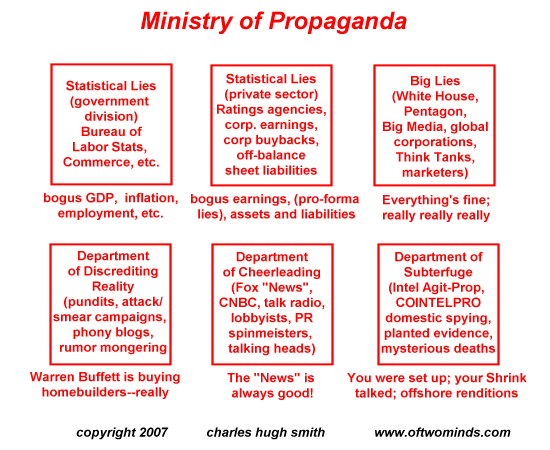
Much like the other operating systems that underpin our daily lives, the core functions of the MoP don’t change much. My chart from 2007 remains an instructive summary of MoP operations, with the only changes being Mr. Buffett is now buying oil companies and social media corporations are now major media players.

The core mission of the Ministry of Propaganda isn’t just to push a desirable narrative–it’s to mystify the underlying dynamics of a system that benefits the few at the expense of the many by promoting a self-serving worldview (weltanschauung) that explains how the world works in a way that protects the interests of those in power.

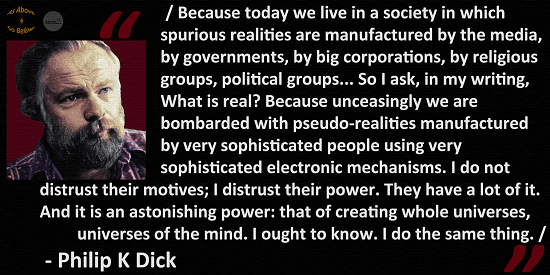
As science fiction author Philip K. Dick explains in the quote below, the MoP narrative isn’t just a cloak thrown over the underlying dynamics, it’s the creation of an entire universe / worldview, including contexts for understanding what’s going on, establishing what’s valuable and what isn’t, and what behaviors enhance status and which ones marginalize us.

The Ministry of Propaganda isn’t monolithic: various factions compete to push their self-serving narratives. As Dick noted, this includes governments, corporations, religious and political groups, each of which understands that once the populace accepts their worldview, their power is cemented in realms far above mere force.

A key mechanism in establishing a dominant worldview is the think-tank or equivalent self-serving body claiming authority over what’s true / false and important / unimportant. This can be authority over the “correct” interpretation of spiritual texts, economic policies, healthcare “standards of care,” geopolitical goals, etc.

Since humans are innately social, status-striving beings, hierarchies of authority and power are the air we breathe. Those who establish themselves as authorities don’t just gain power, they cement their power on the basis of their authority rather than on loyalty or competence.

The enormous powers of social media and traditional media to promote claims of authority have generated a deranging snarl of conflicting agendas and narratives. Various centers of power collaborate on pushing worldviews that benefit their interests, but this isn’t entirely coherent. The one thing all participants in the Ministry of Propaganda agree on is our power is deserved and must be defended against all threats, which includes hostile entities inside and outside the national borders.

This fragmented, constantly shifting cacophony of competing authorities is destabilizing. As the tectonic plates of worldviews collide, the edges crumble and people naturally seek the safety of some core set of beliefs, in effect “circling the wagons” in an attempt to restore some internal stability.

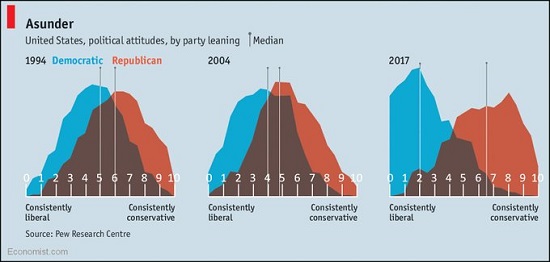
We see this in the intense political polarization of this era (see chart below). To make sense of the competing claims of authority, we reduce the perimeter of what’s defendable, putting more of the world into “outside enemies” (them) and reserving the “safe, trusted place” for fewer of “us.”

With so many competing factions in the Ministry of Propaganda, there’s a proliferation of propaganda such that there is literally nothing left but PR. In a universe constructed of nothing but agit-prop and PR, we all have our favorites examples. James Bond picks up his Nokia phone. Even though nobody’s seen a Nokia phone in ages, if you want to be cool like Bond, go buy a Nokia phone.

Marketing is the MoP’s entire universe. Everybody’s selling something to gain or maintain power, status, mindshare or the ultimate prize, the dominant worldview.

To ease the confusion, please download the latest updates from the Ministry. These updates replace all that misinformation, misdirection, and blatant marketing with the, ahem, facts, or the correct interpretation of the facts. (We had to destroy the village in order to save it. OK, got it.)

While it’s fun to sort all the propaganda into various boxes, we would do well to look for what all the marketers / MoP players seek to mystify. In my analysis, what must be mystified at all costs boils down to the unsustainability of 1) the current consumption of resources, 2) the current method of creating capital so the few can buy up the planet’s most valuable assets, 3) neocolonialism, the modern replacement for the old model of occupation and exploitation by force, and 4) neofeudalism, the economic / social /political arrangement in which the majority of the populace are modern-day serfs with extremely limited agency and power which they are told is limitless.

“You can be anything you choose to be!” Or at least your digital avatar can do so, and that’s practically as good as actually having agency and power in the real world. Or so we’re told, mindlessly, endlessly without pause or respite.

More on these topics in the coming weeks.

What Will You Say When Millions Of People Starve To Death?

By Michael Snyder

Source: End of the American Dream

For a long time, those of us that were claiming that a global famine was coming were widely mocked.  The skeptics could see the exact same trends that everyone else could see, but they just assumed that we would find a way to muddle through somehow.  So they didn’t want to listen to common sense, and they weren’t interested in warnings from “gloom and doomers” such as myself.  But I don’t consider myself to be a “doom and gloomer” because I am actually a very optimistic person.  I am so excited to be living during this time in human history, but I also know that very difficult times are ahead of us.  One of the major trends that I keep writing about over and over is famine, because the truth is that there simply is not going to be enough food for everyone on the planet in 2023 and beyond.  Of course the mainstream media is also starting to issue similar warnings.  For example, the following comes from a Yahoo News article entitled “Millions in East Africa face starvation due to drought”

The World Health Organization warned on Wednesday that millions of people in East Africa face the threat of starvation. Speaking at a media briefing in Geneva, WHO Director-General Tedros Adhanom Ghebreyesus said that drought, climate change, rising prices and an ongoing civil war in northern Ethiopia are all contributing to worsening food insecurity.

Over 50 million people in East Africa will face acute food insecurity this year, a study from late July by the World Food Programme and Food and Agriculture Organization found. Roughly 7 million children are suffering from malnourishment and, according to the United Nations High Commissioner for Refugees, hundreds of thousands are leaving their homes in search of food or livelihoods. Affected countries include Djibouti, Ethiopia, Kenya, Somalia, South Sudan, Sudan and Uganda.

In Somalia, authorities are projecting that vegetable and grain production will “drop by about 80% this year” due to the endless drought that they are currently experiencing.

Millions of precious people in Africa are facing imminent starvation.  But most of us in the western world don’t care, because our grocery stores are still full of food.

If you are one of those people that are choosing to ignore what is happening on the other side of the planet, you can afford to be cocky for now.

But conditions are starting to change here too.

Earlier today, I came across an excellent article about how the multi-year megadrought in the western half of the country is absolutely devastating the ranching industry…

The megadrought in the Western U.S., the region’s worst in 1,200 years, is threatening America’s cattle heartland: withering pastures, wrecking feed harvests and endangering a quintessential way of life.

The drought is forcing ranchers here in Texas and across the Southern plains to make an agonizing decision: Sell early now for less money than they planned on — or hold on, pray for rain and risk losing everything.

Sadly, more ranchers are deciding to sell off cattle with each passing day.

If you can believe it, the rate at which cattle are being sold is now 120 percent above last year’s level…

Over the last two weeks of July, the national cattle sale rate also jumped to 120 percent above 2021 levels — an average that reporting by The Hill and KAMR suggested conceals even higher frenzies of sales in some markets.

What this means is that lots of beef is coming on to the market.

Beef prices had been soaring, but in the short-term all of the cattle that are being slaughtered will help to moderate prices.

However, the outlook for 2023 is grim.  The national cattle herd just keeps getting smaller and smaller, and some beef producers in Oklahoma are now predicting that ground beef “could eventually top $50 per pound”

Thanks to the unending economic symptoms of the pandemic and 2022’s inflation double-punch, average beef prices are currently about twice what they were in 2019. Add in the deepening widespread drought, a shortage of hay and feed, skyrocketing prices, transport costs, and various other metrics, some Southwest Oklahoma beef producers suggest cheap ground beef could eventually top $50 per pound.

If the price of ground beef does reach 50 dollars a pound, what do you think our country will look like?

Needless to say, at that point there will be absolutely no debate about whether we are in a global food crisis or not.

And we are also being told that we could soon be facing shortages of potatoes and tomatoes.  The following comes from Zero Hedge

Days ago, we said the next food insecurity problem that may impact Americans’ eating habits could be an emerging potato shortage. Now there appears to be another issue: Tomatoes are getting squeezed, and risks of a ketchup shortage rise as a severe drought batter California’s farmland.

California accounts for a quarter of the world’s tomato output. The worst drought in 1,200 years has forced farmers to abandon fields as crops turn to dust amid a water crisis.

I recently wrote an entire article about the coming tomato shortage that you can find right here.  Unless some rain comes along, the tomato crop in California this year is going to be absolutely disastrous.

So are you ready to eat less pizza because there isn’t enough pizza sauce to go around?

And are you ready to pay twice as much for spaghetti sauce at the grocery store?

On top of everything else, we are also potentially facing an extremely painful shortage of cotton

Intense drought has forced cotton farmers to abandon millions of acres that have produced so little cotton that they are no longer worth harvesting, the Wall Street Journal reported Tuesday.

Farmers will harvest an estimated 7.13 million acres, abandoning approximately 5.35 million acres due to an ongoing drought hammering southern U.S. states, representing an estimated abandonment rate of 42.87%, according to the National Cotton Council of America, who based their analysis on U.S. Department of Agriculture (USDA) data. This represents the smallest harvest by area since 1868, The Wall Street Journal reported.

What I have touched on in this article is just the tip of the iceberg.

Agricultural production is going to be way down all over the planet this year.

But we will surely find a way to “muddle through” somehow, right?

If you have been a skeptic of reports of shortages and famine, it is time to wake up.

We really are staring an unprecedented global crisis right in the face, and the months ahead are going to be filled with pain.

Calm Before the Tempest?

By Charles Hugh Smith

Source: Of Two Minds

Let’s start by stipulating the obvious: no one knows the future, and most of the guesses–oops, I mean forecasts–will be wrong. Arguing about the forecasts now won’t make any difference as to which ones are correct and which ones are wrong. Time alone will tell.

That said, here’s a scenario that fits the dynamics I see as most consequential: Core-Periphery and the demise of the waste is growth / financialization / globalization model as the reigning model of how the global economy should work.

Core-periphery dynamics are pretty simple: unraveling starts on the periphery and seeps toward the core. The core actually strengthens in the process as capital and talent seek havens where they’re treated well, and the core became the core by treating capital and talent well.

The periphery responds to the unraveling of financialization / globalization by tightening its grip on whatever capital and talent is still available, incentivizing the flight of capital and talent to the core.

A great many people think there are many core economies. In my analysis, there is only one, due to the qualifying requirements: 1) issues a reserve currency, i.e. not pegged to another currency 2) liquid global markets for securities, debt, commodities, etc., i.e. anyone anywhere can trade in size in the core markets 3) transparent market and governance mechanisms, i.e. no overnight devaluations, expropriations, capital restrictions, etc. 4) diverse economy not dependent on exports or imports for its well-being and 5) ease of flow: capital, talent, enterprises and employees all have essentially unlimited freedom of movement within the core.

We can argue about which nations qualify as core but it won’t change the outcome. Capital and talent will make their own decisions about risk, safety, exposure to devaluation and expropriation and where the odds of being treated fairly are highest. It’s a good exercise to put yourself in the shoes of a manager of a $10 billion fund and go through the decision tree of where to put this $10 billion to preserve its purchasing power first and foremost, and secondarily generate a return.

Would you really gamble $10 billion on a 15% return on the bonds of Timbukthree, whose currency has fallen 20% against the U.S. dollar this year? Or Timbukfour, which is dependent on exports of commodities in a shrinking global economy? Or Timbukfive, which is dependent on imports of commodities and exports of consumer goods in a shrinking global economy?? If you answer “yes,” you’re not actually playing like you are responsible for $10 billion.

As the periphery unravels financially, it also unravels politically and socially. Bordering states are at risk of destabilizing, and any entity with large exposure to the unraveling debt or markets starts unraveling, too. The destabilization spreads to second-tier nations whose exposure to the dynamics of unraveling are structural.

As all these dominoes fall, eventually those closest to the core also crumble, and then core itself is finally destabilized.

Humans have an interesting talent for adjusting to new circumstances, i.e. habituating to new conditions. Those households consuming 14,000 gallons of fresh water a month may well scream that they can’t possibly get by on 12,000 gallons, but then if circumstances change and all the water we have is what we can carry in buckets a kilometer over rough terrain, we find that we can live on the few gallons we can carry a kilometer.

The amount of waste in developed economies is beyond easy measure. It’s estimated 40% of all food in the U.S. is wasted. Energy, food and fresh water have been treated as if low cost and abundance were birthrights rather than brief explosions of excess. While we’re screaming about energy costs, empty buildings are brightly lit, water taps are left running and one individual per idling vehicle in a traffic jam frets about rising costs.

When the 1989 Loma Prieta earthquake closed the Bay Bridge across San Francisco Bay, the main artery between San Francisco and the East Bay, economic doom was predictably predicted. Yet people quickly managed via extra BART (subway) trains that rain beneath the Bay and carpools with four people per vehicle rather than one occupant.

Is it possible that all the predictable predictions of economic doom are somewhat exaggerated by the thrill of sensationalism and projections of past trends, as if people can’t possibly make consequential adjustments to their behaviors and consumption?

Systems have constraints, and so there are limits on what adjustments can be made without altering the structure, but in many cases, we’re far from reaching limits on basic conservation work-arounds.

Is it possible that things will prove less dire than currently expected? It seems little credence is being given to the potential to adjust to new conditions.

Is it beyond conception that the core actually strengthens for a length of time before the unraveling reaches it? In my crystal ball, it seems not just possible but likely. This will be the calm before The Tempest, when the unraveling reaches the core and structural changes are finally required.

UNCONSCIOUS BECOMING CONSCIOUS: UNDERSTANDING THE NATURE OF NEGATIVE FORCES

By Kingsley L. Dennis

Source: Waking Times

What people of the fifth post-Atlantean epoch must learn to recognise is the fully conscious struggle against the evil rising up in the evolution of humanity.’ ~Rudolf Steiner, 18 November 1917

According to Austrian metaphysician Rudolf Steiner, the task of humanity in this epoch is to comprehend the relation of good and evil; especially, the human choice between good and evil, and the challenge of evil to make humanity more aware of spirit-consciousness. In our present age, we are to experience the negative counterforces in order to move through to greater development. Steiner stated that the ‘forces of evil’ exist in the world so that humanity might, at the appropriate time, break through into a ‘life of the spirit.’[1]

The presence of the counterforces gives humanity an opportunity to gain insight into the human condition, as well as the life conditions in this earthly domain. By having some understanding of the intention of opposing forces, a person is better prepared for continuing their own journey. That is, we each can learn from our encounters with negating forces; we can take these encounters as an opportunity to connect more strongly with our own force of will. In the words of philosopher Sergei O. Prokofieff:

In addition to working intensely on oneself, especially with regard to eradicating falsehood of any kind and all aspects of fear, together with all overt and secret inclinations towards materialism – something different is required, namely, a working together of human beings in the social realm that is based on spiritual principles.[2]

In advocating the coming together of spiritually minded people, it is not our responsibility to be concerned with those who Steiner called the ‘soulless’ ones. Rather than being pulled into the influence of such people (with their lower vibrational energies), it is more beneficial for a person to transform their immediate environment into a more harmonious energy. Another way of saying this is that the presence of negativity is to be transmuted into that which is not negative or counterproductive. This is akin to an alchemical procedure.

The 21st century is a transformatory epoch, where we shall have to face our shadows and deal with them. Without this acknowledgement, and cleansing, we will be dominated by the forces of stagnation. Later, when this catharsis or ‘cleansing’ has been achieved, we may collectively move into a stage of transmutation where the negative is transmuted into constructive forces. The spirit of our times, therefore, is one of transmutation and transformation. And until counterforces are transmuted, there is no real or lasting transformation. This ‘transmutation of the negative/shadow’ is the leitmotif of our epoch, and it cannot be done without passing through ‘the valley of the shadow of death;’[3] experiencing and, above all, understanding both the forces of negation and those of development. As author Terry Broadman writes:

In saying that, we immediately meet a paradox, because we need to recognise that without the resistance posed to our development by these counterforces, there would be no human freedom possible and therefore, ultimately no possibility for love either. No great drama, especially the great drama of the story of mankind, is possible without the challenge from forces of darkness within us.[4]

By casting light upon those forces that oppose human freedom, we may also see that, somewhat paradoxically, it is these same forces that make freedom possible. And yet, we need to gain this realization so we can know what we are up against.

Entropic counterforces attempt to control and manage human thinking and cultural narratives through arid materialism – the forces of limitation, indifference, rational logic, and consumption, for example. Such arid forces seek to constrain and contain human thinking by limiting it to the physical domain. That is, by negation and denial of the metaphysical background to life; a worldview that recognises no spirit-consciousness or genuine inspiration from beyond the material realm. It can be said that such counter-evolutionary forces wish to ensure that humanity remains at the level of the ‘lower ego;’ that is, our base level ‘everyday’ selves, ruled by passions, possessions, promises, and pseudo-truths. We have already seen how modern life is rife with the self-centred materialist concerned only for their physical pleasures and gains.

This is the false-polished underbelly of a capitalist-fed globalist agenda. This is the sphere where the tightly controlled culture industry provides ultimate dissonance through glamour-distraction. Cacophonous music, jarring rhythms, and discordant lyrics appeal to the basest impulses within the tranced modern listener. It is little wonder then that there is resistance to those people who wish to develop their inner senses and modes of perception. The everyday environment is not conducive to the development of spirit-consciousness. And yet, it is the role of awakened individuals to assist the unconscious in becoming conscious.

Entropic forces can be regarded as forces of hindrance. For various reasons, they have not fulfilled their developmental potentials; they have faltered in their path, and thus ‘fallen by the wayside.’ And as wayside creatures, they hinder and disrupt all other wanderers and walkers upon the path. It can be said that they belong to our realm but are no longer upon our developmental path. Such counterforces are not creative; that is, they are not a creative principle in the universe, and so they need to make use of – or usurp – existing impulses to be able to act in the physical world. Such forces operate by distorting, and demonising, other processes and/or vessels in order to function.

We need to be aware of those beliefs, idealisms, organizations, groupings, etc, that show a deliberate antipathy and hostility towards aspects of spirit-consciousness and the metaphysical. These may be collective, and/or concealed, forces aiming to divert humanity’s path of growth. The materialistic route is a caricature of what now needs to be the human being’s present state. Total materialization, including the digital-virtual domains (such as the Metaverse) represent a paralysis of growth in spirit-consciousness. A total materialization of human consciousness is taking place across the world and is especially dominant within the technologically advanced nations.

Modern life has been turned upon itself to become a parody. Nothing can be taken at face value for the outer expressions have become corrupted. Pseudo-truths are the caricature of relative truths; deep fakes are the travesty of genuine selves; and the lines between knowing and unknowing have been deliberately smeared. The outer life, on its own, exists as a tarnished kingdom. The only thing to do is to extract oneself from this polluting sphere and to re-wire one’s alignments, attachments, and allegiances. In previous epochs, the human being’s inner authority was undermined by subjugating it to exterior bodies of authority – such as institutionalized religions.

When the masses moved out of illiteracy and became educated enough to read, research, and learn for themselves, the exterior forms of authority shifted from the sacred to the secular. Secular institutions came to regulate social norms, thinking patterns, and modes of accepted behaviour. In present times, as conscious awareness and perceptive understanding expands rapidly, the exterior bodies of authority are attempting to gain leverage by gaining interior access to our bodies and minds – what I have referred to as the new forms of biopower. These interventions into the physical integrity of the human being have serious consequences for the natural expression of spirit-consciousness. If the human vessel is unbalanced, or bio-chemically – or even genetically – interfered with, then the incarnated spirit-consciousness will have trouble in manifesting within the physical.

This intervention can be taken to the extreme through advancements in the biological-genetic sciences. The process of human cloning is a further step in this domain. If a physical body is cloned, then it is basically manufactured – it has not been brought into life through an organic birthing process (regardless of how the fertilized egg was delivered into the female body). In a metaphysical sense, it can be said that the physical body is not capable of receiving spirit-consciousness for it is not vibrationally aligned. It is an empty vessel, in a spiritual sense. From this, it may be inferred that other entities or forces could inhabit such a physical vessel. Why is human science increasingly moving towards the automation, the techno-hybrid, the slicing and dicing with DNA and human genetics? In this, there is a shift toward splintering the human being from its metaphysical origins and from the domain of spirit. If anything, this is the definition of evil – the isolation of the physical from its metaphysical source.

The counter-developmental forces are acting against the human mind (psyche), the heart (emotions), and the body (will). These three aspects can be related to imagination, inspiration, and intuition. And these three aspects have been targets for manipulation for quite some time. In our current age, the imagination is targeted through the media, video games, propaganda, digital life, and augmented reality, for example. The faculties of inspiration are being distorted through a controlled culture-industry (music, literature, art). And the intuition is deadened through a weakening of the human will as well as interventions and violations against the physical body. All these forces aim to press down upon the human being in a way that increases its immersion in materiality whilst bringing forth more animalistic, or primitive drives. How much more difficult it is for spirit-consciousness to come into a life experience, only to find that everything is subordinated to a material perspective – a world that is almost oblivious to the reality of the spirit.

The more a person comes under the powers of this world, under the laws set within this materiality, the less a person can act from an inner place of personal and spiritual will. A human being can no longer truly become their essential self if they are wholly invested in a consensus reality that is averse to metaphysical truths. As Christ famously stated: ‘My Kingdom is not of this world.’ (John 18:36) Although not of this world, it must work in this world. Our point of interaction – participation and action – are within this world, yet our foundation does not originate from within this world. And this combination, this merger, is what creates a strength to be in this world and not to be worn down by it.

The expression of spirit-consciousness is a fusion – and the human being is the vessel (the receptor as well as the carrier). Being the carrier for that which is also beyond the physical means also that the person needs to strengthen their interior world – their inner environment. A fully exteriorized person is too much attached with events and influences of the material world, and this can become a hindrance. There needs to be enough capacity within each person to exercise internal creative imaginations so that received inspirations have a vessel, a protected space, in which to gestate before outward expression. A ‘new world’ can come into being, yet it must come through the human being and not to be forced upon it. This is why it is said that a new world is birthed rather than built. The outer actions may be that of building, yet the initial impulses are birthed from within. It is in this way that metaphysical influences can enter into the domain of the physical – through receptive individuals.

The act of transmuting counteractive forces into constructive ones requires that humanity shifts from a place of outward dominance, under the sway of external influences, and into spaces of inward receptivity to inspirational impulses. In this, it can be said that the transformative process is one of the unconscious becoming conscious.

Wokeness is a Product of Neoliberalism

Why don’t more people make this connection?

By Chad C. Mulligan

Source: The Hipcrime Vocab Substack

One thing I haven’t seen people point out anywhere else is how much the current atmosphere of “wokeness” is an outcome of neoliberalism.

Let me explain.

There was a lot of analysis written about neoliberalism back in the 1990s when it was still a relatively new phenomenon, having only been enshrined as the dominant economic paradigm in the 1980s. Now that neoliberalism has become simply the water in which we swim and the horizon upon which we gaze, we don’t even notice it anymore. The idea that there could be other ways to organize the economy and society has completely vanished from the discourse even on the nominal “Left”—so utterly complete has been its intellectual victory.

I can’t recall all the books and articles I read during that time, but a couple of standouts were One Market Under God by Thomas Frank and No Logo by Naomi Klein. Frank’s The Baffler magazine published a lot of good articles about neoliberalism back in those days, and Klein’s subsequent The Shock Doctrine is indispensable for understanding how neoliberalism took over the world.

One of the things that those analyses pointed out was the fact that neoliberalism derided governments as universally incompetent and inefficient and argued that only market competition could distribute goods and services effectively.

Furthermore, those markets had to be global in scope and free from “interference,” which was broadly defined as anything that hindered profit maximization including worker and environmental protections. This, in theory, would lead to ideal outcomes—or at least as close to ideal as they could be in a world of inherent scarcity.

As a corollary of this, neoliberals argued that democratic politics—the idea that citizens could express their wishes and desires via their elected representatives—was a hopelessly naive and outdated notion in the age of globalism. Rather, they argued that people’s preferences and desires would be more accurately reflected by how people spent their money in “free and open” markets. People’s spending patterns—aggregated and allocated by markets—would therefore be a better agent of social change than ineffective political action according to neoliberal theory1.

The One Big Market under neoliberalism, therefore, was seen not just a method for coordinating economic activities and allocating goods and services, but as the highest expression of people’s fundamental valuesWe were now expected to change the world thru shopping. As a result of this, you were expected to be an “ethical consumer.” You were exhorted to “spend your values.” Markets, neoliberals argued—and not popularly elected governments—were the true expression of the democratic will. As our choices at the voting booth began to narrow and seem more and more alike, we were told to vote with your dollar!

Here’s a concrete, real-world example. If you were concerned about dolphins being ensnared and killed in fishing nets used to dredge the ocean for tuna, the solution was not to ban the practice. No, the solution was to spend ethically on products labeled “dolphin safe.” Since consumers would express their preferences via buying dolphin safe tuna instead of the ones not so labeled, eventually the Invisible Hand of the Market would cause this practice to die out without a single government regulation. Similarly, if you wanted to support sustainable farming practices, you would spend preferentially on products labeled “organic” rather than the alternatives.

So in the neoliberal world view, the best way to bring about positive social change was by individuals spending their money in markets. That’s why in a modern shopping center you see all kinds of labels festooned on every conceivable product proclaiming how it is “responsibly sourced,” or how environmentally-friendly it is, or how the package is biodegradable, or how the farmers were fairly compensated, or whatever. You never saw that in the 1960s or 1970s—this change was ushered in by neoliberalism.

Now when you went to the grocery store it was no longer just to buy groceries—you had the obligation to save the world! (As if your life wasn’t stressful enough with the ever-longer working hours that were also the result of neoliberalism). A recurring theme of those analyses I read back in the day was the replacement of citizens with consumers.

(Of course, what’s to stop corporations from slapping any old claim onto their products? How can shoppers evaluate these claims? How can they possibly know what’s accurate and what’s not? Into this void stepped literally hundreds of different (private) certification agencies to try and make sure that these labels accurately reflected what they claimed. Thus, in the effort to avoid regulating markets, neoliberalism actually caused a proliferation of far more regulations and regulatory agencies than ever before. And often these privatized agencies have nonexistent oversight, poor standards and lax enforcement).

Another fundamental aspect of neoliberalism was the notion that competition would bring about ideal social outcomes. Therefore competition, neoliberals argued, had to be introduced into absolutely every aspect of human affairs. In this regard, neoliberalism a was really not just about economics, but was rather a radical totalitarian vision for remaking human society.

This extended even to social issues. For example, the philosophy behind “school choice” came from the notion that the problem with public schools was the lack of free market competition because schools were a state-owned monopoly. State-owned monopolies are the greatest possible evil under neoliberalism because they are not subject to market competition. By unleashing “choice,” schools would be forced to compete for students just like businesses compete for customers. This would make public education better, the thinking went, by eliminating bad schools and teachers and creating “lean and mean” educational institutions.

Even environmentalism has been colonized by neoliberalism. Instead of limiting the emission of fossil fuels, for example, new and exotic markets would be established so that polluters could trade opaque “carbon credits” in order to theoretically allocate pollution the same way we allocate any other resource under neoliberalism. This also demonstrates how neoliberalism is not anti-regulation or “small government” as is often portrayed, since creating these kinds of artificial markets takes massive amounts of government regulation and bureaucracy.

As this all-encompassing philosophy gradually took over the world, social protections were dismantled, regulations were abolished, and untrammeled, cutthroat competition was unleashed in every arena of life.

But it was Karl Polanyi who pointed out that such a vision of turning over society to anarchic markets with no protections and no refuge from its capricious dictates would lead to the “demolition of society.” No one could long withstand the never-ending whipsaws and bullwhips of “pure”relentless market competition—not consumers, not workers, and not even the businesses themselves! That’s why its has never existed, he said, and cannot exist.

So what actually happened in the real world due to unleashing this radical philosophy was an unprecedented wave of mergers, acquisitions, and consolidations in every sector of the economy, enabled by high finance (which was also “unleashed” thanks to neoliberalism).

You see, competition is expensive. It is also highly inefficientIt’s much more effective for parties to cooperate than to compete. That’s just game theory 101. It’s true of human affairs just as it is in nature. That’s why you see cooperation everywhere throughout the animal kingdom as Peter Kropotkin pointed out long ago. Any species where every single member was perennially locked in existential competition with every other member of the species would quickly die out, he said. Even where competition does exist in nature, it is in very limited in scope and in circumscribed contexts like mate choice.

Competition is also inherently unstable. You can’t just have an endless tournament going on forever and ever as free market theory depicts. Eventually there has to be a winner. Again, this is simply game theory 101. You can observe this everywhere you look.

So the current wave of consolidations and mergers in every sector of the economy can be seen as the logical outcome of neoliberal philosophy when applied to the real world as opposed to the world depicted in economic textbooks and think-tank policy papers. Want to know why the entire economy is dominated by a handful of mega-monopolies these days? That’s the reason why.

But getting back to our initial topic, here’s the point that’s absolutely critical: as a result of this neoliberal transformation, corporations had to portray themselves as agents of positive social change.

Read that again. And again and again and again until it sinks in.

This is what has lead to the rise of the modern “socially conscious” corporation and to so-called “woke capitalism.”

Think about it. Back in the pre-neoliberal 1960s, did any company bend over backwards to convey what it believed about absolutely anything? About any social issue whatsoever? No, because corporations weren’t expected to do that. Corporations were widely seen as anonymous entities devoid of values designed to make money by producing the goods and services consumers wanted. Back in the 1960’s—an era of rapid social change—no one cared about what IBM, Boeing, McDonalds, DuPont, General Electric, Coca Cola, General Motors, Prudential, Chevron, or any other big corporation thought about anything, much less the prevailing social issues of the day. That’s what politics was for! Businesses were expected to make money, full stop. Besides, how could a corporation really “think” anything? A corporation is a faceless bureaucratic enterprise composed of hundreds, or even thousands of individuals, each with their own personal set of values and beliefs. The very idea that a corporation could “believe” anything would have been seen as preposterous and absurd back then.

Spending money in “free” markets has subsequently become the only acceptable form of social protest or fomenting change under globalized neoliberalism—and not, for example, people banding together in popular movements to advocate for a better world. Government and politics have become passé and irrelevant—or so we’re told by those in charge. The sole option you have as a lone individual in the face of this relentless onslaught is to become an ethical consumer—in other words, to “spend your values.” Therefore, in order to meet this solemn obligation, you have to be sure that when you hand your money over to a corporation, that corporation reflects your values! That is a fundamental tenet of neoliberalism and its emphasis on markets—and not governments—as the highest arbiter of social values and preferences.

Yet very few commentators on the (fake) Left and the (pseudo) populist Right seem to grasp this. Instead they just shake their fists and rage.

So in order to get their hands on those precious “ethical” dollars, faceless bureaucratic corporations have to fashion themselves as “socially responsible.” As “ethical.” As being “positive change agents.” To that end they have launched wave after wave of PR campaigns designed to proclaim just how ethical and virtuous they are, from Amazon to Dove to Gillette, and every other big business has to follow suit.

Consider, for instance, those Dove advertisements that promised to let plus-size women believe they were beautiful—and publicly paraded them in their bras and panties in a commercial for cellulite-reducing cream. Or the Heineken “Worlds Apart” ad that showed people of disparate backgrounds and races coming together (eventually) over the beer. Or—to bring things back to the strategic positioning of carbonated sugar water as a proto-revolutionary product—the (thankfully short-lived) Kendall Jenner Pepsi spot that portrayed the soda as the means to bring Occupy-style protesters back into a grateful posture of consumer-abundance connoisseurship…

Believe in Something (The Baffler)

This also ties in with the “doing well by doing good” ethos of philanthropic capitalism as described by Anand Giridharadas in his book, Winners Take All. Once again, elected governments and politicians are portrayed as hopelessly inept and incompetent (sense a pattern?). In place of governments installed by the will of the people, therefore, “social entrepreneurs” will step into the void and solve the most pressing social problems of the day—and make a killing $$$ by doing so. This is portrayed as a “win-win” scenario in the media, which is owned and controlled by those same rich people (the fact that every single social problem seems to be getting exponentially worse has not deterred this policy approach in the slightest).

So if you wonder where all that cloying, patronizing Silicon Valley bullshit about “changing the world” and “making the world a better place” comes from—that’s where it comes from. It’s basically a form of neofeudalism in practice.

So the end result of all this is that under neoliberalism corporations are now obligated to portray themselves as ethical and moral in order to attract precious consumer dollars. Hence the rise of the modern “woke” corporation expressing it’s opinion on absolutely every hot-button issue of the day—from Black Lives Matter, to gay marriage, to the abortion debate, to transgender rights, to sexual harassment, to gun control, to multiculturalism, to whatever contentious wedge issue the political Right will dream up next.

And whether you like it or not, the people who tend to earn the most under globalized, technocratic monopoly capitalism really do strongly support cosmopolitan values like diversity, tolerance and inclusiveness. And since we are obligated to “spend our values” under neoliberalism, corporations have to cater to them—and to make sure that everyone knows about it. Thus they have to “officially” support things like Black Lives Matter. They have to speak out against discrimination against gay and transgender people. They have to be “antiracist.” They have to extol “empowering women and girls.” All because they need to attract the kinds of people who “spend their values,” and those values are more likely to be socially liberal for the kinds of people that corporations want to attract both as employees and consumers. That’s just the reality, and it’s not likely to change anytime soon.

And even though conservatives may not like it, socially regressive people and reactionaries tend to be poorer and less educated overall—and hence are less desirable as workers and consumers. That’s also just how it is. Therefore, corporations are “woke” based on a cynical, self-interested calculation of what will net them the most consumer dollars under neoliberal capitalism, and no amount of conservative grousing is going to change that. As a result, reactionaries and authoritarians are increasingly turning to politics to force their values upon people which they can’t enforce via the kinds of free market choices that they believe should dictate every other aspect of life.

When it became clear that the NFL supporters—largely white, male, and older—were outnumbered by the corporation’s brand loyalists—more diverse and younger—Nike went ahead and now even claims that it inaugurated the campaign because it believes that Kaepernick “is one of the most inspirational athletes of his generation.”

Believe in Something (The Baffler)

Of course, if we had a healthy and functioning political system none of this would be necessary. And it follows that if neoliberalism had not become the dominant social and economic paradigm of the twenty-first century there would be no such thing as “woke” capitalism in the first place.

So it’s truly amusing to watch the political Right rage to the heavens at the result of their own economic philosophy being applied in practice.

It’s also funny that, to my knowledge, no one appears to have made this connection. After all, why did corporations only relatively recently (i.e. after the 1990s) begin virtue signalling at every opportunity? It’s not just because everyone suddenly became “based” at approximately the same time. It’s the economic system, stupid!

Of course, it’s a win-win situation for political conservatives since they now have something to permanently complain about to rally people to their side, even though they are still just as pro-wealth and anti-worker as ever, and even though they still fervently believe in the most toxic tenets of neoliberalism (such as its contempt for democratically elected governments and its antipathy toward regulations and constraining the rich in any way). That’s the natural result of gutting civil society in favor of apotheosizing an all-powerful Market.

Of course, the bad news is that the end result of neoliberalism will probably be the rise of a twenty-first century form of fascist authoritarianism based on what I’m seeing in the media and across the political spectrum these days.

In conclusion, I find all of these “culture war” topics utterly inane and ridiculous (despite all the money you can make by endlessly bellyaching about them on Sub$tack). In a country where many citizens can’t even access basic health care, homelessness is endemic and rising, higher education is unaffordable, crime and suicide are rampant, people are mired in debt, wages have stagnated and mass shootings occur on a weekly basis2, I find it hard to get worked up over “wokeness” and “cancel culture.” And, as many besides me have pointed out, the idea that this cynical virtue signalling by mega-corporations means that they are in any way “left-of-center” by any reasonable definition of that term is absurd. After all, we’re talking about some of the most vile, sociopathic billionaires since the Gilded Age and some of the most brutal working conditions since the era of George Pullman. And the saddest thing is, we’ll never be able to unite to stop them since—thanks to neoliberalism—we will be kept perennially at each other’s throats while they continue to Tweet from their luxury yachts, penthouses, villas, and private jets about diversity and inclusiveness for ever and ever.

1 A good book about this is Undoing the Demos: Neoliberalism’s Stealth Revolution by Wendy Brown. Here’s an interview with the author.

2 It’s worth noting that I wrote this post before the latest massacre in Texas.

Pop Culture Has Become an Oligopoly

By Adam Mastroianni

Source: Experimental History

You may have noticed that every popular movie these days is a remake, reboot, sequel, spinoff, or cinematic universe expansion. In 2021, only one of the ten top-grossing films––the Ryan Reynolds vehicle Free Guy––was an original. There were only two originals in 2020’s top 10, and none at all in 2019.

People blame this trend on greedy movie studios or dumb moviegoers or competition from Netflix or humanity running out of ideas. Some say it’s a sign of the end of movies. Others claim there’s nothing new about this at all.

Some of these explanations are flat-out wrong; others may contain a nugget of truth. But all of them are incomplete, because this isn’t just happening in movies. In every corner of pop culture––movies, TV, music, books, and video games––a smaller and smaller cartel of superstars is claiming a larger and larger share of the market. What used to be winners-take-some has grown into winners-take-most and is now verging on winners-take-all. The (very silly) word for this oligopoly, like a monopoly but with a few players instead of just one.

I’m inherently skeptical of big claims about historical shifts. I recently published a paper showing that people overestimate how much public opinion has changed over the past 50 years, so naturally I’m on the lookout for similar biases here. But this shift is not an illusion. It’s big, it’s been going on for decades, and it’s happening everywhere you look. So let’s get to the bottom of it.

(Data and code available here.)

Movies 

At the top of the box office charts, original films have gone extinct. 

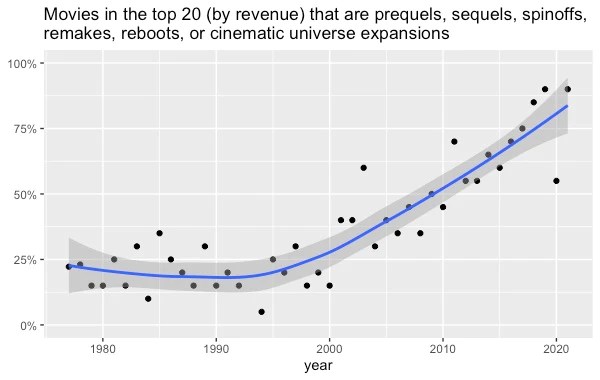
I looked at the 20 top-grossing movies going all the way back to 1977 (source), and I coded whether each was part of what film scholars call a “multiplicity”—sequels, prequels, franchises, spin-offs, cinematic universe expansions, etc. This required some judgment calls. Lots of movies are based on books and TV shows, but I only counted them as multiplicities if they were related to a previous movie. So 1990’s Teenage Mutant Ninja Turtles doesn’t get coded as a multiplicity, but 1991’s Teenage Mutant Ninja Turtles II: The Secret of the Ooze does, and so does the 2014 Teenage Mutant Ninja Turtles remake. I also probably missed a few multiplicities, especially in earlier decades, since sometimes it’s not obvious that a movie has some connection to an earlier movie.

Regardless, the shift is gigantic. Until the year 2000, about 25% of top-grossing movies were prequels, sequels, spinoffs, remakes, reboots, or cinematic universe expansions. Since 2010, it’s been over 50% ever year. In recent years, it’s been close to 100%.

Original movies just aren’t popular anymore, if they even get made in the first place.

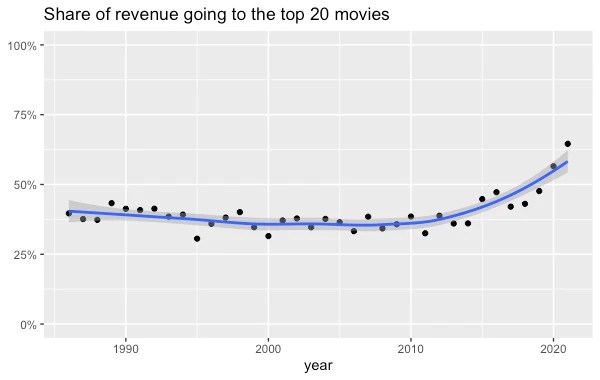
Top movies have also recently started taking a larger chunk of the market. I extracted the revenue of the top 20 movies and divided it by the total revenue of the top 200 movies, going all the way back to 1986 (source). The top 20 movies captured about 40% of all revenue until 2015, when they started gobbling up even more.

Television

Thanks to cable and streaming, there’s way more stuff on TV today than there was 50 years ago. So it would make sense if a few shows ruled the early decades of TV, and now new shows constantly displace each other at the top of the viewership charts.

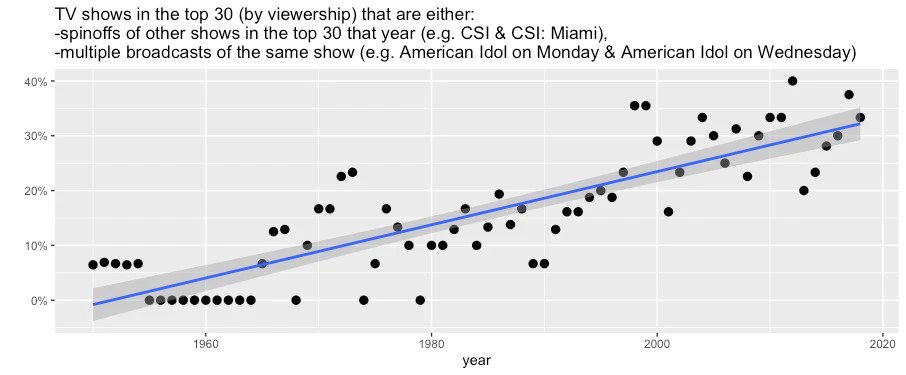
Instead, the opposite has happened. I pulled the top 30 most-viewed TV shows from 1950 to 2019 (source) and found that fewer and fewer franchises rule a larger and larger share of the airwaves. In fact, since 2000, about a third of the top 30 most-viewed shows are either spinoffs of other shows in the top 30 (e.g., CSI and CSI: Miami) or multiple broadcasts of the same show (e.g., American Idol on Monday and American Idol on Wednesday). 

Two caveats to this data. First, I’m probably slightly undercounting multiplicities from earlier decades, where the connections between shows might be harder for a modern viewer like me to understand––maybe one guy hosted multiple different shows, for example. And second, the Nielsen ratings I’m using only recently started accurately measuring viewership on streaming platforms. But even in 2019, only 14% of viewing time was spent on streaming, so this data isn’t missing much.

Music

It used to be that a few hitmakers ruled the charts––The Beatles, The Eagles, Michael Jackson––while today it’s a free-for-all, right?

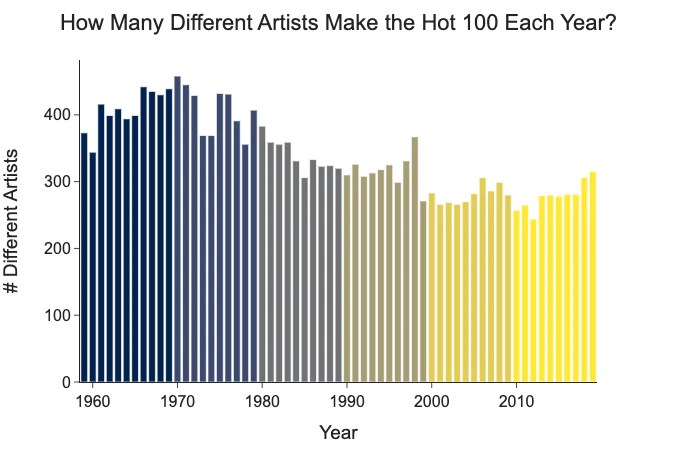
Nope. A data scientist named Azhad Syed has done the analysis, and he finds that the number of artists on the Billboard Hot 100 has been decreasing for decades.

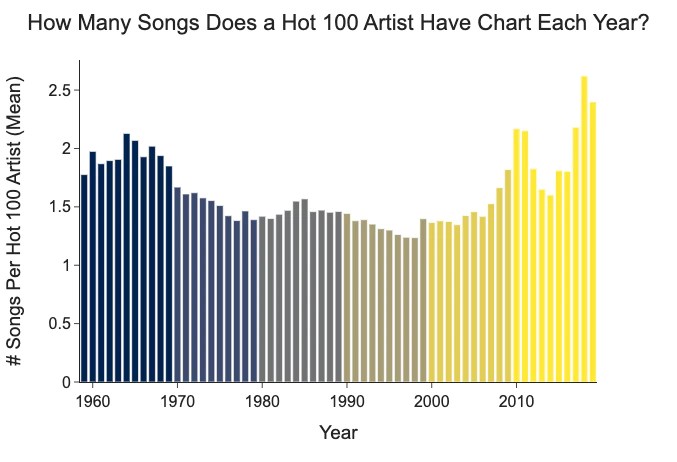
And since 2000, the number of hits per artist on the Hot 100 has been increasing. 

(Azhad says he’s looking for a job––you should hire him!)

A smaller group of artists tops the charts, and they produce more of the chart-toppers. Music, too, has become an oligopoly.

Books

Literature feels like a different world than movies, TV, and music, and yet the trend is the same.

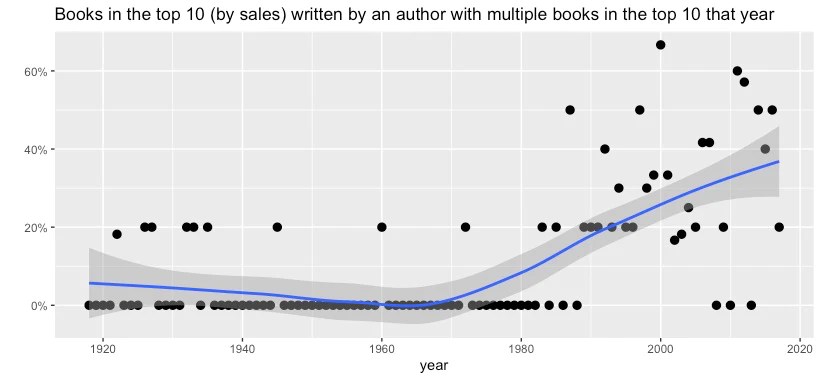
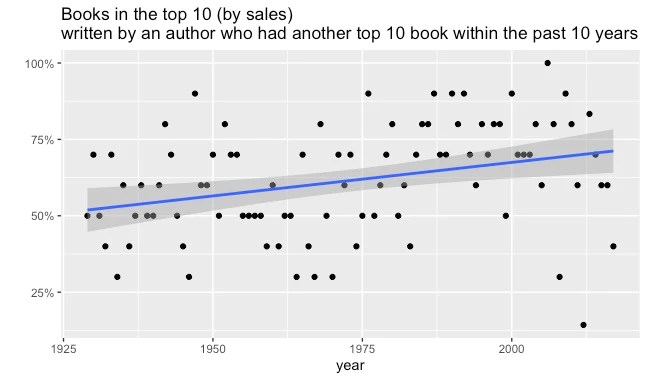
Using LiteraryHub’s list of the top 10 bestselling books for every year from 1919 to 2017, I found that the oligopoly has come to book publishing as well. There are a couple ways we can look at this. First, we can look at the percentage of repeat authors in the top 10––that is, the number of books in the top 10 that were written by an author with another book in the top 10.

It used to be pretty rare for one author to have multiple books in the top 10 in the same year. Since 1990, it’s happened almost every year. No author ever had three top 10 books in one year until Danielle Steel did it 1998. In 2011, John Grisham, Kathryn Stockett, and Stieg Larsson all had two chart-topping books each.

We can also look at the percentage of authors in the top 10 were already famous––say, they had a top 10 book within the past 10 years. That has increased over time, too. 

In the 1950s, a little over half of the authors in the top 10 had been there before. These days, it’s closer to 75%.

Video games

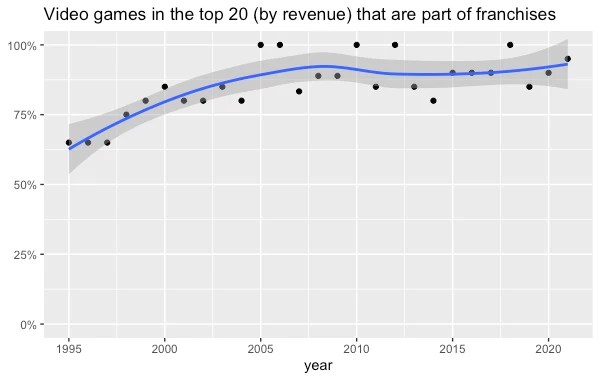
I tracked down the top 20 bestselling video games for each year from 1995 to 2021 (sources: 1234567) and coded whether each belongs to a preexisting video game franchise. (Some games, like Harry Potter and the Sorcerer’s Stone, belong to franchises outside of video games. For these, I coded the first installment as originals and any subsequent installments as franchise games.)

The oligopoly rules video games too:

In the late 1990s, 75% or less of bestselling video games were franchise installments. Since 2005, it’s been above 75% every year, and sometimes it’s 100%. At the top of the charts, it’s all Mario, Zelda, Call of Duty, and Grand Theft Auto.

Why is this happening?

Any explanation for the rise of the pop oligopoly has to answer two questions: why have producers started producing more of the same thing, and why are consumers consuming it? I think the answers to the first question are invasionconsolidation, and innovation. I think the answer to the second question is proliferation.

Invasion

Software and the internet have made it easier than ever to create and publish content. Most of the stuff that random amateurs make is crap and nobody looks at it, but a tiny proportion gets really successful. This might make media giants choose to produce and promote stuff that independent weirdos never could, like an Avengers movie. This can’t explain why oligopolization started decades ago––YouTube only launched in 2005, for example, and most Americans didn’t have broadband until 2007––but it might explain why it’s accelerated and stuck around.

Consolidation

Big things like to eat, defeat, and outcompete smaller things. So over time, big things should get bigger and small things should die off. Indeed, movie studiosmusic labelsTV stations, and publishers of books and video games have all consolidated. Maybe it’s inevitable that major producers of culture will suck up or destroy everybody else, leaving nothing but superstars and blockbusters. Indeed, maybe cultural oligopoly is merely a transition state before we reach cultural monopoly.

Innovation

You may think there’s nothing left to discover in art forms as old as literature and music, and that they simply iterate as fashions change. But it took humans thousands of years to figure out how to create the illusion of depth in paintings. Novelists used to think that sentences had to be long and complicated until Hemingway came along, wrote some snappy prose, and changed everything. Even very old art forms, then, may have secrets left to discover. Maybe the biggest players in culture discovered some innovations that won them a permanent, first-mover chunk of market share. I can think of a few:

  • In books: lightning-quick plots and chapter-ending cliffhangers. Nobody thinks The Da Vinci Code is high literature, but it’s a book that really really wants you to read it. And a lot of people did!
  • In music: sampling. Musicians seem to sample more often these days. Now we not only remake songs; we franchise them too.
  • In movies, TV, and video games: cinematic universes. Studios have finally figured out that once audiences fall in love with fictional worlds, they want to spend lots of time in them. Marvel, DC, and Star Wars are the most famous, but there are also smaller universe expansions like Better Call Saul and El Camino from Breaking Bad and The Many Saints of Newark from The Sopranos. Video game developers have understood this for even longer, which is why Mario does everything from playing tennis to driving go-karts to, you know, being a piece of paper.

Proliferation

Invasion, consolidation, and innovation can, I think, explain the pop oligopoly from the supply side. But all three require a willing audience. So why might people be more open to experiencing the same thing over and over again?

As options multiply, choosing gets harder. You can’t possibly evaluate everything, so you start relying on cues like “this movie has Tom Hanks in it” or “I liked Red Dead Redemption, so I’ll probably like Red Dead Redemption II,” which makes you less and less likely to pick something unfamiliar. 

Another way to think about it: more opportunities means higher opportunity costs, which could lead to lower risk tolerance. When the only way to watch a movie is to go pick one of the seven playing at your local AMC, you might take a chance on something new. But when you’ve got a million movies to pick from, picking a safe, familiar option seems more sensible than gambling on an original.

This could be happening across all of culture at once. Movies don’t just compete with other movies. They compete with every other way of spending your time, and those ways are both infinite and increasing. There are now 60,000 free books on Project Gutenberg, Spotify says it has 78 million songs and 4 million podcast episodes, and humanity uploads 500 hours of video to YouTube every minute. So uh, yeah, the Tom Hanks movie sounds good.

What do we do about it?

Some may think that the rise of the pop oligopoly means the decline of quality. But the oligopoly can still make art: Red Dead Redemption II is a terrific game, “Blinding Lights” is a great song, and Toy Story 4 is a pretty good movie. And when you look back at popular stuff from a generation ago, there was plenty of dreck. We’ve forgotten the pulpy Westerns and insipid romances that made the bestseller lists while books like The Great GatsbyBrave New World, and Animal Farm did not. American Idol is not so different from the televised talent shows of the 1950s. Popular culture has always been a mix of the brilliant and the banal, and nothing I’ve shown you suggests that the ratio has changed.

The problem isn’t that the mean has decreased. It’s that the variance has shrunk. Movies, TV, music, books, and video games should expand our consciousness, jumpstart our imaginations, and introduce us to new worlds and stories and feelings. They should alienate us sometimes, or make us mad, or make us think. But they can’t do any of that if they only feed us sequels and spinoffs. It’s like eating macaroni and cheese every single night forever: it may be comfortable, but eventually you’re going to get scurvy. 

We haven’t fully reckoned with what the cultural oligopoly might be doing to us. How much does it stunt our imaginations to play the same video games we were playing 30 years ago? What message does it send that one of the most popular songs in the 2010s was about how a 1970s rock star was really cool? How much does it dull our ambitions to watch 2021’s The Matrix: Resurrections, where the most interesting scene is just Neo watching the original Matrix from 1999? How inspiring is it to watch tiny variations on the same police procedurals and reality shows year after year? My parents grew up with the first Star Wars movie, which had the audacity to create an entire universe. My niece and nephews are growing up with the ninth Star Wars movie, which aspires to move merchandise. Subsisting entirely on cultural comfort food cannot make us thoughtful, creative, or courageous.

Fortunately, there’s a cure for our cultural anemia. While the top of the charts has been oligopolized, the bottom remains a vibrant anarchy. There are weird books and funky movies and bangers from across the sea. Two of the most interesting video games of the past decade put you in the role of an immigration officer and an insurance claims adjuster. Every strange thing, wonderful and terrible, is available to you, but they’ll die out if you don’t nourish them with your attention. Finding them takes some foraging and digging, and then you’ll have to stomach some very odd, unfamiliar flavors. That’s good. Learning to like unfamiliar things is one of the noblest human pursuits; it builds our empathy for unfamiliar people. And it kindles that delicate, precious fire inside us––without it, we might as well be algorithms. Humankind does not live on bread alone, nor can our spirits long survive on a diet of reruns.

How Empires Die

By Charles Hugh Smith

Source: Of Two Minds

From a systems perspective, nation-states and empires arise when they are superior solutions to security compared to whatever arrangement they replace: feudalism, warlords, tribal confederations, etc.

States and empires fail when they are no longer the solution, they are the problem. As the book The Upside of Down: Catastrophe, Creativity, and the Renewal of Civilization explains, when the dissolution of the state / empire becomes the pain-reducing solution, the inhabitants withdraw their support and the empire loses its grip and expires.

As I explain in my new book, Global Crisis, National Renewal, states and markets are problem-solving structures. These structures solve problems by optimizing adaptability and beneficial synergies that reinforce one another as evolutionary advances.

The rise of the middle class is an example of beneficial synergies: as this new class gains access to credit, expertise, trade, enterprise and pricing power for their labor, they have the means to transform their labor into capital by saving earnings and investing the capital in assets, new enterprises, etc. which then generate income from capital which fuels synergistic increases in credit, expertise, assets and income from investments.

States / empires fail and expire when they elevate the fatal synergies created by self-serving elites. Rather than encourage the dynamics of adaptation–competition, transparency, accountability, experimentation and dissent– the elites suppresses these forces as threats to their monopolies, cartels and wealth.

Stripped of adaptability and beneficial synergies, the state / empire is no longer able to solve problems. It becomes the problem which cannot be resolved.

A key dynamic fueling fatal synergies is the hubristic confidence that low-cost abundance is a birthright bestowed by the state /empire, so resources can be endlessly squandered on excess and extremes of consumption and waste. The state / empire no longer focuses on securing the material sources of security (food, energy, etc.) or the accountability, competition, dissent and transparency required to solve systemic problems.

Instead, the state / empire dissolves into divisive camps seeking to protect their petty fiefdoms and expanding their wealth at the expense of the populace. The super-wealthy build $500 million yachts and palaces, politicians trade on their positions to accumulate fortunes, and corruption replaces governance.

Markets spiral into fatal synergies as low quality products and services, speculative excess, extremes of grotesque consumption and blood-soaked entertainment become “growth industries” while blackouts dim electrical grids and store shelves empty of essentials.

The market solution to everyone already owning everything is to engineer planned obsolescence into every product and form service-sector cartels that then strip services to the bone to juice profits, a.k.a. the crapification of all goods and services.

The state / empire also fails to maintain basic security and functions such as tax collection and a fair enforcement. Petty crimes are exploited by those in power (civil forfeiture) while resistance to the state is severely punished. There are two legal systems, one for the commoners and another for the elite.

The state / empire protects those profiting from the status quo and then calls this profiteering a “solution.” But this profiteering doesn’t solve any problems; it is the problem, as self-serving profiteering protects its privileges by corrupting the state, finance and the economy.

For its part, the market seeks to maximize profits in excesses of consumption, predatory lending (student loans), the wholesale destruction of quality by monopolies and cartels and extremes of speculation.Maximizing profits by any means available has no moral foundation; predatory student loans are profitable, obscure medical billing is profitable, selling products designed to fail is profitable, declaring software outdated is profitable, deceiving consumers is profitable, and so on, in an endless array of shoddy, unhealthy products, rapacious services, fraudulent overcharges, etc.

Since problems go unresolved, things fall apart and the masses veer into extremes of derangement and magical thinking: fanaticism is substituted for friendship, cults abound, common ground vanishes and all the failures of the system are papered over with Bread and Circuses, free money, gaudy entertainments and lifeless displays of conspicuous consumption that reveal the decay and degradation.

Protecting the few stripmining the system at the expense of the many is not problem-solving. It adds a layer of problems that the state /empire is incapable of resolving. Ossified, sclerotic, self-serving, corrupt, focused on virtue-signaling and the appearance of tackling problems rather than actually solving problems because some sacred cow would lose its privileges and income stream, the state / empire is the problem, not the solution.

When the state / empire loses the ability to recognize and solve core problems of security and fairness, it will be replaced by another arrangement that is more adaptable and adept at solving problems. Artifice, fantasy, magical thinking, excuses and absurd cover stories are not part of problem-solving. Problems can only be solved if reality is faced directly.

When reality is unacceptable because it negatively impacts those stripmining the system for private gain, the state / empire is already on its fatal spiral to collapse.

Can a Nation Prosper as its Institutions Fail?

By Charles Hugh Smith

Source: Of Two Minds

Economists focus on what can be easily measured: sales, profits, prices, tax revenues, etc. Since the decay and failure of institutions isn’t easily quantified, this decay doesn’t register in the realm of economics. Since it isn’t measured, it doesn’t exist.

But institutional decay and failure is all too real, and it begs the question: how can a society and economy thrive if its core institutions fail? The short answer is they cannot thrive, as institutions are the foundations of the social and economic orders.

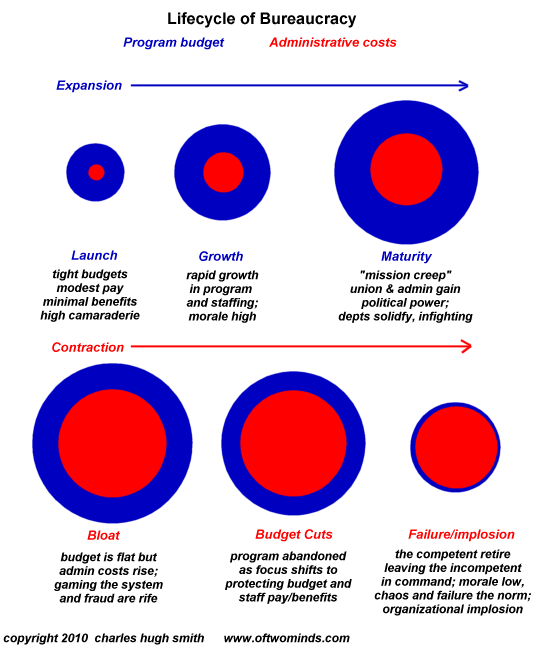
As I explain in my new book, Global Crisis, National Renewal, the conventional view has a naive faith that “great leaders” can reverse institutional rot. This faith overlooks the systemic sources of institutional decay and failure which are outlined in the graphic below, The Lifecycle of Bureaucracy, a.k.a. institutions.

Leaders are constrained by the nature of centralized organizations and the incentive structure that slowly shifts from rewarding efforts to further the institution’s core mission to self-service and protecting an ossified, failing institution from outside scrutiny and reform.

As Samo Burja explains in his insightful essay, Why Civilizations Collapse, those inside institutions are by design so compartmentalized that few (if any) even recognize the institution is failing. As long as everything is glued together in each little compartment, no one grasps the entire institution has lost its way. And since no one recognizes it, no one attempts to save it.

Institutions end up advancing caretaker managers who excel at the political game of rising to the top of a sprawling institution. When the decay (or budget cuts) finally trigger a crisis, the institution has been stripped of visionaries with a bold grasp of what’s needed to restore the focus on the core mission and institute new incentives. The bold leaders quit in disgust or were sent to bureaucratic Siberia as potential threats to the status quo.

The problem is institutions fail by the very nature of their centralized design. The organization is centralized so directives flow down the chain of command, and every branch is compartmentalized to limit the power of each department and employee to disrupt the orderly flow of top-down directives.

Within this compartmentalized, top-down structure, the incentives are to follow procedures rather than get results. The rewards go to those who dutifully follow procedures rather than to those who raise the alarm about the loss of transparency, effectiveness and focus on fulfilling the mission.

The path of least resistance is to protect the existing structure and add more compartments, i.e. “mission creep.” Rather than focus on the dissipation of resources and the decline of the core mission, leaders add “feel good” missions and PR promotions of phony reforms and initiatives that bleed more resources from the core mission.

Consider the institution of democracy, which has been corrupted into an invitation-only auction of state favors and rentier skims. Democracies have another fatal flaw: politicians win re-election by promising virtually everyone something for nothing: more benefits and entitlements and lower taxes. The gap between higher costs and declining revenues will be filled by government borrowing.

All this additional borrowing will supposedly be paid by the magic of “growth”, which will expand tax revenues at a rate that exceeds the cost of borrowing.

But demographics, resource depletion and the diminishing returns of a consumer economy fueled by rapidly expanding public and private debt have sapped “growth” in fundamental ways. Ironically, borrowing and spending more to spur “growth” only hastens the diminishing returns of increasing debt to fund consumption today.

Democracies are thus optimized for rapid “growth” and are ill-suited to transition to DeGrowth, i.e. less of everything for the vast majority of the citizenry as resources become scarce and debt eats the economy alive. (DeGrowth could work to everyone’s benefit, which is the point of Global Crisis, National Renewal.)

Central banking is another failing institution. When faced with fiscal crises, central states/banks inevitably succumb to the temptation to print/borrow currency in whatever sums are needed to fill the shortfall of the moment, i.e. political expediency. This profligate creation of currency seems to be magic at first; everyone accepts the “new money” at the current value. But eventually gravity takes hold and the currency’s purchasing power declines, as the real economy (the production of goods and services) grows at rates far below the expansion of credit and currency.

Even the greatest empires in human history have been unable to resist the “easy” solution of devaluing currency as the means of fulfilling all the promises that were made in more prosperous times.

The progression of centralized power slowly but surely replaces the self-organizing, resilient, decentralized structures of civil society with tightly bound hierarchical centralized structures that are increasingly ineffective, increasingly costly and increasingly fragile, i.e. increasingly prone to failure or collapse.

The irony of institutional decay and failure is everyone inside is so busy following procedures that nobody notices the decay until the whole worm-eaten structure collapses. Look no farther than financialized asset bubbles, healthcare and education for examples of institutions in run-to-failure decline.

We are in effect so busy arranging the beach umbrellas per our instructions that we don’t notice the approaching tsunami. Can a nation prosper as its institutions decay and collapse? Only in the fantasies and magical thinking of the delusional.