
Mind control: Orwell, Huxley, and today’s reality

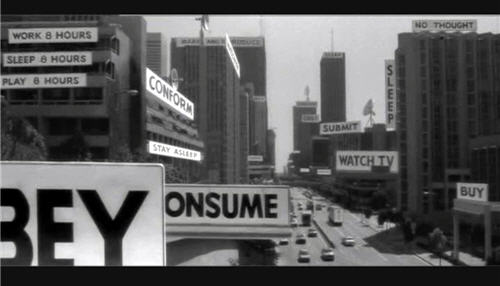
orwell-huxley

We are able to see the architecture – the structural patterns – of each kind of mind-control regime. This can help us recognize precursors – signs that such a future is coming our way.

by Richard K. Moore

Source: News Beacon Ireland

Dystopian predictions

In 1984, George Orwell paints a picture of a dark, gray world. People are afraid to say anything contrary to the official party line, and surveillance is universal. Even thinking contrary to the party is a crime, and thoughtcrimes may be treated by radical psychological intervention. Information is closely controlled by the party media, and the historical record is routinely edited, so as to conform to the latest party statements.

By contrast, in Brave New World, Aldous Huxley paints a colorful, superficially pleasant world. Personal freedom of all kinds is encouraged, even to the point of being a cultural imperative. In the book a young boy is referred to a therapist, because he doesn’t want to play sex games with a girl classmate. An adult character is considered aberrant, because he is drawn toward a monogamous relationship. Drugs and distractions are readily available for mood enhancement.

Central to Huxley’s world is the abolition of the family. Sex never results in pregnancy, and embryos are grown in a production process, based on selected seed material. As part of the production process, an embryo can be fed or starved, at various stages of its development, so as to create classes of people (alphas, betas, etc) with differing levels of intelligence and skills. Quotas are set, regarding how many people of each class are going to be needed, and should therefore be produced.

Various kinds of conditioning are then used on infants in order to get them to accept their class, along with its prerogatives and restrictions, as being best for them. Children are raised on a communal basis, with no concept of parents, siblings, or family. From embryo to adulthood, the state has fine-tuned control over the development of the person, and of their thinking. In the resulting society, people behave as they were programmed to behave, and can’t imagine things being any different.

In Orwell’s world, wrong-thought (thoughtcrime) is detected and suppressed. In Huxley’s world, wrong-thought is unlikely to arise. Orwell’s world suppresses the individual; Huxley’s world manufactures the individual. In both cases, mind control – control over what people are able to think – is the strategy of the regime, as its means of social control generally. Orwell explores a brute-force approach to mind control, while Huxley explores a scientific approach.

The novels are useful because they each take one of these basic approaches to mind control, and follow its consequences to the end. If you really want to suppress what people think, you’d need to do A, B, and C. If you really want to program people, you’ve got to start when they’re born and do X, Y, and Z. We are able to see the architecture – the structural patterns – of each kind of mind-control regime. This can help us recognize precursors – signs that such a future is coming our way.

Echoes of Orwell

Consider the world of mainstream journalists, in particular TV news anchors. There we have a world with echoes of 1984, where what is said must conform to the party line. Any thoughtcrime – such as an anchor commenting onscreen that he doesn’t buy the official story of 9/11, or he thinks Russia isn’t an aggressor – would be quickly punished by the equivalent of death – expulsion from the world of journalism.

Thus is maintained the Matrix, the story we are told about US benevolence, the existence of democracy, the sacredness of market forces, and all the rest. With control of major media in just a few hands, the party line can be always maintained, and current (or past) events can be interpreted within that framework. To do otherwise, for a news anchor, would be literally unthinkable. Huxley’s Ministry of Truth is at work in our world, but it is invisible, hiding away in the boardrooms of media conglomerates, and behind the doors of the White House press office.

The same kind thoughtcrime regime is operating in other arenas as well, where socially-sensitive topics are concerned. The peer-review process, and the editorial boards of the relevant journals, ensure that thoughtcrimes are suppressed, when it comes to concerns regarding genetic manipulation, pesticides, fracking, pharmaceuticals, radiation levels, etc. Again, the Ministry of Truth is invisible, residing high up in the chain of corporate boardrooms.

Even though our society doesn’t resemble Orwell’s dystopia, his mind control methods are operating in very critical places, where the population’s ‘information’ is generated. And of course we do have universal surveillance, courtesy of the NSA, omnipresent CATV cameras, and cell-phone tracking. Big Brother is with us, but he stays behind the scenes, he sees all, and he decides what stories we will be told about the world by the mainstream media.

Echoes of Huxley

Huxley wrote a review of 1984, where he talked about the two different future visions. He suggested that we might go through some kind of dark period, reminiscent of 1984, but he thinks such a regime would be unstable and transitional. He goes on to say that the scientific approach to mind control, based on programming people’s belief systems, would be the more sensible choice for a modern totalitarian society.

US Government research into scientific mind control began at least in the 1960’s, and has been ongoing. The first approach – the CIA’s Operation Mind Control – was heavy handed, reminiscent of 1984. This research involved giving people psychotropic drugs, along with post-hypnotic suggestions. Quite a bit could be (and has been) accomplished with these kinds of methods, along the lines of The Manchurian Candidate, but it didn’t provide a general solution: two much work was required to program people on an individual basis.

Research then shifted to cult creation. If people can be herded into cults of various kinds, cult dynamics themselves would serve the programming function. This provides a more wholesale approach to mind control, than the individual methods tried earlier. The CIA has never publicly claimed credit for this later research, but the experiments were very successful, including Reverend Jim Jones and the People’s Temple, and David Koresh and Waco.

In this kind of research, the first step is to identify a natural cult leader, who has already shown some success in gathering followers. Then the cult is given support of various kinds. Covert agents are sent in to join the cult, not only to observe and report, but also to provide organizational skills. Funds are channeled to the cult, and local police are warned off, so that the cult can grow unhampered.

In this way, researchers have been able to study how a skilled cult leader operates, how people are drawn into a cult, how loyalty is maintained, and how people can be pushed into extreme beliefs and actions. When everything had been learned that could be learned from a cult, the cult’s leader and members were then killed, so as to hide the evidence of what had really been going on in the experiment.

Cults and their uses

One of the first large-scale deployments of cult technology, informed by this research, was the creation of the Jihad movement by the CIA. The immediate purpose was to destabilize the Soviet regime, by tying it down in a quagmire in Afghanistan. This operation was quite successful. Since then, the Jihad cult movement – aka Taliban, Al Qaeda, Kosovo Liberation Army, ISIS, etc. – has proven to be an extremely useful tool for the purpose of destabilizing regimes, in pursuit of US geopolitical objectives. These destabilization operations in turn provide an excuse for direct US intervention, as we’ve seen recently in Libya and Iraq, and as we may soon see in Syria.

Cults generally have certain characteristics. There is usually a charismatic leader, who is able to inspire belief and loyalty in cult members. There is always a defining core belief system, that sets cult members off from outsiders, and which provides a strong sense of identity and purpose for members. There is typically an alleged ‘outside threat’ to the cult, which draws members together. There are actions and sacrifices required of members, which serve to bind them more tightly to the cult.  There are packaged arguments, that cult members are taught to employ, to repel attempts undermine the core belief system. These programming methods are very powerful, and typically intense deprogramming is needed to ply members away from a cult, once they have been thoroughly indoctrinated.

The society described in Brave New World is in fact a cult-based society. Each of the classes (alpha, beta, etc.) is a cult, and the programming begins at birth. No charismatic leader is needed, when so much control over programming is available. Each cult has its own core belief system, along with packaged arguments to maintain those beliefs. The required actions and sacrifices are simply the lifestyle which has been designed for each class. Such a society would tend to be stable, particularly since deprogramming efforts would be absent from the scene.

It is notable that Huxley’s world is not about a single cult, a uniform society, but rather about multiple cults. This makes for greater stability. Cult members have not only a model of what-to-be, they also have models of what-not-to-be. Each cult is more clearly defined, and drawn more into itself, by the existence of other cults. Being glad you’re not a beta is one of the reasons to be glad you are an alpha.

We see this same multi-cult dynamic operating in the US, in the divisiveness between liberals and conservatives. Liberals are kept in the fold by stories of conservative folly, and conservatives are kept in the fold by stories of liberal folly. In a propaganda-only system of control, there would be one party line for everyone. In this multi-cult system, there are two party lines, which we might characterize as CNN vs. FOX.

While the two party lines have many differences, in order to keep the two cults separated, they in fact share basic essentials in common. They both sustain the myth that state policy is a response to public sentiment, and they blame the other cult for providing support for the ‘bad’ policies. In fact US policy is made outside of government, by financial elites, and the state aims to control public sentiment, not respond to it. In this way we can see CNN and FOX as collaborators, sharing the common goal of hiding this fundamental truth from the people. The Democratic and Republican parties collaborate toward this same goal, using Congress as a stage, where they carry on a theater of divisiveness, providing the appearance of a democratic decision-making process.

The Barack Obama phenomenon provides an excellent example of cult tactics in action. Obama himself is obviously a natural cult leader, articulate and charismatic. He came onto the scene offering an inspiring core belief in deep reform, “The ground of politics has changed; Yes we Can!”. The dramatic effect was intense, as if we were witnessing the Second Coming. Campaign volunteers became the core of the budding Obama cult, and they were given lots of work to do, binding their identity to Obama and his professed mission. The McCain campaign was orchestrated to look like a dangerous threat by a rival cult, binding Obama supporters even more tightly.

The success of this mind-control operation was truly amazing. Obama in fact proceeded to carry on and expand everything Bush had been doing; the ground of politics hadn’t changed at all. But the cult binding was so strong that his support continued, by the very people who had hated Bush because of the same policies. Packaged arguments were put forward, to keep people in the cult, blaming Obama’s performance on Republican opposition – the standard divisiveness tactic. Even today there remain legions of Obama loyalists. Once bound to a cult, leaving becomes psychologically difficult.

Another example of mind control by means of cults is provided by global-warming hysteria. Al Gore played the role, at least temporarily, of cult leader, when he presented the core belief in CO2-caused climate crisis in his scientifically fraudulent, but very popular film,  An Inconvenient Truth. The growth of the cult was ensured by the fact that it then became a thoughtcrime in mainstream media and climate journals to question these core beliefs. Cult members are given things to do and sacrifices to make, like riding a bicycle and buying a Prius. They are given a packaged argument, that contrary views are nothing but the propaganda of an outside-threat: the evil petroleum industry.

This kind of mind control operation is much more effective than propaganda on its own. It’s not just that cult members believe in CO2-caused climate crisis, they believe they are fighting a battle against an enemy. They have been fully immunized against counter arguments to their core beliefs, and their only concern is to ‘save the planet’ by supporting anything that looks like it will reduce carbon emissions. Thus they are being led willingly down the garden path to a micro-managed society, as outlined in Agenda 21.

The ‘conspiracy theory’ meme

State control of public schools and mainstream media goes a long way towards programming people’s minds. But it is not enough, particularly in the era of the Internet. There are many sources available that thoroughly debunk mainstream propaganda, and by using those sources a large number of people have escaped, at least in part, from the mind-control regime. In Orwell’s world, the Internet would be banned. In our world, which is developing more along Huxley’s lines, other ways have been found to limit the ability of the Internet to undermine the mainstream narratives.

The ‘conspiracy theory’ meme was launched by the CIA in the wake of the JFK assassination. The official story was so full of holes that more and more people were beginning to doubt it. While the Warren Commission was busy writing its cover-up document, the public began to learn about the existence of ‘conspiracy theorists’. These are people, the story goes, who suffer from paranoid delusions, and sane people should pay no attention to anything they say. If someone even looks at any of those ideas, their own mental stability comes into question.

This mind-control tactic was very effective in marginalizing research into the truth behind the JFK assassination. Anyone who presented evidence contrary to the official story was automatically seen as ‘conspiracy theorist’. By scoffing at such evidence, without looking at it, you could demonstrate that you were mentally balanced. Thus logic and reasoning are banished from the scenario. Either you believe the official story, or your mental health is called into question.

Since then, the conspiracy-theory meme has been carefully nurtured and expanded by the mainstream party lines. This mind-control campaign has been very successful in immunizing the majority of the population against the revelations available on the Internet. Any story not appearing in the mainstream media must by definition be a conspiracy theory, and anything that sounds like a conspiracy theory should be scoffed at and ignored.

Thus for the majority of the population we have a tightly controlled, two-tier, mind-control regime. The thoughtcrime dynamic governs what the media says, and the conspiracy-theory dynamic immunizes people against other views. For the majority, the party line (either CNN or FOX) is ‘truth’, as in Orwell’s world, but without the need for Big Brother’s extreme methods.

By these mind-control methods, a bubble has been created, in which the majority does their thinking. Inside the bubble are the two party-line narratives, and outside the bubble the real world proceeds, invisible to those inside the bubble. It’s a very effective system. The more outrageous the real actions of the state, the more quickly the majority rejects revelations of those actions, as being outrageous conspiracy theories.

In some cases the FOX party line includes accurate revelations which would be thoughtcrimes in the CNN world. In such cases, the CNN world responds by classifying those revelations as  ‘right wing’ conspiracy theories. Unlike a propaganda-only system, where state crimes are always hidden, this multi-cult system enables the state to document its own crimes on conservative media, and know that the information will be disbelieved by the liberal cult. This system allows the truth to be hidden from some, through the act of revealing it to others. Very clever.

Mind control outside the bubble

While the majority may be inside the bubble, there is a large and growing number of people who don’t have faith in any mainstream party line, and who are open to considering the various ideas they find from Internet sources. The phrase ‘waking up’ is frequently used to describe the process of escaping from the bubble. More and more people are ‘waking up’ to the reality of false-flag events, routine government lies, the deep corruption of politics and the media, and the sociopathic central bankers who exercise the reins of power from behind the scenes.

However, the Internet is not being ignored by the state, and mind-control operations are underway there as well – designed for those who have ‘woken up’. Such operations are not aimed at moving people back into the bubble, rather they embrace the ‘awake’ ideas, aikido style, and then seek to direct the energy of the ‘awoken’ in ways that serve the state and its objectives.

An example of one of these outside-the-bubble mind-control operations, of the cult variety, is provided by the Zeitgeist Movement – which claims to be the “largest grassroots movement in the world with chapters in over 60 countries”. Peter Joseph is the charismatic leader of this cult, and he offers his set of core beliefs, backed up by persuasive evidence and arguments, in Zeitgeist: The Movie.

For those who are ‘awake’, the film is very powerful. It presents the essential truths about the world, without pulling punches, in a dramatic and compelling way. The film has gone through several versions over time, and the very first version went viral on the Internet as soon as it was released. To the ‘awoken’, it was a film of liberation, with the potential to wake everyone up and transform the world.

After the film was released, and after it gained a massive and enthusiastic audience, the Zeitgeist Movement was launched. Fans of the film flocked to join the movement, eager to ‘spread the gospel of truth’, and help ‘wake up the world’. They were joining an urgently-needed messianic cause, and this bound them to the movement, in the way cults always bind members. Peter Joseph was seen as a prophet figure, the articulator of the gospel, and the one who could lead the way to liberation – and this is more or less the textbook definition of a cult leader.

What these eager cult members fail to realize is that the very thing that attracts them to the movement also guarantees that the movement could never succeed in ‘waking up the world’. The core beliefs that are so liberating to the members are all seen as outrageous conspiracy theories inside the mainstream bubble. While members think they are pursuing a messianic cause, they are in fact a choir singing to itself, with Peter Joseph setting the tune.

The real purpose behind the cult is revealed in a press release on the movement website, entitled, ‘The Zeitgeist Movement defined: realizing a new train of thought’. Here Joseph expands the gospel, going beyond ‘revealing the truth’, and venturing into envisioning the transformed world that the movement aims to help create. Here are three key points from Prophet Joseph’s vision, with emphasis added:

2): The Scientific Worldview: The essay explores how the development of the scientific method has altered human perception and the critical importance of its recognition and larger order application, specifically with respect to the social system.
(5): The Case for Human Unity: This essay explores the reasoning for a unified global society along with tracing the source of national divisions and propensities for conflict. A relevant point is made regarding the advancement of technological warfare and how the dangers of keeping biased economic boundaries as we have could lead to rapid destruction as time moves forward.
(9): Market Efficiency vs Technical Efficiency: This essay argues the difference between true scientific (or technical) efficiency and the business practice of “market efficiency,” showing how the latter actually works against true economic optimization.

This is a prescription for a micro-managed global technocracy, under the control of a one-world government. Both the social system and the economic system are to be ‘scientifically optimized’ – which in fact means a world organized along whatever lines are set down by some technocratic bureaucracy, under the control of an enthroned global elite. In other words, Prophet Joseph is creating an enthusiastic constituency in support of the central bankers’ long-desired New World Order.

The Zeitgeist cult is an aikido masterstroke. It begins with the revelation that ‘evil bankers’ run the world, blending with the energy of the ‘awoken’, and then shifts that energy in a direction that serves the interests of those same ‘evil bankers’. Again, I must say very clever, very clever indeed.

Zeitgeist is only one example of a mind-control operation aimed at those who have achieved one degree or another of ‘awakening’. Numerous movements have been created, characterized by well-designed websites that tell some version of the truth, drawing in audiences with some specific focus of concerns, and which lead those audiences into useless or counter-productive activities.

In Huxley’s world, we see a scientifically designed society, tightly controlled by a full-spectrum mind-control regime, based on conditioning and cult dynamics. In today’s world, we see cult dynamics being used in a variety of mind-control operations, with cults customized for various constituencies both inside and outside the mainstream bubble. Huxley’s world has achieved stabilization by such means; in our world those means are being used to facilitate a transition – to a brave new world order that is likely to resemble Huxley’s in many of its essential features.

The demise of the family?

If the state can achieve full control over the raising of children, without parental interference, then quite obviously that would give the state the power to achieve a full-spectrum mind-control regime. Not only could the state design the society’s culture, it could tune that culture over time, by updating the conditioning process. If full-spectrum mind-control is the goal, then eliminating the family becomes a primary intermediate objective.

If eliminating the family is indeed an objective of the New World Order project, then it is by no means an easy objective to achieve. One would be hard-pressed to imagine an institution that would be more fiercely defended than the family, or to imagine a more painful experience than being separated from ones children or parents. Any campaign to achieve that objective would need to fly under false colors, not advertised as a campaign to eliminate the family, but rather as a campaign aimed at protecting the rights and welfare of the child.

It is in this light, I suggest, that we consider the many revelations that have emerged in recent years regarding child sexual abuse, and the existence of pedophile rings. In many of these cases we learn that the abusive activity have been going on for many, many years, as we see in the case of pedophile priests. Why is it that these longstanding activities have only recently been ‘discovered’?

If there is to be a strong campaign for the ‘rights and welfare of children’, there needs to be first a strong impression that their rights and welfare need protecting. Exposés of child sexual abuse serve that purpose very well. When you see a police drama, where abused children are rescued by noble cops from drug-addicted parents, you are are getting images of a benevolent state, and a social milieu that requires intervention. It becomes a template that can be expanded on as time goes on. And of course there are the interminable ads, where a neglected child sits alone at home (black and white film for effect), fearful and hungry, and you can donate $3 to some child-protection agency.

I don’t recall the link, but I came across a webpage from a UN agency, promoting the virtues of children raised ‘alternatively’. These are children raised as a group, sans parents, reminiscent of Huxley’s scenario. Supposedly these children were ‘more creative’, and showed other positive signs. How very nice. Another good-intention-stone along the garden path to the demise of the family.

Last year, 2013, in both Ireland and New Zealand, constitutional amendments were adopted, declaring that the rights and welfare of the child are paramount, trumping any rights that might be claimed by a child’s parents. In Ireland, a court challenge was immediately launched, based on the fact that the government had illegally campaigned for the referendum that approved the amendment, when by law the government should have been neutral. The challenge was, not surprisingly, rejected by the courts. There is no specific formula in these amendments as to what defines the rights and welfare of children, leaving it up to the discretion of the state, as to when intervention in the family might be appropriate.

As economic conditions worsen, under the screws of austerity, privatization, and eliminated social services, it will become a struggle for an increasing number of parents to feed, clothe, and house their families. It would be all too easy for the state to mandate a ‘minimum level of acceptable conditions’, and take children wholesale into care, based on ‘economic profiling’. That’s just one possible scenario, but it’s the kind of scenario it seems we are being prepared for.

Getting Inside the Mind of Mainstream Media

Is this the next step of the information war?

By Bernie Suarez

Source: TruthandArtTV.com

Mainstream media lies, deceit, and propaganda are being dramatically exposed in real-time at an alarming rate. Anyone following alternative media knows what I’m talking about. Is it me or does it seem like the MH17 false flag happened years ago? We can see that false flags that are quickly exposed and blown wide open end up dropping to the bottom of mainstream media news. We’re seeing the pattern over and over again, so isn’t it time we sharpen our skills and start predicting the mainstream media lies and propaganda before it happens? For those of us fully awakened, we have to be scratching our heads wondering, what else. What can we do to change and turbo-boost this information war for the better? What creative thing can we do to throw a monkey wrench into the globalist plans? Is it even possible? Let’s examine some ideas.

In all my writings I assert that we have an information and survival battle that is best described as ‘humanity versus the globalists’ or the ‘humanity versus the new world order’ (or other names such as the Illuminati or global elite). We can also call it humanity against the control system. Call it what you want, but understand that if you are not part of the control system, you are part of humanity. Humanity is everyone. We are human, we are on earth and we are not trying to control anyone. We are the pure expression of the species on earth innocently going about our daily lives trying to survive and make the most of it. The globalist control system however, lives and operates for a very different reason. The depth of this truth is gripping when you fully understand it. Imagine for a minute, there is actually a species amongst us who wishes to control you, inflict suffering on you and wishes to diminish or even eliminate your existence.

Many Libertarians and freedom lovers can appreciate this reality. It’s been said, there are two kinds of people on earth; those who want to control you and those who simply want to be left alone. This simple view of life is a very accurate portrayal of reality. Never before have we seen this manifest itself so clearly as it is now. Do you realize that the mainstream media globalist mouthpiece can just as easily encourage humanity, call for peace, reward truth, and honor integrity and what is right? They could do this every day if they wanted to. Even the thought of this seems to all of us as a pipe dream. Instead they (the mass media) take orders from their CFR/CIA masters, they lie, deceive, spread propaganda to promote more wars and condone war crimes in the name of a certain flag or political agenda. And yes, they do this every single day, meaning someone is brainstorming every day on new ways to enslave humanity and keep it oppressed. Think about this. Anyone who runs a website, like I do, knows how much work goes into generating new content every day. It takes work and resources.

These decisions (and the work required) are then being carried out every single day at mainstream media. In real-time the controlled media system gives the final stamp of approval on one lie after another. They say, so what if this next story will pave the road for more wars; So what if this next story is not true and perpetuates an idea that will justify mass murder and war crimes. The soldiers of the western mainstream media lying machine march on into a new day with new ideas on how to sabotage humanity and create more fear and hate. Try to picture their thought process as they implement their lies daily. Let’s get inside their mind for a second.

Is it possible for the rest of humanity to truly grasp the mindset behind this deliberate disinformation system which single-handedly is keeping humanity in slavery? Or is this too far-out of a concept for us to grasp? What if we could actually predict mainstream media narratives before they happen and post them online in a proper predictive forum? Will the so called truth/freedom movement or alternative media ever get to this point? Can we give it a shot?

Last week (from the time of this article) I correctly predicted that the mainstream media would spin the fatal shooting of Michael Brown in Ferguson Missouri as a racial shooting rather than a police state brutality shooting, and I was 100 percent correct. Here’s the thing, I have no background as a psychic or fortune teller. The mainstream media predictably played the race card, so I thought, what if we could do this more often? Naturally we often don’t have a way of predicting what new narrative they are going to spin on the American public (who saw MH370 or MH70 coming?) but we do have a few tools to consider:

a. When a story actually exposes the new world order gangsters, we can observe that the government-media complex often create a new story (or simply shift the attention to) elsewhere to get the attention off of the story that exposes their agenda. Identifying this classic diversion technique can become an effective tool if we focus on what is being said. Many truth seekers are already familiar with this tactic.

b. When something unusual happens (like the downing of MH17) which is related to a crime, we can expect the early formation of accusations and engineered evidence. The accusations will point to the next enemy that the United States wants to bring down, or a small group of villains usually if not always created by the U.S. government and it’s allies. These two scenarios alone account for almost every false mainstream media narrative thrown at the American people over the last 14 plus years (if not 100+ years). Many of us committed to truth and awakening are very familiar with the now common term ‘false flag’ operation. Thankfully over the last few years people all around the world have seen so many false flag examples that the term is known to most people now.

c. The third scenario or tool used by mainstream media is the ‘Wag the dog’ scenario where they suggest ‘preview-like’ accusations that are setting the stage for a future false flag or a future implementation of an agenda. Often they employ CIA “experts” who are invited to all the mainstream media channels to offer their “expert” intelligence advice.

These “experts” are quietly playing a vital role in the (now LEGAL) propaganda being spread by mainstream media and government. Notably, no one is challenging these “experts” and grilling them to expose their link back to CIA or even demonstrate to the world that they in fact are NOT experts at all. Just because someone writes a book doesn’t automatically make them an expert. Yet the status of “author” has been used by the CIA’s mainstream media as the mark of unquestioned “expertise” in almost every issue we can think of.

I’ve written about this specific issue before and many Americans especially conservatives, don’t realize how they are being bamboozled daily by so called “experts” which are nothing more than CIA operatives. These same Americans refuse to connect the dots and realize that CIA took over mainstream media news since at least the late 1940’s (Operation Mockingbird). They fail to realize that mass media was one of the most important things the control system felt it needed to control in order for them to have control of the people.

So while one segment of Americans live in a dream state, not putting thought into these easily verified mechanisms of control and the entities behind it, the other segment, those of us awake and watchful to the new world order plans, have a decent challenge in front of us based on what we know. What if we could predict each narrative the mainstream media puts out, before it actually happens? Yes, this is already happening, but what if we can find a way to make this more known, more glamorized, and more marketable in such a way that we can get inside the mind of mainstream media? What if you could call out a narrative, perhaps wage money on it and make a living guessing right? Would a ‘mainstream media lies prediction’ casino get everyone’s attention? (Pun intended) Okay, perhaps this is not realistic but you get the point. Truth seekers could still come up with a unique, entertaining and convincing platform for predicting mainstream media lies before they are generated.

In the end we’re reminded that we are caught in a dangerous and now predictable information war. The U.S./global government is now trying to exterminate the lives of billions of people world wide and launch World War 3 against Russia. They want to control all the resources on the planet by geoengineering every aspect of life to convert it into profit. From Ebola to GMO’s to chemtrails and engineered drought, they want it all. They also need we-the-people divided and they will do whatever it takes to divide us. (eg… Travon Martin, Ferguson, Bundy Ranch)

Until they get it all, we can expect more synthetic sectarian gangs to be created. The creation of these gangs will always be a secret and a mystery, but the agenda and the chase to terminate them won’t. Whether its Al Qaeda, ISIS or whoever the next group they will create, the process will always be the same- problem, reaction, solution. The solution will always be more war, more murders, more secret prisons and more illegal invasions. OMG, we get it! The script has played itself out too many times and humanity as a whole is primed to get inside the mind of mainstream media because we can.

The CIA/CFR and it’s mainstream media have likely run out of scenarios to fool humanity with. Let’s see this as an opportunity and instead of celebrating victory too soon, let’s see if we can come up with a new idea that involves the embarrassingly easy prediction of mainstream media news. Just an idea I wanted to share with other truth seekers. Do not put limitations on what we (humanity) are capable of. The predictions can be based on not only what we know about what really happened but most importantly based on what we know about how they think and about what their final goals are. It’s the manifestation of true information war. Let’s use all forms of media to play with them.

Finally, I assert that grasping the meaning of life comes from understanding the reality that surrounds us. This reality of the mainstream media and it’s overall goals, intentions, and agenda is as powerful a platform for anyone to focus on and get inside their mind. That is, get inside the mind of the control system if you want to call it that, and correctly predict every move they make in such a way that it waters down the intent of their stories and de-legitimizes everything they say.

I admit it, to some degree all of this is already happening. The information war rages on and as many people realize, truth is winning! Let’s remember, they are not mysterious, their script is limited, they lack creativity, and their agenda is against nature and humanity. That alone gives us an edge over them. Remember, no one ever “wakes up” to the mainstream media narratives but people regularly “wake up” to their lies. This is a function of human nature and everyone should realize that. We (truth seekers of humanity) have nature on our side! At this point in history we have all the weapons of human intuition, awareness, creativity, intelligence and survival instinct we need to get inside the mind of mainstream media predictable lying machine. The question is, can we shift our thinking to view this as a useful and effective paradigm? I can see it that way, is anyone with me?

The Working Class Is Underrepresented In Rap

Killer_Mike

By Eric Ducker

Source: The Believer

Killer Mike is always in command. The thirty-nine-year-old rapper and business owner is a forceful presence, and his dexterity and depth are further improved by the unexpected perspectives he often takes. In his verses, he’s mastered thickly detailed street narratives, big and beastly battle raps, hilarious punch lines, and fierce political exhortations.

It has been well over a decade since the MC left Morehouse College and gave up selling drugs to focus on his rap career. He was introduced to most listeners as a protégé of Outkast—particularly member Big Boi—the first Atlanta rap group to be shown respect by the national hip-hop audience. A member of their Dungeon Family crew, Killer Mike was given a showcase spot on “Snappin’ and Trappin’,” a song from Outkast’s Stankonia album, from 2000. Between that record and 2003’s Speakerboxxx/The Love Below, he had featured verses on the single “The Whole World” and “Land of a Million Drums,” from the live-action Scooby-Doo movie. His own 2003 album, Monster, and single “A.D.I.D.A.S.,” on Columbia Records, were moderate successes. After moving to Big Boi’s Purple Ribbon Records, the label’s issues with Sony Records prevented his follow-up, Ghetto Extraordinary, from receiving an official release. Between that album and his apparent resurrection these days, he kept developing his talents and his underground following with the street albums I Pledge Allegiance to the Grind, I Pledge Allegiance to the Grind II, and PL3DGE. From 2006 to 2008, he also worked on Frisky Dingo, an animated show cocreated by Archer’s Adam Reed, creating music and providing the voice for one of its characters, and beginning his relationship with Cartoon Network’s Adult Swim.

In 2012, Killer Mike released R.A.P. Music, a furious and emotionally raw record that paired the forceful Atlanta-based rapper with the malevolent beats of El-P, a longtime champion of New York City’s independent hip-hop. This on-the-surface odd couple teamed up again the next year for the Run the Jewels project, further united in an attempt to update the approach of late-’80s and early-’90s hip-hop artists like Ice Cube and EPMD. With these two impeccable releases, Killer Mike further established himself as a powerful and imposing voice in modern music.

Mike spoke to me on the phone from Graffitis SWAG Shop, the barbershop he owns in Atlanta, first from the main floor and then from somewhere much quieter. He had recently returned from a trip to New York, where he was working with El-P on Run the Jewels 2. Earlier, El-P had posted a list on Twitter of the amount of drugs that were consumed during those sessions: “2 ounces of sour, 1 ounce of shrooms and 4 grams of hash in 6 days…”

—Eric Ducker

THE BELIEVER: At what point in your life did you decide that being a rapper was going to be your life’s work?

KILLER MIKE: I decided that when I was nine years old; it just didn’t happen in a very linear way. I learned to fly planes at fifteen years old because one of my teachers thought I’d be a better pilot than rapper. I was in the arts program all through high school. I got a scholarship to Morehouse, where I went. My desire for higher learning has always been high, but I wanted to get out and really start chasing rap. I did some of the right things and some of the wrong things. Right when I had my first daughter, who is now seventeen years old, I said, I gotta do it, and I’ve gotta do it for real. I independently started pushing, Big Boi got wind of it, and he gave me an opportunity around 2000.

BLVR: At any stage between when you were nine years old and where you are now, did you think it might not work out?

KM: Yeah, you think that. Doubt has always fueled me. I get nervous before every show. To get onstage I have to fight through that doubt. When I was younger, because of the geography of where I lived, [being a rapper] wasn’t possible. I was in the South. And then later on it was less about geography and more about how I don’t make pop rap, I don’t make dance rap. That was the burden. I can’t tell you that I’m 100 percent sure that my career is totally on the path it should be and how everything is going to go after this. I know that a huge fear is going back to the place I was six, seven years ago, when I had “fallen off.” I don’t ever want to feel that again, so I work hard every day.

BLVR: When you were in that period when you had supposedly fallen off, were you thinking about cutting your losses?

KM: You think about cutting your losses, but I’ve lived my life fueled by a dream. What that time taught me was that even though I wasn’t going to give up rapping, I did have to figure out a financial way to support myself, which is why I’m sitting in the middle of a barbershop that I own, doing this interview.

BLVR: Tell me about that decision to start the barbershop. Was it a matter of having something to fall back on?

KM: You just need multiple sources of income. I like not having to depend on rap money, and the way I don’t have to depend on rap money is finding other endeavors, whether it’s merchandising T-shirts or merchandising the shop or developing a product to support, which we’re currently in the process of doing. For me, it’s always been about creating as many streams of revenue as I possibly can, so I can be free to rap the way I wanna rap.

If I wish to rap something like “Burn” or “That’s Life” or “Reagan,” I have to be more like Hosea Williams and less like other members of the civil rights movement. Hosea Williams was one of the most outspoken of Dr. King’s lieutenants. He was able to be defiant only because of who he was. I watched him my whole childhood; I went to see him speak in the seventh grade. I realized that he was able to be as outspoken as he was because he owned businesses. He was a chemistry major, and he owned businesses off of that. He owned property; he owned a bonding company in Atlanta. He was my example of what you should be as a leader. I knew that if I was ever given the opportunity to have lump sums of money again, I was going to invest directly in things that were accepted by the community and that didn’t have anything to do with music. The barbershop became one of those things.

BLVR: Do you think having multiple income streams legitimizes you in the eyes of others, so they will let you do what you want?

KM: The motivation to me is to make money and not be dependent upon the shallow pool called the entertainment world or the rap world or the hip-hop world. My value in hip-hop matters. My value in another field as a hip-hop guy matters more. Take Ted’s Montana Grill: Ted Turner is a hell of a guy. Ted Turner has a television station I grew up watching. Ted Turner is someone I may or may not ever meet, but I can go to his restaurant and get a piece of his vision for eating clean and being an outdoorsman, so I feel better connected to Ted Turner. The same works for the barbershop. I’m able to make money by brokering whatever celebrity I have into a shop. The shop looks beautiful. It’s more like a Hard Rock Cafe with haircuts than it is a regular barbershop, so I bring added value to the trade, but this is about creating a new stream of revenue. It’s revenue that sustains wealth, it sustains parts of our household, and I’m not dependent upon rapping and touring in the same capacity. I love rapping. I’m going to rap even if no one pays me to rap, but just in case people ever decide to stop paying me for rapping, I have to make sure that my four children and my wife are going to be well taken care of.

Another reason I wanted to open the barbershop is to provide jobs. I have six barbers working for me. I went and bought two new chairs today because two new barbers want to be hired. And I have two barbers moving in from out of town. So I’m capped off at ten barbers. Within the next few weeks, when those four chairs will be filled, we’re going to be looking for another location and opening another shop. First and foremost, I represent a group of men in this country who are doubly unemployed nationwide. Black men have double the unemployment rate [of white Americans], but no one seems to be alarmed by that.

BLVR: One of the things over the past couple years that has helped people connect with what you’re doing is that you’re rapping from the perspective of someone in their thirties rather than someone in their teens or twenties. Do you think that older perspective is missing or underrepresented in rap right now?

KM: I don’t know if it’s an age thing for me, but it is very much a class thing. The working class is underrepresented in rap. There is something valuable that the working class has to offer that doesn’t get honored in rap music in the way that it should be or could be. I don’t drink champagne that often; I drink whiskey every day I can. That’s the difference. So I tend not to rap about champagne-type things, I tend to rap about whiskey things, things that a workingman gets off his job and contemplates. Scarface was twenty-three years old when he wrote “I Seen a Man Die.” There are rappers who are forty-three years old who will never write anything with that type of depth.

BLVR: It seems like a lot of younger rappers feel the need to rap about the champagne-type things because they’re projecting a fantasy.

KM: Yeah, and I can’t criticize the fantasy; it’s just a fantasy, though. Kids have fantasies. Kids rap about Bentleys and diamonds because that’s what they want or that’s what they think you’re supposed to do to get rich. My job is to offer an alternative, because the people I saw who got rich, they did some diamond-y things, but they also did very practical things that I saw my grandparents do. When I think of rich rappers, I’m thinking less of the guys who I see on MTV every day and I’m thinking more of E-40, who independently became rich, got big checks from rap, then diverted that into community and businesses. It’s why I tell people that one of my favorite rappers is Rick Ross. The fact that he owns a Wingstop and is in negotiations to buy twenty-five more: when I hear that I go, Wow, he’s probably going to employ two hundred to two hundred and fifty people. That’s very significant to me. That’s a reason to congratulate and to support him.

BLVR: You’ve rapped about the culpability of rap artists in terms of the values and ideas that they spread and what they give back to the communities that they came from. When did this obligation begin? Did rappers always have this obligation, or was it when rap became a global and commercial force?

KM: It’s always been. I don’t place obligations on you because you’re a rapper; I place obligations on you because you’re a man. Most rappers are black men. If you’re a black man, you owe something to the community that you came from. If you’re rapping about the community that you came from, and you’re romanticizing parts of it for the entertainment of people who don’t look like you, you certainly owe something to the community. That’s why when people try to criticize a person like my good friend T.I., I remind them that all the shit you want to talk about him, one of the first things he ever did with his money was start a construction company, and they were building houses in the community. How many rappers have the gall to do that, to build a construction company to build houses in the inner city? To me that shows a lot of forethought.

I hold rappers just as accountable as I hold the 100 Black Men of Atlanta. I hold them just as accountable as I hold Herman Russell. I know they don’t have a hundred million dollars like Herman Russell, but you’ve got twenty-five thousand dollars to open a chicken-wing stand, and to make sure that the people working in that chicken-wing stand look like you, and to make sure you don’t have bulletproof glass and the people aren’t being served like animals in cages at the zoo. You can do that instead of buying a funky-ass gold chain.

BLVR: There’s an interesting dynamic in all music, but it’s particularly at the forefront in hip-hop, where the artist has to decide how much they want to differentiate between writing and rapping from the perspective of himself or from the perspective of a fictional character. How do you approach that issue? There are two interesting examples of storytelling raps on R.A.P. Music. On “JoJo’s Chillin’” you tell the story of a character you’ve created, but “Don’t Die” is a fictional story that incorporates actual autobiographical details, like your father being a cop.

KM: I sit down and think, I’m going to write a truth. Not, I’m going to write the truth. What I’m writing is going to be a real truth all across the board, or it’s going to be a truth that resonates with certain people for a certain reason. When I did “Don’t Die,” that certainly is a mesh of some autobiographical stuff, some historical stuff, and just some characterization. The autobiographical stuff is that my dad is a police officer. The historical stuff is Larry David and, in particular, Fred Hampton—Fred Hampton because he was a twenty-one-fucking-year-old man who was murdered by the Chicago police department, and the whole world now is like, “What do we do about Chicago?” We’re forgetting that Chicago and its establishment helped put us here by killing off the leaders of the community who were trying to make a radical change that revolved around poverty and violence. And it’s a characterization because I want to put people in a hyper-visualized violent place, to let them know what, at times, I feel this country is becoming. This country is becoming a place where police departments are being replaced by storm troopers. It’s a place where police departments are busting in on grandmothers and killing them because they assume they have a gun. It’s a way to give an audio movie to people to get them to think about their rights in a different way.

Now, with “JoJo’s Chillin’,” I just got to tell you, I’m a fan of the bad guy. I’ve always been enamored of villains in movies, because a lot of times villains have very noble causes. I wanted to tell a story that was like [Slick Rick’s] “Children’s Story,” but without the repercussions of people getting caught. JoJo is never really admittedly a criminal; JoJo just kind of got caught up in the mix. I thought it would be an entertaining story to do about a guy who doesn’t know if he’s on the run or not. JoJo is kind of crazy. You don’t know if it’s really his schizophrenia or paranoia. Nobody really knows why JoJo is running, as much as JoJo thinks the Feds are after him. Although I haven’t known that story to be true, bar for bar, I’ve known people who were like that in the neighborhood, slangin’, hustlin’. You meet all kinds of wild and weird people.

BLVR: “Don’t Die” is a good example of this, but how do you blend having a concept about a social issue you want to get across and telling a compelling story?

KM: I don’t feel the need to preach or dictate. Minister Farrakhan, the pope, the president—all those people do a great job at that. I mean that with no condescension. I’m trying to entertain you to think. I’m trying to “edutain” you, dare I say, like KRS-One did years ago. I want you to be entertained. I don’t want to prove a particular point as much as I want you to think about the point because I’ve forced you to come to the right conclusion. I trust that humans have the empathy to understand why police violence is wrong. The kids who are listening to “Don’t Die” are going to be graduating from college in two years. These children are going to work. Some of them are going to be police officers. I would like those children to have heard “Don’t Die.” My cousin, who is a police officer, listens to “Don’t Die.” I would like to think that he engages with the public in a different way than some of the officers I’ve known. I have empathy and sympathy, and, dare I say, love for men who put their lives on the line to serve our community, like my father and my two cousins. With that said, if you’re a police officer and you abuse that power, I feel that life imprisonment and the death penalty should be options, based on the fact that you’re abusing the public trust.

BLVR: Maybe it’s changing now with the greater availability of production software, but I’ve often found that when rappers are younger, they write out their rhymes without music, but as they get older and start getting into studios, they start writing to specific beats. At this point in your career, are you still writing first, or do you always write to the beat?

KM: I do both. I write without a beat, and some of those records you guys will never hear, because they’re all just thoughts. And then when I get into the studio, different beats tell me what to say. I don’t really pick up a pen anymore unless I’m at home, sort of practicing. In the studio I don’t use a pen or pad. I know a lot of people say that, and I don’t say that with any brag on it as much as I didn’t write R.A.P. Music, it just poured out of me. The beats will tell me what to do, or I’ll come in with thoughts and ideas, and the producers and I figure out the beat to give the emotion that I want.

BLVR: You have a point you want to get across or a feeling you want to get across?

KM: Sometimes. Sometimes it’s a whole concept. Sometimes it’s just an emotion. Like “Willie Burke Sherwood.” I always wanted to write a record that talked about the values that my grandfather had. A lot of times the values that are celebrated in some cultures, and are kind of looked down upon by others, are values that rappers have grown up with. We just haven’t had the freedom to express them. The only other rapper I’ve heard say “I fish,” besides me, is Young Buck. Both of us are from the South. My thing is, if you’re from the South, how could you grow up not fishing? If you grow up in Atlanta, maybe, but if you grow up anywhere else in Georgia, how could you grow up not being outdoors in some capacity? “Willie Burke Sherwood” is a song that gave me an opportunity to honor men like my grandfather. And I believe the vast majority of men in the South are like that. I used that opportunity to get that emotion across.

But I don’t always sit down, like: the concept is going to end here. I don’t know where it’s going to end when I start the record; I just start telling the story. I’m like everybody else: by the time I finish the last bar, I’m on the edge of my seat sometimes. I didn’t know I was going to end “Reagan” with “I’m glad Reagan’s dead.” Me and El were just in the studio and he was like, “It’s gotta be something like when Kris [KRS-One] said, ‘You know, I’m kind of glad Nixon died.’” It had to be a punch. It had to be an exclamation point at the end.

BLVR: Going into the business side of the music industry, we’re at this stage where no one knows what’s going to happen. R.A.P. Music was put out by Williams Street Records, which is the label of Cartoon Network’s Adult Swim, and Run the Jewels was originally put out as a free download through Fool’s Gold. By some measures, these are the two most successful releases of your career, and you didn’t put them out in traditional ways. Did those two models work because of the quality of the product, because of the following you already had, or because of the models themselves?

KM: I’ve been making quality records. I’m not one of those artists who doubts that they made dope-ass records. From the first record to now, each record has gotten better. I started dope, so I’ve just gotten doper and doper and dopest and super dope. The first record I did went to number ten on the Billboard chart and went gold and yada yada yada. That was cool, but I couldn’t tour that record, because at that time I was part of an industry machine that demanded that the lead guys were the main events and the side guys were satellites. So you have Nelly and the St. Lunatics, you have Jay Z and Roc-A-Fella. When I was getting on, Outkast was going through some differences in terms of where they were going. All the satellites around them had to figure other stuff out. In my figuring it out, Pledge 1, 2, and 3 really are the foundation that my current career is built on. Those are the advance ships and those are the supporters outside of the Outkast realm, outside of me tagging along, outside of “he came from the Dungeon Family.” These kids discovered Pledge 1, 2, and 3 on their own, and they trusted me to do R.A.P. Music, and when they got R.A.P. Music, they appreciated it. And they showed their appreciation by coming out and growing an audience.

I’m happy where I’ve ended up. There’s been hard days, I’ve been afraid some days that it wouldn’t work out, but I’m glad I kept my nose to the grindstone.

BLVR: Do you think hip-hop and the hip-hop community put too much stock in conspiracies?

KM: How can a black man not be paranoid? How can I look at any statistic that tells me that if you’re not an average reader by ten years old, you’re destined for prison? How can I say someone doesn’t have a vested interest in making sure the public-school systems stay fucked-up? How can I trust you when it was less than a hundred years ago that there was something called the Tuskegee experiment, which allowed black men to live with syphilis just to see the effects on the human body. As a rapper, how can I not believe in conspiracies?

That doesn’t mean I believe there’s some secret room of people who had a meeting about gangster rap, and that it was pushed. I’m talking about why public schools are truly fucked, why neighborhoods that never could get fixed, all of sudden when people start gentrifying them, we get public services like trash and regular police patrols. Why are churches getting money to shut up or push certain political campaigns through the community? Those are the real conspiracies I worry about, because those are things that are really affecting us.

I don’t have to think that there’s some grand satanic conspiracy for people to inject reptilian minds into mine; I don’t know about all that. But what I do know is that I don’t trust the church or the government, and anything the church or the government tells me I assume to be a lie or a conspiracy, until proven true.

BLVR: Are you optimistic about the future of America?

KM: Let me say that I am a very proud American. This is truly one of the greatest countries on Earth, and I think that we are severely off track with what we should be doing next. Honestly, my wife has already said that we’re going to retire out of the country. I don’t know where I’m going to end up, but I don’t think I’m going to end up here. I don’t like to see such a loss of power on behalf of people. I’m afraid that parts of the Civil Rights Act have been struck down. I’m very afraid of some of the justices who have been appointed in the last twenty to twenty-five years. I don’t have a lot of hope that individual rights are going to be the same in this country. As a person who represents a community of people who are only about fifty or sixty years into real freedom, if I can’t get it here, I’m definitely going to try to find it somewhere else.

BLVR: Is there anything in your life or any topic that you haven’t felt comfortable rapping about yet?

KM: Yeah, of course there is. Of course there are always dark parts of every writer that you’re afraid to expose. But the more personal I get, the more it seems to be therapeutic for me and the more it seems to be therapeutic for a greater community of people. I was going to do an album called 16 in the Kitchen that would be about the experiences of being a teenager growing up with a mom who was a major cocaine distributor and what that life was like. My mom asked me not to put that record out. It would have been a great album, but my mother didn’t want that out there. And who is going to go against their mother?

Remember To Use Your Forgettery To Forget All the Trivia Meant To Divert Your Attention from Important Matters

yndwy

By Edward Curtin

Source: OpEdNews.com

What is the explanation for the brainwashing of so many Americans when it involves the nefarious, unspeakable deeds of their government? Why are so many so easily duped time and again? Why is there such a vast ignorance of the truth behind national and international affairs?

I would suggest that the answer lies not just with the specific issues themselves and the lies and propaganda used to befuddle the American people, but with the cultural and social background that frames Americans’ thinking. The latter serves to cut to the root people’s belief in their own power to think freely and clearly about the former. Invade people’s minds over many years with an ongoing series of interconnected memes, occupy their minds with alleged facts that induce a frenzied depression, and then fooling them on specific issues — e.g. Ukraine, Iraq, Syria, etc. – becomes much easier.

I am a sociology professor, and my students always laugh when during a discussion of memory, social and personal, I ask them about their forgetties (the actual word is forgetteries, but the shorter rhyme gets more laughs). They think I’m joking. Maybe you do, too. I’m not. But when I suggest that if they “possess” the faculty to remember, then they must “possess” the faculty to forget, they are astonished. You can’t forget, they reply, you just don’t remember; you can’t retrieve the memories that are stored in your brain. In other words, there are no forgottens, just temporarily unavailable memories. From there we are onto a discussion of retrieving (I think of dogs), processing (their word for thinking and mine for making American cheese), and all the computer lingo that has been the surround of their lives. Like fish in water, the mechanistic computer memes have been their environment since birth. They are shocked at the suggestion that there might be more outside the cultural water, and that they could go there.

And they have a lot of company.

This may sound flippant, but it’s crucial for understanding why so many Americans can’t comprehend and pay attention to the ways their minds are scrambled and confused about life and death issues, how their country has fallen victim to the military-industrial-intelligence apparatus that operates deep in the shadows, and oftentimes right in the open.

If we examine the social and cultural context of the last twenty-five years, we can see a number of issues that have dominated Americans’ “thinking.” These issues have been promulgated and repeated ad infinitum by the corporate media, professional classes, and schools at all levels. We have been swimming in these issues for years. I suggest the following five are key: the inability to concentrate or pay attention (ADD/ADHD), memory/forgetting (dementia, Alzheimer’s, technological memory devices), people’s lack of time and constant busyness (a recent email I received from a publisher read: “crazy-busy? use our power-point decks”), drugs legal or illegal as problems or solutions (over 4 billion prescriptions written in the U.S.A. yearly), and technology as our savior.

Together with shopping and the weather, these five topics have been the stuff of endless conversations and media chatter over the years.

When people are questioned about major issues of war and peace; political assassinations, such as those of JFK, MLK, or RFK; the alleged war on terror; the downing of Malaysian airlines; the overthrow of elected governments in the Ukraine or Egypt; the events of 9/11; government spying; economic robbery by the elites — the list is long, it’s common for people to echo the government/corporate media, or, if pressed, to say, I don’t know, I can’t remember, no one knows for sure, it’s impossible to know, we’ll never know, etc.. The confused responses are replete with an unacknowledged despair at ever arriving at clear and certain conclusions, not to say being able to do anything about them. On many issues they bounce between the twin absurdities of Democratic and Republican talking points, thinking they are being perceptive.

Why?

If we set aside the substantive issues, and examine the aforementioned cultural memes, the answers are not hard to find. Here most people speak as if they are certain. “Of course there isn’t a forgettery.” “Depression is caused by a chemical imbalance.” “Memories are all stored in the brain.” “I really am so busy all the time.” “Facts are just opinions.” Americans have internalized the ethos presented to them by the elites. At the core of this is the propaganda of scientific materialism and biological determinism that we are not free but are victims of our genes, neurotransmitters, brain/computers and chemicals, technology, etc. Having lost our minds and fixated on our brains, we have been taught to be determined to be determined, not free. And whether consciously or unconsciously, most have obliged. The linkages between memory, attention, distraction, drugs, technology all point to the brain and the obsessive cultural discussion of brain matters. We have been told interminably that our lives revolve around our brains (our bodies) and that the answers to our problems lie with more brain research, drugs, genetic testing, etc. It is not coincidental that the U. S. government declared the 1990s the decade of brain research, followed up with 2000-2010 as the decade of the behavior project, and our present decade being devoted to mapping the brain and artificial intelligence, organized by the Office of Science and Technology Project and the Defense Advanced Research Projects Agency. How convenient! George H. W. Bush, Clinton, George W. Bush, Obama — what a difference! But this is science and the welfare of the world.

For years we have been fed philosophical presuppositions smuggled in as fact. It’s an old trick, ever young. Tell people over and over and over again that life is in essence a mindless material/biological trap and over time they will believe it. Of course there are unspoken exceptions — those who are the masters of this con-game, the few, the elite, those who make and reinforce the case. And even some of them are too ignorant to comprehend their questionable presuppositions. They hoist themselves by their own petards while cashing in at the bank.

My students can’t forget because they don’t believe in it. But they can’t remember either. They don’t know why. So, like the older generation, they fall into the careless habit of inaccuracy, to turn Oscar Wilde on his head. They have downloaded their memories, uploaded their trifles, and been tranquilized by trivia.

As the great American sociologist C. Wright Mills wrote over fifty years ago, “Nowadays people often feel that their private lives are a series of traps.” That is truer today than then. A sense of entrapment and determinism pervades our culture. And it extends to public issues as well. We are told either to accept official explanations for public events or be dismissed as crazies.

I would suggest that for people to break through to a true understanding of the important public events of our time, they must also come to understand the false memes of their culture, the way they have been mindwashed to believe that at the most rudimentary level they are not free.

Maybe the first best step toward free thought and out of the propaganda trap would to accept that you “possess” a forgettery . Listen to the American philosopher Paul Simon sing, “When I think back to all the crap I learned in high school, it’s a wonder I can think at all.” Use your forgettery and forget the crap. Make haste slowly to question everything. Remember that the corporate media works hand in glove with the ruling elites on two levels of propaganda — cultural and political, and it is necessary to understand how they are intertwined. Freedom is indivisible.

That’s worth remembering.

Neither Imitate Nor Hate

they-live

By Micah White

Source: OccupyWallSt.org

As righteous people, how can we live in a world that is poisonous to our souls, harmful to our minds and at odds with our ideals?

Common sense counsels us that we have only two options: either imitate or hate the world. But if we remain stuck within this binary opposition, we will lose ourselves: if we imitate the world we sacrifice our spirit; if we hate the world we succumb to being reactionary and lose the positive passion that grounds our affirmation. What then can we do? This is the question that Seneca, the great Stoic sage, posed nearly two millennia ago. And his answer speaks to today’s struggle of being true to oneself in a corporatist society.

Roman imperial culture was as ruinous to Seneca’s ideals as endgame corporatism is to ours. In a well-known letter to his friend Lucilius, Seneca writes that exposure to crowds and the entertainment they consume ought to be avoided because within the crowd we lose our inner resolve for living a good life. “To consort with the crowd is harmful,” Seneca writes in Letter VII of Epistulae morales ad Lucilium, “[because] there is no person who does not make some vice attractive to us, or stamp it upon us, or taint us unconsciously therewith. Certainly, the greater the mob with which we mingle, the greater the danger.” To prove his point, Seneca tells of his experience watching a gladiator death-match and returning home feeling “more greedy, more ambitious, more voluptuous and even more cruel and inhuman” than before.

In our era, Seneca’s observation will often be rejected on the presumption that his critique of mass culture is based on an aristocratic or antidemocratic philosophy. Proponents of this position will argue that Seneca’s dislike of crowds is due only to a prejudice toward common people and that his position is therefore not worthy of consideration. But this argument misses the deep philosophical insight that Seneca opens for us—there is a correlation between the culture that surrounds us and our inner life. If Seneca is correct then each of us has a legitimate reason to be concerned about involuntary exposure to violence, pornography, and lies because these cultural forms are destructive to our spirit. In other words, Seneca’s stoic philosophy provides another way to understand spiritual insurrection.

The pressing concern is how to resist the dominant culture in such a way that our ideals remain intact and our will to fight stays strong. And it is on this question that Seneca is most articulate. For Seneca, we must be on our guard at all times. He writes: “much harm is done by a single case of indulgence or greed; the familiar friend, if he be luxurious, weakens and softens us imperceptibly; the neighbor, if he be rich, rouses our covetousness; the companion, if he be slanderous, rubs off some of his rust upon us, even though we be spotless and sincere. What then do you think the effect will be on character, when the world at large assaults it!” But Seneca refuses to accept that we ought to either imitate or loathe the world.

Instead, Seneca proposes that we develop a parallel culture in which we commune among ourselves to strengthen our opposition to the dominant culture. Seneca’s counsel is simple: “Withdraw into yourself, as far as you can. Associate with those who will make a better person of you. Welcome those whom you yourself can improve.” While this advice seems simple, it is actually the most difficult to accept because it foregoes the principles of mass participation and mass culture that underlie the majority of contemporary politics.

It would be a mistake to assume that what Seneca has in mind is a politics of neutral moderation. For a stoic, moderation fails to address the root cause of society’s ills. Instead, the art of stoicism is to live within the tension of two extremes without seeking the middle path of unprincipled moderation. Stoicism challenges us to live an affirmation amidst the world as it is, to maintain our inner resolve in the face of temptation and to teach resistance by way of personal example. It is a difficult task for which Seneca offers only one suggestion: decrease your desire.

Seneca writes that the key to attaining happiness, pleasure, riches and anything else of value is, paradoxically, to lower our desires. He relates the story of Epicurus who when asked by Idomeneus how to make his friend Pythocles rich replied, “If you wish to make Pythocles rich, do not add to his store of money, but subtract from his desires.” This wisdom does not only apply to wealth, Seneca argues, and he goes on to give further examples of what Epicurus could have said: “‘if you wish to make Pythocles honourable, do not add to his honours, but subtract from his desires’; ‘if you wish Pythocles to have pleasure for ever, do not add to his pleasures, but subtract from his desires’; ‘if you wish to make Pythocles an old man, filling his life to the full, do not add to his years, but subtract from his desires.’” And I think Seneca would agree if we were to add one of our own to the list and say that if you wish to make a spiritual insurrection, do not wait for many people to join, instead subtract from your desires.

Seneca challenges us to imagine a positive cultural movement that is built on the shared practice of a radical decrease in desire. He suggests that we first build small friendship networks of resistance that are impervious to the influences of mass culture because their highest ideal is a life without consumption. Seneca encourages us to be like the wise man, who when asked why he devotes his life to a philosophy that may reach only a handful of people replied, “I am content with few, content with one, content with none at all.”

— Micah White, PhD lives on the north coast of Oregon. Follow him at @BeingMicahWhite. A version of this article originally appeared in Adbusters

Travelers of the Soul

7billion-earth

By Mark Anthony Rockeymoore

Source: Sacred Space in Time

You never know who you’re going to meet.

Other Travelers, along the Way.

How you’re going to affect their lives, or how they will affect yours.

Lives intersect seemingly at random. The person at the grocery store, met eyes and a few pleasantries. The car passed coming out of the driveway, your chance meeting on a road resulting in a pause, a hesitation in their journey. Thousands and millions of souls encountered along your journey, our journey.

Paths crossing, interacting through space and time. The acquaintances and the folks at work, the close friends and family. Greater and lesser degrees of zero-point geometry, non-local interactions of the sacred and profane intermixed, building intricate networks of causality that spiral out in increasingly complex patterns of manifest destiny.

Choices. Mingling bio-energetic auras, the electromagnetic emissions of the heart, body-consciousness of sub-quantum, zero-point interactions, nodal emanations of undetectable energy creating complex relationships between individuals, groups and the greater matrix of our shared reality itself. Each moment, each decision resulting in further permutations, infinite and unknown.

It is no wonder that life is hard. Lifetimes of personality development shape our individual expression and we interact with others based upon who are are at any given moment. The social mask provides the gateway of understanding, of belonging and difference, while the omniscient, omnipresent, omnipotent observes dispassionately through eyes alight with the flames of forever.

Science shows us that steady-state heart resonation displays the most constant state of being as the body’s electromagnetic sheath pulsates with health, wellness and frequencies of peace, joy and happiness. The cacaphonic discord of pain and suffering shapes lives through unrelinquished stress, dwelling on the past, worrying about the future, leads to shortened lives and dis-harmonic states of being.

Cultivate peace of body. Quietude of mind.Those we encounter in our travels find peace in this resonation and conflict can be lessened, leading to more beneficial interactions with all whom we meet. Taming the passions – to those prepared for such a state of being – clarifies intention and action. Simplifying thought simplifies life.

Each moment carries a contest of its own. Through our interactions with others, we meet the challenges of personality and spiritual development. Through our own examination of our inner life we face our own personal demons and angels and choose which way to go. Whichever way that may be, may it express the truest expression of your heart.

Causality in the form of the divine manifest looks mundane. Looks like the daily grind. But it can feel like the pathway to Eternity if you see it that way. Each moment can be a revelation of self-discovery and growth, each interaction with other Travelers, each experience the crowning achievement of a lifetime, spiraling up into the future consciously aware and prepared for whatever comes next, present in the now moment and living according to your deepest held ideals and understandings about the world and your place in it.

Why We Can’t Wage War on Drugs

drugs-win-war-on-drugs

The war on drugs was always a war against an idea. But ideas have a shelf-life, too, and this one has lost its potency

By Mike Jay

Source: Aeon Magazine

When the US President Richard Nixon announced his ‘war on drugs’ in 1971, there was no need to define the enemy. He meant, as everybody knew, the type of stuff you couldn’t buy in a drugstore. Drugs were trafficked exclusively on ‘the street’, within a subculture that was immediately identifiable (and never going to vote for Nixon anyway). His declaration of war was for the benefit of the majority of voters who saw these drugs, and the people who used them, as a threat to their way of life. If any further clarification was needed, the drugs Nixon had in his sights were the kind that were illegal.

Today, such certainties seem quaint and distant. This May, the UN office on drugs and crime announced that at least 348 ‘legal highs’ are being traded on the global market, a number that dwarfs the total of illegal drugs. This loosely defined cohort of substances is no longer being passed surreptitiously among an underground network of ‘drug users’ but sold to anybody on the internet, at street markets and petrol stations. It is hardly a surprise these days when someone from any stratum of society – police chiefs, corporate executives, royalty – turns out to be a drug user. The war on drugs has conspicuously failed on its own terms: it has not reduced the prevalence of drugs in society, or the harms they cause, or the criminal economy they feed. But it has also, at a deeper level, become incoherent. What is a drug these days?

Consider, for example, the category of stimulants, into which the majority of ‘legal highs’ are bundled. In Nixon’s day there was, on the popular radar at least, only ‘speed’: amphetamine, manufactured by biker gangs for hippies and junkies. This unambiguously criminal trade still thrives, mostly in the more potent form of methamphetamine: the world knows its face from the US TV series Breaking Bad, though it is at least as prevalent these days in Prague, Bangkok or Cape Town. But there are now many stimulants whose provenance is far more ambiguous.

Pharmaceuticals such as modafinil and Adderall have become the stay-awake drugs of choice for students, shiftworkers and the jet-lagged: they can be bought without prescription via the internet, host to a vast and vigorously expanding grey zone between medical and illicit supply. Traditional stimulant plants such as khat or coca leaf remain legal and socially normalised in their places of origin, though they are banned as ‘drugs’ elsewhere. La hoja de coca no es droga! (the coca leaf is not a drug) has become the slogan behind which Andean coca-growers rally, as the UN attempts to eradicate their crops in an effort to block the global supply of cocaine. Meanwhile, caffeine has become the indispensable stimulant of modern life, freely available in concentrated forms such as double espressos and energy shots, and indeed sold legally at 100 per cent purity on the internet, with deadly consequences. ‘Legal’ and ‘illegal’ are no longer adequate terms for making sense of this hyperactive global market.

The unfortunate term ‘legal highs’ reflects this confusion. It has become a cliché to note its imprecision: most of the substances it designates are not strictly legal to sell, while at the same time it never seems to include the obvious candidates – alcohol, caffeine and nicotine. The phrase hasn’t quite outgrown its apologetic inverted commas, yet viable alternatives are thin on the ground: ‘novel psychoactive substance’ (NPS), the clunky circumlocution that is preferred in drug-policy circles, is unlikely to enter common parlance. ‘Legal highs’, for all its inaccuracies, points to a zone beyond the linguistic reach of the war on drugs, that fervid state of mind in which any separation between ‘drugs’ and ‘illegal’ seems like a contradiction in terms. Then again, if that conceptual link breaks down, what does become of the old idea of drugs? When the whiff of criminality finally disperses, what are we left with?

I said ‘old idea’, but the word ‘drug’, at least in the sense that has been familiar throughout our lifetimes, turns out to be a recent coinage, peculiar to the 20th century. The word itself is, of course, centuries old: as a general term for any medication or chemical remedy, it dates back to the 14th century. But its more specific sense – as in ‘drug addict’, ‘drug control’ or ‘drug culture’ – can be dated quite precisely to the years around 1900. And on examination, it proves to be a curious hybrid, bridging two quite separate meanings.

The first is psychoactivity. A ‘drug’ is a substance that acts on the mind, changing the way we think or feel. But this descriptive meaning also carries a strong suggestion of judgment, less easily defined but unmistakably negative. ‘Drug’, in this sense, is a label to be avoided. Thus, according to the industries that produce and promote them, alcohol and tobacco are not drugs; cannabis advocates insist it is not a drug but a herb; and LSD enthusiasts say that it is not a drug but a sacrament. Indigenous users of coca, betel nut or ayahuasca are appalled at the suggestion these substances might be drugs. A cup of tea is psychoactive, but we would only call it a drug if we wished to make a point. An indeterminate white powder bought off the internet, on the other hand, might be legal, but it is undoubtedly still a drug.

Before the 20th century, it would have been difficult to express this idea. Many of today’s ‘drugs’, such as cannabis, cocaine and morphine, were sold in any high-street pharmacy. ‘Heroin’, for instance, emerged in 1898 as Bayer Pharmaceuticals’ new brand of over-the-counter cough medicine. Did the authorities simply turn a blind eye to the dangers that these substances posed? They did not: opium was classified as a poison because of its overdose risk, and cannabis was known to cause mental disturbance in some users. Yet these properties did not confer any exceptional status. And why should they? Even today, there are still plenty of prescription medicines that are toxic, habit-forming or that have deliriant side-effects. What made the drug-drugs special? In the 20th century, they came to be defined by their illegality, but of course they could not have been created by it. Only once certain hostile perceptions about drugs were in place could it make sense to ban them. What caused the perceptions?

We might start with the temperance movement. In the 19th century, alcohol was being recognised as a causal factor in all sorts of social ills, and so temperance campaigns promoted sobriety as the path to personal health, moral virtue and social respectability. Progressive social reformers joined forces with doctors and religious authorities to condemn the habitual intoxication of previous generations. Other intoxicating drugs might not have presented such a widespread problem, but they all got swept up in the same mixture of medical, moral and social opprobrium.

By the late 19th century, consumer groups were campaigning against the heavy doses of opiates and cocaine concealed in patent medicines

Global trade, meanwhile, made imported drugs such as opium and cocaine cheap and abundant; industry refined them into newly potent forms, which an energetic and largely unregulated business sector advertised and distributed to a booming consumer market. At the same time, the hypodermic syringe was transforming medical practice. It allowed doctors – and, increasingly, the general public – to inject large quantities of pure and potentially dangerous opiates such as morphine. This brought a breakthrough in pain relief, but also new risks such as abscesses and blood poisoning and, for some patients, compulsive and self-destructive overuse.

By the late 19th century, consumer groups were campaigning against the heavy doses of opiates and cocaine concealed in patent medicines, and doctors were diagnosing addiction as a medical pathology with serious social consequences. The first uses of ‘drug’ in its modern sense date from this era: in its earliest occurrences, it stood as an abbreviation of phrases such as ‘addictive drug’ or ‘dangerous drug’. Doctors advised governments and the public that injections of powerful narcotics should be confined to professionals. Use without medical supervision was classified as ‘abuse’.

Largely couched in medical terms as it was, the whole notion of ‘drugs’ carried moral and cultural implications from the start. Within the temperance debate, intoxication was an evil in itself and abstinence a corresponding virtue. Also, a good many of the substances that caused concern in the West were associated with immigrant communities: opium in the Chinese districts of San Francisco or London’s docklands, cocaine among the black communities of the southern US. In the racially charged debates of the day, these substances were presented as the ‘degenerate habits’ of ‘inferior races’, a ‘plague’ or ‘contagion’ that might infect the wider population. Such ideas might no longer be explicit, but the drug concept certainly carries a murky sense of the foreign and alien even now. That’s why it rarely applies to the psychoactive substances that we see as part of normal life, whether caffeine in the west, coca in the Andes, or ayahuasca in the Amazon.

During the first years of the 20th century, opium, morphine and cocaine became less socially acceptable, rather as tobacco has in our era. Their use was now viewed through the prism of medical harm, and their users correspondingly started to seem feckless or morally weak. The drugs themselves became, in a sense, ‘legal highs’: not technically prohibited but retreating into the shadows, available only under the counter or from those in the know. And then, once their sale was formally banned in the years around the Great War, ‘drugs’ became a term with legal weight: a specified list of substances that were not merely medically dangerous or culturally foreign, but confined to the criminal classes.

The banning of drugs occasioned strikingly little public debate, certainly compared with the prohibition of alcohol in the US. Then again, the ‘drug problem’ was pretty marginal at that point, and confined to subcultures (ethnic, bohemian, criminal) without a public voice. The only organised resistance to this new language of condemnation came from the pharmaceutical industry, concerned that its legitimate trade was being tarnished by unfortunate associations. What’s now the American Pharmacists Association, pressured by its major corporate sponsors such as Johnson & Johnson, complained about the casual use of terms such as ‘drug evil’, ‘drug fiend’ and ‘drug habit’, and lobbied newspapers to specify the drugs in question as ‘narcotics’ or ‘opiates’.

But ‘drugs’ was too vague and too useful to replace with more precise terms. It conveyed not simply particular chemicals, but a moral position on the use of them by certain people and for certain purposes. This position was eventually enshrined in the legal frameworks that emerged to prohibit them. The 1961 UN Single Convention on Narcotic Drugs, the founding document of the international drug laws, is unique among UN conventions in using the word ‘evil’ to describe the problem it seeks to address.

Legislators celebrated the 1961 Convention as the culmination of a 50-year battle to prohibit drugs, a battle that had begun at the Hague Opium Conference of 1911. Yet with hindsight, 1961 was the moment at which the consensus around the evils of drugs began to fracture. An adventurous postwar generation, the first to be raised as truly global consumers, was awakening to the realisation that alcohol was not the world’s only intoxicant. An international underground was beginning to spread news of hashish-smoking in Morocco and LSD synthesised in Swiss laboratories, as well as Benzedrine pills that propelled truck drivers through the night, and hallucinogenic mushrooms in Mexican mountain villages. For many, the resounding denunciations of drugs as dangerous, foreign and criminal no longer rang quite true. Within a booming youth culture, controlled substances were becoming the talismans of a new morality, an entire view of life that valorised pleasure, experiment and self-discovery.

In a sense, Nixon’s war on drugs was lost before it was even announced. It could have succeeded only by uniting an already polarised society in the belief that drugs were a genuine threat to civilisation, and that there was a genuine possibility of returning to a world without them. These propositions grew ever harder to sell over the intervening decades, as drug use became increasingly normal, while the vast sums of money spent trying to control it not only failed to reduce it, but actually created a global criminal market on a scale that Nixon could never have imagined.

psychiatric diagnoses such as low self-esteem and social anxiety open the door to new ‘feel-good’ drugs designed to enhance confidence and happiness

The problem is not just one of unintended consequences. As the war on drugs has dragged on, the medical, moral and cultural certainties that interlocked so tightly to create the very concept of ‘drugs’ have been drifting out of focus. In medical terms, the category rested on a clear distinction between sanctioned ‘use’ and criminal ‘abuse’. Yet today’s consumers are in practice free to make this distinction themselves. The arrival of online pharmacies means we can all take our chances with the prescription drugs of our choice: generic, pirated, off-label, out of date or semi-legitimately dispensed by doctors and pharmacists on the other side of the world. As a result, the line between pharmaceutical and illicit drugs is blurring. Recent studies in the US have found opiate users moving from prescription drugs such as OxyContin and Vicodin to street heroin and back again, depending on price and availability. As new ‘legal highs’ with opiate-like effects come on-stream, any such line may eventually become impossible to draw.

Within the pharmaceutical industry as a whole, other pressures and trends are conspiring to soften the distinction between recreation and medicine, ‘feeling good’ and ‘feeling better’. Smart drugs and nootropics promise to make us feel ‘better than well’; the broadening of psychiatric diagnoses to encompass conditions such as low self-esteem and social anxiety opens the door to new ‘feel-good’ drugs designed to enhance confidence and happiness. Pop-science catchphrases such as ‘serotonin-booster’ might apply equally to antidepressants or to MDMA. At the cutting edge of brain research, neural network studies are pointing the way towards implants for deep-brain stimulation or brain-embedded fibre-optic cables: a brave new world in which moods and perceptions might be controlled electronically and drugs, good or bad, would be redundant.

At the same time, the cultural landscape in which ‘drugs’ were defined is receding from view. Nixon launched his war on drugs in a country where even cannabis was a profoundly alien substance to almost everybody over the age of 30; today, most Westerners below retirement age recognise drugs, for better or worse, as part of the culture in which they grew up. We have long been comfortable global consumers, seeking out the novel and exotic in everything from food to travel, music to spirituality; our appetite for intoxicants participates in this pursuit of novel sensations, and is explicitly linked to it by corporate advertising that uses the visual lexicon of mind-expanding drugs to sell us everything from energy drinks to smartphones. ‘Drugs’, in its original sense, drew on a reflexive distaste for the culturally alien. This distaste has itself become alien to the inhabitants of the 21st century.

As drugs have swirled into this kaleidoscope of lifestyle and consumer choices, the identity of the ‘drug user’ has slipped out of view. A unitary class of ‘drugs’ depended for its coherence on an identifiable class of users, clearly recognised as deviant. But drug use has long ceased to function as a reliable indicator of class, ethnicity, age, political views or any criminality beyond itself. Plenty of drug users self-identify with confidence these days and, if conspicuous drug ‘scenes’ are easily located, the majority of drug use nevertheless takes place outside them. Buying and selling, the point of greatest visibility and risk for the user, has been rendered virtual: the shady street deals of the past can now be conducted online via PayPal or bitcoin, the incriminating package delivered through the letterbox in an innocuous Jiffy bag.

Though its medical and cultural underpinnings might be shifting, the category of drugs is still firmly defined by the law. At their margins, the drug laws could be starting to reflect the reality of what we might call a post-drug world, but it seems unlikely that they will drive the process. When the drug laws were first passed a century ago, they reflected a cultural shift that had already taken place; we can expect them to be dismantled only after the landscape of a post-drug world is plain for all to see. But even now, it is not hard to discern in outline. Alcohol prohibition, when it eventually collapsed, was superseded by a patchwork of regulatory controls – licensing, insurance, tax – that either existed already or were devised on the basis of pragmatic policy goals.

We can envisage a similar patchwork for a day – however close or distant – when drugs are removed from the ambit of criminal law. In so far as any drug presents medical risks, it requires regulation to minimise them, and a well-established spectrum, from labelling to licensing to prescription, already exists for this purpose. In so far as they constitute a luxury market, we might expect them to be taxed. As with alcohol, in some jurisdictions they might remain illegal by broad popular consent. The prohibition of drugs, including alcohol, was an emergency measure that overrode the logic of pragmatism. The alternative is not another leap in the dark, but a return to the routine regulatory calculus.

But what lies beyond the idea of ‘drugs’ itself? The simple answer is that there is nothing to replace. Behind the term lies a disparate group of chemicals whose varied effects – stimulant, narcotic, psychedelic, euphoriant – offer a more accurate language of description. Value-laden terms, both positive and negative, would doubtless emerge to complement them. A post-drug world would require not a new language but the recovery of an older one. The category of ‘drugs’ was an attempt, characteristic of its historical moment, to separate out good chemicals from bad ones. But as we have known since antiquity, good and evil, virtue and vice are not inherent in a plant or a molecule. Pedanius Dioscorides, the great classical authority on medicine, maintained that no substance is intrinsically good: it all depends on the dose at which it is administered, the use to which it is put, and the intentions behind that use. The Greek term pharmakon could mean both a medicine and a poison: there was no such thing as a harmless remedy, since anything with the power to heal also had the power to harm. All drugs, psychoactive or otherwise, are a technology, a prosthetic that extends our physical and mental reach. Like so many of the other technologies that are transforming our world, their benefits and dangers must ultimately be understood as extensions of ourselves.

These Are Gnostic Times

Christopher Knowle’s “The Secret Sun” is a blog I’ve followed with great interest since there’s some overlap in our pop-culture tastes and philosophical views. However, he’s been noticeably absent for the past year. Chris recently posted an update sharing his personal struggles and current concerns on The Secret Sun:

It’s been nearly a year since I’ve posted here, having been overwhelmed by the two irreducible realities in my life; work and chronic pain. Many a plan and project has been sacrificed on the altar to these unrelenting gods. I’ve lost count of the times I’ve gotten started on a project only to have to back burner it when the need to pay the bills rears its head. 

These gods are like some Janus-faced thing; one a stern taskmaster that nonetheless allows me to maintain some semblance of a middle class American life, the other a wild beast that seems to serve no purpose at all but make everything in my life more difficult, more tiring, less enjoyable. I’ve learned that my particular condition is known as the “rabid dog” of chronic pain conditions among health care professionals, and that even fibromyalgia specialists (who are used to dealing with a vexing disorder) find themselves exasperated by it.

I recently discovered that even a floatation tank aggravates it. Any normal chronic pain condition would benefit from floating in a nice, warm epsom salt bath, but with me it just irritated all of the damaged nerve clusters (known as “trigger points”). So needless to say most of my surplus energy has been spoken for.

For my part, I think the local environment is the primary stressor with my condition (particularly the humidity, barometric pressure, static electricity and mold), which is all too appropriate for a diehard AstroGnostic. I’ve tried everything but it beats back everything you throw at it. Because I don’t belong here.

The problem is that I want my daughter to be able to take advantage of the outstanding public school system as her brothers did, since that experience allowed her oldest brother to graduate with highest honors from a major university this year and score a good paying job even before he was finished with school. The notion of self-sacrifice has taken a beating in the Selfie Decade, but as my grandpappy used to say, fuck that shit. Do the best for your children.

So this Janus-like lord that’s parked itself over my life like a permanent Saturn transit basically drove me to close up shop, for the very immediate and compelling reason that I very much didn’t want to die.

I hadn’t planned to make a book-length series out of the Secret Star Trek thing, it simply imposed itself upon based on a random detail in Star Trek into Darkness. But in addition to putting in 12 to 14 hour work days I found myself driven to capture this story as each new revelation came to light. It was insane. Obsessive-compulsive workaholic binge madness.

For sure a lot of it had been percolating in my unconscious for some time, but that weird tingling in my sinuses just wouldn’t leave me alone, that signal that drives me on to dig up hidden connections. But that’s not always the healthiest thing to do when your energies are required elsewhere.

What’s more, I have to say the response to the post didn’t feel commensurate to the information that was being revealed. This is very much a product of the new Internet reality, one I can’t exactly say I’m crazy about but one that needs to be adapted to nonetheless. I’ve come to understand that longform posts (like, say, this) are self-defeating in an age when more and more people are accessing the Internet through their phones.

Which goes to show you that the notion that evolution leads to things getting better is one of our culture’s most pernicious myths. 

Nearly everything is getting demonstrably worse.

But it’s OK- I’m addressing a small core of people here intentionally. I don’t plan to be doing a lot of long-form blogging in the long run.

My longterm plan is to reactivate The Secret Sun Radio Mystery Hour, which I had already planned to do before hardware problems made that an impossibility (ie., my computer got all messed up). 

I still haven’t fully solved those problems. I have a new computer but now we’ve been having a lot of problems with our current ISP and the router (if it’s not one thing…). But once those are addressed- hopefully by summer’s end- I hope to start up the Mystery Hour again. It’s something I’ve wanted to do for a couple years now, but if you’ve gotten this far you’ll understand how events have conspired to keep me away from the microphone

With the onetime major alt.research podcast becoming something very much unrecognizable to those of us who were there in its early days, there seems to be an opening for something interesting to fill the vacancy. But I will only pursue this if I can do so with the highest level of professionalism I can muster. I have to admit that I got complacent with a few podcast appearances in the past, simply because I was too busy or preoccupied to prepare like should. I regret that and don’t intend to repeat that in the future.

I’m taking suggestions for hosting services. My experience with FraudBean was a nightmare.

SPEAKING OF NIGHTMARES

I don’t think I need to go into too much detail as to how much worse things have gotten out there in the past year, how the world seems perched on the brink of a conflagration the likes of which it hasn’t seen in 70 years. 

The past few days I was going through some old posts and it was depressing to see news stories of people’s expectations for Obama (that Peace Prize seems like the sickest joke imaginable now), and how they’ve been dashed.

The American Republic has given way to Empire, of that we can all agree. Liberals say nothing at all about it (well, besides mocking the Kulaks in flyover country) because they are hypnotized into believing they will be the courtiers in the new Imperial palace, but in reality the rugs are slowly being pulled from beneath them. By the time they notice it will be too late and they’ll all be out on the street.*

One of these rugs is publishing. Borders is gone and Barnes and Noble is in very serious trouble. Ebook sales are falling as well. The major publishers are fighting Amazon for the right to charge full price for Ebooks (which benefits neither authors nor consumers), a fight that may go down in history as their Waterloo.

I’m seeing this from the inside and can’t say more than it’s much worse than it looks from the outside. I haven’t published anything in 4 years because my experience with Secret History of Rock n’ Roll didn’t whet my appetite for another go-round. I simply can’t deal with the limitations imposed on my work by commercial publishing.

My work needs the tools of academic publishing- footnotes, bibliographies, indices, appendices- otherwise it’s too easy for skeptics to dismiss out of hand. I also need as much room as I need to put my points across. All of this is anathema to commercial publishers who are convinced their customer pool is made up of idiots. But I don’t. I think the people who are drawn to alternative points of view want as much data as you can give them.

My first book was self-published and I must say it was the only truly positive experience I’ve had in the two decades I’ve had my work in print. And with publishers expecting authors to do more and more of the promotional work, there’s really very little reason to continue with conventional publishing anymore.

So that is something else I wish to pursue in the future. I’ve got quite a few projects in various stages of development so finding compelling material won’t be a problem. Finding time might be, but that’s another story…

THE WORK

The Work (as in the Great Work) continues on. I’ll save that for a later post but all I can say for now is that it’s been rather stunning and has seriously fucked with my previously held beliefs in causality, agency and whatever hell else you want to throw in. And this is from a guy who’s been messing around with Synchronicity and the rest of it for decades now.

What is the point of it? The point seems to be to find strength to carry on with the work in a world seemingly hellbent on making miserable, mindless robots of us all. 

And that’s quite a point.

I’d like to say the bad guys will lose because good always triumphs but right now that’s a pretty hard prediction to make. But people like us have been here before, and maybe by looking at how they dealt with the Black Iron Prison we too can work up some coping strategies of our own.

32 years ago The Bad Brains wrote a song that declared “These are Coptic Times.” I don’t know if they really understood the meaning of the word, maybe they thought it just sounded heavy and Biblical. What these are are Gnostic times, there are no two ways about it.

These are the times prophesied by the Gnostics and the times most conducive to Gnostic thought. Not necessarily Alexandrian or Bogomil Gnostic thought- the genius of Gnostic thinking is its elasticity and adaptability. A Gnostic canon is an oxymoron.

I think in the days to come a new Gnostic thinking– one that has shaken off the dust and cobwebs of the library and the lecture hall– might be the difference between sanity and the Abyss.

There’s a strange symmetry of history as we stand on the brink of a new Cold War with Russia and China; the Gnostic Gospels unveiled themselves in 1945 at the dawn of the first Cold War, now a major diaspora of Gnostic peoples- Mandaeans, Ismailis, Yezidis, Druze- looms as Obama’s ISIS mad dogs run rampant through Mesopotamia and Syria.

Already many of these Gnostic people have sought refugee status, it will be fascinating if they break centuries of separation and seek to make connections in their new homes.

Scholar Harold Bloom saw Gnosticism as America’s native religion and perhaps the already waning atheist/nihilist phase is a necessary step in shaking off the last vestiges of Puritanism and evolving into a purer, more self-aware variety of Gnosis. One that has broken away from the stifling Medieval past.

2000 years ago Gnosticism and Christianity struggled for the hearts and minds of an Empire, but the world wasn’t yet ready for Gnosis and Gnosis wasn’t yet ready for the world. Then too the Empire’s cosmopolitans and sophisticates shunned all gods and mysteries, only to see their legacy wiped forever from the face of the earth. The same fate awaits their counterparts today. The question remains who will inherit the future?

 * Literally. Worse still, they may well be served up as scapegoats to the burgeoning far right, that is angrier than I’ve seen in my lifetime.