Why War? Building on the legacy of Einstein, Freud and Gandhi

By Robert J. Burrowes

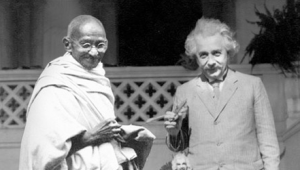
In 1932, Sigmund Freud and Albert Einstein conducted a correspondence subsequently published under the title ‘Why War?’ See ‘Why War: Einstein and Freud’s Little-Known Correspondence on Violence, Peace, and Human Nature’. In many ways, this dialogue between two giants of the 20th century is symbolic of the effort made by many humans to understand that perplexing and incredibly damaging feature of human experience: the institution of war.

In a recent article, the founder of peace research, Professor Johan Galtung, reminded us of the legacy of Freud and Einstein in this regard and reflected on their dialogue, noting some shortcomings including their failure to ‘unpack conflict’. See ‘Freud-Einstein on Peace’.

Of course, Freud and Einstein weren’t the first to consider the question ‘Why War?’ and their dialogue was preceded by a long sequence of individuals and even some organizations, such as the Women’s International League for Peace and Freedom and War Resisters’ International, who sought to understand, prevent and/or halt particular wars, or even to understand and end the institution itself, as exemplified by the Kellogg-Briand Pact in 1928 outlawing war. Moreover, given the failure of earlier initiatives, many individuals and organizations since Freud and Einstein have set out to understand, prevent and/or halt wars and these efforts have taken divergent forms.

Notable among these, Mohandas K. Gandhi was concerned to develop a mode of action to deal with many manifestations of violence and he dramatically developed, and shared, an understanding of how to apply nonviolence, which he labeled satyagraha (holding firmly to the truth), in overcoming large-scale violence and exploitation. He successfully applied his strategic understanding of nonviolence to the Indian independence struggle against British colonial rule. But while Gandhi was happy to acknowledge his debt to those who had gone before, he was not shy in proclaiming the importance of finding new ways forward: ‘If we are to make progress, we must not repeat history but make new history. We must add to the inheritance left by our ancestors.’

My own journey to understand human violence was caused by the death of my two uncles, Bob and Tom, in World War II, ten years before I was born. My childhood in the 1950s and 1960s is dotted with memories of my uncles, stimulated through such events as attending memorial services at the Shrine of Remembrance where their war service was outlined. See ‘My Brothers’ on my father’s website.

But by the early 1960s, courtesy of newspaper articles and photos, I had become aware of exploitation and starvation in Africa and elsewhere, and as a young university student in the early 1970s I was reading literature about environmental destruction. It wasn’t just war that was problematic; violence took many other forms too.

‘Why are human beings violent?’ I kept asking. Because I thought that this question must have been answered somewhere, I kept reading, including the work of Freud and Karl Marx as an undergraduate, but also the thoughts of many other scholars, such as Frantz Fanon, as well as anarchists, feminists and those writing from other perspectives which offered explanations of violence, whether direct, structural or otherwise.

By the early 1980s I had started to read Gandhi and I had begun to understand nonviolence, as Gandhi practised and explained it, with a depth that seemed to elude the activists I knew and even the scholars in the field that I read.

Separately from this, I was starting to gain a sense that the human mind was not something that could be understood well by viewing it primarily as an organ of thinking and that much of the literature and certainly most of the practitioners in the field of psychology and related fields, especially psychiatry, had failed to understand the emotional depth and complexity of the human mind and the implications of this for dealing with conflict and violence. In this sense, it was clear to me, few had understood, let alone been able to develop, Freud’s legacy. This is because the fundamental problem is about feeling (and, in relation to violence, particularly suppressed fear and anger). Let me explain why.

Violence is something that is usually identified as physical: it involves actions like hitting, punching and using weapons such as a gun. This is one of the types of violence, and probably the one now most often lamented, that is inflicted on indigenous peoples, women and people of colour, among others.

Separately from this, Gandhi also identified exploitation as violence and Galtung elaborated this concept with his notion of ‘structural violence’. Other forms of violence have been identified and they take many forms such as financial violence, cultural violence and ecological violence. But violence can be more subtle than any of these and, hence, much less visible. I have given two of these forms of violence the labels ‘invisible violence’ and ‘utterly invisible violence’. Tragically, ‘invisible violence’ and ‘utterly invisible violence’ are inflicted on us mercilessly from the day we are born. And, as a result, we are all terrorized.

So what are ‘invisible’ and ‘utterly invisible’ violence?

In essence, ‘invisible’ violence is the ‘little things’ we do every day, partly because we are just ‘too busy’. For example, when we do not allow time to listen to, and value, a child’s thoughts and feelings, the child learns to not listen to themSelf thus destroying their internal communication system.

When we do not let a child say what they want (or ignore them when they do), the child develops communication and behavioural dysfunctionalities as they keep trying to meet their own needs (which, as a basic survival strategy, they are genetically programmed to do). When we blame, condemn, insult, mock, embarrass, shame, humiliate, taunt, goad, guilt-trip, deceive, lie to, bribe, blackmail, moralize with and/or judge a child, we both undermine their sense of Self-worth and teach them to blame, condemn, insult, mock, embarrass, shame, humiliate, taunt, goad, guilt-trip, deceive, lie, bribe, blackmail, moralize and/or judge.

The fundamental outcome of being bombarded throughout their childhood by this ‘invisible’ violence is that the child is utterly overwhelmed by feelings of fear, pain, anger and sadness (among many others). However, parents, teachers and other adults also actively interfere with the expression of these feelings and the behavioural responses that are naturally generated by them and it is this ‘utterly invisible’ violence that explains why the dysfunctional behavioural outcomes actually occur.

For example, by ignoring a child when they express their feelings, by comforting, reassuring or distracting a child when they express their feelings, by laughing at or ridiculing their feelings, by terrorizing a child into not expressing their feelings (e.g. by screaming at them when they cry or get angry), and/or by violently controlling a behaviour that is generated by their feelings (e.g. by hitting them, restraining them or locking them into a room), the child has no choice but to unconsciously suppress their awareness of these feelings.

However, once a child has been terrorized into suppressing their awareness of their feelings (rather than being allowed to have their feelings and to act on them) the child has also unconsciously suppressed their awareness of the reality that caused these feelings. This has many outcomes that are disastrous for the individual, for society and for nature because the individual will now easily suppress their awareness of the feelings that would tell them how to act most functionally in any given circumstance and they will progressively acquire a phenomenal variety of dysfunctional behaviours, including many that are violent towards themselves, others and/or the Earth.

Moreover, this emotional (or psychological) damage will lead to a unique combination of violent behaviours in each case. And some of these individuals will gravitate to working in one of the social roles that specifically requires, or justifies, the use of ‘legitimized violence’, such as the violence carried out by police, prosecuting lawyers, magistrates and judges, as well as that inflicted by the military. Others, of course, will operate outside the realm of legitimized violence and be labelled as ‘criminals’.

But, you might be wondering, what is the link between what happens in childhood and war?

The answer is simply that perpetrators of violence, and those who collaborate with them, are created during childhood. And these perpetrators and collaborators are all terrified, self-hating and powerless – for much greater detail of the precise psychological characteristics of perpetrators of violence and their collaborators, see ‘Why Violence?’  and ‘Fearless Psychology and Fearful Psychology: Principles and Practice’ – and they go on to perform all of the key roles in creating, maintaining, equipping, staffing and legitimizing the institutions of war and in conducting it.

If it weren’t for the violence to which we are all mercilessly subjected throughout childhood, there would be no interest in violence or war of any kind. If we were raised without violence, we would be naturally peaceful and cooperative, content to spend our time seeking to achieve our own unique evolutionary potential and to nurture the journey of others as well as life itself, rather than just become another cog in someone else’s military (or other bureaucratic or corporate) machine.

If any of the above resonates with you, then I invite you to make ‘My Promise to Children’.

In addition, if further reducing the violence in our world appeals to you, then you are also welcome to consider participating in ‘The Flame Tree Project to Save Life on Earth’,  signing the online pledge of ‘The People’s Charter to Create a Nonviolent World’ and/or considering using the strategic framework on one or the other of these two websites for your campaign to end violence or war in one context or another: Nonviolent Campaign Strategy and Nonviolent Defense/Liberation Strategy.

A child is not born to make war. But if you inflict enough violence on a child, and destroy their capacity to become their own unique and powerful self, they will be terrorised into perceiving violence and war as their society wants them to be perceived. And violence and war, and the institutions that maintain them, will flourish.

If we want to end war, we must halt the adult war against children as a priority.


Biodata: Robert J. Burrowes has a lifetime commitment to understanding
and ending human violence. He has done extensive research since 1966 in
an effort to understand why human beings are violent and has been a
nonviolent activist since 1981. He is the author of ‘Why Violence?
His email address is flametree@riseup.net
and his website is at http://robertjburrowes.wordpress.com


Robert J. Burrowes
P.O. Box 68
Daylesford
Victoria 3460
Australia
Email: flametree@riseup.net

Websites:
Nonviolence Charter
Flame Tree Project to Save Life on Earth
‘Why Violence?’
Nonviolent Campaign Strategy
Nonviolent Defense/Liberation Strategy
Anita: Songs of Nonviolence
Robert Burrowes
Global Nonviolence Network

It Is Bettter to Light One Candle than to Curse the Darkness

hqdefault

By Harvey Lothian

Source: Dissident Voice

The world is in bad shape. Every reasonably intelligent, aware, objective person in the world knows, if only intuitively, that something is very, very wrong. There should not be this many armed conflicts, this much anger, this much violence, this much unemployment and underemployment, this much debt, this much homelessness, hunger, poverty, this ever widening gap between the income and wealth of the super rich and everyone else, and this much distrust in government and politicians. The future does not look good; a financial crisis and a socioeconomic collapse are just around the corner. Another World War or innumerable smaller wars seem almost certain.

Things are dark everywhere in the world, except in the offices and homes of the wealthy and highly connected people of the world. They control the world. There are no genuine democracies in the world, only oligarchies and dictatorships. The wealthy classes have never had it better. Never in recorded history has this class had higher income and wealth compared to the average working family. Oxfam reported that the richest 50% of the people own over 99% of the world’s wealth, the richest 1% of the world’s population hold over 50% of the world’s wealth, and the richest 62 people in the world has as much wealth as the poorest half of the global population, about 3.6 billion people.

Rich people’s insatiable greed has brought the world to this lamentable state. Make no mistake about it, the greed of the wealthy classes and their flunkies are responsible for the wretched state of the world today. We, the masses of the world, believed their lies because we are decent trusting people. We did not believe anyone would tell us such monstrous lies. The wealthy classes did, then they had us go to war against other innocent trusting people around the world while they looted the assets of our countries and stole our future. They have left us nothing but our confusion as to why our lives are going down the drain when we believed and tried our best to be patriotic citizens of our country. Our confusion is rapidly turning to anger as we learn more details about how the wealthy classes and leaders have deceived us, betrayed us, and ruined our lives. They have used us in the most despicable of ways; they used our trust, and naivety to rob and violate us to our very core, by destroying our lives and our hope and dreams for a better future for ourselves and our children.

To put this insanity in clear perspective, consider the following. Reliable U.N. agencies estimate that 32,000 children die around the world every day from hunger and hunger related diseases. They die because their parents do not have enough money to feed them a nourishing diet. Billions of people around the world live on one to three dollars a day, so we can safely say that if these 32,000 children’s parents earned $3 a day these children would not die. A tiny $96,000 a day given to these children’s parents, in wages for work performed, would save these children from what is apparently a painful death. That is $35,040,000 per year to save 32,000 innocent children, or, $1,095 per year to save one child. According to Forbes magazine there are 1,810 billionaires in the world worth a total of $6.5 trillion. Why do 32,000 children die every day from hunger and hunger related diseases, 224,000 every week, 11,648,000 every year when there is enough food to feed them and enough money to buy that food? Because we live in a totally insane world where accumulating wealth is more important to some that feeding hungry children.

There is no way out of the insane economic house of cards the rich have built except total collapse. The rich made that inevitable when they relentlessly incurred ever increasing amounts of federal debt, in our name, as they continually sent our well paying jobs to low wage countries making it impossible for us to reduce that debt through our taxes. They got super rich, we lost our good jobs and had enormous amounts of new debt piled on to us. This is not sustainable, the house of cards must eventually collapse. Or, our insane leaders will try to turn the world into one huge war zone.

We, the decent, sane people of the world now have an important decision to make; we can continue to curse the darkness the insane wealthy people of the world have created with their insane endless pursuit of more wealth, or, we can begin lighting candles by seeking and employing methods of solidly uniting us so we can defeat our common enemy and move us to a better way of living together. If we do not have a clear picture in our minds of how we want to live together in peace and harmony chaos will occur when the socio economic system collapses. We have to know where we are going, or we are lost.

Where do we want to go? The answer is obvious; we are all human beings, we all sprang from the same source, we are all brothers and sisters and all have exactly the same innate needs for food, water, shelter, warmth, sleep, social order, safety, security, stability, employment, a sense of belonging and love, and the opportunity to develop to our fullest potential. Simply put. we want and need to live in a world where countries are at peace with each other while we live in peace and harmony with each other in our country and we have the opportunity to lead decent normal lives while developing to our fullest potential.

The only way out of the horrendous mess of the collapsing house cards the greedy people have erected is if a vast majority of people around the world solidly unite as brothers and sisters under the motto, “All for one, one for all.” After the collapse occurs no one must be left without the necessities of life. Brothers and sisters take care of each other.

No kind of violence can be tolerated after the house of cards collapses. Violence breeds violence and solves no important long term problems. Brothers and sisters are not violent with each other.

Can we, the people of the world, do this? Can we solidly unite, watch out for each other, protect each other and help those in need? The alternative is too awful to think about. So, we must try. If we try we may succeed. It would be a wonderful world if we cared about others as much as we cared about ourselves; if we were all brothers and sisters. It is time to start lighting candles and stop cursing the darkness. Love thy neighbour as thyself. Or, at least try to do it.


Harvey Lothian is a 79-year-old and living on the Sunshine Coast of BC, Canada. His passions since a teenager have been history, politics, economics, sociology, social psychology, learning, traveling and reading. In recent years he has come to understand what Plato meant when he said all dogs have the soul of a philosopher.

Fake Everything — Confronting Our Ideological Hegemony

By Janet Phelan

Source: Activist Post

The recent invocation of “fake news”—notably being levied by those on both sides of the political fence—points to more than allegations of conspiratorial efforts to sway the opinions of John Q Public. What we are seeing emerge is a challenge to the very protoplasm in which we live.

News is history, present tense. As such, accurate news is foundational to understanding the world we live in and the forces that mold it. It only takes a brief immersion into the recording of recent historical events to realize that the history books do not provide a faithful and truthful record.

According to many history books, JFK was felled by a lone assassin, a disgruntled ex-military and Communist sympathizer named Lee Harvey Oswald.

Less than 25% of the American people believe this today.  A multiplicity of theories have sprung up in the wake of the Kennedy assassination; what can be agreed upon is that this event remains an open sore in the American psyche, unresolved and possibly unresolvable.

Foreknowledge surrounding the attack on Pearl Harbor, 9/11, the genesis of why we went to war in Iraq and, most currently, dispute as to who launched gas attacks in Syria (which seem to be impelling us towards war against Assad)—these pivotal events remain in dispute, while facile news reports, bleeding into the history books, provide inadequate answers to troubling questions as we march on towards an increasingly dim future.

If we cannot trust news and history, what can we trust?

Very little, as it turns out….

FAKE LAWS

The US’s legal system is nearly bullet proof, we are told. The separation of powers between the three branches of government ensures an independent judiciary, pivotal to the foundational promise of freedom and justice for all. I have harped enough in these pages over the years as to the weaponization of our legal system, which can be and is levied against targeted groups.

The reality is that there is no law, in terms of its equal application. And if there is no equal application, then what we have is not law but the naked exercise of power. The recent revelations that judges are laundering under the table bribes is only further evidence that we are living in a state of legal nullity.

FAKE HUMAN RIGHTS

Our much revered Constitutional protections are reflected in a number of international human rights treaties, most of which the US has refused to sign or ratify. On the rare occasion of US ratification, such as with the Convention Against Torture, we can see where the US has resorted to schizophrenic babble in her efforts to justify her behavior. Senator Tom Cotton’s recent declaration that “waterboarding is not torture,” which echoes previous assertions by President Bush, should have alerted us that the US intends to honor no international accords. Certainly not where human rights are involved.

The international human rights community has increasingly accommodated US imperatives here, morphing from an original mandate to political support of the oppression that it is tasked with addressing.

For example, let’s take a look at Front Line Defenders, an international Dublin based NGO whose website declares that “The mission of Front Line Defenders is to protect, defend, support, and act for and with human rights defenders whose lives and health are at risk because of their peaceful and legitimate activities.”

A review of FLD’s 230 open cases reads like a carefully vetted political tract. Third World journalists and human rights defenders in China, the Russian Federation and Iran top the list. There is not one single case involving a First World individual. Not one from the US, not one from Western Europe.

Perhaps such individuals have never seen the need to contact FDL, you wonder. The answer is a resounding NO. FDL refuses its services to Western journalists and human rights defenders.

FDL’s financial statements provide a clue to its political decision making of which human rights defenders it will assist and which it will throw to the lions. FDL admits to having received 2,535,982 Euros in government sponsorship in 2016, up from 2,351,474 in 2015. Public donations accounted for a mere 38,900 of last year’s income, which totaled 4,688,641 Euros. Its state sponsors include Norway, Ireland, Switzerland, Germany and the European Instrument for Democracy and Human Rights. Its corporate sponsors include George Soros’s Open Society Foundation and the Ford Foundation, among others.

Article19, the international press freedom NGO, also appears to be toeing the line in terms of trumpeting the causes of vetted Third World journalists. Article19 has admitted to getting funding from the US State Department and while it maintains offices in the Americas, it notably excludes US journalists at risk from its services or reports.

You may still not believe that Western journalists and human rights defenders may currently be at risk. These NGOs have done a very good job in keeping up that perception.

FAKE FOOD

We are not only living in a state of falseness. We are also eating it. The supermarket food is not only GMO-laden. It is also laced with carcinogens and Alzheimer’s inducing agents. This report from the venerable National Institutes of Health is ten years old but deserves to be revisited.

In the intervening decade, the push to contaminate otherwise healthy food, such as yogurt, with cancer inducing fake sugars, has only increased.

And if you thought that your brain was immune to chemical attack, this report should stop you in your tracks. As the so called age related diseases of dementia and Alzheimer’s are now occurring in younger populations, one might want to start asking why the push to chemicalize our bodies, our brains, our environment and our futures.

FAKE MEDICINE

That would be not only vaccines. Many so called beneficial medicines are now found to cause severe illness. Drug induced liver diseases, drug induced renal diseases, drug induced neurological and auto immune diseases—one wonders sometimes if the cure is worse than the illness. The pervasiveness of medically induced medical conditions has led Dr. Josh Axe to declare that “Conventional Medicine is the Leading Cause of Death.”

FAKE RELIGION

Somewhere in the Old Testament, between the Garden of Eden and Moses coming down from the mountain with those venerable tablets, a certain perception of man’s place in the universe got launched. Genesis declared the following: “And God said, Let us make man in our image, after our likeness: and let them have dominion over the fish of the sea, and over the fowl of the air, and over the cattle, and over all the earth, and over every creeping thing that creepeth upon the earth.” Man appears to have taken this to heart.

Dominionism. Manifest Destiny. The White Man’s Burden. Colonialism. Wars for Oil and Wars of Eugenics. All these speak to a mindset wherein man is allowed, no, entitled to assert his mastery over the earth and, if he has enough brute strength, over his fellows. The world view of humans living with, living among, not in ascendency over but in cooperation with, has largely fallen to the Biblical imperative of asserting control over and manipulation of an increasingly beleaguered planet.

Recent research points to the possibility of an entirely different reality than what we have assumed. In as yet unpublished research by Ana Willem, she writes that

The crux of the notion or argument pointing towards existence as a holographic reality, or that points to the Universe (or more correctly, Multiverse as per the work of Richard Amoroso and Elizabeth Rauscher in their book ‘The Holographic Anthropic Multiverse’) being a holographic reality, hinges on the physical and mathematical co-existence of different dimensions in which information or energy is shared or actedon in a way that it is transformed.

Willem goes on to write that

The point of departure for my work is the Mayan Calendar, and more specifically the ‘base’ Tzolkin calendar which is created using the numbers 13 and 20 to create a 260 day calendar grid. The calendar is assembled in a grid using the number 13 as the count of columns, and the number 20 as the count of rows. It is created by starting at the top-left cell of the grid, and counting to 13 as you move down the first column. When you hit the 14th row of the first column, you start counting over again at 1 as you continue to move first down, and then to the next column, and then down again, until you have counted to thirteen 20 times, and the 260 day grid is filled.

According to her,

Part of my work studies the various ways in which the Matrixes I am discovering diverge from the work on Toroidal Vortexes of Rothko and Powell. In addition, I found that the spliced grid created a numerical topology in which the inherent ‘scale’ of a given numerical matrix creates sections of coherent waves that cycle in between the harmonic topologies representing infinity and zero, changing polarity at each crest, and then cycling back. They occur only in specific sections of the spliced the matrix, and interweave like a family of related sine-like waves through one another in a way that resembles highways or streams. This is one way that the matrices I am studying are different than the ones being researched by Powell and Rothko. Much like the topologies being studied by Rothko and Powell, and being made into actual machines/products by Daniel Nunes), the phenomenology of what I have discovered acts very much like a machine.

The million dollar question, asserts Willem, is “what it means or how it specifically relates to the idea of a Holographic Anthropic Multiverse is not yet answered.”

If we are to survive this century, we will need to do more than drain the swamp. We will need to reassess not only the circumstances which bespeak profound efforts at deception by our leaders. We will also need to reassess our place in the universe, with humility and frankness. Our continued trumpeting that God is on our side, that we are in fact formed in His image—and by implication, His representative on this earth, has pushed us to the brink of apocalypse. If we are to survive ourselves, we must first recognize who we are—and who we are not.


Janet Phelan is an investigative journalist whose articles have appeared in the Los Angeles Times, The San Bernardino County Sentinel, The Santa Monica Daily Press, The Long Beach Press Telegram, Oui Magazine and other regional and national publications. Janet specializes in issues pertaining to legal corruption and addresses the heated subject of adult conservatorship, revealing shocking information about the relationships between courts and shady financial consultants. She also covers issues relating to international bioweapons treaties. Her poetry has been published in Gambit, Libera, Applezaba Review, Nausea One and other magazines. Her first book, The Hitler Poems, was published in 2005. She is also the author of a tell-all book EXILE, (also available as an ebook). She currently resides abroad.


Do Psychopaths Run the World?

what-people-think-psychopaths-are-streetdemocracy

By Nick Parkins

Source: Waking Times

“Our society is run by insane people for insane objectives. I think we’re being run by maniacs for maniacal ends and I think I’m liable to be put away as insane for expressing that. That’s what’s insane about it.” ~John Lennon (1940-1980), English singer and songwriter

Lennon and others externalise the apparent paranoia that wells up inside us. “The world has gone mad!” More often than not we partition this voice off, content to view the world as others prescribe it. But who are these others, and what do they want?

The term psychopath is often criminally misjudged, thanks largely to unhelpful portrayals of sick, twisted and violent psycho-character types in the popular media. This has led, by way of public ignorance, to the common belief that the psychopath has no function, role or place in open society. A swift offload that allows us, the apparent sane majority, to circumvent our worst fears.

Any notion that the psychopath is incapable of functioning in open society is, according to M.E. Thomas1 – a self-confessed sociopath – flawed. The question is not the capacity to function, but rather what capacity or form that function takes. As Thomas says, psychopaths and sociopaths share an intertwined clinical history; both can function, they just do so differently. And though we are left to muse on what mask that function may take, in many social situations they excel.

Competition Wins Out

Jean-Baptiste de Lamarck was a French biologist who advocated a theory of evolution widely rebuked in establishment circles. Lamarck’s major work was published in the same year Charles Darwin was born – who would go on to supplant Lamarck’s theory 50 years later. In Lamarck’s world cooperation prevailed over Darwinian competition as the driving mechanism of evolution.

According to authors G. Greenberg and M.M. Haraway,2 it was Darwin’s view that served to reflect and sustain a Victorian society tied to free market, capitalist and imperial values. His model supported a dog-eat-dog, life is hard, code of practice; the scientific valediction of the natural world as played out on a brutal, cold and insensitive landscape. Arguably the perfect environment for the aspiring modern day psychopath, and a prevailing view that the poet Tennyson described as nature, red in tooth and claw.

Snakes & Ladders

Although diagnosing definitive psychopathy in individuals remains somewhat of a grey area, attempts have been made to categorise psychological traits that set psychopathic personalities apart. Most prominent is the diagnostic check-list devised by renowned Canadian psychologist Robert Hare that is used to determine a categorical diagnosis of clinical psychopathy, or at best a category score.

According to Hare’s list, psychopaths display superficial charm, unbridled ego, and pathological lying and cold, calculated cunning to entrance their prey. They are often impulsive and irresponsible, and exhibit an absence of empathy and remorseless lack of guilt. These and other attributes, such as criminal versatility and a marked capacity to manipulate, deceive and control, mark them out as dangerous. These are traits that enable psychopaths to move into high-ranking positions of power and influence.

“We know much less about corporate psychopathy and its implications,” explains New York psychologist Paul Babiak, “in large part because of the difficulty in obtaining the active cooperation of business organisations for our research.”3 A dilemma that Hare disclosed to Jon Ronson, author of The Psychopath Test. “Prisoners are easy,” states Hare. “They like meeting researchers. It breaks up the monotony of their day. But CEOs, politicians…”4 According to Hare, these sharks are a different kettle of fish.

A rare study on psychopathy in the workplace conducted by Babiak, Neumann and Hare5 suggests that 1 in 25, or 4 per cent, of corporate executives display significant personality traits typical of psychopathy – an incidence four times that estimated in the general population. The study supports the claim that psychopaths can and in fact do achieve high ranking corporate status. We are left to speculate, but Hare concedes Wall Street may harbour 1 in 10 attracted to lucrative watering holes that are poorly regulated.6Factor this in and it’s not hard to see how the very lifeblood and identity of corporations and financial institutions can often run cold.

Arguably most startling, the study indicates that despite being classed as substandard managers, team players and attracting poor performance appraisals, executives that met the clinical threshold of psychopath were valued by their immediate superiors as creative and innovative, as good communicators and strategic thinkers.

In short, they may not always fly under the radar. Despite the blips, it is clear to American psychiatrist Hervey Cleckley7 that psychopaths possess the communication, persuasion and interpersonal skills to override any negative impacts on their career. A finding supported by the Babiak study: “some companies viewed psychopathic executives as having leadership potential, despite negative performance reviews and low ratings on leadership and management by subordinates.”8 According to the authors, this shows a proficiency to manipulate decision makers, a point made by psychologist Dennis Doren who observed in institutions the psychopath’s unerring ability to seek out and foster relationships with those of highest authority and demonstrate tremendous skill at influencing them.9

In many instances the chameleon-like ability of the psychopath to mimic its surroundings by reading and influencing colleagues through the art of deception, be it through self promotion or subtle persuasion, allows the snake charmer to hide his true skin and pass unchecked through social customs. Studies suggest psychopathy, in body or by proxy, can entrench itself at the top, but is this phenomenon relatively isolated, or has this scenario over the course of human history always prevailed?

As Above, So Below

As vice president and director of Governance Studies at the Brookings Institution, Darrell West analyses business and law school curricula, specifically, according to West “because business and law schools train the leaders of tomorrow.”10 In the course of his research West reviews course syllabi and conducts interviews with faculty members. He has also surveyed data on business and law school student perceptions. What he found was troubling.

“The social responsibility of business is to increase its profits,” states West, taking his lead from the title of a 1970 New York Times magazine article written by the highly-influential American economist and statistician, Milton Friedman. The article was unequivocal: according to Friedman, maximising shareholder value was a company’s sole responsibility.11

“Many schools do not require stand alone courses that provide broad conceptions on the purpose of the corporation in society,” says West. Of those that do, “many focus on the purpose of the corporation, with emphasis on how to maximise shareholder value, especially in law schools.”12 Instruction therefore is key, notes West, and will colour a student’s view of the world. In fact, West concludes, “business school surveys show that after completing school, students are more likely to see shareholder value as the most important goal of the corporation.”13

It was not that Friedman was a prophet. In hindsight, according to West, he helped shape the outlook of numerous business leaders, academics, and thought-leaders that ultimately served to affect America’s modern sense of purpose of the corporation. An inherent identity that helps shape the way business and law school students view their, often times, lack of responsibility to society even today.

In the real world, inevitable coldly-calculated equations play out on the one side to maximise profit and on the other to minimise loss. And like most mathematical equations they make little or no sense to the layman.

“Can you buy what you already own?” This was the equation facing all concerned when Canadian-based Nautilus Minerals Inc. purchased the licence in 2011 from the “Independent State of Papua New Guinea” (PNG) to mine deep-sea vent fields in sovereign waters off the country’s coastline. The answer, morally, of course, is no.

According to Sir Julias Chan, current Governor of New Ireland province in PNG, ethics are an intangible commodity, and unlike cold hard currency rarely stack up. “First, the state cedes exploration and production rights to foreign companies for next to nothing,” says Chan. In the case of PNG 10,000 kina, equivalent to US$4,000. “For this pittance, the foreign developer gets full control of all the wealth that can be taken from the ground.”14

“The next step is for the state to seek equity in the project, usually 30 percent in a mining project and 22.5 per cent in an oil or gas project,” explains Chan. “The state has ‘given away’ the entire resource to a foreign company, and now returns to buy what was already legally its own property, for a 30 percent interest in the project.” To PNG this meant 300 million kina, or US$118 million. “And, to do so, the state usually takes out a commercial loan rate that puts the country further into debt at high interest.”15 Today a common event whereby the state acts to castrate itself and its people to high finance.

Joel Bakan is a professor of law at the University of British Columbia, Canada. While those that run corporations are for the most part, good, moral people, says Bakan, the duty of the corporate executive is to the corporation’s business interests first and foremost. “The money they manage is not theirs,” explains Bakan. “They can no sooner use it to heal the sick… or buy a villa in Tuscany.” In the corporate world, good people are encouraged to behave badly. In fact, the sum of corporate parts are “singularly self interested and unable to feel genuine concern for others in any context. The corporation, like the psychopathic personality it resembles, is programmed to exploit others for profit.”16

Under such terms it is not difficult to envisage how a system can soon come to value and mimic its most deviant parts. Equally, how the parts over time can come to be shaped by the whole.

It’s Behind You

According to philosopher and author Aaron James, while the psychopath feigns moral action as a tool to manipulate others, the arsehole could well be a butt of equal contention. Unlike the prototypical psychopath, says James, the arsehole “traffics in and is moved by moral justification,” which leads to an “entrenched sense of special entitlement.”17

The perfect example, according to James, is Apple founder Steve Jobs who saw his sole obligation to society as implicitly tied to producing the products his consumers desired. James notes what Jobs’s best friend, Jony Ive, once told Business Insider: “when he’s frustrated… his way to achieve catharsis is to hurt somebody. And I think he feels he has a liberty and license to do that,” said Ive. “The normal rules of social engagement, he feels, don’t apply to him.”18

Worryingly, James says, “the arsehole’s reasoning is shaped by the moral justification his surrounding culture makes available to him.”19 For instance, according to Hare, many white-collar criminals are psychopaths. “They flourish because the characteristics that define the disorder are actually valued,” asserts Hare. “When they get caught, what happens? A slap on the wrist, a six-month ban from trading, [oh] and don’t give us the $100 million back.”20

Accordingly, not only does corporate culture control net arsehole production, but the quality of butt-heads produced. And, depending on the culture, says James, “an arsehole can be better or worse behaved than a psychopath.”21 A consoling thought.

Arguably it is no more comforting to know that the psychopath you had fingered all along is really an arsehole nurtured by a system that is, by way of inherent nature, socially deviant. If the reasoning of a typical arsehole is moved by moral justification, taken from his surrounding environment, then the ability of a psychopathic culture and/or system to shape its own governing class is implied.

They Gave Us Their Mind

The enduring strength of psychopathy lies in its ability to manipulate how others perceive it. But the innate ability of the psychopath or the system to shape our perceptions is not, in itself, entirely the reserve of the clinical psychopath.

We all play our part in the masquerade. Many of us partake in cosmetic enhancements and props that support our ego’s waltz through this porcelain world. Whatever the score, the Hare check-list has a number picked out for us all. In its pursuit of ultimate control, this is the greatest achievement of psychopathy; after all, what better way to predict by response a person or group, than to give them your mind?

The competitor’s urge to win at all cost is certainly pervasive. So, too, the trend of irresponsibility, most evident in the compensation culture that has crept into the social mindset, thanks to laws that restrict a person’s capacity to develop by way of ethics and moral concepts of right and wrong. How can you take responsibility for thoughts and concepts that are not your own? In the broad, rules and regulations teach us to hand over our power, a transaction that re-enforces itself in society according to Thomas. She says that given the choice between having power and giving it up to a ‘trusted’ entity, people often choose to give it up rather than take the responsibility that comes with it.22

In its apparent, endless quest to reinvent society in its own image, psychopathy perhaps has more than one expression. Recent research into social media habits throws up disturbing correlations between heavy Facebook use and socially aggressive narcissism. In one study users that scored highly on a Narcissistic Personality Inventory questionnaire, reports Damien Pearse, “had more friends on Facebook, tagged themselves more often and updated their news-feeds more regularly.” The research, the report states, “comes amid mounting evidence that young people are becoming increasingly narcissistic, and obsessed with self-image and shallow friendships.”23

In the same breath the media have ‘jokingly’ jumped on those abstaining from Facebook as highly suspicious and suspect – they could have something to hide. Facebook use is, of course, prevalent and ‘normal’.

An infinite number of media streams exist that entice us to see our reflection, drawing us into powerful undercurrents, and buffeting us from one bank to the next. We surface only to take breath, disorientated and confused, disconnected from our natural cues. But perhaps that’s the idea. Certainly it is the innate need to control and the power to wield it, at whatever cost, and without care, that fractures the pathological mind from the rest of us.

The God Complex

“Those who rise to power in the corporatocracy, are control freaks, addicted to the buzz of power over other human beings.” ~Bruce Levine, social critic & psychologist

In a competitive world there will always be those who actively seek out, justify or embrace traits of psychopathy as a route to success. For a surgeon, a cold detachment and cool head has its place. But glorifying the psychopath is a perilous path to tread. According to psychologist Linda Mealey, competition only serves to increase the use of antisocial and Machiavellian strategies and counteracts any increase in pro-social behaviour after success.

Spiralling societal separation, and re-enforcing detachment, sets a dangerous precedent, what James refers to as a sense of “entitlement born of cosmic grandiosity.”24 He cites oil baron John D. Rockefeller who viewed his wealth not in some Wild West American capitalist context that gave him free rein, but unapologetically, by divine right: “God gave me my money,”25 said Rockefeller.

This sense of divine entitlement, being chosen, as apart from society, has deeply disturbing parallels to contemporary wealth.

Jeff Greene is a multi-billionaire property investor and entrepreneur, and owns reportedly America’s most expensive home. Greene, who made his fortune betting on sub-prime mortgages, says Americans need to have “less things”: “America’s lifestyle expectations are far too high and need to be adjusted, so we have less things and a smaller, better existence,” lectured the 60-year old, who lets out the $195 million palatial estate in Beverly Hills to royal families and international dignitaries for hundreds of thousands of dollars a month.26

At its heart, assuming it had one, departments within the system, be they political, corporate or financial, select by lineage this mind; one willing to create, support and maintain it. “Figures such as J.P. Morgan, Randolph Hearst, and Mayer Rothschild,” argues author Stefan Verstappen, “are professional psychopaths that reach the pinnacle of the financial stage where they cause no less misery and destruction as their political counterparts.”27

As a result, examples of psychopathic conduct in high office are commonplace. Robert Kirkconnell is a decorated US Air Force combat veteran of 27 years, and an outspoken critic of the US government MK-ULTRA program that conducted a battery of callous psychological or ‘mind control’ tests on its own citizens. In American Heart of Darkness, Kirkconnell charges the presidential Rockefeller Commission, set up to investigate the CIA’s activities, which he says funded the program. Kirkconnell no longer sees his home as a constitutional republic, but as a pathocracy run by psychopaths.

Contagious Psychopathic Worldviews?

“I had to win at all costs, sometimes allowing the costs to flow unchecked, just to see the volume of my power.” ~M.E. Thomas

“Power is all I have ever really cared about in my life,” states Thomas. “Physical power, the power of being desired or admired, destructive power, knowledge, invisible influence. I like people enough that I want to touch them, mould them, ruin them,” says Thomas. “I want to exercise my power.”28 It’s nothing personal. It’s dietary. The idea of ruining people, she says, is simply delicious.

Thomas is not unique. The psychopath invariably plays with its food. In the process actively seeking to visit misfortune or suffering on others. Thomas regards herself as a white tiger – a beautiful and exotic pet but inherently dangerous. And whilst in her own words she considers herself tamed, inside she continues to grapple with a primal urge to destroy.

This mindset is not lost on society. In fact, it is a worldview captured succinctly in Michael Ellner’s personal state of the world address: “Just look at us,” he asks. “Everything is backwards, everything is upside down. Doctors destroy health, lawyers destroy justice, psychiatrists destroy minds, scientists destroy truth, major media destroys information, religions destroy spirituality and governments destroy freedom.” You can see his point. But to what extent does this world talked of by Ellner stem solely from blind pursuit of power and profit?

Is there a hidden systemic malevolence that creates fear and uncertainty; the chaos to warrant this chase? Is the malevolent mist, that evil intent we ascribe to heinous acts and misdeeds, illusory, an epiphenomena, a by-product of the psychopath brain? Or is it real, autonomous, and guiding the program? And does this distinction matter? Does it help us interpret, say, the rise in chronic illness, its origins and how the healing profession has become, as critics claim, a public relations buzz-term; managing symptoms for profit?

The world of Kirkconnell swings into focus. Are we all victims of systemic programming; of disorientation; an imbalance the predator incites in us to maintain and enforce its position and status?

Like a god, so much of what psychopathy is and does hides in plain sight. The psychopath appeals to its prey’s sense of empathy and faith in humanity. He is the blank slate onto which people project their hopes and ideals.

This realisation must dawn if we are to expose systemic psychopathy and confront wildly sinister possibilities, not least the darker identities and underlying motives upon which it is based.

Darwin Dorr is the director of research into psychopathology at Wichita State University, Kansas. “The majority of paedophiles are psychopathic,” says Dorr, “or at least manifest to a significant degree the psychological characteristics of psychopathy.”29

Such ties that bind power to its perversions are historic, endemic and persist to this day. Investigations surrounding an elite Sydney paedophile ring are only the tip of a cold and callous iceberg that threatens to sink a titanic raft of untruths. In the UK, the reputation of once respected DJ, television presenter, and establishment confidante, Jimmy Savile, sank when his penchant for children, dead bodies, and satanic rituals and foreplay was disclosed to a shocked population.

Questions are now being asked outside UK Home Office circles and its curious taste for celebrity trash cans. All of a sudden the term psychopath seems no longer sufficient. Are such people, the system they represent, and the entities they mimic and worship, beyond a check-list? Certainly UK and wider establishment attempts to stymie the truth only serve to disclose further the covert means and amoral control by which psychopathy operates as an integral part of the system.


Nick Parkins has a master’s degree in philosophy of the mind and likes to live outside the box. To read his work, or if you have a strange or unexplained experience you would like him to cover visit www.nickparkins.co.uk.

The above article appeared in New Dawn 152 (Sept-Oct 2015).

If you appreciate this article, please consider a digital subscription to New Dawn.

Footnotes

  1. M.E. Thomas, Confessions of a Sociopath: A Life Spent Hiding In Plain Sight, Crown Publishing Group, 2013
  2. G. Greenberg, M.M. Haraway, Comparative Psychology: A Handbook, Garland Reference Library of Social Science, Routledge, 1998
  3. P. Babiak, C.S. Neumann, R.D. Hare, “Corporate psychopathy: Talking the walk,” Behavioural Sciences and the Law, at http://web.natur.cuni.cz/~houdek3/papers/Babiak et al 2010.pdf
  4. J. Ronson, The Psychopath Test: A Journey Through the Madness Industry, Picador, 2011
  5. P. Babiak, C.S. Neumann, R.D. Hare, op. cit.
  6. R. Hare, www.hare.org/comments/comment2.html
  7. H.M. Cleckley, The Mask of Sanity: An Attempt to Clarify Some Issues About the So Called Psychopathic Personality, Mosby, 1976
  8. P. Babiak, C.S. Neumann, R.D. Hare, op. cit.
  9. B.J. Board, K. Fritzon, “Disordered personalities at work,” Psychology, Crime and Law, Vol. 11(1), 17-32, with reference to D. Doren, Understanding and Treating the Psychopath, Wile, 1987
  10. D. West, “The purpose of the corporation in business and law school curricula,” Governance Studies at Brookings, www.brookings.edu/~/media/research/files/papers/2011/7/19 corporation west/0719_corporation_west.pdf
  11. M. Friedman, “The Social Responsibility of Business is to Increase its Profits,” New York Times Magazine, 13 September 1970
  12. D. West, op. cit.
  13. D. West, op. cit.
  14. “PNG Leadership has been poor steward of resources,” The National, 20 April 2011, www.roland-seib.de/05/Seib-Pressespiegel-1.5.11.pdf
  15. Ibid.
  16. J. Bakan, The Corporation: The Pathological Pursuit of Profit and Power, Free Press, 2004
  17. A. James, “Ass-holes: a theory,” Nicholas Brealey Publishing, 2013
  18. D. Love, “16 Examples of Steve Jobs being a jerk,” Business Insider, 25 October 2011, www.businessinsider.com/steve-jobs-jerk-2011-10
  19. A. James, op. cit.
  20. R. Hercz, “Psychopaths among us,” www.hare.org/links/saturday.html
  21. A. James, op. cit.
  22. M.E. Thomas, op. cit.
  23. D. Pearse, “Facebook’s dark side: study finds link to socially aggressive narcissism,” The Guardian, 17 March 2012, www.theguardian.com/technology/2012/mar/17/facebook-dark-side-study-aggressive-narcissism
  24. A. James, op. cit.
  25. www.bartleby.com/73/1207.html
  26. J. Christie, “Multi-billionaire who gave a lecture about American’s ‘needing to have less things and live a smaller existence’ owns a staggering FIVE mansions…”, Daily Mail, 24 January 2015
  27. S. Verstappen, Defense Against the Psychopath: A Brief Introduction to Human Predators, Woodbridge Press, 2011
  28. M.E. Thomas, op. cit.
  29. D. Dorr, “The pedophile as psychopath,” 1998, in T. Millon, E. Simonsen, & M. Birket-Smith (Eds.), Psychopathy: Antisocial, Violent, and Criminal Behavior, 304-320, Guilford Press
  30. P. Gilbert, “An introduction to the theory and practice of compassion-focused therapy and compassionate mind training for shame based difficulties,” The Compassionate Mind Foundation, www.compassionatemind.co.uk/downloads/training_materials/1.Workbook_2010.pdf
  31. P. Gilbert, op. cit.

Are We (Collectively) Depressed?

By Charles Hugh Smith

Source: Of Two Minds

We need to encourage honesty above optimism. Once we can speak honestly, there is a foundation for optimism.

Psychoanalysis teaches that one cause of depression is repressed anger.

The rising tide of collective anger is visible in many places: road rage, violent street clashes between groups seething for a fight, the destruction of friendships for holding the “incorrect” ideological views, and so on. I Think We Can Safely Say The American Culture War Has Been Taken As Far As It Can Go.

A coarsening of the entire social order is increasingly visible: The Age of Rudeness.

This raises a larger question: are we as a society becoming depressed as we repress our righteous anger and our sense of powerlessness as economic and social inequality rises?

Depression is a complex phenomenon, but it typically includes a loss of hope and vitality, absence of goals, the reinforcement of negative internal dialogs, and anhedonia, the loss of the joy of living (joie de vivre).

Depressive thoughts (and the emotions they generate) tend to be self-reinforcing, and this is why it’s so difficult to break out of depression once in its grip.

One part of the healing process is to expose the sources of anger that we are repressing. As psychiatrist Karen Horney explained in her 1950 masterwork, Neurosis and Human Growth: The Struggle Towards Self-Realization, anger at ourselves sometimes arises from our failure to live up to the many “shoulds” we’ve internalized, and the idealized track we’ve laid out for ourselves and our lives.

The recent article, The American Dream Is Killing Us does a good job of explaining how our failure to obtain the expected rewards of “doing all the right things” (getting a college degree, working hard, etc.) breeds resentment and despair.

Since we did the “right things,” the system “should” deliver the financial rewards and security we expected. This systemic failure to deliver the promised rewards is eroding social mobility and the social contract while generating frustration, anger, etc.

We are increasingly angry at the system, but we reserve some anger for ourselves, because the mass-media trumpets how well the economy is doing and how some people are doing extremely well. Naturally, we wonder, why them and not us? The failure is thus internalized.

One response to this sense that the system no longer works as advertised is to seek the relative comfort of echo chambers–places we can go to hear confirmation that this systemic stagnation is the opposing political party’s fault.

We don’t just self-sort ourselves into political “tribes” online–we congregate in increasingly segregated communities and states: The Simple Reason Why A Second American Civil War May Be Inevitable.

Americans are moving to communities that align more with their politics. Liberals are moving to liberal areas, and conservatives are moving to conservative communities. It’s been going on for decades. When Jimmy Carter was elected in 1976, 26.8% of Americans lived in landslide counties; that is counties where the president won or lost by 20% of the vote.

By 2004, 48.3% of the population lived in these counties. This trend continues to worsen. As Americans move to their preferred geographic bubbles, they face less exposure to opposing viewpoints, and their own opinions become more extreme. This trend is at the heart of why politics have become so polarizing in America.

We’re self-sorting at every level. Because of this, Americans are only going to grow more extreme in their beliefs, and see people on the other side of the political spectrum as more alien.”

Part of the American Exceptionalism we hear so much about is a can-do optimism: set your mind to it and everything is possible.

The failure to prosper as anticipated is generating a range of negative emotions that are “un-American”: complaining that you didn’t get a high-paying secure job despite having a college degree (or advanced degree) sounds like sour-grapes: the message is you didn’t work hard enough, you didn’t get the right diploma, etc.

It can’t be the system that’s failed, right? I discuss this in my book Why Our Status Quo Failed and Is Beyond Reform: the top 10% who are benefiting mightily dominate politics and the media, and their assumption is: the system is working great for me, so it must be working for everyone. That’s the implicit narrative parroted by status quo mouthpieces.

The inability to express our despair and anger generates depression. Some people will redouble their efforts, others will seek to lay the blame on “the other” (some external group) and others will give up. What few people will do is look at the sources of systemic injustice.

Perhaps we need a national dialog about declining expectations, rising inequality and the failure of the status quo that avoids the blame-game and the internalization trap (i.e. it’s your own fault you’re not well-off).

We need ways to express our resentment, anger, despair, etc. that are directed at the source, the complex system we inhabit, not “the other.” We need to encourage honesty above optimism. Once we can speak honestly, there is a foundation for optimism.


Escaping the iron cage of hopelessness

By Edward Curtin

Source: Intrepid Report

“Specialists without spirit, sensualists without heart; this nullity imagines that it has attained a level of civilization never before achieved”—Max Weber, The Protestant Ethic and the Spirit of Capitalism

“In this frightful round of unchecked means, nobody knows any longer where they are going, purposes are forgotten, and ends are overtaken. Human beings have set off at astronomically high speeds toward nowhere.”—Jacques Ellul, Presence in the Modern World

In a previous article, I argued that those who think science can solve our major social problems—in particular, world destruction with nuclear weapons and the poisoning of the earth’s ecology and atmosphere—were delusional and in the grip of the myth of science and technology. These problems were created by science when it became untethered from any sense of limits in its embrace of instrumental rationality. Once it became wedded to usefulness and the efficiency of technical means, it lost its original aim: the search for truth. (Obviously this doesn’t include all scientists.) In embracing means as ends, it produced an endless loop of means justifying means that has resulted in what Weber called an “iron cage.” Concomitantly, the ideology of pure objectivity and impartial innocence was joined to elite state power and the capitalist profit motive where it was supported and instantaneously and completely applied to technical applications, including nuclear, biological, chemical and “conventional” weapons; bio-engineering; GMO foods and people; eugenics and cloning; and chemical/oil production, etc. It is indisputable that if our planet is incinerated or slowly destroyed through toxic pollution that modern science with its Faustian “prohibition to prohibit” will stand indicted, if anyone is left to make the case.

Albert Camus warned us long ago:

And even though we do it in diverse ways, we extol one thing and one alone: a future world in which reason will reign supreme. In our madness, we push back the eternal limits, and at once dark Furies swoop down upon us to destroy. Nemesis, goddess of moderation, not of vengeance, is watching. She chastises, ruthlessly, all those who go beyond the limit.

Ostensibly rational, the illogical logic of modern science has resulted in a mystifying double-bind that denies human freedom and leads to widespread despair and hopelessness. Many people feel trapped by this deterministic ethos, while others fail to see that the cause of our problems can’t be their solutions.

In this essay, I will explore the possibility of a path out of the seeming impossibility of escaping the cul-de-sac of our spiritually disinherited and disenchanted condition.

Max Weber argued that modern rational capitalism was informed by a religious impetus of inner-directed worldly asceticism derived from Protestant Christianity. In essence, modern capitalism was a religion. Likewise, modern mainstream science, despite the discoveries of quantum physics, rests upon a materialistic presupposition that is a self-contradictory act of faith that it denies to others. Committed to determinism, this materialistic scientific world view offers no basis for its truth claim since what is determined cannot be disputed when it wasn’t freely chosen. To espouse a position that was predetermined is to choose nothing. In essence, such science is also a religion that, like capitalism, serves no end but its own regeneration.

Is it any wonder that so many people feel trapped on an endless merry-go-round that contradicts their felt experience and their hopes for a better world? They look around and see a mad world of war and lies and science run amok. The physical scientists tell them that everything started with a bang and will end with a bang or a whimper of one sort or another and that’s how it goes since when did people so puny think they were anything but specks in a vast cosmos of meaningless gas that will devour them in a few billion years, give or take a year or so. The psych folks tell them they are the products of their brain chemicals and neurotransmitters and must submit “freely” to chemical treatment if they know what’s good for them and want to be happy. The social scientists insist that all knowledge is socially conditioned and relative and therefore everything they think and feel is also relative and so they are lost souls forever wandering in a world of relativity where true wisdom is impossible and the difference between right and wrong is a relative choice that has no basis in any “reality.” And of course the power elites and media play with their minds in endless games of mind control as they insist the only real truth comes through screens that they control. Mind and body warped, so many people stumble through their days like the living dead in search of some exit from their pain and confusion.

Or to say it differently. Science—both physical and social—has resulted in the systemization of doubt and the embrace of the relativity of thought and knowledge. The modern predicament is such that whereas in former times people felt that their knowledge was fact or truth and that it was grounded in a physically palpable reality, we have been exposed to systematic doubt and the suspicion has grown that all the various standpoints are limited and “relative.” While not consciously espoused by the majority of people, this doubting worldview permeates social life as a vague insecurity and uncertainty. It may be left to intellectuals to circulate such relativizing ideas, but they have become part of the cultural air we breathe. For people today in a scientifically based society, faced with the relativizing of all knowledge and every eternal verity, the question of how to understand their deaths, and thus their lives, has become acutely problematic. Uncertainty has undermined people’s wills as they have forgotten they are free.

The question that modernity forces us to ask is this: once knowledge is seen to be relative; old cosmologies are transformed by science; symbol systems and religions are seen as the products of humans’ own creativity; reality is understood to be socially constructed; once these developments take place consciously and unconsciously, how then can people understand their lives and deaths and find the confidence to live in peace and harmony with the earth and all living creatures?

Tolstoy put it this way:

Science is meaningless because it gives no answer to our question, the only question important for us: ‘What shall we do and how shall we live?’

In order to make our way out of this maze, we might contemplate the underlying presupposition that “everything is relative.” That, of course is an absurd position. Everything can’t be relative when the statement “everything is relative” is an absolute statement. Joined to that, one can muse on the self-contradiction of materialistic determinism and perhaps glimpse an escape from the iron cage, the prison, the closed room, the garbage pail, or the no-exit—so many terms that our best writers have used to describe the modern condition.

Rudolf Steiner did that as follows in The Philosophy of Freedom:

Materialism can never offer a satisfactory explanation of the world. For every attempt at an explanation must begin with the formation of thoughts about the phenomena of the world. Materialism, thus, begins with the thought of Matter or material processes. But, in doing so, it is ipso facto confronted by two different sets of facts, viz., the material world and the thought about it. The materialist seeks to make these latter intelligible by regarding them as purely material processes. He believe that thinking takes place in the brain, much in the same way that digestion takes place in the animal organs. Just as he ascribes mechanical, chemical, and organic processes to Nature, so he credits her in certain circumstances with the capacity to think. He overlooks that, in doing so, he is merely shifting the problem from one place to another. Instead of to himself he ascribes the power of thought to Matter. And thus he is back again at his starting-point. How does Matter come to think of its own nature?

But these are intellectual exercises and are therefore probably not very helpful to the average person.

Tolstoy maintained that for the modern person death had no meaning because civilization was based on progress—an ‘infinite’ progress—which according to its own internal logic should never come to an end.

On this road of progressiveness everything is provisional and indefinite and so individual death seems like a failure and meaningless because it marks an end. But what then, asked Tolstoy, is the meaning to our lives? Are they meaningless means to meaningless ends?

Materialistic science can only answer in the affirmative. A negative affirmative. But for most people this doesn’t satisfy. They sense the truth that we live by faith—scientists do, religious believers do, atheists do, agnostics do, everyone does—faith is the water we swim in; it is our element. It is what impels us to get out of bed in the morning. But getting out of bed in the morning is a choice, a judgment. It is not inevitable. We do it in faith that the day will be meaningful and worth meeting. We encounter others in good faith and hope they do the same with us. This awareness of the faith dimension of life is a daily human experience that points beyond itself and is a source of hope, even when confusion reigns. While modern science and philosophy have largely attempted to treat all things, including people, as objects to be controlled by subjects, most people encounter others in daily life not as Its, as in Buber’s I-It, but as Thous, as in I-Thou.

Where have I come from? Why am I here? Where am I going? These are life’s basic questions that science answers with nowhere, no reason, and nowhere in that order. Such answers are attestations of a faith in nothing, what is usually called nihilism.

The psychiatrist R.D. Laing maintained that the key to a sane world is for people to truly regain experiencing their experience and not to make-believe. He felt that most people had become estranged from the roots of their being. He put it thus:

The condition of alienation, of being asleep, of being unconscious, of being out of one’s mind, is the condition of the normal man. Society highly values its normal man. It educates children to lose themselves and to become absurd, and thus to be normal. Normal men have killed perhaps 100,000,000 of their fellow normal men in the last fifty years. Our behavior is a function of our experience. We act according to the way we see things. If our experience is destroyed, our behavior will be destructive. If our experience is destroyed, we have lost our own selves. . . . There is everything to suggest that man experienced God. Faith was never a matter of believing. He existed, but of trusting, in the presence that was experienced and known to exist as a self-validating datum. It seems likely that far more people in our time experience neither the presence of God, nor the presence of his absence, but the absence of his presence. . . . The fountain has not played itself out, the frame still shines, the river still flows, the spring still bubbles forth, the light has not faded. But between us and IT, there is a veil which is more like fifty feet of solid concrete. Deus absconditus. Or we have absconded.

So what can we do to break through this mystification of experience that has resulted in a double-bind that has trapped us?

I say nothing, at first. We are so busy doing and thinking our doing is the solution to our problems. We must stop the world we know by first not doing and by simply being in the presence of Being. We must develop a contemplative discipline of allowing the awareness of our egocentric thinking to reveal to us the arrogance of our confused belief that we can coerce others and the natural world to do our bidding and that every problem has a solution. The grotesqueness of nuclear weapons is the physical manifestation of that willfulness. For the magician, the applied scientist, and the technologist all wish to conquer reality with techniques from the outside rather than being open to the truths that Reality (that we are in and is us and that goes by different names—Being, the Tao, Logos—all names for the unnameable) might reveal to us.

“To ‘know’ reality,” writes Alan Watts, “you cannot stand outside it and define it; you must enter into it, be it, feel it.” So the first thing we must “do” is to do nothing so we may heal our divided minds; otherwise we are spinning in a vicious circle, “like everything else which the divided mind attempts.”

This seems self-evident to me and “doing” this should be our first “act” of dissent—our break-out (by breaking in)—from the reigning consensus that underlies the violent and sick condition of the world today. James Douglass, author of the ground-breaking book, JFK and the Unspeakable, says this perfectly in Lightning East to West: Jesus, Gandhi, and the Nuclear Age:

What we know ‘out there’ as the most resistant evil reality to be transformed, is in reality “in here” in its primary being. The precise nature of that correspondence, or identity, between inner and outer worlds is the mystery which Jung was attempting to describe with his theory of Synchronicity, whereby outer events can be increasingly recognized as unifying correlations of a profoundly traveled inner way. Once we begin to see this profound interpenetration of inner and outer worlds in a oneness of reality, the insoluble enigma of the world of evil gives way to the edge of the unifying mystery of Oneness, or of Love, a mystery that we cannot fully understand but which we can in fact move into with our lives and participate in to the extent of experiencing an ever-more-united world in Reality.

I think if we can see the big picture by “doing nothing,” we will have taken a major step toward a solution, or at the least an insight into how we can act to resist the evil that is occurring in the world.

“Seeing through” is to diagnose—dia, through + gignoskein, to know, perceive—which can allow us to see through to the roots of world problems. Without a deep comprehension of the causes of these problems, and how so many of our solutions have failed because they are based on false premises, we will get nowhere.

“The way one sees through the situation changes the situation,” writes Laing. Then, “as soon as we convey in any way . . . what we see or think we see, some change is occurring even in the most rigid situation.”

I think we can agree that we are in a “most rigid situation” as the nuclear weapons await discharge, countries and people are destroyed by U. S. war-making, the environment is poisoned, elite capitalist crooks line their pockets at the expense of everyone else, etc. Many of us convey this again and again, seemingly to no avail. Perhaps this is because we are missing the forest for the trees in our understandable haste to remedy it all. I suspect this is so and scatter these thoughts like breadcrumbs in the hope they may suggest a way home. “Conveying” my thought experiments in the hope “some” change occurs in the process. First, in me.

The word spiritual has acquired a bad name with its embrace by New-Agers et al. with its association with magic and out of the world mumbo-jumbo. So I use it reservedly. But if we look to those so many hold in such high regard for their fight against violence and injustice—e.g. Gandhi and Martin Luther King Jr., to name but two—it is apparent that their “truth-force” and “non-violent resistance” were rooted in a spiritual understanding of the human condition. We don’t need to get caught up in words, for they have a way of missing the truth. Gandhi said God was truth and truth was God. King equated God with love. Truth, God, Love—do the words matter? Did not these men grasp the deepest dimensions of our problems? Didn’t they understand the root causes of hate and violence? Didn’t they see the Tao? Didn’t they see that the way we conceive existence through our deterministic and instrumental sciences is a reflection of our violent world? Didn’t they realize that we can’t force change on anyone from the outside without doing violence and that the only way forward is to move the world through love and truthful resistance? Didn’t they tell us that freedom is our birthright and is indivisible, and when you deny existential freedom you are lost in despair?

Despite the question marks, these are rhetorical questions. Don’t our deepest experiences confirm their truth?

Let me end with James Douglass’s words, for it seems to me they ring true, despite being far outside the reigning scientific paradigm and “common sense.”

Is there a spiritual reality, inconceivable to us today, which corresponds in history to the physical reality which Einstein discovered and which led to the atomic bomb? Einstein discovered a law of physical change: the way to convert a single particle of matter into enormous physical energy. Might there not be, as Gandhi suggested, an equally incredible and undiscovered law of spiritual change, whereby a single person or small community of persons could be converted into an enormous spiritual energy capable of transforming a society and a world? I believe that there is, that there must be, a spiritual reality corresponding to E=mc2 because, from the standpoint of creative harmony, the universe is incomplete without it, and because, from the standpoint of moral freedom, humankind is sentenced to extinction without it. I believe that the human imperative of our end-time is that we discover the spiritual equation corresponding to Einstein’s physical equation, and that we then begin to experiment seriously in its world-transforming reality while there is time.

We must experiment in truth, for time is running out.


Edward Curtin is a writer whose work has appeared widely. He teaches sociology at Massachusetts College of Liberal Arts. His website is edwardcurtin.com.

America’s Retarded Awareness

By Denis Conroy

(RINF)

Alternative ideas don’t come easily to Americans. It seems that Americans imported colonial hierarchal practices from Europe to cultivate them to their own advantage. Over millennia, Europeans had come to accept the authority of Church, Monarchy or State Principalities to be the places where the ‘rightful-centres’ existed. The ‘rightful-centre’ was always beyond the reach of the masses. Pontiffs and warlords alike had built their power base upon the belief that the common people should accept the fact that the centre of power was somewhere above their heads and that it was the lot of underlings to live the life of fellow travellers.

The Confucian idea, that the centre was everywhere, had failed to penetrate the European pantheon.  In Asia, actions and their consequences were measured in language that was neither hierarchical nor internalised within rhetorical borders, but connected to truths that had their origin in humanity-oriented-grass-root realism…ethics. Europe, for its part, went the way of evangelical Christianity by legitimizing religion as the celebrity voice par excellence. Operating in space above the heads of the common folk, Emperors and Popes engaged in the practice of issuing edicts that instructed the commoners on how they should think and respond to the celebrity classes doing their thinking for them.

Branding religion was the event that opened the door to the branding of everything. Patriarchal authority, the central tenet of the Old Testament, reappeared again in the guise of male-dominated New Testament culture when it was integrated into the Roman state. Rebranding regulations to secure the authority of the power-base required a narrative that sought to recluse authority from popular critique. The Founding Fathers in Rome or Washington, became very astute in crafting directives and devices that enabled them to toss their bountiful wisdom to an amorphous flock that would forever defer to their ‘wisdom’. The creation of an inscrutable Machiavellian dimension…secrecy…put in place to coddle the aspirations of the commoners, had the desired effect of separating them from the business of government.

By these means, the State as a force-unto-itself came into being, with lawmakers, merchants and agents of the evangelical stripe committing rank, energy and capital to fulfilling a dream of progress that would see them on a path to seeking mastery over all things…nature included…per subjugation of all things. This was the philosophy that the colonial mind found prepossessing…business-as-usual as a staple operation that would take devotees of their exceptional ilk anywhere they chose to go to, expropriate whatever resources were available to them, while defiling the health of the planet in the process…and think about what we Westerners became and what we did and to whom in the process?

When the genie was released from Europe’s empirical arse-crack, was it because the grass looked greener across the vast expanses of America’s prairies which appeared to be there for the taking? Was the Australian bush an all too alluring opportunity to rebrand someone else’s homeland? Europeans, living midway between science and barbarism went across the world to smote the idyllic ‘innocents’ living midway between paradise and paralysis, believing them to be inferior. With a pugnacious conviction born of arrogance, they swarmed through the greener-grasses with scant regard for life or limb.

So, moving on to present day America…which sees itself as the leader of the free world… who or what can explain the introverted perspectives that draw the national psyche into an ever-expanding empirical loop. There is much evidence available to show that a covert passion for Great-Game memes continues to haunt the power-elites in Washington. It now seems that American presidents may come and go but Henry Kissinger is here to stay. Henry…who served first as Nixon’s national security adviser and then as his secretary of state 1969 until 1974… and nowadays frequently seen slumped in a chair in the Oval Office, looking like a grim medieval gargoyle, whose drooping flesh and demeanour convey an image of intransigence…worthy of Machiavelli’s attention… hovering there to counsel the many presidents who pass through the White House, in the art of genuflecting before Zion. Henry, the Zionist Pope, keen to examine the credentials of all those aspiring to occupy this high office, conjures up the inevitable question; at what point in time did this secondary space and highest office in the land become a Zionist habitat?

Strangest of all, the recent election happened and hardly anybody gave a fig about the destructive consequences of America’s wars abroad. It was like permanent war was o.k. so long as it happens in somebody else’s country…or benefited Israel. The public, before-during-and-after the election, expressed zilch concern for the millions of people their government had destroyed. After all, the American corporate juggernaut was unstoppably hooked on exploiting the globe…leave no paddock unexploited…and the electorate, the fellow travellers… who accepted the propagandized narrative coming per media…from above their heads…would always accept corporate branded salve.

What helped them to ignore the consequences of permanent war was an inhouse injunction…the American narrative had become a religion that represented all that was good for business as gospel…and that was that! Confirming the only ‘reality’ they knew, the fellow travellers passively accepted a piece of the action. America’s brutality in the world at large would continue, signalling that ‘butcher shop’ carte blanche would go on, regardless of who was elected.

The election focused on brand and who would control the narrative. The winner was ‘more-of-the-same’…and that was good for business. The election was merely about people choosing their favourite celebrity, but the one who succeeded failed to fulfil the expectations of the liberal-elite and that meant a ‘wigs-on-the-green’ melee was in the offing. An awareness-deficient electorate left the rest of the world wondering if there was much difference between educated and uneducated Americans.

Where were the voices that might have stormed the barricades with rhetoric that condemned the American practice of sending its apprentices…butcher-boys all…abroad to kill! Kill! Kill! Awareness was absent because the electorate was too comfortable with the hierarchical world above their heads…Wall Street, the Pentagon and the accompanying galaxy of job opportunities available to the educated and uneducated alike. After all, inclusion in the system was all that mattered come payday… and after all, cash cows R us!

“According to U.S. Census 2013 data, 1.68 percent of Americans over the age of 25 have a PhD. This equates to approximately 2.5 million people. People with professional degrees such as MD or DDS make up 1.8 percent of the U.S. population making the total percent of Americans referred to as doctors equal to 3.16 percent.

The vast majority of adults in the U.S., over 88 percent, have a high school diploma or additional education. Around 31 percent of the population has a bachelor’s degree or higher, and almost 12 percent have a master’s degree or higher”…which begs the question; how can so many people live with so much carnage? Can it be that the American dream of freedom and independence, for so long the playbook of the straight white man expressing racial bravado in his quest for dominance, is now beginning to show evidence of him falling…in slow motion…upon his own petard? 

As America grew bigger and bolder and wealthier, the echelons attached to the running of the state multiplied too. In subtle ways, the business of the people operating in the zone above the level of the common people became ever more numerous and secretive…after 9/11, the main perpetrators of secrecy became the CIA and the FBI, regulating the level of fear to kept the public focused on fabricated threats designed to promulgate the ‘war-on terror’ mantra. In the process, the temporal beast grew an extra dimension of the mystical kind to extend its purview beyond its own borders so that the people could believe that greatness was now a context in which America and Americans could shine and shove it to the world. What was happening abroad was bound to enrich them…and to hell with the consequences.

Americans, surfing the contours of their very own exceptional imperial arse-crack, in quest of ever easier access to mother nature’s assets, deluded themselves into believing that the assets allocated to sand-bunnies and other assorted detritus were mistakes that needed correcting. Deriving emotional security from the possession of their vast stock of ballistic missiles, the American imperial persona descended into a state of amnesia as a convenient way of ignoring the increasing problem of the body-count forever multiplying in the countries they were rendering dysfunctional. American boots on the ground had come to spell venality abroad and valour at home.

What was happening abroad was inconsequential…reportage at home became more heated, but it had little impact on a critique-resistant ‘exceptional’ entity like astigmatic America. Retarded awareness was turning the ‘great’ society into an intellectual cadaver…critique had caught some fatal disease that caused ‘John Brown’s Body’ to mournfully turn in its grave.

As Uncle Sam, in horizontal locomotion style, cast his war-ware across the Muslim world, people came to recognized the familiar appearance of the grim reaper, hidden in the folds of the stars and stripes, as their great airpower transported democracy eastwards. They were aware that death and destruction in their country had long ceased to receive much attention in Western media. America was too busy navel-gazing.

To be too preoccupied with one’s own anatomy or infrastructure is likely to cause serious problems for people who live in glasshouses. America’s post traumatic rage over the result of the 2016 presidential election might have gained something if people had stopped a moment to reflect on proverbial insightfulness for a moment, “people who live in glass houses shouldn’t throw stones”.

Ad hominem warfare in America is spreading like wildfire. The population is determined to leave no stone unturned. A veritable ‘kristallnacht’ of sorts, affecting the secondary classes…celebrity classes…more than the ‘deplorable-class’ suggests that the America dream and its affiliations with politic heft and hove is up shit-creek. The current brand of stone thrower lives in that space above the common people’s heads and personifies the American dream from a specific perspective; status, power, money, independence et al… and nothing gels!

But on second thought, perhaps proverbial wisdom needs revision; for example; insular people who live in glass houses shouldn’t throw tantrums or missiles.

And there’s more; Wall Street, AIPAC, The Pentagon, The FBI, The CIA, The State Department, T.V. Talk Hosts, Established Media, Hollywood, Silicon Valley and countless other membranous boundaries that represent the hydra-headed social order are all insular to a man (or woman). Insularity however, inevitably means more trouble for the uninitiated masses excluded from the banquet… secrecy being the better part of valour…but?

So, we don’t ever really know what goes on behind closed doors. Nobody ever comes through the door to explain why evangelical America threatens 150 million Russian Christians with nuclear annihilation. Nobody comes through the door to explain why American bombing throughout the Middle East is Guernica writ large in perpetuity…as was the case with Korea, Vietnam, Cambodia, Laos, etc. etc., Nobody knows who decides which democratically elected government abroad is next in line for regime change. Nobody, on the other hand, is ever allowed to enter the closed doors that conceal the little men who ruminate over charts, statistics, numbers, surveillance data and funding dossiers that help insular careerists to navigate a path ever deeper into Doctor Strangelove’s hoary entrails where drone strikes and Armageddon is contemplated.

The American Constitution, Thomas Jefferson, James Madison, George Washington all have their place in history as instructors…and instructors are there to advise one on how to move forward. The great achievement of the new great country which embarked on so many projects to develop infrastructure, failed to acknowledge that developing at so great a tempo left no time to reflect on the consequences of its actions. As it rushed headlong into the future, it lost sight of where it was coming from.

On becoming a country without a past, its memory span disappeared more and more as the locomotion of its enterprise took America ever deeper into an illusion that the country had to keep its foot on the accelerator 24/7 to achieve greatness for all. In the absence of grass-root ethics that might have revealed the connection between object and subject, respecting and being respected, ‘greatness’ became a synonym of pedigree and power… ‘us-and-them’ a code for superior and inferior, exceptional and unexceptional. The America of superman fame adopted the eagle as super-bird, not as a Phoenix rising in a new world, but as a symbol of a bird of prey with a mission to destroy…the corporeal devouring the spiritual! …History does repeat itself!

“By three methods we may learn wisdom: First, by reflection, which is noblest; Second, by imitation, which is easiest; and third by experience, which is the bitterest”…………..Confucius, 551—479 BC……..

Radicle and Rhizomati: Notes from a Folk Herbalist

By Lisa Fazio

Source: Resilience

Hierarchy

Power structures establish various systems to ensure the organisation of interrelationships and the distribution of resources throughout a group, community, or ecosystem. In human terms, these systems become our tribes, societies, and civilisations. The dominant power structure in the Western world at this time is capitalist, colonial, and hierarchical, with resources being distributed (or, more accurately, hoarded) from the top down.

Before capitalism, many of us who have descended from the nations of Europe have a cultural history of feudalism or some other social-ranking hierarchy. Feudal society is the rootstock of capitalism. One of the primary differences subsumed from this medieval power structure by early capitalism was the waged exchange of labour. The feudal peasants were non-waged, that is, not paid in monetary currency for their labourInstead, they were paid by an exchange of resources such as land, shelter, and farming rights. Both capitalist and feudal hierarchies were architected to direct and control the circulation of currency from those at the top, who are the elite and few, down to those at the bottom, who are the poor and many.

Capitalism depends on unrestrained growth and production, the manufacturing of material goods, and the extraction of resources to meet these ends. Colonisation, the imperious expansion of geographic, cultural, and political boundaries becomes requisite — with all its cruelty and overconsumption — as a result of this excessive and continuous reach to sustain the unsustainable.

When contemplating the quagmire of obstacles and institutions within our capitalist society that interfere with the equitable and just interchange of currency and access to resources, I find myself motivated to explore less oppressive economic, social, and political human relationships.

In doing so, I have become aligned with that ever-gallant and hopeful group of folks dismissed as unrealistic dreamers. We ‘dreamers’ always hold fast to the truth that the wilful designation of creation and power can be delineated into a network of horizontal or lateral functions that make greed, conquest, and competition unnecessary and invalid, except in extreme conditions.

In the words of Larry Wall, creator of Perl, the open-sourced computer programming language: ‘There is more than one way to do it.’ Perl, and Wall’s band of merry hackers, revolutionised the internet with a coding script that encourages other programmers to interject or hack, as they say in the business, their own design style and innovations that contribute to improvements and success for everyone using the network.¹ These internet wizards built the bridge between those of us who simply want to use the internet and those who actually understand it.

I personally am not remotely skilled in the exotic language of programming or the strange tongue of capitalist economics. As one called to the path along the hedges, in the woods, the fields, the gardens, and all the green, untamed and untrailed places, I have found another way to do things in learning the ways of the world beneath the dark shadows of treetops and in the soils with the rooted ones.

As a folk herbalist practising in the foothills of the Adirondack Mountains of New York State, I live remotely, keeping a distant participation to some degree (perhaps never enough?), in the mainstream rush and panic of daily life in the ‘real’ world of productivity, competition and corporate time sheets. My work with others, however, brings me into direct contact with the consequent ills, both physical and emotional, of life within the overworked, overstimulated and ‘red in tooth and claw’ system. My long hours and days gathering and growing the herbs to share with my clients, family, neighbours and friends feels like a different world or alternate reality in contrast to the interface I must make with the civilised world of offices, fluorescent lights and concrete. While I truly love all parts of my work, this polar interchange always clearly elucidates for me the distinct difference between the world of unruly winds and wild waters, and the tame and burning filaments of electricity enslaved within the lightbulb.

Much of my herbal work is spent with a shovel, basket and clippers as I dig and gather roots, leaves, flowers, bark and berries that are prepared into teas and other herbal formulations. I make every practical effort to harvest from local sources. This requires me to be tuned into to the seasonal cycles and growing patterns of wild plants. I also grow a variety of herbs in my own garden, and have become acutely tuned into conservation and ethical harvesting techniques that ensure the long-term survival and proliferation of our wild medicine plants.

This art and practice of traditional herbalism has deep roots into the history of every culture on earth. These roots have twisted, turned and intertwined throughout thousands of years of human civilisation, often being lost and forgotten as the quality of our communal engagements and our narrative with the world has placed humans on top of a hierarchy that centralises power into an above-ground, rootless, disembodied, hegemony.

That said, I think it’s important here to acknowledge that hierarchies occur naturally in wild communities, especially in herd animals, and that hierarchy is not always played out as an oppressive power structure. It can be an excellent tool for ensuring survival, protection and the health of a herd or community when based on consensus, synergy and cooperative principles.

Becoming radicle

Radicle: a rootlike subdivision, the portion of the embryo that gives rise to the root system of the plant
— biology-online.org 

Radicle describes the first part of the seed to emerge after germination that subsequently becomes the primary root. Radicles and the roots they become are a most powerful natural force that, as every city sidewalk knows, will crack and divide concrete. The soil depends upon these mighty revolutionaries to deeply move, turn and aerate the surface of the planet so that life can ascend from it. Plants ‘know’ that in order for productive growth to be sustained, they must first set their roots and begin to make contact with the vast and nutritious field of minerals and essential microbes within the substratum.

Plant roots have many different and effective growing styles, but my favourite are those that are rhizomatic. A rhizome is actually an underground stem that is rootlike; it spreads horizontally, sending out shoots and creating a lateral chain of connection where new sprouts can emerge.

Rhizomes are non-hierarchical and extremely resilient because even if you dig up one part, the other sections will continue to grow and proliferate. Rhizomes have no top or bottom, any point can be connected to any other. They can be broken off at any point and will always be able to start up again. Their network can be entered at any point; there is no central origin. And because there is no central regulatory force, rhizomes function as open systems where connections can emerge regardless of similarities or differences. Freedom of expression exists within a rhizome.

Rhizomes, therefore, are heterogeneous and can create multiplicities, or many different roots, that are sovereign but still in contact and communication with all other parts of the system. This is in contrast to, for instance, a tree, which has a central origin or trunk from which all of its roots and branches emerge. Disconnected from that source, they are no longer in direct contact with their growing system.

As author and storyteller Martin Shaw writes about ‘the rhizomatic universe’ in his book A Branch From the Lightening Tree:

The rhizome is a plant root system that grows by accretion rather than by separate or oppositional means. There is no defined center to its structure, and it doesn’t relate to any generative model. Each part remains in contact with the other by way of roots that become shoots and underground stems. We see that the rhizome is de-territorial, that it stands apart from the tree structure that fixes an order, based on radiancy and binary opposition.

Learning methods and cultural philosophies have been inspired and developed from the patterns observed within rhizomatic root systems. One such concept was introduced by philosopher Guilles Deleuze and psychoanalyst Felix Guattari. From their book on the subject, A Thousand Plateaus: Capitalism and Schizophrenia:

As a model for culture, the rhizome resists the organizational structure of the root-tree system, which charts causality along chronological lines and looks for the original source of ‘things’ and looks towards the pinnacle or conclusion of those ‘things.’ A rhizome, on the other hand, is characterized by ‘ceaselessly established connections between semiotic chains, organizations of power, and circumstances relative to the arts, sciences, and social struggles.’ Rather than narrativize history and culture, the rhizome presents history and culture as a map or wide array of attractions and influences with no specific origin or genesis, for a ‘rhizome has no beginning or end; it is always in the middle, between things, interbeing, intermezzo.’ The planar movement of the rhizome resists chronology and organization, instead favoring a nomadic system of growth and propagation.

In this model, culture spreads like the surface of a body of water, spreading towards available spaces or trickling downwards towards new spaces through fissures and gaps, eroding what is in its way. The surface can be interrupted and moved, but these disturbances leave no trace, as the water is charged with pressure and potential to always seek its equilibrium, and thereby establish smooth space.

Examples of rhizomatic patterns exist throughout the living world and include plants such as ginger, crabgrass, violets and, my favourite, wild sarsaparilla (Aralia nudicalis). In human terms we can see many examples of rhizomatic systems, such as we discussed above about Larry Wall and the internet, even amid the context of complex societal hierarchy. New economic and environmental models of power such as permaculture, bioregionalism, and re-localisation are designed to work as horizontal, cooperative, synergistic, and non-competitive systems.

The Rhizomati

Rhizome: A continuously growing horizontal underground stem that puts out lateral shoots and adventitious roots at intervals.
— Oxford English Dictionary online

Herbal medicines are, and always have been, a rhizomatic source of the equitable and lateral distribution of basic needs that seeks not to hoard, commercialise, and capitalise on healthcare or to dole it out only to those with access to the necessary currency. Herbs themselves have not escaped the thralls of patriarchal conquest. All of our modern medicine was founded on the insight gained from the common people and their unwritten relationship with the medicine of the plants. Many of the early European physicians gathered their knowledge from village herbalists, often women who could not read or write (as the patriarchy forbade them). These women are rarely even mentioned in the published literature of medical history. An example can be found in the book written by Dr William Withering (1774-1799), the man who is said to have ‘discovered’ the medicinal use of foxglove. The very first page of his book makes a short mention of a village wise woman who used it in a formula for dropsy: ‘I was told that it had been a long-kept secret by an old woman in Shropshire, who had sometimes made cures after the more regular practitioners had failed.’

The village healers were not elite or favoured by the ruling classes, and in fact were historically perceived as a threat. Their healing work was focused on the direct and intimate needs of their local community, which they frequently sought to empower and support. Traditional herbal medicine was not motivated by profit nor was it sanctioned by the overculture.

In our current times, herbal medicine and plant-based culture has re-emerged in many forms and I perceive it is in a major cycle of transformation. Many call it the ‘herbal renaissance’ and it’s not clear yet what the trajectory will be, as the world seemingly changes at the speed of light. However, the core values remain inextricably connected to the interdependent place-based character of the village healer and his or her reciprocal conversation with the wild and green world.

Our ancestors in healing, the long-ago plant people, were in service to their human community as well as the medicine allies they harvested from the hedges. These plant people often lived on the edge of town and worked as not only healers of physical sickness, but also practitioners of spirit, shamans of the village soul, and knowers of, or in old English ‘cunners’ of, the ‘wort’, or herb. Some were called wortcunners. Some were called magicians. Some were called witches. There are many different types of herbalists now and in the past. In ancient times — interestingly! — they were called the rhizomati, or by some sources, rhizotomoki, meaning ‘root gatherers’ or ‘root cutters’.

The rhizomati were rhizomatic practitioners of underground and lateral energy patternsas found in the plant kingdom. According to Christian tsch, ‘the rhizotomoki still spoke with the plant spirits…’ He adds: ‘These root-gatherers observed the gods sacred to the respective plant. They made use of the moon’s energy and knew the particular oath formulas for each plant. Witchcraft medicine belongs to the spiritual and cultural legacy of the rhizotomoki.’

tsch asserts, therefore, that ‘witchcraft medicine is wild medicine. It is uncontrollable, it surpasses the ruling order, it is anarchy. It belongs to the wilderness.’² Anarchy and wildness, in this sense, are not instances of chaos, mayhem, or lack of a system; rather, it is a system that is self-organised, organic, self-regulated, and impervious to oppressive external control mechanisms.

The rhizomati were carriers of traditional healing knowledge and have emerged at various points in time. In fact, as would a rhizome — going underground for a time andsprouting their legacy up to the surface in another place or time. Renowned modern-day herbalist David Hoffman has compared herbalists of our time to the Greek ‘rhizotomoi’ who held a very special place in the hierarchy of health-care practitioners during ancient times. He asserts that, now as then, herbal healers ‘breach so many realms.’

It is important to understand that the rhizotomoi were not merely the garden labourers that grew the plants, nor did they have the status of academic physicians who dispensed already prepared pills and formulas. Hoffman says: ‘They were people who knew the plants, knew where they grew, knew how to cultivate them, knew how to collect them appropriately, knew how to make the medicine, but then also knew how to use the medicine in the context of the people’s needs… they were herbalists.’

The legacy of these herbalists has carried their medicine bags into the vernacular, or kitchen, gardens of the past few hundred years in Europe and North America. Such gardens belonged to people of any class, and provided subsistence food and medicine to individuals and families. These communal plots were stewarded by the rhizomati and provided a local source of plants and seeds, were designed to meet the natural rhythms of the seasons, and were small enough to adapt to changing local conditions. They were places ‘in which “herb women” and rhizomati, root gatherers, are a key source of plant materials and seeds, and garden innovations are shared among peers—family, neighbors, friends—rather than distributed by a central authority.’³

Today’s root cutters, root gatherers, folk herbalists, plant charmers, and the like, face unknown challenges as the trail leads into the future of a global, capitalist economy. Herbal medicine has become increasingly mainstream and, will no doubt, continue to be commodified and profiteered at some level.

The overculture has made many recent bids to commercialise, exploit and restrict the use of plants by the people. There have been recent regulations enacted that limit the ability of herbalists to maintain home-based businesses, thereby restricting access to local products and serving the burgeoning corporate herbal industry.4

That is not to say that there is not a place in our health-care system for phyto-physicians that work with herbs allopathically. Plant-based preparations have already found a place in mainstream bio-medicine as a complementary modality, a method of prevention, and as a tool of synergy to potentise pharmaceutical protocols. However, this does not concede the necessity of the decentralised, community focused, and client-centred practice of folk herbalists. The modern rhizomati are a source of resilience and empowerment for our society and world, thanks to their interface with plants and people. This resilience will come not only at our resistance to capitalist exploits, but in our ability to establish rhizomatic, horizontal and local systems of vital sustenance, imagination, and community.

Change and dissent are enacted on even the simplest, most humane level when we just become aware of equitable alternatives to our dominant power structure. This I believe to be true well beyond the realms of herbal medicine practice. It has implications for our homes, businesses, communities local and beyond, schools, food production, the arts, and developing technologies. The key to the door of social justice and change is the knowledge that there are other ways to do it — as well as in the courage and innovation of those that are willing to imagine more than one possibility.

May the rhizomati live again and may we all rise rooted!

Footnotes
1. Silberman, Steve, Neurotribes, New York: Avery, 2015
2. Müller-Ebeling, Claudia, Christian Rätsch, and Wolf-Dieter Storl, Witchcraft Medicine: Healing Arts, Shamanic Practices, and Forbidden Plants, Rochester, Vermont Inner Traditions, 2003
3. ‘Vernacular Gardens’, Wyrtig.com, For gardeners with a sense of history, 2015. Accessed February 18, 2017
4. For more on these regulations or the cGMP laws: A Radicle blogspot. FDA cGMP compliance open source project. aradicle.blogspot.com, 2015. Accessed February 18, 2017