
Daydreaming While Reading Jonathan Crary’s 24/7: Late Capitalism and the Ends of Sleep

By Edward Curtin

Source: Behind the Curtain

“Sleep that knits up the raveled sleave of care, The death of each day’s life, sore labor’s bath, Balm of hurt minds, great nature’s second course, Chief nourisher in life’s feast.”   – Shakespeare, Macbeth

People often laugh when I tell them that I go to sleep at 8:15 P.M.  They laugh harder when I say it’s been a lifetime habit, with unavoidable exceptions of course.  And that I wake up long before dawn.  Not because I am a dairy farmer or a baker, but because I love to sleep and all the best things I have written have been written in my dreams and refined during reveries while walking or in the early morning when all is silent still and I am alone with my musings.  I have always felt that sleeping and being awake were a seamless whole, contrary to the go-getters’ attitude that sleep and dreams are a waste of time, and I have been blessed with the ability to fall asleep as soon as I crawl into my crib and usually to remember my dreams in detail when I wake.

Jonathan Crary, the Meyer Schapiro Professor of Modern Art and Theory at Columbia University, agrees that sleep is profoundly important and under assault today.  To enter his book, 24/7, Late Capitalism and the Ends of Sleep, (which was first published in 2014) is for me to discover a kindred spirit, but also to enter a mind so capacious and profound that I wish to share his insights while I dream in words.

If what William Wordsworth (what a name!) wrote in 1802 was true then,

The world is too much with us; late and soon,
Getting and spending, we lay waste our powers;—
Little we see in Nature that is ours;
We have given our hearts away, a sordid boon!

what possibly could one say about today?  That shopping or thinking about shopping – things or propaganda or the latest useless buzz – is all we know?  That we have become completely insane, bamboozled by a capitalist techno-electronic madness that has not only seized our hearts but convinced our minds that it is good to spend our lives – our sleep and dreams and time and praxis – in tending to machines that destroy our souls night and day without interruption.

When fifty plus years ago the monk Thomas Merton wrote that “someday they will sell us the rain,” he could today add that the hard rain that Dylan sung of then has already fallen and they now need not sell us anything because we have eaten the bitter fruit of our own corruption.  People say they want peace while they fill their nights and days with digital dreams, eliminating what Crary calls “fugitive anonymity” for the bait of 24/7 capitalist drug addiction and being “with it.”  All the clichés have it that peace begins with “you,” yet you has become them or it, the tech-life 24/7.  I hear Sinatra singing Cole Porter’s lyrics today as

Night and day, you are the one
Only you ‘neath the moon or under the sun
Whether near to me or far
It’s no matter, cell phone, where you are
I think of you day and night

And such love is reciprocated, of course, as the electronic machines help so many distracted and restless souls make it through the night.  Sort of.  Not the kind of help Kris Kristofferson sang about, but a fleshless flashing gizmo colder than a frozen heart.

It is well known that sleep disorders are widespread today with technologically produced sleep drugs (and now marijuana) used by vast numbers of people. Such drug-induced sleep, the flip side of the frenetic passivity that precedes and follows it, occurs within a larger 24/7 sleepless framework that Crary accurately notes happens “ . . . within the globalist neoliberal paradigm, [for] sleeping is for losers.”   Yet what’s to be won is never enunciated because the winners’ faces are always well-hidden as they execute the prodigious capitalist machine of control that creates docility and separation in people who find the machine life irresistible – even as it drains them of easy-going vitality and the joy of dawdling, even for an idle while.  Doing nothing has become a crime.

Last night I stepped outside an hour after sunset and was startled by a massive full moon eyeing me as it rose over the eastern hills.  Here where I dwell there are no city or factory lights to block the moon and stars as they illuminate our nights.  But most people are not so lucky, for what our ancestors once took for granted – that we are part of nature, part of the Tao – has been lost for so many as artificial lights, urbanization, and a 24/7 linguistic mind-control ideology block the thrill of being transfixed by the moon’s loving gaze, an invitation to taste the sweetness of the north wind’s cookie.  Maybe the sight of her face might rattle the televised images lodged in people’s “memories” of mechanical misbegotten men in ghost suits trampling her peaceful countenance.

The 24/7 digital life, essential to neo-liberal financialized capitalism with its day and night markets and infrastructure that allow for continuous consumption and work – total availability – is the culmination of a long process that began with the invention of artificial lighting that allowed the English cotton mills to run 24/7.  Crary brilliantly illustrates this point through the 1782 painting, Arkwright’s Cotton Mills by Night, by the British artist James Derby.  This painting shows the windows of the massive mills lit like pin-points in the rural night, watched over by a full moon that illuminates the sky.  Incongruous time indeed!  He writes, “The artificial lighting of the factories announces the rationalized deployment of an abstract relation between time and work, severed from the cyclical temporalities of lunar and solar movements.”  This radical break from the traditional relation between time and work and the earth was later noted by Karl Marx as essential to the advance of capitalism since it disconnected the laboring individual from all interdependent connections to family, community, etc. while reorienting people’s feelings for time.  The English art critic John Berger, who knew that time with its corollary to place was a key to understanding so much history, put it this way: “Every ruling minority needs to numb and, if possible, to kill the time-sense of those it exploits.  This is the authoritarian secret of all methods of imprisonment.”

Dreaming of imprisonment, I just remembered that although it seems like a delusion from so far away and long ago, I once worked in a factory by day with its huge blast furnaces, in a NYC Police precinct jail on the 4-12 P.M. shift, and all-night as a nightwatchman.   All good lessons in how American society works, although I hated them all and labored simply for the pay.  But each in its own way taught me about imprisonment, especially the watchman’s job, since it involved a jolting sense of time and staying awake all night and sleeping by day.  I was always exhausted and felt I was violating my deepest nature.

Sleep deprivation is a central component of the torturers’ methods, as so many victims of the U.S. war machine have learned.  And the Pentagon (DARPA) has spent vast sums trying to create a sleepless soldier who can go at least seven days without sleep.  As Crary notes: “ . . . scientists in various labs are conducting experimental trials of sleeplessness techniques, including neurochemicals, gene therapy, and transcranial magnetic stimulation.”   The war against sleep is being waged on many fronts by well-armed maniacs intent on controlling human beings for nefarious ends.  To control sleep is to control time is to confound minds, which is the goal.

Ovid, the most sensual of Roman poets, would be shocked, I imagine, to learn that Morpheus, the god of sleep and dreams from his Metamorphoses, would be attacked so relentlessly by today’s madmen who never heard of his poetry.  My mind drifts to my college days translating Ovid under a weeping willow.  “My cause is better: no-one can claim that I ever took up arms against you,” he wrote and I read.  These words come back to me as I muse on the arms taken today against sleep, but I’m not sure if it’s Ovid or Bob Dylan’s lyrics in his song Workingman’s Blues #2 (from the album Modern Times) that fly to mind, for Dylan also sings “No-one can ever claim/ That I took up arms against you.”

Poor Morpheus, so many people in these modern times yearn for your arms but instead of that balm, they toss and turn in a time out of mind and out of sleep.

Crary tells us that the amount of sleep the average North American adult gets has gone from ten hours in the early twentieth century to eight hours a generation ago to six-and-a-half today.  And although people will always have to sleep, I think we can expect further reductions.  To say it is a form of torture is probably an exaggeration, but not by much.  He writes:

Behind the vacuity of the catchphrase, 24/7 is a static redundancy that disavows its relation to the rhythmic and periodic textures of human life. . . . A 24/7 environment has the semblance of a social world, but it is actually a non-social model of machinic performance and a suspension of living that does not disclose the human cost required to sustain its effectiveness. . . . 24/7 is a time of indifference, against which the fragility of human life is increasingly inadequate and within which sleep has no necessity or inevitability.  In relation to labor, it renders plausible, even normal, the idea of working without pause, without limits.  It is aligned with what is inanimate, inert, or unageing.  As an advertising exhortation it decrees the absoluteness of availability, and hence the ceaselessness of needs and their incitement, but also their perpetual non-fulfillment.

In other words, 24/7 is a form of linguistic mind control tied to cell phones, computers, and the digital life of the Internet whose purpose is to convince people that sleep and the human body is somehow unnatural and the future lies with people accepting their marriage to machines in a disenchanted and transhuman world.  It is a lie, of course, for if that is a future people accept, there will be no future, just a desert.  “Deleuze and Guattari went to the point of comparing the order-word [24/7] to a ‘death sentence,’” writes Crary. Such an order-word or imperative is similar in this respect to the term “9/11” which was coined to send an instant message that emergencies will now be endless so we will have to monitor you forevermore.  Keep your cell phone ready.  Be on your toes, stay alert, the terrorists come at all hours – keep awake!

Crary makes a profoundly important point at a time when there is much justifiable focus on propaganda and the lies of governments and the media.  This is the power of habit involved in the acceptance of the naturalness of various devices – today, electronic screens that are omnipresent – that we semi-automatically accept as normal.  He says, “In this sense, they are part of larger strategies of power in which the aim is not mass-deception, but rather states of neutralization and inactivation, in which one is dispossessed of time.  But even within habitual repetitions there remains a thread of hope – a knowingly false hope – that one more click or touch might open onto something to redeem the overwhelming monotony in which one is immersed.  One of the forms of disempowerment within 24/7 environments is the incapacitation of daydream or any mode of absent-minded introspection that would otherwise occur in intervals of slow or vacant time.”

This is part of a modern process of psychological reductionism and a changed understanding of the nature of wishes that have excluded dreaming and daydreaming from any connection to a traditional magico-theological framework.  Science and especially the neuro-sciences have reduced all life to what is empirically provable, attenuating life and the creation of art in the service of human life.  Crary uses Jean Paul Satre’s inelegant but insightful neologism, “practico-inert,” to explain people’s inability to see the nature of the social worlds they are part of with any clarity.  “The practico-inert was thus Sartre’s way [in Critique of Dialectical Reason] of designating the sedimented, institutional everyday world constituted out of human energy but manifested as the immense accumulation of routine passive activity.”

To repeat, this frenetic passivity serves to obscure the negative historical reality of life in a 24/7 electronic spectacle that is advertised as amazingly empowering but is the reverse.

For direct experience has fallen on hard times as life today has come to be mediated through electronic gadgets.  Surprises must be googled in advance or photographed to prove their reality.  Living is never easy, not in the summertime or any other season. Tension, inattention, exhaustion, and constant busyness are the order of the day.  This should be self-evident but isn’t.  People feel it but can’t see it.

Commenting on the dying art of storytelling, Walter Benjamin, in an essay called “The Storyteller,” said the following about people’s ability to listen and remember stories that they can integrate into their own experience so they can pass them on:

This process of assimilation, which takes place in depth, requires a state of relaxation, which is becoming rarer and rarer [written in 1936].  If sleep is the apogee of physical relaxation, boredom is the apogee of mental relaxation.  Boredom is the dream bird that hatches the egg of experience.  A rustling in the leaves drives him away.  His nesting places – the activities that are intimately associated with boredom – are already extinct in the cities and are declining in the country as well.  With this the gift of listening is lost and the community of listeners disappears.  [my emphasis]

We have gone beyond rustling in the bushes to a cacophonous electronic world that makes one deaf to all else.  That it will come crashing down around our ears is hard to imagine, but it will.  It already has in the damage that it’s done.

Once upon a time . . . well, I will spare you.  It might just seem like the dream of a ridiculous man, or something Dostoevsky would write, not your normal story or even daydream.

So read Jonathan Crary’s brilliant, 24/7: Late Capitalism and the Ends of Sleep and its sequel, Scorched Earth: Beyond the Digital Age to a Post-Capitalist World.  They will get you to think about your sleep habits and whether or not you are ever turned off and tuned out but just sometimes only in “sleep mode.”


When Black Mirror’s Dystopia Becomes Our Reality

Exploring the Impact of Black Mirror’s Predictive Technologies on Society and Ethics

By Nolan Clarke

Source: Medium

In the eerie twilight between fiction and reality, the anthology series “Black Mirror” has captivated audiences with its unnerving portrayal of technological advancements and their potential consequences. As we stand on the brink of a new era, it’s both fascinating and disconcerting to contemplate which of these technologies might soon transcend the screen and become part of our everyday lives. In this exploration, we delve into the dark corridors of possibility, uncovering the most disturbing technologies from “Black Mirror” that could become real in the near future.

The Grains of Memory: ‘The Entire History of You’

In the episode ‘The Entire History of You’, characters have ‘grains’ implanted behind their ears, recording everything they see and hear. This technology is not too far off from the reality we are inching towards with the continuous advancement in augmented reality (AR) and wearable tech. Companies like Google and Facebook are already experimenting with AR glasses. Imagine a world where every conversation and every event in your life is recorded, rewound, and scrutinized. The implications for privacy and mental health are profound, opening up a pandora’s box of ethical dilemmas.

The Echoes of Social Acceptance: ‘Nosedive’

In ‘Nosedive’, society is ruled by social ratings, with every interaction affecting one’s societal status. This dystopian vision mirrors the existing social credit systems and online rating platforms. China’s social credit system, for instance, rewards or punishes citizens based on their behavior. The psychological impact of living in a society where one’s worth is constantly judged and quantified is alarming, leading to a performative existence devoid of authenticity.

The Haunting Presence of the Dead: ‘Be Right Back’

This episode brings to life an AI that imitates the deceased, based on their online presence. With advancements in AI and deep learning, creating digital personas of the departed is not far-fetched. Companies are already developing chatbots based on deceased individuals’ online data. The moral implications are significant, raising questions about grief, closure, and the ethics of digitally resurrecting the dead.

The Tyranny of Surveillance: ‘Arkangel’

‘Arkangel’ presents a future where children are monitored through neural implants, giving parents omnipresent surveillance capabilities. This reflects the growing trend of helicopter parenting and the use of technology to track children. With GPS trackers and smartphone monitoring apps already prevalent, the leap to neural implants doesn’t seem too distant. The invasion of privacy and loss of childhood independence are stark reminders of the dangers of over-surveillance.

The Price of Convenience: ‘Crocodile’

In ‘Crocodile’, memories can be externally accessed and displayed. With tech giants already exploring brain-computer interfaces, the concept of accessing thoughts or memories isn’t purely fictional. Neuralink, for instance, aims to create devices that can be implanted in the human brain. The ethical implications of such technology are immense, potentially threatening the very sanctity of our thoughts and experiences.

The Dark Side of Entertainment: ‘White Bear’

‘White Bear’ shows a world where punishment is turned into a form of entertainment. While this may seem extreme, the proliferation of reality TV and online shaming cultures points towards a society increasingly desensitized to the exploitation of human suffering for entertainment. The blurring lines between justice and voyeurism highlight a disturbing aspect of human nature.

Conclusion: A Reflection on Our Path Forward

As these “Black Mirror” technologies creep from fiction to reality, we must tread cautiously, balancing innovation with ethical responsibility. We stand at a crossroads, where the choices we make today will shape the morality and humanity of our technological tomorrow. In the end, it’s not just about the technology we create, but the reflection of ourselves that we see in it — a black mirror showing us who we might become if we’re not careful.

27 Premises

Silent Assumptions to Drive Systemic Thinking

By J Circio

Source: Modern Mythology

When you derive a conclusion, how do you get there? As you gather facts and pieces of narratives and figure out the picture that the puzzle should be configured into, what assumptions are you making — do you need to make for the sake of expediency, if nothing else — to get there without spending the better part of a lifetime so you no longer require a shortcut?

These are intrinsically generalizations, since they seem to arise from experience such as — if you find blue seashells every time you go to a particular sea shore, you might derive that sea shells are often blue and so come to conclude that is a general rather than local effect.

The following list each contain a brief explanation, and then a few additional comments. More on this in the upcoming Newsletter! (December 2023)

Talk with a GPT instructed to follow these 27 Premises, aka Narrative Machine-139.

1. Simpler is not necessarily more correct; Complicated is not necessarily more correct.

This principle challenges the idea that the truth or correctness of an idea, theory, or system can be judged based on its simplicity or complexity alone. It’s a rebuttal to both any rigid application of Occam’s Razor, which suggests that simpler explanations are generally better, and to the assumption that more complex theories are inherently more sophisticated or accurate simply on account of their complexity.

“Correctness” is question and context dependent, not innate.

2. Simplicity often obscures inner complications… and the inverse is also often true.

This principle underscores the notion that both simplicity and complexity can be misleading in their own ways. A simple explanation might overlook critical nuances, while a complex one might overcomplicate what is fundamentally straightforward.

An important corollary is that looking at a problem with the mindset of optimal complexity, or optimal simplicity, each will bring out some dynamics and minimize or remove others. Ideally, both frames need to be considered, although not always equally weighted.

3. Anything true is likely propped up by unspoken falsehoods. The inverse is sometimes but not always true.

This suggests that truths are often supported by assumptions or beliefs that may not be accurate. It underscores the importance of scrutinizing the underlying assumptions of any ‘truth,’ as well as the extreme difficulty of actually doing so. The inverse — that falsehoods can support truths — is acknowledged as a less common but possible scenario.

Logical relationship is based on assumptions about likeness, mimesis, and consistency with specified rules. In generalized form, it is tautological. This was a major fin de siecle fixation (before WW1), and in many ways historically and culturally, the devastation of that particular apocalypse was a form of answer to the question, in terms of some of the potential outcomes of “applied reason.”

Of that which goes beyond such tautological relationships, to quote Wittgenstein, “we cannot speak.” As he would also later come to recognize, that includes a significant portion of life.

4. Everything is relatively dependent on context; everything is in some sense connected, but not equivalently.

Context is critical in understanding any concept, idea, or system, as the environment in which anything might come to be. This principle aligns with systems theory, where the meaning and function of a component can only be fully understood in relation to the whole system. It also touches on existentialist ideas about individual perception being shaped by one’s unique context, however the emphasis is on the distributed interconnections of systems that actually operate within the world.

Everything is relatively dependent/contingent, and the range of possibilities that exist within those overlapping contexts in a given place and time, which is another way of saying that everything is connected but not equivalent. Your mileage may vary based on the local neighborhood you’re living in, whether that means solar system or city block. The same is likely true regarding time.

5. Time has various senses, such as that which is measured versus that which allows for experience.

This principle integrates ideas from physics and phenomenology. While time has measurable physical properties, our experience of time is subjective and varies based on individual perception and context.

Time can be measured through the entropy in a system, and it can be distorted by mass (4d curvature), but as a field that allows for experience to occur, our experience of time is just another socio-biological construct of our nervous system.

6. There are no first causes. Look instead for drivers of outcomes.

In line with complex systems theory, this principle rejects the notion of an original, singular cause of events, suggesting that causes are themselves effects of prior conditions, forming an interconnected web of causality.

The billiard ball model is oftentimes less salient than the idea of ‘entanglement.’ Attempting to chase that train to its point of origin will invariably lead you back to the big bang, although that neither means that it necessarily started there, or that it was ‘caused’ by it. Rather, if that had not happened, its antecedents would similarly not exist. That is to say the chain is one of contingency and continuity rather than discrete causality.

7. Nothing happens for a “reason”. (Causal syncretism).

This principle challenges the notion of a singular, directed purpose in events, instead favoring a view of causality where events are contingent on preceding conditions, always “reasons” plural. This aligns with complex systems theory, where outcomes are often the result of numerous interacting variables rather than a linear cause-effect relationship.

“It was meant to be.” Only in the sense that everything happens because many other things did or didn’t happen. What can we actually make of this contingency?

8. Meaning is something we project on the world, not the other way around.

This principle reflects the existentialist and constructivist view that meaning is not an inherent property of the world but is either constructed or imagined by individuals through their interactions, experiences, and interpretations.

Meaning is dependent on action and intent. What is the meaning of a rock? What is the meaning of a flower? What is the meaning of that letter you sent to me? Only one of these makes sense. Even the Buddha’s “flower sermon” only makes sense because of the intention behind holding up the flower, even if its specific meaning is enigmatic.

9. Conversely, and yet equally, our meaning is shaped by our being in the world.

Expanding on the previous as a corollary and yet seemingly contradictory point, this principle suggests that our personal meaning is contingent on our interactions with the world around us. There is in fact no contradiction here. This is a phenomenological view, recognizing that our consciousness and perception shape our understanding and meaning-making processes.

Our meaning is shaped by our own being in the world. We are not in any way inseparable from the worlds in which we have been. “Nothing exists within a void.” That also has dual meaning.

10. No point of view, model, or experience can singularly encompass the truth; they can only model it well or poorly, which is to say, be more or less pertinent to the needs of a specific situation.

This aligns with the philosophical understanding that absolute objectivity is unattainable, and in fact incoherent. All perspectives and models are inherently limited by virtue of their very existence, and can only approximate truth within specific contexts.

Those “needs” might be broad or narrow. Relating back to the first Premise, this is a determinative factor when it comes to how to model a situation, how many variables are necessary to track, and how they should be evaluated.

11. Correlation isn’t causation except when it is.

This principle addresses a fundamental concept in statistics and scientific reasoning, emphasizing the distinction between correlation (when two variables are related) and causation (when one variable directly affects another). While correlation does not inherently imply causation, there are instances where a causal relationship does exist, emphasizing the need for careful analysis in understanding relationships between variables.

This impetus to look for the exception to the rule holds true for many other things as well: e.g. The human mind isn’t like a computer… except in the ways it is.

12. Cause is often both partial and plural.

This principle suggests that in many situations, causes are not singular or absolute but are instead multiple and interconnected, each contributing partially to the outcome. It emphasizes a more nuanced understanding of causality that acknowledges the complexity and interdependence of factors in various contexts.

13. Beware false binaries, such as Free Will/Determinism.

This principle emphasizes the importance of recognizing and challenging oversimplified dichotomies, like the free will versus determinism debate. It suggests that such binary oppositions often fail to capture the complexity and nuance of philosophical, scientific, and ethical concepts.

Outcomes are determined within the context of systems, and in that sense nothing exists “outside” of the system including our own volition. We are free to the extent that our available range of choices allow us to be, although those actions are similarly conditioned (and so on down the chain). All parts affect all other parts, if not universally in the same type or measure.

14. Emergent complexity makes determinism problematic, and randomness or order may appear to emerge at certain levels of complexity or scale.

This principle addresses the challenges determinism faces in the context of complex systems, where emergent properties and behaviors can arise unpredictably. It suggests that at different levels of complexity, what may seem random or orderly may be a product of the system’s own inherent complexity. The unpredictability and non-linearity inherent in complex systems, where larger patterns and behaviors emerge from the interactions of simpler components, render deterministic models less applicable or even irrelevant in certain contexts.

Emergent complexity makes determinism not just epistemologically problematic, but also it doesn’t seem to hold between different scales. For example, things may appear more random at certain levels of complexity or scale, and deterministic at others.

15. Taxonomic categories are descriptive, not prescriptive.

This principle suggests that the classifications and categories we use in various disciplines are tools for describing the world, not inherent truths that dictate how the world must be. It aligns with contemporary understandings in linguistics, biology, and social sciences, challenging essentialist and fixed views of categorization.

We cannot learn all we need to know about an entity from its descriptive taxonomy. Language conceals as it reveals. This has cross-domain salience.

16. Fixed reality is always off limits.

This principle suggests that reality is not knowable without introducing some form of extension or abstraction based on our own prior assumptions, our experiences, and is similarly contingent upon the types of experience we can have. This aligns with post-structuralist ideas about the fluidity of meaning and reality.

We are required to look around corners to derive anything about the world we live in. This is at the root of the “problem of language” and representation in western philosophy.

17. Consciousness as we so far know it on earth is an embodied phenomenon.

This principle posits that consciousness may be a fundamentally embodied experience, emerging from the interactions between a living organism and its environment. It suggests that consciousness is not an abstract or detached entity but is intimately connected to the physical and experiential realities of organisms, operating within an environment.

More on this in upcoming notes.

18. Complexity and emergence on their own don’t simply result in capacity for experience.

This principle posits that consciousness arises not merely as a byproduct of complexity, but from a confluence of various factors within a system, leading to emergent phenomena that cannot be predicted solely from the properties of individual components. It emphasizes the role of emergence in the development of consciousness and warns against simplistic, reductionist views.

19. Consciousness may have a plurality of forms.

This principle recognizes the diversity and continuum of consciousness across different life forms, challenging the notion of a singular, universal model of consciousness. It posits that consciousness manifests in various forms, each unique to its bearer’s biological and ecological makeup.

20. The form of embodiment appears to determine cognitive shaping.

This principle acknowledges the significant role of the body in shaping cognition and consciousness, challenging the traditional dichotomy between the self and the external world. It suggests that the form of embodiment — how an entity exists within an existing ecosystem — plays a crucial role in the development and nature of its consciousness.

21. Self is sustained by narrative.

This is influenced by both existentialism and narrative psychology. It posits that our sense of self is constructed through the stories we tell about ourselves and our experiences, highlighting the importance of narrative in identity formation.

In this specific sense, we don’t exist save as a figment of our collective imagination, and the universe is just another such narrative construction, even if what it represents is obviously quite ‘real’ in a sense that none of our stories are. (Real, but singularly unknowable.)

22. Stories collectivize experience.

This aligns with the role of narrative in forming collective identities and shared understandings, a concept central to folklore and myth studies. Stories serve a crucial role in shaping collective understanding, identity, and social cohesion, but they also have the power to enforce and sustain hierarchies, manipulate public opinion, and solidify power structures.

This dual aspect of storytelling reflects its significant influence in societies, capable of both unifying and dividing through the central lie that the signifier is an entity akin to the signified.

23. A group, when regarded as a single entity, is a kind of mental fiction.

This principle acknowledges that while we often conceptualize groups as singular entities, this is a cognitive simplification. Each member of a group retains individuality as actually existing entities, whereas the group identity is an abstract construct.

The singular entities described by a group are not a mental fiction, nor are they usually strictly limited by that definition.

24. Entities are replicated within other minds by way of narrative methods.

This principle reflects the idea that our understanding of others and the world is mediated through the stories we construct and share, highlighting the role of narrative in shaping our understanding and internal representation of entities, whether they are individuals, groups, concepts, or events. It suggests that our mental models of these entities are largely formed and communicated through storytelling and narrative frameworks.

Our experience is direct, certain, and present to ourselves, and to no one else. Language is one of the primary ways that humans attempt to bridge that gap, to maintain the illusion of a society when living in groups far larger than actual kinship groups.

25. Ideology is a form of fashion.

This principle suggests that aesthetics, beyond mere surface beauty, play a significant role in forming ideologies, cultural hierarchies, and power dynamics. It emphasizes that our understanding and interpretation of the world are profoundly influenced by aesthetic values and preferences.

“Aesthetics” as based in the “image”, a field of idealized possibilities and desires that run through the whole of our daily lives, composed among other things of what we want to see and how we want to be seen. Much of our ethics might amount to the attempt to make that idealized vision a reality.

26. Performance is a fundamental aspect of social life.

This principle, drawing from Judith Butler’s concept of performativity and the ideas presented in the excerpt, suggests that performance and performativity are fundamental aspects of social life, shaping and reifying social relations, structures, and ethics. It highlights the dual nature of performance as both a real act in the world and a constructed representation that can distort reality.

This might seem a path through which ethics can be materialized from art — as if by a single work you might write a new Gospel through the act of speaking or writing. There is a danger, however, in misunderstanding the function of performativity.

It is not a process that lends inherent truth to the concepts it conveys, but rather, it creates a semblance of reality, often masking their inherently subjective and contingent nature.

27. Interpretation is in part an act of projection.

This principle reflects the postmodernist view that multiple interpretations of any text or artwork are valid. It acknowledges the intersubjective / co-creative nature of understanding and interpretation.

There is no singularly correct reading of a book, movie, album, meme, piece of street theater. This includes the creator’s reading of their own work. Some are however nearer or further from the mark. (Determined by who or what? There’s the rub).

There’s a deeper level to it. Mythic symbols — like a god such as Dionysus — tend to bear a great deal of resemblance on the people investing attention (manna) into that image. This is true whether that reflection is a positive or negative one. As an embodiment of libidinally repressed “homicidal fury” (in Rene Girdard’s words), to Freud, Dionysus was a threat. To Nietzsche, he came to represent the allure of a kind of revolution of the spirit. To Jung, the potential of casting off restriction seemed most salient. And so on.

It might even seem as if we only see the psychology of the person speaking writ large in their symbols and the stories they make of them. And yet it is not quite so. The fact that they aren’t just a simple mirror is the greater mystery, as there’s a character hiding out there within or perhaps beyond the symbol, or at least a bias or tendency, which exists outside our influence, on the other side of the mirror.

Reading List Recommendations

For more explication in the following, begin with the following list:

Philosophy and Systems Theory:

  • “The Structure of Scientific Revolutions” by Thomas Kuhn — Explores how scientific theories and paradigms evolve and are influenced by historical and social contexts.
  • “The Logic of Scientific Discovery” by Karl Popper — A critical analysis of the philosophy of science, emphasizing the importance of falsifiability in scientific theories.

Complexity Theory and Biology:

  • “Complexity: A Guided Tour” by Melanie Mitchell — Offers an accessible introduction to complexity theory and its applications in various disciplines, including biology and computer science.
  • “The Web of Life: A New Scientific Understanding of Living Systems” by Fritjof Capra — This book delves into the principles of living systems and their relevance to understanding complex biological and ecological networks.

Semiotics and Phenomenology:

  • “Course in General Linguistics” by Ferdinand de Saussure — A foundational text in the study of semiotics, exploring the nature of linguistic signs and their meaning.
  • “Being and Time” by Martin Heidegger — A seminal work in phenomenology, discussing concepts of being, time, and existence.

Existentialism:

  • “Existentialism is a Humanism” by Jean-Paul Sartre — A concise introduction to existentialist philosophy, emphasizing human freedom and responsibility.
  • “On Truth and Lie in a Non-moral Sense” by Friedrich Nietzsche — Examination of several cogent concepts.

Narrative Psychology and Myth Studies:

  • “The Hero with a Thousand Faces” by Joseph Campbell — Examines the common patterns in global myths, highlighting the significance of storytelling in human culture. The monomyth reduces differences and conflates similarities, which poses both a conceptual tool and a potential cognitive risk, if unexamined.
  • “Acts of Meaning” by Jerome Bruner — Explores the role of narrative in shaping human perception, cognition, and culture.

Folklore and Myth Studies:

  • “Mythologies” by Roland Barthes — A collection of essays analyzing modern myths and the semiotics of popular culture.
  • “The Power of Myth” by Joseph Campbell and Bill Moyers — A dialogue exploring the enduring power of myth in human society.

Manuel DeLanda:

  • “A Thousand Years of Nonlinear History” — DeLanda applies the concepts of nonlinearity and self-organization to interpret the course of history, offering a unique perspective on social and biological systems.
  • “Intensive Science and Virtual Philosophy” — This book tackles the topic of virtuality and its relation to reality, emphasizing the role of topological thinking in understanding complex systems.

Jean Baudrillard:

  • “Simulacra and Simulation” — Baudrillard’s exploration of the nature of reality, simulation, and the hyperreal offers critical insights into the impact of media and technology on society.
  • “The Consumer Society: Myths and Structures” — An analysis of consumer culture, exploring themes of consumption, social stratification, and the creation of modern myths.

Peter Godfrey-Smith:

  • “Other Minds: The Octopus, the Sea, and the Deep Origins of Consciousness” — An intriguing exploration of consciousness through the lens of cephalopod intelligence, blending philosophy, biology, and the study of the mind.
  • “Metazoa” — extends this exploration into the history of evolution beyond cephalopods.
  • “Theory and Reality: An Introduction to the Philosophy of Science” — This book provides an accessible introduction to the main themes in the philosophy of science, from logical positivism to scientific realism and antirealism.

John Gray:

  • “Straw Dogs: Thoughts on Humans and Other Animals” — Gray challenges the commonly held beliefs about what it means to be human, questioning humanism and our perceptions of human progress.
  • “The Silence of Animals: On Progress and Other Modern Myths” — A contemplative work that critiques the idea of human progress and explores the value of contemplating the world beyond human-centric narratives.

Additional Recommendations:

  • “Narrative Machines: Modern Myth, Revolution & Propaganda” by James Curcio — This work examines the role of narrative and myth in shaping cultural and political realities.
  • “Nonzero: The Logic of Human Destiny” by Robert Wright — An exploration of cultural evolution, arguing that human history is marked by a trend toward increased complexity and cooperation.
  • “Chaos: Making a New Science” by James Gleick — A seminal work on chaos theory, illustrating how the principles of chaos are evident in various scientific disciplines.
  • “The Postmodern Condition: A Report on Knowledge” by Jean-François Lyotard — This book examines the status of knowledge in the computerized societies of the West and the legitimization of knowledge in the postmodern era.
  • “The Spell of the Sensuous: Perception and Language in a More-Than-Human World” by David Abram — An examination of the relationship between human perception, language, and the natural world, advocating for a more ecologically attuned way of living.
  • “The Society of the Spectacle” by Guy Debord — A critical theory of media and consumer culture, examining the ways in which reality is constructed and consumed.
  • “Finite and Infinite Games” by James P. Carse — Explores the concept of life as a series of games, each with different rules and outcomes, influencing our perception of identity and reality.

Israel’s Savagery Is So Shocking It’s Sometimes Hard To Take In

By Caitlin Johnstone

Source: CaitlinJohnstone.com.au

Sometimes Israel’s crimes are so horrific that at first you don’t even understand what you’re looking at. You just stare at it trying to make sense of what you’re seeing for a bit, like you would if you suddenly saw a space alien or a leprechaun or something.

It happened to me yesterday when I was watching a Sky News report about a teenage boy who was shot by Israeli forces in Jerusalem for celebrating the release of Palestinian prisoners in the hostage negotiations with Hamas. I was watching it thinking to myself, I must be misunderstanding what I’m looking at. I know that Israel does gross things, but surely the story here isn’t that they shot a kid for being happy about something.

Then, as has happened so many times over the last two months, I kept watching and learned that yes, that is indeed what happened. The deputy mayor of Jerusalem Fleur Hassan-Nahoum is seen defending the shooting by saying “part of the deal is that there would be no celebrations for the release of attempted murderers” (this was actually not a part of the deal, it was just a decree issued by Israel’s national security minister) and claiming dishonestly that “we’re talking about the release of attempted murderers” (the vast majority have not been convicted of any crime and have been denied any due process for the accusations against them).

The band Eve6 nicely summed up what it felt like watching the clip of the deputy mayor’s comments, tweeting, “The remarkable thing about this clip is her self assurance. Like she’s supremely confident that ‘we shot the teenager because he was celebrating’ is a thing that people will find reasonable.”

I had the same experience reading about the five premature babies who were left to die after the IDF raided al-Nasr Pediatric Hospital in Gaza earlier this month, their decomposing bodies only discovered when the temporary ceasefire allowed access to the hospital. It’s just too insane to believe — they attacked a pediatric hospital? And then they left the babies there to die? What??

The only reason we’re learning about this now is because the pause in fighting allowed journalists to get cameras into the building and show the dead infants to the world. This calls to mind the Politico report immediately prior to the ceasefire which said that the White House was worried “an unintended consequence of the pause” would be “that it would allow journalists broader access to Gaza and the opportunity to further illuminate the devastation there and turn public opinion on Israel.”

Indeed, since the pause in fighting began the world has been receiving drone footage from mainstream platforms like Reuters and The Washington Post revealing vast expanses of urban terrain completely destroyed by a blanket of Israeli military explosives spanning from city block to city block. Looking at the blatantly indiscriminate devastation that’s been caused by Israel’s assault on Gaza since October 7 makes it clear that the IDF are not targeting Hamas but Gaza itself.

I’ve been amazed at how much I’ve been sleeping since the ceasefire started; that’s why I haven’t been writing as much. I guess spending weeks staring at unbelievable horrors unfolding on your screen can be pretty hard on your system if you’re sensitive to that sort of thing, so my body’s been resting up as much as it can while there’s an opportunity. 

And I’m just here watching this all unfold safely from my home in Melbourne. I cannot imagine what it’s like to be living in the midst of this horror for the last two months, trying to figure out the best way to survive while also grieving the family, friends and neighbors you’re losing along the way. These people have all been deeply traumatized in ways that will haunt them for the rest of their lives, if they survive the violence, disease and deprivation that’s to come.

This thing is so astonishingly ugly, and it could get a whole lot uglier after the ceasefire ends. If there’s anything positive to be found in this living nightmare, it’s that it’s so earth-shakingly ugly that it just might shake the world awake.

Rebalancing The Masculine & The Feminine For A New Paradigm

In a time of collapse, witnessing the consciousness and paradigm driving our current moment is paramount. A rebalancing of consciousness may be a solution.

By Anne Baring

Source: The Pulse

When the masculine and the feminine are in balance, there is fluidity, relationship, a flow of energy, unity, totality. This fluidity and balance is perhaps best illustrated by the Taoist image of the indissoluble relationship and complementarity of Yin and Yang.

In the broadest terms, the feminine is a containing pattern of energy: receptive, connecting, holding things in relationship to each other; the masculine is an expanding pattern of energy: seeking extension, expansion towards what is beyond.

More specifically, the feminine reflects the instinctual matrix and the feeling (heart) values of consciousness; the masculine reflects the questing, goal-defining, ordering, and discriminating qualities of consciousness, generally associated with the mind or intellect.

For millennia women have lived closer to the first pattern; men to the second. But now, there is a deep impulse to balance these within ourselves and in our culture. There is an urgent need to temper the present over-emphasis on masculine value with a conscious effort to integrate the feminine one.

In the ancient world the feminine principle in the image of the goddess stood for relationship – the hidden connection of all things to each other. Secondly, it stood for justice, wisdom and compassion. Thirdly, and most importantly, it was identified with the unseen dimension beyond the known world – a dimension that may be imagined as a matrix connecting invisible spirit with visible nature.

The word used then to name this matrix was goddess; later it was soul. The feminine principle offered an image of the oneness, sacredness and inviolability of all life; the phenomenal world (nature, matter, body) was regarded as sacred because it was a theopany or manifestation of invisible spirit.

The greatest flaw in civilisation has been the over-emphasis on the masculine archetype (identified with spirit) and the devaluation of the feminine one (identified with nature). This has been reflected in the fact that the god-head has no feminine dimension.

The history of the last 4000 years has been forged by masculine traits – principally the goals of conquest and control. (this is in no sense intended as a criticism; in the context of prevailing belief systems and general level of consciousness, things could not have been different).

However, religion and science – all our cultural ideas and patterns of behaviour – have developed from this unbalanced foundation. Throughout this time, everything designated as “feminine” (nature, body, woman) was devalued and repressed, including the rich diversity of the Pagan legacy of the ancient world.

In the domain of religion, heretics were eliminated; diverse ways of relating directly to the transcendent were lost. Naturally, this has created a deep imbalance in the culture and in the human psyche. It has led finally to the tyrannies of this century where the lives of some 200 million people have been sacrificed to totalitarian regimes.

The modern tyrant is the extreme reflection of a deeply-rooted pathology derived from a long-standing cultural imbalance between the masculine and feminine archetypes.

Where there is no relationship and balance between the masculine and feminine principles, the masculine principle becomes pathologically exaggerated, inflated; the feminine pathologically diminished, inarticulate, ineffective. The symptoms of a pathological masculine are rigidity, dogmatic inflexibility, omnipotence, and an obsession with or addiction to power and control.

There will be a clear definition of goals but no receptivity to ideas and values that conflict with these goals. The horizon of the human imagination will be restricted by an overt or subtle censorship. We can see this pathology reflected today in the ruthless values that govern the media, politics, and the technological drive of the modern world.

We can see the predatory impulse to acquire or to conquer new territory in the drive for global control of world markets, in the ideology of growth, in new technologies such as the genetic modification of food. We see exaggerated competitiveness – the drive to go further, grow faster, achieve more, acquire more, elevated to the status of a cult.

There is contempt for the feeling values grounded in the experience of relationship with others and with the environment. There is a predatory and compulsive sexuality in both men and women who increasingly lose the capacity for relationship. There is continuous expansion in a linear sense but no expansion in depth, in insight. The pressure of things to do constantly accelerates.

What is the result? Exhaustion, anxiety, depression, illness which afflict more and more people.

There is no time or place for human relationships. Above all, there is no time for relationship with the dimension of spirit. The water of life no longer flows. Men and women and, above all, children, become the victims of this harsh, competitive, uncaring ethos: women, in their disorientation, and because the feminine value has no clear definition or recognition in our culture, are drawn to copy the pathological image of the masculine which itself incorporates fear of the feminine.

Because to a large extent, this whole situation arises unconsciously, not much can be done about it until catastrophe intervenes.

Evolutionary Pressure Emerges

I feel we are living in a time of kairos – a mythic time of choice – a time of stupendous scientific discoveries which are enlarging our vision of the universe, shattering the vessel of our old concepts about the nature of reality.

Yet the delicate organism of life on our planet and the survival of our species are threatened as never before by technologies driven by an ethos of the conquest and control of nature, technologies which are applied with an utter disregard for the perils of our interference with the complex web of relationships upon which the life of our planet depends.

The choice is between clinging to an outworn and unbalanced ethos and maturing beyond it towards a more responsible and sensitive capacity for relationship. If we are unable to develop this empathic capacity to relate, we will surely destroy ourselves and the environment that sustains our life.

Bringing Balance

So how could we help to redress the balance between the masculine and feminine in ourselves and in our culture?

First of all, where are we, as individuals out of balance? Where are we driven by the unbalanced cultural ethos of achieving power and control, ignoring our feelings of depression, anxiety or symptoms of the body’s distress?

Are we allowing ourselves enough time for reflection, for relationships, for connection with a deeper dimension of reality?

The priority as I see it is to make the fact of this pathology a matter of public discussion. Shift the emphasis from achieving power to achieving balance.

Secondly, here are some suggestions for strengthening the feminine principle in our society.

  • Free the Imagination from the stranglehold exercised by a controlling minority which excludes the non-rational from inclusion in our understanding of life.
  • Formulate a new image of spirit as the totality of all that is – both seen and unseen. Recover the lost and devalued feminine aspects of spirit: restore nature, matter and the physical body (including sexuality) to the realm of the sacred.
  • Imagine the Soul as a cosmic internet. We belong to an immense field or matrix of relationships. We could imagine the soul in this new way as something we belong to and can develop a relationship with.
  • Religion – Relinquish the dogmatic formulations of the past: Monotheism as Mytheism. (Ravi Ravindra) Recognise the negative effects of deeply rooted beliefs – such as the belief in original sin – on our interpretation of life and its meaning. Welcome the idea of direct individual experience of the sacred and the numinous.
  • Science – Integrate the principle of empathic relationship with what is studied in scientific teaching and practice. In education give children an empathic understanding of their own bodies and of nature rather than the image of the body and the universe as a machine. Help them to become aware of their environment as a great chain of relationships in which their lives are embedded. Nourish their sense of wonder.
  • The psyche: Heal the split between mind and soul. Recognise that feeling is a valid mode of perceiving reality and must be integrated with thinking. The main problem in our society is emotional immaturity.
  • Politics: develop a forum beyond national and international politics where the true problems of the planet can be articulated and addressed. Recognise grandiosity, standardisation, the drive for control, the proliferation of bureaucracy as symptoms of the pathology of an inflated and unrelated masculine principle.
  • Medicine: integrate alternative (complementary) methods of healing with orthodox ones as a deliberate policy. Focus on preventive medicine. The modern GP has no time for an empathic relationship with his or her patient. The pressure of numbers is simply too great. However, in some surgeries and hospitals alternative practises are being integrated with orthodox ones. This integration could be expanded.
  • Agriculture: Focus on increasing the production of organic food. Removal of pesticides, antibiotics and toxins from our food and water.
  • Care of Children: A much higher level of prenatal care. Compared with the rest of Europe, we are way behind (Sweden is the most advanced). Attention to quality of children’s diet and to nourishing the imagination as well as the intellect.
  • Educate Women to be aware of their own specific value and the importance of their contribution to the culture. Articulating feeling values without fear or shame.
  • Educate Adolescents in awareness of the responsibilities of relationships and of the parent towards the child. Teach them the psychology of the child; its dependency; its sensitivity, its potential for emotional growth. Teach them about the complexities of neuroscience so they understand how their emotions affect their bodies and vice-versa. Ask them to invent ways of caring for the environment.
  • Teaching Methods: integrate right-hemispheric consciousness with the linear consciousness of the left hemisphere – opening to the creative power of the image. Balance in the curriculum between developing the capacity for logical thought and creative imagining and participation. This poem by a 12 year old boy at school in Southampton shows how a teacher can provide the environment in which a child can dare to express his true feelings:

I hear my inner voice talking to me,
Explaining, encouraging,
Opening the part of me that I thought was lost.
In this world of cruelty and fear little lights are burning.
Everyone has a flame inside their hearts,
If only they had the courage to find it.
The light can trickle out through a hole in your mind.
When the inside is out
You are transformed and revealed.
There is no need to be afraid,
But be curious
As you will probably never know
where the force is coming from.
 – Daniel Webster

Each of us is called to focus on rebalancing the masculine and feminine in ourselves and in our culture. This could affect a profound alchemy in our lives. Women and men could both participate in a process of transformation which could bring into being a new cultural focus whose emphasis is no longer on power and control but on relationship, balance and connectedness.

The phrase “the conquest of nature” could be replaced by the awareness that humanity and nature participate in a deeper and still unknown reality that embraces them both.

Millions of people have no choice. Those of us who do have a measure of choice could rise to the immense challenge of defining and living a new and responsible role in relation to each other and our planetary home.

The Roots of Radicalism and the Structure of Evil

By Edward Curtin

Source: Behind the Curtain

My title is redundant for a reason, since the root of the word radical is the Latin word, radix, meaning root.  For I mean to show how the use and misuse of language, its history or etymology, and ours as etymological animals as the Spanish philosopher José Ortega y Gassett called us, is crucial for understanding our world, a world once again teetering on the edge of a world war that will almost inexorably turn nuclear as events are proceeding.  If our language is corrupted, as it surely is, and political propaganda flourishes as a result, the correct use of our language and the meaning of words becomes an obligation of anyone who uses them – that is, everyone, especially writers.

The United States government exists to wage war.  In its present form, it would crumble without it; and in its present form, it will crumble with it.  Only a radical structural change will prevent this.  For war-making is at the core of its budget, its raison d’être – 816.7 billion for the Fiscal 2023 National Defense Authorization Act alone – a deficit-financed sum that tells only part of the story.  This amount that finances the military-industrial complex and its blood money is for a country that has never been invaded, is bordered by friendly neighbors, and is oceans away from the multitude of countries its leaders attack and call our enemies.  The U.S. wages wars around the world because killing is its lifeblood, its structural essence.

In writing of the misuse of language, George Orwell wrote, “It becomes ugly and inaccurate because our thoughts are foolish, but the slovenliness of our language makes it easier for us to have foolish thoughts.”  So with these words Orwell slyly places us within the enigma of the chicken and the egg, a conundrum or paradox that relates to my theme in a weird way, but which I will directly ignore.

By radical I do not mean the widespread political usage as in radical-right or radical-left or radical meaning one who plays the role through dress or demeanor.  I am using the word in its primary meaning – a radical is one who is rooted in the earth, which means everyone.  Everyone therefore is mortal, human not a god, and comes from the earth and returns to it.  Everyone is radical in this sense, although they may try to deny it.  And the more one feels alive the more one senses one will die and doesn’t like the thought, therefore many tamp down their aliveness in order to reduce their fear of death.  The best way to do this is to disappear into the crowd, to become a conventional person.  To act as if one didn’t know that one’s political leaders were in love with death and killing and were not obedient cogs in a vast systemic killing machine.  Maybe the unconscious assumption is that these “leaders” can kill death for you by killing vast numbers of people and make you feel someone has control of this thing called death.

Rabbi Abraham Joshua Heschel, who stood strongly against the Vietnam War and marched with Dr. Martin Luther King, Jr., put the basic sense of radical well when he said:

Our goal should be to live life in radical amazement. . . . get up in the morning and look at the world in a way that takes nothing for granted. Everything is phenomenal; everything is incredible; never treat life casually. To be spiritual is to be amazed.

To be radically amazed that we exist is to be equally amazed that we will die.  And there’s the rub.

Yesterday I got in our car and drove away to meet a journalist friend.  It was evening and my wife had previously used the car.  I had just spent time following all the dreadful news about the massive slaughter by Israel of Palestinians in Gaza, including the death of more than 3,000 children whose numbers are climbing fast.  Visions of those children and babies played havoc with my spirits, and I kept thinking of my own children and the love and tenderness that comes with being a  parent.  A musical cd that my wife had been listening to started playing.  The case was on the console.  It was Sacred Arias by Andrea Bocelli.  He of the majestic voice was singing Silent Night.  I was overwhelmed with tears by his passionate words:

Silent night! Holy night!
All is calm, all is bright
round yon Virgin Mother and Child,
Holy infant so tender and mild,
sleep in Heavenly peace!

I saw nights in Gaza as Israeli bombs burst and shattered everyone and everything to bits, all the holy infants, the children and adults.

I felt beside myself with grief, a U.S. citizen driving down a safe country road contemplating the savagery of my nation and its support for the Israeli government’s brutality and mass killings of Palestinians for all the world to see on screens everywhere.

I felt ashamed to live in a land where justice is a game reserved for rhetoric alone as it joins in the massacre of the innocent, as it always has, now together with the apartheid Israeli regime.

I thought of all the compromised politicians who pledge their allegiance to the killers, Biden and all his presidential predecessors, now including the aspirant Robert F. Kennedy, Jr., a man with a conscience on many important issues whom I have supported in his quest for the presidency, but a man whose conscience has abandoned him when it comes to the Palestinians, as Scott Ritter has recently documented.  I have privately urged Kennedy to reconsider his “unwavering, resolute, and practical” support for the Israeli government following the Gaza breakout of October 7, but to no avail.  In fact, I have been trying to get him to withdraw his unconditional support for Israel since the summer when he withdrew his support for Roger Waters, marched with Rabbi Shmuley Boteach in the Israel parade in NYC, and allowed Boteach to say that Sirhan Sirhan had killed his father without correcting him since he knew it was an egregious lie.  My failure in this regard deeply saddens me.

I felt betrayed again – perhaps you will call me naïve – as when I was young and last put my trust in voting for a US presidential candidate in 1972.  I thought I had learned to radically grasp the systematically corrupt nature of the U.S. warfare state.  Now more than three weeks have passed and Bobby Kennedy has remained silent, only to ask for our prayers for the victims of the mass shooting in Maine.  For the Palestinians, not a word. Although he considers the Israeli-Palestinian situation complicated, there is nothing complicated about genocide; it doesn’t necessitate long analyses and discussions with advisers.  The facts of the Israeli slaughter of Palestinians in Gaza are evident for all to see, if they wish.  Bobby Kennedy has turned away.  And I have now sadly turned away from him.

I remembered the Gospel words I heard long ago about the fulfillment of the words of the prophet Jeremiah: “A voice was heard in Ramah, sobbing and loudly lamenting: it was Rachel weeping for her children, refusing to be comforted because they were no more.”  But this time it is not the Jewish Rachel, for Herod has assumed the name Netanyahu and his U.S. allies, and the weeping ones are Palestinian mothers and fathers.  Nothing can justify such slaughter, not the terrible killings of innocent Israelis on October 7 that I denounce; not the fear that the birth of messengers of peace might strike into Herod/Netanyahu’s heart – nothing!  Seventy-five years of ethnic cleansing of Palestinians continues apace. The Jewish child Jesus, the radical preacher of love and peace for all people, didn’t die on a private cross, nor do the Palestinians.  So it goes.

I thought of the indescribable sweet wonder of holding your baby in your arms while realizing how many Palestinian parents have been holding their dead children in theirs.  Rage welled up in me at the obscenity of those who support this and those who shut their eyes to it and those who remain silent.

I realized that as a Christian I am baptized into the human family, not some special in-group, which is the opposite of Jesus’s message.  Every child is holy and innocent and to massacre them is evil.  And to remain silent as it happens is to be complicit in evil.

I remembered how these many ongoing weeks of terror started and thought of a poem that is succinctly apposite: Harlem by Langston Hughes:

What happens to a dream deferred?

Does it dry up
like a raisin in the sun?
Or fester like a sore-
and then run?
Does it stink like rotten meat?
Or crust and sugar over-
like a syrupy sweet?

Maybe it just sags
like a heavy load.

Or does it explode?

And I thought that he could have omitted that final question mark because we have our answer, then and now.

Then the music stopped and I arrived at my destination to meet my friend.

Yes, to be radical is to be rooted in the earth and to realize all people are part of the human family, each of us made of flesh and blood and therefore sisters and brothers deserving of justice, peace, and dignity.  But this is just a first step in the grasping of the full dimension of the radical vision.  It can end in fluff if a second step is not taken: to use our freedom to uproot ourselves from the conventional government and mass media propaganda and mind control that clouds our understanding of how the world works. This takes study and work and an understanding of the historical and systemic roots of all the alleged “unprovoked” violence that ravages our world.

Thus the existential and socio-historical merge in the radical vision that allows us to grasp the structures of evil and our personal responsibility.

Today that obligation is clear: To oppose the Israeli genocide of the Palestinians.

Otherwise we are guilty bystanders.

Evil Walks Among Us: Monsters with Human Faces Wreak Havoc on Our Freedoms

By John & Nisha Whitehead

Source: The Rutherford Institute

“But these weren’t the kind of monsters that had tentacles and rotting skin, the kind a seven-year-old might be able to wrap his mind around—they were monsters with human faces, in crisp uniforms, marching in lockstep, so banal you don’t recognize them for what they are until it’s too late.” ― Ransom Riggs, Miss Peregrine’s Home for Peculiar Children

Enough already.

Enough with the distractions. Enough with the partisan jousting.

Enough with the sniping and name-calling and mud-slinging that do nothing to make this country safer or freer or more just.

We have let the government’s evil-doing, its abuses, power grabs, brutality, meanness, inhumanity, immorality, greed, corruption, debauchery and tyranny go on for too long.

We are approaching a reckoning.

This is the point, as the poet W. B. Yeats warned, when things fall apart and anarchy is loosed upon the world.

We have seen this convergence before in Hitler’s Germany, in Stalin’s Russia, in Mussolini’s Italy, and in Mao’s China: the rise of strongmen and demagogues, the ascendency of profit-driven politics over deep-seated principles, the warring nationalism that seeks to divide and conquer, the callous disregard for basic human rights and dignity, and the silence of people who should know better.

Yet no matter how many times the world has been down this road before, we can’t seem to avoid repeating the deadly mistakes of the past.

This is not just playing out on a national and international scale. It is wreaking havoc at the most immediate level, as well, creating rifts and polarities within families and friends, neighborhoods and communities that keep the populace warring among themselves and incapable of presenting a united front in the face of the government’s goose-stepping despotism.

We labor today under the weight of countless tyrannies, large and small, disguised as “the better good,” marketed as benevolence, enforced with armed police, and carried out by an elite class of government officials who are largely insulated from the ill effects of their actions.

For too long now, the American people have rationalized turning a blind eye to all manner of government wrongdoing—asset forfeiture schemes, corruption, surveillance, endless wars, SWAT team raids, militarized police, profit-driven private prisons, and so on—because they were the so-called lesser of two evils.

Yet the unavoidable truth is that the government—through its acts of power grabs, brutality, meanness, inhumanity, immorality, greed, corruption, debauchery and tyranny—has become almost indistinguishable from the evil it claims to be fighting, whether that evil takes the form of terrorism, torture, drug trafficking, sex trafficking, murder, violence, theft, pornography, scientific experimentations or some other diabolical means of inflicting pain, suffering and servitude on humanity.

At its core, this is not a debate about politics, or constitutionalism, or even tyranny disguised as law-and-order. This is a condemnation of the monsters with human faces who walk among us.

Many of them work for the U.S. government.

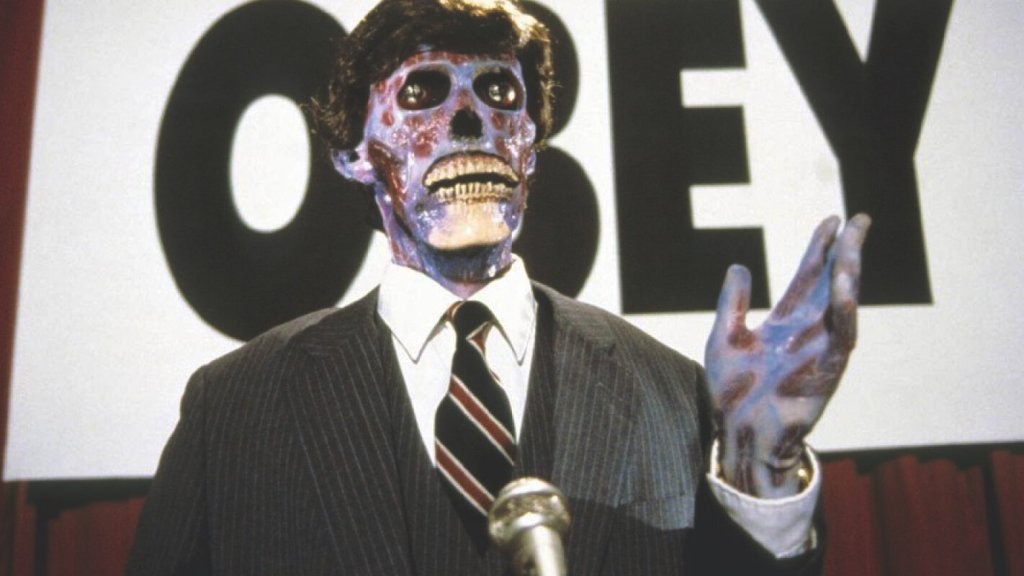
This is the premise of John Carpenter’s film They Live, which was released thirty-five years ago and remains unnervingly, chillingly appropriate for our modern age.

Best known for his horror film Halloween, which assumes that there is a form of evil so dark that it can’t be killed, Carpenter’s larger body of work is infused with a strong anti-authoritarian, anti-establishment, laconic bent that speaks to the filmmaker’s concerns about the unraveling of our society, particularly our government.

Time and again, Carpenter portrays the government working against its own citizens, a populace out of touch with reality, technology run amok, and a future more horrific than any horror film.

In Escape from New York, Carpenter presents fascism as the future of America.

In The Thing, a remake of the 1951 sci-fi classic of the same name, Carpenter presupposes that increasingly we are all becoming dehumanized.

In Christine, the film adaptation of Stephen King’s novel about a demon-possessed car, technology exhibits a will and consciousness of its own and goes on a murderous rampage.

In In the Mouth of Madness, Carpenter notes that evil grows when people lose “the ability to know the difference between reality and fantasy.”

And then there is Carpenter’s They Live, in which two migrant workers discover that the world is not as it seems. In fact, the population is actually being controlled and exploited by aliens working in partnership with an oligarchic elite. All the while, the populace—blissfully unaware of the real agenda at work in their lives—has been lulled into complacency, indoctrinated into compliance, bombarded with media distractions, and hypnotized by subliminal messages beamed out of television and various electronic devices, billboards and the like.

It is only when homeless drifter John Nada (played to the hilt by the late Roddy Piper) discovers a pair of doctored sunglasses—Hoffman lenses—that Nada sees what lies beneath the elite’s fabricated reality: control and bondage.

When viewed through the lens of truth, the elite, who appear human until stripped of their disguises, are shown to be monsters who have enslaved the citizenry in order to prey on them.

Likewise, billboards blare out hidden, authoritative messages: a bikini-clad woman in one ad is actually ordering viewers to “MARRY AND REPRODUCE.” Magazine racks scream “CONSUME” and “OBEY.” A wad of dollar bills in a vendor’s hand proclaims, “THIS IS YOUR GOD.”

When viewed through Nada’s Hoffman lenses, some of the other hidden messages being drummed into the people’s subconscious include: NO INDEPENDENT THOUGHT, CONFORM, SUBMIT, STAY ASLEEP, BUY, WATCH TV, NO IMAGINATION, and DO NOT QUESTION AUTHORITY.

This indoctrination campaign engineered by the elite in They Live is painfully familiar to anyone who has studied the decline of American culture.

A citizenry that does not think for themselves, obeys without question, is submissive, does not challenge authority, does not think outside the box, and is content to sit back and be entertained is a citizenry that can be easily controlled.

In this way, the subtle message of They Live provides an apt analogy of our own distorted vision of life in the American police state, what philosopher Slavoj Žižek refers to as dictatorship in democracy, “the invisible order which sustains your apparent freedom.”

Tune out the government’s attempts to distract, divert and befuddle us and tune into what’s really going on in this country, and you’ll run headlong into an unmistakable, unpalatable truth: what we are dealing with today is an authoritarian beast that has outgrown its chains and will not be restrained.

We’re being fed a series of carefully contrived fictions that bear no resemblance to reality.

Despite the fact that we are 17,600 times more likely to die from heart disease than from a terrorist attack; 11,000 times more likely to die from an airplane accident than from a terrorist plot involving an airplane; 1,048 times more likely to die from a car accident than a terrorist attack, and 8 times more likely to be killed by a police officer than by a terrorist , we have handed over control of our lives to government officials who treat us as a means to an end—the source of money and power.

As the Bearded Man in They Live warns, “They are dismantling the sleeping middle class. More and more people are becoming poor. We are their cattle. We are being bred for slavery.”

We have bought into the illusion and refused to grasp the truth.

From the moment we are born until we die, we are indoctrinated into believing that those who rule us do it for our own good. The truth is far different.

The powers-that-be want us to feel threatened by forces beyond our control (terrorists, pandemics, mass shootings, etc.).

They want us afraid and dependent on the government and its militarized armies for our safety and well-being.

They want us distrustful of each other, divided by our prejudices, and at each other’s throats.

We are little more than expendable resources to be used, abused and discarded.

In fact, a study conducted by Princeton and Northwestern University concluded that the U.S. government does not represent the majority of American citizens. Instead, the study found that the government is ruled by the rich and powerful, or the so-called “economic elite.” Moreover, the researchers concluded that policies enacted by this governmental elite nearly always favor special interests and lobbying groups.

In other words, we are being ruled by an oligarchy disguised as a democracy, and arguably on our way towards fascism—a form of government where private corporate interests rule, money calls the shots, and the people are seen as mere subjects to be controlled.

Rest assured that when and if fascism finally takes hold in America, the basic forms of government will remain: Fascism will appear to be friendly. The legislators will be in session. There will be elections, and the news media will continue to cover the entertainment and political trivia. Consent of the governed, however, will no longer apply. Actual control will have finally passed to the oligarchic elite controlling the government behind the scenes.

Sound familiar?

Clearly, we are now ruled by an oligarchic elite of governmental and corporate interests.

We have moved into “corporatism” (favored by Benito Mussolini), which is a halfway point on the road to full-blown fascism.

Corporatism is where the few moneyed interests—not elected by the citizenry—rule over the many. In this way, it is not a democracy or a republican form of government, which is what the American government was established to be. It is a top-down form of government and one which has a terrifying history typified by the developments that occurred in totalitarian regimes of the past: police states where everyone is watched and spied on, rounded up for minor infractions by government agents, placed under police control, and placed in detention (a.k.a. concentration) camps.

For the final hammer of fascism to fall, it will require the most crucial ingredient: the majority of the people will have to agree that it’s not only expedient but necessary.

But why would a people agree to such an oppressive regime?

The answer is the same in every age: fear.

Fear makes people stupid.

Fear is the method most often used by politicians to increase the power of government. And, as most social commentators recognize, an atmosphere of fear permeates modern America: fear of terrorism, fear of the police, fear of our neighbors and so on.

The propaganda of fear has been used quite effectively by those who want to gain control, and it is transforming the populace into fearful, compliant, pacified zombies content to march in lockstep with the government’s dictates.

This brings me back to They Live, in which the real zombies are not the aliens calling the shots but the populace who are content to remain controlled.

When all is said and done, the world of They Live is not so different from our own. As one of the characters points out, “The poor and the underclass are growing. Racial justice and human rights are nonexistent. They have created a repressive society, and we are their unwitting accomplices. Their intention to rule rests with the annihilation of consciousness. We have been lulled into a trance. They have made us indifferent to ourselves, to others. We are focused only on our own gain.”

We, too, are focused only on our own pleasures, prejudices and gains. Our poor and underclasses are also growing. Injustice is growing. Inequality is growing. A concern for human rights is nearly nonexistent. We too have been lulled into a trance, indifferent to others.

Oblivious to what lies ahead, we’ve been manipulated into believing that if we continue to consume, obey, and have faith, things will work out. But that’s never been true of emerging regimes. And by the time we feel the hammer coming down upon us, it will be too late.

So where does that leave us?

The characters who populate Carpenter’s films provide some insight.

Underneath their machismo, they still believe in the ideals of liberty and equal opportunity. Their beliefs place them in constant opposition with the law and the establishment, but they are nonetheless freedom fighters.

When, for example, John Nada destroys the alien hypno-transmitter in They Live, he delivers a wake-up call for freedom. As Nada memorably declares, “I have come here to chew bubblegum and kick ass. And I’m all out of bubblegum.”

In other words: we need to get active and take a stand for what’s really important.

Stop allowing yourselves to be easily distracted by pointless political spectacles and pay attention to what’s really going on in the country.

As I make clear in my book Battlefield America: The War on the American People and in its fictional counterpart The Erik Blair Diaries, the real battle for control of this nation is taking place on roadsides, in police cars, on witness stands, over phone lines, in government offices, in corporate offices, in public school hallways and classrooms, in parks and city council meetings, and in towns and cities across this country.

All the trappings of the American police state are now in plain sight.

Wake up, America.

If they live (the tyrants, the oppressors, the invaders, the overlords), it is only because “we the people” sleep.

Warning : Reality Is Escaping Out The Back Door

By Patrick Wood

Source: Technocracy News & Trends

There’s a big word that you can add to your vocabulary: Simulacrum. It is a hard word to wrap your head around, but one you are not too likely to forget. Indeed, you should not forget it!

Collins defines it as: “1) an image; likeness; 2) a vague representation; semblance; 3) a mere pretense; sham.”

Cambridge Dictionary says: “something that looks like or represents something else”.

Purdue University put it this way: “Something that replaces reality with its representation.”

Jean Baudrillard wrote about this in a 1981 paper called “The Precession of Simulacra”, where he digs deeper, making a distinction between a simulation and a simulacrum.

Whereas representation attempts to absorb simulation by interpreting it as a false representation, simulation envelops the whole edifice of representation itself as a simulacrum. Such would be the successive phases of the image:

it is the reflection of a profound reality;

it masks and denatures a profound reality;

it masks the absence of a profound reality;

it has no relation to any reality whatsoever;

it is its own pure simulacrum.

So, the switch for reality is anti-reality: “The simulacrum is never what hides the truth – it is truth that hides the fact that there is none.”

This whole process does not happen in a vacuum because it involves human agency. Reality exists but human perception distorts it.

Just for review, reality slips into distortion, then into simulation, then finds its resting place in a state of simulacrum. Reality is subsumed by the simulacrum.

An example of simulacrum in the making

It is estimated that 90 percent of all online content will be generated by AI by 2025. This means news, social media posts, chats, pictures, videos, podcasts, websites, etc. A deluge of fake social media accounts will be run by AI. In short, everything.

Nina Schick, A.I. thought leader, wrote,

“What generative AI can do, essentially, is create new things that would have thus far been seen as unique to human intelligence or creativity, Generative AI can create across all media, so text, video, audio, pictures – every digital medium can be powered by generative AI. So, I think these valuations that you’re seeing for OpenAI are actually going to go up and you’re going to start to see even more generative AI companies which have universal applications across many industries in 2023.”

People will remember back to 2023 images and think that nothing has changed in 2025.

Warning : The Total Collapse Of Reality Could Be At Hand

As described above, a simulacrum is anti-reality.

This is not a paradigm shift of reality. This is not a “new realty”. This is not reality, period. Unfortunately, billions of people risk being captured by it.

While everyone is looking at shiny new simulacra forming right before their eyes, reality is escaping out the back door.