Jiddu Krishnamurti, the Inner Revolution, and Why We Don’t Really Love Our Children

(Editor’s note: on this anniversary of the birthday of Jiddu Krishnamurti [born May 11, 1895] please read and share this excellent overview of some of the key principles of his philosophy.)

By Matt Karamazov

Source: High Existence

“The mind must be utterly silent. Not asking, not hoping for experience. It must be completely still. Only then is there a possibility of that light which will dispel our darkness.”

— Jiddu Krishnamurti

IS FUNDAMENTAL CHANGE POSSIBLE?

In a collection of talks given throughout the 1950’s and gathered together in the book, The Revolution From Within, Jiddu Krishnamurti stressed the urgency of staging a revolution in our thinking.

Our habitual ways of thinking have led us to where we are now, he says, and nothing less than radical, fundamental change has any hope of remaking our thoughts, attitudes, and ultimately the societies in which we live. Anything less than fundamental change is a mere modification of what has come before, and key aspects of what has come before has in turn failed a large proportion of our population.

The paradox that Krishnamurti relentlessly demands us to consider, however, is that nothing we can DO can bring about this change. We can only observe the operations of our own mind, and ask questions about everything that we think we know.

Consider the question, “Is fundamental change possible?”, the jumping-off point leading to the multitudinous questions that Krishnamurti is asking us to examine deeply.

It’s where we have to begin if we want to observe the functioning of our own minds on a level that will have real significance with respect to the outside world, and how we live our lives.

So let’s go into this question, friends, with an open mind, a mind that is open to revelation.

If we go into it with the idea that we already know the answer, then we won’t turn up anything worthwhile. This is a question with real consequences for the way we organize our societies, parent our children, and direct our lives.

We must pursue the idea of fundamental change in the same way that Jiddu Krishnamurti relentlessly posed questions to his listeners.

You’ll notice, if you read the transcripts of some of his greatest talks, that Krishnamurti asks multiple questions for every single ‘answer’ that he gives. He might answer one, only to pose three others that each attempt to get at the original question in a more nuanced way.

Krishnamurti does this because life’s biggest questions have no final answers.

Given the asymptotic nature of perfect Truth, we can only approach it by negation; by discarding what isn’t true or helpful, in an effort to move past our conditioned thinking and to achieve radical, fundamental change.

But is such a change indeed possible?

This is something that must be gone into, and not just accepted because someone has said it. It has no meaning if you just merely accept it. Arguments from authority, that common logical fallacy, have no essential relationship to perfect Truth.

Truth needs no defenders or justification.

Rather, you must ceaselessly question what you think you know, and approach life’s biggest questions from the viewpoint of someone who knows nothing. And it really is clear that we do know nothing, in an absolute sense, as we will discuss later in more depth.

If I were to ask you who you are, where you came from, where you’ll ultimately end up, and where you are right now, you would have no satisfactory answers to any of these questions. There would always be a deeper level of Truth that you could never penetrate with your limited, conscious mind.

So let’s start from the beginning…

WHAT IS FUNDAMENTAL CHANGE?

What exactly is it that we can point to as evidence that a revolution in the mind has taken place that is not simply a modification of what was there before?

It’s clear that anything that can be incrementally added  is not fundamental change. It’s a modification, and it’s improvement, but it is not the fundamental change that we are seeking.

This “adding to” the mind, such as one can achieve by reading books or watching documentaries or listening to talks is simply an incremental increase of knowledge. No matter how compelling or insightful, this newfound knowledge will always be an addition to what was there before.

While learning is important, and proper education is never a waste of time, it’s merely representative of change on the surface, and change on the surface can never lead to radical, fundamental change. What we’re really after is meaningful change.

What kind of change IS meaningful? Is only fundamental change meaningful? How do we get closer to understanding what it might look like?

Let’s first take a look at a few examples of surface change, or simple modifications, in order to get an idea of what radical change is NOT. Thereby, we can approach the idea of fundamental change via negation.

For example:

If you are unhappy, and you are trying to BECOME happy, then you have instantaneously DEFINED YOURSELF as an unhappy person struggling to overcome his or her unhappiness.

You can become MORE happy, sure, but you will always be an unhappy person, always in the process of becoming slightly more happy, adding to your happiness, instead of experiencing the radical, fundamental change that brings with it a revolution in the mind.

Happiness will always be somewhere ‘over there’ and you will always be struggling to arrive there.

That can never be said to be true happiness and fulfillment, and it is certainly not what we mean by fundamental change.

In the same way, trying to become virtuous, we never acquire virtue, but rather expand our Self in the ‘guise’ of virtue.

Simply, a man who cultivates virtue ceases to be completely virtuous, because there is a part of him that is not, a part of him that is increasing his virtue. Likewise, a man who practices humility is no longer completely humble.

And further:

When violent, the mind has an ideal of non-violence which is ‘over there’ in the distance. It will take time to achieve that state, and in the meantime, the mind can continue to be violent.

This, too, is not the radical, fundamental change which we are seeking to illuminate.

So now that we know what fundamental change is not, do we know any more about what it is?

Is it not instantaneous, unconditional freedom in the here and now? Is it not timeless, in that we don’t have to wait for it to appear?

Are there any preconditions that have to be met?

I think that we can conclude, provisionally, that we have the freedom to drop our resentments and sadness at any time we so choose.

Easy for me to type, extremely difficult for you to do. I get that.

But from our current position, we can see that it is our mind, this thing that we call the self, that is preventing fundamental change from occurring. As we get further into our discussion, we’ll have a better handle on whether or not we can discard the restraints of the self, and realize radical, fundamental change.

THE NECESSITY OF FUNDAMENTAL CHANGE

Assuming that we can become radically different than we are today, we must ask ourselves:

Is this a pursuit that’s worthwhile?

Is it necessary?

Do we need to change at all?

I think it would be obvious to many people that we DO need to see fundamental change in our societies and our patterns of social interaction.

A world in which billions of people currently live on less than $2.00/day is crying out for change.

And to be clear, that figure is, shockingly, adjusted for purchasing power. It’s not what $2.00 would buy you in a developing country, although that would be bad enough; rather, billions of people are living on what you could buy for $2.00 a day in a country like Canada or the US.

Aside: There is commendable, although insufficient, progress being made by extremely committed individuals and organizations all over the world. In fact, the World Bank recently predicted that global extreme poverty will soon fall to under 10%. To make matters more complicated, there is an ongoing debate concerning what exactly constitutes “extreme poverty.”

To say that fundamental change isn’t necessary in a world like ours is akin to being in a sinking ship and saying: “I’m sure glad the hole isn’t in OUR end!”

However, we can state rather confidently that trying to change society, while leaving the individuals who constitute that society unchanged, is a dangerous error.

Simply put, we cannot afford to be “ordinary” any longer; the challenge of the world is too great.

We are the world; we are not on the sidelines. What we are, of that we make the world, and everywhere we face real problems that demand our urgent attention.

Thus, we return to the question at hand: Is fundamental change necessary?

I think it’s clear that it is necessary, if by fundamental change within our societies we mean implementing societal structures that would do better in meeting the needs of all our world’s inhabitants.

Obviously, this is a vastly more complex problem than it even may seem at first. It has many moving parts, but we can only begin where we are. A total revolution of the mind has to start from within. Society is comprised of individuals, and radical societal change starts at the level of the individual.

Yet, most of us are so eager to reform others and so little concerned with the transformation of ourselves.

Can we not see that this whole attitude is very confused?

We often look up to those who can help us or who can do something for us, and look down on those who cannot. So we are always looking up or looking down. Cannot the mind be free from this state of contempt and false respect?

Is it even possible to look through the lens of our own confusion and get a clear picture of the idea of radical, fundamental change?

It is to this question that we now turn.

WE ARE ALL CONFUSED

“There is a path to the known, but not to the unknowable. Thus every system of finding truth breaks down.”

— Jiddu Krishnamurti

Before going further in our discussion, I think it’s helpful to take a look at our own confusion when confronted with the problem and necessity of fundamental change.

We’ve asserted that it’s both possible and necessary, but what are the impediments to action? Why are we not all enlightened already? If it’s supposed to be instantaneous, why is it so difficult for us?

The answer has to lie somewhere within our own confusion.

It’s very difficult to admit to yourself that you are confused, but clearly, we are all confused.

And, truth be told, those who say they aren’t confused, are the most confused of all.

In order to be free from confusion, we would have to know that which it is impossible to know. We’d need to know where the universe in its totality is headed, we’d need to know our precise place within it, who we are fundamentally, and what we need to do with our lives.

Philosophers are good at coming up with “-isms” that seek to explain the world and its direction. We can look for answers in logical positivism, consequentialism, possibilianism, dialectical materialism, populism, liberalism, empiricism, and every other kind of ‘-ism’ that we can conceive of, but we are still going to remain confused. Every book and every teacher is only going to add to this confusion that prevents us from knowing what life is all about.

It may be that we do not know what living is about at all, and that is why death seems to be such a terrible thing. Obviously, everyone is confused about death, and many more things besides.

The whole totality of the mind is confused, and there simply isn’t a higher part of the mind which isn’t.

So how are we supposed to make sense out of all this confusion?

Is it possible to bring clarity to our naturally disordered minds?

Is there a method we can follow, or a path we can take towards clarity?

Krishnamurti explains that whenever one is confused, one must stop all activity, psychologically. Otherwise, anything new is just translated according to our own confusion.

If I’m confused, then I may read, or look, or ask, but my search, my asking, is the outcome of my confusion, and therefore it can only lead to further confusion.

We know this, but is there anything we can do about it?

The problem is not the real issue; rather, it is the mind which approaches the problem.

So, again we return to the necessity of radical, fundamental change.

We can’t keep incrementally increasing our store of knowledge and, at some distant point, realize fundamental change. So we have to drop down to the level of the mind, and see if we can’t somehow bypass the problem of incremental change altogether.

So, you see how our desire for the resolution of our confusion can never lead to fundamental change.

All solutions are based on desire, and the problem exists BECAUSE of desire.

Basically, thought is not the way out. All of our thought is conditioned, and a confused mind cannot resolve its own confusion.

You have chosen your political leaders, your religious leaders, out of your confusion.

You have chosen your career, your friends, your daily activities out of your confusion.

The books you’ve read, the experiences you’ve had, the lessons you’ve learned, have all been assimilated according to the confusion that already exists in your mind.

Collectively, we’ve established our social order based on our confusion. Our efforts to help the poor are based on our confusion. Our educational institutions are based on our confusion.

We don’t even know what we don’t know.

But…

When you realize that you don’t know, then you are beginning to find out.

THE FUTILITY OF SEEKING

“If we take this journey together, and simply observe as we go along the extraordinary width and depth and beauty of life, then out of this observation may come a love…which is a state of being free of all demand…and we may perhaps be awakened to something far more significant than the boredom and frustration, the emptiness and despair of our daily lives.”

— Jiddu Krishnamurti

How do we escape our confusion?

How can we even tell when we’re not confused any more?

Is there an end to our confusion while we are still alive?

Krishnamurti’s prescription is as follows:

“Observe the activities of the mind without trying to change them or put a stop to them, because the moment you seek an end, you are back in the ‘me, not-me’ duality.

It’s the mind that is unaware of its own activities that sets up as the authority someone or something external to which we go for help, and we therefore become slaves.”

He is saying that we can bring about a transformation in ourselves only when we understand the process of our own thinking.

What is important is to understand the whole field of thought, and see if the mind can go beyond all that.

He asks, “Is thought somehow different than the mind?”

This in turn leads us to the question of, “What is the ‘self’, the center of the ‘me’ from which all activity seems to spring?”

The self for most people is a center of desires, manifesting itself through various forms of continuity.

We ceaselessly desire to perpetuate ourselves, to satisfy our cravings, and to set ourselves up as an object of specialness in a world of meaning.

None of these desires are permanent except in the memory of what we have been and would like to be, although we try to make them permanent through clinging to various ideas, perceptions, and relationships.

For those who want more, more, more, life is an everlasting struggle.

Life is one thing, and what we want is another. We get what we want, only to discover that it’s not ultimately what we wanted at all. We wanted some other thing, tantalizingly just a little further up the road.

Can we live in this world without any effort to be or become something, without trying to achieve, to reject, to acquire?

I mean, of course, without trying to become something other than your authentic self?

Can the mind cease to think in terms of continuing, of the “me”?

The concern to become something more, to become something others want you to be, is the constant preoccupation of the mind and the primary cause of its superficiality.

That much is clear. Which leads Krishnamurti to say:

“It is my mind that creates the problem, my mind being the result of time, of memory, the seat of the ‘me’, which is everlastingly craving for the ‘more’, for immortality, for continuity, for permanency here and in the hereafter. It is this uncertainty within ourselves that leads to the outward manifestations of personal ambition, the desire to be somebody, the aggressive attitude towards life.”

What we are, of that we make the world. So in order to avoid superficiality and meaninglessness, there must be ceaseless questioning.

Any conscious effort on my part to become something other than what I am, or other than what I consciously want to become, only produces still further suffering, sorrow, and pain.

A man like Jiddu Krishnamurti would never tell his listeners that education was a waste of time. However, we must never believe that our education is over, or that we have somehow reached the end of our confusion.

Everything around us tells us what to think, books and teachers included, and we must continually renew our freedom from traditional and historical thinking in every moment.

Linear thinking and the all-too-human propensity to settle for easy answers has failed the bottom 40%. It even plagues those in the so-called ‘developed’ nations who are today stricken by existential anxiety.

At bottom, acquisitiveness and greed have destroyed our potential for gratitude.

Nationalism and eschatological certitude have crippled our capacity for understanding and reconciliation.

A radical, fundamental revolution from within can restore the unrestrained lust for life that gives us our reason for being. We can revive our capacity to greedily enjoy our friends, instead of our possessions.

But so long as there is the idea of the “me” or the “I”, then there must necessarily be loneliness.

And you can’t seek the immeasurable because you don’t know what it is; hence the futility of seeking.

But, can we give up seeking? Just like that?

Can we overcome our self-directed focus and do what is just and fair? Can we live with uprightness in a world often bereft of such character?

Or, even more basically, can we love our children?

JIDDU KRISHNAMURTI SAYS WE DON’T REALLY LOVE OUR CHILDREN

“If we did love our children, we would stop all wars tomorrow, obviously. We would not condition our children. They would not be English children or American children, they would just be children.”

— Jiddu Krishnamurti

If you have been following what has been discussed so far, you will see that fundamental change is absolutely critical to the dissolution of the threats to our continued existence.

Violence and suffering on a global scale can be reduced to the individual. It is the mind of the individual that approaches the problem that needs to change, and the world is made up of individuals.

Society is based on violence and comparisons, and as long as it is so, there will always be struggle within that society, not to mention all the struggles, pains, and difficulties that naturally accompany human existence. That is what Krishnamurti is driving at here.

Everything that we do is based on striving, ambition, success, achievement; but none of it is the abandonment of the self.

Granting that everyone is doing the best that they can, the best that they know how to do, how can it be otherwise that our toxic thoughts and undisciplined habits are being passed down to our children?

Our own confusion, with which we are now hopefully becoming intimately aware, cascades downward to future generations.

Parents want their children to conform to meet the demands of their insane societies, but is that education?

Since our society is not yet what it should be, why encourage our children to stay within its destructive pattern?

We are currently dependent on this pattern, but can we live without this dependence?

The insistence on one’s nationality, on race, on religious belief or any other idea, obviously separates. All of it represents the activities of the self, and its insistence on continuity and self-perpetuation. That much is clear.

We submit to authority because all of us have this inward demand to be safe, to feel secure. We have enough to think about with respect to our survival and to the “success” of our children, that we can easily settle into the acceptance of easy answers handed down to us from above. Whether that means from the state or from some religious authority.

This safety, so it seems to many, must be defended at all costs, because we have so much invested in it.

So much of our identities and our feelings of assurance of our continued survival rest on the perceived strengths of our existing institutions.

It’s here that Krishnamurti steps in with the bold and incendiary claim that we don’t really love our children.

You don’t really love your children, he says, so you sacrifice them to protect your property, to defend your State, or the church, or some other organization which demands of you certain things.

Organized religions don’t really insist that you step out of greed, envy, ruthless ambition, and cruelty. They are far more concerned with what you believe, with rituals and the rest of the confusion.

In contrast, righteousness of behavior is not something to be gained, to be arrived at, but must be understood from moment to moment in the actuality of daily living.

It requires a fundamental change in our approach to life, and constant awareness of how our actions impact others.

Krishnamurti’s own phrasing is as such:

“The man who is ceaselessly questioning, who has no authority, who does not follow any tradition, any book or teacher, becomes a light unto himself.”

Perhaps it’s radical, fundamental change that’s required to shake us out of our collective stupor and restore to us our humanity.

THE REVOLUTION

“Sirs, life is something extraordinary, if you observe it. Life is not merely this stupid little quarreling among ourselves, this dividing up of mankind into nations, races, classes; it is not just the contradiction and misery of our daily existence. Life is wide, limitless, it is that state of love which is beauty; life is sorrow and this tremendous sense of joy. But our joys and sorrows are so small, and from that shallowness of mind we ask questions and find answers.”

— Jiddu Krishnamurti

If there can be any conclusion at all, it’s that freedom is not at the end; it is at the very beginning, the now.

The end is at the beginning, which lies outside of time.

Radical, fundamental change does not come at the end. Rather, it’s our starting point. If we’re not happy now, then we never will be. If we don’t remake our societies now, then we never will.

Fundamental change doesn’t occur across time, but rather it is available to us at every moment.

Revolutions of the mind occur instantaneously, at the very moment when we cease our anguished searching.

And that is what our lives often are, correct?

We say: “I am ‘this’, and I would like to be ‘that,’” but the struggle to be something different is still within the pattern of our desire.

All suffering comes from desire, and so any incremental change that we pursue throughout our lives is not only going to be fraught with confusion, but will carry with it all the attendant suffering and anguish which it necessarily implies.

So where can we find relief for this condition of the mind?

Where can we go for some form of final answer to our continued searching and relentless questioning?

In the end, we must realize that life’s biggest questions have no definite answers. Indeed, the right question has no answer.

We must also conclude that a mind that seeks peace will never find it, and thought is not the way out.

When you see that fundamental change is instantaneous, and is a function of observing the workings of your own mind, you can break free of your past at any moment, and start to unravel your own conditioning.

It’s simple: The mind can never free itself through some system or method. Anything that your mind DOES can never bring about this kind of radical, fundamental change that we are discussing.

Anything that can be KNOWN is not what we’re looking for.

All that can be left to us is to observe the functioning of our own minds.

When we realize this, we also realize the truth of Krishnamurti’s words when he says:

“To have that inward fullness of life, which includes death, the mind must free itself from the known. The known must cease for the unknown to be.”

When you don’t know what it is that you’re looking for, and you don’t know what it’ll look like when you find it, all that remains to you is to examine the operations of your own mind.

Naturally, this leads to the falling away of every answer that has been and could be given concerning happiness and fulfillment, and concerning how we should govern our societies.

Since we see that the ideas of happiness and fulfillment are constantly changing, we must ask ourselves if there really is such a thing.

We’ve been discussing the necessity and possibility of fundamental change for some time now, and if you have been following the logical progression of our discussion, you can see that observing the function and operation of your own mind without judgement is the only way out of our collective confusion.

I can also assume that you WANT to love your children, that you WANT to overcome the destructive patterns of society, and that you WANT to affirm the meaningfulness of daily life.

So what’s stopping you?

What’s holding you back from experiencing this revolution of the mind?

In the final analysis, there is nothing to do, and nothing to attain.

“When you realize there is nothing lacking, the whole world belongs to you”

— Lao Tzu

There is no set of rules or precepts that you are required to follow, nothing that you are being asked to believe.

Rather, fundamental change is ready and waiting.

What are YOUR answers to these questions that we have been discussing? How will they impact you on the concrete level of your daily existence? Will you change?

If you don’t change now, then you never will.

All the best,

Matt Karamazov


The Government Is Still the Enemy of Freedom

By John W. Whitehead

Source: The Rutherford Institute

“Rights aren’t rights if someone can take them away. They’re privileges. That’s all we’ve ever had in this country, is a bill of temporary privileges. And if you read the news even badly, you know that every year the list gets shorter and shorter. Sooner or later, the people in this country are gonna realize the government … doesn’t care about you, or your children, or your rights, or your welfare or your safety… It’s interested in its own power. That’s the only thing. Keeping it and expanding it wherever possible.”— George Carlin

My friends, we’re being played for fools.

On paper, we may be technically free.

In reality, however, we are only as free as a government official may allow.

We only think we live in a constitutional republic, governed by just laws created for our benefit.

Truth be told, we live in a dictatorship disguised as a democracy where all that we own, all that we earn, all that we say and do—our very lives—depends on the benevolence of government agents and corporate shareholders for whom profit and power will always trump principle. And now the government is litigating and legislating its way into a new framework where the dictates of petty bureaucrats carry greater weight than the inalienable rights of the citizenry.

We’re in trouble, folks.

Freedom no longer means what it once did.

This holds true whether you’re talking about the right to criticize the government in word or deed, the right to be free from government surveillance, the right to not have your person or your property subjected to warrantless searches by government agents, the right to due process, the right to be safe from soldiers invading your home, the right to be innocent until proven guilty and every other right that once reinforced the founders’ belief that this would be “a government of the people, by the people and for the people.”

Not only do we no longer have dominion over our bodies, our families, our property and our lives, but the government continues to chip away at what few rights we still have to speak freely and think for ourselves.

If the government can control speech, it can control thought and, in turn, it can control the minds of the citizenry.

The unspoken freedom enshrined in the First Amendment is the right to think freely and openly debate issues without being muzzled or treated like a criminal.

In other words, if we no longer have the right to tell a Census Worker to get off our property, if we no longer have the right to tell a police officer to get a search warrant before they dare to walk through our door, if we no longer have the right to stand in front of the Supreme Court wearing a protest sign or approach an elected representative to share our views, if we no longer have the right to protest unjust laws by voicing our opinions in public or on our clothing or before a legislative body—no matter how misogynistic, hateful, prejudiced, intolerant, misguided or politically incorrect they might be—then we do not have free speech.

What we have instead is regulated, controlled speech, and that’s a whole other ballgame.

Protest laws, free speech zones, bubble zones, trespass zones, anti-bullying legislation, zero tolerance policies, hate crime laws and a host of other legalistic maladies dreamed up by politicians and prosecutors are conspiring to corrode our core freedoms purportedly for our own good.

For instance, the protest laws being introduced across the country—in 18 states so far—are supposedly in the name of “public safety and limiting economic damage.”

Don’t fall for it.

No matter how you package these laws, no matter how well-meaning they may sound, no matter how much you may disagree with the protesters or sympathize with the objects of the protest, these proposed laws are aimed at one thing only: discouraging dissent.

In Arizona, police would be permitted to seize the assets of anyone involved in a protest that at some point becomes violent.

In Minnesota, protesters would be forced to pay for the cost of having police on hand to “police” demonstrations.

Oregon lawmakers want to “require public community colleges and universities to expel any student convicted of participating in a violent riot.”

A proposed North Dakota law would give drivers the green light to “accidentally” run over protesters who are blocking a public roadway. Florida and Tennessee are entertaining similar laws.

Pushing back against what it refers to as “economic terrorism,” Washington wants to increase penalties for protesters who block access to highways and railways.

Anticipating protests over the Keystone Pipeline, South Dakota wants to apply the governor’s emergency response authority to potentially destructive protests, create new trespassing penalties and make it a crime to obstruct highways.

In Iowa, protesters who block highways with speeds posted above 55 mph could spend five years in prison, plus a fine of up to $7,500. Obstruct traffic in Mississippi and you could be facing a $10,000 fine and a five-year prison sentence.

A North Carolina law would make it a crime to heckle state officials. Under this law, shouting at a former governor would constitute a crime.

Indiana lawmakers wanted to authorize police to use “any means necessary” to breakup mass gatherings that block traffic. That legislation has since been amended to merely empower police to issue fines for such behavior.

Georgia is proposing harsh penalties and mandatory sentencing laws for those who obstruct public passages or throw bodily fluids on “public safety officers.”

Virginia wants to subject protesters who engage in an “unlawful assembly” after “having been lawfully warned to disperse” with up to a year of jail time and a fine of up to $2,500.

Missouri wants to make it illegal for anyone participating in an “unlawful assembly” to intentionally conceal “his or her identity by the means of a robe, mask, or other disguise.”

Colorado wants to lock up protesters for up to 18 months who obstruct or tamper with oil and gas equipment and charge them with up to $100,000 in fines.

Oklahoma wants to create a sliding scale for protesters whose actions impact or impede critical infrastructure. The penalties would range from $1,000 and six months in a county jail to $100,000 and up to 10 years in prison. And if you’re part of an organization, that fine goes as high as $1,000,000.

Michigan hopes to make it easier for courts to shut down “mass picketing” demonstrations and fine protesters who block entrances to businesses, private residences or roadways up to $1,000 a day. That fine jumps to $10,000 a day for unions or other organizing groups.

Ask yourself: if there are already laws on the books in all of the states that address criminal or illegal behavior such as blocking public roadways or trespassing on private property—because such laws are already on the books—then why does the government need to pass laws criminalizing activities that are already outlawed?

What’s really going on here?

No matter what the politicians might say, the government doesn’t care about our rights, our welfare or our safety.

How many times will we keep falling for the same tricks?

Every despotic measure used to control us and make us cower and fear and comply with the government’s dictates has been packaged as being for our benefit, while in truth benefiting only those who stand to profit, financially or otherwise, from the government’s transformation of the citizenry into a criminal class.

Remember, the Patriot Act didn’t make us safer. It simply turned American citizens into suspects and, in the process, gave rise to an entire industry—private and governmental—whose profit depends on its ability to undermine our Fourth Amendment rights.

Placing TSA agents in our nation’s airports didn’t make us safer. It simply subjected Americans to invasive groping, ogling and bodily searches by government agents. Now the TSA plans to subject travelers to even more “comprehensive” patdowns.

So, too, these protest laws are not about protecting the economy or private property or public roads. Rather, they are intended to muzzle discontent and discourage anyone from challenging government authority.

These laws are the shot across the bow.

They’re intended to send a strong message that in the American police state, you’re either a patriot who marches in lockstep with the government’s dictates or you’re a pariah, a suspect, a criminal, a troublemaker, a terrorist, a radical, a revolutionary.

Yet by muzzling the citizenry, by removing the constitutional steam valves that allow people to speak their minds, air their grievances and contribute to a larger dialogue that hopefully results in a more just world, the government is deliberately stirring the pot, creating a climate in which violence becomes inevitable.

When there is no steam valve—when there is no one to hear what the people have to say, because government representatives have removed themselves so far from their constituents—then frustration builds, anger grows and people become more volatile and desperate to force a conversation.

Then again, perhaps that was the government’s plan all along.

As John F. Kennedy warned in March 1962, “Those who make peaceful revolution impossible will make violent revolution inevitable.”

The government is making violent revolution inevitable.

How do you lock down a nation?

You sow discontent and fear among the populace. You terrorize the people into believing that radicalized foreigners are preparing to invade. You teach them to be non-thinkers who passively accept whatever is told them, whether it’s delivered by way of the corporate media or a government handler. You brainwash them into believing that everything the government does is for their good and anyone who opposes the government is an enemy. You acclimate them to a state of martial law, carried out by soldiers disguised as police officers but bearing the weapons of war. You polarize them so that they can never unite and stand united against the government. You create a climate in which silence is golden and those who speak up are shouted down. You spread propaganda and lies. You package the police state in the rhetoric of politicians.

And then, when and if the people finally wake up to the fact that the government is not and has never been their friend, when it’s too late for peaceful protests and violence is all that remains to them as a recourse against tyranny, you use all of the tools you’ve been so carefully amassing—the criminal databases and surveillance and identification systems and private prisons and protest laws—and you shut them down for good.

As I make clear in my book Battlefield America: The War on the American People, once a government assumes power—unconstitutional or not—it does not relinquish it. The militarized police are not going to stand down. The NSA will continue to collect electronic files on everything we do. More and more Americans are going to face jail time for offenses that prior generations did not concern themselves with.

The government—at all levels—could crack down on virtually anyone at any time.

Martin Luther King saw it coming: both the “spontaneous explosion of anger by various citizen groups” and the ensuing crackdown by the government.

“Police, national guard and other armed bodies are feverously preparing for repression,” King wrote shortly before he was assassinated. “They can be curbed not by unorganized resort to force…but only by a massive wave of militant nonviolence….It also may be the instrument of our national salvation.”

Militant nonviolent resistance.

“A nationwide nonviolent movement is very important,” King wrote. “We know from past experience that Congress and the President won’t do anything until you develop a movement around which people of goodwill can find a way to put pressure on them… This means making the movement powerful enough, dramatic enough, morally appealing enough, so that people of goodwill, the churches, laborers, liberals, intellectuals, students, poor people themselves begin to put pressure on congressmen to the point that they can no longer elude our demands.

“It must be militant, massive nonviolence,” King emphasized.

In other words, besides marches and protests, there would have to be civil disobedience. Civil disobedience forces the government to expend energy in many directions, especially if it is nonviolent, organized and is conducted on a massive scale. This is, as King knew, the only way to move the beast. It is the way to effect change without resorting to violence. And it is exactly what these protest laws are attempting to discourage

We are coming to a crossroads. Either we gather together now and attempt to restore freedom or all will be lost. As King cautioned, “everywhere, ‘time is winding up,’ in the words of one of our spirituals, corruption in the land, people take your stand; time is winding up.”


ABOUT JOHN W. WHITEHEAD

Constitutional attorney and author John W. Whitehead is founder and president of The Rutherford Institute. His new book Battlefield America: The War on the American People (SelectBooks, 2015) is available online at http://www.amazon.com. Whitehead can be contacted at johnw@rutherford.org.


How to get rid the bastards before they murder us all

march_of_tyranny

By Jack Balkwill

Source: Intrepid Report

If most Americans knew what was happening in our extremely corrupt government, there would be a bloody riot, and most of the Democrats and Republicans would be slaughtered with as little mercy as they’ve shown the American public.

Through their actions, Democrats and Republicans have caused the deaths of millions from unsafe products, unsafe workplaces, lack of minimal health care, unnecessary wars, and other malfeasance resulting from their serving the vile capitalists who finance their elections.

True, a fourth of the electorate vote Democrat, and another fourth Republican, because they see no other hope. Delusions of “lesser evils” lead them to line up, lambs to the slaughter, hoping that the stinking pile of dung for whom they vote will enable less horror than the other stinking pile of dung.

Half of the electorate routinely do not vote, understanding that, in our system, decent candidates are not allowed air time by the corporate-viewpoint media, nor allowed the mountains of cash given to the Democrats and Republicans with which to purchase additional media exposure for deceitful campaign ads.

If a candidate of the people did find a way to be recognized, he or she would not be allowed into the controlled debates. Ballot access is another way the establishment blocks democracy from breaking out in the Land of the Free. The ruling plutocratic oligarchs have pretty much covered all the bases to snuff out any hope for an iota of democracy.

In many of our elections, far more than half of eligible voters do not cast ballots. Propaganda control by mainstream media tell us this is because those who do not cast votes are satisfied, when anybody with an IQ higher than their shoe size knows it’s a lie. “Let’s see now,” these potential voters ponder, should I vote for the guy who’ll stick a knife in my left hand, or the one who will put an ice pick through my right foot?

I’ve watched for decade after decade as young people voted for “lesser evil” scum, saying they will do better next time. Next time they do the same thing. The system is evil itself, if anything is evil, encouraging the hopeless to vote for scumbags with the hope to stop other scumbags from winning.

It is a part of American capitalism, where everything of importance is controlled and nobody is supposed to notice that it only works for the capitalists—those few who control most of the capital. American capitalism is so badly broken that it requires the world’s largest prison system to make it barely chug along. It requires thousands dying for a lack of health care each year, higher numbers than in any industrialized nation. It requires the highest homelessness and hunger among major industrialized nations.

And the corporate media, fawning lap dogs that they are, never notice any of it. If a corporate-paid journalist did, they would soon find themselves to be among the unemployed. Capitalism loves unemployment because it draws down wages, allowing the capitalists to increase their profits, the only thing that works in capitalism. That is why our submissive government lies about unemployment figures constantly, always giving the numbers as half or less than half of the true misery index.

When people begin to minimally get jobs, the Federal Reserve raises interest rates to increase unemployment and maintain the wealth disparity. As the poor are wiped out by the millions, no billionaire is allowed to lose a penny in the rigged system.

The problem in doing something about it is that the doors have just about all been shut by corrupt laws. There are groups of voters who have more right to be upset than others, but they are locked out of the system to prevent an outbreak of democracy.

For example, in most states convicted felons are not allowed to vote, even though they have officially “paid for their crime.” These people are ripe for voting for a people’s party, and the establishment knows it, so bars them. Unemployed, they may have sold some pot to feed their kids, the only real shot there is for many at the bottom of an economy in which more illegal drugs are sold than in any other nation.

And I’ve tried for decades to change the law in Virginia so that homeless people can vote. Long ago I was feeding homeless people on the street, spooning out grits in freezing cold, watching people with ice around their faces crawl out from doorways where they slept and thinking, “What if I could bring registration forms, get them to sign up and encourage them to vote for the Greens?”

I even found a legislator, a Black woman named Mary Christian, to sponsor me to speak before the Constitution Committee of the House of Delegates, the oldest legislature in North America, and ask that they allow homeless people to vote. To make a long story short, I failed in that attempt.

Didn’t know that homeless people can’t vote? Check your state and you will probably find it’s near impossible there as well. In Virginia, if you are caught with a false address on your registration, you are subject to a year in jail and a $10,000 fine. If you are homeless, and you register as living in the building whose doorway you slept in last night, chances are you won’t be there the next night after a cop tells you to move along.

The establishment knows who could be trouble, and has already enacted laws to make democratic participation hell for millions of Americans.

Most Americans live in ignorance of almost anything of importance to them, knowing only the myths given to them by the corporate media. That is what makes it so difficult to organize them—their heads are filled with propaganda. “But if I don’t vote for Hitler, Satan will get in. . . .”

So, in my entire life of trying to find ways to disrupt the system and make it work for the people, I always come back to the one thing that holds promise, and that is to find a way to get information to the masses around the corporate-viewpoint media. It is that mainstream media which keeps the masses ignorant and in thrall.

I hate to agree with Donald Trump, but he’s right that the mainstream media is the enemy of the people. They have been all my 72 years, but it is getting worse.

Once there were big dreamers in our government who came up with National Public Radio and the Public Broadcasting System, which were a great idea. The idea was to allow opinions around the corporate media, so that the public could get a second opinion.

But good ideas soon hit a meat grinder in our system. The scum who run the country had their bought-and-paid-for politicians cut funding, forcing NPR and PBS to take more and more corporate money, until they became a clone of ABC, NBC, CBS, CNN, FOX, etc.

If we had one TV channel of our own, we could destroy the entire house of cards. Years ago I wrote about it and it appears we need a Social Justice Network more than ever today. The thing the establishment fears most is information and democracy, and a Social Justice Network could bring us both, by opening the eyes of the public to the scam that keeps a boot on their backs. Ignorant people are controlled people.


Jack Balkwill has been published from the little read Rectangle, magazine of the English Honor Society, to the (then) millions of readers USA Today and many progressive publications/web sites such as Z Magazine, In These Times, Counterpunch, This Can’t Be Happening, Intrepid Report, and Dissident Voice. He is author of “An Attack on the National Security State,” about peace activists in prison.

4 Ways to Throw a Monkey Wrench into the War Machine

By Gary ‘Z’ McGee

Source: Waking Times

“When a public is stressed and confused, a big lie told repeatedly and unchallenged can become accepted truth.” ~George Orwell

One of the biggest lies told is the false notion that in order to maintain peace, we must have war. Orwellian logic.

As ridiculous as it sounds, the majority of naïve statists believe this notion to be true. This is due, in no small part, to statist conditioning and state-driven propaganda that capitalizes on a blind, patriotic whimsy. And so the war machine continues to rage on, destroying lives, while fattening the pockets of the fat cats at Lockheed Martin and Boeing, not to mention all the other companies which directly and indirectly profit from war. It’s an all-too-common tragedy. But what can you expect when living within an oligarchic plutocracy disguised as a democratic republic? Rhetorical questions aside, there must be ways in which we can, as courageous individuals, throw a monkey wrench into the war machine and thus stop it in its violent tracks.

Here are four ways to do precisely that.

1. Teach Military Members to Disobey Immoral Orders

“The surest way to corrupt a youth is to instruct him to hold in higher esteem those who think alike than those who think differently.” ~Friedrich Nietzsche

The military chain of command is an antiquated system of leadership that is, unfortunately still in use today. It’s the epitome of a human centipede. Everything just rolls downhill. Like lemmings hell-bent on going over whatever cliff the “higher ranking” lemmings tell them to, the military chain of command is a blatant case of “the blind leading the blind.” Leadership is nothing more than ad hoc authoritarianism disguising a greedy race to the next rank or pay raise. They are not trained to be true leaders who think for themselves; they are brainwashed to be obedient followers that follow orders without question. The entire system is set upon blind obedience.

One way to toss a wrench into the war machine is to teach its members how to courageously and strategically disobey orders, especially immoral ones. Teach them how to put their foot down, how to be a real leader who leads by example, which may, at times, seem like a “bad” example according to the corrupt chain of command, but a “good” example according to health, sustainability, morality, justice, liberty, and truth. Teach them how to be self-empowered human beings first and military members second. Teach them how all things are relative to the observer, especially regarding truth and power. Like Nietzsche said, “All things are subject to interpretation; whichever interpretation prevails at a given time is a function of power and not truth.”

2. Question the Statist Chain of Obedience

“Our scientific power has outrun our spiritual power. We have guided missiles and misguided men.” ~Martin Luther King, Jr. 

In today’s day and age, wars exist because of disagreeable nation states, when they could probably be resolved by reasonable men. The problem is most men are made unreasonable by being unwitting, prideful statists with nationalism and patriotism muddying their logic. As Nietzsche said, “In individuals, insanity is rare; but in groups, parties, and epochs, it is the rule.”

In order not to get caught up in the insanity that ends up leading to war, we must, as individuals, question the state-driven chain of obedience being shoved down our throats by the system. The problem is too many people blindly obey, even at the expense of their own freedom and liberty. There’s too much apathy and indifference and not enough logic and reasoning. We’re a nation of misguided statists propagandized and brainwashed to no end. It’s time to upset the rotten-apple cart. It’s time to turn the tables on insanity. It’s time to put the horse of spiritual power (morality), back in front of the cart of scientific power (military). In short: It’s time to disobey.

3. Transform Statist Patriotism into Worldly Patriotism

“Every transformation demands as it’s pre-condition the ending of a world-the collapse of an old philosophy of life.” ~Carl Jung

Patriotism is a tricky thing. It pulls at our heartstrings. It tugs at our pride like puppet strings. And before we know it, we’re a blind patriot, knee-jerk reacting to the prideful boasts of other blind patriots. And suddenly we’re at war. But there is a way out of this unthinking emotional bias: redefine patriotism itself by becoming an interdependent worldly patriot instead of a codependent statist patriot. All it takes is a little imagination, a little logic and reasoning toward the way everything is connected. Then we rise above the statist condition, think outside the statist box, and embrace the world-as-self/self-as-world dynamic as our patriotic start.

Becoming a worldly patriot is perhaps the most effective way to toss a wrench into the war machine, because the war machine feeds upon the statist patriotic whimsy of the masses; but it chokes on a worldly patriotism, which understands – war anywhere, is a war against ourselves as an interdependent whole.

4. Become An Anti-War Warrior

“The most useful piece of learning for the uses of life is to unlearn what is untrue.” ~Antisthenes

An anti-war warrior has unlearned what is untrue, and has become an anti-war activist par excellence. Anti-war warriors are peaceful warriors who know when to go Tiananman Square on the war machine. They have made an art form out of civil disobedience, strategic and intelligent with their anti-war activism. When the war machine rears it’s ugly head, anti-war warriors know how to ninjaneer inside and outside the belly of the beast, using the pen just as mightily as the sword to strategically transform statist mindsets and dismantle the machine itself.

At the end of the day, the war machine is still a very real menace that cannot be ignored. We can no longer remain silent to the atrocities of the corrupt nation states that “govern” us. Their wicked war machines have been running rampant over our precious planet for far too long. It’s time we challenged it. It’s time we countered it with logic, reasoning, and thinking outside the statist box. We do this by disobeying all immoral orders passed down from both the chain of command and the chain of obedience. We do it by becoming worldly patriots and anti-war activists with the courage it takes to change the world.

“The greatest threat to our planet is the belief that someone else will save it.” -Unknown

Algorithmic Control and the Revolution of Desire

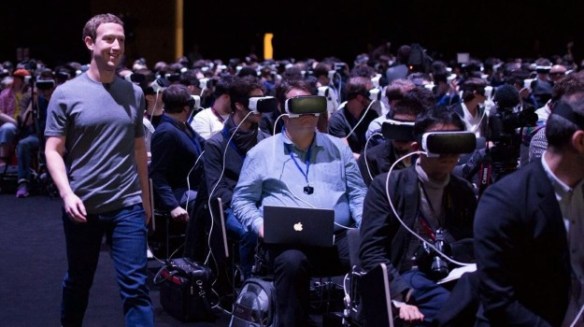
zuckerberg_VR_people-625x350

By Alfie Brown

Source: ROAR Magazine

Last year, Stanford University published a study confirming what many of us may long have suspected: that your computer can predict what you want with more accuracy than your spouse or your friends. Your digital footprint betrays the truth not only about what you “like” but about what you really like — or so the argument goes. But what if our digital footprints, besides revealing our desires, are also responsible for the very construction of these desires? If that were the case, we would need to display a far deeper level of suspicion towards the complex patterns of corporate and state control found in contemporary cyberspace.

There is little doubt that innovations in mobile technologies are part of emerging methodologies of social control. In particular, games and applications that make use of the Google Maps back-end system — including Uber, Grindr, Pokémon Go and hundreds of others — which should be seen as one of the most important technological developments of the last decade or so, are particularly complicit in these new regulatory practices. Putting the well-publicized data collection issue aside, such applications have two powerful ideological functions. First, they construct the new “geographical contours” of the city, regulating the paths we take and mapping the city in the service of both corporate interest and the prevention of uprisings. Second, and more unconsciously, they enact what Jean-Francois Lyotard once called the “desirevolution” — an evolution and revolution of desire, in which that what we want is itself now determined by the digital paths we tread.

The Psycho-Geographical Contours of the City 

In 1981, the French theorist Guy Debord famously wrote of the “psycho-geographical contours” of the city that govern the routes we take, even when we may feel we are wandering freely around the physical space. At that time, it was Debord’s topic — architecture — that was the dominant force in re-organizing our routes through the city. Today, however, that role is increasingly taken up by the mobile phone. It is Uber that dictates the path of your taxi, Maps that dictates the route of your walks and drives, and Pokémon Go that (for a summer at least) determined where the next crowd would gather.

Other similar map-based application programing interfaces, or APIs, dictate our jogging routes (MapMyRun), our recreational hikes (LiveTrekker) and our tourist activities (TripAdvisor Guides). Pokémon Go attracted some publicity because it accidentally and humorously gathered crowds in weird places, but this should only alert us to its potential ability to gather crowds in the right places (to serve corporate interest) or to prevent the gathering of crowds in the wrong ones (to prevent organized uprisings, for instance). Such applications should be seen as a testing phase in the project of Google and its affiliated corporations as they work out how best to regulate the movements of large populations via their phones. Pokémon Go players were the early cyborgs, complete with hiccups and malfunctions — a beta version of Google’s future human. These future humans will go where instructed.

On a smaller scale, this point can be seen in concrete terms with a case study of London. A recent Transport for London talk discussed the possibility of “gamifying” commuting. In order to facilitate this possibility, Transport for London have made the internet API and data streams used to monitor all London Transport vehicles open source and open access, in the hope that developers will build London-focused apps based around the public transport system, thus maximizing profit. One idea is that if a particular tube station is at risk of becoming clogged up due to other delays, TfL could give “in-game rewards” for people willing to use alternative routes and thus smooth out the jam.

While traffic jam prevention may not seem like evidence that we have arrived in the dystopia of total corporate and state control, it does actually reveal the dangerous potentiality in such technologies. It shows that the UK is not as far away from the “social credit” game system recently implemented in Beijing to rate each citizen’s trustworthiness and give them rewards for their dedication to the Chinese state. While the UK media reacted with shock to these innovations in Chinese app development, a closer look at the electronic structures of mapping and controlling our own movements shows that a similar framework is already in its development phase in London too. In the “smart city” of the future, it won’t just be traffic jams that are smoothed out. Any inefficient misuse or any occupation of public space deemed dangerous by the authorities can be specifically targeted.

The Corporate Surveillance State

When it comes to these developments in technology, state and corporate forces work more closely with each other than ever before — and much more closely than they are willing to admit. Srećko Horvat has pointed out the short distance between the creators of Pokémon Go and Hillary Clinton, despite her odd and unsolicited recent public claim that she didn’t know who made the game. Likewise, Julian Assange’s strangely under-discussed 2014 book When Google Met WikiLeaks showed the shocking proximity of Google chief Eric Schmidt and the Washington state apparatus. In terms of surveillance and the use of big data, it has become impossible to sustain the distinction between state control and the production of wealth, since the two have become so irrevocably intertwined. As such, old arguments that “it’s all just about money” need to be treated with greater suspicion, since major firms today are so closely tied to the state. Various aspects of state organization should likewise be considered equally suspect because of their corporate underpinnings.

Of course, when it comes to the mapping applications that promise to help us access the best quality objects of our desire with the greatest efficiency and the least cost, these tempting forces of joint corporate and state control are entered into willingly by participants. As such, they require something else in order to function in the all-consuming way that they do. Far from simply channeling and transforming our movements, they also need to channel and even transform our desires.

We are now firmly within the world of the electronic object, where the mediation of everything from lovers and friends to meals and activities via our mobile phones and computers makes it virtually impossible to separate physical from electronic objectivity. Whilst the electronic Pokémon or the “in-game rewards” offered by many applications may not yet have the physicality of a lover who can be accessed via Tinder, or a burger that can be located via JustEat, the burger and the lover certainly have the electronic objectivity of the Pokémon. We can therefore see a transformation in the objects of desire taking place by and through our devices, so that we are confronted not only with a change in how we get what we want, but with a change in what we want in the first place.

Italo Calvino once wrote of the “amorous relationship” that “erases the lines between our bodies and sopa de frijoles, huachinango a la vera cruzana, and enchiladas.” While in such a moment food and lover become one in a kind of orgy of physical consumption, in the same novel Calvino warned of a time “when the olfactory alphabet, which made them so many words in a precious lexicon, is forgotten,” and in which “perfumes will be left speechless, inarticulate, illegible.”

It is this world that we find ourselves desiring in, where an orgy of electronic objects with no olfactory physicality blurs the distinction between lovers, meals and “in-game” rewards. The purpose of this shift, of course, is to increase the power of technological corporations by giving them a new sort of control over the way we relate to our objects of desire. If the boundaries between the way we search, desire and acquire our burgers, lovers and Pikachus are dissolving, it is not so much the old point that everything has become a commodity, but a new point that this kind of substitutional electronic objectivity endows corporate and state technologists with unprecedented power to distribute and redistribute the objects of the desire around the “smart city.”

Data Centralization in China and the West

There is, moreover, a significant centralization of power underpinning these developments. Like the social credit idea, the Chinese phenomenon of WeChat — developed in 2011 by Tencent, one of the largest internet and mobile media companies in the world — has received concerned media coverage in the West. WeChat is the first truly successful “SuperApp,” the basic premise of which is that all applications like WhatsApp, Facebook, Instagram, OpenRice, Tinder, TripAdvisor and many more, are rolled into one cohesive application. All for our convenience, of course.

As a result, however, there is now a new level of cohesion between the data-collection and movement monitoring going on in the mobile phone as a whole, where all data is now directly collected in a single place. More than half of the 1.1 billion WeChat users access the app over 10 times per day, and many users simply leave it on continuously, using it to map, shop, date and play. This means that the app sets a new precedent for continually monitoring the movements of a whole nation of citizens. WeChat’s incredibly strange “heat map” feature actually lets users — and authorities — see where crowds are forming. The claim is that this has nothing to do with crowd control: the objective is simply to help us access the least crowded shopping malls, doing nothing more than helping us get what we want.

WeChat is already the most popular social media application in China, but it will soon have huge significance worldwide, with an international version now available and many replica “SuperApps” in production. What the Western media finds to be so concerning about WeChat is once again something that already exists here in the West, at least in beta form, without us knowing it. WeChat actually offers us a glimpse into an Orwellian future in which companies and governments can track every movement we make. While in China the blocking of Google means that WeChat uses Baidu Maps as its API, the international version of WeChat simply taps into Google Maps, showing just how deeply integrated these corporate technologies already are.

What emerges from Western media coverage of these developments is the continued insistence on an apparent division between the public and the private sphere in the United States and Europe. When it comes to digital surveillance and the monitoring of movement, the situation is almost certainly better in the West than it is in China at this moment. Yet from an analysis of recent developments in China we learn not only that we need to be attentive to similar dangers here in the West, but also that there are powerful ideological mechanisms at play to obscure these developments by presenting China and the US as fundamentally opposed to one another. Whilst in China the links between the new SuperApps and the state are commonly accepted, in the US the illusion of privacy remains paramount. Although data is often shared between different corporations and between the public and the private sectors, this fact is generally obscured. The continued expressions of shock at the more openly centralized state control visible in China serve only to further consolidate the impression that these things are not happening in the US and Europe.

Furthermore, WeChat reveals more than the dangers of mass data collection and new levels of technological surveillance. It also embodies the power of the phone over the objects of desire. Since one single app can successfully market us food, lovers, holidays, events, blogs and even charities, the connections between such “objects” become more important than the differences. While the structural similarities between Grindr, Pokémon Go and OpenRice become apparent via analysis of both their surfaces and back systems, WeChat makes the connections plain to see. The various forms and objects of each individual’s desire no longer represent discreet and separable elements of a subject’s life. Instead we enter a fully cohesive libidinal economy in which we are increasingly regulated and mapped via the organization of what and how we desire.

The Desirevolution

So what do we do when faced with this revolution — a technological revolution that is not overthrowing any existing power structures but rather transforming the world in the service of private corporations and the state? Often, the response of those concerned by such developments is to express hostility or distrust towards technology itself. Yet to break this corporate organization of desire, we need not nostalgically yearn for a desire that is free of politics and technology, for no such desire is possible. On the contrary, what we need is to recognize that desire is necessarily and always controlled by both politics and technology.

This awareness would be the first step towards ensuring that the centralized corporate and state organization of desire malfunctions — and, ultimately, it would be the first step towards its potential reprogramming. The corporate desirevolution depends on our blindness to the politics of its technologies, asking us to experience our desires as spontaneous yearning and our mobile phone and its powerful apps as just tools for our convenience, helping us get what we want in the easiest way possible. We need to recognize that this is far from the case. The principal concern of those who own the apps — perhaps even more powerful than data collection — is to transform desire itself. At the very least, we can make visible the complicity of such technologies in producing the perfect conformist modern citizen.

Are We Humans Terminally Insane or Just Waking Up?

Brain waves

By Paul Levy

Source: Reality Sandwich

The following article was originally published on Awaken in the Dream


“The world today hangs by a thin thread, and that thread is the psyche of man.”
– C. G. Jung

How does anyone possibly express in words the state of collective madness that humanity has fallen into at this time in our history? As if in a hypnotic trance, our species is enacting a mass ritual suicide on a global scale, rushing as fast as we can towards our own self-destruction. We are destroying the biospheric life-support systems of the planet in so many different ways that it is as if we are determined to make this suicide attempt work—using a variety of methods as a perverse insurance policy, in case a couple of them don’t do the job. What modern-day humanity is confronted with, to quote the author and Trappist monk Thomas Merton, is “a crisis of sanity first of all.”

In trying to find a way to write about this state of affairs, I find myself going “off-planet,” imagining what it would look like if some enlightened aliens, in their travels throughout the universe, came upon our planet. Observing from a distance, they would naturally see all the various living beings who call planet earth home as related members of one larger organism—a single eco-system—who literally depend upon each other for survival. From this vantage point, I imagine, they would be utterly baffled at why human beings—the seemingly most intelligent species ever to appear on planet earth—are acting out their destructive impulses practically without restraint in every corner of the globe. Contemplating the state of humanity, I imagine these awakened beings wondering, “What in the world has gotten into them?”

I imagine these illumined aliens, in agreement with Merton, would quickly conclude that human beings had become afflicted with some sort of psychological illness, a disease of the mind and soul that has caused us to turn on ourselves in self-and-other destruction. Apparently in a “fallen state,” we have lost our way, become disoriented, and, in our confusion, become quite deranged. It is as if our collective madness is so overwhelming—and by now so familiar and so normalized—that most of us, its sufferers, have no idea how to even think about it, let alone how to deal with it. Not knowing what to do, many of us inwardly dissociate—which only exacerbates the collective madness—and in our fragmented and disempowered state go about our lives in a numbed-out, zombie-like trance, making the best of what seems to be a bad situation.

The question naturally arises: how would these enlightened beings conspire with us to help wake us up? We can only imagine. For our part, it seems essential that we ask questions such as: what is the nature of this madness, and how can it be consciously engaged so that humanity can get back on the right track?

Seen as an organism, there is a systemic psycho-spiritual disease that has infected the whole body politic of humanity. At present we are having an acute—and potentially deadly—inflammation of this illness. As with any disease, in order to cure the pathology that ails us we must come up with the right diagnosis. Under the present circumstances, it is a healthy response for us to have an appropriate level of alarm. If we aren’t “alarmed” at what is happening in our world, we are still sleeping.

Economy

It’s difficult to appreciate how our behavior might appear strange—let alone completely insane—to an impartial observer. But engaging in a “benign onlooker” thought experiment—in this case, through the imagined insights of enlightened aliens—affords us some much-needed perspective. Even from this vantage point, though, the collective madness that humanity is acting out is hard to fathom. It is truly as if the inmates are running the asylum.

The first thing these aliens might perceive is a single living organism in crisis. What makes life itself possible is that every cell and organ of a living organism plays a uniquely vital role to the life and health of the greater organism; each part works together as part of an integrated and interdependent whole system. Our planet and its biosphere is a seamlessly interconnected whole system that operates as a macro-organism, and yet its supposedly most intelligent species has set up a global system for managing its rich diversity of natural resources that would kill a living organism in no time if such a system were implemented within the individual bodies of any of its members. If the human body was organ-ized and operated in a similar way to the global economy—where certain parts of the system demand disproportionate and ever-increasing shares of the existing resources—the body would die in no time.

At the heart of this reality is the fact that the way the global economic system has been crafted primarily serves the interests of the very few. Machine-like, “the system” relentlessly, and increasingly, sucks, drains and redistributes wealth from the majority of the populace—who more and more become impoverished and practically enslaved—into the hands of the already unthinkably wealthy. The powers-that-be then use coercive power to not only deny people the means to make even a subsistence living, but even denies them the basic human right to life on massive scales. This system doesn’t just passively allow people to fall below the poverty line, it actively pushes them under, as if poor people are being intentionally “left behind.” The most powerful and successful financial institutions have taken on the form of parasitic enterprises that have attached themselves to governments and people around the world, upon which they shamelessly and ravenously engorge themselves. These illumined aliens, with their clairvoyant vision, would surely find it revealing that the ones who own the wealth are—like vampires—energetically “feeding” off of the ones who barely have enough to eat.

The evidence is overwhelming. The current global economic system has brought us to a point where an incredibly small minority of human beings own a grossly disproportionate percentage of the planet’s resources. According to recent figures, the 62 richest people on the planet have more wealth than the poorest half of the global population combined, and over time this imbalance is increasingly getting worse. This is globalization at work. Much of this rising inequality is a direct result of the fact that globalization is the process by which multinational corporations are taking over sovereign governments—of the 100 largest economies in the world, over half are corporations.

These challenging economic times we live in are simultaneously the times of the greatest profits in all of history for certain select corporate conglomerates. Those at the top of the economic pyramid then use this ever-increasing gap between the rich and the poor to further game the system—itself riddled with corruption—so as to protect their advantage even more. The United States government in particular, instead of being a “government of the people, by the people, for the people,” has instead become a plutocracy—a government “of the rich, by the rich, for the rich.” It should get our attention that such economic stratification into the have and have-nots historically plays a crucial role in the collapse of civilizations.

These aliens would recognize that earth’s current way of “doing business” is unsustainable. Instead of creating value and wealth for the good of all, the way business is done on planet earth is actually destroying the genuine wealth and health of the whole system, with people, communities and the environment considered to be nothing more than collateral damage—all for the benefit of a small minority. If humanity is viewed as a family, there is abuse of power being perpetrated within the family system for the simple reason that those in the positions of power can act with total impunity and, in a case of “moral insanity,” can—and do—literally get away with murder.

These benign aliens would find it revealing that such a large percentage of earth’s resources—including humanity’s intrinsic ingenuity—instead of being used to care for each other and enrich life, are being used to create more potent and deadly weapons of mass destruction. In other words, humanity’s divinely inspired genius is being channeled into ever-more efficient ways of murdering each other! We have become conditioned to accept this astonishing cruelty and destruction as normal. We spend trillions of dollars to sustain a state of endless war against God knows who, while at the same time innumerable of our fellow brothers and sisters are impoverished and dying of starvation every day. These spiritually awake beings would realize that the destruction that humanity is playing out in the world is an unmediated reflection of an imbalance deep within the collective human psyche.

From the meta-perspective of the enlightened aliens, the behind-the-scene financiers who on the surface are benefitting the most from this diabolical set-up are themselves merely puppets in the hands of some darker forces that are informing the whole enterprise. To use writer Matt Taibi’s infamous phrase, a “vampire squid” is running rampant and feasting on the living body of humanity. To quote eminent theologian David Ray Griffin, “It does seem that we are possessed by some demonic power that is leading us, trancelike, into self-destruction.” Similarly, the Bible points out that our fight is not against “flesh and blood” (i.e., human forces), bot rather, against “powers and principalities” (spiritual forces). These forces are not only acting themselves out in our world, but are simultaneously interfacing with and covertly operating through our own minds.

It is as if we have become possessed by a self-created Frankenstein monster that is running amok, wreaking untold havoc all over the planet. This Frankenstein monster has seemingly gained a quasi-life and autonomous will of its own, independent of its creator—us—who it holds in its thrall, as we are unable to escape from the out-of-control hell of our own making. In any case, it certainly seems as if there is a force that is hell-bent on stopping us—both individually and collectively as a species—from reaching our full creative potential.

We are at a severe “crisis” point in our world, which, medically speaking, always tells us that our sickness has reached a dangerous climax. Our species is suffering from what the great doctor of the soul C. G. Jung calls a “sickness of dissociation,” which is a state of fragmentation deep within the collective unconscious that has seemingly spilled outside of our skulls and is playing itself out en masse on the world stage. This primordial rupture, which is a form of trauma on a cosmic scale, has become the in-forming force behind human history itself, conditioning the experience of each individual, as well as our species as a whole. Seen as a whole person, it is as if the undivided wholeness of the universe has split into cosmic multiple sub-personalities who are dissociated from and seemingly separate from each other, desperately in need of recognizing their connection so as to come together and reintegrate. Our sickness of dissociation and the world crisis we are facing as a result can be seen, as Jung points out, as the labor pains of a new birth.

Wetiko

Author and environmental activist Derrick Jensen writes in his foreword to the classic book Columbus and Other Cannibals by Native American scholar Jack Forbes, that it is “the most important book ever written on one of the most important topics ever faced by human beings: why is the dominant culture so excruciatingly, relentlessly, insanely, genocidally, ecocidally, suicidally destructive?” Oftentimes, the most important point in finding a solution to a problem is asking the right question; Jensen’s question feels like the right question, a question literally demanding to be answered.

Forbes’ book beautifully elucidates the Native American idea of “wetiko psychosis,” which can be likened to a mind virus that has infected the human psyche.[1] Jung never tired of pointing out that the greatest danger which threatens humanity comes from the psyche. We are living with the very real possibility that millions—maybe even billions—of us can fall into our unconscious together, reinforcing each others’ madness in such a way that we become unwittingly complicit in our own self-destruction. An inner disease of the soul, wetiko flavors our perceptions by stealth and subterfuge so as to act itself out through us while simultaneously hiding itself from being seen. Being an illness that afflicts the psyche itself, wetiko—a term connoting the spirit of evil—is a psycho-spiritual disease of the soul, a disorder of consciousness existing deep within the collective unconscious of humanity that is playing out writ large on the world stage. Like a cannibal, those taken over by wetiko—also called “cannibal sickness”—consume the life force of others, both human and nonhuman, for private purpose or profit, and do so without giving back anything of real value from their own lives.

The idea of wetiko can be enormously helpful in creating a wider context that can assist us in getting a handle on the mass insanity that is playing out in our world today. Though using individuals as its instruments, wetiko—a “collective psychosis”—can’t replicate itself; it needs the unconscious masses for its genesis and proliferation on the world stage. Wetiko psychosis is highly contagious, spreading through the channel of our shared unconsciousness, rendering us oblivious to our own madness. This fluidly moving, nomadically wandering bug reciprocally reinforces and feeds off and into each of our unconscious blind spots, which is how it nonlocally propagates itself throughout the field. A psychic epidemic, wetiko is at the bottom, at the very root of the seemingly never-ending destruction we are wreaking upon ourselves, each other and the very biosphere we depend upon for our survival as a species.

Every wisdom tradition throughout history has been pointing at wetiko in its own unique way. The Gnostics (“the ones who know”), for example, were pointing at wetiko when they spoke of the “Archons,” who they thought of as “mind parasites” which had infiltrated the human mind. The Nag Hammadi text called The Apocryphon of John II describes these Archons, “They sought to overpower humanity in its psychological and perceptual functions…their triumph is in deception.” Wetiko/the Archons occlude us in such a way that our occlusion becomes self-perpetuating, the result being that we can’t even tell we are occluded. Wetiko bedazzles, bewitches, and bedevils consciousness so that we become blind to the underlying, assumed viewpoint through which we perceive, conjure up and give meaning to our experience of both the world and ourselves. An intrinsic challenge to our investigation of the wetiko virus, therefore, is that it is incarnating in and through the very psyche which itself is the means of our inquiry. In our encounter with wetiko, we find ourselves in a situation where we are confronted—practically face-to-face—with the unconscious.

As Jung has pointed out, when it is a question of mass psychosis, nothing but “new symbolic ideas,” i.e., novel, creative, redemptive, archetypal conceptions, brought up from the depths—which embrace, express and help to re-contextualize the emerging chaos and disorder—can save us from the impending catastrophe. This is to say that in light of our current world crisis, a new creative achievement has become a necessity. The concept of wetiko and all that it stands for is precisely such a “new symbolic idea.” What Plato calls “the eyes of the soul,” ideas have real power, as they are the means by which we see the world and creatively envision and give meaning to our lives.

Being a disease of the soul, we all potentially have wetiko, as it pervades and in-forms the underlying field of consciousness. Any one of us at any moment can fall into our unconscious and unwittingly become an instrument for the evil of wetiko to act itself out through us and incarnate in our world, which is a realization that cultivates humility while simultaneously serving as an inoculation against wetiko’s pernicious effects. If we see someone who seems to be taken over by wetiko and we think that they have the disease and we don’t, we have then fallen under the spell of the virus, as wetiko feeds on the inner, psychological process of shadow projection which underlies and informs our experience of separation, polarization and the paranoid fear—and terror—of “the other.”

Wetiko can be conceived of as a cancer of the psyche that slowly metastasizes, gradually subsuming all of the healthy parts of the psyche into itself to serve its sinister agenda. The personality then becomes one-sided, self-organizing an outer display of coherence around this pathogenic core, which masks the inner dysfunction, making it hard to recognize. In a psychic coup d’état, the wetiko bug can usurp and displace a person, who becomes its puppet and marionette. Like a parasite, the wetiko virus can take over and subvert the will of an animal more evolved than itself, enlisting that creature into serving its nefarious agenda. The psychological fact of being taken over by something “other” than ourselves finds expression in the belief in demons and their ability to possess humans, a belief found among all peoples from time immemorial.

Once the wetiko virus becomes sufficiently entrenched within the psyche, the prime directive coordinating a person’s behavior comes from the disease, as it is now the one in the driver’s seat. As it commandeers and colonizes the psyche—centralizing power and control in the process—wetiko eventually incorporates a seemingly autonomous regime within the greater body politic of the psyche. Once it gains a sufficient sovereignty, wetiko forms something like a totalitarian “shadow government” within the psyche which dictates to the ego. Being an archetypal, transpersonal and daemonic energy, wetiko can not only take over an individual, but also a group of people, a nation or even—potentially—an entire species.

Wetiko is especially unique, in that, though an inner disease of the soul, it is able to inform, give shape to and configure events in the outer world so as to synchronistically express—and reveal—itself. For example, as if the boundary has dissolved between the inner and the outer, the internal landscape of the wetikoized psyche is mirrored in the external world through the totalitarian-like “shadow government”—with its ever-increasing centralization of power and control—that has taken over our seeming democracy. Both within our psyche and in our alleged “democracy,” we are allowed our seeming freedom, but only so long as it doesn’t threaten the sovereignty and dominance of the “ruling” power (interestingly, the word “Archon,” a synonym for wetiko, means “ruler”).

Wetiko covertly works through the projective tendencies of the mind to distract us, keeping our attention directed outside of ourselves, thereby obstructing us from finding and utilizing the immense light of intrinsic awareness within, which would “kill” wetiko, rendering it impotent. The “Buddha” (which means one who has woken up to the dreamlike nature of reality) realized in his enlightenment that the solution to the human predicament could never be found externally, but had to be discovered within the very nature of one’s own mind. If we don’t realize that our current world crisis has its roots within, and is an expression of, the human psyche, we are doomed to unconsciously repeat it, continually re-creating endless destruction in more and more amplified form—as if we are having a recurring dream. Our nightmare will then be fated to continue with ever-alarming intensity until we receive its message.

Wetiko can easily trick and deceive us by materializing itself in, as, and through the medium of the outside world, which we then assume—as if entranced—is distinct from our psyche. Once the ever-increasing sociopolitical insanity plays itself out on the world stage, we have all the proof we need that the conflict is outside of ourselves. It then becomes nearly impossible to convince anyone that the source of the conflict is to be found within the psyche of every individual. The psyche has then become exteriorized, as an internal psychic conflict takes place by way of projection in the outside world in living (and dying) flesh and blood. The sponsor of the whole project(ion), the wetiko bug remains behind-the-scenes, invisible and unnoticed.

Wetiko subversively turns our “genius” for reality-creation against us in such a way that we literally become entranced by our God-given power to create our experience of both our world and ourselves so that it boomerangs against us, undermining our potential for individual and collective evolution. Strangely enough, people under the enchantment of wetiko become compulsively, even fanatically, attached to supporting a social or political agenda that oftentimes is diametrically opposed to serving their own best interests. This self-sabotaging behavior is an outer reflection of the inner state of being under the sway of —and unwittingly serving—the self-destructive wetiko parasite.

An aberration of the psyche, wetiko cannot be ultimately healed by merely bringing about external reforms (although such reforms are welcome and needed); it must be dealt with where it originates—within the human psyche of each individual. Wetiko can’t be “legislated” out of existence via political or social means, but can only be transformed within the individual, who, as Jung reminds us, is the real carrier of life.

To the extent we are unconsciously possessed by the spirit of wetiko, it is as if a psychic tapeworm or parasite has taken over our brain and tricked us, its host, into thinking we are feeding and empowering ourselves while we are actually nourishing the parasite. Wetiko is a virulent, psychic pathogen that insinuates thought-forms and beliefs into our mind which, when unconsciously enacted, feed it, and ultimately, like a fatal addiction, kill its host—us. Beyond informing our addictions, wetiko psychosis is itself the addictive process taking living form so as to take life.

Savaged by the ferocity of their unending hunger, people who are sufficiently infected by the wetiko virus, like the hungry ghosts of Buddhist cosmology, have become possessed by an insatiable craving that can never be filled. Not in possession of their true selves, they try to possess something outside of themselves to both escape from and fill the void within—the result is a futile and never-ending grasping. Attempting to secure a self that by its very nature is illusory and thus can never be secured, their appetites can never be quenched, just as an illusion can never be satisfied.

At the collective level, this perverse inner process is mirrored in the outer world by the consumer society in which we live, a culture that continually fans the flames of never-ending and mostly unnecessary desires, conditioning us to always want more. As if starving, we are in an endless feeding frenzy, trying to fill a bottomless spiritual void. In this regard, wetiko can be likened to a psychic eating disorder.

If the planet were seen as a single organism, and people seen as cells in the greater organism of the planet, it would be as if these cells had become cancerous or parasitic, and had turned on themselves, destroying the very organism of which they are a part. Wetiko can be compared to an autoimmune disease of the psyche that is getting collectively acted out, writ large on the world stage. In autoimmune deficiency syndrome, the immune system of the organism, in its attempt to protect itself against perceived attacks, attacks projected aspects of itself that falsely appear to be “other,” leading, ultimately, to its own self-destruction. Bewitched by its own projections—as if hypnotizing itself—the autoimmune system of the wetikoized psyche has fallen under its own self-created illusion and in its state of confusion and trauma, is tricked into creating the very problem it is trying to resolve. One glaring example of how this internal process is getting acted out in the external world: the way our nation is fighting terrorism is creating ever-more terrorists, as if in fighting a fire we are pouring fuel on it.

Once the wetiko virus takes root in our minds and incorporates itself in the world, it “manages our perception” by framing the terms of our inner and outer dialogue through determining the metaphors which dominate the accepted historical narrative, thus controlling the parameters of our conversation and debate. The consensually agreed-upon thought-forms and beliefs act as an intrinsic, built-in control system, defining the limits of what we imagine our possibilities are, as individuals, nations and a species. If we don’t consciously tap into and use the power of our creative imagination, others, particularly “the state,” will be more than happy to do so in our stead.

Just like vampires, full-blown wetikos have a thirst for the very thing they lack—the mystical essence of life—that is, the “blood” of our soul. Wetiko is a deceptive spirit that apes, mimes and imitates the real thing—called the Antimimon pneuma(literally, “counterfeiting spirit”) in the Apocryphon of John (Apoc. John III, 36:17). Impersonating us, if we identify with wetiko’s false version of ourselves, we have then identified with who we are not while simultaneously disconnecting from—and giving away—who we actually are. We then become a duplicate, a copy of ourselves, losing touch with the original.

Wetiko is an expert at imitation, but it has no creativity on its own. Once it “puts us on,” i.e., fooling us into buying into its version of who we are, it can then piggyback onto and plug into our intrinsic creativity, co-opting our creative imagination to serve its malevolent agenda. When we fall under wetiko’s spell, our life-force and God-given creativity become vampirically drained, as we are bled dry of what really counts.

This situation is a reflection of what happens when wetiko infects an organism (be it a person or species)—certain aspects within its bio-system become starved. In essence, when we are under the thrall of wetiko, the creative spirit within us, the very function which connects us to something beyond ourselves, becomes malnourished and impoverished. We then can’t even imagine things being any other way, let alone being able to actively imagine a way out of our dilemma. This points to the profound importance for each of us to intimately connect with the creative spirit living within us as a way of abolishing wetiko’s death sentence.

Many of the institutions in our world are embodiments of the formless wetiko virus taking on corporeal—and incorporated—form. The counterfeiting spirit of wetiko, a true imposter, imitates something but—in a process known as countermimicry—with the intention of making the copy, the fake version, serve a purpose counter to that of the original thing or idea. For example, the entity of the global economic system itself is a living symbol of wetiko disease “in business.” A “real” economy has to do with the production and distribution of goods and services—generating wealth in the process—while the virtual “bubble economy” that we living in is mainly an exercise in profiting from the manipulation of money—draining real wealth in the process. It is as if wetiko has managed to create a simulation of the real economy, replacing the real thing with a copycat version (what I call the “wetikonomy”) that has inverted its original purpose. This is a reflection in the outer world of the covert operations of wetiko within our minds.

Finding the Name

Our collective psychosis is invisible to us, manifesting itself both in the way we are looking at the world as well as the unspoken ways we have been conditioned—i.e., programmed—to not perceive. Wetiko has the power to induce—both individually and en masse—what writer Philip K. Dick calls a “negative hallucination,” i.e., instead of seeing what is not there, we cannot see what isthere. When we are afflicted with wetiko, we literally are unable to see what is right in front of our face. Wetiko is a form of psychic blindness that not only believes itself to be sighted, but believes it is more sighted than those who are actually clear-sighted. This looking away, this “conspiracy of denial” that is endemic to our culture is simultaneously both the cause and effect of wetiko.

Because wetiko is a psychic blindness, the cure for wetiko starts with seeing it—both seeing how it operates in the world and also tracking how it covertly operates within our own minds. In the medical model we describe the various pathogens that make us sick as cancers, bacilli, parasites, plagues, viruses, etc.. Due to the materialistic culture we live in, we are attached to the idea that for something to have “reality” it must be made of a material substance. The implication of this perspective is that if something is not physical it is not real, which disables our capacity to see wetiko. Though “immaterial,” wetiko is as real as we are.

We have to name something, however, before it can be seen, formally “discovered,” and brought into our shared collective cartography. To quote Jung, “For mankind it was always like a deliverance from a nightmare when the new name was found.” Mythologies and fairy tales the world over have been expressing this from time immemorial—finding the name of the offending demon takes away its power over us. This is why it is important to introduce the word “wetiko”—and the idea it represents—into our planetary dialogue.

Once we become more acquainted with the idea of wetiko and all that it entails, we can “spread the word”—creating a new meme in the process—thus conjuring up a living antigen to the heretofore unrecognized mind virus of wetiko. For nothing is more powerful than an idea whose time has come—wetiko is just such an idea, pregnant with new possibilities. Similar to how a vampire hates the light of day, however, the wetiko virus can’t stand to be illumined, for in seeing how wetiko covertly operates through our own consciousness or lack thereof, we not only take away its seeming autonomy and power over us, we empower ourselves.

Seeing the correlation between the inner and the outer—which is to say, seeing the dreamlike nature of reality—is the doorway through which we develop the requisite vision to see wetiko. In a dream, the inner psyche of the dreamer is expressed through, and is therefore not separate from, the outer forms of the dream. Similar to a dream at night, in the waking dream called life, events in the outer world symbolically—and synchronistically—express the inner psychological situation of the dreamer, which is all of us. We don’t have to try to create or fabricate this correlation between the inner and the outer; rather, we simply have to recognize it, for it is always already the case. Once we realize the dreamlike nature of our situation, we have started to develop the eyes to see wetiko, and hence, dispel its malevolent effects. We have then broken the seeming curse we have fallen under (please see my book Dispelling Wetiko: Breaking the Curse of Evil).

A Catalyst for Human Evolution

People taken over by wetiko—a word Jung never used, but in his writings he referred to the same idea by the phrase “totalitarian psychosis”—are often attracted to positions of power, where, as if compelled by forces beyond themselves, they can’t help but to create scorched earths as outer correlates to the inner ravaged landscape of their souls. Insanely enough, many of the people who are most taken over by wetiko are not in asylums, but are freely running around (and running) the world, oftentimes established in positions of great power to influence world events.

Fueled by the myopic vision that prioritizes the bottom line of corporate-driven profits above anything else, people motivated by the greed of the wetiko virus have little meta-awareness of the long-term and whole-system implications of their rapacious actions. All that the wetiko bug craves is to satisfy its narcissistic desires, experience orgasmic release, and glory in the seeming victory of short-term profits. Hiding behind the deceptive banner of “progress,” the Frankenstein monster of ever-enlarging empire, with its incessant, greed-driven need for endless growth, is like a runaway locomotive gaining speed, approaching the catastrophic event horizon of its inevitable crash. Meanwhile, this “progress” destroys people, families, communities and threatens our entire species, as we potentially trigger a “sixth mass-extinction event.”

At the heart of wetiko is our identification with and subsequent grasping onto an illusory “me,” a seemingly separate, independent self which doesn’t actually exist in the way we think it does. Clinging onto this false sense of self—a “lethal mirage” that becomes a self-perpetuating addictive process with a life of its own—our life-force then gets continually invested into protecting, defending and maintaining an illusion. Identifying with a self-constructed illusion whose originating conditions remain obscure is the stuff of which madness is made.

Reciprocally co-arising with the subjectively convincing and self-validating feeling of a separate “I” is the feeling of “mine,” the sense that this “I” can possess and own things. Modern humanity is, in Walt Whitman’s phrase, “demented with the mania of owning things.” We insanely devote so much of our time and energy—our precious human life—in trying to obtain material goods that we really don’t need and that bring no real benefit to us. Speaking of the white man, Chief Seattle said, “His appetite will devour the earth and leave behind only a desert.” Along similar lines, Sitting Bull said, “the love of possession is a disease with them.” This love of possessing things to fill a void that can never be filled is wetiko disease in a nutshell.

Wetiko is a collectively “dreamed up” phenomena in which we are all ultimately implicated. This means that—at least in theory if not in practice—we have the capacity to dream it differently. In other words, because we’ve created wetiko, we can “un-create” it. We don’t yet know how to do this, however, or we wouldn’t be continuing to create it in a way that is destroying us. Our unconscious process of dreaming up wetiko in all its full-blown destructiveness is the way we are teaching ourselves how to not destroy ourselves, which we evidently haven’t yet learned or we wouldn’t be destroying ourselves. The fact that we wouldn’t have realized how to not destroy ourselves without wetiko’s arrival on the scene is to say that the seeming curse of wetiko actually has a hidden blessing secretly encoded within it.

Wetiko is a quantum phenomenon, in that it contains superposed within it both the deepest darkest evil imaginable, while hidden within it is its own medicine. Encoded within wetiko’s pathology is not only its own cure but a precious gift, as it can—in true quantum style, “potentially”—introduce us to our own agency in calling forth our experience of both the world and ourselves. In other words, the wetiko epidemic is revealing to us our nature as empowered co-dreamers/creators of a universe that is more malleable, plastic and dreamlike than we have previously imagined.

Similar to how the unconscious compensates a one-sidedness in the psyche through the dreams it sends our way, the totalitarian psychosis/wetiko running rampant throughout the world today is the psyche’s way of revealing to us that we are forgetting the crucial role it plays in creating our experience. Marginalizing our own authorship and authority, we then dream up totalitarian forces to limit our freedom and create our experience for us. The “totalitarian psychosis” known as wetiko is, in Jung’s words, “forcing us to pay attention to the psyche and our abysmal unconsciousness of it. Never before has mankind as a whole experienced the numen of the psychological factor on so vast a scale.” Literally demanding that we pay attention to our own psyche, wetiko is thus the greatest catalyst for human evolution that our species has ever encountered.

Wetiko can literally destroy our species through wrenching poverty, endless war and catastrophic environmental destruction. Or, if confronted, named and understood, it can introduce us to the dreamlike nature of reality, which changes everything. Wetiko is a living revelation that only reveals its gifts to us, however, if we recognize what it is a reflection of within ourselves. How it manifests depends upon how we dream it. The choice is truly ours.

It is as if through the instrument of wetiko, a higher intelligence is revealing to us the wholeness of our totality through our darker side. This darkness is revealing light by contrast to itself. As we recognize that the evil we see playing out in the world is a reflection of our own darkness, we notice that, paradoxically, with our increase in consciousness the good and positive features within us come more to light too. As we more and more recognize the correlation between the outer world with what is going on deep within our soul, the enlightened aliens, who have been signaling to us the dreamlike nature of our situation by synchronistically arranging events in the world to reflect back what’s going on deep within us, hide behind the scenes, laughing.

The Dance of Death

By Chris Hedges

Source: OpEdNews.com

The ruling corporate elites no longer seek to build. They seek to destroy. They are agents of death. They crave the unimpeded power to cannibalize the country and pollute and degrade the ecosystem to feed an insatiable lust for wealth, power and hedonism. Wars and military “virtues” are celebrated. Intelligence, empathy and the common good are banished. Culture is degraded to patriotic kitsch. Education is designed only to instill technical proficiency to serve the poisonous engine of corporate capitalism.

Historical amnesia shuts us off from the past, the present and the future. Those branded as unproductive or redundant are discarded and left to struggle in poverty or locked away in cages. State repression is indiscriminate and brutal. And, presiding over the tawdry Grand Guignol is a deranged ringmaster tweeting absurdities from the White House.

The graveyard of world empires — Sumerian, Egyptian, Greek, Roman, Mayan, Khmer, Ottoman and Austro-Hungarian — followed the same trajectory of moral and physical collapse. Those who rule at the end of empire are psychopaths, imbeciles, narcissists and deviants, the equivalents of the depraved Roman emperors Caligula, Nero, Tiberius and Commodus. The ecosystem that sustains the empire is degraded and exhausted. Economic growth, concentrated in the hands of corrupt elites, is dependent on a crippling debt peonage imposed on the population. The bloated ruling class of oligarchs, priests, courtiers, mandarins, eunuchs, professional warriors, financial speculators and corporate managers sucks the marrow out of society as its members retreat into privileged enclaves.

The elites’ myopic response to the looming collapse of the natural world and the civilization is to make subservient populations work harder for less, squander capital in grandiose projects such as pyramids, palaces, border walls and fracking, and wage war. President Trump’s decision to increase military spending by $54 billion and take the needed funds out of the flesh of domestic programs typifies the behavior of terminally ill civilizations. When the Roman Empire fell, it was trying to sustain an army of half a million soldiers that had become a parasitic drain on state resources.

The complex bureaucratic mechanisms that are created by all civilizations ultimately doom them. The difference now, as Joseph Tainter points out in “The Collapse of Complex Societies,” is that “collapse, if and when it comes again, will this time be global. No longer can any individual nation collapse. World civilization will disintegrate as a whole.”

Civilizations in decline, despite the palpable signs of decay around them, remain fixated on restoring their “greatness.” Their illusions condemn them. They cannot see that the forces that gave rise to modern civilization, namely technology, industrial violence and fossil fuels, are the same forces that are extinguishing it. Their leaders are trained only to serve the system, slavishly worshiping the old gods long after these gods begin to demand millions of sacrificial victims.

“Hope drives us to invent new fixes for old messes, which in turn create even more dangerous messes,” Ronald Wright writes in “A Short History of Progress.” “Hope elects the politician with the biggest empty promise; and as any stockbroker or lottery seller knows, most of us will take a slim hope over prudent and predictable frugality. Hope, like greed, fuels the engine of capitalism.”

The Trump appointees — Steve Bannon, Jeff Sessions, Rex Tillerson, Steve Mnuchin, Betsy DeVos, Wilbur Ross, Rick Perry, Alex Acosta and others — do not advocate innovation or reform. They are Pavlovian dogs that salivate before piles of money. They are hard-wired to steal from the poor and loot federal budgets. Their single-minded obsession with personal enrichment drives them to dismantle any institution or abolish any law or regulation that gets in the way of their greed. Capitalism, Karl Marx wrote, is “a machine for demolishing limits.” There is no internal sense of proportion or scale. Once all external impediments are lifted, global capitalism ruthlessly commodifies human beings and the natural world to extract profit until exhaustion or collapse. And when the last moments of a civilization arrive, the degenerate edifices of power appear to crumble overnight.

Sigmund Freud wrote that societies, along with individuals, are driven by two primary instincts. One is the instinct for life, Eros, the quest to love, nurture, protect and preserve. The second is the death instinct. The death instinct, called Thanatos by post-Freudians, is driven by fear, hatred and violence. It seeks the dissolution of all living things, including our own beings. One of these two forces, Freud wrote, is always ascendant. Societies in decline enthusiastically embrace the death instinct, as Freud observed in “Civilization and Its Discontents,” written on the eve of the rise of European fascism and World War II.

“It is in sadism, where the death instinct twists the erotic aim in its own sense and yet at the same time fully satisfies the erotic urge, that we succeed in obtaining the clearest insight into its nature and its relation to Eros,” Freud wrote. “But even where it emerges without any sexual purpose, in the blindest fury of destructiveness, we cannot fail to recognize that the satisfaction of the instinct is accompanied by an extraordinary high degree of narcissistic enjoyment, owing to its presenting the ego with a fulfillment of the latter’s old wishes for omnipotence.”

The lust for death, as Freud understood, is not, at first, morbid. It is exciting and seductive. I saw this in the wars I covered. A god-like power and adrenaline-driven fury, even euphoria, sweep over armed units and ethnic or religious groups given the license to destroy anything and anyone around them. Ernst Juenger captured this “monstrous desire for annihilation” in his World War I memoir, “Storm of Steel.”

A population alienated and beset by despair and hopelessness finds empowerment and pleasure in an orgy of annihilation that soon morphs into self-annihilation. It has no interest in nurturing a world that has betrayed it and thwarted its dreams. It seeks to eradicate this world and replace it with a mythical landscape. It turns against institutions, as well as ethnic and religious groups, that are scapegoated for its misery. It plunders diminishing natural resources with abandon. It is seduced by the fantastic promises of demagogues and the magical solutions characteristic of the Christian right or what anthropologists call “crisis cults.”

Norman Cohn, in “The Pursuit of the Millennium: Revolutionary Messianism in Medieval and Reformation Europe and Its Bearing on Modern Totalitarian Movements,” draws a link between that turbulent period and our own. Millennial movements are a peculiar, collective psychological response to profound societal despair. They recur throughout human history. We are not immune.

“These movements have varied in tone from the most violent aggressiveness to the mildest pacifism and in aim from the most ethereal spirituality to the most earth-bound materialism; there is no counting the possible ways of imagining the Millennium and the route to it,” Cohen wrote. “But similarities can present themselves as well as differences; and the more carefully one compares the outbreaks of militant social chiliasm during the later Middle Ages with modern totalitarian movements the more remarkable the similarities appear. The old symbols and the old slogans have indeed disappeared, to be replaced by new ones; but the structure of the basic phantasies seems to have changed scarcely at all.”

These movements, Cohen wrote, offered “a coherent social myth which was capable of taking entire possession of those who believed in it. It explained their suffering, it promised them recompense, it held their anxieties at bay, it gave them an illusion of security — even while it drove them, held together by a common enthusiasm, on a quest which was always vain and often suicidal.

“So it came about that multitudes of people acted out with fierce energy a shared phantasy which though delusional yet brought them such intense emotional relief that they could live only through it and were perfectly willing to die for it. It is a phenomenon which was to recur many times between the eleventh century and the sixteenth century, now in one area, now in another, and which, despite the obvious differences in cultural context and in scale, is not irrelevant to the growth of totalitarian movements, with their messianic leaders, their millennial mirages and their demon-scapegoats, in the present century.”

The severance of a society from reality, as ours has been severed from collective recognition of the severity of climate change and the fatal consequences of empire and deindustrialization, leaves it without the intellectual and institutional mechanisms to confront its impending mortality.

It exists in a state of self-induced hypnosis and self-delusion. It seeks momentary euphoria and meaning in tawdry entertainment and acts of violence and destruction, including against people who are demonized and blamed for society’s demise. It hastens its self-immolation while holding up the supposed inevitability of a glorious national resurgence. Idiots and charlatans, the handmaidens of death, lure us into the abyss.


‘False flag,’ another weapon in the US arsenal

By Dave Alpert

Source: Intrepid Report

Now hear this . . . Noam Chomsky, respected intellect and political guru of the “left,” a man that ridiculed and denounced the efforts of the 9/11 Truth Movement, has joined the ranks of the conspiracy theorists.

On Monday, March 27, Noam, in an interview, as reported by AlterNet, stated that Donald Trump could stage a “false flag” terror attack in order to consolidate his power.

Trump’s administration is currently on thin ice. Not only does he not have the support of Democrats, but members of his own party have been distancing themselves from him. It also should be noted that Trump’s standing amongst the voters, according to poll numbers, is at an historic low.

George W. Bush’s Secretary of the Treasury, from January 2001 to December 2002, Paul O’Neill, revealed in his book, “The Price of Loyalty,” published in 2004, that the war in Iraq was planned from the first National Security Council meeting, soon after the administration took office. At the first cabinet meeting of the new Bush administration, O’Neill observed that the debate was not “should we attack Iraq?” but rather “how do we go about attacking Iraq?”

It was and is clear that the Bush administration needed to gather popular support for an invasion of Iraq through an event that would guarantee such support. Fortunately, along came 9/11, a perfect example of how a “false flag” event is organized and implemented.

Predictably, the people rallied behind the Bush administration’s stated desire to hold the guilty parties accountable and pursue retribution. Bush was given carte blanche powers to fulfill his promise to find and destroy those responsible for the savage attack on US soil.

Trump knows that people are losing faith in his presidency and, according to Chomsky, will look to scapegoat someone or some group in order to draw our attention away from his failings and, as the G.W. Bush administration did, mobilize support. Trump has already identified those he is likely to scapegoat, the vulnerable, the immigrants, the Muslims, the terrorists, etc.

Chomsky states, “I think that we shouldn’t put aside the possibility that there would be some kind of staged or alleged terrorist act, which can change the country instantly.” WOW, he really said that?

The first and crucial step in a planned false flag event is for the government initiating the action to prime the public by demonizing the target, the country or group that will be scapegoated and assume the blame for the event, and creating fear and anger among the populace. For that, Trump has a fairly large group of possible scapegoats if, in fact, Chomsky’s projections get played out. As mentioned above, there are, of course, Muslims as well as extremists from any of the immigrant groups coming from countries that the US has decimated or from our Mexican neighbors to the South, as well as any group that can conveniently be labeled “terrorists.”

Immediately after the event, there is a comprehensive narrative and a convenient, ready-made culprit is identified by officials. With the help of law enforcement and the media, the narrative is repeated often enough to convince the public of its accuracy. Not only is the official explanation not questioned by the media, their responsibility is to ensure that no alternative views of the event in question are heard. In fact, the media often actively denounce and mobilize against alternative theories regarding the events in question. Most often they marginalize the people who raise questions about the official version, labeling them as “conspiracy nuts.”

Coincidently, it should be noted, if you believe in coincidences, a large percentage of major domestic or international terror attacks have involved simultaneous “training drills.” This list includes, but is not limited to, the infamous NORAD drills of 9/11, the 7/7 London Bombings, the 2011 Norway shooting, the Aurora shooting, and the Boston Marathon.

These training drills serve to confuse respondents to the “terror” attack. During the 9/11 attack, a military officer could be heard, when he was informed, asking “Is this real time?” At the time of the attacks, several military exercises were in progress and were a factor in immobilizing and confusing respondents. Is this another coincidence?

So, the question still hangs out there, unanswered, “Why now, Mr. Chomsky?” Why project the possible false flag operation orchestrated by the Trump people, while ignoring the overwhelming real evidence demonstrating that 9/11 was a false flag event?

The answer to that question may be in Chomsky’s personal feelings about Trump, the man. Chomsky has called Trump a “con man” who will drag civilization “down to the utter depths of barbarism.”

Yet, Mr. Chomsky, despite the events of the past century, when various US presidents have played the role of “con men” and have dragged civilization down to a deadly and destructive level of barbarism, has decided to vent his anger and frustration at Trump, who I’m certain will also continue his assignment to drag the world into a state of savagery. After all, world domination and making America great again is not for sissies.

Yet, he and many other so-called leftists abandoned the 9/11 Truth Movement, made up of people who did not accept the government’s mythological version of that day and were seeking truth.

During the past 16 years, millions of people were either killed, mutilated, or displaced from their homes as a result of 9/11. Where have these “progressive” voices been during this time? Now he’s going to speak out . . . screw him!!!