Decoding the Orlando Shooting, Cui Bono? Who Benefits?

problem-reaction-solution1

By Mark Taliano

Source: GlobalResearch.ca

The shooting in Orlando, Florida, is not about homosexuals, or Muslims, or assault rifles.

It is about waging aggressive warfare overseas, empowering the domestic police state, and electing a warmongering President.

Dr. Graeme McQueen, founding member of the Centre for Peace Studies at McMaster University, Canada and author of The 2001 Anthrax Deception, argues that the prime suspects in any such case should be intelligence agencies.

We don’t have to go far to see the hand of intelligence agencies in this catastrophe. The shooter himself was an employee of G4S, described by journalist Alex Emmons as “a giant, often controversial global contracting corporation that provides mercenary forces, prison guards and security services.”

Additionally, the shooter’s father is said to be a CIA asset.

Given that Intelligence agencies are well-positioned to engineer synthetic terror threats, author Naomi Wolf argues that it is “crazy” not to question new events, since “spectacles” drive “outcomes”.  Further, she observes that propagandizing the public includes films (i.e. “Zero Dark Thirty”) – arguing that the Pentagon must have “signed off” on it —which indirectly seek to “normalize” intelligence operations such as torture and mass surveillance.

Intelligence operatives know that synthetic terror events shock and anesthetize the public; that they make people susceptible to manipulation; and that they lay the groundwork for the terror event to be easily politicized.

Naomi Klein describes the same dynamic in The Shock Doctrine.  When people are shocked by a real or man-made event, they can be easily manipulated to support wars, or neoliberal market schemes, or any number of toxic agendas.

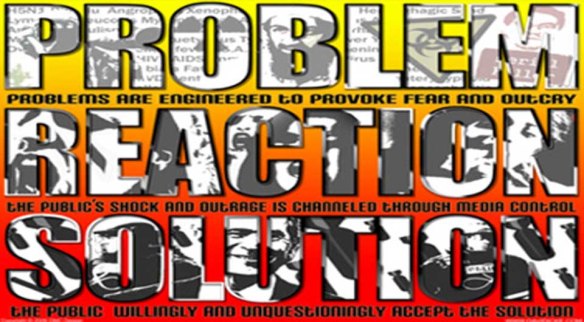
A simple formula underpins these operations:  problem, reaction, solution.

The problem from the perspective of criminal warmongers is that the public doesn’t want war or a police state.  The intended reaction of the operation is that the synthetic terror event will induce people to seek protection from the state, coupled with aggressive war to bomb the threat out of existence. The solution, or intended result, is already occurring.  Engineered fear and racism have set the stage for the public to be manipulated to accept a covert agenda that it would otherwise reject.

Cui Bono?  Who benefits? The police state apparatus, War Inc., and a warmongering Presidential agenda all benefit.

The manipulation of the public is further enabled by an amendment to the National Defense Authorization Act (NDAA) which negates the Smith-Mundt Act (SMA) of 1984 which prohibits government agencies from propagandizing domestic populations.

Susan Posel explains in “How the NDAA Allows US Gov to Use Propaganda Against Americans”:

“SMA  defines the prohibition of domestic access to influence information through a variety of means, from broadcast to publishing of books, media, and online sources by restricting the State Department.”

The Broadcasting Board of Governors was created from SMA. This agency claims to “inform, engage, and connect people around the world in support of ‘freedom and democracy’. They omit that their specialty is making sure propaganda is added to the informational flow we all depend on.”

Instead of succumbing to the shock of terror events, instead of allowing our “reptilian minds” to overrule rational decision-making processes, we need to decode the Orlando shooting, and other terror events, within the “problem, reaction, solution” framework, and be conscious of how they are being manipulated and politicized to suit covert agendas that do not serve the public interest. The “therapy” for the shock will allow us to subordinate our “reptilian” mindsets, and to act rationally.  A rational mindset will reject the racism, hatred, and warmongering which are intended off-shoots of these terror events.


Related Podcast:

Radio WhoWhatWhy – Russ Baker: Don’t Rush to Judgment in Orlando Shooting

Related Video:

The FBI, Not “ISIS,” Radicalized the Orlando Shooter

Mateen-NYPD

By Tony Cartalucci

Source: Land Destroyer

As predicted, the FBI is revealed to have approached Orlando shooting suspect Omar Mateen in 2013 with informants posing as terrorists in an attempt to “lure” him into participating in a terrorist attack.

USA Today’s TC Palm reports in an article titled, “Exclusive: PGA Village residents want answers from security firm,” that (emphasis added):

The FBI launched an investigation into Mateen after Sheriff’s Office officials reported the incident to the agency. As part of its investigation, the FBI examined Mateen’s travel history, phone records, acquaintances and even planted a confidential informant in the courthouse to “lure Omar into some kind of act and Omar did not bite,” Mascara said. The FBI concluded Mateen was not a threat after that, Mascara said.

This is in line with the FBI’s practice of approaching and entrapping potential terror suspects by posing as terrorists themselves and aiding and abetting them in the planning and preparations for high-profile attacks. These undercover operations include everything from “casing out” potential targets, to the obtaining and training with actual, live explosives, to the purchasing of small arsenals of firearms including the sort of semi-automatic rifles and pistols used by Mateen during the Orlando shooting.

In addition to the FBI’s undercover operation, it is now also revealed that Mateen frequented the website of another FBI/CIA informant, Marcus Dwayne Roberson, a former US Marine, turned bank robber, turned US government informant.

While US politicians, law enforcement officials, and media networks attempt to claim Robertson’s extremist website, the “Timbuktu Seminary,” was his own independent project, the extent of his association with the US government makes this difficult, if not impossible to believe. Instead, it appears to be the perfect mechanism to feed the FBI’s entrapment pipeline, attracting and identifying possible suspects for the FBI to then approach and “investigate.”

The National Review’s article, “The Orlando Jihadist and the Blind Sheikh’s Bodyguard,” would report (emphasis added):

According to Fox News, Omar Mateen, the jihadist who carried out the mass-murder attack at a gay nightclub in Florida this weekend, was a student of Marcus Robertson, an Orlando-based radical Muslim who once served as a bodyguard to Omar Abdel Rahman — the notorious “Blind Sheikh” whom I prosecuted for terrorism crimes in the early to mid 1990s. 

The National Review also reported that (emphasis added):

In Robertson’s case, it is reported that he agreed to work for the government, gathering intelligence both overseas and in the United States. According to Fox, however, he was expelled from the covert informant program in early 2007 after attacking his CIA handler in Africa.

But Robertson’s stint with the CIA was not the only time he would work for the US government after his service in the US Marine Corps. The National Review leaves out the fact that before his dismissal from the CIA, he was an informant for the FBI between 2004 and 2007.

The Daily Beast in its article, “Was Orlando Shooter Omar Mateen Inspired by This Bank-Robbing Ex-Marine?,” would report (emphasis added):

“Plaintiff worked as a covert operator for the FBI Terrorist Task Force from 2004 until 2007, performing operations in the United Sates and internationally with and against suspected and known terrorist organizations,” Robertson says in court papers. 

Robertson remained in touch with American law enforcement and intelligence officials when he moved back to the United States, according to court papers filed by his attorney, “served as a confidential source in domestic terrorism investigations from Atlanta to Los Angeles.”

Is the American public expected to believe that a US government asset who received special training in the military and served as an informant and operative for both the FBI and the CIA would somehow, suddenly be allowed to drop off the US government’s radar and be allowed to run an extremist website in the United States?

mohamed-bomb-800x600

Image: How far do undercover FBI investigations go? How about building a van-bomb for a suspect after taking him to a public park to detonate real explosives? The FBI’s own affidavit reveals that is precisely what FBI informants did while investigating Portland, Oregon terror suspect Mohamed Osman Mohamud. Did the FBI’s attempts to lure the Orlando shooter, Omar Mateen, into committing a terror attack contribute in his radicalization? The FBI must answer to this.

Indeed, no American should believe this. Robertson was step one in Omar Mateen – the Orlando shooter’s – radicalization. The FBI’s attempt to pose as terrorists to lure Mateen into going along with a terrorist attack was step two. Though the FBI has so far failed to disclose the details of that investigation, comments made by FBI Director James Comey himself indicate that FBI informants may have worked on Mateen for up to 10 months.

Between exposure to Robertson’s extremist propaganda, honed after years of working as an informant and operative identifying and exposing terror suspects, and the FBI’s own informants over the course of months, if not years, it is clear that the US government and its “counterterrorism” measures radicalized Mateen – not “ISIS.”

The Guardian in its article, “CIA has not found any link between Orlando killer and Isis, says agency chief,” further highlights this blatant truth by reporting (emphasis added):

The Central Intelligence Agency chief has not been “able to uncover any link” between Orlando killer Omar Mateen and the Islamic State, despite Mateen’s stated allegiance to the jihadist group during Sunday’s LGBT nightclub massacre.

If Omar Mateen was a “homegrown terrorist,” the FBI served as the gardeners.

The American public must now demand the details of the FBI’s undercover work regarding Omar Mateen, as well as the truth behind any enduring ties between Robertson and the US government. If Robertson has no connections with the US government, an explanation as to why he is allowed to operate an extremist website on American soil must be provided.

For political and ideological opportunists attempting to seize upon the Orlando tragedy to uphold an example of “Islamic extremism,” it is especially ironic that the facts indicate that the act of terrorism was entirely divorced from “Islam,” and instead the result of America’s ongoing view of terrorism as a convenient and versatile geopolitical tool, rather than a threat to genuinely combat.

That quite literally every aspect that contributed to Omar Mateen’s radicalization is directly connected to the US government itself, illustrates just who the real threat is that American’s should fear – the threat within the halls of its own government – not “terrorists” dwelling beyond them.

CIA: The Corrupt and Ignorant Agency

CIA-corruption-300x227

By Wayne Madsen

Source: Strategic Culture Foundation

The American taxpayers have been fleeced for almost seventy years by a so-called «intelligence» agency that has systematically violated the US Constitution, broken practically every federal law on the books, and penetrated virtually every facet of American life. The Central Intelligence Agency’s creation was bemoaned by its creator, President Harry S Truman, who, in a fit of personal angst following the 1963 assassination of President John F Kennedy, wrote in a newspaper column, «I never had any thought that when I set up the CIA that it would be injected into peacetime cloak and dagger operations… I, therefore, would like to see the CIA be restored to its original assignment… and that its operational duties be terminated or properly used elsewhere».

During a presidential election year, two of the three remaining major candidates – Hillary Clinton and Donald Trump – have given no indication that they will heed the words of President Truman. For example, Trump has indicated he will give the CIA authority to torture that even the CIA considers illegal.

As for Mrs Clinton, her zeal in supporting the violent overthrow and assassination of Libyan leader Muammar Gaddafi in 2011 only gives added impetus to the out-of-control players inside the CIA to commit similar actions in a Clinton administration. Only Democratic candidate Bernie Sanders appears to channel the beliefs of Truman when it comes to reining in the CIA.

It is not known whether Trump, who has made favorable noises to interventionist neo-conservatives within the Republican Party, will stand by his comments that the war in Libya was a mistake. But Trump was one of the cheerleaders urging US intervention in 2011. He said, «Gaddafi in Libya is killing thousands of people, nobody knows how bad it is, and we’re sitting around. We have soldiers all over the Middle East and not bringing them to stop this horrible carnage… We don’t want to get involved and you’re going to end up with something like you’ve never seen before».

Trump, Mrs Clinton, and Obama were wrong about Libya and Gaddafi on all counts. Gaddafi was not killing «thousands of people». That was being done by the jihadist rebels supported by the CIA. The late US ambassador/weapons smuggler in Libya, Christopher Stevens, who was ironically killed by the very same jihadists with whom he was brokering deals to ship Libyan weapons to Syria, ensured that the latest NATO weaponry ended up in radical Islamist hands in Libya. It was these weapons that killed «thousands of people» – Libyan and African guest workers and their families – in a country wracked by a civil war manufactured by Mrs Clinton and CIA director General David Petraeus.

The CIA, in particular, had for decades, fantasized about overthrowing Gaddafi. Never did this most incompetent of US government agencies contemplate the effects of Gaddafi’s ouster: the spread of Saudi-financed jihadist terrorism across the Sahel region of Africa. The CIA’s fanciful notions that Gaddafi’s days were numbered were highlighted in a formerly Secret CIA report titled, «Libya: Will the Revolution Outlast Gaddafi?» Issued in June 1988, the report was obviously intended to bolster those within the Reagan administration who argued for a US military attack on Libya by taking advantage of what the CIA perceived was a weakened Gaddafi government at the end of the 1980s. The CIA, as usual, was extremely off-base in its assessment of Gaddafi’s staying power.

The CIA report states: «Gaddafi’s revolution has largely run its course, and he must rely on coercion to perpetuate his revolutionary vision». In fact, Libyans had the highest standard of living on the African continent with oil revenues being shared with the entire population. The CIA’s erroneous assessment of Libya in 1988 continued: «Just as Libya in 1969 was ripe for a change to a more nationalistic and activist regime, we believe it now ripe for a return to normality». The call for «regime change» by the CIA in 1988 was, in fact, a call for the return to the status quo ante of 1968: a Libya governed by a corrupt oligarchy led by a feeble monarch. Today, a motley crew of United Nations-selected Libyan gangsters governs the country as a «paper tiger» entity called the «Government of National Accord». Meanwhile, jihadists of Ansar al-Sharia govern Benghazi while the Islamic State of Iraq and the Levant (ISIL) governs Sirte, Derna, and a swath of territory southeast of Tripoli, the Libyan capital.

Just as the destruction of Saddam Hussein’s Ba’ath Party and military infrastructures in Iraq following the US invasion and occupation led to the complete collapse of the Iraqi nation-state, the destruction of the four key institutions that united Libya under Gaddafi led to «failed state» status for the country. The CIA cited these key institutions in its 1988 report but no effort was made to preserve them after Gaddafi’s assassination by CIA-supported forces.

The four key institutions in Libya were, according to the CIA, the tribally-based security battalions, the regular Armed Forces, the Military Intelligence service, and the revolutionary committees. These institutions were wiped out in order that the CIA’s wish in 1988 could be realized: that Libya would return to the «normality» of 1968: government by a restored monarchy led by a pretender to the al-Senussi family’s throne once occupied by King Idris I. However, Libya became a polyglot of warring tribes and jihadists, many of the latter imported from conflict zones abroad.

Whether governed by a restored monarchy or a military-dominated successor regime, the CIA saw a post-Gaddafi government desiring «a more constructive relationship with the United States and the West». The CIA added, «Libyan successors probably would turn first to Western Europe for better economic relations and some arms. They also would be likely to seek greater US participation in the Libyan economy». However, after Gaddafi agreed to abandon his so-called «weapons of mass destruction» chemical and nuclear programs, the United States and Western Europe had a more constructive relationship with Libya and the country was wide open for Western economic investment. After Mrs Clinton, Petraeus, Obama, Britain’s David Cameron, and other Western leaders had their way with Libya, it is now a wasteland. The infrastructures of irrigation, road and air transport, social welfare, public education, health care, and employment for African guest workers lie in ruins. The clearly demented Mrs Clinton’s private e-mails show that she and her cabal of interventionists were clearly overjoyed by the misery that befell Libya and its people. When she was informed of Gaddafi’s brutal assassination, one that involved his sodomization, Clinton uttered the preamble to what may be called the «Hillary Doctrine» – «We came, we saw, he died!» She followed her declaration with her signature hideous cackling laughter.

The 1988 CIA report does not seem to care much for Gaddafi’s style of governance through some 2000 local «people’s congresses», described by the CIA as «a hybrid of a New England town meeting and a Bedouin tribal gathering». This demonstration of the «people’s will» in the Libyan «Jamahiriya» was anathema to the CIA’s goals for Libya, even Libya’s emulation of New England-style direct democracy.

A system of direct democracy in an Arab Muslim nation defied the CIA’s wish for the region, which was and remains an alliance of pro-US theocratic states governed by corrupt elites that wield power through US-equipped armed forces. The CIA report on Libya admits that initially, Gaddafi’s system of direct democracy and the exercising of the people’s will «actually worked». Only in the jaundiced view of the United States was such a system of government a threat, not only to US interests and goals, but to those of Israel, Saudi Arabia, Qatar, Kuwait, Morocco, and other corrupt and theocratic US client states in the region.

Hillary Clinton’s war crimes are unforgivable. No real progressive could ever support her.

clinton-kissinger-2-article-header

By Zach Cartwright

Source: U.S. Uncut

Hillary Clinton made headlines with a speech in San Diego casting Donald Trump as unfit for the presidency due to the damage his incendiary rhetoric could cause. Simultaneously, the former Secretary of State sought to convince the California audience that she was the safer choice in foreign policy matters.

But when taking a closer look at US foreign policy under her leadership as the nation’s top diplomat, it’s obvious that Clinton could potentially be as disastrous as Trump if given the position of Commander-in-Chief.

Here are a few examples of countries where conditions are tremendously worse as a result of Hillary Clinton’s policies.

Hillary Clinton made Libya a failed state

In an April interview with Fox News, President Barack Obama, reflecting on his 7 years as Commander-in-Chief, admitted that ousting Libyan dictator Muammar Gaddafi was the biggest mistake of his presidency. While Obama took responsibility for the failure of Libya in that interview, he relied on the input of Hillary Clinton, his Secretary of State at the time.

In March of 2011, Clinton met with Mahmoud Jibril, who was leading the opposition to Gaddafi. As the New York Times reported, Clinton asked Jibril a series of questions about how his coalition planned to fill the power vacuum that would be created by Gaddafi’s ouster. And in the end, it was Clinton who convinced the White House that deposing Gaddafi was the right thing to do:

Her conviction would be critical in persuading Mr. Obama to join allies in bombing Colonel Qaddafi’s forces. In fact, Mr. Obama’s defense secretary, Robert M. Gates, would later say that in a “51-49” decision, it was Mrs. Clinton’s support that put the ambivalent president over the line.

The 2011 NATO-led invasion of Libya that took place after Clinton’s visit has since allowed extremist groups to seize power in an unprecedented takeover of much of the country over the last five years.

In 2014, the US State Department shut down the US embassy in Libya and issued a travel warning urging all Americans to stay away from the country. Roughly one year ago, Libya’s central bank, the last remaining institution in the failed state, was forced to flee to a city in the Eastern region of the country due to rebel forces encroaching on the bank’s facility in Tripoli, the capital. Libya is now a haven for terrorists, with thousands of ISIS soldiers using the country as a staging ground.

In an interview on CBS, Clinton laughed about Gaddafi’s slaying, proudly exclaiming, “We came, we saw, he died.”

Hillary Clinton deserves credit for poverty and instability in Haiti

In Haiti, the first state ever founded by freed black slaves, citizens are still fighting for political and economic freedom today, largely due to the influence of Bill and Hillary Clinton.

In 2011, Wikileaks published US State Department cables from 2008 and 2009 confirming that State Department officials were meeting behind closed doors with Haitian business leaders, plotting on how to stop the Haitian government from implementing a 37-cent hike in the minimum wage from $0.24 an hour to $0.61 cents an hour.

While Haitian President René Préval was initially neutral on the proposal of raising the minimum wage, he went on the record opposing the wage hike after consistent efforts from within the US Embassy in Haiti and the Haitian business lobby by July of 2009. Politifact rated the claim that Clinton’s State Department tried to suppress the wage hike as half-true, since there’s no link proving that Clinton directly played a role.

However, Clinton’s influence on Haiti didn’t stop there. As US Uncut previously reported, the former Secretary of State took an active role in swinging Haitian’s presidential elections in favor of corporate special interests. In the first round of Haiti’s presidential elections, thousands of citizens took to the streets demanding an annulment of election results, alleging that then-Haitian president Michel Martelly committed election fraud.

Martelly, who succeeded René Préval, is a close confidant of the Clinton family. In 2011, Martelly appointed Bill Clinton to an advisory board whose stated goal was to court foreign investors.

And in one of Hillary Clinton’s State Department emails made public, Clinton’s chief of staff received an email from another staffer openly boasting about using connections within the Haitian business elite to lobby for the withdrawal of Jude Célestin, Martelly’s political rival, from an upcoming runoff election. The aide, Kenneth Merten, predicted the news of the US interfering in election results would create widespread protests, and said he had called Martelly, asking him to plead with Haitians “to not pillage.”

While Martelly is no longer in power, his hand-picked successor, Jovenel Moïse, won the most recent election. However, watchdogs are calling the results fraudulent and demanding a new election. Ricardo Seitenfus, who has served as representative of the Organization of American States (OAS) for the last eight years, admitted that Haiti’s government is essentially a puppet of US interests, saying the Haitian election schedule is “subject to the U.S. schedule.” Hillary Clinton deserves to be closely scrutinized when touting her diplomacy record, as Haiti’s political instability is a result of her policies.

Honduras’ downfall resulted from a coup Clinton supported

In 2009, shortly after Obama took office and appointed Hillary Clinton as his Secretary of State, Honduran president Manuel Zelaya was arrested at gunpoint by the military and forced onto a plane to Costa Rica while a new government took power. While the US State Department didn’t directly oust Zelaya, it refused to call his ouster a coup, despite calls from the U.S. ambassador to Honduras and from Congress to do so. In her interview with the New York Daily News editorial board, Clinton defended her decision to keep sending aid to Honduras despite the violent overthrow of Zelaya:

I think, in retrospect, we managed a very difficult situation, without bloodshed, without a civil war, that led to a new election. And I think that was better for the Honduran people. But we have a lot of work to do to try to help stabilize that and deal with corruption, deal with the violence and the gangs and so much else.

However, the result of the coup was a massive amount of bloodshed, as gangs and drug cartels began to take more power in the absence of a stable government. In the year following the coup, Clinton’s State Department published a list of human rights abuses prevalent in Honduras:

“…unlawful killings by police and government agents, which the government took some steps to prosecute; arbitrary and summary killings committed by vigilantes and former members of the security forces; harsh prison conditions; violence against detainees; corruption and impunity within the security forces; lengthy pretrial detention and failure to provide due process of law; politicization, corruption, and institutional weakness of the judiciary; corruption in the legislative and executive branches; government restrictions on the recognition of some civil society groups; violence and discrimination against women; child prostitution and abuse; trafficking in persons; discrimination against indigenous communities; violence and discrimination against persons based on sexual orientation; ineffective enforcement of labor laws; and child labor.”

The horrific conditions in Honduras triggered a mass exodus of migrants to the US. As Telesur reported, approximately 9,000 child refugees fled Honduras in 2015. Also in 2015, Clinton defended the deportation of children back to the Central American countries they’re fleeing in order “send a message.” However, Clinton has since walked back that statement as her Democratic presidential primary battle with Bernie Sanders became more competitive.

Honduras-Activists-Berta-Cáceres-and-Nelson-Garcia-Assassinated-Called-Out-Hillary-Clinton-for-Backing-Honduran-Coup

This March, the violence in Honduras became a subject of international scrutiny when 44-year-old environmental activist Berta Caceres was assassinated in her home. Caceres had been an outspoken opponent of a proposed hydroelectric plant on indigenous land, and had recently gotten in an altercation with soldiers, police, and employees of a private power company while protesting the project just weeks before she was killed.

Clinton is responsible for the fall of Iraq and Syria (and the rise of ISIS)

In late 2011, after months of sustained anti-government protests inspired by the “Arab Spring” movement, Hillary Clinton called for the resignation of Syrian president Bashar al-Assad. Then, in April 2012, Clinton gave a speech in Turkey more forcefully calling specifically for regime change, saying, “Assad must go.” Those three words created the policies that led to both the rise of ISIS in Syria and the European refugee crisis of 2015.

One of Clinton’s last actions as Secretary of State was to call for the arming of Syrian rebels fighting Assad. As the London Telegraph reported, Clinton’s plan to give weapons to Assad’s enemies was backed by not only former Defense Secretary Leon Panetta, but also by former CIA director David Petraeus and General Martin Dempsey, chairman of the Joint Chiefs of Staff. While Obama initially rejected his Secretary of State’s plan, he eventually agreed to arm Syrian rebels in the goal of ousting Assad.

However, as ISIS began to get a foothold into Syria and Iraq, the “moderates” that received weapons from the US were eventually overtaken by ISIS fighters, who suddenly found themselves in the possession of military-grade weapons paid for with US tax dollars. In a study conducted by Conflict Armament Research, which tracks the movement of arms in war-torn regions, researchers found that ISIS has weapons and ammunition not just from the US, but also from coalition forces that are funded by the US government. The access to advanced weaponry was likely the reason for ISIS’ rapid expansion into Libya, Egypt, and elsewhere.

The consequences of destabilizing Syria and Iraq are apparent. Over one million refugees, largely from countries where the US intervened militarily, fled to Europe between 2015 and 2016, creating the world’s largest refugee crisis since World War II. In this chart compiled by Eurostat, the top three countries people are fleeing are Syria, Afghanistan, and Iraq:

refugeechart

Yemeni blood is on Hillary Clinton’s hands

Saudi Arabia’s invasion of Yemen, which started in 2015 and continues today, was made possible with arms purchased by the US government. Since Obama’s presidency, the US has sold approximately $46 billion in arms to the Saudis, with many of those weapons sales greenlighted by Hillary Clinton’s State Department. As US Uncut reported in April, Clinton was particularly focused on making sure the US came through for Saudi Arabia in a 2011 weapons deal. David Sirota of the International Business Times reported that Clinton argued the arms deal was “in the national interest.”

At press conferences in Washington to announce the department’s approval, an assistant secretary of state, Andrew Shapiro, declared that the deal had been “a top priority” for Clinton personally. Shapiro, a longtime aide to Clinton since her Senate days, added that the “U.S. Air Force and U.S. Army have excellent relationships in Saudi Arabia.”

Saudi Arabia is very likely using the weapons acquired from that 2011 exchange to wage brutal bombing campaigns in Yemen. In March, Foreign Policy magazine accused the US and its allies of complicity in war crimes by funding and arming the Saudi regime:

Hundreds of civilians have been killed in airstrikes while asleep in their homes, when going about their daily activities, or in the very places where they had sought refuge from the conflict. The United States, Britain, and others, meanwhile, have continued to supply a steady stream of weaponry and logistical support to Saudi Arabia and its coalition.

This week, the United Nations added the Saudi-led coalition to a blacklist of states and armed groups that violate children’s human rights during conflicts, with UN Secretary General Ban Ki-moon personally slamming the coalition for killing and maiming Yemeni children.

Hillary Clinton is completely right that Donald Trump is woefully unprepared to take on the responsibilities of Commander-in-Chief. But voters should also be leery of Clinton, who, despite having met with more world leaders than any presidential candidate in US history, is responsible for some of the worst foreign policy blunders of the 21st century.


Zach Cartwright is an activist and author from Richmond, Virginia. He enjoys writing about politics, government, and the media. Send him an email: zachcartwright88@gmail.com. 

Hillary Clinton’s Damning Emails

shutterstock_405351559

By Ray McGovern

Source: Consortium News

A few weeks after leaving office, former Secretary of State Hillary Clinton may have breathed a sigh of relief and reassurance when Director of National Intelligence James Clapper denied reports of the National Security Agency eavesdropping on Americans. After all, Clinton had been handling official business at the State Department like many Americans do with their personal business, on an unsecured server.

In sworn testimony before the Senate Intelligence Committee on March 12, 2013, Clapper said the NSA was not collecting, wittingly, “any type of data at all on millions or hundreds of millions of Americans,” which presumably would have covered Clinton’s unsecured emails.

But NSA contractor Edward Snowden’s revelations — starting on June 5, 2013 — gave the lie to Clapper’s testimony, which Clapper then retracted on June 21 – coincidentally, Snowden’s 30th birthday – when Clapper sent a letter to the Senators to whom he had, well, lied. Clapper admitted his “response was clearly erroneous – for which I apologize.”  (On the chance you are wondering what became of Clapper, he is still DNI.)

I would guess that Clapper’s confession may have come as a shock to then ex-Secretary Clinton, as she became aware that her own emails might be among the trillions of communications that NSA was vacuuming up. Nevertheless, she found Snowden’s truth-telling a safer target for her fury than Clapper’s dishonesty and NSA’s dragnet.

In April 2014, Clinton suggested that Snowden had helped terrorists by giving “all kinds of information, not only to big countries, but to networks and terrorist groups and the like.” Clinton was particularly hard on Snowden for going to China (Hong Kong) and Russia to escape a vengeful prosecution by the U.S. government.

Clinton even explained what extraordinary lengths she and her people went to in safeguarding government secrets: “When I would go to China or would go to Russia, we would leave all my electronic equipment on the plane with the batteries out, because … they’re trying to find out not just about what we do in our government, they’re … going after the personal emails of people who worked in the State Department.” Yes, she said that. (emphasis added)

Hoisted on Her Own Petard

Alas, nearly a year later, in March 2015, it became known that during her tenure as Secretary of State she had not been as diligent as she led the American people to believe. She had used a private server for official communications, rather than the usual official State Department email accounts maintained on federal servers. Thousands of those emails would retroactively be marked classified – some at the TOP SECRET/Codeword level – by the department.

During an interview last September, Snowden was asked to respond to the revelations about highly classified material showing up on Clinton’s personal server: “When the unclassified systems of the United States government, which has a full-time information security staff, regularly gets hacked, the idea that someone keeping a private server in the renovated bathroom of a server farm in Colorado is more secure is completely ridiculous.”

Asked if Clinton “intentionally endangered US international security by being so careless with her email,” Snowden said it was not his place to say. Nor, it would seem, is it President Barack Obama’s place to say, especially considering that the FBI is actively investigating Clinton’s security breach. But Obama has said it anyway.

“She would never intentionally put America in any kind of jeopardy,” the President said on April 10. In the same interview, Obama told Chris Wallace, “I guarantee that there is no political influence in any investigation conducted by the Justice Department, or the FBI – not just in this case, but in any case. Full stop. Period.”

But, although a former professor of Constitutional law, the President sports a checkered history when it comes to prejudicing investigations and even trials, conducted by those ultimately reporting to him. For example, more than two years before Bradley (Chelsea) Manning was brought to trial, the President stated publicly: “We are a nation of laws. We don’t let individuals make decisions about how the law operates. He [Bradley Manning] broke the law!”

Not surprisingly, the ensuing court martial found Manning guilty, just as the Commander in Chief had predicted. Though Manning’s purpose in disclosing mostly low-level classified information was to alert the American public about war crimes and other abuses by the U.S. government, Manning was sentenced to 35 years in prison.

On March 9, when presidential candidate Clinton was asked, impertinently during a debate, whether she would withdraw from the race if she were indicted for her cavalier handling of government secrets, she offered her own certain prediction: “Oh, for goodness sake! It’s not going to happen. I’m not even answering that question.”

Prosecutorial Double Standards

Merited or not, there is, sadly, some precedent for Clinton’s supreme confidence. Retired General and ex-CIA Director David Petraeus, after all, lied to the FBI (a felony for “lesser” folks) about giving his mistress/biographer highly classified information and got off with a slap on the wrist, a misdemeanor fine and probation, no jail time – a deal that Obama’s first Attorney General Eric Holder did on his way out the door.

We are likely to learn shortly whether Attorney General Loretta Lynch is as malleable as Holder or whether she will allow FBI Director James Comey, who held his nose in letting Petraeus cop a plea, to conduct an unfettered investigation this time – or simply whether Comey will be compelled to enforce Clinton’s assurance that “it’s not going to happen.”

Last week, Fox News TV legal commentator Andrew Napolitano said the FBI is in the final stages of its investigation into Clinton and her private email server. His sources tell him that “the evidence of her guilt is overwhelming,” and that the FBI has enough evidence to indict and convict.

Whether Napolitano has it right or not, it seems likely that Clinton is reading President Obama correctly – no profile in courage is he. Nor is Obama likely to kill the political fortunes of the now presumptive Democratic presidential nominee. Yet, if he orders Lynch and Comey not to hold Hillary Clinton accountable for what – in my opinion and that of most other veteran intelligence officials whom I’ve consulted – amounts to at least criminal negligence, another noxious precedent will be set.

Knowing Too Much

This time, however, the equities and interests of the powerful, secretive NSA, as well as the FBI and Justice, are deeply involved. And by now all of them know “where the bodies are buried,” as the smart folks inside the Beltway like to say. So the question becomes would a future President Hillary Clinton have total freedom of maneuver if she were beholden to those all well aware of her past infractions and the harm they have done to this country.

One very important, though as yet unmentioned, question is whether security lapses involving Clinton and her emails contributed to what Clinton has deemed her worst moment as Secretary of State, the killing of Ambassador Christopher Stevens and three other U.S. personnel at the lightly guarded U.S. “mission” (a very small, idiosyncratic, consulate-type complex not performing any consular affairs) in Benghazi, Libya, on Sept. 11, 2012.

Somehow the terrorists who mounted the assault were aware of the absence of meaningful security at the facility, though obviously there were other means for them to have made that determination, including the State Department’s reliance on unreliable local militias who might well have shared that inside information with the attackers.

However, if there is any indication that Clinton’s belatedly classified emails contained information about internal State Department discussions regarding the consulate’s security shortcomings, questions may be raised about whether that information was somehow compromised by a foreign intelligence agency and shared with the attackers.

We know that State Department bureaucrats under Secretary Clinton overruled repeated requests for additional security in Benghazi. We also know that Clinton disregarded NSA’s repeated warnings against the use of unencrypted communications. One of NSA’s core missions, after all, is to create and maintain secure communications for military, diplomatic, and other government users.

Clinton’s flouting of the rules, in NSA’s face, would have created additional incentive for NSA to keep an especially close watch on her emails and telephone calls. The NSA also might know whether some intelligence service successfully hacked into Clinton’s server, but there’s no reason to think that the NSA would share that sort of information with the FBI, given the NSA’s history of not sharing its data with other federal agencies even when doing so makes sense.

The NSA arrogates to itself the prerogative of deciding what information to keep within NSA walls and what to share with the other intelligence and law enforcement agencies like the FBI. (One bitter consequence of this jealously guarded parochialism was the NSA’s failure to share very precise information that could have thwarted the attacks of 9/11, as former NSA insiders have revealed.)

It is altogether likely that Gen. Keith Alexander, head of NSA from 2005 to 2014, neglected to tell the Secretary of State of NSA’s “collect it all” dragnet collection that included the emails and telephone calls of Americans – including Clinton’s. This need not have been simply the result of Alexander’s pique at her disdain for communications security requirements, but rather mostly a consequence of NSA’s modus operandi.

With the mindset at NSA, one could readily argue that the Secretary of State – and perhaps the President himself – had no “need-to-know.” And, needless to say, the fewer briefed on the NSA’s flagrant disregard for Fourth Amendment protections against unreasonable searches and seizures the better.

So, if there is something incriminating – or at least politically damaging – in Clinton’s emails, it’s a safe bet that at least the NSA and maybe the FBI, as well, knows. And that could make life difficult for a Clinton-45 presidency. Inside the Beltway, we don’t say the word “blackmail,” but the potential will be there. The whole thing needs to be cleaned up now before the choices for the next President are locked in.


Ray McGovern works with Tell the Word, a publishing arm of the ecumenical Church of the Saviour in inner-city Washington.  He served as a CIA analyst for 27 years, during which he prepared and briefed the morning President’s Daily Brief for Presidents Nixon, Ford, and Reagan.

John Perkins: The New Confessions of an Economic Hitman

apologiesofaneconomichitman

Reposted below is the introduction and sample chapter from John Perkin’s “The New Confessions of an Economic Hitman” (also available in pdf form on his site here).

Introduction

The New Confessions

I’m haunted every day by what I did as an economic hit man (EHM). I’m haunted by the lies I told back then about the World Bank. I’m haunted by the ways in which that bank, its sister organizations, and I empowered US corporations to spread their cancerous tentacles across the planet. I’m haunted by the payoffs to the leaders of poor countries, the blackmail, and the threats that if they resisted, if they refused to accept loans that would enslave their countries in debt, the CIA’s jackals would overthrow or assassinate them.

I wake up sometimes to the horrifying images of heads of state, friends of mine, who died violent deaths because they refused to betray their people. Like Shakespeare’s Lady Macbeth, I try to scrub the blood from my hands.

But the blood is merely a symptom.

The treacherous cancer beneath the surface, which was revealed in the original Confessions of an Economic Hit Man, has metastasized. It has spread from the economically developing countries to the United States and the rest of the world; it attacks the very foundations of democracy and the planet’s life-support systems.

All the EHM and jackal tools—false economics, false promises, threats, bribes, extortion, debt, deception, coups, assassinations, unbridled military power—are used around the world today,even more than during the era I exposed more than a decade ago. Although this cancer has spread widely and deeply, most people still aren’t aware of it; yet all of us are impacted by the collapse it has caused. It has become the dominant system of economics, government, and society today.

Fear and debt drive this system. We are hammered with messages that terrify us into believing that we must pay any price,assume any debt, to stop the enemies who, we are told, lurk at our doorsteps. The problem comes from somewhere else. Insurgents. Terrorists. “Them.” And its solution requires spending massive amounts of money on goods and services produced by what I call the corporatocracy—vast networks of corporations, banks, colluding governments, and the rich and powerful people tied to them. We go deeply into debt; our country and its financial henchmen at the World Bank and its sister institutions coerce other countries to go deeply into debt; debt enslaves us and it enslaves those countries.

These strategies have created a “death economy”—one based on wars or the threat of war, debt, and the rape of the earth’s resources. It is an unsustainable economy that depletes at ever-increasing rates the very resources upon which it depends and at the same time poisons the air we breathe, the water we drink, and the foods we eat. Although the death economy is built on a form of capitalism, it is important to note that the word capitalism refers to an economic and political system in which trade and industry are controlled by private owners rather than the state. It includes local farmers’ markets as well as this very dangerous form of global corporate capitalism, controlled by the corporatocracy, which is predatory by nature, has created a death economy, and ultimately is self-destructive.

I decided to write The New Confessions of an Economic Hit Man because things have changed so much during this past decade. The cancer has spread throughout the United States as well as the rest of the world. The rich have gotten richer and everyone else has got-ten poorer in real terms.

A powerful propaganda machine owned or controlled by the corporatocracy has spun its stories to convince us to accept a dogma that serves its interests, not ours. These stories contrive to convince us that we must embrace a system based on fear and debt, accumulating stuff, and dividing and conquering everyone who isn’t “us.” The stories have sold us the lie that the EHM system will provide security and make us happy.

Some would blame our current problems on an organized global conspiracy. I wish it were so simple. Although, as I point out later,there are hundreds of conspiracies—not just one grand conspiracy—that affect all of us, this EHM system is fueled by something far more dangerous than a global conspiracy. It is driven by concepts that have become accepted as gospel. We believe that all economic growth benefits humankind and that the greater the growth, the more widespread the benefits. Similarly, we believe that those people who excel at stoking the fires of economic growth should be exalted and rewarded, while those born at the fringes are available for exploitation. And we believe that any means—including those used by today’s EHMs and jackals—are justified to promote economic growth; preserve our comfortable, affluent Western way of life; and wage war against anyone (such as Islamic terrorists) who might threaten our economic well-being, comfort, and security.

In response to readers’ requests, I have added many new details and accounts of how we did our work during my time as an EHM, and I have clarified some points in the previously published chapters. More importantly, I have added an entirely new part 5, which explains how the EHM game is played today—who today’s economic hit men are, who today’s jackals are, and how their deceptions and tools are more far-reaching and enslaving now than ever.

Also in response to readers’ requests, part 5 includes new chapters that reveal what it will take to overthrow the EHM system, and specific tactics for doing so.

The book ends with a section titled “Documentation of EHM Activity, 2004–2015,” which complements my personal story by offering detailed information for readers who want further proof of the issues covered in this book or who want to pursue these subjects in more depth.

Despite all the bad news and the attempts of modern-day robber barons to steal our democracy and our planet, I am filled with hope. I know that when enough of us perceive the true workings of this EHM system, we will take the individual and collective actions necessary to control the cancer and restore our health. The New Confessions of an Economic Hit Man reveals how the system works today and what you and I—all of us—can do to change it.

Tom Paine inspired American revolutionaries when he wrote,“If there must be trouble, let it be in my day, that my child may have peace.” Those words are as important today as they were in 1776. My goal in this new book is nothing less than Paine’s: to inspire and empower us all to do whatever it takes to lead the way to peace for our children.


CHAPTER 34

Conspiracy: Was I Poisoned?

The situation has gotten much worse since Confessions of an Economic Hit Man was first published. Twelve years ago, I expected that books like mine would wake people up and inspire them to turn things around. The facts were obvious. I and others like me had created an EHM system that supported the corporatocracy. Together, the EHMs, corporate magnates, Wall Street robber barons, governments and jackals, and all their networks around the world have created a global economy that fails everyone. It is based on war or the threat of war, debt, an extreme form of materialism that pillages the earth’s resources and is consuming itself into extinction. In the end, even the very rich will fall victim to this death economy.

Most of us have bought into it in a big way; we are collaborators—often unconscious ones. Now it is time to change. I had hoped that exposing these facts, making people conscious, would inspire a movement that, by 2016, would have resulted in a new vision, anew story.

People were in fact shaken awake. Activities in so many parts of the world, including localized ones such as the Occupy movements,national ones in places as diverse as Iceland, Ecuador, and Greece, and regional ones such as the Arab Spring and Latin America’s Bolivarian Alliance for the Peoples of Our America (ALBA), have demonstrated that we understand our world is collapsing.

What I had not anticipated was the flexibility in the EHM system or its absolute determination to defend and promote the death economy. I had not anticipated the rise of an entirely new class of EHMs and jackals.

I made it clear in the original book that I did not believe the EHM system was driven by some nefarious, illegal, secret plan devised by a small group of people determined to control the world; in other words, I did not believe in some unified “grand conspiracy.”

Then something strange happened.

In late March 2005, less than five months after publication of the book, I flew to New York City on a Monday. I was scheduled to speak at the United Nations the next day. I was in perfect health,as far as I knew. A man who identified himself only as a free-lance journalist had been hounding my publicist for an interview. Because his credentials were sketchy and I was receiving a lot of press at that time, she kept putting him off. But when he suggested picking me up at LaGuardia Airport, taking me to lunch, and driving me to the apartment where I was staying with a friend, she consulted with me and I acquiesced. He was waiting for me when I exited the airport. He took me to a small cafe, told me how much he admired my book, asked some of what had become rather standard questions about my life as an EHM, and then drove me to my friend’s apartment on the Upper West Side.

I never saw that man again, and meeting him would have been an unmemorable event—except that a couple hours later I suffered severe internal bleeding. I lost about half the blood in my body,went into shock, and was rushed to Lenox Hill Hospital. I ended up spending two weeks there and having more than 70 percent of my large intestine removed.

As I lay recovering in that hospital bed, I thought that perhaps my illness was a message to slow down, that my body was over-taxed and I needed to cut back on writing and the speaking tours.

The New York gastroenterologist told me that I’d suffered from complications due to a severe case of diverticulosis. I was shocked to hear this, because I’d recently had a colonoscopy. My Florida doctor had assured me that there were no signs of cancer, which had been my main concern. He mentioned that I had some diverticula, “like most people your age,” and ended by advising me to come back in five years.

Of course, my UN speech was canceled, as were numerous other media events. Word of my operation got out very quickly, and soon I was receiving lots of e-mails. Most supported me and expressed concern for my well-being. Some e-mails came from people who accused me of being a traitor to my country. Several assured me that I’d been poisoned.

When I asked my gastroenterologist, he responded that he was“quite certain” I hadn’t been poisoned, but that he’d also learned“never to say never.” In any case, all of it got me to thinking and reading more about conspiracies.

I still do not believe in the grand conspiracy theory. In my experience, there is no secret club of individuals who get together to plot illegal, world-dominating strategies. However, I do know that part of the power of the EHM system is that it foments many small conspiracies. By “small,” I mean that they are focused on specific objectives. Such conspiracies—secret actions to accomplish illegal goals—happened when I was just beginning school, such as the CIA coup that replaced the democratically elected Iranian prime minister, Mossadegh, with the shah, in 1953. They continued during my high school years; consider the CIA-supported Bay of Pigs invasion of Cuba, in 1963. But I became most aware of them when I was an EHM and the CIA arranged the assassinations of my two clients, Ecuador’s Roldós and Panama’s Torrijos, in 1981. Then, as I began writing the original of this book in 2002, there was the US-led conspiracy to overthrow Venezuela’s president, Hugo Chávez. After that came the conspiratorial lie about weapons of mass destruction in Iraq. This was followed by a flurry of conspiracies against leaders and governments in the Middle East and Africa.

While I was an EHM, the goals of most conspiracies were to further US and corporate interests in the economically developing countries—to do whatever it took, including overthrowing or killing government leaders, to enable our companies to exploit resources. After my colon operation, as I lounged around my home reading various reports, it became obvious that the tools I had used in Indonesia, Panama, Egypt, Iran, Saudi Arabia, and other countries were now being applied in Europe and the United States. Fortified by the so-called threat of global terrorism after 9/11, these conspiracies have given excessive power to the very wealthy individuals who control global corporations. Among the most striking are conspiracies to implement “free” trade agreements such as NAFTA and CAFTA, and the more recent Trans-Pacific Partnership (TPP) and the Transatlantic Trade and Investment Partnership (TTIP), which empower corporations to assume defacto sovereignty over governments in countries around the world; to convince politicians to pass laws that permit the rich to avoid paying taxes, to control the media, and to use media to influence politics; and to terrify US citizens into fighting endless wars.

These and many other conspiracies took the EHM system far beyond where it had been in the 1970s. Despite all that I had writ-ten, I had to admit that I’d missed much of what had been going on beneath the surface. The old tools had been sharpened and new ones invented. The heart of this system remained the same: an economic and political ideology based on enslavement through debt and enforced by paralyzing people with fear. In my day, it had convinced the majority of Americans and much of the rest of the world that all actions were justified if they protected us from Communist subversives; the fear had now switched to Muslim terrorists,immigrants, and anyone threatening to rein in corporations. The dogma was similar, but the impact was now much greater.

Recuperating from that operation also sent me into the dark abyss of guilt. I’d wake up in the middle of the night haunted by memories of leaders I’d bribed and threatened. I had not yet come to terms with my EHM past.

I asked myself why I’d stayed in that job for ten long years. And then I realized how difficult it had been to escape. It wasn’t just the seduction of money, flying first class, staying in the best hotels, and all the other perks. Nor was it the pressure exerted by my bosses and fellow employees at MAIN. It was also the aura of the job, my title—the very story of my culture. I was doing what I’d been schooled to do, what I’d been told was the right thing to do. I was educated as an American whose job it was to sell America and to believe and convince everyone else that Communist regimes were out to destroy us.

One day, a friend e-mailed me a photograph of a poster like one that had hung on the wall of the boys’ bathroom in my elementary school. It depicted a sinister-looking man who asked, “Is your washroom breeding Bolsheviks?” It was an ad for Scott paper towels, and the subtitle read, “Employees lose respect for a company that fails to provide decent facilities for their comfort.” It sent a strong message that not buying American was akin to treason.

That photograph got me thinking about those most formative years in my life. After the Soviet Union launched Sputnik, the first satellite, we all became convinced that nuclear warheads were on the way. The chilling scream of sirens sent us scampering under our desks in weekly drills, to hide from imagined Soviet missiles. Movies and TV shows like I Led Three Lives, a gripping drama based on the memoir of an FBI agent who infiltrated a Communist cell in the United States, warned us to be vigilant; Red provocateurs, like the evil Bolshevik in the poster, lurked among us, ready to pounce.

By the time I entered the EHM ranks, it had become apparent that we were losing in Vietnam, a nation portrayed as a Sino-Soviet puppet. We were told that there would be a “domino effect”—that Indonesia would go next, then Thailand, South Korea, the Philip-pines, and on and on. It wouldn’t be long before the Red tide would sweep Europe and then engulf the United States. Democracy and capitalism were doomed—unless we halted the onslaught. And that meant doing whatever it would take to promote companies such as Scott, which portrayed themselves as bulwarks against communism.

Delving into my feelings of guilt helped me see the ease with which I had deceived myself in those years. It opened my mind to understanding that millions of people are in positions similar to mine. They are no longer taught to fear communism, but they still fear Russia, China, and North Korea, in addition to al-Qaeda and other terrorists. They may not travel to foreign lands and confront, face-to-face, the consequences of what their companies do. They may not personally stand beside oil spills in the Amazon or see the hovels where sweatshop workers sleep. Instead, they anesthetize themselves with TV. They succumb to assurances by their schools, banks, human relations experts, and government officials that they are contributing to progress. But in their hearts they know other-wise. Deep down, they—we—realize that the stories misrepresent. And now it is time to admit to our complicity.

On a trip to Boston, not long after my operation, I reconnected with my former Boston University professor and the author of A People’s History of the United States, Howard Zinn. Now in his eighties, he was still actively campaigning to reform a system he saw as an experiment that hadn’t worked. When I shared with him the guilt that so often threatened to overwhelm me, he urged me to keep opening to it.

“Don’t be afraid of it,” he said. “You are guilty. We’re all guilty. We have to admit that although the big corporations own the propaganda machine, we allow ourselves to be duped. You can set an example. Show people that the way out, redemption, comes from changing it.”

I told him that I often thought of middle-class Americans as being like the medieval bourgeoisie—the majority of the people, who lived in the bourgs outside the castle walls. “We pay our taxes so soldiers and jackals will defend us from the knights in the neighboring castles.”

“Exactly,” he said, with that smile of his that had enchanted and inspired so many students. “We will do anything to maintain a system that has failed us.”

I came to understand, during those days following my operation and in discussions with Howard, that my most important lesson since the publication of Confessions of an Economic Hit Man was similar to the one I had learned as a Peace Corps volunteer working with Andean brick makers: the only reason the EHM system works is because the rest of us give it permission to work. At best, we look the other way; at worst, we actively support it. One of the things that most bothered me was having to admit to myself that I not only had looked the other way but also had convinced many people to actively support that system. I made a commitment to myself that I’d be more diligent; I’d watch more closely what was going on in my own community, my country, and the world.

Although I was determined to follow Howard’s advice, I also found myself envying another man, who did not struggle with his conscience—a friend who became an immense support during my physical recuperation in Florida and who seemed to have no problem justifying his own violent actions. He was a jackal, taking a short leave of absence from the Middle East.

ABOUT THE AUTHOR

As Chief Economist at a major international consulting firm, John Perkins advised the World Bank, United Nations, IMF, U.S.Treasury Department, Fortune 500 corporations, and leaders of countries in Africa, Asia, Latin America, and the Middle East.

The New Confessions of an Economic Hit Man(2016), a follow-up to John’s classic New York Times bestseller, brings the story of economic hit men and jackal assassins up to date and chillingly home to the U.S. It goes on to provide practical strategies to transform the failing global death economy into a regenerative life economy. Confessions of an Economic Hit Man(70 weeks on the New York Times bestseller list, 32 languages), The Secret History of the American Empire(New York Times bestseller) and Hoodwinked were ground-breaking exposés of the clandestine operations that created the current global crises; they set the stage for the revelations and strategies detailed in The New Confessions of an Economic Hit Man.

John is a founder and board member of Dream Change and The Pachamama Alliance, nonprofit organizations devoted to establishing a world future generations will want to inherit, has lectured at Harvard, Oxford, and more than 50 other universities around the world, and is the author of books on indigenous cultures and transformation, including Shapeshifting, The World Is As You Dream It, Psychonavigation, Spirit of the Shuar, and The Stress-Free Habit. He has been featured on ABC, NBC, CNN, CNBC, NPR, A&E, the History Channel, Time, The New York Times, The Washington Post,Cosmopolitan, Elle, Der Spiegel, and many other publications, as well as in numerous documentaries including The End of Poverty?, Zeitgeist Addendum, and Apology of an Economic Hit Man. He was awarded the Lennon Ono Grant for Peace 2012, and Rainforest Action Network Challenging Business As Usual Award, 2006.

 

American Cartel: How America’s Two Major Parties Helped Destroy Democracy

cartel

By Frank Castro

Source: The Hampton Institute

Cartel: An association of manufacturers or suppliers with the purpose of maintaining prices at a high level and restricting competition.

A little over two decades ago, on December 2, 1993, the principle engineer of Colombia’s infamous cocaine empire, Pablo Escobar, was killed while fleeing police on the barrio rooftops of his hometown, Medellin. Before he died he had amassed an organization of state-like power, challenging, in fact, the government of Columbia itself over the question of its extradition policies-and winning. Dubbed the Medellin drug cartel, his international cocaine operation grew to prominence functioning similarly to the corporations which dominate today’s global economy. Escobar knew, by controlling every possible link in the drug chain from production to retail, he could corral suppliers under a single umbrella, dictate the price of his product, and severely limit any would-be competitors from challenging his power.

Escobar was not alone in learning from the strategies of corporate giants. If anything he was late. Few organizations have pervasively and durably monopolized a market as well as America’s Republican and Democratic parties. The two dominant machines steering the U.S. electorate have consistently diminished the potential for a freer America. That’s because the reality is, rather than arch rivals, liberals and conservatives are two factions of the same team. Both are capitalist. Both are imperialist. Both are white supremacist surrogates. And both are controlled by a plutocratic elite who have discovered what Escobar learned in his early twenties, that competition is best neutralized by eliminating all possible outliers. We merely perceive the two parties as markedly different because of the degree to which the spectrum of possibilities has been narrowed.
American Cartel

Politics, at its barest, is a market characterized by power-and the struggle for how power will be distributed. As CrimethInc illustrated some time ago, in this market ideas function similar to currency. Delineated by ideas which can build capital enough for the acquisition of more power, and those which might unbind power, political parties are tethered to the same basic operating principles of any capitalist enterprise. They must solidify market share in the realm of ideas and grow, wherever and whenever possible, or go bankrupt. Incubated within this constant power play, self-preservation becomes the party’s central priority; and it does not matter if the ideas which accomplish this outcome are beneficial to the electorate or detrimental, so long as it achieves the imperative to survive.

Political organizations which maintain growth long enough to survive often do so by normalizing their ideological framework. When they have obtained a disproportionate amount of influence over their immediate surroundings, they can metastasize into monopolies and control large swaths of the idea-economy. New ideas about how society ought to function can enter the market to contest old ideas, but usually encapsulated within reforms incapable of unseating the dominant paradigm. Characteristic of any capitalist system, once market monopolies are established “power tends to flow upward to the top of a hierarchy, from which the masters, the ones qualified to employ it, decide matters for everyone else.”

Remember the age-old question, what do all those with power want? More power. As such, two monopolies have dominated American politics for over 150 years-the Democratic Party, founded in 1828, and the Republican Party, founded in 1854. Together, they form a political cartel, or an association of political parties with the purpose of maintaining concentrated power and restricting or repressing competition. Throughout the past century its loosely managed agreements, often wholly unofficial, but embedded deep within its standard operation, have been the quasi-coordinated production, distribution, and enforcement of a set of normalized choices which reflect only the range of needs of private corporate power.

Essentially, to solidify and gain greater control, the two parties staked out a set of positions within a predetermined and standardized framework which express the basic ideas of the status quo. This way any “new” solutions about what might be possible tend toward ideas which pose no serious danger to the framework itself, which produce reforms only capable of gutting radical resistance while leaving the underlying problems intact. Any outliers are assimilated or positioned to enhance the strength of current institutions. In other words, all ideas must first be filtered through the umbrella of the Democrat-Republican cartel, which dictates the pedigree of ideas both old and new, and therefore severely limiting any competition from threatening its hegemony.
American Sicarios

Central to the project of any cartel is control. And within most drug cartels there is an armed group responsible for carrying out violence in an effort to maintain it. In Colombia they were called sicarios. Though the violence is systematically different, American sicarios are most accurately found in state institutions like the Central Intelligence Agency (CIA) and the Federal Bureau of Investigation (FBI). Such an observation should not be seen as hyperbole. Even the most marginally informed American should know their government frequently has been involved in shameful acts of violence, whether it was the assassination, framing, and political neutralization of black, brown, indigenous, and left-radical movements and their leaders, or organized coups in the Middle East, Africa, and Central or South America.

Without enforcers America’s political cartel simply could not exist. As I wrote in Gangs Of The State: Police And The Hierarchy Of Violence , our society operates on a clearly defined, yet often unarticulated, hierarchy of violence; and the function of politicians and police agencies is to normalize and enforce that violence. As an institution, these agencies act as state-sanctioned gangs, or, in this instance, the sicarios of America’s political ideology, charged with the task of upholding the violent, racist hierarchy of white supremacist capitalism. Wherever and whenever possible, they are tasked with solidifying a monopoly of power where all violence from/by those higher on the hierarchy upon those lower can be normalized into business as usual. Any deviation from the status quo, any resistance whatsoever, is met with brutal repression.

For those familiar with United States history, the record of repression against anti-capitalist groups has been a source of considerable alliance between Democrats and Republicans. In A People’s History of the United States, recounting America’s anti-leftist atmosphere after Russia’s Bolshevik Revolution, Howard Zinn wrote:

“In early September 1917, Department of Justice agents made simultaneous raids on forty-eight IWW [International Workers of the World] meetings across the country, seizing correspondence and literature that would become courtroom evidence. Later that month, 165 IWW leaders were arrested for conspiracy to hinder the draft, encourage desertion, and intimidate others in connection with labor disputes. One hundred and one went on trial [en masse] in April 1918; it lasted five months, the longest criminal trial in American history up to that time… [T]he jury found them all guilty. The judge sentenced [IWW president William “Big Bill”] Haywood and fourteen others to twenty years in prison; thirty-three were given ten years, the rest shorter sentences. They were fined a total of $2,500,000. The IWW was shattered.”

Commonality between the United States’ two major political parties has been most visible when viewed through its historically imperialist and anti-communist foreign policy. Beginning with the expansion of Soviet influence, the relationship is best described by a popularized euphemism of the Cold War Era: Partisanship ends at the water’s edge, meaning, if the two factions of the cartel could ever totally agree, it must be on the dismembering of communism everywhere. As the growth of nationalist and anti-colonialist movements abroad strengthened in concert with labor movements in America, a fierce need for bipartisan crackdown to preserve the dominant regime emerged. Zinn once again lends clarity:

“The United States was trying, in the postwar decade [of World War II], to create a national consensus-excluding the radicals, who could not support a foreign policy aimed at suppressing revolution-of conservatives and liberals, Republicans and Democrats, around the policies of the Cold War and anti-Communism. Such a coalition could best be created by a liberal Democratic President, whose aggressive policy abroad would be supported by conservatives… [I]f the anti-Communist mood became strong enough, liberals could support repressive moves at home which in ordinary times would be seen as violating the tradition of liberal tolerance.”

Repressive moves were exactly what happened. Imperialist consensus not only generated cohesion on issues of foreign policy, it refined a coordinated relationship of narrowed domestic power between Democrats and Republicans, providing the groundwork to enact an increasingly clandestine police-state. Repression of previous magnitude would continue against not only anti-capitalists, but against movements for self-determination throughout the ’60s and ’70s among black people, Puerto Ricans, Chicanos, and indigenous populations, most notably through the FBI’s COINTELPRO operations. The tactics for gutting competing political currents pioneered by police agencies then became standard operating procedure, evolved into pervasive surveillance apparatuses, and have been deployed in both recent uprisings against Occupy Wall Street and Black Lives Matter protesters.
American Crime Lords

If there is a position within the cartel’s classic hierarchy embodied by most liberal and conservative politicians, it would not be the rank of crime lord, but rather that of lieutenant, the second highest position. Lieutenants are responsible for supervising the sicarios within their own territories-in our case, their respective states. They are allowed discretion to carry-out the day-to-day operations of the cartel, to ensure its smooth operation. Crucial duties include voting on legislation filtered through existing idea-monopolies, which remain firmly rooted within the sanctioned political spectrum, and policing the spectrum’s established borders by criminalizing outliers, especially ones that cannot be assimilated and must be repositioned to reinforce the existing framework. If they perform well enough, they become the focus of investigative inquiry and obscure the higher authority they serve.

The rank of real crime boss goes to richest of the rich. The multi-billionaires of America who-in recent years-have given up to 42 percent of all election contributions, and captured the state in the process. Brothers Charles and David Koch, owners of Koch Industries, the second largest privately owned company in the United States, are known for funding the Republican political machine, giving over one hundred million dollars to far-right causes. But the Kochs are no more alone in their policy purchasing than Republicans are in begging the super wealthy for campaign funds. Democrats have increasingly relied on it too. Money awarded to Democrats from corporate PACs now far outstrips what used to come from labor unions and trial lawyers. For instance, corporate PACs donated $164.3 million to Republicans during the 2010 election season and $164.3 million to Democrats also. Unions gave $59-$79 million.

Owning a cartel may not seem cheap, but it pays dividends. It accomplishes this not only through generating enormously disproportionate wealth, or even through buying elections, but by imposing upon the impoverished a set of values which ensure their continued exploitation. Karl Marx himself pointed this out, explaining that “the class which is the ruling material force of society, is at the same time its ruling intellectual force.” For the poor American voter this means individuals are made to develop in such a fashion that their development fosters the strength of the capitalist state. At their core, working class people are constantly being sold and resold their own disempowerment, until finally we sell it to ourselves-over and over again. It is a sinister, but brilliant, stroke of genius-what better way to destroy the possibility of expropriation than to make disparity gold.

Michel Foucault described this process of perpetually re-inscribing within ourselves, and each other, the relation we have to power as the effect of unspoken warfare, a war where we build within our social institutions, and our very bodies, an ultimate disequilibrium. We self-police so thoroughly that when power’s effects upon us begin self-reproducing “there is no need for arms, physical violence, [or] material constraints,” just an inspecting gaze, “which each individual under its weight will end by interiorisation to the point that he is his own overseer, each individual thus exercising this surveillance over, and against, himself.” In short, we become our own worst enemies. The rules and values of the rich become the self-inflicted rules and values of the poor. But they never benefit us. And we quit asking why.
American Plutocracy

Democracy describes today’s America by only the most facile standards. It has never really described America anyway. Plutocracy is the accurate word. And our plutocratic overlords keep us in a hamster-wheel choosing which lieutenant we will take orders from next for practical reasons. It gives them, and the political parties they own, a sort of object permanence. We understand the prescriptions of those in power even when we cannot observe them directly; because we have been inundated by their surrogates and transformed into a passive body meant only to ratify our subjugation. Imagine waking up in a prison cell with the choice to continue sleeping on an unpadded iron bench or a concrete floor. No matter what “decision” you make, neither can destroy the cage. This is the reality of our political climate, a series of non-decisions masquerading as choice.

Ultimately, the emergence of plutocracy has not been the fault of the working class. Even though we have internalized many of the mechanisms used to exploit us, we constantly have been outpaced, outgunned, and outright demoralized. And in our attempts at democracy we have fundamentally failed to understand that political freedom cannot exist in the absence of economic freedom. They are inextricably linked, like a tree to its roots. Now that many Americans are beginning to see how capitalism has been the physical incarnation of inequality, we must move forward in this moment and reconcile with another unassailable truth: That capitalism’s relation to democracy will always be characterized by adversary, not coexistence. In such an environment, America’s major political parties remain henchmen to a perverse and morally bankrupt distribution of power.

The Mysterious Death of an Artist Whose Drawings Were Too Revealing

lombardibushharkdetl3

Editor’s note: Today marks the birthday of artist Mark Lombardi (born in 1951) and is also the day after the 16th anniversary of his suicide or murder. To learn more about Lombardi’s life, art and the suspicious circumstances surrounding his death, please take a moment to listen to the Radio WhoWhatWhy podcast and/or read the transcript.

A story of banking, organized crime, intelligence, petrodollars and politics…all seen through the lens of innovative Art.

By Jeff Schechtman

Source: WhoWhatWhy.org

Patricia Goldstone’s INTERLOCK is the first biography to explore the life and suspicious death of Mark Lombardi,  a controversial artist whose drawings walked the line between art and information — and revealed the incestous connections between banking, organized crime, politicians, the FBI and the CIA.

His work highlighted such subjects as the Bank of Credit and Commerce International (BCCI), the Iran-Contra affair, the World Finance Corporation, and the relationship between George W. Bush and Harken Energy Corporation. The mystery of  Lombardi’s alleged suicide has yet to be resolved. On March 22, 2000, he was found hanged. Friends find it suspicious because Lombardi was on the the cusp of achieving the recognition that would crown his career.

Goldstone talks to WhoWhatWhy’s Jeff Schechtman about the full scope of Lombardi’s life and work.

For a look at some of Lombardi’s dangerously revealing and possibly fatal work, go here, and here.

http://www.whowhatwhy.org/files/goldstonewwwfinalrevised.mp3

Complete Text Transcript of Audio Podcast:

JEFF SCHECHTMAN:  Welcome back to radio who-what-why. I’m Jeff Schechtman. In March of 2000 the acclaimed conceptual artist, Mark Lombardi, was found hanged in his New York apartment. It was ruled a suicide but Mark Lombardi was no ordinary artist. His work, ‘Interlocks’ as they were called, art was also information shining light on the Vatican, the Mafia, the Bushes, international financiers, and the CIA. In the words of his biographer Patricia Goldstone, his death transformed itself into the ultimate piece of conceptual art. In fact, after his death, Lombardi’s work drew the attention of the most influential art museums in the world as well as the FBI and the CIA.  Patricia Goldstone has been a reporter for the Los Angeles Times and a bureau chief for Cablevision. She has written for the Washington Post, Maclean’s and The Economist Intelligence Unit. She’s an award-winning playwright and she’s just completed Interlock: Art, Conspiracy, and the Shadow Worlds of Mark Lombardi. It is my pleasure to welcome Patricia Goldstone here to radio who-what-why.

PATRICIA GOLDSTONE:  Thank you for having me on the show.

JEFF S.:  Great to have you here. First of all, who was Mark Lombardi? It’s not a name that a lot of people instantly recognize.

PATRICIA G.:  That’s quite true. Mark was a conceptual artist, as you said, which means he essentially drew ideas and not water lilies. Some people considered him to be the first great artist of the 21st century. He is unique in the art world because he used interlocks to create his art. Now interlocks are basically a form of flowchart tracing overly cozy relationships between boards of directors. And they’re common in accounting and in some forms of litigation, but they’re very, very unusual in the art world. Mark used interlocks to draw what amounts to a continual visual history of the interconnections between intelligence and organized crime and corporations and governments in the shadow banking industry that we’ve heard so much about since 2007. He was particularly fascinated in tracing things like money laundering and tax evasion. He was actually way ahead of Edward Snowden and Julian Assange in releasing a very wide swath of extremely uncomfortable information to the public. What he created was a form of visual wiki-leaks. His own life is actually the missing strand and several of the shadowy visual narratives that make up his work. He died, as you said, a very mysterious death.

JEFF S.:  Talk little bit about how Mark first got interested in the shadowy world that he would come to depict in all of these interlocks.

PATRICIA G.:  Well, Mark’s research skills were well known in the Houston art world which was very progressive in its politics, at least at that time, through major patrons like the de Menils, who were the heirs to the Schlumberger fortune and the owners of the world-famous de Menil collection and the Rothko Chapel where Mark was married.  Sissy Farenthold, a very prominent Texas politician who once ran for president of the United States, was on the board of the Rothko Chapel and she met Mark at a gathering around 1986. Farenthold introduced Mark to an informal investigative salon of young people, in her words, who included a number of lawyers and investigative journalists and prosecutors etc. She also introduced him to Bill White who was changing our Bath former business partner. White was engaged in a long-running series of lawsuits at the time so that the group was digging into interconnections of the Texas Savings and Loan scandals and the Iran Contra funding network. So Mark was tasked to draw out these interconnections in a readable way.

JEFF S.:  To what extent was Lombardi simply creating this conceptual art, creating these interlocks from what was the assumed knowledge of the time, as opposed to doing additional work, additional research, to try and find connections that didn’t exist out there, in the popular press for example?

PATRICIA G.:  That’s a very good question. Mark was actually very methodical and systematic. He worked very much like the way a historian works. He learned about the flow of hot money largely through published material by well-respected academics and journals. His library, which I ran through in the course of researching the book, consisted of hundreds of books on the financial debacle he drew, which he rigorously boiled down to bullet points of essentially academically and dictated information which he compiled in thousands of 3 x 5 index cards. He would arrange these in a narrative design on the floor next to the drawing he was composing, much like a film director uses a storyboard. But as I explained in the book, at that time he was given a very large stash of internal memos and other primary documents by one of the participants in the scandals. These are documents that were never previously published and would be a prize of any serious historian. At the time I discovered that he was taught how to do interlocks by the lawyer who deposed Richard Shelby who was one of the major middlemen in the Iran Contra scandal and in DCI. So his research was quite professionally grounded,

JEFF S.:  Who was it that originally recruited Mark to really start doing this political work in Houston?

PATRICIA G.:  Well, I would say it was Farenthold. And you know, he was already rather motivated personally to do it according to a note I found in his files which was apparently written by him. He had a personal run in with the Bushes and it was hard to put this story together because nobody really wanted to talk about it, not even Mark. But according to what I pieced together, Mark moved down to Houston straight out of Syracuse University to work as a curator at the Contemporary Art Museum of Houston, which was a very important job for such a young man. He was hired to do that by Jim Harithas who was the director of the museum and Mark’s college teacher and mentor. And from what I understood from a number of sources under pressure from the board, Harithas terminated him after a famous impromtu bread fight at a major art opening which turned into a major brawl when certain of the eminent guests, who were perhaps inflamed by alcohol, the naughty nature of the proceedings started ripping apart the installation and throwing it around. And a couple of unidentified artists sailed into the melee and started punching up the guests. Now Mark never spoke about this incident again and in fact his ex-wife told me that as the reason for his firing was introduced into a conversation he would actually get up and leave the room. But in his personal files I found this note which looks like it was written by him and it reads “In the late 1970s,” – which is when this incident occurred – “I was working as an organizer of art exhibitions in the Houston area. First International Bank, which was George HW Bush’s bank, barged into the scene at about this time effectively vetoing my participation in a large number of projects.” And Mark said in this note, which is an addendum to the journalism that he was attempting, that he embarked on his research as a form of revenge.

JEFF S.:  Was there anybody specifically, a specific individual that he had had a run-in with from the Bush family that really precipitated this?

PATRICIA G.:  No, again, this is shared conjecture on my part. From the way the note is put together, from the sounds of this, the Bushes might’ve been present at this gathering.

JEFF S.: What happened to all of Mark’s file cards after his death?

PATRICIA G.:  Well, all of them is kind of a subjective number. Because I was told by one major collector of his work that there were as many as 40,000 file cards. And this collector had access to his studio. But what is  archived at the Museum of Modern Art in Long Island, the number is about 14,000 cards, a considerably smaller number and when I went to use the cards, all but four on the financial activities of the Bushes, on whom he focused much of his attention, were missing. That really did strike me as extremely odd. I asked the chief archivist if they had archived the Bush material elsewhere, if I had missed it, and she couldn’t answer the question. She referred me to the security department instead.

JEFF S.:  To what extent was his interest in these things driven by a desire to continue to uncover new stuff or really to continue to uncover new areas to expand his art and create more interesting interlocks essentially?

PATRICIA G.:  I think that Mark was primarily an artist. I think in many ways he can be considered the heir to Marcel Duchamp who was the founder of Dada, one of the most important of the early 20th century art movements. Now Duchamp created his revolutionary art out of ordinary objects like the famous Urinal. Mark took another kind of ordinary object, the interlock, and he used it to pursue that to produce his main track of thought: how the political influence that he was essentially tracing took shape in flows of hot money. And those flows continually expanded and pooled together over the period of years that he was tracing them. So yes, he was constantly expanding his artwork. In fact, he linked all of his drawings together to form one continual drawing he called ‘the one continual drawing in my head’.

JEFF S.:  To what degree did accuracy matter to Mark?

PATRICIA G.:  A great deal. A great deal, as I said. He worked like a historian and the file cards are amazing because they are very much like what an academic would use in compiling the bibliography and index of a 600- page work. So I think he was very, very scrupulous in his research and he relied on primarily unpublished material but by academics and journalists.

JEFF S.:  How was he seen in the art world, his early work,  and as his work progressed?

PATRICIA G:  He was a late bloomer. He turned out his initial body of work at white-hot speed in the mid 1990s when he was already in his 40s. And he garnered quite a bit of attention with this one body of drawings.  He had a solo exhibit in Houston. And the amazing thing about these drawings was that they answered a lot of the questions that John Kerry’s Senate Investigating Committee on BCCI which was winding down at about the same time that Mark was turning out his work, he answered questions that if you read the Kerry committee report they said they didn’t have the time or the resources to pursue. And he was this artist sitting on the floor of a tiny studio in Houston pursuing them.

JEFF S.:  How did the subjects of these pieces of art, those that he really reflected in this interlocking aspect of crime and as you say, ‘hot money’, how did they react to what he was doing?

PATRICIA G.:  Well, with some discomfort, as you might expect. I was told a story by one of my interviews that  one of Neil Bush’s friends came to Mark’s first solo show in Houston and he was looking at a painting on the wall. It was the Silverado painting in which Neil figures and he remarked to someone “Well, I’m going to have to tell Neil that he is represented here.”

JEFF S.:  Talk a little bit about the evolution of his work. How did it progress? How were some his later works and later interlocks different from the early ones?

PATRICIA G.:  Well, the work became much more complex as he progressed because it all interconnected. So the genesis of his work really was a huge bank called BCCI that some people may not remember. It was a bank that billed itself as Bank of America for the Third World but in fact it was the CIA’s first global money laundry and BCCI was very connected to the subprime crises of the 1970s and 1980s and it was officially closed down in the 1990s. But Mark really developed all of his drawings from his initial two boxes of research into BCCI and ended up in this immense continuum of drawings that makes up  his work tracing the genesis of BCCI all the way back to a trove of stolen World War II plunder.

JEFF S.:  Talk about the FBI and the CIA and their interest in Mark’s work.

PATRICIA G.:  Well, the FBI, the CIA, the Department of Defense and the Office of Naval Research actually all had to study Mark’s work in the wake of 9/11 which wasn’t really made public until my book came out. They were  looking for clues for two terrorist social networks. That’s a subject Mark covered in some of his drawings and also for traffic analysis tools which is kind of a funny story because although the NSA, which also studied Mark’s work, may be very good at collecting data on all of us but are not terrific in analyzing it. And when they feed it into a main computer, the visualization tends to come out looking like what they call ‘house of spagetti’. But Mark’s work is actually used in the computer science world to study traffic analysis because he spaced his players in a particular way that makes them very easy to read and sort of aesthetically pleasing and directs the eye in  certain ways.

JEFF S.:  Tell us a little bit about Mark’s personality . What was he like?

PATRICIA G.:  He was a fascinating person. He was a  workingclass guy from Syracuse, New York, who had nothing more than a bachelors in fine arts. And he was intensely ambitious, untrained in finance or anything like that but very, very quick intuitively. And his talent as an artist was to be able to apprehend a lot of visual information all at once and to get at the big picture that lies below the surface of things. I suppose many people would call him obsessive. People have tended to use Aspergers as an explanation for his ability to focus very intensely for a very long period of time. I don’t think that that is quite fair or true. Mark was very charming, very funny, exuberant, impish, intensely attractive to women, and very good socially when he wanted to be. And very good verbally. He was a shrewd communicator and a cunning player of the art game who never quite revealed what he was really up to. I mean nobody in the art world, for example, had a clue that he had actually created his work out of interlocks.

JEFF S.:  Talk about what happened in March of 2000.

PATRICIA G.:  Mark was in the process of opening a very important show at one of the iconic exhibition spaces in New York and everything seemed to be going beautifully for him. He was getting attention, he was getting a great deal of critical acclaim that people were lining up to buy his work, he was making money which had always been an issue for him. His personal life was a bit rocky but that was not unusual. He had recently broken up with a girlfriend depending on whom you talk to and I heard many, many different renditions of this story and in the course of interviewing over 80 people who knew him for over a 50 year period. Depending on whom you talk to he was either happy about that or unhappy about that but he was certainly seeing other women at the time. So he had had a suspicious flood in his studio about three weeks before the show opened. His masterwork, which was the third version of his BCCI series, was very badly water damaged, and this drawing is remarkable because he actually strung all of his previous drawings together on a series of timelines so that you can see exactly how all the scandals from the 1970s onwards sort of add up to this one huge scandal which is BCCI. That painting was almost, almost destroyed but it does remain readable today. So Mark re-created it in a mad workspace. He reconstructed the whole drawing in the space of about four days and some people say that the strain of doing that drove him into a suicidal depression. I don’t quite buy that because he did open the show very successfully with the drawing that he had re-created and people told me that he was quite happy with that drawing. Regardless, about three weeks later he was found hanged in his studio. And the police reports which I got hold of in the beginning of my research, were rather sketchy. A lot of things didn’t ring true. The time of death was never established, for one. Establishing death by hanging is a controversial area of forensic pathology, and the police based their very hasty verdict of death by suicide on the testimony of one witness who appeared increasingly unreliable during the interview process. I actually did track down the two cops who found him , one of whom was a rookie at the time, still very disturbed by the experience. He was a policeman who actually pushed open the transom which is how they got into Mark’s studio and there was Mark staring him straight in the face because he didn’t hang from a sprinkler pipe and he had an open bottle of champagne suspended beside him. Till today I have never really seen anyone take a drink on the way out.

JEFF S.:  Talk about the flood. What is it that made it suspicious? What do we know about that?

PATRICIA G.:  Well, it was a sprinkler flood. And a lot of rumor and conjecture exist in the art world about Mark’s suicide/death/murder. But one artist told me what sounded like a rather implausible story that he had tried to hang himself earlier, at the time of this flood from one of the sprinkler pipes, and that his weight is what broke the pipe and that’s what caused the flood. That’s actually very difficult for that kind of a factor to trigger a flood. I mean sprinkler pipes go off because of fire or they can go off because of a sharp blow applied to a pipe from an upstairs apartment to the gage, to the gage on the pipe line or to apply heat to that gage, that can trigger a flood in the downstairs apartment but someone hanging himself, no, not very likely.

JEFF S.:  Talk a little bit about whether or not there was any history of depression or mental illness or anything else with respect to him.

PATRICIA G.:  No, there was no critical history of depression. In retrospect certain members of Mark’s family told me that they felt he was depressed. However, his mother, who was really the closest person to call me before she died – she died in 2012 – she told me that she had talked to him a couple of days before he was found and he said he was absolutely jubilant at the success his work had brought him and at the prospect of moving in with his girlfriend. So, you know, a lot of this doesn’t compute.

JEFF S.:  The police report after his death, and all the investigation was, as you talk about it, a bit sketchy. Talk about that and was that normal at the time in terms of police procedure or was that unusual?

PATRICIA G.:  Well, the circumstances surrounding his death were really quite strange. He had no clinical history of depression and his mother to whom he was closest and to whom he spoke almost daily, told me that he had told her that he was actually very happy a couple of weeks, a couple of days rather, before he died. And I believe that because Mark was quite single-mindedly ambitious and he was getting the success that he had worked for, for decades by this time, to achieve. He may have been unhappy at the breakup of a relationship but he was extremely attractive to women and extremely attracted to women, and in fact he was seeing somebody else at the time. So I actually began my research by getting hold of the police report through a friend of mine in the homicide division in New York, and there were a lot of things that didn’t ring quite true. A time of death was never established for one thing and that’s very important in this kind of investigation and standard procedure and establishing death by hanging is a controversial area in forensic pathology. That and the fact that the police based their very hasty verdict of death by suicide to close the case today on the testimony of one witness who appeared increasingly unreliable during the interview process. I actually ended up tracking down the two cops who found him. One of them who was a rooky at the time and showed signs of doubt; that and the other pillar, that there are other pillars of evidence which was the absence of signs of struggle and the fact that the door was securely locked from the inside are also questionable as I explained in my book. But the exact nature of what’s in the drawing which can cause any number of people to want him dead.

JEFF S.:  Is there anything in the drawings, all of them, that was what we would classify, I suppose, is original material? One of the things you’ve talked about is that in many ways he worked based upon academic reports, in journalism, and in all the material that he could get his hands on, and he was graded at bringing all of this together in these interlocks. But was there anything in this material that was revealing of anything that hadn’t been revealed anywhere else?

PATRICIA G.:  Well, I did find in his files a large cache of internal memos and other primary documents from James R Bath Company Highway and some of these connections come up in in the George W. Bush Harken Energy Jackson Stevens drawing which was of interest to the FBI after Mark’s death.

JEFF S.:   Did the FBI ever do anything with any of that to your knowledge?

PATRICIA G.:  Well, it might be known that the FBI went to the Whitney after Mark died to look at one of his big BCCI drawings but the FBI was really interested in the relationship between how bin Mahfouz was anchored to the Saudi Royals and certain Islamic charities in Virginia that were allegedly funding Al Qaeda and that the FBI ended up raiding in 2002. And there are some clues to those interconnections in the Lombardi and the George W. Bush Harken Energy Jackson Stephens drawing which focuses on Bush’s oil companies. Now bin Mahfouz allegedly bankrolled Arbusto which was one of George W. Bush’s companies through James Bath who represented Saudi business interests in America; and one of the documents I did find in Mark’s files was a copy of the 1976 trust agreement between James Bath  and Salem bin Laden who was Osama’s older brother and died in a crash a few years later. bin Mahfouz was also allegedly the real owner of that aircraft leasing company Skyways. Now interestingly, bin Mahfouz himself doesn’t actually appear in this drawing. However, Salem bin Laden and also Abdullah Taka Bakhsh who was a major Harken shareholder and CEO of a Halliburton subsidiary who had close ties to bin Mahfouz does appear as a central hub or connection along with James Bath and so does Fox’s representative on the Harken board, an influential business name, who opened the 2000 Republican national convention with the Muslim benediction on Bush’s behalf and later successfully protested the FBI raid on the Virginia charities in a private meeting with Bush’s treasury secretary, Paul O’Neill.

JEFF S.:  If not suicide, where does your speculation, or where can speculation lead in terms of the cause of Mark’s death?

PATRICIA G.:  Well, I have to point out that Mark was actually pretty equal opportunity in his finger-pointing. He did focus a lot of attention on the Bushes for the reasons I go into in the book and he did die during the presidential election in which at least one of his drawings might have had an impact.  That he did a number of important drawings that focused attention on the Clintons and knowing a little group of Indonesians  and the Riady family who were the sources of Chinese influence peddling during the Clinton administration. Also Mark Rich who is famously connected to the Clintons was one of the key middlemen that hooked Mark’s drawings together as is Jackson Stephens who funded both the Bush and the Clinton campaign, so you know overall Mark was really more like a social scientist and political partisan and that I believed his overwhelming interest was in getting this whole financial system done on paper for everyone to see. And in fact, he had reportedly been threatened in the late 1990s. He got a call from someone telling him to back off investigating the five major New York Times families who were the subject of a preparatory sketch he had been working on. He mentioned it to a Williamsburg publication and it was repeated after his death by a German freelance journalist. So there are a lot of names in these drawings. One of them told me that he wouldn’t know a Lombardi drawing from a Mona Lisa.

JEFF S.:  In the material that you’ve uncovered since in your investigation and your work on this, does it lead anyplace in particular?

PATRICIA G.:  Well, you know I have to be careful to point out that I don’t have anything like the smoking gun, that I don’t have the power to pin people and I have many, many different stories from almost everyone I talked to on this subject. But the heft of circumstantial evidence makes me feel that at the minimum a lot more questions should have been asked at the time of his death.

JEFF S.:  And is your conclusion that didn’t really suicide just seem the most unlikely scenario?

PATRICIA G.:  Well, it’s not my impression of Mark as a human being. He was tremendously vital and totally committed to his work. They said he was getting where he wanted to go and he was quite ebullient really, as a person, very high energy. Now of course, you know, I didn’t know the man and it’s always possible for certain personality types to be very volatile and from what people told me he was particularly, when he had been drinking, but no, it doesn’t stack up with where he was going in his life at the time. Because he was really on the verge of very major success.

JEFF S.:  Is there any evidence that he was on to something or that he had made a connection, or that his research had taken him somewhere that was new and heretofore undiscovered?

PATRICIA G.:  Well, that’s an interesting question. One of his drawings, one of his late drawings is called George

Bush Harken Energy Jackson Stephens and the drawing focuses on relationships that apparently – my source for this was a rather particular intelligence newsletter that came out in March of 2000­ ­­- said that the Bush campaign might run into trouble over the Bush relationship with Khaled bin Mahfouz who was anchored to the Saudi royals and very much a presence in Houston. This drawing that Mark had done focused on that relationship.

JEFF S.:  What was the interest like in his work after his death?

PATRICIA G.:  Well, his prices took off, certainly. One of his larger drawings recently went up for sale at one of the most prominent art galleries in the country priced at $450,000. He’s been quite avidly collected. The Whitney  has a major holding of his works, the Museum of  Modern Art has a major holding of his work. A number of eminent computer scientists collect his works. There’s  Robert in Germany who I think owns four of the drawings. Robert, whom I interviewed, is engaged in trying to convert Mark’s drawings into hypertext, stringtext, which means you click on the name and it pulls up the whole history. Through the drawings of the problems he told me he had had in completing this, was that some of the drawings are not available to view because they are in private collections.

JEFF S.:  is there any work that disappeared after his death that anybody is aware of?

PATRICIA G.:  The George Bush Harken Energy drawing did migrate to Germany for quite a number of years but it’s back in the United States now. Some people that I interviewed said they felt that drawings had disappeared from his studio but his studio was not actually very well secured. But it’s after his death and impossible to substantiate that.

JEFF S.:  Patricia Goldstone: the book is Interlock: Art, Conspiracy, and the Shadow Worlds of Mark Lombardi. Patricia, thanks so much for spending time with us here on radio who-what-why.

PATRICIA:  Oh, thank you for having me on the show.

JEFF S.: Thank you. And thank you for listening and joining us here on radio who-what-why. I hope you’ll join us next week for another radio who-what-why podcast. I’m Jeff Schechtman. If you like this podcast, please feel free to share it and help other people find it by rating and reviewing it on iTunes. You can also support this podcast and all the work we do by going to who-what-why.org/donate


Related articleMark Lombardi: Global (Conspiracy) Network by Uri Dowbenko