THE ANTI-STATIST: A REBEL FOR OUR TIMES

By Gary Z McGee

Source: Waking Times

“One man who stopped lying could bring down a tyranny.” ~Aleksandr Solzhenitsyn

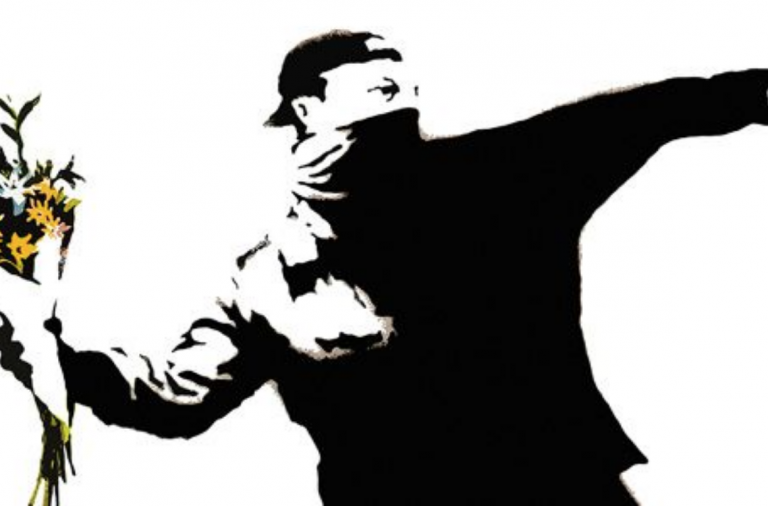
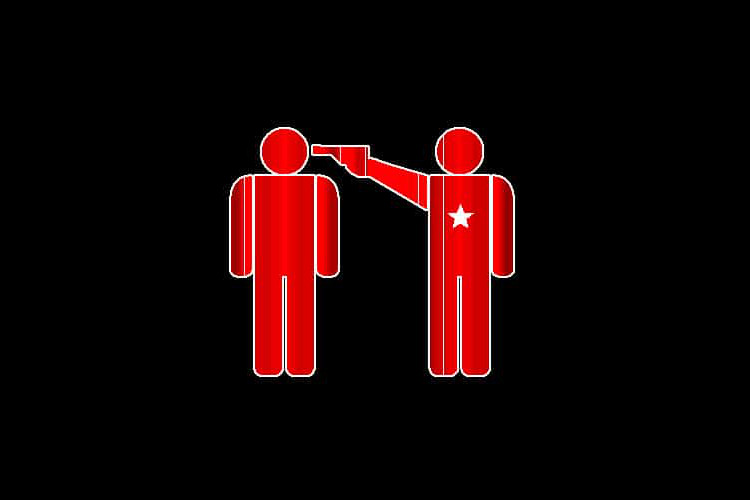
All flag worshipers have the same unhealthy religion: statism. Flag worship is a nationalist’s false idol. It doesn’t matter if you’re a sieg-heiling Nazi or a little kid singing the pledge of allegiance. It’s all parochial symbolism digging its tentacles into contemporary ideals. It leads to blind conformity, indoctrinated complacency, bloated pride, war, and people all too happy to choke on the blue pill of blind obedience to an outdated chain of command.

Flag worship is a psychosocial hang-up. It works because we are social creatures. But what begins as a symbol for unifying people becomes a symbol for dividing people when it is taken too seriously or too pridefully.

In a world of 195 nation states, all with their own flags, it behooves us to use the same reasoning that Aristotle used when he said, “It is the mark of an educated mind to be able to entertain a thought without accepting it,” and then apply it to the concept of flags. Better to entertain a flag without accepting its authority. That’s what anti-statists do. And so, anti-statists are free under all banners.

Statism keeps the world divided. Divided people are easier to control. As Maximilien Robespierre surmised, “The secret of freedom lies in educating people, whereas the secret in tyranny is in keeping them ignorant.” Anti-statists teach us how not to be ignorant statists. They teach us how to rise above our cultural conditioning and how to become well-informed free-range humans instead.

As Nietzsche famously explained, “State is the name of the coldest of all cold monsters. Coldly it lies; and this lie slips from its mouth: ‘I, the state, am the people.’” Anti-statists are here to remind us that we are NOT the state. We are free individuals who require others to be free so that we can remain free. It really is that simple. As Albert Camus said, “I rebel, therefore we exist.”

Statism only functions when unhealthy, divided individuals create an us-versus-them mentality. It cannot continue if people are healthy and connected. It cannot continue if people realize that freedom is paramount. In short: statism fails when enough people achieve a sense of freedom and wellbeing despite the state.

So how do you know if you’re a statist or not?

Here are seven tell-tale signs you may be a statist:

1.) You are a statist if you believe that you need a ruler to rule over you.

2.) You are a statist if you believe that you require permission to be free.

3.) You are a statist if you blindly worship a flag.

4.) You are a statist if you believe that violence is the solution to problems.

5.) You are a statist if you believe that people should be forced into doing things without their consent.

6.) You are a statist if you believe that an authority should make decisions for you.

7.) You are a statist if you believe in comfortable obedience over uncomfortable freedom.

Anti-statism is an alien concept in our world, even though statelessness can be extended to all living beings “in principle” and “in theory,” at its irreducible bedrock nature, it is exceptionally difficult to be sovereign and stateless. This is because the entire world is plagued with the disease of statism. Statism is so second-nature to our existence that we never question it.

We might as well be fish questioning water. But we are NOT fish. We are human beings with the ability for deep logic, higher reasoning, and basic common sense. As Alvaro Koplovich quipped, “A man without a government is like a fish without a bicycle.” Fish do not need bicycles. Just like mankind does not need government, though he is conditioned to think he does.

People are unlikely to question a system they’ve been indoctrinated into, even if that system goes against common sense, the golden rule, and the non-aggression principle. People are more likely to stick to what they’ve been conditioned to believe, whether that belief is judicial, political, religious or all three (statism).

Overcoming statism takes a particular flavor of courage that doesn’t readily exist in the average person. It’s a kind of courage that must be birthed through great psychological upheaval and the death of one’s cultural conditioning. It must be nursed and cultivated daily, lest it slip back into passivity or typical, ineffective, and outdated modes of courage. It must be guided by a unique and daring flavor of leadership: a radical leadership that checks and balances constructs of power and teaches others how to do the same. This is Anti-statism.

Freedom begins by overcoming false truths. A false truth is any belief that is deemed invalid according to universal laws. It’s our responsibility alone to figure this out. Nobody else can do it for us. It’s our responsibility alone to question what we’ve been taught.

What’s crucial to understand is that the concept of freedom is almost entirely psychological in nature. In today’s day and age, it is less about breaking free physically (from harsh overt slavery), and more about breaking free psychologically (from comfortable covert slavery). Breaking free psychologically is rising above the cultural conditioning and reconditioning our condition.

The anti-statist does this with pluck and aplomb, acting as both a beacon of light for those stuck in the dark (confused and disoriented) AND as a beacon of darkness for those blinded by the light (culturally conditioned).

Anti-statists force us to look into the cultural mirror. They teach us how to pour the statist Kool Aid down the sink. They teach us how and why to deny any authority that claims we need permission to be free. They teach us how to disobey inauthentic leadership and how to embrace authentic leadership instead. They teach us how to become leaders who teach others HOW to think rather than WHAT to think.

Where statism is comfortable slavery, anti-statism is uncomfortable freedom. The anti-statist is free and uses that freedom with the soul intent to free others. They escape tyranny by freeing others through the symbol of their own freedom. Thus, freedom begets more freedom.

As the folks at Academy of Ideas said, “Contrary to what statist propaganda teaches, freedom cannot be imposed on us from above, nor is it created or destroyed at the ballot box. Freedom emerges at a societal level when enough of us recognize its value and structure our lives accordingly.”

Freedom must find its limit in justice and justice must find its limit in freedom. Otherwise, we either find ourselves living in a free-for-all state of chaos where anybody can do anything without any consequences (like the movie The Purge), or we’re living in a violent authoritarian state with oppressive laws and the illusion of freedom (like statism). Ideally, freedom balanced with justice and justice balanced with freedom is the healthiest way.

Here are five anti-statist tactics to overcome statism:

1.) Don’t ask for permission to be free.

2.) Don’t pay for the guards to guard you.

3.) Learn self-defense and honor the nonaggression principle.

4.) Vote with your feet: Don’t vote in, vote out.

5.) Don’t rely on government; govern yourself.

(Further reading: The Best Way to Manage Slaves (and how to avoid becoming one.)

Though anti-statists are born into a profoundly sick society, they decide not to be a part of it. They decide to live in the “real” world, a world not tainted by the unhealthy culture that the false system has created. Although the unhealthy culture is something the anti-statist must deal with, it is not something they must be a part of unless they choose to.

The anti-statist takes up the mantle of freedom despite authority so that you, your mother, your daughters, and even your granddaughters can one day be free from the powers of false men. They feel it is their own responsibility, as truly free humans, to do something about the unhealthy state of affairs because nobody else will. Nobody else seems to have the capacity to do what the anti-statist can do.

A wise man once said, “All that is needed for the forces of evil to triumph is for good men and women to do nothing.” Thus, anti-statists refuse to do nothing. They don’t waste time talking about being good men. They ARE good men. They will not allow evil to triumph. Even if that means they must make the goody-two-shoes and snowflakes of the world uncomfortable. Even if that means they must be amoral in the face of shortsighted morality and blind immorality.

When the laws of a nation-state are moral and just, the anti-statist follows them. When they are immoral and unjust, the anti-statist breaks them. This is because the anti-statist has become a self-ruling, self-overcoming, amoral agent unto himself. He can see through the nationalism that blinds the statist and, for that reason, he is a forerunner regarding the healthy and progressive evolution of the species.

Where statists believe that you require permission to be free, anti-statists understand that you are required to be free. Where the statist believes that only the state can provide and protect one’s freedom, the anti-statist understands that it is the sole responsibility of each individual to provide and protect their own freedom and often it must be taken away from the state. As William Blake said, “I must create a system or be enslaved by another Man’s.”

At the end of the day, it comes down to taking personal responsibility. The anti-statist teaches us all that it is our sole responsibility to realize how we are caught up in the song and dance of an extremely dangerous religion known as statism. Statism is an avalanche of outdated cultural conditioning that has divided the world for too long. It is high time that we break the cascade of divisiveness.

If, as Voltaire warned, “No snowflake in an avalanche ever feels responsible,” then the anti-statist’s rebuttal is: if enough snowflakes take the responsibility to distance themselves from the avalanche, then there is no avalanche.

The Real Noam Chomsky

By Raul Fernandez Berriozabal

Source: The Wall Will Fall

This will not be a popular post, simply because of the cult of personality of mythical dimensions built around the figure of Professor Noam Chomsky, regardless, I am posting at the insistence of a friend of mine who encouraged me to publish my critiques highlighting some of the most problematic inconsistencies of Chomksy that ironically enough, have served to “manufacture consent” for the corrupt and criminal establishment that he claims to oppose.

I admit it, for years I admired Professor Chomsky’s work, in spite of his tedious monotone, he comes across as most clever and articulate, yet there is much more to this controversial character that many of his loyal followers perceive as a guru or cult figure and his critics as a faux progressive or a gatekeeper at best and a collaborator at worst.

Here are some of the inconsistencies that I have observed (and documented) during the last few years:

• In spite of the occasional criticism towards Israeli leadership, Chomsky ultimately supports the existence of the belligerent apartheid state of Israel.

• Chomsky opposes the Boycott, Divestment and Sanctions (BDS) Movement, a global non-violent campaign that uses economic and political pressure on Israel to end of Israeli occupation and colonization of Palestinian land, full equality for Arab-Palestinian citizens of Israel, respect for the right of return of Palestinian refugees and recognize the Palestinian people’s inalienable right to self-determination.

• Chomsky was a propagandist of the US/NATO aggression against the former Yugoslav Federation, enabling the criminal policy that broke the Yugoslav Federation into six unstable, impoverished micro-states after carrying out a 78-day bombing campaign in which US/NATO dropped over 3,000 bombs killing thousands of civilians.

• Chomsky said that the Western military intervention was the only way to prevent genocide in Libya, advocated for the ‘no fly zone’ and subsequent destruction of Libya. Every word he uttered turned out to be completely false. The allegations of abuses by the Libyan government were total war propaganda fabrications and look what happened to Libya, once the most prosperous nation in the African continent under Qaddafi who offered, public housing, free healthcare, free education, and many other public benefits to Libyans is now a failed state, a territory disputed by al-Qaeda, Daesh and other Wahhabi takfiri groups rival groups, where organ trafficking is prevalent, where, thousands of refugees drowning in the Mediterranean after paying human traffickers to take them to Europe in tiny, overloaded boats, where sub-Saharan Africans are openly sold as slaves for as little as $200 and where human life is worth not more than infected yeast.

What is Chomsky saying about Libya these days?

Has he assumed any responsibility for his role in manufacturing consent?

No, not at all, Professor Chomsky remains invested in openly advocating for regime change in Syria.

• Chomsky routinely parrots the corporate media lines by referring to Bashar Al Assad an autocrat who needs to be forcibly removed and seems to justify with the continuous bombing of the great Syrian nation to achieve regime change. As of today, he remains a strong advocate for the U.S. occupation forces to remain illegally occupying Syrian territory.

• Chomsky supported the U.S. led coup in Ukraine which successfully installed Europe’s first Nazi government since Adolph Hitler and his Third Reich.• Chomsky acknowledges the one-party corporate oligarchy, and then urges everyone to vote for the “lesser evil”. He did in 2008, 2012, 2016, 2020, He publicly supported the candidacy of war criminals, Barak Obama in 2008, Hillary Clinton “Butcher of Libya, Syria and Honduras” in 2016 and Crime Bill’s author, Joe Biden in 2020 just to maintain the status quo and hence a system of injustice that he claims to oppose.

• Chomsky is perfectly kosher with W Bush government’s official narrative of 9/11 – he went as far as to say, “who cares?” about who might be the real culprits of this historical event.

• Chomsky was academically formed by and works for MIT, an elitist university with close ties with the Military Industrial Complex and the CIA.

• Chomsky defines himself as an “anarcho-syndicalist” yet he defends the existence of the Federal Reserve – while Chomsky bemoans the widespread poverty in America and the Third World, he has never spoken publicly on the role of the Federal Reserve. Therefore, most leftist activists influenced by Chomsky remain unaware of the role played by this privately owned banking cartel which basically prints worthless flat currency out of thin air.

• Chomsky opposes the Right of Return of the Palestinian diaspora – which in essence is opposing international law, since the Right of Return is an inalienable and basic human right.

• These days, Chomsky has turned full-blown fascist as he called for the isolation of the unvaccinated from society even if that means their starvation. Chomsky’s most inflammatory comment came when he was asked how this isolated class he is proposing would receive food. He remarked that this was a problem for the unvaccinated. The solution then, according to Chomsky, is to appeal to moral capacity and then claim that those who do not understand should live in an isolated existence with food uncertainty. Please keep in mind that in his authoritarian views, Chomsky is oblivious to clinical data that shows that Covid vaccines do not prevent neither infection nor transmission, in fact, early data shows that the variant, Omicron is infecting those who are “fully vaccinated” at a much higher rate than the unvaccinated and American authorities also revealed the 79% of the country’s infection cases were vaccinated.

• In addition, Chomsky belittles the importance of Medicare for All in the midst of a global pandemic and cynically refers to it as “candy” to be pursued, but never achieved.In essence, Chomsky has made a career talking from both sides of his mouth while perfecting the art of manufacturing consent.

Chomsky talks like an anarchist during off years, then tucks tail and comes slinking back to the establishment during election years – that is why many refer to him as “controlled opposition” or “left gatekeeper”, this is why I have no use for Chomsky, and why it baffles me when people speak of him in tones of reverence and awe.

The Culture of Vehicular Attacks

On the Murder of Deona Marie Erickson

By CrimethInc.

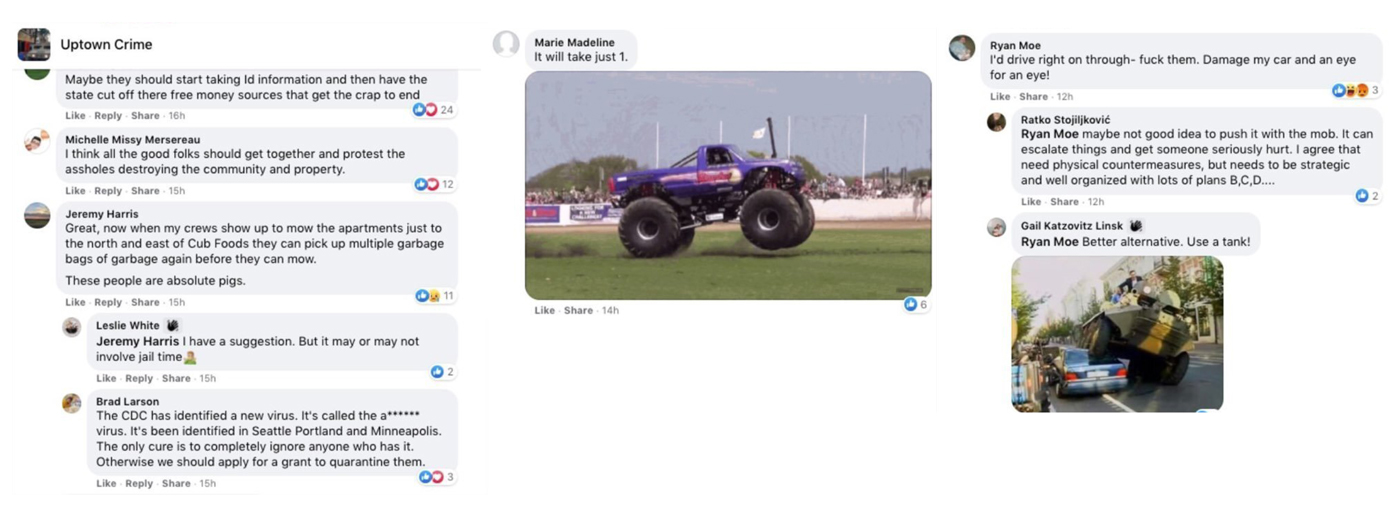
On June 13, a driver attacked a demonstration in Minneapolis, killing Deona Marie Erickson. This is the result of years of right-wing efforts to normalize—and even legalize—vehicular attacks. Now the corporate media has ceased to prioritize covering them, paving the way for more killings. In dialogue with our comrades at It’s Going Down and on the ground in Minneapolis, we have prepared the following reflections on the implications of this.


Shortly before midnight on June 13, while demonstrators gathered at Lake Street and Girard Avenue to protest the murder of Winston Smith by sheriff’s deputies and US Marshals, a man named Nicholas Kraus drove his SUV into the crowd at high speed, killing Deona Marie Erickson. One Black anti-fascist militant who was on the ground at the time of the attack reports that it was clear to those present that it was an intentional attack: “You heard his engine from three blocks away.”

According to Unicorn Riot,

“Deona Erickson’s car was parked on the side of the street in a way that would protect the people who were gathering. She was sitting down on the sidewalk about 15 feet from her car moments before the perpetrator smashed directly against her car at a very high speed. Witnesses say she was then hit by her car and sent flying. Street medics on the scene resuscitated her but she later died at the hospital.”

Deona Marie Erickson had two daughters. She worked as a program manager at a center for disabled adults. Today would have been her 32nd birthday. She gave her life to protect those who protest police murder.

Demonstrators detained the driver, Nicholas Kraus. Eyewitnesses dispute police allegations that he was “pulled from his car”; reportedly, police did not respond until after the attack, sending riot police to threaten the crowd before an ambulance could arrive. Under the circumstances, the demonstrators’ response was measured, to say the least.

https://twitter.com/aishaforward10/status/1404509174516625408


The Culture of Vehicular Attacks

Let’s put this attack in context.

Fox News and the Daily Caller circulated a video encouraging their viewers to carry out vehicular attacks against protesters months ahead of the fascist “Unite the Right” rally in Charlottesville at which a self-identified neo-Nazi did exactly that, killing Heather Heyer and injuring 35 people. Afterwards, leaked chats showed other neo-Nazis also planning to use vehicles to attack protesters.

In summer 2020, vehicular attacks surged in response to protests against the police murders of George Floyd, Breonna Taylor, and others. Over a dozen people were killed in these and other attacks on the movement.

https://twitter.com/IGD_News/status/1404699241570705408

Today, legislators around the United States are taking steps to criminalize protest activity, introducing a wide range of anti-protest bills. Foremost among them, Oklahoma and Florida lawmakers have passed laws guaranteeing civil and criminal immunity to drivers who hit demonstrators with vehicles, effectively granting vigilantes the right to crash cars into demonstrators. At the same time, Florida has introduced penalties of up to 15 years imprisonment for blocking traffic.

The message is clear enough. In short, lawmakers and police seek to crack down on pedestrians acting collectively to oppose state violence, while extending additional privileges to drivers who act individually to support state violence via their own attacks. The official institutions of the state have failed to leverage enough violence to suppress movements against police violence and white supremacy, so they are deputizing others to do so—a longstanding counterinsurgency strategy reflective of the colonial heritage of the United States.

On a fundamental level, the form of subjectivity that these lawmakers are promoting is what we might call a motorist subjectivity: consumerist, individualized, invested in the smooth functioning of the existing order, and regarding all other possibilities as threats. Structurally speaking, for the motorist, all other human beings—traffic as well as pedestrians—are obstacles, and the only imaginable journeys are dictated by the routes established by the state and the economy. The motorist wants to see the laws enforced on others, on the premise that it will reduce the ways that others might inconvenience him, but he doesn’t want the laws enforced on himself. Conceiving of our society as an entirely mapped world—the way that Google Maps does—in which all means of locomotion, all forms of agency, are individualized according to financial means, the motorist cannot imagine why people would assemble, off road or not, to challenge law enforcement itself.

As shocking as vehicular attacks are when they occur, they are an extension of the society in which they take place. They are anti-social, but they express and intensify the anti-social premises of our day-to-day relations with each other. Motorist versus pedestrian is a classic class opposition in a society in which transportation and mobility are fundamentally racialized. People who were raised on advertisements depicting jeeps off-roading across the suspiciously vacant landscape of the frontier only to find themselves sitting in bumper-to-bumper traffic on the freeway for an hour every day look around for someone to blame, and—as if by design—blame those with even less power than themselves. Road rage.

Right-wing online chatter in Minneapolis ahead of the attack that took Deona Marie Erickson’s life.

In this context, the chant “Whose streets? Our streets!” asserts another form of life, another way of relating to each other and conceiving of what our lives could be. Rather than framing vehicular attacks as aberrations from an otherwise peaceful social order—to be addressed, for example, by more policing—we have to understand them as one of the ugliest manifestations of a social structure that is fundamentally racist and anti-human, which can only be addressed via new forms of togetherness.

Honoring those whose lives have been taken by police and pro-police vigilantes is a first step towards this, and it is important that people have been doing this through shared presence in particular physical spaces. The internet—the information superhighway—tends to reinforce the motorist mentality of abstract competition and hostility. One of the most basic steps we can take towards creating a new social fabric on egalitarian terms is to encounter each other in person in ways that affirm the specificity of place.

This gives us more perspective on the ongoing efforts of city officials to evict the autonomous zone at the site where George Floyd was murdered, in order to open it up for “the free passage of traffic.” Rhetoric about “culture wars” is usually used to evoke a conflict between those on the fringe of the left and right, but here, we see centrist officials forcibly imposing a particular model for what our lives, relationships, and forms of grieving should be, even as they purport to be neutral.


Far-Right Murderers and Centrist Beneficiaries

Nicholas Kraus, a man with a history of domestic violence and abuse, is representative of the sort of dysfunctional, alienated men that far-right provocateurs aim to weaponize to carry out stochastic attacks on social movements.

This is effectively a watered-down version of the same strategy that ISIS has used in the Mideast in territories it does not control: taking advantage of the desperation, prejudice, and mental health issues of an entitled but disenfranchised population, the far right aims to disrupt popular mobilizations through consistent but deniable terror attacks. Their goal is to raise the risks of public organizing to such an extent that it becomes hard for movements to maintain momentum, in order to support state repression while opening up space for fascist groups to recruit and mobilize. In Turkey, this approach helped the despotic government of Recep Tayyip Erdoğan to crush what had been powerful social movements. The ultimate beneficiaries of this are not just far-right politicians, but also centrist capitalists who do not wish to see fundamental changes that could threaten their power.

Vigilante attacks are also advantageous for the city officials who would like to present themselves as “neutral” while suppressing the protest movements against the murders that the police they oversee regularly carry out. Vigilante attacks enable these officials to change the subject from the violence of the institutions they represent back to the question of how to “maintain order.”

“Some of these people with the megaphones, I guess their role is to get people riled up and get them in a space and march them around and educate them and tell them what their next big plans are and who they’re backing politics-wise and things like that.

“I like community, organic—no microphones, no megaphones, like right now. It’s about fifty people—but fifty people got Lake and Hennepin shut down right now, you know what I’m saying? We’re moving and grooving right now. As opposed to two or three hundred people holding signs, marching around, and then feeling accomplished, patting themselves on the back and then leaving—ain’t shit get shut down really. Police don’t even monitor the marches no more. No change will come from that.”

-Anonymous Black anti-fascist militant in Minneapolis, evening of June 15, 2021

But Who’s Paying Attention?

“You protested because it was trendy and ‘everyone was doing it.’ I protest because people are out here dying!”
-Deona Marie Erickson, June 10
In 2021, many liberals and progressives have left the streets, relying on the Biden administration to roll back the policies of the Trump administration. Consequently, the murder of Deona Marie Erickson has attracted considerably less attention than it might have just last year. This withdrawal from social struggles creates the conditions for more attacks like this to take place.
This reminds us of the situation before the murder of Heather Heyer made world news, when the far right carried out a series of murders around the United States without drawing the attention of corporate media. Corporate media outlets were only forced to cover the events in Charlottesville because it was not possible to sweep under the rug the fact that a thousand fascists had gathered in one place and killed a white woman. Because the events took news editors—though not anti-fascists—by surprise, they were not prepared to spin the story according to the preferences of their corporate backers; so for a week, fairly honest coverage of the threat represented by the far right suddenly appeared in a variety of news outlets. Subsequently, although this coverage was tempered by efforts to demonize anti-fascists, centrist media outlets continued to report on far-right attacks in order to associate them with the agenda of Donald Trump’s administration.
But now that centrists can’t leverage Deona Marie’s death against Trump, they are prepared to treat it as simply another sad facet of American life, to sweep it under the rug once more.
This coincides with widespread emotional numbness arising from several years of constant tragedies. The COVID-19 pandemic has already accustomed many people to thinking of human life as expendable. Last weekend saw multiple mass shootings across several states. Poverty has reached the highest levels since the beginning of the pandemic. These are the forces that drive desperate people to adopt far-right politics wherever there are no models for a collective pursuit of liberation, creating a feedback loop that will generate more and more tragedies.
“We keep us safe.” “We protect us.” These slogans spread far and wide in the course of the movements that burst onto the world stage in Ferguson, Missouri because it has become eminently apparent that no one else is going to protect us. Deona Marie died doing her best to keep her companions safe—to open up a space in which people can come to know each other on different terms, as part of a community premised on shared consideration for all human beings, not individualized capitalist competition. We should do the same, so that everyone like her, and like George Floyd, Breonna Taylor, and Winston Smith—might live. We should do the same, because the alternative means isolation, means eventually being treated as expendable ourselves.
“If the fascists would have run over Deona Marie and we would have not been holding space, not erected the barricades that the city just tried to tear down, then Deona Marie’s voice would be in vain. We’ve got to be out here. That fascist wins—that fascist who drove his car right here, he wins. ‘Oh, I got them off the street. They’re gone now. My fellow white supremacists can enjoy Lake Street now, because I got them fuckers off the street,’ you know what I’m saying?
“We’re out here stronger now. We have to be.”
-Anonymous Black anti-fascist militant in Minneapolis, June 15, 2021

https://twitter.com/TigerWorku/status/1404329351211016192

“Concerning Deona Marie”

From an internationalist anarchist woman in Rojava:
From half a world away, I hear about this sacrifice, this martyrdom. I use the words sacrifice and martyrdom and not the word “tragedy” because I am hearing about a woman comrade who chose to defend her community, and there are few things more beautiful and free in this world than that choice. She thought beyond herself, felt beyond her own personal safety, to defend those who struggled together side by side with her for freedom.
When a life is given and taken in struggle, it’s not an easy thing for those of us left to continue. It would dishonest for me to say this is not something heavy, but we do not have to let the weight of it become a burden—this weight can give us strength and power, and with it, we can continue her struggle.
Every martyr is another reason to continue, another example to hold ourselves up to. For every woman whose life they take, for every comrade, for every person who stands up to defend their community, whose light they try to extinguish, we can make sure that a hundred rise up in their place. The time when we could be separated on the basis of race, class and gender is coming to an end. When we sacrifice for each other in this way, as comrades, as people who share a freedom struggle, the methods of our enemies turn to dust.
This is the time for us to defend our communities like Deona did. Anything else, and we won’t have risen to her standard. Her choice to defend was a sacred act of love—let us all be led by it.
Revolutionary greetings, respect, and love from Rojava.

If the goal of those who seek to encourage vigilante attacks is to discourage movements based in direct action, this dovetails with the goals of city officials who seek to use the Non-Profit Industrial Complex to buy off a layer of activists to oppose and undermine effective strategies from within the movement. In that regard, one of the most important ways to prevent the attackers from achieving their goals is to preserve the horizontal, grassroots structure of movements against police, while continuing to emphasize systemic forms of white supremacist violence alongside vigilante attacks.

Collective Revolution And Individual Enlightening Are The Same Thing

By Caitlin Johnstone

Source: CaitlinJohnstone.com

Revolution–the real kind–is an inside job.

This is not a click-friendly fact to highlight. Whenever I talk about revolution as having more to do with sincere inner work than with demonstrations and pitchforks and the proletariat rising up against the bourgeoisie, I get met with a lot of blank stares and dead air. It’s much more click-friendly to talk about how terrible this or that politician or oligarch or media figure is and how they should be launched into the sun with a giant crossbow.

It’s true though. Revolution is an inside job.

This is not a click-friendly thing to say because it is not an egoically pleasing thing to say. When they ask why the world is screwed up and what to do about it, people want to be told that it’s because of those Bad Guys over there and they need to be put in their place by these Good Guys over here; they don’t want to be told they need to disentangle themselves from egoic consciousness so they can see clearly enough to operate in an efficacious way.

But it’s a fact.

This is not some new agey, metaphysical philosophical position. I’m not saying that there are no villains outside yourself or any of that dopey spiritual woo woo crap; there absolutely are horrible people in the world who absolutely are doing horrible things that have absolutely horrible consequences for all of us. I’m not saying that if you do inner work you’ll magically make the sociopathic elites who are manipulating humanity toward its doom somehow turn into nice people via some esoteric mystical principle or anything like that. And I’m definitely not saying not to organize, demonstrate or take large, decisive actions against establishment power structures.

What I am saying is that the most effective thing you can do to fight the bastards and create a healthy world is to bring clarity to your own inner processes, so that’s where your energy should be most emphasised.

Egos love being told that the problem and the solution exists outside in other people. Egos thrive on conflict and drama, so the more you make it about fighting others the better; hell it’s even more fun if you can make the case that traitors within your own ranks need to be fought because they have slightly different views from you. What egos don’t like to be told is that it’s the ego itself (or more specifically the belief in it) that is the problem.

But simply pouring your energy into fighting Bad Guys is not an efficacious means toward the end of a healthy world. People who do this find their efforts stagnated and ignored, which is a big part of why so many lifelong revolutionary-minded individuals wind up becoming bitter and jaded in their struggles.

This is because most people, even people who are relatively more awake than the general mainstream population, are severely confused. Most people simply are not conscious of the way their own perception and cognition is actually happening from moment to moment, so their perception and cognition are beholden to subconscious conditioning patterns which were set years or decades ago without any consideration as to whether they would be helpful later on or would be useful in rallying the masses to overthrow their capitalist oppressors. This is made infinitely more complex and confusing by the fact that vast troves of wealth go into manipulating the public away from revolution and toward establishment loyalism.

The word “enlightenment” has a ton of sticky baggage, and can make a shoddy pointer in the way it implies some lofty, elevated state that a very few special people can attain through great effort and then are finished. Really it’s just meant to point to the process of becoming aware of the way your own field of consciousness operates and the perceptual/cognitive habits that you’ve formed for interpreting/understanding your experience. For this purpose I prefer the word “enlightening“, since it suggests an ongoing process rather than some remote “done” state.

By emphasising your own enlightening, your energy is well spent eliminating the mental distortions and egoic sticking points which so often bog down dissident movements (and if you’ve spent any time in revolutionary-minded circles with your eyes even half-open you’ll know exactly what I’m talking about). Because you’re investing your energy in your own backyard, so to speak, you’re dealing with the one area of your life that you actually have some degree of control over. You have no influence over whether the left will espouse your particular vision of revolutionary action by November or whatever, but you absolutely do have influence over whether you’re operating from truth or from delusion.

By making a firm commitment to being ruthlessly honest with yourself and exploring your own inner dimensions via meditation, self-enquiry, contemplation etc, you are opening up the possibility of the birth of a true revolutionary: someone who both desires revolutionary change and has the clarity of vision to efficaciously help manifest it in the world. But first you must pursue the truth at any cost; not “the truth” about Bad Guys and secret societies, but the truth about you and your actual experience of this world. You must put truth, and the desire to know it, above all else.

In this way you are bringing to your own personal microcosm the transformation that we need to see in the outer societal macrocosm: you are enlightening yourself in the exact same way humanity as a whole needs to enlighten. Indeed, it is the exact same movement; your inner work is no more separable from humanity’s collective awakening than an individual antibody’s attack on a pathogen is separable from the entire immune system’s return to health.

A man named Ramana Maharshi once said “Your own Self-realization is the greatest gift you can render the world.” This is what your drive toward revolution is calling you home to. Not toward egoically pleasing conflict and drama, not toward a violent uprising which will inevitably see a reversion to the same preexisting conditioning patterns, but toward a transformation in yourself which will enable you to guide the world toward health in a lucid and efficacious way.

Political Collapse: The Center Cannot Hold

By Kirkpatrick Sale

Source: CounterPunch

Have you noticed? From Hong Kong to Baghdad, Paris to Tehran, 2019 is shaping up to be, as the New York Times dubbed it, “the year of the protest.” Violent—and often deadly—anti-government protests are breaking out throughout the world in an unprecedented fashion, in rich countries as well as poor, as people everywhere are expressing their anger at corrupt, inefficient, brutal, and unresponsive regimes.

But what isn’t so much in the news is worse—worse enough that they don’t want to tell you. At the moment, there are no less than 65 countries are now fighting wars—there are only 193 countries recognized by the United Nations, so that’s a third of the world. These are wars with modern weapons, organized troops, and serious casualties—five of them, like Afghanistan, Libya, Syria, Somalia, and Yemen, with 10,000 or more deaths a year, another 15 with more than 1,000 a year—all of them causing disruptions and disintegrations of all normal political and economic systems, leaving no attacked nation in a condition to protect and provide for its citizens. From 2015 to 2019 more state-based conflicts were engaged in than at any time since World War II, with an estimated 1 million deaths in all.

In addition, there are at least 638 other conflicts between various insurgent and separatist militias, armed drug bands, and terrorist organizations, increasing each year as states fail or collapse completely.

What has made the wars and internal disputes even more egregious as the years go on is that chaotic weather has a direct effect on how societies function. Agriculture, of course, is impacted by higher temperatures, lack of rain, droughts, and wildfires, and crops have failed in many places over the last five years, including North and Central Africa, the Middle East, India, Pakistan, northern China, northern Europe, Argentina, Brazil, Central America, and even parts of North America. The collapse of Syria, for example, and subsequent civil wars were made more devastating if not directly caused by the drought of 2006-2011, in which 75 per cent of the farms failed and 85 per cent of the livestock died. And an official United Nations report in 2019, by 100 experts from 52 countries, warned that things will only get worse, with the world’s land and water resources exploited at “unprecedented rates,” threatening “the ability of humanity to feed itself.”

One obvious consequence, beyond death, famine, disease and starvation, is, as the U.N. report’s lead author says, “a massive pressure for migration,” a desperate attempt to find some refuge and relief when homes have been destroyed and families are uprooted. According to the United Nations, in what I regard as a certain undercount, in 2019 there were 272 million migrants worldwide, up from 258 million in 2017, with the weather in 2019 causing more refugees even than warfare. (The unprecedented crisis at the U.S. southern border in 2019 is only one manifestation of the porous and chaotic collapse of boundaries across the Americas, Africa, and most of Asia.) And meanwhile, the International Committee of the Red Cross in 2018 estimated that more than 100,000 people are simply “missing,” a figure it admits “represents only a fraction” of those who are unaccounted for by any government or organization.

Given the turmoil over wars and immigration threats, it is not surprising that half the world is without coherent government.

Organizations that track these things say that of the 174 covered nations, 76 are in various stages of collapse—that would be 43 per cent—and that excludes a dozen smaller nations that are locked into autocracy and poverty. These include seven completely failed states—Congo-Brazzaville, Central African Republic, Syria, Yemen, Somalia, South Sudan, and Venezuela—and another seven that are on the edge—Guinea, Haiti, Iraq, Zimbabwe, Afghanistan, Chad, and the Sudan—plus 19 that are in an “alert” category, meaning that some but not all government functions have failed, 15 in Africa and 4 in Asia.

In other words, many political systems in the world have effectively collapsed, people are dispossessed and without governments, and almost everywhere else, including the U.S. and Europe, governments are severely strained and political rifts abound. The vote for Brexit in the U.K., the election of Donald Trump (and the subsequent attempts to overturn it), the turmoil that erupted in December 2018 in France and Belgium, the continued protests in Poland were all examples of the population of developed nations coming to see that the attempt to establish capitalist-led democracies in an internationalist arrangement of benefit to corporate and banking interests just was not working, and a rising segment of what were called “deplorables” in America did not want any longer to be powerless, manipulated, and disdained. These turmoils also demonstrated that the established powers in these countries, especially the U.S. and Britain, resisted all of these attempts to change the status quo and in effect ignored or tried to thwart the popular will (cf. the “impeachment” farce)—the developed world’s form of the failed state. Those fissures have widened as the years have worn on, and as one astute observer, James Kunstler, put it in 2019, “The West is enduring paroxysms of political uproar and disenchantment.”

And here’s something weird that sums it all up. It is the opinion of two recent political scientists that “the state system seems to be failing all over the world,” and they have proposed a new study called “archy” to examine how to grow, maintain, and fund states so as to avert their collapse. No better evidence of the seriousness of the world’s “uproar and disenchantment” can there be when academics need to create a discipline to overcome it.

Yeats summed it up some years ago: “The center cannot hold. Mere anarchy is loosed upon the world.”


Kirkpatrick Sale’s new book The Collapse of 2020 will be published in January.

The 4 Greatest Enemies of the State

By Gary Z McGee

Source: The Mind Unleashed

“It’s no measure of health to be well-adjusted to a profoundly sick society.” ~Krishnamurti

How do we know that our society is profoundly sick?

  • 1.) Our society pollutes the air it needs to breathe.
  • 2.) Our society pollutes the water it needs to drink.
  • 3.) Our society pollutes the food it needs to eat.
  • 4.) Our society pollutes the minds it needs to evolve with.

Any system that forces its people to breathe polluted air, drink polluted water, eat polluted food and then continue to do all the things that causes that pollution is a profoundly sick society.

It is in this fundamental way that human wellbeing itself has become the enemy of the state. Statism only functions with unhealthy, divided individuals. It cannot continue if people are healthy and connected. In short: statism fails when enough people achieve a sense of wellbeing despite it.

So, if wellbeing is the enemy of the state, then it stands to reason that anyone seeking wellbeing is also an enemy of the state. Just as those seeking health, vitality and freedom do well to be maladjusted to a profoundly sick society, those seeking wellbeing do well to become enemies of the state.

Freedom is the enemy of the state:

“State is the name of the coldest of all cold monsters. Coldly it lies; and this lie slips from its mouth: ‘I, the state, am the people.’” ~Nietzsche

Have no illusions, the curtailment of human freedom is the state’s business. At every turn the Goliath of the state rears its ugly head, checking the free movement of otherwise free individuals. It’s a monstrous Hydra of overreaching power, hellbent on keeping its people controlled, corralled, and contained under the illusion of security and safety, and under the rampant delusion of law and order.

No nation-state on the planet is genuinely free. All are falsely and insincerely “free.” They are only ever “free” inside the unhealthy box of their conditions. Therefore, they are not free. True freedom is allowing the free movement of people and allowing people to govern themselves under the guidance of the golden rule and the nonaggression principle.

So what is a free-range human to do in the face of such a monstrosity? Become David against Goliath. Become Heracles against Hydra. Become a well-armed lamb contesting all votes. Become lionhearted despite all cowards.

But before that, you must check yourself. You must become free. If you are not free, then you cannot be heroic. You must be free in order to gain the type of courage necessary to become. Full stop.

The golden rule is the enemy of the state:

“Live simply so that others may simply live.” ~Gandhi

Statism is the antithesis of the golden rule. Why is this? Because the state demands that you do unto each other as the state demands. This is the opposite of the golden rule.

The state tricks you into believing that the state is the people. But the state is not the people. It’s the illusion of a people. People are made up of individuals. Individuality is predicated upon freedom. Further freedom is predicated upon individuals allowing other individuals to be free. The state doesn’t allow individuals to be free. It only gives individuals “permission” to be free upon certain conditions, which is the illusion of freedom.

If freedom is the foundation of the golden rule, then consent is its backbone. Without consent there is only rape. Lest we allow rape, consent is paramount.

It’s simple: The difference between robbery and a good trade is consent. The difference between murder and assisted death is consent. The difference between rape and a healthy sexual encounter is consent. The difference between oppression and freedom is consent. The difference between coercion and voluntarism is consent. Consent is everything.

If I don’t want to trade my dollar for your twinkie and you steal my dollar anyway, that’s robbery, because I did not consent. If I don’t want to have sex with you but you have sex with me anyway, that’s rape, because I did not consent. If I feel that your arbitrary law is immoral and you force me to follow it anyway, that’s oppression, because I did not consent. If I don’t want to give up my money to your arbitrary tax system but you force me to do so anyway, that’s coercion, because I did not give my consent.

In order to be a healthy, responsible, moral, and just human being, you must allow others to give their consent. Otherwise, you are violating the golden rule.

If your values are based upon violence being the solution to problems, then your values violate the golden rule. If your values are based upon hindering the freedom of others, then your values violate the golden rule. If your values are based upon coercing people to give you money when they haven’t consented, then your values violate the golden rule.

Bottom line: if your values are based upon violating the golden rule, then your values are immoral, unjust and unhealthy.

Nonviolence is the enemy of the state:

“An eye for an eye makes the whole world blind.” But “When there is only a choice between cowardice and violence, I would advise violence.”~Gandhi

The state wants violent citizens so that it can control them. When people are nonviolent and compassionate toward each other the state doesn’t have an excuse to prevent freedom (though it will still make up excuses). When people are violent and intolerant toward each other the state has a reason to prevent freedom.

Nonviolence is the enemy of the state because the state’s solution to all problems is violence. When its citizenry comes up with nonviolent solutions it makes the state obsolete. But the state will always fight to maintain its overreaching power and control. So, in order not to become obsolete, it must maintain its violence.

The only thing that can prevent state violence is the people realizing that the state is not the people, and upon realizing this, choose to be nonviolent despite the violence of the state.

The flip side of this coin, however, is self-defense. The people must also wake up to the fact that they alone must defend themselves against violence. Whether that violence comes from an individual, a group of individuals, or from the state. The only time when violence is morally correct is in self-defense.

This can become a tricky psychological briar patch. But, basically, offensive violence is unhealthy and immoral (tyranny), whereas defensive violence is healthy and moral (justice). As Albert Camus said, “Absolute freedom mocks justice. Absolute justice denies freedom. To be fruitful, the two ideas must find their limits in each other.”

Peace is the enemy of the state:

“Never relinquish your ability to doubt, reflect, and consider other options –your rationality as an individual is your only protection against the madness that can overcome a group.” ~Robert Greene

If wellbeing, health, freedom, the golden rule, and nonviolence are all the enemy of the state, then what does that tell you?

Feel free to lose the wrestling match between your higher reasoning and your cognitive dissonance. I’ll wait here…

The bottom line is this: War is the only way any nation-state maintains itself. And yet love (peace, compassion, freedom, justice) is the only way humans can progressively evolve in a healthy way.

The state is always at war—with itself, with its citizens, with other states. There is no way out of its net of covert violence unless you leave it behind and become a free-range human. In order to be a lover of humanity one must become an enemy of the state.

The realization that in order to be a healthy, moral, and just human one must become an enemy of the state, is a tough pill to swallow. It’s not for the faint of heart. It will take counterintuitive reasoning to fully fathom it. It will require you to think outside of whatever box you’ve been conditioned to think inside of for most of your life. It will force you to unwash the brainwash. It will involve reprogramming your programming. It will demand that you question the profoundly sick society you were born into.

Most of all, it will require audacious courage in the face of comfortable cowardice. But, as Ralph Waldo Emerson wisely stated, “A man is to carry himself in the presence of all opposition. I ought to go upright and vital and speak the rude truth in all ways. Your goodness must have some edge to it—else it is none.”

When the state is unjust, citizens may use justifiable violence

By Jason Brennan

Source: aeon

If you see police choking someone to death – such as Eric Garner, the 43-year-old black horticulturalist wrestled down on the streets of New York City in 2014 – you might choose to pepper-spray them and flee. You might even save an innocent life. But what ethical considerations justify such dangerous heroics? (After all, the cops might arrest or kill you.) More important: do we have the right to defend ourselves and others from government injustice when government agents are following an unjust law? I think the answer is yes. But that view needs defending. Under what circumstances might active self-defense, including possible violence, be justified, as opposed to the passive resistance of civil disobedience that Americans generally applaud?

Civil disobedience is a public act that aims to create social or legal change. Think of Henry David Thoreau’s arrest in 1846 for refusing to pay taxes to fund the colonial exploits of the United States, or Martin Luther King Jr courting the ire of the authorities in 1963 to shame white America into respecting black civil rights. In such cases, disobedient citizens visibly break the law and accept punishment, so as to draw attention to a cause. But justifiable resistance need not have a civic character. It need not aim at changing the law, reforming dysfunctional institutions or replacing bad leaders. Sometimes, it is simply about stopping an immediate injustice­. If you stop a mugging, you are trying to stop that mugging in that moment, not trying to end muggings everywhere. Indeed, had you pepper-sprayed the police officer Daniel Pantaleo while he choked Eric Garner, you’d have been trying to save Garner, not reform US policing.

Generally, we agree that it’s wrong to lie, cheat, steal, deceive, manipulate, destroy property or attack people. But few of us think that the prohibitions against such actions are absolute. Commonsense morality holds that such actions are permissible in self-defense or in defense of others (even if the law doesn’t always agree). You may lie to the murderer at the door. You may smash the windows of the would-be kidnapper’s car. You may kill the would-be rapist.

Here’s a philosophical exercise. Imagine a situation in which a civilian commits an injustice, the kind against which you believe it is permissible to use deception, subterfuge or violence to defend yourself or others. For instance, imagine your friend makes an improper stop at a red light, and his dad, in anger, yanks him out of the car, beats the hell out of him, and continues to strike the back of his skull even after your friend lies subdued and prostrate. May you use violence, if it’s necessary to stop the father? Now imagine the same scene, except this time the attacker is a police officer in Ohio, and the victim is Richard Hubbard III, who in 2017 experienced just such an attack as described. Does that change things? Must you let the police officer possibly kill Hubbard rather than intervene?

Most people answer yes, believing that we are forbidden from stopping government agents who violate our rights. I find this puzzling. On this view, my neighbours can eliminate our right of self-defense and our rights to defend others by granting someone an office or passing a bad law. On this view, our rights to life, liberty, due process and security of person can disappear by political fiat – or even when a cop has a bad day. In When All Else Fails: The Ethics of Resistance to State Injustice (2019), I argue instead that we may act defensively against government agents under the same conditions in which we may act defensively against civilians. In my view, civilian and government agents are on a par, and we have identical rights of self-defense (and defense of others) against both. We should presume, by default, that government agents have no special immunity against self-defense, unless we can discover good reason to think otherwise. But it turns out that the leading arguments for special immunity are weak.

Some people say we may not defend ourselves against government injustice because governments and their agents have ‘authority’. (By definition, a government has authority over you if, and only if, it can oblige you to obey by fiat: you have to do what it says because it says so.) But the authority argument doesn’t work. It’s one thing to say that you have a duty to pay your taxes, show up for jury duty, or follow the speed limit. It is quite another to show that you are specifically bound to allow a government and its agents to use excessive violence and ignore your rights to due process. A central idea in liberalism is that whatever authority governments have is limited.

Others say that we should resist government injustice, but only through peaceful methods. Indeed, we should, but that doesn’t differentiate between self-defense against civilians or government. The common-law doctrine of self-defense is always governed by a necessity proviso: you may lie or use violence only if necessary, that is, only if peaceful actions are not as effective. But peaceful methods often fail to stop wrongdoing. Eric Garner peacefully complained: ‘I can’t breathe,’ until he drew his last breath.

Another argument is that we shouldn’t act as vigilantes. But invoking this point here misunderstands the antivigilante principle, which says that when there exists a workable public system of justice, you should defer to public agents trying, in good faith, to administer justice. So if cops attempt to stop a mugging, you shouldn’t insert yourself. But if they ignore or can’t stop a mugging, you may intervene. If the police themselves are the muggers – as in unjust civil forfeiture – the antivigilante principle does not forbid you from defending yourself. It insists you defer to more competent government agents when they administer justice, not that you must let them commit injustice.

Some people find my thesis too dangerous. They claim that it’s hard to know exactly when self-defense is justified; that people make mistakes, resisting when they should not. Perhaps. But that’s true of self-defense against civilians, too. No one says we lack a right of self-defense against each other because applying the principle is hard. Rather, some moral principles are hard to apply.

However, this objection gets the problem exactly backwards. In real life, people are too deferential and conformist in the face of government authority. They are all-too-willing to electrocute experimental subjects, gas Jews or bomb civilians when ordered to, and reluctant to stand up to political injustice. If anything, the dangerous thesis – the thesis that most people will mistakenly misapply – is that we should defer to government agents when they seem to act unjustly. Remember, self-defense against the state is about stopping an immediate injustice, not fixing broken rules.

Of course, strategic nonviolence is usually the most effective way to induce lasting social change. But we should not assume that strategic nonviolence of the sort that King practiced always works alone. Two recent books – Charles Cobb Jr’s This Nonviolent Stuff’ll Get You Killed (2014) and Akinyele Omowale Umoja’s We Will Shoot Back (2013) – show that the later ‘nonviolent’ phase of US civil rights activism succeeded (in so far as it has) only because, in earlier phases, black people armed themselves and shot back in self-defense. Once murderous mobs and white police learned that black people would fight back, they turned to less violent forms of oppression, and black people in turn began using nonviolent tactics. Defensive subterfuge, deceit and violence are rarely first resorts, but that doesn’t mean they are never justified.


Jason Brennan is associate professor of strategy, economics, ethics and public policy at Georgetown University. He is the author, together with Peter Jaworski, of Markets Without Limits (2015), and his latest book is When All Else Fails: The Ethics of Resistance to State Injustice (2019).

Building a Cooperative Economy

By Oliver Sylvester-Bradley

Source: Resilience

In permaculture terms the economy sometimes feels like a segregated monoculture planted with terminator seeds, sprayed with patented pesticides on venture capital backed farms designed to maximise profits in an unsustainable market place full of thieves and cheats. No wonder people prefer to potter in their gardens and allotments – and try to forget the craziness of corporate capitalism!

But no matter how much we try to ignore the corporate machine it ploughs on regardless and at various points in all of our lives we are forced to interact with the unsustainable, greed-based economy whether we like it or not. We all need to travel, buy energy, we like presents and holidays and now we are buying more and more of these goods and services online, from people we do not know.

As local banks close in favour of apps, local taxis are driven out by Uber and the likes of Airbnb and other holiday and comparison websites offer us ‘guaranteed savings’ – the brave new world of digital platforms is being thrust upon us, whether we like it or not.

The dominant form of business in our economy has not changed, but the method of delivery has. Platform businesses which reach further and wider than conventional ‘bricks and mortar’ businesses, that are able to ‘scale up’ and attract customers in their millions are forcing out the smaller players, just like supermarkets killed the traditional garden market. Except these “platform monopolies” are taking things to a new level – often unbeknown to us they’re gathering our data and using sophisticated algorithms to work out how to sell us more things, that quite often we don’t need or want. They’re aggregating data and dissintermediating in ways that we never knew were possible. Uber is valued at over 60 billion dollars but does not own a single taxi…

From monoculture to platform co-ops

To someone practicing permaculture, there is something almost offensive about vast fields where businesses cultivate the same single crop and, in a similar way, the exponents of ‘peer to peer’ and ‘open source’ technologies get equally offended by monolithic platforms that dominate the digital landscape.

Peer to peer, (where individuals share content with other people, rather than relying on centralised servers) and open source software (which is free to use and adapt, without requiring a licence fee) are like the digital community’s own versions of permaculture. They provide a pathway to greater independence, autonomy, diversity and resilience than is offered by the dominant system.

David Holmgreen’s ideas about creating small scale, copyable, adaptable solutions which have the power to change the world by creating decentralised, diverse, and more resilient systems have huge parallels with open source, collaborative software projects, which are developing as a response to the monolithic, proprietary and profit driven enclosures that dominate today’s Internet.

The end goal of this work is to create ‘platform cooperatives’, as alternatives to the venture capital backed platforms. Platform cooperatives that are member owned and democratically controlled – allowing everyone that is affected by the business, be they customers, suppliers, workers or investors, a say in how the business is run and managed. Co-ops are an inherently different form of organisation than Limited or Public companies, which place community before profit, hence have entirely different principles than their corporate rivals. For this reason they are more resilient in downturns, more responsible to their communities and environments and more effective at delivering real (not just financial) value to everyone they interact with.

Platform co-ops provide a template for a new kind of economy built on trust, mutual aid and respect for nature and community. By placing ownership firmly in the hands of the people and applying democratic forms of governance they offer a legitimate alternative to the defacto form of business. There are several platform co-ops that already provide comparable, and often better services than their corporate rivals and with more support others will continue to develop.

On 26 and 27 July the OPEN 2018 conference at Conway Hall in London will showcase platform co-ops such as The Open Food Network – which is linking up local food producers and consumers through Europe, Resonate – the music streaming co-op, and SMart from Belgium which provides support for a network of thousands of freelancers throughout Europe. The beginnings of a viable, self-supporting and sustainable economy are stating to emerge and OPEN 2018, along with similar events in the US and across Europe, is bringing together the people with the ideas, the tech developers and the legal experts to help catalyse the transition.

Shared values and the network effect

There are so many similarities between permaculture’s philosophy and principles and the works of other progressive groups that hope to encourage a more sustainable, more resilient and equitable future. From Occupy to Open sourcePermaculture to Peer to Peer and Collaborative Technology to the Commons Transition groups there are clearly overlapping values.

David Bollier, writing on the Peer to Peer Foundation blog has suggested that “…permaculturists and commoners need to connect more and learn from each other…” and the idea that these communities are ultimately working towards the same objective seems especially important to recognise if we are to accelerate the development of a more sustainable world.

There is already an evolving “shared narrative” between these various, disparate initiatives, but it is often sidelined by our self-selecting filters which lead us back into the communities we know and trust. Collaboration and cooperation can be hard work and as groups get bigger they can become harder still but that’s no reason not to try. The fact that Wikipedia provides a better encyclopaedia for free in more languages than Britannica ever managed proves that online, open source collaboration can deliver greater value than proprietary, closed source systems.

The true value of a collaborative, open networks only really manifests when its members communicate, and work together, through connected systems. Sharing ideas, discussing problems and addressing challenges in larger networks creates positive feedback loops via the network effect – a term which describes how the value of something increases in proportion to the number of people using it (like a phone, or social media network) – something all the various ethical and progressive networks could benefit from enormously.

Parallels between collaborative, open source software development and permaculture principles:

1. Observe and interact

Progressive software projects often utilise ‘user focused’ design strategies to ensure they meet people’s needs. Taking time to understand how users interact with software systems via user experience testing groups and an ongoing, iterative design processes are recognised to deliver higher quality solutions which suit specific user needs.

2. Catch and store energy

Peer to peer networks don’t rely on centralised servers but instead make use of the latent capacity of other user’s machines. Imagine how much more efficient it would be than deploying huge server farms if our computers were not shut off at night, or left idle, when they could be providing valuable processing power for others. The Holochain project aims to make it simple and secure for anyone to join a truly peer to peer network and to share files and processing power in this way – and to even earn credits for hosting other people’s files and applications.

3. Obtain a yield

The Peer Production License provides a means by which open source developers can make the code they develop available for free and still benefit from it’s use. Sites like the Internet of Ownership, which contains a directory of cooperative platforms use the PPL to “permit reuse exclusively for non-commercial and worker-owned enterprises” thereby helping to grow the commons. The ultimate goal of the PPL is to enable mechanisms so commoners can support themselves and ensure their own social reproduction without resorting to capitalism.

4. Apply self-regulation and accept feedback

This principle is particularly integral to open source development since the concepts of ‘user focussed’ and ‘agile development’, ‘branching’ and ‘forking’ are all designed to ensure that software projects are self-regulating by listening to the users needs, driven by user feedback and that they are able to be adapted to changing needs.

5. Use and value renewable resources and services

Open source technology is inherently more renewable in the way it enables the reuse and repackaging of code for new purposes. Ethically minded hosts and developers such as Green Net power their servers with renewable energy.

6. Produce no waste

As above, open source code is often re-used and repurposed but progressive developers still have a lot to gain from better collaboration. There are often multiple teams working on identical problems and ideas and whilst this has benefits in terms of developing strength and resilience through diversity it also leads to waste, mainly in terms of time. At least the waste ‘product’ of web development is only digital and so old technology and code doesn’t littler the streets or pollute the environment as much as physical products can, especially if archives are stored on renewably powered servers.

7. Design from patterns to details

Genuine online collaboration has been slow to evolve, with the best examples being Linux (the open source operating system), Firefox, the open source web browser and Wikipedia, the open source encyclopaedia. It is only recently, with the rise of monolithic capitalist gardens such as Google and Facebook and Amazon that the hive mind of the internet is recognising the need to step back and redesign its systems according to new patterns. The push for “Net neutrality” and Tim Berners-Lee’s Solid project are examples of this in action as is the Holo project, a very exciting and truly peer to peer “community of passionate humans building a distributed cloud, owned and run by users like you and me.”

8. Integrate rather than segregate

The move from centralised to decentralised, to distributed and federated technology is a a key element of open source and collaborative technology design. The entire Peer to Peer philosophy is based on the recognition that the connections and relationships between nodes (people or computers) in a network is what gives it strength and value. Collaborative technologists still have a lot to gain from developing deeper and wider integrations, like we see in nature, and which permaculturists know so well.

9. Use small and slow solutions

Designing a computer system to be slow is not something you will normally (ever?) hear a programmer talk about but they often talk about small, in many guises. Small packages (of code), small apps, “minified” (meaning compressed) code and even small computers, like the Raspberry Pi are key features of collaborative technology which all aim for increased efficiency.

10. Use and value diversity

Diversity is intrinsic to open source and collaborative technology. The plurality and adaptability of open source solutions ensures a highly diverse ecosystem. Users are free to adapt open source code to their needs and the open nature of most open source projects values contributions from anyone, irrespective of race, gender, age or any other factor. It is true that the majority of contributors to open source projects are normally young, white and male but the reasons for that seem more to do with societal inequalities and stereotypes rather than any specific prejudices or practices.

11. Use edges and value the marginal

The explanation of this principle places most value on “the interface between things…” and this is a central component of web design. Web services have now realised the necessity of providing intuitive user interfaces, to allow users to navigate complex data and to investigate deeper informational relationships but, more interestingly the latest developments in linked open data enable users to interface with more specific, more granular and more timely data to provide increase value. The Internet Of Things will facilitate a massive increase in the number and type of products which can interact over the internet. Whilst it is not the norm, drawing diverse information from the edges and valuing the marginal is something the open internet can really facilitate.

12. Creatively use and response to change

Most open source, collaborative projects use some kind of agile development, which advocates adaptive planning, evolutionary development, early delivery, and continuous improvement, and encourages rapid and flexible response to change. Permaculture and open source see eye to eye on this principle which bodes very well for a growing, symbiotic relationship in our rapidly evolving world.