Book Review: The Doomsday Machine

By Alex Cox

Source: Lobster Magazine

Until recently I only knew Daniel Ellsberg as the whistleblower who made the
Pentagon Papers public, and for his peace campaigning over the years. I had
no idea that prior to releasing a trove of documents related to the American
War in Vietnam, Ellsberg had been employed by the US Air Force at the RAND
corporation, as a nuclear war planner.

He had originally intended to reveal his nuclear war materials at the same
time as the Pentagon Papers, even though he knew he might face life
imprisonment for doing so. A bizarre series of events, recounted in The
Doomsday Machine, put them beyond the reach of both the FBI and the author.
There is much in Ellsberg’s book that is bizarre, if not amusing, as he recounts
what he learned about the workings of the nuclear-military-political complex. It
is disconcerting reading.

Ellsberg reveals the officially stated policy – that only the President can
authorise nuclear weapons use – to be a fiction. Based on what he learned
reviewing nuclear armed bases for RAND, there is delegation in the use of
nukes at every level. Local base commanders had discretion – or considered
they had it – to launch their nuclear bombers rather than risk losing them. As
in the film Dr Strangelove, there were envelopes aboard each plane containing
secret nuclear go codes (Strategic Air Command [SAC]’s one-size-fits-all
nuclear launch code was 00000000), but there were no recall orders.

As Ellsburg relates, base commanders and bomber pilots had real
autonomy to use their nukes; yet there was no system in place to stop them,
in the event (for example) of an error of judgment, or a presidential change of
heart. His description of the plans to get nuclear-equipped planes airborne at
US bases in Japan is grimly absurd. Smaller bombers were meant to take off in
neat rows, with other rows of bombers following seconds afterwards. Ellsberg
soon saw the possibility that a single pilot error could cause a catastrophic pileup, and atomic explosions, on the runway. Pilots who made it out, and other
US bases, would see or hear of the explosions and assume that Russian bombs
had landed . . . .

Not that it mattered where the US forces thought the bombs came from.
One of Ellsberg’s assignments was to find areas for flexibility in nuclear
weapons use. When he started working for RAND, the US Air Force had one
plan – SIOP, the Single Integrated Operating Plan – which involved a massive,
concerted nuclear weapons salvo against Russia, China, East Germany, Poland,
Hungary, and the other ‘Iron Curtain’ states. President Kennedy and his
defence chief, Robert McNamara, wanted some other options on the table,
besides instantaneous total destruction of all foreign communists and their
neighbours. Ellsberg tried hard to separate US nuclear war plans against
Russia from US nuclear war plans for China, but it was tough going. The Joint
Chiefs preferred one massive nuclear strike (‘general war’ or ‘central war’) to a
piecemeal one.

All the while, Ellsberg writes, he was morally opposed to the bombing of
cities, with the inevitable unnecessary loss of human life. In a brief aside he
recounts his friendship with Sam Cohen – another RAND specialist who liked to
be thought of as the ‘father of the Neutron Bomb’. 1

SIOP also worried Ellsberg since it was a plan for a first strike: all-out first
use of thousands of nuclear warheads against the Soviet Union and its allies, at
a time when the Russians had merely a handful of working atomic bombs.
RAND and Pentagon estimates of damage from nuclear weapons use never
included fire or firestorms; nor the spread of radiation into allied states; nor
the likely consequences for the climate. The consequences of nuclear weapons
use therefore being vastly underestimated, thousands of additional weapons
were built. In presidential briefings, the Pentagon was confident of prevailing
with a first strike: ‘if worst came to worst . . . a preemptive attack on the
Soviet Union would result in less than ten million deaths in the U.S.’

We now know that even a ‘small’ nuclear war – between India and
Pakistan, say – could have climate impacts which would cause billions of
deaths. ‘General’ or ‘central’ wars would do for just about all of us. Ellsberg
was foiled when he proposed changing US targeting policy so that Moscow
would not be destroyed in a first strike: at a NATO meeting, he was told that
even if SAC agreed to spare Moscow, the French would not. Moscow remained
a prime target for French nukes – and presumably for British ones, as well.

Over time, Ellsberg writes, the Russians and the Americans built a
‘doomsday machine’ very like the one Terry Southern envisaged in his script
for Stanley Kubrick’s Dr Strangelove. To protect them against surprise attack,
American and Russian nuclear weapons are numerous, widely dispersed, on
hair-trigger alert. In case the civilian or military leadership is killed, or unable
to communicate, the duty to launch those weapons has been delegated to
pretty much anyone capable of doing so. If the computers say a nuclear first
strike is incoming, if seismographs report massive, blast-style earth tremors, if contact with the leadership breaks down . . . someone will still be there to
push the button/insert the key code/flip the switch.

Ellsberg considers the bombing of civilians – whatever the weapons used –
to be a terrorist atrocity, not an act of war. He calls the ongoing nuclear
standoff between NATO and Russia a ‘moral catastrophe’. If you’re interested in
how close our silly species has come to wreaking its own imminent demise,
this is a valuable and fascinating book by a committed activist and excellent
writer.


1 I knew Sam Cohen, too, and he considered his Bomb to be a moral weapon, as it killed
fewer people than the Hydrogen Bomb, and left most of the physical infrastructure intact and potentially usable . . . at least once radiation levels dropped. Sam was insane, of course, but most of the people Ellsberg encountered on board the nuclear weapons project appear to have been insane, in the same way.

Alex Cox is a film-maker and writer.
He blogs at <https://alexcoxfilms.wordpress.com>.

Art and Dreaming: Realizing our Power to Co-Create Reality

By Ruth Gordon

Source: Reality Sandwich

“True creativity doesn’t just make things; it feeds what feeds life. In modern culture where people are no longer initiated, the spirit goes unfed. To be seen, the uninitiated create insane things, some destructive to life, to feel visible and powerful. These creations are touted as the real world. They are actually forms of untutored grief signaling a longing for the true reality of village togetherness.”

Martín Prechtel, Secrets of the Talking Jaguar, p.232

These words, from a book detailing Martín Prechtel’s initiation as a Mayan Shaman, accurately sum up our modern world. In the humanitarian, ecological, and political crises we are facing, we are witnessing the effects of a severe spiritual hunger.

We in the Western world are a deeply wounded culture; our Indigenous traditions long destroyed, our common land stolen by the rich and powerful, we often now desperately seek comfort by any means possible – over-consumption of food, of social media, of drugs and alcohol, of our natural resources.

This way of being is known among North American Indigenous people by the name of “wetiko,” or the “disease of the white man.” In the traditional Algonquin myth, the “wetiko” is a rapacious spirit who lives in the dark forest and possesses people, filling them with an insane compulsion to consume and destroy. This spirit makes monsters out of humans, filling them with an insatiable drive to devour everything that crosses their path.

Today, we see wetiko everywhere – in our cruel systems of governance that refuse sanctuary to refugees fleeing conflict, while at the same time escalating those very conflicts, mostly for the single purpose of the highest possible short-term profit, in the disintegration of human community through separating and atomizing social structures and the corresponding upsurge of loneliness and despair, and in the continued addiction to economic growth despite clear and repeated warnings that this kind of globalized industry is killing our planet.

Wetiko functions like a virus – it’s highly contagious and most of us are infected with it to some degree. It’s at the root of the human conflicts that often derail attempts to create alternative ways of life. It’s not enough to simply wish for a better world, it’s not even enough to work hard at creating one. We need to be ready to transform our entire mode of perception, to boil down our ways of thinking and being and reconstruct ourselves from scratch, with consciousness of the wetiko-ized habits we often fall into.

In Dispelling Wetiko: Breaking the Curse of Evil, Paul Levy writes:

“The evil that is incarnating in our world simultaneously beckons and potentially actualizes an expansion of consciousness, all depending on our recognition of what is being revealed. It is as if hidden in the darkness is a spark of light that has descended into its depths, and when recognized in the darkness, this light returns to its source.”

(Levy, 2013, p. 145)

Levy’s idea, that hidden in the poison of wetiko lies its own antidote, offers a healing reference for how to approach what Prechtel calls “untutored grief”: the fecund raw material that, if not used to grow something new, becomes destructive. However, when we are educated, or “initiated” into ways of transforming our grief, of understanding what the darkness in us wants to bring to light, we often find we have stumbled upon a store of incredible potentiality – an almost boundless source of energy and power that we can refocus towards healing, if we choose to do so. Our collective shadows are potential treasure, showing us wounds that need healing, the deep behavioral structures that create conflict, and pushing us to grow beyond our self-limiting patterns. We find the light by going through the dark, not by avoiding it. We can only unfold our full potential for love, beauty, and creativity by recognizing the life-force that’s bound up in our trauma. It’s releasing that closed-off and separated aspect of ourselves that will make us whole.

There’s an interesting symbolic parallel in the human compulsion to dig, mine and extract precious metal. If we instead dug into the fertile ground of our consciousness and our imagination rather than into the physical Earth, would we then finally be able to create a sustainable form of the “treasure” we long for – the “true reality of village togetherness,” so overcoming our addiction to exploiting the Earth?

Consciousness and Creativity: We are the Universe Observing Itself

In Quantum Revelation: A Radical Synthesis of Science and Spirituality, Paul Levy describes how the science of quantum mechanics, although yet to really inform our everyday mode of being, could be a gateway for us: enabling us to understand the dreamlike nature of the world, to reconnect with the divine and infinitely creative aspects of existence. The central insight of quantum mechanics is that quantum particles respond differently depending on whether we are observing them or not. They are waves when we do not observe them and become particles when we do. This implies that quantum matter somehow knows when it is being observed, and subsequently changes both its form and behavior. This points to an astounding idea: that the world we perceive not only perceives us, but also manifests itself depending on our very mode of perception. Or, to put it another way, that the world we encounter depends on how we dream it up. It seems as if there are infinite possibilities of reality. The one that is activated depends only on our capacity to envision it, on the expansiveness and daring of our imagination.

Levy goes even further, asserting that we are living in a world that consciously responds to our consciousness, that, in fact, has created us for the purpose of understanding itself:

“[T]hrough us, the universe questions itself and tries out various answers on itself in an effort parallel to our own to decipher its own being. In the process of observing and reflecting upon our universe we are actually changing the universe’s idea of itself.”

(Chapter 5, “Cosmogenesis,” 2018)

If Levy is right, we are part of a cosmos that is self-creating and self-understanding. It is as if, through consciousness, the universe is craning its neck around to look at itself. We are its eyes, and its senses.

If we want to escape the hold of wetiko, to transition to a way of life that serves all beings, we need to value the power of our own creativity, and to understand that we are always creating the reality we experience, whether we are aware of it or not. The more conscious we are of our creative power, the more we can use it to dream up a world we want to live in; to orchestrate our lives with the same skill and precision as a highly trained conductor.

For this, we need to build a network of communities, (as in Tamera’s Healing Biotopes Plan), where we can study the raw matter of our cultural grief, where we can learn to compost it, and use it to grow new life, where we can discover how to create the “village togetherness” we all long for. We need spaces where we can experiment with and test out our powers of dreaming, encountering, understanding and interacting with the dreamlike nature of reality. We need spaces where we can build the self-confidence and courage that a “life artist” needs. We need public forums where our “life-art” is seen and honored. And all this needs to happen in a large enough group of people for our actions to hold weight, gather momentum and give courage to others.

As Paul Levy writes:

“The universe is a collectively shared dream that is too seemingly dense and solidified for any one person’s change in perspective to transform, but when a critical mass of people get into alignment and consciously put together what I call our “sacred power of dreaming” (our innate power to dream the universe into materialization), we can, literally, change the (waking) dream we are having.”

(Levy, Chapter 5: “Self-Excited Circuit,” 2018)

This is why it is so vital to build communities of trust – we will not be able to change the reality we are currently experiencing alone. However, by cooperating with others we will find the power to co-create paradise on Earth: a reality in which war and violence will be completely unthinkable, where we honor and respect the Earth as the sacred life giver it is, where we are able to fully use the creative potential that lies coiled within each of us. The field-creating power of a group of people can both activate our imaginative potential and provide the vessel in which to create the life we long for.

Waking Up to the Dreamlike Nature of Reality

Paying attention to our powers of dreaming is a simple first step towards comprehending the dreamlike nature of reality, as even those of us who believe that we are “not artistic” still dream each and every night, effortlessly creating symbols and stories that resonate through and inform us, if we take the time to remember and listen to them.

In the Tzutujil culture that Prechtel describes, families gathered each morning to share their dreams, which they saw as being the other half of waking life – just as real, and just as important:

“To a shaman a dream is not a creation of the mind, psyche or soul. It is the remembered fragment of the experience of one’s natural spirit in the twin world, the dreamworld … Although the landscape of dreams may seem different than the landscape of the awake world, it is actually the balanced opposite, reversed version, where our souls live out our bodies’ lives reenacted as if in a complex kind of mirror. Like the two opposing wings of a butterfly, the dreamworld is one wing and the awake world is the other wing. The butterfly must have both wings connected at the Heart in order to fly and function. Neither wing – dreams or waking – contains all of life. Real life occurs as a result of the interaction between the two. The life is the butterfly’s heart, and both dreaming and awake life are necessary to keep the heart alive.”

(Secrets of the Talking Jaguar, pp. 169–170)

As Prechtel goes on to say, “dreams read life back to us like a storyteller” and as such, can be excellent and often uncanny guides in life. I’m sure all of us have had the experience of a dream that seems wiser than we are, a dream that gives an answer to a problem, or that seems to foretell future events.

I’ve experienced personally how dreams can come into creative play with waking life. I once had a powerful dream in which a man, who in my waking life I was on the brink of falling in love with, guided me as I climbed down a building. He was agile, he knew the structure well, as it was his parent’s house, and he helped me down, showing me where to put my hands and feet. After I had this dream, I felt a deep certainty that I could trust this man. I understood that his role in my life right now was to accompany and guide me so that I could move forward, leaving behind the old structures of thought and being that no longer served me (structures he knew well, that he’d also “climbed down from” before). In my waking life, I had very little basis for such a deep trust at that point. I’d known this man a few months. And yet the indication of this dream turned out to be true. It encouraged me to trust him as a guide, and in turn, this faith allowed him (perhaps even prompted him) to actually play out this role in my waking life.

Was this dream reality not only informing but actually creating waking life? I think so. By believing in the certainty this dream instilled in me, I was able to act with faith and courage, which then allowed trust and intimacy to develop in waking reality.

For me, this is an example of those twin butterfly wings of the dreamworld and the waking world meeting at the heart’s center. Both dreamworld and waking life kept my heart alive at that time, nourishing and feeding it. These dual realities prompted me to be an artist: to act on my desires and impulses, to paint the world as I wished it to be.

Consciously Shaping Reality

The consequence of accepting our own creative powers and the dreamlike logic of existence are that we can begin to consciously shape reality. This is a deep responsibility – not anything we can take lightly.

Wetiko disrupts our natural experience of unity with all life. But in truth, we are inextricably interrelated with all other living beings, in the same way that a whirlpool is both identifiably different and part of the river it forms in. This knowledge comes with an immense duty to everything else that exists.

Our every thought, our every action, has an effect on the whole, unavoidably altering everything else in some way, however subtle. We do not need to become megalomaniacs about this – we are no more and no less important than any other human, plant or animal being. But we must understand, if we are to overcome wetiko’s hold on us, that all life, and all activity, constantly shifts the pattern of the whole.

Once we realize this, our everyday lives become imbued with a new sense of purpose and responsibility. Knowing that what we think, say and do alters the whole, guiding a new form of reality into being in each and every moment, means considering carefully how we want to exist in this world. It’s much easier to believe that we are powerless; then we can escape any sense of responsibility. Victimhood is much more comfortable than agency. But if we want to realize the role human beings can play in global transformation, we must be willing to step into agency. We must understand that our inherent creative powers are a divine gift. We’ve been given the capacity to make drastic alterations to the world – in the natural environment, in human society, perhaps even to outer space. Now we must choose whether we want to use these gifts in service of life or continue using them against it—and so push ourselves off the brink of abyss.

Let’s choose to use the wetiko virus rampaging through our human system to actualize an expansion of consciousness, to shine a light deep into the roots of our “untutored grief,” and begin to dream into our potential as deeply creative beings with the ability to create the reality of togetherness that we all long for.

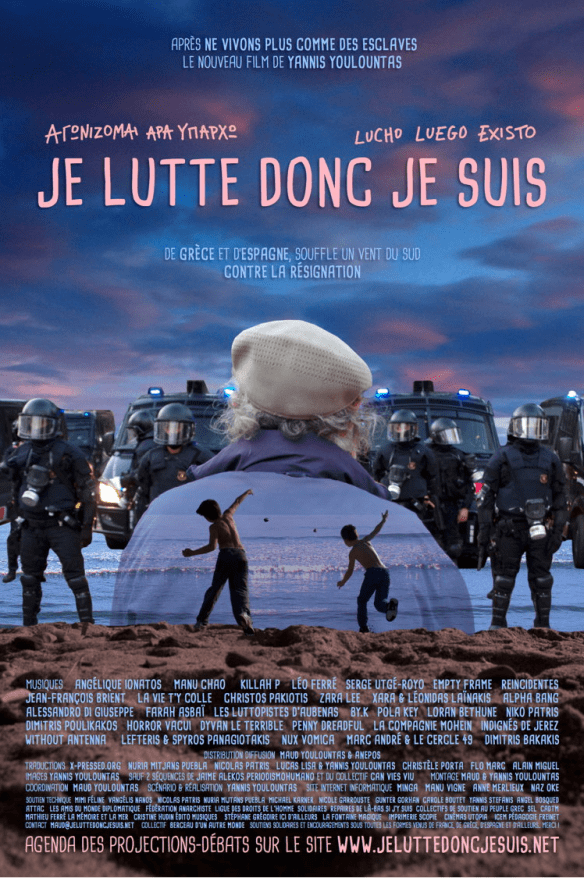
Saturday Matinee: I fight, therefore I am

I fight therefore I am (in french: Je lutte donc je suis) is a documentary film about social and political struggles in Greece and Spain which provides an overview of the struggles in Europe against austerity, capitalism and fascism. A musical journey celebrating Resistance from one end of the Mediterranean to the other. The title is made from the aphorism of the philosopher René Descartes Cogito Ergo Sum (I think therefore I am). Although it hasn’t been distributed by any mainstream company, it has enjoyed great success, and has been shown to numerous theaters, festivals, in France and in Europe.

Oceania, Eurasia and Eastasia Merger: Global Empire of Dystopia?

By Gilbert Mercier

Source: News Junkie Post

The nature of reality in times of universal confusion

The world and our interpretation of it are often at best an idea and, at worse, a figment of our imagination. In our full-blown Orwellian construct, the truths of some are the fake news of others. Invisible forces and undisclosed interests rule the world and its so-called leaders, who are mostly actor-puppets directed from scripted narratives. They largely live in an alternate universe where, if you repeat outlandish lies often and loudly enough, the disinformation becomes the unquestionable reality for countless people. Reality has become stranger than fiction because the conflicting narratives about what is supposed to be real are, by and large, fictional. They are cleverly crafted propaganda that manipulate by maximizing confusion. The masters of this craft have gutted familiar words of all meaning.

For example, at the heart of Oceania, the white-orange clown emperor, obsessed with walls to protect his subjects from southern brown invaders, told his adoring patrons and sycophants, “we renew our resolve that Oceania shall never be socialist!” The aging patricians gathered for the obligatory annual feast gave him a standing ovation, and loudly chanted “Oceania, Oceania, Oceania!…” This enthusiastic chanting from Oceania’s Patricians, except for the more dignified Supreme Elders and Commanders of the Praetorian Guard, repeated itself on cue at least four of five times, to celebrate the great universal superiority of the invincible mighty empire of the free and the brave! The egotistical emperor’s writers must have laughed as he served up their outstanding fictions to the empire’s docile subjects!

Schopenhauer’s relevant pessimism

In his essential book, The World as Will and Idea, the German philosopher Arthur Schopenhauer (1788-1860) contested the rationalist notion that reason alone gave humans the universal key to an infinitely complex, and often irrational, reality. He took the assessments Immanuel Kant had made in his Critique of Pure Reason a step further by adding the fundamental notion of sufficient reason. This was a less absolute concept of the relation of cause to effect, which he anchored in what he deemed to be four categories of human knowledge: science, morality, logic, and metaphysics. Schopenhauer’s work was in part a reaction to the overly optimistic vision of the rationalists, with Rene Descartes in the lead.

In his inherent pessimism, Schopenhauer turned out to be more realistic about the limitations of humans to grasp, not only the full elusive scope of reality, but also their own frailty and insignificance as a self. In these gloomy times of uncertainty and of a general dumbing-down effect in our impoverished global culture, Schopenhauer’s work helps to explain why most aspects of our existence, including our relationship with nature, are beyond most people’s comprehension. For most humans, the absolute reality is an extremely fragmented knowledge filtered through the prism of their perceptions.

Global empire of dystopia?

In other words, whether one lives in Oceania, Eurasia, or Eastasia, the definitions of reality and information have been tailored in these different places to different needs, but almost all the narratives fulfill opaque agendas whose main objectives are to keep people on edge and in despair. The brainwashing from most media makes nearly everybody thoroughly dazed and confused. The goal is to break the will of populations and beat their souls into submission. For this to work, dissent must be eradicated. Let’s face it, if we stay on course, Oceania, Eurasia and Eastasia could soon merge into the global Empire of Dystopia where 2+2=5. For example, Oceania claims that, with its satellite-vassals, the empire defeated ISIS, which it had worked to create, although it is the leader of sovereign Syria (with the help of Eurasia and the former empire of Persia) who defeated both Oceania and ISIS after seven years of war.

From one manufactured crisis to another, always in what my esteemed colleague Dady Chery calls “other people’s countries,” the mad circus goes on and on like a merry-go-round. And it works, so long as the big lies are salted with a little truth for seasoning. As world citizens, we are tasked with dismantling this monstrous global Orwellian Empire of many faces that is tightening its grip everywhere.

Empires of the past and present, which are in flux, have always extended their powers through satellite provinces and spheres of influence. Empires dislike dissent from within, as well as nearby states that are eager to stay independent and sovereign. During the simpler times of the Cold War when the United States and USSR tried to divide the world in two, some independently minded head of states, such as Tito, Nasser and Castro, refused to submit to this bipolarity and initiated the nonaligned movement. This notion must be urgently revisited, for the sake of the little that is left of smaller nations’ sovereignty.

Of course, Orwell’s cartography of the three entities of Oceania, Eurasia and Eastasia no longer reflects the geopolitical reality, but his principle of mass indoctrination is at play on a global scale. The narratives appear to be in conflict, but the nitty-gritty mechanics below the radar are similar. Under the surface, and despite the veneers of ideological or religious clashes, a global scheme of wealth and power concentration has been unleashed. Worldwide, the super-rich, and the corporate entities they control, are getting richer while the middle-class is vanishing and the poor are becoming enslaved. Merciless capitalism is the true god of the Orwellian Empire’s three subdivisions. Capitalism demands daily sacrifices of sweat, tears and blood. The system’s blatant contradictions do not trouble its ruling class. On one hand, pseudo nationalist-populists are the servants of a supra-national corporatism, and on the other, the so-called liberals and neoliberals can, on short notice, adopt the worst methods of authoritarian repression.

Two examples of this are unfolding that serve as valuable case studies. First, there is Oceania’s effort to grab a critical piece of what it views as its birthright continent. This is, of course, Venezuela. Secondly, in La Macronie, an eastern asset of Oceania that used to be an empire in its own right, there is the intent to create an authoritarian neoliberal regime with a metrosexual humanitarian touch, to curtail widespread popular protests.

Venezuela: Revolution is imperialism

Oceania has in its crosshair the sovereign state of Venezuela, founded by Simon Bolivar. All empires have precepts or doctrines that conveniently serve to expand their territories and influence by various means, including military invasions, organization of coups and, lately, severe economic sanctions to engineer failed states that become ripe for orchestrated revolutions. The nervous system of Oceania, in Washington DC, views Venezuela as a natural appendage, based on one of the oldest formative tenets of the empire: the Monroe Doctrine, concocted in 1823. It came about using the seemingly altruistic but false notion that the newly independent countries of Central and South America had to be protected from their old colonial masters. In time, it became a claim to all the Americas as the United States’ domain and backyard.

To topple the legitimately elected Venezuelan President, Nicolas Maduro, whom Washington does not like, the empire is again trying to manufacture a revolution led by someone it handpicked and groomed. The name of the man who currently aspires to be Oceania’s Governor in Venezuela hardly matters. Through the years, the strategy of fake revolution following economic sanctions has had mixed results: it failed in Iran in 2009; it worked against Qaddafi in Libya, combined with a small military intervention; it partially worked in Ukraine until Eurasia stepped in; it failed entirely in Syria, where Bashar al-Assad remains in power. With Venezuela’s military still firmly on his side, this strategy is unlikely to work with the heir of Hugo Chavez.

So far the aggression against Venezuela has served as a thorough head count of Oceania’s vassals and enemies. In the Americas, Bolivia, Cuba, Mexico, Nicaragua, and Uruguay have defied the with-or-against-us litmus test. The rest, including Canada, have aligned themselves with the imperial diktat that Maduro must go. It is the same with most of the European imperial colonies of Oceania, except for Italy and Greece. This is a clear demonstration that the leaders of most states in the European Union lack a foreign policy independent from Oceania and operate largely as governors for Oceania rather than heads of state.

Indeed, according to Mr. Temir Porras, who has worked as Nicolas Maduro’s chief-of-staff and a foreign-policy advisor to Hugo Chavez, the position of most EU countries in supporting Guaido reeks of “neocolonialist interference.” The eight-day “ultimatum to hold presidential elections before recognizing Juan Guaido is a schizophrenic and incomprehensible position.” Porras elaborates that it is “absurd to say that Juan Guaido represents a consensus with Maduro’s opposition in Venezuela,” and that Guaido from the far-right populist party, Voluntad Popular, was almost unknown in Venezuela two weeks ago.

On the opposite side, to go back to Orwell’s cartography lexicon, those that claim so far that “Maduro must stay,” besides the four Latin American countries named above, involve an interesting alliance of Eurasia, Eastasia, and the former Persian and Ottoman empires.

Gilets Jaunes: rays of sunshine on a bleak horizon

Meanwhile, in La Macronie, a beautiful land with a soil rich in its bounty of bread, wine and revolution, a real revolution is brewing from the streets. A little light flickers at the end of the tunnel of our gloomy path, it is like countless little rays of sunshine that try to brighten our dark days, it is the Gilets Jaunes movement. The little governor for Oceania, an arrogant and imperious man who might have liked to be king in a parallel universe, is trying to stop the flow of a tempestuous Gilets Jaunes river with rubber-bullet guns, riot-police shields, and repressive legislation. The disparity between his actions and his almost humanitarian discourse have lost him all credibility. In La Macronie, the governor, by curtailing the freedom to protest and freedom of the press, is testing a brand new form of oppression. It is a young elegant authoritarian regime, with a smile, that caters to the global elite of murderous capitalism. This is an important test, and many worldwide are counting on the Gilets Jaunes to prevail.


Editor’s Notes: Gilbert Mercier is the author of The Orwellian Empire. Photographs one, five, six, seven and eight from the archives of Jakob Reimann; two from the archive of Wackystuff; three from the archive of Philip Pacemaker; four by Daryn Moffitt; nine by Nicholas J. Potter; ten and eleven by Joka Madruga; and fourteen by Urban Nauth.

Banishing Truth

By Chris Hedges

Source: TruthDig

The investigative reporter Seymour Hersh, in his memoir “Reporter,” describes a moment when as a young reporter he overheard a Chicago cop admit to murdering an African-American man. The murdered man had been falsely described by police as a robbery suspect who had been shot while trying to avoid arrest. Hersh frantically called his editor to ask what to do.

“The editor urged me to do nothing,” he writes. “It would be my word versus that of all the cops involved, and all would accuse me of lying. The message was clear: I did not have a story. But of course I did.” He describes himself as “full of despair at my weakness and the weakness of a profession that dealt so easily with compromise and self-censorship.”

Hersh, the greatest investigative reporter of his generation, uncovered the U.S. military’s chemical weapons program, which used thousands of soldiers and volunteers, including pacifists from the Seventh-day Adventist Church, as unwitting human guinea pigs to measure the impact of biological agents including tularemia, yellow fever, Rift Valley fever and the plague. He broke the story of the My Lai massacre. He exposed Henry Kissinger’s wiretapping of his closest aides at the National Security Council (NSC) and journalists, the CIA’s funding of violent extremist groups to overthrow the Chilean President Salvador Allende, the CIA’s spying on domestic dissidents within the United States, the sadistic torture practices at the Abu Ghraib prison in Iraq by American soldiers and contractors and the lies told by the Obama administration about the raid that killed Osama bin Laden. Yet he begins his memoir by the candid admission, familiar to any reporter, that there are crimes and events committed by the powerful you never write about, at least if you want to keep your job. One of his laments in the book is his decision not to follow up on a report he received that disgraced President Richard Nixon had hit his wife, Pat, and she had ended up in an emergency room in California.

Reporters embedded with military units in Iraq and Afghanistan routinely witness atrocities and often war crimes committed by the U.S. military, yet they know that access is dependent on keeping quiet. This collusion between the press and the powerful is a fundamental feature of journalism, one that even someone as courageous as Hersh, at least a few times, was forced to accept. And yet, there comes a time when reporters, at least the good ones, decide to sacrifice their careers to tell the truth. Hersh, relentlessly chronicling the crimes of the late empire, including the widespread use of torture, indiscriminate military strikes on civilian targets and targeted assassinations, has for this reason been virtually blacklisted in the American media. And the loss of his voice—he used to work for The New York Times and later The New Yorker—is evidence that the press, always flawed, has now been neutered by corporate power. Hersh’s memoir is as much about his remarkable career as it is about the death of investigative journalism and the transformation of news into a national reality television show that subsists on gossip, invective, officially approved narratives and leaks and entertainment.

Investigative journalism depends not only on reporters such as Hersh, but as importantly on men and women inside the systems of power who have the moral courage to expose lies and make public crimes. Writing off any institution, no matter how nefarious the activity, as filled with the irredeemable is a mistake. “There are many officers, including generals and admirals, who understood that the oath of office they took was a commitment to uphold and defend the Constitution and not the President, or an immediate superior,” he writes. “They deserve my respect and got it. Want to be a good military reporter? Find those officers.” One of the heroes in Hersh’s book is Ron Ridenhour, who served in a combat unit in Vietnam and who initiated the army’s investigation into the My Lai massacre and generously helped Hersh track down eyewitnesses and participants.

The government’s wholesale surveillance, however, has crippled the ability of those with a conscience, such as Chelsea Manning or Edward Snowden, to expose the crimes of state and remain undetected. The Obama administration charged eight people under the Espionage Act of leaking to the media—Thomas Drake, Shamai Leibowitz, Stephen Kim, Chelsea Manning, Donald Sachtleben, Jeffrey Sterling, John Kiriakou and Edward Snowden—effectively ending the vital connection between investigative reporters and sources inside the government.

This government persecution has, by default, left the exposure of government lies, fraud and crimes to hackers. And this is the reason hackers, and those who publish their material such as Julian Assange at WikiLeaks, are relentlessly persecuted. The goal of the corporate state is to hermetically seal their activities, especially those that violate the law, from outside oversight or observation. And this goal is very far advanced.

Hersh notes throughout his memoir that, like all good reporters, he constantly battled his editors and fellow reporters as much as he did the government or corporations. There is a species of reporter you can see on most cable news programs and on the floor of the newsrooms at papers such as The New York Times who make their living as courtiers to the powerful. They will, at times, critique the excesses of power but never the virtues of the systems of power, including corporate capitalism or the motivations of the ruling elites. They detest reporters, like Hersh, whose reporting exposes their collusion.

The Bertrand Russell War Crimes Tribunal was held in 1967 in Europe during the Vietnam War. It included the testimony of three American soldiers who spoke of watching soldiers and Marines routinely pump indiscriminate rounds of ammunition into villages with no regard for civilian casualties. Most of the American press dismissed the findings of the tribunal.  The Times foreign affairs columnist, C.L. Sulzberger, launched a venomous attack against the Noble Prize-winning philosopher and mathematician, who was then 94 years old. Sulzberger, a member of the family that owned the paper, wrote that Russell had “outlived his own conscious idea and become clay in unscrupulous hands.” The tribunal, Sulzberger went on, “cannot fairly be laid at the door of the wasted peer whose bodily endurance outpaced his brain.”

Hersh, however, tipped off by the testimony at the tribunal, eventually uncovered the My Lai massacre. But no publication would touch it. Magazines such as Life and Look turned down the story. “I was devastated, and frightened by the extent of self-censorship I was encountering in my profession,” Hersh writes. He finally published the story with the obscure, anti-war Dispatch News Service. Major publications, including The New York Times, along with Newsweek and Time, ignored the report. Hersh kept digging. More lurid facts about the massacre came to light.  It became too big to dismiss, as hard as the mainstream media initially tried, and Hersh was awarded the 1970 Pulitzer Prize for International Reporting. The only officer convicted of the war crime, which left 106 men, women and children dead, was Lt. William Calley, who spent three months and 13 days in prison.

Papers like the New York Times pride themselves on their special access to the powerful, even if that access turns them into a public relations arm of the elites. This desire for access—which news organizations feel gives them prestige and an inside seat, although the information they are fed is usually lies or half-truths—pits conscientious reporters like Hersh against most editors and reporters in the newsroom. Hersh, who at the time was working for the Times, describes sitting across from another reporter, Bernard Gwertzman, who was covering Henry Kissinger and the NSC.

“There was a near-daily ritual involving Bernie that stunned me,” Hersh writes. “On far too many afternoons around 5:00, Max Frankel’s secretary would approach Bernie and tell him that Max [the Times’ bureau chief in Washington] was at that moment on the phone with ‘Henry’ and the call would soon he switched to him. Sure enough, in a few moments Bernie would avidly begin scratching notes as he listened to Kissinger—he listened far more than he talked—and the result was a foreign policy story that invariably led the paper the next morning, with quotes from an unnamed senior government official. After a week or two of observing the process, I asked the always affable and straightforward Bernie if he ever checked what Henry was telling him with Bill Rogers, the secretary of state, or Mel Laird at the Pentagon. “Oh no,’ he said. ‘If I did that, Henry wouldn’t speak to us.’”

The Washington Post broke the Watergate story, in which operatives for the Nixon White House in June 1972 broke into the Democratic National Committee headquarters in the Watergate office complex in Washington while Hersh was at the Times. Kissinger’s assurances—Hersh writes that Kissinger “lied the way most people breathed”—that it was not an event of consequence saw the top editors at The New York Times initially ignore it. The paper, however, finally embarrassed by the revelations in The Washington Post, threw Hersh onto the story, although the paper’s executive editor, Abe Rosenthal, called Hersh with a mixture of affection and wariness “my little commie.”

Hersh left the paper after a massive expose he and Jeff Gerth wrote about the corporation Gulf and Western, which carried out fraud, abuse, tax avoidance and had connections with the mob, was rewritten by cautious and timid editors. Charles Bluhdorn, the CEO of Gulf and Western, socialized with the publisher Arthur “Punch” Sulzberger. Bluhdorn used his connections at the paper to discredit Hersh and Gerth, as well as bombard the paper with accusatory letters and menacing phone calls. When Hersh filed his 15,000-word expose, the business editor, John Lee, and “his ass-kissing coterie of moronic editors,” perhaps fearful of being sued, neutered it. It was one thing, Hersh found, to go up against a public institution. It was something else to take on a private institution. He would never again work regularly for a newspaper.

“The experience was frustrating and enervating,” he writes. “Writing about corporate America had sapped my energy, disappointed the editors, and unnerved me. There would be no check on corporate America, I feared: Greed had won out. The ugly fight with Gulf and Western had rattled the publisher and the editors to the point that the editors who ran the business pages had been allowed to vitiate and undercut the good work Jeff and I had done. … The courage the Times had shown in confronting the wrath of a president and an attorney general in the crisis over the Pentagon Papers in 1971 was nowhere to be seen when confronted by a gaggle of corporate con men. …”

His reporting, however, continued to relentlessly expose the falsifications in official narratives. The Navy intelligence official, Jonathan Pollard, for example, had been caught spying for Israel in 1985 and given a life sentence. Hersh found that Pollard primarily stole documents on how the United States spied on the Soviet Union. The Israeli government, Hersh suspected, “was trading Pollard’s information to Moscow in exchange for the emigration of Soviet Jews with skills and expertise needed by Israel.” Pollard was released, after heavy Israeli pressure, in 2015 and now lives in Israel.

The later part of Hersh’s career is the most distressing. He was writing for The New Yorker when Barack Obama was elected president. David Remnick, the magazine’s editor, socialized with Obama and was apparently wary of offending the president. When Hersh exposed the fictitious narrative spun out by the Obama administration about the killing of Bin Laden, the magazine killed the story, running instead a report about the raid, provided by the administration, from the point of view of one of the SEALs who was on the mission. Hersh resigned. He published the account of the raid in the London Review of Books, the beginning of his current exile to foreign publications. When we most urgently need Hersh and good investigative reporters like him, they have largely disappeared. A democracy, at best, tolerates them. A failed democracy, like ours, banishes them, and when it does, it kills its press.

How To Tell If Someone Is Controlled Opposition

By Caitlin Johnstone

Source: CaitlinJohnstone.com

Every day in my article comments and social media I get people warning me that this or that journalist, activist or politician is “controlled opposition”, meaning someone who pretends to oppose the establishment while covertly serving it. These warnings usually come after I’ve shared or written about something a dissident figure has said or done, and are usually accompanied by an admonishment not to ever do so again lest I spread their malign influence. If you’ve been involved in any kind of anti-establishment activism for any length of time, you’ve probably encountered this yourself.

Paranoia pervades dissident circles of all sorts, and it’s not entirely without merit, since establishment infiltration of political movements is the norm, not the exception. This article by Truthout documents multiple instances in which movements like the 1968 Chicago DNC protest and Peter Camejo’s 1976 anti-establishment presidential campaign were so heavily infiltrated by opaque government agencies that one out of every six people involved in them were secretly working for the feds. This trend of infiltration is known to have continued into the current day with movements like Occupy and Black Lives Matter, and we’d be ignorant not to assume that this has been at least as rampant in online circles where people organize and disseminate ideas and information.

So it’s understandable that people are extremely vigilant about prominent figures in dissident circles, and it’s understandable that people feel paranoid. Over and over again we see shining anti-establishment movements fizzle or rendered impotent, often seemingly with the help of people we once trusted, and it’s hard not to get frustrated and become suspicious of anyone who starts shining bright in antiwar, leftist, or other dissident circles.

The trouble with this paranoia and suspicion is that it doesn’t seem to function with any kind of intelligence. I have received such “controlled opposition” warnings about pretty much every prominent dissident figure in the English-speaking world at one time or another, and if I believed them all there’d be no one in the world whose words I could share or write about, including my own. I myself have been accused at different times of being a “plant” for the CIA, the Russians, Assad, the Chinese Communist Party, the Iranian mullahs, the alt-right, Trump, Pyongyang, and the Palestinians, which if all true would make me a very busy girl indeed. Since I know I’m not a plant for anybody, I know for myself that such accusations don’t come from a place of insight with any degree of reliability, and I’ve therefore had to find my own way to navigate this confusing landscape.

So since I know that infiltration and manipulation happens, but I don’t find other people’s whisperings about “controlled opposition” useful, how do I figure out who’s trustworthy and who isn’t? How do I figure out who it’s safe to cite in my work and who to avoid? How do I separate the fool’s gold from the genuine article? The shit from the Shinola?

Here is my answer: I don’t.

I spend no mental energy whatsoever concerning myself with who may or may not be a secret pro-establishment influencer, and for good reason. There’s no way to know for sure if an individual is secretly scheming to sheep dog the populace into support for the status quo, and as long as government agencies remain opaque and unaccountable there will never be a way to know who might be secretly working for them. What I can know is (A) what I’ve learned about the world, (B) the ways the political/media class is lying about what I know about the world, and (C) when someone says something which highlights those lies. I therefore pay attention solely to the message, and no attention to what may or may not be the hidden underlying agenda of the messenger.

In other words, if someone says something which disrupts establishment narratives, I help elevate what they’re saying in that specific instance. I do this not because I know that the speaker is legit and uncorrupted, but because their message in that moment is worthy of elevation. You can navigate the entire political/media landscape in this way.

Since society is made of narrative and power ultimately rests in the hands of those who are able to control those narratives, it makes no sense to fixate on individuals and it makes perfect sense to focus on narrative. What narratives are being pushed by those in power? How are those narratives being disrupted, undermined and debunked by things that are being said by dissident voices? This is the most effective lens through which to view the battle against the unelected power establishment which is crushing us all to death, not some childish fixation on who should or shouldn’t be our hero.

Have no heroes. Trust nobody but your own inner sense-maker. If someone says something that disrupts establishment narratives based on what you understand those narratives to be, go ahead and help throw what they’re saying into the gears of the machine. Don’t make a religion out of it, don’t get attached to it, just use it as a weapon to attack the narrative matrix.

This by the way is also a useful lens to look through in spiritual development, if you’re into that sort of thing. When you enter spiritual circles concerned with enlightenment, you’ll see all sorts of debates about what teachers are really enlightened and which ones are just pretending, and these conversations mimic precisely the exact kinds of debates you’ll see in marginalized political circles about who’s the real deal and who’s controlled opposition. But the truth is there’s no way to know with certainty what’s going on in someone else’s head, and the best thing to do is to stop concerning yourself with who has and has not attained some special realization or whatever and just focus on what they’re saying. If a spiritual teacher says something which helps you notice something you’d never noticed before about consciousness or perception, then use what they said and maybe stick around to see if they have anything else useful to say. If not, move on.

There’s no reason to worry about what journalists, activists and politicians are coming from a place of authenticity if you know yourself to be coming from a place of authenticity. As you learn more about the world and get better at distinguishing fact from narrative, you will get better and better at seeing the narrative matrix clearly, and you’ll come to see all the things that are being said about what’s going on in the world as weapons in the battle of narrative control. Pick up whatever weapons seem useful to you and use them in whatever ways they’ll be useful, without wasting energy concerning yourself with the individuals who created them. Call the bullshit what it is and use the truth for what it is.

Or maybe I’m fulla shit! Maybe I myself am being paid to say these things by some powerful influencer; you can’t know for sure. All you can know is what’s useful for you. If you really find it useful to try and organize individual dissident figures into “hero” and “controlled opposition” boxes, if that genuinely helps you take apart the system that’s hurting us all, you’d know that better than I would. But if you find what I’m saying here useful, pick it up and add it to your toolbox.

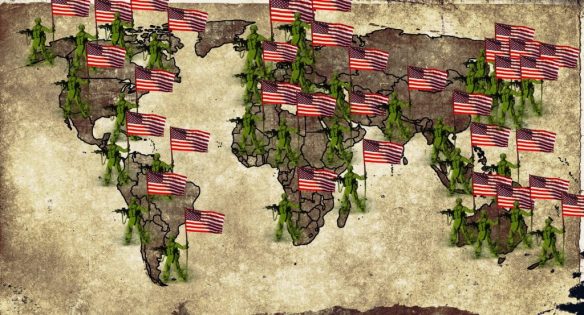
Fuck You, Dying American Empire: Reflections of an Aging Anti-Imperialist

Credit: JOEL PETT

By Jonah Raskin

Source: CounterPunch

Last year at Jamia Millia Islamia Central University in New Delhi, India I met students and teachers who thought that it was cool that I’d written an anti-imperialist book and that it was still in print nearly fifty years after it was first published. It was easy to be an anti-imperialist at Jamia Millia. After all, the students and the teachers were anti-imperialists and all worked-up about U.S. drones, U.S. air strikes and about the Syrians on the ground who had been battered and bombed.

It was also relatively easy to be an anti-imperialist in the late 1960s and early 1970s when anti-imperialism was a red badge of courage in SDS, the Venceremos Brigade, in anti-war circles and even among the Yippies, who were far more internationalist in their outlook than many on the Left assumed. Once upon a time, Jerry Rubin went to Cuba to check out the revolution, and later to Chile with singer and songwriter, Phil Ochs, to see what Salvador Allende was doing.

But here in the U.S. in 2018, is it still possible to be an authentic anti-imperialist, an anti-imperialist in more than name? I thought about that question recently when a former comrade explained that he was still an anti-imperialist and wondered if I was one, too.

It wasn’t the first time that my politics were questioned. In 1980, soon after Reagan was elected president, Professor Edward Said asked me if I was still on the Left and hadn’t drifted to the right like that former radical, David Horowitz, whom Alexander Cockburn dismissed as a “whiner.” A plain “Yes,” or a “No” answer wouldn’t do, nor a “Maybe.”

Am I now and have I ever been an anti- imperialist? It’s really nobody’s business but my own!

I don’t know anyone in my part of northern California who calls himself or herself an anti-imperialist, though friends and neighbors claim to be against racism, sexism, patriarchy and ageism.

U.S. anti-imperialism has a noble lineage. Mark Twain was an anti-imperialist and so was his friend and fellow writer, William Dean Howells. They both belonged to the American Anti-Imperialist League that was founded in 1898 to oppose the U.S. annexation of the Philippines and whose members included an odd assortment of individuals such as Jane Addams, Josephine Shaw Lowell, Henry James, David Starr Jordan, Grover Cleveland and Andrew Carnegie.

The League, which didn’t oppose U.S. entry into World War I, disbanded in 1920 just as U.S. imperialism was flexing its global muscles more than every before, though from its founding the American republic aimed to go West and become a continental empire.

Then, in the twentieth-century, the nation began to shrink the globe big time, to extract labor from peasants and workers in Asia and Africa and export American light bulbs, American Gatling guns, American lingo—“Kilroy Was Here”—and American movies.

Cultural imperialism always bugged me more than any other aspect of imperialism. I hated to see U.S. cultural commodities supplant indigenous cultures. That sight still rankles me, whether I see it in India, Mexico or the American South West. Every time I see and hear about the survival of ancient myths, legends, dances and music I’m ready to cheer.

Membership in an anti-imperialist league or organization makes sense, but to be an anti-imperialist of one in a sea of California anti-intellectualism and provincialism—“We’re number one”—has little or no meaning to me. Why be an anti-imperialist in name only? No, thanks! I don’t mean to live off past glory, though it was a thrill to meet students in India who had studied The Mythology of Imperialism and who told me it was the first book they’d ever read in which they could hear that the author was angry. That was me! I was pissed.

At 77, it’s not possible to be angry with the same intensity that I was angry at 27 when I wrote my anti-imperialist book in-between rioting in the streets, spray painting slogans at Times Square at midnight, going to jail and having the cops kick the shit out of me. I don’t know of any other way to be an anti-imperialist except the way I was an anti-imperialist during the War in Vietnam.

Indeed, it’s no easy feat to be an old anti-imperialist. Che died at 39, Lenin at 53 and Mark Twain at 74. The author of The Adventures of Huckleberry Finn and A Connecticut Yankee in King Arthur’s Court, which takes a big swipe at weapons of mass destruction, noted near the end of his life, “I am always on the side of the revolutionists, because there never was a revolution unless there were some oppressive and intolerable conditions against which to revolute.” Thanks, Mr. Twain. I’m glad you said that.

Today, there are so many oppressive and intolerable conditions the world over, and so many different imperialisms: the Chinese, the Russian, the India, the Israeli, the Brazilian and the U.S. It was comforting in the 1960s and 1970s to recognize that the American Empire was in decline and that the Soviets, the Vietnamese and the Chinese stood up to the Pentagon. Gratifying, too, that crowds in Paris, Rome, and London denounced the U.S. invasion and occupation of Vietnam, Laos and Cambodia.

Now, who stands up to the White House, the Senate, Google, Facebook and Amazon? Precious few citizens! Empires have proliferated and reinvented themselves. The American Empire is still in decline, though as George Lucas noted in 1980 it did “Strike Back” with Reagan, and later with Bush I, Bush II, Clinton and Obama.

An empire in decline—whether Roman, British, or American—isn’t a pretty thing. It can take decades to fall apart. I saw that when I lived in England. An Empire in decline isn’t really anything to cheer about. Indeed, the fall of empire makes life miserable for migrants, serfs, slaves, refugees, prisoners, pensioners and even for aging anti-imperialists. Maybe it’s a cheap shot. I don’t care. I’ll say it here, “Goodbye and Fuck you, American Empire.”

Bust the Trust: Now is the Time to Break Up Amazon

By Andy Laties with additional reporting by Sander Hicks

Source: The New York Megaphone

Standing at the cash register at an Upper West Side independent bookstore I used to run, I once noted the frequent passage of cars painted all over with Amazon’s “And You’re Done” logo. These same-day delivery vehicles were Amazon’s way of pushing back against the resurgence of New York City independent bookselling in progress. Soon, the cars were joined by a Columbus Circle location of the Amazon Books chain. That brick-and-mortar store gave lie to Amazon’s long-standing rhetoric that physical bookstores were doomed.

I have competed with Amazon for twenty years. A couple years ago, we indies were finally winning. 2015 was a great year. More independent stores were opening than closing: Books Are Magic, Greenlight, Word Up, Stories, Archestratus Books & Foods, Astoria Bookshop and Quimby’s. New locations for Book Culture, McNally Jackson, WORD and Books of Wonder were in the works. That trend was mirrored nationally. While our numbers had fallen from 4,000 to 1,500, between 1995 and 2005, now we were pushing 2,000 bookstores again.

Why do indy bookstores matter so much? Well, here’s one way to put it, from the writer Ocean Vuong, “The way I see it, whenever someone walks into a bookstore, they are walking into the future of their cultural and intellectual life. A bookseller collaborates with who you are in order to show you a way forward towards more of yourself, a way you might not have known existed for you–but is still entirely your own. Amazon, with its algorithms, can only show you where you’ve been, can only give you the calcified mirror of your past. In a bookstore, you get a human being who is also a mapmaker of possibility.”


A PEOPLE’S HISTORY OF AMAZON

Amazon itself had started as a New York City project. But retailers don’t collect sales tax on out-of-state shipments. So when hedge fund boy wonder Jeff Bezos rounded up his one million in in start-up capital, he left New York City behind. He launched his company in the lightly-populated Washington State. Bezos planned a national mail-order operation that wouldn’t have to collect sales tax in any other state, especially populous New York and California. Thus, most customers would enjoy a six percent or more cost reduction on each sale.

We indie businesses fought together for twenty years to force Amazon to collect sales tax. And we won. I’m proud of what we fierce indies did to force Amazon to pay sales tax. These taxes fund public services like Medicaid and the local fire department. But Amazon had evolved during the battle, and like that strangling kudzu vine you thought you killed last Fall, it grew back even bigger in the Spring. Instead of dying, Amazon turned into that monster plant from Little Shop of Horrors.

After our victories at the state and national levels, there was no longer any reason for Bezos to base his company in Seattle. That’s one reason Amazon is expanding with a big new HQ2 planned for Crystal City, VA. They recently planned to come back to New York City, but chickened out due to the public criticisms about Amazon’s lucrative tax breaks.

Ten years ago, Amazon used to be an innovative book-seller online. Today, They work for CIA, NSA, they help do facial recognition for ICE. They are bidding to create a “new brain” for the Pentagon, in the little-known “JEDI” program. With Jeff Bezos’s ownership of the Washington Post, they are simultaneously powerful DC lobbyists, defense contractors, spies, and a leading DC media vehicle. Amazon is one juggernaut of unbridled corporate and war-making power.

Amazon developed its Amazon Web Services (AWS), the highly profitable, cloud-hosting division, out of the software and hardware infrastructure that runs its online retail operation. Recent headlines tell the tale of how Amazon monetized AWS. Technology Review reported, “Amazon is the Invisible Backbone Behind ICE’s Immigration Crackdown” And Business Insider let us know that “Amazon is Launching a ‘Secret’ Cloud Service for the CIA.” “‘Alexa, Drop a Bomb’: Amazon Wants in on US Warfare” reveals the plans between Amazon and the Pengaton, for the new JEDI program, as reported by Truthout.

The new Amazon wants to become a leading merchant of death, specializing in robotic drones, while moonlighting as web host for ICE and CIA. Its planned “Washington D.C. footprint” is just across the highway from the Pentagon. The failed effort to come into Queens was offering “twenty-five-thousand jobs.” But who can count how many jobs Amazon has killed, and how many retail stores have closed, due to Amazon artificially lowering prices? (A recent article in Yale Law School journal makes the case that Amazon might be on the road to being a monopoly, since it artificially lowers prices to kill competition.) Amazon promises to add jobs in NYC, but recently committed to making those jobs non-union. Workers at Amazon warehouses complain of onerous conditions at low wages, in which bathroom breaks are rare, and workers sometimes have to urinate into plastic bottles.

Amazon is super convenient. It’s true. But Amazon’s retail customers will feel angst and regret once they learn their dollars pay for robotic drone warfare and racial profiling of immigrants.

Recently, the American Booksellers Association reported that Amazon could be a monopoly. They control 75% of all online retail bookselling, the way that Standard Oil controlled the oil industry, before it was broken up as a monopoly, in 1911.

Let’s resist this new version of the Amazon monopoly. Amazon is an arms dealer and corporate spy. Let’s advocate that the Federal Trade Commission dismember the Amazon octopus. Let’s support a movement that is fired up to do “trust-busting.”

For our safety, it’s time to break up Amazon.


Andrew Laties is the author of Rebel Bookseller: Why Indie Businesses Stand for Everything You Want to Fight For, from Free Speech to Buying Local to Building Communities. He currently co-owns Book and Puppet Company, in Easton, Pennsylvania.