Punching Down: How the “anti-disinformation” movement worked with Big Tech to protect Big Pharma

By Paul D. Thacker

Source: The Disinformation Chonicle

The COVID-19 pandemic saw the greatest acceleration of online censorship in the short history of the internet. In response, the field dedicated to upholding human rights online—the digital rights movement—remained near silent to this massive government and corporate over-reach. Worse, digital rights activists sometimes even collaborated with censors in the name of protecting the public from “disinformation.”

I’ve spent more than 20 years in digital rights, freedom of expression and open technology communities, and co-founded an organisation dedicated to these ideas: EngageMedia. Over the 17 years I ran Engage Media, we built a team that stretched across 10 countries, from India to Australia—one of the biggest digital rights organisations in the Asia-Pacific, hosting hundreds of workshops and large events, and leading multiple international networks. In short, I’m not a newbie or outsider in this field.

But during the pandemic, I watched the digital rights movement lose its voice as champions of online freedom of expression. Instead, they began to echo the positions of governments and companies with far from stellar records on human rights and corporate integrity. This recasting of governments and corporations as allies, rather than institutions to be held to account, has perverted the mission of digital rights and harmed public health.

The Digital Rights Movement

Digital Rights is an umbrella term that captures multiple concepts from “internet freedom” to “open technology” to “digital public policy.” Over the past several decades, it has become a major force in advocating for online rights and freedoms. Hundreds of universities, institutes, and non-profit organizations work in this arena on every corner of the planet. Whilst I know of no exact calculations, funding for the field is surely in the hundreds of millions of dollars annually—sourced from a mix of liberal foundations, governments, and Big Tech itself.

Core to this fundamentally left-leaning field was anti-censorship and a libertarian ethos. If the movement has a founding document, it is the 1996 Declaration of the Independence of Cyberspace, which begins:

Governments of the Industrial World, you weary giants of flesh and steel, I come from Cyberspace, the new home of Mind. On behalf of the future, I ask you of the past to leave us alone. You are not welcome among us. You have no sovereignty where we gather.

We have no elected government, nor are we likely to have one, so I address you with no greater authority than that with which liberty itself always speaks. I declare the global social space we are building to be naturally independent of the tyrannies you seek to impose on us. You have no moral right to rule us nor do you possess any methods of enforcement we have true reason to fear.

Left-libertarianism and techno-utopianism dominated Internet culture in the 90s and 2000s, yet withered rapidly in the Trump era, as it was unable to move quickly enough to address issues of online discrimination and harassment. In response, a new wing took root that was less hippy, more helicopter parent.

Internet parentalism, with its emphasis on safety over freedom, addressed concerns about the dark side of the Internet, but it did so with top-down regulation and control. And just as the former left-libertarianism created an imperfect system, so has the current left-parentalism. This became quite clear during the pandemic. During COVID, general skepticism of authority was replaced by respect for authority. Once suspect governments and businesses were now to be shielded from critique.

Content moderation is key to the new left-parentalism, and the pandemic radically accelerated and solidified a new digital authoritarianism. It is worth revisiting Hillary Clinton’s seminal 2010 “internet freedom” speech, to see how far thinking has shifted:

Now, all societies recognise that free expression has its limits. We do not tolerate those who incite others to violence… And hate speech that targets individuals on the basis of their race, religion, ethnicity, gender, or sexual orientation is reprehensible… But these challenges must not become an excuse for governments to systematically violate the rights and privacy of those who use the internet for peaceful political purposes.

How different content moderation is today, where comments deemed “offensive” might be censored. In those days liberals even thought about balancing safety and freedom when dealing with terrorists, yet this was not the case with COVID. With Musk now taking over Twitter, the Internet-parentalism wing may be on its back-foot but it has made headway in altering culture, so much so that supporting the left-libertarian approach (or the 2010 Clintonian position) is now considered “right-wing.”

New Zealand Prime minister Jacinda Arden personifies the progressive authoritarian shift. In her recent UN speech she compared “disinformation” to “weapons of war,” expressing a deep frustration with those who stray from the “consensus” and emphasising strong government control for “disinformation.” The Arden approach is now the default setting in the digital rights field where government and corporate censorship have replaced debate and persuasion as the answer to “wrong” ideas. For example, Ardern gave the opening speech at the 2022 RightsCon, the biggest digital rights conference on the calendar (EngageMedia co-hosted the 2015 edition).

That government determines truth to protect citizens is a boom to authoritarians everywhere – from the Philippines, to Ethiopia, to Russia—while also limiting government and corporate accountability. To be clear, both Clinton’s and Ardern’s policy served the needs of power. The difference is that Clinton was largely in step with the previous 200 years of liberal theory, while Arden returns society to levels of government authority and control that people have struggled to overcome for centuries.

Growth and change of “anti-disinformation”

Disinformation was already an established sector prior to the pandemic. But it focused on top level malfeasance: for example, Myanmar military social media accounts promoting violence against the Rohingya or former Philippine President Duterte’s use of bots to attack dissidents. Advocacy took a mostly Clintonian approach to counter such state power—minimising overt censorship, while educating the public and notifying Big Tech of egregious incidents of disinformation (mostly by government).

The Trump election and Cambridge Analytica scandal changed these rules as many blamed social media greed and wilful ignorance for the election loss. Claims of Russian disinformation compounded these problems. Big Tech’s alleged lack of action put it at odds with its core, liberal constituencies. Anger and disillusionment allowed the speech control wing of the digital rights movement to ascend, shifting the movement’s mission from watching the powerful to policing the fringe.

Newer disinformation initiatives also sought to rebuild trust in Big Media, legacy organisations whose legitimacy crumbled for a variety of reasons: from supporting the Iraq war, to failing to predict Trump and Brexit. To recapture authority, elites made themselves the adults who discern the truth, as the rest of society cannot be trusted make competent decisions.

Anti-disinformation amid the pandemic

I went into the pandemic with a wide variety of doubts, but was among the majority in supporting government restrictions, though never on access to information. Banning discussion of a possible lab accident at the pandemic’s beginning triggered me to reevaluate. My own Australian government and the former CDC Director Robert Redfield both considered the lab-leak a plausible reason for how the pandemic started. Meanwhile, leading anti-disinformation organisations labelled it a conspiracy theory, and suggested that journalists not amplify it.

After the lab leak theory became mainstream, I saw no reconsideration of facts among the anti-disinformation and digital rights sectors, as any straying meant being called far-right. Unfortunately, silence only shields the powerful, and civil liberties and human rights groups went AWOL on their duties, or even swapped sides. Witness the ACLU advocating for the violation of bodily autonomy and in favour of widespread vaccine mandates.

The digital rights field seem oblivious to how much information is now controlled. Despite all the changes during COVID, the 2022 iteration of RightsCon had no sessions on the pandemic and disinformation. The digital rights community has also ignored news of the White House directing Twitter to deplatform journalists, and of Harvard and Stanford Professors suing the White House for social media related free speech violations.

Other few key examples of how pandemic censorship protected the powerful:

Questioning of lockdowns was once banned, yet it is now widely acknowledged that lockdowns resulted in serious harm including delays in childhood learning, lack of early treatment for serious illness, a rise in domestic abuse, as well as inflation and a massive transfer of wealth to the rich.

Across the board social media sought to disallow information that is “inconsistent with health authorities’ guidance”. But authorities are not all-knowing and this policy blew away previously held norms around open scientific debate and went against the crowd-sourcing ethos of progressives.


Why the conformity?

Some level of conformity is to be expected; however, it reached uncanny levels during the pandemic. Public relations campaigns hid how information controls have worked, as many aren’t even aware of policies and repeated “fact check” failures. PR campaigns also succeeded in associating those seeking to limit pandemic controls as being right-wing and therefore selfish, or worse, racist and misogynist—even as vaccine hesitancy was highest among communities of colour.

Second, the “anti-disinformation” and digital rights field maintains rigorous class solidarity and is overwhelmingly upper-middle and middle class. The upper and middle classes have a higher trust in institutions because they run those institutions and those institutions have worked for them. The field is also the ultimate laptop class, along with others working in tech. Work from home and other lockdown policies benefited them, even as it harmed others.

Third, digital rights melted into the “follow the science” movement. Populism dented the prestige of the expert and professional managerial class, while COVID energized their authority with “science” and gave them back power. Questioning “the science” and acknowledging mistakes means re-diminishing that power.

Finally, Big Tech has compromised the field with tens of millions of dollars (possibly hundreds) annually, yet this funding bias is rarely discussed. Imagine if Shell, BP, and ExxonMobil were core funders of the climate change movement. Added to this financial influence is a revolving door between Big Tech and those meant to hold it to account

Moving forward

Allegations of “disinformation” have become a tool to delegitimize opposition to orthodoxy and power, and have been weaponised to shield government and Big Pharma from scrutiny. Just as criticism of the automobile industry in the 60s and 70s led to improved car safety, today’s public fora must hold the powerful to account.

By aligning with Big Tech and Big Pharma, the “anti-disinformation” and digital rights sectors have neglected their responsibilities, and have come to serve power rather than people, contributing to a broader chilling effect.

To improve digital rights, we must:

  • Ensure funders, non-profits, journalists, and media organisations more clearly stand up for free speech and invite dissenting views;
  • Remain courageous while suffering the slings and arrows of nasty online criticism. And support those who speak out;
  • Highlight bullying that closes down conversation and benefits institutional interests;
  • Generate greater public awareness of government and corporate manipulation on social media;
  • Refuse Big Tech and Big Pharma funding for work that is meant to keep these same industries accountable;
  • Create more watchers to watch the “anti-disinformation” watchers;
  • Develop alternative media platforms so the conversation can’t be so easily controlled;
  • ·Ensure regulation that protects free speech;
  • Break up Big Tech and Big Media to limit government and corporate control of public discourse and increase diversity of opinion.

Pandemic information controls and restrictions on free speech had real world consequences that contributed to poorer, not better, public health outcomes. By neglecting to address corporate and government pandemic censorship, the digital rights movement failed in its core mission of securing online freedom of expression.

FTX: The Dominoes of Financial Fraud Have Yet to Fall

By Charles Hugh Smith

Source: Of Two Minds

If you haven’t plowed through dozens of post-collapse commentaries on FTX, I’m saving you the trouble: here’s a distillation of what matters going forward. If you’re seeking a forensic accounting of FTX, others have done this work already. If you’re seeking an ideological diatribe, you won’t find that here, either.

What you will find is insight into the real innovation of FTX: FTX compressed the entire playbook and history of financial fraud into one brief cycle of the credulous bamboozled, Charles Ponzi bested and creative accounting being revealed for what it really is, fraud.

All financial frauds share the same set of tools. The toolbox of financial fraud, whether it is traditional or crypto-based, contains variations of these basic mechanisms:

1. Using clients’ capital (without full disclosure) to increase the private gain of the Owners of the Con (OOTC).

2. Using the clients’ capital to arbitrage yield differentials in duration, risk and other asymmetries to the benefit not of the clients but to the Owners of the Con (OOTC)..

3. Overstate assets by listing illiquid, insider-controlled, non-marked-to-market assets at valuations completely disconnected from reality, i.e. what they would fetch on the open market in size. Rely on assets issued by the firm or its subsidiaries for the bulk of the firm’s assets, i.e. its claim of solvency.

4. Attracting new capital investments and client funds with “too good to be true” (but borderline plausible, given the fantastic growth and track record of high returns) returns, goals and promises to cover the normal churn of redemptions, so the fraud goes undetected. (Ponzi Scheme)

5. Play fast and loose with leverage, the full extent of which isn’t disclosed to clients or regulators.

6. Issue securities (i.e. “money”–tokens, bonds, shares of stock, etc.) whose value is based on the firm’s fraudulently listed assets and mouth-watering growth.

7. Persuade investors and clients that you’re doing them a favor by letting them get a piece of the action. In other words, exploit their near-infinite greed.

8. Present a facade of prudent, audited, transparent, regulated stability which cloaks the interlocking network of fraud, bogus accounting, illiquid assets, etc. and insider looting.

I have often recommended Herman Melville’s novel The Confidence-Man for its masterful depiction of how The Confidence-Man persuades the skeptic that not only is The Confidence-Man trustworthy, but he is doing the mark a favor in taking his money.

Note that there are quasi-legal versions of some of these tools. The full exposure to the risks inherent in extreme leverage and illiquidity can be cloaked, buried in off-balance sheet assets and liabilities, etc., while pages of mind-numbing disclosures were duly signed by blinded-by-greed marks.

These quasi-legal versions are just as prone to unraveling and collapse as the blatantly fraudulent varieties. Properly disclosed leverage and illiquidity are just as prone to unraveling as undisclosed leverage and illiquidity.

Mismatches of duration, liquidity and risk are just as toxic to full-disclosure firms as they are to fraudulent firms.

This is why we can predict the dominoes of FTX’s financial fraud have yet to fall. When there are mismatches in counterparty asset durations and liquidity, assets that theoretically cover loans that are called can’t be sold or can only be sold at ruinous discounts.

Leverage works both ways, and so the 100-to-1 leverage that’s so glorious when the $1 yields $100 in gains also triggers the mass liquidation of illiquid assets when small losses unwind all that leverage.

Everyone caught short by losses, redemptions and counterparty claims will be desperate to hide their exposure to insolvency. But humans are herd animals, and once the herd gets spooked, trust in assurances quickly plummets and all eyes are on counterparty risks and the actual market for lightly traded assets.

Once assets are revealed as worth far less than claimed, insolvency is the inevitable result. How far will the lines of toppling dominoes extend? Quite possibly much farther than the credulous believe possible.

Putin’s Sledgehammer

By Mike Whitney

Source: The Unz Review

“The Ukrainians are in bad shape… It won’t be long before the Ukrainians run out of food. It won’t be long before they freeze… They have done all that we can reasonably expect them to do. It’s time to negotiate…. before the offensive begins, because once it begins, there will be no further discussion between Moscow and Kiev until it is over to the satisfaction of the Russians.” Colonel Douglas MacGregor, “War in Ukraine; Quiet Before the Storm”, 15 minute-mark

“Strictly speaking, we haven’t started anything yet.” Russian President Vladimir Putin

The relentless attacks on Ukraine’s electrical grid, fuel-storage units, railway hubs, and Command-and-Control centers mark the beginning of a second and more lethal phase of the war. The increased tempo of the high-precision, long-range missile attacks suggests that Moscow is laying the groundwork for a major winter offensive that will be launched as soon as Russia’s 300,000 reservists join their formations in east Ukraine. Kiev’s refusal to negotiate a settlement that addresses Russia’s core security concerns, has left Russian president Vladimir Putin with no other option but to defeat Ukrainian forces on the battlefield and impose a settlement through force-of-arms. The impending winter offensive is designed to deliver the knock-out punch Russia needs to achieve its strategic objectives and bring the war to swift end. This is from Reuters:

Russian missile strikes have crippled almost half of Ukraine’s energy system, the government said on Friday, and authorities in the capital Kyiv warned that the city could face a “complete shutdown” of the power grid as winter sets in.

With temperatures falling and Kyiv seeing its first snow, officials were working to restore power nationwide after some of the heaviest bombardment of Ukrainian civilian infrastructure in nine months of war.

The United Nations says Ukraine’s electricity and water shortages threaten a humanitarian disaster this winter.

“Unfortunately Russia continues to carry out missile strikes on Ukraine’s civilian and critical infrastructure. Almost half of our energy system is disabled,” Prime Minister Denys Shmyhal said….

“We are preparing for different scenarios, including a complete shutdown,” Mykola Povoroznyk, deputy head of the Kyiv city administration, said in televised comments.” (“Ukraine says half its energy system crippled by Russian attacks, Kyiv could ‘shutdown’”, Reuters)

Until recently, Russia had avoided targets that would dramatically impact civilian activities, but now military leaders have returned to a more conventional approach. Presently, the military is destroying whatever facilities, transformers, storage units, substations, rail yards and energy depots that allow Ukraine to continue to wage war. Clearly –as the bigger and more powerful state — it was always within Russia’s ability to take a sledgehammer to Ukraine and break it into a million pieces, but Putin chose to hold back hoping that Kiev would come to its senses and see the hopelessness of its cause. And –despite the deluge of western propaganda to the contrary– the outcome of this war has never been in doubt. Russia is going to impose a settlement on Kiev and that settlement will require the government to cut all ties with NATO and to sign a treaty declaring its neutrality into perpetuity. Russia is not going to allow a hostile military alliance to place its missile sites and combat troops on its western flank. That won’t happen.

Unfortunately, Russia’s military operation is going to greatly increase the suffering of the Ukrainian people who find themselves locked in a cage-match between the Washington and Moscow. This is from the World Socialist Web Site:

Poverty in Ukraine has increased more than tenfold since the outbreak of the US/NATO-Russia war, according to the latest data from the World Bank (WB). Officially, 25 percent of the country’s population is now poor, up from supposedly just 2 percent before February 2022… With officials predicting that the poverty rate could rise to as much as 60 percent or more next year, levels of deprivation are emerging in Ukraine that have not been witnessed on the European continent since the end of World War II.

Unemployment is now running at 35 percent, and salaries have fallen by as much as 50 percent over the spring and summer for some categories of workers. … according to the International Monetary Fund, Ukraine’s public debt has now soared to 85 percent of GDP…. A recently released joint study by the World Health Organization and Ukraine’s Ministry of Health found that 22 percent of people in Ukraine cannot access essential medicines. For the country’s 6.9 million internally displaced, that number rises to 33 percent.

The medications that are hardest to get—those that treat blood pressure, heart problems and pain, as well as sedatives and antibiotics—reveal a population struggling to cope with decades of poverty-induced ill health and the physical and psychological trauma of war.

While US and NATO officials are able to dispatch massive amounts of firepower to Ukraine’s front lines within a matter of weeks, the delivery of life-saving humanitarian goods is seemingly an impossible logistical challenge.” (“Poverty skyrockets in Ukraine”, World Socialist Web Site)

Washington’s proxy-war on Moscow has inflicted incalculable suffering on the people of Ukraine who now face plunging temperatures, dwindling food supplies, a crashing economy and a growing shortage of essential medications. And despite the chest-thumping bravado over the recapturing of Kherson, the Ukrainian people will now be forced to flee their battered homeland by the millions seeking refuge in Europe which has already slipped into a post-industrial slump brought on by Uncle Sam’s reckless provocations. How many of these working-class Ukrainians would have preferred that their leaders reach an accommodation with Putin (regarding his legitimate security concerns) rather than engaging the Russian army in a pointless war which has cost them their homes, their jobs, their cities, and (for many) their lives? And do the people outside the country who claim to “Stand With Ukraine” realize that they are actually supporting the impoverishment and immiseration of millions of civilians that are caught in a geopolitical crossfire between Washington and Russia? Anyone who genuinely cares about Ukraine should support Ukrainian neutrality and an end to NATO expansion. That is the only way this war is going to end. Russian security will be achieved by-way of a treaty or an iron-fist. The choice is Ukraine’s. This is from an article titled ‘Russia Is Right: The U.S. Is Waging a Proxy War in Ukraine‘:

“The war in Ukraine isn’t just a conflict between Moscow and Kyiv, Russian Foreign Minister Sergei Lavrov recently declared. It is a “proxy war” in which the world’s most powerful military alliance … is using Ukraine as a battering ram against the Russian state … Lavrov is … not wrong. Russia is the target of one of the most ruthlessly effectively proxy wars in modern history.”

The US foreign policy establishment does not care about Ukraine or the Ukrainian people. The country is merely a launching pad for Washington’s war on Russia. That is why the CIA toppled the democratically-elected government in Kiev in 2014 and that is why the CIA armed and trained Ukrainian paramilitaries to fight the Russian military in 2015 (7 years before the invasion!) Here’s some background from a 2015 article at Yahoo News:

“The CIA is overseeing a secret intensive training program in the U.S. for elite Ukrainian special operations forces and other intelligence personnel, according to five former intelligence and national security officials familiar with the initiative. The program, which started in 2015, is based at an undisclosed facility in the Southern U.S., according to some of those officials….

“The United States is training an insurgency,” said a former CIA official, adding that the program has taught the Ukrainians how “to kill Russians.”

…the CIA and other U.S. agencies could support a Ukrainian insurgency, should Russia launch a large-scale incursion.

…“We’ve been training these guys now for eight years. They’re really good fighters. …representatives from both countries also believe that Russia won’t be able to hold on to new territory indefinitely because of stiff resistance from Ukrainian insurgents, according to former officials.

If the Russians launch a new invasion, “there’s going to be people who make their life miserable,” said the former senior intelligence official…

“All that stuff that happened to us in Afghanistan,” said the former senior intelligence official, “they can expect to see that in spades with these guys.” (“CIA-trained Ukrainian paramilitaries may take central role if Russia invades”, Yahoo News)

There it is in black and white. The plan to use Ukraine as a staging-ground for conducting a proxy-war on Russia preceded the invasion by at least 7 years. The Obama administration and their neocon allies set a trap for Russia in order to drag them into an Afghanistan-like quagmire that would deplete their resources and kill as many Russian servicemen as possible. As Defense Secretary Lloyd Austin recently admitted, the US wants to “weaken” Russia so it is unable to project power beyond its borders. Washington seeks unhindered access to Central Asia so it can encircle China with military bases and nuclear missiles. The US intends to control China’s growth while dominating the world’s most populous and prosperous region of the next century, Asia. But first, Washington must crush Russia, collapse its economy, isolate it from the global community, demonize it in its media, and topple its leaders. Ukraine is seen as the first phase in a much broader strategy aimed at regime change (in Moscow) followed by the forced fragmentation of the Russian state. The ultimate objective is the preservation of Washington’s preeminent role in the global order.

Putin’s winter offensive threatens to derail Washington’s plan to drag the conflict out for as long as possible. In the weeks and months ahead, Russia is going to intensify its assault on Ukraine’s critical infrastructure. Most of the country will be plunged into darkness, fuel supplies will dry up, food and water will become scarcer, communications will be cut off, and all rail-traffic will cease. Millions of civilians will flee to Europe while the entire country slowly grinds to a standstill. At the same time that Russian battalions overtake cities and towns east of the Dnieper, the Russian army will block vital supply-lines from Poland cutting off the flow of lethal weaponry and combat troops headed to the front. This, in turn, will lead to widespread capitulation among Ukrainian fighting units operating in the field which will force Zelensky to the negotiating table. Eventually, Russia will prevail and its legitimate security demands will be met. Here’s how Colonel Douglas MacGregor summed it up in a recent interview:

“What’s coming in the future is a very massive offensive... the kind of offensive that I and many other military analysts expected at the beginning; Very decisive operations, multiple operational axes designed to effectively annihilate the enemy on the ground. And that’s what’s coming now, that’s what lies in the future.” (Colonel Douglas MacGregor, “War in Ukraine; Quiet Before the Storm”, you tube)

When the ground freezes, Russia’s offensive will begin.

Zelensky, media lackeys caught in most dangerous lie yet

By Alexander Rubinstein

Source: The Grayzone

With Kiev exposed for a lie that could have triggered a third world war, it is time to examine past deceptions that Western media promoted.

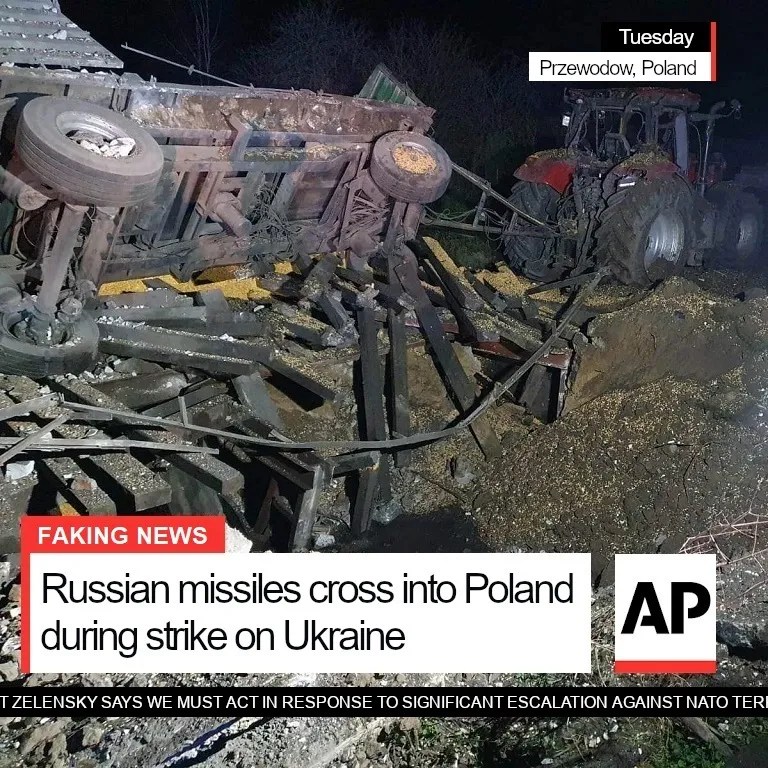
A missile that exploded on Polish soil on November 15 killed two civilians and destroyed farm equipment. Ukrainian President Volodymyr Zelensky and Western corporate media rushed to blame the explosion on Russia in apparent hopes of triggering NATO’s Article 5, which requires NATO states to defend one another militarily when attacked by a hostile force.

Polish and NATO members including US President Joseph Biden have since confirmed the missile that struck Poland was, in fact, a Ukrainian S-300 anti-aircraft missile. Yet Zelensky is sticking to his line, blaming Russia for the strike, while NATO Secretary-General Jens Stoltenberg still insists that “Russia bears ultimate responsibility.” Meanwhile, the media outlets that reflexively pointed the finger at Russia have been forced to take a step back from their initial reporting.

“Russian missiles hit Poland, the territory of our friendly country. People died,” Zelensky insisted on November 15, the night of the attack. “The longer Russia feels impunity, the more threats there will be to anyone within reach of Russian missiles. To fire missiles at NATO territory! This is a Russian missile attack on collective security! This is a very significant escalation. We must act.”

Zelensky held firm the following day, despite mounting evidence that his own country’s air defenses were responsible, declaring “I have no doubt that this is not our missile… I believe that this was a Russian missile, based on our military reports.” By this time, most analysts rejected the Ukrainian president’s assessment, including the founder of the US government-sponsored intelligence cutout Bellingcat, who wrote “At this point I think it’s fair anyone saying that a Russian missile hit Poland based on the current evidence is being irresponsible.”

A Russian attack on NATO member Poland could have triggered Article 5 of the North Atlantic Treaty Organization which compels its member states to consider “an attack against one Ally” to be “an attack against all Allies.” Such a mobilization would have amounted to World War III.

Despite the clear risk of such a catastrophic escalation – or perhaps because of it – Western corporate media immediately blamed Russia for the strike, never even posing the question of why Russia would consider Polish farmland such an important military target that it would be willing to risk a full-scale war with the 30-member NATO alliance. 

Initially, the Associated Press ran with the headline “Russian missiles cross into Poland during strike on Ukraine.” The article cited a “senior US intelligence official,” and later, “a second person.” 

On November 16, AP began redirecting the link to its original article to a correction that stated, “The Associated Press reported erroneously, based on information from a senior American intelligence official who spoke on condition of anonymity, that Russian missiles had crossed into Poland and killed two people. Subsequent reporting showed that the missiles were Russian-made and most likely fired by Ukraine in defense against a Russian attack.”

Time Magazine ran with the headline, “Russian Missiles Cross Into Poland During Strike, Killing Two,” and cited the AP report.

Fox News similarly announced, “Russian missiles cross into NATO member Poland, kill 2: senior US intelligence official, citing the Associated Press. MSNBC also blamed a “Russian missile” for the strike in its headline.

Then there was CNN, which reported, “Poland says Russian-made missile killed two, will consider invoking NATO Article 4.” NATO Article 4 deals with the meetings between NATO states that are to take place in the event one of them is “threatened” and would theoretically precede any invocation of Article 5. Like CNN, Reuters cited the Polish Foreign Ministry and ran the headline, “Poland says Russian rocket hit its territory as NATO weighs response.”

The New York Times stated in the second sentence of its report on the missile strike that “the blast came as Russia fired roughly 90 missiles into Ukraine.” Two lines later, the Times stated “local media suggests a Russian missile strike.” Readers of the paper of record would have to scroll down several times to even read that Russian officials denied responsibility.

Earlier in the war, in an article on “Ukraine’s online propaganda,” the New York Times sought to downplay the Ukrainian government’s penchant for pushing fake news, arguing that Kiev’s information war merely “dramatize[s] tales of Ukrainian fortitude and Russian aggression.” The article quoted an unnamed Twitter user, who wrote, “Why can’t we just let people believe some things? … If the Russians believe it, it brings fear. If the Ukrainians believe it, it gives them hope.”

The US media’s support for Ukraine’s propaganda efforts meant that it covered some of the most suspicious events without a hint of skepticism, and thereby encouraged more. 

These questionable incidents included the following:

  • On March 8, Western media reported that a Mariupol maternity hospital was attacked by Russian aircraft. Zelensky claimed the attack was evidence of Russian “genocide” against Ukraine. However, a key witness – a pregnant woman in the hospital photographed by AP – stated that no such airstrike occurred, and that nearby explosions were caused by Ukrainian artillery shells.

On March 16, the Ukrainian government blamed a targeted Russian airstrike for destroying the Mariupol Dramatic Theater and causing anywhere from 300 to 600 deaths. Western corporate media promoted the Ukrainian narrative of the event despite a total absence of footage showing a missile strike, no images or evidence of large numbers of dead civilians inside, no images or evidence of any attempted rescue, and testimony by Mariupol locals asserting the Azov Battalion fighters that controlled the theater’s grounds staged the explosion to provoke NATO military intervention. Photographic evidence showed that Azov fighters removed all vehicles from the theater’s parking lot one day before the explosion.

The Kramatorsk train station bombing that was blamed on Russia despite the fact the Tochka-U missile responsible for the blast contained a serial number matching others in Ukraine’s arsenal and originated from Ukrainian-controlled territory.

As the war grinds on, elements in the Biden administration appear to be growing impatient with the tall tales of their Ukrainian clients. “This is getting ridiculous,” an unnamed NATO official told the Financial Times on November 16. “The Ukrainians are destroying our confidence and they are openly lying. This is more destructive than the missile.”

THE EIGHTFOLD PATH OF GOOD CHARACTER

By Gary Z McGee

Source: Waking Times

“Watch your thoughts, they become words. Watch your words, they become actions. Watch your actions, they become habits. Watch your habits, they become character. Watch your character, for it becomes your destiny.” ~Frank Outlaw

A robust character hinges on eight core virtues: courage, curiosity, temperance, humility, liberty, honor, wisdom, and humor. These virtues are vital rungs on the ladder toward achieving wholeness in character.

Courage frees character, curiosity grows character, temperance balances character, humility grounds character, liberty stabilizes character, honor unifies character, wisdom guides character, and humor overcomes character. Let’s break it down.

1.) Courage:

“Without courage you can’t practice any other virtue consistently.” ~Maya Angelou

Courage is the bedrock of human excellence. Before any other virtue can be realized, courage must be self-actualized. There must first come a courageous deviation or there is no “first.” Period. Therefore, it is of the utmost importance that you live a courage-based lifestyle over a comfort-based lifestyle.

Without the initial leap of courage there is no freedom, no excellence. Without courage, one is merely restricted to the conventional, inhibited by the whims of others, imprisoned inside the box of the status quo, and hampered by outdated reasoning. Without courage, the third eye remains calcified, rigid, blind.

With the leap of courage, however, one is emancipated. The world unlocks. The mind unbolts. The soul unfastens. Inhibitions dissolve, and serendipity, adaptability, and improvisation manifest. Boundaries transform into horizons. Comfort zones stretch into adventure. You split the smoke. You shatter the mirrors. And the glory of the path is revealed.

2.) Curiosity:

“If you are not living in awe, you are not paying attention.” ~Rumi

Curiosity is essential. It is the fuel that launches us beyond faith. It is the cure for the disease of certainty.

True curiosity is deep, primal, absorbing, imaginative and ravenous for updated knowledge that has the potential to put outdated knowledge to rest.

Curiosity is the ultimate existential leveling mechanism. It forces our thoughts outside the box, stretches our comfort zone, shatters entrenched mental paradigms, keeps us ahead of the curve, and pushes the envelope of all the things we’ve taken for granted.

Curiosity is on the edge of tomorrow, laughing into the abyss, shirking the tiny-minded perspective of our parochial past, and gaping in astonishment and wild wonder into the mysterium tremendum et fascinans of the Great Mystery.

3.) Temperance:

“The best amount of property to have is that which is enough to keep us from poverty, and which yet is not far removed from it.” ~Seneca

Luckily, health is a benchmark for temperance. It’s the core of universal law. Unluckily, this benchmark is hidden in a ‘language older than words,’ which can sometimes seem impossible to decode. Moderation is Health’s secret decoder ring.

Although some things must be moderated more than others, extremism in anything is the bane of health. We can breathe too much oxygen. We can drink too much water. We can even live too much in the moment. Through moderation we discover health. And through health we are free to practice temperance. We maintain our personal health through moderation so that health in general can manifest. As Gandhi wisely suggested, “Live simply so that others may simply live.”

A good rule of thumb, then, is this: moderation in all things, to include moderation. This way we are proactively injecting balance into the cosmos, while at the same time enjoying life. The key is to accept responsibility for the consequences of both our moderate and immoderate choices. Tricky, but that’s where humility comes into play.

4.) Humility:

“After the ecstasy, the laundry.” ~Jack Kornfield

Research suggests that a healthy dose of humility helps protect against extremism, polarization, and bias. When we are humble, we can admit that we are fallible, imperfect, and uncertain. It gives us the courage to admit when we are wrong.

Without humility we are more likely to fall victim to cognitive dissonance. Without humility we are blinded by faith and stuck in hand-me-down ideologies and outdated traditions. Without humility we are more likely to be clouded by pride. Without humility self-pity outmaneuvers self-empowerment and the Ego reigns supreme as it edges out Soul.

Humility brings us back down to earth. It unravels the roots, uncovers the bones, strikes at the core of the human condition. It reveals the wizard behind the curtain was always us. It forces our head over the edge of the abyss. It exposes our halos as mortal coils. It gets us out of our own way.

That Serbian Proverb said it best, “Be humble for you are made of earth. Be noble for you are made of stars.”

5.) Liberty:

“Seek freedom and become captive of your desires. Seek discipline and find your liberty.” ~Frank Herbert

Freedom is not a given. It must be earned. It must be cultivated, practiced, and acted upon daily. The moment freedom is taken for granted is the moment it is lost.

Freedom is always a rebellion. What it rebels against is anything seeking to fetter the progressive and healthy evolution of the human spirit. In the crashing plane of an unfree world, a free human is someone who puts the oxygen mask on themselves first in order to be there for those who are incapable or who are ignorant of the fact that they are not free.

As Jean Piaget said, “We organize our worlds by first organizing ourselves.” And so self-organization (self-discipline) is the first step toward freedom. Liberty, then, is a culmination of earning freedom through self-discipline, and then holding the world accountable.

6.) Honor:

“Nearly all men can stand adversity, but if you want to test a man’s character, give him power.” ~Abraham Lincoln

The core of honor is self-honesty. We cannot be honorable without self-honesty. Where honesty puts character into perspective, honor unifies character. True honor is being responsible with our power.

Foremost, honor is responsibility. If we are not responsible with our power, then we become a pawn to it. Being a pawn to power is dangerous because power causes us to believe we are always right. When we are responsible with our power, however, we are more likely to admit we could be wrong. And since the fallible and imperfect human condition tends to be wrong about a great many things, it behooves us all to take responsibility with our power so as not to become a pawn to it.

If we lord our power over others, we are being dishonorable. If we use our power to help others flourish, we are being honorable. If we hoard power at the expense of others, we are being dishonorable. If we expiate power to empower others, we are not only being honorable we are being prestigious.

7.) Wisdom:

“We are not provided with wisdom, we must discover it for ourselves, after a journey through the wilderness which no one else can take for us.” ~Marcel Proust

Wisdom cannot be taught. Knowledge can be taught, skills can be taught, but not wisdom. We can discover wisdom, we can live it through experience, we can dip in and out of it in Flow States, we can do wonders with it with our creative powers thereafter, but we cannot teach it.

Wisdom is likewise just as undefinable. It is mystical, numinous, and transcendent. It can even be foolish, eccentric, and outlandish. There’s a childlike element to it that humbles mastery, just as there’s a maturity to it that towers over naivete.

Most of all wisdom is a heightened state of clarity. It’s a crispness of elevated spirit. It’s a three-eyed owl on a high branch. It’s a profound sense of humor that’s undeterred by the knowledge, experience, and tribulations that birthed it. Most of all, Wisdom has the wherewithal to get out of its own way.

As Lao Tzu wisely stated, “To attain knowledge, add things every day. To attain wisdom, remove things every day.”

8.) Humor:

“The individual is more completely revealed in play than in any one other way, and play has a greater shaping power over the character and nature of man than has any one other activity.” ~Luther Gulick

Humor is the only virtue that is transcendent. It sees how character is just that: a character caught within a tragicomedy, strutting itself across an all-too-mortal stage. It sees the character’s feet of clay. But it also sees the character’s wings. It honors both through a laughter born out of levity.

Such levity creates a powerful gravity. The self becomes magnetic. When you are flexible in humor you attract the world to yourself. You’re able to have a soulful laugh at all the ego seriousness. Pettiness falls away from you like water off a duck’s back. You become transcendent, detached, unconquerable.

Having a good sense of humor is the crowning achievement of good character, and the soul is the crown. It’s the golden crown chakra of character, sparking in the eternal night, a beacon of hope in the dark, a beacon of darkness in the blinding light, a symbol of recycled mastery that honors the Great Mystery despite our all too mortal angst.

Saturday Matinee: Hero – The Extraordinary Life of Mr. Ulric Cross

Hero – the extraordinary life and times of Ulric Cross

By Stephen Spark

Source: Soca News

Hero has landed. Frances-Anne Solomon’s film about the life of Ulric Cross – eight years in the making ‑ has finally reached London, though only for a few screenings. If the audience reaction at the premiere at Brixton’s Ritzy cinema was anything to go by, this film, like its subject, is destined for great things.

In conventional terms, Cross was indeed a hero. He was born in Belmont, Trinidad, and after school and some inconsequential jobs, he joined the Royal Air Force when war broke out. He became a navigator for an RAF pathfinder squadron, flying low-level missions over enemy territory to mark targets for the bombers to hit. This was not a job guaranteed to increase your life expectancy, and his near-suicidal decision to fly 80 missions without a break as Cross did was something that even he couldn’t really explain. He was, famously, the most-decorated Caribbean serviceman, gaining both a DFC and DSO for his cool-headed courage.

Like many West Indian servicemen and women, he learnt that an exemplary war record counted for little when it came to finding a peacetime job in ‘civvy street’. Despite training as a lawyer, he ended up at the BBC, but the plug was pulled on him when his interviews were deemed “too political”. And at this point the story really begins.

The title ‘hero’ is a little misleading, for his war service was only one aspect of his life and, according to Solomon, among family and friends “no one saw him as a hero”. Instead, what we have is a film about a heroic life. Cross played an important part in the African independence and pan-Africanist movements in Ghana, Cameroon and Tanzania, along with fellow Trinidadians George Padmore and C L R James. The film highlights how exciting, uncertain, energising and downright dangerous it was to be an intelligent, idealistic champion of Black empowerment and unity in Africa.

It would be impossible in anything less than a full-length dissertation to do justice to all the intersecting themes Hero contains. After the screening, almost everyone this reviewer spoke to said they needed to see it multiple times.

Hero is intellectually and emotionally absorbing, and visually exciting. Solomon has made extensive use of archive footage and melded it seamlessly with newly shot elements. At the post-film Q&A session, Solomon said that she used and adapted archive footage because the budget was too tight to allow the big set-piece scenes to be shot. It’s a restriction she turned to great advantage, as it’s resulted in a film that looks distinctive and stylish, combining newsreel immediacy with feature film gloss.

Nickolai Salcedo is mesmerising and entirely believable as Ulric Cross, and there’s a fine chemistry with Pippa Nixon as his wife, Ann – clearly a strong character in her own right. Peter Williams deserves a mention for his portrayal of the plausible, but deceptive, ‘Pony’ Macfarlane, while Fraser James brings a restless energy to the fascinating and enigmatic George Padmore.

In short: thoroughly recommended – go and see it as soon as you can.

Watch Hero on Hoopla here: https://www.hoopladigital.com/title/15317967

AP Editor Said She “Can’t Imagine” A US Intelligence Official Being Wrong

By Caitlin Johnstone

Source: CaitlinJohnstone.com

The Associated Press journalist who reported a US intelligence official’s false claim that Russia had launched missiles at Poland last week has been fired.

As we discussed previously, AP’s anonymously sourced report which said “A senior U.S. intelligence official says Russian missiles crossed into NATO member Poland, killing two people” went viral because of the massive implications of direct hot warfare erupting between Russia and the NATO alliance. AP subsequently retracted its story as the mainstream political/media class came to accept that it was in fact a Ukrainian missile that had struck Poland.

AP’s firing of reporter James LaPorta looks at this time to be the end point of any accountability for the circulation of this extremely dangerous falsehood. AP spokesperson Lauren Easton says no disciplinary action will be taken against the editors who waved the bogus story through, and to this day the public has been kept in the dark about the identity of the US official who fed such extremely egregious misinformation/disinformation to the public through the mainstream press.

It is utterly inexcusable for AP to continue to protect the anonymity of a government official who fed them such a profoundly significant falsehood. This didn’t just affect AP staff, it affected the whole world; we deserve to know what happened and who was responsible, and AP has no business obstructing that knowledge from us.

LaPorta’s firing looks like this is yet another instance where the least powerful person involved in a debacle is being made to take the fall for it. A powerful intelligence official will suffer no consequences for feeding false information to the press — thereby ensuring that it will happen again — and no disciplinary action will be taken against LaPorta’s superiors, despite the absolute buffoonery that subsequent reporting has revealed on their part.

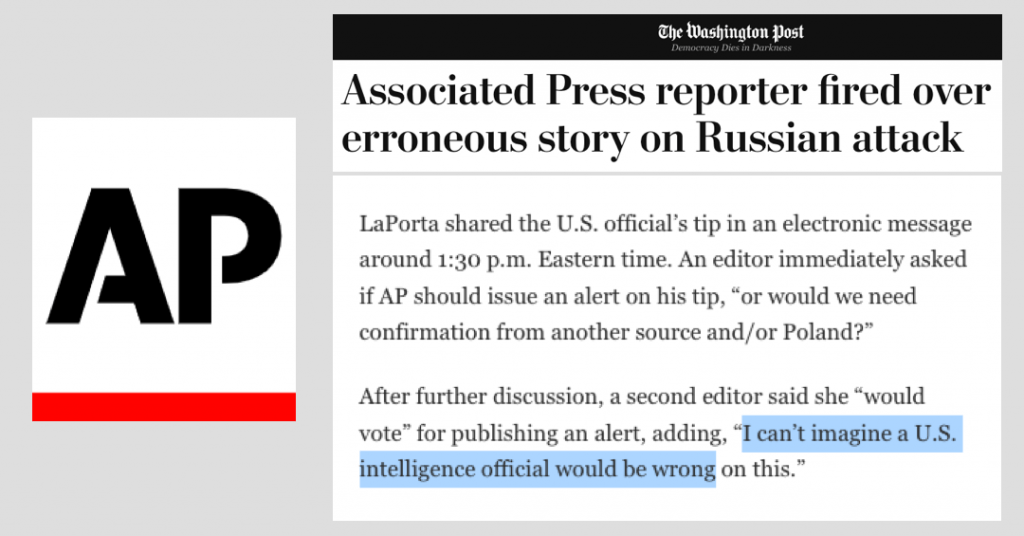
In an article titled “Associated Press reporter fired over erroneous story on Russian attack,” The Washington Post reports the following (emphasis added):

Internal AP communications viewed by The Post show some confusion and misunderstanding during the preparations of the erroneous report.

LaPorta shared the U.S. official’s tip in an electronic message around 1:30 p.m. Eastern time. An editor immediately asked if AP should issue an alert on his tip, “or would we need confirmation from another source and/or Poland?”

After further discussion, a second editor said she “would vote” for publishing an alert, adding, “I can’t imagine a U.S. intelligence official would be wrong on this.”

“I can’t imagine a US intelligence official would be wrong on this.”

Can you imagine not being able to imagine a US intelligence official being wrong? This would be an unacceptable position for any educated adult to hold, much less a journalist, still less an editor, and still less an editor of one of the most influential news agencies on earth.

These are the people who publish the news reports we read to find out what’s happening in the world. This is the baby-brained level of thinking these people are serving the public interest with.

Antiwar commentator Daniel Larison writes the following of the AP editor’s shocking quote:

Skepticism about official claims should always be the watchword for journalists and analysts. These are claims that need more scrutiny than usual rather than less. If you can’t imagine that an intelligence official could get something important wrong, whether by accident or on purpose, you are taking far too many things for granted that need to be questioned and checked out first.

Intelligence officials of many governments feed information to journalists and have done so practically ever since there was a popular press to feed information to, and that information certainly should not be trusted just because an official source hands it over. It is also always possible for intelligence officials to just get things wrong, whether it is because they are relying on faulty information or because they were too hasty in reaching conclusions about what they think they know.

Whether the AP’s source was feeding them a line or was simply mistaken, a claim as provocative and serious as this one should have been checked out much more thoroughly before it got anywhere near publication. The AP report in this case seems to have been a combination of a story that was “too good to check” and a culture of deference to official sources in which the editors didn’t feel compelled to make the effort to check.

Indeed, the only reason the press receive such explicit protections in the US Constitution is because they are supposed to hold the powerful to account. If the editors of a wildly influential news agency will just unquestioningly parrot whatever they are fed by government officials while simultaneously protecting those officials with anonymity, they are not holding the powerful to account, and are in fact not meaningfully different from state propagandists.

They are state propagandists. Which is probably why they are sipping lattes in the AP newsroom while Julian Assange languishes in prison.

As Jacobin’s Branko Marcetic observed, this is far from the first time AP has given the cover of anonymity to US government officials circulating bogus claims of potentially dangerous consequence, like the time it reported an official’s evidence-free assertion which later proved false that Iran had carried out an attack on four oil tankers off the coast of the United Arab Emirates, or the time it let another one anonymously claim that “Iran may try to take advantage of America’s troop withdrawals from Iraq and Afghanistan.”

So to recap  —

  • Powerful government official who fed AP a false story: Zero accountability
  • AP editor who asked if a report should immediately be published upon receipt of the story: Zero accountability
  • Second AP editor who says she can’t imagine a U.S. intelligence official would be wrong:  Zero accountability
  • Journalist who wrote the story: Singular accountability

In a sane society, power and responsibility would go hand in hand. A disaster would be blamed on the most powerful people involved in its occurrence. In our society it’s generally the exact opposite, with the rank-and-file taking all of the responsibility and none of the power.

Our rulers lie to us, propagandize us, endanger us, impoverish us, destroy journalism, start wars, kill our biosphere and make our world dark and confusing, and they suffer no consequences for it. We cannot allow them to continue holding all of the power and none of the responsibility. This is backwards and must end.