


Nightmare Fuel: Massive Swarms of “Crazy Ants” Spreading Across Texas

130517203430-03-crazy-ants-horizontal-galleryRasberry-ants-329_largescreen shot 2013-05-20 at 4.04.47 pm
The New York Times Magazine recently featured a story by Jon Mooallem on a new invasive ant species that seems straight out of a nightmare or horror film. From the article:

Entomologists report that the crazy ants, like other ants, seem drawn to electronic devices — car stereos, circuit boxes, machinery. But with crazy ants, so many will stream inside a device that they form a single, squirming mass that completes a circuit and shorts it. Crazy ants have ruined laptops this way and, according to one exterminator, have also temporarily shut down chemical plants. They are most likely climbing into these cavities to investigate possible nesting sites. But as David Oi, a research entomologist at the Department of Agriculture, told me, the science-fiction-ish theory that the bugs are actually attracted to the electricity itself can’t be ruled out.

Rasberry crazy ants do not have a painful bite, but they effectively terrorize people by racing up their feet and around their bodies, coursing everywhere in their impossibly disordered orbits. (They’re called crazy ants because their behavior seems psychotic.) Some people in Texas have become so frustrated with crazy ants that they have considered selling their houses or been driven to the verge of divorce. “Usually, the husband doesn’t think it’s such a big deal, and the wife is going batty,” one exterminator explained. An attorney living on an infested farm south of Houston told me: “It reminds me of the scenes in Africa, where you see flies crawling all over people. Occasionally they’ll knock one off, but for the most part they’re so accustomed to it that they finally give up.”

Crazy ants decimate native insects. They overtake beehives and destroy the colonies. They may smother bird chicks struggling to hatch. In South America, where scientists now believe the ants originated, they have been known to obstruct the nasal cavities of chickens and asphyxiate the birds. They swarm into cows’ eyes.

So far, there is no way to contain them. In the fall, when the temperature drops, the worker ants are subject to magnificent die-offs, but the queens survive, and a new, often larger crop of crazy ants pours back in the following spring. Rasberry crazy ants were first discovered in Texas by an exterminator in 2002. Within five years, they appeared to be spreading through the state much faster than even the red imported fire ant has. The fire ant is generally considered one of the worst invasive species in the world. The cost of fire ants to Texas has been estimated at more than $1 billion a year.

Rasberry crazy ants are now in 27 different counties in Texas and have also been spotted in Louisiana, Mississippi, Florida and Georgia…

…Edward LeBrun, an ecologist at the University of Texas at Austin who has been studying the area, believes a single “supercolony” of crazy ants occupies as many as 4,200 acres in Iowa Colony and is spreading 200 meters a year in all directions.

The reporter gave the following horror-inducing account of his first encounter with the ants in Iowa Colony, a rural area south of Houston:

“See! See! See!” the Dukes kept telling me. Wherever they pointed, there were ants: under the door of a microwave oven, crawling out of the electrical outlets, heaped in the flower beds where I mistook them for fresh topsoil. It was shocking, and the Dukes seemed vindicated by my shock. “You don’t feel them crawling up your clothes?” Melvin’s wife, Sharlene, asked me at one point. She was walking around barefoot and in shorts, and I could see ants trickling across her feet and ankles and legs — spelunking between her toes. She clutched a can of a pesticide called Enforcer Instant Knockdown to her chest, more as a security blanket than as a weapon, and constantly swept her hands over her calves.

Soon ants were spiraling up the tongues of my sneakers, onto my sock. I tried to shake them off, but nothing I did disturbed them. Before long, I was sweeping them off my own calves. I kept instinctively taking a step back from some distressing concentration of ants, only to remember that I was standing in the center of an exponentially larger concentration of ants. There was nowhere to go. The ants were horrifying — as in, they inspired horror. Eventually, I scribbled in my notebook: “Holy [expletive] I can’t concentrate on what anyone’s saying. Ants all over me. Phantom itches. Scratching hands, ankles, now my left eye.” Then I got in my car and left.

Of course worse things happen to people, but there’s something uniquely unsettling about the feeling of being overtaken by insects. This type of fear is explored in the following passage from the article:

The Hungarian-born philosopher Aurel Kolnai gave the horrifying qualities of bugs some serious thought. Kolnai ultimately decided that what upsets us is “their pullulating squirming, their cohesion into a homogeneous teeming mass” and their “interminable, directionless sprouting and breeding.” That is, it’s the quantity of crazy ants that’s so destabilizing. As the American psychologist James Hillman argued, an endless swarm of bugs flattens your perception of yourself as precious and meaningful. It instantly reduces your individual consciousness to a “merely numerical or statistical level.”

While there’s definitely some truth to this, I think there’s a little more to it. Though we may instinctively avoid things which could possibly sting or bite, because bugs are also associated with the natural process of decomposition, a reflexive revulsion towards contact with insects (for most people) may also be an expression of the fear of death. Insects might also tap into a xenophobia towards creatures that are most unlike ourselves physically and behaviorally, though we might not be as different from insects like ants as we’d like to believe. Just like humans, the crazy ants can dominate an environment to such an extent that it becomes inhospitable to most other insects and animals. And while we all have the potential ability to think independently, there’s also the potential to adopt a “hive mind” or herd mentality. Perhaps it’s the subconscious awareness of such negative aspects we share with insects that horrify us as much as the differences.

Gallery of Creepy NRO Satellite Logos

BawJ5tCCEAAQ6AN

Last Thursday, the Office of the Director of National Intelligence live-tweeted the launch of a US National Reconnaissance Office surveillance satellite from Vandenberg Air Force Base in California. What made the tweet quickly go viral was the attachment of the mission’s ominous and unsubtle logo: a giant malevolent octopus with it’s tentacles all over the planet. As reported by RT:

Along with the National Security Agency and more than a dozen others, the NRO is one of 16 federal offices under the directive of DNI James Clapper and is responsible for building and operating the spy satellites used to collect intelligence around the world. NRO-gathered intelligence was reportedly instrumental in the mission that brought US Navy SEAL’s to the home of former al-Qaeda leader Osama bin Laden in 2011, and decades earlier the agency launched a school-bus sized satellite into orbit to spy on Soviets at the height of the Cold War.

This time around the ODNI says the satellite’s payload is mostly classified, but did admit over Twitter that around a dozen mini satellites funded by both the NRO and NASA will be brought along to orbit as well. Another thing they didn’t bother to acknowledge, of course, is how the lack-of-subtlety apparent in the Earth-strangling octopus emblem could quickly be used by critics of the US intelligence community as fodder to further condemn the government for admitting to their sheer and unmatched ability to control the world’s information.

…”You may want to downplay the massive dragnet spying thing right now,” Chris Soghoian, the chief technologist at the American Civil Liberties Union, tweeted Thursday. “This logo isn’t helping.”

Andy Cush of AnimalNewYork uncovered a number of equally disturbing logos for past N.R.O. spy satellite missions including the following:

National Reconnaissance Office Launch 49, January 2011:  To celebrate its 50th anniversary, the NRO launches six satellites into space in 2010 and 2011. One of them, NROL-49, gets a black hawk rising from flames in front of the American flag for a logo. Its motto: melior diabolus quem scies, or “Better the devil you know.”

National Reconnaissance Launch 66, February 2011: One month after NROL-49, launch 66 took the devilish into goofier territory, featuring a satanic-looking minotaur flying over the Earth holding a modified Route 66 sign.

National Reconnaissance Office Launch 19, September 2003: NROL-19′s patch features the world’s most patriotic dragon clutching the globe with a diamond wrapped in its tail.

National Reconnaissance Office Launch 11, August 2000: This patch, featuring the eyes of what looks like an owl hovering over a darkened planet, could have used some cleaner design. Still, “We Own The Night” is an appropriately terrifying sentiment. Animals in space is beginning to feel like a theme.

National Reconnaissance Launch 38, June 2012: This three headed, world-destroying dragon is made only slightly less threatening by its latin motto, non morieris bello, which means something like “you will not die at war.” An alternate patch depicts the Egyptian god Anubis with a giant spear.

National Reconnaissance Office Launch 32, November 2010: The most illuminati-esque of the bunch, this terrible gradient-laden design puts an all-seeing eagle’s eye on top of a golden pyramid.

National Reconnaissance Launch 16, April 2005: The patch for NROL-16 may have marked the first time the U.S. government used a gorilla as a patriotic symbol.

National Reconnaissance Office Launch 10, December 2000: Last but not least, the “Great Bear” patch for NROL-10 is perhaps creepiest of all. What’s this jolly, star-covered guy doing as the symbol of a spy mission? We may never know.

Pearl Harbor: The Original 9/11

pearl-harbor

Yesterday marked the 72nd anniversary of the Pearl Harbor attack, which from today’s perspective can be viewed as the template on which 9/11 was modeled after. In both cases, documentation exists implicating the U.S. government. In the case of Pearl Harbor, there’s the McCollum Memo which describes in detail the strategy used to successfully provoke the Japanese government into attacking. Shortly before the Pearl Harbor attack, Secretary of State Hull presented “peace terms” to the Japanese government that all but guaranteed an inevitable attack.

In the case of 9/11, there’s a policy document from Project for a New American Century called Rebuilding America’s Defenses, which provides a clear motive to create a “catastrophic and catalyzing event – like a new Pearl Harbor”. It’s not conclusive proof they were behind the attacks, but it’s suspicious to say the least that the people with established motives for conducting an event like 9/11 were responsible for national security at the time multiple unlikely and implausible coincidences made such a successful attack possible.

A number of other dubious aspects of the Pearl Harbor attack were compiled at Washington’s Blog last year, including:

Active Interference with Military’s Ability to Defend

It has also recently been discovered that the FDR administration took numerous affirmative steps to ensure that the Japanese attack would be successful. These steps included taking extraordinary measures to hide information from the commanders in Hawaii about the location of Japanese war ships (information of which they would normally be informed), denying their requests to allow them to scout for Japanese ships, and other actions to blind the commanders in Hawaii so that the attacks would succeed. See, for example, this book (page 186).

Key Military Players Incommunicado

In addition, the heads of the Army and Navy suddenly disappeared and remained unreachable on the night before Pearl Harbor. And they would later testify over and over that they “couldn’t remember” where they were (pages 320 and 335).

Gagging Whistleblowers

Two weeks after Pearl Harbor, the Navy classified all documents top secret, and the Navy Director of Communications sent a memo ordering all commanders to “destroy all notes or anything in writing” related to the attacks. More importantly, all radio operators and cryptographers were gagged on threat of imprisonment and loss of all benefits. (page 256).

Media Complicity

Amazingly, the Army’s Chief of Staff informed the Washington bureau chiefs of the major newspapers and magazines of the impending attacks before they occurred, and swore them to an oath of secrecy, which the media honored (page 361); and listen to interview here (we personally spent an hour speaking with Stinnett, and find him to be a highly credible and patriotic American.)

Postscript: Coincidentally, Philip Zelikow – the Executive Director of the 9/11 Commission, the administration insider whose area of expertise is the creation and maintenance of “public myths” thought to be true, even if not actually true, who controlled what the 9/11 Commission did and did not analyze, then limited the scope of the Commission’s inquiry so that the overwhelming majority of questions about 9/11 remained unasked – also happened to be the main guy defending the alleged unforeseeablity of the Pearl Harbor attack, who wrote a hit piece on Pearl Harbor historians like Stinnett.

Just like 9/11, Pearl Harbor was used as a tool to focus mass hatred on a race demonized by propaganda. The attack created a culture of fear allowing for suspension of civil liberties while crushing opposition to the war. Most importantly (for powerful interests pushing for war) the attacks were a pretense for pursuing and expanding global political and economic hegemony.

For a comprehensive compilation of evidence of U.S. government involvement in the Pearl Harbor conspiracy, see: http://whatreallyhappened.com/WRHARTICLES/pearl/www.geocities.com/Pentagon/6315/pearl.html

Saturday Matinee: What to Do in Case of Fire?

3b6ef1ef605e7

“What to Do in Case of Fire?” (2001) opens with a montage of young anarchist squatters fighting police, making propaganda films, and constructing a homemade bomb in Berlin circa 1987. They plan to blow up a vacant mansion but the bomb is a dud, until thirteen years later when it injures a real estate broker and potential buyer in a fluke accident.

Only two of the original members of the anarchist collective, Tim and Hotte, are still squatting in the same communal housing since the 80s and are unable to prevent police from confiscating filmed evidence in a raid triggered by the bomb incident. Because all members of the collective are potentially linked to the bombing, Tim and Hotte scramble to track down former comrades and formulate an action plan before the evidence is examined. The reunion of old friends, including those who’ve settled into traditional family life or sold out for corporate jobs, stirs up a host of interpersonal conflicts which they must resolve in order to work together to remain free.

Though the film does at times seem to fall back on lazy stereotypes of anarchists, it at least puts them in a human light. Even less radical viewers could relate to certain struggles the protagonists are faced with, such as trying to balance freedom and security, being “successful” versus upholding one’s ideals, and coming to terms with friendships that change over time. It would have been interesting had the film delved deeper into Berlin’s anarchist and squatters movements, in my opinion, but it’s nevertheless a charming and fun mix of comedy, drama and heist genres.

Note: to activate English subtitles on the video, click on the Closed Captions (CC) icon on the bottom right corner while video is playing, click on the box that says “Portuguese (Brazil)”, click “Translate Captions”, click on “Afrikaans”, then you should be able to scroll down until you can click on “English”. The subtitle feature might not be available on some portable devices.

Facing Death

Cemetery_PanoramaSharpweb

Jasun Horsley at Omni Reboot recently shared a number of intriguing insights on the topic of death and how it relates to science fiction, culture and transhumanism. He outlines how science fiction, whether utopia or dystopia, are scientific versions of a belief in a spiritual afterlife since they can soothe awareness of mortality and make us feel better about the present.

Horsley cites the work of Sheldon Solomon which shows how culture is a means of denying death via the manufacturing of extensions of the self and the body, including values which are carried by artifacts we create (ie. books, IPods, spaceships, etc.). The technology we create is meant to improve our lives and bring us closer to the utopia of sci-fi fantasies, but more often than not contributes to a dystopian reality. In his opinion, this happens because we’re unconscious of whatever it is within us causing the problems we’re trying to solve. We’re making things worse the more we try and improve them. A classic metaphor for this is Shelley’s Frankenstein which describes how the inability to accept death and the drive to “play God” creates a tragic monster.

According to Horsley, transhumanism is the religion of the (imagined) future, which most of us are already followers of, whether aware of it or not. For those not familiar with transhumanism (also known as extropianism), he provides an accurate and succinct definition in the following excerpt:

Transhumanism is a scientistic movement based on the belief that who (and what) we are can be divorced from biology. In its more extreme camps, Transhumanism divorces human existence from the psyche by suggesting that:

• At least some of the elements of consciousness can be converted to digital information.

• This data will be self-aware.

• It will be a continuation of the biologically-based awareness which it copied.

Horsley is skeptical of this view because it ignores the importance of the unconscious. In his words:

“Who we are” is not a mind-body system but a psyche-body system. We aren’t meat vessels with an internal stream of mental data running through them and animating them. The vast majority of our total “psychosoma” system functions at an unconscious level.

What he sees as a potentially more productive and fulfilling approach is the acceptance of death. Because it’s such an uncharted path (for the majority of us) it’s difficult to imagine the social impact such a paradigm shift would have, but he asks the following speculative questions which encourages further exploration:

Time is supposed to bestow wisdom on human beings. But can there be wisdom without acceptance of death?

How would both our fantasies and our culture be transformed if, instead of conquering death, we learned to accept it?

If death anxiety fuels human progress, maybe accepting death would not only be the end of fantasy, but the end of the fantasy we call “history”?

What it would be the beginning of, however, is anybody’s guess.

On a related note, rest in peace Nelson Mandela.

“Death is something inevitable. When a man has done what he considers to be his duty to his people and his country, he can rest in peace. I believe I have made that effort and that is, therefore, why I will sleep for the eternity.” – Mandela (1996)

Thailand: Who are the Anti-Regime Protesters?

THAILAND-P__c891587_131127_467

By Tony Cartalucci for Land Destroyer Report

December 3, 2013
– After clashes with police in Bangkok and the taking of several government buildings, anti-regime protesters prepared for the next phase of their resistance – the protracted encampment of key governmental centers. Thousands of protesters are now permanently entrenched in an area winding for nearly a mile through the capital city. They have built up a city within a city at three main locations that are linked by the constant stream of protesters coming and going to and from the protest sites.


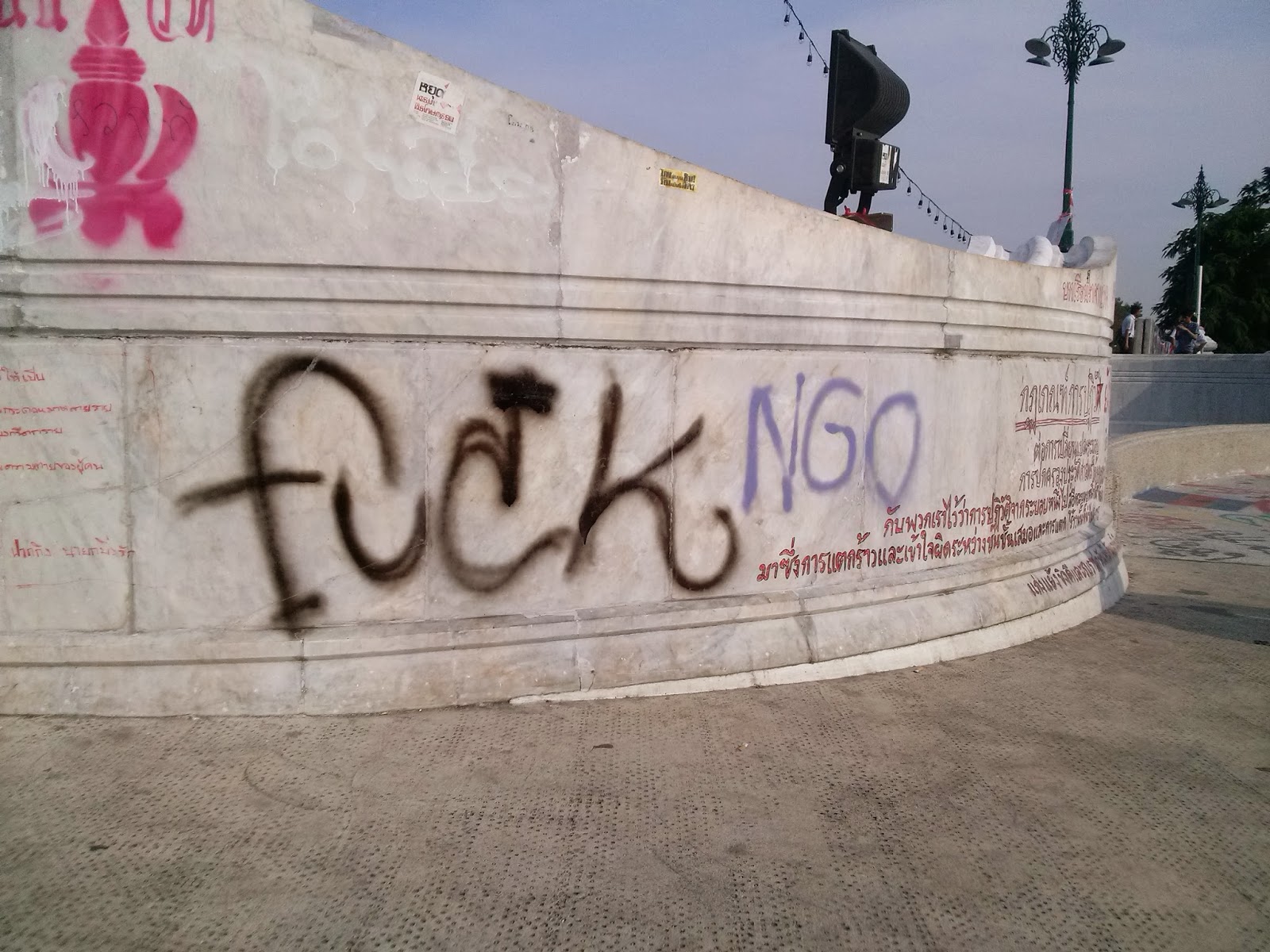
Image: It appears that the anti-regime protesters know exactly who they are dealing with. While it is easier in speeches and sound bites to describe Thaksin Shinawatra and his hereditary dictatorship as the central source of Thailand’s problems, it is well understood amongst protesters that a vast network of foreign-funded NGOs are propping up the Shinawatra regime. Freedom House, for instance, lists as a trustee Kenneth Adelman, who concurrently served as Thaksin’s lobbyist. Pro-regime news website Prachatai, is directly funded by US State Department NGOs such as the National Endowment for Democracy (NED). 

….


But who are these protesters and what do they want? Are they, as the Western media portrays them, anti-democratic elitists who refuse to to concede power to awakened rural masses? Or are they dangerously informed, socially and politically aware groups that are actively opposing the designs of foreign corporate-financiers and the proxy regime they have put into power in Thailand?

Who are Thailand’s Anti-Regime Protesters?

Walking from one end of the protest to the other can become an all day affair. The sites are spaced out slightly, but occupy long stretches of road turned into permanent encampments complete with food, water, medical services, bathrooms, shower stalls, exhibition booths and support points, media centers, stages, and hawker stalls. There are thousands of permanently encamped protesters and thousands more who come and go – even at low points in the day.

The extensive infrastructure of these protest sites resemble a fair or an exhibition. While a single theme has brought them together, a large number of diverse groups have marshaled their resources to build the sprawling encampments. There of course is the main camp and stage set up by a group of political parties including the main opposition party, the Democrats, the People’s Democratic Reform Committee, and the Network of Students and People for Reform of Thailand.

The “Yellow Shirt”  People’s Alliance for Democracy (PAD) also maintains a camp, as does Santi Asoke, a group that practices the Thai-equivalent of organic farming, homesteading, and grassroots community development. 


Images: Labor unions have a strong showing in the anti-regime camps. While the Shinawatra regime has hijacked the color red for his mobs as well as the socialist rhetoric that goes with it, real labor unions flying the color red actually engage in the protection of workers’ rights. 
….


There are throughout the camps, smaller student groups from across Bangkok, and a large number of labor unions. Some of the bigger unions include those working for state enterprises, THAI Airways, and the country’s nationalized telecom company, CAT.

And despite the most vitriolic and perhaps even racist accusations leveled against the protesters is that they represent ethnic Chinese-Thais. While there certainly are a lot of Thais of Chinese descent at the rallies, mainly because they have called Bangkok their home for generations, still the vast majority of the protesters are ethnic Thais and include people drawn to the capital to find better lives from Thaksin Shinawatra’s northeast political stronghold.

What Do They Want? 

We are told by the Western media that this is a “people’s coup,” an attempt to overthrow democracy. In reality, and entirely unlike Thaksin’s red shirts who simplistically demand “democracy,”  the anti-regime protesters have a list of cogent demands.

1. No Amnesty – This refers to an amnesty bill designed by and for Thaksin Shinawatra to absolve himself of a decade of plundering, lying, and mass murder. While the government eventually backed off, it was only because massive street protests were mobilized. When the Constitution Court declared the bill unconstitutional, the ruling regime announced that it no longer recognized the authority of the court – even while using constitutionality to condemn the protests. Even though it is considered “dead,” Thaksin’s entire future depends on it eventually passing. Protesters feel the only way to truly kill this bill, is to remove entirely the regime attempting such an absurd abuse of power.

2. Rollback Article 190 – Article 190 of the Thai constitution requires that all treaties be approved by the parliament before they can be signed. In 2004, this mechanism had prevented Thaksin Shinawatra from unilaterally passing a US-Thai free trade agreement, and was one of many attempted circumventions of the law that led to his ouster in 2006. His nepotist-appointed sister Yingluck Shinawatra, has now managed to amend it making it possible for her to unilateral approve treaties (specifically unpopular FTA’s). Protesters would like to see this reversed.

3. The Re-Nationalization of Thailand’s Oil – Thailand’s oil giant, PTT, was privatized and sold off  to foreign multinationals under Thaksin Shinawatra in late 2001. Tremendous wealth has been siphoned out of Thailand and sent overseas, particularly to Chevron, one of the many sponsors on the US-ASEAN Business Council that directly supports the Shinawatra regime.

 
Image: Another issue protesters have is with the changing of article 190 which allows the regime to now unilaterally sign treaties without the parliament’s approval. This will be used specifically to pass through a series of extremely unpopular free trade agreements with the regime’s Western sponsors. 
….
 
4. Keep Thailand Anti-GMO, Anti-IP – The current Thai establishment resisting the regime has been stalwartly defending against GMO and “intellectual property” (IP) laws pushed on them by the United States, the UK, and the EU. In fact, one of the main points of attack by Thaksin Shinawatra’s Washington lobbyists, was attacking the military council that ousted Thaksin for ignoring US pharmaceutical patents while producing cheaper drugs for poor patients. Regarding GMO, Monsanto has been desperately trying to overrun Thailand’s food security but to no avail. Would it surprise readers to know that the US-ASEAN Business Council directly supporting Thaksin Shinawatra and his political machine also includes Monsanto?

It becomes abundantly clear why corporate media houses like the BBC, Reuters, AP, AFP, CNN, MSNBC, and Australia’s ABC have attacked the protesters as “anti-democratic,” “elitist,” and “violent.” They represent for them a population they cannot trick, manipulate, and have their way with. They would like to see it marginalized and removed from Thailand’s political landscape so they can grind Thailand into the ground like so many other nations across the developing world. Thailand’s anti-regime protesters are making their stand – those that support true freedom and progress should stand with them.

Drone camera footage of the protests:

War on the Poor Continues With Planned Pension Cuts in Detroit and Illinois

130614134247-detroit-protest-620xa

Yesterday Federal bankruptcy court judge Steven Rhodes ruled that Detroit is insolvent and eligible for a Chapter 9 debt restructuring. This gives the city the go-ahead to cut retirement benefits as part of its restructuring plan, despite pensions being explicitly protected by the state constitution.

Learn more about the situation in Detroit at Detroit Inquiry.

Judge Rhodes’s decision serves as a precedent for city and state governments across the country to carry out a similar policies. Just hours after the Detroit ruling, both chambers of the Illinois legislature also passed an unconstitutional pension reform bill that would steal money from the pension plans Illinois state workers paid for, reduce and suspend cost-of-living increases and limit their salaries.

Such acts of class warfare demonstrate how the government/corporate machine views the 99% as merely a source of wealth and cannon fodder. Once they find cheaper labor and more prosperous markets elsewhere and once soldiers return home after fighting their wars, we’re worth even less to them. Judging from their actions, the corporatocracy has no loyalty, trust and respect for us. Why should we give them any loyalty, trust and respect if it’s not reciprocated?

Detroit Bankruptcy Timeline:

2011

March 16: Michigan’s Public Act 4 emergency manager law goes into effect.

Nov. 16: Detroit Mayor Dave Bing says the city could run out of cash by April 2012 and have a potential shortfall of $45 million by the end of the fiscal year June 30.

Dec. 2: State Treasurer Andy Dillon orders a preliminary financial review of Detroit. The move sparks protests against Michigan Public Act 4, the emergency manager law that expanded EM powers.

Dec. 21: Dillon announces “probable financial stress” in Detroit and recommends Snyder send a team to review city finances.

2012

Jan. 10: Former State Treasurer Andy Dillon gives Mayor Dave Bing until the first week of February to submit a financial plan to avoid an emergency manager.

March 13: A 25-page proposed consent agreement is given to the City Council.

March 21: A state review team declares Detroit in a “severe financial emergency.”

March 23: The Michigan Court of Appeals reverses an Ingham County judge’s ruling that barred the state from entering a consent agreement with Detroit.

April 4: The City Council, 5-4, approves a consent agreement.

April 5: Gov. Rick Snyder and Bing sign the agreement.

June 15: A nine-member oversight board created under the consent agreement holds its first meeting.

Aug. 2: A proposed repeal of Public Act 4 is placed on the Nov. 6 ballot and the law immediately is suspended. Public Act 72, the prior 1990 law that grants fewer powers to emergency financial mangers, is reinstated.

Nov. 7: Public Act 4 is repealed in the general election.

Dec. 10: Detroit’s Financial Advisory Board calls for a 30-day review of the city’s finances under Public Act 72.

Dec. 14: A state review of Detroit finances finds “a serious financial problem.”

Dec. 27: Snyder signs a new emergency manager bill, Public Act 436, which is to take effect March 28.

2013

Jan. 3: An audit shows Detroit has a $327 million accumulated deficit as of June 30.

Feb. 19: A state team reviewing Detroit’s finances determines the city is in a financial emergency with “no satisfactory” plan to resolve it.

March 1: Snyder announces plans to bring an emergency manager to Detroit.

March 9: The council makes a formal request for an appeal hearing in Lansing.

March 12: Detroit officials fail to convince the state’s Emergency Loan Board that a satisfactory plan in place to address Detroit’s fiscal crisis without an emergency manager.

March 14: Snyder appoints Kevyn Orr as Detroit emergency manager. He takes office March 25 for the job, which pays $275,000 per year. State officials hope he can complete his job within 18 months.

March 26: Public Act 436 goes into effect and opponents file a lawsuit in U.S. District Court in Detroit, arguing the legislation deprives citizens of “constitutionally protected rights” and dilutes their vote.

May 13: Orr submits a preliminary financial and operating plan to the state Treasury Department, saying Detroit’s cash-flow crisis makes it “insolvent.”

June 14: Orr unveils to creditors his plans to restructure the city’s finances and avoid bankruptcy.

June 20: Orr holds closed-door meetings with union officials to discuss a restructuring proposal that includes health care and pension cuts and launches a probe of the city’s pension funds amid concerns about corruption, spending and management.

July 5: The city files a lawsuit against Syncora Guarantee Inc., in an attempt to recover $11 million a month in casino payments and taxes that Detroit claims are being improperly withheld by the insurance company.

July 15: Orr submits a quarterly financial report to the state saying the city’s financial condition “continues to be dire.”

July 17: The city’s two pension funds sue Snyder July 17 to block him from authorizing what would be the biggest municipal bankruptcy in U.S. history on claims it would violate retirees’ constitutional right to a pension.

July 18: Orr files a petition for municipal bankruptcy in U.S. District Court’s Eastern District in Detroit.

July 19: The case is assigned to U.S. Bankruptcy Judge Steven Rhodes.

July 24: Rhodes freezes all lawsuits against the city challenging the legality of Detroit’s bankruptcy filing.

Aug. 2: Rhodes creates a committee to represent city retirees.

Aug. 5: Orr announces he has contracted with Christie’s, the New York-based international auction house, to appraise the collection of the Detroit Institute of Arts.

Aug. 13: Chief U.S. District Judge Gerald Rosen is appointed to mediate disputes between the city and creditors.

Sept. 26: An audit commissioned by Orr reveals the city’s pension funds lost more than $125 million on real estate deals and gave questionable bonus payments to employees.

Oct. 9: Gov. Rick Snyder is questioned under oath about his decision to authorize the largest municipal bankruptcy in U.S. history. Snyder is the first sitting governor in modern Michigan history to face a sworn deposition.

Oct. 11: Orr announces the city has secured a $350 million loan agreement with Barclays to pay off a pension related-debt and finance city service improvements while Detroit is in bankruptcy.

Oct. 15: In a report to Dillon, Orr says the city’s financial condition remains dire but cash flow improved during the first quarter since the bankruptcy filing.

Oct. 25: Detroit’s eligibility trial begins before Judge Rhodes in Detroit’s federal courthouse.

Nov. 6: Judge Rhodes denies the NAACP’s request to pursue a lawsuit against Gov. Rick Snyder’s administration over the constitutionality of the emergency manager law.

Nov. 8: The city’s nine-day eligibility trial ends.

Nov. 8: Orr postpones a proposed health care initiative for retirees until Feb. 28 under an agreement with the city and retiree committee created through bankruptcy proceedings.

Nov. 13: A city union representing Detroit’s EMTs reaches a five-year, out-of-court contract agreement with Orr.

Nov. 25: Rhodes in a court filing announces he will decide Dec. 3 whether Detroit can proceed with its Chapter 9 bankruptcy filing.

Nov. 26: A group of creditors ask for an independent evaluation of the Detroit Institute of Arts collection.

Nov. 27: Judge Rhodes halts Detroit’s efforts to fix its broken streetlight system after discovering one of the city’s law firms involved in the bankruptcy case also represents the new Public Lighting Authority, a potential conflict of interest.

Nov. 27: A trial over Detroit’s plan to seek a $350 million bankruptcy loan is pushed back amid new objections by creditors. Judge Rhodes and attorneys representing the city and several creditors agreed in principle to delay the trial to Dec. 17-19.

Dec. 3: Rhodes delivers decision on bankruptcy eligibility.

(Timeline: Associated Press)