It’s Time to Start Believing Again – Why Basic Income Could and Should be the Next Global Political Movement

Source: Thought Infection

Things change slowly and then all at once. 

If there is one great consistency about change in the 21st century, it is that things seem to change almost imperceptibly right up until they become inevitable. Many good examples of this effect can be found in the world of technology such as the rise of the internet, the fall of film-cameras, or the explosive growth of the green energy industry. In all of these cases the exponential nature of technological advances led many to discount major changes that eventually disrupted entire industries. While this effect is best understood in the world of technology I think this kind of change can also be seen in social and political spheres.

Political movements must by necessity start with only a minority of individuals working very hard for very many years to push forward on an issue. For a very long time it can appear that little or no progress is being made, but below the surface opinions and minds are slowly shifting. This slow progression continues in the background, almost imperceptibly until some sort of tipping point is reached and a sudden shift in the public and political sentiment can occur. A good example of this effect would be the momentous shift away from a deep and vitriolic hatred of gays only a few decades ago towards increasing acceptance today.

In addition to the energy provided by a small group of dedicated individuals, flashpoint social or political change also requires the maneuvering room in order for rapid revolutionary change to happen. The room for new ideas to maneuver can be created by a collapse of incumbent ideology, or in the case of the greatest shifts it often comes from a wider, systemic loss of faith in the system. When people become embittered with things as they are they will inevitably start looking to those offering alternative views.

A person without belief is a power vacuum. 

I think we are currently stand at time when conditions are set for the next global political movement to take hold. We are seeing clear symptoms of a systemic erosion of faith in the political and economic systems as they stand today.

Economic hardship and unemployment has become endemic across large parts of the developed world. Those who do work find themselves squeezed between longer working hours, higher on the job demands, increasing costs of living, and loss of both job security and benefits.

Times feel tough, and people are starting to ask why they are tough. Did we have some sort of disaster? Are our crops failing, or our industries falling apart? What happened that is making institutions like education and health too expensive to support?

Thomas Piketty, in his recent book provides strong evidence that the economic pathology of the current geopolitical situation may simply be the symptoms of a larger economic disease. When capital out-competes labour, it inevitably leads to increasing wealth disparity and the associated economic problems that we see today. People can see that the economic gains that our collective hard-work creates is going disproportionately into the hands of the wealthy. People can see that the game is rigged against them, and they don’t really want to play any more.

At the same time as economic realities are being thrust upon workers around the world, people are also increasingly detached from mainstream politics. Little real change has happened despite perpetual political promises to deliver such. Political detachment combined with economic hardship is a dangerous mix, and is credited with leading to the rise of extreme political groups like the Golden Dawn in Greece and other far-right parties in the UK and France. The rise of more extremist politics is also apparent in the increasingly polarized and broken political landscape of the United States.

The disengagement of the public from the political sphere is particularly strong for those who are also disproportionately affected by the economic slow-down, the youth. It is an unappreciated fact that there are actually more millenials in the United States than there are baby boomers. Whatever politician figures out how to engage the millenial generation politically is going to run the world.

From my perspective, there seems to be a clear build-up of political tension across the globe. While we can argue about specific economic and political maladies that have led us to this point, I think the simple fact is that people are losing faith in the system as a whole. As people lose faith, governments become more detached and fearful of their citizens, leading more people to lose faith in the system, and thus a vicious cycle of political breakdown is perpetuated.

So how do we stop this?

The answer is surprisingly simple – We need to believe again.

People need to believe that the world will be better for their children than it was for them. This is the magic that drives people to get up in the morning and go to school and work, to put in the long hours of hard work, to make discoveries, to invent new technologies, and improve the world. The economy will flourish only as long as people truly believe they can better their own life, and that of their children.

Without faith in the global economic and political system, we have nothing. 

Believe it or not, there just might be one simple medicine which (while it would not solve all of our problems) could go a long way to solving the twin problems of political and economic break down.

Basic income.

There is a long list of reasons that basic income makes for sensible economic policy, which I will not go through here. Suffice it to say that basic income would (1) give workers the leverage to demand more from work, (2) give individuals and innovators the means to do their thing, (3) give corporations more incentive to automate their production, and (4) generally support the consumption economy. (Some worry that such a basic income might lead to less incentive to work, but I say that if you need to use starvation as a threat to get people to work for you, then your business is not profitable enough.)

Perhaps most importantly, basic income would be the solution to restore the faith of the common individual in the current system of global capitalism. By institutionalizing the social contract in the form of a cash dividend for everyone, basic income would finally enshrine the promise that a rich and successful society must first deliver a minimal living standard to everyone.

Serious realistic types might rush to play down the importance of belief in the political system. Who cares whether the rabble believes in what the government and politicians do, as long as it is functional? But these people are completely missing the central truth of the matter here. Belief is the only power in the world that matters. My dollar is only worth what we collectively agree it to be worth, and the same goes for our societies. If we fail to create societies which inspire belief, then we are lost. If we do not find a way fill that vacuum left by eroding belief, then someone else will.

It is time for something that we can believe in, it is time for basic income. 

Inequality Has Been Eliminated

etc_stack15__01__630x420

By Chad Hill

Source: the Hipcrime Vocab

Have you heard? Inequality has been eliminated.

What? You didn’t know that? Well, certain “professional” economists have proved it is true.
You may wonder, when you drive around your town, why formerly occupied strip malls lie abandoned, and the only local businesses are Cash-For-Gold, Payday Loans, Dollar Stores, and tattoo parlours. You may ignore the people standing near freeway exits with signs begging for work or money (these have exploded where I live), or the people rolling around shopping carts with all their worldly possessions, or the people living in their cars. It’s all an illusion. Detroit? Chicago? Merely a mirage.

You may wonder at all the empty, shuttered factories, or the fact that the Wal-Mart Super Store is the town’s biggest employer, or that “help wanted” signs seem to appear only in the local Arby’s or Home Depot (or my favorite “owner operators wanted”). You may puzzle at the foreclosed homes stripped of copper and being overgrown with weeds that litter towns from coast to coast. The entire neighborhoods that lie empty and abanadoned? Another mirage, silly. The crumbling roads and local governments “tightening their belts?” Not happening.

Not happening. Nope, none of it.

You may have heard stories about people thirty or forty years ago with high-school educations being able to get jobs that supported families, allowed them to buy a house and save money. You may have heard about people able to save up enough to go to college by just working a summer job. You may have heard of people twenty or thirty years ago with full-time jobs that had benefits such as paid vacations and health care, which are now being stripped away job by job. You may have heard about something called a “union.”

False. All false. The world is getting more equal every day thanks to globalized corporate capitalism. The economists told me so.

You may even know people who have lost their job and are unable to find another one because employers discriminate against the unemployed. You may know someone with huge debt burdens because the cost to train workers is borne entirely by the workers themselves, and you have to go tens of thousands of dollars into debt just to get a job at all. Or you may know someone who was foreclosed upon, or drowning in debt due to an unforeseen circumstance or medical emergency. You might know people who’ve had to take jobs with much lower pay and benefits than the ones they had before. You may know people working brutally long hours, or denied extra work time so that they don’t qualify for health care benefits. You may know people who have used food stamps to feed themselves or their families, even though they work full time jobs. You may know older people who have to work because they can’t afford to retire.

They all deserve it. All of them. They’re all lazy. Laziness has exploded since 2008, don’t you know. Everyone gets exactly what they deserve. It’s never been  better time to be a worker under capitalism.

You may look on the outrageous fortunes spend by the rich and conclude that they are reaping more and more benefits by breaking wages and shipping jobs overseas. Don’t you believe it! Their riches are making everyone better off. Just look at Bill Gates! He gives money to poor people in Africa. And Steve Jobs. He invented the iPod in his basement, or something. Soaring CEO salaries are great. The bailouts were all paid back. And the soaring stock market prices will make everyone rich! Don’t worry about the costs for food, housing, education and transport. The “free market” will take care of it all and unleash abundance, but only if the “job creators” don’t have to pay taxes. Those trust fund kids getting unpaid internships and getting jobs downtown – that’s just a natural part of capitalism, it has nothing to do with inequality. The fact that entire cities are unaffordable for people making less than six figures? College and health care costs? Forget about it. Nothing to do with inequality, which, by the way, has been going down, not up. Besides, even if it were going up, inequality doesn’t matter, what matters is that life is getting better even for people even at the bottom. They love being in debt and working for minimum wage! And besides, the life for the average person is getting better and better the more riches the wealthy and powerful accumulate. After all we have smart phones. SMART PHONES!!!

All those people protesting around the world? They just don’t understand capitalism.

You may even have read books and articles asserting that we are a “winner-take-all” economy, a “servant economy,” or something like that. Not true! Those books and articles were all written by “leftists” and “liberals” who don’t understand science and statistics. Articles like this are just sensationalism by liberals who hate our freedom:

76% of Americans are living paycheck-to-paycheck (CNN)

The Middle Class Is Steadily Eroding. Just Ask the Business Community (NYT)

The Financial Vulnerability of Americans (House of Debt)

Employment Down, Profits Up: The Aftermath of the Financial Crisis in 1 Graph (The Atlantic)

‘Happy Days’ no more: Middle-class families squeezed as expenses soar, wages stall (Wall Street Journal)

A Dozen Facts about America’s Struggling Lower-Middle-Class (Brookings)

America’s Sinking Middle Class (NYT)

Why So Little Media Coverage of How the Rich Are Becoming Richer and the Middle Class Wages are Being Squeezed? (Naked Capitalism)

RIP, the middle class: 1946-2013 (Salon)

Yep, Being a Young, American Adult Is a Financial Nightmare (The Atlantic)

Ripping Off Young America: The College-Loan Scandal (Rolling Stone)

Median CEO Pay Just Topped $10M for the First Time (Slate)

Upgrade or Die (George Packer)

San Francisco’s Income Inequality Rivals that of Developing Nations (Vanity Fair)

Gap Between Rich And Poor In Manhattan “Rivals Sub-Saharan Africa” (Gothamist)

How did the economists come to this conclusion, you ask? Well, Piketty made a few spreadsheet errors. And thanks to that, the professional economist caste can breathe a sigh of relief that all of the things I named above don’t exist, and happily go back to their blackboards and spreadsheets in their corporate-funded free-market think-tank cubicles and university offices.

Because inequality is entirely dependent upon r being greater than g. That is, the rate of return to capital (yes, let’s just argue about what constitutes “capital,” that will make this whole thing go away), must be greater than g, the rate of growth of the economy. Because, heaven knows, it’s not like workers could ever get paid less than the growth of the economy, right?

Right?

Read the full article here: http://hipcrime.blogspot.com/2014/06/inequality-has-been-eliminated.html

Donald Sterling’s Secret History

0

By Daniel Hopsicker

Source: MadCow Morning News

Since his highly injudicious comments about Asian girlfriends, Magic Johnson and race almost a month ago, the name Donald T. Sterling, casual racist, parasitic landlord, and thoroughly-disgraced owner of the NBA’s L. A. Clippers, has been much in the news.

The more salacious elements are on the record. He ran newspaper ads for “hostesses” interested in meeting “celebrities and sports stars.” He hired a former model to be an assistant GM for the Clippers.

Yet only now are more serious questions beginning to be asked about some of the more improbable aspects of what might be called “The Donald Sterling Story.”

He’s the son of immigrant Jews from Russia, born in the same West-Side Chicago neighborhood that a generation earlier spawned Jacob Rubinstein, AKA Jack Ruby. He grew up in Southern California’s Boyle Heights in the 1940s,  attending grade school, middle school, and high school in the same town lived in and controlled by notorious mobster Mickey Cohen.

His brother-in-law, a Beverly Hills attorney, was once involved in a heated Mob vs. Mob-type war over who “owned” a famous prize fighter. with boxing promoter (and convicted felon) Don King.

He’s a former “personal injury” attorney—often called “ambulance chasers”—who somehow parleyed a lifetime of “slip and falls” into a real estate empire worth an estimated $1.9 billion dollars.

Getting rich in the dark?

But he’s a funny kind of real estate mogul. His sister demands tenants pay their rent in untraceable cash. Some of his properties are still today registered in the name of a woman— his grandmother—who’s been dead for more than 30 years.

And despite being filthy rich, Sterling  is nobody’s idea of a financial genius. When Sports Illustrated profiled him in 2000, they labeled him “a dismal failure” as a team owner. The low-budget Clippers regularly finished near the bottom of the league.

Perhaps more importantly, the magazine even calls his real estate acumen into question, devoting considerable space to describing the eerie silence inside the Louis B. Mayer Building, a seven-story, gilded and marble-lined LA landmark from Hollywood’s golden age built by the founder of MGM that Sterling uses as his headquarters. Except for Sterling’s own offices, the building was empty, the magazine reported.

Los Angeles magazine quotes the conventional wisdom: “He built his fortune by buying apartment  buildings when the market was low, back in the ’60s and early ’70s, and then not selling them.”

Buy low. Sell high. Make $1.9 billion. Really?

Donald Sterling’s Secret History

Still, his enormous wealth remains essentially unquestioned.  But that may be changing, however. A headline in USA TODAY issued a not-so-veiled threat: Go Now or Face Scrutiny.

“Reporters across the country have been combing through Sterling’s life and business,” the paper reported. “What else might they find? And who else could be caught up in it?”

The overwhelming question on everyone lips which is not yet being asked out loud— especially given the Sterling’s highly-litigious history —is this:  If Donald Sterling isn’t a financial genius, how did he get so rich? 

Is it really all his money? Or is Sterling  “fronting” for some larger, unnamed organization? In a nutshell:Does Donald Sterling have ties to organized crime?

It may already too late for Donald Sterling to just slink away. Because the answer is “yes.”

The evidence in a moment. First, a little background:  As Kennedy assassination researchers became only too well aware, when the Warren Commission dismissed Jack Ruby as a Mob “hanger-on” and “wannabe,” it prevented his true role as the Chicago Outfit’s representative in Dallas from being widely understood  for almost 50 years later.

High Weirdness: America’s chief export

Donald Sterling’s rise to riches is at least a little reminiscent of the story once told about another personal injury attorney  that proved to be a fairy tale under close scrutiny.

Remember Allen Glick?  His story was partly fictionalized by Martin Scorsese in the movie Casino. Kevin Pollock played Glick, a lightly-regarded front man, to Robert DeNiro’s Lefty Rosenthal.

Back in the 1970’s, Allen Glick went from being an ambulance-chasing attorney in Kansas City to the grateful recipient of $87 million dollars worth of Teamster Pension Fund largesse, which he used to purchase four of Las Vegas’ biggest and most profitable casinos  in the blink of an eye.

His rise to prominence aroused extreme suspicion in federal law enforcement. When Glick, to no one’s real surprise,  was found to have been fronting for the Mob, the casinos real owners, who, adding insult to injury, were skimming at least $15 million off the take, Glick turned state’s evidence, and put some aging slabs of marbleized Kansas City beef in federal prison.

Today Allen Glick lives quietly in La Jolla, California, home of the legendary La Costa Resort, where Mobsters once rubbed elbows (and perhaps more?) with the FBI’s  J Edgar Hoover.  More recently La Jolla served as the headquarters of Argyll Equities and Argyll Biotechnology, two recent examples of the more buttoned-up Mob pump-and-dump-type enterprises which have in large measure supplanted the Mob’s old “run-and-shoot’ strategy.

And this is where the Donald Sterling story begins to partake of some of the High Weirdness that America has been known for since the days when Richard Nixon walked the Earth. Because, as it happens, Donald Sterling and Allen Glick have long been such good friends.

You can call me Al…

In fact, it was while in Glick’s company, at a birthday party in Las Vegas for their mutual friend Al Davis, the now-deceased owner of the NFL’s Oakland Raiders, that Sterling met Alexandra Castro, who became Sterling’s mistress before the advent of the recent one,  who gleefully led him to ruin.

The N.F.L. was concerned about the decades-long business relationship between Davis, the Raiders’ managing general partner, and Glick, who newspapers coyly identified as “the former Las Vegas casino owner whom the Justice Department has identified as a ‘a straw party’’ for organized crime interests in Chicago.”

Davis and Glick were partners in an Oakland shopping center that they mortgaged through a loan from the International Brotherhood of Teamsters’ Central States pension fund.

Davis’ Mob ties, of course, had been the subject of conjecture for decades. But they were only investigated after he filed suit against the NFL to move his team from Oakland to Los Angeles, but the Federal judge in the anti-trust case ordered that there be no mention of Davis’ organized crime connections during the trial.

”The jury should not be asked to speculate on this highly prejudicial matter,” said United States District Court Judge Harry Pregerson.

Unusually, the Judge blamed the NFL for this state of affairs, implying the current situation was to the league’s benefit. “The evidence is clear that there has been a cabal among some past and present officials of the Justice Department’s Organized Crime and Racketeering Section, some of its Strike Force offices, and the NFL, which, through its long-term sweetheart relationship with a variety of law-enforcement agencies, has been a direct beneficiary of this situation,” said the Judge. “This raises serious questions about possible conflicts of interest as well as activities that border on sheer political corruption.”

This all happened back in 1983. Judges don’t talk like that anymore.

2-line headline with not a single grain of truth

It was as if Madonna were being given a Life-Time Achievement Award from Focus on the Family.

The press release began: “Donald T. Sterling and friends honored Ramy El-Batrawi as the humanitarian of the year for his support of the homeless people of Los Angeles.”

 A casual perusal of the headline turns up nothing that bears the faintest resemblance to the truth:

“Donald T. Sterling Homeless and Medical Center Honors Ramy El-Batrawi With Humanitarian of the Year Award for His Support of the Homeless People of Los Angeles.”

There was no “Donald T. Sterling Homeless and Medical Center,” back then, just for starters.  Nor is there one today. No institution. No employees. No Board of Directors to mull over who to choose for next year’s award.

The “Donald T. Sterling Homeless and Medical Center” is just a lie someone invented, and then delivered—not verbally, where it could later be denied—but in a press release, a form explicitly designed for maximum visibility.

Sterling must have been acting with the sure knowledge that no one would ever call him on it; and with a rock-solid confident expectation that he was operating with total impunity.

Donald Sterling, Adnan Khashoggi, and Ramy El Batrawi

Ramy El Batrawi is a Saudi national who has been Saudi arms merchant and CIA fixer Adnan Khashoggi’s chief lieutenant in America from more than 30 years. More than once in the past decade, the two men have gone “on the lam” and become fugitives from justice at the same time to avoid arrest.

Back in the days of Iran Contra, El-Batrawi fronted for Khashoggi and posed as the owner and president of an airline in Miami, Jetborne, that flew Oliver North’s TOW missiles to the mullahs in Iran. Court testimony revealed that Jetborne was a CIA proprietary airline, helping to explain how Khashoggi and El Batrawi manage to repeatedly commit financial crimes with impunity.

Khashoggi and El Batrawi also have well-documented links—El Batrawi, for example, “owned” SkyWay’s second DC-9—to the drug trafficking ring operating in St. Petersburg Florida that DEA officials say was being protected by federal agents in the Tampa ICE Office.

Just as the drug trafficking operation out of St Petersburg got underway, in July 2003, ownership of the operation’s second DC-9 (N12ONE) was transferred to El Batrawi.

The airliner came via Finova Corp., which, as was discovered while researching “Barry & ‘the boys,’” is a CIA finance company that was the true owner of Southern Air Transport, Richard Secord’s re-supply cargo airline supplying the Contras with weapons… and the U.S. with cocaine, a fact revealed only much later, when no one was looking, during Southern Air Transport’s bankruptcy proceedings.

El Batrawi and Khashoggi were the lead actors in massive financial fraud which accompanied the drug trafficking. They engineered and ran what came to be called the Stockwalk scandal, which cost investors and U.S. taxpayers hundreds of millions of dollars. It led to what was, at the time, the largest brokerage failure in American history, a record that has been eclipsed many times since.

“Just three months after the company’s Initial Public Offering (IPO), the nearly $17 million raised in the offering was gone,” read one wire service story.

“The creative dealings of defendant El-Batrawi partly explains how this money disappeared so quickly,” reported the AP.

He’s no one’s idea of a prototypical Mobster. He doesn’t sound like he comes from Brooklyn. Nor does he have a colorful nickname. But, like Mobsters of old, Ramy El Batrawi operates with his boss Adnan Khashoggi’s carefully-purchased impunity. In that, he probably something of a poster boy for transnational organized crime in the 21st Century.

So, why was Donald Sterling honoring him as “Humanitarian of the Year?”

The answer was surprisingly simple. El-Batrawi and Khashoggi had just been charged by the SEC with massive financial fraud, and accused of basically stealing more than $100 million. (The figure would later double.)

And Donald Sterling was using his considerable public relations clout—he regularly bought full-page and double-truck spreads in the Los Angeles Times—to stem the tide of bad publicity swamping Khashoggi and El Batrawi’s efforts to move on to the next scam.

Asking if Sterling was doing it as a favor for an unnamed organization to which both he and the two Saudi men belonged is just speculation.

But what isn’t speculation is that Sterling clearly thought no one would notice. And until his recent difficulties thrust him into the harsh glare of a media spotlight, no one did.

The “Humanitarian of the Year Award” headline was a complete misnomer. It implied that the non-existent “Homeless and Medical Center” has given out “Humanitarian of the Year Awards” previously. They had not.

 The Legendary Raw Deal

After Sterling announced his “homeless initiative” in a press release in full-page newspaper ads in the L.A. Times, it received widespread and skeptical coverage in the media in Los Angeles.

At the City Planning Department, no one had filed plans for the property. The Building and Safety Department said there were no demolition requests or building permits requested in conjunction with the project.

“Aside from these ads, no one has seen anything,” said Estela Lopez, the head of the Central City East Assn., a business advocacy group representing an area of downtown that includes skid row. “What’s the plan? Where’s the proposal?”

The real estate agent for the project said the Sterling family trust was in escrow on the property, purchasing it for a “significant discount” from the $12-million asking price. He would not elaborate.

Sterling’s strategy for real estate investment was to buy properties, hold on to them until the market moves into a hot cycle, then refinance and pour the equity into new acquisitions. Some downtown watchers wondered whether he wasn’t doing the same with the skid row property, waiting out a surge in property prices as downtown gentrifies.

Donald Sterling was exploiting homeless people—who do exist—to aggrandize himself and a select few of his cronies. The homeless got nothing. Not even a reach-around. It was the legendary raw deal.

Thoughts of the Humanitarian of the Year

Apparently no one was more surprised than Ramy El-Batrawi himself to have been chosen Humanitarian of the Year.

The Times dutifully sent out a reporter to ask some questions of the newly-minted Humanitarian of the Year. How had he demonstrated support for the homeless?

El Batrawi freely admitted he’d made no contribution of money or time to helping the homeless.

Another celebrity who seemed more than a little vague about the deal was singer Natalie Cole . She appeared with Ramy El Batrawi  in one of Sterling’s full-page ads, where she was identified as a “leader” providing support for the homeless, and as a “special guest” at the dinner.

The event’s producer, Tami Bennett, said Cole was a big supporter of Sterling’s project, in part because she herself was once homeless. The next day, Cole’s publicist, sounding miffed, contacted the Times to say the singer was never homeless, was only “a recent acquaintance” of Sterling’s, and had merely told him she would attend his event.

The next day, the publicist phoned the Times reporter again, saying the singer was on “voice rest” and would not be attending the event at all.

A $270 million dollar blemish

he Times also coolly noted the current blemish on El-Batrawi’s record.  “El-Batrawi was sued earlier this year by the Securities and Exchange Commission, which alleged that he and a partner, Saudi arms dealer Adnan Khashoggi, orchestrated a $130-million scheme to manipulate the stock of a Van Nuys-based company,” reported the story.

“The manipulation, the SEC alleges, resulted in the largest bailout in the history of the Securities Investor Protection Corp.”

“In an interview with the Times, El-Batrawi said the federal charges were untrue and have nothing to do with his interest in helping Sterling launch his homeless center. The businessman said he has not donated money to the cause but has introduced Sterling to other potential donors.”

“I’m devoting a lot of my time, my efforts, in being available,” El Batrawi said. “I’m making introductions … trying to figure out the things he needs.”

It all sounded more than a little vague. What wasn’t vague, not at all, was the massive financial wreckage caused by the swindling Saudi financial fraudsters Khashoggi and El Batrawi, as a news account announcing the huge settlement one of the companies involved signed with the SEC in lieu of going to trial made clear.

“Deutsche Bank, the German financial services giant, will pay as much as $270 million to settle charges stemming in part from the fraud-induced failure of a Twin Cities brokerage subsidiary in 2001.”

“The complicated case involves a trade-clearing subsidiary of Minneapolis-based Stockwalk Group, and several other brokerages that became ensnarled in one of the securities industry’s biggest swindles in history, by a group that included fugitive Saudi arms dealer Adnan Khashoggi.”

Paying $270 million to settle charges is a rough indication of how much real pain and human suffering the scam caused real people.

Whatever Ramy El Batrawi found to say in his acceptance speech at the semi-star-studded dinner at Wolfgang Puck’s Spago in West Hollywood is now lost to history, which is some consolation.

But there’s no consolation at all in the discovery of a tweet Ramy El Batrawi  sent just two weeks ago to homegrown American financial pirate Carl Icahn,an icon of 1980’s greed as well as one of the original “barbarians at the gate.”

Tweeted El Batrawi @Carl_C_Icahn “hi Carl how are you its been a long time.”

Saturday Matinee: Decoder

Decoder_1984_poster.jpeg

William S. Burroughs and industrial music all-stars in dystopian 80s cult film ‘Decoder’

By Ron Kretsch

Source: Dangerous Minds

If your life needs a little-seen dystopian ‘80s German film about Industrial music sparking revolutionary change in a society of fast food and cultivated complacency—and I believe it does—then your life needs Decoder. Largely illuminated in lurid reds and TV-tube blues, the 1984 film starred Einstürzende Neubauten’s then-percussionist F.M. Einheit as a sonic experimenter who discovers that playing back recordings of disturbances in public spaces can create actual disturbances among the public, a concept developed by William Burroughs in the “Electronic Revolution” essay found in some editions of the collection The Job. (In fact, Burroughs briefly appears in the film, as does Throbbing Gristle/Psychic TV’s Genesis P-Orridge.)

Einheit uses this esoteric knowledge to cultivate increasingly widespread defiance and mayhem, attracting the attention of a Muzak corporate hit-man (I love the conceit that Muzak would have an assassin in its employ) whose task is complicated by his crush on F.M.’s peep-show dancer/amateur herpetologist girlfriend, played by Christiane F. The film’s themes and inspirations are illuminated by its writer Klaus Maeck in this interview from Jack Sargeant’s Naked Lens: Beat Cinema, excerpted here from the film’s web site.

I wanted to realize Burroughs’ ideas and the techniques which he described in the ‘Electronic Revolution’, and in The Revised Boy Scout Manual and in The Job. These were my favorite books … And I loved Johnny Rotten for his revolution in show business (and I still do). I was convinced that the only valuable political work must use the enemy’s techniques. From the ‘Foreword’ of the Decoder Handbook: “It’s all about subliminal manipulation, through words, pictures and sound. It is the task of the pirates to understand these techniques and use them in their own interest. To spread information is the task of all media. Media is power. And nowadays (1984!) the biggest revolution happen at the market for electronic media. To spread information is also your task. And we should learn in time to use our video and tape recorders as Weapons. The fun will come by itself.”

Being in the music business and participating in the punk and new wave explosion I became more interested in music. Muzak was one thing I found. Subliminal music to influence people’s moods, to make them function better, or buy more. So my conclusion was similar to that of ‘bands’ like Throbbing Gristle; by turning around the motivation, by cutting up the sounds, by distorting them etc. one should be able to provoke different reactions. Make people puke instead of feeling well, make people disobey instead of following, provoke riots.

Though it deals thoughtfully with provocative ideas, the film is laden with Euro art-film pretense that feels like fit matter for a “Sprockets” gag. Early on there’s a montage of video games cut with military stock footage, and another that alternates gore and erotica while Soft Cell’s “Seedy Films” plays.

But as strange as it can be, Decoder still holds a coherent, if dreamy, narrative, filled with captivating imagery and a gorgeous soundtrack composed by Einheit, P-Orridge, and Soft Cell’s Dave Ball. You can watch it in its entirety right here. I’ll throw the trainspotters a bone: Burroughs’ cameo is in the scene that starts at about 37:30, and P-Orridge’s appearance is at about 49:00.

Posterity Will Hate Us: Building a Lasting Legacy of Death

index

By Chris Floyd

Source: Empire Burlesque

What do we aim at? Houses! Who do we kill? Everyone inside the houses! What are their names? We don’t know! What did they do? We don’t know! Are they civilians? We don’t care!

This could be the catechism of the America’s drone death squads that rain death and destruction on defenceless people from the skies of Pakistan, month in, month out, year after year. As the Bureau of Investigative Journalism reports:

Domestic buildings have been hit by drone strikes more than any other type of target in the CIA’s 10-year campaign in the tribal regions of northern Pakistan, new research reveals. … The project examines, for the first time, the types of target attacked in each drone strike – be they houses, vehicles or madrassas (religious schools) – and the time of day the attack took place.

It reveals:

•Over three-fifths (61%) of all drone strikes in Pakistan targeted domestic buildings, with at least 132 houses destroyed, in more than 380 strikes.

•At least 222 civilians are estimated to be among the 1,500 or more people killed in attacks on such buildings. In the past 18 months, reports of civilian casualties in attacks on any targets have almost completely vanished, but historically almost one civilian was killed, on average, in attacks on houses.

•The CIA has consistently attacked houses have throughout the 10-year campaign in Pakistan.

•The time of an attack affects how many people – and how many civilians – are likely to die. Houses are twice as likely to be attacked at night compared with in the afternoon. Strikes that took place in the evening, when families likely to be at home and gathered together, were particularly deadly.

Some of these operations are carried out at the direct order of the president of the United States, who meets with his advisors every Tuesday to draw up death lists of victims to be killed. Others are slaughtered by the innumerable officers and agents upon whom the White House has bestowed a license to kill as they see fit.

But as the Bureau points out, even when the name of the target is known — although of course there is no need for any proof to be offered as to the target’s ostensible death-deserving guilt — they are most often blown to pieces in domestic homes, along with family members, friends and, often, neighbors who live nearby.

— Sometimes when I write paragraphs like the one above — setting out undisputed facts; indeed, facts that are often celebrated in the highest reaches of the political and media elites — I find myself slack-jawed, drop-jawed to the floor with amazement. The bare, banal, widely accepted, shrugged-off realities of life in the American Imperium today would have been regarded, just a few years ago, as the wildest, most unbelievable fantasies of political paranoids. The president sits in the White House and draws up death lists. Robot-controlled missiles blow up people’s houses, killing hundreds of civilians each year. Not an eyelid is batted, scarcely a voice is raised in protest, except on the far-flung disregarded margins. This is the way the world is, and one must acknowledge that — but sometimes, the cognitive dissonance hits you like a two-by-four upside the head.

But this is where we are now. This is what we are now. Future generations will look back on us in horror. They won’t notice or care about the pointless, finely-meshed gradations of minute policy differences between the two parties, or between the two factions called “left” and “right”; they won’t care if Barack Obama was or wasn’t “two percent less evil” than George W. Bush, or any of the pitiful political molehills that entirely preoccupy our chattering classes. No; all they will see in a seamless record of murder, terror, tyranny and corruption inflicted by a militarist state on the world outside and on its own people within. They will look at us just as we look at the people in Nazi Germany or Stalinist Russia and wonder, with revulsion and incomprehension, how such things happened, how whole societies could give themselves over to brutality and hate, how such vicious, vacuous, pathetic elites — and their wretched little followers and sycophants — were allowed to hold such sway for so long.

They will be sickened by us. They will hate us for what we let happen. And they will be right to do so.

Notes Toward a Future of Activism

anonymous_telecomix_2012_5_31

By Micah White

Source: Reconstruction 10.3

<1> Contemporary activism begins from the realization that for the first time in history, a synergy of catastrophes face us. Our physical environment is dying, our financial markets are collapsing and our culture, fed on a diet of junk thought, is atrophying — unable to muster the intellectual courage to face our predicament. While some may caution against immediate action by pointing out that societies often predict perils that never come, what is remarkable about our times is that the apocalypse has already happened.

<2> When we compare the anxiety of our age to that of the Cold War era, we see that what differentiates the two periods is where the threat is temporally located. During the Cold War, the threat of nuclear destruction was always imagined to be in the future. What terrorized the Cold War generation was the thought of life after a nuclear holocaust. Anxiety was therefore centered on what life would be like “the day after” the future event, which was symbolized by the blinding light of a mushroom cloud on the horizon. Thus the post-apocalyptic narrative was deployed in a series of nuclear holocaust science-fiction stories either to mobilize fear in the name of anti-nuke peace — the exemplar of this tactic being the horrifying and scientifically realistic 1984 BBC docudrama Threads in which civilization collapses into barbarism — or, like Pat Frank’s 1959 novel Alas, Babylon, convince a wary public that winning and happily surviving nuclear war is possible, given resourcefulness, discipline and patriotism.

<3> But for those of us alive today, the catastrophic event is not located in the future. There is no “post”-apocalyptic per se because we are already living in the apocalyptic. And although we can anticipate that life is going to get starker, darker and hellish, the essential feature of our times remains that we do not fear the future as much as we fear the present. We can notice this temporal shift in the work of James Lovelock, whose Gaia Hypothesis is gaining traction inside and outside of the scientific community. According to Lovelock’s latest book, The Vanishing Face of Gaia: A Final Warning, even if we were to immediately cease all C02 emissions, sudden and drastic climate change will still occur. In fact, Lovelock argues that a drastic decrease in emissions would trigger climate catastrophe immediately whereas continuing emissions will trigger climate catastrophe eventually and unpredictably. This realization — that the line into a post-climate-change world has already been crossed — fundamentally changes the temporal and spatial assumptions underpinning activist struggles. And the first aspect of activism that must be rethought is our notion of temporality.

<4> The typical activist project is inscribed within the horizon of a modern conception of temporality. The modernist activist acts as if we occupy a present moment that is a discrete point on the linear progression between a mythical, ancient past and an either utopian or dystopian future. But if we accept this model, then the goal of the activist can only be to change the future by preventing the dystopian possibility from being realized. This involves pushing for changes in laws and behaviors in the present that will impact our predictions of how the future will be. But activism based on this temporal model — which as John Foster points out in The Sustainability Mirage: Illusion and Reality in the Coming War on Climate Change underpins “green capitalism” and “sustainable development” — inevitably fails. For one, unable to accurately predict the future, we constantly play the game of basing our actions on rosy predictions while the future grows increasingly gloomier. Another problem with relying on linear temporality is the assumption that time moves in only one direction. Without the freedom to imagine going backwards, we are left the task of steering the runaway train of industrialization without hope of turning around.

<5> Of course, linear time is not the only way to understand temporality and some models can have even worse political consequences. Take for example, the notion that time is cyclical. For the Roman Stoics, time was marked by a series of conflagrations in which the world was razed and a new one formed only to be razed again. In times of adversity when resistance seems impossible, such as the build-up to World War 2, a watered down version of cyclical temporality sometimes enters the cultural consciousness. It infected Nazis who cheered total war and anti-Nazis who used the spurious argument that only by a catastrophic Nazi triumph would a communist state be realized because only then would the people rise up. A similar line of thought was pursued by Martin Heidegger in a letter to Ernst Jünger in which he wondered if the only way to “cross the line” into a new world is to bring the present world to its awful culmination. Unlike the linear conception of time that calls the activist to act in order to realize an alternate future, the cyclical conception is often leveraged to justify inaction or worse, action contrary to one’s ideals.

<6> To escape the problems of linear time and cyclical time, activism must rely on a new temporality. Perhaps the best articulation of this new activist temporality is in the work of Slavoj Žižek. In his most recent book, First as Tragedy, Then as Farce, Žižek blames the failure of contemporary activism on our assumption that time is a one-way line from past to future. He argues that activism is failing to avert the coming catastrophe because it is premised on the same notions of linear time that underpin industrial society. According to Žižek, therefore, a regeneration of activism must begin with a change in temporality. Paraphrasing Jean-Pierre Dupuy, Žižek writes, “if we are to confront adequately the threat of (social or environmental) catastrophe, we need to break out of this ‘historical’ notion of temporality: we have to introduce a new notion of time.” This new notion of time is a shift of perspective from historical progress to that of the timelessness of a revolutionary moment.

<7> The role of the activist should not be to push history in the right direction but instead to disrupt it altogether. Žižek writes, “this is what a proper political act would be today: not so much to unleash a new movement, as to interrupt the present predominant movement. An act of ‘divine violence’ would then mean pulling the emergency cord on the train of Historical Progress.” To accomplish this act of revolutionary violence involves a switch of perspective from the present-looking-forward to the future-looking-backward. Instead of trying to influence the future by acting in the present, Žižek argues that we should start from the assumption that the dread catastrophic event — whether it be sudden climate catastrophe, a “grey goo” nano-crisis or widespread adoption of cyborg technologies — has already happened, and then work backwards to figure out what we should have done. “We have to accept that, at the level of possibilities, our future is doomed, that the catastrophe will take place, that it is our destiny — and then, against the background of this acceptance, mobilize ourselves to perform the act which will change destiny itself and thereby insert a new possibility into the past.” In other words, only by assuming that the feared event has already happened, can we imagine what actions would need to have been taken to prevent its occurrence. These steps would then be actualized by the present day activist. “Paradoxically,” he concludes, “the only way to prevent the disaster is to accept it as inevitable.”

<8> Žižek is right to suggest that activism is at a crossroads; any honest activist will admit that lately our signature moves have failed to arouse more than a tepid response. The fact is that our present is being swallowed by the future we dreaded — the dystopian sci-fi nightmare of enforced consumerism and planet-wide degradation is, day-by-day, our new reality. And thus, activism faces a dilemma: how to walk the line between false hope and pessimistic resignation. It is no longer tenable to hold the nostalgic belief that educating the population, recycling and composting our waste and advocating for “green capitalism” will snatch us from the brink. Likewise, it is difficult to muster the courage to act when the apocalyptic collapse of civilization seems unavoidable, imminent and, in our misanthropic moments, potentially desirable. Žižek’s shift in temporality offers us a way to balance the paralyzing realization that our demise is inevitable with the motivating belief that we can change our destiny. By accepting that as the world is now we are doomed, we free ourselves to break from normalcy and act with the revolutionary fervor needed to achieve the impossible.

<9> The question for would-be activists is therefore not, “how does one engage in meaningful activism when the future is so bleak?” but instead “how does one engage in revolutionary activism when the present is so dark?”

<10> Corresponding to the necessary temporality shift is a spatial change in activism. The future of activism will be the transformation of strictly materialist struggles over the physical environment into cultural struggles over the mental environment. Green environmentalism, red communism and black anarchism will merge into blue mental environmentalism — activism to save our mental environment will eclipse activism to reclaim our physical environment. A key opening to this new form of politics appeared in 1989 with the founding of Adbusters, the internationally distributed anti-consumerism magazine whose subtitle is The Journal of the Mental Environment.

<11> Adbusters is a Situationist inspired offspring of the environmentalism movement. At the time of its formation, there was an active anti-logging movement in British Columbia, Canada. And responding to sagging public support for cutting down old growth trees, the logging industry introduced the “Forests Forever” advertising campaign. As the name suggestions, this campaign argued that the logging industry was not cutting down forests as much as they were protecting forests. It was the kind of disingenuous advertising ploy known as “greenwashing”– a term that, it is worth noting, originated in that same year. Disgusted by what he saw, Kalle Lasn, who was an experimental filmmaker at the time, created a short claymation anti-ad in which an old-growth tree explains to a sapling that a ancient forests are being replaced by tree farms. His intention was to air the anti-ad on the same television stations that the logging industry had used.

<12> When Lasn tried to buy airtime for his anti-ad on the same television station that aired the Forests Forever advertisements, he was refused. That was the founding event of Adbusters: the realization that while corporations can lie to us via the airwaves, we are unable to respond using the same means. But the message of Adbusters goes beyond concerns over the veracity of the information we receive — and here we would do well to follow Jacques Ellul who spoke of the difficulty in distinguishing between information and propaganda. Instead, it is a matter of how the advertisements we see populate our minds with a picture of reality. This picture of reality, our worldview, colors everything we perceive. Thus, the mental environmentalist movement is concerned with the pollution of our minds.

<13> While some may wish to frame this transition in terms of a new development, I think it is just as accurate to view it as an old phenomenon. Hundreds of years ago, for example, “pollution” had an exclusively unscientific, immaterial and spiritual meaning. In the 14th century to pollute meant to desecrate, defile, or contaminate what is sacred such as one’s soul or moral sensibility. Not until the late nineteenth-century did pollution take on the scientific and materialist connotation it has today. The unfortunate consequence is that with the changing meaning of the word pollution, we’ve become increasingly concerned about desecration of our external, natural environment while ignoring the defilement of our internal, mental environment. The future of activism is a return to the early meaning of pollution.

<14> Activism is entering a new era in which environmentalism will cease viewing our mental environment as secondary to our physical environment. No longer neglecting one in favor of the other, we will see a push on both fronts as the only possible way of changing either. This will involve a shift away from a materialist worldview that imagines there to be a one-way avenue between our interior reality and the external reality. Instead, recognition of the permeability of this barrier, an exploration of the mutually sustaining relationship between mindscape and landscape, will open, and reopen, new paths for politics.

<15> This movement toward an activism of the mental environment is based on an ontological argument that can be stated succinctly: our minds influence reality and reality influences our minds. Although simply stated, this proposition has profound implications because it challenges the West’s long standing Cartesian divisions between internal and external reality that serve to ignore the danger of mental toxins. Whereas traditional politics has assumed a static mind that can only be addressed in terms of its rational beliefs, blue activism believes in changing external reality by addressing the health of our internal environment. This comes from an understanding that our mental environment influences which beings manifest, and which possibilities actualize, in our physical reality.

<16> At first it may seem like a strange argument. But the imaginary has been a part of environmentalism since the beginning. Most people trace the lineage of the modern environmentalist movement back to Rachel Carson’s 1961 Silent Spring. Carson’s book argued that the accumulation of toxic chemicals in our environment could work its way up the food chain, causing a widespread die- off. It may not have been the first time the bioaccumulation argument had been made, but it was the first time that it resonated with people. Suddenly, a movement of committed activists and everyday citizens rallied under the environmentalism flag.

<17> Looking back on Carson’s book from the perspective of mental environmentalism, it is significant that it begins, not with hard science as we may expect because Carson was a trained scientist, but with fantasy. The first chapter, entitled “A Fable for Tomorrow,” reads like a fairy tale: “There once was a town in the heart of America where all life seemed to live in harmony with its surroundings.” She then goes on to describe an idyllic, pastoral community known for its abundant agriculture and wild biodiversity. She writes of foxes and deer; laurel, virburnum and alder; wild birds and trout. However, the beauty of the place is not permanent – an evil, invisible malady spreads across the land. Birds die, plants wilt and nature grows silent. The suggestion is that the land has been cursed; if this were a different story perhaps the farmers would have prayed, offered sacrifices to the gods or asked their ancestors for help. Instead, Carson shifts the blame away from transcendental forces and back to the materialist domain of man. “No witchcraft, no enemy action had silenced the rebirth of new life on this stricken world.” Carson concludes, “The people had done it to themselves.”

<18> Some literary critics have argued that the reason “Silent Spring” resonated with the larger public, sparking a movement of everyday people is largely due to this opening fable. They explain that Carson’s story takes Cold War era fears of radioactivity (an invisible, odorless killer) and redirect them into a new fear over environmental pollution that is, likewise, an invisible, odorless killer. This is a compelling interpretation that explains the rhetorical power of Carson’s story but it misses the larger point. Namely, that at its origin, environmentalism was grounded in a mythological story about a cursed land. Faced with a choice over whether to continue in this fantastical, narrative vein or enter the domain of scientific facts, environmentalism tried the latter. Environmentalism has thus become a scientific expedition largely regulated by Western scientists who tell us how many ppb of certain pollutants will be toxic and how many degrees hotter our earth can be before we are doomed. But here we see again the linear temporal model cropping up again which may explain the inability, according to James Lovelock, of the Intergovernmental Panel on Climate Change to predict the rising temperatures we have experienced. In light of the failures of the exclusively scientific approach, it is worth considering another option.

<19> What if Carson had written about how the disappearance of birds was accompanied by the appearance of flickering screens in every home? What if she had drawn a connection between the lack of biodiversity and the dearth of infodiversity? Or the decrease in plant life and the increase in advertised life? To do so would necessitate a new worldview: a blue worldview that acknowledges the interconnection between mental pollution and environmental degradation, spiritual desecration and real-world extinctions.

<20> Keeping one foot within the domain of imagination, environmentalism could speak not only of the disappearance of the wild birds due to physical pollutants but also their disappearance due to mental pollutants. We could wonder at the connection between a culture’s inability to name more than a handful of plants, and the lack of biodiversity in the surrounding nature. And instead of assuming that the lack of biodiversity in external reality caused our poor recognition skills, we would entertain the opposite possibility: that the fewer plants we recognize, the fewer plants will manifest.

<21> Blue activism begins with the realization that internal reality is connected to external reality and then wonders at the relation between pollution of internal reality and the desecration of external reality. The primary pollutant of our mental environment is corporate communication. It is no longer controversial to claim that advertisers stimulate false desires. Any parent knows that after their child watches the Saturday morning cartoons they will suddenly “need” new toys, new treats, new junk. But the effects of advertising go beyond, what the marketers call, “demand generation”. Advertising obliterates autopoesis, self-creation. It is an info-toxin that damages our imagination and our world picture, essential elements of our mental environment. Activists must work on the assumption that there is a connection between the level of pollution in our minds and the prevalence of pollution in our world. At the most basic level, this is because when our minds are polluted, and our imaginations stunted, we are unable to think of a different way of doing things. At a more complex level, it is because our mental environment dictates, to a certain extent, whether certain beings manifest in our physical environment. Naming calls beings into existence and when all the words we know are corporate-speak, the only beings that will manifesto are corporate- owned.

<22> To understand how the pollution of the mental environment can impact the manifestation of beings, consider the story of the Passenger Pigeon. In 1810 one of the great American ornithologists, Alexander Wilson, observed a flock of Passenger Pigeons so plentiful that it blacked out the sun for three days. On another occasion he documented a flock estimated to be two hundred and forty miles long and a mile wide and comprised of over a billion — 1,000,000,000 — birds. A century later, the last passenger pigeon died in the Cincinnati Zoological Garden on September 1, 1914. How do we explain this alarming extinction of the Passenger Pigeon?

<23> If we take a materialist activist position, then we will argue that their sudden demise is due to a combination of forces, all of which are located outside the psyche: overhunting combined with unenforced laws against killing the birds in their nesting places was exacerbated by the telegraph which was used to track the birds over hundreds of miles. The species death of the passenger pigeon is thus interpreted as a tragedy of specific technologies: guns, nets, laws and communication systems. Of course, this account is not wrong; it would be mistaken to argue that these technologies did not play a major factor in their extinction.

<24> But physical environmentalism boils down to conservationism. It is allopathic, only able to treat the symptom, the disappearance of the birds, without considering the root cause. By focusing our attention exclusively on material forces, we are confined to certain activist tactics: a spectrum from reformist gestures of calling for greater enforcement of environmental protection laws, courageous tree sits and militant ELF arsons. And while these actions are commendable, and with open acknowledgment that a diversity of tactics is necessary, the focus on a secular materialist politics is limiting our success. Under this model, Ted Turner is considered a philanthropic hero because he is the nation’s largest landowner and maintains the largest privately owned bison herd. What we do not need is a rich patron of endangered species, but instead a world without endangered species. That requires more than money, it necessitates a paradigm shift.

<25> The unexplainable extinction of the passenger pigeon is a symptom of the state of our mental environment. Species facing extinction can only be saved if we take their disappearance as a symptom and address the root cause of their disappearance. Because of an over-reliance on a secular, materialist conception of politics, scientists dictate the aims of activists. The irony is that our exclusive concern over the physical environment renders us unable to save it.

<26> The curious interplay between our imagination and external reality gives credence to the argument that the struggles over the mental environment are the future of activism. The future of activism begins with the realization that only with a clear mind, a clean mental environment, do we approach the possibility of a clean physical environment.

<27> Dispel immediately the notion that our mental environment is unique to each individual. Just as we share our natural environment, we also share our mental environment, which is crafted through the culture we consume – the television shows we watch, the websites we frequent and the symbols and concepts that comprise our thoughts. Thus, the mental environment is not something entirely within us but is instead something that is outside of our complete control and shared collectively.

<28> Activism of the mental environmentalism is not a politics of solipsism, or an attempt to dodge the imperative of direct action. Instead, developing a politics of anti-consumerism and anti-materialism, places the role of imagination back into the forefront. Denying corporations the right to dominate our mental environment is the most effective long-term strategy of insurrection in the twenty- first century because it directly influences the manifestation of our natural environment. By targeting the mental polluters, vandalizing billboards and blacking out advertisements, we do more than clean up urban blight — we clear a creative space for a revolutionary moment.

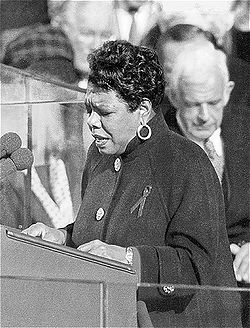
Rest in Peace, Maya Angelou

250px-Angeloupoem

This morning I was rather saddened to learn of the passing of poet and activist Maya Angelou (April 4, 1928 – May 28, 2014). She was well known for her acclaimed series of autobiographical novels and as a colleague of Martin Luther King and Malcolm X in the civil rights movement. According to wikipedia, she has also been a cook, prostitute, night-club dancer and performer, theater cast-member, coordinator for the Southern Christian Leadership Conference, journalist, writer, director (Down in the Delta), producer of plays, movies, and public television programs, and actress (making appearances in Roots and Poetic Justice). One particularly memorable career highlight was her appearance at a ceremony commemorating the 50th anniversary of the United Nations at which she delivered the following poem:

“A Brave and Startling Truth”

We, this people, on a small and lonely planet
Traveling through casual space
Past aloof stars, across the way of indifferent suns
To a destination where all signs tell us
It is possible and imperative that we learn
A brave and startling truth

And when we come to it
To the day of peacemaking
When we release our fingers
From fists of hostility
And allow the pure air to cool our palms

When we come to it
When the curtain falls on the minstrel show of hate
And faces sooted with scorn are scrubbed clean
When battlefields and coliseum
No longer rake our unique and particular sons and daughters
Up with the bruised and bloody grass
To lie in identical plots in foreign soil

When the rapacious storming of the churches
The screaming racket in the temples have ceased
When the pennants are waving gaily
When the banners of the world tremble
Stoutly in the good, clean breeze

When we come to it
When we let the rifles fall from our shoulders
And children dress their dolls in flags of truce
When land mines of death have been removed
And the aged can walk into evenings of peace
When religious ritual is not perfumed
By the incense of burning flesh
And childhood dreams are not kicked awake
By nightmares of abuse

When we come to it
Then we will confess that not the Pyramids
With their stones set in mysterious perfection
Nor the Gardens of Babylon
Hanging as eternal beauty
In our collective memory
Not the Grand Canyon
Kindled into delicious color
By Western sunsets

Nor the Danube, flowing its blue soul into Europe
Not the sacred peak of Mount Fuji
Stretching to the Rising Sun
Neither Father Amazon nor Mother Mississippi who, without favor,
Nurture all creatures in the depths and on the shores
These are not the only wonders of the world

When we come to it
We, this people, on this minuscule and kithless globe
Who reach daily for the bomb, the blade and the dagger
Yet who petition in the dark for tokens of peace
We, this people on this mote of matter
In whose mouths abide cankerous words
Which challenge our very existence
Yet out of those same mouths
Come songs of such exquisite sweetness
That the heart falters in its labor
And the body is quieted into awe

We, this people, on this small and drifting planet
Whose hands can strike with such abandon
That in a twinkling, life is sapped from the living
Yet those same hands can touch with such healing, irresistible tenderness
That the haughty neck is happy to bow
And the proud back is glad to bend
Out of such chaos, of such contradiction
We learn that we are neither devils nor divines

When we come to it
We, this people, on this wayward, floating body
Created on this earth, of this earth
Have the power to fashion for this earth
A climate where every man and every woman
Can live freely without sanctimonious piety
Without crippling fear

When we come to it
We must confess that we are the possible
We are the miraculous, the true wonder of this world
That is when, and only when
We come to it.