Democrats in labor unions and figures like former Labor Secretary Robert Reich and others were justly outraged at Barack Obama’s latest wet kiss to Wal-Mart earlier this month. But First Lady Michelle Obama has been in bed with the giant retailer for years. Is this a nasty bug in the Obama presidency, or a corrupt core feature?
Low Wages, Always: Barack and Michelle Obama Bestow More Wet Kisses on Wal-Mart
“…the willingness of the Obama Administration to do the bidding of Wal-Mart shows just how hollow has become the pretense of elected black Democrats to representing the poor and oppressed…”
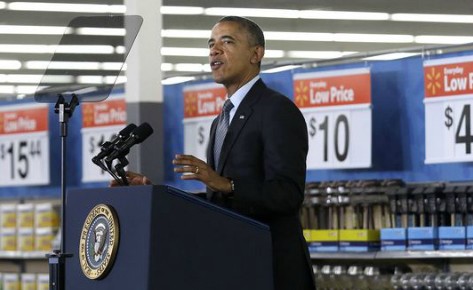
Earlier this month President Obama visited a Bay Area Wal-Mart to praise the world’s largest and most anti-union retailer for its supposed environmental responsibility. The fact is that Wal-Mart’s maintenance of diesel-fueled supply chains between its stores and wherever on the planet wages are lowest and environmental restrictions are totally absent make it a major ongoing contributor to runaway climate change. The president’s appearance therefore, was simply a hypocritical exercise in greenwashing for Wal-Mart.
Though it was an insult to working people and to many of his abject and fervent supporters, it should have been no surprise. It wasn’t President Obama’s first wet kiss to Wal-Mart and with almost three more years in office to go it won’t be his last. Still the willingness of the Obama Administration to do the bidding of Wal-Mart shows just how hollow has become the pretense of elected black Democrats to representing the poor and oppressed.
There was a time when Democrats in the White House did not dare openly shill for the giant retailer. Hillary Clinton served on Wal-Mart’s board of directors through most of the 1980s, while her husband Bill was governor of Arkansas. Even then, Wal-Mart was notorious for overworking and underpaying its workers, violating labor laws to thwart unions, and sopping up prodigious amounts of corporate welfare in the forms of tax breaks and subsidies of all kinds. Being in bed with those crooks wasn’t just an embarrassment, it was a hypocritical affront to Democratic voters, so somewhere on the 1992 road to the White House, Hillary resigned from Wal-Mart’s board. Similarly in 2007 with her husband on the way to the White House, Michelle Obama felt compelled to resign from the board of TreeHouse Foods, a major Wal-Mart vendor. “I won’t shop there,” said presidential candidate Barack Obama when questioned about Wal-Mart at an AFL-CIO labor forum.
Of course labor audiences in 2007 and 2008 were where Obama pledged to renegotiate NAFTA, and immediately raise the minimum wage as soon as he took office. The president never mentioned raising the minimum wage again till about 2012 when Republicans were safely in control of the House of Representatives, and instead of renegotiating NAFTA, President Obama is engaged in secret negotiations to extend it across the Atlantic and Pacific Oceans. Evidently the Obama that promises is a different guy, and far less powerful, than the Obama that acts.
“…The first lady allowed the unscrupulous retailer to leverage her personal image …”
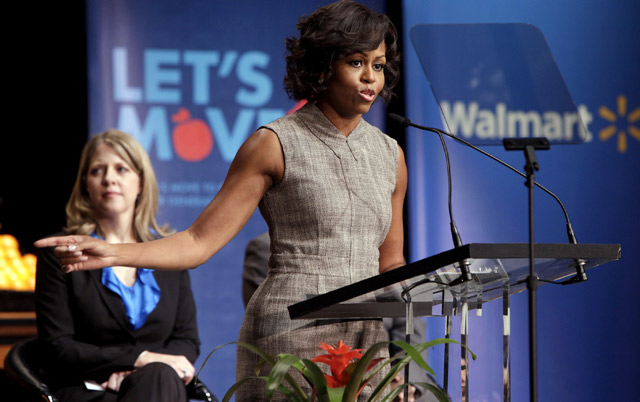
Safely in office, Michelle and Barack Obama have enthusiastically embraced Wal-Mart. The first lady allowed the unscrupulous retailer to leverage her personal image as an advocate of exercise and healthy eating in her “Let’s Move” initiative, and spouting the company line that the best solution to urban “food deserts” is opening more Wal-Mart neighborhood grocery stores. Michelle Obama’s many appearances at and pronouncements around Wal-Mart have done the retailer more good than she and Hillary could ever have done in another decade or two apiece on its board of directors.
Right now Wal-Mart is approaching 30% of the US retail grocery market, with far lower wages, fewer hours, skimpier benefits, and longer and dirtier supply chains than its major competitors. As I said a couple years ago in an article about Michelle Obama’s cynical embrace of Wal-Mart:
Wal-Mart’s business model of corrupting public officials, lying about job creation numbers, rampant sex and race discrimination, relentlessly low wage and benefit levels, and aspirations to monopoly control of local markets across the country make it a bad neighbor, a worse boss, an unfair competitor and sometimes a criminal enterprise.
Wal-Mart has been a leader in the corporate practice of weaponizing its charitable giving, turning it into a lever to open new markets in urban America, to neutralize and isolate opposition, and to curry favor with local political figures. Wal-Mart made it rain on selected charities and ministries in areas like Newark and Chicago when it needed to colonize those new markets. President Obama recognized this “achievement” in the corruption of Democratic party politics in March 2014 by nominating Wal-Mart’s chief of charitable giving to head up his Office of Management and Budget.
Wal-Mart was even allowed, along with McDonalds and other large, low-wage employers, to shape the drafting of regulations governing Obamacare, in ways that exempted the retailer from having to ensure large numbers of its workers for the first several years.
The fiction that elected Democrats represent poor and working people and stand for safeguarding the environment is just that – a fiction. There is a new neoliberal paradigm that allows Democrats to mumble a few words about raising the minimum wage when the other party controls Congress, that claims the moment they took office was the day the oceans stopped rising. If these were curable bugs in the political system, votes and advocacy would wake enough people up to change them. But what if they’re not bugs in the system at all. What if these are its core and immutable features? What then? Isn’t it time to step outside their two-party, capitalist box, to dream and begin to build something else?
Bruce A. Dixon is managing editor at Black Agenda Report and a state committee member of the GA Green Party. He lives and works in Marietta GA and can be reached at bruce.dixon(at)blackagendareport.com.
they sang and prayed,
naming that day in May,
Decoration day they dis-interred 257 Union men
mass graved, dumped, piled broken bodies twisted,
a Charleston North Carolina Guernica
forgotten men dug up, re-interred
with honor, memory, celebration
by 10,000 in 1866
that first Memorial Day
it is Memorial Day 2010
the Turkish flotilla
bringing aid to Gaza
the attack, nine dead,
Americans, Turks
no aid delivered
Memorial Day 1937,
steelworkers striking Little Steel,
strikers with families march toward the Republic steel mill gate
police-guards open fire
ten dead
thirty shot
one hundred clubbed
today we are at Jones beach
it is Memorial Day
we are fifty souls
remembering our dead, the dead
hundreds of Long Islanders
thousands of North Americans
more than a million Iraqis and Afghanis
families stroll past
some look, others see without vision
all have come to eat, drink
and celebrate that insatiable beast
today the Blue Angles
spin flip dive swoop
begging boys and girls to sign up
the navy, the marines want you
as we call out the named and nameless
let us remember these days
past, present, and future
Tom Karlson is founder of Poets for Peace, Long Island, NY.
It’s the third and final day of the Memorial Day weekend.
Millions of Americans are visiting friends and relatives, perhaps taking a three- or four-day mini-vacation. They may be at pool parties and grilling burgers, hotdogs, veggies, and whatever else appeals to them.
The nation’s politicians are going to Memorial Day rallies. There will be speeches and music. American flags and bunting will drape the stages. The politicians will tell us about the “ultimate sacrifices” American servicemen and women made. They will tell us how wonderful America is, how we are the best country in the world, how we defend freedom and remember those who put their lives on the line to do so. The crowds, whether a few or thousands, will applaud vigorously.
Some will even say that the VA hospitals need a complete overhaul, that Gen. Eric Shinseki–who was wounded and earned three Bronze Stars for bravery, should be fired. These are some of the same politicians who had attacked Shinseki when he was Army chief of staff who warned that it would take hundreds of thousands of Americans, not thousands as the Bush-Cheney cabal had claimed, to successfully invade and control Iraq. For his military knowledge, he was forced into an early retirement. These are the politicians who are outraged that America is treating veterans poorly.
Here’s what the politicians also won’t say. They won’t tell us that 41 Republican senators blocked legislation this past year to provide necessary funding for veterans health. They won’t tell us that during the first years of the Iraq War, the quality of American-based hospitals had deteriorated to the point that it took a major newspaper series to expose what had happened and, finally, with politicians forced to look at despicable conditions, and shamed by their ignorance, there were some measures to improve the care for wounded soldiers after their lives were saved by courageous battlefield medics.
They won’t tell us that members of Congress blocked significant increases in the foodstamp program or that governors and legislatures have not done what they should to care for the homeless. After all, the impoverished and homeless don’t contribute to political campaigns. Of course, the politicians won’t tell us that one-fourth of all adult homeless are veterans.
They won’t tell us about veterans who came home from war, and then lost their jobs or homes during the Great Recession that followed the fraud and greed committed by the bankers and industrial giants who were able to become rich because government did little to protect the people.
With crocodile tears and shallow words, recorded by the news media, the politicians will tell us how much they mourn–but they won’t tell us they are part of the problem, for proudly claiming they voted time after time to block necessary funding and for demanding government not intrude upon the free enterprise system.
The politicians will wave flags and say how much they believe in America and our veterans, and how much they mourn the loss of our soldiers. The crowds will enthusiastically agree–and then go to their barbeques and picnics.
No, they won’t tell us that if we want to reduce these problem–DON’T THUMP YOUR CHESTS, UNFURL YOUR FEATHERS, AND SEND THE YOUTH TO WARS THAT SHOULD NEVER BE FOUGHT.
During the Vietnam War, John Prine recorded “Your Flag Decal Won’t Get You Into Heaven Anymore.” It was true then. It is still true. Please listen.
I used to think stealing was subversive. Now I know I had it backwards.
It’s just after nine on Saturday morning, a half-hour after my wife discovered the package. I’m at my desk, pawing nervously at my computer mouse, dragging the arrow across a monitor where the image of a mysterious stranger glows colorless in the washed-out light of dawn. I freeze the frame for a better look, not knowing what information I hope to gather. He’s middle-aged, nondescript. He wears light-colored pants and a fleece sweatshirt, and is carrying a small cardboard box, holding it gently, almost tenderly.
I rewind two minutes to 6:02AM. A brown or maroon minivan pulls up and parks. The man gets out, opens the rear lift gate, rummages around. Now he has the box. He’s walking across the driveway. Has he practiced this? Staked out the place? Have we seen him before? Someone we know?
Fourteen strides bring him to our front door, and he bends down to carefully place the box on our doorstep. Like the man, the box is nondescript—small and tan and unmarked. I let the scene play out for the tenth or 20th time, switching between two camera angles. As he leaves, our security light startles him. He brings up his hand to shield his eyes, annoyed, or maybe just surprised, and I see him as some mad bomber, some fugitive from a TV news story, caught on tape as he makes his getaway.
The security light seems to jolt him a little. He quickens his pace, lengthens his stride. Ten paces bring him back to his van, where he jumps in the driver’s seat and glides off down the empty suburban street. I rewind to watch the scene again, glancing guiltily at the little tan box sitting on my desk. I’ve closed it back up to hide its contents, but it’s still there, inanimate yet insistent, pulsing with unanswered questions.
***
Ever wonder what might be the most subversive act you could undertake in modern America? I have. I used to think stealing was subversive, an idea I probably picked up from reading too much Yippie propaganda as a teenager. It was an idea that fit comfortably with my lower-middle class identity and the fact that, like most young people, I wanted a lot of stuff I couldn’t afford. So I stole—not from regular people but from chain stores, because I reasoned they were soft targets of corporate America and deserved to be bled a little bit. Plus it was a cheap thrill that made me feel dangerous and cool.
I finally gave up shoplifting in my 20s, having been caught a couple times and waking up to the fact that I was not actually bringing down Babylon by pilfering stuff I didn’t even need. I still wanted to play out my revolutionary fantasies though, so I set my sights on creating art that might serve as some catalyst to action—a rallying cry, a message from the underworld—anything to minutely deflect the fatal direction this country’s been headed in ever since the vampire lord Reagan locked us on our present course.
To do this, I made music, wrote manifestoes, passed out pamphlets, spray-painted walls. I was grandiose and ridiculous and painfully naïve, but I believed in what I was doing, even if I didn’t know exactly what it was. I was zealous and immature and probably terrible to be around. I fantasized about arson and assassination squads. I thought I was being subversive, but I didn’t understand the meaning of the word.
As I grew older, my life took that time-honored path from caricature to cliché, my ideals sprayed like seafoam against the rocks of everyday life—kids, marriage, college, career. Through it all, I tried my best to stay active and informed, but in the end I found myself like most everyone else, sitting passively and impotently at a computer, cursing the army of dolts and liars and greedheads that have made it their mission in life to ruin my country and diminish the prospects of my children’s happiness and prosperity. I swallowed my powerlessness and gave up on direct subversion, attempting instead to make changes from within.
To this end, I landed a job in education, and from there, I still do what I can to make change, albeit on an individual and painfully gradual basis. I live off the dwindling largesse of the taxpayer, helping foster and homeless youth get their high school diplomas, so that they at least have a chance at a better life. It’s important work and I enjoy it. It pays the bills and eases my conscience, makes me think that even if I’m not boldly reshaping society, at least I’m not adding to its misery. Yet I’ve always felt I was missing something.
***
We all want so much. So many shiny things catch our eyes and divert our attentions. We exist in perpetual envy, sizing each other up, counting and coveting and judging our worth and the worth of our fellow citizens based on whatever status markers are currently in vogue. My 13-year-old son struts around the house singing about stacking paper and making it rain, of guarded mansions and red Bugattis and gold-plated pistols.
On my friend’s Facebook page, I get in a pointless argument with a millionaire who tells me how sick she is of me and my kind stealing from her via the tax system, how she deserves every penny of her riches because she’s worked harder than everyone else and made better choices, completely ignoring the luck and privilege that enabled her to do so.
Walking downtown, I step over a homeless man sitting on the sidewalk, his back against a chain link fence, dirty belongings splayed around him. In a weak and quiet voice, he asks me for change and I instinctively say no, I don’t have any, and as I round the corner I feel in my pocket anyway, coming out with a rumpled five. Will I miss five bucks? Can I give up a cappuccino today so that this dazed human being can survive another few hours? I put it back in my pocket and unlock my car, but as I’m getting in I feel guilt pooling like blood in my stomach, so I decide to go back and give him the money, but as I take a step toward him, I see that a police car has pulled up to the curb.
We have a new law in town that makes it illegal to sit on a public sidewalk, because businesses complained that homeless people were driving away customers. I wrestle with my thoughts for a second. I’m late for a meeting. I don’t want to deal with any cops right now. I don’t even know this guy—what’s his story? What’s his problem? I have bills to pay and kids to raise and lunch to buy.
The door of the cop car swings open and a man in a blue uniform steps out, looking efficient, professional, authoritative. I shove the fiver back in my pocket and get in my car, ashamed. As I drive away, I see in a flash of stark detail all the systems and devices and conditioning that stops me from giving away even a tiny fraction of my hard-earned yet unimpressive bankroll, and I realize that the truest form of subversion in this tainted republic is not shock or violence or humor. It’s generosity.
But let’s go back in time a bit, to the beginning of this story.
***
As my wife is leaving for her morning run, she hollers that there’s an unmarked package on our doorstep. I ignore her, as I’m busy checking my status and reading the news. I’m doing the same thing when she comes back a half hour later, only now she’s holding the box, a worried and expectant look on her face. She places it in my hands, unopened. It’s light, but there is something inside. I turn it a bit, give a gentle shake. I’m mildly afraid.
A couple days before, some anonymous asshole, we assume the neighbor kid, threw an egg through the cracked back window of our family van, making a smelly and disgusting mess inside. We often awake to find trash strewn on our lawn, or our trees and shrubs covered in toilet paper. We’ve both had stuff stolen from our cars, and sometimes at night we get loud phantom knocks on our front door. It’s petty stuff, but it affects us.
We don’t feel welcome in our neighborhood, hence the security cameras. We feel harassed and beleaguered and out of step with the patriotic Americans who populate our street, with their giant trucks and NRA stickers, country music and Super Bowl parties.
“What do you think’s in it?” my wife asks.
“Probably a dog turd.”
“Naw, feels more like a dead rat.”
We laugh as if we’re joking. The box has complicated flaps that keep it tightly closed. I shake it once more and it doesn’t explode, but still, I hold it away from my body, just in case it is a bomb. That way I’ll only lose a few fingers, maybe a hand, but hopefully get to keep my vital organs. I suck in a breath and we brace ourselves for whatever psychological trauma is about to be inflicted on us. The flaps slide out and the box opens, revealing a large stack of white, restaurant-style napkins.
“That’s weird. I wonder…”
The words evaporate as I turn over the napkins, revealing a neat stack of greenish paper. The box falls to the floor. Nestled inside are ten crisp $100 bills and an anonymous note thanking my wife and I for some unidentified “service to our community”.
“What the fuck is that?” we say in unison.
***
I feel awful watching the footage of the delivery, like I’m the most unworthy wretch in the world, treating this beautiful gesture as if it’s some kind of crime. Here I’ve been given this amazing gift, with no strings attached, and yet I feel… what? Violated? Confused? Someone must have made a mistake. All the awful questions that came up when we discovered our car had been vandalized came flooding back. Why me? Who would do such a thing? What did I do to deserve this?
I tell myself to relax and rejoice, but I can’t. I’m too freaked out. My wife says maybe the money is stolen or counterfeit, some kind of diabolical trap. I try to think of anyone we know who could possibly give away a thousand bucks. There’s no one. Whoever did this is way out of our league.
As I stare at the box of cash, I realize that what’s bothering me is not the gift or the giver. It’s not the way it was delivered or the fact that I can’t properly thank the man who left it. What bothers me is my own reaction. I feel sad and fraudulent and incapable of understanding. It’s not that I don’t feel grateful—far from it. I’m intensely aware that this is a kind of secular miracle, a once-in-a-lifetime occurrence.
But how does one repay such a gift? What saintly act is required to make one feel deserving? I decide the proper thing to do is to take out my checkbook and pass the money on, to UNICEF or cancer research or any number of a million worthy causes. But as the day wears on, my weak altruism is pushed aside by the realities of my financial situation.
There’s the $5,0000 we owe to the IRS. The county wants property taxes and our insurance payment is overdue. There’s the kids’ orthodontist bills and their nonexistent college funds, our student loans, the $800 I need to get my car fixed so it’ll pass smog check, the maxed-out credit cards, the mortgage, the broken fence and the old garage door that we have to prop open with a two-by-four.
UNICEF and the starving kids and the cancer victims will all have to wait. I really do need the money. The thing bumming me out the most, I realize, is how small a difference this enormous gift will actually make. It would take a hundred thousand of these miracles just to get me out of debt, let alone help all those who need money. But… wow.
***
I did end up giving some to charity. A pittance really, but it’s something I guess. As of this writing, I’ve yet to tell anyone (besides my mom) about the gift we got that Saturday. I guess I’m still embarrassed about it. I also don’t want anyone to be envious, to have people wonder why it came to me and not to them. I have lots of friends who deserve that money at least as much as I do, and many of them need it more.
I wish it weren’t like this. I wish I were the subversive money bomber, planting little, tan boxes on people’s doorsteps. I wish our society wasn’t so focused on money, so demanding of greed. I wish rappers and pop stars would stop bragging about all their stupid money and start giving it away, so my son could learn why it really is better to give than receive.
I wish I knew how to make enough to pay my bills so that the five dollars I withheld from that homeless guy wouldn’t spark a moral crisis and make me feel like a cowardly shit every time I step over someone who needs my help.
Now I realize that the true gift of my anonymous benefactor wasn’t really the money at all. It was the knowledge that came with it. The most subversive statement you can make is a simple act of generosity.
Josh Indar is a recovering journalist who currently writes novels and short stories. He lives in a little college town in Northern California, where he tutors homeless & foster youth and plays in a band called Severance Package. He holds an MFA in creative nonfiction from Antioch University, Los Angeles. email: jvindar@yahoo.com
David Cronenberg’s “Scanners” (1981) is infamous for a particular scene occurring less than 15 minutes into the film (and is likely still a shock for audiences today who have never seen it). The film’s notoriety (and comparatively wooden performance of the lead actor) may have caused most viewers to overlook some of the film’s better qualities such as an intelligent proto-cyberpunk storyline involving human drug experimentation, corporate espionage and backlash from a mutant terrorist underground. One particularly compelling plot element features an attack via psychic computer hacking. Scanners is surprisingly polished for its budget in terms of cinematography and special effects and is also notable for standout performances by Patrick McGoohan (creator and star of “The Prisoner” TV series) and Michael Ironside.
Ecological economists such as Herman Daly write that the more full the world becomes, the higher are the social or external costs of production.
Social or external costs are costs of production that are not captured in the price of the products. For example, dead zones in the Gulf of Mexico that result from chemicals used in agriculture are not included as costs in agricultural production. The price of food does not include the damage to the Gulf.
Food production is a source of large social costs. Indeed, it seems that the more food producers are able to lower the measured cost of food production, the higher the social costs imposed on society.
Consider the factory farming of animals. The density of operations results in a concentration of germs and in animals being fed antibiotics. Lowering the cost of food in this way contributes to the rise of antibiotic resistant superbugs that will impose costs on society that will more than offset the savings from lower food prices.
Monsanto has reduced the measured cost of food production by producing genetically modified seeds that result in plants that are pest and herbicide resistant. The result is increased yields and lower measured costs of production. However, there is evidence that the social or external costs of this approach to farming more than offsets the lower measured cost. For example, there are toxic affects on microorganisms in the soil, a decline in soil fertility and nutritional value of food, and animal and human infertility.
When Purdue University plant pathologist and soil microbiologist Don Huber pointed out these unintended consequences of GMOs, other scientists were hesitant to support him, because their careers are dependent on research grants from agribusiness. In other words, Monsanto essentially controls the research on its own products.
In his book, Genetic Roulette, Jeffrey M. Smith writes: “Genetically modified (GM) foods are inherently unsafe, and current safety assessments are not competent to protect us from or even identify most dangers.” The evidence is piling up against such foods; yet the US government is so totally owned by Monsanto that labeling cannot be required.
Pesticides damage birds and bees. Some years ago we learned that ingestion of pesticides by birds was bringing some species near to extinction. If we lose bees, we lose honey and the most important pollinating agent. The rapid decline in bee populations have several causes. Among them are the pesticides sulfoxaflor and thiamethoxam produced by Dow and Syngenta. Dow is lobbying the Environmental Protection Agency to permit sulfoxaflor residues on food, and Syngenta wants to be able to spray alfalfa with many times the currently allowed amount of thiamethoxam.
As the regulators are more or less in the industry’s pocket, the companies will likely succeed in their efforts to further contaminate the food of people and animals.
The profits of Monsanto, Dow, and Syngenta are higher, because many of the costs associated with the production and use of their products are imposed on third parties and on life itself.
Many countries have put restrictions on GMO foods. Lawmakers in Russia equate genetically engineered foods to terrorist acts and want to impose criminal penalties.
The French parliament has approved a ban on GMO cultivation in France. However, Washington lobbies foreign governments on behalf of its agribusiness and chemical donors. Dick Cheney used his two terms as vice president to staff up the environmental agencies with corporate friendly executives. Just as the political appointees at the SEC would not let SEC prosecutors bring cases against the big banks, environmental regulators have a difficult time protecting the environment and food supply from contamination. The way Washington works is that the regulators protect those they are supposed to regulate in exchange for big jobs when they leave government. The economist, George Stigler, made this clear several decades ago.
The public favors labeling of genetically engineered food, but Monsanto and the Grocery Manufacturers Association have so far been successful in preventing it. On May 8 the governor of Vermont signed a bill passed by the state legislature that requires labeling. Monsanto’s response is to sue the state of Vermont.
The opposition to labeling by agribusiness is suspicious. It creates the impression of hiding information from the public. Normally, this is not good public relations. Currently, foods are mislabeled when genetically engineered food is labeled “natural.”
Breakthroughs in science and technology allow mere humans to play God with insufficient information. The downsides of genetic engineering are unknown, and the costs could exceed the benefits. What economists term “low cost production” might turn out to be very high cost.
Neoclassical economists do not lose sleep over external costs, because they think that there is always a solution. They think that the way to deal with pollution is to price it so that the entity that most needs to pollute ends up with the right. Somehow this is thought to solve the problem of pollution. Neoclassical economists think that it is impossible to run out of resources, because they believe man-made capital is a substitute for nature’s capital. It is a fantasy world in which we become ever more productive and better off and never run out of anything.
Ecological economists see the world differently. Nature’s capital, such as mineral resources and fisheries, are being depleted, and the disposal sinks for wastes are filling up, with land, air, and water being polluted. Every act of production produces useful products and wastes. As external costs and the depletion of nature’s capital are not measured, we have no way of knowing whether an increase in output is economic or uneconomic. All we can tell is whether the costs that are measured are covered by the price of the product.
What this means is that in a full world, neoclassical economics becomes less meaningful and is less able to contribute to our understanding of problems. It cannot even tell us whether GDP is rising or falling as we do not have a measure of the full cost of production.
For further information on these issues, see my book, The Failure Of Laissez Faire Capitalism And Economic Dissolution Of The West, and the website: http://steadystate.org
Two Oregon Counties Vote to Ban Genetically Engineered Crops Despite Massive Contributions by Monsanto and Corporate Agribusiness
Wins for Community Rights in Jackson and Josephine Counties a Sign of Growing Momentum for Anti-GMO Movement
FINLAND, Minn. – On Wednesday, May 20, voters in two counties in Oregon passed ballot initiatives to ban the growing of genetically engineered crops.
Jackson County’s Measure 15-119 passed overwhelmingly, by 66 percent to 34 percent. Proponents of the ban raised only $375,000 compared with a record nearly $1 million raised by the opposition, which included agribusiness giants Monsanto, Syngenta and DuPont Pioneer.
Voters in Josephine County passed Measure 17-58 by a vote of 58 percent to 42 percent. However, the ban will be tested in court because the state passed a controversial law in October 2013, stripping counties of the right to pass GMO bans. The Jackson County measure is exempt from the state law because it had already qualified for the ballot prior to the passage of S.B. 863.
Ronnie Cummins, national director of the Organic Consumers Association (OCA), and the Organic Consumers Fund which mobilized its members and donated $50,000 to the Oregon campaigns, issued this statement today:
“The passing of these two GMO bans in Jackson and Josephine Counties should send a clear signal to politicians that citizens not only reject unregulated and hazardous GMOs, but are willing to defy the indentured politicians who pass laws, like Oregon’s S.B. 863, that take away county rights to ban GMOs and obliterate a 100-year tradition of home rule and balance of powers between counties and the state.
“This is a tremendous victory for the citizens of these two counties, and for the farmers who are determined to fight the threat of unwanted contamination by GMO crops. It is also a victory for the national anti-GMO movement as it builds momentum for similar bans in counties in other states.
“The margins of victory for these two measures also bode well for passing Oregon’s Ballot Initiative #44 in November 2014, a statewide ballot measure to require mandatory labeling of GMO foods and foods containing GMO ingredients, sold at retail.
“And finally, these victories make it clear to agribusiness giants like Monsanto and Dow that the day has come when they can no longer buy and lie their way to victory. By using the tools of democracy, such as ballot initiatives, citizens can overcome corporate and government corruption through honest campaigns, built on a foundation of truth, science and fair play.
“The OCA looks forward to helping the citizens of Josephine County defend their right to ban GMOs when they go to court to test the state’s new law, S.B. 863, and to helping the Oregon Right to Know campaign pass a strong GMO labeling law in November.”
The Organic Consumers Association (OCA) is an online and grassroots non-profit 501(c)3 public interest organization campaigning for health, justice, and sustainability. The Organic Consumers Fund is a 501(c)4 allied organization of the Organic Consumers Association, focused on grassroots lobbying and legislative action.
Just in case you’ve been living under a rock (or absorbing the limited range of carefully selected and controlled news reports from the corporate media), Monsanto is a sinister multinational with headquarters in Creve Coeur, Missouri, and it’s engaged in the production of seriously harmful chemicals and agricultural biotechnology.
It’s the largest manufacturer of products which include genetically engineered seed and herbicide glyphosate.
Apart from the genetically produced seed, they have also been known to produce chemicals such as DDT, PCBs, Agent Orange and bovine growth hormone among others. It has been given the name merchant of death by many groups that inform the sleepwalking masses about the dangers of using Monsanto products.
So let’s take a look at just 6 ways Monsanto are destroying humanity:
They produce genetically engineered seeds which are used to grow corn which is fed to cows with the intention of increasing their mass. GMO’s are harmful since they have been known to cause cancer therefore Monsanto has become a promoter of cancer.
Poisonous pesticides and other farm chemicals
They produce chemicals which are harmful and are sprayed on plants which eventually find their way on the tables of many families. These chemicals poison our body organs which eventually lead to death.
Promoters of Deforestation and desertification
Monsanto clears huge tracts of forest in order to set up their farms. This means they promote deforestation which eventually leads to desertification. As years go by with this kind of practice there will be no land to produce food which will lead to hunger and finally death.
They produce synthetic nitrogen fertilizer which when sprayed in their farms is absorbed by the soil making its way to the water table. This has poisoned over two thirds of US drinking water with nitrate poisoning. Apart from poisoning drinking water, the chemicals make their way to the oceans which has led to oceanic dead zones. Examples include the Gulf of Mexico and Chesapeake bay among others.
Wetland and Rainforest Destroyers
Monsanto model of draining wetlands and cutting down rainforests is a big promoter of destructive green house gases. Argentina is one of the victims of Monsanto’s rainforest destruction where they have planted genetically engineered soy. The destruction of the forest has led to destruction of animal and plant life that depend on the forest.
Generating new animal and human diseases
Glyphosate, one of the chemicals produced by Monsanto with the intention of killing pests has found to be a contributor to new diseases in both humans and animals. The chemical when sprayed on plants kills the useful bacteria and leads to formation of virulent pathogens which are introduced in the body when one consumes the food. These pathogens have led to infertility and miscarriages in animals and soon humans.
Russia has some of the most precious uncontaminated top soil on the planet and if it is rigorously controlled to stay GMO-free and free from chemicals its productivity would increase as Europe declines, geopolitical analyst William Engdahl told RT.
Russian PMs have pondered a draft bill outlawing GMOs. A draft bill submitted to the Russian parliament likens GMO production and distribution to terrorism. After entering the World Trade Organization, Russia was expected to allow GM food production and distribution within its market. However, in March Russia’s President Putin said the country would stay GM-free without violating its obligations to the WTO.
RT:What do you think about this latest bill in Russia’s parliament, which equates GM producers who flout the rules with terrorists. Is that a bit over the top?
William Engdahl: The language on Russian media blogs is [that] punishment for knowingly introducing GMO crops into Russia illegally should have a punishment comparable to that given to terrorists for knowingly hurting people. The direction of this is anything that stops, and puts the genie back in the bottle called genetic manipulation of plants and organisms is to the good for the future of the mankind. The comment about 20 percent of harvest increase in some GMOs is absolute rubbish. There is no long-term harvest gain that has been proven for GMO crops anywhere in the world because they are not modified to get harvest increases. So this is just soap bubbles that Monsanto, Syngenta and GMO giants are putting out to loll the public into thinking it is something good.
RT:Will this measure, if adopted, reduce the number of GM products on the market?
WE: I hope it does. I haven’t got access to the paragraphs of legislation but I think the direction that Prime Minister Medvedev indicated two-three months ago in terms of making this U-turn against GMO that seemed to have a green light after WTO. A year ago it was looking like GMO was a common thing in Russia which would be a catastrophe. I think the point is Russia has some of the most precious non-destroyed top soil on this planet and the richness of this top soil, if it is rigorously controlled to be GMO-free, to be free from chemicals, from Roundup or Atrazyne which is Syngenta’s favorite poison, and is marketed on the world markets as certified organic. Russia has a huge export market in Germany, in Western Europe, the European Union and elsewhere because there is a tremendous lack of it. So anything that Russia does to block GMO, keep in mind, the EU has not certified for commercial planting any GMO for years. There is such a great popular opposition in the EU that Monsanto, despite all the proclivities of the corrupt European Commission in Brussels to go with it, or even some people in the German government. The population is absolutely adamant here, they do not want this in their food.
RT:How can consumers be better protected from inadvertently buying genetically modified food?
WE: They can quite easily. First of all, they can do what the State of California tried, and Monsanto spent millions of dollars to block it and will try again. The State of Washington tried it and the same thing with Monsanto spending millions of dollars to create false lobbying campaigns [ensued]. The State of Vermont tried and succeeded in getting labeling on products that contain above 0.9 percent of GMO, which is similar to the EU. That is labeled on the shelves, when you buy this box of Kellogg’s Cornflakes you make sure to look and see if this is not GMO corn in my Cornflakes that my child is going to eat or is it this GMO garbage that Kellogg’s would so lovingly like to get rid of. That is one step. The other thing is for people to become informed about what we eat. Support local farmers, it is not against technology. I have seen it directly in Germany and elsewhere in Europe that properly done organic farming creates greater harvest yields than industrialized agriculture. The productivity is better, the quality is finer. The animals that are range fed, grass fed cows, chickens, they are real cows and chickens, they are not these synthetic pseudo-meat that we buy on the supermarket shelves in the big chains in Europe and in the US. So that is something that Russia has a great positive contribution to make.
William Engdahl is an award-winning geopolitical analyst and strategic risk consultant whose internationally best-selling books have been translated into thirteen foreign languages.
The city of Boston was shaken last year when its marathon was tragically bombed, leaving three people dead and 264 others injured. The alleged mastermind behind the deadly attacks, Tamerlan Tsarnaev, was killed in a shootout with Boston police. His little brother and alleged co-perpetrator, Dzhohar, is now awaiting trial and will potentially face execution.
Amidst the insanity ensuing from last year’s horrors, one story was largely swept under the rug: the bizarre execution of 27 year old Chechan-American Ibragim Todashev. A month after the bombings, Todashev was interrogated by state and federal officials at his Orlando apartment about his alleged association with the Tsarneavs and his purported role in the Waltham triple murders of 2011.
According to official reports, Todashev was in the process of writing a confession to the Waltham homicides when for no apparent reason, he ‘flipped out’ and propelled a coffee table into the air, striking the agent on the back of his head. He then ran to the kitchen area of his apartment and armed himself with a red pole/broom handle. The unnamed FBI agent shot Todashev seven times, once in the head.
Earlier this year, an internal FBI investigation and Florida State Attorney cleared the FBI agent who fatally shot Ibragim Todashev of any wrong doing. Prosecutor Jeffrey L. Ashton ruled the shooting was reasonable in that: ‘the actions of the Special Agent of the FBI were justified in self-defense and in defense of another’.
Aaron McFarlane
Recent unredacted documents reveal the unnamed agent to be Special Agent Aaron McFarlane, an ex-Oakland police officer with quite a controversial record in his short stint on the force.
The ‘Riders’ case was the biggest police corruption scandal ever witnessed by Oakland Police Department. It cost the Department nearly $11 million to settle civil lawsuits by 119 people who claimed they were falsely arrested, beaten, and had evidence falsified against them. The plaintiffs also alleged that Oakland Police Department turned a blind eye to the police misconduct.
Officers Clarence Mabanag, Jude Siapno, and Matthew Hornung stood accused of 26 counts including kidnapping, assault, conspiracy, false arrests and lying in police reports. McFarlane testified in defense of Mabanag, stating that he had always taught him how to write accurate police reports. However, under cross-examination it was alleged that McFarlane had falsified his own reports at the request of the group’s leader. Once he was faced with evidence proving his guilt, McFarlane pled the fifth.
After five years and two mistrials, the charges were dismissed against the three officers. McFarlane was never charged in connection with falsifying police reports or potentially lying on the witness stand. Regardless, he ended up in legal trouble for committing the same types of actions as the riders.
In November 2003, a man named Aaron Girard filed a civil suit against Aaron McFarlane and his Oakland PD colleague, Steven Nowak, for aggravated battery, false arrest, violation of his civil rights and emotional distress. Girard stated he had witnessed McFarlane and Nowak physically beating an individual who had already been subdued in front of a hospital. Girard took a photograph of the incident and when McFarlane and Nowak realized, they attacked him. The plaintiff alleged he was beaten, kicked and punched around the body, suffering injuries to his shoulder, arm, knee and neck. He claimed he was then falsely arrested by McFarlane and Nowak. Neither McFarlane nor Nowak ever faced charges over the incident.
Additionally, both officers were previously sued by a man named Michael Cole, who filed his complaint on March 26 of the same year (2003). The full details of the complaint are unavailable, although the pair were accused of beating the plaintiff with a ‘hand foot and billy club’ before falsely imprisoning him.
After serving only four years in the police force, Macfarlane retired on disability with a leg injury, collecting a pension of more than $52 thousand dollars annually for the rest of his life.
In his short time as an officer, McFarlane had been accused of falsifying police reports, lying under oath, aggravated battery, making false arrests, violating the rights of suspects, assault with a weapon and false imprisonment, yet was never convicted of any charges.
Other than the questionable circumstances surrounding the death of Ibragim Todashev, it is not known if Aaron McFarlane has ever been involved in any other incident after leaving the Oakland Police Department. And it’s not likely to be known, considering the agency’s secrecy surrounding the release of his identity.
According to Carol Rose, executive director of ACLU of Massachusetts,
“We still don’t know what happened…nor why the explanations from those who were present at the shooting death have been inconsistent, suggesting at various times that Mr. Todashev allegedly threatened agents, including with a knife, a pipe, a stick or pole, an agent’s gun, the deceased’s martial arts training, or even a samurai sword.”
Unfortunately, the investigators on the case weren’t able to interview McFarlane himself about what happened, and had to rely only on prewritten statements.
This alone should prove the report is inconclusive, and prompt the investigation to re-open. However, a New York Times FOIA request reveals that between 1993 and 2011, FBI agents fatally shot about 70 subjects and wounded 80 others, and in every single case, the agent’s use of force was determined to be justified.
When a federal agency coordinates with so many forces to try to suppress the truth, there’s usually something to hide.
**
Watch Abby Martin break down Aaron McFarlane’s track record and the case of Ibragim Todashev starting at 14:45:
In a vote last Sunday, 53.7% of Swiss voters rejected a government plan to fund the procurement of 22 Gripen fighter jets which would have cost at least $3.5 billion. In a public statement, Susanne Leutenegger Oberholzer, a Social Democrat member of parliament said: “The people have spoken. We surely don’t have the money for such unnecessary acquisitions.” Supporters of the plan such as Federal Councilor and defense minister, Ueli Maurer argued “This decision has the effect of creating security gaps” but a majority of voters expressed their belief that money spent to procure the planes could be better be spent on other things.
This story should be especially striking to U.S. citizens, who are constantly told they live in a Democracy yet don’t have a chance in hell of voting down similar military spending proposals or ones much worse like the F-35 Joint Strike Fighter project. According to a Bloomberg article quoting Pentagon officials, the program’s life-cycle cost including development and decades of support is projected to top $1.5 trillion. The manufacture of the F-35 funnels business to a global network of contractors including 1,300 suppliers in 45 states, making it the defense project “too big to kill”. Despite a number of high profile technical problems and numerous delays the F-35 remains in development and is expected to go into full production in 2019, seven years later than planned. By that time other countries are likely to have cheaper unmanned drone fighters with superior performance and capabilities. How does this colossal waste of money and time make us safer?