Saturday Matinee: The Loved One

“The Loved One” (1965) is a satire directed by Tony Richardson with a screenplay by Terry Southern and Christopher Isherwood based on a novel by Evelyn Waugh. The plot centers on the journey of young English expat Dennis (Robert Morse) who struggles to navigate the more confusing aspects of Los Angeles culture, particularly politics, romance and the Hollywood cemetery industry. The film was shocking and offensive for audiences of its time and though it may seem tamer from today’s perspective, it retains a cleverly subversive quality and much of the satirical humor holds up well. Features a great supporting cast including Jonathan Winters, Anjanette Comer, Rod Steiger, John Gielgud, Roddy McDowall, James Coburn, Milton Berle, Dana Andrews and Liberace.

Watch the full film here.

Demise Of The Petrodollar Has The Potential To Reshape The Geopolitical World

By James ONeill

Source: New Eastern Outlook

In the early 1970s President Richard Nixon instigated two changes that had profound effects. The first of these was taking United States off the gold standard; i.e. henceforth US dollars would no longer be convertible to Gold. Ordinarily this might have been expected to have significant ramifications for the value of the US dollar.

Deleterious effects however, were avoided by another equally profound change. Nixon’s National Security Adviser Henry Kissinger negotiated an agreement with Saudi Arabia that henceforth all oil(initially from Saudi Arabia but rapidly extended to all OPEC) countries would be traded only in US dollars, the birth of the so called petrodollar.

It was a classic mafia style arrangement. In exchange for Saudi Arabia’s agreement to the sole use of the dollar for oil transactions, the US underwrote Saudi Arabia’s security thereby ensuring the continuity of one of the world’s most corrupt and repressive regimes.

Also unknown at the time, the US and Saudi Arabia entered an arrangement whereby Islamist terrorist groups (as long as they were Sunni) would be financed by Saudi Arabia and armed by the Americans and then used in pursuit of US geopolitical goals. Operation Cyclone, begun under the Carter administration in the 1970s was an early forerunner of this tactic, but it has been refined and utilized in different formats in a wide number of countries ever since.

The objective was always fundamentally the same: to undermine and if necessary replace governments that were insufficiently compliant with US geopolitical aims. As and when necessary, US troops and their “coalition” allies would be inserted into the target countries. The destruction of Afghanistan (2001 and continuing) Iraq (2003 and continuing) Libya (2011 and continuing) are only three of the better-known examples.

The huge financial cost of these military and geopolitical ventures did not impose a proper price upon the US because of the hegemonic role of the US dollar. The US, in effect, had their multiple wars of choice paid for by other countries as the dollar’s role in world trade created a constant demand for US Treasury bonds.

The role of the US dollar also permitted the US to impose sanctions on recalcitrant countries. The selective nature of the sanctions, always directed toward a US geopolitical or commercial advantage, were clearly an instrument of repressive power. Notwithstanding claims that they were to “punish” the alleged misconduct of the specified country, their actually use betrayed their geopolitical purpose.

Sanctions against Russia for its” invasion” of Ukraine “annexation” of Crimea, and against Iran for its “nuclear program” are two of the better known illustrations of sanctions being justified on spurious grounds..

The use and abuse of the dollar’s power is clearly unacceptable, but the capacity to invoke countermeasures was until quite recently severely limited. The single most important countervailing force is the rise of China as the economic powerhouse of the world, and importantly, the creation of alternative structures in trade, finance and security, that translate China’s economic power into a force for major change.

That change is assisted by the number of collateral developments. In 1990, the G7 nations (Canada, France, Germany, Italy, Japan, the US and UK) had a combined GDP approximately six times greater then the seven economically most important emerging nations (Brazil, China, India, Indonesia, Mexico, Russia and South Korea).

By 2013 the “emerging seven” had surpassed the G7’s GDP total and according to the IMF’s estimates for 2017, the GDP of the two groups will be $47 .5 trillion and $37.8 trillion for the emerging seven and the G7 respectively. Turkey, which is growing at 5% per annum, has replaced Mexico in the top emerging seven.

BRICS, which contains four of the emerging seven nations and the Shanghai Corporation Organisation (SCO), which includes China, India and Russia, are working together on the architecture of a monetary alternative to the dollar. The SCO alone contains 42% of the world’s population.

India’s role in BRICS and the SCO is one reason it is being assiduously cultivated by Australia, Japan and the United States in an attempt to set up a “quadrilateral four” to slow and undermine the role of China and Russia in creating an alternative to longstanding western domination and exploitation.

It was in this context that Russia’s President Putin at the recent BRICS meeting in Xiamen, China said that

“Russia shares the BRICS countries concerns over the unfairness of the global financial and economic architecture, which does not give due regard to the growing weight of the emerging economies.”

This speech developed a theme that Putin had developed in an article published prior to the BRICS meeting. Putin bluntly vowed to destroy the US led financial system, aiming to reform a system that gives excessive domination to a limited number of reserve (i.e. predominantly western) currencies.

China has developed a new Cross Border Interbank Payments System (CIPS) to replace the US dominated SWIFT system, itself used as a tool for financial bullying by the US. Russia has also taken steps to insulate itself from the ill effects of being excluded from SWIFT.

Other major changes are also occurring. Venezuela, with the world’s largest known oil reserves, has ceased accepting payment in US dollars. In the past US retaliation through regime change would have been immediate as happened to Libya’s Gaddafi (confirmed by Clinton’s leaked emails) and the Iraq’s Saddam Hussein who had announced that he would henceforth accept payment in euros and not dollars.

China and Qatar recently concluded a $50 billion deal denominated in Yuan. There were immediate threats and absurd demands from Saudi Arabia, undoubtedly acting as the voice of the US administration, but nothing more serious. The lack of military intervention or attempted regime change was probably attributable to Turkey’s military intervention, a series of agreements with Iran, and the probable implied threat of Chinese intervention should the Saudis further demonstrate their military incompetence (as in Yemen) by anything as rash as direct military moves against Qatar.

Saudi Arabia is rapidly reaching a crunch point in its relationship with China, a huge purchaser of Saudi Arabia’s oil. It is widely known that China wants future oil contracts denominated in Yuan. The attraction for Saudi Arabia is that the Chinese guarantee their Yuan with gold traded on the Hong Kong and Shanghai exchanges. Ironically, this puts China in the same position as the United States prior to Nixon’s withdrawal from the gold backed dollar.

The dilemma for the Saudis is that if they comply with the Chinese demands they risk losing the Americans underwriting their security. US instigated regime change in Saudi Arabia is a very real possibility and the recent maneuverings by Mohammad bin Salman to consolidate his power can be interpreted as a response to that possibility.

Typically, the western media focused on relative trivialities, such as women being able to drive motor vehicles from 2018 (in limited circumstances), rather than examining the underlying geopolitical power struggle.

The other major development worth mentioning in this context is the rapid increase in the number of countries doing deals with China using the Yuan or their own national currencies as the medium of exchange. China’s Belt and Road Initiative, currently involving 65 nations, will undoubtedly accelerate this trend. Russia and China are already each other’s critically important trading partners and all agreements between them are being denominated in either Yuan or Rubles.

It would be naïve to assume that this is all going to occur without a massive rearguard action by the Americans who know full well that their ability to defy economic logic is only possible because of the dollar’s unique role, allowing in turn military interventions to prop up their now rapidly declining power.

The United States’ aggressive and provocative actions in the South China Sea, North Korea, Ukraine, Syria and elsewhere our best interpreted as the flailing’s of a declining empire. The real question is will the United States accept the disappearance of the unique power that it has wielded since the Bretton Woods agreement of 1944 and adjust its policies accordingly, or destroy us all in their attempts to recapture a lost world.

Who’s Afraid of Conspiracy Theory?

By Tim Hayward

Source: Tim Hayward’s Blog

‘Conspiracy theory’ is frequently used as a derogatory term, a term of disdain and implicit criticism. An effect of this is to discourage certain kinds of legitimate critical inquiry. But surely, in a world where conspiracies happen, we need good theories of what exactly is happening. The only people who really have anything to worry about from conspiracy theories are conspirators who stand to be exposed by them. For the rest of us, if someone proposes a far-fetched theory, we are instinctively sceptical; if they propose a theory that accounts for some otherwise unaccountable occurrences, they may be helping us learn something.

Of course, people can sometimes be misled by conspiracy theories, but people are misled by the beliefs that conspiracy theories challenge too. This betokens a need for careful scrutiny of controversial contentions quite generally. Obviously, a conspiracy theory is only a theory unless there is also proof. But it is one thing to demand the truth of a theory be proven; it is quite another to pronounce that such a theory can never be accepted as true. Unfortunately, even academic critics fail to observe that clear distinction, with some of them going so far as to condemn conspiracy theories in general, pre-emptively.[1]

Yet what are denigrated as ‘conspiracy theories’ are quite often legitimate lines of inquiry pursued in a spirit of critical citizenship, with the aim of holding to account those who exercise otherwise unaccountable power and influence over our lives, including in ways we are not all always aware of.

My argument, then, is that a kind of inquiry that can be intellectually respectable and socially necessary is far too readily sidelined with the categorisation of it as ‘conspiracy theory’. However, since the name has stuck, I propose we should embrace the designation and push back from the sideline to show how it is possible to engage in conspiracy theory using credible methods of research.

The problem that concerns critics, in fact, is a kind of extravagantly speculative activity that involves believing untested hypotheses. This can appropriately be called conspiracism.[2] Conspiracism designates a fallacious mode of reasoning that reduces questions of explanation to posited conspiracies, without properly investigating the evidence. Conspiracists are prone to see conspiracies everywhere, and to believe what they think they see, without giving sufficient consideration to alternative explanations. What is wrong with conspiracism, though, can be specified by reference to standards of inquiry set by good conspiracy theory. So the two things could hardly be more different.

It is especially important to be aware of the difference, given how it has been effaced in public discussions. Early ideas about a ‘conspiracist mindset’, from Harold Lasswell and Franz Neumann, informed Richard Hofstadter’s influential study of the political pathologies of the ‘paranoid style’ in the 1960s. This association of conspiracy suspicions with irrationality and paranoia was then actively promoted in the United States, especially, and as Lance deHaven Smith notes, ‘the conspiracy-theory label was popularized as a pejorative term by the Central Intelligence Agency (CIA) in a propaganda program initiated in 1967.’[3]  The program, created as a response to critical citizens’ questions about the assassination of J F Kennedy, ‘called on media corporations and journalists to criticize “conspiracy theorists” and raise questions about their motives and judgments.’ Its reach has extended greatly since.

Professor Peter Knight of Manchester University, who heads a major international interdisciplinary research network, funded by the European Union, to provide a comprehensive understanding of conspiracy theories, takes it to be a now generally accepted fact that ‘some of the labelling of particular views as “conspiracy theories” is a technique of governmentality.’[4]

So who’s afraid of conspiracy theorists? Is it possible that certain governments want us all to be?

It is interesting to note that Professor Knight thinks that if serious conspiracy theories can sometimes be on the right track, then perhaps what they are finding should not be thought of as conspiracies. For instance, he writes, ‘it is possible that different parts of the labyrinthine U.S. intelligence agencies were involved with some of the 9/11 attackers in contradictory and ambiguous ways that fall short of an actual conspiracy, but which nonetheless undermine the notion of complete American innocence.’ The point is, those contradictions and ambiguities merit study, whatever they are called. Knight’s tantalizing idea of an ‘involvement’ that ‘falls short of an actual conspiracy’ brings me in mind of analogous definitional questions that were raised about Bill Clinton’s descriptions of his  ‘involvement’ with a White House intern. Good sense suggests that what people are interested to know is what happened, not what someone calls it. Ultimately, the serious conspiracy theorist – or theorist of conspiracies, as Knight puts it – wants to know what is going on, and hypotheses about ‘involvements’ of all kinds can figure in the inquiry.[5]

We should bear in mind too, that the very name of this field was bestowed upon it by those who sought to pre-empt its development. Its actual practitioners might think their activities could be more aptly designated in one or more of a number of other, albeit less catchy, ways, such as, for instance, critical civic investigation, intellectual due diligence, investigative journalism, critical social epistemology, or critical social theory.

Which brings me to my main reason for speaking out in defence of the activity: as citizens we find ourselves increasingly struck by anomalies and inconsistencies in official and mainstream accounts of public affairs, not to mention in matters of foreign policy. But whenever we try to share our concerns in a public forum, there seem to be people there ready to harangue us with put-downs about being crazy conspiracy theorists. The reason why they do this is something I shall reflect on another time.[6] My point for now is that we have been drawn to conspiracy theory for reasons that are very far from crazy.


Notes

[1] There is a marked tendency in certain literatures to take this generalized approach to conspiracy theories. Several philosophers – including David Coady, Charles Pigden, Kurtis Hagen, and Lee Basham – have commented critically on it, with Matthew Dentith, in particular, criticizing the failure of such approaches to consider the possibility of finding merits in particular conspiracy theories. He provides examples of ‘generalist positions which take the beliefs or behaviours of some conspiracy theorists as being indicative of what belief in conspiracy theories generally entails.’ (Matthew Dentith,  ‘The Problem of Conspiracism’, Argumenta, [forthcoming in 2017]) An example is Douglas and Sutton who state that ‘in the main conspiracy theories are unproven, often rather fanciful alternatives to mainstream accounts’; they also argue that conspiracy theorists are likely to believe conspiracy theories because they are more likely to sympathise with conspirators. (Karen Douglas and Robbie M. Sutton, (2011) Does it take one to know one? Endorsement of conspiracy theories is influenced by personal willingness to conspire’, Psychology, 50(3), 2011: 544-552.)

[2] On this, I endorse the recent exposition offered by Matthew Dentith (ibid): ‘recent philosophical work has challenged the view that belief in conspiracy theories should be considered as typically irrational. By performing an intra-group analysis of those people we call “conspiracy theorists”, we find that the problematic traits commonly ascribed to the general group of conspiracy theorists turn out to be merely a set of stereotypical behaviours and thought patterns associated with a purported subset of that group. If we understand that the supposed problem of belief in conspiracy theories is centred on the beliefs of this purported subset – the conspiracists – then we can reconcile the recent philosophical contributions to the wider academic debate on the rationality of belief in conspiracy theories.’  He identifies the challenge I am arguing we need to take on: ‘Typically, when we think of conspiracy theorists we do not think of people who theorised about the existence of some particular conspiracy – and went on to support that theory with evidence – like John Dewey (who helped expose the conspiracy behind the Moscow Trials of the 1930s), or Bob Woodward and Carl Bernstein (who uncovered the conspiracy behind who broke in to the Democratic National Committee Headquarters at the Watergate office complex in the 1970s). Instead, we think of the advocates and proponents of weird and wacky conspiracy theories … .’

[3] Lance deHaven Smith, Conspiracy Theory in America, University of Texas Press, 2013: p.21; see also Chapter 4 passim.

[4] Peter Knight, ‘Plotting Future Directions in Conspiracy Theory Research’, in Michael Butter and Maurus Reinkowski, eds, Conspiracy Theories in the Middle East and the United States, Berlin: De Gruyter, 2014: p.347.

[5] ‘Involvements’ amongst people can include any of the typical elements of conspiracy such as collusion, collaboration, conniving, tacitly understanding, secretly agreeing, jointly planning, acquiescing, turning a blind eye, covering up for, bribing, intimidating, blackmailing, misdirecting or silencing, and many other more nuanced kinds of arrangement.

[6] In a third blog of this series I shall be asking ‘Do we face a conspiracy to curtail freedom of expression?’ Meanwhile, the second will be a discussion of ‘Conspiracy theory as civic responsibility’. A full academic paper comprising extended versions of each of these will be available shortly. (And yes, for afficionados who are wondering, there will be a full response to proposals of ‘cognitive infiltration’ to ‘cure’ us. I may even suspend my reputed politeness…)

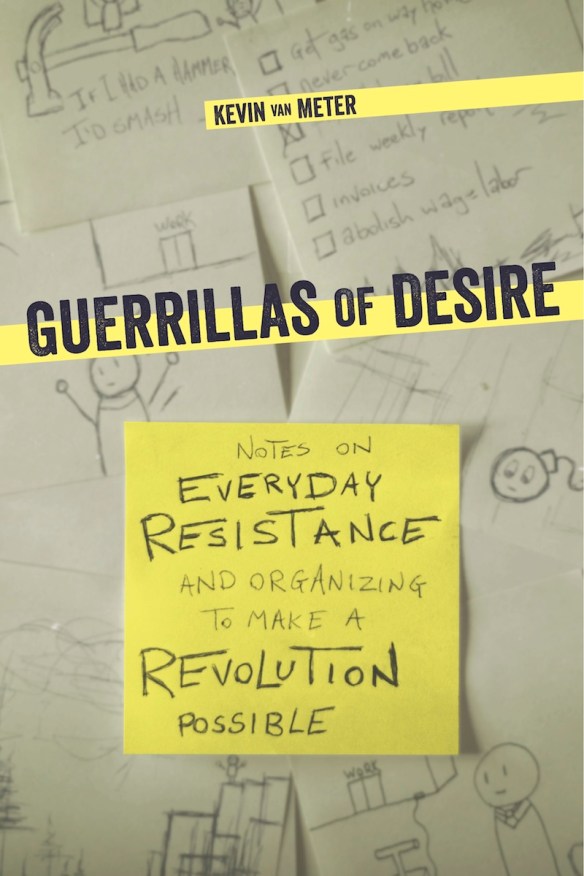
The Seeds of Anti-Capitalist Revolt Found in Everyday Resistance: A Review of Guerrillas of Desire – Notes on Everyday Resistance and Organizing to Make a Revolution Possible by Kevin Van Meter (AK Press, 2017)

By Scott Campbell

Source: Institute for Anarchist Studies

Back when I first began selling my labor for a wage in the wasteland of suburbia’s strip malls, I can recall the tedium of stocking shelves, summoning up insincere courtesy in the face of entitled customers and obnoxious bosses, comparing the stacks of money counted at the end of the day with the totals on our paychecks, and feigning adherence to whatever motivational façade management cooked up to mask the reality of our exploitation.

Yet I also remember, much more vividly and fondly, the latent and occasionally eruptive defiance among my co-workers. This included the constant collective complaining about the job, taking more and longer-than-approved breaks, working as little as possible, fudging time sheets, stealing, and the intermittent screaming matches with the boss in the middle of the store. Underpinning all these actions was an unspoken but broadly understood code of silence when it came to such transgressions and, when appropriate, expressions of support for them.

At the time, I didn’t think much about this, it was just how things happened and I’ve encountered similar experiences to varying degrees in every workplace since. Our actions weren’t guided by a political framework nor was there any attempt to organize them in a directed manner. It was more a spontaneous, innate reaction to experiencing the coercion of capitalism. I had cause to reflect upon this anew while reading Kevin Van Meter’s new book, Guerrillas of Desire: Notes on Everyday Resistance and Organizing to Make a Revolution Possible, published by AK Press and the Institute for Anarchist Studies.

In the preface, Van Meter observes that the question motivating him is not “What is to be done?” but “How do people become what they are?” Throughout the course of the book he seeks to provide an answer by locating power in the resistance of workers, apart from any political ideology or organization. Whether and how that inherently anti-capitalist refusal of work develops into revolt or rebellion are the questions he compellingly urges us to reflect and act upon.

To reach that point, Guerrillas of Desire ambitiously takes on multiple tasks that feed into and build on one another. Van Meter initiates a dialogue between anarchism and Autonomist Marxism that leads to a reconceptualization of the working class, bolstered in part by a historical accounting of workplace actions such as the ones I recounted. He labels these “everyday resistance,” committed by “guerrillas of desire,” and proposes a focus on those deeds as the entry point for organizing revolutionary resistance to capitalism. The impetus for this initiative, concisely carried out in under 160 pages, is his proposal that the current approach to organizing is conceptually flawed and therefore destined to fail. “Guerrillas of Desire offers a contentious hypothesis: the fundamental assumption underlying Left and radical organizing, including many strains of anarchism, is wrong. I do not mean organizationally dishonest, ideologically inappropriate, or immoral. I mean empirically incorrect” (13). The incorrect basis for current organizing is the assumption that the poor and working classes are unorganized and passive and that it therefore rests upon activists and organizations to educate and mobilize them for their own sakes. Van Meter instead proposes that there is in fact informal organization and resistance occurring, it is just of a sort that does not fit within the Left’s organizing vision and therefore goes unseen, unrecognized, and unincorporated into political theories, analysis, and action.

To provide a political frame for understanding the “everyday resistance” of the working class, Van Meter draws upon anarchism’s mutual aid – the material and emotional cooperation and reciprocal support that exists in societies – with Autonomist Marxism’s self-valorization – autonomous working class action that counters the state and capitalism, primarily the refusal of work in its myriad forms. Combined together and reinforcing one another, mutual aid and the refusal of work comprise the “everyday resistance” of the working class.

These phenomena also give definition to what is meant by “working class,” which Van Meter defines as “autonomous from both capitalism and the official organization of the Left, broadly including all those who work under capitalism, based in relationships between workers rather than as a structural component of the economy or sociological category” (32). Rather than being premised on income, occupation, or union membership, the working class under Van Meter’s formulation is made up of all those who must perform work under capitalism – be it waged or unwaged, in the factory, home, office, bedroom, affective, or social spheres. However, when they are not taking action in response to their subjugation under capitalism, these people are just workers. They become a class through the process of struggling against the conditions imposed upon them by capitalism. This struggle initially takes the form of everyday resistance based on mutual aid and the refusal of work. It is everyday resistance that unites individual workers as a class because such resistance, even when performed by one person, requires at a bare minimum the tacit complicity of co-workers and preferably their active collaboration.These acts and the social relationships they create and depend on lay the groundwork for the broader and overt organizing against capitalism more commonly interpreted as working class struggle. Using this framework as offered by Van Meter, we can understand the working class as composed of the relationships forged among workers actively in resistance against capitalism.Without anti-capitalist struggle, the working class does not exist.

After laying this theoretical groundwork, the bulk of the book traces the various forms of resistance by slaves, peasants, and workers in the industrial and social factories (the expansion of capitalist logic from the factory into society at large, in particular in service, immaterial, and reproductive work), creating a lineage and legacy of working class resistance against the various formations of capitalism that spans centuries. “Viewing the working class broadly to include slaves and peasants as well as students, homemakers, immigrants, and factory and office workers reveals the breadth of struggle and generalized revolt against work that continues to be imposed” (128). In doing so, Van Meter further builds the framework of the working class as being formed through its self-activity against the demands and deprivations of capitalism.

The historical survey brings the discussion into the present, where Van Meter offers a proposal to address his initial hypothesis that the Left is carrying out its organizing work in an incorrect way. His suggestion is for the organizers of today and in the future to begin their work by “reading the struggles” already underway in the form of everyday resistance. Through investigation and documentation by organizers, new relationships may be fostered with guerillas of desire that allow everyday resistance to expand into larger and more overt forms of autonomous anti-capitalist struggle. He proposes that the seeds of the new, liberatory worlds sought by anarchism and Autonomist Marxism are to be found in the everyday resistances that are already occurring rather than in the latest organizing manual or official Left strategy document..

While impressed after reading through this formulation, I was left with lingering questions. It remained unclear how, for instance, everyday resistance morphed into more overt, organized resistance and the part organizers positioning themselves as readers of struggle played in such a development. The personal anecdotes he provided on stepping back from ideological assumptions and reorienting towards the collective experiences of communities during his work in Long Island were helpful. It brought to mind the story of Marxist-Leninist intellectuals heading off to the Chiapan jungle with grand plans of starting a peasant guerrilla force. Only when they arrived, they found the population had no time or interest in their grandiose ideology. It was only when they dropped their assumptions and worked within the community to understand its needs, concerns and own history of resistance that the Zapatistas emerged. That, however, is a rather specific and exceptional example. I feel Van Meter’s proposal to begin organizing from within everyday resistance based on the notion that it will lead to more overt resistance could benefit from further articulation and direction.

Similarly, the focus on work as existing solely within the capitalist sphere left me curious as to his vision of the place of non-leisure activity under capitalism or even after capitalism. The refusal of the work that maintains capitalism is indispensable. Yet I would not advocate the refusal of work that maintains communal and personal well-being or builds autonomous organization, or writes books reviews in spare time, for example. Certainly, Van Meter would not advocate that either, but it remains a matter necessitating clarification and one that I believe extends beyond an issue of semantics.

Despite those questions, Guerrillas of Desire is aspirational in its scope and contains ideas and proposals worthy of consideration by radicals reflecting on how to engage in the current moment. In a time when mobilizing and organizing around class has fallen off the radar of many, it is a welcome reminder of the importance of paying attention to the working class and the integral role working class struggle plays in resistance to capitalism, alongside the currently more prevalent resistances to capitalist white supremacy, heteropatriarchy, colonization, environmental destruction and more.

Van Meter assists in this advocacy by accessibly presenting an updated Autonomist Marxist perspective of the working class, expanding it, breathing life into, and imbuing it with its own power, separate from both capitalism and the official Left. As such, he allows readers who may toil in a variety of ways under capitalism to see themselves within the working class, conceptualize their activities as part of a broader resistance with a rich history, and inspire them to build on that legacy.


Scott Campbell is a radical writer and translator based in California. He is part of the collectives that publish the websites El Enemigo Común and It’s Going Down. His personal site is fallingintoincandescence.com

Guerrillas of Desire is available here!


Why We’re Doomed: Our Economy’s Toxic Inequality

By Charles Hugh Smith

Source: Of Two Minds

Anyone who thinks our toxic financial system is stable is delusional.

Why are we doomed? Those consuming over-amped “news” feeds may be tempted to answer the culture wars, nuclear war with North Korea or the Trump Presidency.

The one guaranteed source of doom is our broken financial system, which is visible in this chart of income inequality from the New York Times: Our Broken Economy, in One Simple Chart.

While the essay’s title is our broken economy, the source of this toxic concentration of income, wealth and power in the top 1/10th of 1% is more specifically our broken financial system.

What few observers understand is rapidly accelerating inequality is the only possible output of a fully financialized economy. Various do-gooders on the left and right propose schemes to cap this extraordinary rise in the concentration of income, wealth and power, for example, increasing taxes on the super-rich and lowering taxes on the working poor and middle class, but these are band-aids applied to a metastasizing tumor: financialization, which commoditizes labor, goods, services and financial instruments and funnels the income and wealth to the very apex of the wealth-power pyramid.

Take a moment to ponder what this chart is telling us about our financial system and economy. 35+ years ago, lower income households enjoyed the highest rates of income growth; the higher the income, the lower the rate of income growth.

This trend hasn’t just reversed; virtually all the income gains are now concentrated in the top 1/100th of 1%, which has pulled away from the top 1%, the top 5% and the top 10%, as well as from the bottom 90%.

The fundamental driver of this profoundly destabilizing dynamic is the disconnect of finance from the real-world economy.

The roots of this disconnect are debt: when we borrow from future earnings and energy production to fund consumption today, we are using finance to ramp up our consumption of real-world goods and services.

In small doses, this use of finance to increase consumption of real-world goods and services is beneficial: economies with access to credit can rapidly boost expansion in ways that economies with little credit cannot.

But the process of financialization is not benign. Financialization turns everything into a commodity that can be traded and leveraged as a financial entity that is no longer firmly connected to the real world.

The process of financialization requires expertise in the financial game, and it places a premium on immense flows of capital and opaque processes: for example, the bundling of debt such as mortgages or student loans into instruments that can be sold and traded.

These instruments can then become the foundation of an entirely new layer of instruments that can be sold and traded. This pyramiding of debt-based “assets” spreads risk throughout the economy while aggregating the gains into the hands of the very few with access to the capital and expertise needed to pass the risk and assets off onto others while keeping the gains.

Profit flows to what’s scarce, and in a financialized economy, goods and services have become commodities, i.e. they are rarely scarce, because somewhere in the global economy new supplies can be brought online.

What’s scarce in a financialized economy is specialized knowledge of financial games such as tax avoidance, arbitrage, packaging collateralized debt obligations and so on.

Though the billionaires who have actually launched real-world businesses get the media attention–Bill Gates, Jeff Bezos, Steve Jobs, et al.–relatively few of the top 1/10th of 1% actually created a real-world business; most are owners of capital with annual incomes of $10 million to $100 million that are finance-generated.

This is only possible in a financialized economy in which finance has become increasingly detached from the real-world economy.

Those with the capital and skills to reap billions in profits from servicing and packaging student loan debt have no interest in whether the education being purchased with the loans has any utility to the indebted students, as their profits flow not from the real world but from the debt itself.

This is how we’ve ended up with an economy characterized by profound dysfunction in the real world of higher education, healthcare, etc., and immense fortunes being earned by a few at the top of the pyramid from the financialized games that have little to no connection to the real-world economy.

Anyone who thinks our toxic financial system is stable is delusional. If history is any guide (and recall that Human Nature hasn’t changed in the 5,000 uears of recorded history), this sort of accelerating income/wealth/ power inequality is profoundly destabilizing–economically, politically and socially.

All the domestic headline crises–culture wars, opioid epidemic, etc.–are not causes of discord: they are symptoms of the inevitable consequences of a toxic financial system that has broken our economy, our system of governance and our society.

Killing the Biosphere to Fast-track Human Extinction

By Robert J. Burrowes

Several years ago in Cameroon, a country in West Africa, a Western Black Rhinoceros was killed. It was the last of its kind on Earth.

Hence, the Western Black Rhinoceros, the largest subspecies of rhinoceros which had lived for millions of years and was the second largest land mammal on Earth, no longer exists.

But while you have probably heard of the Western Black Rhinoceros, and may even have known of its extinction, did you know that on the same day that it became extinct, another 200 species of life on Earth also became extinct?

This is because the sixth mass extinction event in Earth’s history is now accelerating at an unprecedented rate with 200 species of plants, birds, animals, fish, amphibians, insects and reptiles being driven to extinction on a daily basis. And the odds are high that you have never even heard of any of them. For example, have you heard of the Christmas Island Pipistrelle, recently declared extinct? See ‘Christmas Island Pipistrelle declared extinct by IUCN’.

Apart from the 200 species extinctions each day however, and just to emphasize the catastrophic extent of this crisis, myriad local populations of many species are driven to extinction daily and millions of individual lifeforms are also killed. See ‘Biological annihilation via the ongoing sixth mass extinction signaled by vertebrate population losses and declines’.

For a taste of the vast literature on this subject touching only on impacts in relation to insects, see ‘Death and Extinction of the Bees’, ‘Insectageddon: farming is more catastrophic than climate breakdown’ and ‘“Decimated”: Germany’s birds disappear as insect abundance plummets 76%’.

Is anything being done to end this omnicide (the destruction of all life)?

Not really, although there is plenty of rhetoric and limited action in some contexts as all bar a few committed individuals and organizations ignore this onslaught while even fewer take action that addresses the underlying cause and/or fundamental drivers of this killing. Unfortunately, most effort is still wasted on lobbying elites.

For example, in the latest example of the foolishness of lobbying elites to take action in our struggle to defend Earth’s biosphere, the European Union has again just renewed Monsanto’s licence to keep poisoning (and otherwise destroying) our world – see ‘German vote swings EU decision on 5-year glyphosate renewal’ – despite the already overwhelming evidence of the catastrophic consequences of doing so. See, for example, ‘Killing Us Softly – Glyphosate Herbicide or Genocide?’ and ‘GM Food Crops Illegally Growing in India: The Criminal Plan to Change the Genetic Core of the Nation’s Food System’.

Of course, massive poisoning of the biosphere is only one way to destroy it and while elites and their agents drive most of this destruction they nevertheless often rely on our complicity. To itemize just a few of these many techniques for destroying our biosphere in most of which we are complicit, consider the following. We destroy rainforests – see ‘Cycles of Wealth in Brazil’s Amazon: Gold, Lumber, Cattle and Now, Energy’ – we contaminate and privatize the fresh water – see ‘Groundwater drunk by BILLIONS of people may be contaminated by radioactive material spread across the world by nuclear testing in the 1950s’ and ‘Nestlé CEO Denies That Water is an Essential Human Right’ – we overfish and pollute the oceans – see ‘New UN report finds marine debris harming more than 800 species, costing countries millions’ – we eat meat despite the devastating impact of animal agriculture on Earth’s biosphere – see ‘The True Environmental Cost of Eating Meat’ – we destroy the soil – see ‘Only 60 Years of Farming Left If Soil Degradation Continues’ – and we use our cars and air travel (along with our meat-eating) as key weapons in our destruction of Earth’s atmosphere and climate with atmospheric carbon dioxide, methane and nitrous oxide levels all breaking new records in 2016. See ‘Greenhouse Gas Bulletin’.

But if you think that is bad enough, did you know about the out-of-control methane releases into the atmosphere that we have triggered – see ‘7,000 underground gas bubbles poised to “explode” in Arctic’ and ‘Release of Arctic Methane “May Be Apocalyptic,” Study Warns’ – and did you know that scientists at the University of Leicester warn that we are destroying the Earth’s oxygen? See ‘Global warming disaster could suffocate life on planet Earth, research shows’ and ‘The Extinction Event Gains Momentum’.

In addition, relying on our ignorance and our complicity, elites kill vast areas of Earth’s biosphere through war and other military violence (without even considering the unique, and possibly life-ending, devastation if the recently and repeatedly threatened nuclear war eventuates) – see, for example, the Toxic Remnants of War Project and the film ‘Scarred Lands & Wounded Lives’ – subject it to uncontrolled releases of radioactive contamination – see ‘Fukushima Radiation Has Contaminated The Entire Pacific Ocean – And It’s Going To Get Worse’ – and use geoengineering to wage war on its climate, environment and ultimately ourselves. See, for example, ‘Engineered Climate Cataclysm: Hurricane Harvey’, ‘Planetary Weapons and Military Weather Modification: Chemtrails, Atmospheric Geoengineering and Environmental Warfare’, ‘Chemtrails: Aerosol and Electromagnetic Weapons in the Age of Nuclear War’ and ‘The Ultimate Weapon of Mass Destruction: “Owning the Weather” for Military Use’.

Of course, all of this is done at immediate cost to human beings, particularly indigenous peoples – see, for example, ‘Five ways climate change harms indigenous people’ –  and those who are in the worst position to resist – see ‘Global Poverty: How the Rich Eat the Poor and the World: The Big Lies’ – but elites know they can ignore our lobbying and occasional, tokenistic and disorganized protests while relying on the fear and powerlessness of most of us to ensure that we do nothing strategic to fight back.

And given the unrelenting criminal onslaught of the insane global elite – see ‘The Global Elite is Insane’  – directed against Earth’s biosphere, together with the elite’s many sycophantic academic, bureaucratic, business, legal, media, military, political and scientific servants who deny science and threaten human survival in the interests of short-term personal privilege, corporate profit and social control, it is long past time when those of us who are genuinely concerned should be developing and implementing a strategy that recognises the elite and its many agents as opponents to be resisted with a careful and powerful strategy.

So, in essence, the problem is this: Human beings are destroying the biosphere and driving countless lifeforms, including ourselves, to extinction. And there is little strategic resistance to this onslaught.

There is, of course, an explanation for this and this explanation needs to be understood if we are to implement a strategy to successfully halt our omnicidal assault on Earth’s biosphere in time to save ourselves and as many other species as possible in a viable ecological setting.

This is because if you want to solve a problem or resolve a conflict, then it is imperative to know and act on the truth. Otherwise you are simply acting on a delusion and whatever you do can have no desirable outcome for yourself, others, the Earth or its multitude of creatures. Of course, most people are content to live in delusion: it averts the need to courageously, intelligently and conscientiously analyse what is truly happening and respond to it powerfully. In short: it makes life ‘easier’ (that is, less frightening) even if problems keep recurring and conflicts are suppressed, to flare up periodically, rather than resolved.

And, of course, this is how elites want it. They do not want powerful individuals or organizations interfering with their scheme to (now rapidly) consolidate their militarized control over the world’s populations and resources.

This is why, for example, elites love ‘democracy’: it ensures disempowerment of the population. How so? you might ask. The fundamental flaw of democracy is that people have been deceived into surrendering their personal power to act responsibly – in relation to the important social, political, economic, environment and climate issues of the day – to elected ‘representatives’ in government who then fearfully represent the elites who actually control them (whether through financial incentives, electoral support or other means), assuming they aren’t members of the elite themselves and simply represent elite priorities out of shared interest (as does Donald Trump).

And because we delegate responsibility to those powerless politicians who fearfully (or out of shared interest) act in response to elite bidding, the best scientific information in relation to the state of the Earth is simply ignored or rejected while conservative ‘scientific warnings’ advocating ‘strategies’ that must fail are widely circulated. See, for example, ‘World Scientists’ Warning to Humanity: A Second Notice’.

So this widespread failure to respond thoughtfully and powerfully is a fundamental reason that we are killing the biosphere and destroying life on Earth. Too few humans are willing to accept personal responsibility to understand why the violence is occurring and to participate in a carefully designed strategy to avert our own extinction, let alone save countless other species from premature entry into the fossil record. It is easier to leave responsibility to others. See ‘The Delusion “I Am Not Responsible”’.

And, clearly, time is running out, unless you are gullible enough to believe the elite-sponsored delusion that promotes inaction, and maximizes corporate profits in the meantime, because we are supposed to have until ‘the end of the century’. Far from it, however. As some courageous scientists, invariably denied access to mainstream news outlets, explain it: near-term human extinction is now the most likely outcome.

One of these scientists is Professor Guy McPherson who offers compelling evidence that human beings will be extinct by 2030. For a summary of the evidence of this, which emphasizes the usually neglected synergistic impacts of many of these destructive trends (some of which are noted above) and cites many references, listen to the lecture by Professor McPherson on ‘Climate Collapse and Near Term Human Extinction’.

Why 2030? Because, according to McPherson, the ‘perfect storm’ of environmental assaults that we are now inflicting on the Earth, including the 28 self-reinforcing climate feedback loops that have already been triggered, is so far beyond the Earth’s capacity to absorb, that there will be an ongoing succession of terminal breakdowns of key ecological systems and processes – that is, habitat loss – over the next decade that it will precipitate the demise of homo sapiens sapiens.

In relation to the climate alone, another scientist, Professor Kevin Anderson, who is Deputy Director of the UK’s premier climate modelling institution, the Tyndall Centre for Climate Change Research, has warned that emissions are now out of control and we are heading for a world that is 6 degrees hotter; he pointed out that even the International Energy Agency, and conservative organisations like it, are warning that we are on track for a 4 degree increase (on the pre-industrial level) by 2040. He also accused too many climate scientists of keeping quiet about the unrealistic assessments put out by governments. See ‘What They Won’t Tell You About Climate Catastrophe’.

So be wary of putting any credence on ‘official’ explanations, targets and ‘action-plans’ in relation to the climate that are approved by large gatherings, whether governmental or scientific. Few people have the courage to tell the truth when it guarantees unpopularity and can readily manifest as career-extinction and social and scientific marginalization.

As an aside, it is perhaps worth mentioning that most people have long forgotten that a decade ago (when the global temperature was .8 degrees above the pre-industrial level) it had been suggested that a decrease in global temperature to not more than .5 degrees above the pre-industrial level was actually necessary to achieve a safe climate, with the Arctic intact (although there was no clear feasible method for humans to reduce the global temperature to this level with any speed). Sadly we have made little progress in the past decade apart from to keep raising the ‘acceptable’ limit (whether to 2 degrees or ‘only’ 1.5). Most humans love to delude themselves to avoid dealing with the truth.

Hence, for those of us committed to responding powerfully to this crisis, the fundamental question is this: Why, precisely, are human beings destroying life on Earth? Without an accurate answer to this question, any strategy to address this crisis must be based on either guesswork or ideology.

So let us briefly consider some possible answers to this question.

Some people argue that it is genetic: human beings are innately violent and, hence, destructive behaviors towards themselves, others and the Earth are ‘built-in’ to the human organism; for that reason, violence cannot be prevented or controlled and humans must endlessly destroy.

However, any argument that human beings are genetically-predisposed to inflict violence is easily refuted by the overwhelming evidence of human cooperation throughout the millennia and there are endless examples, ranging from the interpersonal to the international, of humans cooperating to resolve conflict without violence, even when these conflicts involve complex issues and powerful vested interests. There are also plentiful examples of humans, particularly indigenous communities, living in harmony with, rather than destroying, nature.

Other analysts argue that human violence and destructiveness are manifestations of political, economic and/or social structures – such as patriarchy, capitalism and the state, depending on the perspective – and while I agree that (massive) structural violence actually occurs, I do not believe that these structures, by themselves, constitute an adequate explanation of the cause of violence.

This is simply because any structural explanation cannot account for violence in all contexts (including the violence that led to creation of the structure in the first place) or explain why it doesn’t happen in some contexts where a particular perspective indicates that it should.

So is there another plausible explanation for human violence? And can we do anything about it? Let me offer an explanation and a way forward that also takes advantage of the insights of those traditions that have critiqued structural violence in its many forms.

I have been researching why human beings are violent since 1966 and the evidence has convinced me that the origin of all human violence is the violence inflicted by adults on children under the guise of what sociologists call ‘socialization’. This violence takes many forms – what I call ‘visible’, ‘invisible’ and ‘utterly invisible’ violence – and it creates enormously damaged individuals who then personally inflict violence on themselves, those around them (including their own children) and the Earth, while creating, participating in, defending and/or benefiting from structures of violence and exploitation. For a full explanation of this point, see ‘Why Violence?’ and ‘Fearless Psychology and Fearful Psychology: Principles and Practice’.

Hence, in my view, the evidence is overwhelming that if we want to end human violence, whether inflicted on ourselves, others or the Earth, then the central feature of our strategy must be to end adult violence against children. See ‘My Promise to Children’. I claim that this must be ‘the central feature of our strategy’ for the simple reason that each damaged child grows up to become a willing and active perpetrator of violence when, if they were not so damaged, they would be powerful agents of peace, justice and sustainability committed to resisting violence and exploitation in all contexts until it is eliminated.

This profound evolutionary inheritance – to be an individual of integrity who consciously chooses and lives out their own unique, powerful and nonviolent life path – has been denied to virtually all of us because humans endlessly terrorize their children into mindless obedience and social conformity, leaving them powerless to access and live out their conscience.

And this makes it very easy for elites: By then using a combination of our existing fear, indoctrination (via the education system, corporate media and religion) and intimidation (via the police, legal and prison systems), sometimes sweetened with a few toys and trinkets, national elites maintain social control and maximize corporate profits by coercing the rest of us to waste our lives doing meaningless work, in denial of our Selfhood, in the corporate-controlled economy.

As I implied above, however, we need not be content with just working to end violence against children. We can also work to end all other manifestations of violence – including violence against women, indigenous peoples, people of color, Islamic and working class people, and violence against the Earth – but recognize that if we tackle this violence without simultaneously tackling violence at its source, we fundamentally undermine our effort to tackle these other manifestations of violence too.

Moreover, tackling structural violence (such as capitalism) by using direct violence cannot work either. Because violence always feeds off fear it will always proliferate and remanifest, whether as direct, structural, cultural or ecological violence, however beneficial any short-term outcome may appear.

Importantly then, apart from understanding and addressing the fundamental cause of this crisis, we must implement a comprehensive strategy that takes into account and addresses each and every component of it. There is no point working to achieve a single objective that might address one problem no matter how important that particular problem might be. The crisis is too far advanced to settle for piecemeal action.

Hence, if you wish to tackle all of this violence simultaneously, you might consider joining those participating in the comprehensive strategy simply explained in ‘The Flame Tree Project to Save Life on Earth’. If you wish to tackle violence in a particular context, direct, structural or otherwise, consider using the strategic approach outlined in Nonviolent Campaign Strategy or Nonviolent Defense/Liberation Strategy.

And if you would like to publicly commit yourself to participate in the effort to end all human violence, you can do so by signing the online pledge of ‘The People’s Charter to Create a Nonviolent World’.

Killing the biosphere is the most effective way to destroy life on Earth because it destroys the ecological foundation – the vast array of incredibly diverse and interrelated habitats – on which organisms depend for their survival. And we are now very good at this killing which is why averting human extinction is already going to be extraordinarily difficult.

Hence, unless and until you make a conscious personal decision to participate strategically in the struggle to save life on Earth, you will be one of those individuals who kills the biosphere as a byproduct of living without awareness and commitment: A person who simply over-consumes their way to extinction.

So next time you ponder the fate of humanity, which is inextricably tied to the fate of the Earth, it might be worth considering the unparalleled beauty of what Earth has generated. See, for example, ‘Two White Giraffes Seen in Kenyan Conservation Area’.

And as you do this, ask yourself how hard you are willing to fight to save life on Earth.


Biodata: Robert J. Burrowes has a lifetime commitment to understanding and ending human violence. He has done extensive research since 1966 in an effort to understand why human beings are violent and has been a nonviolent activist since 1981. He is the author of ‘Why Violence?’ His email address is flametree@riseup.net and his website is here.

—
Robert J. Burrowes
P.O. Box 68
Daylesford
Victoria 3460
Australia

Email: flametree@riseup.net

Websites:

https://thepeoplesnonviolencecharter.wordpress.com/ (Nonviolence Charter) https://tinyurl.com/flametree (Flame Tree Project to Save Life on Earth) https://tinyurl.com/whyviolence (‘Why Violence?’) https://feelingsfirstblog.wordpress.com/ (Feelings First) https://nonviolentstrategy.wordpress.com/ (Nonviolent Campaign Strategy) https://nonviolentliberationstrategy.wordpress.com/ (Nonviolent Defense/Liberation Strategy) https://anitamckone.wordpress.com (Anita: Songs of Nonviolence) https://robertjburrowes.wordpress.com/ (Robert) https://globalnonviolencenetwork.wordpress.com/ (Global Nonviolence Network)

A New Concept of Consciousness

By Ervin Laszlo

Source: Reality Sandwich

The following is excerpted from The Intelligence of the Cosmos by Ervin Laszlo, published by Inner Traditions.

What about mind? If the world is vibration, is also mind and consciousness a form of vibration? Or on the contrary, are all vibrations, the observed world, a manifestation of mind?

Although it is true that when all is said and done all we know is our consciousness, it is also true that we do not know our own consciousness, not to mention the consciousness of anyone else. We do not know what consciousness really is or how it is related to the brain. Since our consciousness is the basis of our identity, we do not know who we really are. Are we a body that generates the stream of sensations we call consciousness, or are we a consciousness associated with a body that displays it? Do we have consciousness, or are we consciousness? Consciousness could be a kind of illusion, a set of sensations produced by the workings of our brain. But it could also be that our body is a vehicle, a transmitter of a consciousness that is the basic reality of the world. The world could be material, and mind could be an illusion. Or the world could be consciousness, and the materiality of the world could be the illusion.

Both of these possibilities have been explored in the history of philosophy, and today we are a step closer than before to understanding which of them is true. There are important insights emerging at the expanding frontiers where physical science joins consciousness research.

On the basis of a growing series of observations and experiments, a new consensus is emerging. It is that “my” consciousness is not just my consciousness, meaning the consciousness produced by my brain, any more than a program transmitted over the air would be a program produced by my TV set. Just like a program broadcast over the air continues to exist when my TV set is turned off, my consciousness continues to exist when my brain is turned off.

Consciousness is a real element in the real world. The brain and body do not produce it; they display it. And it does not cease when life in the body does. Consciousness is a reflection, a projection, a manifestation of the intelligence that “in-forms” the world.

Mystics and shamans have known that this is true for millennia, and artists and spiritual people know it to this day. Its rediscovery at the leading edge of science augurs a profound shift in our view of the world. It overcomes the answer the now outdated materialist science gives to the question regarding the nature of mind: the answer according to which consciousness is an epiphenomenon, a product or by-product of the workings of the brain. In that case, the brain would be like an electricity-generating turbine. The turbine is material, while the current it generates is not (or not strictly) material. In the same way, the brain could be material, even if the consciousness it generates proves to be something that is not quite material.

On first sight, this makes good sense. On a second look, however, the materialist concept encounters major problems. First, a conceptual problem. How could a material brain give rise to a truly immaterial stream of sensations? How could anything that is material produce anything immaterial? In modern consciousness research this is known as the “hard problem.” It has no reasonable answer. As researchers point out, we do not have the slightest idea how “matter” could produce “mind.” One is a measurable entity with properties such as hardness, extension, force, and the like, and the other is an ineffable series of sensations with no definite location in space and an ephemeral presence in time.

Fortunately, the hard problem does not need to be solved: it is not a real problem. There is another possibility: mind is a real element in the real world and is not produced by the brain; it is manifested and displayed by the brain.


Mind beyond Brain: Evidence for a New Concept of Consciousness

If mind is a real element in the real world only manifested rather than produced by the brain, it can also exist without the brain. There is evidence that mind does exist on occasion beyond the brain: surprisingly, conscious experience seems possible in the absence of a functioning brain. There are cases—the near-death experience (NDE) is the paradigm case—where consciousness persists when brain function is impaired, or even halted.

Thousands of observations and experiments show that people whose brain stopped working but then regained normal functioning can experience consciousness during the time they are without a functioning brain. This cannot be accounted for on the premises of the production theory: if there is no working brain, there cannot be consciousness. Yet there are cases of consciousness appearing beyond the living and working brain, and some of these cases are not easy to dismiss as mere imagination.

A striking NDE was recounted by a young woman named Pamela. Hers has been just one among scores of NDEs;* it is cited here to illustrate that such experiences exist, and can be documented.

*For a more extensive sampling see Ervin Laszlo with Anthony Peake from The ­Immortal Mind (Rochester, Vt.: Inner Traditions, 2014).

Pamela died on May 29, 2010, at the age of fifty-three. But for hours she was effectively dead on the operating table nineteen years earlier. Her near-demise was induced by a surgical team attempting to remove an aneurism in her brain stem.

After the operation, when her brain and body returned to normal functioning, Pamela described in detail what had taken place in the operating theater. She recalled among other things the music that was playing (“Hotel California” by the Eagles). She described a whole series of conversations among the medical team. She reported having watched the opening of her skull by the surgeon from a position above him and described in detail the “Midas Rex” ­bone-cutting device and the distinct sound it made.

About ninety minutes into the operation, she saw her body from the outside and felt herself being pulled out of it and into a tunnel of light. And she heard the bone saw activate, even though there were specially designed speakers in each of her ears that shut out all external sounds. The speakers themselves were broadcasting audible clicks in order to confirm that there was no activity in her brain stem. Moreover, she had been given a general anesthetic that should have assured that she was fully unconscious. Pamela should not have been able either to see or to hear anything.

It appears that consciousness is not, or not entirely, tied to the living brain. In addition to NDEs, there are cases in which consciousness is detached from the brain in regard to its location. In these cases consciousness originates above the eyes and the head, or near the ceiling, or above the roof. These are the out-of-body experiences: OBEs.

There are OBEs where congenitally blind people have visual awareness. They describe their surroundings in considerable detail and with remarkable accuracy. What the blind experience is not restored eyesight, because they are aware of things that are shielded from their eyes or are beyond the range of normal eyesight. Consciousness researcher Kenneth Ring called these experiences “transcendental awareness.”

Visual awareness in the blind joins a growing repertory of experiences collected and researched by Stanislav Grof: “transcendental ­experiences.” As Grof found, these beyond-the-brain and ­beyond-here-and-now experiences are widespread—more widespread than anyone would have suspected even a few years ago.

There are also reports of ADEs, after-death experiences. Thousands of psychic mediums claim to have channeled the conscious experience of deceased people, and some of these reports are not easy to dismiss as mere imagination. One of the most robust of these reports has come from Bertrand Russell, the renowned English philosopher. Lord Russell was a skeptic, an outspoken debunker of esoteric phenomena, including the survival of the mind or soul beyond the body. He once wrote, “I believe that when I die I shall rot, and nothing of my ego will survive.” Yet after he died he conveyed the following message to the medium Rosemary Brown.

You may not believe that it is I, Bertrand Arthur William Russell, who am saying these things, and perhaps there is no conclusive proof that I can offer through this somewhat restrictive medium. Those with an ear to hear may catch the echo of my voice in my phrases, the tenor of my tongue in my tautology; those who do not wish to hear will no doubt conjure up a whole table of tricks to disprove my retrospective rhetoric.

. . . After breathing my last breath in my mortal body, I found myself in some sort of extension of existence that held no parallel as far as I could estimate, in the material dimension I had recently experienced. I observed that I was occupying a body predominantly bearing similarities to the physical one I had vacated forever; but this new body in which I now resided seemed virtually weightless and very volatile, and able to move in any direction with the minimum of effort. I began to think I was dreaming and would awaken all too soon in that old world, of which I had become somewhat weary to find myself imprisoned once more in that ageing form which encased a brain that had waxed weary also and did not always want to think when I wanted to think. . . .

Several times in my life [Lord Russell continued] I had thought I was about to die; several times I had resigned myself with the best will that I could muster to ceasing to be. The idea of B.R. no longer inhabiting the world did not trouble me unduly. Befitting, I thought, to give the chap (myself) a decent burial and let him be. Now here I was, still the same I, with the capacities to think and observe sharpened to an incredible degree. I felt earth-life suddenly seemed very unreal almost as it had never happened. It took me quite a long while to understand that feeling until I realized at last that matter is certainly illusory although it does exist in actuality; the material world seemed now nothing more than a seething, changing, restless sea of indeterminable density and volume.

This report “from beyond” appears hardly credible, were it not that it is supported by other ADEs. One of the most striking and difficult to dismiss of these ADEs is the case of a deceased chess grand master who played a game with a living grand master.*

*For details see Laszlo with Peake, The Immortal Mind.

Wolfgang Eisenbeiss, an amateur chess player, engaged the medium Robert Rollans to transmit the moves of a game to be played with Viktor Korchnoi, the world’s third-ranking grand master. His ­opponent was to be a player whom Rollans was to find in his trance state. Eisenbeiss gave Rollans a list of deceased grand masters and asked him to contact them and ask who would be willing to play. Rollans entered his state of trance and did so. On June 15, 1985, the former grand master Geza Maroczy responded and said that he was available. Maroczy was the third-ranking grand master in the year 1900. He was born in 1870 and died in 1951 at the age of eighty-one. Rollans reported that Maroczy responded to his invitation as follows.

I will be at your disposal in this peculiar game of chess for two reasons. First, because I also want to do something to aid mankind ­living on Earth to become convinced that death does not end everything, but instead the mind is separated from the physical body and comes up to us in a new world, where individual life continues to manifest itself in a new unknown dimension. Second, being a Hungarian patriot, I want to guide the eyes of the world into the direction of my beloved Hungary.

Korchnoi and Maroczy began a game that was frequently interrupted due to Korchnoi’s poor health and numerous travels. It lasted seven years and eight months. Speaking through Robert Rollans, Maroczy gave his moves in the standard form: for example, “5. A3 – Bxc3+”; Korchnoi gave his own moves to Rollans in the same form, but by ordinary communication. Every move was analyzed and recorded. It turned out that the game was played at the grand-master level and that it exhibited the style for which Maroczy was famous. It ended on February 11, 1993, when at move forty-eight Maroczy resigned. Subsequent analysis showed that it was a wise decision: five moves later Korchnoi would have achieved checkmate.

In this case the medium Rollans channeled information he did not possess in his ordinary state of consciousness. And this information was so expert and precise that it is extremely unlikely that any person Rollans could have contacted would have possessed it.

There are also firsthand testimonies of consciousness without a functioning brain. The well-known Harvard neurosurgeon Eben Alexander, who was just as insistently skeptical about consciousness beyond the brain as Lord Russell had been, gave a detailed account of his conscious experience during the seven days he spent in deep coma. In the condition in which he found himself, conscious experience, he previously said, is completely excluded. Yet his experience—which he described in detail in several articles and three bestselling books—was so clear and convincing that it has changed his mind. Consciousness, he is now claiming, can exist beyond the brain.

The above-cited cases illustrate that there is remarkable, and on occasion remarkably robust, evidence that consciousness is not confined to the living brain. Although this evidence is widespread, it is not widely known. There are still people, including scientists, who refuse to take cognizance of it. This is not surprising, given that the evidence is anomalous for the dominant world concept. Those who strongly disbelieve that such phenomena exist, not only refuse to consider evidence to the contrary, they often fail to perceive evidence to the contrary.

Nonetheless, the view that consciousness is a fundamental element in the world is gaining recognition. The Manifesto of the Summit on Post-Materialist Science, Spirituality and Society (Tucson, Arizona, 2015) declared: “Mind represents an aspect of reality as primordial as the physical world. Mind is fundamental in the universe, i.e., it cannot be derived from matter and reduced to anything more
basic.”