
By
Source: Another Day in the Empire
Forget a popular movement to end the wars.
As George W. Bush said during his murder spree in Afghanistan and Iraq, the antiwar movement at that time (far larger than what we have today) was little more than a “focus group” ignored by the state (with the exception of sending out their operatives to spy on the movement and create disorder and factionalism).
Most Americans are numb to decades of expensive and debilitating wars. They prefer not to think about it. The corporate propaganda media provides plenty of fluff and chaff to distract them—spiked with hate screeds against the president—and the idea of a popular movement to end the wars is now nearly impossible.
Like former dirty trickster Karl Rove famously said, the American people really have no choice but to sit back and watch the creative destructionists “make history.” Any serious effort to mobilize an antiwar movement would be disrupted. The state has perfected the dark art of killing democratic action through subversion.
Economic Armageddon. It’s breathing down our necks, thanks to federal spending out of control for decades, at least half of it going to the “defense” department and associated death merchants.
“The United States recorded a government debt equivalent to 105.40 percent of the country’s Gross Domestic Product in 2017,” Trading Economics points out. “Government Debt to GDP in the United States averaged 61.70 percent from 1940 until 2017, reaching an all-time high of 118.90 percent in 1946 [after participating in the worst act of organized carnage in human history] and a record low of 31.70 percent in 1981.”
According to research conducted by William D. Harding and Mandy Smithberger, the “final annual tally for war, preparations for war, and the impact of war come to more than $1.25 trillion, more than double the Pentagon’s base budget [of the $750 billion Trump budget].”
Last year, the official tally for the national debt was $21,500 trillion. Some believe this is a lowball figure. John Williams of shadowstats.com has shown that with unfunded liabilities, the debt is actually closer to $222 trillion, a staggering number virtually unknown to the American people. Most don’t even realize the average public unfunded liability is $2 million per household (piled atop personal debt, which is at an all-time high).
Obviously, somewhere along the line, and I’d have to say soon, there will be a “reset,” an economic collapse and reordering of the game (on terms beneficial to the bankers). Empires typically fall when they become unsustainable.
Russia and China. Both nations have their own problems and are less than friendly to individual rights, although Russia is far better than totalitarian China. It is now obvious both are working to find an exit to the domination of Federal Reserve fiat funny money scheme that rules international economies and trade around the world. The US has weaponized this system by slapping sanctions on disfavored nations and those it has decided to invade and destroy (and with the current rhetoric from both sides of the one-sided war party, it is obvious the political class and its corporate directors are itching for a fight).
This is, of course, insane. I really do think the hubris—the indispensable nation, the exceptional nation—is so thick these fools can’t see how easily it would be to turn the world into a radioactive cauldron. On the other hand, I do believe, at least in regard to nuclear annihilation, somewhat saner heads will prevail.
News flash. If there is a non-nuclear (or limited nuclear) war with each or both (see the 2001 Sino-Russian Treaty of Friendship), it will not turn out good for the US, which has corrupted its defensive military capacity with a manufactured terror-asymmetrical posture.
This approach is effective in subversion operations to destabilize countries, particularly in the Middle East and South Asia. As we have seen since the end of the Second World War, the United States appears to be incapable of winning wars. This no mistake and primarily benefits Eisenhower’s military-industrial complex with a host of related new “national security” industries in addition to the war merchant stalwarts (Boeing, General Dynamics, General Electric, Lockheed-Martin, Raytheon, etc.), all feeding at the trough. Forever war is a forever profit stream for the ruling elite and its political class.
So, the conclusion is either economic collapse or defeat in a more or less conventional war will halt the trajectory the US is taking now as it is pulled along in a neocon spell with a president that has at best a sixth grade understanding of the world. Both probable outcomes are unthinkable.
Who knows. Maybe the American people will get off their duffs and demand the wars and provocations leading to war end. This was done in the 1960s and early 70s, primarily due to the Vietnam War protest that began in response to military servitude imposed on teenagers. The state ended a military draft, although it retained its “selective service” registration of potential future bullet-stoppers.
The moral aspect was secondary.

Tulsi Gabbard being asked by CBS‘s Stephen Colbert (3/11/19) why she doesn’t see the US as a “force for good in the world.”
By Owen Marsh
Source: FAIR
Presidential hopeful Tulsi Gabbard has not garnered much press coverage since announcing her bid on February 2; she’s the 13th-most-mentioned Democratic candidate on TV news, according to FAIR’s most recent count (4/14/19).
But when corporate media do talk about the Hawaii congressmember, they tend to reveal more about themselves than about her.
A veteran of the Iraq War, Gabbard is centering her presidential campaign around anti-interventionism (2/3/19): the belief that US interference in foreign countries, especially in the form of regime-change wars, increases the suffering of the citizens in those countries.
When corporate outlets talk about this anti-interventionist position, they primarily use it to negatively characterize the candidates who espouse it. Few in establishment media seem interested in going any deeper or considering the veracity of arguments raised by anti-interventionists.
The Washington Post (1/15/19) listed Gabbard’s anti-interventionism as a factor that hurts her electability in a video titled, “Why Some See Tulsi Gabbard as a Controversial 2020 Candidate.” Part of the video’s explanation: “The congresswoman has raised concern among Democrats in the past when she criticized Obama’s strategy on Iran, ISIS and Syria.”
CBS News (2/4/19) briefly interviewed Honolulu Civil Beats reporter Nick Grube regarding Gabbard’s campaign announcement. The anchors had clearly never encountered the term anti-interventionism before, struggling to even pronounce the word, then laughing and saying it “doesn’t roll off the tongue.” When asked to define the candidate’s position, Grube equated it to President Trump’s foreign policy. But “America First” rallying cries aside, it hardly seems accurate to call Trump an anti-interventionist, given his administration’s regime change efforts in Venezuela, his unilateral reimposition of sanctions on Iran (FAIR.org, 5/2/19) and his escalation of the drone wars (Daily Beast, 11/25/18).
When Gabbard appears on talkshows, she is typically on the receiving end of baseless questions coated in assumptions of military altruism. Gabbard appeared on ABC’s The View (2/20/19) and articulated her argument that US intervention does more harm than good to the people purportedly being helped. Rather than respond to any of the points she raised, however, the hosts resorted to the kinds of shallow questions that have been supporting interventionism for decades.
Sunny Hostin asked, “So should we not get involved when we see atrocities abroad?” Fellow panelist Ana Navarro elaborated:
I’m very troubled by the tweets about Venezuela that you’ve put out…. [Maduro] is not allowing humanitarian aid, he is a thug, he is a dictator, he is corrupt. And I am very supportive of what the United States is doing right now…. Why are you so against intervention in Venezuela?
On CBS’s Late Show With Stephen Colbert (3/11/19), the host resorted to old-fashioned American exceptionalism and Cold War–style paranoia to counter the congressmember:
Nature abhors a vacuum. If we are not involved in international conflicts, or trying to quell international conflicts, certainly the Russians and the Chinese will fill that vacuum…. That might destabilize the world, because the United States, however flawed, is a force for good in the world, in my opinion.
Comments like these may seem harmless; why not, after all, fight “atrocities”? In fact, they contain the same language that media have used for decades to justify interventionism and quiet dissenters.
Colbert’s exceptionalism argument, in particular, is reminiscent of the centuries-old vision of the US as a “shining city upon a hill.” It’s also a frame historically employed by media to rationalize the country’s foreign policy. As communications scholar Andrew Rojecki wrote in his 2008 research article (Political Communication, 2/4/08) on elite commentary of George W. Bush’s military interventions in Afghanistan and Iraq, “Over the course of the two crises, American exceptionalist themes made up a constant background presence in elite commentary and opinion.”
In other words, the assurance that Colbert has that the US has been “a force for good in the world” has paved the way for some of the greatest disasters of the modern world, including the 17-year-old war in Afghanistan (or almost 40 years, if you date from the US deliberately provoking the 1979 Soviet intervention) and the half-million-plus killed in the Iraq War. Other difficult cases for proponents of intervention include Libya, where removing an authoritarian ruler devastated the nation and brought back slave markets, and Syria, where hawks evade responsibility for the hundreds of thousands killed in a US-backed effort to overthrow the government by pretending that the US has failed to intervene.
Currently, in Venezuela, where Navarro is “very supportive of what the United States is doing,” Washington has imposed sanctions that are blamed for killing 40,000 in the last two years (CEPR, 4/25/19). Meanwhile, the US offers as a publicity stunt a convoy with “humanitarian aid” valued at less than 1 percent of the assets it has blocked Venezuela from spending.
Another easy to way to discredit anti-war critics is to accuse them of siding with the enemy (FAIR.org, 4/1/06). So it’s not much of a surprise that when Gabbard gets mentioned in establishment news, a comment about her meeting with Syrian President Bashar al-Assad is usually soon to follow.
Gabbard traveled to Syria in 2017, on what her office called a “fact-finding mission.” During her trip, she met and spoke with al-Assad, prompting the media to question her loyalties ever since, equating her meeting to tacit support of his regime. (Gabbard calls Assad a “brutal dictator,” but says US efforts to overthrow his government are “illegal and counterproductive.”)
New York Times columnist Bari Weiss appeared on the popular Joe Rogan Experience podcast (1/21/19) and confidently called Gabbard an “Assad toadie.” When Rogan asked her what “toadie” meant, she couldn’t define the word, asking the show’s producer to look it up for her. (It means “sycophant”).
The New York Times (1/11/19) and Associated Press (Washington Post, 5/2/19) both identified Gabbard’s meeting with Assad as a factor that made her a controversial candidate. In an article about Gabbard’s apparent fall from grace within the Democratic party, Vox (1/17/19) characterized Gabbard’s opposition to the funding of Syrian rebels as “quasi-support for Syrian President Bashar al-Assad, the dictator responsible for the outbreak of the Syrian civil war and the conflict’s worst atrocities.”
Interviewers from MSNBC’s Morning Joe, ABC’s The View, CBS’s Late Show and CNN’s Van Jones Show all asked Gabbard to justify her meeting with Assad, or pressured her to renounce him as an enemy. None were interested in asking even the most basic question of substance, “What did you and Assad talk about during your meeting?” The implication is clear: When it comes to those designated by the state as official enemies, communication is suspect.
So perhaps the simplest explanation for corporate media’s treatment of Gabbard is that she opposes the kind of intervention that they have historically been complicit in.
FAIR (e.g, 4/91, 3/19/07, 8/11) has documented mainstream media’s consistent support for US intervention across the globe. FAIR has also been documenting corporate media’s support for intervention in Venezuela, finding recently that zero percent of elite commentators opposed regime change in that country (4/30/19) and noting corporate media’s harsh admonishment of Bernie Sanders after he tepidly questioned US intervention in Venezuela (3/5/19).
Gabbard’s campaign is just one small piece of a larger phenomenon in the mainstream media: Space for dissenting opinions on the US’s neoliberal, interventionist foreign policies must not be allowed.

By John Bucher
Source: Adbusters
The alarm beside your bed rings, triggered by an event in your calendar. The smart thermostat in your bedroom senses your motion and turns on the hot water, reporting your movements to a central database at the same time.
News and social updates ping your phone, with your decision whether to click them carefully monitored (and parameters adjusted accordingly). How far and where your morning run takes you, the conditions of your commute, the contents of your text messages, the words your smart speaker overhears, the actions you make under all-seeing cameras, your impulse purchases, your online searches (and selections) of dates and mates – all recorded, rendered as data, uploaded to the cloud, processed, and analyzed. This happens so often and so extensively that we become numb, forgetting that this is not some dystopian imagining of the future. It’s the present.
Welcome to surveillance capitalism.
Google and Facebook might not call to mind the belching smoke stacks and child labourers of the Industrial Revolution, but their leaders have revealed themselves to be as ruthless and profit-seeking as any Gilded Age tycoon. Instead of mining the natural landscape, however, surveillance capitalists extract their raw material from human experience.
“Google is a shape-shifter, but each shape manifests the same aim: to hunt and capture raw material.
Baby, wonʼt you ride my car? Talk to my phone? Wear my shirt? Use my app?”
Fortunately for them, the surveillance matrix of present-day capitalism provides plenty of inputs to work with. It should; they built it. We are the source of what technologists call “data exhaust” — the informational by-products of our every connected movement and decision. As it happens, very little of the data is interesting or important on its own. So why are surveillance capitalists vacuuming it up from every corner of our lives? Because at scale, it furnishes a startlingly accurate picture of human behaviour. Behaviour modification is a numbers game, and the prediction algorithms are hungry for ever more of your data.
You know the old saw that if the service is free, the product is you? Turns out it isn’t true.
To the Googles and Facebooks of the world, people are neither customer nor product. We are more like the elephant, that most majestic mammal—or, at least, part of one. What surveillance capitalists are really interested in is our behaviour, our preferences—our ivory. And when, like poachers, they get it, are they inclined to worry about what happens to the rest of the elephant?
No, to the Googles and Facebooks of the world, we aren’t even the product. We are the abandoned carcass.
By Vanessa Beeley
Source: 21st Century Wire
I met journalist and friend Rafiq Lutf and cameraman Abdul-Mun’aim Arnous in January 2018 and I was honoured when Rafiq asked me to work with him on his film project, The Veto.
As Dr Shaaban said to me in August 2016, “Western propaganda is paid for in Syrian blood”. This is true. The horrifying bloodshed and loss of life in Syria could never have happened without the colonial media manufacturing consent for another illegal war against a Sovereign nation.
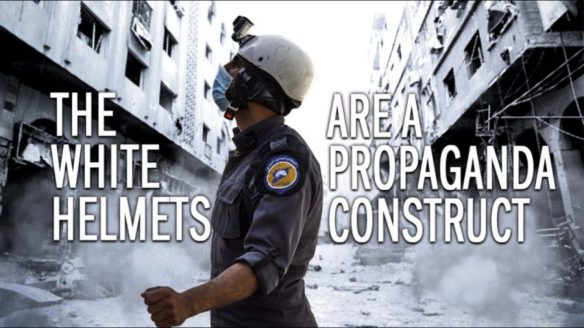
The Veto tracks the evolution of the propaganda campaign waged by Western media against Syria. From Baba Amr in Homs 2011/2012 until the modern day “propaganda construct” – the NATO-member-state funded White Helmets. It honours Russia and China’s vetoes that have consistently defended Syria’s sovereignty and territorial integrity in the UN.
George Orwell said “The most effective way to destroy people is to deny and obliterate their own understanding of their history.” Western media has been tasked with writing the history of the Syrian conflict to serve the aggressors in the US Coalition of terrorism.
As Dr Shaaban also told me:
“The US alliance and its media are focusing on our history, material history, cultural history, identity, our army. Any power that keeps you as an entire state, or any statesman that represents strength or unity will be demonized and destroyed.”
The Veto exposes the criminal intentions of Western media and it archives the progression of the propaganda war waged by the West against Syria. Syrians are writing the history of the Syrian conflict because Syria and her allies have courageously resisted the Imperialist machine.
As Rafiq has said so eloquently “we are the Veto” and we must use it against the Industrial Media Complex in the West. Syria’s history belongs to the Syrians and Syria’s final victory must ensure that Western media is never again given the power to destroy a nation, divide its people and promote international terrorism both military and economic. Watch the film:
By Medea Benjamin and Ariel Gold
Source: Code Pink
Thursday, May 16, Washington D.C. — At 9:30 AM in the morning, D.C. police officers illegally entered the Venezuelan embassy in Washington D.C. in the Georgetown neighborhood and arrested four activists lawfully living in the building since April 10, as guests of the legitimate Venezuelan government. The four activists are Margaret Flowers and Kevin Zeese (with the group Popular Resistance), Adrienne Pine (an academic) and David Paul (a CODEPINK member). They are part of the Embassy Protection Collective that has been living in the embassy since April 10.
“They are charged with ‘interference with certain protective functions.’ It is notable that they were not charged with trespassing, which makes it perfectly clear that the US government does not want to be in the position of having to explain who is lawfully in charge of these premises,” says the Embassy Protection Collective’s attorney Mara Verheyden Hilliard. “What we are seeing today is the most extraordinary violation of the Vienna Convention. The fact that the State Department has broken into a protected diplomatic mission to arrest the peace activists inside is something that will have repercussions the world over.”
“We denounce these arrests, as the people inside were there with our permission, and we consider it a violation of the Vienna Conventions,” says Deputy Foreign Minister Carlos Ron. “We do not authorize any of the coup leaders to enter our embassy in Washington DC. We call on the US government to respect the Vienna Conventions and sign a Protecting Power Agreement with us that would ensure the integrity of both our Embassy in Washington DC and the US Embassy in Caracas.” The US has been negotiating with Switzerland to take charge of its Caracas Embassy and Venezuela has been negotiating with Turkey to take charge of its DC Embassy. These critical negotiations will be broken, however, if the US illegally hands over the Venezuelan Embassy to the forces of opposition leader Juan Guaido.
On April 10, members of the Embassy Protection Collective, including activists from CODEPINK, Popular Resistance and the ANSWER Coalition, moved into the Venezuelan embassy in the Georgetown neighborhood of Washington, D.C. to serve as an interim embassy protection force to prevent the Trump administration from allowing representatives of non-elected opposition leader Juan Guiado from taking over the building as part of a repeatedly attempted and failed coup.
From April 10-April 30, members of the Embassy Protection Collective were able to come and go freely from the building, with up to 50 activists sleeping there. On April 30, a group of Guaidó supporters —coinciding with Guaidó’s failed call for an uprising inside Venezuela — descended on the embassy, determined to oust the activists and seize the building. They blared sirens, horns, and megaphones and surrounded the perimeter of the building with tents, refusing to allow food, medicine, supplies, or people to enter. Multiple peace activists were physically assaulted and arrested in attempts to approach the building with food. On May 8, Potomac Electric Power Company (Pepco), assisted by the Secret Service, cut electricity despite all utility bills being paid in full.
The Collective maintains that the arrests are illegal under Articles 22 and 45 of the 1961 Vienna Conventions on Diplomatic Relations, in which diplomatic premises are “inviolable” and agents of the receiving State may not enter them, except with the consent of the head of the mission. The Trump Administration has not only allowed illegal seizures of diplomatic premises belonging to Venezuela, but has actively facilitated it by giving the Military Attache building and the New York City Consulate to the opposition.
“This struggle is far from over. We will continue to fight to stop this embassy from being handed over by the Guaidó supporters,” says CODEPINK Codirector Medea Benjamin. “The Embassy Protection Collective recognizes that turning over the embassy over to Guaidó would place the U.S. embassy in Caracas in jeopardy. We will continue to use all methods at our disposal to keep the Venezuelan Embassy in Washington D.C. empty until a diplomatic solution — a Protecting Power Agreement — can be worked out between the U.S. and the Venezuelan governments.”
A Protecting Power Agreement would allow third countries to take charge of both the Venezuela and US Embassies. Such an agreement could lead to further negotiations to avoid a military conflict that would be catastrophic for Venezuela, the United States, and for the region. It could lead to a catastrophic loss of lives and mass migration from the chaos and conflict of war, exacerbating the existing humanitarian crisis stoked by U.S. economic sanctions. It could cost the United States trillions of dollars and become a quagmire similar to the U.S. intervention in Iraq and Afghanistan.

“Triple Portrait” by Sophie Kahn
By Robert J. Burrowes
Like many people who have struggled to understand why human beings are driving the sixth mass extinction event in Earth’s history, which now threatens imminent human extinction as well, over many decades I have explored the research and efforts of a great many activists and scholars to secure this understanding. However, with many competing ideas from the fields of politics, economics, sociology and psychology, among others, this understanding has proved elusive. Nevertheless, I have reached an understanding that I find compelling: Human beings are driving the sixth mass extinction event in Earth’s history because of the disintegrated nature of the human mind.
While the expression ‘mental disintegration’ has been used in a number of contexts previously, for the purpose of my discussion in this article I am going to redefine it, explain how it originates, describe several ways in which it manifests behaviorally and the profoundly dysfunctional outcomes this generates, and suggest what we can do about it.
Given that the expression, as I am using it, describes a shocking psychological state but also one that is so widespread it afflicts virtually everyone, it can be described as posing the greatest threat to human survival on Earth. Why? Simply because it caused – and now prevents virtually everyone from thinking, feeling, planning and behaving functionally in response to – the multifaceted threats to humanity and the biosphere.
So, for the purpose of this article: Mental disintegration describes a state in which the various parts of the human mind are no longer capable of working as an integrated unit. That is, each part of the mind – such as memory, thoughts, feelings, sensing capacities (sight, hearing…), ‘truth register’, conscience – function largely independently of each other, rather than as an integrated whole. The immediate outcome of this dysfunction is that human behaviour lacks consideration, conviction, courage and strategy, and is simply driven compulsively by the predominant fear in each context.
The reason this issue first attracted my attention was because, on many occasions, I observed individuals (ranging from people I knew, to politicians) behaving in ways that seemed outrageous but it was also immediately apparent that the individual was completely unaware of the outrageous nature of their behaviour. On the contrary, it seemed perfectly appropriate to them. With the passage of time, however, I have observed this dysfunctionality in an enormously wide variety of more subtle and common forms, making me realise just how widespread it is even if it goes largely unrecognized. After all, if virtually everyone does it in particular contexts, then why should it be considered ‘abnormal’?
One version of this mental disintegration is the version usually known as ‘cognitive dissonance’. The widely accepted definition of this state, based on Leon Festinger’s research in the 1950s, goes something like this: Cognitive dissonance theory suggests that we have an inner drive to hold all of our attitudes, beliefs, values and behavior in harmony and to avoid disharmony (or dissonance). This is known as the principle of cognitive consistency. When there is an inconsistency between attitudes, beliefs and/or values on the one hand and behaviors on the other (dissonance), something must change to eliminate the dissonance.
The problem with this approach to the issue is that it assumes awareness of the inconsistency on the part of the individual impacted and also assumes (based on Festinger’s research) that there is some inclination to seek consistency. But my own observations of a vast number of people in a substantial variety of contexts over several decades have clearly revealed that, in very many contexts, individuals have no awareness of any discrepancy and, hence, have no inclination to seek consistency between their attitude, belief and/or value and their behavior. Moreover, even if they do have some awareness of the inconsistency, most people simply act on the basis of their predominant emotion – usually fear – in the context and pass it off with a rationalization. For example, that their particular work/role is so important that it justifies their excessive consumption on a planet of limited and unequally shared resources.
Consequently, to choose an obvious example, most climate, environmental, anti-nuclear and anti-war activists fail to grapple meaningfully with the obvious contradiction between their own over-consumption of fossil fuels and resources generally and the role that consumption of these resources plays in driving the climate and environmental catastrophes as well as war. The idea of reducing their own personal consumption is beyond serious contemplation (let alone action). And, of course, it goes without saying that the global elite suffers this disintegration of the mind by failing to connect their endless acquisition of power, profit and privilege at the expense of all others and the Earth, with the accelerating and multifaceted threats to human survival including the future of their own children. But the examples are endless.
In any case, leaving aside ‘cognitive dissonance’, there are several types of mental disintegration as I define it in this article. Let me briefly give you five examples of mental disintegration before explaining why it occurs.
So why does this mental disintegration – this disintegration of the mind so that its many components are essentially unaware of the others – happen? In brief, it happens because, throughout childhood, each individual is endlessly bombarded with ‘visible’, ‘invisible’ and ‘utterly invisible’ violence in the name of socialization, which is more accurately labeled ‘terrorization’. This is done to ensure that the child is obedient despite the fact that obedience has no evolutionary functionality whatsoever. See ‘Why Violence?’ and ‘Fearless Psychology and Fearful Psychology: Principles and Practice’.
A primary outcome of this terrorization in materialist cultures is that the child learns to suppress their awareness of how they feel by using food and material items to distract themselves. By doing this, the child rapidly loses self-awareness and learns to consume as the substitute for this awareness. Clearly, this has catastrophic consequences for the child, their society and for nature (although it is immensely profitable for elites and their agents). For a fuller explanation, see ‘Love Denied: The Psychology of Materialism, Violence and War’.
Beyond this, however, this terrorization ensures that the human mind is so disintegrated that virtually all humans have no problem living in denial, delusion and projection and using ‘magic rats’ and lies on a vast range of issues because they simply have no awareness of reality in that context. Different parts of their disintegrated mind simply hold one element of their mind separately from all others (thus obscuring any denial, delusion and projection and the use of ‘magic rats’ and lies), consequently precluding any tendency to restore integrity from arising.
This is why, for example, most people can lie ‘outrageously’, including under oath, without the slightest awareness that they are doing so and which, as an aside, is why oaths to tell the truth in court, and even lie detector tests, are utterly meaningless. If the person themself is unaware they are lying, it is virtually impossible for anyone else – unless extraordinarily self-aware – to detect it. And, of course, judges and juries cannot be self-aware or they would not agree to perform their respective roles in the extraordinarily dysfunctional and violent legal system. See ‘The Rule of Law: Unjust and Violent’.
In essence then, the process of ‘socializing’ (terrorizing) a child into obedience so that they will ‘fit into’ their particular society has the outcome of scaring them into suppressing their awareness of reality, including their awareness of themself. In this circumstance, the individual that now ‘survives’ does so as the ‘socially-constructed delusional identity’ (that is, obedient and, preferably, submissive individual) that the significant adults in their childhood terrorized them into becoming.
To reiterate: Because social terrorization destroys the emergence of an integrated mind that would enable memory, sensing capacities, thoughts, feelings, conscience, attitudes, beliefs, values and behaviours to act in concert, the typical individual will now invariably act in accord with the unconscious fear that drives every aspect of their behavior (and ‘requires’ them to endlessly seek approval to avoid the punishment threatened for disobedience when they were a child).
Moreover, this disintegrated mind has little or no capacity to ‘observe reality’ in any case, such as seek out genuine news sources – like the one you are reading now – that accurately report the biodiversity, climate, environmental, military and nuclear catastrophes and, having done so, to be truly aware of this news in the sense of deeply comprehending its meaning and implications for their own behaviour.
So, to elaborate one of the examples cited above, even most individuals who self-identify as climate, environmental, anti-nuclear and/or anti-war ‘activists’ go on over-consuming (which is highly socially approved in industrialized societies) without any genuine re-evaluation of their own behaviour in light of what should be the observed reality about these crises (or, if their mind allows a ‘re-evaluation’ to commence, to dismiss it quickly with a rationalization that their over-consumption is somehow justified).
One obvious outcome of this is that elite-controlled corporations and their governments can largely ignore ‘activist’ entreaties for change because activist (and widespread) over-consumption constitutes financial endorsement of the elite’s violent and exploitative economy. In other words: If people are buying the products (such as fossil fuels for their car and air travel, and hi-tech devices), made possible by fighting the wars and exploiting the people in countries where the raw materials for this production are secured, then why pay attention to calls for change? Dollars speak louder than words.
So what can we do?
Well, given that the above describes just a small proportion of the psychological dysfunctionality of most humans, which is why we remain on the fast track to extinction despite overwhelming evidence of the profound changes that need to occur – see ‘Human Extinction by 2026? A Last Ditch Strategy to Fight for Human Survival’ – I encourage you to seriously consider incorporating strategies to address this dysfunctionality into any effort you make to improve our world.
For most people, this will include starting with yourself. See ‘Putting Feelings First’.
For virtually everyone, it will include reviewing your relationship with children and, ideally, making ‘My Promise to Children’.
For those who feel readily able to deal with reality, consider campaigning strategically to achieve the outcomes we need. See Nonviolent Campaign Strategy or Nonviolent Defense/Liberation Strategy. The global elite is deeply entrenched – fighting its wars, exploiting people, destroying the biosphere – and not about to give way without a concerted effort by many of us campaigning strategically on several key fronts.
If you recognize the pervasiveness of the fear-driven violence in our world, consider joining the global network of people resisting it by signing the online pledge of ‘The People’s Charter to Create a Nonviolent World’.
But, most fundamentally of all, if you understand the simple point that Earth’s biosphere cannot sustain a human population of this magnitude of which more than half endlessly over-consume, then consider accelerated participation in the strategy outlined in ‘The Flame Tree Project to Save Life on Earth’.
Or, if this feels too complicated, consider committing to:
The Earth Pledge
Out of love for the Earth and all of its creatures, and my respect for their needs, from this day onwards I pledge that:
Conclusion
There is a vast array of ‘professional help’, literature, video material, lecturers and other ‘resources’ from a wide range of perspectives that advocate and ‘teach’ one or a variety of ways that people can use to change their behaviour to get improved outcomes in their lives (whether from a personal, economic, business, political or other perspective). Virtually all of these constitute nothing more than psychological ‘tricks’ to achieve a short-term outcome by ‘working around’ the fundamental truth: As a result of terrorization during childhood, virtually all humans are unconsciously terrified and this makes their behaviour utterly dysfunctional.
The point is this: there is no trick that can get us out of the catastrophic mess in which we now find ourselves. Only the truth can do that. Psychological and behavioural dysfunctionalities notwithstanding, if we do not address this fear as part of our overall strategy, then this fear will destroy us in the end. And the evidence of that lies simply in the fact that the daily updates on the already decades-long but ongoing horrific biodiversity, climate, environmental, nuclear, war and humanitarian crises are testament to our ongoing failure to respond appropriately and powerfully. Because our (usually unconscious) fear prevents us from doing so.
So if you believe that human beings are going to get out of our interrelated social, political, economic, military, nuclear and ecological crises with a largely psychologically dysfunctional population, I encourage you to re-evaluate that belief (paying attention, if you can, to how your disintegrated mind intervenes to prevent you doing so). And I encourage you to ask yourself if the value we get out of improving the psychological functionality of our species might not be worth considerable effort as part of our overall strategy to avert human extinction.
Biodata: Robert J. Burrowes has a lifetime commitment to understanding and ending human violence. He has done extensive research since 1966 in an effort to understand why human beings are violent and has been a nonviolent activist since 1981. He is the author of ‘Why Violence?’ His email address is flametree@riseup.net and his website is here.
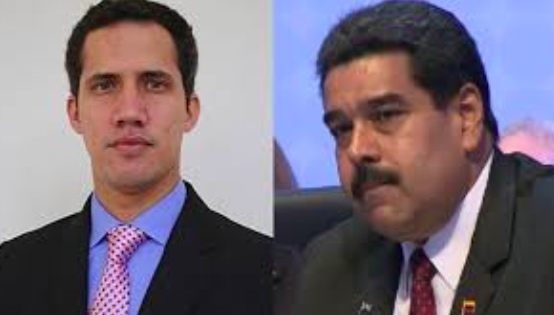
Wno’s the president of Venezuela? The elected Nicolas Maduro or the self-proclaimed unelected Juan Guaido?
By Dave Lindorff
Source: This Can’t Be Happening
American media still refer to Juan Guaidó, America’s hand-picked “legitimate leader” or “legitimate president” of Venezuela, as having an “administration.”
The truth is that his “administration” — consisting of advisors and other opposition leaders — are all either arrested and being held by the government, hiding, seeking asylum in various foreign embassies (Spanish, Italian, Brazilian and Argentinian) in the capital of Caracas, or have fled to other countries like Brazil and Colombia.
Guaidó, apparently a government of one, has so far avoided arrest probably because the elected Venezuelan President Maduro doesn’t want to give the US an excuse to try and rescue him, or to launch military actions of some kind against Venezuela as the White House keeps threatening to do.
Clearly, in calling for US military intervention, Guaidó has both demonstrated almost his total lack of backing among the masses of Venezuelan people, as well as his desperation, given Latin American’s visceral resentment of US interventions in their country, all of which have been designed to put autocrats or even military juntas in power, and many of which have openly overthrown popularly elected governments, as in Guatemala, Chile, Brazil, Nicaragua, Haiti, Dominican Republic, and elsewhere.
None of this gets reported in the US. Only recently has the New York Times, always a reliable backer of US imperial policy in Latin America, at least hinted at the possibility that the reason Maduro remains president and that Guaidó’s efforts to oust him are failing so abysmally could be that the Venezuelan people want him to stay president, and do not want a US-backed coup or a US military intervention to replace him.
At this point the huffing and puffing coming from Secretary of State Mike Pompeo and especially from the White House National Security Advisor and chief militarist blowhard John Bolton, are looking pretty pathetic, with Bolton trying to sow dissension and distrust by hinting that Maduro “better not trust” his own generals’ loyalty, and by offering rewards to those generals willing to abandon Maduro.
It is an indication of the United States’s declining power and influence in Latin America that few outside the US with its insular mass media believe that the US would or even could successfully invade Venezuela and impose a government on that country of 32 million (a number that keeps declining as the upper middle class and rich flee).
If anything, US sabotage and threats and US backing for a government of the wealthy are probably galvanizing support for Maduro. While people in the US, if they are paying any attention at all to events in Venezuela, may believe that Maduro is a corrupt thug, people in Venezuela itself, and in most of Latin America know full well that the main problems in that oil-rich country have to do with the collapse in oil prices since the heady days of Hugo Chavez when it was going for $100 a barrel, to American efforts to block Venezuela from exporting its oil now, and to freeze or even seize Venezuelan assets and oil receipts from the oil it does manage to export, and to other forms of economic warfare engaged in by the United States. As in Cuba, this kind of strategy by the US only works to build support for the country’s existing government.
At some point Guaidó is going to go. He will either be written off by the US media — his main backer — or will be arrested. Probably the latter will follow the former since once he’s recognized as an impotent charlatan, his arrest will not make him a martyr for the opposition. Already he has lost what public support he had as Venezuela’s wealthy abandon the country for Florida. As well, the “50 countries” that we in the US keep hearing about which supposedly back Guaidó as Venezuela’s “legitimate leader” are realizing that they were hoodwinked by the US. The are now mostly calling for a calmer response to the crisis in Venezuela, and are refusing to buy into US military threats against the Maduro government. Meanwhile nobody in the US media mentions that over 140 countries in the world support Maduro as the leader of Venezuela.
In truth it’s impossible to find that list of “more than 50 countries” backing a self-proclaimed and unelected Guaidó as Venezuela’s president. The closest I could come by running google searches was a map produced by Bloomberg News listing 13 countries besides the US as supporting Guaidó. These included Canada, the UK, Guatemala, Honduras, Costa Rica, Panama, Ecuador, Colombia, Peru, Chile, Argentina, Paraguay and Brazil. That is 13 plus the United States. Listed as supporting Maduro as elected President are Russia, China, Turkey, Bolivia, and Cuba, though I believe Bloomberg neglected to mention Nicaragua, a strong Maduro backer, which would make it six. All of Africa and much of Asia was left as “no opinion,” though in fact that means they are continuing to recognize the current Maduro government.
For a time, most of the countries of Europe were lining up behind Guaidó, particularly after Germany announced that it was recognizing him as the new interim leader of Venezuela in late January, and after it ousted the country’s ambassador, but then by late March Germany was having second thoughts, and rejected the person sent there by Guaidó to assume the position of Venezuelan ambassador. At this point, except for the UK, the countries of Europe, along with Mexico and Uruguay, are simply calling for a dialogue and a negotiated solution to the Venezuela political crisis, and in addition to opposing any talk of military action or a coup, are seeking nothing more than a new election (which Maduro would probably win, given the alternative of the return of a government of the rich). The Europeans are no longer really backing Guaidó.
The reporters who continue to refer to “more than 50 countries” calling for Maduro’s ouster all must be using the same wrong or outdated news clip or some exaggerated and dated State Department press release. (I asked the State Department for an updated list today but so far none has been forthcoming, though it would appear such a list shouldn’t take long to compile given how short it must be.)
INDIAN COUNTRY NEWS
"It is the duty of every man, as far as his ability extends, to detect and expose delusion and error"..Thomas Paine
Human in Algorithms
100% Accurate Google Sheets + KDP Book Formatting | 24hr Delivery
From the Roof Top
I See This
blog of the post capitalist transition.. Read or download the novel here + latest relevant posts
अध्ययन-अनुसन्धानको सार

