Two for Tuesday
Reply

Can understanding the nature of Mind, consciousness and the ET phenomenon lead us to an expanded understanding of our origins?

By Tom Bunzel
Source: The Pulse
As a fan of Eckhart Tolle I’ve always liked his description of Consciousness (or ‘Being’ which seems his preference) as “No Thing.”
This separates “Being” from the world of form, and puts it into the area of what Tesla called “nonmaterial reality.”
I’ve generally thought of this reality as (an) Infinite Mind (again as opposed to “God”) to take out the anthropomorphic bias which seems to permeate organized religion. Political Christianity and some other groups seem to relish an angry and vengeful God to keep the parishioners paying. But when you step away from beliefs that are easily debunked you are still left with a fact.
We seem to be thinking.
Of course, it was Descartes who famously equated thought with Being, which has led to all sorts of issues that Eckhart Tolle describes well in his work. When we identify with only our thoughts, we have narrowed our focus and reduced reality to labels.
But the reality of thought persists. What is it?
Neuroscientists seem to have identified the presence of thoughts in the brain through various instruments that can pick up electrical signals in parts of the brain and between synapses.
But so far, I don’t believe they can “download” these signals and decode them.
When we observe our thoughts, we can see that they seem to be comprised of “words”. In fact, I’ve had the experience of thinking in languages other than English (my native language is German) and of course, the thoughts come as words – sometimes in cogent sentences or perhaps just one word.
So, I was musing, what about ancient humans? Did they need to form a sentence in their brains to warn them that a lion might be in the bushes?
If you’ve ever experienced trauma, you know the answer – our limbic system activates, putting us in “fight or flight” well before any thought ever happens.
I would suggest that a primal, lower frequency of Mind operates in our limbic system, before thought and language.
So, when did we start thinking in “words”?
According to my AI friend,
“scholars believe it [language] originated at least 100,000 years ago during the Middle Stone Age. The development of language is linked to the increased complexity of human culture and cognition.”
Maybe a tribe of hunter-gatherers developed a sound for “lion” and it became a warning cry. Then perhaps “big” lion or “many lions”.
We know that our ancients memorialized beasts in petroglyphs of various kinds to communicate but the next big breakthrough was when the words, sentences and thus concepts were able to be preserved.
AI tells us that
“Writing systems were invented independently by different civilizations thousands of years ago as a means of recording information. The earliest writing emerged around 3,500-3,000 BCE in Mesopotamia and Egypt. Chinese writing developed around 1,200 BCE.”
So now I will do what they do on Ancient Aliens, which is take a speculative leap based on the foregoing.
It intrigues me that the cultures that seemed to “create” writing all have a version of the Prometheus myth – crediting the “Gods” with giving them the gift of higher knowledge.
To connect this to the beginning of writing seems to make sense, as we have precisely these myths in Mesopotamia (Annunaki) and Egypt.
And it seems clear that with the onset of the written word (and mathematical notations) great leaps in human progress came almost in quantum intervals. We got the printing press and eventually our modern technology.
We might speculate that it is likely that Mind has been with us forever, but that thought evolved and expanded dramatically with the beginning of writing – and that writing could easily be seen as a gift that transformed human civilization.
It is also very plausible that any entity that conveyed such a gift to humanity may well have angered other entities that wanted to keep humans in check.
Cuneiform tablets from the Sumerians describe how one “God” Enki created humans in the image of the Annunaki and gave them knowledge – but most of the humans were wiped out by his rival Enil in the great flood. We now have evidence in the geological record that such a flood happened about 12,000 years ago.
But just this little thought experiment can vastly expand our sense of our place in the cosmos along with providing a much-needed dose of humility.
What if we did not simply “evolve” with natural selection but received assistance in an area we are now beginning to understand – genetics? This would indicate a profound connection to the cosmos in a way that is disregarded by our current society.
It is also worth noting, as my AI explains,
“There is evidence that around 250,000-300,000 years ago there were some key genetic changes in early humans that contributed to increased brain size and advanced cognitive abilities compared to other primates.”
Where these came from or how they came about is still a mystery.
And now that it seems apparent that some visitation by “entities” from the sky is not likely fiction but a reality, it may help to broaden our understanding of Nature and how we got here.
My AI friend makes another statement which I think is exactly backwards:
“Some key developments that enabled writing include the evolution of symbolic thought, the invention of systems of counting, and the emergence of urban civilization needing record-keeping.”
Clearly, it was first language, and then writing and math that led to this evolution of our brains, not the other way around. Our original brains would have needed to expand to accommodate our first language which took us beyond the limbic system to labeling, and ultimately writing which led us to sharing ideas and thinking “symbolically” – using groups of letters as words and then sentences to convey increasingly complex concepts.
My own experience with neuroplasticity confirms that new uses for the brain expand its capacity, creating new pathways and neural networks. People who keep learning seem less susceptible to dementia.
Opening to the possibility that our evolution was “jump started” by extraterrestrials changes the narrative from chance and natural selection to a more profound connection to the universe in areas that our current science has mostly yet to penetrate. (Nonmaterial reality).
But technology in particular seems to point us in the right direction – it was the offspring of the printing press – the computer – which eventually led us to a huge breakthrough in our awareness of the nonmaterial or seeming empty space as being potentially much much more.
When we developed WiFi suddenly the information encoded in words, thoughts and sentences could travel through space. So who knows what other information or Mind stuff has been around us all along?
Because Mind is everywhere and at the heart of Nature.

Directed by Raúl de la Fuente, Damian Nenow
An animated documentary presenting a journalist’s poignant perspectives on the horrors of war.
By Frederic and Mary Ann Brussat
Source: Spirituality & Practice
You must save something if you can. Because people disappear without a trace. Completely and irretrievably. From the world, and then from our memory.
— Ryszard Kapuscinski
Another Day of Life is an intense, chilling, and convincing anti-war animated documentary about the civil war in Angola at the time of its independence in 1975. With the exit of the Portuguese colonizers, two factions fought with each other to determine who would rule and control the country’s thriving businesses and resources, especially diamonds and oil.
The film is based upon a book by acclaimed Polish war correspondent Ryszard Kapuscinski (1932 – 2007) in which he described the situation he witnessed with the Portuguese term confusão, “a state of absolute disorientation.” His story is told through animated recreations of his experiences during the war and filmed interviews with those he met and worked with.
Despite the advice of fellow journalists, Kapuscinski decides to travel from the relatively safe capital of Angola to the southern front in order to interview Farrusco, a military leader of the MPLA, the Soviet- and Cuba-backed People’s Movement for the Liberation of Angola. Other militias were supported by other African interests as well as the United States and South Africa. By the time the war ended in 2002, nearly one million people were displaced and 5,000 were dead.
The film brings us along on Kapuscinski’s travels through dangerous situations and his encounters with memorable people. Since his words (voiced by Kerry Shale) are used for the narration, we empathize with his perspectives — the horror that he and his companion Artur (Daniel Flynn) feel upon coming across a road clogged with corpses, his fascination with a charismatic female freedom fighter named Carlotta (Lillie Flynn), the desire of the people to be photographed so people would know “this is the face I had when I was alive.” At a key moment, the journalist has to decide whether to maintain his objectivity or reveal information that could change the outcome of the conflict.
IndieWire has published a review of Another Day of Life that includes excerpts from interviews with the two directors. We were very impressed with the insights and respect for the substantive themes of this story as explained by director Raul de la Fuente:
“I was fascinated by this surrealistic diary, the desperate chronicle of a reporter at the limit of his strengths, fighting for survival and finding the truth in a chaotic and fuzzy war. This film is a hallucinatory trip into the heart of darkness, a Cold War tale with a thrilling spy mood, magnetic topics, and characters: decolonization, freedom fighters, boy soldiers, epic battles, and, above all, the surreal and poetic approach by Kapuscinski.”
___________________
Watch Another Day of Life on Hoopla here: https://www.hoopladigital.com/movie/another-day-of-life-john-hollingsworth/12738084

By Michael Lesher
Source: Off-Guardian
You almost want to feel sorry for Israel’s professional apologists in mainstream media these days. Their job, a fetid one at best, has been especially trying lately.
First they assure us that Israel has no intention of committing a genocide – and right away they’re refuted by Israel’s own prime minister, who loudly demands the extermination of every man, woman and child in Gaza, not to mention its president’s equally public insistence that Palestinian civilians are legitimate military targets.
Then they struggle to excuse Israel’s bloody attack on one Gaza hospital, only to end up watching Israel’s killing machine obliterate literally all of them. (Not to mention making a mockery of the excuses by providing no evidence that there was ever a “Hamas command center” under al-Shifa, the first of those destroyed hospitals, to begin with.)
Then they try to divert attention from Israeli atrocities by yelping about “mass rape” supposedly committed by the Palestinian fighters who burst from the Gaza concentration camp on October 7. But the ink is hardly dry on their indignant op-eds before their masters in the Chosen State confess that they have no victim testimonies, no forensic evidence and no reliable witnesses to back up any of the claims.
What’s an apologist to do?
Well, if you’re a staff writer at the Atlantic – where rationalizing Israeli crime is a specialty of the house – you can fall back on the lamest canard of all: that the public disgust stirred by Israel’s worst-yet mass murder campaign against Palestinians is really a product of rising “anti-Semitism.”
And sure enough, Atlantic’s April number sports a feature story to that effect by one Franklin Foer with the lachrymose title “The Golden Age of American Jews is Ending” – because, don’t you see, Americans couldn’t possibly have a respectable motive for getting worked up over a genocide.
Mind you, it takes some high-octane chutzpah to pretend that today’s Big Story is the end of an era for American Jews, at the very moment when American-made bombs and artillery shells are pulverizing Gaza and exterminating its population (half of which consists of children), to the applause of virtually every Jewish communal organization the world over, including inside the US.
But Foer doesn’t lack chutzpah. He’s not only prepared to claim victimhood for Jewish genocide supporters on the grounds that their sachems haven’t been able to stifle all public dissent. He also wants you to believe that the decline of American Jewish power isn’t due to public backlash against bullying by Jewish organizations (think AIPAC, or the sadly misnamed Anti-Defamation League); nor to the exposure of illegal spending sprees with government funds by various Hasidic institutions; nor even to the racist blood lust expressed by almost every prominent Orthodox rabbi in the US since Israel’s genocidal campaign began last October.
No, according to Foer, the real trouble is what he calls “anti-Semitism on the right and the left” – which I guess means “everywhere,” in the US at least. And he’s even prepared to insist that this “anti-Semitism” is not only bad for the Jews; it threatens the American republic, too.
“Over the course of the 20th century, Jews invested their faith in a distinct strain of liberalism that combined robust civil liberties, the protection of minority rights, and an ethos of cultural pluralism,” Foer claims. But now, “that era is drawing to a close. America’s ascendant political movements – MAGA on one side, the illiberal left on the other – would demolish the last pillars of the consensus that Jews helped establish.” Ah, the unaccountable ingratitude of those goyim! I mean – what’s a little genocide between friends?
Setting to one side Foer’s self-righteous reading of American political history, any claim that today’s United States is awash in anti-Semitism is obviously silly. Quite apart from opinion polls – which tell a tale very different from Foer’s – popular culture is a convenient point of reference in such matters, and it’s hard to see how a society permeated with Jew-hatred would have showered no fewer than twenty Oscar nominations last year on films that celebrate already-famous American Jews. And then there’s the large number of American Jews who have participated in the anti-genocide protests that so trouble Foer – a datum that, standing alone, suffices to refute his imputation of anti-Jewish bigotry to the protesters.
But Foer is right about one thing. A privileged chapter in diaspora Jewish history is coming to an end – though not for the reason he gives. The simple truth (though Foer cannot admit it) is that the American public is getting tired of being bullied by a greedy and hypersensitive Jewish elite that, like a spoiled child, has insisted on having its way for years in everything from Mideast policy to the distribution of government benefits, and is now finally overplaying its hand.
And if that Jewish “leadership” really has squandered its measure of imperially-funded impunity by embracing a genocide – at a moment when the fabric of US politics is too strained for an ultra-divisive issue and too cash-poor to give away the extra billions that Israel is demanding to finance its crimes – it is quite possible that Foer has stumbled onto another truth as well: that the wreckage from the fall of the Jewish elite will doom whatever is left of American democracy.
To make sense of these claims, a short summary of recent history is in order. It is well known that since the end of World War II Jews in the West have come to enjoy a degree of freedom, prosperity and political influence that is without precedent in the Jewish diaspora.
Unsurprisingly, American Jews have generally welcomed this development. And given the horrors that preceded it, culminating in the genocide of Europe’s Jewish population in the 1940s, it’s not hard to understand why Jewish elites in the US focused at first on securing their hard-won position in any way they could, taking advantage of new opportunities and assimilating themselves to preexisting power structures.
But after 1967, as Israel settled into a new role as one of Washington’s key client states, what had been prudence morphed into braggadocio. Norman Podhoretz set the tone, vowing that henceforth American Jews would “resist any who would in any way and to any degree and for any reason whatsoever attempt to do us harm” – a boast that meant in practice (to quote the superb scholar Norman Finkelstein) that “American Jewish elites could strike heroic poses as they indulged in cowardly bullying.”
Less privileged constituencies may be forgiven for not seeing that period as a “golden age,” as Foer does, but you can reject his twisted perspective and still agree that the postwar joy ride of Jewish “leadership” is probably coming to an end.
After all, why shouldn’t it?
Today’s United States is not the United States of 1945, nor even the United States of 1967. The American public now is as deeply divided as in the last decades of the 18th century, when armed rebellions and secession plots were recurring realities. The presidential election scheduled for this November – assuming it happens at all (the Democratic Party seems to be trying to convert the balloting system into a prearranged election-by-lawfare) – is likely to exacerbate differences rather than resolve them, with potentially disastrous results. Worse, given the massive attack on civil rights that was launched four years ago on the pretext of a COVID-19 “medical emergency” – an attack that included the deliberate undermining of the electoral process in many states – it is not even clear whether the necessary conditions for democracy exist any longer in the US.
Meanwhile, consumer prices have skyrocketed, workers are suffering massive layoffs, and the small business economy, crippled by the COVID coup, has been unable to compensate for the damage.
Why should a citizenry in such straits continue to give preferential treatment to an overbearing Jewish elite that 1) clearly doesn’t need it, and 2) flaunts its allegiance to a foreign power even as it demands favors from American institutions at every opportunity? (Anyone who needs an introduction to the fraudulent practices this elite will resort to, and the extent to which it has entangled US government in its chicanery, need only read Norman Finkelstein’s copiously documented The Holocaust Industry for some useful details.) By any standard, American Jews have enjoyed an extraordinary run over the last fifty years; it’s about time we were treated just like everybody else – no worse, but no better either.
The (mis)behavior of Jewish “leadership” is exacerbating the problem. Instead of absorbing the message of the writing on the wall and prudently lowering its profile, it is going for broke, intensifying its financial and political demands in support of Israel’s genocidal slaughter – the worst possible issue seized at the worst possible moment. Not even warning growls from old allies like Senate Majority Leader Chuck Schumer have had any noticeable effect. Like Shakespeare’s Richard III, Jewish “leaders” seem intent on plunging ahead toward their own inevitable destruction.
And I fear that they will not fall alone. Gaza is far from being Joe Biden’s only problem this year. But as the Palestinian death toll soars, and the pictures of shredded or starving children become ever more numerous and intolerable, the Gaza genocide could end up being the last straw that breaks the back of Biden’s reelection propaganda.
Genocide Joe’s problem with Gaza is that there is no real escape from it: Biden cannot ignore the issue but also cannot afford to resolve it. If he grows an embryonic conscience and finally brings Israel to heel (at least temporarily), he will pay a heavy price with Jewish voting blocs in November. If he doesn’t, a regional Mideast war could be in the offing, and I doubt that any American administration could survive the fallout from such a debacle.
I am not about to shed any tears for Joe Biden or for the Democratic Party. But if the current government collapses, what will replace it? An ad hoc coalition around the former Narcissist-in-Chief? A caretaker administration effectively under the sway of US intelligence agencies? A COVID coup-inspired government by executive fiat? The prospects are not encouraging.
Meanwhile, the 1,000 American troops now being sent to Israel/Palestine – ostensibly to build a “humanitarian port” for Gaza – may end up, for all I know, as a striking force behind a coup designed to oust Netanyahu and to put the US directly in control of a client state gone rogue. No one familiar with the CIA’s record can rule out such a possibility. But how will an American working class that already resents the billions of dollars annually thrown away on “aid” to Israel (while average American families can’t pay the rent and the heating bill at the same time) react to the idea of turning the Jewish State into an expensive US protectorate? What if those American troops start dying in new wars in Lebanon or Iran? How much can Americans be expected to pay for Israel’s rapaciousness?
I certainly do not know where any of this will lead. But I’m finding it very hard to imagine a happy ending to the story. I’ve already mentioned my doubts about whether the presuppositions required of a democracy exist in today’s United States. One of those presuppositions is the assumption of shared goals (Lessing, following Aristotle, went so far as to describe this as “friendship”) between the members of differing political factions. But can I really acknowledge any sort of common cause with a supporter of genocide? To be honest, I’m still not sure I can use a word like “friendship” to describe my relationship to someone who, just a few years ago, denied my right of movement, my right to be governed by democratic processes, my right to speak my mind without being censored, my right not to be a human guinea pig, and even my right to breathe freely. And I can’t forget that there were many, many such people.
What I’m finding really ominous is that so many enemies of American freedom over the last four years are now quietly cozying up to Israel’s genocide lest they upset the Democratic Party applecart – and are demanding that the American public do the same. Rebecca Solnit, one of those “progressive feminists” who helped to publicize every democracy-destroying lie of the COVID coup, from masks to coerced human medical experimentation, doesn’t mince words about the dangers of Republican politicians: according to her, they have “abandoned all ethics and standards, and will happily violate the oaths they took to uphold the constitution”; in fact, she claims that “[v]iral Trumpism has already merged with conspiracy theories such as QAnon, with anti-vaccine cults, with white supremacists and neo-fascists.” But the prolific Ms. Solnit has gone strangely tongue-tied about the slaughter-plus-systematic-starvation of more than a million children in Gaza.
Gloria Steinem, another “progressive” who bailed on the “my body, my choice” principle as soon as a Democratic Party administration demanded the injection of federal employees with untested drugs, was quick to denounce Palestinians over charges of sexual violence that were probably fabricated. But she too has been practically silent about the slaughter in Gaza, not to mention the well-documented sexual violence committed by Israelis against female Palestinian prisoners. And so on, and so on, and so on.
I mention these examples because I think they expose, like a lantern in a shadowy room, the cruel emptiness belied by all the liberal gesturing. The tragic truth is that the Democratic Party and its mouthpieces are not offering us an alternative to Donald Trump. They are using Trump’s name as hunters use beaters, to induce frightened prey to stampede into their nets. They are not, as some critics believe, political ideologues; they are really more like political parasites, forced to feed on the vital energies and principles of others because they have none themselves.
That is where Democratic Party apologists meet the crime-rationalizing rhetoricians of American Jewish “leadership.” Even genocide, the most heinous of all crimes against humanity, doesn’t move such people, because where they should have hearts capable of empathy with suffering or of anger at injustice, all they’ve really got is a craving for power and a dread of losing it.
And so it turns out that the Jewish elites who are hell-bent on maintaining their undeserved privileges – so much so that they’ll embrace Nazi crimes to do it – are forcing the pitiful hollowness of America’s political elites into public view. That is the real disaster that Franklin Foer, who wants to keep both elites in power, cannot see. His pastiche of anodyne falsehoods is intended to divert public attention from the horror of Israel’s intensifying crimes in occupied Palestine. But he is really laying the groundwork for the radical disillusionment of the American public – a disillusionment that could bring down the entire political process when a generation of its victims realizes how recklessly and how cynically it has been deceived.
Yes, the American Jewish joy ride is probably about to end – and with a bang, not a whimper. The real questions are all about what happens next. How many Americans (and others) are going to be hurt in the crash? How many will get out of the way in time? How many will be ready with aid for the victims when the debris finally settles?
And what will be left – after so much cruel and needless damage – of what we used to call “the land of the free, the home of the brave”?

By Salman Rafi Sheikh
Source: New Eastern Outlook
Europe is in a state of desperation; the continent is losing in Ukraine despite the ‘mighty’ strength of NATO; and European leaders are now vowing for a ‘stronger’ response, including via sending their own forces to combat Russian military forces in Ukraine. Will this decision, if it is ultimately taken, bring any meaningful change to Ukraine’s slow fall is, however, a moot question. What makes it a moot question is the scale of Ukraine’s fall and the depletion of Western stockpiles of weapons and ammunition that it is already finding hard to refill. Russia, on the other hand, is already outpacing its rivals in the West as far as the production of more – and better – weapon systems is concerned. A report in The Guardian noted that “Russian arms production worries Europe’s war planners” primarily because they cannot match this level of military preparedness and the sheer ability to sustain the fighting for two to three years.
The EU’s leader, Josep Borrell, recently noted after two years of high-intensity supply of weapons from EU allies, mainly from existing stocks, European states’ existing stocks are now depleted and “the conflict has evolved from a war of stocks to a war of production”, which, as the said report shows, Russia is clearly winning.
This information is now public, reinforcing, alongside some recently leaked Pentagon documents, the reality of Russian dominance in Ukraine. Propaganda notwithstanding, these leaked documents show that the Pentagon believes that Russian losses in Ukraine have been far less than losses publicly stated by US officials. For example, as opposed to various publicly stated estimates, Russia is said to have lost around 200,000 troops. But the Pentagon documents from February and March 2024 put the figure at around 17,000 only. Such is the scale of propaganda and the magnitude of the fear surrounding the collapse of the NATO expansion agenda that the West is now taking steps to hand over seized Russian assets to Ukraine to fund their war on Russia. They’re probably running out of enough money too!
The situation, according to a French newspaper’s investigation – which also claims to have consulted many official reports – is “critical”, with many French military officials ridiculing the idea of sending French troops to Ukraine, where the French army of “cheerleaders” can hardly fight a battle handed Russian military. But France is not an exception here. Most European military forces share this state of affairs, with very little active hardware or few troops to offer. Surely, Europe cannot send in everything, since it will leave the continent itself unprotected.
But it is highly unlikely that Russia will attack Europe, although a European provocation might change this scenario. However considering the fact that Russian military operation in Ukraine were/are driven by the Western imperative of expanding NATO, Russian success in preventing this expansion serves the purpose. For the West, however, a Russian victory in Ukraine is fretful for different purposes. They publicly talk of a Russian victory leading to a wider war in Europe, but the reality is that a Russian victory will stamp the end of western hegemony in global politics since the end of the Second World War. The West will no longer be an all-powerful ‘centre’ of the world.
Geopolitically, the West will be unable to dictate global politics, as it has been able to in the past several decades. Economically, the US dollar might lose its financial hegemony, primarily because a Russian victory in Ukraine will also indicate Russia’s ability to bypass the Western-dominated financial system. If the West can no longer control the global financial system, it automatically creates the space for alternative systems to flourish and acquire central significance. Such a scenario bodes very well for the imperatives of a new, alternative international order.
For the West – especially, the US, the self-declared leader of the ‘free world’ – this is a deeply troubling situation. Washington’s 2024 Annual Threat Assessment shows this anxiety reaching critical levels. It says: “Moscow will continue to employ all applicable sources of national power to advance its interests and try to undermine the United States and its allies … [challenging] the US primacy within” the global system. Making other admissions of failure, the report also says that the Russian economy continues to grow and that, despite western sanctions, Moscow’s oil trade is far from diminished. The report accepts that “Moscow has successfully diverted most of its seaborne oil exports and probably is selling significant volumes above the G-7–led crude oil and refined product price caps, which came into effect in December 2022 and February 2023, respectively—in part because Russia is increasing its use of non-Western options to facilitate diversion of most of its seaborne oil exports and because global oil prices increased last year”.
Because Russia is able to maintain its “energy leverage”, according to 2024 Assessment, it means it is not facing any problems vis-à-vis financing its military operations in Ukraine. In fact, the report also accepts Russia’s ability to increase public spending despite the ongoing conflict.
This is the Western assessment after financing the war on Russia for two consecutive years. Logically, such assessments infuse a sense of fear and desperation, which has led some leaders in Europe to push for sending NATO troops to Ukraine. While it may only be a threat, it does show an extremely heightened sense of defeat and a clear sense of the beginning of the end of the “Western century”.
$2 Trillion, Here We Come.
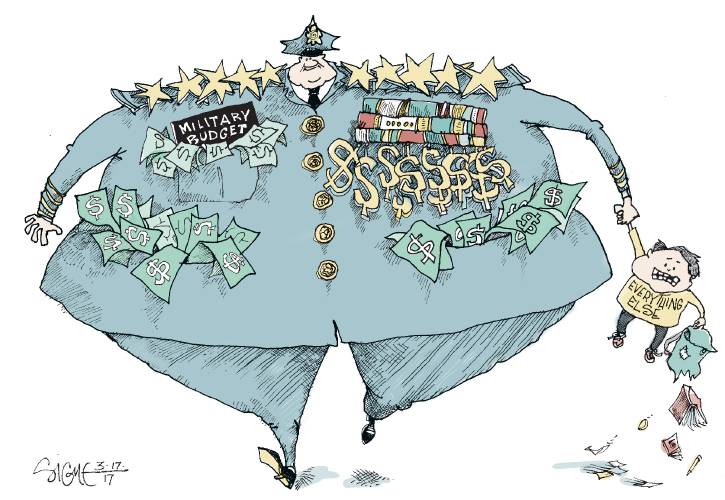
By Andrew Cockburn
Source: Spoils of War
The Biden Administration has just published its proposed budget, generating copious commentary, much of it displaying a commensurate degree of misunderstanding, especially regarding our gargantuan national security spending. To get at the truth of the matter, I consulted my friend Winslow Wheeler, who has been observing the insalubrious intricacies of the budget process over the past fifty years as a senior aide to Senators from both parties as well as a senior analyst for the General Accounting Office and directing the Center for Defense Information.
The defense budget has just been posted by the administration is being described as approaching a trillion dollars. Is that accurate? :
No. It’s actually a lot more than that. In fact it’s beginning to inch up on $2 trillion.
How so?
The problem is that when most people look at the defense budget, they don’t count everything that we spend even for the Pentagon. But in addition to that, there are hundreds of billions of dollars outside of the Pentagon’s budget that we spend for national security. Things like the nuclear weapons activities in the Department of Energy; that’s $37 billion; $26 billion for retired military pensions and healthcare and $12 billion for the Selective Service, the National Defense Stockpile, and a strange and suspicious looking category for the international activities of the FBI in something called “Defense Related Activities.”
Do we have any idea what that last one is for?
It has always been classified. In the 50 years I’ve been watching the defense budget, it’s never been explained other than some occasional hints. One year they admitted to a lot of money being spent by the FBI in, wait for it, Taiwan, and so it’s very unclear exactly what this is, but it’s always counted as part of so-called defense related activities.
The expenses that I have just been describing come to $970 billion, but that leaves out a lot.. Add in about $800 billion for the Department of Veterans Affairs, the State Department and its associated agencies, the Department of Homeland Security. And we know now from our Republican friends that border protection is a dire national security issue. Add all that together. Then you can calculate the share for the interest on the debt that we pay each year. All those activities I’ve just described come to 21% of all federal spending. Calculating in that percentage as a the amount it contributes to the debt burden gives you $254 billion.. And so you add all of that up together and you get $1.767 trillion.
Jesus Christ. What about CIA and other intelligence spending?
All the intelligence agencies are in the Pentagon budget except for the intelligence agencies for the State Department, Coast Guard and the Department of Homeland Security. Those are the few other things that are not in the Pentagon budget that are distributed in the other agencies that I’ve described. When they last published the total amount for the intel budget it was over $120 billion, but it’s all embedded in these various agencies.
Since the budget was published, there’s been some wailing and lamentation that because of irksome spending restraints, this budget actually represents a cut or at least restraint on defense spending. What’s your view on that?
Well, last yea the budget deal that then-Speaker Kevin McCarthy negotiated with the Democrats for the Pentagon allowed only a 1% increase in defense spending. But because of the screwy way that we actually calculate things, if you put together everything we spent just for the Pentagon without all those other items I mentioned, last year, it looks like we will have spent $968 billion, while for 2025, Biden’s requesting $921 billion. So yes, that’s a cut. But that doesn’t include the supplementals that Biden will request later this year for the Pentagon, for Ukraine, Israel, God knows what, that will get us back into competition with 2024. The reason why 2024 is higher than the Biden request is because it had 60 billion worth of emergency supplementals that Congress is about to approve and that money is counted in my total. But because of the broken accounting rules that we use for the budget, that money’s not counted when you calculate the deal that McCarthy made with the Democrats, and that’s emergency money that doesn’t count on budget cap.
For years we had the Overseas Contingency Operations defense spending, the so called war budget, which was the extra money the military got for actually fighting wars in Afghanistan and elsewhere. Are we getting back to that?
Yes. The politically-derived budget caps don’t apply to that money. And it’s a lot more than just for the wars; lots of billions for goodies for everybody added each year there. It’s all part of the hocus pocus ways that Congress allows itself to appropriate money so it can pretend that it’s using restraint, but actually is exploiting all kinds of loopholes to increase whatever cap or restraint they pretend that they’ve added to the defense budget.
What’s the next budgetary legislative stage that we’re going to endure?
:We haven’t finished with 2024 yet, because Congress has gotten into this habit of never passing budgets on time. And it also helps the Speaker of the House and the Majority Leader of the Senate discipline members so they don’t get out of the line on things. We do these things called continuing resolutions that keep the money flowing but only at the level approved in the previous year. And we’re in that situation for the Defense Department for 2024. Next week or the week after, they’re going to resolve that and pick a final total for 2024, which will include most, but probably not all of the emergency supplemental that Biden requested for Ukraine, Israel, Taiwan, and defense industrial base spending. So that number will become final in two or three weeks. We have barely begun on the 2025 consideration in Congress that will take the next three, four months and we’ll have another continuing resolution because they won’t pass things in time for the beginning of the fiscal year on October 1st, and we’ll go through this charade once again. And because this is an election year, it’ll be all that more sloppy, painful, and unappealing to observe.
Then when they do it, Chuck Schumer and whoever is the Speaker of the House will pat themselves on the back and say, ‘well, we’ve done a great job. Who says we can’t do anything. We just got the budget finally passed.’ But that will be months late yet again.
Are there items tacked onto the defense bills that have nothing to do with defense?
Yes. There’s two bills. One is the National Defense Authorization Act, which is the bill that goes to the House and Senate Armed Services Committees. That’s a policy bill. It doesn’t make money actually available to be spent, but it pretends it does. It has lots of numbers in it; it’s a tar baby for all kinds of crazy stuff or politically driven stuff because the legislative process is so broken. Members don’t have an opportunity to do stuff on the floor of the House and Senate and especially in the Senate because the Majority Leader exploits the rules to make amendments impossible. The National Defense Authorization Act is one of those bills where they actually get a chance to do amendments and they do all kinds of crazy stuff, lots of stuff that has absolutely nothing to do with national defense. Last year they had 600 amendments for that bill.
Whew.
But they don’t really get debated. This is yet another way that the Majority Leader, Chuck Schumer, controls things. If you’re a Senator, you have to supplicate Schumer to get him to accept your amendment. That will then will get into a package that he’s blessed and it’ll be adopted wholesale by the Senate with perfunctory debate and members giving staff-written speeches about ‘this is a wonderful bill. It includes my important amendment to increase ice block cutting in Minnesota’ and all kinds of other crazy stuff. Every one of these will have been approved by Schumer or his agents as politically acceptable. If you are a dissenter and have a problem with how things are done in the Pentagon or anywhere else, you will not get Schumer’s blessing and your amendment will not be added to his package to be dumped into the National Defense Authorization Act, and you’ll be out in the cold. We go through essentially the same process with the appropriations bill, which is the one that actually makes the money available to all these agencies. Yet again, Schumer controls the process where if he likes the smell of your amendments and it’s okay with the prevailing political dogma that week or that month or for the last decade, it’ll get included. And if you have something that that Chuck Schumer doesn’t like, your amendment will be out in the cold.
Was it always like this?
When the Senate described itself as the world’s greatest deliberative body back in the 1970s and eighties, it would have a process where a bill would come up on the floor in the Senate, and the Senate took great pride in the fact that it had unlimited amendments, and you could offer an amendment on anything you wanted to all of these bills, whether it’s the National Defense Authorization Act or the FAA Authorization Act, and there would be a proper debate, and then the Senate would vote and the majority of those senators present in voting would prevail.
Today it’s a fundamentally broken process because of the automatic filibuster, which allows the party leaders to totally control things. Unless a Senator can somehow put together sixty votes to override a filibuster, Schumer and McConnell can simply prevent your amendment from even coming to the floor, let alone get debated. It’s also a corrupt process because if you legislate in ways that Chuck Schumer, or whoever is the leader, doesn’t like or your idea is a pain in the ass for the Democratic, or Republican, caucus, you will be on the outs. Furthermore, Schumer, and McConnell control a large portion of the money that you need for your reelection campaign. And if you don’t behave yourself, you’ll be on the outs, not just on getting your amendment adopted, but you’ll be on the outs so far as getting any of his money is concerned. And for the money that he doesn’t directly control, he’ll be sending the message to the big political donors, ‘don’t give anything to Senator So and So. He’s not one of us; he’s not a good boy.’ That’s the way we do business these days.
Getting back to the defense bill, I saw an item this morning that the Navy is saying they all have to cut back Virginia class submarine production from two to one next year because of their terrible financially straitened circumstances. How do we read that?
There’s two things going on there. One is that the Navy has requested a gigantic ship-building budget, something like $45 billion. The problem is that navy ships are so expensive these days that you can’t fit much dirt into that bag. Those submarines are about $3 billion apiece. Aircraft carriers, and we’re paying for two more, are about $13 billion apiece. They have a brand new ‘low cost’ frigate that’s getting into production this year. Those come in at $1 billion apiece. When you have ships that cost these amounts, even with a gigantic budget, like $45 billion, you can’t buy many of them. The second thing that’s going on is the Navy is tickling the system. They’re saying, ‘Oh dear, we can only afford one sub this year because we’re so stretched running. And isn’t that just terrible?’ So they’re tickling Congress where it feels good, and they’re saying, ‘okay, when you add money, add money for another submarine.’
So does that mean the budget will grow beyond what the President has asked for?
The Biden request is a floor, not a ceiling.
And the other game that goes on is they are actually limited in a relative sense in the billions of dollars that they can add on each year. So the staff on the appropriations committee and the two armed services committees, they go looking for things to cut in the accounts in the Pentagon budget where nobody’s paying much attention. So they can then plow that money back into the stuff that the Navy wants for these submarines, or that Senator X, Y, or Z wants for a research and development program that just happens to be performed in his, or her, state and just happens to be from that company that gave him a healthy political contribution last year. One of the things the staffs love to cut is training money for the Air Force and others, because they’ll declare the request to have been excessive. They’ll add that few hundred million dollars to the pot for goodies that members of Congress want. An added problem, of course, is that the Air Force is already way, way behind on trending hours for pilots, and that account needs more money, not less money. There are all kinds of other games that the staff at these committees play to pretend they’re taking out unuseful money, and paying for the oh, so wonderful ideas that members of Congress want for their special requests.
Thank you. At least we’ve been warned.
INDIAN COUNTRY NEWS
"It is the duty of every man, as far as his ability extends, to detect and expose delusion and error"..Thomas Paine
Human in Algorithms
From the Roof Top
I See This
blog of the post capitalist transition.. Read or download the novel here + latest relevant posts
अध्ययन-अनुसन्धानको सार
 After the Crash