Israel to Invade Gaza — Again?

By Stephen Lendman

Source: StephenLendman.com

Hostile to peace, stability and the rule of law, militantly racist/fantasy democracy Israel is an apartheid police state.

Waging preemptive war on Palestinians without declaring it — again — state terror is its favorite tactic against defenseless civilians.

What’s been going on since mid-April — especially since terror-bombing of Gaza began days earlier — threatens the lives, well-being and rights of millions of long-suffering Palestinians. 

According to the Times of Israel, the IDF will present a Gaza ground invasion plan for the Netanyahu regime to consider on Thursday.

Israeli forces are mobilized along Gaza’s border for invasion if ordered, no go-ahead given so far.

If initiated, it’ll be the fourth Israeli full-scale ground war of aggression on Gaza since December 2008.

Civilian casualties are already mounting in the Strip in defiance of international law.

The Laws of War: Laws and Customs of War on Land (1907 Hague IV Convention) states:

Article 25: “The attack or bombardment, by whatever means, of towns, villages, dwellings, or buildings which are undefended is prohibited.”

Article 26: “The officer in command of an attacking force must, before commencing a bombardment, except in cases of assault, do all in his power to warn the authorities.”

Article 27: “In sieges and bombardments, all necessary steps must be taken to spare, as far as possible, buildings dedicated to religion, art, science, or charitable purposes, historic monuments, hospitals, and places where the sick and wounded are collected, provided they are not being used at the time for military purposes.” 

Fourth Geneva prohibits violence against civilians in times of war. Collective punishment is banned.

According to Article 33, “(n)o protected person may be punished for an offense he or she has not personally committed.” 

“Collective penalties and likewise all measures of intimidation or of terrorism are prohibited.”

Pillage is prohibited. Reprisals against protected persons and their property are prohibited.

In 1938, a unanimously adopted League of Nations resolution — the UN’s precursor — prohibited the “bombardment of cities, towns, villages, dwellings or buildings not in the immediate neighborhood of the operations of land forces.”

The 1945 Nuremberg Principles prohibit “crimes against peace, war crimes and crimes against humanity.” 

Included are “inhumane acts committed against any civilian populations, before or during the war.”  

Indiscriminate killing and “wanton destruction of cities, towns, or villages, or devastation not justified by military necessity” are absolutely prohibited.

In 1968, a UN General Assembly Resolution on Human Rights prohibited launching of attacks against civilian populations. 

Terror-bombing Gaza by Israel — now and earlier — resembles Nazi Germany’s aerial terror against Guernica, Spain in April 1937.

Nazi Wehrmacht warplanes destroyed the city, massacred over 1,600 people, injuring hundreds more.

According to air commander Herman Goring at the time, the attack was an “opportunity to test under fire whether (munitions) had been adequately developed.”

An aftermath eyewitness said “(t)he only things left standing were a church and a sacred tree, the symbol of the Basque people.”

“There hadn’t been a single anti-aircraft gun in the town. It (was) mainly a fire raid.”

“A sight that haunted me for weeks was the charred bodies of several women and children huddled together in what had been the cellar of a house.”

Civilian sites were fair game. Guernica had no military significance. 

It was prelude for how both sides operated viciously throughout WW II on a much larger scale.

In his book titled “The Good War: An Oral History of World War II,” the late Studs Terkel explained the “warped…view of how we look at things today (seeing them) in terms of war,” adding:

This “twisted memory…encourages (people) to be willing, almost eager, to use military force” as a way to solve problems — what Terkel called “lunatic” actions.

Examples are endless pre-during-and-post-WW II.

Gazans are again enduring the barbarity of preemptive Israeli terror-bombing, notably against civilians in harm’s way.

Is an end of it near or does the Netanyahu regime have much more mass slaughter and destruction in mind — for political reasons as a way to try holding onto to power?

For time immemorial, long-suffering Palestinians have been victimized by Israeli viciousness because the world community largely looks the other way — while feigning concern for their lives, welfare and rights.

Silicon Valley Algorithm Manipulation Is The Only Thing Keeping Mainstream Media Alive

By Caitlin Johnstone

Source: CaitlinJohnstone.com

The emergence of the internet was met with hope and enthusiasm by people who understood that the plutocrat-controlled mainstream media were manipulating public opinion to manufacture consent for the status quo. The democratization of information-sharing was going to give rise to a public consciousness that is emancipated from the domination of plutocratic narrative control, thereby opening up the possibility of revolutionary change to our society’s corrupt systems.

But it never happened. Internet use has become commonplace around the world and humanity is able to network and share information like never before, yet we remain firmly under the thumb of the same power structures we’ve been ruled by for generations, both politically and psychologically. Even the dominant media institutions are somehow still the same.

So what went wrong? Nobody’s buying newspapers anymore, and the audiences for television and radio are dwindling. How is it possible that those same imperialist oligarchic institutions are still controlling the way most people think about their world?

The answer is algorithm manipulation.

Last month a very informative interview saw the CEO of YouTube, which is owned by Google, candidly discussing the way the platform uses algorithms to elevate mainstream news outlets and suppress independent content.

At the World Economic Forum’s 2021, YouTube CEO Susan Wojcicki told Atlantic CEO Nicholas Thompson that while the platform still allows arts and entertainment videos an equal shot at going viral and getting lots of views and subscribers, on important areas like news media it artificially elevates “authoritative sources”.

“What we’ve done is really fine-tune our algorithms to be able to make sure that we are still giving the new creators the ability to be found when it comes to music or humor or something funny,” Wojcicki said. “But when we’re dealing with sensitive areas, we really need to take a different approach.”

Wojcicki said in addition to banning content deemed harmful, YouTube has also created a category labeled “borderline content” which it algorithmically de-boosts so that it won’t show up as a recommended video to viewers who are interested in that topic:

“When we deal with information, we want to make sure that the sources that we’re recommending are authoritative news, medical science, et cetera. And we also have created a category of more borderline content where sometimes we’ll see people looking at content that’s lower quality and borderline. And so we want to be careful about not over-recommending that. So that’s a content that stays on the platform but is not something that we’re going to recommend. And so our algorithms have definitely evolved in terms of handling all these different content types.”

Progressive commentator Kyle Kulinski has a good video out reacting to Wojcicki’s comments, saying he believes his (entirely harmless) channel has been grouped in the “borderline” category because his views and new subscribers suddenly took a dramatic and inexplicable plunge. Kulinski reports that overnight he went from getting tens of thousands of new subscriptions per month to maybe a thousand.

“People went to YouTube to escape the mainstream nonsense that they see on cable news and on TV, and now YouTube just wants to become cable news and TV,” Kulinski says. “People are coming here to escape that and you’re gonna force-feed them the stuff they’re escaping like CNN and MSNBC and Fox News.”

It is not terribly surprising to hear Susan Wojcicki admit to elevating the media of the oligarchic empire to the CEO of a neoconservative publication at the World Economic Forum. She comes from the same elite empire management background as all the empire managers who’ve been placed in charge of mainstream media outlets by their plutocratic owners, having gone to Harvard after being literally raised on the campus of Stanford University as a child. Her sister Anne is the founder of the genetic-testing company 23andMe and was married to Google co-founder Sergey Brin.

Google itself also uses algorithms to artificially boost empire media in its searches. In 2017 World Socialist Website (WSWS) began documenting the fact that it, along with other leftist and antiwar outlets, had suddenly experienced a dramatic drop in traffic from Google searches. In 2019 the Wall Street Journal confirmed WSWS claims, reporting that “Despite publicly denying doing so, Google keeps blacklists to remove certain sites or prevent others from surfacing in certain types of results.” In 2020 the CEO of Google’s parent company Alphabet admitted to censoring WSWS at a Senate hearing in response to one senator’s suggestion that Google only censors right wing content.

Google, for the record, has been financially intertwined with US intelligence agencies since its very inception when it received research grants from the CIA and NSA. It pours massive amounts of money into federal lobbying and DC think tanks, has a cozy relationship with the NSA, and has been a military-intelligence contractor from the beginning.

Then you’ve got Facebook, where a third of Americans regularly get their news. Facebook is a bit less evasive about its status quo-enforcing censorship practices, openly enlisting the government-and-plutocrat-funded imperialist narrative management firm The Atlantic Council to help it determine what content to censor and what to boost. Facebook has stated that if its “fact checkers” like The Atlantic Council deem a page or domain guilty of spreading false information, it will “dramatically reduce the distribution of all of their Page-level or domain-level content on Facebook.”

All the algorithm stacking by the dominant news distribution giants Google and Facebook also ensures that mainstream platforms and reporters will have far more followers than indie media on platforms like Twitter, since an article that has been artificially amplified will receive far more views and therefore far more clicks on their social media information. Mass media employees tend to clique up and amplify each other on Twitter, further exacerbating the divide. Meanwhile left and antiwar voices, including myself, have been complaining for years that Twitter artificially throttles their follower count.

If not for these deliberate acts of sabotage and manipulation by Silicon Valley megacorporations, the mainstream media which have deceived us into war after war and which manufacture consent for an oppressive status quo would have been replaced by independent media years ago. These tech giants are the life support system of corporate media propaganda.

The Future is Hawaii

By Peter Van Buren

Source: We Meant Well

I have seen the future. It looks a lot like Hawaii. What I saw there (absent the beautiful beaches, confused tourists, and incredible nature) was a glimpse of the future for much of America.

COVID paved the way for internal travel restrictions — Americans moving around inside their own country — never before thought possible, or even constitutional. Hawaii, an American state, had to decide if they accepted American me, much as a foreign country controls its borders and decides which outsiders may enter.

Hawaii required a very specific COVID test, from a “trusted partner” company they contract with, at the cost of $119 (no insurance accepted.) To drive home the Orwellian aspects of this all, after receiving the test kit I had to spit into the test tube during a Zoom call, some large head onscreen peeping into my bedroom watching to ensure it was indeed my spit. And now of course, after clicking Accept several times, my DNA information is in Hawaiian government hands along with whoever else’s name was buried in pages of Terms of Service. I was rewarded with the Scooby snack of an QR code on my phone.

Hawaii used to offer the option of skipping the test and doing quarantine on-island. However, they now pre-screen at major airports and so no QR code, no boarding. And for those who don’t think good, today it’s a COVID test, tomorrow other criteria may be applied. Aloha!

I will add that all the extra health screening at the airport made me a little nostalgic when I finally got to the bombs and weapons detecting set up by TSA. Just like the good old days when we worried about Muslim terrorists instead of each other turning our planes into flying death tubes, I was checked to make sure I was not carrying more than 3 ounces of shampoo. It felt… quaint to remove my shoes alongside everyone else, millions of pairs a day, all because some knucklehead failed to explode his shoe bomb and was subdued by other passengers 12 freaking years ago. For old times’ sake I prepared mentally to subdue my fellow cabin mates. The nostalgia was driven home as the TSA screener made everyone remove their mask for a moment to verify the face matched the ID picture except Muslim women, ensuring every non-Muslim woman passenger got to exhale a couple of COVID-era breaths into the crowd. Viva!

The future in Hawaii strikes you as soon as you clear the airport into that beautiful Pacific air. It smells good in patches, but in fact there are growing masses of homeless people everywhere; the unsheltered homeless population is up 12 percent on Oahu. Coming from NYC I am certainly not surprised by the zombie armies, but these people live outside. You can’t escape them by surrendering control of the subway system, or by creating shelters in someone else’s neighborhood. The homeless here live in tents, some in gleefully third world shacks made of found materials, others in government-paid shanties creatively called “tiny houses.”

Some make solo camp sites alone on the sidewalk, some create mini-Burning Man encampments in public parks. I’d like to say the latter resemble the migratory camps in Grapes of Wrath, but the Joad family could still afford an old jalopy and these people cannot. The Joads were also headed to find work; these people have burrowed in, with laundry hanging out, dogs running among the trash, rats and bugs happily exploring the host-parasite relationship. These folks stake out areas once full of tourists on Waikiki, and in public spaces once enjoyed more by locals. Drugs are a major problem and whether a homeless person will hassle you depends on which drug he favors, the kind that makes him aggressive or the kind that makes him sleep standing up at the bus stop.

The future is built around the homeless, literally. My business was in the Kakaako area, once a warehouse district between Waikiki and downtown Honolulu, now home to a dozen or more 40 story condos. They are all built like fortresses against the homeless. Each tower sits on a pedestal with parking inside, such that the street view of most places is a four story wall. There is an entrance (with security) but in fact the “first floor” for us is already four floors above ground. Once you’re up there, the top of the pedestal usually features a pool, a garden, BBQ, kiddie play area, dog walking space, all safely out of reach from whatever ugly is going on down below.

If you look out the windows from the upper, most expensive floors, you can see the ocean and sand but not the now tiny homeless people. They become invisible if you’re rich enough. Don’t be offended or shocked — what did you think runaway economic inequality was gonna end up doing to us? Macroeconomics isn’t a morality play. But for most of the wealthy the issue isn’t confronting the reality of inequality, it is navigating the society it has created. Never mind stuff like those bars on park benches that make it impossible to lay down. The architects in Kakaako have stepped it up.

These heavily defended apartments can run lots of millions of dollars, with most owners either coming from the mainland U.S. or Asia. They will live a nice life. Most of them work elsewhere, or own businesses elsewhere, which is good, because the future in Hawaii does not look good for the 99 percent below. It’s inevitable in a society that is constantly adding to its homeless population while simultaneously lacking any comprehensive way to provide medical treatment, all the while smoothing over the bumps on the street with plentiful supplies of alcohol and opioids.

Hawaii’s economy may be the future. Very little is made here. As making steel and cars left the Midwest in the late 2oth century, so did Hawaii’s old economy based on agriculture. It was cheaper to grow food elsewhere and import it to the mainland. The bulk of pineapple consumed in the United States now comes from Mexican, Central and South American growers same as steel now comes from China, and the few pineapple fields in Hawaii are for tourists. Hawaii now depends on two industries: tourism and defense spending. And both are controlled by government.

Tourism accounts directly for 24 percent of the state’s economy, more if one factors in secondary spending. The industry currently does not exist in viable form, with arrivals down some 75 percent. Unemployment Hawaii-wide is 24 percent, much more if you add in those who long ago gave up looking or are underemployed frying burgers. Much is driven by COVID. Will those ever recede? No one knows. When might things get better? No one knows. The decisions which control lives are made largely in secret, by the governor or “scientists,” and are not subject to public debate or a state congressional vote. One imagines a Dickensonian kid in hula skirt asking “Please sir, may we have jobs?”

Everyone knows Pearl Harbor, not only once a major tourist destination but also a part of direct Pentagon spending which pumps $7.2 billion into Hawaii’s economy, about 7.7 percent of the state’s GDP. Hawaii is second in the United States for the highest defense spending as a share of state GDP, and that’s just the overt stuff. Rumor has it the NSA has multiple facilities strewn around western Oahu with thousands of employees. All those government personnel, uniformed or covert, do a lot of personal spending in the local economy, much as they do in the shanty towns which ring American bases abroad. Everyone relies on local utilities like water, power, and sewers, and those bases need engineers, plumbers, electricians and others. Many are local residents either directly employed by DoD or working through contracts with private companies. The point is even more then tourism, this large sector of the economy is controlled by the government. At least they’re still working.

Another important sector of the Hawaiian economy is also government controlled, those who live entirely on public benefits. Benefits in Hawaii are the highest in the nation, an average of $49,175 and untaxed. For the last 9 years Hawaii spent more on public welfare benefits, about 20 percent of the state budget, then it did on education. More than one out ten people in Hawaii get food stamps (SNAP), though the number is higher if you include free lunches at school and for the elderly. Fewer working people means fewer tax paying people, so this is unsustainable into the future.

Who owns the future? The government in Hawaii owns the land. The Federal government owns about 20 percent of everything, and the state of Hawaii owns some 50 percent of the rest. Do Not Enter – U.S. Government Property signs are everywhere if you take a drive out of town. There are also plenty of private roads and gated communities to separate the rich from the poor, but the prize goes to Oracle owner Larry Ellison who owns almost the entire island of Lanai, serving as a gatekeeper inside another gatekeeper’s turf. For the rest of the people, homeownership rates in Hawaii are some of the lowest in the nation.

The good news (for some…) is in the future whites will be a minority race in all of America. They already are in Hawaii. Asians not including Native Hawaiians make up 37 percent of the population, with whites tagging in at 25 percent. Local government, some 55 percent of the jobs, is dominated by people of Japanese heritage. Japanese heritage people also have the highest percentage of homeownership, 70 percent. Almost all have a high school diploma, and about a third have a four-year college degree.

The well-loved mainland concept of “people of color” fades quickly in Hawaii, where Japanese color people are a majority over everyone else. And unlike in some minds, people in Hawaii are very aware that the concept of “Asian” is racist as hell, and know the differences among Japanese, Korean, Chinese, and Vietnamese. Things are such that local Caucasian and Hawaii Democratic Congressman Ed Case said he was an “Asian trapped in a white body” and meant it as, and was understood in Hawaii as, a good thing and was echoed by Case’s Japanese-American wife.

White supremacy has clearly been defeated here, though I am not sure BLM would be happy with how that actually worked out without them. On a personal note, I will say as a white-identifying minority I was well-treated by the police and others. I was not forced to wear one of those goofy shirts or add an apostrophe to words while in Hawai’i against my cultural mores, so there may be hope yet in the future I saw.

A Case of Graphical Correlations: Making Sense of India’s COVID-19 Surge

By Mathew Maavak

Source: Activist Post

India is currently witnessing a COVID-19 surge of unprecedented proportions, with an allegedly triple-mutant strain stretching the nation’s healthcare infrastructure to the limits.  The uncertainty hanging over the nation is compounded by viral despatches of dead bodies piling up in morgues; of people dropping dead in the streets; of despondent souls jumping off their balconies; and of funeral pyres all over the country. There will be no public service-minded Big Tech censorship in this instance.

This is supposedly Wuhan 2.0. Any social media addict would be forgiven for thinking that India’s population of 1.3 billion might suffer a dip before the year is out.

Amidst the toxic miasma of fear-mongering, coherent explanations over this surge are hard to come by. Therefore, one needs to resort to correlations and proxies in order to gauge causations and effects. For starters, one should compare the yearly death tolls (from all causes) before and after the advent of COVID-19 in India, particularly for the year 2021. But relevant data will only be available a year from now. Many will die as a result of continued lockdowns which generally weaken the immune system. Essential medical procedures will be deferred as hospitals are compelled to focus on COVID-19.  Rising socioeconomic despair will naturally lead to a surge in suicides. In the end, not all coronavirus deaths can be directly attributed to the virus no matter how “experts” add them up.

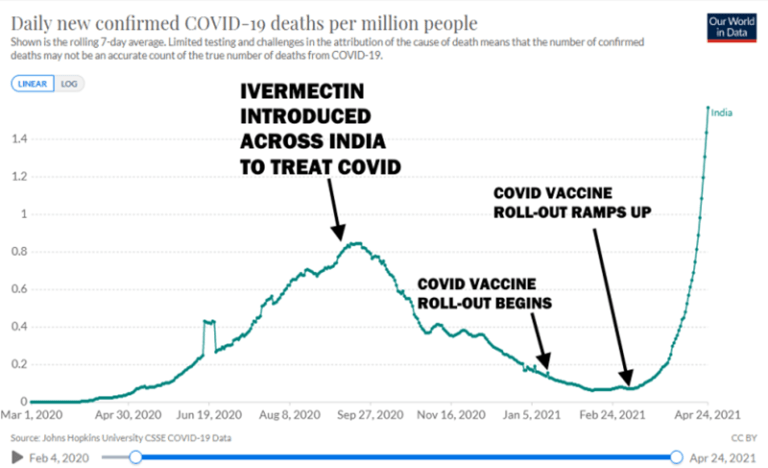
Other correlations must also be explored in the Indian context. India was rather late in joining the mass vaccination bandwagon. Throughout 2020, its COVID-19 mortality figures were moderate by global standards due to the efficacy of low-cost treatment protocols. Hydroxychloroquine (HCQ) was sanctioned for early stage treatment from March 2020 onwards; while a few months later, India’s most populous state of Uttar Pradesh (population 231 million) replaced HCQ with ivermectin (an anti-parasitic drug).

The results were highly encouraging. As the TrialSiteNews (TSN) reported on Jan 9 2021:

By the end of 2020, Uttar Pradesh — which distributed free ivermectin for home care — had the second-lowest fatality rate in India at 0.26 per 100,000 residents in December. Only the state of Bihar, with 128 million residents, was lower, and it, too, recommends ivermectin.

Despite having the coronavirus situation under control, New Delhi was under immense pressure from various international lobbies and their local proxies to roll out a mass vaccination campaign. It can be argued that India’s ongoing oxygen shortages are the direct result of prioritizing foreign-curated experimental vaccines over local necessities.

While the initial mass vaccination launch was pencilled for Jan 16, the campaign effectively took off only in late February. With uncanny timing, the New York Times hailed India as an “unmatched vaccine manufacturing power” that could counter China in the area of vaccine diplomacy.

As the goal of vaccinating 300 million people by August 2021 neared the midway mark, however, the number of COVID-19 cases surged accordingly. The graph below broadly charts this anomaly.

Not only has India’s COVID-19 cases surged in tandem with increased vaccination, the trajectory of infections and inoculations can be neatly superimposed as the following graph suggests.

Can one infer that there may be a correlation between increased vaccinations and infections? This is not the first time that gene-based therapies ended up creating new viral chimeras. The World Health Organisation (WHO) recently admitted that a Bill & Melinda Gates Foundation (BMGF)-backed vaccine program was responsible for a new polio outbreak in Africa.  The usual suspects were also behind a vaccination-linked polio surge in Pakistan and Afghanistan.

Vaccines causing deadly outbreaks of the very diseases they are supposed to eradicate happen to be a 21st century phenomenon – brought to you by an unholy alliance of Big Tech and Big Pharma. In the process, new mutant strains or “vaccine-derived viruses” emerge, necessitating even more potent vaccines which deliver greater profits and levers of global control to Big Tech. This is how the Davos cabal tries to stay relevant in a century that should otherwise be dominated by Asia. India may end up being the first Asian victim of Big Tech’s Great Reset against the East.

A recent study by Tel Aviv University may shed further light on India’s bizarre surge. It seems those who have been vaccinated with the Pfizer-BioNTech vaccine are 8 times more likely to contract the new South African variant of COVID-19 than the unvaccinated.

The Covishield (Oxford University-AstraZeneca) and Covaxin (Bharat Biotech) vaccines used in India may have produced a similar effect. Dr. Harvey Risch, a professor of epidemiology at Yale University, has estimated that over 60 percent of all new COVID-19 cases seem to occur among the “vaccinated.” Dr Michael Yeadon, former vice president and chief science officer for Pfizer, fears a more alarming outcome which includes the possibility of “massive-scale depopulation”. These are not your average basement-dwelling conspiratorial kooks!

“The vaccine,” to paraphrase Francis Bacon, “is now appearing to be the worse than the disease itself.” Gene-based vaccines open up a Pandora’s Box of what systems theorists call “emergence”. The human body is a complex system that may react unpredictably to interferences at its most substrate (or genetic) levels. As a result, mutant virus strains may emerge alongside unforeseen side effects. This is what we are witnessing worldwide.

But as the virus mutates, so does the official narrative. The Indian Medical Association (IMA) now claims that mass vaccinations in densely-packed stadiums and halls are “superspreader” events. Is the IMA suggesting that new vaccine delivery systems, as lobbied by Big Tech, will solve this problem? Let us wait and see. Furthermore, is close proximity the prime culprit behind the super-surge in India? India is a nation where trains, buses and all forms of public spaces teem with human bodies. Yet, it did not lead to mass casualties in 2020 as many had feared.

In the absence of a watertight scientific explanation from mainstream gatekeepers, a more plausible narrative may be sought from peripheral sources. The Daily Expose offers one such graphic-laden narrative to explain the correlation between mass vaccinations and the rising death toll in India.

While the Daily Expose concedes that correlation does not always equal causation, a similar pattern was noticed in other nations. The vaccination-mortality graph for Mongolia, for example, is particularly eye-popping.

Did Mongolia witness a near-zero to mutant COVID-19 surge just when mass vaccinations rolled out? How coincidental can that be?

The Case of America: Red vs Blue States

One may scientifically argue that India’s surge had nothing to do with ramped-up vaccinations. A new mutant virus may also somehow explain the vaccination-mortality correlations in Mongolia.

Therefore one should resort to another layman-friendly proxy to see whether similar correlations exist elsewhere. How about a comparison within the most coronavirus-affected nation on earth – the United States of America?

Reports thus far suggest that US states which have been resisting mass vaccinations and/or mandatory masking, at least in relative terms, are generally faring better than those adhering to draconian COVID-19 guidelines. Just weeks after Texas lifted its public mask mandate – featuring full crowds at bars, restaurants and concerts  no less – COVID-19 cases as well as hospitalizations dropped to its lowest levels since October 2020. The current White House occupant, who continues to make a buzz over his mental acuity, nonetheless panned the move as a symptom of “Neanderthal thinking”.  In the meantime, South Dakota Governor Kristi Noem, a prominent opponent of mandatory masking, is using COVID-19 restrictions elsewhere to lure businesses to her state. Other red states such as Florida and Arizona have moved to ban the so-called vaccine passports.

Rather coincidentally, the annual flu has virtually disappeared in the United States since the onset of the pandemic. It must be a modern medical miracle!

How will India fare?

With the surge affecting the nation badly, the CEOs of Google, Microsoft and Apple, among others, have pledged heartfelt aid to India. With friends like these, one wonders why Indians cannot question the global COVID-19 narrative on Twitter, Facebook or YouTube without being summarily banned or censored. If India can concede the digital rights of its own citizens and the digital sovereignty of the nation to Big Tech, then how is it going to crowdsource solutions for COVID-19? Or deal with any other future crisis for that matter? An Indian scientific paper which tentatively explored a laboratory origin for COVID-19 can be summarily removed after concerted condemnation from Western academics but a similar claim made by the former head of the US Centers for Disease Control (CDC) appears relatively palatable. Isn’t this a textbook example of neoliberal racism?

Indians should also question why Africa has not been badly affected thus far, despite a South African variant hovering in the region. This is a continent mired in conflicts, poverty, serious healthcare deficits and other Third World-related woes. It lacks world-class scientists and institutions which India admittedly has. Is it because Africa does not pose an economic threat to the Western oligarchy the way Asia does? Or maybe, mass vaccinations haven’t yet taken off in Africa?

For the time being, India cannot reverse course on its vaccination drive and adopt measures similar to the one employed by the Eisenhower administration during the 1957-58 Asian Flu pandemic. The fear genie is already out of the bottle. Big Tech controls the digital narrative in India as it does elsewhere. Even if New Delhi manages to tame the COVID-19 crisis within the next few weeks or months, Big Tech will still be around to stifle India’s destiny.

Ultimately, this game is much bigger than COVID-19; it is about global domination through perennial mass-manufactured crises until a Great Reset is achieved.

The “Russian Threat”

By Paul Craig Roberts

Source: PaulCraigRoberts.org

During 2016  CIA director John Brennan and FBI director James Comey, together with the corrupt Democrat party, began orchestrating Russiagate in order to prevent Trump from reducing the risk of nuclear war by normalizing relations with Russia.  President Trump tried to nip a New Cold War in the bud, but that was not in the interest of the power and profit of the military/security complex which desperately needs the “Russian threat” as its raison d’etre. 

Stephen Cohen, myself and a few others expressed concern that the tensions between the two  nuclear powers were being driven to more dangerous highs than ever existed during the 20th century Cold War.  Many websites joined in debunking the orchestrated Russiagate fabrication.

To discredit these voices, a new website, PropOrNot, suddenly appeared with a list of 200 “Russian agents/dupes.”  Those of us who had raised red flags about Russiagate and the worsening of tensions were on the list. The Washington Post gave the accusation credibility by reporting the PropOrNot accusation that those who dissented from a hostile policy toward Russia were “Putin agents.”

A number of the falsely accused websites were intimidated and abandoned the truth.  CounterPunch went even further. It dropped its best and most incisive writers—people such as Mike Whitney and Diana Johnstone.  CounterPunch, which  had once collected, published, and marketed a collection of my essays as a book, suddenly discovered that it preferred fiction over fact.  Other websites that had religiously reproduced all of my columns now became selective about which parts of the official narrative they would permit to be examined on their sites.  This was, perhaps, the beginning of the movement to de-platform all who challenge the narrative.

The threat to truth-tellers has now been elevated by election thief Joe Biden’s latest Executive Order declaring a “national emergency” to “deal with the Russian threat.” Pepe Escobar reports that Biden’s order opens every American to being accused of being a Russian agent engaged in undermining US security. “A sub-paragraph (C), detailing ‘actions or policies that undermine democratic processes or institutions in the United States or abroad,’ is vague enough to be used to eliminate any journalism that supports Russia’s positions in international affairs.”

“Supports Russia’s position” includes an objective description and non-partisan analysis of Russian policy. The crucial point is that, in effect, Biden’s executive order places everyone reporting objectively on Russia’s political positions as a potential threat to the United States.  https://www.unz.com/pescobar/putin-rewrites-the-law-of-the-geopolitical-jungle/  

If we are honest, we will acknowledge that we have undergone the complete collapse of the United States.  Truth is prohibited in the media, school systems, and universities if it conflicts with the elite agendas served by the official narratives. The First Amendment is dead and buried. Free speech is reserved for the official narratives, such as “systemic racism”  and “Russian threat.” Those who exercise their Constitutional right find themselves de-platformed or fired.  

To understand how the victory of propaganda over truth elevates the likelihood of nuclear Armageddon, consider the difference between the 20th century and 21st century cold wars.

In the original Cold War both Soviet and American leaders worked to defuse tensions.  Agreements were made on arms control and the anti-ballistic missile treaty. There were regular meetings or summits between American and Soviet leaders.  Diplomatic decorum was maintained.  There were agreements that permitted each side to inspect the other’s compliance.  

This process began with President John F. Kennedy and  Soviet First Secretary Khrushchev.  It continued through President Reagan and, more or less, President George H. W. Bush.  It ended with the Clinton regime and has been downhill ever since.  President Trump intended to reduce the dangerous tensions, but was not permitted.  Indeed, his intent was sufficient cause for the Establishment to drive him from office.  2020 was a coup, not an election.

In the 20th century Cold War Russian experts differed in their assessments of the threat, and their differences were publicly aired. Differing assessments were debated. Dissenters were not demonized as Russian agents.  Today American Russian experts find that being Russophobic is a career boost. In the 20th century the New York Times and Washington Post were aligned with peace efforts. Today they are part of the neoconservative warmongers’ propaganda ministry.

The alarming conclusion is that since the Clinton regime, the US government has worked consistently to worsen relations with Russia even to the extent of publicly demonizing the Russian president and strangling objective debate in the US.  This is the perfect foundation for war.

All the while insouciant Americans elected governments that successively raised the likelihood of nuclear annihiliation while shutting down dissident concerns.  As I reported on March 17, “In the United States Russian Studies has degenerated into propaganda.  Recently, two members of the Atlantic Council think tank, Emma Ashford and Matthew Burrows, suggested that American foreign policy could benefit from a less hostile approach to Russia. Instantly, 22 members of the think tank denounced the article by Ashford and Burrows.”

Today even in Republican and conservative circles to question Putin’s demonization raises disapproving eyebrows (the same for China and Iran).  The US Establishment has succeeded in labeling objective analysis as “pro-Russian” (or pro-Chinese or pro-Iranian). This means that an objective view of US/Russian relations is off-limits to US policymakers.  

The “Russian threat” is another hoax, one that will destroy the world.

Zen In The Trenches

By Gary Z Mcee

Source: Waking Times

“You ask, ‘what is Zen?’ I answer, ‘Zen is that which makes you ask the question.’ Because the answer is where the question arises. The answer is the questioner himself.” ~Daisetz Suzuki

Zen is ultimately undefinable. It’s paradoxical. It’s a feeling; a meditation on opposites and interconnectedness intermittently. It’s a bridge between the unanswerable question and the unknowable answer. Even more cryptic: it’s No-mind meditating the mind into mindfulness.

No matter what Zen really is, the meditator attempting Zen is Zen. Or perhaps they are Zenning and Zen is actually a verb disguised as a noun—like God.

Either way, Zen practice is never more important than when we are in the trenches, down and out, at the bottom of the rollercoaster ride, experiencing a Dark Night of the Soul. In such a state, Zen is the great equalizer, an individuating leveling mechanism. An excuse to climb out of Hell and into Heaven. Or at least back to level ground.

Transforming shadows into sharpness:

“By accepting the inevitability of our shadow, we recognize that we are also what we are not. This humbling recognition restrains us from the madness of trying to eliminate those we hate or fear in the world. Self-mastery, maturity, and wisdom, are defined by our ability to hold the tension between opposites.” ~Louis G. Herman

Zen is the essence of holding the tension between opposites. It’s a proactive meditation on the paradoxical state of the human condition. It acts like a bridge between the unconscious shadow and the darkness made conscious.
When our shadow is hidden from us or repressed—either subconsciously or through willful ignorance—we feel dull, insecure, fragmented, confused, unaware, and less than whole. But when our darkness is made conscious, we fell whole, aware, open, and sharper in mind, body, and soul.

Zen teaches us how to reconcile our dark side. Deep in the trenches of our shadow, Zen plants a question mark seed made of light. Through daily cultivation and practice (attention, awareness, focus), the light brightens the darkness, and the shadow becomes a vital self-aware aspect of the overall condition. Light magnifies shadow out of repression and into self-actualization.

Transforming certainty into curiosity:

“I ask you: what are you? You don’t know; there is only ‘I don’t know.’ Always keep this don’t-know mind. When this don’t-know mind becomes clear, then you will understand. Keep don’t-know mind always and everywhere. This is the true practice of Zen.” ~Seung Sahn Sunim

The most deceptive of all “trenches” is being stuck in the box of certainty. Believing that one certainly knows is the ultimate delusion. Whereas thinking that one possibly knows, but probably doesn’t, is the ultimate escape from delusion. Flexibility and open-mindedness are key. Zen can help us with both.

Zen helps us get in touch with the primordial coordinates of the interconnected cosmos. It helps us recognize the probability spectrum. When Socrates said, “The only thing I know is that I know nothing,” he was speaking in probabilities. He recognized that his was a single perception dwarfed by an unfathomably large universe. He realized that what he thought he knew was incomparably less to what he didn’t know and wisely swallowed his pride.

Better to use Zen to keep us in flow. When we are fluid and dynamic in our thinking, we are less likely to be seduced by dogmatic belief. Zen keeps us questioning to the nth degree. It keeps is open to the vital transformations the universe goes through. Zen is the art of adapting to the ebbs and flows of constant change. Being aware of this deep flow is being curious. Curiosity is the wave of change crashing over the fragile structure of our certainty. We would be wise to ride that wave straight over and learn from the destruction. The debris of which holds gold tantamount to transformative ambrosia.

Transforming anxiety into artistry:

“Who among you can at the same time laugh and be exalted? He who climbs upon the highest mountains laughs at all the tragedies, real or imagined.” ~Nietzsche

Anxiety is like an open wound of the psyche. And when you are down in the tranches, it can be a crippling experience. When we transform anxiety into art, we are using the stress as fuel for the fire of our imagination. The anxiety becomes a kind of eu-stress, which can be quite cathartic. Tension becomes a bridge between ‘stress’ and ‘creative outlet,’ where anxious state meets flow state.

Whether it’s transforming wounds into wisdom, demons into diamonds, or setbacks into steppingstones, the cathartic release of worry and pain can become the active components of a beautiful work of art. Pain is transformed into paint, misery into music, psychosis into poetry. And with enough practice, a kind of existential masochism can arise from the spiritual and psychological plasticity—robustness becomes antifragility.

Insofar as this existential masochism can be applied to a life well-lived, a Zen-full humor arises where all tragedies are laughable aspects of the overall cosmic joke. Life itself becomes a work of art.

Transforming hypocrisy into humor:

“No one ever grows up. They may look grown up, but it’s a disguise. It’s just the clay of time. Men and women are still children deep in their hearts. They still would like to jump and play, but that heavy clay won’t let them.” ~Robert McCammon

Governing the precept that life is a cosmic joke, it stands to reason that we get better at laughing at the joke rather than crying over the spilled milk of being the butt-end of it. The humbling effect of Beginner’s Mind can help with this. It reminds us that we are all merely fallible creatures at the mercy of the cosmic joke. Anything else is mere hypocrisy. Especially the title of “grown up.”

The Zen of Beginner’s Mind is the art of tapping into that playful innocence which refuses to be serious but is always sincere. It counters the hypocrisy of the human condition with a sense of playfulness. From which a creative adaptation and improvisation arises. We are fallible creatures? So be it. We are hypocritical naked apes? Might as well have a sense of humor about it. It’s all laughable in the grand scheme of things? We might as well have a laugh.

Adopting a good sense of humor is the best tool we can utilize while in the tranches. It can get us through just about anything. And even if it doesn’t, at least we’re laughing. Our inner child teaches us how to laugh and play through the misery, rather than just be miserable.

Transforming Hell into Heaven:

“Morality doesn’t mean ‘follow divine commandments.’ It means ‘reduce suffering.’” ~Yuval Noah Harari

Even in the trenches, we have a choice to be healthy or not. Even in the gutter, we can either drown in our own tears or flip over, take a deep breath, and regard the stars their aesthetic splendor. Yes. Even beauty itself can be healing. And beauty combined with a good sense of humor can be transcendent… Skipping through Hell with bells on. Laughing into the abyss. Mocking all devils, demons, angels, and gods. Using it all as a sharpening stone.

That’s Zen in the trenches.

We either play the victim and wallow in self-pity, or we rise up with a ‘humor of the most high’ and dare to become healthier. In the alchemical transformation of the human condition, Hell is the forge folding the blade of the soul into a sharper instrument.

Our comfort zone just isn’t hot enough. Heaven is too soft. Purgatory is too comfortable. Hell is just right, as long as we don’t make the mistake of losing ourselves there and burning ourselves out. We must remember to kill the devil first, and then make our way back to the “tribe” to inform them that there’s nothing to be afraid of anymore.

Zen in the trenches is no walk in the park. It takes daring and flexibility. It takes moxie and mettle. It takes a good sense of humor despite a meaningless universe. It takes emotional alchemy and existential masochism to deal with the pain and suffering.

Practicing Zen in the trenches is whistling, “Always look on the bright side of life” while nailed to a cross (The Life of Brian). It’s creating meaning out of nothingness, building bridges out of bandages, birthing a Phoenix out of ashes. It’s laughing and playing and dancing despite the slings and arrows and in spite of the ever-tightening mortal coil. Indeed.

As Rabelais said, “For all your ills, I give you laughter.”

Saturday Matinee: Zerograd (aka Zero City, City of Zero)

Review by Movies Unchained

Absurdity can take many different forms, particularly when it comes to artistic expression, with many individuals over the past century making their living from subverting the central tenets of reality. One such artist was Karen Shakhnazarov, whose ambition film Zerograd (Russian: Gorod Zero) holds the distinction of being one of the most bizarre works of cinema produced in the last few decades. A strange, hypnotic voyage into a darker version of the world, this film feels like the perverted offspring of David Lynch and Andrei Tarkovsky (especially if they collaborated on a twisted version of Alice in Wonderland), and I don’t think there is a single moment in this film that I was in complete awe of. Cinema is supposed to be challenging, and it doesn’t get more impenetrable than this, where Shakhnazarov takes us on a voyage that is somehow both hilarious and utterly terrifying, showing us a side of society that isn’t familiar to anything the best of us have experienced ourselves, but still manages to be as captivating as anything else. A deliriously work of experimental dark comedy, Zerograd is quite an achievement – and kudos has to go to Shakhnazarov for managing to construct something so bewildering, yet so deeply brilliant in both how it provokes certain ideas while remaining quite stable and consistent in its message (at least after we actually figure out what this film is attempting to convey), which creates a sensational piece of filmmaking that tests the boundaries of reality and presents the viewer with something so singularly unique, one would be forgiven for believing that Zerograd isn’t actually a film, but a fever-induced bout of delusions – and for all these reasons and more, we can easily proclaim this film as something of a hidden masterpiece, an outrageous, disconcerting surrealist odyssey that is as entertaining as it is wholly disruptive, both to the art form in which it was made and in terms of the broader socio-cultural implications embedded within it.

The film centres on Alexey Varakin (Leonid Filatov), a regular civil engineer who is sent to a small town in the middle of nowhere to meet with the owner of a factory to discuss some of the products they have been supplying. What was supposed to be a brief day-trip turns into what appears to be an eternity, especially when it becomes clear that everything isn’t what it seems in this mysterious countryside hamlet. His visit takes a horrifying turn when Alexey witnesses the suicide of a chef, which not only traumatizes him, but also places him at the centre of a conspiracy that points to him as the chief suspect, especially when the perspective of the event changes from suicide to a murder. What Alexey doesn’t realize is that he is stuck here – it is physically impossible for him to move beyond the borders of the town, since there are certain metaphysical forces keeping him there. This is made clear when he visits a museum, where the crotchety curator (Yevgeny Yevstigneyev) gives him a tour, taking him to subterranean levels and relaying the history of the town, which stretches all the way back to the formative years of the USSR and the rise of communism across the Soviet Union. Despite being a mild-mannered working-class man, Alexey is seen as something of an anomaly in this town, a stranger sent there by some celestial being to disrupt the lives of the residents – but it soon becomes clear that he’s not the one to fear, since a looming sense of foreboding lingers over the town, and causes the protagonist to reevaluate not only his own life, but the entire concept of reality in general, as everything around him is starting to point to the fact that everything Alexey knew to be true is quite possibly false information, and he himself is at risk of losing his identity as a whole if he doesn’t solve the problem before its too late.

Zerograd is a very different kind of film in every conceivable way. It positions itself as something of a mystery film, but one that dares to ask what happens when someone is investigating something and searching for the truth when every clue not only distances him further from the answer, but proves the incredulity of reality as a whole. This is a mystery film that struggles to even ask a coherent question – if anything, the answers are there, if only we knew where to start looking for them. Shakhnazarov masterfully constructs one of the most fascinating films of its era, a hauntingly dark comedy that eviscerates the very idea of plausibility, going beyond the confines of surrealism and becoming something else entirely, a kind of cold-blooded psychological horror that is more terrifying the more we realize how the sense of danger isn’t just constructed for dramatic purposes, but rather a fundamental aspect of the story. Modern audiences tend to equate the concept of surrealism with the idea of weird works that are artistically transgressive and show a lack of logic – and while this is often very true, its a baseline assessment that can’t apply particularly well to a work like Zerograd, which thrives on its ability to deconstruct nearly every sacrosanct truth while still retaining a coherent, concise narrative that goes to some bizarre narrative territory, but only for the sake of supporting its own ambitious ideas. There are many aspects of Zerograd that positively yearn to be discussed – and I’d expect some background knowledge of Soviet-era politics, while not essential in any way, would only enrich the experience, and help add context to a work of unhinged socio-cultural satire that masters the fine art of amusing the audience while gradually dismantling their deep-seated beliefs, to the point where we too get lost in this world, and begin to question our own individual realities.

We never quite know where this film is heading, and like any work of great surrealism, a clear sense of direction is entirely inconsequential. A brief roadmap of ideas is presented at the outset of Zerograd, but for the most part, it functions as a stream-of-consciousness odyssey that launches us into an uncanny world that feels familiar, but where the smallest inconsistencies prevent us from ever being at ease. The character of Alexey is our surrogate, an ordinary man thrown into these strange circumstances, and forced to navigate a side of the world he isn’t only unfamiliar with, but struggles to understand in any meaningful way. There is certainly some strange occurrences that take place throughout this film, with these events ranging from mildly amusing in how offbeat they are, to fully terrifying, especially when they hint at something far more sinister lurking beneath the surface. There’s quite a bit to digest when it comes to this film, where each individual idea can be unpacked – but as should be familiar to any devotee to the school of surrealism, the more you provoke a theme, the less effective it is. Zerograd works most effectively when each individual concept is taken as part of some larger whole, and while the details make for a fascinating film, the brilliance comes in the cumulative power, the gradually-compounding unearthliness that indicates that the eccentricities embedded within this story are not there merely for the sake of perplexing the audience, but rather to manipulate the entire concept of reality and everything it stands for, which is precisely what makes this such a remarkable film. It only makes the actual filmmaking more effective – Shakhnazarov constructs such a magnificent odyssey, where each frame is stunningly detailed, detached from reality in a way that doesn’t confuse us, but still points towards a more haunting alternative. There are some unforgettable images in this film, such as when the main character is served a cake that is modelled after his own head, or the striking final shot where he is finally able to makes his escape – and when taken alongside the brilliant story, we have a truly memorable work of speculative fiction.

Zerograd is a film in which the plot doesn’t revolve around the fact that nothing seems real – this is a film where we know for a fact that absolutely nothing we are seeing makes sense, but yet it is so grounded in some fundamentally realistic ideas, it never feels too far-fetched. There is an eerie sense of foreboding that intermingles with the darkly comic underpinnings to create quite a memorable piece that delves deeply into looking at the themes of identity and freedom, two concepts that are often explored in Soviet-era literature, albeit not in quite as bizarre a way as here. Shakhnazarov is a masterful filmmaker who produced something truly incredible with Zerograd, crafting a surreal odyssey that feels so compelling, even when it is clear that it is not afraid to venture beyond the confines of all known logic. This is the kind of film that people should be referring to when they’re describing the concept of a Kafka-esque story, since everything about Zerograd feels like something the esteemed but troubled author would write – a mysterious setting, a protagonist thrown into a world he doesn’t understand, eccentric characters that are so familiar yet so deeply unsettling, and a general sense of danger that never quite abates, constantly following the protagonist (and by extension, the audience) the further we journey through this strange world. This is a film that should be seen and discussed, even if the most insightful academics would have trouble coming to terms with the ideas Shakhnazarov uses throughout the film. In short, Zerograd is an astounding achievement, a bewildering but truly worthwhile absurdist masterpiece of Russian cinema that traverses reality and comes out of it stranger and more profoundly fascinating than ever before.