Taking Control by Destroying Cash: Beware Cyber Polygon as Part of the Elite Coup

By Robert J. Burrowes

For many people desperate to see a return to a life that is more familiar, it is still easy to believe that the upheavals we have experienced since March 2020 and the changes that have been wrought in their train are ‘temporary’, even if they are starting to ‘drag on’ somewhat longer than hoped.

However, anyone who is paying attention to what is taking place in the background is well aware that the life we knew before 2020 has already ended and what is being systematically put in its place as the World Economic Forum (WEF) implements its ‘Great Reset’ will bear no comparison to any period prior to last year. See ‘Killing Democracy Once and for All: The Global Elite’s Coup d’état That Is Destroying Life as We Know It’.

Of course, those of us who qualify as ‘ordinary people’ have had no say in the shape of what is being implemented: that shaping has been the prerogative of the criminal global elite which is now implementing a plan that has been decades in the making and built on hundreds of years of steady consolidation of elite power.

Also, of course, there is nothing about this shaping that is good for us. In simple terms, it is reshaping the human ‘individual’ so that previously fundamental concepts such as human identity, human liberty, human rights (such as freedom of speech, assembly and movement), human privacy and human volition are not just notions of the past but are beyond the comprehension of the typical ‘transhuman’. At the same time, the global elite is restructuring human society into a technocratic dystopia which is a nightmarish cross between ‘Brave New World’, ‘1984’ and the Dark Age. See ‘Strategically Resisting the New Dark Age: The 7 Days Campaign to Resist The Great Reset’.

The only question remaining is this: ‘Can we mobilize adequate strategic resistance – that is, resistance that systematically undermines the power of the global elite to conduct this coup and restores power to ordinary people – to defeat this coup?’

But before I answer that question, I wish to highlight just one element of the elite coup that is taking place and outline the profound changes that are being left in its wake unless we stop them.

These changes are essentially related to the capacities of computerized technologies to deprive us of what little we have left of our financial autonomy, including because any notion of privacy is rapidly vanishing.

Vanishing Money

One reason for highlighting the issue of money is because while it is good to see increasing critical attention being paid to the ‘injectables’ program, with its devastating consequences for humanity, far too little attention is being paid to the profoundly important transformation being wrought under cover of the elite-driven narrative which has virtually all people’s attention distracted from this deeper agenda. And while this deeper agenda entails a great many aspects, one subset of these is related to the way in which the global financial system is being re-engineered to play its role in fully controlling the human population.

In a series of reports issued in early 2020, the Deutsche Bank claimed that ‘cash will be around for a long time’. See the three reports accessible from ‘Transition to digital payments could “rebalance global economic power”’.

However, these reports are contradicted by other research and the ongoing evidence that cash is vanishing. Most importantly, there is no doubt about the elite intention in this regard. They want cash gone.

The digitization of money has been occurring for decades and it is now being accelerated dramatically.

Moreover, the World Economic Forum and other elite organizations have been actively working towards achieving a cashless economy for years. To get a sense of this trend, see ‘Why we need a “less-cash society”’ and ‘The US should get rid of cash and move to a digital currency, says this Nobel Laureate economist’.

Notably, in this respect, the ‘Better Than Cash Alliance’ has 78 members ‘committed to digitizing payments.’ If you think that this is a grassroots initiative set up by people like you and me, you will be surprised to read that the Bill & Melinda Gates Foundation is a ‘Resource Partner’ to the initiative along with some UN agencies, many national governments and corporations such as Mastercard and Visa.

So while the trend toward a cashless society has been progressing steadily for some decades, with countries like Denmark, Norway and Sweden already virtually cashless and India rapidly moving in that direction – see ‘India’s PM Modi defends cash ban, announces incentives’ – the so-called ‘Covid-19 pandemic’ was contrived partly to provide a pretext for further accelerating the move from cash to cards and apps, with increasing numbers of people using the digital methods, even for small sums, partly because some people were scared into believing that the ‘virus’ could be transmitted by bills and coins.

But there is more. In addition to measures not mentioned here, other plans include the use of a facial scan that records your entry to a store and is linked to artificial intelligence that identifies you and your credit rating. This then enables, or otherwise, your ability to pay for goods and services based on this facial scan.

‘Does all of this matter’, you might ask. Well the convenience of cards and apps has two significant costs: your privacy and your freedom. You lose both simply because while paying with cash is anonymous, paying by card or app leaves a digital trail that is as difficult to follow as an elephant whose tail you are already holding. And this digital trail forms a vital part of the surveillance grid that enables all of those who are tracking and documenting your movement, your payments and your behaviour to do so without leaving the comfort of their chairs. For more detail on this, watch ‘Cash or card – will COVID-19 kill cash?’ which is embedded in the article ‘Cash or Card –  Will COVID-19 Kill Cash? Leaving a Digital Footprint With Every Payment’.

But it goes beyond this. As touched on above in relation to privacy and explained at some length by Whitney Webb, ‘there is a related push by WEF partners to “tackle cybercrime” that seeks to end privacy and the potential for anonymity on the internet in general, by linking government-issued IDs to internet access. Such a policy would allow governments to surveil every piece of online content accessed as well as every post or comment authored by each citizen, supposedly to ensure that no citizen can engage in “criminal” activity online.

‘Notably, the WEF Partnership against Cybercrime employs a very broad definition of what constitutes a “cybercriminal” as they apply this label readily to those who post or host content deemed to be “disinformation” that represents a threat to “democratic” governments. The WEF’s interest in criminalizing and censoring online content has been made evident by its recent creation of a new Global Coalition for Digital Safety to facilitate the increased regulation of online speech by both the public and private sectors.’ See ‘Ending Anonymity: Why the WEF’s Partnership Against Cybercrime Threatens the Future of Privacy’.

But to get back to cash: Unfortunately for us, the global elite does not intend to leave the abolition of cash to our ‘preference for the convenience of cards’ and other moves to entice us to switch to digital payment. It fully intends to force us to accept digital methods as the only means of payment.

In part, this is because electronic payments are extremely lucrative for banks and payment service providers, while the data broker industry is also making huge revenues. See ‘Cash or Card –  Will COVID-19 Kill Cash? Leaving a Digital Footprint With Every Payment’.

And in some ways, ‘killing cash’ is simple. Two obvious ways of doing so are by removing ATMs (including from shopping centres) and closing local bank branches so that cash is simply unavailable. As has been happening for some time. See ‘Why Are ATMs Disappearing at an Alarming Rate after a Wave of Branch Closures?’ and ‘Australian bank branches and ATMs are vanishing’.

But, in this instance, even profitability is at the trivial end of the elite motivation spectrum.

Cash is being forced out of existence because it undermines the elite agenda to take all power from ordinary people.

So, in parallel with other regressions over the past 18 months as the elite coup to take complete control of our lives has continued to unfold, there have been ‘warnings’ from various institutions – including the World Economic Forum and the Carnegie Endowment for International Peace – about the possibility of an ‘allegedly imminent cyber attack that will collapse the existing financial system’.

Following a simulation in 2020, in which the World Economic Forum along with the Russian government and global banks conducted a high-profile cyberattack simulation that targeted the financial industry, another simulation was held on 9 July 2021 involving the World Economic Forum and the Russian government-owned Sberbank as well as other key financial agents. See ‘Cyber Polygon’ and ‘Cyber Polygon 2021’. In reality, of course, such a collapse of the financial system would constitute ‘the final yet necessary step’ to implement the World Economic Forum’s desired outcome of forcing a widespread shift ‘to digital currency and increased global governance of the international economy’.

If this financial collapse happens, the ‘solution’ suggested by key agencies – ‘to unite the national security apparatus and the finance industry first, and then use that as a model to do the same with other sectors of the economy’ – will ensure that we lose what little control is left in our lives, not just in relation to our financial resources but in all other domains as well. For a full explanation, see ‘WEF Warns of Cyber Attack Leading to Systemic Collapse of the Global Financial System’.

And for another account of the deeper agenda and its financial impacts already, including its ‘economic genocide’, as well as what is yet to happen, watch this interview of Catherine Austin Fitts: ‘Globalist Central Banking New World Order Reset Plan’.

Beyond this, if you want some insight into another key threat in the cybercrime realm, check out this video by the Ice Age Farmer in relation to the cyber threat to the power grid. See ‘“Next Crisis Bigger than COVID” – Power Grid/Finance Down – WEF’s Cyber Polygon’.

So How Can We Resist?

Fortunately, there is some resistance already.

In response to concerns in the United States that businesses that refuse cash will disadvantage communities with poor access to traditional banking systems, there are signs that ‘a national movement protecting consumers’ ability to pay in cash may be emerging’ with a number of states and cities already outlawing cashless outlets. See ‘Cash or Credit? State and City Bans on Cashless Retailers Are on the Rise’.

Realistically, however, given what is at stake, considerable elite pressure will be applied to reverse these decisions in time. So we need our defense to be more rigorous and less reliant on agents who are unlikely to be tough enough to defend our interests or will be sidelined or killed for doing so, as at least two national presidents who resisted the elite intention last year have since been killed. See ‘Coronavirus and Regime Change: Burundi’s Covid Coup’ and ‘John Magufuli: Death of an African Freedom Fighter’.

Moreover, given the likelihood that the financial system will be deliberately crashed at some point – and possibly soon – we need to employ a variety of tactics, that build resilience into our resistance, to defeat this initiative.

Hence, storing and paying with cash, moving your accounts to local community banks or credit unions (and away from the large corporate banks) and making the effort to become more self-reliant, particularly in food production, will increase your resilience, as will participating in local trading schemes, whether involving local currencies or goods and services directly.

As with all elements of the defense we implement, it will need to be multi-layered and integrated into the overall defense strategy. The elite intends to kill off many of us – as the depopulation measures within the coup, including the destruction of the global economy throwing 500,000,000 people out of work and killing millions as a result, as well as the ‘injectables’ program already killing tens of thousands, make perfectly clear – and enslave the rest.

For an integrated strategy to defeat the elite coup, see the ‘We Are Human, We Are Free’ campaign, which has 29 strategic goals for defeating the coup including meaningful engagement with police and military forces to assist them to understand and resist, rather than support, the elite agenda.

But for a simpler presentation, see the 7 Days Campaign to Resist The Great Reset. The Telegram group is here.

Conclusion

One of the interesting challenges about the current ‘Covid-19 Crisis’ is that it continues to very successfully distract most people from awareness of the deeper agenda: the Global Elite’s ‘Great Reset’ and related initiatives, such as that discussed above in relation to money.

Hence, apart from the perennial problem of raising awareness and mobilizing resistance among those still believing the elite-driven propaganda, we face two key strategic hazards.

The first hazard is a longstanding one: while virtually all people believe that elite agents – in this case, governments – are controlling events, much ‘resistance’ will focus on begging governments, through such things as petitions and protest demonstrations, to ‘fix it’ for us. The elite has long dissipated our dissent by having us direct it at one or other of its agents. This case is no different. And while we are not using our occasional large rallies to inform people how to resist powerfully every day of their life, these rallies are a waste of time whatever solidarity they build in the short term. History is categorically instructive on that point.

A second strategic hazard we face is that resistance to the ‘vaccine’ and the ‘vaccine’ passport might be ‘successful’ (in the sense that concerted actions stall some government implementation of some measures in relation to these two initiatives) and leave most people believing that they have ‘won’, while the deeper agenda remains in the shadows with virtually no-one resisting.

It is important, therefore, that those who are aware of the deeper agenda continue to provide opportunities for others to become aware of this too and the fundamental threat it poses to us all while also sharing how we can resist its key dimensions in a way that makes a difference. It is not enough to complain about elite agents, such as governments, the medical and pharmaceutical industries, and the corporate media.

We must strategically resist the elite coup itself with actions such as those in the 7 Days Campaign to Resist The Great Reset before we find ourselves locked in a technocratic prison without the free-willed minds necessary to analyze, critique, plan and act.

Robert J. Burrowes has a lifetime commitment to understanding and ending human violence. He has done extensive research since 1966 in an effort to understand why human beings are violent and has been a nonviolent activist since 1981. He is the author of ‘Why Violence?’ His email address is flametree@riseup.net and his website is here.

Have We Reached “Peak Self-Glorifying Billionaire”?

By Charles Hugh Smith

Source: Of Two Minds

Perhaps we should update Marie Antoinette’s famous quip of cluelessness to: “Let them eat space tourism.”

As billionaires squander immense resources on self-glorifying space flights, the corporate media is nothing short of worshipful. Millions of average citizens, on the other hand, wish the self-glorifying billionaires had taken themselves and all the other parasitic, tax-avoiding, predatory billionaires with them on a one-way trip into space.

Have we reached Peak Self-Glorifying Billionaire? If so, where does the downhill slide take us? Let’s start with a bit of history. Correspondent Jim B. summarized historian Arnold Toynbee’s study of the rise and fall of civilizations thusly: “Civilizations fail when their elites change from an admired dynamic creative class to a despised Establishment of corrupt rentiers, an entrenched governing class unfit to govern.”

Despised, check. Corrupt, check. Entrenched, check.

The 2013 book Why Nations Fail: The Origins of Power, Prosperity, and Poverty discusses the differences between failed states and successful states, and concludes that the failed states are fundamentally kleptocracies that answer to a self-serving elite while successful states are answerable to the broad populace.

To summarize: When the few benefit at the expense of the many, the resulting kleptocracy ends up a failed state. When states maintain meaningful, transparent ways of responding to public needs and demands, the result is a successful state.

This is of course a simplification. The perverse effects of colonialism linger, the development of civic organizations public institutions, values and identities that make up what I call the social ontology are not pre-ordained, and nations with low-cost surplus energy can be quite successful kleptocracies until their energy surplus runs out.

But in the main, the question remains: How did previously successful political, social and economic systems change such that they no longer generated beneficial synergies but slid into fatal synergies?

From the point of view of how systems fail to maintain dynamic stability, three factors pop out:

1. Elites become too successful in sluicing the nation’s income, wealth and political power into their own hands.

2. Since the system continues to thrive despite their dominance, then there is obviously no need to change anything–especially if it reduces their share of the nation’s wealth and political power.

3. The elites ignore the intangible decay of leadership, the real-world dynamics of scarcity and over-estimate their own capabilities and the resilience of the system.

I recently described the feedback loop that occurs when a wealthy elite can purchase political power:“as a result of their campaign contributions and lobbying, the elites’ wealth continues expanding, enhancing their political power to further expand their wealth, and so on.”

In a healthy system, there are mechanisms that limit elite ownership of wealth and political power to what the system can bear. Over time, the feedback I described increases elite wealth and power to a point where the limits are crushed and the elite feedback gathers momentum.

With institutional limits no longer in the way, the elite reaches the point where the political system no longer responds to the broad public at all, and the vast majority of income-producing wealth is already in the hands of the elite.

The U.S. is already at this final stage: Wealth/Power Inequality and the Slide Into Disorder.

Testing Theories of American Politics: Elites, Interest Groups, and Average Citizens“Contrary to what decades of political science research might lead you to believe, ordinary citizens have virtually no influence over what their government does in the United States.”

This dominance throws the system out of balance such that, as David Parsons recently put it: (Elite-dominated) “Capitalism makes everyone homeless and then makes award-winning movies about how resilient people are for living in their cars.”

The apparent success of the system even as it grows ever more imbalanced generates a self-serving confidence in the Elites that their dominance is not only benign but permanent.

But this self-serving view is illusory. Beneath the surface, major subsystems are attempting to re-establish stability, but the instability is so extreme that the measures being deployed are also extreme.

These policy extremes only push the system further out of balance in other directions, creating fatal synergies as mutually reinforcing imbalances pile up.

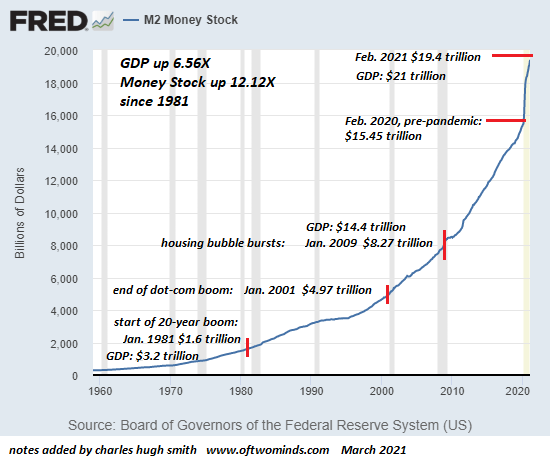
See the chart below of money supply as one example of many.

But the elite is blinded by their confidence and greed to these accelerating imbalances. They reckon that managing the narratives (a.k.a. propaganda), minor policy tweaks and creating more currency and credit are all that’s needed to maintain what they consider the optimal form of stability: they own 99% of political power and 97% of all the income from capital.

Monopoly Versus Democracy: How to End a Gilded Age“Ten percent of Americans now control 97 percent of all capital income in the country. Nearly half of the new income generated since the global financial crisis of 2008 has gone to the wealthiest one percent of U.S. citizens. The richest three Americans collectively have more wealth than the poorest 160 million Americans.”

I’ve often noted that the wealth of Rome’s political and economic elite went from being 20 times the wealth of a landowning farmer or craftsman to 200,000 times the commoners’ wealth at the end of the Western Empire. Now that three individuals own more wealth than half the American populace, and the top 0.1% hold more wealth than the bottom 80%, I think we can safely declare we’ve reached the same extreme.

The first tranche of American presidents left office less wealthy than when they entered because serving in public office was understood as a noble and valued sacrifice of time and wealth. Now presidents leave office far wealthier than when they entered public service.

Per #3, the elite no longer sees any compelling reason to sacrifice their income, wealth and power to stabilize the system or benefit the common good. In the view of the billionaires, if any sacrifices are necessary, then they should be borne by the bottom 95%, or failing that, the bottom 99.5%.

Given their dominance, their willingness to use their wealth and power to protect their dominance dooms the system to destabilization and collapse, as the resources and value system required to successfully navigate eras of instability and scarcity are no longer available to the state or public.

In effect, the elite uses its power not to restabilize the system but to maintain its extreme dominance and protect it from any political threats.

A once vibrant ecosystem has become a monoculture whose stability is far more precarious than it appears on the surface, as the resilience of monocultures is entirely artificial.

Two recent books illuminate corners of this destabilizing inequality:

Billionaire Wilderness: The Ultra-Wealthy and the Remaking of the American West

‘Jackpot’ Looks at How Inequality Is Experienced by the Very, Very Rich

We are in the final stages of this accelerating destabilization: the refusal of the elite to sacrifice any meaningful share of their wealth and power to save the system from fatal synergies guarantees collapse.

Perhaps we should update Marie Antoinette’s famous quip of cluelessness to: “Let them eat space tourism.” We all know where this cluelessness ultimately leads.

Drone warfare whistleblower sentenced to 45 months in prison for telling the American people the truth.

Drone warfare whistleblower sentenced to 45 months in prison for telling the American people the truth.

By Chris Hedges

Source: ScheerPost.com

Daniel Hale, a former intelligence analyst in the drone program for the Air Force who as a private contractor in 2013 leaked some 17 classified documents about drone strikes to the press, was sentenced today [7/27/21] to 45 months in prison.

The documents, published by The Intercept on October 15, 2015, exposed that between January 2012 and February 2013, US special operations airstrikes killed more than 200 people. Of those, only 35 were the intended targets. For one five-month period of the operation, according to the documents, nearly 90 percent of the people killed in airstrikes were not the intended targets. The civilian dead, usually innocent bystanders, were routinely classified as “enemies killed in action.”

The Justice Department coerced Hale, who was deployed to Afghanistan in 2012, on March 31 to plead guilty to one count of violating the Espionage Act, a law passed in 1917 designed to prosecute those who passed on state secrets to a hostile power, not those who expose to the public government lies and crimes. Hale admitted as part of the plea deal to “retention and transmission of national security information” and leaking 11 classified documents to a journalist. If he had refused the plea deal, he could have spent 50 years in prison. 

Hale, in a handwritten letter to Judge Liam O’Grady on July 18, explained why he leaked classified information, writing that the drone attacks and the war in Afghanistan “had little to do with preventing terror from coming into the United States and a lot more to do with protecting the profits of weapons manufacturers and so-called defense contractors.”

At the top of the ten-page letter Hale quoted US Navy Admiral Gene LaRocque, speaking to a reporter in 1995: “We now kill people without ever seeing them. Now you push a button thousands of miles away … Since it’s all done by remote control, there’s no remorse … and then we come home in triumph.”

“In my capacity as a signals intelligence analyst stationed at Bagram Airbase, I was made to track down the geographic location of handset cellphone devices believed to be in the possession of so-called enemy combatants,” Hale explained to the judge. “To accomplish this mission required access to a complex chain of globe-spanning satellites capable of maintaining an unbroken connection with remotely piloted aircraft, commonly referred to as drones. Once a steady connection is made and a targeted cell phone device is acquired, an imagery analyst in the U.S., in coordination with a drone pilot and camera operator, would take over using information I provided to surveil everything that occurred within the drone’s field of vision. This was done, most often, to document the day-to-day lives of suspected militants. Sometimes, under the right conditions, an attempt at capture would be made. Other times, a decision to strike and kill them where they stood would be weighed.”

He recalled the first time he witnessed a drone strike, a few days after he arrived in Afghanistan.

“Early that morning, before dawn, a group of men had gathered together in the mountain ranges of Patika province around a campfire carrying weapons and brewing tea,” he wrote. “That they carried weapons with them would not have been considered out of the ordinary in the place I grew up, much less within the virtually lawless tribal territories outside the control of the Afghan authorities. Except that among them was a suspected member of the Taliban, given away by the targeted cell phone device in his pocket. As for the remaining individuals, to be armed, of military age, and sitting in the presence of an alleged enemy combatant was enough evidence to place them under suspicion as well. Despite having peacefully assembled, posing no threat, the fate of the now tea drinking men had all but been fulfilled. I could only look on as I sat by and watched through a computer monitor when a sudden, terrifying flurry of hellfire missiles came crashing down, splattering, purple-colored crystal guts on the side of the morning mountain.”

This was his first experience with “scenes of graphic violence carried out from the cold comfort of a computer chair.” There would be many more.

“Not a day goes by that I don’t question the justification for my actions,” he wrote. “By the rules of engagement, it may have been permissible for me to have helped to kill those men — whose language I did not speak, customs I did not understand, and crimes I could not identify — in the gruesome manner that I did. Watch them die. But how could it be considered honorable of me to continuously have laid in wait for the next opportunity to kill unsuspecting persons, who, more often than not, are posing no danger to me or any other person at the time. Never mind honorable, how could it be that any thinking person continued to believe that it was necessary for the protection of the United States of America to be in Afghanistan and killing people, not one of whom present was responsible for the September 11th attacks on our nation. Notwithstanding, in 2012, a full year after the demise of Osama bin Laden in Pakistan, I was a part of killing misguided young men who were but mere children on the day of 9/11.” 

He and other service members were confronted with the privatization of war where “contract mercenaries outnumbered uniform wearing soldiers 2 to 1 and earned as much as 10 times their salary.”

“Meanwhile, it did not matter whether it was, as I had seen, an Afghan farmer blown in half, yet miraculously conscious and pointlessly trying to scoop his insides off the ground, or whether it was an American flag-draped coffin lowered into Arlington National Cemetery to the sound of a 21-gun salute,” he wrote. “Bang, bang, bang. Both served to justify the easy flow of capital at the cost of blood — theirs and ours. When I think about this, I am grief-stricken and ashamed of myself for the things I’ve done to support it.”

He described to the judge “the most harrowing day of my life” that took place a few months into his deployment “when a routine surveillance mission turned into disaster.” 

“For weeks we had been tracking the movements of a ring of car bomb manufacturers living around Jalalabad,” he wrote. “Car bombs directed at US bases had become an increasingly frequent and deadly problem that summer, so much effort was put into stopping them. It was a windy and clouded afternoon when one of the suspects had been discovered headed eastbound, driving at a high rate of speed. This alarmed my superiors who believe he might be attempting to escape across the border into Pakistan.”

Now, whenever I encounter an individual who thinks that drone warfare is justified and reliably keeps America safe, I remember that time and ask myself how could I possibly continue to believe that I am a good person, deserving of my life and the right to pursue happiness.

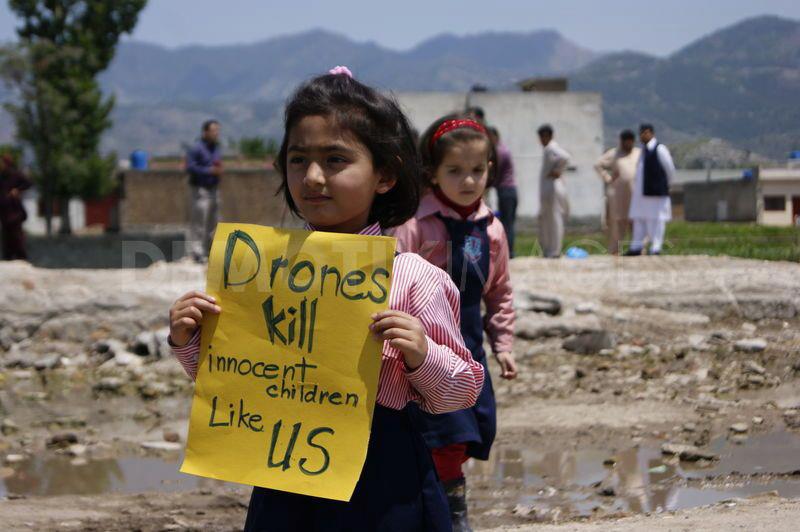
— Daniel Hale, of learning about children killed by indiscriminate US drone attacks he participated in.

“A drone strike was our only chance and already it began lining up to take the shot,” he continued. “But the less advanced predator drone found it difficult to see through clouds and compete against strong headwinds. The single payload MQ-1 failed to connect with its target, instead missing by a few meters. The vehicle, damaged, but still driveable, continued on ahead after narrowly avoiding destruction. Eventually, once the concern of another incoming missile subsided, the driver stopped, got out of the car, and checked himself as though he could not believe he was still alive. Out of the passenger side came a woman wearing an unmistakable burka. As astounding as it was to have just learned there had been a woman, possibly his wife, there with the man we intended to kill moments ago, I did not have the chance to see what happened next before the drone diverted its camera when she began frantically to pull out something from the back of the car.”

He learned a few days later from his commanding officer what next took place. 

“There indeed had been the suspect’s wife with him in the car,” he wrote. “And in the back were their two young daughters, ages 5 and 3 years old. A cadre of Afghan soldiers were sent to investigate where the car had stopped the following day. It was there they found them placed in the dumpster nearby. The eldest was found dead due to unspecified wounds caused by shrapnel that pierced her body. Her younger sister was alive but severely dehydrated. As my commanding officer relayed this information to us, she seemed to express disgust, not for the fact that we had errantly fired on a man and his family, having killed one of his daughters; but for the suspected bomb maker having ordered his wife to dump the bodies of their daughters in the trash, so that the two of them could more quickly escape across the border. Now, whenever I encounter an individual who thinks that drone warfare is justified and reliably keeps America safe, I remember that time and ask myself how could I possibly continue to believe that I am a good person, deserving of my life and the right to pursue happiness.”

“One year later, at a farewell gathering for those of us who would soon be leaving military service, I sat alone, transfixed by the television, while others reminisced together,” he continued. “On television was breaking news of the president giving his first public remarks about the policy surrounding the use of drone technology in warfare. His remarks were made to reassure the public of reports scrutinizing the death of civilians in drone strikes and the targeting of American citizens. The president said that a high standard of ‘near certainty’ needed to be met in order to ensure that no civilians were present. But from what I knew, of the instances where civilians plausibly could have been present, those killed were nearly always designated enemies killed in action unless proven otherwise. Nonetheless, I continued to heed his words as the president went on to explain how a drone could be used to eliminate someone who posed an ‘imminent threat’ to the United States. Using the analogy of taking out a sniper, with his sights set on an unassuming crowd of people, the president likened the use of drones to prevent a would-be terrorist from carrying out his evil plot. But, as I understood it to be, the unassuming crowd had been those who lived in fear and the terror of drones in their skies and the sniper in this scenario had been me. I came to believe that the policy of drone assassination was being used to mislead the public that it keeps us safe, and when I finally left the military, still processing what I’d been a part of, I began to speak out, believing my participation in the drone program to have been deeply wrong.”

Hale threw himself into anti-war activism when he left the military, speaking out about the indiscriminate killing of hundreds, perhaps thousands, of noncombatants, including children in drone strikes. He took part in a peace conference held in Washington, D.C. in November 2013. The Yemeni Fazil bin Ali Jaber spoke at the conference about the drone strike that killed his brother, Salem bin Ali Jaber, and their cousin Waleed. Waleed was a policeman. Salem was an Imam who was an outspoken critic of the armed attacks carried out by radical jihadists.

“One day in August 2012, local members of Al Qaeda traveling through Fazil’s village in a car spotted Salem in the shade, pulled up towards him, and beckoned him to come over and speak to them,” Hale wrote. “Not one to miss an opportunity to evangelize to the youth, Salem proceeded cautiously with Waleed by his side. Fazil and other villagers began looking on from afar. Farther still was an ever present reaper drone looking too.”

“As Fazil recounted what happened next, I felt myself transported back in time to where I had been on that day, 2012,” Hale told the judge. “Unbeknownst to Fazil and those of his village at the time was that they had not been the only watching Salem approach the jihadist in the car. From Afghanistan, I and everyone on duty paused their work to witness the carnage that was about to unfold. At the press of a button from thousands of miles away, two hellfire missiles screeched out of the sky, followed by two more. Showing no signs of remorse, I, and those around me, clapped and cheered triumphantly. In front of a speechless auditorium, Fazil wept.”

A week after the conference Hale was offered a job as a government contractor.  Desperate for money and steady employment, hoping to go to college, he took the job, which paid $ 80,000 a year.  But by then he was disgusted by the drone program.

“For a long time, I was uncomfortable with myself over the thought of taking advantage of my military background to land a cushy desk job,” he wrote. “During that time, I was still processing what I had been through, and I was starting to wonder if I was contributing again to the problem of money and war by accepting to return as a defense contractor. Worse was my growing apprehension that everyone around me was also taking part in a collective delusion and denial that was used to justify our exorbitant salaries, for comparatively easy labor. The thing I feared most at the time was the temptation not to question it.”

“Then it came to be that one day after work I stuck around to socialize with a pair of co-workers whose talented work I had come to greatly admire,” he wrote. “They made me feel welcomed, and I was happy to have earned their approval. But then, to my dismay, our brand-new friendship took an unexpectedly dark turn. They elected that we should take a moment and view together some archived footage of past drone strikes. Such bonding ceremonies around a computer to watch so-called “war porn” had not been new to me. I partook in them all the time while deployed to Afghanistan. But on that day, years after the fact, my new friends gaped and sneered, just as my old one’s had, at the sight of faceless men in the final moments of their lives. I sat by watching too; said nothing and felt my heart breaking into pieces.”

“Your Honor,” Hale wrote to the judge, “the truest truism that I’ve come to understand about the nature of war is that war is trauma. I believe that any person either called-upon or coerced to participate in war against their fellow man is promised to be exposed to some form of trauma. In that way, no soldier blessed to have returned home from war does so uninjured. The crux of PTSD is that it is a moral conundrum that afflicts invisible wounds on the psyche of a person made to burden the weight of experience after surviving a traumatic event. How PTSD manifests depends on the circumstances of the event. So how is the drone operator to process this? The victorious rifleman, unquestioningly remorseful, at least keeps his honor intact by having faced off against his enemy on the battlefield. The determined fighter pilot has the luxury of not having to witness the gruesome aftermath. But what possibly could I have done to cope with the undeniable cruelties that I perpetuated?”

“My conscience, once held at bay, came roaring back to life,” he wrote. “At first, I tried to ignore it. Wishing instead that someone, better placed than I, should come along to take this cup from me. But this too was folly. Left to decide whether to act, I only could do that which I ought to do before God and my own conscience. The answer came to me, that to stop the cycle of violence, I ought to sacrifice my own life and not that of another person. So, I contacted an investigative reporter, with whom I had had an established prior relationship, and told him that I had something the American people needed to know.”

Hale, who has admitted to being suicidal and depressed, said in the letter he, like many veterans, struggles with the crippling effects of post-traumatic stress disorder, aggravated by an impoverished and turbulent childhood.

“Depression is a constant,” he told the judge. “Though stress, particularly stress caused by war, can manifest itself at different times and in different ways. The tell-tale signs of a person afflicted by PTSD and depression can often be outwardly observed and are practically universally recognizable. Hard lines about the face and jaw. Eyes, once bright and wide, now deep-set, and fearful. And an inexplicably sudden loss of interest in things that used to spark joy. These are the noticeable changes in my demeanor marked by those who knew me before and after military service. To say that the period of my life spent serving in the United States Air Force had an impression on me would be an understatement. It is more accurate to say that it irreversibly transformed my identity as an American. Having forever altered the thread of my life’s story, weaved into the fabric of our nation’s history.”

How Breakdown Cascades Into Collapse

By Charles Hugh Smith

Source: Of Two Minds

Maintaining the illusion of confidence, permanence and stability serves the interests of those benefiting from the bubbles and those who prefer the safety of the herd, even as the herd thunders toward the precipice.

The misconception that collapse is an all or nothing phenomenon is common: Either the system rights itself with a bit of money-printing and rah-rah or it collapses into post-industrial ruin and gangs are battling over the last stash of canned beans.

Neither scenario considers the fragility and resilience of the socio-economic system as a whole. It is both far more fragile than the believers in the permanence of the waste is growth model grasp and more resilient than the complete collapse prognosticators grasp.

The recent relatively mild logjams in global supply chains of essentials are mere glimpses of precariously fragile delivery-supply systems. These can be understood as bottlenecks that only insiders see, or as unstable nodes through which all the economy’s connections run. Put another way, the economy’s as a network appears decentralized and robust, but this illusion vanishes when we consider how the entire economy rests on a few unstable nodes.

One such node is the delivery of gasoline and fuels. It’s such an efficient and reliable system that 99.9% of us take it for granted: there will always be plenty of gasoline at every station, the tanks of jet fuel will always be topped off, and so on.

The 0.1% know that this system, once disrupted, would knock over dominoes all through the economy.

Hyper-efficiency and hyper-globalization has reduced the number of producers of essentials to the point that disruptions cannot be overcome with redundant sources. We see this everywhere in the global economy: a handful of plants and companies (sometimes a single source of essential components) process or manufacture essential components in much larger systems.

This is how you end up with thousands of newly manufactured vehicles parked in lots awaiting one critical part that is in short supply.

Another key weakness is the entire system’s reliance on debt, leverage and speculation. Few seem to understand that physical production and delivery systems can grind to a halt for financial reasons–for example, lines of credit being pulled, a counterparty to some arcane commodity swap goes under, taking the presumably solvent corporation down with it, and so on.

The more debt that’s been piled up, the greater the instability of the entire system. Risk always appears low until the system destabilizes, and then all the hedges fail and risk breaks out, flooding through the entire financial system.

Leverage is great fun on the way up, as it magnifies gains. Since the Federal Reserve implicitly guarantees that “buy the dip” will generate massive gains, why not ramp up leverage ten-fold to maximize those Fed-guaranteed gains?

Leverage is less fun on the way down. When the underlying collateral has shrunk to 20% of the leveraged bets being made, a 21% decline in the asset wipes out all the collateral holding up the palace of leveraged debt.

The Fed can print money but it can’t create collateral, nor can it make insolvent entities solvent. All the Fed can do is increase the debt and leverage, which is not the solution, it’s the problem.

Speculation is also inherently unstable, as the euphoric herd, once startled, turns in panic and stampeded in fear. Markets which appeared liquid–i.e., sellers could count on someone buying as many millions of shares as they desired to sell–become illiquid, as buyers vanish like mist in Death Valley. With buyers gone, prices plummet to levels the herd reckoned “impossible” just days before.

The Fed’s entire strategy in the 21st century has been to inflate asset bubbles that generate the illusion of wealth–the so-called wealth effect which is presumed to inspire voracious borrowing and spending.

Unfortunately for the Fed, most of the gains flowed to the top 0.1%, and an economy based on a handful of billionaires buying super-yachts and spaceships is a line of dominoes awaiting the inevitable “accident.” So there are two systemic problems with relying on asset bubbles to generate “wealth”: 1) since 90% of the assets are owned by a thin slice of the populace, bubbles increase destabilizing inequality, and 2) bubbles are intrinsically unstable. So the U.S. economy, dependent on the Fed for the “juice” of monetary stimulus, is now dependent on incredibly unstable bubbles in assets, debt and leverage, bubbles which have generated extremes of wealth/income inequality that are destabilizing the social and political orders.

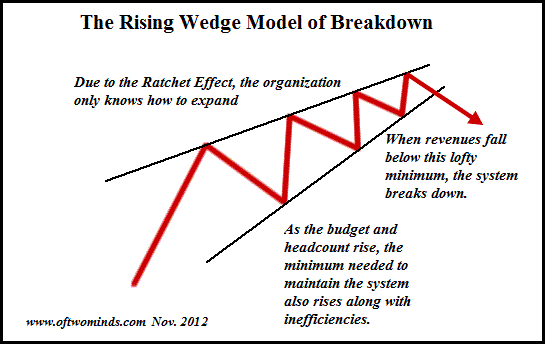
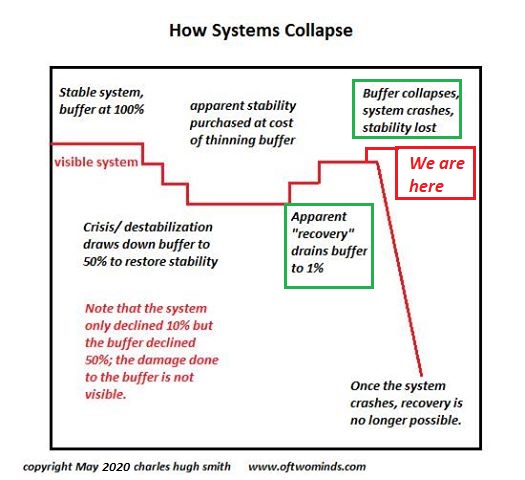
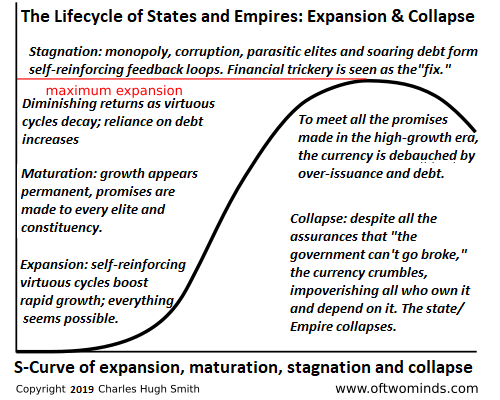
As the three charts below illustrate, the fragility and instability are well hidden until it’s too late: bubbles, debt, leverage, budgets and revenues can only click higher because the system breaks down if there is any sustained decline (the rising wedge model of breakdown). Once the subsystems fail, there’s no putting the eggshell back together.

The second chart depicts how buffers thin beneath the surface, masking the systemic fragility. The loss of redundancy, the decay of maintenance, the loss of experienced workers–all of these are hidden from public view until the system breaks down.

The third chart tracks the S-curve of expansion, confidence, complacency, delusion and collapse followed by human systems, from nations to empires to corporations: as the buffers thin and the rising wedge reaches an apex of vulnerability, the leadership evinces a delusional confidence in the permanence and stability of increasingly fragile, unstable systems.

Maintaining the illusion of confidence, permanence and stability serves the interests of those benefiting from the bubbles and those who prefer the safety of the herd, even as the herd thunders toward the precipice.

This is how breakdowns in apparently stable subsystems triggers the fall of dominoes throughout the larger system, leading to a collapse that was widely viewed as “impossible.” Such is the power of complacency and delusion.

“We’ve Got To Fight Disinformation,” Says Empire Made Entirely Of Disinformation

By Caitlin Johnstone

Source: CaitlinJohnstone.com

The weirdest thing about the Biden administration tasking itself with the censorship of “disinformation” on social media is that the United States is the hub of a globe-spanning empire that is built upon a foundation of disinformation, maintained by disinformation, and facilitated by disinformation.

If the propaganda engine of the US-centralized empire ceased actively deceiving the public about the world, it would collapse immediately. There would be mass unrest at home and abroad, status quo politics would be abandoned, alliances and coalitions would crumble, leaders official and unofficial would be ousted, and US unipolar hegemony would end.

The only thing keeping this from happening is the vast amounts of wealth and energy which are poured into continuously deceiving the people of America and its allies about what’s really going on in their nations and political systems, and in the world as a whole.

Getting people believing they live in separate, sovereign nations which function independently from one another, instead of member states within a single undeclared empire which moves as one unit on the international stage.

Getting people believing they control the fate of their nation via the democratic process, when in reality all large-scale politics are scripted puppet shows controlled by a plutocratic class who owns both the politicians and the media outlets which report on them.

Getting people believing they are part of a virtuous rules-based international order which opposes totalitarian regimes to spread freedom and democracy, instead of a tyrannical empire that works to destroy any nation which disobeys its dictates.

And above all, manufacturing the illusion that the oppressive, exploitative imperialist status quo is normal.

It’s not the big, famous lies like those which preceded the invasion of Iraq that make up the bulk of the adhesive holding the empire together, it’s the small, mundane lies we’re fed every single day by the plutocratic media. The ones which distort our worldview by half-truths, spins and omissions designed to normalize a status quo of murder, theft and ecocide.

This normalization happens in the way pundits and politicians treat any attempt to end wars or redress income inequality as freakish extremism and unrealistic fantasy, when in reality it’s the most sane and normal thing in the world and the only thing unrealistic about it is the fact that attempts to advance those agendas are always sabotaged by those same pundits and politicians.

The normalization also happens in the way endless wars, starvation deaths by US sanctions, the looming threat of total extinction via climate collapse or nuclear war, rapidly exacerbating income inequality and increasing tyranny at home and abroad are not treated as newsworthy stories, while celebrity gossip and partisan bickering between AOC and Marjorie Taylor Greene makes headline news. Every day the news media fail to report on the greatest horrors that the empire has unleashed on our world while focusing on vapid trivialities, they help normalize the horrors.

If the mass media actually existed to share important information about the world, the US-backed genocide in Yemen would be front-page news every day instead of something which gets a marginal mention once every few weeks. Every day it isn’t, this outrageous abuse is normalized.

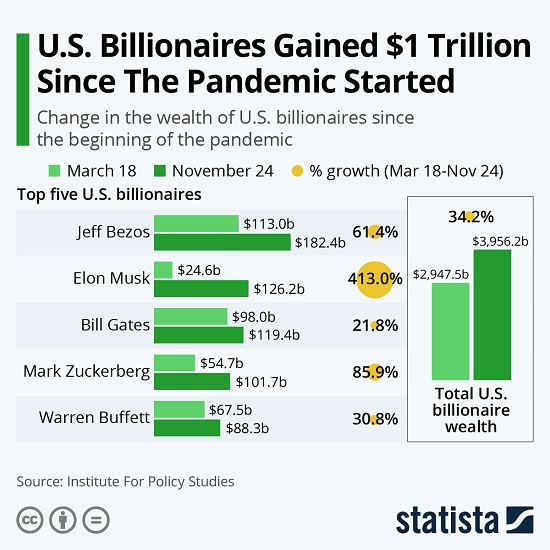
If the mass media actually existed to share important information about the world, the fact that Americans are getting poorer and poorer while billionaires multiply their wealth during the pandemic would be brought front and center to everyone’s attention. Every day it isn’t, this outrageous abuse is normalized.

If the mass media actually existed to share important information about the world, the fact that the US military just spent trillions of dollars on a decades-long occupation of Afghanistan that accomplished nothing besides making horrible people rich would have been a national scandal. Every day it isn’t, this outrageous abuse is normalized.

But the mass media do not exist to share important information about the world. They exist to share important disinformation about the world. If they did not do this, the same US empire which is decrying the spread of disinformation today would collapse into its own footprint.

The US empire is without exception the single most corrupt and destructive force on this planet, and it’s not even close. It is the very last institution on earth that should be in charge of deciding what online content is true and what is “disinformation”. Absolute dead last, without exaggeration.

Depraved institutions which lie constantly and have killed millions and displaced tens of millions just since the turn of this century should not be the Ministry of Truth for the world’s online communication systems. This should be extremely obvious to everyone.

FU@K FEAR! TRANSFORM IT INTO FUEL INSTEAD

By Gary McGee

Source: Waking Times

“We are all ready to be savage in some cause. The difference between a good man and a bad one is the choice of the cause.” ~William James

Fuck fear! Fuck angst! Fuck existential dread! Turn it all into fuel for the fire of life instead. Life is less about getting what you want and more about making the best of what you get. It’s about playing a shitty hand of poker like a boss. So you got dealt fear, angst, ennui, dread, and a sense of meaninglessness? So what? Play the hand! Own it. Double down on it. Bluff the devil and take God for all he’s worth. Turn it all into gold by becoming unfuckwithable.

Unfuckwithable (adj.): When you are truly at peace and in touch with yourself, and nothing anyone says or does bothers you, and no negativity or drama can touch you. ~Urban Dictionary

Transform fear into fuel for fire:

“The difference between a good life and a bad life is how well you walk through the fire.” ~Carl Jung

Rule number one of being unfuckwithable: Fear is fuel for the fire of doing what you love.

Never forget that. It will get you through just about anything. And even if it doesn’t, at least you’ll have the ‘fuck-it bucket of your daring’ to toss all your fucks into.

At least you’ll have what you love. At least you’ll have your passion. Whatever that is. It will be unique to you. It might even be something that nobody else will ever need to know.

As long as what you love to do is valid and in alignment with the universal laws of health, you can’t go wrong. Be savage. Be fierce. Love dangerously. Love as you live—on the edge. Love on purpose, with purpose. Love like you’re not going to live forever. Because you aren’t.With a love this fierce, this bold, this full-frontal boss-mode, fear has no choice but to become fuel for its fire. For—have no illusions—love is fire. Fear is its kindling. Because of this, it is the hottest fire that ever burned. No moth can resist it. No moth can survive it. Only the Phoenix thrives there. Or fire itself.

Be fire itself! No fear, but for the fuel of it. No concern, all burn. This is what fearlessness truly is. Your love is a blaze of glory just waiting to flare up. Let it flare through the sieve of what you fear.

Be brave despite danger or hardship:

“The bravest are surely those who have the clearest vision of what is before them, glory and danger alike, and yet notwithstanding, go out to meet it.” ~Thucydides

Rule number two of being unfuckwithable: Focus on what you can control, let go of what you can’t.

You can’t know the future. You can’t control how things will turn out. You can only control how you react to how things turn out. Even then, it’s not about control. It’s about being adaptable. It’s about being flexible and resilient. It’s about being prepared for the worst, even as you hope for the best. It’s about pulling your fragile past toward your antifragile future.

In that speck of hope is all the courage you’ll ever need. A dash of courage trumps an ocean of doubt. Use that courage like a sword. Or, even better, a scythe. Cut through the storm of the unknown. Shred the shroud of not knowing. Slice and dice the thickness of uncertainty. Not for the goal of invulnerability. No. For the transcendence of absolute vulnerability.

Cut with your soul. Meet the danger in the throes of adventure. Meet the glory in the field. Meet the albatross on the path. Meet the Minotaur in the labyrinth. Cut! To cut means to engage absolutely. To cut is to become the sword. Even if you have no sword. Cut. Cut the obstacle until it becomes the path. And if God Himself should stand in your way, cut that bastard down and become one with all things.

Nip fear in the bud through self-inflicted knowledge:

“Ignorance leads to fear, fear leads to hatred, and hatred leads to violence. This is the equation.” ~Averroes

Rule number three of being unfuckwithable: Stay as close to the edge as you can without going over.

Death is a given. Use it to hone a proper perspective, to sharpen the sword of your courage. This soul-sharpening comes in the form of spiritual circumspection, or existential skepticism. Ignorance will lead to fear and fear will lead to hatred—with paranoia, nihilism, and ennui in between—if you’re not careful.

Stay ahead of the curve by questioning things to the nth degree. Be a razor-sharp question mark in the dark. Just don’t forget to also cut through the blinding light. For blinding light can be just as unhealthy as too much darkness. Be both: a beacon of light that cuts through the darkness and a beacon of darkness that cuts through the blinding light.

Allow uncertainty to become your guide. Just as fear can be transformed into fuel for fire, uncertainty can be transformed into fuel for curiosity. Curiosity is the cure for certainty. It will give you an edge. It will keep you ahead of the game. You’ll be playing James P. Carse’s Infinite Game while everyone else is toppling over themselves in the myopic one-upmanship of the Finite Game.

Most of all, even as it cures certainty, your curiosity will be your guiding light through uncertainty. It’s double-edged. It will help you become resilient despite discomfort. It will help you stretch your comfort zone despite comfort. It will help you become adaptable despite an inhospitable world. It will help you overcome yourself by not getting hung-up on your ego.

Why? Because curiosity is always on the edge. It is always the tip of the spear. It is always foremost. It is utmost, supreme, ahead of itself because it is always on the edge of its seat. It is always cutting, despite the world’s attempts at dulling its mettle.

Use it. Harness its trailblazer essence. Channel its catalyst synergy. Recalibrate the universe with it. Discover the cheat codes hidden in the storm. Do it despite the storm. Do it despite the slings and arrows of vicissitude. Do it despite the worst the tempest can dish out. Do it despite the fear. Do it because of the fear. Do it for the tribe. Then come back and share the magic elixir of being unfuckwithable.

Back to that shitty hand of poker… So you got dealt fear, angst, ennui, dread, and a sense of meaninglessness? Transform the fear into fuel, the angst into hunger, the ennui into curiosity, the dread into humor, and the sense of meaninglessness into meaning. Then go all in.