Censorship Is the Way that Any Dictatorship — and NO Democracy — Functions

By Eric Zuesse

Source: Strategic Culture Foundation

No democracy can survive censorship. If there is censorship, then each individual cannot make his/her own decisions (voting decisions or otherwise) on the basis of truth but only on the basis of whatever passes through the censor’s filter, which is always whatever supports the censoring regime and implants it evermore deeply into the public’s mind — regardless of its actual truthfulness.

The public does have a mind, as a collective constituting the majority of the residents in the given land, which majority rules any democratic government. If the government doesn’t really represent the majority, it’s no democracy, at all, but instead represents other individuals, the real rulers, who might be hidden. Consequently, if a democracy exists but a censor somehow becomes allowed, and emerges into existence in a given land, then democracy will inevitably be snuffed-out there, and dictatorship will inevitably be the result — merely because censorship has been applied there, which blocks some essential truths (truths that the rulers don’t want the public to know) from reaching the public.

Nothing is as toxic to democracy as is censorship. Censorship prevents democracy.

If a dictatorship already exists in a given land, then it does so by means of censorship, because only by that means will the public be willing to pay taxes to the regime and to go to war for it and to kill and die for it. Without censorship, none of that could happen, except in an authentic democracy. An authentic democracy has no censorship.

This is why democracy is so rare. Almost every dictatorship calls itself a ‘democracy’. But a government which calls itself “democratic” isn’t necessarily democratic, but more likely it has simply fooled its public to think that it is one (such as the United States has by now been scientifically proven to be — an actual dictatorship).

Anyone who endorses censorship is a totalitarian, a supporter of totalitarianism, even without recognizing the fact. If the person fails to recognize the fact that censorship is applied only in a totalitarian regime, then that person has bought into the most basic belief of totalitarianism: the idea that censorship can be justified in some circumstances. Dictatorships always pump that lie, so as to be able to continue to exist as a dictatorship. There is no circumstance which ever can justify censorship, unless one believes that dictatorship is, or can be, good instead of bad.

If you think that some censorship is good, then you have bought into the fundamental belief that is promulgated in any dictatorship. It’s a lie, but it fools the majority of people, in a dictatorship.

No writing, nor any other statement, should ever be censored, no matter how vile it is. Indeed, if it is vile, then it needs to be exposed, not hidden; because, if it is hidden, then it will fester until it grows in the dark and finally becomes sprung upon a public who have never been inoculated against it by truth, and therefore the false belief becomes actually seriously dangerous and likely to spread like wildfire, because it had been censored before it became public. The most deadly infections are those that grow in the dark and then become released upon a population who have no pre-existing protection against it.

Every religion, and every evil regime, seeks to censor-out whatever contradicts its propaganda, and is therefore intrinsically hostile toward democracy, but the danger is always being presented not by the writers and speakers of the propaganda, but by its publishers (regardless of media: print, broadcast, or online) — they are the source of all censorship. They are the censors. The people who select what to publish, and what not to publish, are the censors. The regime’s media are what perpetrate censorship, routinely, because those media are actually essential arms of the dictatorship, even if they are not directly owned by the government but instead by the clique who actually possess control over the government because they possess control over the mainstream (and much of the non-mainstream) media and thus the public’s mind in a ‘democracy’ in order to make it the dictatorship that it actually is.

Much has been written about how this censorship has been perpetrated in the post-WW-II (post-26-July-1945) USA., such as here, and here, and here, and here. (All of that has been censored-out from the major media — they don’t report that they represent the regime instead of the public.) As a consequence of that censorship against truth, history is being revised to be ‘history’ so as to portray a false ‘reality’ to people today. And there are numerous other examples of this, by the U.S. regime, each instance, of which lying, is affirmed as being truth by the regime’s agents, but is actually nothing more than vicious lies that are spread by the regime and its agents. What goes on behind the scenes is hidden from the American public, not really in order to protect them, but purely in order to deceive them. The deception of the American people, and of the residents in all of the U.S. Government’s foreign vassal-states (or ‘allies’) in Europe and elsewhere, is extreme, in all fields of international relations. Whereas Julian Assange was the world’s strongest enemy against censorship, he has been almost ten years now under some form or another of imprisonment, including solitary confinement and torture, all without ever having been convicted of anything, and all because he is an enemy against censorship instead of a flak for censorship. And Twitter and other ‘social media’ are hiding from the public — censoring — the sheer outrageousness of it all.

The solution to the problem of lies is not censorship, it is banning censorship. On 7 June 2019, the need for this seemed even clearer to me after Russia’s RT headlined on that date “Glenn Greenwald rips liberals who ‘beg for censorship’”, and that brilliant lawyer and investigative journalist presented powerfully the case against any censorship at all. As one can see from the accompanying video interview there of him, Greenwald was like a force of nature, in that video, or (to use a different metaphor) a huge dose of mental draino for clogged minds.

This also means that issues of libel and slander are only to be addressed in the civil courts, and not, at all, in the government’s prosecutions, the criminal courts.

All censorship needs to be banned. The question therefore becomes: How can this be done? That’s a question I have never seen discussed, perhaps because it is being censored. It’s a very serious question. Any ‘political science’ which exists that has no extensive literature about this question is fake. Perhaps draino for clogged minds is needed especially for scholars.

Things are worse than we know, because censorship exists. Maybe censorship is pervasive.

So: I shall venture a solution to this problem: By law, all media which discuss national and/or international affairs will fire all editors and producers of “news,” but not the employees who have only managerial, presentational, and/or stylistic assignments, and replace these people (all personnel who select what to present and what not to present) by a randomized algorithm being applied to each topic, so that, if, for example, something is entered into a search-box, then the order or presentation of the findings will be listed either (at the user’s selection) from earliest-posted to latest-posted, or latest-posted to earliest-posted, but not by anything that is chosen or determined by the search-engine itself. (In other words: no search-engine will be allowed to censor.) On print or broadcast media, every news-piece will be controlled in real time by its audience so as to determine what the questions are and then to bring into the presentation randomly selected scientifically qualified experts regarding each such question. For example: on the question of climate-change, the experts would be individuals who have terminal graduate-level degrees in each of the related climatology sub-specialties, such as those listed at Wikipedia, but also in essential related fields such as economics (an important climatological sub-specialty that’s not listed there). If, indeed, over 90% of climatologists agree that man-made global warming is a reality, then the result of this method of selecting the “experts” who will be presented is that that viewpoint will be represented by over 90% of the experts — and this outcome would not be controlled by the given ‘news’-medium, nor affected by its advertisers. In other words: only the subject-matter and academic qualifications — no governmental positions or background — would qualify individuals as being “experts” on the given topic. If a terminal degree isn’t a qualification for expertise on a topic, then what is? Aren’t government officials supposed to be relying on them? And if, for example, the topic is Syria, then shouldn’t all individuals who have terminal degrees on Syria be the “experts” who are invited, on a randomized basis, to comment to the public about Syria-related issues? If that were the case, then perhaps many Americans would know that the U.S. and NATO “began operations in April- May 2011 to organize and expand the dissident base in Syria,” “organizing defectors in Syria,” and “smuggle U.S. weapons into Syria, participate in U.S. psychological and information warfare inside Syria” to produce regime-change there, and that Syria had never posed any threat to U.S. national security. And Barack Obama was hoping for such opportunities to overthrow Syria’s Government even when he became President in 2009. If the American public didn’t know those things at the time, then perhaps America’s censorship was total — which would indicate how absolutely crucial a randomization of the public’s information-sources is, so as to replace the power that the existing mainstrean ‘news’-media have over the public’s mind, in America, and in its vassal-nations (which don’t yet include Syria). If the public do not have unprejudiced — which means entirely uncensored — information presented routinely to them, then democracy isn’t even possible.

Anyway: that is one proposed way of replacing censorship, and overcoming dictatorship. How many politicians are proposing such changes? Why aren’t any? Are all of them afraid of the dictators? Is there no basis for hope, at all?

Omens, Portents, Karma and the Mandate of Heaven

By Charles Hugh Smith

Source: Of Two Minds

The question of legitimacy isn’t limited to China.

what makes humans unique among social mammals? Some say humor, I would nominate superstition: regardless of how hard we promote our rationality and logic, humanity continues to sense portents and omens in events and feel the intangible tug of karma: the consequences of past actions that we arrogantly thought we’d escaped forever.

Michael Snyder recently compiled a list of peculiarities that are raising eyebrows around the globe: One, sure, two, not that unusual, three, well things happen in threes, but ten disturbances and we’re only six weeks into 2020? 10 ‘Plagues’ That Are Hitting Our Planet Simultaneously (Zero Hedge)

As the saying has it, Nature Bats Last, and maybe arrogant, destructive humanity’s war on Nature is about to get its comeuppance. Maybe overdosing hundreds of millions of chickens and pigs to knock down bacteria in overcrowded conditions has finally generated a karmic blowback via bird and swine viruses.

As for karma in human society: maybe the disruption of the supply chain in China is a karmic response to offshoring production to fatten Corporate America’s profits at the expense of all else in America’s society and economy.

Then there’s the celestial right to rule, a.k.a. The Mandate of Heaven, the concept rooted in Chinese culture that political leadership which fails the people invites divine retribution in the form of withdrawing the support of Heaven. This withdrawal of support manifests in the tangible world as natural disasters: earthquakes, floods, droughts, plagues, etc.

Though it’s not politically correct to discuss The Mandate of Heaven in any serious way, the reading of omens goes back in Chinese history to oracle bones, the process of heating bones until they crack and then interpreting the patterns as portents to the future.

With human and domestic animal epidemics devastating China in a novel cluster of natural disasters, The Mandate of Heaven is in play even if no one dares speak of it openly. The regime is well aware that these parallel plagues are understood as manifestations that question the legitimacy of the current regime.

The question of legitimacy isn’t limited to China. Soaring wealth inequality, the dependence on debt to fund “growth” and the political disenfranchisement of the masses are global manifestations of political-financial systems that invite divine retribution for their excesses of corruption, self-aggrandizement, and exploitation of the planet and its human workforce.

Will Censorship Prevail over the First Amendment?

By Paul Craig Roberts

Source: PaulCraigRoberts.org

I remember when censorship in America was a limited phemonenon.  It applied during war time—“loose lips sink ships.”  It applied to pornography.  It applied to curse words on the public airwaves and in movies.  It applied to violence in movies.  There could be violence, but not the level that has become common.

Today censorship is ubiquitous.  It is everywhere.  In the United States censorship is both imposed from above and flows from the bottom up.  Censorship is imposed from above by, for example, TV and print media, Google, Facebook, Twitter, and by laws in 28 states prohibiting criticism and participation in boycotts of Israel and by President Trump’s executive order preventing federal funding of educational institutions that permit criticisms of Israel. Censorship flows from the bottom up by, for example, people of protected races, genders, and sexual preference claiming to be offended. 

The ubiquitous censorship that today is characteristic of the United States has shut down comedians. It has shut down criticism of non-whites, homosexuals, transgendered, feminists, and Israel. Official explanations are shielded by labeling skeptics “conspiracy theorists.”  The ubiquitous censorship in the United States is an extraordinary development as the US Constitution guarantees freedom of expression and a free press.

We owe journalist Abby Martin appreciation for reminding us of our right to free speech.  Abby is suing the state of Georgia, one of 28 states that have violated the Constitutional protection of free speech.

Abby was scheduleded to give the keynote speech at a conference at Georgia Southern Univeristy.  She discovered that in order to speak publicly at a Georgia college she had to sign a pledge of allegience not to criticize Israel.  Her refusal to sign resulted in the conference being cancelled.

Here we have the state of Georgia blocking free speech because it will not support the Israeli position on Palestine. See: https://www.lewrockwell.com/2020/02/no_author/journalist-abby-martin-sues-state-of-georgia-over-law-requiring-pledge-of-allegiance-to-israel/ .  Also:  https://www.timesofisrael.com/filmmaker-who-wouldnt-sign-georgias-oath-not-to-boycott-israel-sues-us-state/ 

Think about this for a moment. More than half of the 50 states that comprise the United States have passed laws that are clear violations of the US Constitution.  Moreover, these 28 states have imposed censorship in behalf of a foreign country.  Americans have gags stuck in their mouths because 28 state governments put the interest of Israel higher than the First Amendment of the US Constitution. When government itself is opposed to free speech, what becomes of democracy and accountable government?

Why would 28 states legislate against the US Constitution?  One explanation is that the state governments were bought by the Israel Lobby with money under the table, by promises of political campaign donations, or by threats of financing rival candidates.  How else do we explain 28 state governments imposing censorship in behalf of a foreign country?

Abby Martin is one person who will not stand for it.  She has brought a lawsuit that—if the US Supreme Court is still a protector of the First Amendment—will result in the 28 state laws and Trump’s executive order being overturned.  The protection of Israel against boycotts parallels state laws passed in the 1950s that prevented Martin Luther King’s movement from boycotting businesses that practiced racial segregation. These laws were overturned by the Supreme Court.

The outcome of Abby Martin’s suit will tell us whether the US Constitution is still a living document.

Financial Feudalism

By Michael Krieger

Source: Liberty Blitzkrieg

“Happy 18th Birthday! Meet your new Daddy,” read one website advertisement. “Do you have strong oral skills? We’ve got a job for you!” cooed another.

A message on another billboard directed at the “daddies” was more blunt: “The alternative to escorts. Desperate women will do anything”…

SeekingArrangement was founded by Las Vegas tech tycoon Brandon Wade. Wade is apparently worth somewhere in the neighborhood of $40 million. His motto is, “Love is a concept invented by poor people”…

SA also markets itself as an antidote to student debt. In the U.S. and elsewhere, college students are enduring financial instability and hardship. Because of rising college fees and rent, and the lack of time available for work during studies, many women are extremely vulnerable to exploitation. “SeekingArrangement.com has helped facilitate hundreds of thousands, if not millions, of arrangements that have helped students graduate debt-free,” Wade boasts on the website. Promotional videos show young, beautiful women enrolled in “Sugar Baby University” — in classrooms, holding wads of cash, driving luxury cars, and discussing the pleasure and ease of being a sugar baby.

When signing up for an account, potential sugar babies are told, “Tip: Using a .edu email address earns you a free upgrade!”

TruthDig: Sugar-Coated Pimping

Watching politics unfold in the post-financial crisis era has been extraordinarily frustrating. While it’s been refreshing to observe the emergence of grassroots populism over the last few years, there’s a problematic lack of depth and clarity embedded in these burgeoning mass movements. Tens if not hundreds of millions of Americans now acknowledge that something’s deeply broken within the current paradigm, but we remain focused on identifying symptoms as opposed to understanding and rectifying the systemic nature of the problem.

Of course, there are numerous complexities when it comes to the administration of an imperial oligarchy, and our system didn’t emerge overnight. Perhaps the most fundamental mutation of the post WW2 era came in 1971 when the international convertibility of U.S. dollars into gold was severed. This is when the country began its long transformation from a largely industrial empire to a financial one. I’ve often highlighted how the purely fiat USD reserve currency is the most powerful weapon ever invented, and how the U.S. control of the global financial system is the true backbone of empire, but it’s equally important to understand how the predatory financial system is also used to subjugate Americans in their own country.

In order to understand how this works we need to dig into the most fundamentally important four letter word in any modern economy: Debt.

When most people consider the debilitating societal effects of excessive debt they tend to see it from one basic level. How the bottom half of the population essentially has no choice but to borrow in order to participate in the economy as constructed. This is because the cost of so many things has been inflated way beyond the capacity of most people to purchase them outright. Specifically, wage growth has failed to keep up with the soaring costs of fundamental things such as shelter, healthcare and higher education.

For instance, home prices have been rising faster than wages in 80% of U.S. markets, which means the higher cost tends to offset historically low mortgage rates. Low interest rates don’t really help such people, it just lets them maybe, barely purchase an intentionally inflated asset to live in by taking on a huge chunk of debt. An asset that could quickly become completely unaffordable should the economy turn down as it did a decade ago.

As such, you have multitudes taking on debt defensively just to keep going and avoid falling further down the socioeconomic scale. Debt doesn’t empower such people, rather, it turns them into modern day indentured servants endlessly stuck on a hamster wheel with little to no hope of getting off. This is not an accident, it’s a tried and tested tool which, when combined with incessant mass media propaganda, is an effective way of creating a submissive, confused and desperate underclass.

Many people understand this by now, but what’s far less understood, yet potentially more significant, is how the wealthy use debt.

When you own your primary home outright and you’ve got enough savings that healthcare premiums and paying for your kids college in cash doesn’t make a dent, debt becomes something else entirely. Debt’s no longer an albatross around your neck, instead it becomes a tool to increase wealth. Debt becomes leverage.

Much of the explosion in wealth inequality over the past several decades can be traced back to this systemic interclass weaponization of debt. If you’re very wealthy and connected, access to extremely cheap debt is virtually unlimited, and this access is used to make leveraged bets on all sorts of stuff, but primarily real estate and financial assets such as stocks and bonds. Hasn’t this always been the case you ask? Aren’t those with capital always extremely advantaged over those without it? Isn’t that the history of capitalism and America since the beginning? My answer would be yes and no.

The main difference between prior periods of history and, let’s say the 21st century, has been the vast increase in power of the financial services sector thanks to the Federal Reserve’s willingness to encourage and enable the insatiable reckless behavior of the speculator class. It’s no secret the Fed has been intentionally boosting assets across the FIRE sector such as real estate, stocks and bonds since the crisis. Those with the capital to ride the coattails of this irresponsible and undemocratic central planning rushed out to take on debt to buy these assets, thus multiplying the return on investment.

While the white-collar cubicle worker with enough extra income to diligently add to their retirement account over the past decade has done fine, bankers or hedge fund managers who took on massive leverage to amplify such bets made generational fortunes while creating nothing of value. It’s the way debt works for the financial services sector versus how it works for the average person in a world dominated by big finance and the central bankers who provide them unlimited welfare.

The same thing occurs within the corporate suite, as executives across industries have used access to extremely cheap debt to buyback stock and reward themselves handsomely despite creating nothing of societal value while doing so. It’s pure financial engineering. Nobody should become generationally wealthy this way, but it’s exactly what’s been happening. So you see, debt’s not just a means to subjugate a desperate bottom half of the population, it’s concurrently an effective tool to expand wealth and power at the top. 

Then there’s this.

When was the last time the bond market paid you to make an acquisition? As Max Keiser so eloquently puts it, this is interest rate apartheid.

But it’s even more pernicious than that. It’s still possible for regular wealthy people to take on too much leverage, make a mistake, and lose their fortunes — unless of course you’re an executive at major financial services firm. In that case you simply can’t lose, which was the primary lesson learned from the response to the financial crisis.

Not only were the titans of this industry not jailed, they walked away with their fortunes intact. The Federal Reserve and the U.S. government made this happen. It wasn’t an accident and it wasn’t to “save the economy;” that’s just nonsense talk for the confused masses. The entire point was to consolidate and further entrench the unaccountable power of those at the very top of the finance feudalism paradigm and signal they’ll also be bailed out for any future catastrophe they create.

Significantly, financial feudalism isn’t just interclass, it’s also intergenerational. The stock market and real estate crash of a decade ago was the market’s attempt to reset those assets more in line with median incomes, but central banks would have none of that. They determined asset prices needed to be re-inflated as much as possible as fast as possible, and these unelected banker stooges went about implementing this major policy decision of central economic planning with zero public debate. Young people entering the workforce had no savings and poor wage growth, so a generation was quickly priced out of homeownership while simultaneously stuck with an enormous pile of student debt. The results of all this are unsurprising.

The crisis facing this country is simmering and metastasizing under the surface of misleading aggregate economic data and record stock markets. While it’s tempting to focus on the symptoms, we’ll never confront and tackle any of this properly unless we understand the structure and how the game is really played. The system you’re living in isn’t capitalism or socialism, it’s financial feudalism. 

The Power of Vulnerability

By Milan Karmeli

Source: Collective Evolution

Vulnerability is about being honest, and this includes embracing our dark side. No matter whether we find ourselves on the conservative spectrum or liberal, we often abuse morals and ideals in order to avoid our own shadow. In this turbulent ‘Trump era,’  where values fly high for all sides, vulnerability could become the currency that returns our sanity. My intention here is not political, but recent events coinciding with personal ones have created some urgency around the issue.

In the name of righteousness and higher ideals — personal, social, or political — we often establish a perimeter of comforting beliefs around us. This way we don’t need to face our own fear and insecurity. Instead of taking responsibility for our insufficiencies, we respond with judgment and morality. Fearing to face our simplicity and delicate humanity, we try proving our sophistication through how good, spiritual, or moral we are. Survival at any cost justifies the means to an end, but is basic survival what we really want?

If you’re interested in understanding how comfortable you are with your own vulnerability, take a moment to sense how you respond to abandonment, rejection, judgment, or betrayal. 

Vulnerability Wasn’t Top Priority Growing Up

For most of us, childhood experiences left lasting imprints. When we got out of line, according to the values and needs of others, judgment or ridicule often followed. It became unsafe to express feelings and fears. Almost as a natural consequence, we began pretending that we don’t need anything and can do it ourselves. Hiding our true needs became the best strategy and we embarked on a journey of manipulating our way through life. To say the least, we became creative in coming up with ways to keep our true needs hidden — even from ourselves. 

We learned to trust that suffering shown through sadness, crying, or pain point to or represent our vulnerability, though even these seemingly obvious markers may not really be signs of such at all. Often they are more representative of (un)conscious of manipulation of our partners. It’s safer to express needs through suffering. Not from bad intentions, but because it’s not as exposing.

What we call a ‘need’ easily turns into ‘demand.’ And what we often call ‘vulnerability’ becomes our personal way of blackmail and punishment. Even waiting silently and lonely for a response after an argument can ‘look and feel’ vulnerable. However, deep down hides a righteous expectation to be seen or heard. If we look close, we can discover pain buried beneath.

Practicing Vulnerability With Those Close to Us Makes Us More Human

When we’re truly vulnerable, we don’t use morality as a weapon in judging who’s right or wrong. What we do is recognize and acknowledge our feelings, fears, and needs. We do not generalize or base our arguments on past events, but respond to the feelings stirred through a specific event. We take off our masks and become available to ourselves and others. In many ways, we actually choose to become choice-less.

Betrayal, sacrifice, and other patterns that result in disappointment become central themes in our close relationships, but this is mainly because we enter those connections protected and guarded in the first place. Sacrifice, for example, is a tricky form of manipulation. We feel pain and righteousness at the same time. Sacrifice always leaves us with anger in our belly and the sense of missed opportunities.

I remember the deep pain I felt when my partner rejected my attempts to ‘help’ her time and time again. My response was to shut down and give her the silent treatment, while at times also throwing some moral judgment her way, such as “I give you everything I have, and what about you?”. But was I open when I gave so much, or rather feeling morally superior by loving ‘more’? I placed myself in an untouchable place and at the same time lost my vulnerability.

In relationships with those close to us we have a rare opportunity to exit the spiral of survival that gives us the illusion of staying on top of our game. That place which makes us believe we’re protected by high ideals, values, and other virtues — and sometimes also by self-judgment that we’re evil beyond repair. 

Search for truth is a delicate process and doesn’t follow any defined path other than facing the complexity of our human existence as honestly, responsibly, and sincerely as we can. So long as we choose our personal safety and false importance, we prevent the power of vulnerability to guide us back to our hearts.

Vulnerability Can Be One of Our Greatest Teachers

There’s a big difference between saying and feeling things, and so a sentence like “I don’t need anything and can do it alone” can easily slip off our tongue. Nevertheless, the pain of loneliness and abandonment remains. There is no doubt that we can and could do many things by ourselves, like raising children, being without close friends, a lover, touch, recognition and the list goes on. 

But what we really want is to learn to express our fears, and needs. Our demand for acknowledgment, the requirement to have our needs satisfied, or maintaining moral high ground, all leave us in a state of fight, in which receiving becomes impossible. Vulnerability forms the basis for our receptivity.

In expressing true vulnerability we hold the ground for our feelings and needs. We sense it as a state of integrity in which we accept the totality and complexity of our human imperfection. It’s a place of power, in which we accept that we need and thereby acknowledge our dependency on each other. It’s empowering when we connect with our humility and simplicity.

Where to begin being vulnerable?

Vulnerability is best expressed in the “I” form. We take responsibility for our own state of mind and feelings, and don’t hold our partners prisoners to our moral standards and ideals. We don’t use sacrifice, guilt, shame, or judgment to drive our point across.

It’s challenging, since it leaves us with little or no protection other than the acceptance of who we are. The “I” form takes the guessing game out of the relationship, where we expect our partners to ‘know’ what we fear, feel, or need. 

This way those close to us can decide to satisfy our needs or not. Everything else turns into an expectations game in which there are no winners, and this triggers resistance. They feel manipulated. And for us, vulnerability holds the key to accepting more parts in ourselves, which forms the basis of coming out of hiding and denial, and into our light.

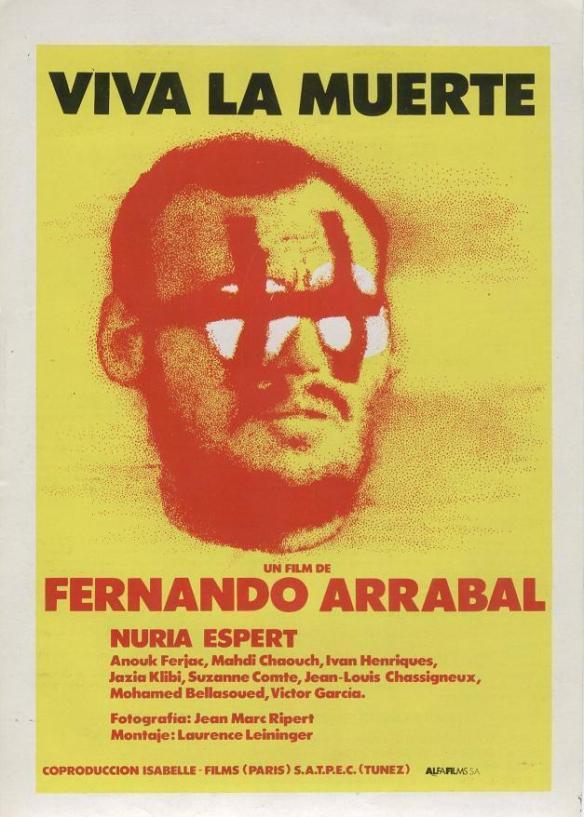
Saturday Matinee: Viva la Muerte

“Viva la Muerte” (1971) is a French-Tunisian drama film shot in Tunisia and directed by Fernando Arrabal, one of the founders of the Panic Movement (with Alejandro Jodorowsky and Roland Topor). The film takes place at the end of the Spanish Civil War, telling the story of Fando, a young boy whose father was turned in to authorities as a suspected communist by his fascist-sympathizing mother. It has gained cult popularity as a midnight movie. The opening credits sequence features drawings by acclaimed artist, actor and novelist Roland Topor.

Watch the full film on Kanopy here.

Bloomberg Was Stopped, Frisked and Bruised at Debate

Democratic Debate February 19, 2020 (Left to Right: Michael Bloomberg, Senator Elizabeth Warren, Senator Bernie Sanders, former Vice President Joe Biden, Pete Buttigieg, Senator Amy Klobuchar.)

By Pam Martens and Russ Martens

Source: Wall Street on Parade

Michael Bloomberg reaffirmed for those who have turned off the news since January 20, 2017 that no one, not even his own mock debate team, dares to tell a powerful billionaire what he doesn’t want to hear. And that’s one of the key reasons that billionaires are so dangerous to high public office – they hear only their own voice.

Bloomberg’s performance on the Democratic Debate stage last night was painfully embarrassing. It was like watching an overly-hyped downhill skier, in his first appearance at the U.S. Olympics, trip on his skies getting off the chair lift and slide down the mountain on his belly – making a few awkward groans on the way down.

Voters across the country who had been inundated with Bloomberg’s $409 million in advertisements (ten times what Senator Bernie Sanders has spent) were likely shaking their heads in amazement that such an amateur had made it onto the debate stage with three U.S. Senators and a former Vice President.

To give you a broader assessment of just how lacking in charisma and oratory skills the former Mayor of New York City was last night, Politico Magazine asked 14 political experts for their views on the debate. This is a sampling of what they had to say about Bloomberg:

Alan Schroeder, Professor, School of Journalism at Northeastern University in Boston: “In his ubiquitous TV ads, Bloomberg depicts himself as an Obama-like progressive with the passion and know-how to set the country on a correction course. But in his first debate, Bloomberg came off as something quite different: a bland, clueless billionaire with feet of clay. Despite extensive preparation, Bloomberg was totally unready for the rough-and-tumble of a presidential primary debate, unready even for issues he must certainly have known would come up. Democratic voters hoping that Bloomberg might swoop in and grab the nomination on the basis of charisma and superior performance skills instead ended up with one more name to cross off their list.”

Michelle Bernard, political analyst, lawyer, author, president and CEO of the Bernard Center for Women, Politics & Public Policy: “After 10 weeks of hype, millions of dollars spent on ads, endorsements from highly respected members of the African American community and a double-digit surge in the polls, we learned that Bloomberg does not deserve any of the African American support he has received to date. From stop and frisk to overt and unapologetic sexism, the former mayor appears to be nothing more than Trump bathed in blue.”

Larry J. Sabato, founder and Director of the University of Virginia’s Center for Politics and contributing editor at Politico Magazine. “Bloomberg was the foremost loser. To be blunt, he was terrible. It’s been about a dozen years since his last debate, so I didn’t suppose he’d shine. But I never expected him to look timid and act nervous….”

John Neffinger, speaker coach, lecturer on political communication at Georgetown University and Columbia Business School, and former communications director of the Democratic National Committee: “Bloomberg, who had a case to make but was not prepared to take incoming fire, didn’t make a strong case for his progressive credentials and showed no charisma or spark—suggesting that it might be a dreary four years with him on our screens and radios every day.”

Jennifer Lawless, Professor of Politics at the University of Virginia: “To say that Bloomberg underperformed is to understate how poor the former mayor’s performance really was. He was disengaged, ill-prepared to respond to questions he was sure to be asked—from allegations of sexism to racism to classism—and seemingly unaware that he needed to convince Democrats that he could defeat Trump. He exhibited neither the fiery energy embodied in his recent tweets nor the acumen of a politician who needs to seal a deal.”

Read the full analysis at Politico here.

The worst moment of the night for Bloomberg came from Senator Elizabeth Warren who stunned the audience with this:

“I’d like to talk about who we’re running against: a billionaire who calls women ‘fat broads’ and ‘horse-faced lesbians.’ And, no, I’m not talking about Donald Trump. I’m talking about Mayor Bloomberg. Democrats are not going to win if we have a nominee who has a history of hiding his tax returns, of harassing women and of supporting racist policies like redlining and stop and frisk. Look, I’ll support whoever the Democratic nominee is, but understand this, Democrats take a huge risk if we just substitute one arrogant billionaire for another. This country has worked for the rich for a long time and left everyone else in the dirt. It is time to have a President who will be on the side of working families and be willing to get out there and fight for them. That is why I am in this race and that is how I will beat Donald Trump.”

Bloomberg has, without exaggeration, been attempting to buy his seat in the Oval Office by funding his own campaign out of his $61.5 billion net worth – the bulk of which came from leasing data terminals to Wall Street banks’ trading floors around the globe. (Curiously, the chat rooms on those Bloomberg terminals were the venue of choice for Wall Street traders engaged in rigging markets.) On Monday we reported on the questionable ways that Bloomberg is using his cash to tip the scales in his favor. (See Bloomberg Has Built a Star Wars Machine to Try to Steal the Democratic Nomination.) On Wednesday, the Wall Street Journal reported that Bloomberg was paying hundreds of social-media influencers $2500 per month to “post regularly on their personal social-media accounts in support of the candidate and send text messages to their friends about him.”

After last’s night performance, it has become quite clear why Bloomberg needs to pay people to “like” him and call him cool.