The Fed Has Loaned $1.2 Billion from its TALF Bailout Program to a Tiny Company with Four Employees

By Pam Martens and Russ Martens

Source: Wall Street on Parade

Every Wall Street bailout program that the Fed has created since September 17 of last year has, according to the Fed, been ostensibly created to somehow help the average American.

According to the Fed’s Term Sheet for the Term Asset-Backed Securities Loan Facility (TALF), it’s going to “help meet the credit needs of consumers and businesses by facilitating the issuance of asset-backed securities.” Not to put too fine a point on it, but asset-backed securities and related derivatives are what blew up Wall Street in 2008, creating the worst economic downturn, at that point, since the Great Depression.

According to the Fed’s most recent H.4.1 filing, it has loaned a total $11.1 billion from TALF. Eleven percent of that money, $1.2 billion, went to a company that has 4 employees (outside of clerical workers) according to its filing with the SEC.

Read the rest of the article.

One real but ‘polemic’ way to defeat COVID-19

By Andre Vltchek (1962-9/22/2020)

Source: New Eastern Outlook

COVID-19 is not just a disease; it is also a state of mind, a psychosis, a fear. It is an event that, all over the world, unleashed irrational behaviour by the governments, individuals, and media. It triggered speculations, bizarre analyses, and selective ‘cut-and-paste science.’

Result: while there are, undeniably, few optimistic success stories, including the Russian vaccine, China’s and Vietnam’s ability to contain the pandemic without ruining economy and livelihood of the citizens, the great majority of the world is undoubtfully in disarray. Hundreds of millions of people are literally tossed into a gutter. Other billions, all over Asia, Latin America, the Middle East, Africa, and to some extent, the United States and the UK are locked in, unable to travel abroad, and unwilling to accept visitors from other countries.

All this is pure insanity. Families are divided, broken apart. People are locked out of their homes in other countries. Lovers are told they cannot see each other, perhaps for years.

Extreme right-wing governments that are ripe to fall, like those in Thailand or Chile, are hiding behind the COVID-19, not allowing anyone to enter and face their downfall.

International life patterns of billions of people are ruined which leads to suicides, deep depressions, violence, as well as COVID-19 unrelated but lockdowns-related health issues.

In brief: The world is screwed! Most likely, billions of human lives are.

Apart from my work in several parts of the United States after the murder of George Floyd, and then in Aruba, from where the NATO is threatening Venezuela, I spent almost five months in a brutal lockdown in Chile. Truly brutal, because I arrived there after covering several conflict zones in Asia, with the COVID-19 at my heels. One airport after another was closing behind me, after my departure. A journey took eight days: Hong Kong to Bangkok, then Seoul, Amsterdam, Suriname, Brazilian Belem, Brasilia, Rio de Janeiro, Lima, and finally, Santiago.

At the conflict zones, including when I was filming in devastated Borneo, my guts and eyes got attacked by some vicious parasites (or was it COVID-19, after all?), and something happened to my feet; I could hardly walk. Well, once in a while, I have this tendency to run myself to the ground, after the excessive doses of Afghanistan, Syria, Indonesia, Iraq, DR Congo, Kashmir, Gaza… I never stop until it is too late, or more precisely, until I fall on my face.

But then, after I do, after I find myself flattened on the ground, I know precisely what to do. Which is: a few months of rest, rigorous exercises, foot massages, sea, diet, sun. Until I can move again, and return to performing duties, I have towards humanity.

But this time it was different. With a single digit of popularity, Chilean Pinochet-style regime utilised COVID-19 in order to stay in power, to crack on the opposition and to rob indigenous people of that little they still had left. Result: bizarre, total lockdowns with tanks on the streets, with the meaningless curfews, with even a small park at the back of my building out of reach to the tenants.

My only ‘walks’ were inside the apartment. I needed to get to my place in Bangkok; small, but with a gym and pool and with a garden. But Thailand’s rulers made sure to keep the foreigners out, too. Clearly, for political reasons.

And so, I was forced to spend the longest time in my life in one place. The longest since I was 15 years old if I remember correctly.

And instead of improving, my health deteriorated in that monstrous lockdown, where I was facing bare, depressing winter Andes, and the 160-average pollution levels (US AQI). When I was finally departing, I could hardly walk and had to use a cane.


***

I RAN away on one of the first re-introduced non-stop Iberia flights to Madrid. I was lucky that I could, as one of my passports was that of the EU.

It had to be Madrid or Italy. I would also happily run to Russia, but in August, it was still closed.

When I was very young, I used to escape to Madrid, in order to be as far away as possible from New York. I despised my life in the United States. I couldn’t write there. In Italy and Madrid, I could easily. For months I would be saving, and then disappear from the United States, for 5–6 weeks. My plan was to travel all over Spain, but Madrid was so absorbing, so fascinating that in the end, I lost all my desire to leave it. Cafes on Plaza de Olavide were where I used to write my fiction.

And now, beaten, hardly able to move, I returned. Before my interviews in Turkey and Serbia, and before at least some parts of Asia would be re-opening, Madrid became my logical destination.


***

I ANTICIPATED what would be waiting for me here. And all of my expectations came through.

In Madrid, life didn’t stop. It slowed down, to some extent, yes. Some visible and invisible barriers were erected. Many precautions have been taken. But there was no ‘full stop.’ Unlike in New York and Santiago, colours were everywhere, and so were beauty, elegance, and harsh Castellan sense of humour.

First of all, Madrid was clearly demonstrating that life is much stronger then death, but only if life is pitched against death, and lived with unwavering strength and passion.

In Prado Museum, I rediscovered one of the greatest and most frightening artworks of all times: Pieter Bruegel’s the Elder: ‘The Triumph of Death.’ I searched for it, and I found it in one of the main halls.

Here, in this surreal, powerful, and highly perverse artwork, it was depicted all. Yes, Death is frightening. Yes, it has tremendous strength, and it has its own ‘army of skeletons.’ And yes, in the end, it always wins.

But you look out, through the windows of Prado, and you see the ancient, green, and beautiful trees, you see the splendid architecture, and lovers holding hands. Death may have the last word for all human beings, but life goes on, too. It never gets defeated, and it never surrenders. There is time to live and time to die.

Bruegel, who painted his macabre masterpiece c. 1562, wanted us to live in constant fear of death.

Today’s Madrid, with its passion, wants us to forget about death, at least for that short but brilliant moment, which is called life.

This new and hopefully short-lived era of COVID-19 terror is throwing us, human beings, back to the middle ages, where continuous anxieties and images of horrors were masterfully manufactured, even mass-produced, in order to poison our existence and strip us of dreams, of power, and joy.

Throughout the middle ages, at least in Europe, suffering and fear were habitually glorified. Joy and desires were suppressed, often chastised.

In the middle ages, Christianity reached perfection in scaring humans to death, in stripping life of almost all delights, and in administering brutal, grotesque punishments. And this is when the Muslim armies arrived, liberating a large part of Spain from the religious fundamentalism. Glorious caliphate of Cordoba was erected, synonymous with the golden age of Islam; caliphate admired for knowledge, poetry, playfulness, the quest for freedom and beauty.

There, Muslims, Christians, and Jews lived together; they freely mingled together, building one mighty, tolerant, and creative society. It was a society without fear, society full of hope.

Caliphate of Cordoba also defeated death, at least from one’s birth till demise. Great Pakistani thinker, Tariq Ali, wrote beautifully about that era, many years before COVID-19 appeared on the horizon.

I took Talgo, high-speed train, to Cordoba. I had to revisit the old mosque, where the fight for tolerance began. All this was now relevant. It was not just the medicine, not just the science, which had to be mobilised.

The battle against COVID-19 has to be also fought by thinkers, by artists, by all those who can make life meaningful, or at least bearable.


***

SPAIN and its capital Madrid can easily ‘go either way.’ The city can be oppressive and harsh when it goes through the ‘bad wave.’ It can ruin millions of lives, as it did when it embarked on the horrid colonialist expeditions, religious fundamentalism, or fascist dictatorship.

But Madrid can also be highly enlightened, creative, and forward-looking. It can be light and reasonable, embracing life.

In the age of COVID-19, Madrid decisively refused to lock up millions of people in the proverbial cages. Few weeks of confusion and enough! The government tried, half-heartedly, but failed to impose full oppressive order.

By the middle of August 2020, the number of Covid-19 cases was higher in Spain, then in many other EU countries. Madrid made it to the ‘red list’ in such countries as Germany and the UK.

But walk through the streets of the city, sit in its cafes, look at children playing in the elegant parks, and then compare all this with terrible stress in those societies full of rules and regulations, such as Germany or Macron’s France.

Brueghel’s skeletons are clearly depicting destruction and death. Scenes are full of nihilism. They fit perfectly well into the devastated landscapes of the excessively locked down, terrified cities.

Some cities with a relatively small number of infections, like Bangkok, already died. How come? They lost, they handed victory to death. They threw up their hands without the battle. They surrendered, offering to death precisely what she has been demanding: voluntarily, they stopped living.

In the United States or such places like Southeast Asia, Facebook, Amazon, Apple have been making fortunes. Bookstores, museums, theatres all surrendered; they closed down.


***

MADRID introduced social distancing, imposed masks regulations, a limited number of visitors, but rapidly reopened cinemas, gardens, galleries. Cafes are functioning, too, and so are the restaurants. Soon, after the summer holidays end, the city’s theatres and concert halls will reopen.

It is not because the city is reckless. Not at all. Disinfectants are everywhere and when walking or in public places, people are wearing masks. The streets of Madrid are meticulously clean. Various safety regulations are imposed. But life goes on. Airplanes are taking off towards many parts of the world. Madrid is an open city. Not yet to all, but at least to many.

And as a reward, there are smiles. There are politeness and kindness. People do not look suicidal. They do not explode at the slightest conflict. No honking, no shouting. No animalistic, all-consuming fear.

Madrid understands that there is a certain degree of danger. But it deals with this state of siege with admirable dignity and courage.

After the panic and ugly behavioural patterns that I observed in the United States and Chile, Madrid impressed me enormously. The COVID-19 pandemic brought economic and social hardship to some, but there was no national agony so clearly noticeable in New York, Washington DC, or Santiago.

Even if they struggled, people made sure to put on their best, to behave with dignity, and confront danger with both strength and heart.

When my still weak feet let go on the third day, when I stumbled and fell on an ancient sidewalk, several people immediately ran to my rescue. They fought for me. In my own way, I came here in order to fight for them, too.

Madrid is not a perfect city. Actually, I keep repeating it again and again: there are no ‘perfect cities’ in this world.

And Madrid’s way is not the only example of how to fight and defeat the latest deadly pandemic.

But perhaps it is the most agreeable one: full of smiles, support from friends and families, with the exposure to the sun, to excellent food, nature, culture, and arts.

It is the Latin spirit, joie de vivre, which is put to work here, in order to overpower Brueghel and his army of skeletons, together with the excessive religious asceticism of El Greco.

We still don’t know how to defeat COVID-19, scientifically, but in such places as Madrid, we are learning how to prevent it from defeating us.

Nine days in Madrid did not fully ‘cure me,’ but it gave back the optimism to my scarred soul. It gave me the strength to fight again. As well as the desire to walk forward!


Originally published 8/20/20

Social media fact-checking, brought to you by the Deep State

By Daniel Espinoza

Source: Off-Guardian

Almost four years of mainstream media hype about “fake news” and “Russian meddling” propaganda has brought to the world exactly what they were intended to bring: an effective mechanism for internet and social media censorship.

In the center of this move toward global discourse control is an organization called the Poynter Institute, home to the International Fact-Checking Network (IFCN), a body created to coordinate, promote and train dozens of fact-checkers from around the world.

The IFCN and many non-profits working in the same field are funded by the big capitalist “philanthropists” of our era, like George Soros, Pierre Omidyar, Bill Gates, and even the Koch brothers…but also by the US Department of State and a shady “aid” – in reality, political meddling – organization, the National Endowment for Democracy (NED), historically linked to the CIA and regime change operations.

Google and Facebook – itself tied to the warmongering Atlantic Council and its “Digital Forensic Research Lab” – are also associated with Poynter, by funding and partnerships to fight “fake news” (including the development of an “automated” fact-checking program for the upcoming 2020).

The marriage between Poynter’s IFCN, politically inclined billionaires, the State Department – and the whitewashed public face of the Deep State – suggest that the institute is probably working in what Nelson Poynter, its founder, worked on for a key part of his life: propaganda and censorship for the US government.

Although this information is not available in Nelson Poynter’s Wikipedia profile or in poynter.org’s history page, his work for a government propaganda agency is not exactly a secret. A resemblance of his wife, Henrietta, also at the institute’s website, quickly passes over the fact that Poynter did work for the Office of War Information (OWI) during WWII, but his specific role as a government censor and propagandist is never mentioned.

Nevertheless, Hollywood Goes to War, a book written in 1987 by Clayton R. Koppes and Gregory D. Black, is one of the many historical sources that tell the details of Poynter’s job.

FILM CENSORSHIP AND THE BIRTH OF THE VOICE OF AMERICA

Nelson Poynter was recruited by the OWI with his wife Henrietta, who worked as assistant program chief under Elmer Davis, head of the agency. She came up with the name for the “Voice of America”, the famous psychological war operation of the US government.

The radio project was established in February 1942 and soon grew to be the most important US overt propaganda arm of the Cold War.

Unlike his wife’s job, Poynter’s regarded not radio – or his previous line of work, journalism – but movies. In 1942, the OWI’s Bureau of Motion Pictures (BMP) set up office in Hollywood, naming Poynter as its head. His mission was to act as liaison between the agency and the owners of Warner Brothers, Twentieth Century Fox, MGM and the other big studio names.

Elmer Davis, head of the OWI, regarded films as:

The easiest way to inject a propaganda idea into most people’s minds”, in part, because they “do not realize that they are being propagandized”.

Davis was a career journalist who worked for ten years for the New York Times before being recruited by the government. Franklin D. Roosevelt’s White House needed the film industry to incorporate specific themes in their movies, ideas that promoted the notion of WWII as being a “popular” war, fought to defend his Four Freedoms.

But at first, Poynter’s office in Hollywood had little veto power over what the industry could produce – for the entire Western world – limiting itself to suggest cosmetic changes here and there, or the toning down of reactionary and racist imagery and language, an inherent feature in the Hollywood of that era.

The heads of the studios were in fairly good terms with the US Army, historically close to the industry. Its owners were happy to portrait US wars abroad as heroic, in exchange for the lending of military equipment, installations and expert advice.

But in most cases, a disappointed Poynter complained, war ended up only as “a backdrop” for shallow romance, cheap comedies and other proven formulas. Poynter and his boss at the BMP, Lowell Mellett, also hired a former assistant of Harold Lasswell, a famous social researcher who said – back in the 30s – that democracy needed propaganda because people were not the best judges of their own interest.

Eventually, the team devised a way to exert more power over the unruly, reactionary and overly commercial Hollywood studios. They decided to ask the US Office of Censorship to weight in and threat them with banning “offending” films from export, seriously reducing their potential earnings.

According to Koppes and Black’s Hollywood Goes to War, it was a success, prompting MGM, Warner and the other big names to start turning their scripts for review to the Poynter. The BMP knew it was important to intervene right at that stage, before big amounts of money were spent in production.

Poynter was a diligent censor and propagandist, going as far as to suggest dialogues for the movie scripts he was reviewing, breaching “one of the industries taboos” and provoking the powerful tycoons, according to the authors mentioned above.

When the war ended, Poynter went back to journalism. He eventually took over the St. Petersburg Times (renamed Tampa Bay Times in 2012), owned by his father. He also founded the Congressional Quarterly with his wife Henrietta, who died in 1968. As we can read in the Poynter institute’s website:

When Henrietta died suddenly at the age of 66, Nelson mourned deeply. ‘Her passing marked the end of an era for Mr. Poynter,’ said David Shedden, former research librarian at The Poynter Institute. ‘He started looking to the future and thinking about his legacy. He focused on creating a school for journalists, which of course became the Modern Media Institute, and then the Poynter Institute’.”

Nevertheless, historian W.C. Bourne explains that many of the OWI’s top brass – as Elmer Davis and Nelson Poynter, former journalists – returned to the corporate media after the war, but “retained an abiding belief in the things for which OWI stood and the possibilities of accomplishment in the international information picture”.

Many of them also retained the Deep State contacts and a nationalistic “spirit of collaboration”.

A LEGACY OF CENSORSHIP

Nelson Poynter’s work for the government ended many decades ago, and it would be reasonable to suggest that his ties to the US government and its propaganda apparatus probably never involved the journalism institution he founded years after leaving the OWI.

But we have evidence pointing precisely in the opposite direction.

Firstly, the obvious – and open – ties between the institute and today’s version of the foreign meddling machine installed by the US during the Cold War (i.e. the NED). As informed on many occasions by independent journalists, one of the founders of the National Endowment for Democracy once admitted that:

A lot of what we do today was done covertly twenty-five years ago by the CIA.”

Secondly, the intimate ties between the Poynter Institute and the US State Department, which selected it to conduct the “Edward Murrow Program for Journalists”. It brings together “more than 100 emerging international journalists from around the world to examine journalistic practices in the United States”.

In other words, to be indoctrinated in Western corporate journalism and culture and start a relationship with a potential foreign opinion leader.

The State Department’s Murrow program is part of Bureau of Educational and Cultural Affairs (ECA), an agency dedicated to “cultural diplomacy”, intimately tied to intelligence and foreign policy since way before the Cold War. The participants to be trained by Poynter are chosen by US embassies abroad.

2017 report of the historical success of the educational exchange agency stated that:

…565 alumni of the ECA programs are current heads or former heads of state and government, and 31 alumni are heads of international organizations.”

Thirdly, the Poynter Institute, too, redacted an infamous blacklist of “fake news” sites, with the intention of marginalize and, in this case, deny many of them of any kind of advertisement money.

A BLACKLIST TO DEFUND THEM ALL

For this operation, launched on April 30, 2019, Poynter ganged-up with the rest of the fact-checking “cartel”, so to speak.

The institute gathered the blacklists and analysis done in recent years by Snopes, Fact-check.org, Politifact (owned by the Tampa Bay Times and Poynter), OpenSources and the Fake News Codex, and used them to create the mother of all blacklists, naming 515 “unreliable” news websites.

It was retracted shortly after its publication, on May 2, after coming under criticism for “unreliability and poor methodology”. The irony! And this should be understood as an indictment on the whole bunch. As one critic from the George Washington University noted:

Beneath the veneer of its precision, the fact-checking enterprise relies heavily on opinion and interpretation…If a list summarizing fact-checking results and verified by fact checkers is ultimately retracted by those same fact checkers for not being rigorous, it underscores the question of why we should trust anything from the fact-checking community.”

To add insult to injury, Poynter’s dubious list of “unreliable websites” was intended to cause financial harm to those named in it, by guiding advertisers and ad-technology applications to deny them of ads.

After the retraction, Stephen Gutowski, a writer from one of the affected websites, Free Beacon, wrote:

What a disgusting exercise in bad faith from an organization that’s supposed to be about improving and promoting journalism. Instead, they’re creating tabloid-level listicles to smear reporters without offering even a single piece of evidence. Shame on you, @Poynter.”

Philip Klein, from The Washington Examiner – also listed – thought it was:

…worrisome to call for advertisers blacklisting news organizations, especially given the opacity of the process and arbitrariness of many of the judgements [sic].”

THE “CARTEL”

Most of the non-profits behind Poynter’s blacklist share patrons, except for the controversial Snopes, that runs on less grant money than advertisement revenues.

The International Fact-checking Network and its more than a hundred “associated” – subordinated – smaller fact checkers around the globe, are also funded by the same “philanthropists”, like Bill Gates, whose foundation already finances tens of mainstream corporate news outlets with tens of millions of dollars, just like the Columbia Journalism Review recently uncovered.

Regarding Poynter and Gates, specifically:

…Poynter senior vice president Kelly McBride said Gates’s money was passed on to media fact-checking sites, including Africa Check, and noted that she is “absolutely confident” that no bias or blind spots emerged from the work, though she acknowledged that she has not reviewed it herself.”

In a blatant conflict of interests, those same fact-checkers often (try to) debunk information related to the Gates Foundation, just like a private PR agency.

Many lesser players in the global constellation of fact checkers are also funded directly by George Soros and his Open Society Foundation, the Ford Foundation, the US embassy and/or the NED.

When “fact-checking”, the members of this private-public consortium often limit themselves to copy/paste from their “parent” sources, like Poynter’s Politifact and Snopes.

As Emil Marmol and Lee Mager recently wrote for Project Censored, the “fake news” psychological operation was little more than a “Trojan horse for silencing alternative news and reestablishing corporate news dominance”:

The fake news hysteria created by those in government and echoed by the corporate news media is being harnessed and used as a pretext for the suppression of dissent and counterhegemonic viewpoints while re-establishing the corporate press’s preeminence as the sole purveyor and manufacturer of public opinion”.

The Covid-19 pandemic has accelerated the degenerative process under the guise of “protecting us”, prompting democratic governments to take dangerous paths, like arresting citizens for promoting street marches on Facebook.

The internet opened up a world of information to the regular citizen, we must keep it open so more of us can take a look.


Daniel Espinosa lives in Arequipa, second largest city of Peru. He graduated in Communication Sciences in Lima and started researching propaganda and mainstream media. He writes for a Peruvian in-print weekly, Hildebrandt en sus trece, since 2018, and collaborates with many online media. His writings are a critique of the role of mass media in society. You can read his previous work through his MuckRack profile.

COVID-19: Trigger for a New World Order. Economic Stagnation and Social Destruction

By Patrick Henningsen

Source: Global Research

I can remember them saying that ‘everything changed after 9/11’. It did, but certainly not for the better. I think we can all agree on that.  I remember how everyone surrendered their rights and key aspects of democracy, all in the name of ‘keeping us safe’.

Back then, world-changing decisions were made in reaction to an exaggerated threat, with sweeping ‘emergency measures’ and laws enacted. Usually, nothing good follows from a government that is making decisions and formulating permanent policy, suspending constitutions and rights – imposing all of this on a population operating from a position of fear. That much we did learn. Some of us did anyway.

In January, like a leviathan sprung forth from the titans Oceanus and Ceto in ancient Greece, the global coronavirus pandemic was born. Like 9/11, it was a disruptive event, but this time on a scale unimaginable. Whether or not one believes this was naturally-occurring or a biologically-engineered pathogen (there is every reason to believe it could be), it is beyond argument that this ‘crisis’ is and will be used to advance a multi-pronged globalist agenda, likely to feature more wars between the great powers.

Modern man is now entering realms of dystopia only imagined before by the likes of Aldous Huxley and George Orwell, with more than a hint of Philip K. Dick. What makes all of this difficult for so many is that the sudden transition has been almost instantaneous, leaving people in a near callow state of bewilderment, wondering what just happened to their old life.

No matter which way this situation goes, it’s almost certain life will never be the same.

COVID Crisis

By now we should be familiar with the story: a novel coronavirus, scientifically known as SARS-CoV-2, or COVID-19, has made its way across the planet, infecting millions of people and registering over 100,000 deaths (as of the time of writing) across 180 countries. The victims of this outbreak are overwhelming elderly persons over the age of 70 and those in palliative care, most of who have severe and chronic underlying medical conditions.

Make no mistake about it – this is a disruptive event on a scale the modern world has never seen before. The shock and awe began from the moment the story broke from the Chinese city of Wuhan in Hubei Province. Global audiences were inundated with images of Chinese authorities putting hundreds of people into biological suits, hosing down the outside of buildings, before quarantining themselves in their apartments. Then began a state-sanctioned medieval-style program that western media and politicians enthusiastically dubbed a “lockdown,” a term aptly borrowed from the prison industrial complex.

Wuhan was an unforgettable spectacle which really impacted the western psyche, such that when the coronavirus made it to European and North American shores, the public was already conditioned to expect a Chinese-style response from their own governments. Not surprisingly, this is exactly what they got and, in fact, it was what they demanded.

On 12 March, British Prime Minister Boris Johnson called an emergency press conference where he took to the podium, flanked by his two leading science advisors, Sir Patrick Vallace and Chris Whitty, who proceeded to explain the government plan of action which was centred around the commonly known epidemiological concept of “herd immunity.” Their strategy was a familiar one because it has been the orthodoxy in modern epidemiology – allow a virus to go through approximately 60-80% of the population in order to achieve herd immunity, naturally extinguishing the virus in a single season.

But Johnson made the fatal error of grossly overestimating the death rate at 1% of the total infected, an estimate that would have left the country with some 52 million infected and 500,000 fatalities. Of course, in hindsight, these numbers were pure fiction, but at the time everyone was so enveloped in fear that they believed the ‘experts’. Nonetheless, the herd immunity approach was more or less identical to the ‘no lockdown’ approach taken by European countries Sweden and Iceland, as well as Belarus, Mexico, and Japan. This would entail standard random sample testing nationally and for those exhibiting COVID-19 symptoms. The elderly and vulnerable people would be told to self-isolate for a period of time while studies were conducted.

‘Plan A’ didn’t last long. On 24 March, Johnson appeared on national TV, this time without his science team, to announce a nationwide lockdown – an effective shutdown of society and most of the country’s economy. The UK was now following fellow NATO member states France, Italy, Spain and others, which had already imposed draconian national lockdowns, including strict new ‘social distancing’ guidelines preventing people from being together.

It appeared that Johnson’s sudden 180º degree turn was prompted in part by an alarmist report generated by one of the government ‘expert’ teams at Imperial College London, led by controversial computer modeler Neil Ferguson who was previously responsible for the 2001 ‘Foot and Mouth’ crisis, a debacle which ended in the unnecessary culling of some six million livestock in Britain.

This time, Ferguson and his team worked their modelling magic to come up with an estimated half a million coronavirus deaths if the government did not implement “very intense social distancing and other interventions now in place.”

While the figure was completely fictional, the media seized on it, as did government officials, which fuelled fear and panic across Britain’s government-media complex. Frightened and unsure, the public accepted the authoritarian measures, but the government never gave an end date to the quarantine; it was left open-ended at the discretion of the government’s scientific coterie.

Once that bubble of fear had been sufficiently inflated, a medieval-style lockdown was a fait accompli in numerous countries including Australia and New Zealand. The impact of a full national quarantine is yet unknown, but it’s already becoming clear that it will be nothing short of cataclysmic for those countries who agreed to the voluntary self-destruction of their economies and the indefinite suspension of democracy.

It’s worth noting this isn’t the first time the United Nations, the World Health Organization (WHO), and Imperial College tried conjuring a global panic over a flu virus. Back in 2005, the “range of deaths,” the UN warned of bird flu virus H5N1, “could be anything between five and 150 million.” Officials even drafted in Imperial’s most reliable doomsayer, Neil Ferguson, to help come up with another completely fictional death toll of 200 million people. His high school level math equation was breathtaking in its over-simplicity:

“Around 40 million people died in the 1918 Spanish flu outbreak,” said Prof. Ferguson. “There are six times more people on the planet now so you could scale it up to around 200 million people probably.”

That doomsday prediction led to the culling of tens of millions of birds in Southeast Asia, but the pandemic never really materialised. In the end, human fatalities numbered in the hundreds worldwide. It was a non event.

Similar unremarkable numbers followed the global hype over the H1N1 swine flu in 2009. Thanks to the work of investigative journalist Sharyl Attkisson, the Center for Disease Control (CDC) in the US was caught over-inflating the number of cases – a fraudulent move that had grave implications for government policy and stoking unfounded public fear.

With COVID-19, the globalist medical industrial complex, led by WHO, hoped to repeat the previous public relations campaigns by hyping the novel coronavirus as the next Spanish Flu. This time they were given an extraordinary opportunity thanks to China which put on an incredible media performance and ‘show of strength’ in the month of January by ‘locking down’ Wuhan – inspiring western and other leaders to try the same big government approach.

However, the results would turn out economically disastrous for western ‘lockdown’ countries.

Economic Collapse

All of this is certain to trigger a protracted global recession marked by at least 12 months of negative growth, with economic and social displacement the likes of which the world has never seen before. The decision by countries like the UK, France, Italy, Canada, Australia, New Zealand and the US to voluntarily implode their economies and place most of their populations under house arrest will have a lasting impact not only on national economies but also the global economy for years to come.

In terms of scale, the damage caused to markets and industry has already surpassed the 2008 financial crisis by orders of magnitude, and there’s no end in sight.

To ‘fight the coronavirus’ governments have imploded their real economies and replaced them with nationalised pools of finance earmarked for each section of the economy. This emergency transformation is the same as a wartime mobilisation of an economy, with a heavy focus on the medical and pharmaceutical industrial complex, the military, and selected corporate partners hand-picked by the state. This hard fusion of state and corporate interests is classic corporatism or fascism. In this brutal and constrained environment, these are some of the only institutions strong enough to remain viable.

The net effect of immediately putting millions of workers onto government welfare rolls and pushing hundreds of thousands of small-to-medium-sized businesses (SMEs) into bankruptcy will be the largest consolidation and transfer of wealth in modern history. Those with enough capital to ride out the crisis will be able to buy-up companies, and even whole industries, for literally pennies on the dollar. Monopolies like Amazon, Google and telecoms giants will consolidate and solidify their market shares as competitors gradually die off and are swallowed-up in receivership. Formerly independent contractors will now be reliant on government assistance, as will any business qualifying for government ‘relief’ grants and loans. Large corporations will now have governments covering the cost of their payrolls for the duration of the crisis.

There is no semblance of any discernible sound economic model to describe what is now happening with government printing up record amounts of money to cover the enormous cost of the shutdown. For a wealthy country like the US, the Federal Reserve Bank will simply go into overdrive, creating trillions of dollars to be released through various ‘stimulus plans’ and bailouts. The New York Fed is now pumping trillions of new dollars into banks, with the Fed also issuing ‘bridge’ loans directly to businesses. This never happened before in history. The US is also buying up unprecedented amounts of corporate stock in order to keep Wall Street afloat. With these levels of quantitative easing, there are risks of hyperinflation and other systemic problems. This may be coupled with higher food prices due to supply shortages, and stagnant wages due to a glut in the labour market after the government’s domestic scorched earth economic policies. The end result of all these bailouts (if they ever end) will be exactly as with any war in history: a rapid wholesale transfer of power, control and ownership into centralised government and the central banking cartel.

For individuals and families, this means your savings are wiped-out, your property collapses in value, and your future prospects are dim, at least in the short to midterm, and you will have no choice but to load up on personal and family debt to survive.

Before this crisis, we saw the largest wealth gap in modern history since the Gilded Age (1870–1900), with the richest 1% now owning more than half of the world’s wealth. After the first phase of this crisis, that gap may double or even triple. With SMEs wiped out, the only jobs available will be with the government or with a handful of mega-corporations.

As is often the case after any war, developed and developing countries are likely to become dependent on credit lines from either the International Monetary Fund (IMF) or from the United States itself which will have plenty of dollars and US Treasury bonds for sale or loan at near zero percent interest rates. Plenty of funny money to go around, mostly for the elites.

The shutting down of the world’s airlines – along with biosecurity and financial stagnation hitting certain sections of global trade – will severely injure the dominant system of globalisation. This will no doubt encourage already existing regional trading blocs, like ASEAN in Southeast Asia, and the African Union, leveraging their interests to create more regionalised and resilient trading networks. As physical trade and relations are codified regionally, globalisation will increase in the online digital sphere and with international e-commerce, online learning and social networking.

Now, with massive economic recession, marked by record levels of mass unemployment and debt, the balkanisation of formerly open globalisation routes, combined with a new global veil over scarcity of resources, all under a broad cloak of biological insecurity – the soil is fertile for more dismantling of democracy and a rise in fascist regimes, particularly in the West. The trend was already moving in this direction before the crisis, but now it will only accelerate.

Historically speaking, the scene is now set for another world war in which the winner sets the agenda for a ‘new world order’ going into the 21st century.

Full Spectrum Dominance: World War Footing

Just as in 1914 and the onset of World War I, the year 2020 will be a major pivot point for the early 21st century and should be seen as a tangible prelude to a new world war. There are a number of reasons why this is likely.

It is true that you can implement more change in two years of war than you can in twenty years of peace. In the case of the corona crisis, that two years was reduced to two months. Presently, events are being framed by western powers as the “global fight against an invisible enemy,” but the corona crisis has created a number of new paradigms some of which are classic precursors for war. The first and most obvious is the fact that virtually overnight, the western countries, especially NATO member states the United States, United Kingdom and France, have effectively mobilised all aspects of their country’s economy and restructured society to reflect both a wartime economy and a state of martial law. The western bloc countries are now prepared to bunker down for a long war if need be.

The threat of a biological agent presents some serious problems for a globally-embedded military as America’s. Already the US had to cancel major NATO drills in Europe, and pull some of its naval fleet into dock because of the coronavirus and fears of infecting large numbers of military personnel. Other countries may have similar issues. In this sense, the disease has severely slowed fighting across the world – one of the more unexpected, albeit welcome, tertiary benefits of the crisis.

The western powers first obvious choice for instigating either a hot or cold war is China, along with its allies. When US President Donald Trump refers to COVID-19 as “the Chinese virus,” he is signalling to his base and to the war hawks in the Republican Party that the White House is preparing a confrontation. Anti-Chinese rhetoric and media propaganda has increased substantially in the US since the onset of the corona crisis, with many Americans, particularly the right-wing, now blaming the Chinese for releasing this pestilence into the world.

After a few more months of economic destruction, social malaise and an increasing death toll in the US, the new ranks of unemployed will be demanding a scapegoat for their terrible suffering, at which time a war with China could become more viable for Washington. This could take the form of an on-off, hot-cold war which lasts for 30 or 40 years, and pulls in other major powers using proxy battlegrounds in third party countries.

For the US empire, one primary objective in confronting China would be to disrupt and possibly derail Beijing’s historic infrastructure and economic development known as the Belt and Road Initiative, designed to link Europe with Asia along various routes over land and sea. If successful, the global centre of gravity would shift away from the US and back towards Eurasia. In the event of a global depression post-corona, the US is geopolitically well-placed to weather the storm as it commands the control of both the Atlantic and Pacific oceans. China’s Belt and Road would effectively upend Washington’s plans for Fortress America lording it over all global markets during this new tumultuous epoch.

In some ways, the crisis has disrupted the emergence of a new multipolar world, but the imperative for multipolarism may also be propelled by the economic balkanisation and the fact that the US will continue withdrawing its military assets from stalwart outposts like the Middle East. Any US withdrawal from the world stage will be filled by other emerging powers like Russia, India, Turkey and possibly Japan. Many of these emerging powers require resources and materials, so the scramble to establish trading routes in Africa will be a post-corona feature.

The corona crisis also provides a convenient cover for the aggressive roll-out of 5G networks around the world. These look to be the backbone of a new global surveillance state able to track and record everything in real-time. Along with millions of masts in towns and cities, the network will also feature an array of new satellites with the potential to flood our atmosphere and communities with even more untested high-frequency radiation.

One World Health & Medical Martial Law

The current ‘state of war’ extends internationally with blanket travel restrictions already in place. There looks to be a rapid drive to institute a streamlined global system of mandatory digital tracking and tracing, implemented under the auspices of ‘global health’ and spearheaded by the World Health Organization (WHO). They are joined by participating governments and the transnational corporations that will roll out these new ‘health surveillance’ systems.

The real question that remains unanswered is what will happen once all the ‘lockdown’ measures are relaxed, and international air travel opens up again?

There are already noises coming from governments and organisations about requiring citizens to pass some form of ‘immunity test’ for COVID-19 to be granted freedom of movement within society by carrying an ‘immunity passport’ or digital certificate stored on a microchip or smartphone.

This dovetails with the rapid drive for a cashless society as a result of the corona scare. Due to corona contagion fears, paper money and coins are being stigmatised as ‘dirty’ with many retail outlets refusing to accept cash. Once this system is adopted domestically, it follows that these same restrictions will be extended to international travellers. Needless to say, this has grave implications for personal liberty and privacy. At present, this juggernaut seems difficult to stop.

If allowed, this new bio regime will become the de facto governance for the world’s population. Microsoft founder Bill Gates (net worth $97.8 billion) has called for a national vaccine tracking system in the US, funded in part by an estimated $100 million he and his wife Melinda’s Gates Foundation have donated to fight the coronavirus to discover ‘a fix’ as quickly as possible. Gates is already heavily invested in vaccine research, development and production and, with his wife, they are a primary driver in the proliferation of vaccines globally. Gates says he will front the investment for seven new vaccine factories around the globe, and as he told Daily Show host Trevor Noah during an interview on 2 April, “until we get the world vaccinated.”

Clearly, he has a vision for vaccinating every person on the planet, presumably for the coronavirus, or until the next big ‘outbreak’. “The only thing that really lets us go back completely to normal and feel good about sitting in stadiums with lots of other people is to create a vaccine and not just take care of our country but take that vaccine out to the global population,” said Gates.

From oligarchs like Gates, the transnational pharmaceutical corporations, and the government officials in their pocket, the warning is clear: you will not be permitted to resume ‘normal life’ until you accept the latest vaccine. And do not expect the list of newly required vaccinations to end with the novel coronavirus. Once this first precedent is set, countries dependent on international travel and trade will be forced to adopt the regulatory framework of this new ‘one world health’ security complex. The trail is then blazed for a constant stream of vaccine requirements to ‘fight’ various and sundry outbreaks and ‘biothreats’, be they real, exaggerated or completely fabricated. This could be another disruptive force going forward.

Combine this with naked authoritarian statements made by other self-appointed corona tsars like Dr Michael Ryan, Executive Director of WHO, who recently remarked that members of families may need to be removed from their homes by force. “Most of the transmission actually happening in many countries now, is happening in the household at family level…. In some sense, transmission has been taken off the streets and pushed back into family units. Now, we need to go and look at families to find those people who may be sick and remove them, and isolate them in a safe and dignified manner,” said Ryan.

The obvious danger here is that this new state-corporate regime will discriminate against and marginalise citizens based on their immunity records, requiring them to take a new vaccine to receive rights and privileges. This would be a complete abrogation of personal liberty and human rights, effectively turning the clock back hundreds of years – all based on what many leading doctors and epidemiologists agree is no more of a significant public health threat, in terms of infections and fatalities, than seasonal influenza.

A COVID Green New Deal?

One of the clear main political beneficiaries of a COVID-19 global shutdown has been the climate change lobby.

By forcibly shutting down millions of businesses and pulling tens of millions of cars off the road and grounding world commercial airlines, the crisis has delivered young Greta Thunberg the evidence she and her supporters need to demonstrate the virtues of a net zero carbon world in a real-life simulation.

This will also accelerate the adoption of a so-called ‘Green New Deal’ internationally, which may have less to do with saving the environment or ‘changing the climate’, and more to do with the creation of new global financial bubble based on the commodification and financialisation of Earth’s ecosphere. This is essentially a new ‘green-backed’ and fully tradeable monetary credit, bond and derivatives market.

Greta didn’t appear out of nowhere in 2018. She and her handlers have been tasked with a mission, and now in just three weeks they are very close to realising large pieces of their agenda, which also dovetails with UN Agenda 2030 sustainability goals.

Who’s Winning: Globalism or Nationalism?

Another unexpected byproduct of this crisis has been a number of European Union member states kicking Brussels to the curb, either for not reacting fast enough to help, or simply for not releasing enough funds for struggling public institutions and businesses. As a result, countries like Italy and Poland are exerting their nationalist power over Brussels’ relatively weak and ineffectual response to requested assistance from members states.

At the same time, this new global control grid lends itself towards the implementation of a world government structure to be used to fund an international regime that regulates and adjudicates problems, as well as manage future ‘outbreaks’. In late March, former British PM and Chancellor, Gordon Brown, called for world leaders to create a provisional global government body in order to tackle the coronavirus pandemic and manage the global economic collapse.

Whatever geopolitical and social engineering agendas were already in motion before the crisis, you can be sure that the coronavirus has accelerated many of them.

In terms of power-grabs, this is the embodiment of “never let a good crisis go to waste.”

Oh, and don’t forget –it’s really all about saving lives. 


*

Note to readers: please click the share buttons above or below. Forward this article to your email lists. Crosspost on your blog site, internet forums. etc.

Patrick Henningsen is the founder and editor of the news and analysis website 21st Century Wire, and is an independent foreign and political affairs analyst for RT International. He is also the host of the SUNDAY WIRE radio program which airs live every Sunday on the Alternate Current Radio Network. Learn more about this author at: http://www.patrickhenningsen.com

Notes

1. Professor who predicted 500,000 Britons could die from coronavirus and prompted Boris Johnson to order lockdown accused of having ‘patchy record of modelling pandemics’, http://www.dailymail.co.uk/news/article-8164121/Professor-predicted-500-000-Britons-die-coronavirus-accused-having-patchy-record.html

2. Return of the oppressed, aeon.co/essays/history-tells-us-where-the-wealth-gap-leads

3. Is an ‘immunity certificate’ the way to get out of coronavirus lockdown?, edition.cnn.com/2020/04/03/health/immunity-passport-coronavirus-lockdown-intl/index.html

4. The first steps after lockdown ends: How will Spain return to normal life?, english.elpais.com/society/2020-04-05/the-first-steps-after-lockdown-ends-how-will-spain-return-to-normal-life.html

5. Bill Gates Calls For National Tracking System For Coronavirus During Reddit AMA, www.forbes.com/sites/mattperez/2020/03/18/bill-gates-calls-for-national-tracking-system-for-coronavirus-during-reddit-ama/

6. Bill Gates on Fighting Coronavirus – The Daily Social Distancing Show (YouTube), www.youtube.com/watch?v=iyFT8qXcOrM

7. The coronavirus is washing over the U.S. These factors will determine how bad it gets in each community, www.statnews.com/2020/04/01/coronavirus-how-bad-it-gets-different-communities/

8. Gordon Brown calls for global government to tackle coronavirus, www.theguardian.com/politics/2020/mar/26/gordon-brown-calls-for-global-government-to-tackle-coronavirus

THE SEVEN REASONS WE OBEY AUTHORITY

By Phillip Schneider

Source: Waking Times

Rebels are a very important part of society, but they rarely get the recognition they deserve. They help us break through old norms and keep us from falling into groupthink. However, human nature urges most of us to remain in our comfort zone even when it means less freedom or more difficult problems down the road.

Why is it the case that so many people ignore the outside world or pass it off as somebody else’s problem until it reaches their own doorstep? In a recent video, Brittany Sellner (Brittany Pettibone before she married) describes the seven reasons men obey authority, even when it is against their best interest.

#1 Habit

“As everybody knows, habits are extremely difficult to break and even if we have gripes about the state of things, accepting our imperfect reality seems better to us than taking on the daunting prospect of change. Conversely… habit ceases to be a reason for obedience in times of political crisis; kind of similar to what we are experiencing now as a consequence of Covid. Despite many of us not wanting to alter our habits, our habits were forcibly altered for us.”

#2 Moral Obligation

“The second reason for obedience is moral obligation which is obviously a motive that is very often found in religion, but politically speaking… some see it as a moral obligation to ‘1) obey for the good of society,’ 2) ‘due to the ruler having superhuman factors such as being a supernatural being or a deity,’ which isn’t something that I think applies to too many Americans… 3) People see it as a moral obligation to obey because they ‘perceive the command as being legitimate, owing to its source an issuer’. For example, a mayor or a police officer [would be considered under this reason], and 4) People see it as a moral obligation to obey due to ‘conformity of commands to accepted norms.’ For example, most people believe that a command such as not committing murder is a moral command and therefore, they obey it.”

#3 Self-Interest

“The third reason for obedience is self-interest and this is perhaps one of the more common motives nowadays. For example, most big corporations are immoral and seek to piggy-back off of current social and political trends in order to gain money, status, and approval. Just look at all the corporations that suddenly became ‘champions of social justice’ after the death of George Floyd; none of them gave a crap about police brutality and Black Lives Matter until it became in their interest to care.

This self-interest can of course also extend to individuals. Famous and non-famous people have a lot to gain by falling in line, or… there is also a negative self-interest wherein the person doesn’t obey simply because they’re going to gain something but so they won’t lose everything: their reputations, jobs, social standing and future career prospects.”

#4 Psychological Identification with the Ruler

“The fourth reason for obedience is psychological identification with the ruler, meaning that people have a close emotional connection with the ruler, regime, or the system. I imagine you would have encountered a lot of this in, for example, Communist Russia or Nazi Germany.”

#5 Zones of Indifference

“The fifth reason for obedience is an extremely common one today and that is ‘zones of indifference,’ meaning that even if people are not fully satisfied with the state of things, they have a margin of indifference or a margin of tolerance for the negative aspects of their society and government.”

#6 Fear of Sanctions

“The sixth reason for obedience is the most obvious reason… and that is ‘fear of sanctions,’ which generally involve the threat or the use of some form of physical violence against the disobedient subject and induce obedience by power merely coercive, a power really operating on people simply through their fears.”

#7 Absence of Self Confidence

“Lastly, the seventh and final reason for obedience is the absence of self confidence among subjects, meaning that many people simply don’t have sufficient confidence in themselves, their judgement, and their capacities to make themselves capable of disobedience and resistance.

Thanks to the internet, I observe this motive quite often. Thousands of people decry on the daily that they’re miserable with the state of things and yet they do nothing because they have no confidence in their personal ability to lead, to organize a peaceful protest, to start a movement and so on.”

Although authority can be legitimate and meaningful, resistance to unnecessary acts of violence or draconian government injustice is often better for the individual and his society and shows greater character than inaction. Although this is certainly not a comprehensive list, perhaps it will help you to better understand your own role in life and greater society.

Watch Brittany Sellner’s analysis on BitChute

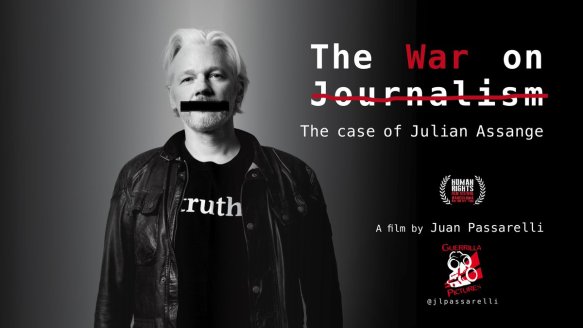
Saturday Matinee: The War on Journalism: The Case of Julian Assange

WATCH: The War on Journalism: The Case of Julian Assange

A new documentary by Juan Passarelli can be seen here on Consortium News, followed by a panel discussion with Passarelli, director Ken Loach and filmmaker Suzie Gilbert.

Source: Consortium News

Journalists are under attack globally for doing their jobs. Julian Assange is facing a 175 year sentence for publishing if extradited to the United States. The Trump administration has gone from denigrating journalists as ‘enemies of the people’ to now criminalizing common practices in journalism that have long served the public interest.

Imprisoned WikiLeaks founder and editor Assange’s extradition is being sought by the Trump administration, in a hearing to begin Sept. 7,  for publishing U.S. government documents, which exposed war crimes and human rights abuses. He is being held in maximum security HMP Belmarsh in London. There is a war on journalism and Julian Assange is at the centre of that war. If this precedent is set then what happens to Assange can happen to any journalist. Join director Ken Loach and film-maker Suzie Gilbert for a discussion with Juan Passarelli about his new documentary – The War on Journalism: The Case of Julian Assange.

Watch the replay here:

An Unprecedented 1,640 CEOs Departed in 2019; Now Execs Are Dumping Stock at Highest Pace Since 2006

By Pam Martens and Russ Martens

Source: Wall Street on Parade

A rather fascinating picture is emerging that suggests that things were not as rosy in the U.S. economic landscape prior to the pandemic as President Donald Trump and his Director of the National Economic Council, Larry Kudlow, would have the public believe.

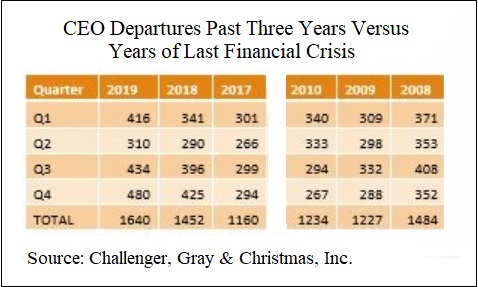
Challenger, Gray & Christmas, Inc. has been tracking CEO departures for the past 12 years. Its Vice President, Andrew Challenger, called the numbers for 2019 “staggering.” It was the highest number since their surveys began in 2002. A total of 1,640 CEOs headed for the exits last year. That was 156 more CEOs than those who left their post in 2008 – the year that Wall Street blazed a scorched earth trail through the U.S. economy.

The number of CEOs that did not leave on their own accord last year was 101 out of the 1,640. According to the study, 15 CEOs left over allegations of professional misconduct; 20 left amid a scandal, “typically under investigations for financial wrongdoing or other legal issues”; 24 saw their positions terminated; 39 left due to a merger or acquisition; 3 left due to bankruptcy.

CEOs of old, established companies have the clearest view of what is happening in the overall economy. They can compare sales growth to prior years and prior decades. They can spot negative or positive trends in the economy far ahead of the economic reports that the federal government releases to the public.

When an outsized number of CEOs decide to cash out their stock options, grab their golden parachutes, and flee their corner offices – something smells.

On top of that fishy smell comes a report from TrimTabs Investment Research that corporate insiders have reaped more than $50 billion in stock sales since May, putting insider selling on a pace not seen since 2006 – two years before the stock market and economic crash of 2008.

The above two reports on corporate executive behavior are compatible with Wall Street On Parade’s reports that show that the current financial crisis began in the fall of 2019 – months before the first case of COVID-19 had emerged anywhere in the world. What triggered the financial crisis? The same kind of liquidity crisis on Wall Street that ushered in the crisis of 2008. (See Wall Street’s Financial Crisis Preceded COVID-19: Chart and Timeline and our archive of more than 100 articles on the financial crisis of 2019/2020 here.)

Why does it matter when the financial crisis began? It’s critically important for the following reasons.

First, the U.S. national debt has exploded to $26.69 trillion. To wrap your mind around this explosion of the national debt, you need some historical perspective. At the beginning of the Bill Clinton Presidency in January 1993, the U.S. national debt stood at $4 trillion. At that point, the United States was more than 200 years old. During that 200 years, the U.S. had financed the Revolutionary War, the Civil War, World Wars I and II and the Vietnam War. The country had also been through the greatest economic collapse in its history, the Great Depression, which required a multitude of fiscal spending programs.

It took more than two centuries for the U.S. national debt to reach $4 trillion but in just the past 27 years the national debt has grown by more than $22 trillion – more than a five-fold increase in less than three decades.

This staggering amount of debt puts the nation at risk of a future credit downgrade and cripples its ability to adequately deal with the financial struggles of its citizens during the worst health and financial crisis in a century.

One of the key reasons for this mushrooming debt was the Wall Street financial crisis of 2008 which required massive fiscal spending to keep the economy from sinking into a depression.

But no serious steps were taken by Congress to reform Wall Street. Derivatives remain largely unregulatedDark Pools are still trading in darkness. Wall Street continues to pay credit rating agencies to rate their toxic debt piles. Off balance sheet casinos run rampant at the largest Wall Street banks. Obscene pay for performance via stock options continues to incentive CEOs and CFOs to massage earnings.

The biggest unaddressed problem is the critical need to restore the Glass-Steagall Act. All of the dangers cited above can, and do, bring down an entire financial institution as we learned in 2008. But with the restoration of the Glass-Steagall Act, the giant, federally-insured, deposit-taking banks would be completely separated from the Wall Street casino investment banks.

This handful of mega banks that hold the majority of deposits in this country are too critical to keeping credit flowing to businesses and consumers to be run by the Wall Street bet-the-ranch mentality. These banks are simply too big to be bailed out again.

When Citigroup was disintegrating from all of the evils mentioned above from 2007 to 2010, this is what it took to resuscitate its sinking hull: $45 billion in capital infusions from the U.S. Treasury; over $300 billion in asset guarantees from the federal government; the Federal Deposit Insurance Corporation (FDIC) guaranteed $5.75 billion of its senior unsecured debt and $26 billion of its commercial paper and interbank deposits; and the Federal Reserve secretly, with no authorization or even awareness of Congress, made a cumulative $2.5 trillion in below-market rate loans to Citigroup from 2007 through at least the middle of 2010, according to an audit by the Government Accountability Office (GAO).

And, finally, acknowledging that this latest financial crisis began prior to the pandemic shines a bright light on the incompetency of the Federal Reserve to manage these Wall Street behemoth banks. It’s simply an insane regulatory model to have a bank regulator with the ability to create money out of thin air that can secretly create and spend $29 trillion bailing out the banks to cover up its own incompetency. That’s what happened from 2007 to 2010 and is in the process of happening again. (See The Fed Has Pumped $9 Trillion into Wall Street Over the Past Six Months, But Mnuchin Says “This Isn’t Like the Financial Crisis”.)