Whither Russiagate?

By Philip Giraldi

Source: OffGuardian

Two years have passed since the 2016 presidential election. Allegations that foreign interference had influenced the result, perhaps decisively, began to surface even as the last ballots were being counted. Against all odds underdog Donald J. Trump had been elected president and the Establishment, which denigrated him throughout the campaign, had to find a scapegoat to explain their failure to elect the preferred candidate. The scapegoat turned out to be Russia.

The Robert Mueller led inquiry into the election has been running since May 2017. It has been tasked with determining whether the Trump campaign colluded corruptly with the Russian government to influence the outcome of the election. It has worked hard to delegitimize the president without that being its stated objective and has had a certain measure of success in doing just that.

But apart from a couple of low-level convictions for perjury, Mueller has come up with nothing that convincingly demonstrates that Moscow had some kind of plan to disrupt the elections and thereby damage American democracy. There was, to be sure, some Russian government sponsored probing and what might be described as attempted influencing, but that is what intelligence agencies do to justify their existence. The worst culprit when it comes to election interference worldwide is undoubtedly America’s own Central Intelligence Agency, which has been doing just that since 1947. But apart from some low-level activity, there has been nothing to suggest some kind of grand design orchestrated by Russian President Vladimir Putin to overthrow or cast into confusion the American government.

No one should ever let a good story line go to waste, so the U.S. mainstream media has bought into the proposition that Russia did both interfere in and influence the result of the election based on the assumption that where there is smoke there must be fire with little in the way of evidence being provided. Some media outlets have maintained that the margin of victory for Trump was actually “made in Russia,” meaning that he is ipso facto Moscow’s puppet. It should be noted that this is the same media that embraced Saddam Hussein’s weapons of mass destruction and transatlantic gliders back in 2002 and the Syrian use of chemical weapons more recently, suggesting that the relationship between demonstrated facts and what comes out in the reporting is very tenuous.

To keep the story fresh, both government and the media have now been suggesting that there has already been an attempt by Russia to interfere in the 2018 midterm election which will take place on Tuesday. The New York Times describes an “elaborate campaign of ‘information warfare’ to interfere.” On October 19th, federal prosecutors charged Elena Alekseevna Khusyaynova of St. Petersburg Russia, a woman whom they labeled the project’s “chief accountant.” She allegedly managed a budget to “sow division and discord” in the lead-up to the voting. The Times goes on to describe how “She bought internet domain names and Facebook and Instagram ads and spent money on building out Twitter accounts and paying to promote divisive posts on social media.”

And the list of culprits has also been expanded to include China and Iran, if one goes by PBS’s coverage of the story. One would not be surprised to see North Korea added to the list, as it is convenient to keep all of one’s enemies in one place, all on the march to destroy American democracy and its political institutions before the GOP and Democrats finally get around to doing it.

One might easily regard the never ending Russiagate saga as a bit of an amusement, but there are actually real-life consequences to corrupting the popular sentiment in a large and powerful nuclear armed nation like the United States by constantly discovering new enemies to stimulate the selling of newspapers and television ad time. At a minimum, phony threat accusations create paranoia and also mistrust in the institutions that are supposed to be protecting the country.

And there are also other less tangible consequences, namely that the constant crying wolf over the Russians and Chinese corrupting America’s political system actually does tell the voters that their vote does not matter as outside forces beyond their control will determine the result anyway.

Stephen Cohen, professor of Russian studies at Princeton University, has been arguing for some time that the pursuit of Russiagate and the various delusions that have become attached to it is doing grave damage not only to the bilateral relationship between Moscow and Washington but also to perceptions of the state of the U.S. political system. His latest article in The Nation entitled Who is really undermining American democracy? has as a sub-heading “Allegations that Russia is still ‘attacking’ US elections, now again in November, could delegitimize our democratic institutions.”

Cohen argues plausibly how the “undermine American democracy” meme may itself erode confidence in U.S. political institutions because if the trick of claiming outside interference can to be used successfully once it will be used again even after Trump is gone. If there are claims by losing candidates that Russia or some other foreign power interfered in the midterm this week it will inevitably jumpstart a witch hunt to find those congressmen who were “helped.” The legitimacy of congress itself will be in question.

Cohen also argues that “Russiagate has revealed the low esteem that many U.S. political-media elites have for American voters—for their ability to make discerning, rational electoral decisions, which is the bedrock assumption of representative democracy… Presumably this is a factor behind the current proliferation of programs—official, corporate, and private—to introduce elements of censorship in the nation’s ‘media space’ in order to filter out ‘Kremlin propaganda.’ Here, it also seems, elites will decide what constitutes such ‘propaganda.’”

It is the ultimate irony that the most powerful and least threatened country in the world – the United States of America-runs on fear. The obsession with possible foreign interference in U.S. elections reflects the fundamental insecurity of the elites that actually manipulate the system to benefit themselves and their constituencies. If the midterm results do not satisfy the Establishment and the “foreign menace” again is surfaced as causative it will, in truth, be the beginning of the end for American democracy as mistrust of the integrity of the government institutions will continued to be eroded. The alternative? Tell Robert Mueller to put his cards on the table and prove what is being generally accepted as true regarding Russia or fold up his tent and go home because he is no longer need.

Lost in the Theatre of Data, Dada, and Emotional Manipulation

By Edward Curtin

Source: OpEdNews.com

“It is not only information that they need — in this Age of Fact, information often dominates their attention and overwhelms their capacities to assimilate it”What they need, and what they feel they need, is a quality of mind that will help them to use information and to develop reason in order to achieve lucid summations of what is going on in the world and of what may be happening within themselves”what may be called the sociological imagination.”

— C. Wright Mills, The Sociological Imagination, 1959

“‘Our own death is indeed, unimaginable,’ Freud said in 1915, ‘and whenever we make the attempt to imagine it we can perceive that we really survive as spectators.’ It is thus the very habit of military situations that turn them theatrical. And it is their utter unthinkableness: it is impossible for a participant to believe that he is taking part in such murderous proceedings in his own character. The whole thing is too grossly farcical, perverse, cruel, and absurd to be credited as a form of ‘real life.’ Seeing warfare as theatre provides a psychic escape for the participant: with a sufficient sense of theatre, he can perform his duties without implicating his ‘real’ self and without impairing his innermost conviction that the world is still a rational place. Just before the attack on Loos, Major Pilditch testifies to ‘a queer new feeling these last few days, intensified last night. A sort of feeling of unreality as if I were acting on a stage”.'”

— Paul Fussell, The Great War and Modern Memory

“The society whose modernisation has reached the stage of integrated spectacle
is characterised by the combined effect of five principal factors: incessant technological renewal, integration of state and economy, generalised secrecy, unanswerable lies, and eternal present . . . .”

— Guy Debord, The Society of the Spectacle

“Hi-diddle-dee-dee

An actor’s life for me..

Hi-diddle-dee-dum

An actor’s life is fun”

— Walt Disney, “Pinocchio”

It was 100 years ago this November 11th when World War I ended. This “War to End All Wars,” resulted in the death of approximately 9 million soldiers and 9 million civilians. The brilliant leaders who waged this war — the crème de la crème — men who, in their own warped minds, possessed impeccable logic and rigorous reasoning, expected the war to be over in a few months. It lasted four years. Like their more current American counterparts before they launched the war against Iraq in 2003, they expected a “cakewalk” or a “slam-dunk” (the former term is racist and the latter a sports term, perfect unconscious verbiage for the slaughter of “lesser” humans). All these principals were data demented, they had lined up their little toy ducks in a row and expected a neat and logical outcome. Or so they said. The new weapons would make quick mincemeat of the enemy. Technology would expeditiously destroy to expeditiously save. Nothing has changed in one hundred years

Such instrumental logic and its positivistic data reductionism has now deeply infected the popular mind, as common sense has been destroyed by government and mass media propaganda so blatantly ridiculous that only a hypnotized person could believe it. But so many have been hypnotized and follow the repetitious and overwhelming streaming of each day’s markedly ad hoc “news,” following the Pied Piper to their doom via the wizardry of digital technology. Raptly attentive to the “politainment” that passes for journalism, they pin ball between alleged assertions of fact cobbled together with tendentious and faulty logic and theatrical displays of emotion meant to manipulate an audience of spectators in the national theatre of absurdity. It is all show and tell in which the audience is expected to react emotionally rather than think, with images and feelings having replaced concentrated reflection, and facts and evidence having disappeared like a coin from a magician’s hand.

This technological surround-sound theatre has reduced everything to play-acting, with audiences and their puppeteers playing reciprocal parts. Theodor Adorno analogizes thus:

“Real life is becoming indistinguishable from the movies. The sound film, far surpassing the theatre of illusion, leaves no room for imagination or reflection on the part of the audience, who is unable to respond within the structure of the film, yet deviate from its precise detail without losing the thread of the story; hence the film forces its victims to equate it directly with reality. The stunting of the mass-media consumer’s powers of imagination and spontaneity does not have to be traced back to any psychological mechanisms; he must ascribe the loss of those attributes to the objective nature of the products themselves, especially to the most characteristic of them, the sound film. They are so designed that quickness, powers of observation, and experience are undeniably needed to apprehend them at all; yet sustained thought is out of the question if the spectator is not to miss the relentless rush of facts.”

Meanwhile, the real business of murder, mayhem, and economic exploitation continues apace. As one “small” example of a fact relegated to oblivion by our mainstream media, in Gaza this past week, Israeli occupation forces killed Nasser Azim Musabeh (12), Mohammed Nayef Ai (14), Mohammed Ali Mohasmmed Anshasi, (18), Iyar Khalil Al-Sha’er (18), Mohasmmed Bassam Mohammed (24), Mohammed Walid Haniyeh (23), and Mohammed Ashraf Awawdeh (23). But such facts don’t matter since these dead young people were already reduced to invisible people not worthy of a mention.

Rather, pseudo-debates and pseudo-events are created by media and political magicians whose goal is to confuse the audience through information (data) and emotional overload into thinking that they are “freely” choosing what is always the same, to paraphrase Theodor Adorno. It is a conjurer’s act of mind manipulation in support of a repressive political and economic ideology built on false dichotomies. The political/media empire creates its own “reality” that the captivated audience takes as reality, as their emotions swing from outrage to laughter and their electronic clickers jump them from show to show, from CNN or Fox or the New York Times to Saturday Night Live in the land where there is no business but show business. “Amusing ourselves to death,” as Neal Postman so aptly put it. To which I would add: As we put others to death outside the show.

The other day I was in a library and was looking through a large book of World War I photographs from the Imperial War Museum that I found lying on a table. They were arranged chronologically from the start of the war in 1914 to its end in 1918. Fascinating photos, I thought. I went through the book page by page, examining the photos one by one, beginning with the assassination of Archduke Ferdinand by a young guy, on through the photos of stiff British war-hawk leaders in double-breasted suits, through photos of the trenches and the new weapons until I reached photos of the treaty to “end” it. By the conclusion, I felt exhausted and knew nothing new. Photos as data. Click, click, click: How many are enough? It was like spending an hour with the mainstream corporate media, and much of the alternative press. It was like a black and white movie in no motion. Same old, same old, as a young man I know often says when I ask him what’s new. Same old data via photographs. War is hell. Ditto. Bodies get blown to bits and decompose in mud. Ditto. Heads get separated from necks and blood pours forth. Ditto. War is hell. Ditto. Great leaders meet and end the carnage. Ditto.

Ditto Data Dada. I had to imagine the subsequent pages and years as these great leaders, so disgusted by war, prepared for the next one, and the one following, etc. Ditto, data, dada.

I understood then why the first famous Dadaist piece of art that emerged from absolute disgust with the data driven crazies who started and waged WW I was Marcel Duchamp’s 1917 “Fountain,” a porcelain urinal signed by R. Mutt, a message to tell the “great” leaders to piss off.

But Dadaist art, like all avant-garde art, gets quickly sucked into the maw of the entertainment complex, which is another name for the propaganda complex. As the word media means etymologically — magicians — these sorcerer’s have developed and use every bit of black magic to engineer the consent of the bewildered herd, to blend the words of two of America’s key propagandists from the past: Edward Bernays, Freud’s American nephew and President Woodrow Wilson’s master propagandist for WW I, and the famous journalist Walter Lippman. Bernays put it straight and succinctly:

It is impossible to overestimate the importance of engineering of consent. The engineering of consent is the very essence of the democratic process. It affects almost every aspect of our daily lives.

Last week I attended a production of the play Annie in a community theatre in a liberal town in the northeast. The show was sold out, and I was there because my lovely granddaughter was performing in the play, one whose story and music I was very familiar with. The show was delightful and the audience was enraptured by the performances and the wonderful music. If you are not familiar with the story, it is about an 11 year old orphan named Annie who, in 1933 when FDR has assumed the presidency, is in search of her biological parents. Together with other orphans in a NYC orphanage, she is treated miserably by a character named Miss Hannigan. By the play’s end, Annie is adopted by a wealthy man to presumably live happily ever after. At one point in the play, this wealthy man brings Annie to Washington D. C. to meet his friend, President Roosevelt. He says to FDR, Franklin, you need to do something and get my factories humming again. In this scene, Roosevelt and his cabinet, the wealthy man, and Annie sing the very upbeat song — “Tomorrow” — which Roosevelt loves since it offers hope in the dark time of the great depression. Everyone sings the stirring song, many in the audience silently singing along and the mood in the theater elevates. By the play’s end Annie is adopted by the wealthy man, whose name is Daddy Warbucks. This super-capitalist billionaire with a mansion on Fifth Avenue and a heart of gold has made his riches making weapons for WW I, though this is not spelled out in the show. I kept wondering what the audience of liberal-minded people were thinking, or if they were, about the strange fact the hero of the show was a man with a war-monger’s name whose factories had produced armaments that had created tens of thousands of war orphans and who was urging the liberal Roosevelt to get his munitions factories up and running again in 1933. I suspected they weren’t thinking about this at all and that the work of subtle propaganda was being magically induced at an unconscious level. For how could such a nice, caring guy, who adopts the cute Annie and who sings such tuneful songs, be a killer?

I guiltily thought: I shouldn’t be thinking such thoughts, as I also thought how can I not think them. Emotionally I felt one thing, and intellectually another. This was the classic double-bind.

Upon further reflection, I realized that this is how the finest propaganda works. It splits people in two and works subtly. Emotionally you are pulled one way, and intellectually another, if you are thinking at all. There are certain connections you are not supposed to make or verbalize, when to oppose the powerful sway of the media’s emotional appeals is considered a betrayal of your humanity and certain victims, such as a cute orphan or acceptable victims, even when that doesn’t follow logically.

But in the Magic Theatre that is American life, false choices are the essence of the show. Democrats vs. Republicans, Clinton vs. Bush, Bush vs. Obama, Obama vs. Trump, liberals vs. conservatives, and on and on endlessly. It’s Dada, my friends, all theater. The next election will change everything, right? “The sun’ll come out/Tomorrow, So ya gotta hang on/’Till tomorrow/ Come what may.”

Only when we leave the theatre can we see the real play. But that’s a bold act for which no Oscars, Tonys, or Emmys are handed out. And outside the theater’s warm embrace, it’s cold, and you feel like an orphan looking for a home, no matter how much blood-money purchased it. But don’t go in; it’s a trap.


Saturday Matinee: Dick

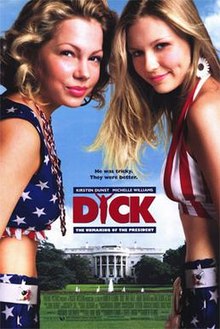
“Dick” (1999) is a cult comedy co-written (with Sheryl Longin) and directed by Andrew Fleming. It’s an absurdist retelling of the events surrounding the Watergate scandal which led to the resignation of Richard “Tricky Dick” Nixon (played in the film by Dan Hedaya). Kirsten Dunst and Michelle Williams star as Betsy and Arlene, two fun-loving and ditzy best friends, who, through a random chain of events, become the legendary “Deep Throat” figure ultimately responsible for bringing down the Nixon presidency. Will Ferrell and Bruce McCulloch star as this film’s version of Woodward and Bernstein. A roster of comedic actors including Teri Garr, Dave Foley, Harry Shearer, Jim Breuer and Ryan Reynolds also make appearances.

Watch the full film here.

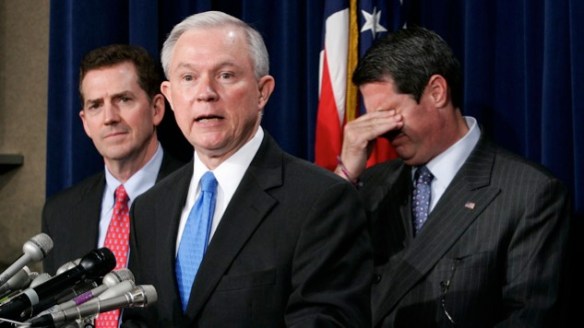
Democrats rally to defend fired Attorney General Sessions, Special Counsel Mueller

By Tom Eley

Source: WSWS.org

The Democrats and their fake “left” allies held war-mongering demonstrations in a number of cities on Thursday in defense of the fired far-right attorney general, Jeff Sessions, and the anti-Russia investigation being conducted by Special Counsel Robert Mueller.

Wednesday’s ouster of Sessions and his replacement by Trump ally Matthew G. Whitaker has brought forth a wave of condemnation from Democratic Party figures and their media allies, including the New York Times and Washington Post, asserting that the move is the prelude to Trump’s closing down of the Justice Department probe into allegations of Russian “meddling” in the 2016 elections and possible collusion by the Trump campaign.

Trump had repeatedly denounced Sessions for having recused himself from the Russia investigation in March of 2017, leaving Deputy Attorney General Rod Rosenstein, a defender of the investigation, in overall charge of its conduct. Whitaker, a former US attorney and now acting attorney general and therefore responsible for overseeing the Mueller probe, is on record criticizing Mueller and suggesting that the Justice Department could cut off funding for his office.

Mueller’s investigation has been at the center of a McCarthyite-style campaign against Russia spearheaded by the intelligence agencies and the Democratic Party, based on fabricated claims that Russian President Vladimir Putin interfered in the presidential election to undermine the candidacy of Democrat Hillary Clinton and boost Trump. It has been used as a weapon in the drive by the Democrats and sections of the military/intelligence establishment to force Trump to adopt a more aggressive posture against Moscow and in the war for regime-change in Syria.

To the extent that the Democrats oppose the right-wing Trump administration, it is on this entirely reactionary basis. In the lead-up to Tuesday’s midterm elections, they not only called no demonstrations, they were entirely silent on Trump’s fascistic attacks on immigrants, his deployment of troops to the border against the caravan of Central American asylum seekers, and his pledge to overturn the 14th Amendment guarantee of birthright citizenship—a cornerstone of the Bill of Rights.

Following the election, in which the Democrats won control of the House of Representatives, the party leadership called repeatedly for bipartisan unity and collaboration with Trump, underscoring their essential agreement with his policies of war, austerity and repression. It was only when Trump fired Sessions, a right-wing anti-immigrant zealot, that they swung into action, reviving their denunciations of Trump as a stooge of Putin.

The aim of shifting the Trump administration to a war footing against Russia has been achieved to the extent that there is now a substantial risk of nuclear conflict between the US and the second-leading nuclear power. War could quickly erupt in a number of flash points, especially Syria, where Russian soldiers, sailors and airmen carry out combat operations within miles of their American counterparts, as well as US-allied Islamist proxies armed by Saudi Arabia.

Though promoted in the media and sponsored by over 50 Democratic Party-linked organizations, including MoveOn.org, the rallies on Tuesday were small, reflecting the lack of support in the general population for the anti-Russia crusade. The protests were notable primarily for their unvarnished right-wing and neo-McCarthyite character.

Two of the largest were in Washington DC and New York City, which each drew roughly 1,000 demonstrators, many of whom held hammer and cycle posters with Putin’s image. Sessions began his career as a segregationist in Jim Crow Alabama and went on to become a right-wing Republican senator from the state. Mueller, for his part, was director of the FBI from 2001 to 2013, during which time he helped institute mass domestic surveillance and other sweeping attacks on democratic rights linked to the so-called “war on terror.”

At the Washington demonstration, Democratic Congressman Jamie Raskin led those in attendance in a round of applause for Sessions. Randi Weingarten, president of the American Federation of Teachers, appealed to the military against Trump, declaring, “You are the defenders of our democracy,” and led a chant of “protect Mueller.”

In defending Sessions, the Democrats and their allies are rallying around the most rightwing attorney general in American history, who, prior to joining the Trump cabinet, had won a well-earned reputation as a bitter opponent of civil rights. As attorney general, Sessions will primarily be remembered for the persecution of immigrants, most notably the separation of immigrant children from their parents and their imprisonment in detention camps built in the desert.

The task of spearheading the attack on immigrants and democratic rights will now fall, pending the installation of a permanent attorney general, to Whitaker, who has boasted that he interprets the Constitution from a biblical standpoint. His very first act as head of the Department of Justice was to issue, in conjunction with the Department of Homeland Security, a directive stripping the right to asylum from anyone who enters the US over the Mexican border and has not first gained legal status—a move that is tantamount to abolishing the right to asylum, which is guaranteed under international and US law.

This move, a new landmark in the attack on immigrants, due process and basic democratic rights, has been virtually ignored by the media and the Democratic Party. It was not mentioned in the press release calling Thursday’s demonstration, nor by speakers at the demonstrations in Washington and New York.

Time to Wake Up: the Neoliberal Order is Dying

By Jonathan Cook

Source: CounterPunch

In my recent essay, I argued that power in our societies resides in structure, ideology and narratives – supporting what we might loosely term our current “neoliberal order” – rather than in individuals. Significantly, our political and media classes, who are of course deeply embedded in this neoliberal structure, are key promoters of the very opposite idea: that individuals or like-minded groups of people hold power; that they should, at least in theory, be held accountable for the use and misuse of that power; and that meaningful change involves replacing these individuals rather than fundamentally altering the power-structure they operate within.

In other words, our political and media debates reduce to who should be held to account for problems in the economy, the health and education systems, or the conduct of a war. What is never discussed is whether flawed policies are the fleeting responsibility of individuals and political parties or symptoms of the current neoliberal malaise – manifestations of an ideology that necessarily has goals, such as the pursuit of maximised profit and endless economic growth, that are indifferent to other considerations, such as the damage being done to life on our planet.

The focus on individuals happens for a reason. It is designed to ensure that the structure and ideological foundations of our societies remain invisible to us, the public. The neoliberal order goes unquestioned – presumed, against the evidence of history, to be permanent, fixed, unchallengeable.

So deep is this misdirection that even efforts to talk about real power become treacherous. My words above and below might suggest that power is rather like a person, that it has intention and will, that maybe it likes to deceive or play tricks. But none of that is true either.

Big and little power

My difficulty conveying precisely what I mean, my need to resort to metaphor, reveals the limitations of language and the necessarily narrow ideological horizons it imposes on anyone who uses it. Intelligible language is not designed adequately to describe structure or power. It prefers to particularise, to humanise, to specify, to individualise in ways that make thinking in bigger, more critical ways near-impossible.

Language is on the side of those, like politicians and corporate journalists, who conceal structure, who deal in narratives of the small-power of individuals rather than of the big-power of structure and ideology. In what passes for news, the media offer a large stage for powerful individuals to fight elections, pass legislation, take over businesses, start wars, and a small stage for these same individuals to get their come-uppance, caught committing crimes, lying, having affairs, getting drunk, and more generally embarrassing themselves.

These minor narratives conceal the fact that such individuals are groomed before they ever gain access to power. Business leaders, senior politicians and agenda-setting journalists reach their positions after proving themselves over and over again – not consciously but through their unthinking compliance to the power-structure of our societies. They are selected through their performances in exams at school and university, through training programmes and indentures. They rise to the top because they are the most talented examples of those who are blind or submissive to power, those who can think most cleverly without thinking critically. Those who reliably deploy their skills where they are directed to do so.

Their large and small dramas constitute what we call public life, whether politics, world affairs or entertainment. To suggest that there are deeper processes at work, that the largest of these dramas is not really large enough for us to gain insight into how power operates, is to instantly be dismissed as paranoid, a fantasist, and – most damningly of all – a conspiracy theorist.

These terms also serve the deception. They are intended to stop all thought about real power. They are scare words used to prevent us, in a metaphor used in my previous post, from stepping back from the screen. They are there to force us to stand so close we see only the pixels, not the bigger picture.

Media makeover

The story of Britain’s Labour party is a case in point, and was illustrated even before Jeremy Corbyn became leader. Back in the 1990s Tony Blair reinvented the party as New Labour, jettisoning ideas of socialism and class war, and inventing instead a “Third Way”.

The idea that gained him access to power – personified in the media narrative of the time as his meeting with Rupert Murdoch on the mogul’s Hayman Island – was that New Labour would triangulate, find a middle way between the 1 per cent and the 99 per cent. The fact that the meeting took place with Murdoch rather than anyone else signalled something significant: that the power-structure needed a media makeover. It needed to be dressed in new garb.

In reality, Blair made Labour useful to power by re-styling the turbo-charged neoliberalism Margaret Thatcher’s Conservative party of the rich had unleashed. He made it look compatible with social democracy. Blair put a gentler, kinder mask on neoliberalism’s aggressive pursuit of planet-destroying power – much as Barack Obama would do in the United States a decade later, after the horrors of the Iraq invasion. Neither Blair nor Obama changed the substance of our economic and political systems, but they did make them look deceptively attractive by tinkering with social policy.

Were the neoliberal order laid bare – were the emperor to allow himself to be stripped of his clothes – no one apart from a small psychopathic elite would vote for neoliberalism’s maintenance. So power is forced to repeatedly reinvent itself. It is like the shape-shifting Mystique of the X-Men films, constantly altering its appearance to lull us into a false sense of security. Power’s goal is to keep looking like it has become something new, something innovative. Because the power-structure does not want change, it has to find front-men and women who can personify a transformation that is, in truth, entirely hollow.

Power can perform this stunt, as Blair did, by repackaging the same product – neoliberalism – in prettier ideological wrapping. Or it can, as has happened in the US of late, try a baser approach by adding a dash of identity politics. A black presidential candidate (Obama) can offer hope, and a woman candidate (Hillary Clinton) can cast herself as mother-saviour.

With this model in place, elections become an illusory contest between more transparent and more opaque iterations of neoliberal power. In failing the 99 per cent, Obama so woefully voided this strategy that large sections of voters turned their back on his intended successor, the new makeover candidate Hillary Clinton. They saw through the role-playing. They preferred, even if only reluctantly, the honest vulgarity of naked power represented by Trump over the pretensions of Clinton’s fakely compassionate politics.

Unstable politics

Despite its best efforts, neoliberalism is increasingly discredited in the eyes of large sections of the electorate in the US and UK. Its attempts at concealment have grown jaded, its strategy exhausted. It has reached the end-game, and that is why politics now looks so unstable. “Insurgency” candidates in different guises are prospering.

Neoliberal power is distinctive because it seeks absolute power, and can achieve that end only through global domination. Globalisation, the world as a plaything for a tiny elite to asset-strip, is both its means and its end. Insurgents are therefore those who seek to reverse the trend towards globalisation – or at least claim to. There are insurgents on both the left and right.

If neoliberalism has to choose, it typically prefers an insurgent on the right to the left. A Trump figure can usefully serve power too, because he dons the clothes of an insurgent while doing little to actually change the structure.

Nonetheless, Trump is a potential problem for the neoliberal order for two reasons.

First, unlike an Obama or a Clinton, he too clearly illuminates what is really at stake for power – wealth maximisation at any cost – and thereby risks unmasking the deception. And second, he is a retrograde step for the globalising power-structure.

Neoliberalism has dragged capitalism out its nineteenth-century dependency on nation-states into a twenty-first ideology that demands a global reach. Trump and other nativist leaders seek a return to a supposed golden era of state-based capitalism, one that prefers to send our children up chimneys if it prevents children from far-off lands arriving on our shores to do the same.

The neoliberal order prefers a Trump to a Bernie Sanders because the nativist insurgents are so much easier to tame. A Trump can be allowed to strut on his Twitter stage while the global power-structure constrains and undermines any promised moves that might threaten it. Trump the candidate was indifferent to Israel and wanted the US out of Syria. Trump the president has become Israel’s biggest cheerleader and has launched US missiles at Syria.

Faustian pacts

The current power-structure is much more frightened of a left insurgency of the kind represented by Corbyn in the UK. He and his supporters are trying to reverse the accommodations with power made by Blair. And that is why he finds himself relentlessly assaulted from every direction – from his political opponents; from his supposed political allies, including most of his own parliamentary party; and most especially from the state-corporate media, including its bogus left-liberal elements like the Guardian and the BBC.

The past three years of attacks on Corbyn are how power manifests itself, shows its hand, when it is losing. It is a strategy of last resort. A Blair or an Obama arrive in power having already made so many compromises behind the scenes that their original policies are largely toothless. They have made Faustian pacts as a condition for being granted access to power. This is variously described as pragmatism, moderation, realism. More accurately, it should be characterised as betrayal.

It does not stop when they reach high office. Obama made a series of early errors, thinking he would have room to manoeuvre in the Middle East. He made a speech in Cairo about a “New Beginning” for the region. A short time later he would help to snuff out the Egyptian Arab Spring that erupted close by, in Tahrir Square. Egypt’s military, long subsidised by Washington, were allowed to take back power.

Obama won the 2009 Nobel peace prize, before he had time to do anything, for his international diplomacy. And yet he stepped up the war on terror, oversaw the rapid expansion of a policy of extrajudicial assassinations by drone, and presided over the extension of the Iraq regime-change operation to Libya and Syria.

And he threatened penalties for Israel over its illegal settlements policy – a five-decade war crime that has gone completely unpunished by the international community. But in practice his inaction allowed Israel to entrench its settlements to the point where annexation of parts of the West Bank is now imminent.

Tame or destroy

Neoliberalism is now so entrenched, so rapacious that even a moderate socialist like Corbyn is seen as a major threat. And unlike a Blair, Obama or Trump, Corbyn is much harder to tame because he has a grassroots movement behind him and to which he is ultimately accountable.

In the US, the neoliberal wing of the Democratic party prevented the left-insurgent candidate, Bernie Sanders, from contesting the presidency by rigging the system to keep him off the ballot paper. In the UK, Corbyn got past those structural defences by accident. He scraped into the leadership race as the token “loony-left” candidate, indulged by the Labour party bureaucracy as a way to demonstrate that the election was inclusive and fair. He was never expected to win.

Once he was installed as leader, the power-structure had two choices: to tame him like Blair, or destroy him before he stood a chance of reaching high office. For those with short memories, it is worth recalling how those alternatives were weighed in Corbyn’s first months.

On the one hand, he was derided across the media for being shabbily dressed, for being unpatriotic, for threatening national security, for being sexist. This was the campaign to tame him. On the other, the Murdoch-owned Times newspaper, the house journal of the neoliberal elite, gave a platform to an anonymous army general to warn that the British military would never allow Corbyn to reach office. There would be an army-led coup before he ever got near 10 Downing Street.

In a sign of how ineffectual these power-structures now are, none of this made much difference to Corbyn’s fortunes with the public. A truly insurgent candidate cannot be damaged by attacks from the power-elite. That’s why he is where he is, after all.

So those wedded to the power-structure among his own MPs tried to wage a second leadership contest to unseat him. As a wave of new members signed up to bolster his ranks of supporters, and thereby turned the party into the largest in Europe, Labour party bureaucrats stripped as many as possible of their right to vote in the hope Corbyn could be made to lose. They failed again. He won with an even bigger majority.

Redefining words

It was in this context that the neoliberal order has had to play its most high-stakes card of all. It has accused Corbyn, a lifelong anti-racism activist, of being an anti-semite for supporting the Palestinian cause, for preferring Palestinian rights over brutal Israeli occupation. To make this charge plausible, words have had to be redefined: “anti-semitism” no longer means simply a hatred of Jews, but includes criticism of Israel; “Zionist” no longer refers to a political movement that prioritises the rights of Jews over the native Palestinian population, but supposedly stands as sinister code for all Jews. Corbyn’s own party has been forced under relentless pressure to adopt these malicious reformulations of meaning.

How anti-semitism is being weaponised, not to protect Jews but to protect the neoliberal order, was made starkly clear this week when Corbyn criticised the financial elite that brought the west to the brink of economic ruin a decade ago, and will soon do so again unless stringent new regulations are introduced. Useful idiots like Stephen Pollard, editor of the rightwing Jewish Chronicle, saw a chance to revive the anti-semitism canard once again, accusing Corbyn of secretly meaning “Jews” when he actually spoke of bankers. It is a logic intended to make the neoliberal elite untouchable, cloaking them in a security blanket relying on the anti-semitism taboo.

Almost the entire Westminister political class and the entire corporate media class, including the most prominent journalists in the left-liberal media, have reached the same preposterous conclusion about Corbyn. Whatever the evidence in front of their and our eyes, he is now roundly declared an anti-semite. Up is now down, and day is night.

High-stakes strategy

This strategy is high stakes and dangerous for two reasons.

First, it risks creating the very problem it claims to be defending against. By crying wolf continuously about Corbyn’s supposed anti-semitism without any tangible evidence for it, and by making an unfounded charge of anti-semitism the yardstick for judging Corbyn’s competence for office rather than any of his stated policies, the real anti-semite’s argument begins to sound more plausible.

In what could become self-fulfilling prophecy, the anti-semitic right’s long-standing ideas about Jewish cabals controlling the media and pulling levers behind the scenes could start to resonate with an increasingly disillusioned and frustrated public. The weaponising of anti-semitism by the neoliberal order to protect its power risks turning Jews into collateral damage. It makes them another small or bigger drama in the increasingly desperate attempt to create a narrative that deflects attention from the real power-structure.

And second, the effort to stitch together a narrative of Corbyn’s anti-semitism out of non-existent cloth is likely to encourage more and more people to take a step back from the screen so that those unintelligible pixels can more easily be discerned as a smoking gun. The very preposterousness of the allegations, and the fact that they are taken so seriously by a political and media class selected for their submissiveness to the neoliberal order, accelerates the process by which these opinion-formers discredit themselves. Their authority wanes by the day, and as a result their usefulness to the power-structure rapidly diminishes.

This is where we are now: in the final stages of a busted system that is clinging on to credibility by its fingernails. Sooner or later, its grip will be lost and it will plunge into the abyss. We will wonder how we ever fell for any of its deceptions.

In the meantime, we must get on with the urgent task of liberating our minds, of undoing the toxic mental and emotional training we were subjected to, of critiquing and deriding those whose job is to enforce the corrupt orthodoxy, and of replotting a course towards a future that saves the human species from impending extinction.

CEOs should have been the fall guys; why are they still heroes?

By Carl Rhodes

Source: aeon

On 15 September 2008, the giant financial services firm Lehman Brothers filed for bankruptcy, starting a chain reaction that saw the global economy spiralling toward total collapse. The global financial crisis that ensued revealed just how fragile and unstable the world economic order really was. If there was ever a time that neoliberal capitalism should have faced a legitimation crisis, this was it.

One only needs to think back to December 2008 when the then US president Barack Obama scolded the heads of the largest US auto firms for flying to Washington in private jets to ask for financial bailouts. As one Democratic Party representative added: ‘Couldn’t you all have downgraded to first class or jet-pooled or something to get here? It would have at least sent a message that you do get it.’

For a short time after the crash, those on the top of the corporate ladder seemed as powerless as those on the bottom. The failure demonstrated that neither chief executive officers (CEOs) nor their financial advisors had much of an idea of how the market worked or how to control it. All that was left for modern citizens was to brace themselves as a runaway global free market fell off the proverbial cliff. The CEO suddenly appeared like a fall guy for the crash rather than as a hero.

Fast-forward 10 years, and it’s hard to believe that the economic and political supremacy of the CEO could have even been put into radical question the way it was in 2008. CEOs never really lost their stride and, now more than ever, they are considered to be visionaries and idealised as leaders. Nor did they lose their corporate jets. Other than for a brief symbolic belt-tightening immediately after the crisis, CEOs were soon flying high again on company planes.

Today, business founders such as Elon Musk, Mark Zuckerberg or even Larry Fink epitomise a new class of celebrity CEOs, seen by so many as personal heroes who can save the world, and the same goes for the larger array of employee CEOs such as Jamie Dimon at JPMorgan Chase or Tim Cook at Apple. Yet all the while, CEOs participate in a world economy wracked by increasing inequality, as epitomised by the kind of obscene CEO remuneration that sees the likes of Amazon’s boss Jeff Bezos earning almost a million times that of the workers in his warehouses.

More ominously, millions of Americans voted for an ostentatiously super-rich CEO, electing Donald Trump as their president. In his acceptance speech, Trump praised his own business acumen as being key to his political success: ‘I’ve spent my entire life in business, looking at the untapped potential in projects and in people all over the world. That is now what I want to do for our country.’

The barely interrupted veneration of the CEO as a hero, marked most expressively by the Trump presidency, has brought us to a point today where CEOs are not just valued for their skills in business but have become role models in all walks of life. We now live in what we call a ‘CEO society’: a society where corporate leadership has become the model for transforming not just business, but all human activity, where everyone from politicians to jobseekers to even those seeking love are expected to imitate the qualities of the lionised corporate executive.

The contemporary adulation and admiration of CEOs raises the question of what enabled their continued idolisation, given what could well have been their fall from grace 10 years ago? At the time, many hoped that the sad devastation of the crisis might open the door for an economic and political paradigm shift that would usher in a fairer, more equal and just society. It’s not that this promise of change has not arrived, it’s that it seems farther away than ever.

After 2008, for a brief time, people clamoured for CEOs to be held accountable and be prosecuted. This was, not least, a practical matter. With jobs being lost, shop fronts being boarded up, and politicians crying austerity, what people wanted above all else was economic recovery. Yet with the world’s top executives in disgrace, who could lead such a dramatic economic revival?

What arose from peril was a novel fantasy of executive-led recovery that allowed the shattered reputation of the CEO to stage a prompt, if not miraculous, comeback. This played into an appealing crisis narrative. With such a narrative, all faith must be invested in the recuperation of an imaginary golden past that existed before the upheaval. Most recently, this has manifested in Brexit’s investment in the promise of a renewed British sovereignty, as well as in populist political rallying cries such as ‘Make America Great Again’.

These desires for recovery and return are of course perfectly understandable, and they clearly shed light on why ideologies of free-market heroism thrived again after crisis. But this still only scratches the surface of why CEOs continue to be idolised by so many. Whereas individual executives from Martin Shkreli of Turing Pharmaceuticals to Harvey Weinstein of Miramax might be reviled for their greed, corruption or abuse of power, the CEO – as an ideal – has been reinstated with a solid-gold allure.

The financial crisis pointed to a deep insecurity rested in the fear that it was futile for humans to control the economic world that we had created, and this reverberated with a more general fear that we lack agency more widely. Suddenly, people were pushed into facing the possibility that their lives were lost to the whims and unpredictable fate of a supernatural market. Where since the advent of the 20th century it had been righteously condemned that ‘money is the secular God of the world’, now it was feared that finance had become an even more reckless God, one who cared little for the humans who worshiped at his gilded altar.

The quick rehabilitation of the image of the CEO in the popular imagination was not just a practical matter of wanting to hold on to the material benefits afforded by neoliberal capitalism. It was a psychic measure needed to counteract the fear of dehumanisation at the hands of a runaway Frankenstein economy. In other words, we just wanted to pretend that someone was in control, even if all the facts and evidence were telling us that this wasn’t the case. Everything could be forgiven if hope could be returned.

The retention of the CEO myth was an assertion of the power of individuals to shape events and control their destiny. To achieve this meant holding on to the heroic character of the CEO such that people might regain a sense of control over their own lives too.

Maintaining faith in the CEO was less a matter of empirical fact and more a symptom of a human need to find something to believe in at the end of a hard-earned day; with the reality too hard to bear, the fantasy had to return. Held out was the promise that everyone could receive grace if only he accepted the modern CEO gospel. This is the very same faith that allows people to believe that the business acumen of an impetuous, loud-mouthed, misogynist bully is able to lead America to greatness. When Trump said that he would run the US like a business project, ‘under budget and ahead of schedule’, enough people believed him to pave his way to the White House.

CEOs represent the ability to be in control of a market that appears uncontrollable and uncaring of its profound human costs. This desire for control belies the reality for too many people of being on the wrong side of the rising tide of inequality, and of being subjected to the tyranny of a new singleminded political authoritarian intolerance. Let’s hope that with the next crisis we learn that we need to let go of the fantasy of the CEO.

Western Media Attacks Critics of the White Helmets

By Rick Sterling

Source: Dissident Voice

Introduction

The October 16 issue of NY Review of Books has an article by Janine di Giovani titled “Why Assad and Russia Target the White Helmets“. The article exemplifies how western media promotes the White Helmets uncritically and attacks those who challenge the myth.

Crude and Disingenuous Attack

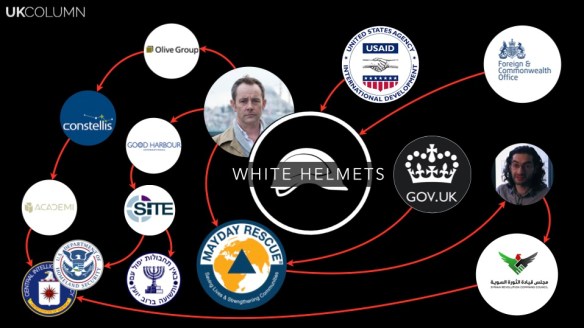
Giovani’s article attacks several journalists by name. She singles out Janine di Giovani and echoes the Guardian’s characterization of Beeley as the “high priestess of Syria propaganda”. She does this without challenging a single article or claim by the journalist. She might have acknowledged that Vanessa Beeley has some familiarity with the Middle East; she is the daughter of one of the foremost British Arabists and diplomats including British Ambassador to Egypt. Giovanni might have explored Beeley’s research in Syria that revealed the White Helmets founder (British military contractor James LeMesurier) assigned the name Syria Civil Defence despite the fact there is a real Syrian organization by that name that has existed since the 1950’s. For the past several years, Beeley has done many on-the-ground reports and investigations in Syria. None of these are challenged by Giovanni. Just days ago Beeley published a report on her visit to the White Helmets headquarters in Deraa.

Giovanni similarly dismisses another alternative journalist, Eva Bartlett. Again, Giovanni ignores the fact that Bartlett has substantial Middle East experience including having lived in Gaza for years. Instead of objectively evaluating the journalistic work of these independent journalists, Giovanni smears their work as “disinformation”. Presumably that is because their work is published at alternative sites such as 21st Century Wire and Russian media such as RT and Sputnik. Beeley and Bartlett surely would have been happy to have their reports published at the New York Review of Books, Newsweek or other mainstream outlets. But it’s evident that such reporting is not welcome there. Even Seymour Hersh had to go abroad to have his investigations on Syria published.

The New McCarthyism

Max Blumenthal is another journalist singled out by Giovanni. Blumenthal is the author of three books, including a New York Times bestseller and the highly acclaimed “Goliath: Life and Loathing in Greater Israel”. Giovanni describes his transition from “anti-Assad” to “pro-Assad” and suggests his change of perspective was due to Russian influence. She says, “Blumenthal went to Moscow on a junket to celebrate RT’s tenth anniversary. We don’t know what happened during that visit, but afterwards, Blumenthal’s views completely flipped.” Instead of examining the facts presented by Blumenthal in articles such as “Inside the Shadowy PR Firm that’s Lobyying for Regime Change in Syria“, Giovanni engages in fact-free McCarthyism. Blumenthal explained the transition in his thinking in a public interview. He also described the threats he experienced when he started to criticize the White Helmets and their public relations firm, but this is ignored by Giovanni.

Contrary to Giovanni’s assumptions, some western journalists and activists were exposing the White Helmets long before the story was publicized on Russian media. In spring 2015 the basic facts about the White Helmets including their origins, funding and role in the information war on Syria were exposed in my article “Seven Steps of Highly Effective Manipulators“. The article showed how the White Helmets were a key component in a campaign pushing for a “No Fly Zone” in Syria. It confirmed that the White Helmets is a political lobby force.

In spring 2016, Vanessa Beeley launched a petition “Do NOT give the Nobel Peace Prize to the White Helmets“. That petition garnered more support than a contrary petition urging the Nobel Prize committee to give the award to the White Helmets. Perhaps because of that, the petition was abruptly removed without explanation from the Change.org website. It was only at this time, with publicity around the heavily promoted nomination of the White Helmets for a Nobel Peace Prize that RT and other Russian media started to publicize and expose the White Helmets. That is one-and-a-half years after they were first exposed in western alternative media.

White Helmets and Chemical Weapons Accusations 

Giovanni ignores the investigations and conclusions of some of the most esteemed American journalists regarding the White Helmets and chemical weapons incidents in Syria.

The late Robert Parry published many articles exposing the White Helmets, for example “The White Helmets Controversy” and “Syria War Propaganda at the Oscars“. Parry wrote and published numerous investigations of the August 2013 chemical weapons attack and concluded the attacks were carried out by an opposition faction with the goal of pressuring the US to intervene militarily. Parry also challenged western conclusions regarding incidents such as April 4, 2017 at Khan Shaykhun. Giovanni breathlessly opens her article with this story while Parry revealed the impossibility of it being as described.

Buried deep inside a new U.N. report is evidence that could exonerate the Syrian government in the April 4 sarin atrocity and make President Trump look like an Al Qaeda dupe.

Legendary American journalist, Seymour Hersh, researched and refuted the assumptions of Giovanni and the media establishment regarding the August 2013 chemical weapons attacks near Damascus. Hersh’s investigation, titled “The Red Line and Rat Line“, provided evidence the atrocity was carried out by an armed opposition group with active support from Turkey. A Turkish member of parliament provided additional evidence. The fact that Hersh had to go across the Atlantic to have his investigation published suggests American not Russian disinformation and censorship.

In addition to ignoring the findings of widely esteemed journalists with proven track records, Giovanni plays loose with the truth. In her article she implies that a UN investigation blamed the Syrian government for the August 2013 attack. On the contrary, the head of the UN investigation team, Ake Sellstrom, said they did not determine who was responsible.

We do not have the evidence to say who did what ….The conflict in Syria is surrounded by a lot of rumors and a lot of propaganda, particularly when comes to the sensitive issue of chemical weapons.

First Responders or Western Funded Propagandists?

Giovanni says, “But the White Helmets’ financial backing is not the real reason why the pro-Assad camp is so bent on defaming them. Since 2015, the year the Russians began fighting in Syria, the White Helmets have been filming attacks on opposition-held areas with GoPro cameras affixed to their helmets.”

In reality, the ‘White Helmets” have a sophisticated media production and distribution operation. They have much more than GoPro cameras. In many of their movie segments one can see numerous people with video and still cameras. Sometimes the same incident will be shown with one segment with an Al Qaeda logo blending into the same scene with a White Helmets logo.

Giovanni claims “The Assad regime and the Russians are trying to neutralize the White Helmets because they are potential witnesses to war crimes.” However, the claims of White Helmet “witnesses” have little credibility. The White Helmet “volunteers” are paid three times as much as Syrian soldiers. They are trained, supplied and promoted by the same western states which have sought to regime change in Syria since 2011. An example of misleading and false claims by a White Helmets leader is exposed in Gareth Porter’s investigation titled “How a Syrian White Helmets Leader Played Western Media” . His conclusion could be directed to Giovanni and the NYReview of Books:

The uncritical reliance on claims by the White Helmets without any effort to investigate their credibility is yet another telling example of journalistic malpractice by media outlets with a long record of skewing coverage of conflicts toward an interventionist narrative.

When the militants (mostly Nusra/al Qaeda) were expelled from East Aleppo, civilians reported that the White Helmets were mostly concerned with saving their own and performing publicity stunts. For example, the photo of the little boy in east Aleppo looking dazed and confused in the back of a brand new White Helmet ambulance was essentially a White Helmet media stunt eagerly promoted in the West. It was later revealed the boy was not injured, he was grabbed without his parent’s consent. Eva Bartlett interviewed and photographed the father and family for her story “Mintpress Meets the Father of Iconic Aleppo Boy and says Media Lied About his Son“.

A Brilliant Marketing Success

The media and political impact of the White Helmets shows what money and marketing can do. An organization that was founded by a military contractor with funding from western governments was awarded the Rights Livelihood Award. The organization was seriously considered to receive the 2016 Nobel Peace Prize just three years after its formation.

The Netflix infomercial “The White Helmets” is an example of the propaganda. The scripted propaganda piece, where the producers did not set foot in Syria, won the Oscar award for best short documentary. It’s clear that lots of money and professional marketing can fool a lot of people. At $30 million per year, the White Helmets budget for one year is more than a decade of funding for the real Syrian Civil Defence which covers all of Syria not just pockets controlled by armed insurgents.

Unsurprisingly, it has been announced that White Helmets will receive the 2019 “Elie Wiesel” award from the heavily politicized and pro-Israel Holocaust Memorial Museum in Washington. This, plus the recent “rescue” of White Helmets by the Israeli government, is more proof of the true colors of the White Helmets. Vanessa Beeley’s recent interview with a White Helmet leader in Deraa revealed that ISIS and Nusra terrorists were part of the group “rescued” through Israel.

The Collapsing White Helmets Fraud

Giovanni is outraged that some journalists have successfully challenged and put a big dent in the White Helmets aura. She complains, “The damage the bloggers do is immense.”

Giovanni and western propagandists are upset because the myth is deflating. Increasing numbers of people – from a famous rock musician to a former UK Ambassador – see and acknowledge the reality.

As described in Blumenthal’s article, “How the White Helmets Tried to Recruit Roger Waters with Saudi Money“, rock legend Roger Waters says:

If we were to listen to the propaganda of the White Helmets and others, we would encourage our governments to start dropping bombs on people in Syria. This would be a mistake of monumental proportions…

Peter Ford, the former UK Ambassador to Syria, sums it up like this:

The White Helmets are jihadi auxiliaries… They are not, as claimed by themselves and by their supporters… simple rescuers. They are not volunteers. They are paid professionals of disinformation.

Giovanni claims her article is a “forensic take down of the Russian disinformation campaign to distort the truth in Syria.” In reality, Giovanni’s article is an example of western disinformation using subjective attacks on critics and evidence-free assertions aligned with the regime change goals of the West.