On the Process of Awakening

lifestyle

By Charles Hugh Smith

Source: Of Two Minds

We cannot help but feel a hunger for authenticity, honesty, spiritual solace and human connection, but these are precisely what is scarce in our social and economic structure.

There is a tremendous amount of pain in our society. There are many sources of this pain: the emotional desertification of dysfunctional families, the knowledge that we don’t fit in and never will, a widening disconnect between the narratives we’re told are true and our experience, and a social and economic structure that tosses many of us on the trash heap.

The lifestyle we’re told we need to be happy is unattainable to many, and disconcertingly unsatisfactory to the top 10% who reach it.

We cannot help but feel a hunger for authenticity, honesty, spiritual solace and human connection, but these are precisely what is scarce in our social and economic structure.

The process of awakening has many paths. For some, the path starts with the incoherence of official explanations and narratives. For others, it’s the inner search for truth via psychotherapy or spiritual practice.

For some, it’s an investigation into the way our economic and political hierarchy function. For others, art is the starting point: a film, a novel, a comic, a song.

For many of us, it begins with this simple but devastating realization: I don’t fit in. I don’t fit in, have never fit in and never will fit in. I play along because it’s easier on me and everyone I interact with to do so, and I value my independence which means I have to find a way to support myself. That is difficult, as what I like to do has little to no value in our economy.

What interests me is how the epidemic of pain and alienation that characterizes our society is the direct result of how our economy and social order is structured. Incoherence, self-destruction, pain and alienation are the only possible outputs of the system we inhabit.

I have explored this dynamic in my books, starting with Survival+ in 2009 and working forward to my latest book, Why Our Status Quo Failed and Is Beyond Reform. (My other books are: A Radically Beneficial World: Automation, Technology and Creating Jobs for All; Get a Job, Build a Real Career and Defy a Bewildering Economy; The Nearly Free University and the Emerging Economy: The Revolution in Higher Education; Resistance, Revolution, Liberation: A Model for Positive Change; Why Things Are Falling Apart and What We Can Do About It and An Unconventional Guide to Investing in Troubled Times.)

I recently had an amazing free-form 1:50 hour conversation on these topics with New Zealand talk-show host Vinny Eastwood. Any conversation that stretches from the erosion of community to loneliness to Daniel Ellsberg to Marx to Taoism to alienation to Michelangelo Antonioni and on to the process of awakening is amazing in my view.

Here’s Vinny’s page with listening/viewing/downloading options, and the program on Youtube (please ignore my goofy expressions): The magic of bitcoin and cryptocurrencies (1:49:54)

My conclusion may strike many as radical, but to me it is self-evident: the primary source of the rot, insecurity, inequality and alienation of our society is the way we create and distribute money, which is the conduit for creating and distributing political power.

I explain why this is so in my books A Radically Beneficial World: Automation, Technology and Creating Jobs for All and Why Our Status Quo Failed and Is Beyond Reform.

If we don’t change the way money is created and distributed, we change nothing. Money = power. If we don’t devise a form of money that is beyond the reach of central banks and states, all “reform” is just window-dressing, simulacra of “change” that simply solidifies the system’s bogus claim of being reformable.

Cryptocurrencies are in their infancy. There will be many more iterations of Cryptocurrencies beyond bitcoin and Ethereum; recall that bitcoin went public in 2009.

There are security challenges with cryptocurrencies, and the potential for central-state meddling via backdoors in computer operating systems. But once we understand that community and the potential for a less toxic society and economy are crippled by the centralized structure of the state and its money, then there is no way forward but to develop structures of money, work, community, purpose and meaning that are outside the direct control of the state and central bank.

This sort of “crazy talk” is unwelcome. As I noted earlier this week on my chart of the Ministry of Propaganda, in the status quo, skepticism is always a conspiracy or a hoax.

So instead we consider an exploding opiate epidemic, an epidemic of obesity and metabolic illnesses, a discourse of inchoate rage and a Grand Canyon-sized gap between what we’re told is true and what we experience as true “normal.” These things are not normal; they are manifestations of a system that can only generate one output: self-destruction.

Anarchy vs. Statism: Uncontrolled Order Over Controlled Chaos

23b9159be655ca9b54290bca42db5736

By Gary ‘Z’ McGee

Source: Waking Times

“Knowledge makes a man unfit to be a slave.” ~Frederick Douglas

Caught up, as we are, in the politics of statism, it is often extremely difficult to see the forest for the trees. We’re often so busy pretending to think outside the box that we lose track of what’s “the box” and what’s not. We’re so inured by this system of exploitation that it’s often too easy to kiss each other with lies rather than smack each other with the truth.

Meanwhile, complacency sets in and inertia takes hold. Apathy takes root and ignorance becomes “bliss.” Our lives go on and we placate each other with such cowardly platitudes as, “It’s just the way things are,” or “Why fight it? There’s nothing we can do.” Bullshit!

This is not the way things are. This unhealthy system (statism) has separated you from the way things are (natural anarchy). Why fight? Derrick Jensen said it best, “We are the governors as well as the governed. This means that all of us who care about life need to force accountability onto those who do not.” You think there’s nothing you can do about it? Well, you could begin by educating yourself on what the difference between statism and anarchy really is.

Statism is controlled chaos under the illusion of order. Anarchy is uncontrolled chaos under the delusion of chaos. That’s the difference in a nutshell. But if the nutshell doesn’t suffice, please read on.

Controlled Chaos Under the Illusion of Order (Statism)

“Chaos is what we’ve lost touch with. This is why it is given a bad name. It is feared by the dominant archetype of our world, which is Ego, which clenches because its existence is defined in terms of control.” ~Terence McKenna

Statism is bureaucratic order. When order becomes bureaucratic it becomes an abstraction of an abstraction. It loses the essence of real order because it is in the throes of an “order” pigeonholed by fallible men claiming to hold infallible truths that become ill-conceived laws that generally don’t coincide with cosmic laws. Deception becomes rampant in such an illusory state. And the innocent people who are conditioned, brainwashed, and propagandized to no-end by such an illusory bamboozlement become easily manipulated into believing that man-made laws must be followed. Sometimes even at the expense of cosmic laws that should not be avoided.

Statism is the result of an obsolete idea (that has somehow (stupidly) withstood the test of time) held by a group with outdated notions of power lording such power over an ignorant majority. The small group of individuals harboring outdated notions of power want to remain in power –no matter how misguided, immoral, or downright stupid their notion of power is. And so they manipulate the hierarchical nature of statist dogma to keep themselves entrenched in their parochial seats of power, usually at great expense (exploitation, structural violence, violent expropriation, debt slavery, andenvironmental rape) to others.

Under their deceptive controlled chaos and unhealthy illusion of order, all healthy order falls in polluted disarray. Unnecessary poverty is rampant. Avoidable wars are waged. Needless divisive racism and xenophobic jingoism is rife. Preventable pollutants destroy the land, poison the air, and toxify the oceans. All because of the idiotic statist notion of order, which is nothing more than controlled chaos, which is nothing more than an unhealthy hierarchy high on its own ignorant understanding of power, which leaves the world bleeding and dying at its feet.

It matters not the state; any state pushing its statist dogma onto otherwise free human beings is fundamentally unhealthy and is the opposite of liberty. In fact, it is disguised tyranny. Which is ten-times worse than naked tyranny, because naked tyranny is easily thwarted and thus easily denied by the majority. But the disguised tyranny of the state is not so easily thwarted, for it becomes diabolically entrenched in the mind of the majority of conditioned men, deceiving them into believing the Great Lie, as Nietzsche wisely put it, “State is the name of the coldest of all cold monsters. Coldly it lies; and this lie slips from its mouth: ‘I, the state, am the people.’” Indeed. Such a lie is not easily untold. Much cognitive dissonance must be navigated in order to dissolve it. Cognitive dissonance can cripple even the most intelligent and most open-minded of men.

If the State is the name of the coldest of all cold monsters, then Anarchy is the name of the freest of all free liberators. Anarchy slays the beast that is the state by “being so absolutely free that its very existence is an act of rebellion (Albert Camus).” Anarchy is the only way to deal with the “unfree world” erected by the disguised tyranny of the state.

Uncontrolled Order Under the Illusion of Chaos (Anarchy)

“The multitudes have a tendency to accept whoever is master. Their very mass weighs them down with apathy. A mob easily adds up to obedience. You have to stir them up, push them, treat the men rough using the very advantage of their deliverance, hurt their eyes with the truth, throw light at them in terrible handfuls.” ~Victor Hugo

Anarchy is cosmic order. When order is uncontrolled and allowed to flow, then a healthy equilibrium becomes manifests. It only seems chaotic because the majority of us have been conditioned by statism to think that a world without man-made laws is a world in chaos. Nothing could be further from the truth. On a long enough timeline most man-made laws become irrelevant. Unless they coincide with cosmic laws. As James Russell Lowell surmised, “Time makes ancient good uncouth.” This means that what once seemed right and just and lawful eventually goes out of date, and if we cannot let go of it, if we cannot update our outdated values, we become uncouth, immoral, or even downright stupid for withholding them.

Such is our plight against the heavy shadow of the state. The state is without a doubt an “ancient good” deemed uncouth by the passage of time. And it is on us as rational, healthy, and free human beings, who are attempting to progressively evolve on an ever-changing planet, to discard such parochial values. Indeed, as Eliezer Yudkowsky proclaimed, “You are personally responsible for becoming more ethical than the society you grew up in.”

As it stands, becoming more ethical than the society we grew up in means shedding the too-heavy, overreaching, unhealthy, unsustainable armor of the state and donning the anarchist cape of vulnerable courage. It means adapting to, and overcoming, a world that must continue to change in order to remain healthy. It means embracing the flexible courage of anarchy in the face of the inflexible cowardice of the state. In short, it means becoming healthier than the society we grew up in. Which is easy, really. Because the society we grew up in is fundamentally unhealthy. It means being proactive about finding a cure for the sickness within society. The sickness is statism. The cure is anarchy. It means undeceiving ourselves. It means holding those accountable who deceive, and who are still deceived. It means getting power over power by using our updated understanding of prestigious power to trump their outdated understanding of violent and exploitative power.

There is a way to have our progressive evolution and our freedom as well. It’s not a “you can’t have your cake and eat it too” situation. It’s a freedom begets freedom situation. It’s a situation of ‘I want to be free so that I have a better chance of helping others be free.’ Because with enough people free, who also honor the freedom of others, the less likely the chances are that tyranny and slavery become a problem. Alas, as Voltaire quipped, “It is difficult to free fools from the chains they revere.”

But the problem is the way power is perceived. Statism has conditioned us to think that power means having money, stockpiling possessions and gaining wealth through the violent exploitation of others in a vicious cycle of one-upmanship. Statism preaches the use of exploitative and violent power as its unhealthy dogma. Anarchy advocates the use of cooperative nonviolent power through reciprocity. Because power can be healthy. Power balanced with humility and humor is healthy. Healthy power is moral. Healthy power is prestigious. It is nonviolent. It balances itself out in healthy accord with the natural order of things. It is harmonious with Cosmic Law, The Golden Rule, The Golden Mean, The Golden Ratio, The Nonaggression Principle, and Ubuntu. Indeed. Healthy power is naturally anarchic and egalitarian.

The conclusion? The uncontrolled order of anarchy is healthier than the controlled chaos of statism. It’s healthier not only because its eco-centric freedom trumps the statist’s egocentric tyranny, but also because it frees the independent individual into a deeper freedom, into realizing his/her own interdependent nature, despite a codependent state. Interdependence is what we’ve lost touch with. Anarchy is given a bad name because of this, because interdependence is antithetical (even deemed chaotic) to the codependency of the state (which is nothing more than controlled chaos). But anarchy bridges the gap between nature and the human soul, and thus connects thesis to antithesis, which then becomes the synthesis of interdependence.

In the end, the uncontrolled order (cosmic law) will win out, whether or not our species is still around to experience it. However, if we continue to kowtow to the controlled chaos of unhealthy states, then we will not survive. But if we can learn to embrace anarchy, we will give both ourselves, and the environment that sustain us, a fighting chance at survival. Just remember, as Marcus Aurelius said, “The best revenge is not to be like your enemy.” Have no illusions. The enemy is the state.


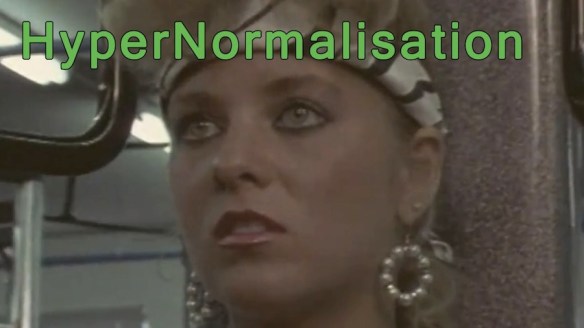
Saturday Matinee: HyperNormalisation

maxresdefault

Media, Mind-Control, & Meditation: Plato’s E-Cave Panopticon and Beyond

panopticon-image

By Mankh (Walter E. Harris III)

Source: Axis of Logic

“Relax,” said the night man,
”We are programmed to receive.
You can check-out any time you like, 
But you can never leave!”

 – The Eagles, from “Hotel California”

In Plato’s Allegory of the Cave, people saw a shadow play on the wall and perceived it as reality. Today that Cave has morphed to provide umpteen TV channels and mini-screen gadgets; and the once sanctified living room cave has expanded into a free-range bubble of consciousness – heads bowed before an electronic altar, seemingly oblivious to the outside world.

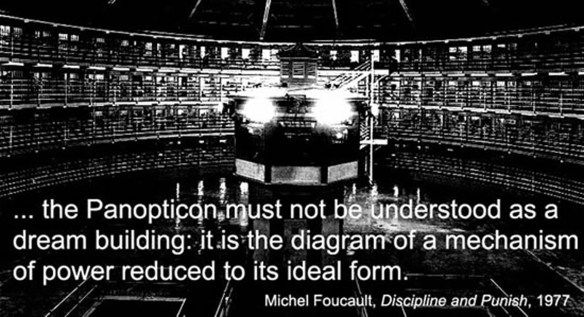
“The “panopticon” refers to an experimental laboratory of power in which behaviour could be modified, and Foucault viewed the panopticon as a symbol of the disciplinary society of surveillance.”[1]

In Plato’s E-Cave, not only are the people watching a shadow play, they, and the shadows they watch, are being watched.

HyperNormalization
With a veneer of calm aplomb, the masses communicate 24-7, often in a frenetic urgency of the mundane, hence one interpretation of HyperNormalization. In all the years of overhearing cell-phone conversations in public, I can’t recall one snippet of philosophy or practical advice, rather stuff like, ‘yeah OMG I’ll get the chips!’ and ‘I’ll be there in like 30 seconds!’; if you’re old enough, you’d remember the days when, you got there when you got there! That said, a cell-phone can be a helpful even life-saving device.

The USEmpire election appears to have both proven and disproven the main theory of Adam Curtis’ fascinating new documentary “HyperNormalization.”

“Curtis argues that since the 1970s, governments, financiers, and technological utopians have given up on the complex “real world” and built a simple “fake world” that is run by corporations and kept stable by politicians.”[2]

The California cyber-tech-boom was a love-child of LSD-consciousness that found refuge in E-wizardy all the while looking to escape repressive politics. In his book “2030” Pepe Escobar describes it as: “Digital network capitalism would then shape post-modern globalization, from the New Economy before the end of the millennium to every digital wall to be broken beyond. California cosmology forged our world.”

According to Wikipedia:

“The term “hypernormalisation” is taken from Alexei Yurchak’s 2006 book Everything was Forever, Until it was No More: The Last Soviet Generation, about the paradoxes of life in the Soviet Union during the 20 years before it collapsed. A professor of anthropology at the University of California, Berkeley, he argues that everyone knew the system was failing, but as no one could imagine any alternative to the status quo, politicians and citizens were resigned to maintaining a pretence of a functioning society. Over time, this delusion became a self-fulfilling prophecy and the “fakeness” was accepted by everyone as real, an effect which Yurchak termed “hypernormalisation”.”[3]

First off, I see HyperNormalization as a half-truth because while the self-referential, gossipy world is fake, it is a veneer for a very real world of resource extraction and the violence perpetrated to maintain the status quo – and that is what the fakers ignore. As far as the election, many expected the Clinton dynasty to prevail as the corrupt, business as usual lesser of two evils. Breaking snooze: Where’s  the headline news that Melania Trump plans to focus on helping women and children?; I saw that mentioned on CNN’s Anderson Cooper 360, such a perfect antidote for Hillary’s loss and The Donald’s anti-feminist track record.

Even though WikiLeaks revealed the DNC (Democratic National Convention) was rigged against Sanders and leaks of Podesta/Clinton e-mails may have been proverbial straws for Hillary’s campaign camel, the prevailing media sentiment was that she would win – despite the fact that the day before the election some polls indicated a shrinking 3-4 point lead, thus with the typical margin of error, it was, in effect, tied. Yet the mass hyper-surprise!; and all that after the corporate media and comedy shows had simultaneously bashed Trump and given him more air-time than a kite on a windy day – both disdaining and elevating him, a media-mindfuck if ever there was one.

And there was little uproar when Gary Johnson and Jill Stein were excluded from debates and virtually banned from all corporate news, thus proving (if you didn’t know already) that it’s not a truly democratic election. Yet carry on we must and do the best we can with what we got, was the general sentiment, in other words, “the “fakeness” was accepted by everyone as real” aka HyperNormalization.

Yet the non-coastal, poor and middle America White working class (with sides of KKK and minorities!), which reportedly was the key demographic for The Don’s victory, was voting out of bare-bones needs; in effect they were not HyperNormalized. Then again, if Trump, who promises to challenge the status quo, caves-in to Deep State pressure, we will have an answer to an interesting article’s titular question: “President Trump: big liar going to Washington or Tribune of the People?”[4] And if that answer is the former, then the mostly White working poor will also have been duped/HyperNormalized.

You see, it’s hard to know what’s what; which all seems to prove HyperNormalization as the dominant societal charade; which screen is real, if any?

What you perceive is what you get
Another key phrase in Curtis’ documentary is “managed perception” – akin to Chomsky and Herman’s  “Manufacturing Consent: The Political Economy of the Mass Media” (1988) which showed how opinions and desensitized agreement to the status quo became a product to be mined and marketed. Witness CBS Chairman Les Moonves’ comment from February 2016:

“Man, who would have expected the ride we’re all having right now? … The money’s rolling in and this is fun. I’ve never seen anything like this, and this [is] going to be a very good year for us. Sorry. It’s a terrible thing to say. But, bring it on, Donald. Keep going.” [5] And, if i might satirically add, like an orangey topped Duracell battery, The Don does seem to have a lot of energy.

HyperNormalization is also akin to Sheldon Wolin’s theory  of “inverted totalitarianism,” where the faceless corporate machine wields so much entertainment and bureaucratic power that the people barely notice they are being played hook, line, and sinking feelings.

Some of Curtis’ info, however, is inaccurate or questionable. For examples, he blames the demise of the Occupy Movement on lack of vision and planning yet neglects to mention the FBI coordinated systemic crackdown on the ‘camps’ across the country. [6]

About Syria he says that President Bashar al-Assad retaliated with a “vengeful fury,” whereas Assad has defended his actions as self-defense for his people; numerous journalists back the Syrian President’s claim.

Post-election, I wonder: Why were so many liberals, lefties, and women more surprised that Trump won than that the DNC/HRC rigged it against Sanders? Were they simply feeling impotent due to HyperNormalized shadow play? Whatever the case, his victory revealed a crack in the smooth screen of HyperNormalization.

According to Patrick Caddell’s survey before the election, the populace seems to be hip to what’s happening:

“Powerful interests from Wall Street banks to corporations, unions and political interest groups have used campaign and lobbying money to rig the system for them. They are looting the national treasury of billions of dollars at the expense of every man, woman and child. AGREE = 81%; DISAGREE = 13%…

“The country is run by an alliance of incumbent politicians, media pundits, lobbyists and other powerful money interests for their own gain at the expense of the American people. AGREE = 87%; DISAGREE = 10%

The real struggle for America is not between Democrats and Republicans but between mainstream American and the ruling political elites. AGREE = 67%; DISAGREE = 24%.” [7]

This makes it seem it is the ‘how-to bring about change’ that is the deeper conundrum of the HyperNormalized world. Then again, people too often seem to have only their own best interests at heart. Approximately 90% of Americans want their food labeled so as to know if they contain GMOs etc. or not, yet hardly a peep out of anyone that climate change or the “environment” aka Mother Earth & Nature-beings were deliberately excluded as a main topic of the presidential debates. This makes it seem that, in general, Americans want clean food for themselves, they want a clean environment so they can go ‘play in the park’ by themselves. And that brings us to the Great Disconnect and Standing Rock.

Flow like water, be steady as a rock
Part of HyperNormalization is a disconnect from Nature and from being self- and community-guided, and therefore disconnected from the Original Peoples of Turtle Island. While many people are certainly aware of what’s happening with Standing Rock, the corporate media’s lack of attention, let alone empathy, fosters lack of concern for the outcome, lack of being outraged by the violent and racist treatment of those in prayer and peacefully protecting the main source of water for the Standing Rock Sioux and other Natives as well as approximately 17-million people downstream. The real-fake outrage is over the outcome of a fake election.

For many Native reservations where poverty and PTSD are prevalent, the people are anything but HyperNormalized; they are struggling to survive – as with Standing Rock, they are not asking for much: clean water and the space to live their lives with ancient traditions timelessly connected with the land, the water, the stones…

Plato, imagining a prisoner getting outside of the Cave, wrote: “Slowly, his eyes adjust to the light of the sun. First he can only see shadows. Gradually he can see the reflections of people and things in water and then later see the people and things themselves. Eventually, he is able to look at the stars and moon at night until finally he can look upon the sun itself .” [8]

Standing Rock is bringing people together, raising consciousness at many levels. As one example from a little over a week ago:

“In a “historic” show of interfaith solidarity, 500 clergy members prayed along the banks of North Dakota’s Cannonball River on Thursday where they “bore witness with the Standing Rock Sioux Nation,” which has faced intimidation, violence, and arrests for protecting their sacred land and water supply from the threats of a massive oil pipeline. According to the Episcopal News Service, “The interfaith group spent more than five hours on site, marching, singing hymns, sharing testimony, and calling others to join them in standing with the more than [300] tribes who have committed their support to the Sioux Nation as they protest the route of the Dakota Access Pipeline (DAPL).” [9]

This solidarity is in stark contrast with the election where a typically 51/49 system determines an outcome for a society literally programmed for exciting close-call winners – think sporting events,
reality shows, awards ceremonies.

Outside in and inside out
There are many ways to get outside the Cave. One of those is by going within. When I first started to meditate, as is common, I became aware of the constant chatter in my head and soon realized that the mind left unattended will rattle on endlessly. Meditation then showed me that once the chatter quiets, one then has access to other frequencies, other ‘channels’ – what happens then is a very personal matter yet also impersonal because one becomes connected with another source of thinking-seeing-feeling. Chatter, like cell-phones, has it’s usefulness, say, if you forgot to turn the stove off. My point to the personal anecdote is that the corporate media is too much chatter, endlessly looping itself. The gadgets, too, though useful, seem hard-wired for HyperNormalization.

Some of the chatter we must live with, yet by learning to follow our intuitions, listening to and connecting with Nature, talking with elders and little children we can better tune-out from the shadow-play, we can find new and ancient ways for more people – and that includes trees, rivers, etc. –  “to look at the stars and moon at night” and “look upon the sun itself.”

“Sin filo ya y derrotada se quejó: Soy más fuerte que ella, pero no le puedo hacer daño y ella a mi, sin pelear. me ha vencido.’”

“Without sharpness and defeated, it [the sword] complained: ‘I am stronger than the water, but I cannot harm her. And the water, without fighting, has conquered me.’” [10]

NOTES:
1.    Panopticism here and here.
2.    Ibid.
3.    HyperNormalization
4.    See here.
5.    “Les Moonves: Trump’s run is ‘damn good for CBS’”. See here.
6.    “Revealed: how the FBI coordinated the crackdown on Occupy
7.    “Patrick Caddell; The Pollster Who ‘Got it Right’
8.    “Allegory of the Cave
9.    “A Prayer for People and Planet: 500 Clergy Hold ‘Historic’ Mass Gathering for Standing Rock
10.    “Questions & Swords: Folktales of the Zapatista Revolution” as told by Subcomandante Marcos, Cino Puntos Press, El Paso, Texas, 2001, p.82.

To watch “HyperNormalization”, click here.

Mankh (Walter E. Harris III) is an essayist and resident poet on Axis of Logic. In addition to his work as a writer, he is a small press publisher and Turtle Islander. His new book of genre-bending poetic-nonfiction is “Musings With The Golden Sparrow.” You can contact him via his literary website.

  

Review: The Utopia of Rules, by David Graeber

index

By Jonathan Woolley

Source: Gods & Radicals

Reading a book about bureaucracy may not sound like an exciting way to spend a weekend off with my family. And yet, having just started David Graeber’s latest – A Utopia of Rules – when I wasn’t making tea for my elderly grandmother, I curled up in a comfy chair with this little pink book, mocked up to look like one of the forms it excoriates, and excited by each new page. Although many of the ideas Graeber presents here aren’t new, the clarity and force with which they are drawn together and set out is a rare pleasure – a contrast with turgid official paperwork that was almost certainly intentional.

Graeber – a social anthropologist, anarchist, and prominent leftist thinker, based at the London School of Economics (LSE) – develops his argument, in part, by thinking ethnographically with his own personal experiences of officialdom, beginning with a heartbreaking account of his own struggle to deal with his elderly mother’s Medicaid application. In response to this, he introduces the book as a series of short essays on different facets of what he calls “total bureaucratisation” – defined as “the gradual fusion of public and private power into a single entity, rife with rules and regulations whose ultimate purpose is to extract wealth in the form of profits”. Bureaucracy is not a simple matter of red-tape created by the state tying up private enterprise, as right-wing pundits would have us believe: Graeber points out that bureaucratic forms have become intrinsic to both private and public spheres.

While the Left has been largely unable to produce a critique of bureaucracy, the Right has such a critique – but efforts to “roll back” the state by the Right have had the opposite effect, producing even more paperwork than ever. This leads Graeber to propose what he calls “the Iron Law of Liberalism”, which states that “any market reform, any government initiative intended to reduce red tape and promote market forces will have the ultimate effect of increasing the total number of regulations, the total amount of paperwork, and the total number of bureaucrats the government employs.”

In stressing the coeval nature of the free market and an expansive state, Graeber directs his analysis away from shallow criticism of big government, towards the common institutional basis of all inequality, found at the heart of neoliberal governance. Given the extent to which the general public in the English-speaking world continue to view the expansive state and the “free” market as antithetical to one another and synonymous with the Left and the Right of politics respectively, this is an important point to make.

With the foundations laid, Graeber’s lucid prose carries the reader briskly through a sequence of stand-alone essays, each of which engages with a particular aspect of total bureaucratisation today. Each of these, Graeber claims, will need to be addressed by any critique of bureaucracy the Left might develop. Dead Zones of the Imagination utilises feminist theory of imaginative labour to develop the argument that bureaucracy – in addition to being stupid – exists to create stupidity. Its impersonal procedures, backed up by threat of violence, ensure that those in positions of authority – especially the police – are able to avoid doing the imaginative labour of empathising with others, while forcing those others to engage in imaginative labour towards the authorities, simply in order to avoid physical harm. Police insist upon being able to “define the situation” – those who contest this, rather than violent criminals, are the ones who are routinely meet with physical violence. This serves to emphasise a very basic point: don’t underestimate the importance of physical violence, even if it takes place behind a veil of paper.

In Of Flying Cars and the Declining Rate of Profit, Graeber turns his attention to the trajectory of technological development in the modern world. Why is it, he asks, that in the 1950s we were able to explore space, and expected to be surrounded by robotic servants and flying cars by now, but that this awesome potential has not been realised? The answer, he suggests, is that rather than cause social change by itself, the direction of technological innovation is directed by financial interests – so that instead of pursuing automation and space travel that could disrupt existing economic relations on Earth, major funders have prioritised less disruptive research lines, such as information technology. The greatest achievement of the late 20th century – the Internet – is revealed as decidedly chimeric; both a tool for enhanced communication, but also a means of surveillance and manipulation on an industrial scale. The promise of technology has been broken in favour of labour discipline and social control; R&D budgets have been slashed in favour of boosting executive pay and shareholder dividends. Instead of being allowed to pursue their research interests, academics are increasingly forced to spend more and more of their time doing paperwork. Rather than a driver of social change, technology is itself subject to the demands of capital.

The Utopia of Rules, or Why We Really Love Bureaucracy After All concludes the triptych, by exploring the ways in which bureaucracy can, in fact, be deeply enchanting – when it works well – providing human beings with a sense of predictability and certainty that can be deeply seductive. While the second essay uses science fiction to reflect upon the curious falling short of innovation, this essay turns to magic and fantasy fiction in an attempt to understand how the appeal of bureaucratic rationality is generated. Graeber argues that the elaborate angelic hierarchies and formulaic modes of ritual address, developed in the Rennaissance but that now enliven Western Ceremonial Magic, actually reflect a political imaginary – a vision of the chaotic, violent world of the Middle ages reordered according to a spiritualised version of the old, lost, Roman bureaucracy. Nowadays, however, this vision is inverted – fantasy fiction today constructs a pseudo-Medieval world, where bureaucracy is almost entirely absent, where creativity is directly channelled into reality via magic, and where leadership is acquired on the basis of personal virtue and conquest, rather than through impersonal qualification or graduate recruitment. However, while giving us an opportunity to vicariously enjoy a world without bureaucracy, medievalist fantasies – with their perennial sense of threat and danger – nonetheless reinforce our sense that it’s probably preferable to live with the devil we know. Just as the gruesome spectacle of Gladitorial combat both beguiled and repulsed the populace of Rome from the idea of democracy, the blood-soaked cities of Westeros instil in us a fear of a world without bureaucratic order.

Perhaps the most fascinating contestation made by Graeber – albeit, only in passing – is that bureaucratic rationality rests upon a resolutely spiritual set of commitments. The idea that numbers and their rational appraisal can help one to understand and manipulate reality, reaches back to the Pythagoreanism of ancient Greece. They, in turn, directly inspired Plato, the father of Western formalism, and in turn the Medieval angelic hierarchies mentioned above. This commitment to the power of logic and pure numbers conferred upon bureaucracy a utopian air; bureaucrats envision a world of perfect harmony, governed by well-designed, efficient institutions, and develop frameworks that attempt to make that world a reality. The fact that the complexity of the world-as-lived rarely fits these lofty ideals ensures that bureaucracy requires constant enforcement – with the force in question being the threat of violence meted out by private security, the police or the military.

But it is in the Appendix – Batman and the Problem of Constituent Power – that we find some of Graeber’s most timely observations for the present moment. In a playful analysis of the cultural and political significance of superheroes, Graeber points out that – building upon his analysis of medievalist fantasy in the previous chapter – comics teach the same kind of lesson. In pitting basically passive superheroes who seek to preserve the status quo against endlessly creative and scheming villains who wish to unseat it, comics allow the reader to vicariously enjoy the thrill of unfettered creative potential, only to enforce the idea that such potential necessarily leads to violence, and that violence is in turn the only way that it can be controlled.

In the Marvel and DC Universes, the only alternative to bureaucracy is violent creativity of villains – in short, fascism. This, in turn, allows Graeber to highlight a broad distinction between the left and the right: “Ultimately, the division between left-and right-wing sensibilities turns on one’s attitude towards the imagination. For the Left, imagination, creativity, by extension production, the power to bring new things and new social arrangements into being, is always to be celebrated. It is the source of all real value in the world. For the Right, it is dangerous; ultimately, evil. The urge to create is also a destructive urge. This kind of sensibility was rife in the popular Freudianism of the day [1950s]: where the Id was the motor of the psyche, but also amoral; if really unleashed, it would lead to an orgy of destruction. This is also what separates conservatives from fascists. Both agree that the imagination unleashed can only lead to violence and destruction. Conservatives wish to defend us against that possibility. Fascists wish to unleash it anyway. They aspire to be, as Hitler imagined himself, great artists painting with the minds, blood, and sinews of humanity.”

Following from the magistral philosophical treatise Debt: The First 5,000 years (2011), The Utopia of Rules is a more modest project. Graeber does not attempt to propose a leftist critique of total bureaucratisation within its pages, though he argues such a critique is long overdue. Nor does he advance a singular argument – his goal is simply to prompt a conversation. With the rise of the populist right, this conversation is more important than ever. The mainstream Left, Graeber points out, has for too long positioned itself on the side of state control, leaving critiques of bureaucracy to the Right. As the pro-market efforts of neoliberalism have done nothing but concentrate capital in the hands of the rentier classes, the frustration is now boiling over. And yet, in unveiling the mystical roots of stultifying modern paperwork, Graeber reveals a way forward for us – if total bureaucratisation is a spell laid over the world, that spell may be broken. We need not live out the fevered dreams of Renaissance mystics; we can awaken. Nor shall the dark blood and bone portraits of fascists necessarily hold sway over the human imagination, for the Left is just as creative as the right; indeed, unlike them, we can create without fear of creativity. The Right may aspire to break this world, but it is the birthright of the Left to make a better one.

Millions Around the World Fleeing from Neoliberal Policy

Source: The Real News Network

Economist Michael Hudson says neoliberal policy will pressure U.S. citizens to emigrate, just as it caused millions to leave Russia, the Baltic States, and now Greece in search of a better life.

A research team from Columbia University’s Mailman School of Public Health in New York estimates 875,000 deaths in the United States in year 2000 could be attributed to social factors related to poverty and income inequality.

According to U.S. government statistics, 2.45 million Americans died in the same year. When compared to the Columbia research team’s finding, social deprivation could account for some 36% of the total deaths in 2000.

“Almost all of the British economists of the late 18th century said when you have poverty, when you have a transfer of wealth to the rich, you’re going to have shorter lifespans, and you’re also going to have emigration,” says Michael Hudson, Distinguished Research Professor of Economics at the University of Missouri-Kansas City.

Many countries, such as Russia, the Baltic States, and now Greece, have seen a massive outflow of their populations due to worsening social conditions after the implementation of neoliberal policy.

Hudson predicts the United States will undergo the same trend, as greater hardship results from the passage of the Trans-Pacific Partnership, changes to social security, and broader policy shifts due to prospective appointments to the U.S. Supreme Court and the next presidential cabinet.

“Now, the question is, in America, now that you’re having as a result of this polarization shorter lifespans, worse health, worse diets, where are the Americans going to emigrate? Nobody can figure that one out yet,” says Hudson.

Transcript

SHARMINI PERIES, TRNN: It’s the Real News Network. I’m Sharmini Peries coming to you from Baltimore.

After decades of sustained attacks on social programs and consistently high unemployment rates, it is no surprise that mortality rates in the country have increased. A research team from Columbia University’s Mailman School of Public Health in New York has estimated that 875,000 deaths in the United States in the year 2000 could be attributed to clusters of social factors bound up with poverty and income inequality. According to U.S. government statistics, some 2.45 million Americans died in the year 2000, thus the researchers’ estimate means that social deprivation was responsible for some 36 percent of the total deaths that year. A staggering total.

Now joining us to discuss all of this from New York City is Michael Hudson. Michael is a Distinguished Research Professor of Economics at the University of Missouri Kansas City. His latest book is Killing the Host: How Financial Parasites and Debt Bondage Destroy the Global Economy. Michael, good to have you with us.

MICHAEL HUDSON: Good to be back here.

PERIES: So, Michael, what do you make of these recent research and what it’s telling us about the death total in this country?

HUDSON: What it tells is almost identical to what has already been narrated for Russia and Greece. And what’s responsible for the increasing death rates is actually neoliberal economic policy, neoliberal trade policy, and the polarization and impoverishment of a large part of society. After the Soviet Union broke up in 1991, death rates soared, lifespans shortened, health standards decreased all throughout the Yeltsin administration, until finally President Putin came in and stabilized matters. Putin said that the destruction caused by neoliberal economic policies had killed more Russians than all of whom died in World War II, the 22 million people. That’s the devastation that polarization caused there.

Same thing in Greece. In the last five years, Greek lifespans have shortened. They’re getting sicker, they’re dying faster, they’re not healthy. Almost all of the British economists of the late 18th century said when you have poverty, when you have a transfer of wealth to the rich, you’re going to have shorter lifespans, and you’re also going to have immigration. The countries that have a hard money policy, a creditor policy, people are going to emigrate. Now, at that time that was why England was gaining immigrants. It was gaining skilled labor. It was gaining people to work in its industry because other countries were still in the post-feudal system and were driving them out. Russia had a huge emigration of skilled labor, largely to Germany and to the United States, especially in information technology. Greece has a heavy outflow of labor. The Baltic states have had almost a 10 percent decline in their population in the last decade as a result of their neoliberal policies. Also, health problems are rising.

Now, the question is, in America, now that you’re having as a result of this polarization shorter lifespans, worse health, worse diets, where are the Americans going to emigrate? Nobody can figure that one out yet. There’s no, seems nowhere for them to go, because they don’t speak a foreign language. The Russians, the Greeks, most Europeans all somehow have to learn English in school. They’’re able to get by in other countries. They’re not sure where on earth can the Americans come from? Nobody can really figure this out.

And the amazing thing, what’s going to make this worse, is the trade, the Trans-Pacific trade agreement, and the counterpart with the Atlantic states. In today’s news there’s news that President Obama plans to make a big push for the Trans-Pacific trade agreement, essentially the giveaway to corporations preventing governments from environmental protection, preventing them from imposing health standards, preventing them from having cigarette warnings or warning about bad food. Obama says he wants to push this in after the election. And the plan is the Republicans also are sort of working with them and saying okay, we’re going to wait and see. Maybe Donald Trump will come in and he’ll really do things. Or maybe we can get Hillary, who will move way further to the right than any Republican could, and bring the Congress.

But let’s say that we don’t know what’s happening after the elections, and the Republicans don’t want a risk. They’re going to do a number of things. They’re going to approve Obama’s Republican nominee to the Supreme Court that he’s already done, figuring, well, maybe Hillary will put in someone worse, or even Trump may put in someone worse. They may go along, at this point, with ratifying a trade agreement that’s going to vastly increase unemployment here, especially in industrial labor, turning much of the American industrial urban complex into a rust belt. And they’’re also talking about an October surprise or an early November surprise. It’s the last chance that Obama has, really, to start a war with Russia.

And there’s Stephen Cohen and a number of other sites have warned that there’s going to be a danger when they put in the atomic weapons in Romania. President Putin has said this is a red line. We’re not going to warn. We don’t have an army. We can only use atomic weapons. So you have danger coming not only from domestic decline in population, you have a real chance of war. And Obama has stepped things up. Hillary has, I think, almost announced that she is going to appoint Victoria Nuland as secretary of state, and Nuland is the person who was pushing the Ukrainian fascists in the [inaud.] assassinations and shootout.

So it looks, this trend looks very bad. If you want to see where America is going demographically, best to look at Greece, Latvia, Russia, and also in England. A Dr. Miller has done studies of health and longevity, and he’s found that the lower the income status of any group in England, the shorter the lifespan. Now, this is very important for the current debate about Social Security. You’’re having people talk about extending the Social Security age because people are living longer. Who’s living longer in America? The rich are living longer. The wealthy are living longer. But if you make under $30,000 a year, or even under $50,000 a year, you’re not living longer.

So the idea is how do we avoid having to pay Social Security for the lower-income people, you know, the middle class and the working class that die quicker, and only pay social security for the wealthier classes that live longer? Nobody’s somehow plugged this discussion of lifespans and longevity into the Social Security debate that Obama and Hillary are trying to raise the retirement age, to ostensibly save Social Security. By save Social Security she means to avoid taxing the higher brackets and paying for Social Security out of the general budget, which of course would entail taxing the higher-income people as well as the lower-income people.

PERIES: All right, Michael. Thank you for your report today, and we look forward to seeing you next week.

HUDSON: Thank you.

PERIES: And thank you for joining us on the Real News Network.

End


Michael Hudson is a Distinguished Research Professor of Economics at the University of Missouri, Kansas City. He is the author of The Bubble and Beyond and Finance Capitalism and its Discontents. His most recent book is titled Killing the Host: How Financial Parasites and Debt Bondage Destroy the Global Economy.

Nonviolent Action: Why and How it Works

marcha_sal3

Nonviolent action is extremely powerful.

Unfortunately, however, activists do not always understand why
nonviolence is so powerful and they design ‘direct actions’ that are
virtually powerless.

I would like to start by posing two questions. Why is nonviolent action
so powerful? And why is using it strategically so transformative?

When an activist group is working on an issue – such as a national
liberation struggle, war, the climate catastrophe, violence against
women and/or children, nuclear weapons, drone killings, rainforest
destruction, encroachments on indigenous land – they will often plan an
action that is intended to physically halt an activity, such as the
activities of a military base, the loading of a coal ship, the work of a
bulldozer, the building of an oil pipeline. Their plan might also
include using one or more of a variety of techniques such as locking
themselves to a piece of equipment (‘locking-on’) to prevent it from
being used. Separately or in addition, they might use secrecy both in
their planning and execution so that they are able to carry out the
action before police or military personnel prevent them from doing so.

Unfortunately, the focus on physical outcomes (including actions such as
‘locking-on’ and its many equivalents), and the secrecy necessary to
carry out their plan, all functionally undermine the power of their
action. Why is this? Let me explain how and why nonviolent action works
so that it is clear why any nonviolent activist who understands the
dynamics of nonviolent action is unconcerned about the immediate
physical outcome of their action (and what is necessary to achieve
that).

If you think of your nonviolent action as a physical act, then you will
tend to focus your attention on securing a physical outcome from your
planned action: to prevent the military from occupying a location, to
stop a bulldozer from knocking down trees, to halt the work at an oil
terminal or nuclear power station, to prevent construction equipment
being moved on site. Of course, it is simple enough to plan a nonviolent
action that will do any of these things for a period of time and there
are many possible actions that might achieve it.

But if you pause to consider how your nonviolent action might have
psychological and political impact that leads to lasting or even
permanent change on the issue in question but also society as a whole,
then your conception of what you might do will be both expanded and
deepened. And you will be starting to think strategically about what it
means to mobilise large numbers of people to think and behave
differently.

After all, whatever the immediate focus of your action, it is only ever
one step in the direction of more profound change. And this profound
change must include a lasting change in prevailing ideas and a lasting
change in ‘normal’ behaviour by substantial (and perhaps even vast)
numbers of people. Or you will be back tomorrow, the day after and so on
until you get tired of doing something without result, as routinely
happens in campaigns that ‘go nowhere’ (as so many do).

So why does nonviolent action work?

Fundamentally, nonviolent action works because of its capacity to create
a favourable political atmosphere (because of, for example, the way in
which activist honesty builds trust), its capacity to create a
non-threatening physical environment (because of the nonviolent
discipline of the activists), and its capacity to alter the human
psychological conditions (both innate and learned) that make people
resist new ideas in the first place. This includes its capacity to
reduce or eliminate fear and its capacity to ‘humanise’ activists in the
eyes of more conservative sections of the community. In essence,
nonviolent activists precipitate change because people are inspired by
the honesty, discipline, integrity, courage and determination of the
activists – despite arrests, beatings or imprisonment – and are thus
inclined to identify with them. Moreover, as an extension of this, they
are inclined to change their behaviour to act in solidarity.

It is for this reason too that a nonviolent action should always make
explicit what behavioural change it is asking of people. Whether
communicated in news conferences or via the various media, painted on
banners or in other ways, a nonviolent action group should clearly
communicate powerful actions that individuals can take. For example, a
climate action group should consistently convey the messages to ‘Save
the Climate: Become a Vegan/Vegetarian’, ‘Save the Climate: Boycott
Cars’ and, like a rainforest action group, ‘Don’t Buy Rainforest
Timber’. A peace group should consistently convey such messages as
‘Don’t Pay Taxes for War’ and ‘Divest from the Weapons Industry’ (among
many other possibilities). Groups resisting the nuclear fuel cycle and
fossil fuel industry in their many manifestations should consistently
convey brief messages that encourage reduced consumption and a shift to
more self-reliant renewable energies. See, for example, ‘The Flame Tree
Project to Save Life on Earth’. Groups struggling to defend or reinstate indigenous sovereignty should convey compelling messages that explain what people can do in their particular context.

It is important that these messages require powerful personal action,
not token responses. And it is important that these actions should not
be directed at elites or lobbying elites. Elites will fall into line
when we have mobilized enough people so that they are compelled to do as
we wish. And not before. At the end of the Salt March in 1930 Gandhi
picked up a handful of salt on the beach at Dandi. This was the signal
for Indians everywhere to start collecting their own salt in violation
of British law. In subsequent campaigns Gandhi called for Indians to
boycott British cloth and make their own khadi (handwoven cloth). These
actions were strategically focused because they undermined the
profitability of British colonialism in India and nurtured Indian
self-reliance.

A key reason why Mohandas K. Gandhi was that rarest of combinations – a
master nonviolent strategist and a master nonviolent tactician – was
because he understood the psychology of nonviolence and how to make it
have political impact. Let me illustrate this point by using the
nonviolent raid on the Dharasana salt works, the nonviolent action he
planned as a sequel to the more famous Salt March in 1930.

On 4 May 1930 Gandhi wrote to Lord Irwin, Viceroy of India, advising his
intention to lead a party of nonviolent activists to raid the Dharasana
Salt Works to collect salt and thus intervene against the law
prohibiting Indians from collecting their own salt. Gandhi was
immediately arrested, as were many other prominent nationalist leaders
such as Jawaharlal Nehru and Vallabhbhai Patel.

Nevertheless, having planned for this contingency, under a succession of
leaders (who were also progressively arrested) the raid went ahead as
planned with hundreds of Indian satyagrahis (nonviolent activists)
attempting to nonviolently invade the salt works. However, despite
repeated attempts by these activists to walk into the salt works during
a three week period, not one activist got a pinch of salt! Moreover,
hundreds of satyagrahis were injured, many receiving fractured skulls or
shoulders, and two were killed.

But an account of the activists’ nonviolent discipline, commitment and
courage – under the steel-tipped lathi (baton) blows of the police – was
reported in 1,350 newspapers around the world. As a result, this
nonviolent action – which ‘failed’ to achieve the stated physical
objective of seizing salt – functionally undermined support for British
imperialism in India. For an account of the salt raids at Dharasana, see
Thomas Weber. ‘”The Marchers Simply Walked Forward Until Struck Down”:
Nonviolent Suffering and Conversion’

If the activists had been preoccupied with the physical seizure of salt
and, perhaps, resorted to the use of secrecy to get it, there would have
been no chance to demonstrate their honesty, integrity, courage and
determination – and to thus inspire empathy for their cause – although
they might have got some salt! (Of course, if salt had been removed
secretly, the British government could, if they had chosen, ignored it:
after all, who would have known or cared? However, they could not afford
to let the satyagrahis take salt openly because salt removal was illegal
and failure to react would have shown the salt law – a law that
represented the antithesis of Indian independence – to be ineffective.)

In summary, nonviolent activists who think strategically understand that
strategic effectiveness is unrelated to whether or not the action is
physically successful (provided it is strategically selected,
well-designed so that it elicits one or other of the intended responses,
and sincerely attempted). Psychological, and hence political, impact is
gained by demonstrating qualities that inspire others and move them to
act personally too. For this reason, among several others, secrecy (and
the fear that drives it) is counterproductive if strategic impact is
your intention.

If you are interested in planning effective nonviolent actions, a
related article also explains the vital distinction between ‘The
Political Objective and Strategic Goal of Nonviolent Actions’.

And if you are concerned about violent military or police responses,
have a look at ‘Nonviolent Action: Minimizing the Risk of Violent
Repression’.

For those of you who are interested in planning and acting strategically
in your nonviolent struggle, whatever its focus, you might be interested
in one or the other of these two websites: Nonviolent Campaign Strategy and Nonviolent Defense/Liberation Strategy.

And if you are interested in being part of the worldwide movement to end
all violence, you are welcome to sign the online pledge of ‘The People’s
Charter to Create a Nonviolent World’.

Struggles for peace, justice, sustainability and liberation often fail.
Almost invariably, this is due to the failure to understand the
psychology, politics and strategy of nonviolence. It is not complicated
but it requires a little time to learn.


Biodata: Robert J. Burrowes has a lifetime commitment to understanding and ending human violence. He has done extensive research since 1966 in an effort to understand why human beings are violent and has been a nonviolent activist since 1981. He is the author of ‘Why Violence?‘ His email address is flametree@riseup.netand his website is at http://robertjburrowes.wordpress.com

Robert J. Burrowes
P.O. Box 68
Daylesford
Victoria 3460
Australia
Email: flametree@riseup.net

Websites:
Nonviolence Charter
Flame Tree Project to Save Life on Earth
‘Why Violence?’
Nonviolent Campaign Strategy
Nonviolent Defense/Liberation Strategy
Anita: Songs of Nonviolence
Robert Burrowes
Global Nonviolence Network