Saturday Matinee: Bringing Out the Dead

“Bringing Out the Dead” (1999) is the fourth collaboration between director Martin Scorsese and screenwriter Paul Schrader (and their most underrated). Based on a novel by Joe Connelly, the plot follows New York paramedic Frank Pierce (Nicolas Cage), who’s on the verge of a nervous breakdown as he struggles to save a steady stream of victims of a heroin plague in the early 90s. As could be expected, the film is full of grim and harrowing situations but is punctuated by darkly humorous moments as well. Given the current wave of opiate overdoses caused primarily by the drug war and big pharma, Bringing Out the Dead is unfortunately more topical than ever.

Watch the full film here.

The Unifying Force of War Abolition

By David Swanson

Source: Let’s Try Democracy

Remarks at United National Antiwar Coalition in Richmond, Virginia, on June 18, 2017.

It’s not unusual for an activist, focused on one of the millions of worthy causes out there, to try to recruit other activists to that particular cause. That’s not exactly what I want to do. For one thing, if we are going to succeed we are going to have to recruit millions of new people into activism who are not now active at all.

Of course I do favor types of activism that eliminate the need for more activism, such as campaigns to make voter registration automatic or to index the minimum wage to the cost of living. But for the most part I want everyone to keep doing what inspires them. Only, I think I know a way to shift our emphases and unite out movements, a way that doesn’t usually occur to us.

It’s not unusual for an activist to think that their particular field is the unifying top priority.

For example:

If we don’t get the money out of politics how can we enact or enforce any laws not favored by money? We’ve legalized bribery for godsake! What else matters until we fix that?

Or:

If we don’t create credible democratic independent media, we can’t communicate. Door knocking can’t defeat television. We only know that Cindy Sheehan went to Crawford or Occupyers went to Wall Street because corporate television chose to tell us. Why have elections if we can’t tell the truth about the candidates?

Or:

Excuse me, the earth is cooking. Our species and many others are losing their habitats. If it’s not already too late, now is the time to decide whether we will have great grandchildren at all. If we don’t have any, what will it matter what kind of elections or television networks they have?

One can go on and on in this vein, as well as in claiming that one societal evil precedes and causes another. Racism or militarism or extreme materialism is the disease and the others are the symptoms.

All of this is also not exactly what I want to do. I want us to work on everything and use every means of unifying. I want us to recognize how each problem contributes to others and vice versa. Hungry scared people can’t end climate change. A culture that puts a trillion dollars a year into mass-killing of distant dark-skinned people can’t build schools or end racism. Unless we redistribute wealth, we cannot redistribute power. We can’t create media unless we have something important to say. We can’t protect the earth’s climate while steadfastly ignoring the top consumer of petroleum on earth because criticizing the military would be inappropriate. But we will go on ignoring it if we don’t create good media. We have to do it all, and there are various ways in which we can become more united, more strategic, and potentially more effective.

The way that I think we don’t pay enough attention to lies in developing a focus on complete and total war abolition, elimination of all weapons and militaries, all bases, all aircraft carriers, missiles, armed drones, generals, colonels, and if necessary all senators from Arizona.

Why war abolition? I’ll give you 10 reasons.

  1. It actually makes sense. The reasonable position of opposing some wars and cheering for others, but cheering for the troops even in the bad wars doesn’t attract a lot of energy because it doesn’t make any sense. Jeremy Corbyn just won votes by pointing out that wars generate terrorism, they are counter-productive on their own terms, endangering us rather than protecting us. They need to be replaced with diplomacy, aid, cooperation, the rule of law, the tools of nonviolence, the skills of de-escalation of conflict. Claiming that wars are sort of good but shouldn’t be overdone makes no sense at all — what is the point of them if not to win them? And if wars make murder OK, why is torture so unacceptable? And if bombs dropped by piloted planes are OK, what’s wrong with drones? And if Anthrax is barbaric, why are White Phosphrous and Napalm civilized? None of it makes any sense, which is one reason the top killer of U.S. troops is suicide. You know how to properly love the troops, end all war and give them life options that don’t make them want to kill themselves.
  2. Nuclear apocalypse is a growing danger on a par with climate chaos and will continue to grow unless war abolition succeeds.
  3. The biggest destroyer of water, air, land, and atmosphere that we have is militarism. It’s war or planet. Time to choose.
  4. War kills first and foremost by removing resources from where they are needed, including from famines and disease epidemics created by war. Any activism that seeks funding for any human or environmental needs has to look to ending war. It is where all the money is, more money every single year than could be taken once and only once from the billionaires.
  5. War creates secrecy, surveillance, classification of public business, warrantless spying on activists, patriotic lying, and illegal actions by secret agencies.
  6. War militarizes local police, making the public into an enemy.
  7. War fuels, just as it is fueled by, racism, sexism, bigotry, hatred, and domestic violence. It teaches people to solve problems by shooting guns.
  8. War divides humanity at a time when we must unite on major projects if we are to survive or prosper.
  9. A movement to abolish all war, all weapons, and all atrocities that flow out of war can unite opponents of the crimes of one government or group with the opponents of the crimes of another. Without equating all crimes with each other, we can unite as opponents of war rather than of each other.
  10. War is the primary thing our society does, it sucks down the majority of federal discretionary spending, its promotion permeates our culture. It is the very foundation of the belief that ends can justify evil means. Taking on the myths that sell us war as necessary or inevitable or glorious is an ideal way of opening our minds to rethinking what we’re doing on this little planet.

So let’s not work for an environmentally sensitive military into which women have the equal right to be drafted against their will. Let’s not oppose the weapons that are wasteful or don’t kill well enough. Let’s build a broad multi-issue movement in which one of the unifying factors is the cause of eliminating in its entirety the institution of organized mass murder.

The Globalisation of Bad Food and Poor Health: Sustainable Development or Sustainable Profits?

gmo_crops_genfood_735_350-400x190

By Colin Todhunter

Source: RINF

The proportion of deaths due to cancer around the world increased from 12 percent in 1990 to 15 percent in 2013. Globally, cancer is already the second-leading cause of death after cardiovascular diseases.

In India, government data indicates that cancer showed a 5 percent increase in prevalence between 2012 and 2014 with the number of new cases doubling between 1990 and 2013. The incidence of cancer for some major organs in India is the highest in the world. Reports have also drawn attention to rising rates of breast cancer in urban areas, and, in 2009, there was a reported increase in cancer rates in Tamil Nadu’s textile belt, possibly due to chemically contaminated water.

The increase in prevalence of diabetes is also worrying. By 2030, the number of diabetes patients in India is likely to rise to 101 million (World Health Organisation estimate). The number doubled to 63 million in 2013 from 32 million in 2000. Almost 8.2 percent of the adult male population in India has diabetes. The figure is 6.8 percent for women.

In India, almost 76,000 men and 52,000 women in the 30-69 age group died due to diabetes in 2015, according to the WHO. The organisation reports South-East Asia had a diabetic population of around 47 million, which is expected to reach 119 million by 2030.

new study in The Lancet has found that India and China continue to have the largest number of underweight people in the world; however, both countries have broken into the top five in terms of obesity.

India leads the world in terms of underweight people. Some 102 million men and 101 million women are underweight, which makes the country home to over 40 percent of the global underweight population.

Contrast this with India’s surge in obesity. In 1975, the country had 0.4 million obese men or 1.3 percent of the global obese men’s population. In 2014, it was in fifth position globally with 9.8 million obese men or 3.7 percent of the global obese men’s population. Among women, India is globally ranked third, with 20 million obese women or 5.3 percent of global population.

Although almost half the nation’s under-5s are underweight, the prevalence of underweight children in India is among the highest in the world; at the same time, the country is fast becoming the diabetes and heart disease capital of the world.

Many social and economic factors, including environmental pollution, poor working and living conditions, tobacco smoking, lack of income and economic distress, lack of access to healthcare and poverty, contribute to ill health and disease. However, conditions like cardiovascular disease and obesity have among other things been linked to sedentary lifestyles and/or certain types of diet, not least modern Western-style convenience food (discussed later).

Western junk food aside, it will be shown that even when we have access to sufficient calorific intake or seemingly nutritious and wholesome traditional diets, there is little doubt that due to the processes involved in growing and processing the food we eat, diet can be a (major) contributory factor in causing certain conditions and illnesses.

The junk food revolution, ‘free’ trade and poor health

The impact of the North American Free Trade Agreement on Mexico and the subsequent flood of cheap US processed food into the country has adversely affected the health of ordinary people. Western ‘convenience’ (junk) food has displaced more traditional-based diets and is now readily available in every neighbourhood. Increasing rates of diabetes, obesity and other health issues have followed. This report by GRAIN describes how US agribusiness and retailers have captured the market south of the border and outlines the subsequent impact on the health of Mexican people.

In Europe, due to the ‘harmonisation’ of food regulatory standards, the Transatlantic Trade and Investment Partnership (TTIP) could seriously impact the health of Europeans. Washington wants Europe to eliminate all restrictions on imports of food from the US and to adopt a US-style food supply regulatory regime, stripped of the precautionary principle. US corporations want to make it difficult for European consumers to identify whether what they’re eating is food that was produced using health-damaging practices that EU consumers are against, like GMOs, chlorine-washed chicken and meat from animals treated with growth hormone.

These types of trade agreements represent little more than economic plunder by transnational corporations. They use their massive political clout to author the texts of these agreements with the aim of eradicating all restrictions and regulations that would impede greater profits.

Western agribusiness, food processing companies and retail concerns are gaining wider entry into India and through various strategic trade deals are looking to gain a more significant footprint within the country. The Knowledge Initiative on Agriculture and the ongoing India-EU free trade agreement (like TTIP, both are secretive and largely authored by powerful corporations above the heads of ordinary people) talks have raised serious concerns about the stranglehold that transnational corporations could have on the agriculture and food sectors, including the subsequent impact on the livelihoods of hundreds of millions and not least the health of the public.

Western style fast-food outlets have already been soaring in number throughout the country. Pizza Hut now operates in 46 Indian cities with 181 restaurants and 132 home delivery locations, a 67 percent increase in the last five years). KFC is now in 73 cities with 296 restaurants, a 770 percent increase. McDonalds is in 61 Indian cities with 242 restaurants as compared to 126 restaurants five years back, a 92 percent increase). According to a study published in the Indian Journal of Applied Research, the Indian fast food market is growing at the rate of 30-35 percent per annum (see this).

Heart disease, liver damage, stroke, obesity and diabetes are just some of the diseases linked to diets revolving around fast-food. Frequent consumption of fast food has been associated with increased body mass index as well as higher intakes of fat, sodium, added sugars and sugar-sweetened beverages and lower intakes of fruits, vegetables, fibre and milk in children, adolescents and adults. Fast food also tends to have higher energy densities and poorer nutritional quality than foods prepared at home and in comparison with dietary recommendations (see this).

To further appreciate just how unhealthy even seemingly healthy food can be in well-stocked supermarkets, this report in The Guardian reveals the cocktails of additives, colourants and preservatives that the modern food industry adds to our food.

Moreover, in many regions across the globe industrialised factory farming has replaced traditional livestock agriculture. Animals are thrown together in cramped conditions to scale up production and maximise output at minimum cost. For example, just 40 years ago the Philippines’ entire population was fed on native eggs and chickens produced by family farmers. Now, most of those farmers are out of business. And because world trade rules encourage nations from imposing tariffs on subsidised imported products, they are forced to allow cheap, factory-farmed US meat into the country. These products are then sold at lower prices than domestic meat. There is therefore pressure for local producers to scale up and industrialise to compete.

Factory farms increase the risk of pathogens like E coli and salmonella that cause food-borne illness in people. Overuse of antibiotics can fuel the growth of antibiotic-resistant bacteria, the use of arsenic and growth hormones can increase the risk of cancer in people and crowded conditions can be a breeding ground for disease. And genetically modified animal feed is also a serious issue, leading to concerns about the impact on both animal and human health.

The green revolution, micronutrient deficient soil and human health

We often hear unsubstantiated claims about the green revolution having saved hundreds of millions of lives, but any short-term gains have been offset. This high-input petro-chemical paradigm helped the drive towards greater monocropping and has resulted in less diverse diets and less nutritious foods. Its long-term impact has led to soil degradation and mineral imbalances, which in turn have adversely affected human health (see this report on India by botanist Stuart Newton – p 9 onward).

Adding weight to this argument, the authors of this paper from the International Journal of Environmental and Rural Development state:

“Cropping systems promoted by the green revolution have increased the food production but also resulted in reduced food-crop diversity and decreased availability of micronutrients (Welch, 2002; Stein et al., 2007). Micronutrient malnutrition is causing increased rates of chronic diseases (cancer, heart diseases, stroke, diabetes and osteoporosis) in many developing nations; more than 3 billion people are directly affected by the micronutrient deficiencies (Cakmak et al., 1999; Welch, 2002; WHO, 2002; Welch and Graham, 2004). Unbalanced use of mineral fertilizers and a decrease in the use of organic manure are the main causes of the nutrient deficiency in the regions where the cropping intensity is high (Prasad, 1984; Welch, 1993, 2005).”

The authors imply that the link between micronutrient deficiency in soil and human nutrition is now regarded as crucial:

“Moreover, agricultural intensification requires an increased nutrient flow towards and greater uptake of nutrients by crops. Until now, micronutrient deficiency has mostly been addressed as a soil and, to a smaller extent, plant problem. Currently, it is being addressed as a human nutrition problem as well. Increasingly, soils and food systems are affected by micronutrients disorders, leading to reduced crop production and malnutrition and diseases in humans and plants (Welch et al., 1982; Welch and Graham, 2004). Conventionally, agriculture is taken as a food-production discipline and was considered a source of human nutrition; hence, in recent years many efforts (Rengel and Graham, 1995a, b; Cakmak et al., 1999; Frossard et al., 2000; Welch and Graham, 2005; Stein et al., 2007) have been made to improve the quality of food for the growing world population, particularly in the developing nations.”

Pesticides, the environment, food and health

Hand in hand with the practices outlined above has been the growth of the intensive use of chemical pesticides. There are currently 34,000 pesticides registered for use in the US. Drinking water is often contaminated by pesticides and more babies are being born with preventable birth defects due to pesticide exposure. Illnesses are on the rise too, including asthma, autism and learning disabilities, birth defects and reproductive dysfunction, diabetes, Parkinson’s and Alzheimer’s diseases and several types of cancer. The association with pesticide exposure is becoming stronger with each new study.

In Punjab, pesticide run-offs into water sources have turned the state into a ‘cancer epicentre‘, and Indian soils are being depleted as a result of the application of green revolution ideology and chemical inputs. India is losing 5,334 million tonnes of soil every year due to soil erosion because of the indiscreet and excessive use of fertilisers, insecticides and pesticides. The Indian Council of Agricultural Research reports that soil is become deficient in nutrients and fertility.

India is one of the world’s largest users of pesticides and a profitable market for the corporations that manufacture them. Ladyfinger, cabbage, tomato and cauliflower in particular may contain dangerously high levels because farmers tend to harvest them almost immediately after spraying. Fruit and vegetables are sprayed and tampered with to make them more colourful, and harmful fungicides are sprayed on fruit to ripen them in order to rush them off to market.

Consider that if you live in India, the next time you serve up a good old ‘wholesome’ meal of rice and various vegetables, you could be taking in half a milligram of pesticide also. That would be much more than what an average North American person would consume.

Research by the School of Natural Sciences and Engineering (SNSE) at the National Institute of Advanced Studies in Bangalore has indicated disturbing trends in the increased use of pesticide. In 2008, it reported that many crops for export had been rejected internationally due to high pesticide residues. Moreover, India is one of the largest users of World Health Organization (WHO) class 1A pesticides, including phorate, phosphorus, phosphamidon and fenthion that are extremely hazardous.

Kasargod in Kerala is notorious for the indiscriminate spraying of endosulfan. The government-owned Plantation Corporation of Kerala aerially sprayed the harmful pesticide on cashews for a period of over 20 years. Consequently, it got into rivers, streams and drinking water. Families and their children have been living with physical deformities, cancers and disorders of the central nervous system ever since.

Officials and the pesticide companies benefited from the spraying. At the time, cashew was grown without pesticides throughout Kerala, but the government-run plantation invested millions of rupees of public money in spraying the deadly pesticide. Endosulfen poisoning cases also emerged elsewhere, including Karnataka.

The SNSE notes that pesticide use across India has greatly increased over the years. This not only impacts the health of consumers but also the health of agricultural workers who are subject to pesticide drift and spaying, especially as they tend to wear little or no protection. Research by SNSE shows farmers use a cocktail of pesticides and often use three to four times the recommended amounts (see this).

Forced-fed development: who benefits?

If there are any beneficiaries in all of this, it is the pesticide manufacturers, the healthcare sector, especially private clinics and drug companies, and the transnational food and agribusiness companies, which now see their main growth markets in Asia, Africa and South America, where traditionally people have tended to eat food from their own farms or markets that sell locally-produced foods.

Of course, the commodification and privatisation of seeds by corporate entities, the manufacturing and selling of more and more chemicals to spray on them, the opening up fast food outlets and the selling of pharmaceuticals or the expansion of private hospitals to address the health impacts of the modern junk food system (in India, the healthcare sector is projected to grow by 16 percent a year) all amounts to the holy grail of neoliberal capitalism, GDP growth; which increasingly means a system defined by jobless growth, greater personal and public debt and massive profits for large corporations and banks.

While there are calls for taxes on unhealthy food and emphasis is placed on encouraging individual ‘lifestyle changes’ and ‘healthy eating’, it would be better to call to account the corporations which profit from the growing and production of health-damaging food in the first place and to get agriculture off the chemical treadmill.

Part of the solution entails restoring degraded soils. It also includes moving towards healthier and more nutritious organic agriculture, encouraging localised rural and urban food economies that are shielded from the effects of rigged trade and international markets and shying away from the need for unhealthy food-processing practices, unnatural preservatives and harmful additives.

In India, it also involves calling a halt to the programmed dismantling of local rural economies and indigenous agriculture under the guise of ‘globalisation’ for the benefit of transnational agribusiness and food retail corporations. And it entails placing less emphasis on a headlong rush towards urbanisation (and the subsequent distortion of agricultural production), while putting greater emphasis on localisation.


Related Article:

8 Critical Factors Behind Every Food Crisis



A Nonviolent Strategy to Defeat Genocide

Rohingya protesters gather in front of a United Nations regional office building to call for an end to the ongoing unrest and violence in Myanmar’s Rakhine State in Bangkok on June 11, 2012. AFP PHOTO/ Nicolas ASFOURI


By Robert J. Burrowes

It is a tragic measure of the depravity of human existence that genocide is a continuing and prevalent manifestation of violence in the international system, despite the effort following World War II to abolish it through negotiation, and then adoption and ratification of the 1948 ‘Genocide Convention‘.

According to the Genocide Convention, genocide is any act committed with the intent to destroy, in whole or in part, a national, ethnic, racial or religious group by killing members of the group, causing serious bodily or mental harm to members of the group, deliberately inflicting on the group conditions of life calculated to bring about its physical destruction in whole or in part, imposing measures intended to prevent births within the group and/or forcibly transferring children of the group to another group.

While this definition is contested because, for example, it excludes killing of political groups, and words such as ‘democide’ (the murder or intentionally reckless and depraved disregard for the life of any person or people by their government,) and ‘politicide’ (the murder of any person or people because of their political or ideological beliefs) have been suggested as complementary terms, in fact atrocities that have been characterized as ‘genocide’ by various authors include mass killings, mass deportations, politicides, democides, withholding of food and/or other necessities of life, death by deliberate exposure to invasive infectious disease agents or combinations of these. See ‘Genocides in history‘.

While genocide and attempts at genocide were prevalent enough both before World War II (just ask the world’s indigenous peoples) and then during World War II itself, which is why the issue attracted serious international attention in the war’s aftermath, it cannot be claimed that the outlawing of genocide did much to end the practice, as the record clearly demonstrates.

Moreover, given that the United Nations and national governments, out of supposed ‘deference’ to ‘state sovereignty’, have been notoriously unwilling and slow to meaningfully respond to genocides, as was the case in Rwanda in 1994 and has been the case with the Rohingya in Myanmar (Burma) for four decades – as carefully documented in ‘The Slow-Burning Genocide of Myanmar’s Rohingya‘ – there is little evidence to suggest that major actors in the international system have any significant commitment to ending the practice, either in individual cases or in general. For example, as official bodies of the world watch, solicit reports and debate whether or not the Rohingya are actually victims of genocide, this minority Muslim population clearly suffers from what many organizations and any decent human being have long labeled as such. For a sample of the vast literature on this subject, see ‘The 8 Stages of Genocide Against Burma’s Rohingya‘ and ‘Countdown to Annihilation: Genocide in Myanmar‘.

Of course, it is not difficult to understand institutional inaction. Despite its fine rhetoric and even legal provisions, the United Nations, acting in response to the political and corporate elites that control it, routinely fails to act to prevent or halt wars (despite a UN Charter and treaties, such as the Kellogg-Briand Pact, that empower and require it to do so), routinely fails to defend refugees, routinely fails to act decisively on issues (such as nuclear weapons and the climate catastrophe) that constitute global imperatives for human survival, and turns the other way when peoples under military occupation (such as those of Tibet, West Papua, Western Sahara and Palestine) seek their support.

Why then should those under genocidal assault expect supportive action from the UN or international community in general? The factors which drive these manifestations of violence serve a diverse range of geopolitical interests in each case, and are usually highly profitable into the bargain. What hope justice or even decency in such circumstances?

Moreover, the deep psychological imperatives that drive the phenomenal violence in the international system are readily nominated: in essence, phenomenal fear, self-hatred and powerlessness. These psychological characteristics, together with the others that drive the behaviour of perpetrators of violence, have been identified and explained – see ‘Why Violence?‘ and ‘Fearless Psychology and Fearful Psychology: Principles and Practice‘ – but it is the way these (unconsciously and deeply-suppressed) emotions are projected that is critical to understanding the violent (and insane) behavioural outcomes in our world. For brief explanations see, for example, ‘Understanding Self-Hatred in World Affairs‘ and ‘The Global Elite is Insane‘.

Given the deep psychological imperatives that drive the violence of global geopolitics and corporate exploitation (as well as national, subnational and individual acts of violence), we cannot expect a compassionate and effective institutional response to genocide in the prevailing institutional order, as the record demonstrates. So, is there anything a targeted population can do to resist a genocidal assault?

Fortunately, there is a great deal that a targeted population can do. The most effective response is to develop and implement a comprehensive nonviolent strategy to either prevent a genocidal assault in the first place or to halt it once it has begun. This is done most effectively by using a sound strategic framework that guides the comprehensive planning of the strategy. Obviously, there is no point designing a strategy that is incomplete or cannot be successful.

A sound strategic framework enables us to think and plan strategically so that once our strategy has been elaborated, it can be widely shared and clearly understood by everyone involved. It also means that nonviolent actions can then be implemented because they are known to have strategic utility and that precise utility is understood in advance.

There is little point taking action at random, especially if our opponent is powerful and committed (even if that ‘commitment’ is insane which, as briefly noted above, is invariably the case). There is a simple diagram presenting a 12-point strategic framework illustrated here in the form of the ‘Nonviolent Strategy Wheel‘.

In order to think strategically about nonviolently defending against a genocidal assault, a clearly defined political purpose is needed; that is, a simple summary statement of ‘what you want’. In general terms, this might be stated thus: To defend the [nominated group] against the genocidal assault and establish the conditions for the group to live in peace, free of violence and exploitation.

Once the political purpose has been defined, the two strategic aims (‘how you get what you want’) of the strategy acquire their meaning. These two strategic aims (which are always the same whatever the political purpose) are as follows: 1. To increase support for the struggle to defeat the genocidal assault by developing a network of groups who can assist you. 2. To alter the will and undermine the power of those groups inciting, facilitating, organizing and conducting the genocide.

While the two strategic aims are always the same, they are achieved via a series of intermediate strategic goals which are always specific to each struggle. I have identified a generalized set of 48 strategic goals that would be appropriate in the context of ending any genocide here. These strategic goals can be readily modified to the circumstances of each particular instance of genocide.

Many of these strategic goals would usually be tackled by action groups working in solidarity with the affected population campaigning in third-party countries. Of course, individual activist groups would usually accept responsibility for focusing their work on achieving just one or a few of the strategic goals (which is why any single campaign within the overall strategy is readily manageable).

As I hope is apparent, the two strategic aims are achieved via a series of intermediate strategic goals.

Not all of the strategic goals will need to be achieved for the strategy to be successful but each goal is focused in such a way that its achievement will functionally undermine the power of those conducting the genocide.

It is the responsibility of the struggle’s strategic leadership to ensure that each of the strategic goals, which should be identified and prioritized according to their precise understanding of the circumstances in the country where the genocide is occurring, is being addressed (or to prioritize if resource limitations require this).

I wish to emphasize that I have only briefly discussed two aspects of a comprehensive strategy for ending a genocide: its political purpose and its two strategic aims (with its many subsidiary strategic goals). For the strategy to be effective, all twelve components of the strategy should be planned (and then implemented). See Nonviolent Defense/Liberation Strategy.

This will require, for example, that tactics that will achieve the strategic goals must be carefully chosen and implemented bearing in mind the vital distinction between the political objective and strategic goal of any such tactic. See ‘The Political Objective and Strategic Goal of Nonviolent Actions‘.

It is not difficult to nonviolently defend a targeted population against genocide. Vitally, however, it requires a leadership that can develop a sound strategy so that people are mobilized and deployed effectively.


Biodata: Robert J. Burrowes has a lifetime commitment to understanding
and ending human violence. He has done extensive research since 1966 in
an effort to understand why human beings are violent and has been a
nonviolent activist since 1981. He is the author of ‘Why Violence?
His email address is flametree@riseup.net
and his website is at http://robertjburrowes.wordpress.com


Robert J. Burrowes
P.O. Box 68
Daylesford
Victoria 3460
Australia
Email: flametree@riseup.net

Websites:
Nonviolence Charter
Flame Tree Project to Save Life on Earth
‘Why Violence?’
Nonviolent Campaign Strategy
Nonviolent Defense/Liberation Strategy
Anita: Songs of Nonviolence
Robert Burrowes
Global Nonviolence Network

America’s Oligarchs Will Control 70% Of National Wealth By 2021

By Whitney Webb

Source: AntiMedia

America’s rich just won’t quit getting richer, according to a new study released in mid-June by the Boston Consulting Group (BCG), a global management consulting firm. The study, which seeks to analyze the global wealth management industry, as well as the evolution of private wealth, uncovered some startling statistics that suggest that global financial inequality will grow significantly by the year 2021.

The firm found that the already massive gap between the world’s wealthy elite – the approximately 18 million households that hold at least more than $1 million in assets – and everyone else is continuing to widen at a remarkable rate. The estimated 70 million people who make up these households were found to control 45 percent of the world’s $166.5 trillion in wealth. And in just four more years, it is estimated that they will control more than half of the world’s wealth, despite representing less than 1 percent of the world’s current population.

However, while rising inequality is a global phenomenon, it is especially pronounced in the United States. While wealth inequality in the U.S. is by no means an unknown phenomenon, the U.S. is significantly more unequal than most other countries, with the nation’s elite currently holding 63 percent of the private wealth. The U.S. elite’s share of national wealth is also growing much faster than the global average, with millionaires and billionaires expected to control an estimated 70 percent of the nation’s wealth by 2021.

The U.S.’ high wealth inequality largely owes to post-World War II government policies that have seen almost a quarter of all national income go to its wealthiest residents. Meanwhile, wages for the majority of Americans have remained stagnant for decades – in contrast to the richest Americans, their future economic outlook is incredibly bleak by comparison.

The U.S. is also home to more billionaires and millionaires than anywhere else in the world, which partly explains how U.S. policy has come to favor them over the years. According to Bloomberg, two out of five millionaires and billionaires live in the United States – and their ranks are growing.

While the world’s richest citizens may be pleased by the results of BCG’s recent study, there is plenty for them to be worried about if history is any indicator. Indeed, history shows that societies with drastic wealth inequality are much more unstable and more likely to experience drastic economic failure or outright societal collapse.

For instance, a 2014 study conducted by the National Socio-Environmental Synthesis Center noted that over-consumption and wealth inequality have occurred in the collapse of every civilization over the last 5,000 years. That same study also warned that rising inequality could easily lead to an unsustainable use of resources and the “irreversible collapse” of global industrial civilization.

This warning seems particularly prescient, given that wealth inequality in the U.S. is well above that of past civilizations that eventually collapsed as a result of these factors. For example, at the time of the collapse of the Roman Empire, the top 1 percent of the Roman elite controlled just 16 percent of the society’s wealth, a measly figure compared to the percentage commanded by the 1-percenters of the U.S.

While the BCG study paints a rosy picture for the world’s millionaires and billionaires, particularly in the United States, they should be gravely concerned that their growing accumulation of wealth could have drastic consequences – not just for those poorer than them, but for everyone.

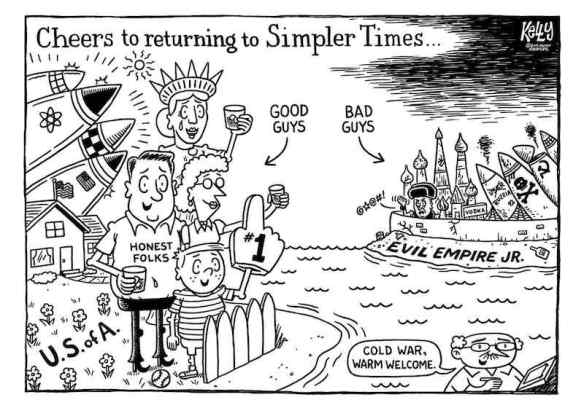
How Fear of Russia Misleads Americans

NSA whistleblower Thomas Drake sees grave dangers in the U.S. government and media exaggerating foreign threats as a means to mislead and control the American public, reports Dennis J Bernstein.

By Dennis J Bernstein

Source: Consortium News

Russia has been made “the go-to scapegoat” for distracting Americans from the serious problems afflicting the U.S. government, says Thomas Drake, a former senior executive at the National Security Agency who blew the whistle on multi-billion-dollar waste and violations of the rights of citizens through secret mass surveillance programs after 9/11.

As retaliation, the Obama Administration indicted Drake in 2010 as the first whistleblower since Daniel Ellsberg charged with espionage, carrying a possible 35-year prison term. However, in 2011, the government’s case against him collapsed and he went free in a plea deal. He became the recipient of the 2011 Ridenhour Truth-Telling Prize.

I sat down with Thomas Drake on June 3, 2017, at the home of ConsortiumNews editor Robert Parry in Arlington, Virginia, on the occasion of the awarding of the 2016 Gary Webb Freedom of the Press Award to Oliver Stone.

Dennis Bernstein: I want to ask you about a story. ConsortiumNews has offered quite a different perspective on the relationship between the U.S. government and Russia [questioning the allegations about] Trump collaborating with Putin. What’s your take on this story? Do you think that ConsortiumNews is onto something in terms of really questioning that whole line?

Thomas Drake: Yes. This hyperbolic narrative that is posited almost to the point of hysteria. They would say that Russians are behind everything. “It’s all the Russians’ fault and you can blame Russia.” It’s just pure political pretension and there is a significant amount of propaganda behind it.

It’s intended to distract. It’s intended to keep people from really looking at some of the deeper truths of our own government and so it is very convenient for the political elites, on both sides of what has become the Democratic/Republican divide, which in fact is not a divide; it’s two sides of the same coin, with slightly different narrative – to project all the blame on Russia and particularly the hyper-conflation of the littlest thing that would appear to be that Trump is ruining the country or Trump is the worst thing that has ever happened. Just really taking this
way, way beyond the pale.

And ConsortiumNews — having written for ConsortiumNews going back several years now as a result of my case and mass domestic surveillance and government abuse of power — is one of the few – it’s surreal for me to say this right now – it’s one of the few alternative media outlets who have the courage to stand up to the elite narrative and get behind this hyper-partisan politicization of blaming it all on external entities.

And, in this case, Russia has become the go-to scapegoat, frankly. And it’s easy to simply focus on that as your excuse without having to concern yourself with the deeper trends in terms of the darker history of American politics.

And Gary Webb – I am quite familiar with his case. Remember he had his own profession turn on him because they wanted to curry favor with power and they wanted to have access to power. So it was full access press and power is an aphrodisiac. Henry Kissinger said that. …

DB: Access press, as in, if you don’t say the right thing […] they can toss you into prison.

TD: Yep, precisely. And so you’re willing to overlook what may be done under the cover or blanket of government, the government structure. And so ConsortiumNews is one of the few. …

I was sort of the pre-Snowden Snowden. …

DB: He cites you for opening that door….

TD: Well, he has said there wouldn’t have been him without me. And he has cited a number of people who have preceded him, right? And I was there at the foundation, at this extraordinary willful violation of, in secret, of what I call the subversion of the Constitution. Really, it was a silent coup against the Constitution….

DB: What are the multiple dangers of the way in which information is used now, and slanted to support policy as opposed to inform?

TD: Well, it’s self-interest. It’s largely self-interest driven. You have, what I have sometimes called Gov-Corp, which is a combination of government and corporations and it’s an extraordinarily pathological relationship because they feed on each other. One protects the other and when you have the government corrupting itself to serve very powerful interests at the expense of public interests, guess what? Something has to give and what gives is public transparency. What gives is accountability. What gives is responsible power. What gives is the promise. What gives is “we the people”, right?

Power just… generally at least, power is about the people and it’s pathological, and so unfortunately the checks and balances that have in the past – Ellsberg is eyewitness to this — he’s certainly a key person by simply standing up with his colleague Edgar Russo, standing up to power in terms of the bright and shiny light called Vietnam, right? He clearly brought into the public purview what was really going on with Vietnam and, ultimately, as we know, I was a very young teen growing up in the ’70s. He was already in his early 40s at the time. That, yeah, the government can use power… and that, yeah, power does tend to corrupt. Lord Acton was right.

So, what became known as the imperial presidency of Nixon, this era makes that era look like a hyper type of person, especially post-9/11. It’s just extremely concerning. It’s what I would call the devolution of democracy and constitutional rights following 9/11 and Ellsberg has said and I have said, what was actually unlawful and unconstitutional has been made legal from his time.

And the old, what became the infamous statement made by Nixon, “You know, if the President says it’s okay, it’s not illegal.” I heard almost those exact same words when I confronted the lead attorney in the Office of General Counsel. That was the first week in October 2001. I had already found out about the massive domestic surveillance program that had been unleashed. And I confronted him and he said, “This is great. The White House has approved the program. It’s all legal.” …. The hairs on the back of my neck were like…. I’m having major flashbacks… Wait a minute, just because the White House approves it, it makes it okay? I mean, history is not kind. He says,” Yep, we’re the executive agent – all approved. Yes. Don’t ask any more questions.”

So, because the White House approved it, then it’s okay to violate the Constitution. All those checks were put in place as a result of the … president resigning, the standing committees and intelligence House and the Senate, the Foreign Intelligence Surveillance Act and a whole lot of others, right? So that was the check and balance, right? Nah, just, hey 9/11, the failure of the government to provide the common defense. 3,000 people murdered that day. It should never have happened. It really should never have happened. And so we are going to use that as sort of a reverse false flag. We’re going to use that as an excuse, because, “Hey, after all, the Constitution is not a suicide pact… you know, we don’t know where the enemy is.”

So just this weird, everything is existential now. We now know how the enemy is because of 9/11. And so it’s weird for me, having been brought up as a very young lad during the Cold War and remembering alarms going off and they’d turn off the lights and block the hall and face your lockers, right? The air raid sign drills and fears of the nuclear winter. It’s like these people want a World War 2.0.

We have far more in common with the Russians than we don’t. We have far in common than our own disputes. I assume there are some differences, right? I recognize, I am well aware, in terms of historical notes, but hey we have far more in common than we have difference.

DB: I guess what we all have in common is the state of the Earth at this point.

TD: The state of the Earth? We are the third rock from the sun. I mean, this is our home. The world is a much smaller place, in part because of technology and in part because we find out that, yeah, we really are dependent on each other.

And yet there is this addiction to conflict. There is this addiction to have threats. There is this addiction to divide. And this is not pretty. I mean, human history, the dark side of human history, and if the 20th century is not an optic lesson, then I don’t know what is….. I could go back to any of the others, in terms of written history that we know of, right? And yet here we are. And so, to me it is a sign of an empire….

The U.S. is an empire… and it is a sign of an empire that is losing it. And so, just like the Roman Empire, I mean, if you go back to the rise and fall of the Roman Empire, you know…. Those who don’t learn the lessons of the past are doomed to repeat them.

DB: Well, and the beat goes on. We’re going to let you join the party.

TD: The beat does go on. Yeah.

DB: But as we speak, there’s a major bombing, frightening bombing in Iran today.

TD: I did not know that. Wow.

DB: After the President of the United States is in Saudi Arabia. When is the last time you heard of a major suicide bomb in Iran?

TD: Not in Iran, no.

DB: So, here we go and who knows what comes next, who know what that’s going to bring in that part of the world. We thank you for all of your courage and all the suffering you did for all of us so we could know more. Thank you very much.

TD: Yeah. No. I have really become a warrior for peace. That’s what I have become. Ultimately it’s about who we are as human beings and who we are for each other and after all it is us, right? And in terms of U.S. culture and background, I think Pogo was right. We have met the enemy and the enemy is us. We are our own worst enemies.

It’s just that, for some of us, it’s critical to hold power accountable. We recognize we don’t govern ourselves very well. If you put people over others, yeah, bad things happen. But bad things tend to happen. And it’s that whole control, power. It’s all about — psychopathy is an area of study that I increasingly have as an issue, because of this idea that people gaining pleasure from the distress of others. So, it’s a disease. It really is. And some of us, at great sacrifice, weren’t going to just sit idly by and watch it all happen.

I care deeply about who we are as human beings. And I’ve spent a lot of time in front of college students and high school students and civic auditoriums and small group settings and churches and college campuses talking about these things. These are things that matter.https://consortiumnews.com/2017/06/20/how-fear-of-russia-misleads-americans/

Escaping the iron cage of hopelessness

By Edward Curtin

Source: Intrepid Report

“Specialists without spirit, sensualists without heart; this nullity imagines that it has attained a level of civilization never before achieved”—Max Weber, The Protestant Ethic and the Spirit of Capitalism

“In this frightful round of unchecked means, nobody knows any longer where they are going, purposes are forgotten, and ends are overtaken. Human beings have set off at astronomically high speeds toward nowhere.”—Jacques Ellul, Presence in the Modern World

In a previous article, I argued that those who think science can solve our major social problems—in particular, world destruction with nuclear weapons and the poisoning of the earth’s ecology and atmosphere—were delusional and in the grip of the myth of science and technology. These problems were created by science when it became untethered from any sense of limits in its embrace of instrumental rationality. Once it became wedded to usefulness and the efficiency of technical means, it lost its original aim: the search for truth. (Obviously this doesn’t include all scientists.) In embracing means as ends, it produced an endless loop of means justifying means that has resulted in what Weber called an “iron cage.” Concomitantly, the ideology of pure objectivity and impartial innocence was joined to elite state power and the capitalist profit motive where it was supported and instantaneously and completely applied to technical applications, including nuclear, biological, chemical and “conventional” weapons; bio-engineering; GMO foods and people; eugenics and cloning; and chemical/oil production, etc. It is indisputable that if our planet is incinerated or slowly destroyed through toxic pollution that modern science with its Faustian “prohibition to prohibit” will stand indicted, if anyone is left to make the case.

Albert Camus warned us long ago:

And even though we do it in diverse ways, we extol one thing and one alone: a future world in which reason will reign supreme. In our madness, we push back the eternal limits, and at once dark Furies swoop down upon us to destroy. Nemesis, goddess of moderation, not of vengeance, is watching. She chastises, ruthlessly, all those who go beyond the limit.

Ostensibly rational, the illogical logic of modern science has resulted in a mystifying double-bind that denies human freedom and leads to widespread despair and hopelessness. Many people feel trapped by this deterministic ethos, while others fail to see that the cause of our problems can’t be their solutions.

In this essay, I will explore the possibility of a path out of the seeming impossibility of escaping the cul-de-sac of our spiritually disinherited and disenchanted condition.

Max Weber argued that modern rational capitalism was informed by a religious impetus of inner-directed worldly asceticism derived from Protestant Christianity. In essence, modern capitalism was a religion. Likewise, modern mainstream science, despite the discoveries of quantum physics, rests upon a materialistic presupposition that is a self-contradictory act of faith that it denies to others. Committed to determinism, this materialistic scientific world view offers no basis for its truth claim since what is determined cannot be disputed when it wasn’t freely chosen. To espouse a position that was predetermined is to choose nothing. In essence, such science is also a religion that, like capitalism, serves no end but its own regeneration.

Is it any wonder that so many people feel trapped on an endless merry-go-round that contradicts their felt experience and their hopes for a better world? They look around and see a mad world of war and lies and science run amok. The physical scientists tell them that everything started with a bang and will end with a bang or a whimper of one sort or another and that’s how it goes since when did people so puny think they were anything but specks in a vast cosmos of meaningless gas that will devour them in a few billion years, give or take a year or so. The psych folks tell them they are the products of their brain chemicals and neurotransmitters and must submit “freely” to chemical treatment if they know what’s good for them and want to be happy. The social scientists insist that all knowledge is socially conditioned and relative and therefore everything they think and feel is also relative and so they are lost souls forever wandering in a world of relativity where true wisdom is impossible and the difference between right and wrong is a relative choice that has no basis in any “reality.” And of course the power elites and media play with their minds in endless games of mind control as they insist the only real truth comes through screens that they control. Mind and body warped, so many people stumble through their days like the living dead in search of some exit from their pain and confusion.

Or to say it differently. Science—both physical and social—has resulted in the systemization of doubt and the embrace of the relativity of thought and knowledge. The modern predicament is such that whereas in former times people felt that their knowledge was fact or truth and that it was grounded in a physically palpable reality, we have been exposed to systematic doubt and the suspicion has grown that all the various standpoints are limited and “relative.” While not consciously espoused by the majority of people, this doubting worldview permeates social life as a vague insecurity and uncertainty. It may be left to intellectuals to circulate such relativizing ideas, but they have become part of the cultural air we breathe. For people today in a scientifically based society, faced with the relativizing of all knowledge and every eternal verity, the question of how to understand their deaths, and thus their lives, has become acutely problematic. Uncertainty has undermined people’s wills as they have forgotten they are free.

The question that modernity forces us to ask is this: once knowledge is seen to be relative; old cosmologies are transformed by science; symbol systems and religions are seen as the products of humans’ own creativity; reality is understood to be socially constructed; once these developments take place consciously and unconsciously, how then can people understand their lives and deaths and find the confidence to live in peace and harmony with the earth and all living creatures?

Tolstoy put it this way:

Science is meaningless because it gives no answer to our question, the only question important for us: ‘What shall we do and how shall we live?’

In order to make our way out of this maze, we might contemplate the underlying presupposition that “everything is relative.” That, of course is an absurd position. Everything can’t be relative when the statement “everything is relative” is an absolute statement. Joined to that, one can muse on the self-contradiction of materialistic determinism and perhaps glimpse an escape from the iron cage, the prison, the closed room, the garbage pail, or the no-exit—so many terms that our best writers have used to describe the modern condition.

Rudolf Steiner did that as follows in The Philosophy of Freedom:

Materialism can never offer a satisfactory explanation of the world. For every attempt at an explanation must begin with the formation of thoughts about the phenomena of the world. Materialism, thus, begins with the thought of Matter or material processes. But, in doing so, it is ipso facto confronted by two different sets of facts, viz., the material world and the thought about it. The materialist seeks to make these latter intelligible by regarding them as purely material processes. He believe that thinking takes place in the brain, much in the same way that digestion takes place in the animal organs. Just as he ascribes mechanical, chemical, and organic processes to Nature, so he credits her in certain circumstances with the capacity to think. He overlooks that, in doing so, he is merely shifting the problem from one place to another. Instead of to himself he ascribes the power of thought to Matter. And thus he is back again at his starting-point. How does Matter come to think of its own nature?

But these are intellectual exercises and are therefore probably not very helpful to the average person.

Tolstoy maintained that for the modern person death had no meaning because civilization was based on progress—an ‘infinite’ progress—which according to its own internal logic should never come to an end.

On this road of progressiveness everything is provisional and indefinite and so individual death seems like a failure and meaningless because it marks an end. But what then, asked Tolstoy, is the meaning to our lives? Are they meaningless means to meaningless ends?

Materialistic science can only answer in the affirmative. A negative affirmative. But for most people this doesn’t satisfy. They sense the truth that we live by faith—scientists do, religious believers do, atheists do, agnostics do, everyone does—faith is the water we swim in; it is our element. It is what impels us to get out of bed in the morning. But getting out of bed in the morning is a choice, a judgment. It is not inevitable. We do it in faith that the day will be meaningful and worth meeting. We encounter others in good faith and hope they do the same with us. This awareness of the faith dimension of life is a daily human experience that points beyond itself and is a source of hope, even when confusion reigns. While modern science and philosophy have largely attempted to treat all things, including people, as objects to be controlled by subjects, most people encounter others in daily life not as Its, as in Buber’s I-It, but as Thous, as in I-Thou.

Where have I come from? Why am I here? Where am I going? These are life’s basic questions that science answers with nowhere, no reason, and nowhere in that order. Such answers are attestations of a faith in nothing, what is usually called nihilism.

The psychiatrist R.D. Laing maintained that the key to a sane world is for people to truly regain experiencing their experience and not to make-believe. He felt that most people had become estranged from the roots of their being. He put it thus:

The condition of alienation, of being asleep, of being unconscious, of being out of one’s mind, is the condition of the normal man. Society highly values its normal man. It educates children to lose themselves and to become absurd, and thus to be normal. Normal men have killed perhaps 100,000,000 of their fellow normal men in the last fifty years. Our behavior is a function of our experience. We act according to the way we see things. If our experience is destroyed, our behavior will be destructive. If our experience is destroyed, we have lost our own selves. . . . There is everything to suggest that man experienced God. Faith was never a matter of believing. He existed, but of trusting, in the presence that was experienced and known to exist as a self-validating datum. It seems likely that far more people in our time experience neither the presence of God, nor the presence of his absence, but the absence of his presence. . . . The fountain has not played itself out, the frame still shines, the river still flows, the spring still bubbles forth, the light has not faded. But between us and IT, there is a veil which is more like fifty feet of solid concrete. Deus absconditus. Or we have absconded.

So what can we do to break through this mystification of experience that has resulted in a double-bind that has trapped us?

I say nothing, at first. We are so busy doing and thinking our doing is the solution to our problems. We must stop the world we know by first not doing and by simply being in the presence of Being. We must develop a contemplative discipline of allowing the awareness of our egocentric thinking to reveal to us the arrogance of our confused belief that we can coerce others and the natural world to do our bidding and that every problem has a solution. The grotesqueness of nuclear weapons is the physical manifestation of that willfulness. For the magician, the applied scientist, and the technologist all wish to conquer reality with techniques from the outside rather than being open to the truths that Reality (that we are in and is us and that goes by different names—Being, the Tao, Logos—all names for the unnameable) might reveal to us.

“To ‘know’ reality,” writes Alan Watts, “you cannot stand outside it and define it; you must enter into it, be it, feel it.” So the first thing we must “do” is to do nothing so we may heal our divided minds; otherwise we are spinning in a vicious circle, “like everything else which the divided mind attempts.”

This seems self-evident to me and “doing” this should be our first “act” of dissent—our break-out (by breaking in)—from the reigning consensus that underlies the violent and sick condition of the world today. James Douglass, author of the ground-breaking book, JFK and the Unspeakable, says this perfectly in Lightning East to West: Jesus, Gandhi, and the Nuclear Age:

What we know ‘out there’ as the most resistant evil reality to be transformed, is in reality “in here” in its primary being. The precise nature of that correspondence, or identity, between inner and outer worlds is the mystery which Jung was attempting to describe with his theory of Synchronicity, whereby outer events can be increasingly recognized as unifying correlations of a profoundly traveled inner way. Once we begin to see this profound interpenetration of inner and outer worlds in a oneness of reality, the insoluble enigma of the world of evil gives way to the edge of the unifying mystery of Oneness, or of Love, a mystery that we cannot fully understand but which we can in fact move into with our lives and participate in to the extent of experiencing an ever-more-united world in Reality.

I think if we can see the big picture by “doing nothing,” we will have taken a major step toward a solution, or at the least an insight into how we can act to resist the evil that is occurring in the world.

“Seeing through” is to diagnose—dia, through + gignoskein, to know, perceive—which can allow us to see through to the roots of world problems. Without a deep comprehension of the causes of these problems, and how so many of our solutions have failed because they are based on false premises, we will get nowhere.

“The way one sees through the situation changes the situation,” writes Laing. Then, “as soon as we convey in any way . . . what we see or think we see, some change is occurring even in the most rigid situation.”

I think we can agree that we are in a “most rigid situation” as the nuclear weapons await discharge, countries and people are destroyed by U. S. war-making, the environment is poisoned, elite capitalist crooks line their pockets at the expense of everyone else, etc. Many of us convey this again and again, seemingly to no avail. Perhaps this is because we are missing the forest for the trees in our understandable haste to remedy it all. I suspect this is so and scatter these thoughts like breadcrumbs in the hope they may suggest a way home. “Conveying” my thought experiments in the hope “some” change occurs in the process. First, in me.

The word spiritual has acquired a bad name with its embrace by New-Agers et al. with its association with magic and out of the world mumbo-jumbo. So I use it reservedly. But if we look to those so many hold in such high regard for their fight against violence and injustice—e.g. Gandhi and Martin Luther King Jr., to name but two—it is apparent that their “truth-force” and “non-violent resistance” were rooted in a spiritual understanding of the human condition. We don’t need to get caught up in words, for they have a way of missing the truth. Gandhi said God was truth and truth was God. King equated God with love. Truth, God, Love—do the words matter? Did not these men grasp the deepest dimensions of our problems? Didn’t they understand the root causes of hate and violence? Didn’t they see the Tao? Didn’t they see that the way we conceive existence through our deterministic and instrumental sciences is a reflection of our violent world? Didn’t they realize that we can’t force change on anyone from the outside without doing violence and that the only way forward is to move the world through love and truthful resistance? Didn’t they tell us that freedom is our birthright and is indivisible, and when you deny existential freedom you are lost in despair?

Despite the question marks, these are rhetorical questions. Don’t our deepest experiences confirm their truth?

Let me end with James Douglass’s words, for it seems to me they ring true, despite being far outside the reigning scientific paradigm and “common sense.”

Is there a spiritual reality, inconceivable to us today, which corresponds in history to the physical reality which Einstein discovered and which led to the atomic bomb? Einstein discovered a law of physical change: the way to convert a single particle of matter into enormous physical energy. Might there not be, as Gandhi suggested, an equally incredible and undiscovered law of spiritual change, whereby a single person or small community of persons could be converted into an enormous spiritual energy capable of transforming a society and a world? I believe that there is, that there must be, a spiritual reality corresponding to E=mc2 because, from the standpoint of creative harmony, the universe is incomplete without it, and because, from the standpoint of moral freedom, humankind is sentenced to extinction without it. I believe that the human imperative of our end-time is that we discover the spiritual equation corresponding to Einstein’s physical equation, and that we then begin to experiment seriously in its world-transforming reality while there is time.

We must experiment in truth, for time is running out.


Edward Curtin is a writer whose work has appeared widely. He teaches sociology at Massachusetts College of Liberal Arts. His website is edwardcurtin.com.