
WikiLeaks’ 10 Most Damning Clinton Emails that Prove Mainstream Media is Scripted and Controlled

d435thf

By Jay Syrmopoulos

Source: The Free Thought Project

Washington, D.C. – With information coming out of WikiLeaks at a fast and furious pace, it’s difficult for the average person to keep up with the many bombshell revelations being exposed.  This is happening so much that the most damning evidence is ending up as background noise in the 24-hour election news cycle without ever making it into the mainstream news.

On October 7th, 2016, WikiLeaks publish thousands of emails belonging to John Podesta’s private email archives. More emails have been released in the days that followed. Podesta is Hillary Clinton’s 2016 presidential campaign Chairman. He previously served as Chief of Staff to President Bill Clinton and Counselor to President Barack Obama.

The Podesta emails give insight into why there has been such little fanfare in the mainstream media regarding many of the most damning allegations against Clinton.

The fact that most of the newsworthy information contained in the emails is not being reported by the corporate media is indicative of the incestuous relationship between the mainstream media and the Clinton campaign – and is on full display in the Podesta emails.

While there are dozens of bombshell revelations contained within the emails –including transcripts of speeches to Wall St. banks that Clinton had refused to release, hidden policy positions, and evidence of collusion with brutal regimes – the most damning is the collusion and control of the U.S. media on display in the emails.

Essentially, the media has been weaponized as a means of controlling public opinion by propagandizing the American people. World renowned academic Noam Chomsky, in his book “Manufacturing Consent: The Political Economy of the Mass Media,” detailed how U.S. media frequently serve as an errand boy for U.S. corporate, military and imperial interests.

Chomsky forwarded the idea of what he called a “propaganda model.” Although the book was written in 1988, it speaks precisely to what is currently taking place and clearly revealed  in the Podesta emails.

“The media serve, and propagandize on behalf of, the powerful societal interests that control and finance them. The representatives of these interests have important agendas and principles that they want to advance, and they are well positioned to shape and constrain media policy.” -Chomsky

With knowledge of what is currently transpiring, here are the ten most damning Clinton emails regarding the media’s collusion with her presidential campaign, with hotlinks to the original WikiLeaks release.

1. Clinton Staff hosts private “off-the-record cocktail party” with 38 “influential” reporters, journalists, editors, and anchors (from 16 different mainstream media outlets including CNN, NBC, CBS, NYT, MSNBC, & more) with the stated goal of “framing the race.”

2. Donna Brazile (CNN contributor at the time, and current DNC Chairman now) leaked CNN town hall questions to Hillary Clinton’s staff prior to the debate.

3. Clinton campaign and the New York Times coordinating attack strategy against Trump.

4. Glen Thrush, POLITICO’s chief political correspondent and senior staff writer for POLITICO Magazine, sends John Podesta an article for his approval. Writes: “Please don’t share or tell anyone I did this. Tell me if I fucked up anything.”

5. Huffington Post contributor Frank Islam writes to John Podesta in an email titled “My blogs in the Huffington Post”, says “I am committed to make sure she is elected the next president.” “Please let me know if I can be of any service to you.”

6. Clinton staffer “Placing a story” with Politico / New York Times: “place a story with a friendly journalist” “we have a very good relationship with Maggie Haberman of Politico” “we should shape likely leaks in the best light for HRC.”

7. John Podesta receiving drafts of New York Times articles before they’re published.

Clinton staff “placing a story with a friendly at the AP (Matt Lee or Bradley Klapper).”

More media collusion: NYT and AP “helpful” to Clinton campaign.

8. Clinton staff colluding with New York Times and Wall Street Journal to paint Hillary’s economic policies in a “progressive” light.

9. CNBC panelist colluding with John Podesta on what to ask Trump when he calls in for an interview.

10. Clinton staff appearing to control the release times of Associated Press articles.

The reality revealed in these emails is one of media collusion with powerful interests, which only serve to keep the American people in the dark about what is actually transpiring. The exact opposite of transparency.

Please share this article to wake people up to the fact that their news is scripted by powerful entities as a means of influencing people’s perceptions!

Saturday Matinee: Mars Attacks!

mars_attacks_ver3

“Mars Attacks!” (1996) is a satirical alien invasion film directed by Tim Burton and starring a surprisingly large cast of familiar actors. It’s easy to forget that Burton, now a friend of the establishment, once made films with a misanthropic subversive element. This is in full view in Mars Attacks! which (similar to Verhoeven’s Starship Troopers) embraces its inherently xenophobic premise and pushes it over-the-top to skewer society’s most cherished institutions (ie. government, media, religion, and business). The movie bombed when first released but perhaps it was just a little ahead of its time?
Watch the full film here.

The Media Can’t Get Its Story Straight on Election Hacking

obamariggedelections

By Dan Engelke

Source: Who.What.Why.

In August, the corporate media was falling all over itself with breathless coverage on how Russia is interfering in the US election. Back then, stories citing experts suggested that voting machines were vulnerable to tampering that could change the outcome of the vote. A month later, something curious happened.

By September, government officials were doing all they could to tamp down those concerns, and the media duly reported their reassurances.

Should the public be comforted that election mischief will be homegrown?

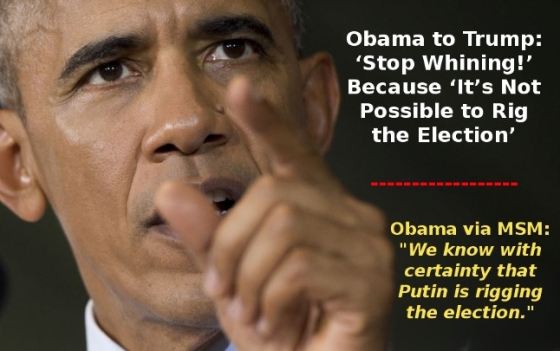
The articles, usually citing active government officials, serve a dual purpose in reassuring the public: First, there is no way Russia can hack the election, despite cyber hacks in the Illinois and Arizona voter registration banks. Meanwhile, the message is also to insist Russian President Vladimir Putin is still giving orders to disrupt US cyberspace. This latter message culminated in the Obama administration publicly blaming the Russian government for trying to influence the election in early October.

Voter System vs Election System

The Washington Post began the trend on August 31 with the definitive headline “There’s Almost No Chance Our Elections Can Be Hacked by the Russians. Here’s why.”

The Post cites two major obstacles for potential (Russian) disruption of our election. One is the difference between the “voter system” and the “election system.” The voter system involves registered voter databases throughout the country, while the election system refers to voting machines and paper ballots.

According to executive director Merle King of the state-funded Center for Election Systems in Georgia, the public conflates these two issues about the election, and that leads to a lot of confusion.

The second hindrance for potential hackers is the decentralized voting process, the Post reported. A major positive for vote security, according to the Post, is that local jurisdictions set their own rules for how votes will be counted.

This claim is buttressed by a letter sent by state election officials to Florida voters which notes the public safeguards already in place for our voting process — including (1) layers of encryption for voting machines, (2) thumb drive backups of votes, (3) lack of internet connection to voting machines, and (4) a review of votes after an election.

The Los Angeles Times followed on September 8 with a report titled “Could Russian Hackers Mess with the US Election Results? It Wouldn’t Be Easy; Here’s Why.”

The Times also highlights the decentralized nature of the voting system as a safeguard against tampering. However, while the Post viewed the system as sophisticated, the Times saw the state-run and community-monitored systems as too cumbersome to be susceptible to any hacking.

Quoted again is Merle King, along with Connecticut Secretary of State Denise Merrill, and FBI Director James Comey. Pamela Smith of Verified Voting — an organization that highlights the susceptibility to election rigging — is also sourced to reassure readers that the upcoming election is safe, thanks to an uptick in paper ballot usage.

Russia’s Goal Not Hacking — But Scandal

On September 10, Washington, D.C.-based political newspaper The Hill worked the same dual agenda with “Hacking the Election is Nearly Impossible. But that’s not Russia’s Goal.”

Like the previous articles in the Washington Post and LA Times, The Hill presents the decentralized process of US elections as an impenetrable obstacle to Russian hacking. Bolstering the claims of election security in the piece are Florida’s Secretary of State Ken Detzner, Colorado’s Secretary of Wayne Williams, Pennsylvania Department of State spokesperson Wanda Murren, and Wisconsin’s Administrator of State Elections Division Michael Hass. The only non-governmental official quoted is Chris Porter, an administrator of strategic intelligence at cybersecurity firm FireEye Horizons.

Porter cited examples of Russian election tampering in the Ukraine and efforts to “create scandal,” despite their inability to hack the election.

The Chicago Tribune got its turn on September 14, quoting Assistant to the President for Homeland Security and Counterterrorism Lisa Monaco, who reiterated the safety of the election thanks to the decentralization of the voting process.

These assertions of election security and passive blame on Russia culminated in early October with the Obama administration publicly accusing “senior-most officials in Russia” of tampering with the election, despite their claimed inability to do so.

Taking a Screwdriver to the Election

Let’s go back to August to see why certain experts said that elections could indeed be tampered with.

Princeton professor Andrew Appel made headlines in August after hacking the Sequoia AVC Advantage electronic voting machine in seven minutes. Such machines are used in Louisiana, New Jersey, Virginia and Pennsylvania.

“[Appel] summoned a graduate student named Alex Halderman, who could pick the machine’s lock in seven seconds. Clutching a screwdriver, he deftly wedged out the four ROM chips — they weren’t soldered into the circuit board, as sense might dictate — making it simple to replace them with one of his own: A version of modified firmware that could throw off the machine’s results, subtly altering the tally of votes, never to betray a hint to the voter. The attack was concluded in minutes.”

Former government officials working in the cyber sphere have also warned of election tampering. Former White House counterterrorism czar Richard Clarke asserted: “Yes, It’s Possible to Hack the Election” on August 18.

“I have had three jobs that together [under Bill Clinton, George W. Bush, and Barack Obama] taught me at least one thing: If it’s a computer, it can be hacked.”

Special Interests and the Machines

Clarke sees the decentralized election system as the access point for potential tampering —rather than a potential safeguard. While there are safeguards, such as the voter tabulation through paper ballots, almost no state exclusively uses paper ballots. Instead, voting machines — even allowing votes from home — produce no paper ballot record and thus no way to ensure the “correct” vote was cast.

Furthermore, Clark argues paper ballot receipts from the voting machines are only used in the case of a recount — something today’s sophisticated hackers are aware of and would seek to avoid.

“My first reaction to all this government reassurance was ‘are you kidding me?’” Dr. Jonathan Simon of the Election Defense Alliance told WhoWhatWhy. “There is all this concern about outside hacking, but absolutely no talk of internal rigging.”

While Simon points out that there are many election safeguards, connections to special interests by those that control voting machines provides easy access to election rigging.

“Anyone who could stand to profit off certain policies — the Koch brothers, for example — have a better chance of rigging the election due to their connections to voting systems like Dominion, SES and their satellite companies,” Simon explained. “Russia, China, nor any terrorist group in the Middle East have a connection like that.”

Despite encryption and the lack of an Internet connection, Simon claims that there are other ways to change voting results.

“In a memory card, which is used in optical scanner-verified voting, three lines of code to flip votes one way or another can be entered into 7,000 or 8,000 lines of code virtually without detection. Multiple memory cards can be manipulated like this at the push of a button.”

Why Overlook Potential Domestic Hacking?

With articles by outside experts in August claiming the election could be hacked, followed in September with articles by government officials claiming it could not be — by Russia — it raises the question: why overlook domestic tampering?

“These are relatively unsophisticated and simple ways to rig the election,” Simon concluded.

Washington moves to silence WikiLeaks

germanywikileaks-12d90

By Bill Van Auken

Source: WSWS.org

The cutting off of Internet access for Julian Assange, the founder of WikiLeaks, is one more ugly episode in a US presidential election campaign that has plumbed the depths of political degradation.

Effectively imprisoned in the Ecuadorian embassy in London for over four years, Assange now is faced with a further limitation on his contact with the outside world.

On Tuesday, the Foreign Ministry of Ecuador confirmed WikiLeaks’ charge that Ecuador itself had ordered the severing of Assange’s Internet connection under pressure from the US government. In a statement, the ministry said that WikiLeaks had “published a wealth of documents impacting on the US election campaign,” adding that the government of Ecuador “respects the principle of non-intervention in the internal affairs of other states” and “does not interfere in external electoral processes.” On that grounds, the statement claimed, the Ecuadorian government decided to “restrict access” to the communications network at its London embassy.

This statement from the bourgeois government of Ecuadorian President Rafael Correa is a study in hypocrisy and cowardice. By abetting the US government’s suppression of WikiLeaks, Quito has intervened in the US elections on the side of the ruling establishment and against the rights of the American people. If Correa expects that his professed sensitivity toward the “principle of non-intervention” will be reciprocated, he should recall the fate of Honduran President Manuel Zelaya, who was toppled in a coup orchestrated by then-Secretary of State Hillary Clinton in 2009.

WikiLeaks cited reports that Secretary of State John Kerry had demanded that the government of Ecuador carry out the action “on the sidelines of the negotiations” surrounding the abortive Colombian peace accord last month in Bogota. The US government intervened to prevent any further exposures that could damage the campaign of Clinton, who has emerged as the clear favorite of the US military and intelligence complex as well as the Wall Street banks.

Whether the State Department was the only entity placing pressure on Ecuador on behalf of the Clinton campaign, or whether Wall Street also intervened directly, is unclear. The timing of the Internet cutoff, in the immediate aftermath of the release of Clinton’s Goldman Sachs speeches, may be more than coincidental.

In the spring of 2014, the government of Ecuador agreed to transfer more than half of its gold reserves to Goldman Sachs Group Inc. for three years, in an attempt to raise cash to cover a growing deficit brought on by the collapse in oil prices. It reportedly sent 466,000 ounces of gold to Goldman Sachs, worth about $580 million at the time, in return for “high security” financial instruments and an anticipated profit on its investment. It is hardly a stretch of the imagination to believe that such a relationship would give Goldman Sachs considerable leverage in relation to the Ecuadorian government.

In any case, it is evident that the US ruling establishment is growing increasingly desperate to stanch the flow of previously secret emails and documents that are exposing the real character not only of Clinton, but of capitalist politics as a whole. While WikiLeaks has released over 17,000 emails from the account of Clinton campaign manager and top establishment Democrat John Podesta, it is believed that there are more than 33,000 still to come.

The transcripts of Clinton’s speeches to Goldman Sachs and other top banks and employers’ groups, for which she was paid on average $200,000 per appearance, are the most incriminating. They expose the workings of the oligarchy that rules America and the thinking and actions of a politician prepared to do anything to advance the interests of this ruling stratum, while simultaneously accruing ever greater riches and power for herself.

While on the campaign trail, Clinton has postured as a “progressive,” determined to hold Wall Street’s feet to the fire. But in her speeches to Goldman Sachs, she made clear her unconditional defense of the banks and financial houses. Under conditions of popular outrage against the bankers and their role in dragging millions into crisis in the financial meltdown of 2008, Clinton gave speeches praising the Wall Street financiers and insisting that they were best equipped to regulate themselves. She apologized to them for supporting the toothless Dodd-Frank financial regulatory law, saying that it had to be enacted for “political reasons.”

In front of her Wall Street audiences, Clinton made clear she had no inhibitions about ordering mass slaughter abroad. While telling her public audiences that she supports a “no-fly zone” in Syria as a humanitarian measure to save lives, she confidentially acknowledged to her Goldman Sachs audience that such an action is “going to kill a lot of Syrians” and become “an American and NATO involvement where you take a lot of civilians.” In the same speech she declared her willingness to bomb Iran.

The emails have laid bare the nexus of corrupt connections between the State Department, the Clinton Foundation, her various campaigns and her network of financial and corporate donors, which together constitute a quasi-criminal influence-peddling enterprise that could best be described as “Clinton, Inc.”

The revelations contained in the WikiLeaks material have been ignored or downplayed by the corporate media, which instead has focused unrelentingly on the charges of sexual misconduct leveled against Clinton’s Republican rival, Donald Trump.

The Clinton camp itself has sought to deflect any questions regarding what the candidate said in her speeches or the corrupt operations of her campaign by claiming, with no evidence whatsoever, that the material released by WikiLeaks had been hacked by the Russian government and therefore cannot be trusted.

This line of argumentation serves not only to divert attention from the WikiLeaks material, but also to further the Clinton campaign’s neo-McCarthyite claims of Kremlin intervention on behalf of Trump and advance a propaganda campaign aimed at preparing popular opinion for a direct military confrontation with Russia.

There is an air of desperation in the attempt to quash the WikiLeaks material. CNN news anchor Chris Cuomo, an open supporter of Clinton, went so far as to lie to his audience, claiming it was illegal for them to access the emails and insisting they could obtain any information on them only through the filter of the corporate media.

Well before the release of documents related to the Democratic Party, the determination of ruling circles to suppress WikiLeaks had found repeated and violent expression. State Department officials have come forward with a report that in 2010, in the midst of WikiLeaks’ mass release of State Department cables exposing US imperialist operations around the world, Clinton, then secretary of state, asked subordinates, “Can’t we just drone this guy?” She recently said she could not remember the remark, but if she made it, it was a joke.

During the same period, however, Clinton supporter and longtime Democratic campaign operative Bob Beckel declared in a television interview in relation to Assange: “A dead man can’t leak stuff. This guy’s a traitor, he’s treasonous, and he has broken every law of the United States… there’s only one way to do it: illegally shoot the son of a bitch.”

To this point, the American ruling class has limited itself to judicial frame-ups and character assassination, counting on the help of its servants within both the media and the pseudo-left, large sections of which have either joined the witch-hunt against Assange or downplayed his victimization.

The principal vehicle for this campaign of persecution had been fabricated allegations of sexual misconduct pursued by Swedish authorities acting in league with the US and British governments. Earlier this year, the UN’s Working Group on Arbitrary Detention issued findings that Assange had been “deprived of his liberty in an arbitrary manner,” meaning the body had reached the conclusion that the Swedish case constituted a politically motivated frame-up.

In the midst of the current attempt to silence Assange, an even more bizarre and filthy frame-up has been concocted, attempting to smear the WikiLeaks founder with charges of taking Russian money as well as pedophilia.

At the center of these allegations is a little known online dating service, Toddandclare.com, which first attempted to lure Assange into a supposed deal to film an ad for the site, for which he supposedly would be paid $1 million, to be provided by the Russian government. When WikiLeaks rejected this preposterous provocation, the same site claimed that Assange had been charged with inappropriate contact through the site with an eight-year-old Canadian child visiting the Bahamas. This accusation was then invoked in an attempt to pressure the UN to drop its demand for an end to the persecution of Assange.

Even a cursory investigation makes clear that these allegations constitute a grotesque fabrication. Bahamian police have stated that there are no charges or any case whatsoever against Assange. The dating service has no business address, working phone number or corporate presence anywhere in the US, having all the earmarks of a dummy company created by US intelligence for the purpose of hounding Assange.

The use of such tactics is a measure of how terrified the US ruling class has become in the face of growing mass hostility to both major political parties and their two abhorrent candidates. Their fear is that the relentless exposure of the inner workings of a government of the rich, by the rich and for the rich is robbing the existing political setup of what little legitimacy it had left within the population, and creating the conditions for a political radicalization within the working class and social upheavals, whoever is elected on November 8.


Related Article:

Real Reason Trump’s Being Treated Like He’s Crazy for Refusing to Accept Election Results by Rob Kall

Pokémon and the Age of Augmented Hyper-Surreality

maxresdefault

By Luther Blissett

Imagine walking to a park in a fairly average medium-sized city on a warm Summer day. There you see groups, pairs and individuals of different ages and races slowly milling about, some with dogs, some with baby carriages. Approaching closer, you realize nearly everyone in the park other than yourself is staring intently at their phone, occasionally tapping and swiping the screen. It seems odd, though not completely out of the ordinary in this day and age. Then, off in the distance at the far end of the park, someone shouts what sounds like a word in an alien language or dialect triggering a crowd to rapidly swarm towards the general area; most speed-walking or jogging but all aiming their phones at the same destination. Soon everyone in the vicinity of the park (except yourself a few vagrants and junkies of a less tech-savvy sort) surges towards the center of the swarm of over a hundred participants as if sucked into a vortex. As quickly as it started, the crowd disperses and an “normalcy” resumes, albeit temporarily since the pattern repeats continuously at half hour to one hour intervals throughout different areas of the park.

This dream-like scenario is an outsider’s description of a Pokémon Go session on a typical Summer weekend at Bellevue Downtown Park. The crowd might have been slightly larger than usual due to the balmy weather, but numerous videos posted on YouTube indicate such occurrences aren’t completely anomalous.

An example:

Still, the relative newness and novelty of the experience doesn’t make it feel any less like being in a dystopian narrative such as a Philip K. Dick novel or an episode of Charlie Brooker’s “Black Mirror”. However, the sense of social displacement and alienation for non-gamers is dampened by nearly a decade of collective exposure to increasingly advanced internet-enabled cellphones whose ubiquity and usage has steadily increased over the years.

Prior to the release of Pokémon Go more people have been spending increasing hours using smartphones for talking, texting, email, news, entertainment and social media, selfies, etc. In the context of modern industrial society it’s almost an aberration to be without a device, or to not be heavily reliant on one. What sets Pokémon Go apart is its ability to simulate a fusion of material and virtual worlds by depicting through phone screens digital sprites superimposed on real-time images of physical environments to its users.

Just as shamans would use entheogens to peer behind the veil of reality, augmented reality allows users to perceive additional veils over reality. This is not necessarily a bad thing because there’s potential for “digital veils” to assist us in seeing what certain interests might prefer to keep hidden. For example, what if everyone could literally see the interests orchestrating a politician’s rise to power? What if we could walk into any store and instantly know which products were made by war-profiteers, polluters, and/or sweatshop owners? Would people want to know? How much of an impact would it have on decisions and actions in the context of a media environment inundated with heavily financed government/corporate PR and marketing? Of course, even without augmented reality the virtual realm affects the “real world”, most notably with the economic dominance of the tech industry as well as the social, political and economic havoc wreaked by hackers; but rarely is such influence immediately manifested as when crowds swarm newly spawned Pokémon sprites.

In many ways, Pokémon Go was the ideal vehicle to bring augmented reality to the masses. Many apps have utilized it for different purposes such as navigating, translating, finding dates, viewing celestial objects, narrating self-guided tours, weather forecasting, image enhancement, etc., but only Pokémon was able to use the technology to bring a fictional universe closer to life by creating a cross-generational craze. Alfie Brown of ROAR Magazine, characterized virtual Pokémon as the perfect example of what Jacques Lacan called the objet petit a, a fetishized yet ephemeral and unobtainable object of desire, a key concept behind consumerist neoliberalism’s push towards cheap, chronically obsolete, ephemeral and now digital goods and services.

But what makes Pokémon creatures so desirable? In regard to children, they seem naturally drawn towards cute and brightly colored cartoon characters. The mechanics of the game taps into natural tendencies to collect things and to display one’s collection to others (a phenomenon South Park astutely critiqued on episodes lampooning World of Warcraft and “freemiums”). In consumer societies children and adults are prone to feeling prestige and power from the size and perceived value of their collections; however, children are mostly limited in terms of the acquisitive power: video games elicit a rare opportunity to gain more prestige and power than adults have in real life.

As for older folks, there’s a variety of additional interconnected factors. For teens and young adults, peer pressure alone might be enough to hook some people, but the mainstreaming of geek culture no doubt plays a part, making fandom, quirkiness and technological obsession more accepted and valued. The transition to adulthood also happens to be a time when there’s increased pressure to establish one’s sense of identity, become more independent and to succeed academically and professionally. Games are a means of escape from such pressures (as real life opportunities for economic advancement continue to dwindle) while at the same time functioning as structured activities for social interaction and, more broadly, to build communities. For adults, reasons may include all of those previously mentioned in addition to fascination with technology, bonding with younger friends and family, the feeling of being part of a global phenomena, or nostalgia for the original Pokémon games, for example.

Returning to Pokémon Go’s more dystopian aspects, the game has been used as a tool by the unscrupulous for crimes such as robbery and sexual assault. Though crowds created by Pokémon Go spawning areas or “gyms” (locations where players battle each other in teams to increase their avatars’ abilities) have been a benefit to some local businesses, residential neighbors in some cases view game players as unwanted loiterers invading their privacy. There have also been news reports of video game battles escalating to physical brawls and innocent gamers being racially profiled as suspicious threats.

As with most online tools, there’s a risk of the app and users being exploited for surveillance, social control, to extract money and personal data, etc. Modern media literacy requires an understanding of how businesses benefit from our use of game and service apps (especially “free” ones) and how intentional or unknowing misuse of collected data could serve government/corporate/criminal interests. Augmented reality games are an exciting new media with potential to be used in novel and fun ways, but we should be vigilant of its potential to influence beliefs as well as decisions regarding how we spend time and resources.

Pokémon Go is at the forefront of the increasing power of tech companies such as Google and Niantic (the software developer behind Pokémon Go) to control and use information to manipulate the masses. Such power in itself is disturbing, but more sensational examples might include news reports of car accidents caused by drivers mindlessly following Google Maps off the road or colliding into other cars while playing Pokémon Go. Such cases may seem absurd but they prompt a number of important questions. Why do some prioritize and trust mediated information over their own senses? As online personas increase in perceived importance, at what lengths will people go to sustain it and would it be at the expense of others things (such as personal safety)? Are we becoming addicted to cognitive “skinner boxes” with our needs perpetually triggered and gratified by apps? In an increasingly hyperreal world in which the boundary between the real and virtual becomes more permeable, what new hazards await?

The Cyber-War on Wikileaks

By

Source: CounterPunch

When the ruling class is in panic, their first reaction is to hide the panic.

They react out of cynicism: when their masks are revealed, instead of running around naked, they usually point the finger at the mask they wear. These days the whole world could witness a postmodern version of the infamous quote “Let them eat cake”, attributed to Marie-Antoinette, queen of France during the French Revolution.

As a reaction to WikiLeaks publishing his emails, John Podesta, the man behind Hillary Clinton’s campaign, posted a photo of a dinner preparation, saying “I bet the lobster risotto is better than the food at the Ecuadorian Embassy”.

A similar version of vulgar cynicism emerged earlier this month when Hillary Clinton reacted to the claim that she reportedly wanted to “drone” WikiLeaks founder Julian Assange (“Can’t we just drone this guy?”) when she was the US Secretary of State. Instead of denying her comments, Clinton said that she doesn’t recall any such joke, “It would have been a joke if it had been said, but I don’t recall that”.

One doesn’t have to read between the lines to understand that if Hillary Clinton had said that, she would have considered it a joke. But when emperors joke, it usually has dire consequences for those who are the objects of their “humor.”

Cyber-war Not with Russia…but WikiLeaks

During the last few months I have visited Julian Assange in the Ecuadorian Embassy in London several times and each time I came out of the Embassy, where he is spending his fifth year in political asylum under legitimate fear he might be extradited to the US, my thought was the following one: although he lives, without his family, in a postmodern version of solitary confinement (even prisoners are allowed to walk for up to one hour a day), although he has no access to fresh air or sunlight for more than 2000 days, although the UK government recently denied him safe passage to a hospital for an MRI scan, if his access to the internet would be cut off this would be the most severe attack on his physical and mental freedom.

The last time I saw him, which was only two weeks ago, he expressed the fear that, because he had already published leaks concerning US elections and with more to come, the US might find various ways to silence him, including pressuring Ecuador or even shutting down the internet.

What seemed a distant possibility only two weeks ago, soon became a self-fulfilling prophecy.

When the Obama administration recently announced that it is, as Biden said, planing an “unprecedented cyber covert action against Russia”, the first victim was not Putin, but precisely Julian Assange whose internet was cut off just a day after Biden’s self-contradictory proclamation.

No wonder Edward Snowden reacted immediately by saying that “nobody told Joe Biden what ‘covert operation’ means.

According to the U.S. Department of Defense’s Dictionary of Military and Associated Terms, a covert operation is “an operation that is so planned and executed as to conceal the identity of or permit plausible denial by the sponsor.”

It is no secret anymore that the Ecuadorian government has come under extreme pressure since Assange leaked the Democratic National Committee email database. We don’t know yet whether the US pressured Ecuador to shut down the internet, but it is clear that the present US government and the government to come is fighting a war with WikiLeaks which is all but “covert”. Is it really a coincidence that Julian Assange’s internet access was cut off shortly after publication of Clinton’s Goldman Sachs speeches?

If at the beginning we still had a “soft” version of postmodern McCarthyism, with Hillary calling everyone opposed to her campaign a Russian spy (not only Assange, but also Donald Trump and Jill Stein), then with Obama’s recent intervention it became more serious.

With Obama’s threat of a cyber-war, the “soft” McCarthyism didn’t only acquire geopolitical significance, but at the same time a new mask was revealed: Obama is obviously trying to cement the public debate and make the Russian threat “real”, or at least to use it as a weapon in order to help Clinton to get elected. Moreover, this new twist in something that has already become much more than only US elections (US elections are never only US elections!), shows not only how Obama is ready to strengthen Hillary’s campaign, but it also reveals that a cyber war is already in the making.

It is not a cyber war with Russia, but with WikiLeaks.

And it is not the first time.

What would Clausewitz say?

In 2010, when the Collateral Murder video was published, the Afghan and Iraq war logs were released, and we witnessed one of the most sinister attacks on freedom of speech in recent history. VISA, Mastercard, Diners, American Express and Paypal imposed a banking blockade on WikiLeaks, although WikiLeaks had not been charged with any crime at either state, federal or international level. So if the US government successfully convinced payment companies representing more than 97% of the global market to shut down an independent publisher, why wouldn’t they pressure Ecuador or any other state or company to cut off the internet?

The US is not only rhetorically trying to “get” Assange (it is worth to check out the Assassinate Assange video for evidence of the verbal masturbation of US officials), he poses a serious threat to the major elite factions in the US to remain in power. No wonder panic is rising in the US, which is now going even so far that a 16-year-old boy in Britain has been arrested on criminal charges related to the alleged hacking of email accounts used by CIA director John Brennan, which WikiLeaks published in October 2016.

What WikiLeaks obviously successfully challenged–and maybe one day (“history is written by the victors”, remember?) it will be learned in military strategy– is what the Prussian general and military theorist Carl von Clausewitz would call the “centre of gravity” (Schwerpunkt), which is the “central feature of the enemy’s power”.

Instead of speaking about the Russians, we should start speaking about the Schwerpunkt of the actual leaks, their real essence. Just take the following quotes by Hillary Clinton exposed by WikiLeaks, which reveal her true nature and the politics behind her campaign: “We are going to ring China with missile defence”, “I want to defend fracking” and climate change environmentalists “should get a life”, “you need both a public and a private position”, “my dream is a hemispheric common market, with open trade and open borders”.

What WikiLeaks has shown is not only that Hillary is a hawkish war-monger, first it was Libya (over 1,700 of the 33,000 Clinton emails published by WikiLeaks reference Libya), then it was Syria (at a Goldman Sachs conference she explicitly stated she would like to intervene in Syria), tomorrow it will be another war.

It is now clear – and this is the real “centre of gravity” where we should focus our attention – that the future Clinton cabinet may already been filled with Wall Street people like Obama’s was. No wonder WikiLeaks revelations create utter panic not only in the Democratic Party itself but also the Obama administration.

One question remains, isn’t WikiLeaks, by leaking all these dirty secrets, influencing the US elections? Yes, it certainly is, but the current criticism misses its point: isn’t the very point of organisations such as WikiLeaks to publish the material they have and to influence public opinion?

The question should finally be turned around: isn’t the US mainstream media the one influencing the US elections? And isn’t Obama, by announcing a cyber-war with Russia, influencing the elections?

WikiLeaks is not only influencing the US elections, but transforming the US elections – as they should have been from the very beginning – into a global debate with serious geopolitical consequences at stake. What WikiLeaks is doing is revealing this brutal fight for power, but, as the old saying goes, “when a wise man points at the Moon, the idiot looks at the finger”. Instead of looking at the finger pointing to Russia, we should take a look at the leaks themselves.

If democracy and transparency means anything today, we should say: let them leak!


Srećko Horvat is a philosopher and activist. He is co-author, with Slavoj Žižek, of What Does Europe Want? (Columbia University Press, 2014) and author of The Radicality of Love (Polity Press, 2015). Together with Yanis Varoufakis he co-created the movement DiEM 25. https://diem25.org/

The Odor of Desperation

screen-shot-2016-10-18-at-8-59-54-pm

By James Howard Kunstler

Source: Kunstler.com

It must be obvious even to nine-year-old casual observers of the scene that the US national election is hacking itself. It doesn’t require hacking assistance from any other entity. The two major parties could not have found worse candidates for president, and the struggle between them has turned into the most sordid public spectacle in US electoral history.

Of course, the Russian hacking blame-game story emanates from the security apparatus controlled by a Democratic Party executive establishment desperate to preserve its perks and privileges . (I write as a still-registered-but-disaffected Democrat). The reams of released emails from Clinton campaign chairman John Podesta, and other figures in HRC’s employ, depict a record of tactical mendacity, a gleeful eagerness to lie to the public, and a disregard for the world’s opinion that are plenty bad enough on their own. And Trump’s own fantastic gift for blunder could hardly be improved on by a meddling foreign power. The US political system is blowing itself to pieces.

I say this with the understanding that political systems are emergent phenomena with the primary goal of maintaining their control on the agencies of power at all costs. That is, it’s natural for a polity to fight for its own survival. But the fact that the US polity now so desperately has to fight for survival shows how frail its legitimacy is. It wouldn’t take much to shove it off a precipice into a new kind of civil war much more confusing and irresolvable than the one we went through in the 1860s.

Events and circumstances are driving the US insane literally. We can’t construct a coherent consensus about what is happening to us and therefore we can’t form a set of coherent plans for doing anything about it. The main event is that our debt has far exceeded our ability to produce enough new wealth to service the debt, and our attempts to work around it with Federal Reserve accounting fraud only makes the problem worse day by day and hour by hour. All of it tends to undermine both national morale and living standards, while it shoves us into the crisis I call the long emergency.

It’s hard to see how Russia benefits from America becoming the Mad Bull of a floundering global economy. Rather, the Evil Russia meme seems a projection of our country’s own insecurities and contradictions. For instance, we seem to think that keeping Syria viciously destabilized is preferable to allowing its legitimate government to restore some kind of order there. Russia has been on the scene attempting to prop up the Assad government while we are on the scene there doing everything possible to keep a variety of contestants in a state of incessant war. US policy in Syria has been both incoherent and tragically damaging to the Syrians.

The Russians stood aside while the US smashed up Iraq, Afghanistan, and Libya. We demonstrated adequately that shoving sovereign nations into civic failure is not the best way to resolve geopolitical tensions. Why would it be such a bad thing for the US to stand aside in Syria and see if the Russians can rescue that country from failure? Because they might keep a naval base there on the Mediterranean? We have scores of military bases around the region.

It’s actually pretty easy to understand why the Russians might be paranoid about America’s intentions. We use NATO to run threatening military maneuvers near Russia’s borders. We provoked Ukraine — formerly a province of the Soviet state — to become a nearly failed state, and then we complained foolishly about the Russian annexation of Crimea — also a former territory of the Soviet state and of imperial Russia going back centuries. We slapped sanctions on Russia, making it difficult for them to participate in international banking and commerce.

What’s really comical is the idea that Russia is using the Internet to mess with our affairs — as if the USA has no cyber-warfare ambitions or ongoing operations against them (and others, such as hacking Angela Merkel’s personal phone). News flash: every country with access to the Internet is in full hacking mode around the clock against every other country so engaged. Everybody’s doing it. It is perhaps a projection of America’s ongoing rape hysteria that we think we’re special victims of this universal activity.


Related Article:

Update from Craig Murray: “I can tell you with 100% certainty that it is not any Russian state actor or proxy that gave the Democratic National Committee and Podesta material to WikiLeaks.”