Charlie Brooker’s insightful year-end recaps puts others (from mainstream media) to shame, and they only get funnier as each year gets worse.

Charlie Brooker’s insightful year-end recaps puts others (from mainstream media) to shame, and they only get funnier as each year gets worse.

By
Source: New Eastern Outlook
The latest mantra of CIA-linked media since the “Pizzagate” leaks of data alleging that Hillary Clinton Campaign Manager John Podesta and other highly influential political persons in Washington were connected to an unusual pizza place near the White House run by a 41-year old James Achilles Alefantis called Comet Ping Pong, is the need to crack down (i.e. censorship) on what is being called “Fake News.” The latest step in this internet censorship drive is a decision by the murky social media organization called Facebook to hire special organizations to determine if Facebook messages are pushing Fake News or not. Now it comes out that the “fact check” private organizations used by Facebook are tied to the CIA and CIA-related NGO’s including George Soros’ Open Society Foundations.
In the last weeks of the US Presidential campaign, Wikileaks released a huge number of emails linked to Clinton Campaign Manager, John Podesta. The contents of thousands of emails revealed detailed exchanges between Podesta and the oddly-influential Comet Ping Pong pizza place owner, Alefantis, as well as the Clinton campaign, which held fundraisers at Comet Ping Pong.
The Pizzagate scandal exploded in the final weeks of the US campaign as teams of private researchers documented and posted Facebook, Instagram and other data suggesting that Alefantis and Comet Ping Pong were at the heart of a pedophilia ring that implicated some of the most prominent politicians in Washington and beyond.
The New York Times and Washington Post moved swiftly to assert that the Pizzagate revelations were Fake News, quoting “anonymous sources” who supposedly said the CIA “believed” Russia was behind hackers who exposed emails and documents from the Democratic National Committee (DNC) and Hillary Clinton’s campaign chair John Podesta. Former NSA senior intelligence expert William Binney claimed the Podesta and Clinton campaign data were leaked, not hacked. The NSA, he pointed out, would immediately identify a hack, especially a foreign hack, and they have remained silent.
The uncovering and release to Wikileaks of the Podesta emails were immediately blamed on Russian intelligence by the CIA, and now by the US President, with not a shred of proof, and despite the fact that NSA. Wikipedia, whose content is often manipulated by US intelligence agencies, rapidly posted a page with the curious title, “Pizzagate (Conspiracy Theory).”
To make certain the neutral interested reader gets the message, the first line reads, “Pizzagate is a debunked conspiracy theory which emerged during the 2016 United States presidential election cycle, alleging that John Podesta’s emails, which were leaked by WikiLeaks, contain coded messages referring to human trafficking, and connecting a number of pizzerias in Washington, D.C. and members of the Democratic Party to a child-sex ring.”
‘Fake News’ Mantra Begins
My purpose in mentioning Pizzagate details is not to demonstrate the authenticity of the Pizzagate allegations. That others are doing with far more resources. Rather, it is to point out the time synchronicity of the explosive Pizzagate email releases by Julian Assange’s Wikileaks web blog, with the launch of a massive mainstream media and political campaign against what is now being called “Fake News.”
The cited New York Times article that Wikipedia cites as “debunking” the Pizzagate allegations states, “None of it was true. While Mr. Alefantis has some prominent Democratic friends in Washington and was a supporter of Mrs. Clinton, he has never met her, does not sell or abuse children, and is not being investigated by law enforcement for any of these claims. He and his 40 employees had unwittingly become real people caught in the middle of a storm of fake news.” The article contains not one concrete proof that the allegations are false, merely quoting Alefantis as the poor victim of malicious Fake News.
That New York Times story was accompanied by a series of articles such as “How Fake News Goes Viral: A Case Study.” Another headline reads, “Obama, With Angela Merkel in Berlin, Assails Spread of Fake News.” Then on November 19, strong Clinton supporter, Facebook billionaire Mark Zuckerberg is quoted in a prominent article titled, “Facebook Considering Ways to Combat Fake News, Mark Zuckerberg Says.”
Facebook uses CIA Censors
Zuckerberg, CEO and founder of the world-leading social media site, Facebook.com, the world’s 5th wealthiest man at an estimated $50 billion, has now established a network of “Third Party Fact Checkers” whose job is to red flag any Facebook message of the estimated one billion people using the site, with a prominent warning that reads, “Disputed by Third-Party Fact Checkers.”
Facebook has announced that it is taking its censorship ques from something called The International Fact-Checking Network (IFCN). This IFCN, a new creation, has drafted a code of five principles for news websites to accept, and Facebook will work with “third-party fact checking organizations” that are signatories to that code of principles.
If we search under the name International Fact-Checking Network, we find ourselves at the homepage of something called the Poynter Institute for Media Studies in St. Petersburg, Florida.
OK. If we look a bit deeper we find that the Poynter Institute’s International Fact-Checking Network in turn, as its website states, gets money from the Bill & Melinda Gates Foundation, Google, the National Endowment for Democracy, the Omidyar Network, the Open Society Foundations of George Soros.
Oh my, oh my! Bill & Melinda Gates Foundation who partners with Soros in numerous nasty projects such as convincing African countries to accept Genetically Modified or GMO seeds? Google, whose origins date back to funding by the CIA and NSA as what intelligence researcher Nafeez Ahmed describes as a “plethora of private sector start-ups co-opted by US intelligence to retain ‘information superiority‘ “?
The Omidyar Foundation is the foundation of eBay founder and multi billionaire, Pierre Omidyar, which finances among other projects the online digital publication, The Intercept, launched in 2014 by Glenn Greenwald, Laura Poitras and Jeremy Scahill.
And the National Endowment for Democracy (NED), the US Government-financed “private” NGO behind every Color Revolution CIA regime change from the Ukraine Color Revolutions to the Arab Spring? The NED was a CIA project created in the 1980’s during the Reagan Administration as part of privatizing US intelligence dirty operations, to do, as Allen Weinstein, who drafted the Congressional legislation to establish the NED, noted in a candid 1991 Washington Post interview, “A lot of what we do today was done covertly 25 years ago by the CIA.”
And if we dig even deeper we find, lo and behold, the name George Soros, convicted hedge fund insider trader, tax-exempt philanthropist and giga-billionaire who seems to fund not only Hillary Clinton and virtually every CIA and US State Department Color Revolution from Russia to China to Iran through his network of Open Society Foundations including the 1990’s Jeffrey Sachs Shock Therapy plunder of Russia and most of former Communist East Europe.
Another one of the media working with Zuckerberg’s Facebook censorship of Fake News is the Washington Post, today owned by Amazon billionaire founder Jeff Bezos. Bezos is a major media business partner of….The US Central Intelligence Agency, a fact he omitted to inform about after taking over ownership of the most important newspaper in Washington.
Bezos’ Washington Post recently published a bizarre list of 200 websites it claimed generated Fake News. It refused to identify who gave them the list. Veteran Washington investigative reporter, Wayne Madsen, exposed the source of the McCarthy-style taboo list of so-called Fake News. It was a “website called PropOrNot.com that has links to the CIA and George Soros.”
It’s not merely the Pizzagate revelations that have triggered such a massive attack on independent Internet websites. It seems that back in January 2014 at the Davos World Economic Forum control of information on the Internet was a top item of discussion. At the time, Madsen noted, “With the impending demise of World Wide Web ‘net neutrality,’ which has afforded equal access for website operators to the Internet, the one percent of billionaire investors are busy positioning themselves to take over total control of news reporting on the Internet.”
It’s not even the foxes who are guarding the Internet Henhouse. It’s the werewolves of CIA and US Government censorship. Whether the explosive Pizzagate Podesta revelations merely triggered a dramatic acceleration in the timetable for the CIA’s planned “Fake News” operation as the successor to their 1980’s “Conspiracy Theory” linguistic discrediting operation, it’s clear this is no unbiased, objective, transparent public service to protect the Internet public from harmful content.
And, besides, who are they to tell me or you what you are allowed to read, digest and form your independent ideas about? This is a 21st Century reincarnation of the Spanish Inquisition, one by the real fake newsmakers–Washington Post, AP, ABCNews, Snopes.com, FactCheck.org, the CIA and friends. I would say it’s an alarming development of cyber warfare, not by Russia, but by those CIA-run networks that are fomenting Fake News to demonize any and everyone who opposes Washington intelligence propaganda.
F. William Engdahl is strategic risk consultant and lecturer, he holds a degree in politics from Princeton University and is a best-selling author on oil and geopolitics, exclusively for the online magazine “New Eastern Outlook.”

By Prof Michel Chossudovsky
Source: GlobalResearch.ca
The world is at a dangerous crossroads. The United States and its allies have launched a military adventure which threatens the future of humanity. Major military and covert intelligence operations are being undertaken simultaneously in the Middle East, Eastern Europe, sub-Saharan Africa, Central Asia and the Far East. The US-NATO military agenda combines both major theater operations as well as covert actions geared towards destabilizing sovereign states.
America’s hegemonic project is to destabilize and destroy countries through acts of war, covert operations in support of terrorist organizations, regime change and economic warfare. The latter includes the imposition of deadly macro-economic reforms on indebted countries as well the manipulation of financial markets, the engineered collapse of national currencies, the privatization of State property, the imposition of economic sanctions, the triggering of inflation and black markets.
The economic dimensions of this military agenda must be clearly understood. War and Globalization are intimately related. These military and intelligence operations are implemented alongside a process of economic and political destabilization targeting specific countries in all major regions of World.
Neoliberalism is an integral part of this foreign policy agenda. It constitutes an all encompassing mechanism of economic destabilization. Since the 1997 Asian crisis, the IMF-World Bank structural adjustment program (SAP) has evolved towards a broader framework which consists in ultimately undermining national governments’ ability to formulate and implement national economic and social policies.
In turn, the demise of national sovereignty was also facilitated by the instatement of the World Trade Organization (WTO) in 1995, evolving towards the global trading agreements (TTIP and TPP) which (if adopted) would essentially transfer state policy entirely into the hands of corporations. In recent years, neoliberalism has extend its grip from the so-called developing countries to the developed countries of both Eastern and Western Europe. Bankruptcy programs have been set in motion. Island, Portugal, Greece, Ireland, etc, have been the target of sweeping austerity measures coupled with the privatization of key sectors of the national economy.
The global economic crisis is intimately related to America’s hegemonic agenda. In the US and the EU, a spiralling defense budget backlashes on the civilian sectors of economic activity. “War is Good for Business”: the powerful financial groups which routinely manipulate stock markets, currency and commodity markets, are also promoting the continuation and escalation of the Middle East war. A worldwide process of impoverishment is an integral part of the New World Order agenda.
Beyond the Globalization of Poverty
Historically, impoverishment of large sectors of the World population has been engineered through the imposition of IMF-style macro-economic reforms. Yet, in the course of the last 15 years, a new destructive phase has been set in motion. The World has moved beyond the “globalization of poverty”: countries are transformed in open territories,
State institutions collapse, schools and hospitals are closed down, the legal system disintegrates, borders are redefined, broad sectors of economic activity including agriculture and manufacturing are precipitated into bankruptcy, all of which ultimately leads to a process of social collapse, exclusion and destruction of human life including the outbreak of famines, the displacement of entire populations (refugee crisis).
This “second stage” goes beyond the process of impoverishment instigated in the early 1980s by creditors and international financial institutions. In this regard, mass poverty resulting from macro-economic reform sets the stage of a process of outright destruction of human life.
In turn, under conditions of widespread unemployment, the costs of labor in developing countries has plummeted. The driving force of the global economy is luxury consumption and the weapons industry.
The New World Order
Broadly speaking, the main corporate actors of the New World Order are
• Wall Street and the Western banking conglomerates including its offshore money laundering facilities, tax havens, hedge funds and secret accounts,
• the Military Industrial Complex regrouping major “defense contractors”, security and mercenary companies, intelligence outfits, on contract to the Pentagon;
• the Anglo-American Oil and Energy Giants,
• The Biotech Conglomerates, which increasingly control agriculture and the food chain;
• Big Pharma,
• The Communication Giants and Media conglomerates, which constitute the propaganda arm of the New World Order.
There is of course overlap, between Big Pharma and the Weapons industry, the oil conglomerates and Wall Street, etc.
These various corporate entities interact with government bodies, international financial institutions, US intelligence. The state structure has evolved towards what Peter Dale Scott calls the “Deep State”, integrated by covert intelligence bodies, think tanks, secret councils and consultative bodies, where important New World Order decisions are ultimately reached on behalf of powerful corporate interests.
In turn, intelligence operatives increasingly permeate the United Nations including its specialized agencies, nongovernmental organizations, trade unions, political parties.
What this means is that the executive and legislature constitute a smokescreen, a mechanism for providing political legitimacy to decisions taken by the corporate establishment behind closed doors.
Media Propaganda
The corporate media, which constitutes the propaganda arm of the New World Order, has a long history whereby intelligence ops oversee the news chain. In turn, the corporate media serves the useful purpose of obfuscating war crimes, of presenting a humanitarian narrative which upholds the legitimacy of politicians in high office.
Acts of war and economic destabilization are granted legitimacy. War is presented as a peace-keeping undertaking.
Both the global economy as well as the political fabric of Western capitalism have become criminalized. The judicial apparatus at a national level as well the various international human rights tribunals and criminal courts serve the useful function of upholding the legitimacy of US-NATO led wars and human rights violations.
Destabilizing Competing Poles of Capitalist Development
There are of course significant divisions and capitalist rivalry within the corporate establishment. In the post Cold War era, the US hegemonic project consists in destabilizing competing poles of capitalist development including China, Russia and Iran as well as countries such as India, Brazil and Argentina.
In recent developments, the US has also exerted pressure on the capitalist structures of the member states of the European Union. Washington exerts influence in the election of heads of State including Germany and France, which are increasingly aligned with Washington.
The monetary dimensions are crucial. The international financial system established under Bretton Woods prevails. The global financial apparatus is dollarized. The powers of money creation are used as a mechanism to appropriate real economy assets. Speculative financial trade has become an instrument of enrichment at the expense of the real economy. Excess corporate profits and multibillion dollar speculative earnings (deposited in tax free corporate charities) are also recycled towards the corporate control of politicians, civil society organizations, not to mention scientists and intellectuals. It’s called corruption, co-optation, fraud.
Latin America: The Transition towards a “Democratic Dictatorship”
In Latin America, the military dictatorships of the 1960s and 1970s have in large part been replaced by US proxy regimes, i.e. a democratic dictatorship has been installed which ensures continuity. At the same time the ruling elites in Latin America have remoulded. They have become increasingly integrated into the logic of global capitalism, requiring an acceptance of the US hegemonic project.
Macro-economic reform has been conducive to the impoverishment of the entire Latin america region.
In the course of the last 40 years, impoverishment has been triggered by hyperinflation, starting with the 1973 military coup in Chile and the devastating reforms of the 1980s and early 1990s.
The implementation of these deadly economic reforms including sweeping privatization, trade deregulation, etc. is coordinated in liaison with US intelligence ops, including the “Dirty war” and Operation Condor, the Contra insurrection in Nicaragua, etc.
The development of a new and privileged elite integrated into the structures of Western investment and consumerism has emerged. Regime change has been launched against a number of Latin American countries.
Any attempt to introduce reforms which departs from the neoliberal consensus is the object of “dirty tricks” including acts of infiltration, smear campaigns, political assassinations, interference in national elections and covert operations to foment social divisions. This process inevitably requires corruption and cooptation at the highest levels of government as well as within the corporate and financial establishment. In some countries of the region it hinges on the criminalization of the state, the legitimacy of money laundering and the protection of the drug trade.
The above text is an English summary of Prof. Michel Chossudovsky’s Presentation, National Autonomous University of Nicaragua, May 17, 2016. This presentation took place following the granting of a Doctor Honoris Causa in Humanities to Professor Chossudovsky by the National Autonomous University of Nicaragua (UNAN)

By Paul Craig Roberts
Source: PaulCraigRoberts.org
Do you smirk when you hear someone question the official stories of Orlando, San Bernardino, Paris or Nice? Do you feel superior to 2,500 architects and engineers, to firefighters, commercial and military pilots, physicists and chemists, and former high government officials who have raised doubts about 9/11? If so, you reflect the profile of a mind-controlled CIA stooge.
The term “conspiracy theory” was invented and put into public discourse by the CIA in 1964 in order to discredit the many skeptics who challenged the Warren Commission’s conclusion that President John F. Kennedy was assassinated by a lone gunman named Lee Harvey Oswald, who himself was assassinated while in police custody before he could be questioned. The CIA used its friends in the media to launch a campaign to make suspicion of the Warren Commission report a target of ridicule and hostility. This campaign was “one of the most successful propaganda initiatives of all time.”
So writes political science professor Lance deHaven-Smith, who in his peer-reviewed book, Conspiracy Theory in America, published by the University of Texas Press, tells the story of how the CIA succeeded in creating in the public mind reflexive, automatic, stigmatization of those who challenge government explanations. This is an extremely important and readable book, one of those rare books with the power to break you out of The Matrix.
Professor deHaven-Smith is able to write this book because the original CIA Dispatch #1035-960, which sets out the CIA plot, was obtained through a Freedom of Information Act request. Apparently, the bureaucracy did not regard a document this old as being of any importance. The document is marked “Destroy when no longer needed,” but somehow wasn’t. CIA Dispatch #1035-960 is reproduced in the book.
The success that the CIA has had in stigmatizing skepticism of government explanations has made it difficult to investigate State Crimes Against Democracy (SCAD) such as 9/11. With the public mind programmed to ridicule “conspiracy kooks,” even in the case of suspicious events such as 9/11 the government can destroy evidence, ignore prescribed procedures, delay an investigation, and then form a political committee to put its imprimatur on the official story. Professor deHaven-Smith notes that in such events as Kennedy’s assassination and 9/11 official police and prosecutorial investigations are never employed. The event is handed off to a political commission.
Professor deHaven-Smith’s book supports what I have told my readers: the government controls the story from the beginning by having the official explanation ready the moment a SCAD occurs. This makes any other explanation a “conspiracy theory.” This is the way Professor deHaven-Smith puts it:
“A SCAD approach to memes assumes further that the CIA and other possibly participating agencies are formulating memes well in advance of operations, and therefore SCAD memes appear and are popularized very quickly before any competing concepts are on the scene.”
The CIA’s success in controlling public perception of what our Founding Fathers would have regarded as suspicious events involving the government enables those in power positions within government to orchestrate events that serve hidden agendas. The events of September 11 created the new paradigm of endless war in behalf of a Washington-dominated world. The CIA’s success in controlling public perceptions has made it impossible to investigate elite political crimes. Consequently, it is now possible for treason to be official US government policy.
Professor deHaven-Smith’s book will tell you the story of the assassination of President Kennedy by elements of the US military, CIA, and Secret Service. Just as the Warren Commission covered up the State Crime Against Democracy, Professor deHaven-Smith shows why we should doubt the official 9/11 story. And anything else that the government tells us.
Read this book. It is short. It is affordable. It is reality preparation. It will innoculate you against being a dumbshit, insouciant, brainwashed American. I am surprised that the CIA has not purchased the entire print run and burned the books. Perhaps the CIA feels secure from its success in brainwashing the public and does not believe that American democracy and accountable government can be restored.

By Kingsley L. Dennis
Source: Reality Sandwich
The collective psyche seems to be in the grip of a powerful archetypal dynamic in which the long-alienated modern mind is breaking through, out of the contractions of its birth process, out of what Blake called its “mind-forg’d manacles,” to rediscover its intimate relationship with nature and the larger cosmos.
Richard Tarnas
Reality, it seems, has been deregulated, and nothing is business as usual anymore….as ancient mapmakers used to mark on the watery unknown, “Here be dragons”
Erik Davis
Here be dragons, indeed. Our human exploration is swinging through a momentum that includes knowledge of the finer forces at work within the cosmos, which includes how we experiment in our interactions with not only the environment but also our bodies. In this article I will explore these themes, looking at memes of meta-programming to post-body scenarios – all in the framework of a human search along the sacred path of understanding our very selves.
American writer Philip K. Dick is famous mostly for his science-fiction books that question the nature and validity of our reality-matrix. In “The Android and the Human,” a speech that Dick gave in the early 1970s, he spoke about this blurring of the boundaries between body and environment:
[O]ur environment, and I mean our man-made world of machines, artificial constructs, computers, electronic systems, interlinking homeostatic components – all of this is in fact beginning more and more to possess what the earnest psychologists fear the primitive sees in his environment: animation. In a very real sense our environment is becoming alive, or at least quasi-alive, and in ways specifically and fundamentally analogous to ourselves.1
The human-body-environment is increasingly being reconfigured as a site for a new magical animism, as distinct from the previous archaic notion of animism. Writer-philosopher Erik Davis has referred to this as a sort of ‘techno-animism’ whereby we give life to our technologies based on our imaginations.2 This new configuration is no longer anymore about technologies and us, but rather our technological bodies that now inhabit our ‘techno-imaginal’ realm. The body is becoming back into vogue as a site for experience and experimentation, as a vessel that interacts, intercedes, and interprets the sacred-mystical reality-matrix that encloses us. As modern quantum science has now aptly demonstrated, we do not inhabit a subject-object type of us-and-it world.[1] All materiality is enmeshed within a quantum entangled universe, and our bodies are somatically communicating with this energy field simultaneously.
Much of the western spiritual (Gnostic) mystical practice is interpreted as a somatically felt experience. The body is the instrument that receives and grounds the experience, whether it be in terms of the ‘great flash’, ‘illuminating light’ or the ‘bodily rush.’ The body is the human instrument for attracting and centralizing (receiving, transcribing, and sometimes transferring) the developmental energy. There are many ‘bodies’ in spiritual-mystic traditions, including the etheric, the spiritual, the ecstatic, the subtle, the higher, and others, so that the purely physical-material body is recognized as the densest and least mobile of them all. As cultural historian Morris Berman has noted, the body in history has always been a site/sight of focus.3 It has helped define the experience of the Self/Other, the Outer/Inner, and to be a material vessel for the spiritual impulse. Our earlier ancestors, who exhibited more of an animist relationship to the world, saw less distinction between the physical body and its environment. The rise of the philosophy of dualism and the mind-body split, which was supported by the mechanistic worldview, saw our modern societies further strengthen the mind/body rift. This was publicly endorsed by Orthodox/organized religions that have been quick to spurn and even demonize the body. Many so-called ‘modern’ societies around the world have, at one time or another, attempted to suppress the power and expression of the human body. The body has always been a site for the convergence of power and control. Perhaps no one in recent times has done more to expose this body-power relationship than the work of French philosopher Michel Foucault.[2] Foucault has deconstructed, in the body of work that he refers to as a critical history of modernity, how the body has been fought over as a site of power. The physical body is a location of resistance against the establishment; it is a fixed place where an individual can be located, found, and held accountable. If we cannot escape from our bodies then, it seems, we are forever within the system. The body-in-system has always been taken to represent the form of something, as a socially tangible entity. We have bodies in terms of social institutions, such as the body politic, or the social body, the scientific body, the medical body, or the body of an organization, etc. The once sacred site of the body, which was the vessel for somatic spiritual experiences, has become the subject of control and suppression.
In Gnostic terms the body’s site of power has been referred to as those of the ‘sleepers’ and ‘wakers.’ The ‘sleepers’ being those whose conscious self has yet to break through the layers of the body’s social conditioning. The spiritual-somatic experience has been seen as a threat to hierarchical societies because it exists beyond their bounds of power. This is one reason why ecstatic experiences – whether through spiritual or other means – have been suppressed, outlawed, and discredited by religions and mainstream institutions alike. Ecstatic experiences that can break down human thinking patterns and conditioning structures are unnerving for institutions of social-political power. How can you control, regulate, and discipline a body/energy/experience that has no physical location? Such intangible forces, such as the power of baraka,[3] is positively infectious and beyond bounds. As Berman notes,
The goal of the Church (any church) is to obtain a monopoly on this vibratory experience, to channel it into its own symbol system, when the truth is that the somatic response is not the exclusive property of any given religious leader or particular set of symbols. 4
The spiritual-occult renaissance of the 20th century strove to rejuvenate and strengthen the presence of the somatic experience. This intangible flow of spiritual blessing, grace, and power is also a resurging undercurrent in the sacred revival.
In more recent times there has been an increasing focus on what is termed the innate consciousness (of the body), and which has been revealed through such techniques as muscle testing. It is innate because it is inborn (born in and of the body), and it is instinctual. Somatic consciousness then is another word for our intuitive intelligence. As I discussed in a previous book,[4] many of those now being born into the world are displaying a stronger sense of intuitive intelligence. However, in our modern haste we have, in the words of French philosopher Bruno Latour, never really been modern at all since we continue to exist in an anthropological matrix where nature and culture cannot be neatly divided. As Latour points out, this matrix is composed of hybrids where natural/cultural, real/imagined, and subject/object merge. Moreover, this hybridity is being further enforced and coalesced through genetic engineering, implants, virtual reality, and NBIC sciences (Nanotechnology, Biotechnology, Information technology and Cognitive science). Latour is right in saying that humanity has never exited from what he refers to as our pre-modern ancestors’ world. We are, and always have been, a hybrid of body-mind-environment. Yet unlike Latour, I contest that we are modern – or rather we are past the post of post-modern, in how we are merging our lives into a new hybrid fusion.
Our ancestors made no such division between nature and society because their state of consciousness did not allow them to – they simply did not perceive it. However, the state of human consciousness today is far different in its capability and lucidity to perceive and acknowledge the relationship with our external world. Saying this, of course, in our development ‘to be modern’ we left behind the sacred component of perceiving just how entangled our reality truly is. Yet the succeeding ‘post-modern’ stage then worked on breaking down these ‘perceptions of containment.’ As William Irwin Thompson says,
The project of Modernism was to expel preindustrial magic and mysticism and stabilize consciousness in materialism, but the projects of postmodernism have broken down the walls that once contained us in a solidly materialistic and confidently middle class worldview. 5
This breakdown has now moved into a more advanced stage with the advent of the internet and digital technologies. We have now entered what Thompson refers to as the ‘astral plane, a bardo realm, in which everything is out there at once, a technologized form of the collective unconscious…a place where the physical body is either dead or absent.’ 6
Thompson prefers to view this technologized-bardo realm, where the physical body is either dead or absent, not as post-modern but as postcivilization – or even posthistoric.7 We are in a new phase of planetary culture where we are no longer simply reacting to emerging technologies, but rather our evolving state of consciousness is drawing forth these new technologies. In other words, it is as if new technologies come into being in accordance with shifting states of human consciousness. Like a good magician, we are pulling new technological innovations out of the hat of our collective consciousness – archetypes into manifestation. Whereas modernity was about ‘coming to our senses’ in a rather conservative way, the posts we have passed now – whether they be modern, civilization, or historic – are about shifting beyond our senses. As one well-placed commentator put it,
The human being’s organism is producing a new complex of organs in response to such a need. In this age of the transcending of time and space, the complex of organs is concerned with the transcending of time and space. What ordinary people regard as sporadic and occasional bursts of telepathic or prophetic power are…nothing less than the first stirrings of these same organs.8
As a new historical phase unfolds within the human species – as part of a shift toward a planetary civilization – it appears that new needs are pushing out – or birthing – novel organs or faculties within the human being.
This brings to mind the Richard Tarnas quote that headed up this article, where he stated that the once alienated (read ‘sacred’) mind is now breaking through, as if in a birth process, out of what Blake called its “mind-forg’d manacles,” to ‘rediscover its intimate relationship with nature and the larger cosmos.’ Note that Tarnas said ‘rediscover,’ suggesting it is a recovery, a revival, and not a new birth. The sacred revival of which I speak is literally carving out a new topography for itself.
Hybrid Landscapes
Our millennial era is still trying to decide how to define and view the physical biological body. At this stage the landscape is literally littered with a thousand voices, all howling ‘for the ancient heavenly connection to the starry dynamo in the machinery of night.’[5] Some voices see the human body as a hindrance upon the evolutionary journey toward an immortal society that is destined for the stellar neighbourhood. Others view it as a field for experimentation; to tinker and adapt toward a genetically modified hybrid. There are still others who see the body as a site to blur the boundaries between the digital and physical worlds. And then there are those voices who view the biological body as undergoing its own intrinsic in-built modification, or upgrade, through a self-adapting nervous system, programmed by emerging DNA programs hitherto latent.
In the latter part of the 20th century we had a wave of trends that all converged upon the body-mind-spirit matrix. These streams included the physical (bodily) research fields of cybernetics, computer programming, and artificial intelligence. These streams then interwove with the mind-spirit tropes of psychedelic experimentation (LSD, peyote, etc), mystical philosophies (Gurdjieff, Castaneda, etc) and transcendental movements. You would literally need a whole book dedicated to this topic alone to even begin to make a credible dent into this yellow brick road bricolage of body-mind-spirit convergences. Just to give a slight taste from the tip of the iceberg I will ever so briefly mention how the computer metaphor gave rise to notions of programming – and meta-programming – the human body as a biocomputer. This image was reinforced by Dr. John C. Lilly’s bookProgramming and Metaprogramming in the Human Biocomputer that described some of his experiments on human consciousness and human-dolphin communication. Meta-programming became a core theme of the writings of Timothy Leary and Robert Anton Wilson who produced such works as Exo-Psychology: A Manual on the Use of the Human Nervous System According to the Instructions of the Manufacturers and Prometheus Rising respectively. Both these works discuss an eight-circuit model of consciousness that is part of a path in neurological evolution. Both authors, Leary especially, took it upon themselves to evolve a philosophy stating that the future evolution of human civilization was encoded in our DNA. Hence, the new sacred technology is our nervous system itself, and our DNA is already hard-wired for evolutionary mutation. Similarly, running through some of these streams were the ideas of Caucasian mystic G. I. Gurdjieff who spoke of the human being in terms of a ‘man-machine’ that was asleep to life and could be triggered into wakeful activation. Leary, as if in Gurdjieffian overtones, would call for humanity to ‘wake up, mutate, and ascend.’9 The new sacred magic had mutated into practices (rituals) to reprogram the apparatus that receives, according to the authors, our biofields as well as human consciousness; namely, DNA. Interestingly, recent advances in quantum biology have outlined how DNA emits biophotons that produces a coherent biological field that may be susceptible to impact and influence (read ‘reprogramming’ here).10[6]
Whether or not the new game in town was actively to epigenetically re-program the DNA through a fusion of transcendental and/or psychedelic practices, it was very much about work on oneself. Gurdjieff’s program of study – called The Fourth Way – was a kind of blend of Eastern dervish yoga with western scientism. As Gurdjieff famously proclaimed – Take the understanding of the East and the knowledge of the West and then seek. This blend of eastern understanding and western knowledge became known amongst its adherents simply as The Work. The western melting pot of sacred angst and survivalist spirituality saw an emergence of similar tropes such as E.J. Gold’s The Human Biological Machine as a Transformational Apparatus. The western playing field in the second half of the 20th century was open to the new Great Game – and it involved inner spaces and the body-mind matrix. Robert S. de Ropp aptly called it the Master Game in his book Master Game: Pathways to Higher Consciousness Beyond the Drug Experience. For a sense of what was bubbling up around this Master Game sacred revival, in the US especially, one needs to understand a history of the Esalen Institute, co-founded by Michael Murphy and Richard Price on the Californian shores.[7] An excellent, if exhaustive, study of the body-mind matrix based upon the fizzy, fired-up tropes of the time is Michael Murphy’s Future of the Body: Explorations into the Further Evolution of Human Nature. These explorations, however, were all based upon expanding and amplifying the potentials of our current human biological body-mind. That was before the computer trope really got going – and science-fiction became research grant.
The rise of the robots literally happened after the Dartmouth Summer Research Project on Artificial Intelligence (AI), in the summer of 1956, announced the beginning of the AI field. College campuses and defence departments suddenly began the earnest journey along the stony research road that finally spawned the controversial concept of consciousness upload. One of the more vocal supporters of this ‘mind-in-machine’ notion is robotics researcher Hans Moravec. Moravec, whose books include Mind Children and Robot, outlines a future where the human mind can be uploaded as a precursor to full artificial intelligence. Similarly, cognitive scientist Marvin Minksy (who was one of the 1956 gang who coined the AI field) espoused a philosophy that saw no fundamental difference between humans and machines – as put forward in such works as his Society of Mind. Artificial Intelligence is uncannily consistent with the Christian belief in resurrection and immortality – does this make AI research into a sacred, god-like enterprise? It does make us wonder. Historian of technology David F. Noble notes also that the AI project is imbued with its own trajectory of transcendence:
The thinking machine was not, then, an embodiment of what was specifically human, but of what was specifically divine about humans – the immortal mind…the immortal mind could evolve independently into ever higher forms of artificial life, reunited at last with its origin, the mind of God.11
Other streams have been quick to spring up around this fertile theme, including several futurist movements and their manifestos. These have included, but not limited to, the Upwingers (F. M. Esfandiary), Extropians, Transhumanists; and then later came the high-profile members that announced the Technological Singularity.
F.M. Esfandiary’s ‘Upwingers Manifesto’ (by now Esfandiary was known as FM-2030) announced in the 1970s our glorious moment in human evolution. According to their manifesto:
We UpWingers are resigned to nothing. We consider no human problems irreversible – no goals unattain-able. For the first time in history we have the ability, the resources, the genius to resolve ALL our age-old problems. Attain ALL our boldest visions.[8]
Similarly, in the 1980s Max Moore and Natasha Vita-More expounded on Extropian principles which later came to be formulated as: Perpetual Progress; Self-Transformation; Practical Optimism; Intelligent Technology; Self-Direction; and Rational Thinking. And for the Moores, Intelligent Technology meant ‘Applying science and technology creatively and courageously to transcend “natural” but harmful, confining qualities derived from our biological heritage, culture, and environment.’ [9] The Transhumanist movement is still going strong and is not definable to any one particular group, although Humanity Plus (H+) is one of its most recognized institutions. There are streams and sub-groups under the transhumanist umbrella, and yet they all share a similar goal in viewing the human condition as being open to transformation through the use of sophisticated technologies. In other words, the goal is to give humanity a technological upgrade to its current bodily and mental capacities.
From Gurdjieff’s ‘man-machine,’ to Moravec and Minsky, to Max and Natasha Vita-More and Ray Kurzweil, the list goes on. And recently we have had the call for a new speciation along the homo sapiens evolutionary line – into Homo evolutis. In their TED talk and subsequent book Homo Evolutis Juan Enriquez and Steve Gullans present how we have already gone through twenty-five speciation events before arriving at our current species. Enriquez and Gullans consider it an anomaly to think that no other humanoid will ever evolve; and so they ask the question – ‘what would the next human species look like?’ They say that ‘We are transitioning from a hominid that is conscious of its environment into one that drastically shapes its own evolution…We are entering a period of hypernatural evolution…Homo evolutis.’12 This brings us back again to Latour’s concept of the anthropological matrix where nature and culture is mixed together without clear boundaries. With the NBIC sciences of nanotechnology, biotechnology, information technology and cognitive science we are meshing our genetic and cultural DNA. We are 3-D printing buildings as well as human body parts. We are now as a species consciously and deliberately experimenting, shaping, and morphing our environments, as well as journeying and mapping our inner spaces. We are the inhabitants and psychonauts of hybrid landscapes. And yet why should all this be part of an observation on the sacred revival? Because this transmutation of the human condition is what we, as a sentient sapien species, have always been doing.
Our early ancestors were obsessed with the transmutation of the human body-mind as far back as 35,000 years ago. The existence of rock paintings of therianthropes (shape-shifting forms from human to animal) that date back 35,000 years are speculated to be the early origins of human religious traditions. The symbolic paintings and drawings on cave walls and traces of ancient rituals which appear throughout the Palaeolithic era display a ‘primitive’ people in touch with the unseen realm. They display a fascination with a creative world beyond that of the human reality-matrix. These numerous examples of sacred, ritualistic art show how early humans were communing with a transcendental realm which modern humans have never stopped attempting to access. Noted anthropologist David Lewis-Williams has built a theory which explains how the people of the Upper Palaeolithic era harnessed altered states of consciousness to fashion their society, and used such imagery as a means of establishing and defining social relationships.13 The rock art of shape-shifting therianthropes also suggests a ‘primitive’ spiritual belief in the human soul as being connected to that of an animal or another being. Here we have a clear indication of our early ancestors creating sacred ritual around the transmutation and transcending of the human body-mind matrix. And this, in a nutshell, is part of the wisdom stream of shamanism.
It appears then that the human body-mind matrix has always, since earliest known cultural records, been a site for practicing sacred transcendentalism not far off from current transhumanist notions. As a species ‘in-transmutation’ we are increasingly having out-of-body experiences that meld cosmic consciousness with cultural artefacts. From the published out-of-body flights of Robert Monroe[10] to the rise in channelled texts and audio, we have passed beyond our senses into a totally different multifaceted realm. We are not wanderers in an anthropological matrix but waves and particles in a holographic field where each flash and speck contains and reflects the whole. Enmeshed and entangled within this field-matrix we are akin to the famous Buddhist Indra’s Net analogy:
Far away in the heavenly abode of the great god Indra, there is a wonderful net that has been hung by some cunning artificer in such a manner that it stretches out infinitely in all directions. In accordance with the extravagant tastes of deities, the artificer has hung a single glittering jewel in each “eye” of the net, and since the net itself is infinite in all dimensions, the jewels are infinite in number. There hang the jewels, glittering like stars of the first magnitude, a wonderful sight to behold. If we now arbitrarily select one of these jewels for inspection and look closely at it, we will discover that in its polished surface there are reflected all the other jewels in the net, infinite in number. Not only that, but each of the jewels reflected in this one jewel is also reflecting all the other jewels, so that there is an infinite reflecting process occurring.14
We are also reflections of ourselves in other universes as our reality-matrix bends and curves throughout countless cosmic contortions. According to physicist Paul Davis we co-exist alongside countless billions of other universes ‘some almost identical to ours, others wildly different, inhabited by myriads or near carbon-copies of ourselves in a gigantic, multifoliate reality of parallel worlds.’15 We no longer know what it means to live in a dualistic subject/object type of world. Our dualistic prison walls have disintegrated around us like a simulacrum or, in more popular parlance, like a rebooting video game.
We have already passed the post into a posthistoric era. Almost everything is up for grabs, which makes this era one of spectacular possibilities as well as gravest dangers. It would appear to any off-world observer that we are in the midst of a western slipstream of creative nihilism that is creeping its way around the fringes of tech-geekism and apocryphal-apocalyptic mysticism that says Take Nothing for Granted! As the ancient mapmakers used to scribe over unknown watery territories, Here be dragons – and here indeed they be, like lounging lizards waiting to lick at our heels. These are adventurous times as we innovate with outer form, and forge ahead into the inner spaces of essence. These are the features that adorn the sacred – the multifaceted faces of the body-mind-nature matrix that weaves the cosmic with the social, and which collapses the wave of duality. Lifepass the post is where we experiment with ourselves, as a species, and as a vessel of consciousness. And this, if done in a right relationship within our reality-matrix, is at its core a sacred art. Our cultural canvas is a palimpsest upon which new fictions and artefacts are engraved. And these fictions are the channels through which the sacred revival is raising its head and smiling the seven rays of emanation.
1 Cited in Davis, Erik (1998) Techgnosis: myth, magic and mysticism in the age of information. New York, Three Rivers Press, p187
2 Davis, Erik (1998) Techgnosis: myth, magic and mysticism in the age of information. New York, Three Rivers Press
3 Berman, Morris (1990) Coming to Our Senses: Body and Spirit in the Hidden History of the West. New York, HarperCollins.
4 Berman, Morris (1990) Coming to Our Senses: Body and Spirit in the Hidden History of the West. New York, HarperCollins, p146
5 Thompson, William Irwin (1998) Coming Into Being: Artifacts and Texts in the Evolution of Consciousness. New York, St. Martin’s Griffin, p307
6 Thompson, William Irwin (1998) Coming Into Being: Artifacts and Texts in the Evolution of Consciousness. New York, St. Martin’s Griffin, p307
7 Thompson, William Irwin (1998) Coming Into Being: Artifacts and Texts in the Evolution of Consciousness. New York, St. Martin’s Griffin.
8 Shah, I. (1982) The Sufis. London: Octagon, p54
9 Leary, Timothy (1988) Info-Psychology. New Mexico, New Falcon Publications.
10 Ho, Mae-Wan (1998) The Rainbow and the Worm: The Physics of Organisms. Singapore, World Scientific.
11 Noble, David F. (1999) The Religion of Technology: The Divinity of Man and the Spirit of Invention. London, Penguin, p148-9
12 Enriquez, Juan and Gullans, Steve (2011) Homo Evolutis. TED Books – ebook only.
13 Lewis-Williams, David (2004) The Mind in the Cave: Consciousness and the Origins of Art. London, Thames & Hudson.
14Cited in Davis, Erik (1998) Techgnosis: myth, magic and mysticism in the age of information. New York, Three Rivers Press, p319
15 Cited in Thompson, William Irwin (1998) Coming Into Being: Artifacts and Texts in the Evolution of Consciousness. New York, St. Martin’s Griffin, p217
[1] See Dawn of the Akashic Age: New Consciousness, Quantum Resonance, and the Future of the World by Ervin Laszlo and Kingsley L. Dennis
[2] See especially Michel Foucault’s Discipline and Punish.
[3] Baraka, a prominent concept in Islamic mysticism, refers to a flow of grace and spiritual power that can be transmitted.
[4] See The Phoenix Generation: A New Era of Connection, Compassion, and Consciousness
[5] Taken from part 1 of Allen Ginsberg’s poem Howl
[6] See also Dennis, Kingsley L. (2010) ‘Quantum Consciousness: Reconciling Science and Spirituality Toward Our Evolutionary Future(s)’, World Futures, 66: 7, 511 — 524
[7] See Esalen: America and the Religion of No Religion by Jeffrey J. Kripal
[8] http://transhumanism.org/index.php/WTA/more/upwingers/
[9] https://web.archive.org/web/20131015142449/http://extropy.org/principles.htm
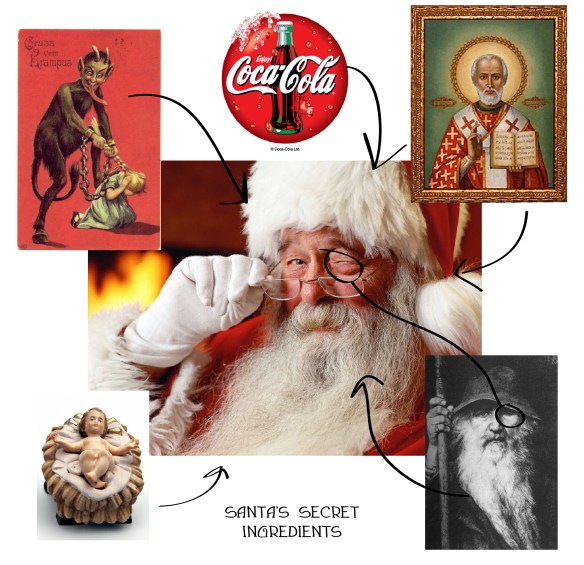
By Jerry B. Brown Ph.D. and Julie M. Brown M.A.
Source: Reality Sandwich
The following is excerpted from The Psychedelic Gospels by Jerry B. Brown, Ph.D. and Julie M. Brown, M.A., published by Inner Traditions.
On Christmas Eve, when the streets are all covered with snow and a hush falls over the land, parents recite the story of Santa Claus to wide-eyed children. They discreetly wink as they tell the timeworn tale of a jolly old elf who is dressed all in red and white from his head to his toes. Miraculously, Santa travels around the world in one night, in a sleigh pulled by flying reindeer, stopping at each home to place gifts under the Christmas tree festively decorated in tinsel and colorful ornaments with a star on top.
How improbable! How curious! But what if this snow-white lie, which we dutifully recount each year, was grounded in an ancient reality whose roots reach back thousands of years to the vast forests of Siberia? What if the real story of Santa was even stranger than that of the commercial myth of Saint Nick, the little sleigh driver “so lively and quick”? What if it was stranger than most of us could ever imagine?
It was high in the Cairngorms in the heart of the Scottish Highlands that Julie first heard the true story of Santa Claus and his flying reindeer. Driving east from the Isle of Skye, where we spent our twenty-fifth anniversary, Julie and I stopped in Inverness, located at the north end of Loch Ness. From there, we followed route A9 as it twisted and turned up into Cairngorms National Park. After lunch in the alpine resort town of Aviemore, Julie made a few phone calls and found lodging at the Braeriach Guest House. Sitting on the banks of the River Spey in the quaint village of Kingcraig, this two-story stone-walled Victorian inn has five guest rooms, all furnished with wooden sleigh beds. The view from our bedroom window looked out past a flower garden to the fast-moving river, on to a wide pastoral valley dotted with black-and-white cows, and up to the peaks of the snow-capped mountains. Over tea that afternoon, we asked our innkeeper Fiona, a refugee from the hubbub of London, what we should see during our stay.
“Oh, my favorite place would be to visit the wild reindeer. When you return, you can have dinner at the Boathouse Restaurant, only a twenty-minute walk from here through the forest.”
The following morning we drove to the long wooden cabin that housed the Cairngorm Reindeer Center. There we met three other couples and our guides, Beth and William, who would lead us up into the mountains. Beth explained that the “reindeer were reintroduced into Scotland in 1952 by a Swedish reindeer herder, Mikel Utsi. Starting from a few reindeer, the herd has grown in numbers over the years and is currently held at between a hundred and thirty and a hundred and fifty by controlling breeding.”1 About fifty of these reindeer live in a natural environment in the forests and highland plateaus nearby. The region is rich with lichen, the chief food of reindeer.
After the orientation we drove in a car caravan up a steep, curvy road. After parking in a small clearing, everyone donned knee-high Wellington boots. It was a cold day, and the trail was wet and muddy from a drizzling rain. We were excited and a bit apprehensive at the thought of encountering creatures in the wild. As the trail opened onto a large pasture, bordered by a dense dark-green forest, the sun broke through the clouds and the rain lifted. As we shed our rain gear, Will put down the sack of food he had carried on his shoulder and instructed us how to behave around the reindeer—who were still nowhere to be seen. “You can pet them, even touch their noses, but not their antlers. They grow very fast, a couple of inches a week, and are very sensitive.”
Just then, Beth began bellowing loudly. It felt eerie to be huddled together on a chilly hilltop while our guide howled into the wilderness. It took a minute before we realized that she was rounding up reindeer. Suddenly, we saw a huge light-brown stag emerge from the woods. He strode majestically toward us, his giant antlers swaying to and fro. Another reindeer followed and then another, slowly walking toward us, a plodding procession of caribou.
As the males, females, and calves drew closer Beth began calling them by name: Sting, Marley, Cranna, Oryx, Gandhi, Magnus . . . Elvis. As the herd approached, Will opened the sack and scooped pellets of food into our hands, telling us to pick a reindeer and go up to him slowly with outstretched arms. I walked up to a large bull. He nuzzled his warm, silky nose into my palms, gently licking them clean. Julie stood back and observed. Soon, everyone was talking, smiling, and even giggling at the sheer delight of being in the presence of these gentle caribou.
Julie noticed an albino reindeer standing off to the side, away from the herd. She asked Beth why he did not join the group.
“Oh, him. Sircus is his name,” Beth replied. “He only takes food from me or Will. He’s a real loner.”
“Really? Do you know why?” Julie inquired.
“I think it’s because he loves mushrooms so much,” Beth said.
At the mention of mushrooms, Julie’s ears perked up. She glanced over at me with a knowing look. Aha, she thought.
“Now, don’t get me wrong,” Beth continued. “All reindeer love fly agaric, but for Sircus they are his favorite food, even more than lichen. Sometimes, during the summer mushroom season, he eats so many that he just stands there mesmerized, staring into the sun, swaying back and forth. That’s why his face is so blotched and pink. It’s sunburned.”
As Beth finished speaking, Sircus turned toward Julie and without hesitation walked up to her. He placed his soft muzzle into her palms and ate slowly, all the while looking into her eyes. Julie glanced toward me, her face beaming. She stood still for a long while, gently petting Sircus. Then, just as quickly as they had appeared, the reindeer turned and ambled back toward the forest. Sircus followed. Everyone was silent on the downhill walk back to the cars.
“Jer,” Julie said softly to me, taking my hand along the trail, “I swear I had a real connection with Sircus, as if we knew each other. Don’t you think it strange that I could have such a spiritual encounter with a reindeer?”
“Yes, you must be Saint Francis of the animals,” I said.
Julie laughed and nodded her head in affirmation.
Rudolph, the Red-Nosed Reindeer
Once back at the inn, I was tired from our excursion and lay down to take a nap. But when I happened to glance over at the bookshelf next to the bed, I noticed the Field Guide to Mushrooms of Great Britain. Soon, I was turning its richly illustrated pages. After finding Sircus’s favorite, the red-and-white Amanita muscaria, I eventually fell into a deep and restful sleep.
When I awoke, I carried the field guide downstairs, planning to show it to Julie. I found her sitting near a roaring fireplace. She was engaged in animated conversation about our reindeer adventure with the other houseguests: Anne and John, a well-groomed, middle-aged couple from Devon, whose English accent I could understand if I listened carefully, and Bonny and Sid, young punk bikers from Liverpool whom I could barely understand at all. No wonder George Bernard Shaw observed, “England and America are two countries separated by a common language.”
After Julie mentioned that the Reindeer Center rented the caribou out during the Yuletide season to pull sleighs bearing gifts for children across Great Britain, the conversation turned to Christmas and Santa Claus.
“Does anyone know what Santa has to do with Christmas, the birth of Jesus, and this?” I asked, opening the mushroom field guide and showing everyone the photo of the bright red Amanita mushroom covered with snowy white dots.
Before I could finish the sentence, I felt Julie’s two hands firmly tugging on my arm, as she said in her calming therapist’s voice, “Sorry to interrupt, honey, but if we don’t leave now, we won’t be able to walk to dinner and back before dark.”
We strolled under tall trees whose leaves sparkled in the late afternoon sunlight. The air carried a sweet scent of wildflowers. Soon we came to the rustic restaurant on the banks of an alpine lake. After finishing the delectable grilled trout fresh from the lake, Julie asked pointedly, “What were you thinking back there?”
“I was just trying to explain my theory of Santa Claus,” I said defensively.
“I . . .” “Come on. You know what I’m talking about,” Julie objected. “What about our vow of secrecy, the one we made to each other at the beginning of this trip? Right before I escorted you out the door, you were about to blurt out that we were searching for the psychedelic roots of Christianity. I need to know that you won’t go around talking to people about our work while we are on this research trip.”
“Okay, I promise,” I replied.
“Now, tell me,” Julie said with a sigh of relief, “what were you trying to say about Santa back there at the inn?”
“While most people think of Christmas in terms of the quintessential Christian celebration,” I began, “the truth is that nearly all of the symbols associated with Santa Claus are based on the shamanic traditions of pre-Christian Europe.”
“I always thought of shamanism as a tribal religion,” Julie said. “I certainly never thought of Santa as a shaman! What do you mean?”
Archaic Techniques of Ecstasy
The classic anthropological definition of shamanism comes from Mircea Eliade (1907–1986), who described it as “archaic techniques of ecstasy.” By “ecstasy” he was invoking the Greek term ekstasis, which literally means “to be outside oneself” and in this context figuratively means “flight of the soul.” In essence, shamanism refers to ancient methods for inducing the flight of the soul, for both the living and the recently deceased. One of the most concise descriptions of the universal foundations of shamanism is found in Peter Furst’s Hallucinogens and Culture. These foundations include “the skeletal soul of man and animal and the restitution of life from the bones; all phenomena in the environment as animate; [and] separability of the soul from the body during life.”
At the very center of these belief systems stands the persona of the shaman and his or her unique ecstatic experience. With the aid of spirit helpers he can travel to and intercede with the supernatural forces of the Upperworld and Underworld whose mystical geography he has traversed through training and trance. Frequently, although not always, his mastery comes from the use of sacred psychoactive plants, which serve both as a portal to other realms and as a source of transforming power or “soul stuff.” With the concept of “transformation” so fundamental to this worldview, it is easy to see why sacred plants with the power to radically alter consciousness and provide direct access to these supernatural realms would be universally revered in ancient religions. Throughout prehistory the religions of our ancestors were shamanistic.
“But how does shamanism work?” Julie asked.
Seeing a puzzled look on Julie’s face, I searched for an analogy.
“Imagine yourself,” I replied, “as a Koryak reindeer herder living a nomadic existence in the endless boreal forest belt of Siberia. You live in a world without maps, compasses, or clocks and certainly without GPS. Season upon season you travel with your clan and reindeer herd through a seamless landscape of green and brown forests sometimes interrupted by the blues and grays of lakes and rivers. Then one day you watch your favorite reindeer nibble on a bright red-and-white mushroom that popped up out of the moist ground overnight. Suddenly, the reindeer begins to cavort about in a very un-reindeer-like fashion. You try the mushroom and soon find yourself transported through magical landscapes filled with talking spirits who instruct you how to live well and prosper.”
Julie was listening intently as I asked her, “So what would you think about this world?”
“That it was showing me a spirit world that could help me thrive in the natural world,” Julie replied.
“Precisely,” I agreed, “and that’s the point. For tribal peoples, these supernatural realms were accessed through the shamanic flight of the soul. It’s only within the context of shamanism that we can understand the true origins of Santa Claus.”
Mushroom Rock Art of the Chukchi
Often overlooked and certainly overshadowed by Wasson’s cracking of the Soma code in the Rigveda is his equally surprising discovery of an ancient “Siberian fly-agaric complex” among the ancient indigenous peoples of the Arctic Circle. Peering deep into the wellsprings of time long before the Aryan invasion on the Indus Valley,* Wasson traced the roots of Aryan worship of the Soma mushroom back some six thousand years to the semi-nomadic reindeer herders of Eurasia known to anthropologists as the fathers of shamanism. Today there remain some three hundred thousand reindeer herders divided into thirty ethnolinguistic groups.†
*According to the widely accepted Aryan invasion theory, between the fourth and second centuries BCE, several migrations occurred involving different Proto-Indo-Aryan groups from the steppes of central Asia toward the alluvial plains and valleys of northwest India. However, academics continue to debate whether the Indo-Aryans invaded and assimilated the less sophisticated Indus Valley cultures, or whether the Indo-Aryans moved in as the superior Indus Valley civilization was in a state of decline, adopting their mythologies and technologies. †They inhabit three far-flung, forest-belt regions of Russia and Scandinavia. Among them are the Lapps and Nenets in the Far West; the Ostyak, Samoyed, and Vogul of the central tundra and taiga zones; and the Chukchi, Koryak, and Kamchadal who live in the extreme Far East of Russia.
When Wasson published Soma in 1968, he had to rely on secondhand data derived from folk tales and linguistic analysis and on the firsthand accounts of “explorers, travelers, and anthropologists” who visited these remote regions as far back as the late eighteenth century.4 At that time he was unaware of recent Russian archaeological expeditions that had found iconic evidence—dramatic images etched in stone—of the use of psychoactive mushrooms among the ancient Chukchi.
During field expeditions in 1967 and 1968, Russian archaeologist N. N. Dikov discovered numerous mushroom and reindeer petroglyphs (rock carvings dating from 1000 BCE) on the banks of the Pegtymel River in the Far Eastern Chukotka region, located across the Bering Sea from Alaska. These rock drawings graphically reflect the worldview of nomadic herders and their traditional shamanic practice of ingesting Amanita muscaria. Since that initial discovery, Russian researchers have identified more than two hundred similar compositions at rock art centers in northern Russian, mainly in areas inhabited by reindeer herders.
The central images of these carvings are reindeer and an increasing number of “incomparable” anthropomorphic images of people, mainly women, wearing huge mushroom-shaped hats or, in another interpretation, dancing women with mushrooms hovering over or emanating from the crowns of their heads.
The northern region where these figures are found is one where fly agaric thrive. In a later work, observing that these “doubtless” Amanita muscaria “mushrooms were much larger in scale than normal,” certainly when compared to the humanlike figures, Wasson concurs that this suggests “mushroom possession.” A common theme in these visions is the personification of the spirit (wapaq) of the mushroom as “little men or women.” The Koryak believe that the spirits residing in the fly agaric appear in the form of tiny mushroom folk who give instructions to the be-mushroomed person. One observer reports that among the Ob-Ungrians, “the mushroom eater enters the realm of the little people, talks with them, learns from them what he wishes to know—the future, the outlook for a sick person, etc.”
Santa, the Reindeer Shaman
“So are you saying that the story of Santa Claus originated with the reindeer herders?” Julie asked.
“Not at all,” I replied, “simply this: while most people think of Christmas in terms of the classic Christian holiday, the truth is that most of the symbols associated with Santa Claus are based on the religious traditions of pre-Christian Europe. In fact, every major meme of our modern myth of Santa Claus can be found in Wasson’s pioneering description of a Siberian fly agaric–reindeer culture.
“Convince me,” Julie insisted.
“Okay, I will,” I replied.
Flying Reindeer
In Soma, Wasson notes that “reindeer have a passion for mushrooms and especially for the fly-agaric, on which they inebriate themselves. Reindeer have a passion for urine and especially human urine. (When the human urine is impregnated with fly-agaric, what regal cate is there, to be served to a favored reindeer!)”9 In fact, some herders carry sealskins filled with their own urine to lure stray reindeer back to the herd.
Reindeer have a seminal place in the lives of these semi-nomadic herders as the primary source of useful everyday articles and of spiritual significance. Practically, the reindeer provide transporation by sleigh, food and milk, clothing, shelter in the form of skins for yurts, tools, and many other necessities. Spiritually, flying reindeer serve as guides for shamans, transporting them through the spirit world. The hundreds of flying reindeer megaliths found in Siberia and Mongolia offer graphic representations of myths and legends about winged reindeer who transport their ecstatic riders up into the highest branches of the Cosmic Tree, universally revered by ancient peoples as the Tree of Life.
Christmas Tree as Cosmic Tree
In addition to the nearly universal flood myth similar to the story of Noah in the Bible, many tribal cultures have a deep belief in a sacred Cosmic Tree. In the context of shamanism, this tree provides a cosmic axis around which the three planes of the universe revolve. Its roots run deep into the Underworld, its trunk holds Middle Earth, and its branches reach skyward into the Upperworld.
The birch, pine, cedar, and fir trees play a conspicuous role among Siberian cultures and serve as the nodal points for shamanism. But it was Wasson who first pointed out that birches and evergreens play an essential role in the life cycle of the fly agaric. This is because fly agaric has a symbiotic relationship with these trees in that its invisible spores colonize the host trees’ roots prior to the mushroom bursting into view aboveground as an early stage Amanita muscaria, wrapped in a pure white veil. As a result, tribespeople were amazed to witness how these mushrooms apparently sprang from the earth without any visible seeds in what appears to be a virgin birth.
Like the Cosmic Tree, the center point between heaven and earth, the North Star is also considered sacred. Among reindeer herders, it is also known as the “Immobile Star” or the “Pole Star,” because all the stars in the heavens revolve around it. Thus today we symbolically place a star at the tippy-top of the Christmas tree, and for this reason Santa makes his home in the North Pole.
Santa, the Archetypal Shaman
Our contemporary image of Santa Claus as a rotund, jolly, white-bearded fellow in a red suit (or robe) with white fir trim is a modern version of the archetypal Siberian mushroom shaman. In fact, even today some Siberian male shamans and female mushroom gatherers still dress in ceremonial red-and-white trimmed jackets when they go to gather the sacred mushrooms. The biochemical effects of Soma are most pleasant and transformative when the mushrooms are dried before consumption. For this reason, the shaman initially hangs the fresh fungi to dry in the branches of pine trees (like the colorful ornaments that decorate the Christmas tree).
After the mushroom harvest is complete, the shaman collects his gifts in a sack and places them on his sleigh, which a team of reindeer pulls back to his yurt (Santa’s sleigh full of toys, pulled by flying reindeer). A yurt is the nomad’s teepee-like dwelling typically made out of birch branches and reindeer hides. In winter, snow drifts can cover the yurt’s main entrance, so the shaman enters through the smoke hole at the top (Santa coming down the chimney) to deliver his gifts to appreciative clan members. To further dry the mushrooms, they string them up around the fireplace, and in the morning they awaken to a ritual feast of dried magic mushrooms (Christmas gifts placed in stockings over the fireplace). Once they ingest the mushrooms, the celebrants leave the physical plane and are transported to the mystical realms of the Cosmic Tree, guided by spirits that live within the mushrooms (Santa’s helpers, elves that live in the North Pole).
All of these Christmas themes include the image of Santa Claus: the Christmas tree, the flying reindeer pulling Santa’s sleigh, Santa coming down the chimney, the exchange of gifts—even the elves who live in Santa’s workshop at the North Pole.
Dusk was falling as we started to walk back around the lake toward the inn. The Santa Claus conversation had sparked Julie’s inquisitiveness. “What about the Christian Saint Nicholas?”
“To be sure, religious historians argue that many saints were simply Christian versions of earlier pagan gods, adapted by the church to encourage heathens to accept the new religion of Rome. It is said that Saint Nicholas’s legends were created mainly out of folk tales about the Teutonic god Hold Nickar, a malevolent water spirit who tips over boats and torments sailors, or even about Alte Hoerner, which stands for ‘Old Horney.’
Julie smiled at the sexual reference to Santa Claus.
“No, no, it’s not what you’re thinking. In old German, Alte Hoerner literally means ‘old horned one’ and in this case the ‘ancient horned god,’ referring to the headdress of reindeer antlers worn by Eurasian shamans. Later on, when pagan deities were demonized by the medieval church under Pope Gregory, the horned god of shamanism became the devil of Christianity. And ‘Santa’ became ‘Satan.’”
“Rings of Smoke through the Trees”
“Look, look around us!” whispered Julie. A low-hanging cloud was slowly creeping through the woods, completely encircling us in a ring of ghostly white gossamer. The mist moved silent as cat paws, covering the ground and the trunks of the trees in a blanket of clouds. The tops of trees stood bare, silhouetted against the gun-metal sky and the fading sun, silent sentinels of the forest.
“Jer,” Julie spoke, in hushed tones, “this is unearthly. All evening, we’ve been talking about the way of the shaman, portals between the worlds, about how all things are alive with spirit.”
“Look,” I said, patiently, “just because this rare cloud rolls in just as we were discussing shamanism doesn’t mean there’s a connection. You can’t prove that; no one can.”
“No, I can’t prove it,” Julie spoke quietly, “but think about what’s happened today! We came to the mountains for vacation, and I met Sircus, an albino, Amanita-loving reindeer, who walks up to me and peers into my soul. We spend the evening talking about mystical realms. And now all around us the forest is alive, as if the living spirit of nature was welcoming us to the world of the shaman . . . affirming our decision to retrace Wasson’s steps.”
I was about to object, but just then these lines from Led Zeppelin’s “Stairway to Heaven” ran through my head: “There’s a feeling I get when I look to the west/ And my spirit is crying for leaving. In my thoughts I have seen rings of smoke through the trees/ And the voices of those who stand looking. Ooh, it makes me wonder/ Ooh, it really makes me wonder.”
We stood silently in the middle of the mist-filled forest, wondering what the future would bring. At our next stop in Greece, the cradle of Western civilization, we walked among the monumental ruins of Eleusis, where rituals involving entheogens had been practiced for two thousand years.
INDIAN COUNTRY NEWS
"It is the duty of every man, as far as his ability extends, to detect and expose delusion and error"..Thomas Paine
Human in Algorithms
From the Roof Top
I See This
blog of the post capitalist transition.. Read or download the novel here + latest relevant posts
अध्ययन-अनुसन्धानको सार

 After the Crash