Oil and Money – Lessons Learned

petrodollar-systemThis is a concluding post for an excellent 7 part long-form series featured on the Hipcrime Vocab blog. While this serves as an adequate synopsis of what was covered, I highly recommend the series for it’s depth and scope starting with the introduction.

Source: Hipcrime Vocab

The first thing I learned is that I bit off more than I could chew, lol. I was intending a simple book review, and it turned into a lot more than I intended to write. I also learned how difficult and thankless a task blogging can be. I’m glad at least a few of you chimed in to let me know you enjoyed it.

One major thing I learned (which I already sort-of knew) is how much real resources have to do with the economy, and economic history, despite economists’ insistence that land, labor and capital are all that matter. In fact, real resources appear to be the MAJOR driver of our economic fortunes. Even Forbes magazine had to admit: The Recessions of 1973,1980,1991,2001,2008 Were Caused By High Oil Prices. Energy doesn’t matter, huh?

I was really taken aback at how recent this all is. I was somewhat aware the historic problem with oil was that there was too much of the stuff.  Eric Roston, in The Carbon Age, writes, “Gasoline was a throwaway by product of kerosene refining until the early 1900s, used sometimes in solvents or as fuel for stoves. In 1892, two cents a gallon was a decent price. For another thirty years, apothecaries were the makeshift filling stations.”

But I had no idea just how much of a glut there was and how people thought it would last forever. That it was so cheap we needed the Texas Railroad Commission to hold back production so that the prices would be high enough. I mean, this substance contains the equivalent of ten to eleven years of human labor (1750 Kilowatt hours of human labor), for crying out loud! And it is a non-renewable resource! I was amazed at how far we went in coming up with new uses for the stuff, to the point destroying perfectly good and workable infrastructure just so we could use more of it. Can anything be more insane?

The long boom was driven by the exploitation of oil as a resource. This led to the dominance of the ICE (Internal Combustion Engine). All of the knock-on effects of the ICE were behind the post-war boom. I mean, you could write a book about all the economic development caused by cars and trucks. In fact, truck driver/delivery is still the most common job in most states to this day! The ability to deliver goods cheaply anywhere had so many knock-on effects, from the creation of whole new cities to the rise of big-box retailers. Let’s not forget that everything in that big-box retailer is made from plastic which is made from petroleum feedstocks. Kunstler calls the suburbs the greatest misallocation of resources in human history. It’s easy to see how that’s true.

I didn’t know that it was only as late as 1959 that petroleum overtook coal to be more than 50 percent of our energy use. I didn’t know that coal only became the world’s predominant energy source after 1900. Before that, we were still essentially in a wood/biofuel economy. As I wrote before, that’s pretty recent – less than three generations.

 We think of the 19th century as the era of coal, but as the distinguished Canadian energy economist Vaclav Smil has pointed out, coal only reached 5% of world energy supply in 1840, and it didn’t get to 50% until about 1900.

The modern oil industry began in 1859, but it took more than a century for oil to eclipse coal as the world’s No. 1 source. “The most important historical lesson,” Dr. Smil says, is that “energy resources require extended periods of development.”

The Power Revolutions (WSJ)

Peak oil ideas made it sound like oil (specifically petroleum) was the only resource that matters to the economy, so that once oil production stops growing, the economy will collapse. That’s clearly not the case (oil is 36 percent of the world’s energy). There are lots of other fuels in the mix. However, things like fracking, tar sands, and offshore drilling clearly mean that cheap, easy-to-get oil is on the wane. Oil is cheap now because of fracking – not the tight oil itself, but rather because the fear of it is keeping prices low by the Saudis. That will change. I’m always amazed at the people who run out and buy SUVs the minute the oil price goes down. Do they expect it to be cheap forever or do they expect to drive their car for only a year? It’s also cheap because our economy is in the crapper.

Forget who the candidates are and all the campaigning and the billions of dollars spent– If oil prices are high, the economy is in recession, and the incumbent party will lose power. You can pretty much predict any presidential election by this fact alone. Two-thousand is the only one that sort-of breaks the mold, and that was such a bizarre election between the hanging chads, the voting fraud and the Supreme Court. In other words, it’s not just the economy driven by energy prices – it’s the political world too. Everything else is just meaningless fluff.

At the end of the day, whether a president presides over a good economy or a bad economy is almost entirely down to oil prices.

The other thing that strikes you is the “Groundhog Day” nature of the situation. Oil prices get high, we get worried about the environment, and there’s a great boom in alternative energy, energy efficiency, environmental impacts, worries about the economy and supply chains, and so forth. Then oil prices go down and we forget all about alternative energy and all the inherent problems with relying on a finite resource. All the progress toward getting off of oil stagnates, and people assume oil will be cheap forever. Then they get high again, and suddenly it all becomes important again, and we have to go back to square one (compare the EV-1 to Tesla, for example. Heck, Edison built an electric car!). Charles Mann had a great line along the lines of “The human propensity to see flukes of good fortune as never coming to an end,” or something like that.

Given the manipulation of oil prices, it’s hard to see natural economic factors as ever being able to do the right thing when it comes to energy. When prices get high, new supply comes online and alternatives are pursued. But then oil prices crush the economy, demand falls more in line with supply, the price falls, and the initiatives are halted. It feels like the invisible hand is attached to an idiot. Maybe this time we’ll finally get serious.

Prices are temporary conditions. Peak oil is permanent.

The drug dealer analogy of us being addicted to oil is shopworn, but it is just so accurate. It was only once we were addicted to the product that they could jack up the price, and then we HAD to pay what they demanded. But like a drug that devastates the lives of its users, when you hit rock-bottom you try to get on the twelve-step program and get your life back. Then, the dealers will lower the price to keep you addicted, and the cycle begins again. Plus, every dealer wants to be your dealer, so they need to be just a little bit cheaper than the next guy. Barring that, they will bind together with the other dealers to keep the price high and protect their “turf.” The economics of drug dealing and oil are eerily similar. I wonder if anyone’s formally studied this.

In the past each new energy source was added on to the previous ones. Now we are talking about substitution – a totally different ballgame. That is, new energy sources will replace old. That’s substitution, not expansion.

Cheap oil combined with the opening up of China drove globalization. There is no way we could build the largest moving structures ever built to transport goods if we didn’t have a fuel source cheap enough to make it worthwhile. A single ship can move 19,000 containers, enough to move 300 million tablet computers.

That oil played a role in foreign policy shouldn’t be a surprise, but looking at exactly how it led to the invasions of Afghanistan and Iraq, the civil war in Syria, the removal of Qaddafi, the propping up or removing of dictators, and the positioning of armies around the globe was still eye-opening. So much foreign policy is dictated by access to oil. So much…

I was actually unaware of the Eurodollar and how I caused the fall of Bretton Woods. As Smith illustrates, going back to the gold standard is practically impossible (sorry libertarians). I was unaware of the role that Petrodollar recycling played in the Latin American debt crisis. I was aware of how the Petrodollars funded terrorism. I’m sure readers of Dmitry Orlov were familiar with the role oil and grain prices played in the fall of the Soviet Union. Again, this made Reagan look like a genius.

What I really wanted to describe is how the oil price crisis came about and how it led directly to the rise of Neoliberalism. I also wanted to show how Jimmy Carter’s “failure” and Ronald Reagan’s “success” was based mostly on oil prices. Some people would take issue with that, but it’s hard to separate one from the other. Is it 100 percent? Maybe not, but what percentage was oil prices? Seventy? Fifty? Twenty-five? Surely it played a role.

The problem is that it made Neoliberalism look like a success. People came to believe that unions were evil, and tax cuts for the rich and corporations, deregulation, and speculation were the magic keys to prosperity. But throughout the Neoliberal reign, oil prices were either stable or crashing. When that wasn’t the case, as in 2007-2008, the system came apart. The rise of China also made Neoliberalism appear to work. But it was smoke and mirrors – cheap uneducated labor, overinvestment, state-controlled enterprises, artificially cheap currencies, entire cities built with no people in them, etc. It was a Potemkin’s village on the scale of a nation. Globalization is a Ponzi scheme.

But now Neoliberalism is literally tearing the world apart. Some major reasons:

1.) Turning the speculators loose. The oil price rise and the food price rise seem to be mainly problems of market speculations (i.e. greed and fear, always the real movers of markets, not supply and demand). This has, in turn, led to political turmoil as we saw in the Arab Spring. If speculation continues to cause price rises for essentials like food, fuel and water to pad the fortunes of speculators, expect more chaos and collapse. Even in the U.S., the actions of Enron and “Kenny-boy” lay caused serious harm to economies, not expansion. And we spent enough on the bailouts to give every unemployed person a job and every homeless person a home, with billions left over. Is this how economies should be run?

2.) The suppression of worker wages has caused massive hardship around the world. The abandonment of full employment as a policy goal has led to a worldwide unemployment crisis that is destabilizing the world. Unemployed people have nothing to lose. People with nothing to lose tend to revolt (see above). The gutting of social services and welfare safety nets has also led to poverty and desperation all around the world. It calls into question the ability of capitalism to deliver broad increases in living standards everywhere. We are clearly not seeing that. We’ve been in reverse for some time. Shouldn’t an economic system make us ALL richer, rather than provide winners and losers? If it can’t, what kind of system is it?

3.) Globalism spreads not only the wealth around, but the poverty too. Some countries, notably Western Europe, have attempted to defend their citizens, while others like the United States, did nothing to insulate its workers from third-world wages and working conditions (and even encouraged them). Rising living standards in China and India are one thing, but falling living standards in formerly wealthy countries make the rich capitalists richer, but cause anger and consternation which is easily exploited by the unscrupulous and power-hungry. This is also destabilizing. Just look at all the anger in the U.S. today searching for a scapegoat.

4.) Austerity and the straitjacketing of governments has led to wealthy, industrialized countries “undeveloping.” The United States is a nation of private affluence and public squalor, with one-third of its children living in poverty, entire cities abandoned and crumbling, urban areas too expensive for median income workers, the infrastructure of a banana republic, poor access to education and healthcare, pockets of poverty, ghettoes, etc. Greece is being gutted as an example to the West. This is leading to rise of right-wing parties in Europe, again redolent of the run-up to the Second World War.

5.) The faith in Markets to solve all problems is especially disastrous with an ongoing environmental crisis. Instead of rationing or capping, instead we get easily gamed “cap and trade” markets to reduce emissions. Nature is just “natural capital,” and every drop of water, tree leaf, and grain of sand must be assigned an owner and a price. In other words, all of nature must be subsumed into the market, because markets are the only way we can solve our problems! This is a Neoliberal idea. Look at how the United States responded to the crisis in the seventies by contrast.

6.) Debt crises have caused massive hardship around the world. As I learned, Mexico’s reputation as a haven for poverty, prostitution, drug gangs, etc. was only after the Latin American debt crisis of 1982. That, in turn, led the massive influx of Latin American refugees into the United States turning America into a Latin country overnight.  Prior to 1979, places like Afghanistan, Iran, Lebanon, Egypt, Iraq, Algeria, Syria and Libya were stable, secular, relatively prosperous places (See this. And this). Now look at them. Yes, they had dictators and human rights violations. But compare it to today. Latin America has fared somewhat better, largely by finding a way to reject or bypass Neoliberalism. Africa has not fared well, either. Note that you only heard about collapse and famine after the 1980’s (remember Ethiopia?). Yes, Africa was poor before then, but it seemed to be heading in the right direction. Not any more.

7.) People from these wrecked countries are heading to the Western industrialized countries in massive waves of migration–Latin America for the United States and Canada, and the Middle East and Africa for the European Union. This has driven down wages and caused the rise of nativist parties. Everyone is heading for the lifeboats as more and more countries become failed states. There is simply not enough room for all. But rebuilding these countries would mean abandoning the Neoliberal paradigm, forgoing debt and putting into place quasi-socialist policies. Then again, the rich can always retreat to floating offshore islands (and eventually space colonies).

It’s clear that much of the money that has not been collected by governments has gone not only into speculation as opposed to productive activity, but in purchasing political representation. This has led to democracies devolving into oligarchies and a mistrust of democracy in general. The buying of politicians and the media blocks any attempts to deal with collapsing systems. We’ve seen ever greater instability and ever greater bubbles under Neoliberalism now that government has been “contained” and workers have been “disciplined.”

The answer to our problems should be clear: abandon Neoliberalism and return to the mixed economy. Stop hamstringing governments. End speculation. Tax the rich. Close offshore tax shelters. Raise tariffs. Defend domestic industries. Write down the debts. Pursue full employment policies such as a job guarantee, reduced working hours and an basic income guarantee. Distribute essential social services through the government, and let the market handle non-necessities. Regulate to deal with externalities. Impose limits on natural resource extraction. Decarbonize energy.

All of this used to be common-sense. Now it beyond the pale.

The problem is, it’s a ratchet effect. We cannot go back, because TPTB will not allow it. And since the 1970s, they learned they had to not only control the government, but the information we imbibe day after day, otherwise we would instruct our government to do something the powerful may not want. Instead, we had to be convinced that Neoliberalism is the only valid economy – hence the think tanks, talk radio, publishing mills, Fox news, etc. Any sense of common purpose or solidarity is evil “socialism.” As we learned, even “liberal” news sources are fully dedicated to defending this paradigm at all costs, even at the cost of credibility. And the funding of the political classes by the wealthy will ensure that anything that threatens the fortunes of the oligarchs will be a non-starter, even if people do see past the media rhetoric.

The change in economics swallowed the hope of the sixties. How much does it have to do with Neoliberalism, and how much with oil prices? A lot of commenters say, “Hey, the oil is gone, we just need to learn to be peasants.” They point out that American wages stopped growing in 1973, around the time domestic oil production peaked in the U.S. But I think that’s simplistic. American wages stopped growing, not everyone else’s–not what we’d expect in an energy descent scenario. Rather, I think it was the wealth transfer of the seventies, and the politics it engendered, that was the primary culprit. The oil shock opened the door for globalized Neoliberalism, and that is the primary cause of our misfortune. By using oil as an excuse to be politically passive, we remove any chance at creating an economy that works better for all and play into the hands of the powerful.

I think old economy Steve puts it best. Or shall we say, “mixed economy” Steve:

OY4w945

The Suspicious Downing of Russia’s Metrojet Airbus A321-200. “The ISIS is a Creation of the CIA”

151101114659-02-russia-plane-crash-1101-large-169

By Larry Chin

Source: Global Research

The explosion and crash of Russian Metrojet Airbus A321-200 over Egypt’s Sinai peninsula raises ominous new questions. There are going to be numerous theories bandied about in the course of another long international “investigation”, accompanied with endless political spin from all sides.

We hear numerous variations that boil down to two basic theories: catastrophic mechanical failure or bomb.

Many officials have already ruled out a missile strike because there was no evidence of a missile launch nor an engine burn. US satellites detected heat around the plane before the explosion, but the cause of the heat is unknown. In an Associated Press account, US aviation analyst Paul Beaver stated, “It doesn’t tell us if it was a bomb, or if someone had a fight in the airplane with a gun—there is a whole raft of things that could happen in this regard.” Adding to the mystery, Beaver also noted that in the event of a fuel tank or engine explosion, “engines are designed so that if something malfunctions or breaks off, it is contained within the engine”. The plane broke up at high altitude.

Most recently, British officials have more strongly suggested that a bomb was the cause. And now, US intelligence officials are coming forward to embrace the idea of a bomb.

Looking past the political smoke, one scenario deserves scrutiny.

The Islamic State (IS) has taken responsibility for the incident. In a manifesto, the IS claimed to have brought down the Russian plane in retaliation for Russian military intervention in Syria.

Egyptian officials immediately derided the claim as propaganda that damages the image of Egypt. But at the same time, the authenticity of the IS propaganda has not been debunked. The nature of the propaganda was in keeping with previous manifestos; CIA standard procedure. There is “insufficient evidence” to support the claim, but there never is sufficient evidence. By design.

Given the amply documented fact that the IS (ISIS, ISIL, etc.) is a creation of US intelligence, and function as assets and military-intelligence fronts of the CIA and Washington—financed, recruited and trained by the US and its allies— why shouldn’t the claims of responsibility be taken at face value?

In an era in which false flag atrocities and deception have constituted US foreign policy, it is in no way inconceivable that forces aligned with Washington committed yet another act of terrorism, another act of war, to send a message of warning and/or provocation to Moscow.

This is by no means the first time that the downing of a plane has been exploited for political purpose, aimed at Russia. The false flag shootdown of MH-17 and the cover-up and propaganda that followed offers a ghastly example. The history of American covert operations is rife with atrocities involving planes.

The CIA is opportunistic, flexible, and selective with its work. In this conveniently-timed case, Washington can deny terrorism, warn about terrorism, poo-pooh the jihadist rhetoric (sourced to their own propaganda machine), and express sympathy, all at the same time that a brutal political message is sent to Moscow.

This scenario is not merely “conspiracy theory” when viewed against current big picture realities, and the fact that a superpower war is underway. As chronicled by Michel Chossudovsky:

While the media narrative acknowledges that Russia has endorsed the counter-terrorism campaign, in practice Russia is (indirectly) fighting the US-NATO coalition by supporting the Syrian government against the terrorists, who happen to be the foot soldiers of the Western military alliance, with Western mercenaries and military advisers within their ranks. In practice, what Russia is doing is fighting terrorists who are supported by the US.

The forbidden truth is that by providing military aid to both Syria and Iraq, Russia is (indirectly) confronting America.

Moscow will be supporting both countries in their proxy war against the ISIL which is supported by the US and its allies.

Russia is now directly involved in the counter-terrorism campaign in coordination with the Syrian and Iraqi governments.

In fact, as written in Tru Publica, the war in Syria is not about the Islamic State.

In fact,

“the countries involved in this war are now from all four hemispheres of the planet who are now represented and engaged in a conflict that will definitely be a fight to the very end.”

We can even go beyond this measured view. From Ukraine to Syria, to hot spots across the Middle East and North Africa, we are witnessing an increasingly open war between Washington and Russia, no different than the Cold War (Vietnam, etc.) but with stakes even higher, engulfing far more of the planet. Add to this the increasing tensions between the United States and China, and the map of the global conflict is literally worldwide. What cannot be argued is that the war between the superpowers is intensifying, perhaps past the brink.

The downing of a Russian passenger plane and the death of hundreds of Russians would mean nothing to the war criminals with grand aspirations of conquest for the geography and resources of the most resource-rich chunks of the Earth.

Russia has openly and resolutely waged effective military counter-terrorism operations against the terror fronts of the US and NATO—all jihadist terrorist armies, including ISIS, ISIL, Al-Qaeda, and Al-Nusra, which are all US and CIA fronts. What Moscow has done is call Washington’s bluff and upping the ante.

Put simplistically, Moscow said:

“If you (US-NATO) truly wish to combat terrorism throughout the region, then we will ‘help you’, by actually doing it.”

These operations were followed by agonized and flummoxed whines from Washington, as more and more of the Anglo-American empire’s terror assets have been hampered from their massive attempt to topple the Assad regime. The Vienna-Geneva Peace Talks are a charade that buys time for Washington to counter the Russian actions.

Moscow, acting as the actual “good guys”, have “ruined everything”; ripped the “false good guy” mask off of Washington’s massive criminal operation. This embarrassment to the empire had to be met with a desperate reply.

Was Metrojet Airbus A321-200 part of this response? The message from the Islamic State (aka the CIA) clearly was.

The message was received: Russian President Vladimir Putin’s spokesman Dmitri Peskov quickly rejected any connection between the crash and the Russian military operation in Syria, while Putin himself has vowed that nothing will succeed in scaring them off.

Why the Darknet Matters

shutterstock_251313145-650

By Luther Blissett and J. F. Sebastian of Arkesoul

In February 2015 Ross Ulbricht was convicted of money laundering, computer hacking and conspiracy to traffic narcotics for his role (either with or as Dread Pirate Roberts) in creating and administrating the darknet market Silk Road. For this, U.S. District Judge Katherine Forrest sentenced Ulbricht to life in prison without possibility for parole. Why was Ulbricht treated more severely than most murderers and child molesters (not to mention wall street and state criminals who do far more societal harm than all others combined)? The only logical explanation is that they needed to make an example out of him not just for his actions but for what he represented. The draconian sentence sends a message that the government is doubling down on its destructive and wasteful war on drugs and is clearly threatened by agorists (ie. those advocating for a society of voluntary exchanges and counter-economics without violence or authority) who utilize the darknet to make their ideas manifest. To understand the scope of the threat this poses to governments one must understand what the darknet is.

The darknet is an anonymous overlay network accessed through special software, configurations and/or protocols. It was created in the 1970s to designate anonymous networks isolated from ARPANET (an early form of the internet) which, for security purposes, had addresses hidden from network lists and were unresponsive to pings or other inquiries. The World Wide Web content that exists on darknets (known as the dark web) can only be accessed through anonymous browsers such as the Freenet or TOR Browser Bundle. The darknet and dark web are part of the deep web, the content of the World Wide Web not discoverable by means of standard search engines.

Interest in and use of the darknet has grown dramatically since TOR was released to the public in 2003. Much like when the internet was new, the darknet is often slow, though it has more to do with the complex random rerouting necessary for anonymity than the hardware or infrastructure. And like the early internet, the darknet is widely viewed as the new “wild west”. The darknet does attract its share of fringe subcultures including cryptoanarchists, transhumanists, digital pirates, sexual fetishists, drug users and dealers of different types, etc., but the groups that have arguably been the most empowered by the technology are political dissidents such as whistleblowers and activists.

As governments and corporations gain increasing power over the physical realm through laws, economics, violence and surveillance, one of the few remaining options for anyone wanting to bring about systemic change without fear of retribution, is the darknet. The government would of course never openly admit their fear of such a threat, though it’s apparent that law enforcement and intelligence agencies (who behave as if they’re entitled to the right to monitor all activity) are threatened enough even by less overtly political darknet sites such as Silk Road. They may claim concern over drug gang violence and addiction justifies the crackdown, but if that were actually the case they would have ended the war on (some) drugs years ago when more than enough data was available proving harm reduction to be a more humane and effective strategy.

Of course violent and cruel behavior can be found on the darknet, just as it exists offline. One could argue such cases should be investigated in ways that don’t jeopardize the anonymity of all users. What about the safety of victims attempting to evade dangerous individuals and groups? Whistleblowers need anonymity as well if releasing information on crimes committed by people in power.

As law enforcement struggles to defeat darknet anonymity with new tools such as Memex (a data-trawling program), programmers innovate to make darknet sites more decentralized, private, secure, and user friendly. Improved user interface will draw more users to the darknet, especially as awareness of internet privacy and security issues increase. Government efforts to police and regulate the darknet will also increase further as aspects of the darknet become both more mainstream and fringe, the darknet marketplace expands exponentially and improved cryptocurrencies are developed to meet demand.

As is, the Darknet is a system that is continually evolving. And, inasmuch as it poses a threat and a risk to authority, there is friction between the two. On the one hand, there is the axiom for control and security, which often times conflates manipulation with exploitation. On the other, freedom and liberty of expression, which often times conflates a lack of cohesion with relativism.

Regarding the first side of the debate, it’s a natural product of strategic rationality to calculate safe scenarios as to ensure survival. Vertical hierarchies often times result in perverse agendas that funnel the interests of the few on the top. However, these exist to ensure safety for a particular collective. That is the very paradox of government: The criterion for peace, however illusory, is to make up a contract with the State and its people. “I give up certain rights in exchange of safety”. This is game theory: Predict the behavior of others so as to ensure safety. The government fulfills this need through law and order. Let’s minimise risk, and up control as well as safety, which produces a space to live and grow. In this model, the assumption is to always expect the worst, while paradoxically ensuring productivity through an illusory cohesion and identity. In a collective that is afraid of itself, everybody is “doing their part”, but as well miss out on having a say on the big issues. Government is a fail switch for everything absurd, illogical, and different. The infamous saying applies: “Fear what you don’t understand”.

On the other side of the debate, the inverse is suiting. Greater freedom involves having a voice. The trade off is becoming segregated as an outsider, because having an opinion comes with a price. Refusing to accept the “game rules” of “law and order”, is anathema to cohesion and identity. This philosophy is natural to fringe culture, because often times fringe culture is made up of victims of a system that doesn’t respond to the needs and demands of its people. That’s the problem: If everybody played by the rules, including those at the top, then the big illusion would make sense. There’d be intrinsic justice to the operational structures of society. That’s another paradox, power perverts when it should essentially allow and protect human flourishing and expression. That’s what we are taught, right? Civilization is supposed to be good. But it seems more and more evident that we haven’t yet learnt how to keep our governments at bay and working for the people. Because ideas fracture models by confronting power structures of domination and corruption, we essentially have a duty to be creative and protect what we rightfully are as a species. Ideas are revolutionary, because they add to the frame of possibilities and suggest ways in which the old modes of thinking are outdated. They pose a danger for the status quo, insofar as they fragment cultural psyches. They allow people to think. This is not what Government wants. Our freedom in exchange for safety. Censorship in exchange for control. Our voices in exchange for capital.

At odds, therefore, is the fear for different things versus the need for expression. The Darknet is an idea. It’s not perfect. It fails in many ways, particularly in allowing terrible transactions to happen. However, these are already there with or without the Darknet. If the government was smarter, it would learn to cooperate with the Darknet. It would stop trying to silence voices by hammering the stick. It would offer incentives for creativity and solutions. Yes, the Darknet might be a channel for people to do bad things. But it also allows for new and positive changes. Change is good. Change is evolution. We move forward as we learn. At some point, the Darknet will learn how to push the bad and to cohere the good. If we admonish the Darknet we also chastise our right to expression. We need to challenge our governments, and the Darknet meets that demand. One could argue there’s many pressing problems as important (if not more so) as electronic freedom, but few could have as much of an effect on the outcome of every other struggle. Government can’t silence our voices, it must adapt to them. The battle over the Darknet symbolizes a crossroads in history where decisions made now will have an increasingly large impact on our lives in the future. If freedom prevails, we have an opportunity to make a great idea function for an even greater and much more illuminating goal.


Some day, we could be a shining beacon of hope for the oppressed people of the world just as so many oppressed and violated souls have found refuge here already. Will it happen overnight? No. Will it happen in a lifetime? I don’t know. Is it worth fighting for until my last breath. Of course. Once you’ve seen what’s possible, how can you do otherwise? How can you plug yourself into the tax eating, life sucking, violent, sadistic, war mongering, oppressive machine ever again? How can you kneel when you’ve felt the power of your own legs? Felt them stretch and flex as you learn to walk and think as a free person? I would rather live my life in rags now than in golden chains. And now we can have both! Now it is profitable to throw off one’s chains, with amazing crypto technology reducing the risk of doing so dramatically. How many niches have yet to be filled in the world of anonymous online markets? The opportunity to prosper and take part in a revolution of epic proportions is at our fingertips!

I have no one to share my thoughts with in physical space. Security does not permit it, so thanks for listening. I hope my words can be an inspiration just as I am given so much by everyone here.
Dread Pirate Roberts  [3/20/2012]

LEVIATHAN: The end of history has arrived and it is in post-Soviet Russia

leviathan

By Lauren Carroll Harris

Source: Adbusters

Within contemporary Russian film, it seems there is an ability to make the grandest statements from the smallest stories. From the insides of tiny flats, dying towns and treeless bays, directors like Andrey Zvyagintsev are able to tell big morality tales of corruption, futility, class and superstition that are at once national and universal in their scope and ambition. Zvyaginstev’s latest film, Leviathan, offers the newest iteration of these massive themes.

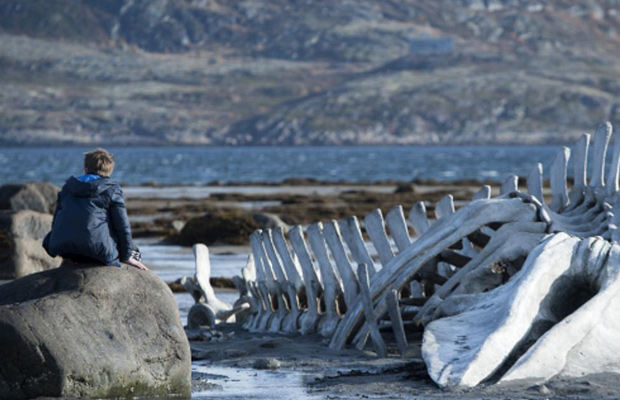
Our ‘Job’, Kolya, is a hotheaded everyman, whose house and land are to be seized, razed and developed by the corrupt major. His old lawyer friend from Moscow, Dmitri, must resort to blackmail to defend him, his second wife Lilya looks on despairingly, and his son Roma is busy learning how to drink in the ruins of a nearby church. Our protagonist is never idealized, nor is his gut reaction – to fight – rendered noble, it is merely taken for granted that he is on the edge of a last chance cliff. This is a story of one man against a terrible system and his fate is sealed from the start. It follows that even Leviathan’s portrayals of beautiful things are heavy with doom: the whale carcass in the film’s poster is the film’s strongest visual statement of political futility.

In all these contemporary Russian films I’ve seen – Zvyaginstev’s third film Elena, last year’s The Fool – concepts of social justice are dismissed as naive. The protagonists inch closer to their foregone conclusions blindly, the humor is black and the philosophical currency is fatalism. As in last year’s Two Days, One Night, there is humanity in the fightback, but unlike that film, Leviathan and its cohort underline the tragedy and futility of the fightback. The tides, the courts, the politicians, the priests – all carry on, undeterred. The end of history may have arrived, but not in post-Soviet Russian cinema, where it is accepted that history merely repeats, and repeats and repeats. What if there’s no march of progress? What if the world is growing flatter? Those questions at Leviathan’s heart are threatening for their antithetical stance to one of capitalism’s most inherent and foundational myths: that progress and growth is happening and will always happen. But what I found the most demoralizing thing about Leviathan is that it forestalls the march of progress because its only vision of post-capitalist political change is backwards – towards Stalinism. In that respect, the film is emblematic of the world’s lack of political imagination of visualizing alternatives to the current neoliberal ways of doing and thinking – in that way it is complementary with capitalism’s ‘end of history’ narrative.

In this respect, Leviathan’s global success – it is perhaps the most critically lauded foreign art-house film of 2015 so far – may speak to the way in which it tells Westerners what they already know and want to hear about Russia. It illuminates the truths about that post-socialist country that those in the West look down upon with the assurance of someone from a self-declared ‘democracy’ and reinforces Russia as blackly enigmatic. Never mind the continued use of torture in the USA, or the flagrant assaults on the human rights of asylum seekers in Australia: to foreign viewers, the idea of Russia as a black-hole for human rights is a seductive myth that distracts from their own societies’ hypocrisies.

Perhaps the most despairing storytelling technique in Leviathan is the visual concealment of key plot points. The film’s grimmest, most violent moments – Lilya’s affair with Dmitri, their altercation in the wilderness, Kolya’s retaliative attack, Dmitri’s beating at the hands of the mayor’s thugs – none of these are shown, just the moments leading up to them and following them. There’s something distinctly anti-Hollywood in Zvyaginstev’s withholding and something more violent. What we imagine is far more brutal, far more sinister and the present state of everything is both unimaginable and bitterly accepted. If Leviathan is a masterpiece, and by all critical consensus it is, it’s a masterpiece of political pessimism. The end of history has arrived and it is in post-Soviet Russia.

—Lauren Carroll Harris is a PhD Candidate and Sydney based writer.

Saturday Matinee: The Internet’s Own Boy

internetsownboyEditor’s Note: Tomorrow marks the birthday of Aaron Swartz. Had the government not driven him to an early death he would have been 29.

Synopsis by TakePart.com

The Internet’s Own Boy follows the story of programming prodigy and information activist Aaron Swartz. From Swartz’s help in the development of the basic internet protocol RSS to his co-founding of Reddit, his fingerprints are all over the internet. But it was Swartz’s groundbreaking work in social justice and political organizing combined with his aggressive approach to information access that ensnared him in a two-year legal nightmare. It was a battle that ended with the taking of his own life at the age of 26. Aaron’s story touched a nerve with people far beyond the online communities in which he was a celebrity. This film is a personal story about what we lose when we are tone deaf about technology and its relationship to our civil liberties.

Full Text of TPP Released to Public… And It’s Horrible

TPP-protest-sign-from-Petrovich-lawn1-e1384352291139

‘We now have concrete evidence that the Trans-Pacific Partnership threatens our families, our communities, and our environment.’

By Jon Queally

Source: Commondreams

It’s a disaster for people, the planet, democracy, and the future of the global economy.

That was the immediate assessment of informed critics as world governments, including the United States, on Thursday morning made the full text of the controversial Trans Pacific Partnership Agreement (TPP) available to the public for the first time.

Though a tightly held secret throughout the years-long negotiating process, publication of the entire text (available online here) confirms the deal’s many woeful inadequacies which had been gleaned from leaked drafts and public statements by those privy to its contents.

“The TPP is a disaster for jobs, and environment and our democracy. It is the latest stage in the corporate capture of our society,” said Nick Dearden, executive director of Global Justice Now, in response to the full text.

The enormous so-called “free trade” deal between 12 Pacific Rim nations, he continued, “has less to do with selling more goods, than with rewriting the rules of the global economy is favor of big business. Like the North American Free Trade Agreement (NAFTA), 20 years ago, it will be very good for the very richest, and a disaster for everything and everyone else. NAFTA entrenched inequality and caused massive job losses in the USA, and TPP is turbo-charged NAFTA.”

Based on its initial assessment of the text, Sierra Club said—just as predicted—the TPP would threaten the health of communities, the environment, and global climate.

“We now have concrete evidence,” said Michael Brune, the group’s executive director, “that the Trans-Pacific Partnership threatens our families, our communities, and our environment. It’s no surprise that the deal is rife with polluter giveaways that would undermine decades of environmental progress, threaten our climate, and fail to adequately protect wildlife because big polluters helped write the deal.”

Now parked for all to see and review on the website of the U.S. Trade Representative, the deal itself is over 2,000 pages long, broken into 30 separate chapters and various indexes and appendixes.

Released one month after the final deal was secured at a final negotiating meeting in Atlanta, Georgia, the publication of the text in the U.S. begins a 90-day review period before Congress.

The good news, said Dearden, is that the TPP can still be stopped and that civil society groups in all of the countries involved will use the coming weeks and months to mobilize against its passage. “We’ll be doing all we can to support the huge swathe of trade unions, campaigners, activists and consumer groups  in all those countries fighting TPP in the coming months.”

In the U.S., said Brune, environmental groups like his will be marching and lobbying alongside allies from labor and economic justice groups to make sure lawmakers vote the deal down. “Congress must stand up for American jobs, clean air and water, and a healthy climate by rejecting the toxic Trans-Pacific Partnership.”

Cult Movie Inspires Global Protest Against Internet Censorship

anonymous_telecomix_2012_5_31

Anonymous to Commemorate Guy Fawkes Day with Hundreds of Events

By Klaus Marre

Source: WhoWhatWhy.org

Here’s something sure to raise “hackles” in corporate boardrooms everywhere: The hacker collective Anonymous is marching in cities around the world today in the name of a free Internet.

The more than 600 events scheduled coincide with Guy Fawkes Day, an English holiday that animates the plot of the popular anti-tyranny movie V for Vendetta. Guy Fawkes was a notorious rebel who tried to blow up the English Parliament in 1605.

The Free Flow of Information: Unstoppable

“This year you are invited to stand against censorship and tyranny, corruption, war, poverty,” Anonymous said in a video on the Million Mask March website. “Millions will unite around the globe on the 5th of November to make their voices heard and let the various governments of the world know that they’ll never stop the free flow of information.”

Most of the events will be held in the US and Europe. In London protesters will gather outside the Ecuadorian embassy, where Wikileaks founder Julian Assange has found temporary refuge from prosecution. Hacktivists see his prosecution as payback for his making public vast numbers of top-secret files. Another major demonstration is planned for Washington, DC.

Others actions are scheduled for remote areas like Greenland and even, purportedly, scientific stations in Antarctica.

Only a handful of events are planned in countries like Russia and China, which have a history of dealing harshly with protesters.

The Million Mask March website warns marchers to be prepared for government counter-measures.

“Don’t risk your safety. Depending upon your country, if you believe you must go with superhero costumes, flowers, peace signs and pink sunglasses, do it,” the site states. “Go with a buddy. Keep your cameras on, and never surrender your camera.”

“Governments Don’t Work for the Interest of the People”

While advising caution, Anonymous frames the rationale for the Million Mask March in the starkest terms.

“It must be clear by now that governments don’t work for the interest of the people, but for big banks and corporations,” the hacker collective says in the video. “Do you or your children really want to live in a world where the government spies on its own citizens and sees you as a potential terrorist or criminal?”

Anonymous also announced that it would release today the names of KKK members that it gathered from hacked websites and databases. This would be the group’s latest high-profile action.

Anonymous is credited with dozens of “hacktivist” activities — against a wide range of government and private entities that rouse its ire. Previous targets have included the governments of the US and Israel, the Church of Scientology, child pornography sites, major corporations and the rabidly anti-gay Westboro Baptist Church.

The hacker collective sees the Internet as “one of the last truly free vessels that we the citizens have access to” and it has come out against what they view as harmful to that freedom. This includes government initiatives such as the Stop Online Privacy Act, the Cyber Intelligence Sharing and Protection Act, and the Trans-Pacific Partnership.