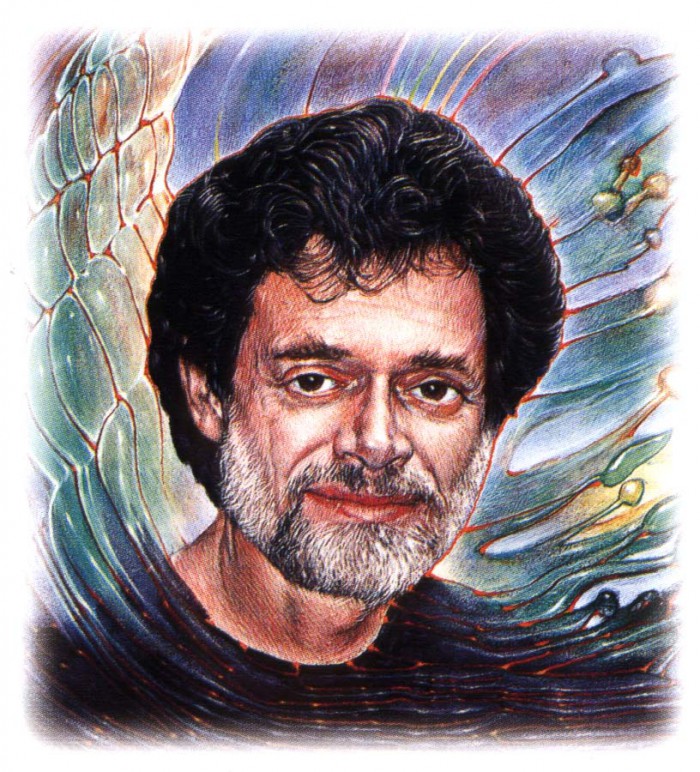
Terence McKenna’s Disillusioned Perspective on Mass-Consumerist Culture

Editor’s note: Since Terence McKenna’s passing on April 3 2000, his ideas have only grown in relevance and popularity largely because of their prescience and resonance to growing segments of internet culture. In commemoration of the 70th anniversary of his birthday we’re sharing this article which reflects an important yet often neglected aspect of McKenna’s worldview.

By Jordan Bates

Source: Refine the Mind

“We have to create culture, don’t watch TV, don’t read magazines, don’t even listen to NPR. Create your own roadshow.”

Terence McKenna is one of those cult-famous, societal-fringe figures of whom the majority of people have never heard. He’s also someone whose views probably have a polarizing effect on anyone who encounters them. At the very least, though, Terence was an exceptionally original thinker, and those who explore a fraction of his work will note his erudition and incredible ability to articulate his thoughts.

McKenna was an American philosopher and ethnobotanist who passed away in the year 2000. He was known for possessing expertise on a broad range of subjects including history, biology, geology, botany, and ecology. He toured and lectured extensively on everything from language and science to shamanism and extraterrestrials, developing a sizable and enthusiastic following.

His controversial status is in large part due to his vocal advocacy of  mind-altering substances. McKenna was a well-known psychonaut–one who explores consciousness through the ingestion of psychedelic hallucinogens–and a staunch proponent of the use of naturally occurring psychoactive compounds.

Obviously this latter aspect of McKenna’s legacy is an immediate turn-off to many. For a major sector of the population, the colossal stigma surrounding psychedelic substances is sufficient reason to lambaste the views of a well-known user. I, however, am not so quick to dismiss such a person, especially one as lucid, compelling, internally consistent, and dedicated to free inquiry as Terence McKenna.

McKenna’s Views on Mass-Consumerist Culture

I’ve delved into hours of McKenna’s lectures, and I am particularly interested in his ideas on culture. When McKenna speaks of culture, he seems to refer primarily to modern, mass-consumerist culture, so keep that in mind.

McKenna held a rather unfriendly position toward culture that can be summed up succinctly by one of his most famous quotations: “Culture is not your friend.” McKenna saw modern culture as a sort of engine detached from the interests of the individual and serving the manipulative, power-focused agendas of various institutions and wealthy individuals.

The following short video contains a portion of one of his lectures in which he addresses culture. I encourage you to watch it now (I will transcribe and elaborate on its central ideas below):

What Civilization is and What it Could be

McKenna certainly had a way of poetically articulating his ideas, and the video opens with what I feel is one of Terence’s most memorable metaphors:

“What civilization is is 6 billion people trying to make themselves happy by standing on each other’s shoulders and kicking each other’s teeth in. It’s not a pleasant situation. And yet you can stand back and look at this planet and see that we have the money, the power, the medical understanding, the scientific know-how, the love, and the community to produce a kind of human paradise.”

With this statement McKenna addresses the hyper-competitive environment that is symptomatic of the modern capitalistic socioeconomic paradigm. Our culture has a tendency to glorify competition, and many would argue that competition drives innovation and “progress” (a slippery word). I doubt McKenna would argue that competition has not been essential to the invention of our modern world, but he seems to step back and ask, “Yes, but when will it be enough?”

McKenna suggests that we’ve reached a stage of technological advancement and knowledge that would allow us to “produce a kind of human paradise.” This declaration sounds vague and idealistic, but based upon what I know of McKenna, I assume that by “human paradise” he envisioned something like a drastic change in the work paradigm, an elimination of poverty and starvation, a great reduction in disease and illness-related death, the end of war, and a much more palpable sense of a world community.

“Culture is Not Your Friend”

These items might sound far-fetched, but McKenna is not the first to suggest that such a situation is possible with our modern technology. R. Buckminster Fuller comes to mind as another prominent thinker who held similar views. After making this statement, McKenna elaborates on what he believes prevents us from attaining this state of affairs–namely, a lack of significant resistance to the poor leadership, dehumanizing values, and damaging cultural “control icons” that he perceives in the world. He states:

“Culture is not your friend. Culture is for other peoples’ convenience and the convenience of various institutions, churches, companies, tax collection schemes, what have you. It is not your friend. It insults you. It disempowers you. It uses and abuses you. None of us are well-treated by culture.”

[…]

But the culture is a perversion. It fetishizes objects. It creates consumer mania. It preaches endless forms of false happiness, endless forms of false understanding in the form of squirrelly religions and silly cults. It invites people to diminish themselves and dehumanize themselves by behaving like machines.”

Modern World as Dystopia?

McKenna holds that modern culture is centered around the agendas of those who are almost certainly not you. He believes that culture diminishes and dehumanizes the vast majority of the population by inviting them to unreflectively reinforce its models.

McKenna seems to suggest that instead of focusing on creating the type of world that is possible, we are caught up in a game of culture–a robotic pursuit of fetishized objects and false visions of a proverbial light at the end of the tunnel.

To some, this view may seem rather grim and dystopian. I don’t see it that way. I see it as a warning that remains pertinent in 2013 [and 2015]. The culture McKenna refers to does exist, and its effects are far-reaching and potentially insidious. However, I know that there are many, many people who are aware of this cultural game and do not conform to its status quo, who resolve to try to choose their own way of life and who see through the glitzy media-images.

Simply by being among this latter group of people, I think we’re doing the work that McKenna believed needed to be done–the work of resisting the damaging and dehumanizing aspects of modern consumerist culture. The mere realization that we are culturally conditioned to behave in certain ways is a sufficient catalyst to begin assuming a more active and reflective role in deciding how to live and act.

I see nothing wrong with being a cultural participant, but it should be our goal to develop a deeper awareness of the ideals our culture would have us pursue. When we understand the culture’s vision for our lives, we can continue to exist within our given society while challenging its flaws in subtle ways. We can deliberately express ourselves in forms that disrupt its norms, and we can consciously choose which aspects of it are worth partaking in. In this way, we become active constituents of culture, shifting and re-imagining its values, contributing to the gradual creation of a culture that we can call our “friend”.

McKenna Suggests We Must Create Culture

McKenna was certainly a vocal critic of mass culture, but to his credit, he was also quite vocal about offering alternatives. He believed strongly in the importance and utility of art, the primacy of felt experience, and the need to create our own values and alternative spaces for expression.

I’ll leave you with one last quote from another of Terence’s lectures that is especially poignant here. He was a frank and opinionated speaker, to be sure, but don’t let his style put you off. Terence was also always quick to check his own views and make light of his position. He didn’t want to insult people–he just wanted us to ask questions. This message from beyond the grave is valuable to each of us; ponder it with an open mind:

“We have to create culture, don’t watch TV, don’t read magazines, don’t even listen to NPR. Create your own roadshow. The nexus of space and time where you are now is the most immediate sector of your universe, and if you’re worrying about Michael Jackson or Bill Clinton or somebody else, then you are disempowered, you’re giving it all away to icons, icons which are maintained by an electronic media so that you want to dress like X or have lips like Y. This is shit-brained, this kind of thinking. That is all cultural diversion, and what is real is you and your friends and your associations, your highs, your orgasms, your hopes, your plans, your fears. And we are told ‘no’, we’re unimportant, we’re peripheral. ‘Get a degree, get a job, get a this, get a that.’ And then you’re a player, you don’t want to even play in that game. You want to reclaim your mind and get it out of the hands of the cultural engineers who want to turn you into a half-baked moron consuming all this trash that’s being manufactured out of the bones of a dying world.”
― Terence McKenna

Living in a PNAC World: The Toxic Legacy of 9/11

pnac-criminals-2-1

By Chris Floyd

Source: Empire Burlesque

In September 2000, an advocacy group called “Project for New American Century,” led by Jeb Bush, Dick Cheney, Donald Rumsfeld, Paul Wolfowitz and others — published a “blueprint” for “transforming” America’s future. PNAC acknowledged that the “revolutionary” changes it envisaged could take decades to bring about — unless, they said, the United States was struck by “some catastrophic and catalyzing event – like a new Pearl Harbor.” One year later, after the disputed election of George W. Bush, came the “catalyzing” event of the 9/11 attacks — which indeed “transformed” America’s future in many “revolutionary” ways.

Here are some of the changes PNAC called for in 2000, all of which came about after the “new Pearl Harbor” they had hoped for: An attack on Iraq. Vast increases in military spending. Planting new American bases all over the world. Embracing the concept of “pre-emptive war” and unilateral action as cornerstones of national strategy. Developing sophisticated new technologies to “control the global commons of cyberspace” by closely monitoring communications and transactions on the Internet. Pursuing the development of “new methods of attack – electronic, ‘non-lethal, biological…in new dimensions, in space, cyberspace and perhaps the world of microbes.”

Oddly enough, although “regime change” in Iraq was clearly a priority for PNAC, it had little to do with Saddam Hussein and his brutal rule. Instead, removing Saddam was tied to the larger goal of establishing a permanent U.S. military presence in the Persian Gulf in order to “secure energy supplies” and preclude any other power from dominating the vital oil regions of the Middle East and Central Asia. The PNAC report puts it quite plainly:
“The United States has for decades sought to play a more permanent role in Gulf regional security. While the unresolved conflict with Iraq provides the immediate justification, the need for a substantial American force presence in the Gulf transcends the issue of the regime of Saddam Hussein.”

This is why the Bush Administration offered a constantly shifting menu of rationales for the impending attack on Iraq: because the decision to remove Saddam was taken long ago, as part of a larger strategic plan, and had little to do with any imminent threat from the broken-backed Iraqi regime, which at that time was constantly bombed, partially occupied (with U.S. forces already working in the autonomous Kurdish territories) and swarming with UN inspectors. If the strategic need for the attack “transcends the issue of the regime of Saddam Hussein,” then almost any rationale will do.

The same desire to “secure energy supplies” and prevent any other power from gaining dominance in the oil regions also underlies current and recent US policies in Libya, Syria, Yemen and elsewhere. That’s why we see the same shifting rationales, see policies that on the surface seem to make no sense: we fight al Qaeda in Iraq, we support al Qaeda in Yemen and Syria; we say defeating ISIS is of supreme global importance, but we prevent other countries (Iran, Russia) from joining the fight; we push “regime change” to “liberate” Libya and Syria while partnering with one of most repressive, extremists nations on earth, Saudi Arabia, and arming other dictators like Sisi in Egypt. We are “fighting” terrorism while turning whole nations (Iraq, Libya, Syria) into swamps of ruin and violence where terrorism can breed. None of these contradictory rationales make sense on the surface. But viewed as part of an ongoing, bipartisan agenda of securing American dominance of economically strategic lands — and of “discouraging advanced industrial nations from challenging our leadership or even aspiring to a larger regional or global role” (as an earlier Cheney-Wolfowitz document put it) — it becomes easier to see a pattern in today’s howling chaos.

This is not “conspiracy theory.” These motives and agendas are out in the open, and always have been. Our bipartisan leaders eagerly trumpet them, and declare that it is our right and our duty to dominate the world in this way. What’s more, any actions we take to accomplish this — wars, regime change, intrusive surveillance, drone campaigns, death squads, torture, killing thousands of innocent people (mere “collateral damage”), fomenting more hatred and extremism, breaking our own laws, turning our own people into fearful cowards ready to throw away their liberties to “stay safe,” etc. — are automatically just and righteous, because we are “exceptional.”

So yes, the “transformations” wrought in American policy — and the American psyche — since that “new Pearl Harbor” have indeed been “revolutionary.” Post-9/11, we are all living in a PNAC world.

Note: The above post was adapted (and updated) from a much more detailed piece originally written in 2002, which can be found here.


Rope-a-Dope

rope-a-dope3By Rodney Swearengin

Source: Adbusters

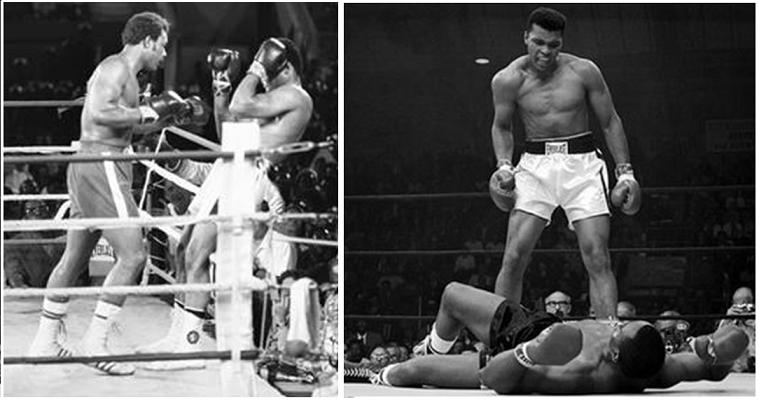
During the second round of the 1974 epic boxing match billed as the Rumble in the Jungle, Mohammad Ali leaned extraordinarily far back upon the ropes as George Foreman relentlessly bludgeoned Ali’s body and arms. It looked much like the devastating beating Ali took at the hands of Joe Frazier in 1971. Foreman’s notoriously powerful punches were sure to do Ali in as he languished on the ropes round after round. But in the eighth — with Foreman’s stamina sapped — Ali got off the ropes, and went on the attack, winning the bout with a knockout. He called it the “rope-a-dope.”

I feel worked over — not knowing if I can keep up the pace of the caffeine infused all-night drift through a world-wide cataloging of every failure of imagination — large and small — the war, disease, simple stupidity, the latest meme designed to bring a smile all the way to your eyes — brought not only into your living room, but also the kitchen, the bedroom. It seems we&rsquo—re always peering deep into our glowing box, trying to sort out the trouble and hop to the next possible potential of some game-changing inspiration in the incessant production-line flow of recycled mediocrity. But the troubles are never through. The work is never done. That breakthrough — that genius sabot insight never comes.

But the metaphor of production-line work — already passé when McLuhan made us aware of so many similarly irrelevant tropes — is based on psychological responses and concepts conditioned by the former technology — mechanization — of the factory. There is something comforting in the nostalgic ease with which Lucille Ball or Charlie Chaplin revealed the absurdity of Fordist efficiency, the worker as a mere appendage of the machine. Although laughable even then — that was a time in which the worker still had a genuine role to play; being more than an option cheaper than automation. That time is gone.

I feel over worked. But I’ve never worked at the mill. I’ve never done a 12-hour stint keeping pace with cogs and conveyer belts. I’m not being over worked. I’m being worked over — as we all are — not by a craftwork mechanized pace that drives us to exhaustion — but by an alluring rhythm — a rhythm that can at once lull us into acquiescence while at the same time keeping us off balance — all the better mobilized for each permutation of familiar themes. We are mesmerized by the rhythm of electrostatic transmissions coded through glitches of the cybernetic network and the fragments of old media. Cycling through neoclassic postmodern motifs destructured and reformulated into predictably surprising combinations — this rhythm — this aesthetic — makes us move —and more importantly, buy. Consumers at heart, the rhythm sucks us in and incorporates us more completely than any machine ever could. Somehow thinking that we are breaking free from the autonomic conditioning of a youthful wasteland, we wait in eager anticipation for the next issue of a magazine devoted to the pure form of advertising —though in its pages there is none to be found. It makes our consumer heart skip a beat. Like Victorians who wouldn’t dare indulge in such an unsavory act — but nonetheless cannot stop talking about it — we swoon, sway and jerk with the rhythm of the spliced (dis)tasteful image juxtaposed by words of a hopeful, anxious, elliptical cant — breakdown and breakthrough.

I get the breakdown. Where’s the breakthrough? We talk and all the while we’re being worked over. And this is no massage. This is a beat down. In the expanded edition of his vintage Politics and Vision, Sheldon Wolin argued that the particular rhythm of our contemporary aesthetic has been put to expert use by the new corporate form of governance he called “inverted totalitarianism.” Perhaps Wolin really put his finger on our fatal flaw when he suggested that the “cascades of ‘critical theory’ and their postures of revolt, and the appetite for theoretical novelty, function as support rather than opposition” to capitalism, because this sort of frenetic, syncopated, decentering only “encourages its rhythms.” Like a prizefighter — agile, yet made of solid, consolidated muscle. The centralized corporate entity gets in step with our fancy footwork — bobs and weaves into every new channel of communication and community, coopts every sophistication of critique, adopts the most non-hierarchical, horizontal stance of organization and deployment — moving with the rhythm — adapting the rhythm to its own purpose — waiting for the opportunity to unload its notoriously devastating punch — coming in on the trash talker of dissent — Muhammad Ali stumbling back on the ropes, body blow after wicked body blow — pummeled — worked over completely.

I don’t want to go down on the ropes. Where’s the rope-a-dope? Where’s the rope-a- dope?!


Prophecy, Spirit and the Dreamtime

spiritual-phenomena-other-dimensions

By Jay Weidner

Source: ZenGardner.com

The mythology of our modern, high-tech culture teaches us that the last frontier for humanity is outer space. Somehow, according to this emerging mythos, the fragile human body is supposed to be able to survive the rigors of travel in outer space over vast distances. The writers of science fiction and Star Trek-style television shows would have us believe that human beings can somehow endure through every kind of radiation and danger to successfully colonize other planets and solar systems.

But this notion is probably never going to happen. As this age ends and the next age begins humanity will lose its interest in conquering space. The last 6000 years have been spent conquering the space around us.

The last frontier of humanity is not the conquering of outer space, of other planets and solar systems. As we approach the end of this era we will realize that the last frontier is time.

Space is defined by the three dimensional reality that surrounds us. It is height, width and depth. We humans possess the most spectacular array of physical and mental abilities ever devised in creation to navigate these three dimensions. These abilities have enabled us to conquer our three-dimensional world.

Now at this critical juncture in history we discover that we have completely conquered the planet’s biosphere. People are living in the coldest environments imaginable and in the hottest tropical jungles. There are few mysteries left concerning the outer physical reality of our planet. Due to oil and cheap energy, we have been able to travel to any place on Earth. As this age of oil ends there will be only one mystery left for us to ponder.

This final mystery is the mystery of time.

Let’s take a look at our perception of time. Much of the way we experience the present moment depends on our experience of time past. The events of the past are distilled and repainted in our memories until their very reality loses its solidity. If we let them cook long enough, images of past events take on a dream like quality. Through this process, our remembrances frequently slide into a fantasy disconnected from anything tangible.

How often have we encountered someone who remembers an incident in a completely opposite manner from the way we remember it? Our minds appear to be constantly rewriting history to make it more agreeable to our present day wishes. Incidents in the past that are disturbing or frightening are frequently glossed over in our memory until they disappear only to be replaced by a memory that is more easily digested by consciousness.

Our view of the future works in a similar but opposite texture. Whereas the past begins to become a dream within our memories, the future is the dream that has not yet arrived. When someone is successful in the material world we like to say that they have “lived their dreams”. This cliché reveals an intrinsic understanding that present and future reality is created from the dream state of the past.

This idea dovetails with the central belief of the Aborigines of Australia. The essential teaching from that tradition is that everything in our world begins in the Dreamtime. From their ancient perspective, every thought, every action emerges from a larger metaphysical landscape that surrounds and pervades our material world. They call this larger reality the Dreamtime. According to this tradition, each living thing first begins in the Dreamtime. After it has become fully developed in the Dreamtime it then concretizes and becomes a part of our three dimensional reality.

This process is recursive in that our future dreams are frequently constructed from the archetypes of ancient dreams. So the past and the future, the material world and the dream world work together to create not only everything that we see, feel and hear but all that we have manifested as human beings. If one looks beyond the veil of linear time, one can easily see that there is a certain control mechanism over this peculiar process. Because reality is so dependent on the dream world, it is possible to shift reality by simply shifting the dream.

Motivational speakers, politicians, television script writers, preachers and many others understand this fundamental concept and use it to re-script reality in their favor. The last thing that they want you to discover is that you have the innate ability to take control of your dreams. They much prefer that you dream their dream, live in their past and help build their future.

Just think about the nature of the media these days. Over the past century, finding new and ever more invasive means of manipulating thoughts, desires and actions have been at the forefront of the research conducted by “psychic engineers”; the advertising agencies, spin doctors, pollsters, pharmaceutical companies, and secret government agencies of our world.

Through the constant barrage of images projected by the media, through the manipulation of food, and the polluting of the atmosphere, much of humanity has become lulled into a hypnotic state and their Dreamtime is occupied with nightmares. This has led us to today, to the present moment, in which our planet and our species are in a state of crisis. To transmute this crisis, this very critical situation in time, we must learn to step outside of linear time and enter the Dreamtime, that subtle realm in which everything becomes possible.

As the word Dreamtime aptly describes, there is little difference between the dream and the time. This very moment will become a dream soon in your memory. Also you are creating the future that is racing towards you – right now.

The dream world, time and four-dimensional space are all the same thing. The fourth dimensional world, often referred to as ‘time’ by physicists, surrounds and permeates our three dimensional reality. Everything that we are is shaped and formed within this topological manifold that flows into and out of our existence. As the stream of time passes we have the ability to alter it’s course. Each moment of our lives offers us the chance to change the course of our dreams and the dreams of those we love.

Understanding this landscape, the ragged mountains and mossy valleys of the wilderness of time, is the frontier that awaits us. When we finally colonize this land and understand its many intricacies and nuances, we will realize that any future is possible. We will no longer need to be slaves to systems that require us to live in someone else’s dream. The powers of the dark sorcerers that rule our world will be overthrown and a new Dreamtime will be created. When we discover how to navigate the river of time, when the topological map of time is finally understood by us, all of the certain dangers that await us will vanish in the blink of an eye during REM sleep.

We are at the crossroads now. There is a choice. One road leads to a mechanistic, toxic, polluted, fascist nightmare from which we may never recover. The other road leads to a revitalized world where we live our dreams in freedom, prosperity and love.

One of the main aims of many ancient spiritual traditions is to provide us with the means to create a conscious break with the almost dictatorial dreams of our past. This is the essence of the teachings of the Buddha for instance. We are slaves to the dreams that we were born into, slaves to a past of which we had nothing to do. Many of these ancient spiritual traditions teach us how to break with the mental slavery that has burdened us for so long.

Humans frequently hurt themselves and others around them defending the imprinted dreams of their past and creating belief systems that make it all right to hurt and destroy people who come from a different past, a different dreamtime.

The way to stop this recurring cycle is to find our way towards a detachment from the heated beliefs and ego-inspired histories and cultures that we were born into. This is not to say that we should reject our traditions. Only that true liberation of ourselves can only begin when we detach ourselves from ingrained spiritual and cultural habits.

Right now we are trapped by time. And this means that we are trapped in a Dreamtime from which escape is nearly impossible. But as long as there is a chance, as long as the odds are not one hundred percent against us – and they are not – we should attempt to make this leap.

If we change the dream we can change the world and ourselves.

The spiritual emergence that is happening right now across the world is the realization that there is only one kind of time. There is no past and there is no future.

There is only NOW.

And we can change the NOW at any time that we like.


For more about the Shasta movie, go to ShastaMovie.com

Jay Weidner’s websites –    JayWeidner.comGaiamTV.com

Jay Weidner’s DVDs

Jay Weidner’s book:
“The Mysteries of the Great Cross of Hendaye: Alchemy and the End of Time”

Saturday Matinee: Journey to the West

jttw

“Journey to the West” (2013) is writer/director Stephen Chow and Derek Kwok’s film adaptation of the classic 16th century Chinese novel of the same name. It chronicles the portion of the story in which young monk Xuan Zang (Zhang Wen) protects a village from three demons with the help of demon hunter Miss Duan (Qi Shu) and has his first encounter with the Monkey King (Bo Huang). Like Stephen Chow’s other blockbusters Kung Fu Hustle and Shaolin Soccer, Journey to the West features delightfully over-the-top performances and slapstick sensibility, but unlike previous works it also contains a spiritual message about redemption, sacrifice and enlightenment.

http://www.dailymotion.com/video/x2mn7pd_journey-to-the-west-conquering-the-demons-full-movie-new-action-movies-hd-english-movi-action-movie_shortfilms

Was Afghanistan’s Invasion Also Based on Lies?

binladen01_04

It’s Time for a Real Investigation

By Jack Balkwill

Source: Dissident Voice

There appears to be a bigger lie than “weapons of mass destruction.”  It’s not simply that the illegal invasion of Iraq was based on lies, but that the entire “war on terrorism” is likely based on lies.

We were told by our government that Afghanistan was invaded for giving shelter to Osama bin Laden, who was responsible for the 9/11 attacks.  Mainstream press have pushed this so repeatedly that “9/11″ and “Osama bin Laden” have become interchangeable.

While working on this piece I asked the first three people I ran into at my local grocery store “Who was responsible for the 9/11 attacks?,”  three times getting “Osama bin Laden” for replies.  This is not scientific, yet it makes one wonder how this would work out in national polling.

But what if bin Laden was not responsible for the 9/11 attacks despite the drumbeat of government officials and the corporate press?  What if there has been a rush to judgment to make it appear the Bush regime was taking definitive action?

The invasion of Afghanistan certainly wasn’t about the Taliban – the Bush regime gave the Taliban $43 million in “aid” only four months before the 9/11 attacks, so were on friendly terms.

Following are three reasons to question official sources on their casus belli for invading Afghanistan.

Attempts to Peacefully Resolve the Issue

First, before the invasion of Afghanistan, the Taliban offered to try bin Laden in exchange for evidence that he was responsible for the 9/11 attacks.

President Bush provided no evidence, and invaded Afghanistan instead.

After the start of the U.S. air campaign, the Taliban offered to send bin Laden to a third country for trial if evidence could be provided that he had been involved in the 9/11 attacks – a proposal the United States also promptly rejected.

Why not provide evidence, if it were available, to prevent a war?  It was obvious that the people of Afghanistan would defend their country from a foreign invasion, as they had since Alexander the Great invaded, and there would be a great loss of life (see Roman Empire, British Empire, USSR, etc.).

There can only be two answers– that there was no evidence supporting the cause for invasion, or that former President Bush is a psychopath who doesn’t care about human life, so contemptuously ignored the request for evidence.

Bin Laden’s Denials

Second, bin Laden denied, more than once, in the months following 9/11, that he was involved in the dirty deed.  Less than a week after the 9/11 attacks, al Jazeera quoted bin Laden:  “The U.S. government has consistently blamed me for being behind every occasion its enemies attack it.  I would like to assure the world that I did not plan the recent attacks, which seem to have been planned by people for personal reasons.”

In an interview with Pakistan’s Karachi Ummat on 28 September 2001, bin Laden was quoted,

Neither I had any knowledge of these attacks nor I consider the killing of innocent women, children, and other humans as an appreciable act. Islam strictly forbids causing harm to innocent women, children, and other people. Such a practice is forbidden ever in the course of a battle. … I have already said that we are against the American system, not against its people, whereas in these attacks, the common American people have been killed.

This is a translation from Arabic to Urdu to English, and may not be entirely clear.  But for those who believe bin Laden was lying, I would suggest they come up with a motive for such a lie.  The USA had offered a $25 million reward for information leading to his capture, and President Bush had threatened “I want justice, and there’s an old poster out West that says, ‘Wanted Dead or Alive,’” so bin Laden had nothing to gain from such a lie – he was condemned either way.  Bin Laden’s followers would have admired him as a great hero for having taken on the USA, so he had much to gain by accepting responsibility for the 9/11 attacks, were it a fact.

Demonization

Third, there was an extensive effort to demonize bin Laden, at times with apparently false charges.  Why would this be necessary for one who was guilty?

Our government and corporate media, as one on National Security State issues, made him out to be abominable, and without providing evidence, unceasingly assumed his guilt.  Recordings were blasted and headlined in Western corporate print and electronic media of bin Laden accepting responsibility for 9/11.  The public were not given the same eyeball-grabbing headlines when the recordings were proven to be likely bogus.

Here is a Guardian report showing that Swiss Scientists suggested that an audio tape of bin Laden taking responsibility was likely faked, although widely broadcast in the corporate press as evidence of his involvement in 9/11 attacks.

Here’s a BBC report showing how the “smoking gun” video may have been faked, again, after the corporate press hyped the video as incontrovertible evidence.

Conclusion

The official version, that 19 Arab hijackers were responsible, has flaws.  One flaw was that many of the alleged hijackers have been found alive and well since 9/11.  Of course, it may be that the hijackers used pseudonyms to conceal their identities.

But getting beyond these 19 Arabs is difficult because they are all dead and cannot be interviewed.  Official government investigations into 9/11, much of which are classified, look like reflexive actions to neatly tie up loose ends rather than serious inquiries.

Certainly, as Ward Churchill pointed out (and lost his job for raising the issue), Arabs had a clear motive for the 9/11 attacks, with the UN revealing, only two years earlier, that the sanctions pushed mainly by the USA on the people of Iraq resulted in over 500,000 deaths of children under age five, mostly Arab, and most Arabs were aware of this and seething with anger.

To jump to the conclusion that bin Laden was behind the 9/11 attacks causes one to wonder, “Why then did the FBI never bring charges against bin Laden for the hijackings and murders?  Why did the wanted posters (up to his death he was on the FBI ten most wanted list) not mention the biggest crime, though they mentioned smaller terrorist incidents as reasons for his being on the list?

We may never know if bin Laden was responsible for 9/11, but his involvement was used as the excuse for invading Afghanistan and slaughtering a massive number of people, based on the assumption that they gave bin Laden refuge.

Just as nobody has been charged with a crime for the illegal invasion of Iraq based on lies, it would appear that an investigation is in order involving the justification behind invading Afghanistan, starting with the matter of proof that bin Laden was directly involved.  The American people and the people of Afghanistan have every right to be presented with the evidence.

Jack Balkwill is an activist in Virginia. He can be reached at libertyuv@hotmail.com Read other articles by Jack.

Related article: Who Was Really Behind the 9/11 Attacks?