GIVE AMERICA’S ‘HELICOPTER PARENTS’ A BREAK

Hovering parents don’t need lectures. They need a more equal nation.

By Sam Pizzigati

Source: OtherWords

A good many of us aging baby boomers are having trouble relating to the “helicopter parents” of our modern age — those moms and pops constantly hovering over their kids, filling their schedules with enrichment activities of every sort, worrying nonstop about their futures.

Back in the middle of the 20th century, baby boomers didn’t grow up like that. We lived much more “free-range” childhoods. We pedaled our bikes far from hearth and home. We organized our own pick-up games. We spent — wasted! — entire summers doing little bits of nothing.

We survived. So did our parents. So why do parents today have to hover so much?

The standard explanation: Times have changed. Yes, today’s parents take a more intense approach to parenting. But they have no choice. The pressures of modernity make them do it.

Economists Matthias Doepke of Northwestern University and Fabrizio Zilibotti of Yale have followed all the debate over helicopter parenting, and they’re not jumping on this blame-modernity bandwagon. If the pace and pressures of our dangerous digital times are driving parents to hover, the pair points out, then we ought to see parents helicoptering across the developed world.

We’re not.

In fact, researchers have found significant differences in parenting styles from one modern industrial nation to another. Parents in some nations today have parenting styles as relaxed as anything aging baby boomers experienced back in the 1950s. In other nations, by contrast, parents seem as intense as today’s helicoptering norm in the United States.

How can we account for these differences?

Doepke and Zilibotti have a compelling explanation. Levels of helicopter parenting, they note, track with levels of economic inequality. The wider a society’s income gaps, the more parents hover.

The two countries most notorious for their helicopter parenting, China and the United States, just happen to sport two of the world’s deepest economic divides. And those more relaxed parenting days of mid-20th century America? They came at a time when the United States shared income and wealth much more equally than the United States does today.

What’s going on here? Why should economic inequality have any impact on parenting styles?

In severely unequal nations, the evidence suggests, childhoods have become high-stakes competitions. Only the “winners” go on to enjoy comfortable lives when they grow up. You either make it into the ranks of your nation’s elite or you risk struggling on a treadmill that never ends.

In more equal societies, you don’t have to matriculate at the “best” schools or score a high-status internship to live a dignified life. In societies with income and wealth more evenly distributed, broad swatches of people — not just elites — live comfortably. That leaves parents, as Doepke puts it, “more room to relax and let the kids just enjoy themselves.”

Parents in highly unequal nations can’t afford to relax. They have too much to do. They have to shape their kids into winners. But the competition their children face will always be rigged, because the already affluent in deeply unequal societies have more time and money to invest in that shaping.

Researchers Doepke and Zilibotti call for greater public investments in social services — like quality child care — to narrow the competitive advantage that wealth bestows upon affluent American families.

The investments they recommend would certainly help ease the pressure on working households. Would they be enough to get our parents more relaxed? Not likely, not so long as rewards keep concentrating in the pockets of the few at the expense of the many.

Our helicopter parents, in short, don’t need fixing. Our economic system does.

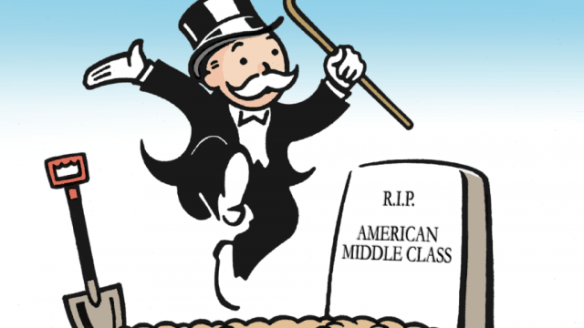
The Erosion of the Middle Class — Why Americans Are Working Harder and Earning Less

By John Liberty

Source: The Mind Unleashed

“I don’t have to tell you things are bad. Everybody knows things are bad. It’s a depression. Everybody’s out of work or scared of losing their job. The dollar buys a nickel’s worth, banks are going bust, shopkeepers keep a gun under the counter. Punks are running wild in the street and there’s nobody anywhere who seems to know what to do, and there’s no end to it.” — Howard Beale

Howard Beale, the main character in the 1976 film Network, became a part of cinematic history when he uttered the line “I’m mad as hell and I’m not gonna take it anymore.” That one line expressed a growing rage among America’s shrinking middle class at a time when Americans were reeling from years of war, political scandals and economic downturn.

In the four decades that have followed, little has improved for the average American. We’re still ‘mad as hell’ and the middle class is being eroded right in front of our eyes. When adjusted for inflation, many Americans are working longer hours and earning less than they did in 1976. So, how have we gone from vibrant middle class to the working poor in a matter of decades?

Median Incomes Are Stagnant

Despite increases in the national income over the past fifty years, middle class families have experienced little income growth over the past few decades. According to U.S. Census datamiddle class incomes have grown by only 28 percent from 1979 – 2014. Meanwhile, a report from the Congressional Budget Office (CBO) shows that the top 20 percent of earners has seen their incomes rise by 95 percent over that same period of time.

Contributing to the stagnation of wages is a notable decrease in the workforce participation rate. According to the Brookings institute, “One reason for these declines in employment and labor force participation is that work is less rewarding. Wages for those at the bottom and middle of the skill and wage distribution have declined or stagnated.” Historical data from the Bureau of Labor Statistics backs up these findings, showing a steady decrease in workforce participation over the last two decades.

The Erosion of the Minimum Wage & America’s Purchasing Power

Anyone who has read a comment thread on the internet about minimum wage laws knows the debate is currently one of the most highly contentious political topics in America. In the halls of Congress, the debate has turned into a nearly decade long impasse. As a result, workers at the low end of the wage scale have watched the purchasing power of their wages decrease from $7.25 in 2009, to $6.19 in 2018 due to inflation. In 2018, you need to perform 47 hours of minimum wage work to achieve the same amount of purchasing power as 40 hours of work in 2009.

The inflation-adjusted minimum wage value has been in steady decline since 1968, when the $1.60 minimum wage was equal to $11.39 (in 2018 dollars). Since then, lawmakers have reduced minimum wage increases relative to the rate of inflation. As Christopher Ingraham reports:

“Recent research shows that the reason politicians — Democrats and Republicans alike — are dragging their feet on popular policies such as the minimum wage is that they pay a lot more attention to the needs and desires of deep-pocketed business groups than they do to regular voters. Those groups tend to oppose minimum wage increases for the simple reason that they eat into their profit margins.”

To be clear, the erosion of the purchasing power of everyday Americans is hardly a new phenomenon. According to data from the U.S. Bureau of Labor Statistics, the purchasing power of the U.S. Dollar has plummeted by over 95 percent since 1913, the year the Federal Reserve was created. The Bureau’s Consumer Price Index indicates that prices in 2018 are 2,436.33% higher than prices in 1913 and that the dollar has experienced an average inflation rate of 3.13% per year during this period.

The Rich Get Richer

While the outlook may be grim for low-wage workers, this is fantastic news for large corporations. Data from the U.S. Bureau of Economics shows that corporate profits are approaching all-time highs. But it’s not just workers who are feeling the effect of growing income inequality. The contrast is also being felt on Main Street. An analysis of the S & P 500 and the Russell 1,000 & 2,000 indexes by Bloomberg revealed a growing gap between America’s largest employers and smaller businesses.

A report from the Institute for Policy Studies entitled Billionaire Bonanza: The Forbes 400 and the Rest of Us echoed these findings when it revealed that America’s 20 wealthiest people — a group that could fit comfortably in one single Gulfstream G650 luxury jet –­ now own more wealth than the bottom half of the American population combined.

Although the Trump administration continues to tout stock market and labor force increases as signs of economic prosperity, numbers show that the wealthiest 10 percent of Americans own 84 percent of all stock. A study conducted by the Economic Policy Institute found that wage growth remains too weak to consider the economy at full employment and that stagnant wage growth has contributed to the growing level of income inequality in America. The study noted that while wages have recovered from the 2008 recession, the gap between those at the top and those at the middle and bottom has continued to increase since 2000. As the study’s author, Elise Gould writes:

“We’re looking at nominal wage growth that is still slower than you would expect in a full employment economy, slower than you would expect if you thought there were any sort of inflation pressures from wage growth.”

The Decimation of the American Dream

Comedian George Carlin once said, “The reason they call it the American Dream is because you have to be asleep to believe it.” For millions of middle class Americans Carlin’s statement has proven eerily accurate. Stagnant wages and decreased purchasing power has put the prospects for middle class children in a tailspin as upward mobility trends have reportedly fallen by over 40 percent since 1950.

A poll conducted by the Pew Research Institute corroborates this claim. According to Pew, only 37 percent of Americans believe that today’s children will grow up to be better off financially than their parents. That means more Americans think that today’s children will be financially worse off than their parents than those who believe they will be better off.

The sentiments expressed by millions of middle class Americans appear to be wholly justified due to the fact that middle class families are becoming more fragile and dependent on two incomes. A report from the Council of Economic Advisors found the majority of the income gains made by the middle class from 1979 to 2013 were a result of increased participation in the workplace by women. The report also noted the fragility of two income families amidst a decline in marriage and a drastic rise in single parent homes in recent years.

As a result of the slow growth in wages, over half of Americans now receive more in Government transfer payments (Medicare, Medicaid, food stamps, Social Security) than they pay in federal taxes. An analysis of all 50 states also found that in 42 states the cost of living is higher than the median income.

The rising cost of healthcare is also putting the pinch on the wallets of many Americans. As Jeffrey Pfeffer noted in his book Dying for a Paycheck, healthcare spending—per capita—has increased 29 fold over the past 40 years, outpacing the growth of the American economy.

While many Americans continue to look to the government to fix problems like wage stagnation, income inequality and rising healthcare costs, the sad truth is that we live in a time when 1 in 3 households has trouble paying energy bills and 40 percent of Americans face poverty in retirement at the exact same time the Federal Government has admitted that they lost $21 trillion. Not only did they lose $21 trillion (yes that’s TRILLION with a T), but the Department of Defense indicated in a press conference that they “never expected to pass” the audit to locate the missing taxpayer money.

John Emerich Edward Dalberg Acton famously proclaimed in 1887:

“Power tends to corrupt, and absolute power corrupts absolutely. Great men are almost always bad men.”

Perhaps it’s time for the millions of Americans who are quietly ‘mad as hell’ to start expressing their rage at the corrupt institutions of power that are decimating their livelihoods rather than expecting those very same institutions to fix the problems they created.


The Rule of the Uber-Rich Means Tyranny or Revolution

By Chris Hedges

Source: TruthDig

At the age of 10 I was sent as a scholarship student to a boarding school for the uber-rich in Massachusetts. I lived among the wealthiest Americans for the next eight years. I listened to their prejudices and saw their cloying sense of entitlement. They insisted they were privileged and wealthy because they were smarter and more talented. They had a sneering disdain for those ranked below them in material and social status, even the merely rich. Most of the uber-rich lacked the capacity for empathy and compassion. They formed elite cliques that hazed, bullied and taunted any nonconformist who defied or did not fit into their self-adulatory universe.

It was impossible to build a friendship with most of the sons of the uber-rich. Friendship for them was defined by “what’s in it for me?” They were surrounded from the moment they came out of the womb by people catering to their desires and needs. They were incapable of reaching out to others in distress—whatever petty whim or problem they had at the moment dominated their universe and took precedence over the suffering of others, even those within their own families. They knew only how to take. They could not give. They were deformed and deeply unhappy people in the grip of an unquenchable narcissism.

It is essential to understand the pathologies of the uber-rich. They have seized total political power. These pathologies inform Donald Trump, his children, the Brett Kavanaughs, and the billionaires who run his administration. The uber-rich cannot see the world from anyone’s perspective but their own. People around them, including the women whom entitled men prey upon, are objects designed to gratify momentary lusts or be manipulated. The uber-rich are almost always amoral. Right. Wrong. Truth. Lies. Justice. Injustice. These concepts are beyond them. Whatever benefits or pleases them is good. What does not must be destroyed.

The pathology of the uber-rich is what permits Trump and his callow son-in-law, Jared Kushner, to conspire with de facto Saudi ruler Mohammed bin Salman, another product of unrestrained entitlement and nepotism, to cover up the murder of the journalist Jamal Khashoggi, whom I worked with in the Middle East. The uber-rich spend their lives protected by their inherited wealth, the power it wields and an army of enablers, including other members of the fraternity of the uber-rich, along with their lawyers and publicists. There are almost never any consequences for their failures, abuses, mistreatment of others and crimes. This is why the Saudi crown prince and Kushner have bonded. They are the homunculi the uber-rich routinely spawn.

The rule of the uber-rich, for this reason, is terrifying. They know no limits. They have never abided by the norms of society and never will. We pay taxes—they don’t. We work hard to get into an elite university or get a job—they don’t. We have to pay for our failures—they don’t. We are prosecuted for our crimes—they are not.

The uber-rich live in an artificial bubble, a land called Richistan, a place of Frankenmansions and private jets, cut off from our reality. Wealth, I saw, not only perpetuates itself but is used to monopolize the new opportunities for wealth creation. Social mobility for the poor and the working class is largely a myth. The uber-rich practice the ultimate form of affirmative action, catapulting white, male mediocrities like Trump, Kushner and George W. Bush into elite schools that groom the plutocracy for positions of power. The uber-rich are never forced to grow up. They are often infantilized for life, squalling for what they want and almost always getting it. And this makes them very, very dangerous.

Political theorists, from Aristotle and Karl Marx to Sheldon Wolin, have warned against the rule of the uber-rich. Once the uber-rich take over, Aristotle writes, the only options are tyranny and revolution. They do not know how to nurture or build. They know only how to feed their bottomless greed. It’s a funny thing about the uber-rich: No matter how many billions they possess, they never have enough. They are the Hungry Ghosts of Buddhism. They seek, through the accumulation of power, money and objects, an unachievable happiness. This life of endless desire often ends badly, with the uber-rich estranged from their spouses and children, bereft of genuine friends. And when they are gone, as Charles Dickens wrote in “A Christmas Carol,” most people are glad to be rid of them.

C. Wright Mills in “The Power Elite,” one of the finest studies of the pathologies of the uber-rich, wrote:

They exploited national resources, waged economic wars among themselves, entered into combinations, made private capital out of the public domain, and used any and every method to achieve their ends. They made agreements with railroads for rebates; they purchased newspapers and bought editors; they killed off competing and independent businesses and employed lawyers of skill and statesmen of repute to sustain their rights and secure their privileges. There is something demonic about these lords of creation; it is not merely rhetoric to call them robber barons.

Corporate capitalism, which has destroyed our democracy, has given unchecked power to the uber-rich. And once we understand the pathologies of these oligarchic elites, it is easy to chart our future. The state apparatus the uber-rich controls now exclusively serves their interests. They are deaf to the cries of the dispossessed. They empower those institutions that keep us oppressed—the security and surveillance systems of domestic control, militarized police, Homeland Security and the military—and gut or degrade those institutions or programs that blunt social, economic and political inequality, among them public education, health care, welfare, Social Security, an equitable tax system, food stamps, public transportation and infrastructure, and the courts. The uber-rich extract greater and greater sums of money from those they steadily impoverish. And when citizens object or resist, they crush or kill them.

The uber-rich care inordinately about their image. They are obsessed with looking at themselves. They are the center of their own universe. They go to great lengths and expense to create fictional personas replete with nonexistent virtues and attributes. This is why the uber-rich carry out acts of well-publicized philanthropy. Philanthropy allows the uber-rich to engage in moral fragmentation. They ignore the moral squalor of their lives, often defined by the kind of degeneracy and debauchery the uber-rich insist is the curse of the poor, to present themselves through small acts of charity as caring and beneficent. Those who puncture this image, as Khashoggi did with Salman, are especially despised. And this is why Trump, like all the uber-rich, sees a critical press as the enemy. It is why Trump’s and Kushner’s eagerness to conspire to help cover up Khashoggi’s murder is ominous. Trump’s incitements to his supporters, who see in him the omnipotence they lack and yearn to achieve, to carry out acts of violence against his critics are only a few steps removed from the crown prince’s thugs dismembering Khashoggi with a bone saw. And if you think Trump is joking when he suggests the press should be dealt with violently you understand nothing about the uber-rich. He will do what he can get away with, even murder. He, like most of the uber-rich, is devoid of a conscience.

The more enlightened uber-rich, the East Hamptons and Upper East Side uber-rich, a realm in which Ivanka and Jared once cavorted, look at the president as gauche and vulgar. But this distinction is one of style, not substance. Donald Trump may be an embarrassment to the well-heeled Harvard and Princeton graduates at Goldman Sachs, but he serves the uber-rich as assiduously as Barack Obama and the Democratic Party do. This is why the Obamas, like the Clintons, have been inducted into the pantheon of the uber-rich. It is why Chelsea Clinton and Ivanka Trump were close friends. They come from the same caste.

There is no force within ruling institutions that will halt the pillage by the uber-rich of the nation and the ecosystem. The uber-rich have nothing to fear from the corporate-controlled media, the elected officials they bankroll or the judicial system they have seized. The universities are pathetic corporation appendages. They silence or banish intellectual critics who upset major donors by challenging the reigning ideology of neoliberalism, which was formulated by the uber-rich to restore class power. The uber-rich have destroyed popular movements, including labor unions, along with democratic mechanisms for reform that once allowed working people to pit power against power. The world is now their playground.

In “The Postmodern Condition” the philosopher Jean-François Lyotard painted a picture of the future neoliberal order as one in which “the temporary contract” supplants “permanent institutions in the professional, emotional, sexual, cultural, family and international domains, as well as in political affairs.” This temporal relationship to people, things, institutions and the natural world ensures collective self-annihilation. Nothing for the uber-rich has an intrinsic value. Human beings, social institutions and the natural world are commodities to exploit for personal gain until exhaustion or collapse. The common good, like the consent of the governed, is a dead concept. This temporal relationship embodies the fundamental pathology of the uber-rich.

The uber-rich, as Karl Polanyi wrote, celebrate the worst kind of freedom—the freedom “to exploit one’s fellows, or the freedom to make inordinate gains without commensurable service to the community, the freedom to keep technological inventions from being used for public benefit, or the freedom to profit from public calamities secretly engineered for private advantage.” At the same time, as Polanyi noted, the uber-rich make war on the “freedom of conscience, freedom of speech, freedom of meeting, freedom of association, freedom to choose one’s own job.”

The dark pathologies of the uber-rich, lionized by mass culture and mass media, have become our own. We have ingested their poison. We have been taught by the uber-rich to celebrate the bad freedoms and denigrate the good ones. Look at any Trump rally. Watch any reality television show. Examine the state of our planet. We will repudiate these pathologies and organize to force the uber-rich from power or they will transform us into what they already consider us to be—the help.

The USA Is Now a 3rd World Nation

By Charles Hugh Smith

Source: Of Two Minds

I know it hurts, but the reality is painfully obvious: the USA is now a 3rd World nation.

Dividing the Earth’s nations into 1st, 2nd and 3rd world has fallen out of favor; apparently it offended sensibilities. It has been replaced by the politically correctdeveloped and developing nations, a terminology which suggests all developing nations are on the pathway to developed-nation status.

What’s been lost in jettisoning the 1st, 2nd and 3rd world categories is the distinction between developing (2nd world) and dysfunctional states (3rd world), states we now label “failed states.”

But 3rd World implied something quite different from “failed state”: failed state refers to a failed government of a nation-state, i.e. a government which no longer fulfills the minimum duties of a functional state: basic security, rule of law, etc.

3rd World referred to a nation-state which was dysfunctional and parasitic for the vast majority of its residents but that worked extremely well for entrenched elites who controlled most of the wealth and political power. Unlike failed states, which by definition are unstable, 3rd World nations are stable, for the reason that they work just fine for the elites who dominate the wealth, power and machinery of governance.

Here are the core characteristics of dysfunctional but stable states that benefit the entrenched few at the expense of the many, i.e. 3rd Worldnations:

1. Ownership of stocks and other assets is highly concentrated in entrenched elites. The average household is disconnected from the stock market and other measures of wealth; only a thin sliver of households own enough financial/speculative wealth to make an actual difference in their lives.

2. The infrastructure of the nation used by the many is poorly maintained and costly to operate as entrenched elites plunder the funding to pad their payrolls, pensions and sweetheart/insider contracts.

3. The financial/political elites have exclusive access to parallel systems of transport, healthcare, education, etc. The elites avoid trains, subways, lenders, coach-class air transport, standard healthcare and the rest of the decaying, dysfunctional systems they own that extract wealth from the debt-serfs.

They fly on private aircraft, have their own healthcare and legal services, use their privileges to get their offspring into elite universities and institutions and have access to elite banking and lending services that are unavailable to their technocrat lackeys and enforcers.

4. The elites fund lavish monuments to their own glory disguised as “civic or national pride.” These monuments take the form of stadiums, palatial art museums, immense government buildings, etc. Meanwhile the rest of the day-to-day infrastructure decays in various states of dysfunction.

5. There are two classes that only interact in strictly controlled ways: the wealthy, who live in gated, guarded communities and who rule all the institutions, public and private, and the debt-serfs, who are divided into well-paid factotums, technocrat lackeys and enforcers who serve the interests of the entrenched elites and rest of the populace who own virtually nothing and have zero power.

The elites make a PR show of being a commoner only to burnish the absurd illusion that debt-serf votes actually matter. (They don’t.)

6. Cartels and quasi-monopolies are parasitically extracting the wealth of the nation for their elite owners and managers. Google: quasi-monopoly. Facebook: quasi-monopoly. Healthcare: cartel. Banking: cartel. National defense: cartel. National Security: cartel. Corporate mainstream media: cartel. Higher education: cartel. Student loans: cartel. I think you get the point: every key institution or function is controlled by cartels or quasi-monopolies that serve the interests of the few via parasitic exploitation of the powerless.

7. The elites use the extreme violence and repressive powers of the government to suppress, marginalize and/or destroy any dissent. There are two systems of “law”: one for the elites ($10 million penalties for ripping off the public for $10 billion, no personal liability for outright fraud) and one for the unprotected-unprivileged: “tenners” (10-year prison sentences) for minor drug infractions, renditions or assassinations (all “legal,” of course) and institutional forces of violence (bust down your door on the rumor you’ve got drugs, confiscate your car because we caught you with cash, so you must be a drug dealer, and so on, in sickening profusion).

8. Dysfunctional institutions with unlimited power to extract money via junk fees, licensing fees, parking tickets, penalties, late fees, etc., all without recourse. Mess with the extractive, parasitic bureaucracy and you’ll regret it: there’s no recourse other than another layer of well-paid self-serving functionaries that would make Kafka weep.

9. The well-paid factotums, bureaucrats, technocrat lackeys and enforcers who fatten their own skims and pensions at the expense of the public and slavishly serve the interests of the entrenched elites embrace the delusion that they’re “wealthy” and “the system is working great.” These deluded servants of the elites will defend the dysfunctional system because it serves their interests to do so.

The more dysfunctional the institution, the greater their power, so they actively increase the dysfunction at every opportunity.

The USA is definitively a 3rd World nation. Read the list above and then try to argue the USA is not a 3rd World nation. Try arguing against the facts displayed in this chart:

I know it hurts, but the reality is painfully obvious: the USA is now a 3rd World nation.


Taxpayers Are Footing the Bill for Sky-High CEO Salaries

Billions in taxpayer funds go to CEOs who pay their workers peanuts. We can change that.

By Sam Pizzigati

Source: Other Words

Politicians often gab about the “private sector” and the “public sector,” as if these two categories of economic activity operated as two completely separate worlds.

In reality, these two sectors have always been deeply intertwined.

How deeply? Every year, the federal government spends about half a trillion dollars buying goods and services from the private sector. State and local government contracts with private-sector enterprises add hundreds of billions more.

And private-sector companies don’t just receive contracts from our governmental entities. They receive all sorts of subsidies — billions upon billions of dollars in “corporate welfare.”

Where do all these dollars come from? They come from us, America’s taxpayers. Without the tax dollars we provide, almost every major corporation in the United States would flounder. Some would simply cease to exist. The defense contractor Lockheed Martin, for instance, takes in almost all its revenue from government contracts.

This private sector reliance on public tax dollars gives us, as citizens, some leverage over the behavior of our largest and most powerful corporations. We could, if we so chose, deny those dollars to corporations that engage in behaviors that undermine the values we hold dear.

On other fronts, we already do this denying. For over a generation now, we’ve leveraged the power of the public purse against companies with employment practices that discriminate on the basis of race and gender. Companies that discriminate can’t get government contracts because we’ve come to a consensus, as a society, that we don’t want our tax dollars subsidizing racial and gender inequality.

Unfortunately, our tax dollars are still subsidizing — in a big way — economic inequality, as a new Institute for Policy Studies report on CEO pay details quite vividly. Billions of our tax dollars are annually going to corporations that pay their top executives more in a week, or even a day, than their typical employees can make over an entire year.

The late Peter Drucker, the founder of modern management science, believed that no corporate enterprise that pays its CEO over 25 times what its workers are earning could operate efficiently and effectively over the long haul. In 2017, every single one of the federal government’s 50 largest private contractors paid its chief executive over 25 times more than its most typical workers.

In fact, most paid their top execs well over 100 times more.

And at one, DXC Technology, the CEO pulled down over $32 million in 2017 pay — over 800 times the compensation of the firm’s typical employees.

Let’s add a little context here. The president of the United States earns $400,000 a year. The CEOs of the 50 private companies with the largest federal contracts last year averaged over $13.5 million. The CEOs of the 50 largest recipients of federal subsidies last year averaged over $12 million.

Our tax dollars, in other words, are helping a lucky few become fabulously rich.

We do live, as our politicians like to point out, in a “free country.” Corporations can pay their top execs whatever they want. But we taxpayers have freedom, too. We can freely deny our tax dollars to enterprises that are making our society ever more unequal.

Some lawmakers are starting to step in that direction. Five states have begun considering legislation that would make it harder for companies with wide CEO-worker pay gaps to get government contracts and tax breaks. And one city — Portland, Oregon — has already enacted legislation that taxes corporations with wide CEO-worker pay gaps at a higher rate than corporations with more modest gaps.

We need more Portlands.

Why do corporate boards so overpay US CEOs?

By Sam Pizzigati

Source: Nation of Change

Back in 1999, near the dizzying height of the dot-com boom, no executive in Corporate America personified the soaring pay packages of America’s CEOs more than Jack Welch, the chief exec at General Electric. Welch took home $75 million that year.

What explained the enormity of that compensation? Welch didn’t claim any genius on his part. He credited his success, instead, to the genius of the free market.

“Is my salary too high?” mused Welch. “Somebody else will have to decide that, but this is a competitive marketplace.”

Translation: “I deserve every penny. The market says so.”

Top U.S. corporate execs today, on average, are doing even better than top execs in Welch’s heyday. In 1999, notes a just-released new report from the Economic Policy Institute, CEOs at the nation’s 350 biggest corporations pocketed 248 times the pay of average workers in their industries. Top execs last year averaged 312 times more.

What explains this growing generosity to America’s top corporate chiefs? Today’s apologists for over-the-top CEO compensation, like Jack Welch a generation ago, point to the market.

One leading critic of these apologists, the Dutch management scientist Manfred Kets de Vries, neatly summed up this market world view earlier this year: Big CEO pay packages “reflect market demands for a CEO’s unique skills and contribution to the bottom line.” Mega-million executive paychecks “merely represent the market forces of supply and demand.”

Or, as the University of Chicago’s Steven Kaplan puts it, “The market for talent puts pressure on boards to reward their top people at competitive pay levels in order to both attract and retain them.”

In the world that CEO cheerleaders like Kaplan inhabit, impartial, unbiased markets determine executive compensation. Corporate boards simply play by market rules. They pay their execs what the market says their execs deserve. If they don’t, they risk losing their executive talent.

American corporate leaders take scarcity – of CEO talent – as a given. How else, in a market economy, to explain rapidly rising CEO pay? If quality CEOs abounded, executive compensation would not be soaring. But that compensation is soaring, so qualified CEOs obviously must be few and far between – and totally deserving of whatever many millions they receive. Simple market logic.

And simply wrong. American corporations today confront no scarcity of executive talent. The numbers of people qualified to run multi-billion-dollar companies have never, in reality, been more plentiful. These numbers have been growing steadily over recent decades, in part because America’s graduate schools of business have been graduating, year after year, thousands of rigorously trained executives.

America’s first graduate school for executives, the Tuck School of Business at Dartmouth, currently boasts an alumni network over 10,000 strong. MBAs in the equally prestigious Harvard Business School alumni network total over 46,000. Add in the alumni from other widely acclaimed institutions and the available supply of executives trained at America’s top-notch business schools approaches several hundred thousand.

Just how many of these academically trained executives have the skills and experience really needed to run a Fortune 500 company? Let’s assume, conservatively, that only 1 percent of the alumni from the “best” business schools have enough skills and experience to run a big-time corporation.

That arithmetic would give Fortune 500 companies that go looking for a new CEO at least several thousand eminently qualified candidates. No supply shortage here.

Indeed, today’s business world is overflowing with eminently qualified CEO candidates, once you add in the grads from business schools abroad. INSEAD, perhaps the most prominent of these international schools, now has over 56,000 active alumni.

In the past, to be sure, American corporations seldom looked beyond the borders of the United States for executive talent. That tunnel vision made some sense. Executives inside the United States and executives outside worked in different business environments. Foreign executives could hardly be expected to succeed in an unfamiliar American marketplace, even if they did speak flawless English.

But today, in our celebrated “globalized” economy, that distinction between domestic and foreign executives no longer matters nearly as much. In dozens of foreign nations, in hundreds of foreign corporations, executives are competing in the same global marketplace as their American counterparts. They’re using the same technologies, studying the same market data, and strategizing toward the same business goals. Together, taken as a group, executives from elsewhere in the world constitute a huge new pool of talent for American corporations.

Pay consultants in the United States, for their part, do acknowledge the reality of this global marketplace for executive talent. In fact, they cite global competition as one important reason why executive pay in the United States is rising. American companies, the argument goes, now have to compete against foreign companies for executive talent, the argument goes. This competition is forcing up executive pay in the United States.

Really? What ever happened to market logic? If corporations all around the world paid their executives at comparable rates, market competition would certainly force up executive compensation worldwide. But corporations don’t all pay executives at comparable rates.

American executives take home far more compensation than their foreign counterparts, on average over triple the pay of execs in America’s peer nations. By classic market logic, any competition between highly paid American executives and equally qualified but more modestly paid international executives ought to end up lowering, not raising, the higher pay rates in the United States.

Why, after all, would an American corporation pay $50 million for an American CEO when a skilled international CEO could easily be had for one-fifth or even one-fiftieth that price?

We have here, in short, a situation that a deep, abiding faith in the “market” does not explain. In the executive talent marketplace, American corporations face plenty, not scarcity, yet the going rate for American executives keeps rising.

Has someone repealed the laws of supply and demand? How else could executive pay in the United States have ascended to such lofty levels?

Some analysts do have an alternate explanation to offer. Markets, they point out, still operate by supply and demand. But markets don’t set executive pay.

“CEOs who cheerlead for market forces wouldn’t think of having them actually applied to their own pay packages,” as commentator Matthew Miller has noted in the Los Angeles Times. “The reality is that CEO pay is set through a clubby, rigged system in which CEOs, their buddies on board compensation committees and a small cadre of lawyers and ‘compensation consultants’ are in cahoots to keep the millions coming.”

“CEO compensation,” agree Lawrence Michel and Jessica Schieder, the authors of the new Economic Policy Institute executive pay report, “appears to reflect not greater productivity of executives but the power of CEOs to extract concessions.”

If CEOs earned less, the pair add, we would see “no adverse impact on output or employment.” Instead, they go on, lower executive paychecks would mean higher rewards for corporate workers, since the huge paydays that go to CEOs today reflect “income that otherwise would have accrued to others.”

How could those “others,” the rest of us, best go about lowering CEO compensation? Michel and Schieder offer a variety of promising proposals, ranging from higher marginal income tax rates to higher corporate tax rates on companies with excessively wide CEO-to-worker compensation ratios.

And what might a reasonable CEO-to-worker pay ratio be? The new Economic Policy Institute research suggests one plausible goal. Back in 1965, Michel and Schieder calculate, America’s top execs only pulled down 20 times more pay than the nation’s average workers.

Inequality Social Dysfunction and Misery

By Graham Peebles

Source: Dissident Voice

Year on year the economic divisions and sub-divisions in the world deepen, the associated social ills increase: The rich, comfortable, and the very extremely rich keep getting richer, and the rest, well, whilst some may be raised up out of crippling poverty into relative poverty, the majority of people continue to live under a blanket of economic insecurity and largely remain where they are.

Straddling the global ladder of economic and social division sit the Multi-Billionaires (there are now 2,208 billionaires), 42 of whom (down from 61 in 2016), according to a recent report by Oxfam, own the same amount of wealth as the poorest half of humanity combined. Together with their lesser cohorts this coterie of Trillionaires sucked up “eighty-two percent of the wealth generated [in the world] last year…while the 3.7 billion people who make up the poorest half of the world saw no increase in their wealth.”

The defining challenge of our time

Income and wealth inequality is not simply a monetary issue, it is a complex social crisis that supports and strengthens notions of superiority and inferiority, and was described by President Barak Obama in 2013 as “the defining challenge of our time.”

Today’s obscene levels of inequality are the result of the Neo-Liberal economic system. This extreme form of capitalism took hold first in America and Britain in the early 1980s when Reagan and Thatcher ruled, workers’ rights were trampled on, ‘society’ was a dirty word and community responsibility was abandoned to selfishness and greed. With the aid of the World Bank and the IMF, Neoliberalism swiftly spread throughout the world, polluting life in every city, town and village with its divisive, cruel ideology. Commercialization and competition are key principles and have infiltrated every area of contemporary life; everything and everyone is seen as a commodity, and the size of ones bank account determines the level of health care, education and housing available, as well as one’s access to culture and freedom to travel.

Social injustice is inherent in the system, as is inequality, which is itself a major form of injustice. Inequality strengthens deep-seated social imbalances based on class and social standing, and in a world where everything is classified, commercialized and priced; i.e., attributed value, external wealth and position have become the common criteria for determining the internal worth of a human being. Comparison and imitation follow, individuality is perverted and fear fostered; fear of inadequacy, fear of failure, fear of not being loved, because not ‘deserving’ love, not being able to ‘afford’ love. Resentment, anger and self-loathing are fed, leading to a range of mental health issues, including anxiety, depression and drug and alcohol addiction.

Happiness and inequality

The impact of financial inequality on the health and well being of society has been extensively studied by Richard Wilkinson; British co-author of Spirit Level, Professor Emeritus of Social Epidemiology at the University of Nottingham. In order to establish national levels of inequality Wilkinson and his team used a benchmark based on how much richer the top 20% is to the bottom 20%: Japan and Scandinavia (Finland, Norway, Sweden, Denmark) came out most equal, and now, Slovenia and the Czech Republic have moved towards this group. Israel, New Zealand, Australia, Britain, Portugal and USA were found to have the greatest levels of inequality, and by some margin. Recent data suggests that Russia, South Africa and Turkey should now be added to the most unequal pile. Germany, Spain and Switzerland sit somewhere in the middle.

Data relating to a range of social issues was examined: The most unequal countries were found to have lower life expectancy than more equal societies, higher infant mortality, many more homicides, larger prison populations (by 10-15 times), applied longer sentences; had higher teenage pregnancies, lower mathematic/literacy levels, more obesity, less social mobility, and, according to The World Value Survey, a great deal less trust. In more equal countries, like Sweden and Norway, around 65% of people trust others, whereas in unequal societies like America a mere 15% admitted to trusting their fellow citizens.

In all areas, countries with high levels of inequality did worse, in many cases much worse, than more equal nations. Mental health, for example, (figures from the World Health Organization): In Japan around 8% of the population suffers from some form of mental health issue, compared to 30% in America. Children are considerably healthier in more equal countries – based on UNICEF’s Index of Child Well-Being – and feel a good deal happier. Wilkinson concludes, “What we’re looking at is general social dysfunction related to inequality. It’s not just one or two things that go wrong, it’s most things.”

Look to Scandinavia

If one of the primary purposes of any socio-economic system is to create environments in which human beings can grow and live happily together, then the nations suffering under the shadow of inequality need to learn from Sweden, Norway, Denmark and Finland, which are not just the least unequal, they are also the happiest countries in the world. Throughout Scandinavia public services – education (which is probably the best in the world), health care and housing, are valued, and taxes levied in order to fund them properly; there are greater levels of social justice, this allows for trust to develop, and where there is trust relationships flower. The extremes of staggering wealth and stifling poverty don’t exist as they do in the more unequal parts of the world; social mobility is greater and the dream of betterment more realistic, as Richard Wilkinson says, “if Americans want to live the ‘American dream’ they should go and live in Denmark.”

The first duty of government is to protect the people; this involves not only dealing with terrorism and the like, but requires the development of socio-economic policies that contribute to the creation of a healthy harmonious environment. By supporting extreme inequality (which has been shown to fuel a range of social issues) governments in the more unequal countries are totally failing in this fundamental duty. Politicians, who in many cases rely on big business and wealthy benefactors for their funding, are either blind to, or negligent of, the inherent faults of the current system, and the unhealthy, negative way of life it supports.

The case for fundamental change in the economic order, and a shift away from the destructive values it promotes is becoming irrefutable; however, change occurs only gradually and resistance is great. In the meantime, governments (particularly in the most unequal states) need to acknowledge the connection between the dysfunction and disease within society and their socio-economic methodology, which is literally making people ill, as well and poisoning the natural world. They need to invest properly in public services, address wage differences, ban bonuses, introduce progressive tax reform, and, unlike America and France which are taking retrograde steps by designing tax codes which will fuel inequality, look to the Scandinavian countries and learn from their example.

For too long socio-economic systems have been designed and maintained to cater to the desires and interests of a privileged few, while the majority live inhibited lives under the shadow of financial uncertainty. For harmonious societies to evolve this long-standing injustice needs to be addressed and a degree of balance found. This requires that those whose table is full to overflowing share some of their bounty, so that all may have enough, not excess, enough.

As a wise man has said, “The rich must give up what they want, so that the poor can have what they need.” What the rich and comfortable must give up is greed (another car, another house, more designer clothes, etc.), what the rest need is freedom from economic insecurity and the fear of destitution, freedom from exploitation and dependency; secure, comfortable, and well-designed accommodation, and access to good education, health care and culture. Such essential needs are the rights of all; when made manifest they go a long way towards establishing social justice, and where there is social justice, functional, compassionate communities do evolve, conflict is reduced and collective harmony is cultivated.

The Con of Diversity

By Chris Hedges

Source: OpEdNews.com

In 1970, when black students occupied the dean’s office at Harvard Divinity School to protest against the absence of African-American scholars on the school’s faculty, the white administration was forced to respond and interview black candidates. It asked James Cone, the greatest theologian of his generation, to come to Cambridge, Mass., for a meeting. But the white power structure had no intention of offering Cone a job. To be black, in its eyes, was bad enough. To be black, brilliant and fiercely independent was unpalatable. And so the job was given to a pliable African-American candidate who had never written a book, a condition that would remain unchanged for the more than three decades he taught at Harvard.

Harvard got what it wanted. Mediocrity in the name of diversity. It was a classic example of how the white power structure plays people of color. It decides whom to promote and whom to silence. When then-Maj. Colin Powell helped cover up the 1968 massacre of some 500 civilians at My Lai in Vietnam he was assured a glittering career in the Army. When Barack Obama proved obedient to the Chicago political machine, Wall Street and the Democratic Party establishment he was promoted to the U.S. Senate and the presidency.

Diversity in the hands of the white power elites — political and corporate — is an advertising gimmick. A new face, a brand, gets pushed out front, accompanied by the lavish financial rewards that come with serving the white power structure, as long as the game is played. There is no shortage of women (Hillary Clinton, Nancy Pelosi and Donna Brazile), Latinos (Tom Perez and Marco Rubio) or blacks (Vernon Jordan, Clarence Thomas and Ben Carson) who sell their souls for a taste of power.

Ta-Nehisi Coates in his book “We Were Eight Years in Power: An American Tragedy” writes that “Barack Obama is directly responsible for the rise of a crop of black writers and journalists who achieved prominence during his two terms.” But this was true only for those black writers like Coates and Michael Eric Dyson who were obsequious cheerleaders for Obama. If, like Cornel West, you were black and criticized Obama you were isolated and attacked by Obama surrogates as a race traitor.

“For those who didn’t support Obama it was the lonely time,” said Glen Ford, the executive editor of the Black Agenda Report, when we spoke recently. “It’s like A.D. and B.C. Before Obama time, my politics reflected that of a black commentator, probably within a respectable black political spectrum. I’m looking at a fax, ‘NAACP September 8, 2007. NAACP regional leader.’ I got this after giving a keynote speech in Little Rock, Ark., in commemoration of the events in Little Rock in ’57. You see what I’m saying? I could do that, even as late as 2007. Then Obama happened. It was a wonderful time for people who endorsed Obama. If you didn’t endorse Obama, you were verboten in the community. All of a sudden you were ostracized.”

The absence of genuine political content in our national discourse has degraded it to one between racists and people who don’t want to be identified as racists. The only winners in this self-destructive cat fight are corporations such as Goldman Sachs, whose interests no American can vote against, along with elite institutions dedicated to perpetuating the plutocracy. Drew G. Faust, the first woman president of Harvard University, whose appointment represented a triumph for diversity, upon her retirement was appointed to the board of Goldman Sachs, a role for which she will receive compensation totaling over half a million dollars a year. A new and “diverse” group of Democratic Party candidates, over half of whom have been recruited from the military, the CIA, the National Security Council and the State Department, is hoping to rise to political power based on the old con.

“It’s an insult to the organized movements of people these institutions claim to want to include,” Ford said. “These institutions write the script. It’s their drama. They choose the actors, whatever black, brown, yellow, red faces they want.

“I don’t think a black left should be investing any political capital or energy into getting Barack Obamas into a Harvard,” Ford said, “or believing it can transform Harvard or any of these ruling-class universities from the inside out, any more than it can transform the Democratic Party from the inside out.”

Ford points out that “diversity” has been substituted by the white power elites for “affirmative action.” And, he argues, diversity and affirmative action are radically different. The replacement of affirmative action with diversity, he says, effectively “negates African-American history as a legal basis for redress.”

Once the Supreme Court in its 1978 Bakke decision outlawed “quotas” for racial minorities, ruling institutions were freed from having to establish affirmative action programs that would have guaranteed a space for those traditionally excluded. The Trump administration’s recent reversal of an Obama-era policy that called on universities to consider race as a factor in admissions is an attempt to eradicate even diversity. President Trump and his racist enablers, including Education Secretary Betsy DeVos, are resegregating America.

“You do not take a man who for years has been hobbled by chains, liberate him, bring him to the starting line of a race, saying, ‘You are free to compete with all the others,’ and still justly believe you have been completely fair …” President Lyndon Johnson said in 1965 to the graduating class of Howard University. “This is the next and more profound stage of the battle for civil rights. We seek not just freedom but opportunity — not just legal equity but human ability — not just equality as a right and a theory, but equality as a fact and as a result.”

Johnson’s call, along with that of Martin Luther King Jr., was swiftly sabotaged by white, liberal elites, who divorced racial justice from economic justice. White liberals could live with laws prohibiting desegregation but not with giving up some of their financial and social privilege.

“White liberals are not seeking justice,” Ford said. “They’re seeking absolution. Anything that absolves them of responsibility for what this society has done, they welcome it. They’re hungry for it.

“The legal, as well as moral, basis for affirmative action lay in the culpability of the United States and all of its layers of government in the enslavement and Jim Crow ‘hobbling’ of African-Americans — a unique history of oppression of a specific people that requires institutional redress,” Ford has written. “Otherwise, the legacies of these crimes will reproduce themselves, in mutating forms, into infinity. Once the specificity of the Black American grievance was abandoned, affirmative action became a general catch-all of various historical wrongs. Stripped of its core, affirmative action morphed into ‘diversity,’ a vessel for various aggrieved groups that was politically versatile (and especially useful to the emerging Black deal makers of electoral and corporate politics), but no longer rooted in Black realities. The affirmative action of Dr. King and President Johnson was a species of reparations, a form of redress for specific and eminently documentable harms done to African Americans, as a people. It was understood as a social debt owed to a defined class.”

“‘Diversity,'” Ford wrote, “recognizes no such debt to a particular people, or to any people at all. Rather, its legal basis is the ‘compelling interest’ of public institutions in a diversified student body (or faculty).”

Diversity does not force the white power structure to address racial injustice or produce results within the black underclass. This feint to diversity was abetted, Ford points out, by black elitists who found positions for themselves in the power structure in exchange for walking away from the poor and marginalized.

Ford calls these black elitists “representationalists” who “want to see some black people represented in all sectors of leadership, in all sectors of society. They want black scientists. They want black movie stars. They want black scholars at Harvard. They want blacks on Wall Street. But it’s just representation. That’s it.”

The plague of diversity lies at the core of our political dysfunction. The Democratic Party embraces it. Donald Trump’s Republican Party repudiates it. But as a policy it is a diversion. Diversity has done little to ameliorate the suffering of the black underclass. Most blacks are worse off than when King marched in Selma. African-Americans have lost over half of their wealth since the financial collapse of 2008 because of falling home-ownership rates and job loss. They have the highest rate of poverty at 27.4 percent, followed by Hispanics at 26.6 percent and whites at 9.9 percent. And 45.8 percent of black children under six live in poverty, compared with 14.5 percent of white children in that age group. Forty percent of the nation’s homeless are African-Americans although blacks make up only 13 percent of our population. African-Americans are incarcerated at more than five times the rate of whites.

Diversity does not halt the stripping away of our civil liberties, the assault on our ecosystem or the punishing effects of mandated austerity and deindustrialization. It does not confront imperialism. Diversity is part of the mechanics of colonialism. A genuine revolutionary, Patrice Lumumba, was replaced with the pliant and corrupt Mobutu Sese Seko. Both were black. But one fought the colonial tyrants and the other served them. A political agenda built solely around “diversity” is a smokescreen for injustice.

The victory by Alexandria Ocasio-Cortez over the powerful Democratic Rep. Joe Crowley in a Democratic primary in Brooklyn last month is not a victory for diversity, although Ocasio-Cortez is a woman of color. It is a victory of political substance over the empty rhetoric of the Democratic Party. Ocasio-Cortez defied the party establishment as an avowed member of the Democratic Socialists of America. She could not even get a pre-election endorsement from Bernie Sanders, her mentor. She calls for Medicare for all, the abolishment of ICE, a federal jobs program and an end to the wars in the Middle East and has denounced Israel’s massacre of unarmed Palestinians. She stands for something. And it is only when we stand for something, including reparations for African-Americans, that we have a chance to dismantle corporate tyranny.

“I’ve always felt, in the early ’60s when I was just a kid, that the silent partner, sometimes reluctant although still a partner, in the civil rights movement were the corporations who wanted a unified market,” Ford said. “Jim Crow was a big anomaly in terms of creating a more unified market in the United States. You can’t have an Atlanta skyline, with its magnificent elevators, with Jim Crow. Not only would Atlanta not be an international city, it couldn’t be a national city with Jim Crow. The corporate forces wanted to break down Jim Crow and explicit color discrimination. It standardized the market. This is what capitalists do. The Democratic Party is not behaving any differently than the corporations over the past 50 years.

“I’m not worried by the Trump phenomenon,” Ford said. “That doesn’t scare me. It’s disconcerting. But it doesn’t scare me. I’m far more afraid of the space that it gives to the corporatists. It’s to their advantage. Trump defines the white man’s party’s space. It’s big. It’s no joke. It can win presidential elections. It can win again. It needs money from corporate Republicans, but it doesn’t need anything else from them. The white man’s party more clearly defines the space the Democrats claim. It’s everybody who is not an overt racist.

“I don’t think Trump will ever beat Obama’s records in terms of deportation,” Ford went on. “We should be fighting U.S. immigration policy. But that isn’t Trump. We should be organizing against Amazon taking over a whole city. But that isn’t Trump. Will Trump’s next pick for the Supreme Court be different from any pick that a Republican would make? In fact, because he’s crazy, he might f*ck up and make a bad pick for himself. He ain’t deep enough to pick the worst guy. He hasn’t read the Federalist Papers.”