Beneath the surface signals of an eternally rising stock market and expanding GDP, we all sense something is deeply, systemically wrong with the U.S. economy. These nine structural dynamics generate secondary dynamics, all of which are toxic to social mobility, sustainable prosperity, accountability and democracy:
1. The financialization of the economy, which transformed services, credit, risk and labor into commodities that could be traded globally. Financialization generates enormously asymmetric returns: those with access to low-cost credit, global markets and expertise in finance collect the lion’s share of gains in income and wealth.
2. The technological transformation of the economy, which has placed a substantial scarcity premium on specific tech/managerial/communication skills and devalued ordinary labor and capital. As a result, the majority of gains in wealth and income flow to those with the scarce skills and forms of capital, leaving little for ordinary labor and capital.
3. The end of cheap fossil fuels. The fracking boom/bubble has obscured the long-term secular trend: the depletion of cheap-to-access and process oil. As many analysts have observed (Nate Hagens, Gail Tverberg, Richard Heinberg, Chris Martenson et al.), the global economy only grows if energy and credit are both cheap.
4. Globalization, which transformed the developing world into the environmental dumping ground of the wealthy nations and enabled the owners of capital to offshore waste and labor.
5. The destructive consequences of “growth at any cost” are piling up. “Growth” is the one constant of all existing political-economic systems, and none of the current Modes of Production (i.e. the structures that organize production, consumption, the economy and society) recognize that “growth” is not sustainable.
The first two dynamics drive three other dynamics that have hollowed out the productive economy:
6. The dominance of debt-funded speculation as the means of “getting ahead” as opposed to producing products and services of intrinsic value that serve the core needs of communities.
7. The economy’s gains in income and wealth are concentrated in the very top of the wealth-power pyramid: the top 5%–entrepreneurs, professionals and technocrats, etc., and within this class, most of the gains go to the top 1/10th of 1% –the existing owners of wealth, and financiers/speculators with access to cheap credit.
The net result is the bottom 95% have few opportunities to “get ahead” outside of gambling in the asset bubbles du jour: the stock and housing market. While the average middle class household may be able to borrow enough to speculate in the housing bubble, two factors limit the odds of success for ordinary investors/gamblers:
A. The gains in housing are concentrated in specific markets; outside these hot markets, gains are modest.
B. Asset bubbles eventually pop, leaving those still owning the assets with losses. The risks are thus intrinsic and high. The average investor/gambler lacks the experience needed to recognize the bubble has stopped expanding and exit the market before ll the other speculators rush for the narrowing exit.
8. The devaluation of ordinary labor and capital means the bottom 60% of the economy that lacks the requisite skills with a scarcity premium in the Emerging Economy have lost easy access to the ladder of social mobility.
9. The concentration of wealth and power in the hands of the self-serving few corrupts the economy and democracy. The U.S. economy is dominated by insider and elite rackets, skims, scams and cartels/quasi-monopolies, all of which corrupt the economy by creating perverse incentives for exploitation and gaming the system to benefit the few at the expense of the many.
This corruption in service of maximizing private/personal gains at the expense of the system itself also corrupts the mechanisms of governance, which are now little more than cloaking devices that protect insiders and elites from scrutiny and consequences.
The 20% above the bottom 60% may appear to have some access to social/economic mobility, but this is largely an artifact of the bubble economy since 2009. Once the bubble deflates, the illusion of social mobility for the “middle class” between the bottom 60% and the upper 20% vanishes.
The “upper middle class” between the bottom 80% and the top 5% is being squeezed by the over-production of elites, i.e. the over-abundance of those with college degrees and the relative scarcity of secure jobs within the top 5%. As a result, credential inflation is rampant, with Masters Degrees replacing Bachelors Degrees as the default for a white-collar job, and PhDs replacing Masters diplomas as the new default for positions that lack security and upward mobility.
In other words, the number of people who qualify for and desire a slot in the elite class (top 5%) far exceeds the number of slots available. As Peter Turchin has explained, this competition generates social disorder at the top of economic heap as the top 20% fight over the few positions open in the top 5%. The disgruntled, frustrated losers far outnumber the relatively few winners.
These nine dynamics are mutually reinforcing, meaning that each dynamic strengthens one or more of the others, reinforcing each other so the sum of the nine is far more powerful than a mere addition might suggest.
The concentration of the planet’s wealth in the hands of a narrow financial elite is growing by leaps and bounds. A new report published Tuesday reveals that the wealth of the world’s 18.1 million “high net worth individuals”—those having investable assets of $1 million or more—shot up by 10.6 percent last year to top $70 trillion for the first time ever.
The “World Wealth Report 2018,” issued by the consulting firm Capgemini, revealed that the combined wealth of the world’s millionaires rose for the sixth consecutive year in 2017 to reach $70.2 trillion. It is on target to surpass $100 trillion by 2025.
Capgemini defines a high net wealth individual (HNWI) as someone with assets above $1 million, excluding his or her primary residence, collectibles, consumables and consumer durables. This defines a wealthy elite that owns more than $1 million in stocks, bonds, real estate or other investments.
The number of HNWIs grew almost 10 percent, or 1.6 million. The United States, Japan, Germany and China are the four largest markets for millionaires, accounting for 61 percent of the world’s HNWIs. The US tops the list with 5.3 million HNWIs, a 10 percent increase from 2016.
However, the Asia-Pacific region has most of these millionaires overall and accounted for the bulk of the increase in both the number of HNWIs (74.9 percent of the total) and the rise in their global wealth (68.8 percent). Economic inequality appears to be rising faster in this region than any other. Japan saw a 9 percent increase in HNWI millionaires, China an 11 percent rise and India a stunning 20 percent increase.
The financial oligarchy itself resides within what the report calls “ultra-high net wealth individuals,” those with $30 million or more in investable assets. They comprise only 1 percent of HNWIs, or 174,000 individuals, but they account for a vastly disproportionate share of the overall wealth of HNWI millionaires, as well as the increase in HNWI wealth. These ultra-HNWIs own some 35 percent of total NHWI wealth. In 2017, their ranks grew by 11.2 percent and their wealth by 12 percent, reaching $24.5 trillion.
The main factor driving the rapid enrichment of the financial aristocracy is the record rise in stock prices. “High net worth individuals around the world enjoyed investment returns above 20 percent for the second year in a row,” Anirban Bose, head of Capgemini’s financial services global strategic business unit, wrote in the report’s preface. The report noted that global market capitalization grew 21.8 percent in 2017.
The stock market has served as the primary mechanism for central banks and governments around the world to increase the wealth of the financial oligarchy, which dominates the world economy and all of the official institutions of society and dictates the policies of governments. For decades, the central banks, led by the US Federal Reserve, working in tandem with governments of the nominal “left” no less than the right, have deliberately engineered a vast transfer of wealth from the working class to the ruling elite by pursuing policies designed to pump up the financial markets.
These polices have been intensified since the 2008 financial crash. The Fed and the US government, first under Bush and then Obama, responded to the Wall Street meltdown by enacting measures to ensure that the oligarchs recouped all of their losses and were able to exploit the crisis to further enrich themselves. In addition to bailing out the banks and hedge funds with trillions of dollars in tax-payer money, they provided virtually free credit to Wall Street by means of near-zero interest rates and used “quantitative easing”—a euphemism for money-printing—to offload the banks’ bad loans onto the Fed’s balance sheet.
From the low-point of the post-crash recession in March 2009 to the present, US stock prices have risen four-fold, stoking a similar stock bonanza internationally.
This stock market boom and the entire process of social plunder have depended on the suppression of working class opposition and a savage attack on workers’ living standards by means of austerity and wage-cutting. The throttling of the class struggle has been contracted out to the trade unions, the industrial police agencies of the ruling class.
One of the most significant findings in the Capgemini report is that the total financial wealth of the world’s HNWIs more than doubled between 2008 and 2017, rising from $32.8 trillion to $70.2 trillion. This same period has seen, in the world inhabited by the vast majority of humans, a growth of poverty, hunger, homelessness, disease and, in the United States, a decline in life expectancy, a surge in infant and maternal mortality, and record rates of suicide and drug addiction.
This attack has continued and intensified under Trump, as well as governments in Europe, Latin America and Asia. Just last week the Federal Reserve raised interest rates and announced a tightening of monetary policy in response to the growth of workers’ strikes and protests. The oligarchy is petrified that lower unemployment and a tight labor market will encourage a militant wages movement that would undercut the entire basis of the stock market surge. It is moving to slow the economy and drive up unemployment.
To place the wealth of the world’s multi-millionaires and billionaires in perspective, the total of $24.5 trillion owned by “ultra-high net wealth individuals” is almost one-fifth of the world gross domestic product of $135 trillion.
$24.5 trillion is more than the GDP of the United States. It is more than the combined GDPs of the next three countries—China, Japan and Germany.
Just the global increase in ultra-HNWI wealth in 2017, $2.6 trillion, is larger than the GDPs of countries such as Italy, Brazil, Canada and Russia.
What could this money be used for were it not squandered to satisfy the demands of the rich and the super-rich for mansions, private jets and yachts? To give an example, the United Nations estimates it would cost $30 billion a year to eradicate world hunger. That means the money currently controlled by the world’s ultra-HNWIs could eliminate world hunger for 817 years.
The “World Wealth Report 2018” is only the latest in a wave of studies documenting the ever tightening grip of a tiny financial oligarchy and its ultra-wealthy periphery over the world’s resources. Wealth concentration on such a scale makes it impossible to seriously address a single social issue. The staggering diversion of resources into private wealth accumulation by the financial oligarchy starves society of the resources it needs to deal with the most basic problems.
The working class has no choice but to confront head-on the problem of economic inequality. The financial elite enforces its social interests through the wholesale buying of political parties and politicians, making democracy under capitalism nothing but a hollow shell. Any attempt within the framework of the profit system to carry out a modest reallocation of resources to ensure that all people had the basic rudiments of nutrition, health care and education would provoke a furious response from the oligarchy, which has at its disposal not only the courts, politicians and mass media, but, even more decisively, the police and the army.
When social reform becomes impossible, social revolution becomes inevitable. There is no avoiding the conclusion that it is necessary to expropriate the wealth of the financial oligarchs.
Common threads persist throughout definitions of terrorism: violence, injury or death, intimidation, intentionality, multiple targets and political motivation. Big pharma, big oil and big banks meet them all.
Various definitions of terrorism have been proposed in recent years, by organizations such as the FBI, the State Department, Homeland Security, and the ACLU. Some common threads persist throughout the definitions: violence, injury or death, intimidation, intentionality, multiple targets, political motivation. All the criteria are met by pharmaceutical and oil and financial companies. They have all injured and intimidated the American public, and caused people to die, with intentionality shown by their refusal to acknowledge evidence of their misdeeds, and political motives clear in their lobbying efforts, where among all U.S. industries Big Pharma is #1, Big Oil is #5, and Securities/Investment #8.
The terror inflicted on Americans is real, and is documented by the facts to follow.
Big Pharma: Qualifying for Trump’s Call for Capital Punishment for Drug Dealers
In a Time Magazine article a young man named Chad Colwell says “I got prescribed painkillers, Percocet and Oxycontin, and then it just kind of took off from there.” Time adds: “Prescriptions gave way to cheaper, stronger alternatives. Why scrounge for a $50 pill of Percocet when a tab of heroin can be had for $5?” About 75% of heroin addicts used prescription opioids before turning to heroin.
As for malicious intentions, Bernie Sanders noted, “We know that pharmaceutical companies lied about the addictive impacts of opioids they manufactured.” Purdue Pharma knew all about the devastating addictive effects of its painkiller Oxycontin, and even pleaded guilty in 2007 to misleading regulators, doctors, and patients about the drug’s risk. Now Purdue and other drug companies are facing a lawsuitfor “deceptively marketing opioids” and ignoring the misuse of their drugs.
No jail for the opioid pushers, though, just slap-on-the-wrist fines that can be made up with a few price increases. But partly as a result of Pharma-related violence, Americans are suffering “deaths of despair”— death by drugs, alcohol and suicide. Suicide is at its highest level in 30 years.
The oil industry’s intentionality and political motives have been demonstrated by their refusal to admit the known truth, starting with Exxon, which has covered up its own climate research for 40 years, and continuing through multi-milliondollarlobbying efforts by Amoco, the US Chamber of Commerce, General Motors, Koch Industries, and other corporations in their effort to dismantle the Kyoto Protocol against global warming.
Big Banks: Leaving Suicidal Former Homeowners Behind
Any doubts about the violence stemming from the 2008 mortgage crisis have been resolved by studies of recession-caused suicides. Both the British Journal of Psychiatry and the National Institutes of Healthfound definite links between the recession and the rate of suicides.
As with Big Pharma and Big Oil, intentionality and political motives are evident in the banking industry’s lobbying efforts on behalf of deregulation — leading to the same conditions that threatened American homeowners in 2008. There has also been a surge in the number of non-bank lenders, who are less subject to regulation.
Making it all worse are private developers, who make most of their profits by building fancy homes for the rich. And by avoiding affordable housing. Since the recession, Blackstone and other private equity firms — with government subsidies — have been buying up foreclosed houses, holding them till prices appreciate, and in the interim renting them back at exorbitant prices.
This is leaving more and more Americans out in the cold — literally. A head of household in the U.S. needs to make $21.21 an hour to afford a two-bedroom apartment at HUD standards, much more than the $16.38 they actually earn. Since the recession, the situation has continually worsened. From 2010 to 2016 the number of housing units priced for very low-income families plummeted 60 percent.
Here’s the big picture: Since the 1980s there’s been a massive redistribution of wealth from middle-class housing to the investment portfolios of people with an average net worth of $75 million. It’s not hard to understand the “deaths of despair” caused by the terror inflicted on people losing their homes.
The status quo, in all its various forms, is dominated by incentives that strengthen the centralization of wealth and power.
As longtime readers know, my work aims to 1) explain why the status quo — the socio-economic-political system we inhabit — is unsustainable, divisive, and doomed to collapse under its own weight and 2) sketch out an alternative Mode of Production/way of living that is sustainable, consumes far less resources while providing for the needs of the human populace — not just for our material daily bread but for positive social roles, purpose, hope, meaning and opportunity, needs that are by and large ignored or marginalized in the current system.
One cognitive/emotional roadblock I encounter is the nearly universal assumption that there are only two systems: the State (government) or the Market (free trade/ free enterprise). This divide plays out politically as the Right (capitalism, favoring markets) and the Left (socialism, favoring the state). Everything from Communism to Libertarianism can be placed on this spectrum.
But what if the State and the Market are the sources of our unsustainability? What if they are intrinsically incapable of fixing what’s broken?
The roadblock here is adherents to one camp or the other are emotionally attached to their ideological choice, to the point that these ideological attachments have a quasi-religious character.
Believers in the market as the solution to virtually any problem refuse to accept any limits on the market’s efficacy, and believers in greater state power/control refuse to accept any limits on the state’s efficacy.
I often feel like I’ve been transported back to the 30 Years War between Catholics and Protestants in the 1600s.
I’ve written numerous books that (in part) cover the inherent limits of markets and the state, so I’ll keep this brief. Markets are based on two premises: 1) profits are the key motivator of human activity and 2) whatever is scarce can be replaced by something that is abundant (for example, when we’ve wiped out all the wild Bluefin tuna, we can substitute farmed catfish.)
But what about work that creates value but isn’t profitable? This simply doesn’t compute in the market mentality. Neither does the fact that wiping out the wild fisheries disrupts an ecosystem that is essentially impossible to value in terms that markets understand: in a market, the supply and the demand in this moment set the price and thus the value of everything.
But ecosystems simply cannot be valued by the price set in the moment by current supply and demand.
As for the state, its ontological imperative is to concentrate power, and since wealth is power, this means concentrating political and financial power. Once bureaucracies have concentrated power, insiders focus on securing budgets and benefits, and limiting transparency and accountability, as these endanger the insiders’ power, security and perquisites.
Both of these systems share a single quasi-religious ideology: a belief that endless economic growth is an intrinsic good, for it is the ultimate foundation of all human prosperity. In other words, we can only prosper and become more secure if we’re consuming more of everything: resources, credit, energy, and so on.
The second shared ideological faith is that centralizing wealth and power are not just inevitable but good. In other words, Left and Right share a single quasi-religious belief that centralization is not just inevitable but positive; the only difference is in who should hold the concentrated wealth/power, private owners or the state.
This ideology assumes a winner take most structure of winners and losers, with the winnings being concentrated in the hands of a few at the top of the Winners. Thus rising inequality and divisiveness are assumed to be the natural state of any economy.
This ideology underpins the entire status quo spectrum. The “growth at any cost is good” part of the single ideology underpinning the status quo is captured by the 1960 Soviet-era film Letter Never Sent; in its haunting, surreal final scene, a character envisions a grand wilderness untouched by human hands transformed into an industrial wasteland of belching chimneys and sprawling factories. This was not a nightmare–this was the Soviet dream, and indeed, the dream of the “growth at any cost is good” West.
Simply put, the status quo of markets and states is incapable of DeGrowth, i.e. consuming less of everything, including credit, “money”, profits, taxes—everything that fuels both the state and the market. As I have taken pains to explain, it doesn’t matter if a factory is owned by private owners or the state: the mandate of capital is to grow. If capital doesn’t grow, the resulting losses will sink the enterprise—including the state itself.
What lies beyond “growth at any cost” capitalism and socialism? My answer is the self-funded community economy, a system that is self-funded (i.e. no need for a central bank or Treasury) with a digital currency that is created and distributed for the sole purpose of funding work that addresses scarcities in local communities.
Rather than concentrate power in the hands of state insiders, this system distributes power to communities are participants. Rather than concentrate the power to create currency for the benefit of banks and the state, this system distributes the power to create currency for the sole benefit of those working on behalf of the community, on projects prioritized by the community.
This community economy recognizes that some work is valuable but not profitable. The profit-driven market will never do this work, and the central state is (to use Peter Drucker’s term) the wrong unit size to ascertain each community’s needs and scarcities.
Clearly, we need a socio-economic-political system that has the structure to not just grasp the necessity of DeGrowth and positive social roles (work benefiting the greater community) but to embrace these goals as its raison d’etre (reason to exist).
Human activity is largely guided by incentives, both chemical incentives in our brains and incentives presented by the society/economy we inhabit. In the current system, concentrating power and wealth in the hands of the few at the expense of the many and wasting resources / destroying ecosystems are incentivized if the activity is profitable to some enterprise or deemed necessary by the state.
In the current system, the state incentivizes protecting its wealth and power and the security/benefits of its insiders, and markets incentivize maximizing profits by any means available.
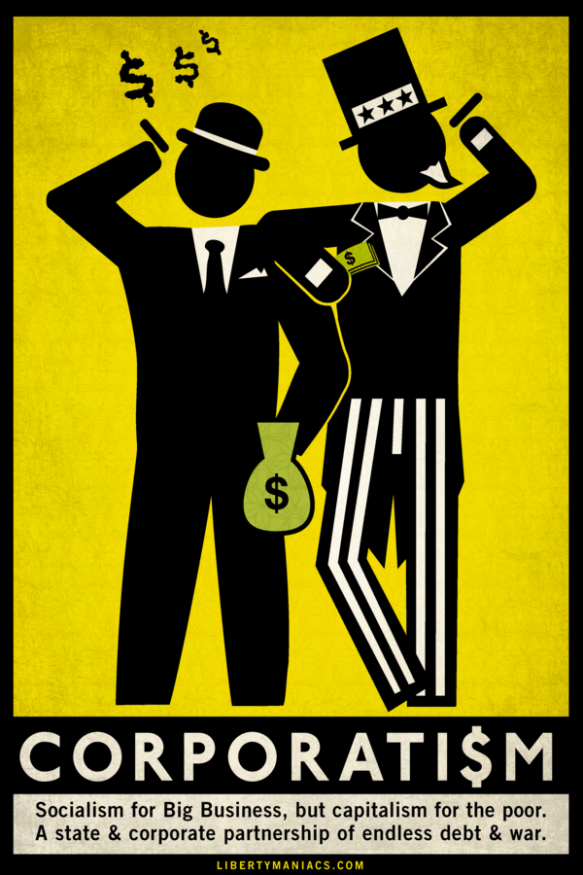
As I have explained many times in the blog and my books, we inhabit a state-cartel economy: the most profitable form of enterprise is the quasi-monopoly or cartel that limits supply and competition in order to extract the maximum profit from its customers.
Monopolies (or quasi-monopolies such as Google, which holds a majority share of global search revenues, excluding China) and cartels quickly amass profits which they then use to secure protection of their cartel from the state via lobbying, campaign contributions, etc. The elites controlling the state benefit from this arrangement, and so the system inevitably becomes a state-cartel system dominated by the state and private sector cartels and incentives that benefit the wealth and power of these institutions.
Once we understand the inevitability of this marriage of state and cartel, we understand socialism and capitalism–the State and Markets–are the yin and yang of one system. Reformers may recognize some of the inherent limits of the state and the market, but they believe these problems can be solved by tweaking policies–in systems-speak, modifying the parameters of the existing subsystems of lawmaking, the judiciary, regulatory agencies, and so on.
But as Donella Meadows explained in her classic paper, Leverage Points: Places to Intervene in a System tweaking the parameters doesn’t actually change the system. For that, we must add a new feedback loop.
The status quo, in all its various forms, is dominated by incentives that strengthen the centralization of wealth and power, increase inequality and divisiveness and the permanent expansion of consumption and credit. That this path leads to implosion / collapse does not compute because the status quo is constructed on the fundamental assumption that permanent growth/expansion of consumption, credit, wealth and state power is not just possible but necessary.
As many of us have labored to show, the financial system has been pushed to unprecedented extremes to maintain the illusion that rapid growth of consumption and credit can be maintained essentially forever.
We need an alternative system that’s built on sustainable incentives and feedback loops so we have a new blueprint to follow as the current arrangement unravels in the next decade or two.
Security and prosperity are worthy goals, but the means to achieve them, as well as the definition of security / prosperity, must be reworked from the ground up. We need to include positive social roles and meaningful work as essential components of security/prosperity.
My conception of a Third / Community Economy does not replace either the state or the free-enterprise market; rather, it does what neither of the existing structures can do. It adds opportunity, purpose, positive social roles and earned income for those left out of the state/cartel/market economy.
There is nothing inevitable about such vast, fast-rising income-wealth inequality; it is the only possible output of our financial and pay-to-play political system.
One chart defines the 21st century economy and thus its socio-political system: the chart of soaring wealth/income inequality. This chart doesn’t show a modest widening in the gap between the super-wealthy (top 1/10th of 1%) and everyone else: there is a veritable Grand Canyon between the super-wealthy and everyone else, a gap that is recent in origin.
Notice that the majority of all income growth now accrues to the the very apex of the wealth-power pyramid. This is not mere chance, it is the only possible output of our financial system. This is stunning indictment of our socio-political system, for this sort of fast-increasing concentration of income, wealth and power in the hands of the very few at the top can only occur in a financial-political system which is optimized to concentrate income, wealth and power at the top of the apex.
Well-meaning conventional economists have identified a number of structural causes of rising wealth/income inequality, dynamics that I’ve often discussed here over the past decade:
1. Global wage arbitrage resulting from the commodification of labor, a.k.a. globalization
2. A winner-takes-most power law distribution of the gains reaped from new technologies and markets
3. A widening mismatch between the skills of the workforce and the needs of a rapidly changing economy
4. The concentration of capital gains in assets such as high-end real estate, stocks and bonds that are owned almost exclusively by the top 10% of households
5. The long-term stagnation productivity
6. The secular decline in the percentage of the economy that flows to wages and salaries
While each of these is real, the elephant in the room few are willing to mention much less discuss is financialization, the siphoning off of most of the economy’s gains by those few with the power to borrow and leverage vast sums of capital to buy income streams–a dynamic that greatly enriches the rentier class which has unique access to central bank and private-sector bank credit and leverage.
Apologists seek to explain away this soaring concentration of wealth as the inevitable result of some secular trend that we’re powerless to rein in, as if the process that drives this concentration of wealth and power wasn’t political and financial.
There is nothing inevitable about such vast, fast-rising income-wealth inequality; it is the only possible output of our financial and pay-to-play political system.
Policy tweaks such as tax reform are mere public relations ploys. The cancer eating away at our economy and society arises from the Federal Reserve and the structure of our financial system, and the the degradation of our representative democracy into a pay-to-play auction to the highest bidder.
“Economic crisis at home and endless war abroad has placed finance and monopoly capital in political disarray.”
When I was here last year, I spoke a lot about ideology and how the struggle for social transformation in the mainland of imperialism partly depended upon the ideological development of oppressed people trapped within US borders. The 2016 elections were beginning to pick-up momentum, but it was unclear what direction they would go. Fast-forward to the present and, I don’t know about you all, but I am exhausted. The election of Donald Trump has presented both new and old challenges. It has created an almost circus-like political environment with dire consequences for the masses. What precipitated the circus-show is a crisis of governance that has been intentionally misunderstood by US imperialism’s corporately owned media and political elite.
To distort the crisis, a state of anti-Russian madness has been prescribed to medicate political consciousness in rapidly changing times. The rise of China and Russia has exposed the bankruptcy of US imperialism on all fronts. Economic crisis at home and endless war abroad has placed finance and monopoly capital in political disarray. Donald Trump took advantage of the chaos. He spoke about jobs, he spoke about wars, and he spoke to the growing insecurities of white Americans of working and middle class status who no longer can rely on the wages of whiteness for guaranteed prosperity. The duopoly and its capitalist masters had no one to offer, indeed nothing to offer, so Trump rode in on his orange horse to become the head of state of imperialism.
“The rise of China and Russia has exposed the bankruptcy of US imperialism on all fronts.”
The ruling class does not want people in the United States to understand the context of the Trump Presidency. It has reapplied Cold War fears with Russia as the prime target. Russia’s geopolitical moves away from imperialism have been deemed just as criminal as China’s economic supremacy. The US does not depend as much on Russia in the economic sense, but it trembles in fear at the prospect of growing Russian economic activity across Eurasia. Yet, provoking Russia militarily will lead to World War. This is a risk the ruling class appears willing to take as the anti-Russia narrative in the US has only intensified since Hillary Clinton made the erroneous claim of Russian interference in the 2016 elections.
According to the US ruling class and its “intelligence officials,” Russia promotes “fakes news” to assist Donald Trump. Russian President Vladimir Putin lurks in our social media, and is hacking his way through algorithms to smear the US political system. Russia is infecting minds with its Russia Today “propaganda” arm. The Ruskies have no regard for the damage they have caused to so-called US democracy. Putin wants total control of the US and will wield his most talented social media users to get the job done. This is what the corporate media sounds like these days.
“The U.S. trembles in fear at the prospect of growing Russian economic activity across Eurasia.”
Of course, the US ruling class doesn’t want to talk about how US intelligence already collects the numbers, emails, and calls of every single person in the world who uses a cell phone or computer. They don’t want to tell you about how the US has interfered in every election in Russia since the Soviet Union fell, or how it has led bloody proxy wars and coups in over fifty countries in as many years. They don’t want to discuss how Russia has absolutely nothing to do with the millions of incarcerated people in the US or the fact that it is the US monopoly capitalist economy, not the emerging capitalist economy of Russia, which has automated many of the jobs and siphoned much of the wealth that once belonged to a privileged sector of US workers. No, it would rather attention be placed on the Russian boogeyman.
Anti-Russian hysteria doesn’t just distract the broad masses of people from the legitimate causes of the conditions afflicting the working and unemployed. It feeds into an atmosphere of war that strikes the very roots of the US social order. Imperialism is the rule of monopoly and finance capital. This system has run its course. It cannot hold onto political legitimacy any more than it can spur economic development beyond the meager 1 to 2 percent growth calculated year after year. In a sense, war is all the system has left. And war is exactly what the ruling class will get, with or without Trump.
“They don’t want to tell you about how the US has interfered in every election in Russia since the Soviet Union fell, or how it has led bloody proxy wars and coups in over fifty countries in as many years.”
War with Russia is today’s clarion call for “American unity.” In times of crisis, the US imperial state has relied on war to bring political and economic relief from domestic crisis. Every major US-led war has in part been waged for this purpose. What differs now is that war with Russia could bring about the destruction of humanity. Scientists have confirmed that nuclear war could make the planet uninhabitable.
What is also different about this current war drive with Russia is how it marks the historical conclusion of the current stage in the world imperialist order. When the US threatened nuclear war with the atomic bombing of Japan in 1945 and the Cuban missile crisis almost two decades later, the world was in the midst of a transition from Western monopoly capitalism to proletarian socialism. Revolutions in Vietnam, Cuba, and the Soviet Union, to name a few, threatened to undo the very notion of private property. And while US and Western backlash nearly eliminated the socialist bloc by 1991, the imperialist order entered a transition stage of its own that some call “neo-liberalism.”
Neo-liberalism has greatly expanded the reach of capitalism’s tentacles and widened the impact of capitalist crisis since its inception in the late 1970s. Neo-liberalism has unleashed unfettered capitalist production by imposing economic stagnation on participating countries. Meanwhile, China’s socialist model has paved a different path, one marked by unprecedented growth and poverty reduction. China has understandably attracted underdeveloped nations so desperately seeking to escape from the clutches of neo-colonial impoverishment. Russia has grown close to China, providing both countries with much assistance in the way of constructing a multi-polar economic arrangement based on the principles of sovereignty and mutually beneficial cooperation. According to the logic of neo-liberal capital, only war with Russia and China can save the system from itself.
“War with Russia could bring about the destruction of humanity.”
This conclusion stems from the fact that neo-liberal capital is not growing, it is contracting. Eighty-percent of workers are near-poor in the US while six mega billionaires hold ownership of over half of the planet’s wealth. Concentrated profit does not mean that all is well with the ruling class. Internal contradictions are eating the capitalist system alive. Neither finance capital nor its monopoly investors can arrest the resultant decline. The growth of technology to speed up production and profit has left millions stuck in permanent unemployment. A high-tech system of production is an expensive system of production, requiring lower wages and debt to absorb the falling rate of profit. Global overproduction has thus developed alongside mass misery.
Such conditions are at the root of mass incarceration, where millions of mostly Black and poor workers are warehoused in cages because there is nothing on the outside that the system can offer. They are also the root of mass surveillance, as the system must keep tabs on an increasingly restless population and justify infringements on civil liberties as necessary counter-terror measures. The War on Terror and Drugs have been prerequisites toward keeping the population scared and its attention away from the US capitalist overlords who fund and support drug trafficking and terrorism for political gain. And when all else fails, blame Russia.
“The system must keep tabs on an increasingly restless population and justify infringements on civil liberties as necessary counter-terror measures.”
The struggle against neo-liberal capital and anti-Russian hysteria is a struggle to transform and revolutionize society. This struggle requires both practical political organization and ideological development. There will be no revolution without revolutionary thought, and no revolution without revolutionary action. All too often the left is debating which one is the most important for the future success of a revolutionary movement. The answer is both, together.
For most, this explanation is understandably too broad to inform individual political energy. Liberal thought and action thus becomes attractive because it hides behind the cloak of the possible and pragmatic. It is easier to think in terms of electoral politics than in global struggle. It is far more simple to advocate for a cooperative economy or universal basic income without spelling out the broad context that prevents their formation. In order for any material victories to be won on a mass scale, the victors must understand the world in which they fight.
“A movement for social transformation in the US has still yet to be born.”
Conscious struggle has brought about meaningful and deep changes in recent years. Mumia Abu-Jamal is now receiving Hep-C treatment after years of struggle with the State of Pennsylvania. The release of Chelsea Manning and Oscar Rivera Lopez also come to mind. Solidarity with Cuba freed the Cuban 5 and has given the socialist nation more opportunities to develop its economy. But these victories have come in the midst of great cost. A movement for social transformation in the US has still yet to be born, as the presence of dozens of political prisoners and the ongoing US blockade against Cuba reminds us.
Not once did I mention the Democratic or Republican Party. Both parties have done their part to create the crisis before us. A rejection of the two-parties means an embrace of the struggle against imperialism worldwide. It means that the nations with US targets on their backs should be seen as potential allies. Yes, this includes Russia. And Syria. It includes the left movements in Latin America. In the spirit of Malcolm X, the Black liberation movement, and the historic anti-imperialist struggle around the world, the time has come to search for real bonds of solidarity around the world to aid in the struggle against white supremacy, capitalism, and empire in the US and the West. Let no one, not even those who call themselves “the left,” tell you otherwise.
Danny Haiphong is an Asian activist and political analyst in the Boston area. He canbereachedatwakeupriseup1990@gmail.com
“The unacknowledged, but obvious, truth is that unnecessary work, imposed by either edict or contrived financial legerdemain, is slavery and servitude—totally irrational and immoral. Every engineer worthy of the name is trying to eliminate the need for human effort as a factor of production while every witless or hypocritical politician, pressured by the financial powers above and an insecure and uncomprehending population below, is professing, at least, to promote policies designed to ‘put people back to work.’” (from the below article)
Five minute video of Major C.H. Douglas, founder of Social Credit (1934):
Because of its deleterious impact on personal freedom and initiative, centralization of both economic and political power is the critical issue facing society. The primary obstacle to reversing this growing concentration of power is an almost universal ignorance of the manner in which the existing financial system renders the price-system increasingly non-self-liquidating, making impossible the recovery of industrial production costs through sales. Institutions and individuals attempt to resolve this problem by resorting to bank debt, thereby obtaining access to the products of industry by the self-defeating expedient of mortgaging our future–i.e., transferring these costs as an exponentially growing debt charge against future cycles of production–and by engaging in an orgy of wasteful and destructive activities, effectively culminating in continuous war.
Their monopolistic proclivities disincline both Finance-Capitalism operating under the Monopoly of Credit and every form of collectivist organization (e.g., socialism, communism or fascism) from grappling with this problem. The solution must entail an appropriate modification of the existing financial-credit and price system so as to properly facilitate distribution of the immense output of modern technology-based industry, in the context of expanding leisure.
Nearly a century ago this emergent challenge was studied in depth by the British engineer Clifford Hugh Douglas, who not only analyzed the defects of the existing price system as it functions under present financial and industrial cost-accounting conventions, but also put forward realistic remedial proposals. Between and for a period after the World Wars, Douglas’s ideas, which he named “Social Credit”, attracted large numbers of adherents and spawned many political movements in countries around the world.
Douglas recognized that life is more than bread alone and that in order to attain his full stature man must be released from unnecessary material concerns in order to make time for matters of the Mind and Spirit. This clearly was inherent in certain much-neglected aspects of the message of Jesus, who explicitly stated that lack of faith is the reason for our obsession with toiling our own way to material survival. Jesus asked how we could doubt that God, who provides for the fish and birds and the beasts, knows our needs and will provide even better for us. On more than one occasion Jesus unconditionally distributed loaves and fishes to crowds that had gathered to hear him. To indicate how reality operates outside of puritanical human notions of morality, Jesus pointed out that his heavenly Father causes the sun to rise on the evil and the good, and lets rain fall on both the just and the unjust.
An aspect of this divine caring is the ability we have been given to accumulate understanding of natural laws, which has resulted in an endless extension of “mechanical advantage”—termed by Social Crediters the Unearned Increment of Association—from which has emerged our amazing modern technology with its outflow of material abundance. Through learning how to associate effectively in the areas of both human endeavours and material resources, we have multiplied our productive capacity many thousands, if not millions, of times over. The historical aggregation of Unearned Increments has provided the vast Cultural Heritage upon which we all so greatly, if unconsciously, depend.
This is the background of why Social Credit came to be perceived by its leading thinkers as “practical Christianity”. Although Douglas did not set out to design it as such, ongoing development of Social Credit thought has revealed it to be uniquely consonant with and revelatory of the assurances given by the founder of the Christian faith.
This realistic perception of our situation is absent from the major ideologies of our time. For example, Libertarians promote the notion that the individual must “make it on his/her own”. No one today (apart maybe from individuals lost in the wilderness) is doing this; all have the benefit of the Cultural Heritage, which ties us in a web of dependencies not only with our contemporaries but also with previous generations.
Socialism, which calls for State ownership and administration of the means of production—the central planning of the economy and of human activity—similarly endeavors to alienate people from their heritage. Besides specifically attacking the very principle of inheritance, Socialists force the energies of the members of society into mandatory employment in projects prescribed by the State. Suppression of individual initiative is an inevitable result of this constraint of access to the possibilities afforded by the richness of the Cultural heritage. This observation applies to all forms of “socialism”, whether national or international in nature.
Social Credit is the inverse of socialism and a negation of finance capitalism. Many persons have it in their minds that a sharing society necessarily is socialistic; i.e., power centralizing. Presumably they think this way on the erroneous assumption that the sharing will be accomplished by redistributing existing wealth by means of various confiscatory forms of taxation. However, Social Credit, uniquely, stands not for redistribution of earned incomes, but rather for distribution of consumer goods at source as they emerge from the production line.
Douglas enunciated and stressed the truism that production without consumption is sheer futility and waste.
The fundamental task of economic policy is to match and balance the cycles of consumption and production. Producers’ costs cannot be recovered without money received from consumers, whose incomes alone provide business its means to liquidate all financial costs of production.
In order to effect this balance, Douglas recommended that National (Consumer) Dividends and Compensated (lowered) Prices at point of retail sale must be provided and financed by a Government Agency (created or existing, whatever is most efficient and convenient) with funds not derived from taxation but drawn down from a properly constructed National Credit Account. This would be a continuously updated actuarial accounting of the nation’s real credit, being an inventory of all those resources which are available to be used for production and which, if so used, may result in the making of financial prices.
Unfortunately, the public are conditioned to reason from the false assumption that the economic “pie” is limited to the financial incomes paid out in production, and hence they perceive this as the only possible source of funding. This assumption includes the erroneous corollary that the price-system is self-liquidating; i.e., that incomes paid out as wages, salaries and dividends are not only equal to, but available to meet, the total financial costs of production. That this is a major fallacy is readily proved by the enormous accumulation of inflationary private and public debt created as loans by the banking system, which allows goods to be purchased after a fashion but does not liquidate their financial costs of production in a synchronized fashion. As a kind of stop-gap expedient, these loans merely transfer these costs into the future, to be liquidated with income derived from later cycles of production unrelated to the cycles in which they were incurred.
The physical (i.e., real) costs of production are met as production takes place. Obviously, if this were not the case, production could not proceed. This is self-evident and axiomatic. When goods are produced in finished form they are meant to be used and should be immediately available to the overall consuming public in toto and without entailing any residual financial debt.
This universal piling-up of debt is bogus and is required only because price increasingly includes, as real capital replaces labor as a factor of production, allocated charges in respect of real capital which are not distributed as income in the same cycle of production. Consumer income is cancelled prematurely, leaving a growing deficiency of income relative to the total prices of goods awaiting purchase. In other words, the flow of final prices increasingly exceeds the flow of effective financial purchasing-power. Purchasing-power is prematurely cancelled in respect of still existing real capital, whereas it should be cancelled only at the rate of actual physical consumption or depletion. Money should be issued at the rate of production and cancelled at the rate of consumption
In the face of this predicament, we can simply forgo acquisition of these goods, leaving the producer no option but to warehouse or destroy them and go bankrupt—making his endeavors a mindless exercise in futility. Or we can ensure that, while required remaining actual “workers” (i.e., recipients of remuneration from others for services rendered) continue to have the benefit of their earnings, all citizens, workers included, have access to the full output of industry by being provided adequate aggregate purchasing-power to make this possible.
Besides being a practical necessity, such an arrangement recognizes the share all have in the almost fantastic Cultural Heritage of Civilization. In a Social Credit dispensation, Inheritance would be generalized.
In stark contrast is the socialist attitude, which is that inheritance is evil and should be abolished.
Social Credit stands most definitely, unashamedly and unabashedly, for a sharing society—and as labor is increasingly reduced by technology it would become more sharing with the passage of time. Unlike Socialism, which in reality has always been more about centralized control than about sharing, Social Credit does not involve State ownership, planning or administration of the economy or of social organization as such. By giving people as individuals full access to the ever-increasing abundance made possible by technology and to concomitant economic independence, it is in fact highly decentralizing.
The rational purpose of technology is to eliminate inefficiency, and “jobs” concocted merely for the sake of distributing incomes are precisely that—mere wasted energy and materials. The solution to the problem of economic insecurity in the modern age of super-production does not lie primarily in “making” work, but increasingly in facilitating
distribution. Those who clamor for “jobs” actually visualize a model along the lines of fascist and communist states, which give and demand of everyone endless work throughout their lifetime, in accordance with the rather suspect dictum that “work will make you free”—but not until you die.
The unacknowledged, but obvious, truth is that unnecessary work, imposed by either edict or contrived financial legerdemain, is slavery and servitude—totally irrational and immoral. Every engineer worthy of the name is trying to eliminate the need for human effort as a factor of production while every witless or hypocritical politician, pressured by the financial powers above and an insecure and uncomprehending population below, is professing, at least, to promote policies designed to “put people back to work.”
Frankly, if I desire “work”, then I want to do it by my own choice and at my own leisure, increasingly freed from the enforced conformity and servitude of the existing system.
We should not be striving to provide more, and more, human work but rather more technological productive efficiency with augmented effective consumer purchasing-power capable of eliminating consumer debt and liquidating industrial costs in a timely manner. Let robots do the work. Tirelessly and without complaint, they perform the vast majority of it better than people can.
You want more work? Then let’s have another war—or, better yet, continuous wars until we end up destroying the whole planet or all life upon it.
Indeed, the flaws in the current financial system provide a constant incentive for military war, which normally is just an extension of economic war. Unbalanced international trade is driven by the increasing inherent orthodox need to export—not to receive an equivalent of real wealth in return, but to capture financial credits from other nations to compensate for the internal intrinsic deficiency of consumer purchasing-power that exists in the domestic price-system of every nation.
Anyone who does not understand this compulsive destructive dynamic of the modern financial-economic system is totally unqualified even to comment on our economic position.
The abundance that technology makes possible should set men and women free from physical want, increasingly enabling them to choose independently and without duress their preferred activities in life. As opposed to the ubiquitous Keynesian, cognitively dissonant, counterfeit socialist concept of “economic democracy” as a centralized administrative proletarian Work-State, Social Credit gives real meaning to the concept of economic democracy by favoring a consumer-motivated system of production.
C. H. Douglas stressed the importance of understanding policy by tracing its pedigree. From a metaphysical standpoint, Social Credit would be a practical, physical incarnation of the Christian Doctrine of Salvation by Unearned Grace—in contradistinction to the prevailing Judaic conception, and system, of Salvation through Works. The current financial system is predicated upon a materialist philosophy characterizable as do ut des, meaning “this for that”—in other words, that nothing can be obtained except it be earned, that, as the saying goes, “There is no free lunch”. It is the underlying principle of the madness-inducing doctrine of “Salvation through Works”.
Hence, the existing financial system issues money only as debt for production and never for consumption, except in the latter case as debt which must be acquitted by future work This policy of issuing money only for work might have had some basis in equity in the primitive economy where production was primarily due to human effort. It makes no rational or moral sense whatever in the modern highly technological economy where non-human factors of production predominate and human intervention becomes increasingly a mere, although essential, catalyst within a vast productive complex.
Social Credit coheres profoundly with the Christian philosophy of Salvation through Unearned Grace–Grace being an outright gift from God. Spiritual Grace has, or should have, a physical counterpart, or incarnation, in the economic or material realm. Thus, from this philosophical standpoint access to consumer goods and services should increasingly be justified not by work alone but rather by the individual’s share in an inalienable inheritance of the communal capital that has accumulated over the ages. The effect of growth of our historic Cultural Heritage has always been to advance the potential for faster, more diversified and less wasteful productivity, with an accompanying potential for enhanced human leisure.
Christian philosophy holds that it is a major sin to make an end of a means. The rational purpose and end of production is consumption, not to create work (a means). An economic system should provide goods and services for mankind as efficiently as possible with minimal trouble and effort for all concerned.
One might ask how it is possible for a nation such as the United States of America, professedly predicated upon Christian principles, to base its entire economy and social structure upon a financial system that is a total inversion of those principles. A clue to this strange contradiction may be found in Douglas’s observation that Finance and the Established Media are concentric. As a result, he said, society has been hypnotized, with the consequence that only a drastic de-hypnotization can save it.
If society can pursue a continuous, destructive, malevolent and malignant policy of devastating the continents and populations of foreign nations, then surely we can easily pursue instead the civilized alternative of providing (Consumer) Dividends and Compensated (lowered) Retail Prices to support a secure and leisured life for our citizens. Under the existing iniquitous financial system we are driven to deliver those potential Dividends to other nations in the form of bombs. This would appear to be insanity by any rational criterion, but it satisfies the overarching irrational one of providing plenty of “jobs” and “incomes” (not to mention “profits”)—albeit at the additional cost of stupendous physical waste, human suffering and a massive, exponentially expanding financial mortgage burdening our future. This too would appear to be insanity, but apparently not to members of the banking fraternity, which finances it all with conspicuously detached equanimity.
Surely the time is long past when individuals and nations should have stopped “fighting” amongst themselves and instead concentrated their intelligence, energies and talents on demanding reality-grounded financial and economic policies.
I hope that the above commentary may help to clarify some of the major questions and issues often raised about Social Credit.
Dr. Oliver Heydorn has recently published a major informative book, comprehensively incorporating C. H. Douglas’s essential ideas. Refer: http://www.socred.org
The author was born during the so-called “Great Depression” when in 1935 the historic election of the world’s first “Social Credit” Government in the Province of Alberta, Canada startled the pundits and alarmed the global financial powers. In later years he became acquainted with several Cabinet Ministers of that Government. His close mentor was Mr. Leslie Denis Byrne, O.B.E., a British actuary and technical expert in Social Credit who was sent, with a colleague, from Britain by C. H. Douglas to advise the fledgling new Provincial Administration. The author holds baccalaureate degrees in Arts and Education. In Arts, he majored in political science, and minored in economics. In Education, he majored in social studies, secondary route.
Appreciation is expressed to Robert E. Klinck, M.A. for his considerate and patient assistance in editing this essay.





 After the Crash