Hunting the Twitter Files

Legacy Media Censor Details About Censorship

By Nolan Higdon

Source: Project Censored

More than two years since Big Tech made the historic decision to limit access to the New York Post’s story about President Joe Biden’s son Hunter, users are getting a glimpse into how Twitter came to that decision. However, delusional legacy and social media outlets are doing everything they can to misrepresent and bury the consequential details of the process.

An October 2020 New York Post story titled “Smoking-gun email reveals how Hunter Biden introduced Ukrainian businessman to VP dad” offered sensationalistic photos and details of Hunter’s addiction issues coupled with damning emails indicating that Hunter utilized his connection with his father to curry favor and economic opportunity in foreign countries. At the time, intelligence officials told members of the press that the story was Russian propaganda aimed at influencing that year’s election. As a result, Big Tech platforms limited access to the story including in direct messages which is usually done only in extreme cases such as child pornography.

On Friday, December 2, 2022, Elon Musk promised to release files related to the matter. Soon afterward, journalist Matt Taibbi published a report based on thousands of internal Twitter documents. Taibbi demonstrated that Twitter’s decision to remove the Hunter Biden story was influenced in part by Biden’s campaign. Indeed, as Taibbi described, Twitter’s staff regularly fields phone calls from powerful people in government and acts upon their requests to moderate content. And it’s is not just Twitter. During a 2022 interview with Joe Rogan, co-founder, chairman, and CEO of Meta (formerly Facebook) Mark Zuckerberg admitted that his company’s decision to moderate content – including the 2020 Hunter story – is sometimes based on recommendations from the intelligence community. Similarly, The Intercept reported in 2022 that the Department of Homeland Security regularly informs Big Tech’s content moderation practices.

In any other country, the revelation that government and Big Tech collude to shape public discourse and democratic participation would make Americans irate, but the story has received little coverage. The coverage received by legacy media has been dismissive. CNN reduced the files as simply showing “how employees debated how to handle 2020 New York Post Hunter Biden story.” Variety echoed the same sentiments. Meanwhile, giving readers less than 24-hours to process what Taibbi reported, WAPO declared that Musk’s Twitter Files “haven’t changed minds.”

The lack of substantive coverage of the Twitter Files is rooted in the legacy media’s fears over the broader implications of the story. Since 2015, legacy media have been fostering a moral panic over fake news and blamed their competition – digital media – for its spread. They have practically begged Big Tech overlords to fix the country and restore faith in journalism by censoring problematic content, which they often refer to as misinformation or disinformation. Taibbi’s reporting demonstrates that the news media’s framing of Big Tech content moderation as a solution to anti-democratic practices, actually functioned as an anti-democratic position that enables the elite political class to shape public dialogue and manufacture consent of the electorate.

Adding to the news media’s inability to cover the story is their business model which depends on framing every story as an issue of left versus right, blue versus red, Democrat versus Republican. Indeed, whether it is cable news audiences or legacy newspaper subscribers, news outlets cater to audiences’ confirmation biases by villainizing a caricature of the “otherside.” This has reduced every story to a partisan issue, and fostered such high levels of hyper-partisanship vitriol that half of Americans cite “other Americans” as their number one fear, while 40% contend that a civil war will occur in their lifetime.

Although they still try, the legacy media has found it impossible to frame the Twitter Files as a hyper-partisan story because the political duopoly, not one party, utilizes Big Tech to manufacture the consent of the people. For example, Big Tech’s content moderation of was influenced by Biden’s Campaign in 2020 and leading Democrats after January 6th. Similarly, Donald Trump’s campaign spent $100 million to work with Facebook staff to amplify their campaign messages, and Trump met personally with Zuckerberg in secret meetings throughout his presidency. Furthermore, legacy news media outlets cannot villainize the “other side” for censorship when loyalists for both parties are complicit. Indeed, the feckless liberals who begged Big Tech overlords to censor content about elections and Covid-19 are equally complicit as the neocons who championed censorship of the press and individuals, and organizations during the War on Terror and Trump supporters who lauded his attacks on the free press and whistleblowers such as Julian Assange.

Anyone can, and will, argue that Hunter’s photos are not newsworthy, but that is for the citizens to decide when they encounter the story. That is how a free press in a democratic republic works. A democracy does not depend on Big Tech overlords acting at the behest of the political class to determine what content the public should see. The notion that censorship will erode hate, correct falsehoods, or solve national problems is a fallacy of utmost proportions.  The contemporary censorious crowd seems to be in such a state of delusion that they have come to believe that World War II and the Holocaust could have been avoided if Twitter was around to censor Nazis. It is ludicrous and the establishment news media deserve part of the blame for perpetuating this lunacy.

A truly independent press would privilege narratives that expose Silicon Valley propaganda, which has led users of all political ideologies to a delusional state of Stockholm Syndrome, where Big Tech exploits their labor, erodes their privacy, and manufactures their consent for the duopoly, but users still laud and entrust the industry with their democracy. To be clear, Big Tech commercialized tools that were developed by the military industrial complex during the Cold War (which was not so cold in much of the world) to surveil and exploit users. They advertised their platforms as transformative tools that strengthen democracy and inclusion. As whistleblower after whistleblower remind us, this is all nonsense: Big Tech’s oligarchs are rapacious capitalists who time and time again put profits over people. No entity should be moderating information in a democracy, and as the Twitter Files reveal, the unaccountable profiteers in Big Tech are no exception.

Related Video:

The Washington Post’s Case Against Democracy

By David Swanson

Source: Let’s Try Democracy

The Washington Post has been a leading promoter of the Rules Based Order, which some have confused with a pro-democracy initiative. The Post has, however, assembled a powerful case against democracy, that we all need to take seriously if we want to be, you know, serious.

I want to highlight just the most recent two additions to the anti-democracy argument that by now is quite overwhelmingly established.

On August 29th, a column appeared in the Washington Post by a very serious columnist who has seriously and consistently supported every war in recent decades, and done so with completely inconsistent but super serious arguments. The fault of the horrific deaths of 13 people in Afghanistan in recent days, this column argued, lies with the U.S. public, which may have (the column doesn’t really suggest this, but who knows) had some influence on the U.S. government.

The brilliance of this column may fade into the wallpaper, because some of it is now well-established practice. It is none the less worth noting that vastly more than 13 people have died in recent days in Afghanistan. The U.S. military is still sending in missiles to blow men, women, and little children into tiny bits and pieces. But they are not lives that matter. If they mattered, then it would also matter that the war has been killing people, almost certainly in the 2 to 4 million range over a period of 20 years. And if that mattered, then ending a war wouldn’t be understood as an act of violence, no matter how badly you ended it.

There’s something even more brilliant here, though. If you look back at the public opinion polls in the United States, the U.S. public has opposed the war for well over 18 years. Millions of us have not just said that but done everything we could to end it since the day it began. If you’re finally going to give us credit, it might be worth considering the likelihood that the ending would have been better 19 or 20 years ago than it was this past week. Only a very skilled and serious columnist could erase that line of thought by transforming credit into blame, peace into war, and missile victims into vapor.

The idea of democracy is subtly weakened while the wars for “democracy” are strengthened in the hands of a master — or of a brain-dead jackass paid big bucks for this swill; as a member of the public, I don’t feel qualified to say which it is.

Example number 2: On August 27th, the Washington Post published a column that lamented the possible influence of European public opinion on the participation of European governments in NATO. It seems that people in Europe are not fond of all the wars, much less of planning more of them. They believe some of the fearmongering lies about Russia, yet still strongly oppose the basic idea of NATO, which is the illegal commitment of each member to join in any crime committed by the military of another member. In particular they oppose stirring up a war on China, which is of course the number one project of the democracy-spreading Rules Based Order.

The Washington Post knows what matters, thank goodness, and is focused on making sure NATO can do what the weapons dealers demand, no matter what the pesky public may prefer in NATO member states.

The point that the Post really needs to develop further, and I have every confidence that it can, is how an antidemocratic institution waging unpopular and illegal wars that cause more destruction, death, and suffering than just about anything else happening in the world can be better sold as pro-democracy. The Rules Based Order is already crumbling as a piece of propaganda. It too obviously is a mask for the notion that who rules gives the orders. But the sacred word “democracy” is of too much value to the most serious project there is for it to be allowed to slip away without a struggle. That project is of course the critical work of bullshitting everyone.

Which Is More Dangerous: Mainstream Media or The Spike Protein?

By Madhava Setty, MD

Source: Collective Evolution

Last week CE published this piece that demonstrated the obvious spin The Washington Post used to mislead their readers about the status of the unvaccinated, claiming that their rates of infection, death and hospitalization are significantly higher than vaccinated individuals when in fact they never measured these rates. In this article I will once again focus on the Washington Post and their lack of journalistic integrity. This time their propaganda is more egregious because they are targeting the largest pool of unvaccinated individuals: children.

The Washington Post urges the vaccination of adolescents

On May 10, 2021 the Washington Post published this article titled “FDA authorizes Pfizer Coronavirus vaccine for adolescents 12 to 15 years old”. The article begins with a quote from Kawsar R. Talaat, an assistant professor of international health at the Johns Hopkins Bloomberg School of Public Health who says,  “A vaccine gives them an extra layer of protection and allows them to go back to being kids.” 

This is a fascinating statement. Obviously kids were never not kids during the pandemic. Dr. Talaat is essentially saying that in order to be allowed to enjoy their youth kids must be vaccinated. However the restrictions that have been imposed upon their activity were never based on sound data. Asymptomatic spread could never be quantified or even confirmed. Mask mandates have been empirically demonstrated to have no effect on transmissibility or incidence of infection. The only things preventing kids from going back to being kids are the mandates that remain unsupported by any evidentiary arguments–not their vaccination status.

This statement was then further supported in the article:

”Robert W. Frenck Jr., the researcher who led [an] adolescent trial at Cincinnati Children’s Hospital Medical Center, who said the study was designed to test whether it triggered immune responses, not whether it prevented disease. But because of the number of children who became ill in the placebo arm of the trial, it also became evident the vaccine offered robust protection. He finishes by stating ‘That really points out how much covid there is in the adolescent community.’”

Dr. Frenck admits that the study he conducted was not designed to tell whether the vaccine prevented disease but whether children in the study developed antibodies. The point he is trying to make is that there is a lot of disease in the adolescent community. How much? In his study 16 out of approximately 1150 unvaccinated kids got Covid, all of whom recovered. That is an absolute risk of 1.4%. Compare that to the risk of getting the flu in a flu season: 8%. 

The article goes on to claim that the mortality of COVID is greater than the flu in children. The Post correctly states that of the 581,000 deaths from Covid only 300 adolescents have perished from the disease, an admittedly extremely small percentage but tragic nonetheless. However they state that this number is greater than the number of adolescents that die from the flu which justifies universal vaccinations. The article cites this paper from the CDC that they claim confirms this statistic. In it the CDC states that 188 children died from the flu in the 2017-18 season, indeed less than 300. However the paper then states that “CDC estimates the actual number was closer to 600”. We have caught the Post in what can be fairly called a lie that is being used to make their case that the threat of the disease justifies prevention through vaccination.

Vaccination Risks and what we know about the “Spike Protein”

Every medical intervention has a risk/benefit relationship that must be examined closely. The Washington Post never once addresses the potential risk of the vaccine in children. Despite mainstream media’s dogged refusal to pursue any research into potential harm of the Covid vaccines, some very troubling information has recently surfaced if one is willing to look beyond headlines and CDC reports. Unlike the Washington Post, I will also examine the risk aspect of the vaccine with a look at the role of the infamous “spike” protein.

As is well known, the Spike protein on the SARS-COV2 virus is what allows it to enter a human cell and infect it. It is also the target protein of the mRNA “vaccines” that use a novel approach to teach our immune systems to recognize it by stimulating our own cells to produce this protein ourselves, hopefully triggering our immune system to produce antibodies against it.

The vaccine manufacturers and the FDA who grant them authorization to deploy their product have made an enormous assumption: the virus is dangerous, but the spike protein is not. It is becoming clear that this assumption does not hold true. In this short article published on April 30, 2021 (11 days before the WP published their article) Salk News summarizes one of several scientific publications that demonstrate the danger of the spike protein:

“The paper, published on April 30, 2021, in Circulation Research, also shows conclusively that COVID-19 is a vascular disease, demonstrating exactly how the SARS-CoV-2 virus damages and attacks the vascular system on a cellular level. The findings help explain COVID-19’s wide variety of seemingly unconnected complications, and could open the door for new research into more effective therapies.

‘A lot of people think of it as a respiratory disease, but it’s really a vascular disease,” says Assistant Research Professor Uri Manor, who is co-senior author of the study. “That could explain why some people have strokes, and why some people have issues in other parts of the body. The commonality between them is that they all have vascular underpinnings.’”

The takeaway from these statements is that Covid-19 is a vascular disease more than just a respiratory illness. This was suspected very early on in the pandemic when many people were injured by bleeding, clots, strokes and organ failure. The authors were able to establish its mechanism by an elegant experiment. They designed a “pseudovirus”, one that had the SARS-COV2 spike protein on its surface but without any viral RNA in it. The pseudovirus damaged the lungs and pulmonary vasculature in animal models. They then isolated the molecular pathway by which spike proteins alter the metabolism of vascular endothelial cells causing injury. Conclusion: the spike protein itself causes harm in animal models.

Though we cannot definitively assert, from this study alone, that the spike protein is directly responsible for injury in humans, we must avail ourselves of the reality that this may take a very long time to prove definitively. If it is shown that an intervention is dangerous to animals there is no justification in assuming that it will be safe in a human being. That is why we use animal models in medical research to begin with.

“Fact Checkers” are Taking Notice

As expected, such statements are getting a lot of attention in the media. PolitiFact quickly responded with two articles (one here) “debunking” the theory that spike proteins are dangerous to humans. They quote Dr. Walter Orenstein (associate director of Emory University’s Emory Vaccine Center) and Dr. Paul Offit (director of the Vaccine Education Center at Children’s Hospital of Philadelphia) who both summarize that they are not aware of any evidence around the danger of spike proteins. Neither, however commented on the study presented in this essay.

PolitiFact also noted that the Centers for Disease Control and Prevention (CDC) called the spike protein “harmless”. Once again, PolitiFact accepted their blanket statement without asking the CDC for their opinion of the evidence cited here. PolitiFact declined to query the CDC for a different explanation of why hospitalized Covid-19 patients commonly expressed systemic disease often with vascular and clotting disorders.

The Danger of an mRNA vaccine that generates spike proteins

If the spike protein is pathogenic, i.e. capable of causing disease, how do we know that when we create antibodies to it we will be completely protected from it? We don’t. How do we know that every person inoculated will mount an antibody response to them? We don’t. This should be sounding alarms in every institution charged with public health. Why? With traditional vaccines there is very little risk, if any, of contracting disease from the vaccine. For example, if a person inoculated with a Hepatitis B vaccine does not mount an immunological response they do not end up getting Hepatitis B.

The situation we may be in is much more concerning. These mRNA vaccines, if they work as intended, are in fact introducing the disease-inducing component of the virus into our bodies. As with most biological processes there will be a wide distribution of responses to the vaccine from people who have little or no side-effects to others who suffer devastating injury. Is that what we are seeing now? Yes it is. 

The vaccines migrate throughout the body after injection

More recently, more disturbing information is coming to light. Bioavailability studies of the vaccine were not made public prior to Emergency Use Authorization (EUA). A Pfizer bioavailability study, obtained through the FOIA from a Japanese regulatory agency by a group of international scientists, demonstrates where the vaccine may go once it has been injected into the muscle tissue of our shoulder. Table 2.6.5.5B in this study indicates that the very same Lipid Nanoparticles (LNPs) used in the Pfizer vaccine begin to redistribute throughout the bodies of mice. Within 15 minutes after inoculation LNPs show up in the brain, liver, gastrointestinal tract, heart, lungs and especially in the ovaries and spleen. We can infer that where the LNPs go so do the mRNA that codes for spike protein. That was the purpose behind doing this study. We can also safely say that Pfizer and the other Covid-19 vaccine manufacturers never intended for their product to migrate so far from the site of inoculation.

This story is still evolving, however these studies and recently released bioavailability reports help to explain the clinical picture of Covid-19 with its broad effects on the body that are not limited to the respiratory system. Furthermore it may substantiate the numerous reports of injury following vaccinations like strokes, blood clots, bleeding, “brain fog”, Bell’s Palsy, etc.

The spike protein is toxic. The vaccine induces our cells to make spike proteins. The vaccine spreads throughout the body after injection. Until another unifying explanation is found we must assume that these vaccines are potentially far more dangerous than anticipated.

A call to halt vaccinations in the UK

In this advisory letter to Dr. June Raine, chief executive of Medicines and Healthcare Products Regulatory Agency (the UK’s FDA), Dr. Tess Lawrie, the director of an evidence based medicine consulting firm, urges the director to halt the vaccination program in that country after an extensive review of the UK’s adverse reaction data was conducted.

The Takeaway

We know, through the CDC’s own data, that Covid-19 vaccines provide almost no benefit to children and adolescents. The danger of vaccination is yet to be fully understood or quantified. In my opinion, the medical community, the FDA and CDC have no reasonable argument to encourage parents to vaccinate their children at this point. The Washington Post has once again demonstrated sloppy research standards, unbalanced reporting and lack of integrity. In this case adolescents, who are among the least vulnerable to the virus, may be harmed from The Post’s inability or unwillingness to uphold basic journalistic principles.

Jeff Bezos Embodies the Cruel Autocracy of Neoliberal Capitalism

Amazon CEO and richest-man-in-the-world Jeff Bezos wants you to work as much as he does—for one millionth of the pay

By Branko Marcetic

Source: In These Times

“Is Jeff Bezos a horrible boss and is that good?” That was the question posed by Forbes magazine in 2013, a sentiment that helps explain why Amazon’s founder and CEO is detested by the Left for his oligarchic ambitions, while simultaneously admired by America’s capitalist class for his business success. Ironically, Bezos is also loathed by former President Donald Trump, while celebrated by many liberals for so-called resistance.

But with Bezos and his $115 billion fortune laying claim to the title of richest man on Earth, and with Amazon playing an increasingly influential role in public life, it is worth asking: What does Jeff Bezos stand for?

A gifted child born to a teen mom, Bezos grew up not knowing his biological father, who was once one of the top-rated unicyclists in Albuquerque, N.M. Instead, Bezos was raised by the man his mother soon married: Miguel Bezos, who had fled Cuba and the Communist revolution, which had shuttered the elite private Jesuit school he attended, as well as his family’s lumberyard.

Journalists have speculated whether Bezos’ near-pathological competitiveness is a product of his early abandonment, similar to that of fellow tech overlord Steve Jobs. No doubt equally formative was Bezos’ adoptive father, who told Brad Stone, author of The Everything Store: Jeff Bezos and the Age of Amazon, that their home life was ​“permeated” by complaints about totalitarian governments of both the Right and the Left.

Bezos envisioned the concept of an ​“everything store” while working for a Wall Street hedge fund in the 1990s. He opened Amazon in 1994 as an online bookshop, a pragmatic starting point. Bezos gave the company his own $10,000 cash injection, took out interest-free loans, and received $245,000 from his parents and family trust.

Many of Amazon’s controversial labor practices can be traced to these early years as a plucky start-up. Amazon’s small team ran on tireless ambition to live up to the company’s customer-focused promise — key to its eventual market domination. Stone reports that, to meet Bezos’ ​“get big fast” directive, employees devoted themselves completely, working long, unusual, frenzied hours. One early warehouse worker who biked to work simply forgot about his improperly parked car, eventually discovering it had been ticketed, towed and sold at auction.

Such a relentless pace is one thing for a small group of true believers but is quite another when applied to low-wage workers just making ends meet. By 2011, Amazon’s workplace culture became known through a series of headline-grabbing reports that have come to define its public image: badly paid, ceaselessly surveilled, overworked workers, struggling to maintain a breakneck pace.

Bezos created a culture in which everyone from the lowest peon to the highest-ranking executive is expected to match his own devotion, an approach that resulted in spectacular levels of staff turnover by the early 2000s. A declared enemy of ​“social cohesion,” Bezos pushed his underlings to reject compromise and instead fiercely debate and criticize colleagues when they disagreed. One former employee described it as ​“purposeful Darwinism.” Known for withering put-downs — ​“Are you lazy or just incompetent?” ​“Did I take my stupid pills today?”—Bezos also isn’t above pulling out his phone or, in some cases, simply leaving the room when an employee fails to impress.

The flipside of Bezos’ intellect is a cold, clinical approach to human relations. Bezos described himself as a ​“professional dater” during his Wall Street days, trying to improve what he called his ​“women flow” — a riff on the Wall Street term ​“deal flow.”

“He was not warm,” one person who knew Bezos during his Wall Street days told the East Bay Express in 2014. ​“It was like he could be a Martian for all I knew.”

Bezos’ pitiless leadership style bled out beyond the Amazon boardroom as he used the company’s growing market share to bully book publishers into his terms. The company launched the ​“Gazelle Project”—as in, go after publishers ​“the way a cheetah would pursue a sickly gazelle” — allowing Amazon to undercut its competition at the cost of little to no profit for smaller publishers.

As Amazon inched closer to Bezos’ original vision, it began lobbying efforts in 2000 and became more transparently political by 2011, spending millions to defeat an internet sales tax and playing hardball with state governments, threatening to shutter Amazon facilities if its wishes went unfulfilled. In 2013, Amazon began lobbying Congress to cut corporate taxes.

The same year, Bezos bought the Washington Post, invested in Business Insider and donated to the publisher of the libertarian magazine Reason. Though Bezos argues his purchase of the Post was motivated by ​“a love affair [with] the printed word” and a desire to support American democracy, others suspect Bezos’ interest in media is related to bad press following a scathing Lehman Brothers report in 2000, which sent Amazon’s stock price tumbling.

Leading up to the Post purchase, Bezos was increasingly displaying what early Amazon investor Nick Hanauer called his ​“libertarian politics.” In addition to spending $100,000 in 2010 on a campaign to defeat a proposed Washington state tax on high-income earners, Bezos put hundreds of thousands of dollars toward boosting charter schools and other neoliberal education reforms.

Bezos’ political involvement reached a new apogee in 2019 during the re-election bid of Seattle’s socialist city councilwoman, Kshama Sawant, who called Bezos ​“our enemy” and tried to pass a head tax to fund housing for those displaced by Amazon’s Seattle footprint. Amazon spent $1.5 million against Sawant and other progressive candidates, a record at the local level, with more than a dozen of the company’s executives contributing to Sawant’s opponent. (Sawant won re-election anyway.)

As for Bezos’ endgame? A Trekkie since childhood, he has long dreamed of funding space exploration, a mission pursued by other superrich moguls (such as Elon Musk) in the face of the climate emergency. Opening the doors of his secretive Blue Origin aerospace company to journalists for the first time in 2016, Bezos told the New York Times he envisioned a future of ​“millions of people living and working in space,” exploiting the natural resources of surrounding planets and rezoning Earth ​“as light industrial and residential.”

Ironically, as Bezos pours the wealth he wrung out of exhausted, low-wage Amazon workers into space exploration, Amazon is busy hastening the very planetary collapse Bezos claims he’s trying to prevent — by silencing workers who speak out against Amazon’s assistance to oil and gas companies.

Let’s imagine, however, that Bezos, who accumulates $9 million an hour, lived in a world with Bernie Sanders’ 8% wealth tax (just on fortunes over $10 billion). A single year would see $9 billion flow from Bezos’ treasure trove into government coffers, more than enough to cover the 10-year cost of Elizabeth Warren’s universal child care plan ($1.7 billion) and maintain safe drinking water under Sanders’ plan ($6 billion).

Bezos’ career is a testament to the cruel autocracy and senseless misallocation of resources that our neoliberal capitalist system enables. But his opulence also reveals that the wealth exists to build a fairer and more equitable society — if redistributed. Bezos may loathe social cohesion, but in a world organized around democracy rather than the whims of space-billionaires, it’s something we may well be able to achieve.

How Surveillance and Propaganda Work in ‘the Free World’

By Brian Cloughly

Source: Strategic Culture Foundation

A Bloomberg report of October 22 was concise and uncompromising in declaring Russia to be a surveillance state. Harking back to the good old days of the Cold War, as is increasingly the practice in much of the Western media, Bloomberg recounted that “The fourth of 10 basic rules Western spies followed when trying to infiltrate Russia’s capital during the Cold War — don’t look back because you’re never alone — is more apt than ever. Only these days it’s not just foreigners who are being tracked, but all 12.6 million Muscovites, too. Officials in Moscow have spent the last few years methodically assembling one of the most comprehensive video-surveillance operations in the world. The public-private network of as many as 200,000 cameras records 1.5 billion hours of footage a year that can be accessed by 16,000 government employees, intelligence officers and law-enforcement personnel.”

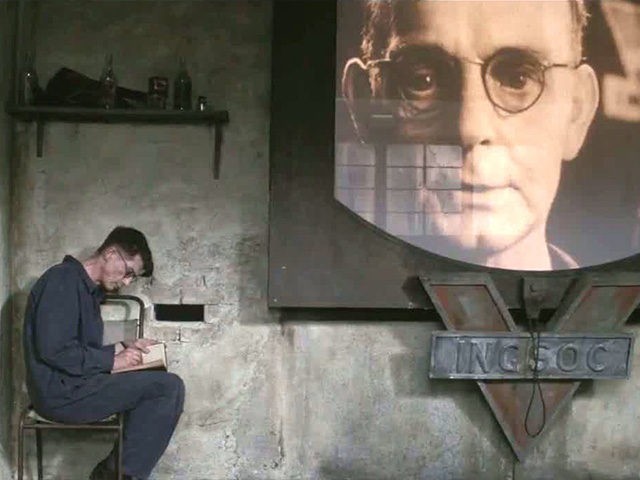
Terrifying, one might think. Straight out of Orwell’s 1984, that dystopian prediction of what the world could become, as noted in one description of how the face of the state’s symbolic leader, Big Brother, “gazes at you silently out of posters and billboards. His imposing presence establishes the sense of an all-seeing eye. The idea that he is always watching from the shadows imposes a kind of social order. You know not to speak out against The Party — because big brother is watching… The face always appears with the phrase Big Brother is watching you. As if you could forget.” Such is the terrifying Bloomberg picture of Moscow where there are supposedly 200,000 video cameras. You can’t blow your nose without it being seen. And wait for the next phase, in which Big Brother will hear you laugh.

In line with the Western approach, there is little mention of surveillance in other cities, but the website ‘Caught on Camera’ has analysed world-wide practices. It reports that there are some 25 million closed-circuit surveillance cameras world-wide and “the United Kingdom [with 4 million cameras] has more CCTV activity than any other European country, per capita… surprisingly, the Wandsworth borough in London in particular has more CCTV cameras than Boston, Dublin, Johannesburg and San Francisco put together. It is estimated there are 500,000 cameras dotted around London. The average person living in London will be recorded on camera 300 times in one day.”

The statistics obtained by Caught on Camera and comparitech differ markedly from those in the Bloomberg story which was retailed throughout the Western world by many news outlets, who increasingly refer to the West as “the Free World”. Comparitech records that as at August 2019 Moscow, with a population of 12.4 million, had 146,000 (not 200,000) cameras, while London’s 9 million citizens were being watched by 627,707 cameras. The picture (if one may use that word) is slightly slanted. To put it another way, London has 68 cameras for each 1,000 people, and the ratios elsewhere are enlightening: Shanghai 113 (China is in treble figures in three cities); Atlanta (Ga) 15; Chicago 13; Baghdad, Sydney and Dubai 12; Moscow and Berlin 11; and St Petersburg, Canberra and Washington DC tie at 5.

The slanting doesn’t stop there, because there are other ways of attacking Russia, spearheaded by such as the Washington Post, which highlighted the Bloomberg surveillance tale. The Post behaves like Big Brother focusing on Winston Smith, the hapless victim/hero of 1984 whose job it is “to rewrite the reports in newspapers of the past to conform with the present reality.” There is an eerie resonance in this, because the Post’s reportage on Russia verges on the obsessively censorious, while it avoids mention of anything remotely positive.

Understandably, the Post relies heavily on such sources as “Meduza, a Latvia-based online news outlet that covers the Kremlin” which reported that the Russian government “passed a law earlier this year that lets Vladimir Putin take all the country’s Internet traffic off the World Wide Web if he decrees that there’s an ‘emergency’.”

The fact that the intelligence services of the West have worked for a long time to devise strategies and tactics to destroy internet services in Russia and many other countries is neither here nor there, but it is important for Western propaganda purposes to condemn Russia for taking measures to counter the manoeuvres of the West’s cyberwar agencies. The Post emphasised that arrangements were made by various Russian ministries and agencies, including the Emergencies Ministry and the Federal Security Service which “is the successor to the KGB, where Putin was once an officer.”

The absurdity of that needlessly-injected personal point is amusing in a way, and serves to highlight the unending reiteration of detail intended to set the western public against Russia. Naturally, there is exclusion of information that could lead to audiences approving of Russia in any way.

The news site Axios states it aims to “deliver the cleanest, smartest, most efficient and trust-worthy experience for readers and advertisers alike” but when it comes to Russia it appears that there could be a bit of selectivity in that delivery. For example, in October the UK’s Guardian newspaper reported approvingly that according to the World Health Organisation (WHO), alcohol consumption in Russia “has dropped by 43% since 2003” and commented that the WHO had “put the decrease down to a series of measures brought in under the sport-loving president, Vladimir Putin, including restrictions on alcohol sales and the promotion of healthy lifestyles.” But Axios didn’t report it quite like that.

The Guardian also noted that “The last Soviet leader, Mikhail Gorbachev, led an anti-alcohol campaign with partial prohibition, which brought down consumption from the mid-1980s until 1990. But after the collapse of the Soviet Union, alcohol consumption exploded, continuing to rise until the start of the 2000s. Under Putin, Russia has introduced measures including a ban on shops selling any alcohol after 11 pm, increases in the minimum retail price of spirits and an advertising blackout.” The result has been “increased life expectancies in Russia, which reached a historic peak in 2018, at 78 years for women and 68 years for men. In the early 1990s, male life expectancy was just 57 years.”

This is an amazing societal development. In no other country has there been a comparable initiative that resulted in such a massive and positive shift in community habits.

The BBC was more coy than the Guardian about allocating approval for the remarkable success of the programme, and confined itself to reporting that the WHO “attributed the decline to a series of alcohol-control measures implemented by the state, and a push towards healthy lifestyles.” There was no reference to President Putin, and indeed the credit went elsewhere, because “alcohol-control measures introduced under former President Dmitry Medvedev included advertising restrictions, increased taxes on alcohol and a ban on alcohol sales between certain hours.”

Axios followed suit, and ‘Radio Free Europe’ didn’t mention Presidents Putin, Medvedev or Gorbachev, retailing simply that the “decline in consumption was due to “alcohol-control measures introduced at the beginning of the 2000s.” There were no reports of the achievement in US mainstream outlets or the UK’s resolutely right-wing anti-Russia media. (The Guardian doesn’t carry a Russian flag; it merely reports without xenophobic bias.)

The WHO Case Study provides an admirably detailed timeline of legislature and other developments concerning Russia’s successful drive against alcohol abuse, recording, for example, that in 2018 there was a “presidential decree on ‘National Purposes and Strategic Development Challenges of the Russian Federation until 2024’… including in the field of public health. The aim is to increase life expectancy to 78 years by 2024 and to 80 years by 2030, as well as the proportion of citizens leading a healthy lifestyle and systematically engaging in physical activities and sports.”

Don’t expect such an initiative to be praised or even mentioned by the Western media. Big Brother prefers to slant the cameras.

Facebook and YouTube remove posts naming CIA impeachment whistleblower

By Kevin Reed

Source: WSWS.org

Multiple media sources reported on Friday that the social media platforms Facebook and YouTube were removing posts that identified by name the CIA whistleblower behind the Congressional impeachment inquiry of President Donald Trump.

In an email statement, Facebook said, “Any mention of the potential whistleblower’s name violates our coordinating harm policy, which prohibits content ‘outing of witness, informant or activist’,” adding, “We are removing any and all mentions of the potential whistleblower’s name and will revisit this decision should their name be widely published in the media or used by public figures in debate.”

CNN also reported that YouTube issued a statement saying that it was using a combination of artificial intelligence software and human monitors to find and delete videos with the name of the “Ukrainegate” whistleblower. “The removals, the spokesperson added, would affect the titles and descriptions of videos as well as the video’s actual content,” the CNN report said.

The World Socialist Web Site has independently confirmed that Facebook is deleting posts containing the name of alleged CIA whistleblower Eric Ciaramella.

Facebook’s claim that any content posted on its platform naming Ciaramella constitutes “outing” the whistleblower is absurd. The alleged identity of the career CIA analyst who filed a complaint regarding the July 25 phone call between President Trump and Ukrainian President Volodymyr Zelensky has been known since October 30 when the pro-Republican Real Clear Politics website published his name.

When his name was published by Real Clear Politics, the whistleblower’s attorneys—in typical CIA fashion—said they could “neither confirm nor deny” that Ciaramella was their client.

Ciaramella is a plausible candidate for being whistleblower, given his background as a registered Democrat and CIA analyst with expertise in Ukraine and Russia. He worked under both Obama National Security Advisor Susan Rice and Trump National Security Advisor H.R. McMaster. In mid-2017 he was sent back to the CIA amid accusations that he was leaking anti-Trump information to the media.

While Ciaramella’s name has been widely circulated by Republican political figures, right-wing news sites and former CIA analyst and Trump aide Fred Fleitz said, “everyone knows who he is,” the Democrats and their allies in the media at the New York Times, Washington Post and major television networks have not made his name public.

Even an article in the New York Times on Friday that reported on Facebook’s censoring of posts by the right-wing website Breitbart did not include Ciaramella’s name. By taking the step of scrubbing posts mentioning allegations that are widely shared and reported, Facebook and YouTube are now joining with these corporate media organizations and blocking the public from having access to important information.

The latest heavy-handed social media censorship—so obviously being carried out in the service of the Democratic Party impeachment inquiry and the CIA—actually helps the Trump administration, the Republican Party and the extreme right-wing political forces defending the White House, allowing them to adopt the false posture of advocating free flow of information, even as Trump continues to demonize the media as the “enemies of the people.”

The mass scrubbing of all social media content by Facebook and YouTube that mentions the name Eric Ciaramella is part of the broader censorship efforts by the technology monopolies, in collaboration with the intelligence state, and sets the stage for even more draconian attacks on freedom of expression.

This must be seen within the context of the drive by a substantial section of the ruling establishment for the social media platforms to “step up to the plate” and, as Hillary Clinton said last week, take down “false, deceptive or deliberately misleading content” or “pay a price.” Leading figures within the Democratic Party, including presidential candidate Elizabeth Warren, Congresswoman Alexandria Ocasio-Cortez and Congresswoman Rashida Tlaib, have been campaigning for social media censorship that will block what they call “untruthful statements.”

As explained on the World Socialist Web Site, the increasing calls for censorship on social media are part of a protracted campaign by the US intelligence apparatus, under conditions of a growing movement of the working class and young people and increasing interest and support for socialism, to suppress left-wing, antiwar and progressive political viewpoints.

Furthermore, the WSWS has pointed out that what is determined as “fake” or “real” is not to be decided by the government or giant tech monopolies: “All the dishonesty of the campaign for internet censorship is contained in the failure to answer, much less consider, one central question: Who is to determine what is true and what is false?”

The publication of the name of the CIA analyst who submitted his complaint memo to the heads of the House and Senate Intelligence Committees in August is not a crime. In fact, his identity is of substantial consequence, given that his complaint became the starting point of an effort to remove a sitting president through impeachment.

Why is the New York Times still trying to sweep the Epstein case under the rug?

By Patrick Martin

Source: WSWS.org

A prominent article published in the Washington Post Thursday exposes the systematic violation of prison rules governing the detention of multimillionaire sex trafficker Jeffrey Epstein during the period immediately preceding his death on August 10.

Reporter Devlin Barrett writes: “At least eight Bureau of Prisons staffers knew that strict instructions had been given not to leave multimillionaire sex offender Jeffrey Epstein alone in his cell, yet the order was apparently ignored in the 24 hours leading up to his death, according to people familiar with the matter.”

His report continues: “The fact that so many prison officials were aware of the directive—not just low-level correctional officers, but supervisors and managers—has alarmed investigators assessing what so far appears to be a stunning failure to follow instructions, these people said.”

This language is quite extraordinary, suggesting that Post reporters have reason to believe that the security failure has no legitimate explanation, and may have been the result of concerted action to leave Epstein exposed and vulnerable.

The report continues, “Investigators suspect that at least some of these individuals also knew Epstein had been left alone in a cell before he died, and they are working to determine the extent of such knowledge …”

In other words, numerous prison officials, including some in authority, were aware that Epstein—on suicide watch from July 23 to July 29—was alone in a cell, in violation of rules governing at-risk prisoners. (Other press accounts claim that his cellmate was granted bail on Friday, August 9, and released from custody, leaving Epstein by himself.)

Epstein was found dead in his cell the following morning, at 6:30 a.m. on Saturday, August 10. During that night, the two guards assigned to check in on him every 30 minutes did not do so. Both were said to have been asleep for some or all of that night, rather than standing watch.

The two guards reportedly falsified the logs to show that they had checked on Epstein as required, but these logs were contradicted by video evidence from a surveillance camera monitoring the hallway outside his cell.

Investigators from the FBI and the inspector-general of the Department of Justice have taken possession of the videotapes, but have released no information about what they show, including whether there were any unauthorized visitors to Epstein’s cell the night he died.

The Post report suggests misconduct on a scale so staggering that it leaves little doubt that Epstein was either murdered or allowed to commit suicide, with the former far more likely. It defies belief that so many Bureau of Prisons employees, including managers and supervisors, could have each independently decided to ignore the rules for handling the most notorious prisoner then in federal custody.

Epstein had been arrested July 6 at Teterboro Airport in New Jersey, and was being held on sex-trafficking charges that carried a possible sentence of 45 years in prison. The nature of the charges, combined with his vast wealth and his connections in high places—including to Donald Trump, Bill Clinton, Prince Andrew of England, and Saudi Crown Prince Mohammed bin Salman—ensured maximum television and tabloid publicity for the case.

Many powerful people feared exposure if Epstein were brought to trial, and there is ample evidence that he was preparing an aggressive and highly publicized defense rather than attempting a plea bargain that would have swept the case under the rug. Epstein was meeting with his lawyers for as many as 12 hours a day, and they have described his demeanor as anything but downcast or suicidal. (Epstein denied that he had attempted suicide July 23, claiming he was the victim of an assault by a cellmate).

Under these circumstances, the real question is why the bulk of the American media, spearheaded by the New York Times, has chosen to swallow the claim of “suicide” and denounced any questioning of the official verdict as a “conspiracy theory.” Epstein was killed in downtown Manhattan, only a few miles from Times Square. But most of the reports exposing new evidence in the case have come in the pages of the Washington Post, while the Times has published lengthy reports—such as a front-page account in its edition of Sunday, August 19—which could be summed up as “nothing to see here, move along please.”

It is worth recalling that when Epstein was first arrested, the Times editorialized against making a political issue out of his kid-glove treatment during his first sex-crimes prosecution in 2008. The editorial urged congressional Democrats to stay away from Epstein, although the US Attorney who had recommended a token 13-month sentence in 2008—with six days out of seven on work-release to run his financial empire—was Alex Acosta, chosen by Trump as his secretary of labor.

While the Times warned Democrats that they would be making a martyr of Acosta by examining his conduct in the Epstein case, Acosta was actually forced to resign only a week after the publication of the editorial. Far from fearing that targeting Acosta was too ambitious, the Times editorial board seems rather to have feared that Epstein, followed by Acosta, would become the first two dominoes in a chain that would implicate others perhaps too close for comfort.


Related Articles:

Why is the media dismissing questions about Jeffrey Epstein’s death as “conspiracy theories”?
[13 August 2019]

The case of Jeffrey Epstein and the depravity of America’s financial elite
[13 July 2019]

Facebook Censorship of Alternative Media “Just the Beginning,” Says Top Neocon Insider

At a Berlin security conference, hardline neocon Jamie Fly appeared to claim some credit for the recent coordinated purge of alternative media.

By Max Blumenthal and Jeb Sprague

Source: Gray Zone

This month, Facebook and Twitter deleted the accounts of hundreds of users, including many alternative media outlets maintained by American users. Among those wiped out in the coordinated purge were popular sites that scrutinized police brutality and U.S. interventionism like The Free Thought Project, Anti-Media, Cop Block and journalists like Rachel Blevins.

Facebook claimed that these sites had “broken our rules against spam and coordinated inauthentic behavior.” However, sites like The Free Thought Project were verified by Facebook and widely recognized as legitimate sources of news and opinion. John Vibes, an independent reporter who contributed to Free Thought, accused Facebook of “favoring mainstream sources and silencing alternative voices.”

In comments published here for the first time, a neoconservative Washington insider has apparently claimed a degree of credit for the recent purge and promised more takedowns in the near future.

“Russia, China, and other foreign states take advantage of our open political system,” remarked Jamie Fly, a senior fellow and director of the Asia program at the German Marshall Fund. “They can invent stories that get repeated and spread through different sites. So we are just starting to push back. Just this last week Facebook began starting to take down sites. So this is just the beginning.”

Fly went on to complain that “all you need is an email” to set up a Facebook or Twitter account, lamenting the sites’ accessibility to members of the general public. He predicted a long struggle on a global scale to fix the situation, and pointed out that to do so would require constant vigilance.

Fly made these stunning comments to Jeb Sprague, who is a visiting faculty in sociology at the University of California-Santa Barbara and co-author of this article. The two spoke during a lunch break at a conference on Asian security organized by the Stiftung Wissenschaft und Politik in Berlin, Germany.

In the tweet below, Fly is the third person from the left who appears seated at the table.

The remarks by Fly — “we are just starting to push back” — seemed to confirm the worst fears of the alternative online media community. If he was to be believed, the latest purge was motivated by politics, not spam prevention, and was driven by powerful interests hostile to dissident views, particularly where American state violence is concerned.

Rise of a neocon cadre

Jamie Fly is an influential foreign policy hardliner who has spent the last year lobbying for the censorship of “fringe views” on social media. Over the years, he has advocated for a military assault on Iran, a regime change war on Syria, and hiking military spending to unprecedented levels. He is the embodiment of a neoconservative cadre.

Like so many second generation neocons, Fly entered government by burrowing into mid-level positions in George W. Bush’s National Security Council and Department of Defense.

In 2009, he was appointed director of the Foreign Policy Initiative (FPI), a rebranded version of Bill Kristol’s Project for a New American Century, or PNAC. The latter outfit was an umbrella group of neoconservative activists that first made the case for an invasion of Iraq as part of a wider project of regime change in countries that resisted Washington’s sphere of influence.

By 2011, Fly was advancing the next phase in PNAC’s blueprint by clamoring for military strikes on Iran. “More diplomacy is not an adequate response,” he argued. A year later, Fly urged the US to “expand its list of targets beyond the [Iranian] nuclear program to key command and control elements of the Republican Guard and the intelligence ministry, and facilities associated with other key government officials.”

Fly soon found his way into the senate office of Marco Rubio, a neoconservative pet project, assuming a role as his top foreign policy advisor. Amongst other interventionist initiatives, Rubio has taken the lead in promoting harsh economic sanctions targeting Venezuela, even advocating for a U.S. military assault on the country. When Rubio’s 2016 presidential campaign floundered amid a mass revolt of the Republican Party’s middle American base against the party establishment, Fly was forced to cast about for new opportunities.

He found them in the paranoid atmosphere of Russiagate that formed soon after Donald Trump’s shock election victory.

PropOrNot sparks the alternative media panic

A journalistic insider’s account of the Hillary Clinton presidential campaign, Shattered, revealed that “in the days after the election, Hillary declined to take responsibility for her own loss.” Her top advisers were summoned the following day, according to the book, “to engineer the case that the election wasn’t entirely on the up-and-up … Already, Russian hacking was the centerpiece of the argument.”

Less than three weeks after Clinton’s defeat, the Washington Post’s Craig Timberg published a dubiously sourced report headlined, “Russian propaganda effort helped spread ‘fake news.’” The article hyped up a McCarthyite effort by a shadowy, anonymously run organization called PropOrNot to blacklist some 200 American media outlets as Russian “online propaganda.”

The alternative media outfits on the PropOrNot blacklist included some of those recently purged by Facebook and Twitter, such as The Free Thought Project and Anti-Media. Among the criteria PropOrNot identified as signs of Russian propaganda were, “Support for policies like Brexit, and the breakup of the EU and Eurozone” and, “Opposition to Ukrainian resistance to Russia and Syrian resistance to Assad.” PropOrNot called for “formal investigations by the U.S. government” into the outlets it had blacklisted.

According to Craig Timberg, the Washington Post correspondent who uncritically promoted the media suppression initiative, Propornot was established by “a nonpartisan collection of researchers with foreign policy, military and technology backgrounds.” Timberg quoted a figure associated with the George Washington University Center for Cyber and Homeland Security, Andrew Weisburd, and cited a report he wrote with his colleague, Clint Watts, on Russian meddling.

Timberg’s piece on was PropOrNot was promoted widely by former top Clinton staffers and celebrated by ex-Obama White House aide Dan Pfeiffer as “the biggest story in the world.” But after a wave of stinging criticism, including in the pages of the New Yorker, the article was amended with an editor’s note stating, “The [Washington] Post… does not itself vouch for the validity of PropOrNot’s findings regarding any individual media outlet.”

PropOrNot had been seemingly exposed as a McCarthyite sham, but the concept behind it — exposing online American media outlets as vehicles for Kremlin “active measures” — continued to flourish.

The birth of the Russian bot tracker

By August, a new, and seemingly related initiative appeared out of the blue, this time with backing from a bipartisan coalition of Democratic foreign policy hands and neocon Never Trumpers in Washington. Called the Alliance for Securing Democracy (ASD), the outfit aimed to expose how supposed Russian Twitter bots were infecting American political discourse with divisive narratives. It featured a daily “Hamilton 68” online dashboard that highlighted the supposed bot activity with easily digestible charts. Conveniently, the site avoided naming any of the digital Kremlin influence accounts it claimed to be tracking.

The initiative was immediately endorsed by John Podesta, the founder of the Democratic Party think tank, Center for American Progress, and former chief of staff of Hillary Clinton’s 2016 presidential campaign. Julia Ioffe, the Atlantic’s chief Russiagate correspondent, promoted the bot tracker as “a very cool tool.”

Unlike PropOrNot, the ASD was sponsored by one of the most respected think tanks in Washington, the German Marshall Fund, which had been founded in 1972 to nurture the special relationship between the US and what was then West Germany.

Though the German Marshall Fund did not name the donors that sponsored the initiative, it hosted a who’s who of bipartisan national security hardliners on the ASD’s advisory council, providing the endeavor with the patina of credibility. They ranged from neocon movement icon Bill Kristol to former Clinton foreign policy advisor Jake Sullivan to ex-CIA director Michael Morrell.

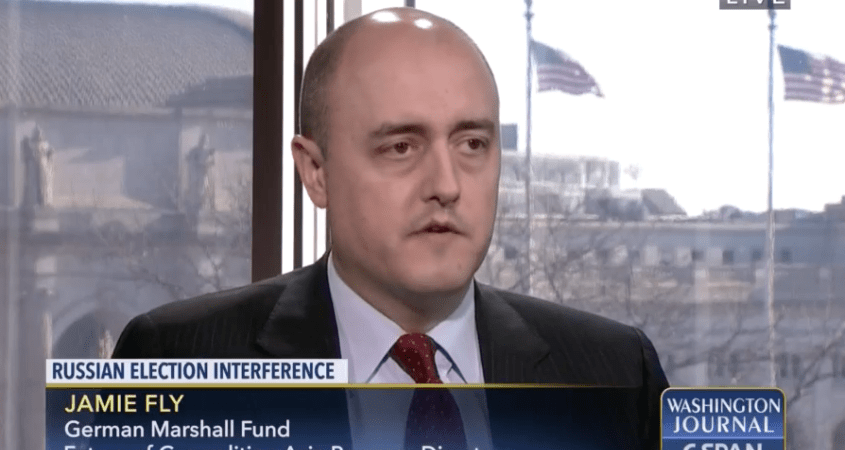
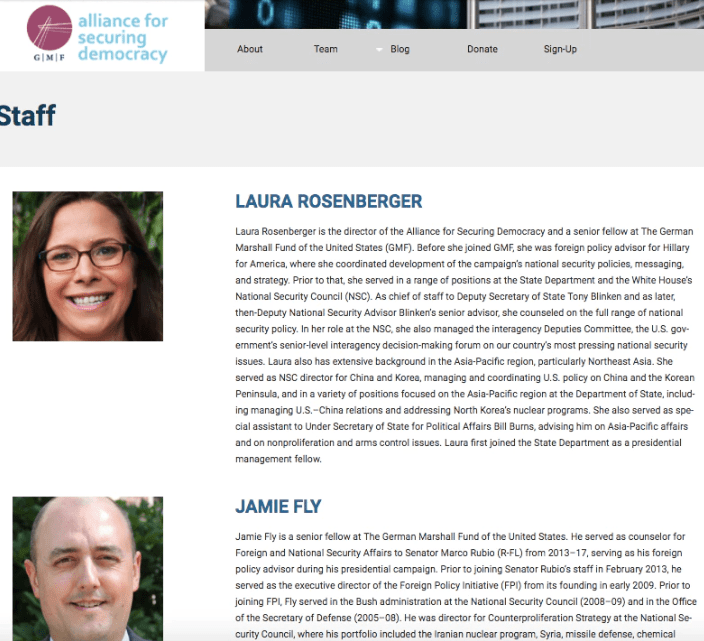
Jamie Fly, a German Marshall Fund fellow and Asia specialist, emerged as one of the most prolific promoters of the new Russian bot tracker in the media. Together with Laura Rosenberger, a former foreign policy aide to Hillary Clinton’s 2016 campaign, Fly appeared in a series of interviews and co-authored several op-eds emphasizing the need for a massive social media crackdown.
During a March 2018 interview on C-Span, Fly complained that “Russian accounts” were “trying to promote certain messages, amplify certain content, raise fringe views, pit Americans against each other, and we need to deal with this ongoing problem and find ways through the government, through tech companies, through broader society to tackle this issue.”

Yet few of the sites on PropOrNot’s blacklist, and none of the alternative sites that were erased in the recent Facebook purge that Fly and his colleagues take apparent credit for, were Russian accounts. Perhaps the only infraction they could have been accused of was publishing views that Fly and his cohorts saw as “fringe.”

What’s more, the ASD has been forced to admit that the mass of Twitter accounts it initially identified as “Russian bots” were not necessarily bots — and may not have been Russian either.

“I’m not convinced on this bot thing”

A November 2017 investigation by Max Blumenthal, a co-author of this article, found that the ASD’s Hamilton 68 dashboard was the creation of “a collection of cranks, counterterror retreads, online harassers and paranoiacs operating with support from some of the most prominent figures operating within the American national security apparatus.”

These figures included the same George Washington University Center for Cyber and Homeland Security fellows — Andrew Weisburd and Clint Watts — that were cited as experts in the Washington Post’s article promoting PropOrNot.

Weisburd, who has been described as one of the brains behind the Hamilton 68 dashboard, once maintained a one-man, anti-Palestinian web monitoring initiative that specialized in doxxing left-wing activists, Muslims and anyone he considered “anti-American.” More recently, he has taken to Twitter to spout off murderous and homophobic fantasies about Glenn Greenwald, the editor of the Intercept — a publication the ASD flagged without explanation as a vehicle for Russian influence operations.

Watts, for his part, has testified before Congress on several occasions to call on the government to “quell information rebellions” with censorious measures including “nutritional labels” for online media. He has received fawning publicity from corporate media and been rewarded with a contributor role for NBC on the basis of his supposed expertise in ferreting out Russian disinformation.
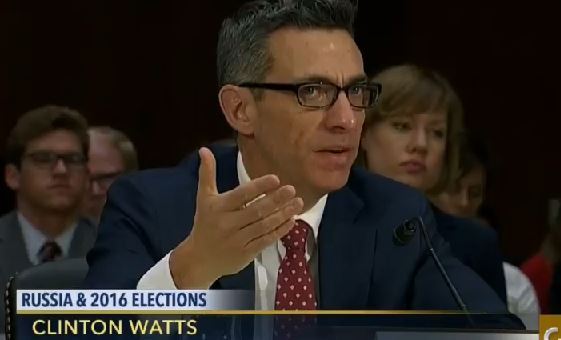
Clint Watts has urged Congress to “quell information rebellions”

However, under questioning during a public event by Grayzone contributor Ilias Stathatos, Watts admitted that substantial parts of his testimony were false, and refused to provide evidence to support some of his most colorful claims about malicious Russian bot activity.

In a separate interview with Buzzfeed, Watts appeared to completely disown the Hamilton 68 bot tracker as a legitimate tool. “I’m not convinced on this bot thing,” Watts confessed. He even called the narrative that he helped manufacture “overdone,” and admitted that the accounts Hamilton 68 tracked were not necessarily directed by Russian intelligence actors.

“We don’t even think they’re all commanded in Russia — at all. We think some of them are legitimately passionate people that are just really into promoting Russia,” Watts conceded.

But these stunning admissions did little to slow the momentum of the coming purge.

Enter the Atlantic Council

In his conversation with Sprague, the German Marshall Fund’s Fly stated that he was working with the Atlantic Council in the campaign to purge alternative media from social media platforms like Facebook.

The Atlantic Council is another Washington-based think tank that serves as a gathering point for neoconservatives and liberal interventionists pushing military aggression around the globe. It is funded by NATO and repressive, US-allied governments including Saudi Arabia, Bahrain and Turkey, as well as by Ukrainian oligarchs like Victor Pynchuk.

This May, Facebook announced a partnership with the Atlantic Council’s Digital Forensic Research Lab (DFRLab) to “identify, expose, and explain disinformation during elections around the world.”

The Atlantic Council’s DFRLab is notorious for its zealous conflation of legitimate online dissent with illicit Russian activity, embracing the same tactics as PropOrNot and the ASD.

Ben Nimmo, a DFRLab fellow who has built his reputation on flushing out online Kremlin influence networks, embarked on an embarrassing witch hunt this year that saw him misidentify several living, breathing individuals as Russian bots or Kremlin “influence accounts.” Nimmo’s victims included Mariam Susli, a well-known Syrian-Australian social media personality, the famed Ukrainian concert pianist Valentina Lisitsa, and a British pensioner named Ian Shilling.

In an interview with Sky News, Shilling delivered a memorable tirade against his accusers. “I have no Kremlin contacts whatsoever; I do not know any Russians, I have no contact with the Russian government or anything to do with them,” he exclaimed. “I am an ordinary British citizen who happens to do research on the current neocon wars which are going on in Syria at this very moment.”

With the latest Facebook and Twitter purges, ordinary citizens like Shilling are being targeted in the open, and without apology. The mass deletions of alternative media accounts illustrate how national security hardliners from the German Marshall Fund and Atlantic Council (and whoever was behind PropOrNot) have instrumentalized the manufactured panic around Russian interference to generate public support for a wider campaign of media censorship.

In his conversation in Berlin with Sprague, Fly noted with apparent approval that, “Trump is now pointing to Chinese interference in the 2018 election.” As the mantra of foreign interference expands to a new adversarial power, the clampdown on voices of dissent in online media is almost certain to intensify.

As Fly promised, “This is just the beginning.”