The Fear Driving US Nuclear Strategy

By Robert J. Burrowes

The United States Department of Defense released its latest ‘Nuclear Posture Review 2018’ (NPR) on 2 February, updating the last one issued in 2010 during the previous administration. See ‘Nuclear Posture Review 2018’.

The Executive Summary of the NPR is also available, if you prefer. See ‘Nuclear Posture Review 2018 Executive Summary’.

Several authors have already thoughtfully exposed a phenomenal variety of obvious lies, invented threats, strategic misconceptions and flaws – such as the fallacious thinking behind ‘deterrence’ and significantly increased risk of nuclear war given the delusional ‘thinking’ in the document – as well as the political fear-mongering in the NPR. For example, eminent scholar Professor Paul Rogers has pointed out: ‘The risk now is that we are on a slippery slope towards “small nuclear wars in far-off places”, which themselves could either escalate or at the very least break the 70+ year taboo on treating nuclear weapons as useable.’ See ‘Nuclear Posture Review: Sliding Towards Nuclear War?’

Stephen Lendman has reminded us that US ‘defense spending far exceeds what Russia, China, Iran and other independent countries spend combined’ and that the US ‘nuclear arsenal and delivery systems can destroy planet earth multiple times over’ with the document suggesting ‘preparation for nuclear war’. Moreover, the NPR ‘falsely claims the nation must address “an unprecedented range and mix of threats” posed by Russia, China, North Korea, Iran and other countries’ and this despite the incontrovertible fact that no nation has threatened US security since World War II and none threatens it now.

He further points out that the NPR’s claim that there is ‘an unprecedented range and mix of threats, including major conventional, chemical, biological, nuclear, space, and cyber threats, and violent nonstate actors’ is ‘utter rubbish’ and that ‘America’s rage for endless wars of aggression, along with its rogue allies, poses the only serious threat to world peace and stability.’ See ‘Trump’s Nuclear Posture Review’.

Even Andrew C. Weber, an assistant defense secretary during the Obama administration, has warned that

‘Almost everything about this radical new policy will blur the line between nuclear and conventional’ and ‘will make nuclear war a lot more likely.’ See ‘Pentagon Suggests Countering Devastating Cyberattacks With Nuclear Arms’.

Despite the obvious belligerence in the document, we are supposed to believe, according to words in the NPR, that ‘The United States remains committed to its efforts in support of the ultimate global elimination of nuclear, biological, and chemical weapons’ despite the US denunciation of the ‘UN Treaty on the Prohibition of Nuclear Weapons’ negotiated by 122 countries just a few months ago in mid-2017. See ‘U.S., UK and France Denounce Nuclear Ban Treaty’.

Presumably, we are supposed to have shorter memories than members of the US administration or to be even more terrified and unintelligent than are they. This would be difficult.

Rather than further critique the document, which several authors have done admirably, I would like to explain my observation immediately above.

Let me start by explaining why those who formulated the current US nuclear strategy, wrote the Nuclear Posture Review, now promote it and are responsible for implementing it, are utterly terrified and quite delusional, and constitute a threat to human civilization.

The NPR is full of language such as this: ‘There now exists an unprecedented range and mix of threats, including major conventional, chemical, biological, nuclear, space, and cyber threats, and violent nonstate actors. These developments have produced increased uncertainty and risk.’

Are these individuals, notably including Donald Trump, Secretary of Defense General Jim ‘Mad Dog’ Mattis, Chief of Staff Marine General John Kelly and National Security Adviser General H. R. McMaster, really frightened of countries such as Iran (with its non-existent nuclear arsenal) or North Korea (with its handful of ‘primitive’ nuclear weapons and inadequate delivery systems)? Or are they really frightened of countries such as Russia and China, whose nuclear arsenals pale in comparison to that of the United States and whose strategic posture in any case is decidedly non-aggressive (particularly towards the United States) despite its ongoing provocations of them?

Are US government leaders really so terrified of possible conventional, chemical, biological, space and cyber attacks that they need to threaten nuclear annihilation should it occur?

Well, the answer to each of these questions is that Trump, Mattis, Kelly, McMaster and other US political and military leaders are, indeed, terrified.

However, they are projecting their obvious terror away from its original source and onto a ‘safe’ and ‘approved’ target so that they can behave in accordance with their terror. They do this because the original cause of their terror – their parents and/or other significant adults in their childhood – never allowed them to feel their terror and to direct and express it safely and appropriately. For a full explanation of why this happens, see Why Violence?’ and Fearless Psychology and Fearful Psychology: Principles and Practice.

Unfortunately, and in this case potentially catastrophically, this dysfunctional behavioural response to deeply suppressed terror cannot ‘work’ either personally or politically for the individuals concerned. Let me explain why.

Evolution devised an extraordinarily powerful response to threats: it gave many organisms, including human beings, the emotion of fear to detect threats as well as other tools that can be used in conjunction with fear to respond powerfully to threats. Hence, in response to a threat, humans are meant to feel their fear and, while doing so, engage other feelings, conscience and intelligence so that the source of the threat can be accurately identified and the most powerful and effective behavioural response to that threat can be devised and implemented. In simple language: We need our fear to tell us we are under threat and to play a part in defending ourselves. In evolutionary terms, this was highly functional.

If, however, during childhood, the fear is suppressed because the individual is too frightened to feel it (usually because their parents deny them a safe opportunity to do so), then they will be unconsciously compelled to project their fear onto those who pose no threat (precisely because these people do not immobilize them with terror) and to endlessly seek to control these people (during childhood this usually means their younger siblings and/or friends, and during adulthood it usually means people of another sex, race, class, religion or nation) so that they can gain relief from experiencing their suppressed (childhood) fear.

The relief, of course, is delusionary. But once someone is terrified, it is not possible for them to behave functionally or powerfully. They will live in a world of delusion and projection, endlessly blaming those who they (unconsciously) project to be a threat precisely because these people are not frightening and not a threat and seem more likely to be able to be ‘controlled’.

This projection and behaviour happen all of the time, both in personal interactions and geopolitically, but it doesn’t usually threaten imminent annihilation, even if, to choose another example, it endlessly and perhaps disastrously impedes efforts to tackle the environmental and other assaults on our biosphere.

It is because parents are frightened to feel and experience their own fear that they also fear their child’s fear and they act (consciously or unconsciously, depending on the context) to prevent the child from feeling this fear, perhaps by doing something as simple as reassuring them.

However, parents also use a variety of methods to distract their child from feeling their feelings. They might offer the child a toy or food to distract them. But another important way in which fear is suppressed is by teaching children to use play as a distraction from having their feelings. This fear might then remanifest in the form of the child wanting others to play with them but particularly by doing so in a game of their choosing and over which they have control (so that they can ensure that their fear is not raised).

Once the child has learned to use gaining control over play to distract themselves from their terror, it might well become a lifetime addiction, subsequently manifesting as a dysfunctional desire for control within a family or perhaps even economically, politically or militarily.

Unfortunately, as some of these children grow up and the nature of their ‘game’ changes, the outcome can have deadly consequences. This is simply because there is never any guarantee that others will submit willingly to control by others. And, if they do not, this can trigger the original person’s (unconscious) terror ‘necessitating’ action – a higher-risk strategy in an attempt to secure this higher degree of control over others – to resuppress their terror.

However, for example, even if the terrified person ends up owning a major corporation and exercising a great degree of control over employees, markets and possibly countries, the terror driving their delusional need for control can never be satisfied. See ‘Love Denied: The Psychology of Materialism, Violence and War’. But the same principle applies in other domains as well, including the political and military.

And in the most dangerous collective manifestation of this major psychological disorder, the current US political/military leadership, which has been effectively merged by Trump’s appointment of military generals to his political staff, we now have the situation where a collection of individuals who are terrified and also project their dysfunctional desire for control onto other nations, are willing to threaten (and use) nuclear weapons in a delusionary attempt to feel (personally) ‘in control’.

It is little wonder that the Bulletin of the Atomic Scientists has moved the Doomsday Clock to two minutes to midnight! See It is now two minutes to midnight: 2018 Doomsday Clock Statement.

So what can we do?

Well, I would tackle the problem at several levels and I invite you to consider participating in one or more of these.

To help prevent this problem from emerging at its source, you are welcome to consider making ‘My Promise to Children’. This will play a vital role in ensuring that children do not grow up suppressing their fear.

Given the extraordinary emotional and other damage inflicted by school, you might consider educational opportunities for your child(ren) outside that framework. See ‘Do We Want School or Education?’

If you suspect that you are not as powerful as you would like, you might consider ‘Putting Feelings First’ so that you can learn to behave with awareness – a synthesis of all of the feedback that your various mental functions give you and the judgments that arise, in an integrated way, from this feedback. This will enable you to love yourself truly and always courageously act out your own self-will, whatever the consequences.

If you wish to work against the many threats, including military threats, to our environment simultaneously, you are welcome to join those participating in ‘The Flame Tree Project to Save Life on Earth’.

And if you wish to be part of efforts to end violence and war, including the threat of nuclear annihilation, you are welcome to consider signing the online pledge of ‘The People’s Charter to Create a Nonviolent World’ and/or using sound nonviolent strategy for your campaign or liberation struggle. See Nonviolent Campaign Strategy or Nonviolent Defense/Liberation Strategy.

Our world is poised perilously on the brink of catastrophic nuclear war. This has happened because we have given responsibility for holding the nuclear trigger to a handful of men who, emotionally speaking, are terrified little boys cowering from the imaginary threat of the bogeyman under their bed.

There is no easy way back from this brink. But you can help, both now and in the future, by doing one or more of the suggestions above.

Biodata: Robert J. Burrowes has a lifetime commitment to understanding and ending human violence. He has done extensive research since 1966 in an effort to understand why human beings are violent and has been a nonviolent activist since 1981. He is the author of Why Violence? His email address is flametree@riseup.net and his website is here.


Robert J. Burrowes
P.O. Box 68
Daylesford
Victoria 3460
Australia
Email: flametree@riseup.net

Websites:
Nonviolence Charter
Flame Tree Project to Save Life on Earth
‘Why Violence?’
Feelings First
Nonviolent Campaign Strategy
Nonviolent Defense/Liberation Strategy
Anita: Songs of Nonviolence
Robert Burrowes
Global Nonviolence Network
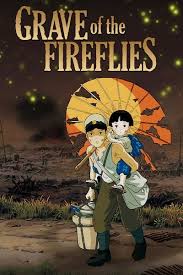
Saturday Matinee: Grave of the Fireflies

Review by Roger Ebert

In the waning days of World War II, American bombers drop napalm canisters on Japanese cities, creating fire storms. These bombs, longer than a tin can but about as big around, fall to earth trailing cloth tails that flutter behind them; they are almost a beautiful sight. After they hit, there is a moment’s silence, and then they detonate, spraying their surroundings with flames. In a Japanese residential neighborhood, made of flimsy wood and paper houses, there is no way to fight the fires.

“Grave of the Fireflies” (1988) is an animated film telling the story of two children from the port city of Kobe, made homeless by the bombs. Seita is a young teenager, and his sister Setsuko is about 5. Their father is serving in the Japanese navy, and their mother is a bomb victim; Seita kneels beside her body, covered with burns, in an emergency hospital. Their home, neighbors, schools are all gone. For a time an aunt takes them in, but she’s cruel about the need to feed them, and eventually Seita finds a hillside cave where they can live. He does what he can to find food, and to answer Setsuko’s questions about their parents. The first shot of the film shows Seita dead in a subway station, and so we can guess Setsuko’s fate; we are accompanied through flashbacks by the boy’s spirit.

“Grave of the Fireflies” is an emotional experience so powerful that it forces a rethinking of animation. Since the earliest days, most animated films have been “cartoons” for children and families. Recent animated features such as “The Lion King,” “Princess Mononoke” and “The Iron Giant” have touched on more serious themes, and the “Toy Story” movies and classics like “Bambi” have had moments that moved some audience members to tears. But these films exist within safe confines; they inspire tears, but not grief. “Grave of the Fireflies” is a powerful dramatic film that happens to be animated, and I know what the critic Ernest Rister means when he compares it to “Schindler’s List” and says, “It is the most profoundly human animated film I’ve ever seen.”

It tells a simple story of survival. The boy and his sister must find a place to stay, and food to eat. In wartime their relatives are not kind or generous, and after their aunt sells their mother’s kimonos for rice, she keeps a lot of the rice for herself. Eventually, Seita realizes it is time to leave. He has some money and can buy food–but soon there is no food to buy. His sister grows weaker. Their story is told not as melodrama, but simply, directly, in the neorealist tradition. And there is time for silence in it. One of the film’s greatest gifts is its patience; shots are held so we can think about them, characters are glimpsed in private moments, atmosphere and nature are given time to establish themselves.

Japanese poets use “pillow words” that are halfway between pauses and punctuation, and the great director Yasujiro Ozu uses “pillow shots”–a detail from nature, say, to separate two scenes. “Grave of the Fireflies” uses them, too. Its visuals create a kind of poetry. There are moments of quick action, as when the bombs rain down and terrified people fill the streets, but this film doesn’t exploit action; it meditates on its consequences.

The film was directed by Isao Takahata, who is associated with the famous Ghibli Studio, source of the greatest Japanese animation. His colleague there is Hayao Miyazaki (“Princess Mononoke,” “Kiki’s Delivery Service,” “My Neighbor Totoro”). His films are not usually this serious, but “Grave of the Fireflies” is in a category by itself. It’s based on a semi-autobiographical novel by Nosaka Akiyuki–who was a boy at the time of the firebombs, whose sister did die of hunger and whose life has been shadowed by guilt.

The book is well-known in Japan, and might easily have inspired a live-action film. It isn’t the typical material of animation. But for “Grave of the Fireflies,” I think animation was the right choice. Live action would have been burdened by the weight of special effects, violence and action. Animation allows Takahata to concentrate on the essence of the story, and the lack of visual realism in his animated characters allows our imagination more play; freed from the literal fact of real actors, we can more easily merge the characters with our own associations.

Hollywood animation has been pursuing the ideal of “realistic animation” for decades, even though that’s an oxymoron. People who are drawn do not look like people who are photographed. They’re more stylized, more obviously symbolic, and (as Disney discovered in painstaking experiments) their movements can be exaggerated to communicate mood through body language. “Grave of the Fireflies” doesn’t attempt even the realism of “The Lion King” or “Princess Mononoke,” but paradoxically it is the most realistic animated film I’ve ever seen–in feeling.

The locations and backgrounds are drawn in a style owing something to the 18th century Japanese artist Hiroshige and his modern disciple Herge (the creator of Tin Tin). There is great beauty in them–not cartoon beauty, but evocative landscape drawing, put through the filter of animated style. The characters are typical of much modern Japanese animation, with their enormous eyes, childlike bodies and features of great plasticity (mouths are tiny when closed, but enormous when opened in a child’s cry–we even see Setsuko’s tonsils). This film proves, if it needs proving, that animation produces emotional effects not by reproducing reality, but by heightening and simplifying it, so that many of the sequences are about ideas, not experiences.

There are individual moments of great beauty. One involves a night when the children catch fireflies and use them to illuminate their cave. The next day, Seita finds his little sister carefully burying the dead insects–as she imagines her mother was buried. There is another sequence in which the girl prepares “dinner” for her brother by using mud to make “rice balls” and other imaginary delicacies. And note the timing and the use of silence in a sequence where they find a dead body on the beach, and then more bombers appear far away in the sky.

Rister singles out another shot: “There’s a moment where the boy Seita traps an air bubble with a wash rag, submerges it, and then releases it into his sister Setsuko’s delighted face–and that’s when I knew I was watching something special.”

There are ancient Japanese cultural currents flowing beneath the surface of “Grave of the Fireflies,” and they’re explained by critic Dennis H. Fukushima Jr., who finds the story’s origins in the tradition of double-suicide plays. It is not that Seita and Setsuko commit suicide overtly, but that life wears away their will to live. He also draws a parallel between their sheltering cave and hillside tombs.

Fukushima cites an interview with the author, Akiyuki: “Having been the sole survivor, he felt guilty for the death of his sister. While scrounging for food, he had often fed himself first, and his sister second. Her undeniable cause of death was hunger, and it was a sad fact that would haunt Nosaka for years. It prompted him to write about the experience, in hopes of purging the demons tormenting him.”

Because it is animated and from Japan, “Grave of the Fireflies” has been little seen. When anime fans say how good the film is, nobody takes them seriously. Now that it’s available on DVD with a choice of subtitles or English dubbing, maybe it will find the attention it deserves. Yes, it’s a cartoon, and the kids have eyes like saucers, but it belongs on any list of the greatest war films ever made.


Note: To activate English subtitles, click on the “CC” button on the bottom-left corner of the video window.

Mainstream Media: The Evil Empire

By Anthony Freda

Source: Medium

As it becomes increasingly clear that yesterday’s conspiracy theories are today’s real news, the call to kill the messengers just gets more shrill and hysterical.

The attacks on free speech with high-tech censorship campaigns and old-fashioned hit pieces in the “War on Fake News” are massive and concerted.

The book burners are starting so many fires it’s impossible to stamp them all out.

What are the horrible thought crimes committed by the alternative press?

The new media has consistently exposed the lies and crimes of our corrupt and broken institutions.

Pioneers of alt media have passionately and convincingly made the case that The Patriot Act literally reversed the gains to human liberty codified in The Bill of Rights.

Independent media dismantled the lies that were presented as the pretexts to the invasion of Iraq. The same lies aggressively promoted by Bush, Hillary Clinton, CNN and The New York Times and that resulted in the death of a million people and global chaos. By contrast, how many people have died as a result of alternative media reports? The answer is zero.

The independent press interviewed NSA whistle-blowers who accurately described how the U.S. government was illegally spying on its citizens and retaining our data, and how these whistle-blowers were being persecuted by their own government for coming forward and refusing to break the law.

This was years before anyone heard of Edward Snowden.

Amazingly, there was very little interest in these bombshell allegations in the mainstream press.

It’s hard to believe now, but in those days, people who claimed the government was spying on innocent citizens were dismissed as paranoid by the self-proclaimed arbiters of truth at the NYT and CNN.

Grassroots media detailed a decade ago how police forces all over America were becoming militarized and predicted that this dangerous trend would lead to racially charged conflict on the streets of the nation. What kooks!

We have also railed against; torture, needless wars, police brutality, government corruption, the two-party duopoly, the criminality of the banksters and the end of privacy.

Now the very same mainstream media hacks who promoted the lies that lead to war in Iraq and Libya and mindlessly regurgitate whichever talking point is uploaded onto their teleprompter are gleefully assassinating what they call “fake news” using edited tape and misleading hit-pieces.

While these discredited war cheerleaders lie about why our sons and daughters are sent to die, we are bravely exposing the fraudulent casus belli they traitorously and disgracefully promote.

While these corporate spokespeople work for the interests of the oil and drug companies and political forces that pay their salaries, we risk everything to expose the crimes and scams of these same broken institutions.

We have done a great public service by exposing the deceptive, psychological methods used by the ruling elite to warp historical narratives, manipulate patriotism and manufacture consent.

By helping people to recognize and suspend their belief in propaganda and therefore their own complicity in it, the alternative media is helping to create a public awareness to the tactics our enemies use to keep us divided, steal our rights and slaughter countless innocents all over the world.

I know it’s fun and easy to call us tin-foil-hat wearers, or whatever pejorative has been chosen for you today, but let’s be clear about whose dirty work some are doing. Ironically, many are using talking-points written by deep-state operatives to ridicule the idea that the deep-state exists at all!!

Alternative media is in direct competition with the mainstream media for revenue and the MSM want to control the information we are exposed to.

The MSM is waging a concerted demonization campaign aimed at destroying some of the dominant platforms exposing the lies and crimes of their corporate and deep-state masters and many are helping them do it.

The MSM is an enemy of the truth and of the people. Friends of mine have been accused of being Russian agents in The NYT because they simply told the truth about Clinton during the campaign.

The corporate press has gone from lying to the American people to lying about the American people.

Do we have the will and power to destroy our common enemy?

Financial Tyranny: ‘We the People’ Are the New Permanent Underclass in America

By John W. Whitehead

Source: The Rutherford Institute

“When plunder becomes a way of life for a group of men in a society, over the course of time they create for themselves a legal system that authorizes it and a moral code that glorifies it.” ― Frédéric Bastiat, French economist

Americans can no longer afford to get sick and there’s a reason why.

That’s because a growing number of Americans are struggling to stretch their dollars far enough to pay their bills, get out of debt and ensure that if and when an illness arises, it doesn’t bankrupt them.

This is a reality that no amount of partisan political bickering can deny.

Many Americans can no longer afford health insurance, drug costs or hospital bills. They can’t afford to pay rising healthcare premiums, out-of-pocket deductibles and prescription drug bills.

They can’t afford to live, and now they can’t afford to get sick or die, either.

To be clear, my definition of “affordable healthcare” is different from the government’s. To the government, you can “afford” to pay for healthcare if your income falls above the poverty line. That takes no account of rising taxes, the cost of living, the cost to clothe and feed a household, the cost of transportation and communication and education, or any of the other line items that add up to a life worth living.

As Helaine Olen points out in The Atlantic:

Just because a person is insured, it doesn’t mean he or she can actually afford their doctor, hospital, pharmaceutical, and other medical bills. The point of insurance is to protect patients’ finances from the costs of everything from hospitalizations to prescription drugs, but out-of-pocket spending for people even with employer-provided health insurance has increased by more than 50 percent since 2010.”

For too many Americans, achieving any kind of quality of life has become a choice between putting food on the table and paying one’s bills or health care coverage.

It’s a gamble any way you look at it, and the medical community is not helping.

Healthcare costs are rising, driven by a medical, insurance and pharmaceutical industry that are getting rich off the sick and dying.

Indeed, Americans currently pay $3.4 trillion a year for medical care. We spent more than $10,000 per person on health care in 2016. Those attempting to shop for health insurance coverage right now are understandably experiencing sticker shock with premiums set to rise 34% in 2018. It’s estimated that costs may rise as high as $15,000 by 2023.

As Bloomberg reports, “Rising health-care costs are eating up the wage gains won by American workers, who are being asked by their employers to pick up more of the heftier tab… The cost of buying health coverage at work has increased faster than wages and inflation for years, pressuring household budgets.”

Appallingly, Americans spend more than any developed country on healthcare and have less to show for it. We don’t live as long, we have higher infant mortality rates, we have fewer hospital and physician visits, and the quality of our healthcare is generally worse. We also pay astronomical amounts for prescription drugs, compared to other countries.

Whether or not you’re insured through an employer, the healthcare marketplace, a government-subsidized program such as Medicare or Medicaid, or have no health coverage whatsoever, it’s still “we the consumers” who have to pay to subsidize the bill whenever anyone gets sick in this country. And that bill is a whopper.

While Obamacare (a.k.a. the Affordable Care Act) may have made health insurance more accessible to greater numbers of individuals, it has failed to make healthcare any more affordable.

Why?

As journalist Laurie Meisler concludes, “One big reason U.S. health care costs are so high: pharmaceutical spending. The U.S. spends more per capita on prescription medicines and over-the-counter products than any other country.”

One investigative journalist spent seven months analyzing hundreds of bills from hospitals, doctors, drug companies, and medical equipment manufacturers. His findings confirmed what we’ve known all along: health care in America is just another way of making corporations rich at consumer expense.

An examination of an itemized hospital bill (only available upon request) revealed an amazing amount of price gouging. Tylenol, which you can buy for less than $10 for a bottle, was charged to the patient at a rate of $15 per pill, for a total of $345 for a hospital stay. $8 for a plastic bag to hold the patient’s personal items and another $8 for a box of Kleenex. $23 for a single alcohol swab. $53 per pair for non-sterile gloves (adding up to $5,141 for the entire hospital stay). $10 for plastic cup in which to take one’s medicine. $93 for the use of an overhead light during a surgical procedure. $39 each time you want to hold your newborn baby. And $800 for a sterile water IV bag that costs about a dollar to make.

This is clearly not a problem that can be remedied by partisan politics.

The so-called Affordable Care Act pushed through by the Obama administration is proving to be anything but affordable for anyone over the poverty line. And the Trump administration’s “fixes” promise to be no better. Indeed, for too many Americans who live paycheck to paycheck and struggle just to get by, the tax penalty for not having health insurance will actually be cheaper than trying to find affordable coverage that actually pays for care.

This is how the middle classes, who fuel the nation’s economy and fund the government’s programs, get screwed repeatedly.

When almost 60% of Americans are so financially strapped that they don’t have even $500 in savings and nothing whatsoever put away for retirement, and yet they are being forced to pay for government programs that do little to enhance their lives, we’re not living the American dream.

We’re living a financial nightmare.

We have no real say in how the government runs, or how our taxpayer funds are used, but that doesn’t prevent the government from fleecing us at every turn and forcing us to pay for endless wars that do more to fund the military industrial complex than protect us, pork barrel projects that produce little to nothing, and a police state that serves only to imprison us within its walls.

We have no real say, but we’re being forced to pay through the nose, anyhow.

George Harrison, who died 16 years ago this month, summed up this outrageous state of affairs in his song Taxman:

If you drive a car, I’ll tax the street,
If you try to sit, I’ll tax your seat.
If you get too cold I’ll tax the heat,
If you take a walk, I’ll tax your feet.

Don’t ask me what I want it for
If you don’t want to pay some more
‘Cause I’m the taxman, yeah, I’m the taxman

Now my advice for those who die
Declare the pennies on your eyes
‘Cause I’m the taxman, yeah, I’m the taxman
And you’re working for no one but me.

In other words, in the eyes of the government, “we the people, the voters, the consumers, and the taxpayers” are little more than indentured servants and sources of revenue.

If you have no choice, no voice, and no real options when it comes to the government’s claims on your property and your money, you’re not free.

Consider: The government can seize your home and your car (which you’ve bought and paid for) over nonpayment of taxes. Government agents can freeze and seize your bank accounts and other valuables if they merely “suspect” wrongdoing. And the IRS insists on getting the first cut of your salary to pay for government programs over which you have no say.

It wasn’t always this way, of course.

Early Americans went to war over the inalienable rights described by philosopher John Locke as the natural rights of life, liberty and property.

It didn’t take long, however—a hundred years, in fact—before the American government was laying claim to the citizenry’s property by levying taxes to pay for the Civil War. As the New York Times reports, “Widespread resistance led to its repeal in 1872.”

Determined to claim some of the citizenry’s wealth for its own uses, the government reinstituted the income tax in 1894. Charles Pollock challenged the tax as unconstitutional, and the U.S. Supreme Court ruled in his favor. Pollock’s victory was relatively short-lived. Members of Congress—united in their determination to tax the American people’s income—worked together to adopt a constitutional amendment to overrule the Pollock decision.

On the eve of World War I, in 1913, Congress instituted a permanent income tax by way of the 16th Amendment to the Constitution and the Revenue Act of 1913. Under the Revenue Act, individuals with income exceeding $3,000 could be taxed starting at 1% up to 7% for incomes exceeding $500,000.

It’s all gone downhill from there.

Unsurprisingly, the government has used its tax powers to advance its own imperialistic agendas and the courts have repeatedly upheld the government’s power to penalize or jail those who refused to pay their taxes.

Irwin A. Schiff was one of the nation’s most vocal tax protesters. He spent a good portion of his life arguing that the income tax was unconstitutional. He paid the price for his resistance, too: Schiff served three separate prison terms (more than 10 years in all) over his refusal to pay taxes. He died at the age of 87 serving a 14-year prison term. As constitutional activist Robert L. Schulz noted in Schiff’s obituary, “In a society where there is so much fear of government, and in particular of the I.R.S., [Schiff] was probably the most influential educator regarding the illegal and unconstitutional operation and enforcement of the Internal Revenue Code. It’s very hard to speak to power, but he did, and he paid a very heavy price.”

It’s still hard to speak to power, and those who do are still paying a very heavy price.

All the while the government continues to do whatever it likes—levy taxes, rack up debt, spend outrageously and irresponsibly—with little thought for the plight of its citizens.

The national debt is $20 trillion and growing. The amount this country owes is now greater than its gross national product (all the products and services produced in one year by labor and property supplied by the citizens). We’re paying more than $270 billion just in interest on that debt annually. And the top two foreign countries who “own” our debt are China and Japan.

To top it all off, all of those wars the U.S. is so eager to fight abroad are being waged with borrowed funds. As The Atlantic reports, “For 15 years now, the United States has been putting these wars on a credit card… U.S. leaders are essentially bankrolling the wars with debt, in the form of purchases of U.S. Treasury bonds by U.S.-based entities like pension funds and state and local governments, and by countries like China and Japan.”

If Americans managed their personal finances the way the government mismanages the nation’s finances, we’d all be in debtors’ prison by now.

Still, the government remains unrepentant, unfazed and undeterred in its money grabs.

While we’re struggling to get by, and making tough decisions about how to spend what little money actually makes it into our pockets after the federal, state and local governments take their share (this doesn’t include the stealth taxes imposed through tolls, fines and other fiscal penalties), the police state is spending our hard-earned tax dollars to further entrench its powers and entrap its citizens.

For instance, American taxpayers have been forced to shell out $5.6 trillion since 9/11 for the military industrial complex’s costly, endless so-called “war on terrorism.” That translates to roughly $23,000 per taxpayer to wage wars abroad, occupy foreign countries, provide financial aid to foreign allies, and fill the pockets of defense contractors and grease the hands of corrupt foreign dignitaries.

Mind you, that staggering $6 trillion is only a portion of what the Pentagon spends on America’s military empire.

That price tag keeps growing, too.

The 16-year war in Afghanistan, which now stands as the longest and one of the most expensive wars in U.S. history, is about to get even longer and more costly, thanks to President Trump’s promise to send more troops over.

In this way, the military industrial complex will get even richer, and the American taxpayer will be forced to shell out even more funds for programs that do little to enhance our lives, ensure our happiness and well-being, or secure our freedoms.

As Dwight D. Eisenhower warned in a 1953 speech:

Every gun that is made, every warship launched, every rocket fired signifies, in the final sense, a theft from those who hunger and are not fed, those who are cold and are not clothed. This world in arms is not spending money alone. It is spending the sweat of its laborers, the genius of its scientists, the hopes of its children. The cost of one modern heavy bomber is this: a modern brick school in more than 30 cities. It is two electric power plants, each serving a town of 60,000 population. It is two fine, fully equipped hospitals. It is some fifty miles of concrete pavement. We pay for a single fighter plane with a half million bushels of wheat. We pay for a single destroyer with new homes that could have housed more than 8,000 people. This is, I repeat, the best way of life to be found on the road the world has been taking. This is not a way of life at all, in any true sense. Under the cloud of threatening war, it is humanity hanging from a cross of iron. […] Is there no other way the world may live?

This is still no way of life.

Yet it’s not just the government’s endless wars that are bleeding us dry.

We’re also being forced to shell out money for surveillance systems to track our movements, money to further militarize our already militarized police, money to allow the government to raid our homes and bank accounts, money to fund schools where our kids learn nothing about freedom and everything about how to comply, and on and on.

Are you getting the picture yet?

The government isn’t taking our money to make our lives better. Just take a look at the nation’s failing infrastructure, and you’ll see how little is being spent on programs that advance the common good.

We’re being robbed blind so the governmental elite can get richer.

This is nothing less than financial tyranny.

“We the people” have become the new, permanent underclass in America.

It’s tempting to say that there’s little we can do about it, except that’s not quite accurate.

There are a few things we can do (demand transparency, reject cronyism and graft, insist on fair pricing and honest accounting methods, call a halt to incentive-driven government programs that prioritize profits over people), but it will require that “we the people” stop playing politics and stand united against the politicians and corporate interests who have turned our government and economy into a pay-to-play exercise in fascism.

We’ve become so invested in identity politics that label us based on our political leanings that we’ve lost sight of the one label that unites us: we’re all Americans.

As I make clear in my book Battlefield America: The War on the American People, the powers-that-be want to pit us against one another. They want us to adopt an “us versus them” mindset that keeps us powerless and divided. Trust me, the only “us versus them” that matters anymore is “we the people” against the police state.

We’re all in the same boat, folks, and there’s only one real life preserver: that’s the Constitution and the Bill of Rights.

The Constitution starts with those three powerful words: “We the people.”

The message is this: there is power in our numbers.

That remains our greatest strength in the face of a governmental elite that continues to ride roughshod over the populace. It remains our greatest defense against a government that has claimed for itself unlimited power over the purse (taxpayer funds) and the sword (military might). As Patrick Henry declared in the last speech before his death, “United we stand, divided we fall. Let us not split into factions … or … exhaust [our strength] in civil commotions and intestine wars.”

This holds true whether you’re talking about health care, war spending, or the American police state.

To Liberate Cambodia

By Robert J. Burrowes

A long-standing French protectorate briefly occupied by Japan during World War II, Cambodia became independent in 1953 as the French finally withdrew from Indochina. Under the leadership of Prince Norodom Sihanouk, Cambodia remained officially neutral, including during the subsequent US war on Indochina. However, by the mid-1960s, parts of the eastern provinces of Cambodia were bases for North Vietnamese Army and National Liberation Front (NVA/NLF) forces operating against South Vietnam and this resulted in nearly a decade of bombing by the United States from 4 October 1965. See ‘Bombs Over Cambodia: New Light on US Air War’.

In 1970 Sihanouk was ousted in a US-supported coup led by General Lon Nol. See ‘A Special Supplement: Cambodia’. The following few years were characterized by an internal power struggle between Cambodian elites and war involving several foreign countries, but particularly including continuation of the recently commenced ‘carpet bombing’ of Cambodia by the US Air Force.

On 17 April 1975 the Communist Party of Kampuchea (CPK), otherwise known as the Khmer Rouge, took control of Cambodia. Following four years of ruthless rule by the Chinese-supported Khmer Rouge, initially under Pol Pot, they were defeated by the Vietnamese army in 1979 and the Vietnamese occupation authorities established the People’s Republic of Kampuchea (PRK), installing Heng Samrin and other pro-Vietnamese Communist politicians as leaders of the new government. Heng was succeeded by Chan Sy as Prime Minister in 1981.

Following the death of Chan Sy, Hun Sen became Prime Minister of Cambodia in 1985 and, despite a facade of democracy, he and the Cambodian People’s Party (CPP) have been in power ever since. This period has notably included using the army to purge a feared rival in a bloody coup conducted in 1997. Hun Sen’s co-Prime Minister, Prince Norodom Ranariddh, was ousted and fled to Paris while his supporters were arrested, tortured and some were summarily executed.

The current main opposition party, the Cambodia National Rescue Party (CNRP) was founded in 2012 by merging the Sam Rainsy Party and the Human Rights Party. Emblematic of Cambodia’s ‘democratic’ status, more than two dozen opposition members and critics have been locked up in the past year alone and the CNRP leader, Kem Sokha, known for his nonviolent, politically tolerant views, is currently imprisoned at a detention centre in Tboung Khmum Province following his arrest on 3 September 2017 under allegations of treason, espionage and for orchestrating anti-government demonstrations in 2013-2014. These demonstrations were triggered by widespread allegations of electoral fraud during the Cambodian general election of 2013. See ‘Sokha arrested for “treason”, is accused of colluding with US to topple the government’.

On 16 November 2017 the CNRP was dissolved by Cambodia’s highest court and 118 of its members, including Sokha and exiled former leader Sam Rainsy, were banned from politics for five years.


Cambodian Society

Socially, Cambodia is primarily Khmer with ethnic populations of Chinese, Vietnamese, Cham, Thai and Lao. It has a population of 16 million people. The pre-eminent religion is Buddhism. The adult literacy rate is 75%; few Cambodians speak a European language limiting access to western literature. Most students complete 12 years of (low quality public) school but tertiary enrollment is limited. As in all countries, education (reinforced by state propaganda through the media) serves to intimidate and indoctrinate students into obedience of elites. Discussion of national politics in a school class is taboo and such discussions are rare at tertiary level. This manifests in the narrow range of concerns that mobilize student action: personal outcomes such as employment opportunities. Issues such as those in relation to peace, the environment and refugees do not have a significant profile. In short, the student population generally is neither well informed nor politically engaged.

However, many other issues engage at least some Cambodians, with demonstrations, strikes and street blockades being popular tactics, although the lack of strategy means that outcomes are usually limited and, despite commendable nonviolent discipline in many cases, violent repression is not effectively resisted. Issues of concern to workers, particularly low wages in a country with no minimum wage law, galvanize some response. See, for example, ‘Protests, Strikes Continue in Cambodia: Though their occupations differ, Cambodian workers are united in their push for a living wage’. Garment workers are a significant force because their sector is important to the national economy. Land grabbing and lack of housing mobilize many people but usually fail to attract support beyond those effected. See, for example, ‘Housing Activists Clash With Police in Street Protest’. Environmental issues, such as deforestation and natural resource depletion, fail to mobilize the support they need to be effective.

Having noted that, however, Cambodian activists require enormous courage to take nonviolent action as the possibility of violent state repression in response to popular mobilization is a real one, as illustrated above and documented in the Amnesty International report ‘Taking to the streets: Freedom of peaceful assembly in Cambodia’ from 2015.

Perhaps understandably, given their circumstances, international issues, such as events in the Middle East, North Korea and the plight of the Rohingya in neighbouring Myanmar are beyond the concern of most Cambodians.

Economically, Cambodians produce traditional goods for small local households with industrial production remaining low in a country that is still industrializing. Building on agriculture (especially rice), tourism and particularly the garment industry, which provided the basis for the Cambodian export sector in recent decades, the dictatorship has been encouraging light manufacturing, such as of electronics and auto-parts, by establishing ‘special economic zones’ that allow cheap Cambodian labour to be exploited. Most of the manufacturers are Japanese and despite poor infrastructure (such as lack of roads and port facilities), poor production management, poor literacy and numeracy among the workers, corruption and unreliable energy supplies, Cambodian factory production is slowly rising to play a part in Japan’s regional supply chain. In addition, Chinese investment in the construction sector has grown enormously in recent years and Cambodia is experiencing the common problem of development being geared to serve elite commercial interests and tourists rather than the needs (such as affordable housing) of ordinary people or the environment. See ‘China’s construction bubble may leave Cambodia’s next generation without a home’.

Environmentally, Cambodia does little to conserve its natural resources. For example, between 1990 and 2010, Cambodia lost 22% of its forest cover, or nearly 3,000,000 hectares, largely to logging. There is no commitment to gauging environmental impact before construction projects begin and the $US800m Lower Sesan 2 Dam, in the northeast of the country, has been widely accused of being constructed with little thought given to local residents (who will be evicted or lose their livelihood when the dam reservoir fills) or the project’s environmental impact.

Beyond deforestation (through both legal and illegal logging) then, environmental destruction in Cambodia occurs as a result of large scale construction and agricultural projects which destroy important wildlife habitats, but also through massive (legal and illegal) sand mining – see ‘Shifting Sand: How Singapore’s demand for Cambodian sand threatens ecosystems and undermines good governance’ – poaching of endangered and endemic species, with Cambodian businesses and political authorities, as well as foreign criminal syndicates and many transnational corporations from all over the world implicated in the various aspects of this corruptly-approved and executed destruction.

In the words of Cambodian researcher Tay Sovannarun: ‘The government just keeps doing business as usual while the rich cliques keep extracting natural resources and externalizing the cost to the rest of society.’ Moreover, three members of the NGO Mother Nature – Sun Mala, Try Sovikea and Sim Somnang – recently served nearly a year in prison for their efforts to defend the environment and the group was dissolved by the government in September 2017. See ‘Environmental NGO Mother Nature dissolved’.


Cambodian Politics

Politically, Cambodians are largely naïve with most believing that they live in a ‘democracy’ despite the absence of its most obvious hallmarks such as civil and political rights, the separation of powers including an independent judiciary, free and fair elections, the right of assembly and freedom of the press (with the English-language newspaper The Cambodia Daily recently closed down along with some radio stations). And this is an accurate assessment of most members of the political leadership of the CNRP as well.

Despite a 30-year record of political manipulation by Hun Sen and the CPP – during which ‘Hun Sen has made it clear that he does not respect the concept of free and fair elections’: see ‘30 Years of Hun Sen: Violence, Repression, and Corruption in Cambodia’ – which has included obvious corruption of elections through vote-rigging but also an outright coup in 1997 and the imprisonment or exile of opposition leaders since then, most Cambodians and their opposition leaders still participate in the charade that they live in a ‘democracy’ which could result in the defeat of Hun Sen and the CPP at a ‘free and fair’ election. Of course, there are exceptions to this naïveté, as a 2014 article written by Mu Sochua, veteran Cambodian politician and former minister of women’s affairs in a Hun Sen government, demonstrates. See ‘Crackdown in Cambodia’.

Moreover, as Sovannarun has noted: most Cambodians ‘still think international pressure is effective in keeping the CPP from disrespecting democratic principles which they have violated up until this day. Right now they wait for US and EU sanctions in the hope that the CPP will step back.’ See, for example, ‘The Birth of a Dictator’. He asks: ‘Even assuming it works, when will Cambodians learn to rely on themselves when the ruling party causes the same troubles again? Are they going to ask for external help like this every time and expect their country to be successfully democratized?’

The problem, Sovannarun argues, is that ‘Cambodians in general do not really understand what democracy is. Their views are very narrow. For them, democracy is just an election. Many news reports refer to people as “voters” but in Khmer, this literally translates as “vote owners” as if people cannot express their rights or power beside voting.’

Fortunately, recent actions by the CPP have led to opposition leaders and some NGOs finally declaring the Hun Sen dictatorship for what it is. See, for example, ‘The Birth of a Dictator’. But for Sovannarun, ‘democratization ended in 1997. The country should be regarded as a dictatorship since then. The party that lost the election in 1993 still controlled the national military, the police and security force, and the public administration, eventually using military force to establish absolute control in 1997. How is Cambodia still a democracy?’

However, recent comprehensive research undertaken by Global Witness goes even further. Their report Hostile Takeover ‘sheds light on a huge network of secret deal-making and corruption that has underpinned Hun Sen’s 30-year dictatorial reign of murder, torture and the imprisonment of his political opponents’. See ‘Hostile Takeover: The corporate empire of Cambodia’s ruling family’ and ‘Probe: Companies Worth $200M Linked to Cambodian PM’s Family’.

So what are the prospects of liberating Cambodia from its dictatorship?

To begin, there is little evidence to suggest that leadership for any movement to do so will come from within formal political ranks. Following the court-ordered dissolution of the CNRP on 16 November 2017 – see ‘Cambodia top court dissolves main opposition CNRP party’ – at the behest of Hun Sen, ‘half of their 55 members of parliament fled the country’. And this dissolution was preceded by actions that had effectively neutralized the opposition, with two dozen opposition members (including CNRP leader Kem Sokha) and critics imprisoned in the past year alone, as reported above, and the rapid flight of Opposition Deputy President Mu Sochua on 3 October after allegedly being notified by a senior official that her arrest was imminent. See ‘Breaking: CNRP’s Mu Sochua flees country following “warning” of arrest’. But while Mu Sochua called for a protest gathering after she had fled, understandably, nobody dared to protest: ‘Who dares to protest if their leader runs for their life?’ Sovannarun asks.

Of course, civil society leadership is fraught with danger too. Prominent political commentator and activist Kem Ley, known for his trenchant criticism of the Hun Sen dictatorship, was assassinated on 10 July 2016 in Phnom Penh. See ‘Shooting Death of Popular Activist Roils Cambodia’ and ‘Q&A With Kem Ley: Transparency on Hun Sen Family’s Business Interests is Vital’. Ley was the third notable activist to be killed following the union leader Chea Vichea in 2004 – see ‘Who Killed Chea Vichea?’ – and environmental activist Wutty Chut in 2012. See ‘Cambodian Environmental Activist Is Slain’. But they are not the only activists to suffer this fate.

In addition, plenty of politicians, journalists and activists have been viciously assaulted by the security forces and members of Hun Sen’s bodyguard unit – see, for example, ‘Dragged and Beaten: The Cambodian Government’s Role in the October 2015 Attack on Opposition Politicians’ – and/or imprisoned by the dictatorship. See ‘Cambodia: Quash Case Against 11 Opposition Activists: No Legal Basis for Trumped-Up Charges, Convictions, and Long Sentences’. In fact, Radio Free Asia keeps a record of ‘Cambodian Opposition Politicians and Activists Behind Bars’ for activities that the dictatorship does not like, including defending human rights, land rights and the natural environment.

Moreover, in another recent measure of the blatant brutality of the dictatorship, Hun Sen publicly suggested that opposition politicians Sam Rainsy and Kem Sokha ‘would already be dead’ had he known they were promising to ‘organise a new government’ in the aftermath of the highly disputed 2013 national election result. See ‘Rainsy and Sokha “would already be dead”: PM’. He also used a government-produced video to link the CNRP with US groups in fomenting a ‘colour revolution’ in Cambodia. See ‘Government ups plot accusations with new video linking CNRP and US groups to “colour revolutions”’.

In one response to Hun Sen’s ‘would already be dead’ statement, British human rights lawyer Richard Rogers, who had filed a complaint asking the International Criminal Court (ICC) to investigate the Cambodian ruling elite for widespread human rights violations in 2014, commented that it was simply more evidence of the government’s willingness to persecute political dissidents. ‘It shows that he is willing to order the murder of his own people if they challenge his rule’. Moreover: ‘These are not the words of a modern leader who claims to lead a democracy.’ See ‘Rainsy and Sokha “would already be dead”: PM’. Whether Hun Sen is even sane is a question that no-one asks.

So what can Cambodians do? Fortunately, there is a long history of repressive regimes being overthrown by nonviolent grassroots movements. And nonviolent action has proven powerfully effective in Cambodia as the Buddhist monk Maha Gosananda, and his supporters demonstrated on their 19-day peace walk from Siem Reap to Phnom Penh through war ravaged Khmer Rouge territory in Cambodia in May 1993, defying the expectations of the United Nations Transitional Authority in Cambodia (UNTAC) coordinators at the time that they would be killed by the Khmer Rouge. See ‘Maha Gosananda, a true peace maker’. However, for the Hun Sen dictatorship to be removed, Cambodians will be well served by a thoughtful and comprehensive strategy that takes particular account of their unique circumstances.

A framework to plan and implement a strategy to remove the dictatorship is explained in Nonviolent Defense/Liberation Strategy with Sovannarun’s Khmer translation of this strategy here.

This strategic framework explains what is necessary to remove the dictatorship and, among consideration of many vital issues, elaborates what is necessary to maintain strategic coordination when leaders are at high risk of assassination, minimize the risk of violent repression while also ensuring that the movement is not hijacked by government or foreign provocateurs whose purpose is to subvert the movement by destroying its nonviolent character – see, for example, ‘Nonviolent Action: Minimizing the Risk of Violent Repression’ – as well as deal with foreign governments (such as those of China, the European Union, Japan and the USA) who (categorically or by inaction) support the dictatorship, sometimes by supplying military weapons suitable for use against the domestic population.

Sovannarun is not optimistic about the short-term prospects for his country: Too many mistakes have been repeated too often. But he is committed to the nonviolent struggle to liberate Cambodia from its dictatorship and recognizes that the corrupt electoral process cannot restore democracy or enable Cambodians to meaningfully address the vast range of social, political, economic and environmental challenges they face.


Biodata: Robert J. Burrowes has a lifetime commitment to understanding and ending human violence. He has done extensive research since 1966 in an effort to understand why human beings are violent and has been a nonviolent activist since 1981. He is the author of ‘Why Violence?’ His email address is flametree@riseup.net and his website is here.

Websites:
Nonviolence Charter
Flame Tree Project to Save Life on Earth
‘Why Violence?’
Feelings First
Nonviolent Campaign Strategy
Nonviolent Defense/Liberation Strategy
Anita: Songs of Nonviolence
Robert Burrowes
Global Nonviolence Network

The Public Are All Alone: Understanding How the Enemy of Your Enemy Is Not Your Friend

By Eric Zuesse

Source: Strategic Culture Foundation

In political matters, the public are taught to believe that some political Party is ‘good’, and that the others are “bad”; but the reality in recent times, at least in the United States, has instead been that both Parties are rotten to the core (as will be clear from the linked documentation provided here).

Belief in this myth (that the opposition between Parties is between ‘good’ ‘friend’ versus ‘bad’ ‘enemy’) is based upon the common adage that “The enemy of my enemy is my friend.” One side is believed, and ones that contradict it are disbelieved — considered to be lying, distorting: bad. But, maybe, both (or all) Parties are deceiving; maybe all of them are enemies of the public, but just in different ways; maybe each of them is trying to control the country in the interests of (and so to obtain the most financial support from) the aristocracy, while all of them are actually against the public.

Can it really be false that “The enemy of my enemy is my friend?” Not only can be, but often is. And no one is able to vote intelligently without recognizing this fundamental political fact.

It’s true between entire nations, too — not only within nations.

For example: Hitler and Stalin were enemies of each other, but neither of them was a friend of America (except that Stalin did more than anyone else to defeat Hitler, and thereby saved the world, though the U.S. — far less a factor than the U.S.S.R. was in defeating Hitler — still refuses to acknowledge the fact that Stalin did more than anyone else did to prevent the entire world’s becoming dictatorships; so, whatever democracy exists today, is a result of that dictator, Stalin, even more than it’s a result of either FDR or Churchill).

What about internally, then?

Hillary Clinton and Donald Trump became enemies of each other, but neither of them had ever really been a friend of the American public: both of them were instead liars who would, and did, do everything they could to grab control (on the aristocracy’s behalf, who financed their respective campaigns) over what is supposed to be our Government, in a democracy. That’s just a sad fact about reality, which both of America’s political Parties deny (because they both need those voters, not merely those mega-donations; they need the public to believe that the Party cares about them).

Most of the American public have been successfully deceived by the ‘news’media, and by the ‘history’-books (likewise published by agents for the aristocracy), to believe that the U.S. Government serves the public-interest, and not the interest of the centi-millionaires and especially billionaires, who finance political campaigns. But it’s no truer than it’s true that the enemy of your enemy is necessarily your friend: both enemies of each other can be your enemies, too. The difference here is that the enmity between the aristocracy and the public is basically intrinsic, whereas the enmities between (Republican versus Democratic, or any other divisions between) aristocrats, are basically personal — these are matters of business, instead of matters of state. They are, in a sense, different business-plans — competing business-plans. But they are all assisting the aristocracy, to control the public, so as to advance the interests of the aristocracy. They’re all competing for the aristocracy’s support, and deceiving for the public’s support. Two blatant recent examples displaying this were America’s invasion in 2003 that destroyed Iraq, and America’s invasion in 2011 that destroyed Libya. Did either of those invasions advance the interests of the American public? But the owners of Lockheed Martin and other ‘defense’ contractors blossomed after 9/11. In fact: U.S. arms-exports are at record highs.

The now-proven reality in America is that the U.S. Government really does represent those billionaires and centi-millionaires, and not the public. It’s a now-proven reality, that the U.S. isn’t a democracy but a dictatorship — albeit, a two-Party one, with a real competition between billionaire and centi-millionaire Republicans on the one hand, versus billionaire and centi-millionaire Democrats on the other. But all billionaires and centi-millionaires are takers (that’s how they came to be super-rich, even the ones who didn’t inherit it from their parents), who (notwithstanding any ‘charity’ they may establish to avoid taxes while extending their control) receive from the public far more than they give to the public; and, so, there is actually an intrinsic class-war — not at all like Karl Marx famously said, between the bourgeoisie (including small-business owners) versus the proletariat (including some centi-millionaires and billionaires who became super-wealthy from being movie-stars or athletic stars and who don’t necessarily actually control any business at all, and so they’re “proletariats”), but instead between the aristocracy versus the public: the ancient and permanent class-conflict. It’s the entire aristocracy-of-wealth (which is maybe half of the nation’s wealth) that’s arrayed against the public (the poorer 99+% of the people). (In fact, Marx — the promoter of the view that the bourgeoisie are the public’s enemies — had aristocratic sponsors, and he would have remained obscure and died poor, if he had instead blamed the aristocracy, not “the bourgeoisie” — which is mainly the middle class — as being the exploiting-class. Marx, too, was an agent of aristocracy. He succeeded and became famous because he had aristocratic sponsors. Otherwise, his name would have simply been forgotten.)

Anyway, the American public are now alone. No Government represents our interests. It’s now been proven that America’s Government doesn’t represent us; and it’s not even the business of any other Government in the world to represent us; so, no foreign government does, either. No Government represents us.

In order to understand any aristocracy, one must understand what gives rise to almost all wars, because almost all wars throughout history have been between contending aristocracies — between the aristocracies of different nations. Each aristocracy needs to be able to fool its national public, to believe that they’re fighting against the foreign public, when, in fact, they’re fighting against the foreign aristocracy, and they’re fighting for the home-nation’s aristocracy — they are, almost always, fighting for one aristocracy, against another aristocracy. Any public who would know that this is the reality, would just as soon commit a democratic revolution, against the local aristocracy, as go to war for the local one, against the foreign ones. This is the reason why, in every dictatorship, the local centi-millionaires and billionaires buy up all of the ‘news’media that inform, or (on essential matters) misinform, their audiences about international relations, and about who did what to whom and why. They hire only ‘reporters’ who comply with whatever deceptions the owners feel to be necessary, in order to be able to attract sponsorships from other aristocrats’ corporations and ‘charities’. But, the aristocrats themselves are actually all in this together, because their mutually shared enemy is the public. Without deceiving the public about essential matters, no national news-medium would be able to attract the sponsorships it needs in order to grow, or even to survive.

The public thinks it’s fighting an international war, when, in fact, they’re fighting for the local aristocracy (and its allied aristocracies), against foreign aristocracies (and their allied aristocracies). This has been true since the dawn of human civilization. Only the weapons are bigger now, and the alliances (in the World Wars) are now global. (But, of course, if there is another World War, then all of human civilization will immediately end, and not long thereafter, all human and most other forms of life will also end.)

An excellent example of the real class-war, and of its international nature, is James Bamford’s 3 April 2012 masterful and pioneering article in Wired, “Shady Companies With Ties to Israel Wiretap the U.S. for the NSA”. He documented that even very high-up people in America’s NSA were kept out of the loop when joint U.S.-and-Israeli intelligence-agencies and private corporations were creating the present 1984-ish, “Big Brother” reality, in (at least) those countries (but, actually, the Sauds, and probably a few others, were also on the inside — the aristocracies not merely of those two countries, U.S. and Israel, are in the alliance).

The “Deep State” isn’t merely one nation’s aristocracy and its agents; it is basically a form of actually international gang-warfare. That’s what got us into invading and destroying Iraq 2003, Libya 2011, Syria 2012-, Ukraine (by coup 2014), and so many other nations. It wasn’t done in order to serve the American public’s interests. That’s just the standard lie — and it keeps going on, and on. Maybe until we invade Russia.

$21 Trillion of Unauthorized Spending by US Govt Discovered by Economics Professor

Source: Covert Geopolitics

he US government may have misspent $21 trillion, a professor at Michigan State University has found. Papers supporting the study briefly went missing just as an audit was announced.

Two departments of the US federal government may have spent as much as $21 trillion on things they can’t account for between 1998 and 2015. At least that’s what Mark Skidmore, a Professor of Economics at MSU specializing in public finance, and his team have found.

They came up with the figure after digging the websites of departments of Defense (DoD) and Housing and Urban Development (HUD) as well as repots of the Office of the Inspector General (OIG) over summer.

The research was triggered by Skidmore hearing Catherine Austin Fitts, a former Assistant Secretary in the HUD in the first Bush administration, saying the Inspector General found $6.5 trillion worth of military spending that the DoD couldn’t account for. She was referring to a July 2016 report by the OIG, but Skidmore thought she must be mistaking billion for trillion. Based on his previous experience with public finances, he thought the figure was too big even for an organization as large as the US military.

“Sometimes you have an adjustment just because you don’t have adequate transactions… so an auditor would just recede. Usually it’s just a small portion of authorized spending, maybe one percent at most. So for the Army one percent would be $1.2 billion of transactions that you just can’t account for,” he explained in an interview with USAWatchdog.com earlier this month.

After discovering that the figure was accurate, he and Fitts collaborated with a pair of graduate students to comb through thousands of reports of the OIG dating back to 1998, when new rules of public accountability for the federal government were set and all the way to 2015, the time of the latest reports available at the time. The research was only for the DoD and the HUD.

“This is incomplete, but we have found $21 trillion in adjustments over that period. The biggest chunk is for the Army. We were able to find 13 of the 17 years and we found about $11.5 trillion just for the Army,” Skidmore said.

The professor would not suggest whether the missing trillions went to some legitimate undisclosed projects, wasted or misappropriated, but believes his find indicates that there is something profoundly wrong with the budgeting process in the US federal government. Such lack of transparency goes against the due process of authorizing federal spending through the US Congress, he said.

Skidmore also co-authored a column on Forbes, explaining his research.

The same week the interview took place the DoD announced that it will conduct its first-ever audit. “It is important that the Congress and the American people have confidence in DoD’s management of every taxpayer dollar,” Comptroller David Norquist told reporters as he explained that the OIG has hired independent auditors to dig through the military finances.

“While we can’t know for sure what role our efforts to compile original government documents and share them with the public has played, we believe it may have made a difference,” Skidmore commented.

Interestingly, in early December the authors of the research discovered that the links to key document they used, including the 2016 report, had been disabled. Days later the documents were reposted under different addresses, they say.

This is probably where the Deep State government called CIA and State Department took their extra fund to topple uncooperative governments around the world. The bulk, of course, may have gone to the military industrial complex.

The United States has double the military budget of the combined military spending of Russia, China and G7 countries. Said military spending remains unauditable due to “widespread material internal control weaknesses, significant uncertainties, and other limitations” according to a GAO report in 2010.

So, how can a government spread its wings beyond its own borders, and demand democratic ideals elsewhere when it is not practicing the same values at home?

How To Create NPR’s Propaganda – As Seen In a Hit Piece Against Me

By Lee Camp

Source: Naked Capitalism

I never thought I’d be the target of an NPR attack piece. Through my twenties I even looked to NPR as an outlet full of good, progressive, thoughtful reporting – You know, the soothing voices occasionally interrupted by music no one really listens to but that sounds good between soft-spoken ivy league journalists over the age of 50.  Everything about NPR subtly reinforced the idea, “Everything is fine. You’re probably a middle to upper class white person or you hope to be one day, and that’s just great. Everything is fine.” They might not SAY that, but they say that. And for a long time, I was cool with that message.

Then I woke up. About the time NPR was avoiding Occupy Wall Street – or when they did cover it, acting like those of us who supported it were brainless hippies without a point or at least none that would fit easily into the lives of suburbanites with two kids, one cat, and a robust retirement account. In hindsight I should’ve woken up sooner. I should’ve seen the truth about the time most NPR shows were pushing for war in Iraq, buying into the WMD lie. Or maybe I should’ve realized the truth when Kevin Klose took over as President of NPR in 1998. Klose came straight from a nice seat as director of the US Information Agency, described as “a United States agency devoted to ‘public diplomacy’ (AKA propaganda).” So when you have one of the top government propagandists as your president, one can assume your reporting is slightly biased.

Anyway, that leads me to today. A couple days after NPR’s Weekend Edition hosted by Scott Simon did a rather awesome attack piece on me and my TV show Redacted Tonight with Lee Camp which airs on RT America. I’d like to walk you through how to write such beautiful propaganda, as I did following the NY Times smear job against me, which sounded shockingly similar (more on that later).

STEP ONE: Create a subconscious association to old Cold War Russian propaganda

Scott Simon opens his show with “Russian programming is no longer breathless proclamations about tractor production or accolades to the Kremlin. Look at a show like Redacted Tonight.” This opening sentence essentially tells the listener that everything they’re about to hear is modern Russian propaganda. Sure, he doesn’t use the word “propaganda” yet, but when you say something was ONCE accolades to the Kremlin and is now Redacted Tonight, you are priming your audience, giving them a subconscious opinion of the target before they even know what it is. This would be like saying “American programming is no longer ads where a little girl with a daisy is killed by a nuclear blast. Now it’s the Daily Show.” If you had never heard of the Daily Show, you would assume it must be a modern version of a girl obliterated by a nuclear bomb.

STEP TWO: Lie by omission

Scott Simon knows the truth, but he’s keeping it from his audience. My show is not Russian propaganda. Simon knows I’m an American in America covering American news for Americans. He does slip in that I’m American in the opening sentences, but not until the end does he reveal to his audience that I have never been told to say anything or not to say anything on RT America. And after he says that, he immediately plays a clip of me joking that my show is written by heavily bearded Russian trolls. He seems to play it as if it reveals the truth, rather than being a joke. Furthermore, assuming Simon did even an ounce of research, he knows that I’ve been doing the same type of material in my stand-up comedy act for decades – long before I was every on RT. Saying my show is Russian propaganda would be to say that all the shows on RT America are Russian propaganda including ones hosted by Larry King, Pulitzer Prize-winner Chris Hedges, Governor Jesse Ventura, Mike Papantonio, and former hosts Thom Hartmann and Abby Martin.

I’ve addressed why I do this show on RT America, and you can watch that here. But for NPR’s listeners who have never heard of me, Simon wants to essentially warn them that they are about to hear nefarious neo-propaganda put forward by dastardly Russians.

STEP THREE: Subtly let your listeners know the target is not one of us

In his second sentence Simon says, “The show is hosted and written by an American comic in black jeans with a hipster beard and long, bobbed hair, Lee Camp.” To begin with, I don’t know what a hipster beard is, but I doubt I have one. I guess Scott Simon thinks any beard is a “hipster beard.” I suppose this means Wolf Blitzer has a hipster beard too. I also don’t know what “long bobbed hair” is other than a way of saying, “He’s a fuckin’ long hair!” This description is all basically Simon’s way of letting his elitist older core audience know, “This guy is NOT one of us. He probably doesn’t even OWN a salmon-colored button-down shirt.”

STEP FOUR: Imply that curse words = enemy of the state

Simon next plays a few sentences from my show, bleeping out the word “fuck.” Then he interrupts and says, “A lot of profanity. In fact ONE profanity over and over…” So Simon’s first sentence about me was to insult my clothing and look. His first sentence about my show was to express near horror at the fact I use the word “fuck”. First of all, I take great exception to the idea I only use ONE profanity. My profanity is varied AND prolific. Name another show where you’ve recently heard Congress described as a “Steaming bucket of mangy dicks.” But again this is designed so Simon can let the nice NPR listeners know, “He’s not one of us. He uses dirty language.” Isn’t it amazing that it’s been a half century since the 1960’s and yet the insults against the “counter culture” are all the same – “He’s a long-hair hipster with a dirty mouth!” As George Carlin said, dirty words can “impact your mind, curve your spine and lose the war for the Allies!” Clearly Scott Simon didn’t get the memo that fearing dirty words is not something most of America is doing anymore. Americans are far more worried about where their next paycheck will come from or how to get healthcare for their sick child. If you look at the situation our country is in and don’t say “FUCK” to yourself, then you aren’t paying attention.

STEP FIVE: Bring in an “Expert” who clarifies how awful the target is

Next, Julia Ioffe is brought on to explain how horrible Redacted Tonight truly is and why your children should be asked to leave the room and cover their ears until the terrifying thought bombs are extinguished. NPR identifies Ioffe as simply someone who writes critically about Russia for the Atlantic and other platforms. What Simon doesn’t want his listeners to know is that Ioffe is a hardcore neocon neo-McCarthyist who spends her days spouting fake news about Russia, such as this lovely piece of fact-free reporting entitled “How Russia Hacked America.” In the credits of that piece she thanks two private intelligence firms for helping her out – Fidelis Cybersecurity and Farsight Security. Fidelis used to be owned by General Dynamics, one of the biggest weapons contractors riding the Russia hysteria to billions of dollars in profits. Julia Ioffe is not even close to an unbiased critic of my show. She’s quite the opposite – a useful idiot for the weapons industry which collects bundles of cash from the deaths of millions.

And those Russian hacking claims? I covered the reality of those claims on my show with former 27-year veteran CIA analyst Ray McGovern.

It’s very telling that while Ioffe and Scott Simon breathlessly attack dissenting voices, they choose NOT to cover how our 2016 election was ACTUALLY rigged as reported on by the nonpartisan Project Censored herehere, and here. I have also covered all of these stories extensively on my show.

Ioffe is not only a pure xenophobe, seemingly trying to angle our country towards nuclear war, but she also is – apparently – an expert on comedy! Her opening lines – “[Redacted Tonight] is very shrill. Lee Camp is very shrill. It looks like the kind of rantings I would engage in when I was an angry 15 year-old.” Apparently when Julia Ioffe was a mere teen, she was angrily spouting about how unfettered vulture capitalism destroyed Puerto Rico even before the hurricane did, or the unlimited war powers that both Democrats and Republicans voted to give Donald Trump, or perhaps the secret family making billions from our opioid crisis. I guess little Julia was once very well informed. But now, as an adult, she has changed her ways – becoming a good shill for the corporate state, toeing the pro-war propaganda line without a second thought.

STEP SIX: Shrug off or ignore any positive attributes

At one point Scott Simon talks about attending a taping of the show where the audience “laughed and cheered when prompted – but sincerely.” In the audio version the words “but sincerely” drip with disgust. This is about as close as Simon can come to admitting Redacted Tonight has very large, active, and excited fanbase of people who see through the ridiculous mainstream media and want something more, something deeper.

Another positive attribute of my show, in my opinion, is the fact that we’re left of the corporate-owned Democrats. Simon mentions that I mock both Republicans and Democrats but that’s where he leaves it. If he watched more than ten minutes, he knows that I don’t simply attack everything for the sake of mockery. I go after our ruling elite who are bought and sold by massive corporations, soulless people who seem fine with a level of inequality that surpasses even ancient Rome just before its collapse. This is the most important thing any viewer should know about my show, but NPR intentionally leaves it out. The reasoning is obvious – because it would attract a lot of viewers. And when you’re busy making new Cold War propaganda, you don’t want such stumbling blocks in your path.

STEP SEVEN: Bring in another “expert” to simply lie

Scott Simon next asks executive producer of Second City, Kelly Leonard, if Redacted Tonight is funny. Leonard response: “It is funny, but there’s a problem. ” Leonard says the real trouble is that I avoid certain subjects – such as hacking of the election. But in fact, I HAVE talked about hacking the election herehereherehereherehere – You get the point. I’ve talked about it FAR more than any other comedy news show Leonard can list. The problem is I don’t talk about it from the false narrative Leonard and Simon WANT me to – the narrative that calls it “hacking the election” even though no one is even accusing Russia of actually hacking voting machines, which is essentially impossible from a foreign country. (Instead voting machine rigging happens right here at home.) The accusations only have to do with hacking emails at the DNC (that showed *REAL* corruption) – and even those accusations have been debunked by experts.

So even if Leonard disagrees with my more truth-based views on the hacking, he still provably lied when he said I don’t talk about election hacking. Either he lied or he’s so woefully unfamiliar with my show that he’s hardly seen any of it. Which is worse? Scott Simon then lets this grand lie go unchecked, or Simon doesn’t know that I’ve covered the hacking extensively. Again, which is worse?

STEP EIGHT: Simply call your target evil

Leonard next says, “I think comedy is a superpower. And a very smart person once said, if it can’t be used for evil, it’s not a superpower. And in this case, that’s kind of what I feel is going on.” Yep, my show is clearly being used for evil. A show which tirelessly fights for a more egalitarian and just society – You could hardly find an episode where I’m not covering those issues and giving solutions for how to get there – Such a TV show is using comedy for evil. …Hence the sinister beard and long hair.

STEP NINE: Refuse to have the target on for a live interview

The number one question I’ve gotten about NPR’s attack piece was about this sentence by Simon, “We asked Lee Camp for an interview but couldn’t agree to his ground rules.” Simon is being intentionally vague here. Saying that we couldn’t agree to ground rules makes the listener think I said, “I’ll do an interview but no questions about Russia, and you have to be dressed as a chicken during the entirety of it!” In fact, what Simon doesn’t reveal to his listeners is that I simply said, “I would love to do a live on-air interview.” That is all I said, and I said it repeatedly over email. NPR cannot have me on for a live on-air interview because that would not allow them to cut out all the things they don’t want viewers to know. It would not allow them to redact certain parts and take things out of context. I was told by the producer of Weekend Edition that they rarely do live interviews – which means they do indeed have the capability. I, myself, have an interview show that is never filmed live because it simply doesn’t air live. So I am not opposed to pre-taped interviews played in their entirety, but NPR is not looking for that. If Simon valued honesty, he should’ve stated, “Lee Camp agreed to a live interview, but we were not willing to do that.”

STEP TEN: Bring back the New Cold Warrior faux expert

Julia Ioffe comes back to call me and my team  “co-conspirators” and “useful idiots.” (Which is it? Are we conspiring or are we idiots??) She says we are not creating the show “…for the rights and the lives of the little man or the little person. It’s for Putin’s power.” And although I find it hilarious to respond to a moral attack coming from someone spouting talking points on behalf of weapons contractors, I’ll do it anyway. Ioffe is perfectly wrong in her assertion. I’ve been doing politically minded stand-up comedy for nearly 20 years. Long before I ever created Redacted Tonight, I was speaking about the same issues – endless war, gut-wrenching inequality, environmental destruction – all the topics I continue to cover on my show. When I decided to work with RT America, it came down to one simple thought – I don’t believe we have a lot of time to waste. Our world is collapsing around us – for example the earth has lost half its wildlife in the past 40 years. We have to talk about all these issues, which are redacted from our corporate media. We have to provide information to people in new and interesting ways, and I’ve been trying to do that for two decades. Julia Ioffe on the other hand wants to create war, death, and continued destruction while tearing down anyone who dissents.

STEP ELEVEN: One last parting lie – “No one’s watching anyway.”

Scott Simon closes by saying fewer than 30,000 people are likely watching RT America. He says, “That’s not far from the average attendance at a Milwaukee Brewers baseball game.” But one can assume Simon knows he’s lying. Even without factoring in television views, the average episode of Redacted Tonight gets over 30,000 views on YouTube alone, which does not count Facebook and other platforms. Clips from each episode add hundreds of thousands of more views on YouTube. I have recent web exclusive videos that have over 150,000 views each on YouTube. Assuming Simon can do a simple search, he knows he’s misleading his listeners as to how many people watch my show. If he can’t do a YouTube search, it might be time for him to throw in the ol’ crusty  “journalism” towel.

If I really wanted to get down in the mud with Simon, I might mention that he has nearly 1.25 Million Twitter followers and yet his tweets – almost without exception – receive between zero and ten retweets. This either means Simon isn’t saying much of value or his 1.25 million followers aren’t listening to him to begin with.

It’s also a bit comical Simon picks Milwaukee as the city to use in his parting jab. Milwaukee also happens to be the home of Pabst Blue Ribbon beer, which helps fund NPR and therefore receives glowing segments like this in what seems to be a pay-to-play scenario. Even when corporations are not influencing NPR’s coverage, they are still benefiting from what NPR proudly calls “the halo effect” simply by being an underwriter. Basically NPR brags that they scrub clean the image some of the worst corporations in the world, making them angelic – corporations like ExxonMobil, Goldman Sachs, and Wells Fargo.

Furthermore Fairness and Accuracy In Reporting did a study (“Some Things Considered Mostly By White Men”) that included Weekend Edition and other NPR shows and found that most of the commentary is by white men and in recent years there is less and less political coverage. The lack of political coverage is actually by design. NPR’s job is to cast reality in a pro-corporate pro-war light via two avenues, one is by straight up propaganda, such as hit pieces against dissenting voices – anything outside the corporate unfettered-capitalist paradigm. (I covered this in a recent web exclusive video.)  Another avenue is to simply fill the airwaves with useless information that makes us feel smart and comfortable but contributes nothing to informing the population about what is REALLY happening. This is why Scott Simon produces pieces like this one about waiting in line. (It has 9 retweets as of this writing.) If you listen to the piece, he actually could have gone deeper and made the segment meaningful. He could have talked about how our system seeks profit over all else, even over the innately fair process of waiting in line. He could’ve discussed how those ideals then become codified in our cultural mindset, creating an immense level of misery and inequality. …But instead he left it as a weak version of Andy Rooney (which is impressive because I thought Andy Rooney was a weak version of Andy Rooney).

When he does cover politics, Simon has proven to be war hungry. Right now he seems to be Cold War hungry – which could lead to nuclear war. In the past he supported the Wars in Afghanistan and Iraq. In case it was never mentioned on NPR, the Iraq War killed over one million people according to Reuters. Even in 2003 he reassured his listeners that not finding weapons of mass destruction (the entire premise for the war) didn’t really matter that much anyway because the greatest threat to Iraqis was the regime that the U.S. had taken down. (One assumes he doesn’t mean the greatest threat to the million who were killed during our obliteration of their country.) Simon helped manufacture the consent for such a horrific bloodbath, and I wonder whether that sits with him at all.

Since Weekend Edition did a poor job of finding guests who could speak intelligibly on the issues at hand, I did it for them. Author Max Blumenthal said of this segment, “NPR only interviewed neo-Cold Warriors, giving figures with no expertise on Russia a platform to hold forth on Russian meddling, and offering figures with no experience in comedy a platform to criticize Redacted Tonight‘s comedic value. NPR interviewed Lee Camp’s fans but no media professionals from the left who could have offered a nuanced perspective on RT. And they deliberately obscured Camp’s principled left-wing positions by claiming that he bashes the GOP and Democrats equally, with the Dems as a stand in for the living, breathing left social movement that Camp is part of. If anyone is looking for slanted propaganda under the guise of news, look no further than this piece by the semi-official radio outlet of the US government.”

And Scott Dikkers, co-founder and longtime head of The Onion publicly stated to Scott Simon, “I was disappointed you thought it necessary to tar [Lee Camp] as little more than a Putin Stooge. He happens to be a talented and hard-working comedian on the populist/left end of the spectrum.”

This is the second major attack piece on me and my comedy show in recent months, one on NPR and one on the cover of the NY Times Arts section. These smear jobs are similar in nature, and I’m far from the only one experiencing such attacks. Many dissenting voices have been attacked, suppressed, and maligned, and it’s up to those of us who value truth and open debate to stand up and demand better. The good news is that corporate media [which does include NPR] and the profit-over-people they uphold are right now fighting for their lives, and the only way of maintaining their power is by drumming out those of us calling attention to the reality.