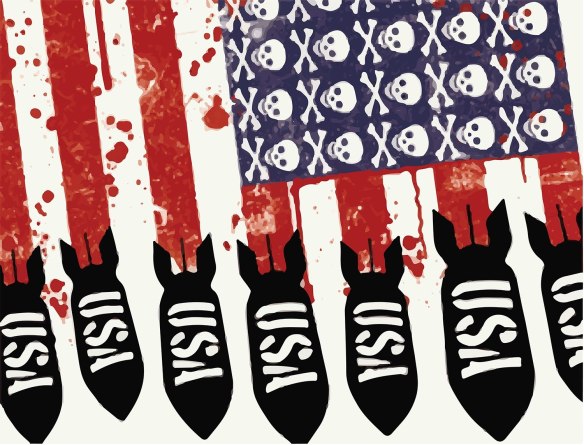
State of Failure

By James Howard Kunstler

Source: Kunstler.com

BEIRUT, Lebanon — Days after President Trump said he wanted to pull the United States out of Syria, Syrian forces hit a suburb of Damascus with bombs that rescue workers said unleashed toxic gas.

Fool me once, shame on you; fool me twice, shame on me, the old saying goes. So, tread carefully through the minefields of propaganda laid for the credulous in such low organs as The New York Times. There are excellent reasons to suppose that the American Deep State wishes strenuously to keep meddling all around the Middle East. The record so far shows that the blunt instruments of US strategic policy produce a consistent result: failed states.

Syria was well on its way to that sorry condition — prompted by an inflow of Jihadi maniacs fleeing our previous nation un-building experiment in Iraq — when the Russians stepped in with an arrantly contrary idea: to support the Syrian government. Of course, the Russians had ulterior motives: a naval base on the Mediterranean, expanded influence in the region, and a Gazprom concession to develop and manage large natural gas fields near the Syrian city of Homs, for export to Europe. The latter would have competed with America’s client state, Qatar, a leading gas exporter to Europe.

But the US objected to supporting the government of Bashar al-Assad, as it had previously with Saddam Hussein and Muammar Gaddafi, as well as Russia’s presence there in the first place. So, the US cultivated anti-government forces in the Syrian civil war, a hodgepodge of Islamic psychopaths variously known as ISIS (Islamic State of Iraq and the Levant), Daesh, al-Qaeda, al-Nusra, Ansar al-Din, Jaysh al-Sunna, Nour al-Din al-Zenki, and what-have-you.

As it happened, US policy in Syria after 2013 became an exercise in waffling. It was clear that our support for the forces of Jihad against Assad was turning major Syrian cities into rubble-fields, with masses of civilians caught in the middle and ground up like so much dog food. President Barack Obama famously drew a line-in-the-sand on the use of chemical weapons. It was well-known that the Syrian army had stockpiles of chemical poisons. But the US also knew that our Jihadi consorts had plenty of their own. Incidents of chemical atrocities were carried out by… somebody… it was never altogether clear or proven… and Mr. Obama’s line-in-the-sand disappeared under dust-storms of equivocation.

Finally, a joint mission of the United Nations Human Rights Commission (UNHRC) and the Organization for the Prohibition of Chemical Weapons (OPCW) was called in to supervise the destruction of the Syrian government’s chemical weapons, and certified it as accomplished in late 2014. Yet, poison gas incidents continued — most notoriously in 2017 when President Donald Trump responded to one with a sortie of cruise missiles against a vacant Syrian government airfield. And now another incident in the Damascus suburb of Douma has provoked Mr. Trump to tweetstormed threats of retaliatory violence, just days after he proposed a swift withdrawal from that vexing corner of the world.

Surely by now the American public has developed some immunity to claims of nefarious doings in foreign lands (“weapons of mass destruction,” and all). The operative sentence in that New York Times report is “…Syrian forces hit a suburb of Damascus with bombs that rescue workers said unleashed toxic gas.” Yeah, well, how clear is it that the toxic gas was contained in the bombs, or rather that the bombs dropped by the Syrian military blew up a chemical weapon depot controlled by anti-government Jihadis? Does that hodgepodge of maniacs show any respect for the UN, or the Geneva Convention, or any other agency of international law? As in many previous such incidents, we don’t know who was responsible — though there is plenty of reason to believe that parties within the US establishment are against Mr. Trump’s idea of getting the hell out of that place, and might cook up a convenient reason to prevent it.

Lastly, how is it in Bashar al-Assad’s interests to provoke a fresh international uproar against him and his regime? I’d say it is not the least in his interest, since he is on the verge of putting an end to the awful conflict. He may not be a model of rectitude by Western standards, but he’s not a mental defective. And he has very able Russian support advising him in what has been so far a long and difficult effort to prevent his state from failing — or being failed for him.

Mass Deception and the Prelude to World War

By Colin Todhunter

Source: Defend Democracy Press

In Libya, NATO bombed a path to Tripoli to help its proxy forces on the ground oust Gaddafi. Tens of thousands lost their lives and that country’s social fabric and infrastructure now lies in ruins. Gaddafi was murdered and his plans to assert African independence and undermine Western (not least French) hegemony on that continent have been rendered obsolete.

In Syria, the US, Turkey, France, Britain, Saudi Arabia and Qatar have been helping to arm militants. The Daily Telegraph’s March 2013 article “US and Europe in ‘major airlift of arms to Syrian rebels through Zagreb’” reported that 3,000 tons of weapons dating back to the former Yugoslavia had been sent in 75 planeloads from Zagreb airport to the rebels. The New York Times March 2013 article “Arms Airlift to Syria Rebels Expands, With CIA Aid” stated that Arab governments and Turkey had sharply increased their military aid to Syria’s opposition fighters. This aid included more than 160 military cargo flights.

Sold under the notion of a spontaneous democratic uprising against a tyrannical political leader, Syria is little more than an illegal war for capital, empire and energy. The West and its allies have been instrumental in organising the war as elaborated by Tim Anderson in his book ‘The Dirty War on Syria’.

Over the last 15 years or so, politicians and the media have been manipulating popular sentiment to get an increasingly war-fatigued Western public to support ongoing wars under the notion of protecting civilians or a bogus ‘war on terror’. They spin a yarn about securing women’s rights or a war on terror in Afghanistan, removing despots from power in Iraq, Libya or Syria or protecting human life, while then going on to attack or help destabilise countries, resulting in the loss of hundreds of thousands of civilian lives.

Emotive language designed to instill fear about potential terror attacks in Europe or myths about humanitarianism intervention are used as a pretext to wage imperialist wars in mineral-rich countries and geostrategically important regions.

Part of the battle for the public’s hearts and minds is to keep people confused. They must be convinced to regard these wars and conflicts as a disconnected array of events and not as the planned machinations of empire. The ongoing disinformation narrative about Russian aggression is part of the strategy. Ultimately, Russia (and China) is the real and increasingly imminent target: Moscow has stood in the way of the West’s plans in Syria and both Russia and China are undermining the role of the dollar in international trade, a lynchpin of US power.

The countries of the West are effectively heading for war with Russia but relatively few among the public seem to know or even care. Many are oblivious to the slaughter that has already been inflicted on populations with the help of their taxes and governments in far-away lands. With the reckless neoconservative warmonger John Bolton now part of the Trump administration, it seems we could be hurtling towards major war much faster than previously thought.

Most of the public remains blissfully ignorant of the psy-ops being directed at them through the corporate media. Given recent events in the UK and the ramping up of anti-Russia rhetoric, if ordinary members of the public think that Theresa May or Boris Johnson ultimately have their best interests at heart, they should think again. The major transnational corporations based on Wall Street and in the City of London are the ones setting Anglo-US policy agendas often via the Brookings Institute, Council on Foreign Relations, International Crisis Group, Chatham House, etc.

The owners of these companies, the capitalist class, have off-shored millions of jobs as well as their personal and company tax liabilities to boost their profits and have bankrupted economies. We see the results in terms of austerity, unemployment, powerlessness, privatization, deregulation, banker control of economies, corporate control of food and seeds, the stripping away of civil liberties, increased mass surveillance and wars to grab mineral resources and ensure US dollar hegemony. These are the interests the politicians serve.

It’s the ability to maximise profit by shifting capital around the world that matters to this class, whether on the back of distorted free trade agreements, which open the gates for plunder, or through coercion and militarism, which merely tear them down.

Whether it is the structural violence of neoliberal economic policies or actual military violence, the welfare of ordinary folk around the world does not enter the equation. In an imposed oil-thirsty, war-driven system of globalised capitalism and over-consumption that is wholly unnecessary and is stripping the planet bare, the bottom line is that ordinary folk – whether workers in the West, farmers in India or civilians displaced en masse in war zones like Syria – must be bent according to the will of Western capital.

We should not be fooled by made-for-media outpourings of morality about good and evil that are designed to create fear, outrage and support for more militarism and resource-grab wars. The shaping of public opinion is a multi-million-dollar industry.

Take for instance the mass harvesting of Facebook data by Cambridge Analytica to shape the outcomes of the US election and the Brexit campaign. According to journalist Liam O’Hare, its parent company Strategic Communications Laboratories (SCL) has conducted ‘behavioural change’ programmes in over 60 countries and its clients have included the British Military of Defence, the US State Department and NATO. According to O’Hare, the use of the media to fool the public is one of SCL’s key selling points.

Among its activities in Europe have been campaigns targeting Russia. The company has “sweeping links” with Anglo-American political and military interests. In the UK, the interests of the governing Conservative Party and military-intelligence players are brought together via SCL: board members include “an array of Lords, Tory donors, ex-British army officers and defense contractors.”

O’Hare says it is clear is that all SCL’s activities have been inextricably linked to its Cambridge Analytica arm. He states:

“International deception and meddling is the name of the game for SCL. We finally have the most concrete evidence yet of shadowy actors using dirty tricks in order to rig elections. But these operators aren’t operating from Moscow… they are British, Eton educated, headquartered in the City of London and have close ties to Her Majesty’s government”

So, what are we to make of the current anti-Russia propaganda we witness regarding the nerve agent incident in Salisbury and the failure of the British government to provide evidence to demonstrate Russian culpability? The relentless accusations by Theresa May and Boris Johnson that have been parroted across the corporate media in the West indicate that the manipulation of public perception is everything and facts count for little. It is alarming given what is at stake – the escalation of conflict between the West and a major nuclear power.

Welcome to the world of mass deception à la Edward Bernays and Josef Goebbels.

US social commentator Walter Lippmann once said that ‘responsible men’ make decisions and have to be protected from the ‘bewildered herd’ – the public. He added that the public should be subdued, obedient and distracted from what is really happening. Screaming patriotic slogans and fearing for their lives, they should be admiring with awe leaders who save them from destruction.

Although the West’s political leaders are manipulating, subduing and distracting the public in true Lippmannesque style, they aren’t ‘saving’ anyone from anything: their reckless actions towards Russia could lead towards a war that could wipe out all life on the planet.


* Colin Todhunter is a frequent contributor to Global Research and Asia-Pacific Research.

Coincidence? Every Time the US Threatens to Pull Out of Syria, Assad Uses Chemical Weapons

For the second time in a year, immediately after the US says they are going to pull out of Syria, Assad conveniently gasses his own people to make sure that won’t happen.

By Matt Agorist

Source: Free Thought Project

Late Saturday night, the mainstream media began spreading the news of an alleged chemical weapons attack in Douma, Syria. It was reported that the tragic attack has claimed the lives of some 70 innocent civilians. Immediately after the unconfirmed reports, President Donald Trump began threatening Russia, Iran and “Animal Assad,” and blamed them for the attack.

The report of the alleged attack is unconfirmed and reported only by the known ISIS sympathizers, the White Helmets.

There has been no independent verification of the chemical attack and it is only being reported by a group who was caught multiple times staging fake attacks.

“Seventy people suffocated to death and hundreds are still suffocating,” said Raed al-Saleh, head of the White Helmets. This was their second tweet as the first one—now deleted—which claimed 150 people were killed, was apparently too big of an exaggeration to be believable.

Indeed, less than a month ago, the Russian military predicted this exact scenario. As CNBC reported last month, the threat, by Chief of Russia’s General Staff Valery Gerasimov, was widely reported by Russia media sites such as state news agency RIA and Tass. It said Gerasimov said Russia had “reliable information” about militants preparing to falsify a government chemical attack against civilians.

In spite of the fact that Syria and Russia are decrying the allegations as false, referring to them as a “fabrication,” the US has begun the pretext to provoking more war in Syria and potentially Russia and Iran.

The US state department said Russia – with its “unwavering support” for Syria’s government – “ultimately bears responsibility” for the alleged attacks.

There has been zero investigation, and the US government is already pointing fingers and implicating a world power in a massive war crime. Irresponsible indeed.

However, it was entirely predictable as these alleged gas attacks all follow a similar scheme.

For those who don’t remember, below is a timeline showing how conveniently timed this gas attacks are for the military-industrial complex.

On March 30, 2017, Reuters reported that Syria was no longer a US priority and that the government is no longer focused on “getting Assad out.” Conveniently, only 5 days after trying to de-escalate the situation, an alleged gas attack takes place to which Trump responds with 59 Tomahawk missiles.

Three days after the missile attack, the US ambassador to the United Nations, Nikki Haley, issued a statement that regime change in Syria is inevitable.

As TFTP reported at the time, a leading weapons academic, and one of the foremost experts in the field, came forward in a series of reports noting his opposition to the official story in regards to the Khan Sheikhoun nerve agent attack in Syria. According to the expert, that Syrian gas attack was staged.

Fast forward to March 29, 2018 and Trump put many people to ease when he said that the US would “be coming out of Syria like very soon,” just hours after the Pentagon highlighted the need for US troops to remain in the country for the immediate future. “We’re knocking the hell out of ISIS. We’ll be coming out of Syria like very soon. Let the other people take care of it now,” Trump told supporters at an Ohio event on infrastructure, as CNN reported.

Days later, on April 7, 2018, the White Helmets report that Assad gassed his own people — again — and no one, other than the people known for staging videos, is the source.

On April 8, 2018, Trump then blames Russia, Iran, and Syria and issues “Big price to pay” threats to all of them.

“Many dead, including women and children, in mindless CHEMICAL attack in Syria. Area of atrocity is in lockdown and encircled by Syrian Army, making it completely inaccessible to outside world. President Putin, Russia and Iran are responsible for backing Animal Assad. Big price……to pay. Open area immediately for medical help and verification. Another humanitarian disaster for no reason whatsoever. SICK!” wrote Trump.

No one here is claiming that Assad is some hero, but for him to make this move—knowing the end result—is entirely preposterous and would not happen.

This alleged chemical attack is in spite of the Syrian regime successfully defeating ISIS in over 90 percent of the county. Just as Assad hears that Trump is considering pulling out of the country—which would have been a massive win for the Syrian regime—he gases his own people ensuring the exact opposite of this would happen. Sure thing.

But, we are supposed to believe this. According to the official narrative, every time Syria is on the verge of a military victory in their own country, Assad then randomly gases his own people to thwart this victory and gives the US a reason to invade and turn what’s left of Syrian infrastructure into rubble.

And, the American mainstream is eating it up and ramming it down the throats of US citizens who couldn’t point to Syria on a map, yet demand we spend billions bombing brown people in a country that has never done a single thing to them.

As Finian Cunningham notes, “this weekend’s alleged chemical-weapon attack on civilians in Syria has all the hallmarks of a false-flag propaganda stunt. Only people who have had their critical senses numbed by saturated Western media distortion could possibly believe otherwise.”

Indeed, if you are one of these people who believes this most preposterous story, please consider turning off your television and opening a book instead. Being uninformed is far better than being misinformed.


Related Video:

The Skripal Poisonings and the Ongoing Vilification of Putin

By Gary Leupp

Source: CounterPunch

Sergei Skripal and his daughter were poisoned by a nerve agent on March 4 on a park bench in Salisbury, England.

Skripal had been a Russian double agent, a spy who turned over 300 names of Russian spies to British intelligence from 1995 to 2004. He was (not so surprisingly) arrested in Russia in 2004 and sentenced to thirteen years in prison. He was released in a spy-swap in 2010, settled in the UK and became a British citizen.

I see no reason to judge his moral character, although some might reflect that in Kantian general terms what he did was rather bad. (In precisely the same sense that it would be bad for a British citizen to become a double agent for Russia.) Double agents are often punished harshly; this is the way of the world.

Skripal posed no further threat to the Russian state. There is at least one report that he sought to return to Russia recently. It’s hard to comprehend why at this time Moscow would poison him and his young daughter visiting from Russia with a nerve agent (Novichok) created in the USSR from the 1970s but subsequently banned and destroyed under international supervision. Cui bono? Who profits from these poisonings?

In all the outrage, expressed in Britain and elsewhere, about this attack, there is precious little analysis. The Russian foreign minister Sergey Lavrov has said, “This is nonsense. This has nothing to do with us.” The group of military-grade nerve agents called Novichok have been described in academic literature such that many different actors could produce Novichok. The Russians say they have long since destroyed their stocks and suggest the Czech Republic could be the source of the substance used.

But this attack on Skripal and his 33-year-old daughter (by somebody) is highly useful to those who want to vilify Vladimir Putin, just as the use of chemical weapons in Syria last April (by somebody) was useful for those wanting to further vilify Bashar Assad and justify a U.S. missile strike. Have you noticed that we live in an age of constant disinformation, misinformation and “fake news”?

The most annoying thing is, once these unproven causal relations are posited, embraced by cable news directors, such that they become Truth, discussion centers solely on how the U.S. and allies should respond. Why, pundits ask, didn’t Trump raise the issue in his last chat with Putin? Why is Britain’s Labour Party leader Jeremy Corbyn skeptical about the Russia link, suggesting the Novichok could have been possessed by East European mafia? Why isn’t everyone on board the obvious conclusion that Russia did it?

Which would mean: Putin—facing no threat from this traded ex-spy or his innocent daughter—ordered their killing, not because they threatened him, but rather to manifest his deep cruelty and evil to the world and his willingness to invite more and more sanctions against Russia. It doesn’t make much sense.

Putin is ex-KGB. Very rational and calm. He knows all about agents and double agents. I doubt that he is morally judgmental; he understands why people do what Skripal did. He made a deal for the man’s release eight years ago. His only motive to kill him at this point would be to punish Skripal for past sins and warn others not to ever sell secrets. But why would such a rational person incur global outrage by using a banned agent to attempt to murder a British citizen and his Russian daughter, for no compelling reason?

There are international legal processes for investigating charges of use of chemical weapons. Russia has asked Britain to observe them, providing evidence, samples, details. It urges adherence to rules established by the Organization for the Prohibition of Chemical Weapons (OPCW) to establish the facts. But London has merely announced it knows Putin was responsible for the state of these two on that park bench.

So the grand narrative now includes: Russian invasions of Georgia in 2008 and Ukraine in 2014 (somehow becoming in the process “adversaries” of the U.S.); alleged “threats” against the Baltic states; multiple political assassinations; dictatorial control of the Russian polity, economy and media; the accumulation of billions in illicit wealth. To say nothing of his brash exposure of his naked chest to his fandom, his judo, his hunting, his annoyingly high approval ratings.

I don’t know who attacked these two who now struggle for their lives in hospital. But I know that the response means nothing good for Russia, or the world. It is just another short chapter in the new Cold War, and like the old war, basically irrational. What is Putin’s motive? Fareed Zakaria says he’s trying to “undermine democracies” although why anyone would want to do that in principle puzzles me. Putin is not the Heath Ledger’s Joker in the Dark Knight Batman film, just spreading chaos for its own sake.

Putin is not interested in heading a European movement towards isolationist nationalisms but rather in thwarting NATO expansion plans, which any rational Russian leader would want to do. To use the strange Skripal incident as a rationale for further Cold War-type confrontation is more than sad.  Yet in a supposed display of solidarity with Britain, which has kicked out Russian diplomats in response, the U.S. has suddenly expelled 60 Russian diplomats and closed down the Russian consulate in Seattle. Trump, under constant criticism for not criticizing Putin, and not bringing up election meddling or the Skripal affair in his recent phone call, has approved the move without commenting on it.

If Trump planned for better relations with Russia to be a hallmark of his presidency, he has been stymied by his foes’ insistence that he express the traditional knee-jerk hostility. Why, they keep asking, when he criticizes his own cabinet members, does he never say anything bad about Putin? And from there, they proceed to the conclusion that the Russians have stuff on Trump and are blackmailing him…into not being default-mode hostile.

Trump is an ignorant man, uninterested in the world intellectually, unable to invest time in reading, clueless about the historical context of current crises. Part of his candidate persona was opposition to recent U.S. wars (not so much because they’ve killed hundreds of thousands of people, but because they have been expensive and not resulted in the U.S. taking the oil). But he loves men in uniform, surrounds himself with them, relies on them. These are men who grew up during the Cold War and can’t kick it from their minds. Baby-sitting what they surely see (with McMaster) as a “moron,” “idiot,” “dope,” “kindergartner” they see their minimal task the responsibility to remind him that Russia is an adversary.

And so without even ascertaining the facts of the Skripal incident, Washington expels all these diplomats. TV pundits applaud: “absolutely the right thing to do, to defend western values” etc. , the system succeeds in maintaining, even strengthening, Cold War Russophobic mentality. The Skripal incident was a blessing to Trump’s critics, who want him with his child-mind to embrace this mentality. We have to support Theresa May in Britain, they told him. This was the first offensive use of  a nerve agent in Europe since World War II, they told him; very, very serious. A Russian attack on the UK.

Whoever administered that agent triggered a wave of sanctions on Russia, adding to those earlier imposed after the 2014 coup in Ukraine and the Russian response. Russia will respond proportionately. Whoever did this forces Trump to harden a political line against Russia. As his presidency teeters in the winds of scandal, he is prone to more crazy moves like the appointment of John Bolton. Trump’s sole saving grace in his campaign was his advocacy of better ties with Russia. This immediately upon his election became his chief fault. Pundits  demand that he  abandon any hope for cordial relations with Putin’s Russia and properly denounce him for multiple crimes.

Maybe that’s what’s in store. Trump’s unpredictable. He agrees to meet Kim Jong Un then appoints Bolton (advocate of war with North Korea, removed from negotiations with the DPRK  after Pyongyang called him “human scum”) as national security advisor. And why follow up that cordial call to Putin with the expulsion of so many diplomats? What the hell. Doesn’t make sense.

Had Hillary won, I would probably have found some logic and predictability in her evil. With Trump the evil unfolds erratically. He drops a MOAB on Afghanistan (or his generals do, without necessarily consulting). He attacks a Syrian army base in response to an unproven sarin attack. His cabinet members contradict him, espousing the gospel truth that Russia and its allies such as Syria are threats to U.S. national security, whatever that is. One feels that as his personal situation deteriorates, the president will be more prone to lean on his generals, and listen to their advice while also heeding the horrific Bolton. This is a very bad situation.

4/05 Update:
Double miracle as BOTH Skripals are now said to be recovering from deadly nerve agent attack. How?

Nonviolence or Nonexistence? The Legacy of Martin Luther King Jr.

By Robert J. Burrowes

Fifty years ago, on 4 April 1968, the Reverend Martin Luther King Jr. was assassinated.

The night before he died, King gave another of his many evocative speeches; this one at the packed Mason Temple in Memphis. The speech included these words:

‘Men for years now have been talking about war and peace. Now no longer can they just talk about it. It is no longer a choice between violence and non-violence in this world, it is non-violence or non-existence. That is where we are today.’

In clearly identifying this stark choice and having been inspired by Mohandas K. Gandhi’s wideranging social concerns, King’s concerns were also broad:

‘The Triple Evils of poverty, racism and militarism are forms of violence that exist in a vicious cycle. They are interrelated, all-inclusive, and stand as barriers to our living in the Beloved Community. When we work to remedy one evil, we affect all evils.’ See ‘The King Philosophy’.

So what has changed in the past 50 years? The world has traveled a great deal further down the path of violence. So far, in fact, that nonexistence is now the most likely outcome for humanity. See ‘On Track for Extinction: Can Humanity Survive?’

Despite the vastly more perilous state of our planet, many people and organizations around the world are following in the footsteps of Gandhi, King and other nonviolent luminaries like Silo, and are engaged in what is effectively a last ditch stand to end the violence and put humanity on a path to peace, justice and sustainability.

Let me tell you about some of these people and organizations and invite you to join them.

In Bolivia, Nora Cabero works with the Movimient Humanista. The Movement has many programs including the Convergence of Cultures which aims to facilitate and stimulate true dialogue – oriented towards the search for common points present in the hearts of different peoples and individuals – to promote the relationship between different cultures and to resist discrimination and violence. Another program, World Without Wars and Violence emerged in 1994 and was presented for the first time internationally in 1995 at the Open Meeting of Humanism held in Chile at the University of Santiago. It is active in about 40 countries. It carries out activities in the social base and also promotes international campaigns such as Education for Nonviolence and the World March for Peace and Nonviolence.

Eddy Kalisa Nyarwaya Jr. is Executive Secretary of the Rwanda Institute for Conflict Transformation and Peace Building and also President of the Alternatives to Violence Program. For the past 18 years, he has been active in the fields of ‘peace, reconciliation, nonviolence, healing of societies, building harmonious communities’ in many countries including Burundi, Chad, eastern Congo, Darfur (western Sudan), Kenya, Rwanda, Somalia, South Sudan and northern Uganda. Late last year he was in New Zealand to deliver a paper on the Great Lakes conflict. In Rwanda, the Institute for Conflict Transformation particularly works on nonviolence education in schools, universities and refugee camps. Another initiative is the conduct of workshops on nonviolence and peace through sports for head teachers in the country but it also has programs to fight early marriages and pregnancies, as well as offering trauma counseling to refugees.

In Russia, Ella Polyakova is a key figure at the Soldiers’ Mothers of Saint-Petersburg. Ella and her colleagues work to defend the rights of servicemen and conscripts in the Russian military. Ella explains why:

‘When we were creating our organization, we understood that people knew little about their rights, enshrined in Russia’s Constitution, that the concept of “human dignity” had almost disappeared, that no one had been working with the problems of common people, let alone those of conscripts. We clearly understood what a soldier in the Russian army was a mere cog in the state machine, yet with an assault rifle. We felt how important hope, self-confidence and trust were for every person. At the beginning of our journey, we saw that people around us, as a rule, did not even know what it meant to feel free. It was obvious for us that the path towards freedom and the attainment of dignity was going through enlightenment. Therefore, our organization’s mission is to enlighten people around us. Social work is all about showing, explaining, proving things to people, it is about convincing them. Having equipped ourselves with the Universal Declaration of Human Rights and Russia’s Constitution, we started to demolish this dispossession belt between citizens and their rights. It was necessary to make sure that people clearly understood that, having a good knowledge of rights, laws, and situations at hand, they would be able to take responsibility and protect themselves from abuse.’

Bruce Gagnon, coordinator of the Global Network Against Weapons & Nuclear Power in Space, was recently part of a committed effort to convince the Maine state legislature not to give warship-builder General Dynamics, which has already received more than $200 million in state and local tax breaks for the Bath Iron Works (BIW), any more ‘corporate welfare’. Bruce recently completed a fast, which lasted for more than a month, as one of the actions that Maine peace activists took to try to prevent this welfare payment to a company that has spent $14.4 billion buying back its own stocks between 2013-2017 and whose CEO was paid $21 million in 2016.

Despite their efforts, the Maine House of Representatives voted 117-31 in favor of the $45million General Dynamics corporate welfare bill and the Senate supported it 25-9. The decision was announced on the same day that General Dynamics sacked 31 workers from the BIW. As Bruce noted: ‘It was an honor to work alongside [those] who stood up for the 43,000 children living in poverty across Maine, for the tens of thousands without health care, for our starving public education system, and for the crumbling physical infrastructure as Maine joins Mississippi in the “race to the bottom”’. You can read more about this ongoing campaign to convert the Bath Iron Works into a location for the production of socially useful and ecologically sustainable non-killing technologies on the website above. There are some great photos too.

Gaëlle Smedts and her partner Luz are the key figures at Poetry Against Arms based in Germany. ‘The inspiration for this campaign is the life, work and legacy of the Latin American poet, philosopher and mystic: Mario Rodriguez Cobos, also known as Silo. His total commitment to active nonviolence, his denunciation of all forms of violence, his doctrine for overcoming pain and suffering and his magnificent poetry are a great affirmation of the meaning of life and transcendence.’ Poetry Against Arms publishes poetry/songs of people around the world who take action to resist militarism.

Since the 1970s, the world’s leading rainforest activist, John Seed, has devoted his life to saving the world’s rainforests. Founder and Director of the Rainforest Information Centre in Australia, one of his latest projects is to save the tropical Andes of Ecuador, which is ‘at the top of the world list of biodiversity hotspots in terms of vertebrate species, endemic vertebrates, and endemic plants’. From the cloud forests in the Andes to the indigenous territories in the headwaters of the Amazon, the Ecuadorean government has covertly granted mining concessions to over 1.7 million hectares (4.25 million acres) of forest reserves and indigenous territories to multinational mining companies in closed-door deals without public knowledge or consent. These concessions will decimate headwater ecosystems and biodiversity hotspots of global significance. If you would like to read more about this campaign and what you can do to help, you can do so in John’s article ‘Ecuador Endangered’.

Apart from the individuals mentioned above, signatories and endorsing organizations are engaged in an incredibly diverse range of activities to end violence in one context or another. These include individuals and organizations working in many countries to end violence against women (including discriminatory practices against widows), to rehabilitate child soldiers and end sexual violence in the Congo, activists engaged in nonviolent defense or liberation struggles – see Nonviolent Defense/Liberation Strategy – in several countries and occupied territories, as well as campaigns on a vast range of environmental, climate and indigenous rights issues, campaigns to promote religious and racial harmony as well as campaigns for nuclear disarmament and to end war. See Nonviolent Campaign Strategy.

But it also includes many individuals tackling violence at its source – see Why Violence?’ and Fearless Psychology and Fearful Psychology: Principles and Practice – by focusing on their own healing – see ‘Putting Feelings First’ – and/or working on how they parent their children for a nonviolent world. See ‘My Promise to Children’.

Given the perilous state of the global environment and climate, still others are focusing their efforts on reducing their consumption and increasing their self-reliance in accordance with the fifteen-year strategy outlined in The Flame Tree Project to Save Life on Earth.

If you would like to be part of the worldwide movement to end violence that has drawn the six people and several organizations mentioned above together, along with many others in 103 countries around the world, you are welcome to sign the online pledge of The Peoples Charter to Create a Nonviolent World.

Reverend King posed the fundamental choice of our time: nonviolence or nonexistence. What is your choice?


Biodata: Robert J. Burrowes has a lifetime commitment to understanding and ending human violence. He has done extensive research since 1966 in an effort to understand why human beings are violent and has been a nonviolent activist since 1981. He is the author of Why Violence? His email address is flametree@riseup.net and his website is here.


Robert J. Burrowes
P.O. Box 68
Daylesford, Victoria 3460
Australia

Email: flametree@riseup.net

Websites:
Nonviolence Charter
Flame Tree Project to Save Life on Earth
‘Why Violence?’
Feelings First
Nonviolent Campaign Strategy
Nonviolent Defense/Liberation Strategy
Anita: Songs of Nonviolence
Robert Burrowes
Global Nonviolence Network

 

Thinking Beyond Exceptionalism

By David Swanson

Source: Let’s Try Democracy

Excepted from Curing Exceptionalism: What’s wrong with how we think about the United States? What can we do about it? (April, 2018).

Try this experiment: Imagine that space aliens really come to earth and really have, as I think is very unlikely, developed the ability to travel to earth while simultaneously remaining so primitive as to violently attack the places they visit. In contrast to the space aliens, could you identify as an earthling to such an extent as to diminish your other senses of identity? “Earthlings — F— Yeah!” “We’re Number 1!” “Greatest Earthlings on Earth!” And can you hold that thought, in the absence of the space aliens, and rid yourself of any notion of opposing any other or foreign group, while still holding that earthling thought? Alternatively, can you cast climate change and environmental collapse in the role of the evil alien Hollywood monster against whom humanity must unite?

Or try this one: Imagine that various species of humans survived to the current day, so that we Sapiens share the earth with the Neanderthals, the Erectus, the tiny little Floresiensis, etc.[i] Could you form your identity in your mind as a Sapiens? And then, can you hold that thought while either imagining the other species back out of existence or imagining learning to be as respectful and kind to the other species of humans as we should perhaps actually be attempting to be to other types of living human and non-human earthlings right now?

Perhaps the most powerful tool for altering habits of thought about groups of people is role reversal. Let’s imagine that for whatever reasons, beginning some seventy years ago North Korea drew a line through the United States, from sea to shining sea, and divided it, and educated and trained and armed a brutal dictator in the South United States, and destroyed 80 percent of the cities in the North United States, and killed millions of North USians. Then North Korea refused to allow any U.S. reunification or official end to the war, maintained wartime control of the South United States military, built major North Korean military bases in the South United States, placed missiles just south of the U.S. demilitarized zone that ran through the middle of the country, and imposed brutal economic sanctions on the North United States for decades. As a resident of the North United States, what might you think when the president of North Korea threatened your country with “fire and fury”?[ii] Your own government might have gazillions of current and historical crimes and shortcomings to its credit, but what would you think of threats coming from the country that killed your grandparents and walled you off from your cousins? Or would you be too scared to think rationally?

This experiment is possible in hundreds of variations, and I recommend trying it repeatedly in your own mind and in groups, so that people’s creativity can feed into the imagination of others. Imagine that you’re from the Marshall Islands seeking restitution for nuclear testing and/or the rising seas.[iii] Imagine you’re from Niger and less than amused that Americans first hear about your country when their government pretends that Iraq purchased uranium in your country, and that Americans only learn about their own military’s actions in your country when the U.S. president is rude to the mother of a deceased U.S. soldier.[iv] Imagine you’re my friends from Vicenza, Italy, who found local and national majority support for blocking the proposed construction of a U.S. Army base but couldn’t stop it — or similar people in Okinawa or Jeju Island or elsewhere around the globe.

And don’t just imagine you’re the other people. Learn and then re-tell the stories with all the details inverted. It’s not Okinawa. It’s Alabama. Japan is filling Alabama with Japanese military bases. The towns and state are opposed, but craven politicians in Washington, D.C., are going along. The military airplane crashes happen in Alabama. The spread of prostitution and drugs happens in Alabama. The local girls raped and murdered are Alabaman. The Japanese troops say it’s for your own good whether you think so or not, and they don’t really care what you think. You get the idea. This can be done with wealth distribution, with environmental impact, with militarism, with any issue under the sun. The danger of over-simplification should be resisted. The idea is not to stupidly convince yourself that all Americans are 100% evil while all Japanese are some sort of angels. The idea is to reverse some key facts and see whether anything happens to your attitudes. If not, then perhaps your attitudes were fair and respectful to begin with.

Another nominee for most powerful tool for altering habits of thought about groups of people is what goes by the very odd name “humanization.” This is the process wherein you supposedly take a human being or group of human beings, and by learning their names and facial expressions and little idiosyncrasies, you “humanize” them, and you come to the conclusion that these humans are . . . wait for it . . . wait for it . . . humans. Now, I’m 100 percent in favor of this to whatever extent it is needed and works. I think Americans (and probably most people) should read more foreign books, learn more foreign languages, watch more foreign films, and travel more in ways that truly involve them in foreign cultures. I think students should be required to spend a year as exchange students in foreign families and schools. I think a key test of childhood education in the United States should be: What have these children learned about all of humanity, including the 96% outside the United States?

I am hopeful that at some point we can jump the humanization and arrive squarely on the understanding that, in fact, humans are all humans, whether we know anything about them or not! It might help to pretend that all Hollywood movies have been made about and starring Syrians (or any other nationality). If that were so, if every favorite character from every film and TV show were Syrian, would anyone in the world have any doubt that Syrians were human beings? And what effect would that have on our perception of the reported Israeli government position, seemingly abetted by U.S. government policy, that the best outcome in Syria is for nobody to win but the war to continue forever?[v]

David Swanson’s forthcoming book from which this is excerpted is called Curing Exceptionalism: What’s wrong with how we think about the United States? What can we do about it? (April, 2018).


[i] This scenarios was suggested to me by this book: Yuval Noah Harari, Sapiens: A Brief History of Humankind Paperback (Harper Perennial, 2018).

[ii] https://www.nytimes.com/2017/08/08/world/asia/north-korea-un-sanctions-nuclear-missile-united-nations.html (January 16, 2018).

[iii] Marlise Simons, “Marshall Islands Can’t Sue the World’s Nuclear Powers, U.N. Court Rules,” New York Times, https://www.nytimes.com/2016/10/06/world/asia/marshall-islands-un-court-nuclear-disarmament.html (October 5, 2016).

[iv] David Caplan, Katherine Faulders, “Trump denies telling widow of fallen soldier, ‘He knew what he signed up for’,” ABC News, http://abcnews.go.com/Politics/trump-denies-telling-widow-fallen-soldier-knew-signed/story?id=50549664 (October 18, 2017).

[v] Jodi Rudoren, “Israel Backs Limited Strike Against Syria,” New York Times, http://www.nytimes.com/2013/09/06/world/middleeast/israel-backs-limited-strike-against-syria.html?pagewanted=all (September 5, 2013).

America: The Country That Never Was!

By thnkfryrslf

Source: Axis of Logic

The ideal country. Democratic and Free. The greatest country in the world, because they’re exceptional.

Saves citizens of other countries from tyrannical governments by slaying the tyrants and bringing democracy and staying to make sure that democracy is implemented, no matter how long it takes. Always doing right by those citizens in need.

A beacon of liberty to the rest of the world. Saved the world by winning the 2nd world war. Its citizens always patriotically supporting the troops. The richest country on earth. All citizens are equal under the law. Economically, presents to its citizens every opportunity to succeed. A culture of endless opportunities.

Constantly reforming education for its people. Good God-fearing moral people, supported by a God-fearing, moral government. A benevolent people, whose benevolent government shows benevolence to the rest of the world. Respecting the freedom and sovereignty of all nations.

Generous loans given to poorer countries.

Good supportive and caring neighbour to its northern and southern neighbours.

Always warning its public and the rest of the world who the enemy of their stability and peace is and that this country of exceptional people will always defend them.

Admirer of those self-made creators of wealth. They are the true rugged individuals. Showing in Hollywood movies the heroism of their noble military. Accepting all races of people, it being one of their highest values.

An engaged citizenry always challenging its government to do better. Freedom of speech exercised by all, because they are a government of the people and by the people.

Citizens love of their country runs deep, shown by not having a need to travel much to other lesser countries. The MSM always helping the people to understand politics domestically and globally and how their government is constantly practicing democratic values at home and abroad.

The envy of the world for their wealth and freedom. A country who historically fought a civil war to abolish slavery and succeeded. A country that was essentially built by Europeans. A country whose heroic history is taught as an inspiration.

America, a brutal and savage killer, posing as a liberator and keeper of peace, is the country that does exist.

Saturday Matinee: Testament

Cover Your Eyes: Lynne Littman’s ‘Testament’, 1983

By Richard McKenna

Source: We Are the Mutants

Testament
Directed by Lynne Littman
Paramount Pictures, 1983

1983 was a pretty fertile year for fictional nuclear apocalypses in Western popular culture. 2019: After the Fall of New York, Endgame, Exterminators of the Year 3000, Stryker, and Le Dernier Combat were released in cinemas, while ABC’s The Day After and Britain’s BBC2 adaptation of 1961 dystopian novel The Old Men at the Zoo, updated to feature a nuclear attack on London, appeared on television. Publishers released a slew of books with atomic mushrooms on their covers, including The Aftermath: The Human and Ecological Consequences of Nuclear War (edited by Jeannie Peterson), Luke Rhinehart’s Long Voyage Back, William Prochnau’s Trinity’s Child, and Dean Ing’s Pulling Through, as well as The Web, that year’s installment in Jerry Ahern’s Survivalist series. All of them attempted, seriously or otherwise—and it was generally otherwise—to examine the effects of a seemingly imminent nuclear war. The Doomsday Clock stood at four minutes to midnight (the closest it had been since 1960, though it was about to move even closer) and two events that year—the NATO military exercise Able Archer 83 and a nuclear attack false alarm in the Soviet Union—almost prompted a catastrophic escalation from fiction to reality.

The BBC’s optimism-annihilating Threads was still a year away, but the cultural momentum was building up to a psychological discharge whose blast radius would, for some, obliterate their ability to think about or plan for the future: what was the point, when they would be spending it eking out a life in the radioactive ruins of our civilization (or, if the Italians were right, driving customized cars and dressing like members of Krokus). That momentum surged dramatically with the release of Testament, the high water mark of the class of ’83. British sci-fi and horror magazine Starburst published a short yet positive review of it alongside a single publicity still showing a mother huddled up in bed with her children, fearfully pointing a torch into the darkness—an image that summarized perfectly the fear that it would be in our own homes that we would be killed, if not by the bomb itself then by the stone-age appetites and economics its detonation unleashed.

Despite containing no mushroom clouds, no heroics, no fallout shelters, no special effects, no geiger counters, and no enormous doors slamming in the depths of hellTestament is absolutely devastating: nothing except average people gradually realizing that the rest of their already abbreviated lives is destined to be a grim slog through even more illness, death, and loss than they’ve already experienced.

The film, produced by PBS and directed by National Education Television documentarian Lynne Littman, deals with the effects of a nuclear attack on a family who live in an idyllic small town (so idyllic that a young Kevin Costner and Rebecca De Mornay have settled there) somewhere within driving distance of San Francisco, and the first ten minutes is an artfully contrived little précis of their privileged lives: we see mom Carol (the great Jane Alexander) unenthusiastically acting out the instructions on her workout tape from bed while husband Tom (the also great William Devane) blithely takes their reluctant older son Brad cycling, leaving mom to get teenage daughter Mary (Roxana Zal) and little son Scotty (Lukas Haas) ready for school.

This initial section of the film highlights the reassuring frivolities and ephemera of Western life—toys, games, sports, exercise, E.T. t-shirts, He-Man figures and Sesame Street, and, in a way, Testament plays peculiarly like some kind of anti-E.T., or at least some nightmarish re-edit of its homely, chaotic, childish motifs, the intruder into the suburban calm not a kindly alien botanist but something native and altogether less friendly.

There is almost no buildup to the nuclear attack—no news reports about the mobilization of the armed forces, no preparations for shelter. The only indication that an attack is coming at all is that the nature of the film indicates that it must be, and the lack of narrative preparation makes the viewer’s stomach sink even more violently when the cartoon the family children are watching in their sunny lounge is suddenly replaced by static, which is then replaced by an emergency warning transmission. When the attack itself comes, it’s not even a noise, just a silent flash of blinding light. There are none of the typical signifiers: no models are destroyed, there is no colorized stock footage of shacks being blown away by 1,000 mph winds, no flesh drooping from bones, no radiation sickness makeup—only confusion, then coffins, and then funeral pyres. As the broadcasters who exchange news with the town’s chipper old radio ham start to vanish one by one, awareness grows that this might really be it—there might really be no hope.

The locals pull together and, unable to believe that the wider world won’t rally, seem determined to struggle through, organizing mutual assistance and continuing with their little world of school plays and piano lessons. But it gradually becomes more and more obvious that there is going to be no struggling through this one. Things are not going to return to normal—they are just going to keep getting worse, and there won’t be any school plays when all the children have died and all the adults are busy building bonfires to burn their corpses on.

The delicacy of touch with which the proceedings are handled—director Littman got the rights to the source material, a 1981 short story by Carol Amen, after reading it with her son—means that Testament makes its point all the more forcefully. Yes, very occasionally the tone does get slightly preachy, but considering the point the film wants to make—the stupidity of slowly and agonizingly killing half of the population of the planet—it’s a forgivable blip. In any event, Testament never feels smug or self-righteous: there are a few things that jar, and others that produce the odd smirk (a display of priestly affection very unlike that in Thorn Birds, a TV miniseries that caused a scandal the same year that Testament was released), but, most of the time, the viewer is simply staring at the screen in dread.

With its calm tonal palette and inoffensive James Horner score, suggestive of TV movies about domestic tragedy on the scale of divorce or alcoholism, one can imagine a grandparent of any political persuasion sitting down to watch it. In terms of production values, Testament sits somewhere between that well-made TV movie and a feature film proper, and its artlessness and lack of pretension, make it, if anything, even more upsetting and disorientating when things start to get really awful. Handled with a little less sensitivity and compassion, it could easily have been mawkish; but it isn’t, and Testament refuses to underline any particular aspect of the situation. There is simply the grind of life getting worse and worse until it is intolerably awful and you cannot survive. The economy with which the characters are sketched lends them a blank credibility, and the absence of any of the iconography of nuclear war (not even a single radioactive symbol) only adds to the film’s power.

Throughout the film, motifs of recording and repetition recur: family super-8 movies, nursery rhymes, the exercise cassette that mom is playing at the beginning, the answering machine, the pre-recorded warning message, the journal that Carol starts writing at the beginning of the film, even the roles of priest, mom, and policeman. It is when the graves turn to funeral pyres that the gravity of the situation becomes obvious, and perhaps the point is that the repetition and formalization of daily life is life. Deprived of the batteries and security and hope that allow us make those repetitions, the life we know ends as the recordings wind down. One very touching moment, when mom and son dance together to a (not very good) cover of the Beatles’ “All My Loving” played on a battery powered recorder, underlines perfectly the finite nature of the technologies we use to remember who we are.

The film is dotted with such lovely little scenes, like the one where Brad takes his late dad’s bike from the garage after his own has been stolen, and another when Mary asks Carol what it’s like to make love. Nobody is blamed for the war, and there’s no mention of politics, or enemy countries, or presidents. By definition it is probably a left-wing film (Amen’s original story appeared in feminist magazine Ms.), at least in as much as it aims to affect the opinion of the viewer as regards the effectiveness of a nuclear deterrent, and it is conceivable that to some particularly ideologically-driven idiots at the time it may have looked like liberal hand-wringing.

Testament isn’t perfect, but it is a powerful and economic piece of drama about personal loss and mass death that eschews all spectacle and seems to have no particular axe to grind other than to ask: What is the conceivable purpose of all this misery? It’s a point that bears repeating.

Watch the full film here.