
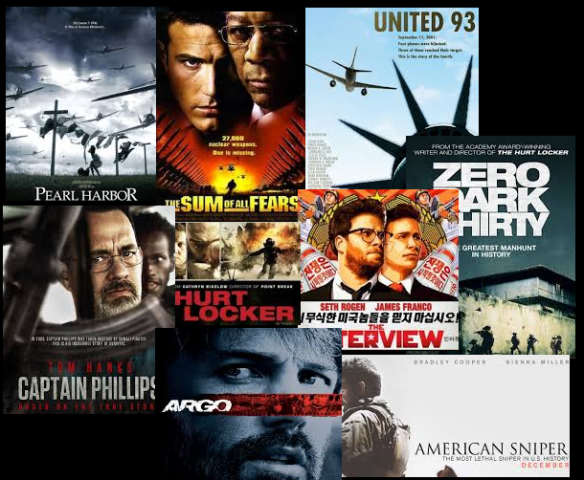
The Simulacra Democracy

By John Steppling

Source: CounterPunch

… a nation in which 87 percent of eighteen- to twenty-four year olds (according to a 2002 National Geographic Society/Roper Poll survey) cannot locate Iran or Iraq on a world map and 11 percent cannot locate the United States (!) is not merely “intellectually sluggish.” It would be more accurate to call it moronic, capable of being fooled into believing anything …”

— Morris Berman

I cannot remember U.S. culture ever being quite so compromised by ruling class control. Hollywood turns out one jingoistic and militaristic and racist film and TV show after another. Corporate news is completely controlled by the same forces that run Hollywood. It is the complete capitulation of the liberal class to the interests of the increasingly fascistic U.S. elite. And this didn’t start with Donald Trump. Certainly in its current incarnation it goes back at least to Bill Clinton, and really it goes back to the end of World War Two. The ideological trajectory was formed under the Dulles brothers and military industrial complex — representing U.S. business interests and exhibiting a demand for global hegemony. But once the Soviet Union collapsed, the project was accelerated and intensified.

Another starting point might well be the 1960 Bay of Pigs fiasco, or the 1961 CIA (and MI6) assassination of Patrice Lumumba. Or Kennedy’s 1962 speech at American University calling for the end of Pax Americana. We know what happened to Kennedy soon after that. Pick any of these incidents. But it was the fall of the U.S.S.R. that signaled to the governing class, the proprietor class, that the last real obstacle to global domination had been removed. In the interim, one finds the Iran/Contra affair, and the invasion of Iraq. The real and the symbolic meaning of the Soviet Union is forgotten today, I think. Its meaning for the developing world, especially.

The next conscious trial balloon was Clinton’s attack on the former Yugoslavia. A test run for expanding NATO. And it worked. The propaganda machine has never been as successful as it was when it demonized the Serbs and Milosevic. Then came 9/11. And the well honed PR machine spewed an endless barrage of hyper-patriotic rhetoric and disinformation. American exceptionalism was given full credibility. And remember Colin Powell and his cartoon visual teaching aids at the UN? Nobody was going to argue. Certainly not the white liberal class. And Hollywood upped its game in churning out military fantasies. And in just churning out fantasies. A genre that lent itself to obvious neo-colonial messages. By 2007, when Barack Obama announces he will run for President, the master narrative for America was firmly entrenched. The biggest hit from Hollywood in this period is Avatar (2009), a neo-colonial fable that fit seamlessly with Obama’s reconquest of Africa.

Dan Glazebrook recently wrote:

The year 2009, two years before Gaddafi’s murder, was a pivotal one for US-African relations. First, because China surpassed the US as the continent’s largest trading partner; and second, because Gaddafi was elected President of the African Union. The significance of both for the decline of US influence on the continent could not be clearer. Whilst Gaddafi was spearheading attempts to unite Africa politically, committing serious amounts of Libyan oil wealth to make this dream a reality, China was quietly smashing the West’s monopoly over export markets and investment finance. Africa no longer had to go cap-in-hand to the IMF for loans, agreeing to whatever self-defeating terms were on offer, but could turn to China – or indeed Libya – for investment. And if the US threatened to cut them off from their markets, China would happily buy up whatever was on offer. Western economic domination of Africa was under threat as never before.

The US response was to increase base building, upgrade AFRICOM, and then murder Gadaffi. Hollywood hits from this period include The Hurt Locker and The Dark Knight. Meanwhile domestically Obama was giving the OK for militarizing of police departments across the country. On another front….Danny Haiphong wrote…

What isn’t discussed often enough is how Obama has worked tirelessly to protect and fulfill the interests of the corporate healthcare system. In 2009, he collaborated with the monopoly health insurance industry and its pharmaceutical counterparts to repress the demand for single payer healthcare. The conditions at the time appeared ripe for a single payer system. Popular discontent with Republican Party rule was at its highest point. A relatively organized movement for single payer care was represented by organizations such as Healthcare Now. The Democratic Party possessed a majority in both the House and Senate.

Obama came to power as Wall Street went into meltdown, 2008. But instead of hope and change we got almost 5 trillion dollars moving to the top 1% of the financial elite. Poverty increased every year under Obama, as did inequality. Social Network came out in 2010 and Wolf of Wall Street in 2013. Both were big hits. The message from Hollywood never changed. And part of that message is that wealth is its own justification and a symbol of virtue. Hollywood, and U.S. liberals just naturally gravitate toward the rich.

Obama attacked Afghanistan, Iraq, Syria, Libya, Sudan, Somalia, and Yemen. And it is perhaps that last venture that will prove to be his most significant. Arming, training, and coordinating the Saudi aggression (and now that has escalated to boots on the ground) against the helpless Yemen has resulted in the largest humanitarian catastrophe in five decades.

The U.S. now has all but formally criminalized dissent, especially if that dissent is aimed at Israel.

None of this is to create exact corollaries between political action and studio product. But rather that the overriding message of Hollywood in both film and TV is to validate U.S. exceptionalism. And to hedge criticism with faint token protest. But its not just Hollywood, its theatre and fiction and all the rest of the arts. The erasure of the working class is the most pronounced truth in American culture today. There are no Clifford Odets (a high school drop out) anymore; they have been replaced by a steady stream of well groomed compliant MFA grads. Mostly from elite and expensive schools. Hemingway and James Baldwin were not college grads, nor was Tennessee Williams, the son of a traveling shoe salesman. Even more recent authors such as Thomas Pynchon were college drop outs (to join the Navy), but the point is that today mass culture is carefully controlled. Dreiser was a college drop out, and Twain was a typesetters apprentice. Others like Faulkner, went to University, but also worked. In Faulkner’s case as a postman. Same profession as Henry Miller and Charles Bukowski. Stephen Crane and Hemingway worked as journalists, when that was an honorable profession.

The decision makers in mass culture are mostly firmly entrenched in the Democratic Party ethos (witness stuff like House of Cards, Madame Secretary, or Veep). If one only gets one’s news from MSNBC or FOX or CNN then one will take away mostly pure propaganda. Rachel Maddow has a career based on craven parroting of DNC approved talking points and conclusions. Bill Maher, whose show is on HBO, is of late pimping for war. Sunday news talk shows do not invite radical voices, not ever. Michael Parenti isn’t on those shows, nor  are Ajamu Baraka or Glen Ford Mike Whitney or Ed Curtin or Dan Glazebrook or Stephen Gowans. No, but there are plenty of retired generals and politicians. This is a media that exerts absolute control of message.

The loss of the working class, of class diversity, has been a far bigger blow to the health of the culture than anything else. One might argue that culture has always been, in the modern era, a province of the bourgeoisie, and that’s true. But there is still a rather pronounced change that has taken place. But Americans are discouraged from thinking in terms of class. They see individualism and identity. Get me more women directors they cry….which would give us more versions of Zero Dark Thirty, I guess. Gender equality matters, something every single socialist country in history has emphasized. Something Chavez saw fit to write into the Bolivarian constitution on day one. Chavez, who liberal avatar Bernie Sanders dismissed as a “dead communist dictator”. Chavez, who feminist avatar Hillary Clinton worked overtime to oust from power.

People are shocked…shocked I say…that US soldiers are killed in Niger. Darn that Donald Trump. When it is pointed out that it was Obama who sent troops there in his pivot to Africa, one is met with blank stares. The concern over U.S. soldiers dying is simply mind numbing in its hypocrisy and blinkered exceptionalism. I mean just count the numbers of dead civilians due to U.S. drone strikes from just one year. Pick any year you like.

Under Obama, the US African Command (AFRICOM) has penetrated every African country but Zimbabwe and Eritrea. AFRICOM has locked African nations into military subservience. In 2014, the US conducted 674 military operations in Africa . According to a recent Freedom of Information Act request by Intercept, the US currently has Special Forces deployed in more than twenty African nations.

Danny Haiphong

People are terrified today lest they be called conspiracy theorists. No single pejorative term has exercised such disproportionate power. There is a subterranean subject position associated with this, too. A masculine identity that connects with the presentation of those accepting of the official version of things. It is ‘no nonsense, mature, and sort of tough guy’ pose. Only weak and muddled (feminine you see!) would bother to question official narratives of…well, anything. It is staggering, really, why so few ask why is it OK to assassinate people without due process? Why is it whistleblowers, truth tellers, are being locked away and shunned? Why are there 900 plus US military bases around the world. Why, given the growing poverty in the U.S. do we need an updated nuclear arsenal that will cost trillions? In fact why is the defense budget over 4 billion a day? The liberal educated class seem not to ask such questions. Let alone ask is the U.S. arming takfiri jihadists in Syria? Most of what people call conspiracy is just perfectly reasonable skepticism. Given a history that includes COINTELPRO, Operation Northwoods, Gladio, MKUltra, and Operation AJAX. This is also relevant in terms of the coming war on *fake news*. An idea put forward by Obama and now in enthusiastic Orwellian operation by Facebook, YouTube, and Google. In the U.K. Theresa May proudly announces the government SHOULD control what one can see on the internet. Censorship is pitched as protection.

And then we come to NATO and Europe. Why does NATO even exist one might ask? I mean the USSR doesn’t exist anymore. Well, the answer has been under construction for a few years now, and that answer is the extraordinary anti Putin propaganda of the U.S. The “Russian Threat” is now an accepted trope in public discourse. Or the anti Iranian disinformation. In fact Iran is far more democratic and less a global threat (actually its NO global threat) than U.S. boon allies Israel and Saudi Arabia. Which brings us back to Yemen. The utter destruction of Yemen, poorest Arab country in the world, and now one with the largest Cholera outbreak in history, posed no threat to ANYONE. Certainly not to the United States. Are we to believe the House of Saud is worth supporting? They behead homosexuals and witches in Saudi Arabia. The leader of KSA is a 32 year old psychopath named Mohammed Bin Salman. Someone please explain the U.S. support for this country?

Or Venezuela. The U.S. has waged various campaigns against this sovereign nation for over a decade now. A democracy. But a disobedient one. Where is the outcry? When people are going on about Harvey Weinstein, a troglodyte movie producer that literally everyone knew was a serial abuser, I wonder that the women of Venezuela seem not to count. Or of Libya, or Haiti, or Puerto Rico, or hell, the women of Houston right now. Poor women. Ah, but that is class again. Now perhaps the Weinstein affair will yield good results and some form of collective protection and maybe even unionizing will take place to limit the power of rich white men. I doubt it, but maybe. Still, given that the liberal class today applaud the idea of making it OK for women to bomb defenseless villages in Afghanistan or Iraq or Yemen, just like men, and given that most of these horrified by Weinstein were and are solidly behind Hillary Clinton and the DNC, and laud adulation on figures like Maddie Albright, it seems hard to imagine.

David Rosen:

Sexual abuse and violence in the U.S. is as old as the country. America’s patriarchal culture long legitimized sexual abuse and violence toward women — and children — whether conducted at the workplace, at home, a nightclub or on a deserted street. During the nation’s earliest days, the custom of sexual abuse and violence was legitimized through the notion of “chastisement.” This was a feature of Anglo-American common law that recognized the husband as master of “his” household and, thus, permitted him to subject “his” wife to corporal punishment, including rape, so long as he did not inflict permanent injury upon her. Sexual abuse was institutionalized in the rape of African and later African-American female slaves. As the legal scholar Adrienne Davis notes, “U.S. slavery compelled enslaved black women to labor in three markets – productive, reproductive, and slavery – crucial to the political economy.”

One need only note the sexual violence that takes place in the U.S. military (See Kirby Dick’s The Invisible War). But that is not the military you see in this season’s TV shows such as SEAL Team or Valor or The Brave. The current Tom Cruise film American Made is a sort of comedy about Barry Seal who worked as a pilot for the CIA, and with various cartels in South America. Yeah, nothing funnier than squashing a socialist government like in Nicaragua. There is not a single Spanish speaking character who is not either a drunk, a sadist, or just incompetent. This stunningly racist revisionism was called “jaunty and bouncy” by the Hollywood Reporter.

The liberal class will always side with the status quo. Always. They do not care if the status quo is fascist. And its suits them much more to lay out bromides about male abuse of women, as long as this doesn’t mean having to untangle the complexity of women in unfamiliar non tourist visited nations like Yemen or Libya or Honduras. Just like the fact that U.S. domestic police departments murdered over a thousand black men in 2015. And continue to do so, along with increasing numbers of black women. That’s just not a jaunty bouncy story, I guess. Obama has never been comfortable talking about or to black people. He did manage to scold Colin Kaepernick recently though, about the pain he, Kaepernick, might be causing. The pain of white billionaire sports team owners I guess. The Uncle Tomism of what Glen Ford called black misleadership has never been greater. And that’s another crime we can lay, largely, at the feet of Barack Obama.

The U.S. House voted unanimously to sanction Iran and North Korea, an absurdity and a crime, and yet one that barely registered on the media Richter scale. What has Iran or North Korea ever done to hurt anyone in the United States? It is Saudi Arabia and Israel that fear a democratic nation like Iran and the influence they wield in the region. Iran is accused of fomenting instability but evidence is never given. Russia is said to control U.S. public opinion, but evidence is never given. The U.S. doesn’t even bother to really try and make claims about Venzeuela, because its just part of inherited wisdom that they are *bad*. Like Castro was bad, like Gadaffi, like Aristide, like anyone exhibiting independence. The world according to media entertainment is made up of bad guys and good guys. Mike Pompeo, head of the CIA, recently stated that his agency would become a “much more vicious agency” in fighting its enemies. Its actually hard to imagine what that might look like given CIA history. More vicious than rendition, drone killing and black site torture? Remember it was the U.S. and its School of the Americas that trained those death squads in Central America. Hollywood makes comedies about this.

In any event nobody in Hollywood complains. Just as none of the actresses assaulted by Weinstein (and countless others) said anything lest they lose career opportunities. Just as nobody complains about the racism and demonizing of Muslims or Serbs or North Koreans or Russians lest they not get the job. Coercion is silent and a given. It is also absolute. Most actors and directors simply don’t think about it, and most know little beyond what they hear on corporate news or read in the NYTimes. But I understand. People have to eat, have to feed their families. The real problem is that power is ever more consolidated. Distribution of films is monopolized. And for most Americans, foreign policy remains a giant black hole about which they know very little. Tell someone Milosovic was actually a good guy and they will laugh at you (this still happens on the left, too, rather depressingly). Tell them Russia is not threatening the U.S. or Europe, and they will laugh at you. Try to explain what Imperialism is and means, and you get that bored look of irritation. A good rule of thumb is if the U.S. targets a country or leader, then its worth questioning the western generated propagated propaganda in mainstream media about said country or leader (think Syria, Gadaffi, Aristide, Milosovic, Iran, North Korea). The U.S. does not go after countries who welcome western capital.

One of the things I’ve noticed about Hollywood film is the extraordinary amount of self pity from most characters. Self pity, entitlement, and sarcasm. The people who produce and make film and TV today, by and large, tacitly censor themselves. Some don’t have to, of course. But there is a general group think at work. And it extends to the way characters are written. The problems of affluent white people is the template here. Few examine the wider world, and mostly when they do it is seen as a world of threat and menace. An uncivilized place in need of guidance from the civilized white West (The Lost City of Z comes to mind, which made all the approved anti colonial notes while still creating a colonial narrative anyway.). But it is even more narrow than that. Everything resembles a studio; political discussions, even if they take place in outer space, resemble studio executives discussing opening weekend profits, or Neilson ratings. And since Hollywood itself ever more resembles Wall Street, or some corporate headquarters, that is increasingly what the world looks like. It is a profound loss of imagination. Westerns look and sound the same as melodramas set in Santa Monica or New York. Fantasy worlds resemble corporate headquarters or corporate motivational weekends. It is a world created by writers under thirty, largely, and certainly under forty. These are worlds created by people who themselves know very little of the world. They know even less about having to work for a living. The entire universe of film is absent any class awareness. History is simplified the better to appeal to a wider audience. Everything feels and sounds the same. And it is stultifying. There are films and TV from Europe, even from the U.K. that have merit, have heterogeneous sensibilities, but not from Hollywood. Like White House press conferences, the idea is to stay on message. Black characters sound white (or are given caricature *black* dialect and dialogue), brown characters sound white (or are given caricature barrio dialects), and Muslims sound dangerous and devious. Asians seem lifted from Fu Manchu serials or Charlie Chan. Strange when I hear people make fun of ethnic cliches from the 1940s, because it is really no different today (and check the recent TV incarnation of the venerable Star Trek franchise where the Klingon villains are very dark, live in dark spaceships and utter a guttural invented language all of which suggests something oddly racist and like nothing so much as colonial portraits of savages from darkest Africa).

Fixation on Trump’s crimes distracts from a system in which crime is a built-in factor. Clinton, Bush, Obama, and Trump. They are only the figureheads that carry water for the system. And the system is the property of the ruling class. People vote as if it crucially matters, and they vote for who they like. Not for policy because mostly they have no idea of policy. Trump is an obvious target, but that’s the problem in a sense. America didn’t become racist and violent overnight. The forces of social unrest have been building for decades. Trump was inevitable. His lack of basic literacy mirrors the nation he nominally heads, and his vulgarity mirrors the vulgarity of America, as does his misogyny and racism. The same advisors are in place and if Hillary had won, those openly fascist thugs applauding Trump would still be committing hate crimes. Has Trump empowered them? To a degree, yes. But an HRC win would likely have provided motivation of a different sort and the same violence would be taking place. You cannot sustain, as a country, this level of inequality. And as more super hurricanes descend on us, as the bio-sphere collapses, none of this may end up mattering. There is something disturbing, actually, about the relentless attacks on Trump. Its like beating up a special needs kid. Where was this hatred and outrage before? I mean Trump’s America, a term I hear a lot, is just America. We have over 2 million people in prison in the U.S. Far and away leaders in the world. Infant mortality however puts the U.S. between 26th and 51st, depending on who is counting. There is no Universal Heath Care, no union protection for workers, no maternity leave, no free education. What is there to feel so special about, exactly? Trump was very popular on his moronic reality TV show. I’m guessing more than few now outraged by this buffoonish reactionary watched that show. I mean it did last fifteen years I believe. Who did they think he was? There is nothing wrong with identifying the crimes of Trump’s administration. But there is something deeply wrong in not recognizing it as a continuation of prevailing policy. Yes, it is worse in many areas. The environment for one. But then again, 47% of the world’s pollution is caused by the military. And the U.S. has a military bigger than the next ten largest militaries in the world. And every president since the first  Bush has increased the military budget. The nightmare did not begin with the swearing in of Donald Trump. But nobody likes him. They liked Obama. And that is why he was able to do so much harm. Trump is dangerous not because of what he thinks (he mostly doesn’t) but because of his ignorance and weakness (and fear). And that weakness generated his welcoming hand to the Pentagon. Foreign policy is really in the hands of a man nicknamed ‘Mad Dog’. One cannot blame this catastrophic situation on one man. This is the creation of American history.

Time To Make Life Hard For The Rich

By Hamilton Nolan

Source: Splinter

It is time for polite, respectable, rational people to start saying what has become painfully obvious: It is time to stop respecting the rich, and start stealing from them. In earnest.

Inequality is eating America alive. It has been growing for decades. To say that “the American dream is dead” is no longer a poetic exaggeration—it is an accurate description of 40 years of wage stagnation and declining economic mobility that has produced a generation that cannot expect to live better than their parents did. Not because of devastating war or plague, but because of a very specific set of rules governing a very specific economic system that encourages the accumulation of great wealth among a tiny portion of the population, to the detriment of the vast majority of people. Our political and business leaders have chosen to embrace a system that favors capital over labor. A system in which the more you already have, the more you make, and the less you have, the harder it is to build wealth. It is a system designed to increase inequality. It is functioning exactly as designed. And now, it is about to get worse.

How long are people supposed to tolerate being smacked in the face? By the rich? Who already have more than enough? It is not as though the fact that inequality is a crisis is a fact that snuck up on anyone. Economists have seen the trend for decades, and the general public has been well aware of it since at least the financial crisis. Obama called it “the defining challenge of our time.” Thomas Piketty became a rock star by writing a very dry book about it. It’s not an underground thing. It is well known and well understood by the people in control of the institutions with the power to change it. The response to this dire situation by the Republican Party, which a wholly owned subsidiary of the American capital-holding class, has been to pass a tax bill that will horribly exacerbate economic inequality in this country. It is a considered decision to make a bad situation worse. It is a deliberate choice—during a time when the rich already have too much—to take from the poor in order to give the rich (including members of Congress and the President) more. That is not a metaphor. That is the reality. That is what the Republican party is about to accomplish on behalf of the donor class, calling it “middle class tax relief” in the face of mathematical proof to the contrary. Even to my cynical ass, the sheer fuck you-ness of this action towards the majority of the country is breathtaking. This is not just a failure to solve a severe problem; it is the expenditure of vast amounts of political capital to make the severe problem worse so that a tiny handful of people will get wealthier than anyone needs to be.

Ideally, in a democracy, elected leaders reflecting the interests of the people would pass taxes and regulations to reverse the growing inequality here. For that to happen, we would need to end gerrymandering and reform campaign finance and probably abolish the Senate and the Electoral College, and that’s just for starters. It is not imminent, in other words. Our broken political system, which is designed to reward money with political power, is actually moving in the opposite direction of a solution. Who is suffering because of this? Most Americans. Certainly the bottom 50% are acutely suffering—money that would have been in their paychecks has been instead funneled upwards into the pockets of the rich. Every desperate family that has found themselves coming up short for rent or food or medicine, every American who has downgraded her dreams and aspirations because they became financially implausible, has been directly harmed by the political and economic class war perpetuated by the rich, even if they cannot see the perpetrators with their own eyes. I think that people have been more than patient in the face of this slow-moving crisis. In 2009, when the markets crashed and millions were laid off, nobody rioted and kidnapped the financiers and burned their homes. The outcome of that lack of direct action is the situation we find ourselves in today.

Violence against people is morally wrong and a bad way to solve problems. But capital is different. One thing that would help to create the political environment conducive to solving the inequality problem would be to make the cost of accumulating all that capital too high to be worth it. In other words, to create a downside to being too rich. I have personally stood in a room full of hedge fund titans and billionaire investors warning one another explicitly that inequality must be addressed lest the U.S. become a place like Latin America, where rich people are forced to live behind walls, surrounded by armed guards, because of the very real risks from the rage of the poor. Rich people in this country do not want to live like that. If they see that they must stop being so greedy in order to enjoy their own freedom, they will stop being so greedy. Those conditions have to be created by people who want justice.

Our situation is absurd. Not since the Gilded Age has it been more clear that a few people have too much. Furthermore, the people with too much are investing in political clout to give themselves more. It’s just wrong. If the government won’t help, we have to help ourselves. Sticking up a billionaire on the street for $100 is not going to do it. But one can imagine other ways that angry Americans might express their dissatisfaction with our current division of wealth: A large-scale online attack against the holdings of the very rich; yachts sunk in harbors; unoccupied vacation homes in the Hamptons mysteriously burned to the ground. Sotheby’s auctions swarmed by vandals, Art Basel attacked by spraypaint-wielding mobs, protests on the doorsteps of right-wing think tanks, venomous words directed at millionaires as they dine in fancy restaurants. People have a right to life and safety, but property does not. A life spent screwing the little people so that you can acquire lots of stuff loses its allure when you know that all that stuff will be smashed to pieces by angry little people. It is not hard to put together a list of those who should be targeted—Forbes publishes it every year. Likewise, public campaign finance records give us a pretty good idea of exactly who is funding the politicians who are perpetuating this economic war on behalf of the rich.

It is nice to imagine a grand, well-targeted computer hack that would neatly transfer billions of dollars out of the accounts of, say, the Walton family and into a charity account that would disburse the money to the poor in untraceable ways. That seems far-fetched. Realistically, what people can do now is to start thinking about ways to make it uncomfortable to be too rich. Socially uncomfortable and otherwise. When the accumulation of great wealth ceases to be a praiseworthy endeavor and instead becomes viewed as a sick, greedy pastime whose only reward is the hatred of your fellow citizens and the inability to live comfortably without fear of your excessive property being destroyed, rich people will rethink their goals. Until then, inequality will keep rising, and everything, for most people, will continue to slowly, slowly get worse.

A Stock Market Primer, in Six Easy Steps

By

Source: CounterPunch

What is the stock market?

1) It’s not real economic activity—it’s a form of mass hysteria or mass psychosis.

2) Stock prices reflect a mass-hysteria impression of the worth of a piece of paper you hold—a stock certificate. The worth of that piece of paper is sometimes tethered to some economic reality of some corporation—at least partially—but sometimes not. Often a stock price bears little relation to the economic health of a company, as illustrated in the wildly gyrating stock price-to-earnings ratios through the decades. Hence the stock price is often a matter of caprice, covert manipulation, and/or unfathomable crowd psychology, not necessarily real economic “health” or productivity.

If, say, you are fortunate enough to own a stock that has doubled or tripled in price, this does not mean that you have accrued new wealth—that stock valuation is meaningless as long as you still own the piece of paper (the stock certificate); you realize that wealth only by selling the stock. And if you do cash out—sell the piece of paper—to someone else, you are transferring to another person the hazard of seeing that valuation drop or evaporate—an opportune fobbing off of risk to someone else, a transfer of cash to you, but no real creation of wealth—just the passing on of a piece of paper in exchange for currency. Eventually, down the road, your gain will be someone else’s loss when the music stops playing and the last holder of the piece of paper finds there is no chair for him to land on—the stock market as Ponzi scheme.

If everyone or most people decide to sell their pieces of paper—to take their profits—all at once, then the stock prices tumble, so the idea that everyone can cash out and realize this imaginary wealth equally and universally is a mirage: if everyone tried to access it at once, it would evaporate. Hence the common notion that rising stock prices indicate a general increase in wealth or national prosperity is delusional. A stock crash does not erase billions or trillions in “wealth” overnight, as we are commonly told. There was never any “wealth” there to begin with, in the sense that a stock price rationally or measurably reflects the worth of tangible goods or services; that price is just a mass fever dream, a collective, chaotic, bidding war about the worth of pieces of paper.

3) The stock market is a swindle.

Much of the movement of these equities markets originates in the decisions of large funds or high-speed traders who have access to esoteric information, advanced algorithms, or trading networks from which Joe Trader, playing the market at home on his laptop, is excluded. Hence Joe Trader inevitably gets screwed. The author Michael Lewis draws the veil from this complicated high-tech rigging in a 2014 interview with CBS’s 60 Minutes:

Steve Kroft: What’s the headline here?

Michael Lewis: Stock market’s rigged. The United States stock market, the most iconic market in global capitalism is rigged.

Steve Kroft: By whom?

Michael Lewis: By a combination of these stock exchanges, the big Wall Street banks and high-frequency traders.

Steve Kroft: Who are the victims?

Michael Lewis: Everybody who has an investment in the stock market. . . .

Steve Kroft: And this is all being done by computers?

Michael Lewis: All being done by computers. It’s too fast to be done by humans. Humans have been completely removed from the marketplace. “Fast” is the operative word. Machines with secret programs are now trading stocks in tiny fractions of a second, way too fast to be seen or recorded on a stock ticker or computer screen. Faster than the market itself. High-frequency traders, big Wall Street firms and stock exchanges have spent billions to gain an advantage of a millisecond for themselves and their customers, just to get a peek at stock market prices and orders a flash before everyone else, along with the opportunity to act on it. . . . The insiders are able to move faster than you. They’re able to see your order and play it against other orders in ways that you don’t understand. They’re able to front run your order.

Steve Kroft: What do you mean front run?

Michael Lewis: Means they’re able to identify your desire to, to buy shares in Microsoft and buy ‘em in front of you and sell ‘em back to you at a higher price. It all happens in infinitesimally small periods of time. There’s speed advantage that the faster traders have is milliseconds, some of it is fractions of milliseconds. But it’s enough for them to identify what you’re gonna do and do it before you do it at your expense.

4) The MSM commentators on the markets are all industry touts.

Their unvarying counsel, under all circumstances, is this: Get into the market. Get in if you’re not in already. Stay in if you’re already in. A plunge is a buying opportunity. A surge is a buying opportunity. A buying opportunity is that which puts a commission in their pockets. A mass exit from the stock market is the end of their livelihood. I don’t know the Latin term for the logical fallacy at work here, but I think the English translation is something like this: bullshit being slung by greedy con artists. These are people with no more conscience or expertise than the barking guy with the Australian accent on the three a.m. informercial raving about a miracle degreaser or stain remover.

5) This market, more than most, is a big fat bubble, ready to pop.

This bubble is a cloistered biosphere of Teslas and beach houses, of con artists, kleptocrats, and financial sorcerers. It is rigorously insulated from the dolorous real economy inhabited by the 99 percent: declining living standards; stagnant real hourly wages; lousy service-industry jobs; debilitating consumer and student debt peonage; soaring medical insurance premiums and deductibles that render many people’s swiss-cheese policies unusable; crumbling cities and infrastructure; climate disasters of biblical proportions; and toxic food, water, and air. This stock-market bubble has been artificially inflated by historically low interest rates (so the suckers have to go into the market to get a return on their money) and Fed “quantitative easing,” a technocratic euphemism for a novel form of welfare for the one percent that has left untold trillions of “liquidity” sloshing around among the financial elites with which to play Monopoly with one another and pad their net worth by buying back shares of their own companies to inflate stock prices. Moreover, this bubble is even more perilous and tenuous than previous ones because the “air” inside is being pumped by unprecedented levels of consumer and institutional debt that will cause a deafening “pop” when some of the key players start to lose their shirts, and suddenly all the Peters start calling in the debts of all the Pauls who can’t pay.

6) The end game is near. We can console ourselves that these latest innovations in financial prestidigitation and fraud are stretched about as far as they can go. The financial elites are out of three-card monte scams to suck the wealth out of the economy. The heroic productivist heyday of capitalism, celebrated by Marx himself, is over in this country—no more driven visionary builders of railroads, factories, skyscrapers, and highways to a better tomorrow: just endless financial skullduggery and hoarding at the top, and for the rest of us the cold comforts of cell phones, smart televisions, and the endless streams of plastic consumer junk circulating through Amazon and Walmart. What Baudrillard called “the mirror of production” is a prison for the planet earth and every species on it. All that is left for the bipartisan predator class of the United States is scavenging: massive tax breaks for the rich today and tomorrow, perhaps, no more Medicare, no more Social Security, no more public schools—if they have their way, and they probably will. Pop goes the stock market, the illusion of prosperity, the whole unsustainable carbon-poison “economy,” and pop goes the planet and the human race. But look at it this way: it’s a buying opportunity.

Putting an End to the Rent Economy

By Michael Hudson and Vlado Plaga

Source: Unz Review

Interview with Vlado Plaga in the German magazine FAIRCONOMY, September 2017.

Originally, you didn’t want to become an economist. How did it come that you changed your plans and digged so deep into economics?

I found economics aesthetic, as beautiful as astronomy. I came to New York expecting to become an orchestra conductor, but I met one of the leading Wall Street economists, who convinced me that economics and finance was beautiful.

I was intrigued by the concept of compound interest and by the autumnal drain of money from the banking system to move the crops at harvest time. That is when most crashes occurred. The flow of funds was the key.

I saw that these economic cycles were mainly financial: the build-up of debt and its cancellation or wipe-out and bankruptcy occurring again and again throughout history. I wanted to study the rise and fall of financial economies.

But when you studied at the New York University you were not taught the things that really interested you, were you?

I got a PhD as a union card. In order to work on Wall Street, I needed a PhD. But what I found in the textbooks was the opposite of everything that I experienced on Wall Street in the real world. Academic textbooks describe a parallel universe. When I tried to be helpful and pointed out to my professors that the textbooks had little to do with how the economy and Wall Street actually work, that did not help me get good grades. I think I got a C+ in money and banking.

So I scraped by, got a PhD and lived happily ever after in the real world.

So you had to find out on your own… Your first job was at the Savings Banks Trust Company, a trust established by the 127 savings banks that still existed in New York in the 1960s. And you somehow hit the bull’s eye and were set on the right track, right from the start: you’ve been exploring the relationship between money and land. You had an interesting job there. What was it?

Savings banks were much like Germany’s Landesbanks. They take local deposits and lend them out to home buyers. Savings and Loan Associations (S&Ls) did the same thing. They were restricted to lending to real estate, not personal loans or for corporate business loans. (Today, they have all been turned into commercial banks.)

I noticed two dynamics. One is that savings grew exponentially, almost entirely by depositors getting dividends every 3 months. So every three months I found a sudden jump in savings. This savings growth consisted mainly of the interest that accrued. So there was an exponential growth of savings simply by inertia.

The second dynamic was that all this exponential growth in savings was recycled into the real estate market. What has pushed up housing prices in the US is the availability of mortgage credit. In charting the growth of mortgage lending and savings in New York State, I found a recycling of savings into mortgages. That meant an exponential growth in savings to lend to buyers of real estate. So the cause of rising real estate prices wasn’t population or infrastructure. It was simply that properties are worth whatever banks are able and willing to lend against them.

As the banks have more and more money, they have lowered their lending standards.

It’s kind of automatic, it’s just a mathematical law…

Yes, a mathematical law that is independent of the economy. In other words, savings grow whether or not the economy is growing. The interest paid to bondholders, savers and other creditors continues to accrue. That turns out to be the key to understanding why today’s economy is polarizing between creditors and debtors.

You wrote in “Killing the Host” that your graphs looked like Hokusai’s “Great Wave off Konagawa” or even more like a cardiogram. Why?

Any rate of interest has a doubling time. One way or another any interest-bearing debt grows and grows. It usually grows whenever interest is paid. That’s why it looks like a cardiogram: Every three months there’s a jump. So it’s like the Hokusai wave with a zigzag to reflect the timing of interest payments every three months.

The exponential growth of finance capital and interest-bearing debt grows much faster then the rest oft he economy, which tends to taper off in an S-curve. That’s what causes the business cycle to turn down. It’s not really a cycle, it’s more like a slow buildup like a wave and then a sudden vertical crash downward.

This has been going on for a century. Repeated financial waves build up until the economy becomes so top-heavy with debt that it crashes. A crash used to occur every 11 years in the 19th century. But in the United States from 1945 to 2008, the exponential upswing was kept artificially long by creating more and more debt financing. So the crash was postponed until 2008.

Most crashes since the 19th century had a silver lining: They wiped out the bad debts. But this time the debts were left in place, leading to a massive wave of foreclosures. We are now suffering from debt deflation. Instead of a recovery, there’s just a flat line for 99% of the economy.

The only layer of the economy that is growing is the wealthiest 5% layer – mainly the Finance, Insurance and Real Estate (FIRE) sector. That is, creditors living of interest and economic rent: monopoly rent, land rent and financial interest. The rest of the economy is slowly but steadily shrinking.

And the compound interest that was accumulated was issued by the banks as new mortgages. Isn’t this only logical for the banks to do?

Savings banks and S&Ls were only allowed to lend for mortgages. Commercial banks now look for the largest parts of the economy as their customers. Despite the fact that most economic textbooks describe industry and manufacturing as being the main part of economy, real estate actually is the largest sector. So most bank lending is against real estate and, after that, oil, gas and mining.

That explains why the banking and financial interests have become the main lobbyists urging that real estate, mining and oil and gas be untaxed – so that there’ll be more economic rent left to pay the banks. Most land rent and natural resource rent is paid out as interest to the banks instead of as taxes to the government.

So instead of housing becoming cheaper and cheaper it turns out to be much less affordable in our days than in the 1960s?

Credit creation has inflated asset prices. The resulting asset-price inflation is the distinguishing financial feature of our time. In a race tot he bottom, banks have steadily lowered the terms on which they make loans. This has made the economy more risky.

In the 1960s, banks required a 25-30% down payment by the buyer, and limited the burden of mortgage debt service to only 25% of the borrower’s income. But interest is now federally guaranteed up to 43% of the home buyer’s income. And by 2008, banks were making loans no down payment at all. Finally, loans in the 1960s were self-amortizing over 30 years. Today we have interest-only loans that are never paid off.

So banks loan much more of the property’s market price. That is why most of the rental value of land isn’t paid to the homeowner or commercial landlord any more. It’s paid to the banks as interest.

Was this the reason for the savings and loan crisis that hit the US in 1986 and that was responsible for the failure of 1,043 out of the 3,234 savings and loan associations in the United States from 1986 to 1995?

The problem with the savings and loan crisis was mainly fraud! The large California S&L’s were run by crooks, topped by Charles Keating. Many were prosecuted for fraud and sent to jail. By the 1980s the financial sector as a whole had become basically a criminalized sector. My colleague Bill Black has documented most of that. He was a prosecutor of the S&L frauds in the 1980s, and wrote a book “The best way to rob a bank is to own one”.

That’s a famous quotation, I also heard that.

Fraud was the main financial problem, and remains so.

Since 2007 Americans were strangled by their mortgages in the sub-prime crisis…

These were essentially junk mortgages, and once again it was fraud. Already in 2004 the FBI said that the American economy was suffering the worst wave of bank fraud in history. Yet there was no prosecution. Essentially in the United States today, financial fraud is de-criminalized. No banker has been sent to jail, despite banks paying hundreds of billions of dollars of fines for financial fraud. These fines are a small portion of what they took illegally. Such payments are merely a cost of doing business. The English language was expanded to recognize junk loans. Before the financial crash the popular press was using the word “junk mortgages” and “Ninjas”: “No Income, No Jobs, no Assets”. So everybody knew that there was fraud, and the bankers knew they would not go to jail, because Wall Street had become the main campaign contributor to the leading politicians, especially in the Democratic party. The Obama Administration came in basically as representatives of the bank fraudsters. And the fraud continues today. The crooks have taken over the banking system. It is hard for Europeans to realize that that this really has happened in America. The banks have turned into gangsters, which is why already in the 1930s President Roosevelt coined the word “banksters”.

I also heard the nice English sayings “Too big to fail” or “Too big to jail”…
But what has become of those 10 million households that ended up losing their homes to foreclosure? How are their economic and living conditions today? What has become of their houses? The economy has recovered…

Most of the houses that were foreclosed on have been bought out by hedge funds for all cash. In the wake of 2008, by 2009 and 2010 hedge funds were saying “If you have $5,000,000 to invest, we’re going to buy these houses that are being sold at distress prices. We’re going to buy foreclosed properties for all cash, because we can make a larger rate of return simply by renting them out.” So there has been a transfer of property from homeowners to the financial sector. The rate of home-ownership in America is dropping.

The economy itself has not recovered. All economic growth since 2008 has accrued only to the top 5% of the economy. 95% of the economy has been shrinking by about 3% per year… and continues to shrink, because the debts were kept in place. President Obama saved the banks and Wall Street instead of saving the economy.

That’s why we live in an “age of deception” as the sub-title of your latest book suggests, I guess?

“People have the idea that when house prices go up, somehow everybody’s getting richer. And it’s true that the entry to the middle class for the last hundred years has been to be able to own your own home…”

What is deceptive is the fact that attention is distracted away from how the real world works, and how unfair it is. Economics textbooks teach that the economy is in equilibrium and is balanced. But every economy in the world is polarizing between creditors and debtors. Wealth is being sucked up to the top of the economic pyramid mainly by bondholders and bankers. The textbooks act as if the economy operates on barter. Nobel prices for Paul Samuelson and his followers treat the economy as what they call the “real economy,” which is a fictitious economy that in theory would work without money or debt. But that isn’t the real economy at all. It is a parallel universe. So the textbooks talk about a parallel universe that might exist logically, but has very little to do with how the real economy works in today’s world.

If you had a picture you’d see me nodding all the time, because that’s what I also found out: if you look at the mathematics, it is polarizing all the time, it is de-stabilizing. Without government interference we’d have crash after crash… It is not under control anymore.

But you also suggest that there’s another factor that makes housing prices go up – and that’s property tax cuts. Why?

“Taxes were shifted off the Donald Trumps of the world and onto homeowners….”

Whatever the tax collector relinquishes leaves more rental income available to be paid to the banks. Commercial real estate investors have a motto: “Rent is for paying interest.” When buyers bid for an office building or a house, the buyer who wins is the one who is able to get the largest bank loan. And that person is the one who pays all the rent to the bank. The reason why commercial investors were willing to do this for so many decades is that they wanted to get the capital gain – which really was the inflation of real estate prices as a result of easier credit. But now that the economy is “loan up,” prospects for further capital gains are gone. So the prices are not rising much anymore. There is no reason to be borrowing. So the system is imploding.

So, how could we change the situation and make land a public utility?

There are two ways to do this. One way is to fully tax the land’s rental value. Public investment in infrastructure – roads, schools, parks, water and sewer systems – make a location more desirable. A subway line, like the Jubilee tube line in London, increases real estate prices all along the line. The resulting rise in rents increases prices for housing. This rental value could be taxed back by the community to pay for this infrastructure. Roads and subways, water and sewer systems could be financed by re-capturing the rental value of the land that this public investment creates. But that is not done. A free lunch is left in private hands.

The alternative is direct public ownership of the land, which would be leased out to whatever is deemed to be most socially desirable, keeping down the rental cost. In New York City, for instance, restaurants and small businesses are being forced out. They’re closing down because of the rising rents. The character of the economy is changing. It is getting rid of the bookstores, restaurants and low-profit enterprises. Either there should be a land tax, or public ownership of the land. Those are the alternatives. If you tax away the land’s rent, it would not be available to be paid to the banks. You could afford to cut taxes on labor. You could cut the income tax, and you could cut taxes on consumption. That would reduce the cost of living.

To me that’s pretty close to the position of Georgists on how to handle land, isn’t it?

I don’t like to mention Henry George, because he didn’t have a theory of land rent or of the role of the financial sector and debt creation. The idea of land tax came originally from the Physiocrats in France, François Quesnay, and then from Adam Smith, John Stuart Mill, and in America from Thorstein Veblen and Simon Patten. All of these economists clarified the analysis of land rent, who ended up with it, and how it should be taxed. In order to have a theory of how much land rent there is to tax, you need a value and price theory. Henry George’s value theory was quite confused. Worst of all, he spent the last two decades of his life fighting against socialists and labor reformers. He was an irascible journalist, not an economist.

The classical economists wrote everything you need to know about land rent and tax policy. That was the emphasis of Adam Smith, John Stuart Mill… all the classical economists. The purpose of their value and price theory was to isolate that part of the economy’s income that was unearned: economic rent, land rent, monopoly rent, and financial interest. I think it is necessary to put the discussion of tax policy and rent policy back in this classical economic context. Henry George was not part of that. He was simply a right-wing journalist whom libertarians use to promote neoliberal Thatcherite deregulation and anti-government ideology. In Germany, his followers were among the first to support the Nazi Party already in the early 1920s, for instance, Adolf Damaschke. Anti-Semitism also marked George’s leading American followers in the 1930s and ‚40s.

So I guess I have to go back a bit further in history, to read the original Physiocrats as well…

John Stuart Mill is good, Simon Patten is good, Thorstein Veblen is wonderful. Veblen was writing about the financialization of real estate in the 1920s in his Absentee Ownership. I recently edited a volume on him: Absentee Ownership and its Discontents (ISLET, Dresden, 2016).

Germany’s land tax reform seems to go in the wrong direction. Germany has to establish new rules for it’s “Grundsteuer” that in fact is a mingled tax on land and the buildings standing on it, based on outdated rateable values of 1964 (in the West) and 1935 (in the East). The current reform proposals of the federal states will maintain this improper mingling and intend a revenue neutral reform of this already very low tax. It brings about 11 billion Euro to the municipal authorities, but this is only 2% of the total German tax revenue, whereas wage tax and sales tax make up for 25% each. We need a complete tax shift, don’t we?

Germany is indeed suffering from rising housing prices. I think there are a number of reasons for this. One is that Germans have not had a real estate bubble like what occurred in the US or England. They did lose money in the stock market, and many decided simply to put their money in their own property. There is also a lot of foreign money coming into Germany to buy property, especially in Berlin.

The only way to keep housing prices down is to tax away the rise in the land value. If this is done, speculators are not going to buy. Only homeowners or commercial users will buy for themselves. You don’t want speculators or bank credit to push up prices. If Germany lets its housing prices rise, it is going to price its labor out of the market. It would lose its competitive advantage, because the largest expense in every wage-earner’s budget is the cost of housing. In Ricardo’s era it was food; today it is housing. So Germany should focus on how to keep its housing prices low.

I’d like to come back to the issue of interest once more. The English title of “Der Sektor” is “Killing the host – How Financial Parasites and Debt Bondage Destroy the Global Economy”. It’s much more coming to the point. It struck me that you mention John Brown. He wrote a book called “Parasitic wealth or Money Reform” in 1898. I came across his book some years ago and thought that he was somehow America’s Helmut Creutz of the 19th century. He was a supporter of Henry George, but in addition John Brown analyzed and criticized the interest money system and its redistribution of wealth. He said that labour is robbed of 33% of its earnings by the parasitic wealth with subtle and insidious methods, so that it’s not even suspected. Why does almost nobody know this John Brown?

John Brown’s book is interesting. It is somewhat like that of his contemporary Michael Flürscheim. Brown’s book was published by Charles Kerr, a Chicago cooperative that also published Marx’s Capital. So Brown was a part of the group of American reformers who became increasingly became Marxist in the 19th and early 20thcentury. Most of the books published by Kerr discussed finance and the exponential growth of debt.

The economist who wrote most clearly about how debt grew by its own mathematics was Marx in Vol. III of Capital and his Theories of Surplus Value . Most of these monetary writers were associated with Marxists and focused on the tendency of debt and finance to grow exponentially by purely mathematical laws, independently of the economy, not simply as a by-product of the economy as mainstream economics pretends.

So you recommend reading his book?

Sure, it is a good book, although only on one topic. Also good is Michael Flürscheim’s Clue to the Economic Labyrinth (1902). So is Vol. III of Capital.

Brown’s plan of reforms included the nationalization of banks and the establishment of a bank service charge in lieu of interest. The latter sounds remarkably up-to-date. In Germany the banks are raising charges because of the decrease in their interest margins. How is your view on the matter of declining interest rates?

Well, today declining interest rates are the aim of central bank Quantitative Easing. It hasn’t helped. The most important question to ask is: what are you going to make your loans for? Most lending at these declining interest rates has been parasitic and predatory. There’s a lot of corporate take-over lending to companies that borrow to buy other companies. There is an enormous amount of stock market credit that has helped bid up stock prices with low-interest credit and arbitrage. This has inflated asset prices for stocks, bonds and real estate. If the result of low interest rates is simply to inflate asset prices, the only way this can work is to have a heavy tax on capital gains, that is asset price gains. But in the US, England, and other countries there are very low taxes on capital gains, and so low interest rates simply make housing more expensive, and make stocks and buying a flow retirement income (in the form of stocks or bonds that yield dividends and interest) much more expensive.

I guess Brown is getting to the positive aspects of low interest also.

What Brown was talking about were the problems of finance. In the final analysis there is only one ultimate solution: to write down the debts. Nobody really wants to talk about debt cancellation, because they try to find a way to save the system. But it can’t be fixed so that debts can keep growing at compound rates ad infinitum. Any financial system tends to end in a crash. So the key question is how a society is NOT going not to pay debts that go bad. Will it let creditors foreclose, as has occurred in the US? Or are you going to write down the debts and wipe out this overgrowth of creditor claims? That’s the ultimate policy that every society has to face.

Very topical, the German Bundesbank sees the combination of low interest rates and a booming housing market as a dangerous cocktail for the banking sector. “The traffic lights have jumped to yellow or even to dark yellow”, Andreas Dombret said, after the Bundesbank had denied the problem in the last years by dismissing it as Germany’s legitimate catch-up effects. The residential property prices have gone up by 30% since 2010, in the major cities even by more than 60%. The share of real estate loans in the total credit portfolio is significantly rising. The mortgage loans of the households have increased in absolute terms as well as relative to their income. It’s only due to the low interest rates that the debt service has not increased yet. But the banks and savings companies are taking on the risk: the mortgages with terms of more than ten years have risen to more than 40% of the residential real estate loans. The interest-change risks lie with the banks. Don’t we have to face up to the truth that interest rates shouldn’t go up again?

What should be raised are taxes on the land, natural resource rent and monopoly rent. The aim should be to keep housing prices low instead of speculation. Land rent should serve as the tax base, as the classical economists said it should. Adam Smith, John Stuart Mill… all urged that the basis of the tax system should be real-estate and natural resource rent, not income taxes (which add to the cost of labor), the cost of labor and not value-added taxes (which increase consumer prices). So tax policy and debt write-downs today are basically the key to economic survival.

Banking should be a public utility. If you leave banking in the present hands, you’re leaving it in the hands of the kind of crooks that brought about the financial crisis of 2008.

Couldn’t the subprime-crisis have been prevented if the Fed had introduced negative interest rates in the 1990s?

No. The reason there was the crash was fraud and speculation. It was junk mortgages and the financialization of the economy. Pension funds and people’s savings were turned over to the financial sector, whose policy is short-term. It seeks gains mainly by speculation and asset price inflation. So the problem is the financial system. I think the Boeckler foundation has annual meetings in Berlin that focus on financialization and explain what the problem is.

Yes, that’s a big topic. The financial sector is interested, as you said, in short-term gains, but people who want to save for their retirement are interested in long-term stability – that is contradictory. Do you know the “Natural Economic Order by Free Land and Free Money” by Silvio Gesell?

It is not practical for today’s world, it is very abstract. The solution to the financial problem really has to be ultimately a debt write-down, and a shift to the tax system, as the classical economists talked about.

Gesell was also advocating the taxing of land. I think he had something in mind with bidding for the land, letting the market fix the prices.

He did not go beneath the surface to ask what kind of market do you want. Today, the market for real estate is a financialized market. As I said, the basic principle is that most rent is paid out as interest. The value of real estate is whatever a bank will lend against it. Unless you have a theory of finance and the overall economy, you really don’t have a theory of the market.

You are advocating a revival of classical economics. What did the classical economists understand by a free economy?

They all defined a free economy as one that is free from land rent, free from unearned income. Many also said that a free economy had to be free from private banking. They advocated full taxation of economic rent. Today’s idea of free market economics is the diametric opposite. In an Orwellian doublethink language, a free market now means an economy free for rent extractors, free for predators to make money, and essentially free for financial and corporate crime. The Obama Administration de-criminalized fraud. This has attracted the biggest criminals – and the wealthiest families – to the banking sector, because that’s where the money is. Crooks want to rob banks, and the best way to rob a bank is to own one. So criminals become bankers. You can look at Iceland, at HSBC, or at Citibank and Wells-Fargo in the news today. Their repeated lawbreaking and criminal activities have been shown to be endemic in the US. But nobody goes to jail. You can steal as much money as you want, and you’ll never go to jail if you’re a banker and pay off the political parties with campaign contribution. It’s much like drug dealers paying off crooked police forces. So crime is pouring into the financial system.

I think this is what’s going to cause a return to classical economics – the realization that you need government banks. Of course, government banks also can be corrupted, so you need some kind of checks and balances. What you need is an honest legal system. If you don’t have a legal system that throws crooks in jail, your economy is going to be transformed into something unpleasant. That’s what is happening today. I think that most Europeans don’t want to acknowledge that that’s what happened in America (USA). There is such an admiration of America that there is a hesitancy to see that it has been taken over by financial predators (a.k.a. “the market”).

We always hear that oligarchies are in the east, in Russia, but hardly anyone is calling America an oligarchy… although alternative media says that it’s just a few families that rule the country.

Yes.


Michael Hudson is the author of Killing the Host (published in e-format by CounterPunch Books and in print by Islet). His new book is J is For Junk Economics. He can be reached at mh@michael-hudson.com


What You May Not Know About Today’s Economic War

By Phil Butler

Source: New Eastern Outlook

Many people believe the world is spiraling in a downward freefall toward Armageddon. At the same time billions on Earth feel the sting of crippling poverty, sanctions, and austerity imposed by the elites – the numbers of billionaires have risen geometrically. And so have those billionaire’s profits. It’s time we took a closer look at where we stand as of 2018, if we are to be left anything at all to cling to. From the steppes of Russia to the ancient lands of the Minoans, economic terror now reigns.

When I left Germany for Greece several months ago, the common belief there was that the “lazy Greeks” were part of the cause of Deutsche banker discomfort. My neighbors in Germany’s oldest city of Trier honestly believe the bailout of Greece is because Greeks unwilling to work hard. The bitter irony of this believe lies in the fact the average German would melt under the workload of the average citizen here in Heraklion on Crete. As an American what I witnessed in Germany can only be considered a “part-time” employment state. But here in Greece the average person works seven days a week, and usually at more than one job. This microeconomic perception is one that has been implanted by state and corporate controlled media in Germany. There’s a very good reason for this, which I will now explain.

A New Secret Economic Weapon – Organized Failures

The International Monetary Fund, the German and American bankers, the globalist elites who control financial systems in the so-called “west” – they’ve been on a mission since 2008. The “meltdown” of markets when Barack Obama first took office as American president was not some random and chaotic economic mistake. Wall Street and the global markets were turned upside down on purpose. In his book “Secret Weapon”, the CEO of Freeman Global Holdings and a New York Times bestselling author Kevin Freeman presents a persuasive chain of evidence pointing to the fact the crash of September 2008 was the result of a deliberate and well-prepared act of sabotage. Even though the author blames competing governments like China and Iran for what he terms “economic terrorism”, his proofs and theories are correct in so far as the “meltdown” being on purpose. The fact Freeman is founder and chairman of the NSIC Institute, and a Senior Fellow of the Center for Security Policy suggests his work may be a double dealing by the financial community to obscure the real perpetrators. But for my report it’s more important to follow the trail of financial chaos to our financial reality.

Freeman is not alone in his suggestion the economic crisis was a conspiracy. The financial disaster of 2008 costs Americans nearly $20 trillion dollars, as framed in this Forbes piece by investment banker and former Forbes editor, Robert Lenzner. In the report the financial guru inadvertently points the finger at Goldman Sachs and Citigroup, claiming the Greenspan Treasury allowed them to “master their own appetite for profits,” which in turn led to the various collapses that forced the American people to bail out the banks. Lenzner, to his great credit, goes on to describe the lurking dangers for total collapse we still face. But what about Greece, the rest of Eastern Europe, the Germans and the rest of the indebted world? Who can we blame for destroying the futures of a billion people? When I’m done your come to realize the Nazis never lost World War II. Read on.

Win-Win or Lose-Lose for Ukraine

Ukraine was turned into a “scorched Earth” when Hitler’s operation Barbarossa threatened Russia. When the armies commanded by Joseph Stalin during the German Army’s invasion of the Soviet Union in the Second World War destroyed crops and goods in their path, the invaders found nothing to fuel their advance. Today Ukraine is laid waste by an economic Barbarossa where the Russians had no opportunity to defend the steppes. Some will remember Vice President Joe Biden’s son taking a position to reap Ukrainian energy benefits. Other readers may recall when a Franklin Templton investment fund, one controlled by the Rothschild bankers, bought up 20% of Ukraine’s debts at junk bond prices. You see, the US orchestrated situation in Ukraine is not simply about events on the Maidan and the ongoing war in the Donbass as a byproduct of the geopolitics of the United States seeking to cut off Ukraine from Russia. Agri-giant Monsanto and other GMO companies had targeted Ukraine long before the events on Maidan Square, and the fact Ukraine is a Central hub in the supply of Russian gas to Europe cannot be under-stressed. Where foreign profiteering in Ukraine is concerned, this story on my blog tells of an Oakland Institute report where more than 1.6 million hectares of land in Ukraine went under the control of foreign-based corporations. This quote from the report makes my case for economic terrorism by the west for me:

“International financial institutions swooped in on the heels of the political upheaval in Ukraine to deregulate and throw open the nation’s vast agricultural sector to foreign corporations….Monsanto, Cargill, and DuPont, and how corporations are taking over all aspects of Ukraine’s agricultural system.”

These stories were more than two years ago. Today we see the catastrophic effects of the Euromaidan far from the battle front and the Donbass region’s pro-Russian separatists.

When I first learned that the forests in the Ukrainian Carpathians were being chopped to the ground back in 2016, the impending ecological disaster perpetrated by these globalist blood suckers hit home hard. This Counterpunch story tells the tale of a brand of liberty and democracy no Ukrainian can afford. Despite the aerial photos and other proofs Ukraine’s forests were being stolen from under the people, the Lviv Regional Forestry and Hunting Agency denied all such reports in customary Eastern European mafia form. The fact is, the Petro Poroshenko assisted in selling out Carpathian forests. Ecologists now predict an ecological Armageddon for western Ukraine. These photos from Censor.net prove the disaster in progress. This RT story on the firesale by the Poroshenko regime of 22 out of 34 state assets being put up for sale at a 60 percent discount leads us into the Greece situation, where the legacy of a people is up for grabs.

Those lazy Greeks! Funny, I just walked around the corner to the bakery here in Heraklion to get a coffee from the same lady I get coffee from every day. She was there Christmas, and I am sure she’ll be there behind the counter New Year’s Eve and New Year’s Day. The shopkeeper across the street, he sees Alexis Tsipras on TV and shoves an open hand toward Greece’s Prime Minister shouting; “Malaka!”, which can only be translated coldly as “jerk-off”. Also in the hotel lobby, at the donut house in the city center, and at each-and-every shop along Heraklion’s many retail districts, Greece officials are all Malakas (in ancient Greek – mentally ill) or worse. I’ll bet most Germans don’t know or care to know that the VAT in Greece is now 24%, and that the average shopkeeper pays 37% – 45% in income tax on top of the VAT for the goods they purchase. As crazy as it sounds though, Cretans are still especially friendly toward foreigners like me. If they only know what the German and American bankers did to them.

The Greece Fire Sale – A Tsipras Sellout

I just made a report about the great Greek sellout of privatization on my travel news site Argophilia Travel News this morning. Researching it prompted me to do this piece for NEO. The long and short of the Greek economic crash that was assisted by none other than Goldman Sachs, is that the same privatization the globalists had in store for Russia during the Yeltsin years is being exacted on Greeks. The latest sellout by Tsipras, who swore he’d end privatization, the Germans and Americans snapping up the Thessaloniki Port and the future of LNG shipments to Europe through Greece. I found it interesting that one of the principals in this sale, South Europe Gateway Thessaloniki (SEFT) Limited Director, Alexander von Mellenthin Has a distinguished German name. I’m not certain, but I believe he is a close relative of both General of the artillery, Horst Alexander, Alfred Paul von Mellenthin, and his brother, Major General Friedrich Wilhelm von Mellenthin, who served as Hitler’s chief of staff of the XXXXVIII Panzer Corps in the occupied Soviet Union, including the Battle of Kursk, the Battle of Kiev, and the spring 1944 retreat through the western Ukraine. The term “irony” will simply not do if Mellenthin is the son or grandson of a key Nazi general. Financial Blitzkrieg, Financial Armageddon, and the Fourth Reich finalizing the rape of Greece! Wow.

Regardless of whether or not the kin of old Nazis are expanding the Fourth Reich or not, the fact the European Commission, the International Monetary Fund and the European Central Bank have insisted on Greek and other privatization schemes as a condition for much-needed loans for bailouts is a smoking gun held by the same elites who always fuel wars. The fallacy of the “lazy Greek” lives on because of those who would reap the vast financial rewards of yet another deconstructed economy. It’s no coincidence that the Greek privatization plan’s administrator — the Hellenic Republic Asset Development Fund (TAIPED) — so closely resembles Germany’s Treuhandanstalt, or the agency charged with the privatization of East Germany’s state-owned enterprises following unification. Few readers will recall Treuhandanstalt being accused of turning over to West German big business hundreds of billions of Deutsche Marks in national property for little or nothing. And, though a number of Treuhandanstalt managers were ultimately indicted for corruption and embezzlement, this brand of pillaging has escalated in the Greece situation. There was even a plan back in 2014 to convert much of Greece’s protected coastal areas into “composite tourist villages,” a move which would essentially privatize every inch of valuable Greek seaside. Former Greek Finance Minister, Yanis Varoufakis called the Treuhandanstalt-like plan for Greece “an abomination” in this Huff Post piece. Varoufakis, who resigned on principle from the Tsipras administration, goes on to frame the Greek debt debauchery, describing the real IMF scheme:

“The plan is politically toxic, because the fund, though domiciled in Greece, will effectively be managed by the troika. It is also financially noxious, because the proceeds will go toward servicing what even the IMF now admits is an unpayable debt. And it fails economically, because it wastes a wonderful opportunity to create homegrown investments to help counter the recessionary impact…”

Yanis Varoufakis proposed to the Germans and the Rothschild bankers of Luxembourg and Frankfurt a Greek plan for repayment of the staggering debt the Goldman Sachs bankers helped usher into Greece. But the IMF and the new Reich refused, of course. His plan was for Greece to cooperate via its own newly formed central holding company for some Greek assets. The IMF and the banksters would have nothing of it, they needed complete control of what, and for how much Greece was to be auctioned off. Tsipras betrayed his country, and the only decent politician the Greeks have had in decades stepped down.

The Hamilton Hustle

By Matt Stoller

Source: The Baffler

AS DONALD TRUMP SETTLES INTO THE WHITE HOUSE, elites in the political class are beginning to recognize that democracy is not necessarily a permanent state of political organization. “Donald Trump’s candidacy is the first time American politics has left me truly afraid,” wrote Vox cofounder Ezra Klein just before the election. Andrew Sullivan argued in New York magazine that American democracy is susceptible, “in stressful times, to the appeal of a shameless demagogue.” Paul Krugman wrote an entire column on why republics end, citing Trump’s violations of political norms. But if you want to understand the politics of authoritarianism in America, the place to start is not with Trump, but with the cool-kid Founding Father of the Obama era, Alexander Hamilton.

I’m not just talking about the actual founder, though we’ll come back to him. I’m talking about the personage at the center of the Broadway musical, Hamilton.

The show is a Tony Award–winning smash hit, propelling its writer, Lin-Manuel Miranda, to dizzying heights of fame and influence. It is America’s Les Misérables, an achingly beautiful and funny piece of theater about a most unlikely icon of democratic inclusiveness, Alexander Hamilton.

I’m not going to dissect the show itself—the politics of it are what require reexamination in the wake of Trump. However, it should be granted one unqualified plaudit at the outset: Miranda’s play is one of the most brilliant propaganda pieces in theatrical history. And its construction and success tell us a lot about our current political moment. Before it was even written, the play was nurtured at the highest levels of the political establishment. While working through its material, Miranda road-tested song lyrics at the White House with President Obama. When it was performed, Obama, naturally, loved it. Hamilton, he said, “reminds us of the vital, crazy, kinetic energy that’s at the heart of America.” Michelle Obama pronounced it the best art she had ever seen.

The first couple’s comments were just the leading edge of a cultural explosion of praise. Actress Kerry Washington called it “life changing.” Lena Dunham said, “If every kid in America could see Hamilton they would thirst for historical knowledge and then show up to vote.” Saturday Night Live featured a sketch wherein Lorne Michaels begged guest host Miranda for Hamilton tickets (“I can do a matinee!”). It’s perhaps harder to list celebrities who haven’t seen Hamilton than those who have. And in Washington, D.C., politicians who haven’t seen the show are considered uncool.

Admiration for the play crossed the political spectrum. Conservative pop-historian Niall Ferguson opened up a book talk, according to one witness on Twitter, “with a rap set to music inspired by Hamilton.” Former secretaries of the treasury praised it, from Tim Geithner to Jack Lew to Hank Paulson. So did Dick Cheney, prompting Obama to note that the wonder of the play was perhaps the only thing the two men agreed on. Trevor Noah asked if Bernie Sanders, who had just seen the play, ran for president just so he would be able to get tickets. Rahm Emanuel, the mayor of Chicago and former White House chief of staff, raised eyebrows by jetting off to New York City to see a performance of Hamilton the night after Chicago teachers went on strike.

It’s not just that Hamilton is about a founding father, and thus inherently making statements about who we are as a culture. It’s become a status symbol within the Democratic establishment, offering them the chastened consolation that they might still claim solidarity with the nascent American democracy of the eighteenth century that’s stubbornly eluded them in the present-day political scene. Hillary Clinton quoted the play in her speech accepting the Democratic nomination, and told a young voter, “I’ve seen the show three times and I’ve cried every time—and danced hard in my seat.” The play has become a political football in the era of Trump. When Trump’s vice president, Mike Pence, saw the show, one of the cast members read him a special note, written by Miranda and several cast members, asking Pence to protect all of America. Hamilton cast members helped lead the Women’s March in Chicago to protest Trump’s inauguration. Right-wing website Breitbart has a hostile mini-Hamilton beat, noting that the play’s producers specifically requested non-white actors to fill the cast.

And after Trump won, Hamilton became a refuge. Journalist Nancy Youssef tweeted she overheard someone at the Pentagon say, “I am reaffirming my belief in democracy by listening to the Hamilton soundtrack.”

Beast Master

What’s strange about all of this praise is how it presumes that Alexander Hamilton was a figure for whom social justice and democracy were key animating traits. Given how Democrats, in particular, embraced the show and Hamilton himself as a paragon of social justice, you would think that he had fought to enlarge the democratic rights of all Americans. But Alexander Hamilton simply didn’t believe in democracy, which he labeled an American “disease.” He fought—with military force—any model of organizing the American political economy that might promote egalitarian politics. He was an authoritarian, and proud of it.

To assert Hamilton disliked democracy is not controversial. The great historian Henry Adams described an evening at a New York dinner, when Hamilton replied to democratic sentiment by banging the table and saying, “Your people, sir—your people is a great beast!” Hamilton’s recommendation to the Constitutional Convention, for instance, was to have a president for life, and to explicitly make that president not subject to law.

Professional historians generally avoid emphasizing Hamilton’s disdain for the people, at least when they write for the broad public. Better to steer safely clear of the freight train of publicity and money behind the modern Hamilton myth. One exception is amateur historian William Hogeland, who noted in a recent Boston Reviewessay that Hamilton had strong authoritarian tendencies. Hamilton, he wrote, consistently emphasized “the essential relationship between the concentration of national wealth and the obstruction of democracy through military force.”

Indeed, most of Hamilton’s legacy is astonishingly counter-democratic. His central role in founding both the financial infrastructure of Wall Street and a nascent military establishment (which supplanted the colonial system of locally controlled democratic militias) was rooted in his self-appointed crusade to undermine the ability of ordinary Americans to govern themselves. We should be grateful not that Hamilton structured the essential institutions of America to fit his vision, but that he failed to do so. Had he succeeded, we would probably be living in a military dictatorship.

Father of Finance

Viewers of the play Hamilton have a difficult time grasping this point. It just seems outlandish that an important American political official would argue that democracy was an actively bad system. Sure, America’s leadership caste has done plenty on its own to subvert the legal norms and folkways of self-rule, via voting restrictions, lobbying and corruption, and other appurtenances of access-driven self-dealing. But the idea of openly opposing the hallowed ideal of popular self-government is simply inconsistent with the past two hundred years of American political culture. And this is because, in the election of 1800, when Hamilton and his Federalist allies were finally crushed, America repudiated aristocracy and began the long journey toward establishing a democratic political culture and undoing some, though not all, of the damage wrought by Hamilton’s plutocratic-leaning Federalist Party.

Indeed, the shifting popular image of Hamilton is itself a gauge of the relative strength of democratic institutions at any given moment. In the roaring 1920s, when Wall Street lorded it over all facets of our public life, treasury secretary Andrew Mellon put Hamilton’s face on the ten-dollar bill. Mellon was the third richest man in the country, famous for, among other things, having his brother and chairman of one of his coal mining subsidiaries extoll the virtues of using machine guns to enforce labor discipline. Mellon himself, who later presided over the Great Depression, was routinely lauded by big business interests as the “greatest secretary of the treasury since Alexander Hamilton.” Big business leaders in Pittsburgh, such as Andrew Carnegie and Henry Clay Frick, worshipped Hamilton (as well as Napoleon).

During the next decade, as populists put constraints on big money, Hamilton fell into disrepute. In 1925, Franklin Delano Roosevelt, then just a lawyer, recognized Hamilton as an authoritarian, saying that he had in his mind after reading a popular new book on Hamilton and Jefferson “a picture of escape after escape which this nation passed through in those first ten years; a picture of what might have been if the Republic had been finally organized as Alexander Hamilton sought.” By 1947, a post-war congressional report titled “Fascism in Action” listed Hamilton as one intellectual inspiration for the Nazi regime. Hamilton’s name practically became an epithet among Democrats of the New Deal era, which makes it all the more surprising that he is the darling of the modern party.

Within this context, it’s useful to recognize that Hamilton the play is not the real story of Alexander Hamilton; rather, as historian Nancy Isenberg has noted, it’s a revealing parable about the politics of the finance-friendly Obama era. The play is based on Ron Chernow’s eight-hundred-page 2004 biography of Hamilton. Chernow argues that “Hamilton was an abolitionist who opposed states’ rights, favored an activist central government, a very liberal interpretation of the Constitution and executive rather than legislative powers.” Hamilton, he notes, “sounds . . . like a modern Democrat.” The abolition arguments are laughably false; Hamilton married into a slaveholding family and traded slaves himself. But they are only part of a much broader obfuscation of Hamilton’s politics.

No Accidental Coup

To understand how outrageous Chernow’s understanding of Hamilton is, we must go through a few key stories from Hamilton’s life. We should probably start with the Newburgh Conspiracy—Hamilton’s attempt to foment a military coup against the Continental Congress after the Revolution. In 1782 several men tried to organize an uprising against the Continental Congress. The key leader was Robert Morris, Congress’s superintendent of finance and one of Hamilton’s mentors. Morris was the wealthiest man in the country, and perhaps the most powerful financier America has ever known, with the possible exception of J. P. Morgan. His chief subordinate in the plot was a twenty-seven-year-old Hamilton, former aide-de-camp of George Washington and delegate to the Congress.

After the war, army officers, then camped out in Newburgh, New York, had not been paid for years of service. Morris and Hamilton saw in this financial-cum-political crisis an opportunity to structure a strong alliance between the military elite and wealthy investors. Military officers presented a petition to Congress for back pay. Congress tried to pass a tax to pay the soldiers, while also withholding payments owed to bondholders. Hamilton blocked this move. Indeed, according to Hogeland, “when a motion was raised to levy the impost only for the purpose of paying army officers, Hamilton shot it down: all bondholders must be included.” Meanwhile, Morris and Hamilton secretly encouraged General Horatio Gates at Newburgh to organize a mutiny. After unifying investors and the military elite, Morris and Hamilton calculated that the military officer corps would threaten Congress with force unless the Articles of Confederation were amended to allow full federal taxing power by federal officials. This coup attempt would then, they reasoned, force Congress to override state governments that were more democratic in their approach to political economy, and place aristocrats in charge.

According to Hogeland,

In Morris’s plan these taxes, collected not by weak state governments but by a cadre of powerful federal officers, would be earmarked for making hefty interest payments to wealthy financiers—including Morris himself, along with his friends and colleagues—who held millions of dollars in federal bonds, the blue-chip tier of domestic war debt.

The mutiny itself failed due to a public statement by George Washington opposing a military uprising. But in broader terms, the plot succeeded, once Washington promptly warned Congress about the unstable situation and urged that they take drastic action to centralize and federalize the structure of the American republic. Military officers received what would be the equivalent today of multi-million-dollar bonuses, paid largely in federal debt instruments. This effectively institutionalized the elite coalition that Morris and Hamilton sought to weaponize into a tool of destabilization. The newly unified creditors and military officers formed a powerful bloc of aristocratic power within the Congress that pushed hard to dramatically expand federal taxing power. This group “set up [Hamilton’s] career,” Hogeland writes, because by placing him in power over their asset base—a national debt—they would assure a steady stream of unearned income. Chernow obscures Hamilton’s participation in the mutiny, claiming in a rushed disclaimer to preserve his hero’s honor that Hamilton feared a military uprising—but he then proceeds to note that Hamilton “was playing with combustible forces” by attempting to recruit Washington to lead the coup. It’s a howling inconsistency bordering on falsification.

Snobs at the Falls

When Hamilton became Washington’s secretary of the treasury, he swiftly arranged the de facto payoff of the officer group at Newburgh, valuing their bonds at par and paying them the interest streams they wanted. Here was perhaps the clearest signal that the Federalist Party was structured as an alliance between bondholders and military elites, who would use a strong central government as a mechanism to extract money from the farming public. This was Hamiltonian statecraft, and it was modeled on the political system of the Whigs in Great Britain, the party of “monied interests” whose power was anchored by the Bank of England.

Chernow, a longtime Wall Street Journal financial writer, portrays Hamilton as a visionary financial genius who saw beyond the motley array of foolish yeoman farmers who supported his ideological foe Thomas Jefferson. In lieu of the static Jeffersonian vision of a yeoman’s republic, Chernow’s Hamilton is reputed to have created a dynamic, forward-looking national economy—though it’s more accurate to say that Hamilton was simply determined to shore up the enduring basis of a financial and industrial empire. Hillary Clinton even quoted the play paraphrasing Hamilton’s line, “They don’t have a plan—they just hate mine.” But in fact, there were competing modern visions of finance during the period, as Terry Bouton showed in Taming Democracy. And the one we have today—a public central bank, substantial government involvement in credit markets, paper money—has characteristics of both.

True to their own aristocratic instincts and affiliations, Hamilton and his mentor Morris wanted to insulate decision-making from democratic influence. Morris told Congress that redistributing wealth upward was essential so that the wealthy could acquire “those Funds which are necessary to the full Exercise of their Skill and Industry,” and thereby promote progress. While in office, Hamilton granted a group of proto-venture-capitalists monopoly control over all manufacturing in Paterson Falls, New Jersey, the site of some of the most powerful waterfalls on the East Coast. Hamilton, who captained this group of investors, thought it would power a network of factories he would then control. Among the prerogatives enjoyed by the funders of the Paterson Falls project was the authority to condemn lands and charge tolls, powers typically reserved to governments. More broadly, in the fight to establish a for-profit national bank owned and controlled by investors, he placed control over the currency in the hands of the wealthy, linking it to gold and putting private financiers in charge.

Morris and Hamilton sought, as much as possible, to shift sovereign powers traditionally reserved for governments into the hands of new chartered institutions—private corporations and banks—that would be strategically immunized from the democratic “disease.” These were not corporations or banks as we know them; they were quasi-governmental institutions with monopoly power. Jefferson sought to place an anti-monopoly provision in the Constitution precisely because of this well-understood link between monopoly finance and political power.

Chernow portrays this far-reaching debate over the future direction of America’s productive life as a byproduct of Hamilton’s unassailably noble attempt to have the federal government retire the Revolutionary War debt. This is simply false (and a very common lie, expressed with admiration by other prominent Hamilton fans like Alan Greenspan and Andrew Mellon). Hamilton wanted a large permanent debt; he wanted it financed so his backers could extract a steady income from the people by way of federal taxes. To pay off the debt would be to kill the goose laying the golden egg. By constricting the question of democracy to a question of accounting, Chernow misrepresents what was really at stake. It was a fight over democracy, authoritarianism, and political economy—and in many ways, the same one we’re having today.

The Gold Standard and the Iron Fist

In the 1780s and 1790s, Hamilton won this battle, and the effects were catastrophic. Interest rates shot up as a monopoly of finance gathered in the hands of the merchant class. The debt was owned by the wealthy, while ordinary farmers who had fought in the Revolution had to pay the tax in gold that they didn’t have. It was a heavily deflationary policy, and the era after the Revolution saw an economic contraction similar in size to that of the Great Depression, with a foreclosure crisis as severe. According to Bouton, “There were more Pennsylvanians who had property foreclosed by county sheriffs during the post-war decades than there were Pennsylvania soldiers who fought for the Continental Army.”

Protests broke out in the western parts of the country, similar to pre-Revolution-era revolts against the British, who, in extracting revenues for the Crown and its allies, were pursuing the same policies that Hamilton did. These protests were a response not to taxes, but to the specific tax structure Hamilton constructed. Western farmers, though not poor, had little access to cash, so they used whiskey as currency—a medium of exchange that farmers in many cases produced sporadically in backyard stills. Hamilton’s tax was a political attack on these farmers, whom he saw as his political opponents. The levy targeted whiskey because western farmers had converted this commodity into a competitive monetary system. The whiskey levy was also regressive, with a low rate on industrial distillers and a high rate for small farmers, with the goal of driving the farmers out of the whiskey business. Furthermore, Hamilton placed the collection authority for the tax in the hands of the wealthiest big distillers, who could then use it to drive their smaller competitors out of business. This was all intended not only to destroy the political power of small farmers, but to foment a rebellion that Hamilton could then raise an army to crush. And that’s just what happened.

In 1795, Washington and Hamilton raised more than ten thousand troops to march into Western Pennsylvania, the strongest redoubt of opposition to the new tax (known forever after as the Whiskey Rebellion). Washington, halfway through the march and perhaps doubting the wisdom of this use of military power, handed over command to Hamilton, and went home. Entrusted with executive power, Hamilton used indefinite detention, mass arrests, and round-ups; seized property (including food stores for the winter); and had soldiers administer loyalty oaths. He also attempted to collect testimony to use against his political enemies, such as William Findley and Albert Gallatin (who would later be Jefferson’s and Madison’s secretary of the treasury), which he “hoped to use,” as Hogeland writes, “to silence his political opponents by hanging them for treason.” This is the strong-armed tyranny that David Brooks (to take one among countless exemplars of latter-day Hamilton worship) celebrates when he says that Hamilton gave us “the fluid capital markets that are today the engine of world capitalism.” It is also, far from incidentally, what John Yoo cited as precedent when defending George W. Bush’s national security policies.

Similarly, Hamilton’s fights with John Adams in the late 1790s represented one of the most dangerous periods in American history, akin to the McCarthy era on steroids. The latter part of the French Revolution was as shocking to Americans of the early republic as the 1917 Russian Revolution was to their modern successors. It stoked the widespread fear among Federalists that any talk of democracy would lead to similar guillotine-style massacres; they began referring to Jefferson’s supporters as “Jacobins”—an epithet that was the 1790s equivalent of “terrorist” or “communist.” This was the era of the Alien and Sedition Acts, which made criticism of the government a federal crime. But in addition, and more frighteningly, Hamilton constructed the only partisan army in American history (titled the “New Army”) and tried to place himself at the head of it. Only Federalists could be officers. He envisioned himself leading an expedition into Florida and then South America, and mused aloud about putting Virginia “to the test” militarily. Ultimately, Adams—perhaps the most unlikely savior of self-governance in the annals of our history—figured out what Hamilton was doing and blocked him from becoming a New World Napoleon. The New Army was disbanded, and our military established a tradition of nonpartisanship.

Another Near Miss

When Thomas Jefferson won the presidency, he described that year’s presidential election as the “Revolution of 1800,” precisely because it was proof that self-government could work. Unlike the succession from Washington to Adams, this was a change in party control, the first peaceful transfer of power in a republic in modern history. Most popular accounts of the hard-fought 1800 ballot focus on Hamilton’s relationship with John Adams, his endorsement of Jefferson, and the Burr-Jefferson soap opera—and how all of these personal intrigues culminated in an eventual tie among electors. In fact, this is so well known that liberals unhappy with the outcome of the 2016 election tried to convince members of the Electoral College to overturn Trump’s victory, and titled their project “Hamilton electors.”

But there’s a darker story of the 1800 deadlock. It involves the more extreme wing of the Federalist Party, which simply tried to have the election overturned, risking civil war to do so. Federalists were inflamed at a host of purported Republican outrages, including the party’s opposition to the Alien and Sedition Acts and to the creation of the New Army. They also claimed the Republicans were sympathetic to France (with which we were then engaged in a post-Revolutionary “quasi-war”) and abetted domestic disturbances like the Whiskey Rebellion and a similar uprising a few years later known as the Fries’s Rebellion. In 1799, Federalists put forward “the Ross bill” to have the Senate effectively choose the next president by empowering a select committee to disallow electors. The bill was defeated by House members who didn’t want to delegate their authority to the Senate.

Then, after the election, Federalist allies in the lame duck session of Congress were considering, according to Jefferson, “a law for putting the government into the hands of an officer of their own choosing.” Jefferson threatened armed resistance, and both Pennsylvania and Virginia began military preparations. Ultimately, the Federalists backed down. As historian James Lewis pointed out, the election of 1800 produced a peaceful transition of power, but that was not necessarily a likely outcome.

Hamilton lost, but not without bequeathing to later American citizens a starkly stratified political economy. Bouton argues that the defeats of the middle class in the 1780s and 1790s narrowed democracy for everyone. As poor white men found the freedoms for which they fought undermined by a wealthy elite, they in turn “tried to narrow the concept to exclude others.” Much of the turn toward a more reactionary version of white supremacy in the early 1800s, in other words, can be laid at Hamilton’s feet. Later on, Hamilton’s financial elite were ardently in favor of slave power. Manhattan, not any Southern state, was the first political entity to follow South Carolina’s call for secession, because of the merchants’ financial and cultural ties to the slave oligarchy. In other words, Hamilton’s unjust oligarchy of money and aristocracy fomented a more unjust oligarchy of race. The aggrieved rites of ethnic, racial, and cultural exclusion evident in today’s Trump uprising would no doubt spark a shock of recognition among the foes of Hamilton’s plutocracy-in-the-making.

Rites of the Plutocrats

Hamilton had tremendous courage, insight, and brilliance. He is an important Founder, and not just because he structured early American finance. His life sheds light on some deep-rooted anti-democratic forces that have always existed in America, and in particular, on Wall Street. Much of the far-reaching contemporary Hamilton PR offensive is connected to the Gilder Lehman Institute, which is financed by bankers who back the right-wing Club for Growth and American Enterprise Institute (and support Hamilton’s beloved gold standard). Robert Rubin in 2004 started the Hamilton Project at the Brookings Institution, which laid out the framework for the Obama administration’s financial policies. Chernow has made millions on books fawning over J. P. Morgan, the Warburg financial family, and John D. Rockefeller. And thanks largely to the runaway success of Hamilton the musical, Chernow is now, bizarrely, regarded as a court historian of American democracy in the mold of Arthur Schlesinger Jr.

One of Hamilton’s biggest fans is Tim Geithner, the man who presided over the financial crisis and the gargantuan bank bailouts during the Obama presidency. In his 2014 memoir, Stress Test, Geithner wrote admiringly of Hamilton as the “original Mr. Bailout,” and said that “we were going to deploy federal resources in ways Hamilton never imagined, but given his advocacy for executive power and a strong financial system, I had to believe he would have approved.” He argues this was a financial policy decision. In doing so, he evades the pronounced anti-democratic impulses underlying the response to the financial crisis.

As economist Simon Johnson pointed out in a 2009 essay in The Atlantic titled “The Quiet Coup,” what the bailouts truly represented was the seizure of political power by a small group of American financiers. Just as in the founding era, we saw a massive foreclosure crisis and the evisceration of the main source of middle class wealth. A bailout, similar to one that created the national debt, ensured that wealth would be concentrated in the hands of a small group. The Citizens United decision and the ever-increasing importance of money in politics have strong parallels to the property disenfranchisement along class lines that occurred in the post-Revolutionary period. Just as turnout fell to record lows in much of the country in 2014, turnout collapsed after the rebellions were put down. And in another parallel, Occupy Wall Street protesters camped out across the country were evicted by armed guards—a martial response coordinated by banks, the federal government, and many Democratic mayors.

The Obama era looks like an echo of the Federalist power grabs of the 1780s and 1790s, both in its enrichment and glorification of financial elites and its open disdain for anything resembling true economic democracy. The Obama political elite, in other words, celebrates Hamilton not in spite of Hamilton’s anti-democratic tendencies, but because of them.

Set in contrast to the actual life and career of its subject, the play Hamilton is a feat of political alchemy—as is the stunningly successful marketing campaign surrounding it. But our generation’s version of Hamilton adulation isn’t all that different from the version that took hold in the 1920s: it’s designed to subvert democracy by helping the professional class to associate the rise of finance with the greatness of America, instead of seeing in that financial infrastructure the seeds of a dangerous authoritarian tradition.

In 1925, Franklin Roosevelt asked whether there might yet be a Jefferson to lead the forces of democracy against Hamilton’s money power. Perhaps someone—maybe Elizabeth Warren, who pointed out on PBS that Hamilton was a plutocrat—is asking that question again. That said, Hamilton is a great musical. The songs are catchy. The lyrics are beautiful. But the agenda is hidden, because in America, no political leader, not even Donald Trump, can credibly come right out and pronounce democracy a bad thing and agitate for rule by big finance. And the reason for that is that Alexander Hamilton, despite his success in structuring Wall Street, lost the battle against American democracy. Thank God for that.

What Happened to All Those Foreclosed Houses?

Wall Street bought them — and is now leasing them out and driving up rents.

By Jim Hightower

Source: OpEdNews.com

We know that millions of American families lost their homes after Wall Street’s 2007 financial crash. But where did all those houses go?

It turns out that Wall Streeters themselves formed profiteering investment groups that rushed out to scoop up tens of thousands of those foreclosed properties, usually grabbing them on the cheap at courthouse auctions in suburban metro areas that were hard-hit by the crash.

These moneyed syndicates have deep, deep pockets, so they easily outbid local buyers to take possession of the majority of the single-family homes being sold off in many distressed places.

Why are they buying? To turn the homes into rental properties and become the dominant suburban landlord, controlling the local market and constantly jacking up rents.

For example, the Wall Street Journal found that in Nashville’s suburb of Spring Hill, just four of these predatory giants own 700 houses — giving this oligopoly of absentee investors ownership of three-fourths of all rental houses in town.

One of these bulk buyers is an arm of Blackstone, the world’s largest private equity firm. Another is an equity outfit that was spun out of the housing speculation department of Goldman Sachs. And still another is a billionaire whose investors include the Alaska state oil fund.

Not only do rents jump dramatically when such outfits seize a market, but Wall Street’s intention is to impose “a new way” on housing America: They’re pushing a cultural shift in which homeownership is no longer part of the American Dream, and tenants are taught to accept annual rent increases as the price of having a home.

So the banksters crash the economy, you lose income and your home, they buy your house at auction, then they rent it to you at an ever-increasing price. The “new way” is the same old story: The rich robbing the rest of us.


Wall Street Primitivism: Nicaragua, China, The Middle East & Charlottesville

By Caleb Maupin

Source: New Eastern Outlook

Wall Street, London, and the Bretton Woods institutions like the World Bank, and the International Monetary Fund claim to support development and the eradication of poverty around the world. They also claim to support scientific progress and raising the global standard of living. However, often they seem to make friends and allies with very different goals. As Nicaragua proceeds with a huge construction project that has dynamic global implications, one can see a certain international pattern repeating itself, with quite dangerous implications.

“Native Activists” Fighting To Preserve US Maritime Dominance

Control of the Panama Canal by the United States has been vital in asserting control over the world economy. The US military has intervened militarily in Panama on many occasions to secure its control of this vital global shipping and transportation hub.

While the USA currently allows vessels to pass through, this could easily change in the case of a military confrontation. With so much of the world’s industrial shipping passing through this vital point, control of the canal gives the USA a level of unchecked power in the global economy. At any point they could “veto” a country’s economy by stopping ships.

However, a construction project currently in the works in Nicaragua could change that. The Chinese government and corporations based in China are cooperating with the socialist government of Nicaragua to construct a new canal, parallel to the Panama Canal. This canal will not be under US dominion, but under the dominion of the Sandinista government and the People’s Republic of China.

The announcement of the project was followed by all kinds of reports in western media claiming it would be an ecological disaster and contribute to global warming. Now, as the project proceeds, voices of the establishment are crying crocodile tears for the indigenous people who will be forced to move by the project. The Guardian has run stories bemoaning their plight. Amnesty International is warning Nicaragua not to interfere with their protests.

The USA is in the process of putting sanctions on Nicaragua, for their support of Venezuela. A bill currently in the US congress called the NICA Act aims to cripple the socialist government.

While it is ignored in US press reports, the Sandinista government has done a great deal to improve the lives of its population, a large percentage of which is indigenous. Poverty in Nicaragua has been reduced by 30%. The United Nations World Happiness Index reports the great increase of happiness in any country in 2016, as having taken place in Nicaragua.

The socialist government is asserting public control over major industries, guaranteeing jobs, housing, and education to the population, and moving toward a centrally planned economy. The Sandinistas are cultivating a layer of patriotic small business owners, who cooperate with the state to develop the economy with foreign investment. Their methods are similar to those employed by Deng Xiaoping when opening up China during the 1980s.

Though the Sandinistas are widely popular, the forces who oppose the canal project have found a number of indigenous leaders to align with. 76% of people in Nicaragua have some indigenous ancestry. The overwhelming majority of the country is ethnically “mestizo” meaning it has a mixture of European and native ancestry.

However, the forces being rallied to oppose the project are not from the overwhelming majority of the population which has indigenous ancestry, but rather to a specific group of just over 4% of the population, which is described as “unmixed indigenous inhabitants.” These are individuals who have cut themselves off from Nicaraguan society at large, and much like the Amish or Mennonites in the USA, maintain a lifestyle without technology, immersed in religious tradition. While the majority of Nicaraguans are Christians, these forces are Shamanists and practitioners of polytheistic faiths. They reject all “european” concepts and lump Marxism, dialectical materialism, and Christianity into the same basket.

The relationship between this isolated minority in Nicaragua and the US Central Intelligence Agency is not a new development. During the 1980s contra war, the CIA supplied weapons and military training to the indigenous Mosquito peoples to fight the Sandinistas. In addition to the weapons and funding they received from the USA, a number of Anti-Communist US Native American activists such as Russell Means joined with them. Many of these indigenous, anti-technology, and anti-science fanatics stood against what they called the “Racist European Marxism” of the Sandinista government, which was made up largely of dark skinned people with indigenous blood. While they claimed to oppose both “capitalism and communism” as European concepts, they quietly and sometimes not-so-quietly, worked with the Pentagon and the CIA.

Just as they took up guns in the 1980s in alliance with Washington, they now get promoted by pro-US Non-Governmental Organizations and Non-Profits, who conveniently see maintaining US maritime dominance as the latest, trendy, ecological, liberal cause, done to rescue some “mystical people” with “beautiful ancient traditions” being crushed by “racist” “dogmatic” Marxists.

“Traditionalist” CIA-Allies in China

Western utilization and manipulation of primitivist, conservative, and reactionary social forces in order to stop economic development is not restricted to Latin America. The political allies of the United States on the Chinese mainland, who work against the People’s Republic, often while spouting rhetoric about “human rights” are a rather interesting bunch.

The Chinese government has just cracked down on an extremist cult known as “Eastern Lightning.” The group is also known as the “Church of the Almighty God” and worships a woman who they claim is the second coming of Jesus Christ. They are reported to torture, mutilate, and even execute members who attempt to leave. Members of the group famously murdered a man in a Mcdonalds restaurant for refusing to allow his daughter to give her phone number to them.

While some would dismiss this simply as an obscure religious cult, it is important to note that the lead minister of the Church, along with the woman who claims to be Jesus Christ, both currently live in the USA. In 2001, they sought “political exile” in the United States, and while millions of people die attempting to cross the US border, the US government happily grants visas to anti-China activists, order to help them escape “persecution” from the US government.

Another friend of the USA in China is the Falun Gong, a strange buddhist sect. The group calls for the public execution of homosexuals and opposes inter-racial marriage. Li Hongzi, the group’s founder, lives in Queens, New York. His organization has been presented with awards by the Heritage Foundation.

Much like Eastern Lightning, the Falun Gong preaches that the Chinese Communist Party’s leadership, in particular its policies advancing the position of women, are harmful to society. The Falun Gong argues that the Chinese Communist Party’s rule represents a “Dharma Ending Period” and that its efforts to include women in government positions is one of its most grievous crimes. The group is also known for separating young people from their families, and threatening ex-members.

Following this pattern, the USA has worked endlessly to promote the deposed feudal theocratic monarchy of Tibet. The Dalia Lama, who ruled Tibet with an iron fist and executed and tortured all who questioned him, is presented as a harmless self-help, spiritual guru in US media.

While he is presented as a man of peace, it is widely known that his brother was given military training in Colorado, and air dropped into the Tibet Autonomous Region in the 1950s. With guns and weapons from the USA, the Tibetan separatists waged a violent proxy war in the mountains for years. This is all boasted about in the right-wing, anti-China book “The CIA’s Secret War in Tibet.”

All these bizarre religious groups aligned with the USA in China seem to glorify feudal, pre-Communist China. They all oppose the Chinese Communist Party for its modernization. While they speak different languages, and glorify different traditions, they probably would agree a lot with the Nicaraguan, US-backed “indigenous activists” who oppose the socialism of the Sandinistas. Meanwhile, it is a similar crowd of western liberals who admire them, and would accuse any who criticized them of “racism” and “white-splaining.”

Not only does Washington have a history of aligning with primitivist and feudalist forces, so do European fascists. Julius Evola, the Italian far-right ideologue who spoke of a “revolt against the modern world” had a particular admiration for feudalism and primitive societies around the world. In his book “Man Among Ruins” he speaks of “the demonic nature of the economy” in western countries, which people are always trying to advance, create, and become more prosperous. He admires pre-capitalist civilization for its poverty and “stability” amid starvation.

As members of the European far-right, the Nazis also admired primitivism and poverty. Heinrich Harrier, the author of the beloved “Seven Years in Tibet,” practically a holy book for advocates of Tibetan seperatism, was actually an SS officer. The Nazis believed Germans to be descended from Tibetans, and sent scientists to measure ancient skulls in order to somehow prove this. The Nazis had similar admiration for the caste system in ancient India, and adopted the swastika as their symbol for that reason.

CIA Loves Islamic Extremists

It was the British empire that first discovered the political value of Wahabbism. The Saudi monarchy owes its origins to a cleric named Muhammad ibn ʿAbd al-Wahhab. His interpretation of Islam in 1700s enabled the Saudi royal family to establish its brutal, repressive theocratic monarchy. The British cooperated with the Saudi royal family, which conveniently allowed them access to oil in exchange for propping up the barbaric regime. In 1945, the USA joined with the British is coddling the Saudi autocracy.

Today, Saudi Arabia is one of the only countries in the world where housing in bedouin tents, not modern buildings is widespread. The lack of infrastructural development accompanies a government that outlaws women from driving cars, conducts public floggings and beheadings, and punishes crimes with mutilation. Every person and everything in Saudi Arabia is the property of the King. Citizens are routinely executed for “insulting the King” or “sorcery” among other crimes. Sometimes bodies are crucified and left on public display after execution.

A large percentage of the Saudi population are guest workers who live as slaves with no human rights. Even among the Saudi born population, the Shia oil workers face brutal discrimination and exploitation on the job, with their religious freedom often denied.

While the western economic institutions and governments all claim to support “poverty alleviation” and “development” in the third world, they embrace the Saudi Monarchy in all its horror and backwardness. Meanwhile, the targets of the USA and NATO in the Middle East, are not the primitive oil autocracies, but rather, regimes that work toward modernization.

The Iranian revolution of 1979 deposed western capitalism, and established a government under the slogan of “not capitalism, but Islam.” After the revolution, even in the context of a massive war with Iraq, Imam Khomeni launched a “construction Jihad.” In this effort inspired by Stalin’s Five Year Plans and the rapid industrialization of socialist countries, Iranians were mobilized to build highways, schools, hospitals, power plants, and so much else in order to bring the country out of poverty. Despite sanctions and attacks from the west, Iran has utilized oil revenue and central planning to construct a highly modern country, with a comparatively prosperous population. The Islamic Republic of Iran that emerged from the 1979 revolution, and has made huge strides toward modernization, is now the target of western leaders.

The Syrian Arab Republic, born in the Baath Socialist revolution, is also targeted by the west. This is a government that has multiple parties in office, and has worked with Russia and China to construct huge power plants and highways. Syrian industrial workers are organized into labor unions, and have legal protections on the job. The Communist Party and the Communist Party (Baghdash) are permitted to participate in the government process. Religious freedom is guaranteed with Sunnis, Shia, Alawi, Christians, Druze, and other religious groups all freely practicing their faith. The achievements of Syria’s state controlled healthcare system are widely praised by international bodies, with many doctors and medical professionals trained the state run Universities.

Fitting with this pattern, western leaders are now arming and training Wahabbis, a force representing primitivism and barbarism of the Saudi variety, in the hopes of toppling the Syrian government. It is worth noting that prior to 2011, when the USA began working to foment civil war in the context of the Arab Spring, Syria had begun constructing an oil pipeline, connecting Iran to Mediterranean.

Prior to its destruction by NATO bombs in 2011, Libya was the most prosperous country on the African continent. It had the highest life expectancy, and had constructed a huge irrigation system in order to spread water across this dry, desert country. The forces backed by the United States to topple the Islamic Socialist government in Libya were Wahabbis. Now ISIS and Al-Queda have set up shop in the country, and citizens are fleeing on rafts trying to reach Europe.

Different Definitions of Imperialism

In his 1917 book “Imperialism: The Highest Stage of Capitalism,” Russian revolutionary leader Vladimir Lenin argued that capitalism had entered a globalist phase. He talked about the rise of “monopoly capitalists” in Britain, France, Germany, and the United States. He spoke of how bankers had triumphed over industrial capitalists, and described how wealthy financial elites in the west teamed up with governments to battle against each other, carving out “spheres of influence” in Africa, Asia, Latin America, and elsewhere. He described how third world countries were utilized as “captive markets” in which western countries could sell commodities without competition.

Imperialism, as Lenin understood it, was about keeping the world poor, so that western bankers could stay rich. Furthermore, imperialism meant dividing the working class within the western countries. A “labor aristocracy” of well paid workers was created. These were working class people who could be cultivated to identify with the western capitalists against the colonized people. With their rising standard of living, they would see their interests as identical to the interests of the monopolists that controlled their governments.

This understanding of imperialism was developed by Lenin, and adopted by figures like Mao Zedong, Che Guevara, Ho Chi Minh, Huey Newton. Even non-Marxists like Michel Aflaq, Juan Peron, and Moammar Gaddafi studied and came to understand imperialism this way. For various anti-imperialist figures of the 20th century, third world revolutions against imperialism were about raising their countries up from poverty, modernizing, and developing.

However, a large section of the modern political left has abandoned this understanding. The understanding of “imperialism” taught in Universities across the USA and western Europe is quite different.

Starting in the 1950s, the New Left, specifically beloved “cultural critics” in the Frankfurt School and elsewhere, began speaking about “cultural imperialism.” Suddenly, among western academics and leftist activists, imperialism wasn’t about holding back development and keeping people poor. Rather, it was about eroding “beautiful” “traditions” and “ways of life” and “imposing” supposedly “western” values.

So-called “Mcworld” & Wahabbi Extremists Work Together

When describing the supposed leftist critique of imperialism in his book “On Paradise Drive” New York Times Columnist David Brooks said that “anti-American” and anti-imperialist forces oppose “McDonalds, Barnes and Noble, and boob jobs.” Those who object to Wall Street running the world are depicted as Native American mystics, Islamic fanatics, or others who object to the industrialization, commercialization, and sexual freedom of western life.

This misrepresentation is widespread. The false dichotomy is often stated as “Mcworld vs. Jihad,” and was widely promoted in the USA, prior to, but especially after 9/11. In this “Clash of Civilizations” narrative, the forces said to represent “Jihad” were the Saudi Monarchy and Osama Bin Laden, while the forces said to represent “Mcworld” were the IMF, the World Bank, and Wall Street.

In reality, Mcworld globalizationists and the forces represented as “Jihad” are on the same team. They have never been enemies. Washington has been on friendly terms with Saudi Arabia since 1945. The CIA worked with Wahabbi extremists in Afghanistan to topple an independent, modernizing government called the People’s Democratic Party. The USA and Saudi Arabia worked with Wahabbis in Chechnya to fight against the Soviet Union and afterwards the Russian Federation. The USA currently funds and arms Wahhabis in Syria, and cooperated with these forces in Libya to topple the Islamic Socialist government.

The conservative forces in the Middle East that oppose modernization and development, and embrace the Wahabbi ideology of the 1700s are not enemies of Wall Street or the London Stock Exchange. Unlike the Shia revolutionaries, or the Baath Socialists, which represent legitimate resistance, the Wahabbi forces do not wish to modernize or industrialize the region. They want to keep it a mess of impoverished oil plantations ruled over by autocratic vassals. Wall Street has no objection to this setup, and it can largely be traced back to the Sykes-Pickot agreement, crafted by western colonizers.

However, in the west, especially in circles considered to be “progressive” there is a strange mystical and cosmopolitan admiration for the forces of primitivism. For example, those who defend the Syrian government, and point out the terrorist nature of the anti-government forces are labelled “Islamophobic.” Liberal crowds in the United States swoon over the pro-Saudi demagogue named Linda Sarsour as she wears a headscarf, uses exotic sounding Arabic words, accuses those who oppose her of racism, and holds rallies calling for the USA to topple the Syrian government.

This degeneration of leftist politics has been a long time in the making. In the 1960s, the Hare Krishna movement, an extremely right-wing Hindu sect in India, suddenly became a beloved staple of Peace Marches. Gurus from India, figures who promoted drug use for “spiritual” purposes, all suddenly became the fixture of the left. Previously these kinds of bohemian elements had been embraced by the far-right and fascists.

In the 1950s, it was Republicans and the “China Lobby” that rallied support for the Dalia Lama and his insurgency in the Tibet Autonomous Region. Republicans accused the democrats of “losing China.” However, in the present context it is liberals who sport “Free Tibet” bumper stickers, while the right-wing is less interested in foreign meddling and applauds to the words “America First.” No matter what region is being discussed, in the present context, it is the liberals, not the conservatives, whose hearts bleed the loudest for US proxy fighters around the world.

While in the 1980s, it was conservatives like Ronald Reagan and Oliver North who championed the fight against the Sandinistas in Nicaragua, it is now liberals who moan for the “indigenous cultures” that are supposedly being “oppressed” by the Marxist government, which dares challenge the hegemony of the Panama Canal.

The US Central Intelligence Agency is probably the most involved with supporting forces of primitivism around the world, as they work to battle independent modernizing governments that threaten the monopoly of western capitalism. It should be no surprise, that since the 1950s, the CIA has also been heavily involved in supporting the anti-communist political left, which seems now fully dedicated to their latest crusade.

The CIA began its infamous “Congress for Cultural Freedom” in the 1950s, hoping to direct anti-capitalist activists and artists away from the pro-Soviet Communist Parties in the USA and Europe. The CIA funded the art of Jackson Pollack, experimental music, and all kinds of cultural strata intended to clash with Marxist-Leninist dialectical materialism and socialist realism. The CIA also launched a program called “MK-Ultra” which involved distributing drugs on college campuses.

The Monument Fights in the USA

The media in western countries, as it champions various primitivist forces, has essentially embraced Julius Evola’s critique of the “demonic nature of the economy.” Like Mother Teresa who infamously said “There is something beautiful in seeing the poor accept their lot, to suffer it like Christ’s Passion. The world gains much from their suffering,” the non-Marxist, “liberal” element now sees social, economic, and technological progress as its enemy, and looks on poverty, ignorance, and primitivism in a condescending admiration.

While once it was the right-wing that pushed malthusian ideas about “overpopulation” it is now billionaire liberals like Bill Gates that work to decrease the global population. Often in the name of ecology, liberals will boast about how they refrain from shopping, and live frugal lives.

Now in the USA, a political clash that is very dangerous is unfolding. The fight involves monuments to various historical figures who did reprehensible things, such as owning slaves or fighting for the Confederacy in the hopes of preserving the slave system.

While it easy for anyone who hates racism and the racist mythology of films like “Gone With The Wind” and “The Birth of a Nation” to celebrate the destruction of Confederate Monuments, and they are absolutely right to do so, the context of their destruction, and who is destroying them, presents a new danger.

The forces that seek to defend the Confederate monuments are white supremacists, Ku Klux Klansmen, admirers of Hitler, traditionalists, and others. These are forces that want the USA to return to segregation, racial division, and other things overcome through decades of struggle. These forces are known to use violence, and they are widely hated and unpopular, though their prestige is slowly growing due to the absurd political context.

The problem is not that reactionary symbols are being destroyed. This is a positive thing. The problem is rather that the forces who line up against them do not seek to replace their hateful ideology with something new. In Charlottesville and elsewhere, the battle is taking place in which bigots who think Robert E. Lee was a hero are facing and off and violently clashing with those who believe society should have no heroes at all.

Racism Battles Post-Modernism

While the racist, hateful messaging and views of White Nationalists fill the airwaves, and become the subject of debate, what does Anti-Fa believe in? The media refers to crowds opposing the “Alt Right” as “anti-racist activists.” The White Nationalists are quick to call them “Communists.” But what ideas does “The Resistance” believe in? What alternative vision do they hold up to combat the right-wing?

The crowds of post-modern, non-ideological leftists largely do not seek to replace statues they destroy with statues of progressive figures like Frederick Douglas, Huey Newton, or William Z. Foster. Rather, they rally around the concept that “no one should be worshipped” and “there is no truth.” Images of Abraham Lincoln, the man who defeated Robert E. Lee and led the fight against slavery are now being destroyed, alongside the Confederates.

While “Anarchists” and liberals who destroy monuments are quick to point out and emphasize these leaders real crimes, the slogan they rally in opposition with is “No Gods and No Masters.” They fall back on concepts like “think for yourself” “question everything” and more subtly: “don’t believe in anything” “there is no truth.”

As media eulogized Heather Heyer, who was murdered by a white nationalist in Charlottesville, very few reports mentioned that she was a member of the Industrial Workers of the World. The IWW, an anarcho-syndicalist labor union formed in 1905, also known as “the wobblies,” indeed has an ideology and belief system of its own. The IWW believes in creating a society in which the major industries and workplaces are controlled by those who work in them. Throughout its history, it was known for working in favor something, it syndicalist vision, not simply for the destruction the old. Not surprisingly, US media, which largely cheers for the opposition to the Alt-Right, obscures this important aspect of the woman who recently died opposing them.

As the media champions the fight against the Alt-Right, they work to obscure any solid ideology that would oppose them. The primary voices opposing the Alt-Right are post-modernists from middle class backgrounds, trained at elite Universities. They tear down the statues of confederate monuments as they cheer for the “Syrian revolution” that reduces Syria to chaos, or the various “oppressed” primitivist groups that fight against China or the government of Nicaragua.

Bill Maher, a left-wing TV commentator interviewed Leah Remini about her painful history in the Church of Scientology. In the interview, Maher outrageously compared scientology to Communism. The outrageous comparison was in reference to the low income of scientology practitioners.

As the polarization continues, the dangerous reality is that this is not the 1930s. The fighting fascists are not armed with Marxism-Leninism and guided by the Soviet Union, fighting for the ideal of Communism. Unlike the anti-fascist of the 1930s, anti-fa and the liberals who support them are not fighting to impose their own ideology onto society. Rather, they are fighting in the hopes of destroying ideology itself.

This is a hopeless mission. Every society since the dawn of agriculture has involved ideas, religions, and some concept morality, however, incorrect or distorted they may have been. These things are the foundation of human civilization. Even pre-historic tribes of hunter gathers had some rules or beliefs to guide their actions. Post-modernism and relativism cannot lay the foundations of a healthy society.

Western capitalism now rallies around the belief that “there is no truth.” At home it promotes free market capitalism and austerity, an economic model in which selfishness rules, and many people are left in poverty and misery. Meanwhile, it emphasizes a social liberalism based on hedonism and shallow values. Internationally, the west aligns itself with forces that seek to stop economic and technological progress, and freeze their societies in poverty and ignorance, so that Wall Street can maintain its monopoly.

As Americans, like all human beings, long for something to believe in, and long for their lives to improve, not get worse, they are likely to rally around forces who offer them such things. If no alternative is presented, only the now marginal far right-wing will be available to offer such things.

While its easy to call Trump a fascist, something far more deadly, and far closer the reactionary regimes of Nazi Germany and Mussolini’s Italy could gain support. A population told to chose between either anarchy, chaos, and nihilism, or the hateful “truths” of reaction, could be pushed toward a very dangerous trajectory.


Caleb Maupin is a political analyst and activist based in New York. He studied political science at Baldwin-Wallace College and was inspired and involved in the Occupy Wall Street movement, especially for the online magazine “New Eastern Outlook”.