
LIFE… IN REVERSAL

By Kingsley L. Dennis

Source: Waking Times

‘We must distinguish between real change and fictitious change. The change that comes from without, from externally imposed training and discipline, is fictitious…Real change comes from within, by conscious work intentionally performed by the being himself.’ ~J.G. Bennett 

It is increasingly difficult in these times to speak of ‘non-verifiable’ or unprovable matters, especially concerns of the spirit-consciousness, for too many people are inculcated with fixed beliefs and thinking patterns. This is itself a sign of social conditioning and of a certain ‘management of mind.’ We should not be surprised that this situation is rife throughout our societies and cultures and is becoming increasingly predominant. Social norms are persuading many people to prefer safety and security rather than the potential discomfort that comes from gaining new realizations and understanding.

An ex-officer of the Soviet secret police who defected to the West (Gregory Klimov), revealed that in the fields of Soviet psychological warfare (and social psychology) they utilized the principles of psychoanalysis. In this, they saw the phenomena of evil as a ‘complicated, complex social illness.’ The psychoanalysts within the KGB equated evil with illness, especially an illness of the human psyche. This perspective places demonic actors and events as ‘objective realities;’ i.e., as various forms of illness of ‘psyche and soul.’ As the Russian anthroposophist G.A. Bondarev writes: ‘The devils represents an involved and complex process of degeneracy or retrogression that in the main consists of three parts: sexual deviation, psychic illnesses and some physical deformities of the organism.

The number of humans already afflicted with this degeneration is legion.’1 Bondarev goes on to say that, based on certain social-psychological testing, the greatest degeneracy exists within the so-called elite of the world (as much as 75%). What this points to, concludes Bondarev, is a drastic decline of the human spirit. What it also tells us is that the phenomenon of ‘evil’ does not necessarily need to be personified or projected into certain personages as it represents an illness of the human psyche. We can recognize its presence operating within psychic imbalance and internal disconnect and detachment. And I would concur with Bondarev’s conclusion in that such psychic dis-ease represents an inner disconnect with the transcendental impulse. This disconnect, or splintering, from a sacred source has now come to signify the nature of the reversal that epitomizes much of contemporary life.

It is within this reversal that we see much of the negating, or counter-evolutionary, forces within humanity. And these forces have been dominating much of our everyday lives and continue to do so. I would suggest that it is our individual responsibility to recognize these forces, attempt to comprehend them, and to transform them into impulses that can work for humankind’s evolvement. In this, we need to come to grips with the presence and activity of those aspects that signify a psychic illness, or dis-ease, within life. Such aspects are a feature of existence as much as positive, developmental forces. They all act within the playground of attraction, repulsion, and the expression of energy. The Rosicrucians recognized these forces when they referred to the Deus Inversus – or the ‘Reversed God.’ This nature of reversal works on humanity through the spheres of imbalance and disharmony to counteract civilizational development. The Austrian mystic Rudolf Steiner was aware of the future impact of such forces when he stated that: ‘It is essential that the forces which manifest as evil if they appear at the wrong place must be taken in hand…in such a way that humanity can achieve something with these forces of evil that will be beneficial for the future of the whole of world evolution.’2 In this regard, it is important that the individual becomes aware of the metaphysical realm that lies beyond the threshold of normal, or every day, consciousness.

If we remain unawares to our own forces of spirit-consciousness, then we are more susceptible to the manipulations of such counter-developmental forces. Those readers familiar with my writings will know that I have attempted to draw attention to certain aspects of our consensus reality in order to gain greater clarity about how we may respond to the situation in a constructive way. I stand by what was written in the Gnostic Gospel of Philip: ‘For so long as the root of wickedness is hidden, it is strong. But when it is recognized, it is dissolved. When it is revealed, it perishes.’ Recognition, through heightened awareness and perception, brings more choice into play. The individual needs to be conscious of certain facts before they can manifest the correct intention and focus of will. What is needed is a culture of revelation – of ‘uncovering’ – rather than of cover up. It is through revelation that insight into the metaphysical foundation of life can be sustained within our increasingly materialistic societies. This access to metaphysical realities can never be wholly eradicated. Yet just a cursory glance at modern life indicates that there are attempts to deepen peoples’ immersion into deteriorating forms of dissonance and distraction. This can be seen as a form of reality deceit.

Reality Deceit

The great deceit that is coming upon us is the unveiling of a so-called ‘utopia’ based on the isolation of the human spirit-consciousness. This fake promise is wrapped up in tech-salvationist terms, heralding a false ideal future. The real dis-ease of the human condition is to be in a state of estrangement. That is, estranged and alienated from any metaphysical influence or nourishment. It is not that the metaphysical background to life must necessarily be obvious to us, or tangible in our daily lives – only that we are cognizant of its existence and continual influence. Yet once this sense of recognition (the act of aware cognition) is dissolved, a barren soulless life is the result. And yet, in most circumstances, people will not be cognizant of this loss – this lack of the transcendental impulse in their lives – for they will be entrained into a reality consisting of a physical-digital mesh that keeps them attached to their lower nature and desires. This deceit consists of a most heinous form of enslavement, for it shall both be a willing one as well as an ignorant one. The splintering of the human being from its metaphysical connection shall go almost unnoticed, and the transfer into a reality of limited consciousness will have been enacted quite skillfully. This sly route to a human condition of alienation, procured through the guise of technological advancement and progress, will be a coup against the creative spirit. And this shall be the reversal of the human reality – the reality deceit.

The almost imperceptible dangers are that we have been slipping into a reversed reality, constructed through a realm of fantasy and make-believe, which now fuels the crass and superficial culture industries that dominate modern life. Any notion of Higher Reality has been twisted into an artificial lesser reality that attempts to hinder, as far as is possible, the developmental impulse from penetrating. This arrangement has culminated in dissociating humankind not only from its natural, organic, carbon-based environment, but also from an inherent contact with its origin – Source consciousness. This increasing disembodiment is reflected in such forms as the techno-digital ecosystem, extended reality (the Metaverse), computerization (including algorithms), and artificial intelligence. For many people today, their digital devices have become their instruments of salvation. But this salvation, this divine deliverance, belongs to the Deus Inversus – and we should choose our gods carefully. We should be careful too, not to be pulled into the encroaching banalization of life. And we should be on the look-out for signs and signals.

If anyone wishes to see how ‘signals’ can operate within the reality deceit, then watch all the episodes in the recent Westworld TV series (2016-2022). In Season Four, the machinic android ‘hosts’ have taken control of the world using a bioengineered virus that infects humans over the course of a generation, turning them docile and susceptible to AI and ‘host’ control. Storylines and narratives are created in order to give people their roles and characters in life, which they passively follow believing them to be their own life stories. Humankind is managed through these manufactured ‘storylines’ (a.k.a. socio-cultural narratives) that are transmitted directly to the minds and lives of humans through a series of radio-sonic transmission signals via the global technological infrastructure…But then again, this is just a fantasy story after all.

The course of external events that inform our political, economic, and cultural systems are not arbitrary, coincidental or natural. The modern human has been subtly manipulated into disconnecting from, and even shunning, the guidance of higher impulses. We are being told that the human being alone is the sole and dominant driving force for the future. And by this, we are propelled ever further into the personality construct with the human ego at the wheel. We are standing at the threshold of adopting a glorified materialistic view of life and the world. The spell of this disease is working to over-materialize materialism in a very deliberate and nefarious way. There may be some discomfort in the unfoldment of awareness, yet this is part of the transmutation of the dis-ease.

Life ‘in reversal’ is working hard and fast on this intensifying of materialism. This deepening materialism not only denies the expansion of consciousness but is actively working to stagnate it. At the same time, we are moving through an impulse of increasing individual awareness against the backdrop of this over-materialization. Yet it is an awareness through the few, and not the many (yet). By recognizing that certain forces within the world are using processes of mass suggestion to introduce a simplification – or ‘dumbing down’ – of human consciousness, we can gain greater awareness over our condition and predicament. And in this awareness, we can gain a natural resistance and protection, as recognition allows a discernment to be made. It is this discernment to step away from the negating energies and frequencies of toxicity that can help a person to attune to a resonance of perceptive consciousness. By choosing where we place ourselves – our focus and attention – we can either take a step forward or stay where we are and stagnate. As always, the choice remains with us.

Healing from Dissonance and Dystopia

Accepting the inevitability of cascading collapse creates space to build alternatives beyond a system based on extraction and exploitation.

By Natalie Holmes

Source: Post Growth Institute

The beach was pure perfection. March’s sunshine warmed the wintry air. Cobalt waves lapped the shore with soothing persistence. Yet my soul started stirring and I became aware of a deep emotional discomfort — a yearning for peace of mind that not even the ocean could deliver. The infinite beauty of the moment reminded me of the fragility of the world, and the avoidable suffering that it contains.

I suppose it was, in some ways, a manifestation of the dissonance I’ve been feeling lately. The news tells devastating stories of war and environmental crises, yet here I am, in paradise. My nervous system knows there’s danger, but my physical reality says otherwise. It’s becoming harder and harder to enjoy and appreciate my utopia, because it’s harder and harder to ignore the externalized costs its creation and maintenance require.

In To Paradise, Hanya Yanagihara’s dystopia is grim and disarmingly familiar — a near-future New York City, in a world ravaged by pandemics, where the US has fought, and lost, a war with China. The protagonist and narrator, Charlie, ostensibly suffered intellectual damage from experimental treatment for a virus during childhood. Pliant and accepting, she describes her life and its quotidian horrors with a seeming lack of emotion and imagination. Yanagihara encourages us to join Charlie’s family and colleagues in underestimating her, while subtly providing evidence to undermine those assumptions.

Since finishing the book I haven’t been able to stop thinking about this dystopia. Through masterful structuring, Yanagihara takes us on a journey from the present day to the future, showing how we arrive at dystopia via a series of events that are unimaginable until the moment they occur, and are then readily assimilated to become the new normal. Through it all, people remain fundamentally unchanged, driven by love, ambition, and the drive to escape suffering.

Back in the real world, life is imitating art. My longed-for post-pandemic paradise has been destroyed by war in Ukraine. Yet even as I write those words I recognize the dissonance. I feel in my body that individual happiness is incomplete while others experience avoidable suffering. I’m also aware that apocalypse is not a future to be feared, avoided or prepared for, but a lived reality for the majority of the world’s inhabitants, past, present and (at this rate) future — from the devastation wrought by slavery, war, and colonialism, to environmental destruction and the unfolding climate catastrophe.

Post Growth Fellow, Monika Bielskyte, frames the concept of utopia vs dystopia as a false binary informed by multiple biases and centuries of injustice. After all, “Haven’t most utopias been someone else’s dystopias, and vice versa?” Bielskyte calls out utopias as exclusionary, colonialist projects that perpetuate “the gaze and the experience of privilege.”

Utopian Futures are generally envisaged as so “perfect” that they can only exist by prodigiously leapfrogging all of the most urgent inequities of the present. Consequently, they are mostly closed to critical inquiry. Utopian imaginings pertain to communicating a peaceful and magically post-austerity world, yet somehow the peace of such a future is always peace without justice.

Bielskyte also criticizes dystopian futures as “despair escapism, and excuses for inaction and further consumption.” I find myself guilty of this to some extent — I savored Yanagihara’s dystopia, basking in the art of it. Yet dystopias can contain wisdom and lessons:

This is not to say that, historically, dystopian warnings, especially by authors of marginalized backgrounds, have not been extraordinarily prescient and valuable. For example, if our policy makers would have heeded the lessons of Octavia Butler’s The Parable Of The Sower (1993), we could have diminished or at least been better prepared for some of the most disheartening aspects of the last decade: the disinformation warfare-driven resurgence of inequality, alienation, xenophobia, racism, fascism, and biosphere collapse. Butler’s dystopia rings true in 2021 PRECISELY because the systems of oppression she critiques remain. Further, her embodied experiences as a Black woman, impoverished and disenfranchised early in her writing career, positioned her to see the broader societal implications of these injustices because she and those in her community were already living in these dystopias (*Ash Baccus-Clark).

As dystopia descends in real life (my life), casting a shadow over the last remaining patches of light, it’s time to finally stop pretending. When you look at capitalism’s fragile foundations and false premises, these economic, environmental, and geopolitical collapses are inevitable. The current global socio-economic system is founded on extraction and exploitation. The west has built its utopia by creating multiple dystopias, across time and space.

I’ve been asking myself lately how to honor life and find joy in its myriad gifts while acknowledging the uncertainty, fear, sadness, and loss that are its price. My instinct is to run and hide, to hold my breath and wait for ‘things to get back to normal’ — in other words, for my utopia to be restored — yet all the while I’m doing that I’m missing what life there is left, and with it any opportunity to have agency over the future.

As I continue to discover in my work at the Post Growth Institute, arguing that the current system is the only option represents a massive failure of imagination. Who’s to say we can’t maintain and develop what’s working while reframing or removing what’s not? Taking this approach requires a shift to a worldview beyond binaries.

Buddhist and deep ecologist Joanna Macy has shown that accepting our profound losses and grieving for them offers a way through shutdown and despair, towards activism and the building of hopeful, meaningful alternatives. As an alternative to the dystopia-utopia dichotomy, Bielskyte proposes Protopia, a blueprint for action based on continuous dialog that centers previously marginalized perspectives and “explores visions of embodied HOPE, futures wherein we have come together, as imperfect as our condition is.”

Imagination and speculation are not the only tools available. As several Post Growth Fellows point out, the dystopias created by capitalism also contain real-life narratives of agency and the existence of alternatives, some of which predate the current economic system and some of which are responses to it. Shrishtee Bajpai, outlines some examples from Africa, Latin America, and Southeast Asia in her article about the Global Tapestry of Alternativesand Yusra Bitar, explores glimpses of systemic, post-carbon alternatives that are emerging in Lebanon in the wake of the country’s economic and political collapse.

These stories reveal the privilege and pretension of trying to avoid the cascading collapse of the current system. In looking to people and communities who have faced their own version of dystopia, I see power and possibility in the agency and alternatives that exist beyond the binary. Like Yanagihara’s Charlie, between the lines there is resilience, not resignation. It’s in accepting the end of my utopia, as difficult as it is, that I can find peace of mind — and the space to start dreaming of Protopia.

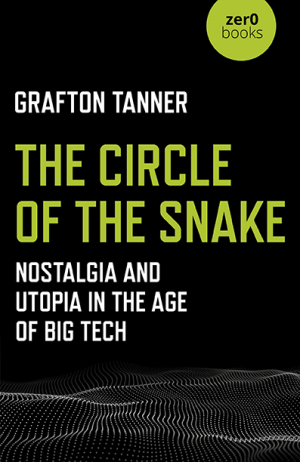
Big Tech, Nostalgia, and Control: Grafton Tanner’s ‘The Circle of the Snake’

By Michael Grasso

Source: We Are the Mutants

The Circle of the Snake: Nostalgia and Utopia in the Age of Big Tech
By Grafton Tanner
Zero Books, 2020

I’m sure many members of Generation X have taken a moment to look around the pop culture landscape over the past decade and a half and had a sudden moment of realization: there are certainly a whole lot of people trying to sell me things using the media of my youth. Ultimately, this is nothing new. I remember when every pop culture moment, from sitcoms to TV commercials, seemed to be using the Baby Boomers’ favorite songs to sell them cars and sneakers. But in 2020, the dominance of these re-treaded properties is even more nakedly cynical, whether its the endless sequels of the Star Wars and Marvel cinematic universes, or the easy-to-consume, signifier-filled pastiches of the worlds of Stranger Things and Ready Player One. The cultural marketplace, as dominated by bloated media and tech empires, no longer sees any need to admit the novel, the fresh, the unusual.

Both the “why” and the “how” of this cultural and technological tendency are explored by author Grafton Tanner in his new book, The Circle of the Snake: Nostalgia and Utopia in the Age of Big Tech. (Disclosure: Tanner is an occasional contributor to We Are The Mutants.) Tanner explores not only the pop culture properties that utilize nostalgia in an effort to assuage the anxieties of contemporary life in the aftermath of the 2008 financial rupture; he also explains how tech companies use the feedback from algorithmic analysis to keep consumers locked into a never-ending cycle—an ouroboros—of digital satisfaction of their subconscious desires for an older, more secure time. This nostalgic digital utopia, in turn, keeps consumers constantly “on,” working through endless “quests” that approximate proactivity but in the end keep people locked into pointless and unproductive cycles of feedback, emotional satisfaction, and control. “Recommender systems and predictive analytics—the very tools that allow our contemporary media to function—zero in on quick reactions, such as a flash of anger or a swell of nostalgia,” says Tanner in his Introduction. “These reactions are noted by algorithms, which then make recommendations based on them… The result is a nostalgic feedback loop wherein old ideas travel round.”

Tanner examines how the Big Tech tendency towards technolibertarianism and monopoly over the past 20 years has created the material conditions for this self-reinforcing system of psychic feedback. With an increasing belief in culture as disposable and “just for fun,” the material and political implications of this system of control are obfuscated. The way that these cultural narratives award Big Tech further and deeper power over all of us is merely part of the game. And we are enlisted as active players, not merely passive viewers, as in the era of television’s height. The online world, Tanner notes, demands a keen eye for analysis and a deep capacity for paying attention. The technolibertarian and neoliberal alike view our tech-suffused world—everyone is plugged in, 24/7—as a kind of utopia-in-waiting, or indeed a permanent utopia, where the idealized past can be endlessly revisited and basked in, while the present never changes from its current state of cultural and political stasis. This virtual plaza of commerce, emotional satisfaction, the illusion of proactivity, and control and surveillance describe the boundaries of Big Tech’s dominance of both our material and psychic space at the beginning of the 2020s.

The interview below was conducted in November and December 2020 via email and has been lightly edited for clarity.

***

GRASSO: Given the topic of your first book for Zero, Babbling Corpse: Vaporwave and the Commodification of Ghosts, the topic for The Circle of the Snake seems like a natural outgrowth. But from reading the book it also seems like there were a lot of specific events and observations about the world of Online and Big Tech over the past few years that led to the book’s development. What are the origins of The Circle of the Snake, and what kinds of specific cultural developments led you to propose and write the book?

TANNER: I can pinpoint the exact moment I knew I was going to write a book on Big Tech. I was living in a kind of exile in 2016, in this small town in Georgia, trying to piece my life back together after a series of false starts after college. I was sitting in a Barnes & Noble reading the 2016 Tech Issue of The Atlantic, and there was a story by Bianca Bosker about former Google employee Tristan Harris, who left the Valley and started an advocacy group called Time Well Spent because he thought Big Tech was eroding mental health. He was on a mission to fix Big Tech by making it work for us, not against us. But the piece didn’t make me feel better about tech. In fact, it was terrifying: here is an ex-Valley technocrat, mournful that he had invented habit-forming technology with severe public side effects, asking us to not only forgive him, but believe in him to create newer, better tech. I was incensed.

Shortly thereafter, we learned that Cambridge Analytica sharpened their psychographic modeling techniques by harvesting Facebook data from millions of users without their permission, all to aid in the election of Donald Trump. There was suddenly this huge backlash against Big Tech. I was supportive of it, but I also understood it came a little too late. Tech critics had been sounding the alarm for years and years. It took the election of a fascist for the left to wake up to the tech nightmare, only to realize the ones promising to end the nightmare were former technocrats themselves.

And yet, as many were loudly critiquing Big Tech for its role in throwing elections, spreading fascism, and worsening mental health, the culture industry was churning out politically retrograde nostalgia-bait. Was it really that the techlash had made everyone even more nostalgic for the pre-digital past? Or was there some kind of connection between nostalgia and Big Tech? These were the questions I had in mind when I started writing.

GRASSO: I think one of the things I like best about the book is your fusion of theory, philosophy, and epistemology with the material and economic realities of 21st century Big Tech and Big Media. Throughout the book you explore concepts such as surveillance, sublimity, nostalgia (of course), and virtuality with concrete examples from the online plaza. Essentially, if I’m not mistaken, you’re saying that the people who created the feedback loops that keep us hooked on technology and the internet and mine our data for still more ways to sell to us have themselves studied their philosophy, economic history, and techniques of mass psychology and persuasion with great attention?

TANNER: Persuasion techniques, yes, but I wouldn’t go so far as to say the technocrats have studied much else beyond their limited worldview, which is scientistic. Yes, technocrats like James Williams and Tristan Harris like to cite philosophers, but they usually do it to support their self-help solutions to the attention economy. Wake up with a little philosophy, they say, because reading Socrates is better for the mind than scrolling through Twitter. It’s a very neckbeard way of thinking about cultural consumption.

Make no mistake: these technocrats are uninterested in anything other than making a lot of money. If that means learning psychological techniques of persuasion with Stanford psychologist B.J. Fogg, then so be it. They weren’t and aren’t trying to make the world a better place or something. Like the banks before the Great Recession, the technocrats are out to make a quick buck by any means necessary, and they would have kept on doing what they were doing if the bubble hadn’t burst. People were disgruntled with Facebook for years before Cambridge Analytica, and tech critique was already a robust genre by 2016. But it took a kind of implosion, a Great Recession-style reckoning with Big Tech, to change the public opinion. Honestly, the technocrats would probably benefit from studying a little history and philosophy, instead of cloistering themselves in the ideological fortress of STEM.

GRASSO: I think one of the “oh shit” moments in the text for me was finding out that the Black Mirror special choose-your-own-adventure episode “Bandersnatch,” which I quite liked mostly for its material and inspirational signifiers (early ’80s computing, references to Philip K. Dick) was also used to mine viewers’ data in a delightfully dark real-life Dickean stroke. It’s not merely that nostalgia offers us a safe place from the dangerous present, but that those who create these nostalgic visions are working hand-in-hand with the very media empires that make us crave the past: another ouroboros.

TANNER: “Bandersnatch” not only exploits viewers’ nostalgia for its own gain, but it further normalizes the feeling of being controlled. Everyone today knows we’re being controlled from afar: by Twitter, Instagram, Amazon, insurance companies, think tanks, banks, and so forth. We are part of this giant social experiment called consumer capitalism. The purpose is to find out what we’ll buy. But we aren’t being controlled by future gamers or, as much as Elon Musk would like to believe, programmers in this computer simulation we call life. “Bandersnatch” is a work of fiction masquerading a horrible fact—that Netflix is the one controlling us, that we are not as in control as we think. The irony, of course, is that we relinquish our control via the technology we use every day, but we ultimately have very little choice in the matter. Students use devices at school, and jobs often require employees to have smartphones. We aren’t puppets, but we’re by no means totally free either.

GRASSO: So that leads me to asking you about your critique of specific media franchises: Stranger Things and the endless array of sequels and especially reboots we’ve seen since the end of the aughts. You very cannily explore Stranger Things‘ reliance on physical signifiers of commodities and objects that are no longer extant but remind us of the shackles of our technology-laden present (the old landline telephone, the shopping mall) as a key to its appeal to both Gen-Xers who were there and Zoomers who weren’t. Likewise the cinematic reboot is a way to cheaply create product and content that will connect with multiple generations. This element of “spot the Easter egg, aren’t you smart?” for older generations melds with the offer of a trip to a now-alien time for younger generations. These franchises seem to simultaneously reward passive immersion in nostalgia with an illusion of proactivity.

TANNER: Well, the spot-the-Easter-egg activities are very often nostalgic exercises themselves. Viewers are invited to find the nostalgic signifiers, even if they don’t know what they are. That’s the brilliance of Easter egg marketing for advertisers: you might not know what the hidden clue means, but you know it’s a clue and so you make note of it. Of course, the “real” fans will be able to cite all the references, but regular viewers can sometimes recognize a clue, like a corded phone or a VCR or a reference to an older movie, when they see it.

Easter egg marketing is the advertising tactic of choice in the prosumer age. It turns watching into a game. And it’s very heuristic. The films with the most Easter eggs inspire the most “count them all” YouTube videos or Buzzfeed listicles. The problem here isn’t that movies and series reference a bunch of older media; the problem is that Easter eggs reference certain things and leave others out, thus establishing these unnecessary pop culture canons. I don’t care that the Halloween franchise makes reference to itself. It’s an extended universe at this point—of course it’s going to do that. What I find questionable is its constant updating in an attempt to recapture the magic of the original film. I’m always signaling my love of Halloween III: Season of the Witch, but that film is too wacky to be included in the Halloween universe, because the franchise is desperately trying to give us the original again, as if it were the first time, without all the messy parts of the sequels. The Halloween filmmakers want to keep the bloodline of the first film pure, which means anything standing in the way must be excised.

GRASSO: You mark the period between 9/11 and the financial crisis of 2008 (and its aftermath) as the final foreclosure of any alternative to our current future and one of the dividing lines between an idealized past depicted in our nostalgic media and the forever Now. Unsurprisingly, so many of the elements of online life we now recognize as irredeemably toxic (social media, ranking and rating apps, tentpole cinematic universes full of identical sequels) began around the end of the Bush years as well.

TANNER: One of these days, I’m going to write a history-critique of the 2000s. I find the decade fascinating. It was probably the nadir of contemporary culture. Mark Fisher called it “the worst period for (popular) culture since the 1950s.”

It’s true: there was no breaking point at which contemporary nostalgia ramped up. It was a gradual shift between 9/11 and the Great Recession. Directly after 9/11, the U.S. was reeling from shock. Before nostalgia set in later in the decade, there was a feeling of futurelessness, as Robert Jay Lifton wrote—a feeling that there can be no future after 9/11, that the fear of another terrorist attack foreclosed the future altogether, that if people could fly planes into buildings on a regular weekday morning, then anything horrific is possible. During these years, we saw the birth of cinematic universes with the Star Wars prequels and the first megabudget superhero films. Of course, there were Batman, Superman, and Star Wars films before the twenty-first century, but it was after 9/11 that we saw the avalanche of these movies, several of which could not have been made without post-9/11 Pentagon support, with its bloated influence and near-endless supply of capital. You cannot downplay the reach these films have. They’re seen all over the world. And they aren’t just pro-military propaganda, they are engines of nostalgia.

After the Great Recession, nostalgia calcified. People were moving back in with their parents, revisiting old memories to soothe the anxiety of joblessness. Financial recessions are progressive only for the bankers, if they’re bailed out. For workers, they’re regressive. They set people back and invite the sufferers to hide away from it all. There is nothing wrong with this reaction. We cannot blame people who were hit by the Recession for their nostalgia. But we can blame the ones who caused it. And austerity measures only increase the desire to escape into nostalgic feelings. In short, financial meltdowns are crises that affect the future because they erase the plausibility of surviving the present.

GRASSO: You state that nostalgia is not only an emotion used to track us and to trigger specific emotional responses (which themselves are often assuaged by consumption), but also, possibly most importantly, to control us. And that control is not only physical/material but also social/aesthetic, limiting our options to wander away from the digital plaza. How do nostalgia and nostalgic media help this attempt by the market to quantify, objectify, and commodify us, the consumer?

TANNER: Content creators—a sickening term that reduces art and culture to commodities—understand the value of nostalgia. Consumer scientists have known for years that nostalgia sells. If anger draws your attention to the screen, then nostalgia triggers you to buy what will soothe the anger. That’s the cycle we’re dealing with in the present century.

And the worse things get, the more that nostalgia will naturally rise to the surface for many people. It’s not that media companies force-feed nostalgia to us. Many people are already feeling the emotion. It’s inescapable because nostalgia is a modern condition. Corporations merely go the extra mile by locking nostalgia into these feedback loops. The more you feed nostalgia into the cultural industry, the more of it you will consume because entire companies depend on you to want it. We live in a world of disruption, and every modern displacement is accompanied by nostalgia. Corporate capital knows this and depends on it.

GRASSO: Two of the specific technologies you talk about, Instagram and virtual reality, have undergone mutations in their appeals to our desire to escape the modern world. Instagram started off as a fairly disposable nostalgic evocation of the Polaroid camera aesthetic and has become a playground for big-money influencers and exhibitionists; virtual reality has evolved into just another facet of the internet’s control apparatus, despite its conceptual origins in early ’80s cyberpunk and its promised potential to give people the ability to create their own worlds. Why do these technologies seem to always mutate in the direction of greater commercialization and/or control, despite their initial apparent harmlessness or revolutionary promise?

TANNER: In the case of Instagram, its nostalgia factor was mainly due to the horrible photo quality of early smartphone cameras. With some Wi-Fi, a phone, and an app, you could take photos anywhere and upload them on the spot, which was enticing enough for many people to do just that, but you couldn’t deny the photo quality was very poor. So one way to deal with this poor quality was to saturate photos in a kind of analog haze, which could be done by applying one of several different stock filters. I can’t emphasize this enough: so much of our nostalgic appetite in the early 2010s was whetted by the inability to take and post a decent looking digital photo.

Whether it’s Instagram or virtual reality, digital technology is never totally harmless. It’s like when Tristan Harris and the Center for Humane Tech guys tell us we can have our digital cake and eat it too. You can’t have “humane tech” because tech is driven by the profit motive, which itself is often powered by another force: the military. Have you seen this new recruiting ad for the Marine Corps? It’s basically telling young people that joining the military will be an escape from the overwhelming anxieties of the digital age. The scariest thing about the ad is that it conceals the long relationship between tech and the military. Which is to say, the “tech” presented in the ad couldn’t exist without the military-industrial complex. At this point, any new, possibly revolutionary digital technology will either be bought out by a Big Tech monopoly or put to use on the battlefield.

GRASSO: As far as solutions and escapes from this predicament go, you talk a little bit about the ineffectual attempts of former technocrats to try to ameliorate our enslavement to the internet and social media with apps that limit time on websites or “safety labels,” and find them all wholly wanting. Likewise, you mention attempts to make nostalgia something constructive, playful, reflective (in the schema of Svetlana Boym). And yet the very structure of the internet and Big Media as it stands now denies all alternatives to the current control stasis. What does a constructivist nostalgia look like? Where could it exist in the cracks of the current marketplace? Is there a place for nostalgia as a political instrument of the left outside of the usual avenue of Left Melancholy?

TANNER: I’m currently writing a history of nostalgia, out fall 2021 with Repeater Books, called The Hours Have Lost Their Clock: A Recent History of Nostalgia. In it, I put forth a theory of radical nostalgia, drawing on the work of Alastair Bonnett and Svetlana Boym. Radical nostalgia is the third “R” beyond reflective and restorative nostalgia, which Boym coined. She was right about nostalgia, but over the first two decades of the present century, restorative nostalgia ballooned while the reflective strains were edged to the margins. But there needs to be this third form, radical nostalgia, because the melancholic disposition of reflective nostalgia just hasn’t been working for the left and the restorative tint has proven to be destructive.

Radical nostalgia is the act of looking back to those moments when collective action stood up to capital. It yearns for the social movements of the past. It aches for them. It isn’t interested in “getting back there,” in restoring what’s been lost, but in learning from those who came before: the struggle for indigenous rights, the staunch anti-capitalism of Martin Luther King Jr., Stonewall, the Battle of Seattle. When Richard Branson signals his support for LGBTQ+ communities, that isn’t radical nostalgia. There’s nothing radical about it; it’s mere nostalgia. Radical nostalgia looks to these and other movements to continue the fight for a more egalitarian future. It is inherently anti-fascist.

Radical nostalgia takes the action step of restorative and the aching heart of reflective nostalgia and fuses them together. It knows that the past isn’t perfect, which means what we yearn for shouldn’t be either. Restorative nostalgia is too clean, too high-definition. Reflective nostalgia kicks the can around, although reflectors might recognize the problems of the past long before the restorers do. But radical nostalgia knows that everything is imbued with horror, the past especially. Many revolutionary movements of the past suffered from machismo and intolerance, even in their own collectives. Radical nostalgia knows this and endeavors to leave it in the past. Some things must remain buried.

And radical nostalgia is one perspective we can take to resist the utopian thinking of tech. At this point, Big Tech is about the only entity that circulates visions of the future, but those visions are falling out of favor thanks to the techlash. Get ready, because they will absolutely be replaced with a different utopian vision: the humane tech movement. We’re going to be dealing with the technocrats for years. It’s going to seem like we should trust Tristan Harris and the Center for Humane Tech guys. They’re going to be pushing their vision of the future for years to come. But they are the new boss, same as the old. Only collective action, informed by the decolonial and anti-fascist movements of history, can resist what’s coming in the next decade and beyond.

How to Avert a Digital Dystopia

By Jumana Abu-Ghazaleh

Source: OneZero

“What I find [ominous] is how seldom, today, we see the phrase ‘the 22nd century.’ Almost never. Compare this with the frequency with which the 21st century was evoked in popular culture during, say, the 1920s.”

—William Gibson, famed science-fiction author, in an interview on dystopian fiction.

The 2010s are almost over. And it doesn’t quite feel right.

When the end of 2009 came into view, the end of the 2000s felt like a relatively innocuous milestone. The current moment feels so much more, what’s the word?

Ah, yes: dystopian.

Looking back, “dystopia” might have been the watchword of the 2010s. Black Mirror debuted close to the beginning of the decade, and early in its run, it was sometimes critiqued for how over-the-top it all felt. Now, at the end of the decade, it’s regularly critiqued as made obsolete by reality.

And it’s not just prestige TV like Black Mirror reflecting the decade’s mood of incipient collapse. Of the 2010s top 10 highest-grossing films, by my count at least half involve an apocalypse either narrowly averted or, in fact, taking place (I’m looking at you, Avengers movies).

People have reasons to wallow. I get it. The existential threat of climate change alone — and seeing efforts to mitigate it slow down precisely as it becomes more pressing — could fuel whole libraries of dystopian fiction.

Meanwhile, our current tech landscape — the monopolies, the wild spread of disinformation, the sense that your most private data could go public whenever, with no recourse, all the things that risk making Black Mirror feel quaint — truly feels dystopian.

We enjoy watching distant, imaginary dystopias because they distract us from oncoming, real dystopias.

Since no one in a position to actually do something about our dystopian reality seems to be admitting it — no business leaders, politicians or legacy media — it makes sense that you might get catharsis of acknowledgment from pop culture instead. And yet, the most popular end-of-the-world fiction isn’t about actual imminent threats from climate or tech. It’s about Thanos coming to snap half of life out of existence. Or Voldemort threatening to destroy us Muggles.

Maybe that kind of pop culture, which acknowledges dystopia but not the actual threats we currently face, gives us a feeling of control: Sure, Equifax could leak my social security number and face zero consequences, but there are no Hunger Games. Wow — it really could be so much worse! Maybe we enjoy watching distant, imaginary dystopias because they distract us from oncoming, real dystopias.

But let’s look at those actual potential dystopias for a moment and think about what we need to do to avert them.

I’d suggest the big four U.S. tech giants — Amazon, Facebook, Apple, Google — each have a distinct possible dystopia associated with them. If we don’t turn around our current reality, we will likely get all four — after all, for all the antagonistic rhetoric among the giants, they are rather co-dependent. Let’s look at what we might have, ahem, look forward to — unless we demand the tech giants deliver on the utopia they purportedly set out to achieve when their respective founders raised their rounds of millions. I would argue not only that we can, but that we must hold them accountable.

“Mad Max,” or, slowly then all at once: starring Apple

“‘How did you go bankrupt?’ Bill asked. ‘Two ways,’ Mike said. ‘Gradually and then suddenly.’”

—Ernest Hemingway, The Sun Also Rises.

When you think of Mad Max, you probably think of an irradiated, post-apocalyptic desert hellscape. You’re also not thinking of Mad Max.

In the original 1979 film, the apocalypse hasn’t quite yet happened. There’s been a substantial social breakdown, but things are getting worse in slow motion. There are still functioning towns. Our protagonist, Max, is a working-class cop; and while there’s reason to believe a big crash is coming, or has even begun, society is still hanging on. (It’s only in the sequels that we’re well into the post-apocalyptic landscape people are thinking of when they say “Mad Max.”)

A relatively subtle dystopia, where things gradually decline in the background, is also a good day-to-day description of a society overrun by algorithms, even without the attention-grabbing mega-scandals of a Cambridge Analytica or massive data breach. A kind of dystopia “light” — and Apple is its poster child.

After all, Apple has a genuinely better track record than some of the other tech giants on a few key privacy issues. But it’s also genuinely aware of the value of promulgating that vision of itself — and that can lead Apple users into danger.

In January, Apple purchased a multistory billboard outside the Consumer Electronics Show in Las Vegas, with this message: “What happens on your iPhone, stays on your iPhone.” Sounds great — but it’s deeply misleading, and as journalist Mark Wilson noted, Apple’s mismatch between rhetoric and behavior fuels the nightmare that is our current data security crisis:

“[iPhone] contents are encrypted by default […] But that doesn’t stop the 2 million or so apps in the App Store from spying on iPhone users and selling details of their private lives. “Tens of millions of people have data taken from them — and they don’t have the slightest clue,” says [the] founder of [the] cybersecurity firm Guardian […] The Wall Street Journal studied 70 iOS apps […] and found several that were delivering deeply private information, including heart rate and fertility data, to Facebook.” [Emphasis mine.]

A tech giant that is claiming it’s the path to salvation, while effectively creating a trap for those who believe it, sounds ironically familiar given Apple’s famous evocation of Big Brother.

After all, when people talk about habit-forming technology in terms so terrifying they’ve convinced Silicon Valley executives to limit their children’s access to their own products, let’s be real: They’re talking about iPhones.

When academic child psychology researcher Jean Twenge talks about a possible teenage mental health epidemic fueled by social media, we know what’s at the heart of it: She’s talking about iPhones.

All those aforementioned horror stories, and a huge slice of those algorithms you’ve heard so much about, are likely first reaching you on smartphones that, with world market share above 50%, are largely, you guessed it, iPhones. (And none of these stories even mention Apple workers at overseas at facilities like Foxconn who create our iPhones and who really are living in a kind of explicit dystopia.)

What happens on your iPhone almost certainly doesn’t stay on your iPhone. But who created that surveillance capitalism running it all in the first place?

Enter Google.

“Black Mirror:” “Nosedive,” or, welcome to surveillance capitalism: starring Google

“We know where you are. We know where you’ve been. We can more or less know what you’re thinking about.”

—Google’s then-CEO Eric Schmidt, in a 2011 interview.

You’ve probably heard it before: “if you’re not paying, you’re the product.” This is usually in reference to ostensibly “free” services like Facebook or Gmail. It’s a creepy thought. And, according to Shoshana Zuboff, professor emeritus at Harvard and economic analyst of what she’s termed “surveillance capitalism,” the selling of your personal information undermines autonomy. It’s worse than you being the product: “You are not the product. You are the abandoned carcass.”

Google, according to Zuboff, is the original inventor of Surveillance Capitalism. In their early “Don’t Be Evil” days, the idea of accessing people’s private Google searches and selling them was considered unthinkable. Then Google realized it could use search data for targeting purposes — and never stopped creating opportunities to surveil their users:

“Google’s new methods were prized for their ability to find data that users had opted to keep private and to infer extensive personal information that users did not provide. These operations were designed to bypass user awareness. […]In other words, from the very start Google’s breakthrough depended upon a one-way mirror: surveillance.”

Twenty years later, surveillance capitalism has become so ubiquitous that it’s hard to live in Western society without being surveilled constantly by private actors.

As far as I know, no mass popular culture has really yet captured this reality, but one small metaphor that kind of hits on its effects is a Black Mirror episode called “Nosedive.”

In “Nosedive,” everyday people’s lived experience is very clearly the picked-apart carcass for an entire economic and social order; a kind of surveillance-driven social credit score affects every aspect of your daily life, from customer service to government resources to friendships, all based on your app usage and, most creepily, how other people rate you in the app.

If surveillance capitalism has been the engine powering our economy in the background for nearly two decades, it’s now having a coming-out party. Increasingly, Google isn’t just surveilling us in private — with its “designing smart cities” initiatives, the company will literally be making city management decisions instead of citizens: Sidewalk Labs, a Google sister company, plans to develop “the most innovative district in the entire world” in the Quayside neighborhood of Toronto, and Google itself is planning on siphoning every bit of data about how Quayside residents live and breathe and move via ubiquitous monitoring sensors that will likely inform — for a fee naturally — how other cities will develop.

If surveillance capitalism has been the engine powering our economy in the background for nearly two decades, it’s now having its coming-out party.

Much like Apple, Google takes pains to present itself as a conscientious corporate citizen. They might be paternalistic, or antidemocratic — but they have learned it’s important to their brand that they’re seen as responsive to their workers and the broader public, largely thanks to the courageous and persistent effort of their workers and consumer advocates in civil society.

Not so much with Amazon.

“Elysium,” or, dystopia for some, Prime Day for others: starring Amazon

“[The New York Times] claims that our intentional approach is to create a soulless, dystopian workplace where no fun is had and no laughter heard. Again, I don’t recognize this Amazon and I very much hope you don’t either.” —Jeff Bezos, August 17, 2015 letter to staff after the New York Times investigation into working conditions at the company.

In 2015, Jeff Bezos felt the need to set the record straight: The New York Times was wrong about Amazon. Working there did not feel like a dystopia.

The years since have only validated the New York Times story, which focused on life for coders and executives at Amazon. Notably, when the Times and other investigative journalists have probed life for the far more numerous warehouse workers employed by Amazon, Bezos has largely stayed silent.

In fact, the further down the corporate ladder you get at Amazon, the more likely it seems that Jeff Bezos will stay quiet on any controversy. Just this month, in a report published almost exactly four years after Bezos’ “Amazon is not a dystopia” declaration, the New York Times has uncovered almost a dozen previously unreported deaths allegedly caused by Amazon’s decentralized delivery network. Rather than defend itself out loud, Amazon has kept quiet while repeating the same argument in the courts: Those delivery people aren’t Amazon workers at all, and thus Amazon is not liable.

Amazon, like every major tech giant, has a key role in the dystopia of surveillance capitalism — the monopolylike market share of Amazon Web Services, and Amazon’s involvement in increasingly ubiquitous facial recognition software, represent their own deeply dystopian trends. But the most visible dystopia Amazon creates, for all to see, is dystopia in the workplace.

In many ways, Amazon is the single company that best explains the appeal of an Andrew Yang figure to a certain slice of economically alienated young voters. When speaking near Amazon’s HQ in Seattle, Yang explicitly talked about the surveillance of Amazon workers, and how reliable those jobs are in any case:

“All the Amazon employees [here] are like, ‘Oh shit, is Jeff watching me right now?’… [Amazon will] open up a fulfillment warehouse that employs, let’s call it 20,000 people. How many retail workers worked at the malls that went out of business because of Amazon? [The] greatest thing would be if Jeff Bezos just stood up one day and said, ‘Hey, the truth is we are one of the primary organizations automating away millions of American jobs.’ […] I have friends who work at Amazon and they say point-blank that ‘we are told we are going to be trying to get rid of our own jobs.’”

You can flat-out disagree with Yang’s proposed solutions, but a lot of his appeal stems from the fact that he’s diagnosing a problem that broad swaths of people don’t feel is being talked about. Yang validates his supporters’ concerns that they are, in fact, living in a dystopia of the corporate overlord variety.

In the movie Elysium, most work is done in warehouses, under constant surveillance, with workers creating the very automation systems that surveil and punish them. The movie takes place in a company townlike setting, with no such thing as a class system or social mobility. Meanwhile, the ruling class in Elysium lives in space, having left everyone else behind to work on Earth, a planet now fully ravaged by climate change.

That might sound particularly far-fetched, but given Bezos’ explicit intention to colonize space because “we are in the process of destroying this planet,” it suddenly doesn’t feel so off the mark. And in an era where Governors and Mayors openly genuflect to Amazon, preemptively giving up vast swaths of democratic powers for the mere possibility that Amazon might host an office building there, it’s hard not to feel like we’re already in an Elysium-flavored dystopia.

Amazon has their dystopia picked out, flavor and all. But what happens when the biggest social network in the world can’t decide which dystopia it wants to be when it grows up?

Pick a dystopia — any dystopia!: starring Facebook

“Understanding who you serve is always a very important problem, and it only gets harder the more people that you serve.”

—Mark Zuckerberg, 2014 interview with the New York Times.

Ready Player One is one of the more popular recent dystopian novels.

The bleak future it depicts is relatively straightforward: In the face of economic and ecological collapse, the vast majority of human interaction and commercial activity happens over a shared virtual reality space called Oasis.

In Oasis, the downtrodden masses compete in enormous multiplayer video games, hoping to win enough prizes and gain sufficient corporate sponsorship to scrape out a decent existence. Imagine a version of The Matrix, where people choose to constantly log into unreality because actual reality has gotten so unbearably terrible, electing to let the real world waste away. Horrific.

Ready Player One is also the book that Oculus founder and former Facebook employee Palmer Luckey used to give new hires, working on virtual reality to get them “excited” about the “potential” of their work.

Sound beyond parody? In so many ways, Facebook is unique among the tech giants: It’s not hiding the specter of dystopia. It’s amplifying dystopia.

It’s hard to pick a popular dystopia Facebook isn’t invested in.

Surveillance capitalism? Google invented it, but Facebook has taken it to a whole new level with its social and emotional contagion experiments and relentless tracking of even nonusers.

1984? Sure, Facebook says, quietly patenting technology that lets your phone record you without warning.

Brave New World? Lest we forget, Facebook literally experimented with making depression contagious in 2014.

28 Days Later, or any of the various other mass-violence-as-disease horror movies like The Happening? Facebook has been used to spread mass genocidal panics far more terrifying than any apocalyptic Hollywood film.

What about the seemingly way out there dystopias — something like THX-1138 or a particularly gnarly Black Mirror episode where a brain can have its thoughts directly read, or even electronically implanted? It won’t comfort you to know that Facebook just acquired CTRL-Labs, which is developing a wearable brain-computer interface, raising questions about literal thought rewriting, brain hacking, and psychological “discontinuity.”

Roger McNamee, an early Zuckerberg advisor and arguably its most important early investor, has become unadorned about it: Facebook has become a dystopia. It’s up to the rest of us to catch up.

We spent the 2010s on dystopia—let’s spend the 2020s on utopia instead

“Plan for the worst, hope for the best, and maybe wind up somewhere in the middle.” —Bright Eyes, “Loose Leaves”

People generally seem to think dystopias are possible, but utopias are not. No one ridicules you for conceiving of a dystopia.

I think part of that is because it gives us an easy out. Dystopias paralyze us. They overwhelm. They make us feel small and powerless. Envisioning Dystopia is like getting married anticipating the divorce. All we can do is make sure it’s amicable.

Is there room for a utopian counterweight? There’s not only room, there’s an urgent need if we want to look forward (as opposed to despondently) to the 22nd century. We cannot avert or undo dystopias without believing in their counterparts.

But we need to make the utopian alternative feel real, accessible, and achievable. We need to be rooting not for the lesser of two evils, but for something actually good.

Dystopias — real, about-to-unfold dystopias — have been averted before. The threat of nuclear apocalypse during the Cold War. The shrinking hole in the ozone layer (which is both distinct from, and has lessons to teach us about, the climate crisis). We didn’t land in utopia, but it was only by hitching our wagons to a utopian vision that we averted the worst.

In 2017, cultural historian Jill Lepore penned a kind of goodbye letter to dystopian fiction, calling for a renewal of utopian imagination. “Dystopia,” she lamented, “used to be a fiction of resistance; it’s become a fiction of submission.” Dystopian narratives once served as stark warnings of what might be in store for us if we do nothing, spurring us on to devise a brighter future. Today, dystopian fiction is so prevalent and comes in so many unsavory flavors that our civic imaginations are understandably confined to identifying the one we deem most likely to inevitably happen, and to come to terms with it.

But we don’t have to.

A new decade is on the way. Let’s spend the 2020s exercising our utopian imaginations — the muscles we use to envision dystopia are now all too-well-developed, and a body that only exercises one set of muscles quickly grows off-balance.

Dystopias disempower. We are tiny, inconsequential — how could we do anything about them? Utopias, on the other hand, are rhetorical devices calling upon us to build. They invite our participation. Because a utopia where we don’t matter is a contradiction in terms.

Let’s envision a world where those creating algorithms are thinking not only about their reach, but also about their impact. A world in which we are not the carcass left behind by surveillance capitalism. A world in which calling for ethical norms and standards is in itself a utopian act.

Let’s spend the next decade fighting for what we actually want: A world in which the powerful few are held to a higher standard; an industry in which ethics aren’t an afterthought, and the phrase “unintended consequences” doesn’t absolve actors from the fall out of their very deliberate acts.

Let’s actualize the utopia which, ironically enough, the tech giants themselves so enthusiastically promised us when they set out to change the world.

Let’s spend this next decade asking for what we actually want.

The Fine Edge Between Comedy and Horror: The Millions Interviews Margaret Atwood

atwood-the_heart_goes_last

By Claire Cameron

Source: The Millions

The Heart Goes Last Margaret Atwood’s first standalone novel since The Blind Assassin, which won the Man Booker in 2000 — is a novel that teeters on the fine edge between comedy and horror. The writing is full of Atwood’s wry humor, but the dystopian world in which the characters live, whether they are a sleeping in a car and fleeing thugs or under surveillance in a tightly controlled community, is an alternate world that is full of horror.

The novel tells the story of Stan and Charmaine. After a great financial crash, their home is repossessed, their credit is frozen, and they are left to eek out a meager life living in their cramped Honda for shelter. Stan sleeps in the driver’s seat so they can flee quickly during the night if need be. With only Charmaine’s money from a bartending job, they dumpster dive, eat day old doughnuts, and have no viable prospects for their future. When Charmaine sees an ad on TV for Consilience, a suburban utopia and a ‘social experiment,’ she signs them up to take a look. Participants are given a home of their own in exchange for going to prison every other month.

The idea behind Consilience is that a full prison creates full employment and all prosper. While Charmaine and Stan do their month in jail, they swap places with an alternate couple who live their life, drive their scooters, and sleep in their bed until the month is up and they trade places again. In a set up that recalls a Midsummer’s Night Dream-like mix up, unknown to each other both Stan and Charmaine have chance encounters with their alternates. Confusion, obsession, and mistrust turn into revelations about the truth about Consilience.

The more I read, the more I questioned whether I could describe the community of Consilience and the chaos outside its gates as taking place in an alternate world. So much of what happens in this novel, from foreclosed houses to private prisons, is already part of our world. The world of The Heart Goes Last feels more like a twisted version of our current reality. Only small changes would be needed to make it all ‘true.’ Just as Charmaine and Stan’s lives contort when they seek out their alternates, utopian turns dystopian and comedy bends into horror with, as Atwood says, “one small turn of the wrench.”

I interviewed Atwood over the phone from her hotel room in New York. We spoke about not having sex with furniture, Pepper the greeting robot, themes in Victorian literature, and quotas in private prisons.

The Millions: The Heart Goes Last has your trademark humor, but the circumstances that Stan and Charmaine find themselves in are horrifying.

Margaret Atwood: A lot of things are funny to those watching them, but not to the person undergoing them. The person who slips on the banana peel doesn’t think it’s funny as a rule.

TM: Charmaine says near the beginning of the book that, “comedy is so cold and heartless, it makes fun of people’s sadness.”

MA: It does, unfortunately. Sometimes people make fun of themselves, but if you dig down there’s a bit of that too. On the other hand, where would we be if we couldn’t laugh? I think they’ve always been joined at the hip.

TM: At the beginning of the novel, you quote Ovid, William Shakespeare, and a blog post by writer Adam Frucci[1] — who sets out to test an ottoman with a fake vagina. I have to ask: Did you have sex with furniture to research this novel?

MA: I think that piece of furniture is intended only for men?

TM: Frucci warned that it was, “no Kleenex clean up, my friends.” Actually, what he endured to test the ottoman is a good example of something that is funny for the reader, but not so for the person going through the experience.

MA: One of the headlines of that post is “I did this so you don’t have to.” Frucci has probably woken to find himself strangely famous. A lot of people are reading that blog post.

The other thing that has to trouble your mind is — who had this idea for this piece of furniture? And would you have this in your living room? I have many questions.

TM: Maybe you’ve given the ottoman maker a little sales bump?

MA: I have a feeling that a piece of furniture with a sex thing built into it came and went fairly swiftly. If that blog post was written in 2009, the furniture has fairly quickly been superseded by the advances in robotics.

Do you know about Pepper the robot? Pepper is not a sex robot. In fact, Pepper comes with instructions that say explicitly that you are not supposed to use it for sex, though I don’t know how you could.

Pepper is a greeting robot, like one that Stan, the main character in The Heart Goes Last, is working on before he gets fired at Dimple Robotics. Except that Stan’s is a grocery bagging robot. It is supposed to smile at you.

Pepper is supposed to be able to read your emotions. They were installing Pepper as a greeting robot in Japan where greeting is a social custom. And then they put him/her on for private sale and he/she sold out very quickly. Apparently we want someone who can read our emotions.

TM: At Dimple Robotics, Stan’s job, before he looses it, was working on the empathy module of his robot.

MA: Personally, I don’t want someone who can read my emotions, because then you can’t dissimulate, can you? If somebody asks if you are having a nice day and you say yes, but you’re actually not…it spoils your act.

TM: It’s the white lies that get us through.

MA: I’m afraid that’s correct. They do. “That’s a lovely dress! You look wonderful!”

TM: The novel is filled with this kind of joke — your humor is always close to hand. I love a line on writing from Sheila Heti’s How Should a Person Be?: “You have to know where the funny is, and if you know where the funny is, you know everything.” Do you agree?

MA: No, but it’s a good hint. You don’t know everything if you know that, but you know some things. It’s true in a negative way. If something is unintentionally funny, you ought to know. If you intended it to be very serious and dramatic, but actually it’s funny, then you are in trouble.

There is a wonderful book called The Stuffed Owl. It’s an anthology of good, but bad, verse. It’s well worth reading. It is full of writers who were aiming for the heights and tripped on the banana peel.

TM: As I was reading The Heart Goes Last, I kept thinking back to Survival, your thematic guide to Canadian literature that was published in 1972. In it you said: “I read then primarily to be entertained.” Do you still?

MA: Go back to what the ancients used to say, that art should entertain and instruct. They didn’t say to what degree. If it doesn’t entertain, and by entertain I don’t mean just frivolous, I mean engage your attention and keep you going. If that doesn’t happen, you’re not going to turn the page. So there has to be something engaging enough to keep you reading.

That is why first chapters are so important. If you can’t get the reader through the first chapter, they are never going to get to your pithy piece of wisdom on page 85.

On the other hand, if there is nothing serious in it, you may be entertained on a superficial level and it’s a one time read. Or it’s what we call a “beach read.” Or what I sometimes call a “hotel room drawer read.” I leave them there for others to enjoy. I did that in Hong Kong once and they were so screamingly honest that they collected the books and mailed them back to me. I thought that was so sweet.

TM: The Heart Goes Last is about characters who give up their freedom for comfort. When Stan and Charmaine tour Consilience for the first time they both feel reason to worry about how it runs. However, after experiencing the discomfort and fright of life in a car, they opt for comfort, “the bath towels clinched the deal.”

MA: Yes. It’s also about how circumstances cause people to do things that they would otherwise not do. That is a human universal truth. Stan and Charmaine give up their freedom, but of what does their freedom consist? They don’t have a lot of money, they are living in their car, they are subject to every thug and criminal that stumbles across them, so that is maybe “freedom,” but of a very limited kind.

TM: Can we expect a scared or thirsty human to make good decisions?

MA: You can’t. Self-preservation kicks in. A person will make the decision that you think gives him or her the best chance of getting through.

TM: In that way, is The Heart Goes Last a survival story?

MA: A lot of people lived that, or something close to it, when the 2008 crash happened. They were thrown out onto their front lawn or living in their cars. That is ongoing.

There’s a movie that just came out that I must go and see called 99 Homes — it’s the story of a man who evicts people from their houses because they couldn’t pay their mortgages. As I said, the situation is ongoing.

I was listening to the radio in London, England, and there was a show about people who had moved back into their parents’ houses, or parents who have had their kids move back in, because they could not afford to either rent or buy in London. It was too expensive.

TM: The set up of your novel felt so real.

MA: It is real.

TM: But it’s not necessarily your reality. David Mitchell wrote about how he imagines the far past or the far future, that to get in the right mindset he thinks about the things that the characters might take for granted in life.

MA: We did a lot of car travel when I was a child. We also did a lot of camping out. So that wasn’t under duress, but I know what it’s like to sleep in a car.

TM: There are other parts of the book that could be taken as speculative fiction, but aren’t, like private prisons.

MA: There are private prisons in the U.S. The Atlantic just did a huge piece on this. There is nothing in the U.S. constitution that says you can’t make people do enforced labor if they are convicted criminals.

There’s a history of that kind of prison as enterprise. The Australian penal colony was one of them. They would send people to work off their sentence. Someone was making money out of it.

TM: I also read that in Arizona there are three private prisons that require 100 percent inmate occupancy.

MA: You have to keep them full to make them profitable and that is a recipe for creating more prisoners.

TM: In 2008, when you published Payback, a book of non-fiction about the nature of debt, it almost felt like the world of finance had collapsed at your feet. The timing was quite something. Tell me about your crystal ball?

MA: I don’t actually have a crystal ball, but I do read advertisements when I’m sitting on the subway. I was seeing a lot of them that said “let us help you get out of debt.” I thought, boy, if there are all these enterprises doing that, there must be an awful lot of people in debt.

The other thing is that, if you are a student of Victorian literature, as once I was, debt is a big theme. Not only with Dickens, but a number of other writers as well. So is the prison system.

TM: In Survival you wrote, “Literature is not only a mirror; it is also a map.” Can The Heart Goes Last be read as a map?

MA: Maybe a map, but also a door. Open the door and what’s inside? Stan and Charmaine are in a planned prison system, a for-profit enterprise. What they don’t know when they go in is how the enterprise is making its money. The thing to ask about private prisons is who is making the profit? And how much are they making. Maybe it’s time to rethink. What should we have instead?

__

[1] I contacted Adam Frucci, author of “I Had Sex with Furniture: The Shameful (NSFW) Fleshlight Motion Review,” to comment about the honor of becoming an Atwood epigraph: “I didn’t really believe it at first — Ovid, Shakespeare, and my goofy blog post from 2009. I can’t say that of all of the things I’ve ever written that this is the one I want people to remember and attach to my name, but what can you do? All I can really do is be honored and assume that Margaret Atwood is a huge fan of all of my work and looks to me for inspiration all the time. That’s about accurate, right?”


Insurrection and Utopia, Part 1: “We are Eating From a Trashcan; This Trashcan is Ideology.”

AsoskW4CMAAPEf9

By Dr. Bones

Source: Gods and Radicals

It all started innocently enough. A friend asked me a question on facebook:

“How can you advocate anarchic revolution when your political vision is so far in the minority?”

The underlying premise was a good one: In a country of 300+ million, how can you call for the upheaval of society, the breaking of societal and political bonds, when so few would readily identify as Anarchists/Socialists/Communists/Leftists/Anti-Capitalists/What-have-you? It’s a question often thrown at the Left and unfortunately many haven’t fully wrapped their heads around it.

In a way it’s a watermark. For an ideology or political vision to go from outright dismissal and laughter to being asked to provide real world examples of what would be done if it came to pass is a sign of growth; it is a signal, an omen, that the winds are beginning to blow in our favor and many want to know what might lie ahead. It’s one thing to talk about “from each according to their ability, to each according to their need” but it’s quite another to discuss how restaurants would be run democratically and without profit or what exactly people might “do” on a day to day level in a classless, stateless society.

Still, the question is not an easy one. We could argue that it is the one question that has always plagued and nagged the Left: “Well that’s all good and well, but how do you plan to achieve this? How does such a world become born?” Staunch Marxists rely on a religious belief in the inevitable procession of history, Syndicalists will rail about the need for increased unionization, firebrand Neo-Bolsheviks plot to simply take power and liquidate class enemies, while the newly minted faux-left “Democratic Socialists” will hem-and-haw about passing enough laws to magically change the balance of power.

All of these options present difficult problems. History has been shown to be anything but inevitable (every year since 1914 has been “Late Capitalism”), a worker-owned McDonalds is still a site of exploitation, nobody ever bothers to explain just where all these people ready to kill for the Revolution are to come from, and the ludicrous doctrine of the Sandernistas that the wealthy and powerful will simply submit to higher taxes and the rule of law is so preposterous it’s only response should be derisive laughter.

So, where are we? Where do we go from here? How are we to change the world?

I start first with a question: Whose world?

You Can’t Teach an Old Carrion-Eater New Tricks

Society, technology, language, and culture all bear the birth marks and forms of the ideological underpinnings of the system they emerged from. Marx notes:

The ideas of the ruling class are in every epoch the ruling ideas, i.e. the class which is the ruling material force of society, is at the same time its ruling intellectual force. The class which has the means of material production at its disposal, has control at the same time over the means of mental production, so that thereby, generally speaking, the ideas of those who lack the means of mental production are subject to it. The ruling ideas are nothing more than the ideal expression of the dominant material relationships, the dominant material relationships grasped as ideas; hence of the relationships which make the one class the ruling one, therefore, the ideas of its dominance.

The Ruling Class, whether Capitalist or State Socialist, informs and projects its will and vision onto the rest of society by the sheer nature of being the dominant force in that society. Of course we can see this politically, but Marx notes this extends also into ideas, culture, anything that could be identified as a byproduct of human interaction and thinking.

The iron steel resolve and blatant disregard of human life so typical of the fearsome Bolshevik Commissar was not so much traits born as traits cultivated; ideals taken within the individual and digested. These cultivated traits came directly from the ideological call for early revolutionary Bolsheviks to identify themselves as “hards,” to be tough, to be ruthless and uncompromising in their goals; when they took state power it become propagated on a cultural level. This meme, this political trait, spiraled out and became a creature, a position, a symbolic figure to be adored/feared all onto its own. It transcended its existence as a mere “idea” or feeling about how party members should behave.

Uber, the trendy internet-based taxi service, could have just as easily manifested into the world as a collectively owned, worker-managed co-op. The internet platform itself is not that revolutionary, the people and tools to create the business were there all along and yet….it did not. Instead Uber emerged and was formed through an ideological lens that made sense to the Ruling Class and by a CEO who’s practically a poster boy for modern capitalism:

“Let’s consider how Kalanick treated his Uber taxi drivers in New York. When he was trying to convince them to break the law to boost Uber’s footprint in the city, Kalanick offered yellow cab drivers free iPhones and promised to “take care of” any legal problems they encountered with the TLC. A few short months later, when the service was forced to close, those same drivers received a message to come to Uber HQ. Reports the Verge ‘Multiple drivers said Uber called them into headquarters, claiming they needed to come by in order to get paid and would get a cash bonus for showing up. When the cabbies came in, Uber surprised them by asking for the device back, informing them that taxi service was no longer available in New York.’”

This is how Uber is evolving, this is how the entire concept other companies will build off is evolving: through actions committed under the dictate and logic of a particular ideology. Taken as gospel or rejected as too harsh new companies will only differ themselves in shades from this first “business plan” and mold their own social and economic arrangements within this ideological parameter. Even the technologies, once thought to be “pure” of politics develop along political lines.

“In an even stronger sense, many technologies can be said to possess inherent political qualities, whereby a given technical system by itself requires or at least strongly encourages specific patterns of human relationships. Winner (1985, 29–37) suggests that a nuclear weapon by its very existence demands the introduction of a centralized, rigidly hierarchical chain of command to regulate who may come anywhere near it, under what conditions, and for what purposes. It would simply be insane to do otherwise. More mundanely, in the daily infrastructures of our large-scale economies — from railroads and oil refineries to cash crops and microchips — centralization and hierarchical management are vastly more efficient for operation, production, and maintenance. Thus the creation and maintenance of certain social conditions can happen in the technological system’s immediate operating environment as well as in society at large.”

What’s interesting is the feedback loop this creates: technology is warped and shaped by the society(and thus dominant ideology), while at the same time the society becomes molded by the technology.

“As technologies are being built and put into use, significant alterations in patterns of human activity and human institutions are already taking place … the construction of a technical system that involves human beings as operating parts brings a reconstruction of social roles and relationships. Often this is a result of the new system’s own operating requirements: it simply will not work unless human behavior changes to suit its form and process. Hence, the very act of using the kinds of machines, techniques and systems available to us generates patterns of activities and expectations that soon become “second nature.”…

Winner gives several examples of technologies employed with intention to dominate, including post-1848 Parisian thoroughfares built to disable urban guerrillas, pneumatic iron molders introduced to break skilled workers’ unions in Chicago, and a segregationist policy of low highway overpasses in 1950s Long Island, which deliberately made rich, white Jones Beach inaccessible by bus, effectively closing it off to the poor. In all these cases, although the design was politically intentional, we can see that the technical arrangements determine social results in a way that logically and temporally precedes their actual deployment. There are predictable social consequences to deploying a given technology or set of technologies.”

In effect we our trapped in a web: We exist in a world not only molded and shaped by a Hierarchical and Capitalist mentality, but the very tools we use including our social selves maintain and reinforce this artifice. The ideology molds the world which molds the people which molds the technology which molds the world which molds the people, etc, etc, etc. As Slajov Zizek points out even those who wish to rebel against the system seem doomed(as if by design?) to remain within it:

“If, today, one follows a direct call to act, this act will not be performed in an empty space — it will be an act WITHIN the hegemonic ideological coordinates: those who ‘really want to do something to help people’ get involved in (undoubtedly honorable) exploits like Medecins sans frontiere, Greenpeace, feminist and anti-racist campaigns, which are all not only tolerated, but even supported by the media, even if they seemingly enter the economic territory (say, denouncing and boycotting companies which do not respect ecological conditions or which use child labor) — they are tolerated and supported as long as they do not get too close to a certain limit. This kind of activity provides the perfect example of interpassivity: of doing things not to achieve something, but to PREVENT from something really happening, really changing.”

Even if State power is seized, if the old masters are cast out, the very throne itself acts like a cursed object and corrupts those that sought to destroy it. People who fought for the worker’s emancipation end up crushing strikes, Greens end up debating just how much depleted uranium to bury underground and how much to fire out of tanks, anti-austerity Leftists end up dispatching riot police to break up protests, the list goes on and on throughout history. The simple truth is you can take the most noble pauper and make him a king, and he may be a great king, but he must still maintain certain conditions(however unjust) by simply being king. The more he becomes attached to this position the more “pragmatism” takes over, excusing acts once thought unthinkable in the name keeping the current conditions going if only to “continue to do good things.” Hugo Chavez and Castro can speak all day of “people’s liberation” but the fact is people aren’t liberated if simply holding a different opinion is so threatening to your revolution they have to be jailed. And thus the throne lives on. While the Kings may change shape or party color the throne of the State and Capital continue to exist, continue to propagate exploitative and domineering cultural memes, social conditions, and technological apparatus.

But there is hope, even on the hinterlands of the oh-so-popular activism of today, in that seemingly bizarre behavior the State displays when people, protests, and organizations are met with overwhelming force.  Why can millions march up and down streets freely “as long as they do not get close to a certain limit” of behavior? What is this Hedge, this boundary we must cross? What is this line so jealously guarded?

Push it to the Limit

Remember the Cuban Missile crises? Where the big bad Soviet Union brought us within an inch to war, ready to point nuclear warheads stationed in Cuba right at us? And how it was only through tough diplomacy and American bravado that we got them to turn around? No? Good, because it didn’t happen like that at all. The Soviets, arming an ally after a recent American-backed invasion, made the deal, not us: Remove the missiles stationed in Turkey(a country that shared a border with the USSR) pointed at Moscow and they would do the same. Kennedy liked the deal and took it. This brought horror to the Military-Industrial establishment; they saw it as backing down to the Soviets. Remember that ideology bit? They didn’t see it as two individuals avoiding nuclear war; their ideological lens would not permit them to. They instead saw it in a hierarchical, dominating dialectic: we had been submissive towards another power. But the Soviets didn’t see it that way, and neither did much of the world, and therein lay the true danger: a new way of thinking, a shift in vision had been displayed and put into practice. And this would not stand.

Others have covered just how against the grain Kennedy went, and how often those who went against him howled for war. I leave the fact that one of those two combatants is dead under your feet for you to play with and ponder. I could mention that right when Nobel Laureate Martin Luther King started talking about “economic justice” and planned on occupying DC until the Vietnam war was ended he too ended up dead. Interestingly enough his family won a wrongful death suit(full court transcripts available) alleging the government killed him. But I’ll instead stick with “accepted” facts like the long history of COINTELPRO, an FBI program specializing in infiltrating, discrediting, and disrupting domestic political organizations. And this wasn’t a kids games either.

“Infiltration: Agents and informers did not merely spy on political activists. Their main purpose was to discredit and disrupt. Their very presence served to undermine trust and scare off potential supporters. The FBI and police exploited this fear to smear genuine activists as agents.

Psychological warfare: The FBI and police used myriad “dirty tricks” to undermine progressive movements. They planted false media stories and published bogus leaflets and other publications in the name of targeted groups. They forged correspondence, sent anonymous letters, and made anonymous telephone calls. They spread misinformation about meetings and events, set up pseudo movement groups run by government agents, and manipulated or strong-armed parents, employers, landlords, school officials and others to cause trouble for activists. They used bad-jacketing to create suspicion about targeted activists, sometimes with lethal consequences.

Legal harassment: The FBI and police abused the legal system to harass dissidents and make them appear to be criminals. Officers of the law gave perjured testimony and presented fabricated evidence as a pretext for false arrests and wrongful imprisonment. They discriminatorily enforced tax laws and other government regulations and used conspicuous surveillance, “investigative” interviews, and grand jury subpoenas in an effort to intimidate activists and silence their supporters.

Illegal force: The FBI conspired with local police departments to threaten dissidents; to conduct illegal break-ins in order to search dissident homes; and to commit vandalism, assaults, beatings and assassinations. The object was to frighten or eliminate dissidents and disrupt their movements….

The FBI also conspired with the police departments of many U.S. cities (San Diego, Los Angeles, San Francisco, Oakland, Philadelphia, Chicago) to encourage repeated raids on Black Panther homes—often with little or no evidence of violations of federal, state, or local laws—which resulted directly in the police killing many members of the Black Panther Party…In order to eliminate black militant leaders whom they considered dangerous, the FBI is believed to have worked with local police departments to target specific individuals, accuse them of crimes they did not commit, suppress exculpatory evidence and falsely incarcerate them.”

Anyone who thinks this has ended is sorely mistaken. Really, really mistaken.

“Participants were tasked to “identify those who were ‘problem-solvers’ and those who were ‘problem-causers,’ and the rest of the population whom would be the target of the information operations to move their Center of Gravity toward that set of viewpoints and values which was the ‘desired end-state’ of the military’s strategy.”

Let me translate that for you: “We are actively studying political movements, identifying people whom might actually change things and are using propaganda techniques to change the conversations they have as well as they views they hold to better suit the military’s domestic strategy.” Let that one sink in.

Truth be told we may never fully know how deep the rabbit hole goes. But there is a unifying factor here: the State clamps down hard whenever the ongoing narrative, the ideology itself is shown not to be the only one. They’re afraid of ideas, because these things are what sparks action. The greatest threat to the system isn’t just learning things aren’t what they appear to be, but beginning to imagine a world where things are different. If something is outside the “parameters of acceptance” for the dominant ideology it presupposes that there are limitations to the system; if there are limitations to the system it can become old, worn out, made useless, and ultimately replaced.

So the Ruling Class will violently defend it’s doctrines at all costs. Can we beat such an invincible enemy, an enemy whose literally shaped us all our lives?  How can we achieve that? Can we ever free ourselves and stop eating out of the trashcan of Capitalist Ideology?

Follow me down a rabbit hole of our own making, lets…article6


Dr. Bones is an 8 year practitioner of the Southern occult tradition known as Conjure, Rootwork, and Hoodoo. A skilled card reader and Spiritworker, Dr. Bones has undertaken all aspects of the work, both benevolent and malefic. Politically he holds the Anarchist line that “Individuality can only flourish where equality of access to the conditions of existence is the social reality. This equality of access is Communism.” He resides in the insane State of Florida with his loving wife, a herd of cats, and a house full of spirits.
He can be reached through facebook and at drbones@gmail.com

The Role of Dystopian Fiction in a Dystopian World

images

By Luther Blissett and J. F. Sebastian of Arkesoul

A few years ago, Neal Stephenson wrote a widely-shared article called Innovation Starvation for the World Policy Institute. He began the piece lamenting our inability to fulfill the hopes and dreams of mid-20th century mainstream American society. Looking back at the majority of sci-fi visions of the era, it’s clear many thought we’d be living in a utopian golden age and exploring other planets by now. In reality, the speed of technological innovation has seemingly declined compared to the first half of the 20th century which saw the creation of cars, airplanes, electronic computers, etc. Stephenson also mentions the Deepwater Horizon oil spill and Fukushima disasters as examples of how we’ve collectively lost our ability to “execute on the big stuff”.

Stephenson’s explanation for this predicament is two-fold; outdated bureaucratic structures which discourage risk-taking and innovation, and the failure of cultural creatives to provide “big visions” which dispute the notion that we have all the technology we’ll ever need. While there’s much to be said about archaic, inefficient (and corrupt) bureaucracies, there’s also a compelling argument invoked over the cultural importance of storytelling and art and how best to utilize it. One of the solutions offered by Stephenson, in this regard, is Project Hieroglyph which he describes as “an effort to produce an anthology of new SF that will be in some ways a conscious throwback to the practical techno-optimism of the Golden Age.”

While Project Hieroglyph may be a noble endeavor, one could argue that it’s based on a flawed premise. The role of science fiction has never been just about supplying grand visions for a better future, but to make sense of the present. There seems to be an assumption that the optimistic Golden Age had a causal relationship with a perceived technological golden age when it may have simply been a reflection of it— just as dystopian sci-fi reflects and strongly resonates with the world today. Stephenson may be correct in his view that much SF today is written in a “generally darker, more skeptical and ambiguous tone”, but this more nuanced perspective does not necessarily signify the belief that “we have all the technology we’ll ever need”. Rather, it reflects decades of collective experience and knowledge of unforeseen and cumulative effects of technologies. Nor does such fiction focus only on destructive effects of technology, as large a component of the narrative it may be simply because it makes for better drama and the subtext is often intended as a critique rather than celebration. For example, the archetypal hacker protagonists of technocratic cyberpunk dystopias employ technology for more positive ends (though some question whether good SF, as in speculative fiction, needs to involve new technology at all).

A particularly positive function for dystopian sci-fi is its use as rhetorical shorthand. It’s increasingly common in public discourse on major issues of the day to invoke dystopian references. Disastrous social effects of peak oil or post-collapse are often characterized as Mad Max scenarios. Various negative aspects of genetic modification and pharmaceutical development conjure Brave New World. Anxiety over out-of-control AI and resultant devaluing of human life brings to mind films as varied as Blade Runner, The Matrix and Terminator films. The expanding police/surveillance state is reminiscent of 1984 and numerous classics which have followed in its footsteps including V for Vendetta and Brazil. General fears of duplicitous, psychopathic power elites and social manipulation have elevated They Live from relatively obscure b-movie to cult classic. The entry of the term “zombie apocalypse” into the popular lexicon may in part stem from fear (and uncomfortable recognition) of images of viral social disintegration and martial law-enforced containment efforts depicted throughout various media. The burgeoning omnipotence of multinational corporations and hackers in Mr. Robot may have been the stuff of cyberpunk dystopias such as Neuromancer and Max Headroom 30 years ago, yet, it still has much to contribute to the public discourse as contemporary drama. Such visions may not prevent (or have not prevented) the scenarios they warn us of but have provided a vocabulary and framework for understanding such problems, and who’s to say how much worse it could be had such cautionary memes never existed?

The prophetic nature of storytelling, inasmuch as it derives from the minds of authors, artists and commentators that coexist with tensions and contexts particular to their epochs, resonate with the oughts, ifs, and whats inherent to our daily lives. As it were, the cautionary element of narrative is a natural product of the human mind, and the premium of what involves sharing our mental reserves to the world. To creatively dwelve and concoct problems and solutions from experience, is an axiom analogous to that of the categorical imperative—purely, and in abstract terms of what rationality involves. Yet, often times, we find material that is in favor of cultural malaise; of all things pathological in our society, such as censorship, conformity, bureaucracy, authoritarianism, militarism, and capital marketing; things which underpin issues that, if left untouched, can engulf the real brilliance of our spirit.

Stephenson fails to see this point. SF, as any form of intelligent culture, denounces and opposes systems of oppression, and even shows us the how, when, and why—the frameworks, the makings of apparent utopias into dystopias. Dystopian storytelling can serve the efforts of downtrodden creators with utopian ideals as effectively as utopian stories can reframe a societal trajectory led by beneficiaries of real world dystopia (though it may be experienced as utopia for a privileged few). SF does not only conjure visions of better futures. They lend us vocabularies and syntaxes to understand, and impede the fallenness of a confused, and ever increasingly isolated humanity. They are languages that pervade our interiorities, and that allow the exterior to change.

At the core, SF is prophecy through reasoned extrapolation and artistic intuition. This is what SF stands for when properly aligned with the subjectivities of the oppressed, and not with the voices of oppression: true testaments of a space and a time; visions of the future that carefully partake in not committing the mistakes of the past; and tools for our personal and collective flourishing.

America’s Mania for Positive Thinking and Denial of Reality Will Be Our Downfall

tomorrowland-trailer-poster-2015-movie-george-clooney

The ridiculous positivism, the belief that we are headed toward some glorious future, defies reality.

By Chris Hedges

Source: Alternet

The naive belief that history is linear, that moral progress accompanies technical progress, is a form of collective self-delusion. It cripples our capacity for radical action and lulls us into a false sense of security. Those who cling to the myth of human progress, who believe that the world inevitably moves toward a higher material and moral state, are held captive by power. Only those who accept the very real possibility of dystopia, of the rise of a ruthless corporate totalitarianism, buttressed by the most terrifying security and surveillance apparatus in human history, are likely to carry out the self-sacrifice necessary for revolt.

The yearning for positivism that pervades our corporate culture ignores human nature and human history. But to challenge it, to state the obvious fact that things are getting worse, and may soon get much worse, is to be tossed out of the circle of magical thinking that defines American and much of Western culture. The left is as infected with this mania for hope as the right. It is a mania that obscures reality even as global capitalism disintegrates and the ecosystem unravels, potentially dooming us all.

The 19th century theorist Louis-Auguste Blanqui, unlike nearly all of his contemporaries, dismissed the belief, central to Karl Marx, that human history is a linear progression toward equality and greater morality. He warned that this absurd positivism is the lie perpetrated by oppressors: “All atrocities of the victor, the long series of his attacks are coldly transformed into constant, inevitable evolution, like that of nature. … But the sequence of human things is not inevitable like that of the universe. It can be changed at any moment.” He foresaw that scientific and technological advancement, rather than being a harbinger of progress, could be “a terrible weapon in the hands of Capital against Work and Thought.” And in a day when few others did so, he decried the despoiling of the natural world. “The axe fells, nobody replants. There is no concern for the future’s ill health.”

“Humanity,” Blanqui wrote, “is never stationary. It advances or goes backwards. Its progressive march leads it to equality. Its regressive march goes back through every stage of privilege to human slavery, the final word of the right to property.” Further, he wrote, “I am not amongst those who claim that progress can be taken for granted, that humanity cannot go backwards.”

Blanqui understood that history has long periods of cultural barrenness and brutal repression. The fall of the Roman Empire, for example, led to misery throughout Europe during the Dark Ages, roughly from the sixth through the 13th centuries. There was a loss of technical knowledge (one prominent example being how to build and maintain aqueducts), and a cultural and intellectual impoverishment led to a vast historical amnesia that blotted out the greatest thinkers and artists of the classical world. None of this loss was regained until the 14th century when Europe saw the beginning of the Renaissance, a development made possible largely by the cultural flourishing of Islam, which through translating Aristotle into Arabic and other intellectual accomplishments kept alive the knowledge and wisdom of the past. The Dark Ages were marked by arbitrary rule, incessant wars, insecurity, anarchy and terror. And I see nothing to prevent the rise of a new Dark Age if we do not abolish the corporate state. Indeed, the longer the corporate state holds power the more likely a new Dark Age becomes. To trust in some mythical force called progress to save us is to become passive before corporate power. The people alone can defy these forces. And fate and history do not ensure our victory.

Blanqui tasted history’s tragic reverses. He took part in a series of French revolts, including an attempted armed insurrection in May 1839, the 1848 uprising and the Paris Commune—a socialist uprising that controlled France’s capital from March 18 until May 28 in 1871. Workers in cities such as Marseilles and Lyon attempted but failed to organize similar communes before the Paris Commune was militarily crushed.

The blundering history of the human race is always given coherence by power elites and their courtiers in the press and academia who endow it with a meaning and coherence it lacks. They need to manufacture national myths to hide the greed, violence and stupidity that characterize the march of most human societies. For the United States, refusal to confront the crisis of climate change and our endless and costly wars in the Middle East are but two examples of the follies that propel us toward catastrophe.

Wisdom is not knowledge. Knowledge deals with the particular and the actual. Knowledge is the domain of science and technology. Wisdom is about transcendence. Wisdom allows us to see and accept reality, no matter how bleak that reality may be. It is only through wisdom that we are able to cope with the messiness and absurdity of life. Wisdom is about detachment. Once wisdom is achieved, the idea of moral progress is obliterated. Wisdom throughout the ages is a constant. Did Shakespeare supersede Sophocles? Is Homer inferior to Dante? Does the Book of Ecclesiastes not have the same deep powers of observation about life that Samuel Beckett offers? Systems of power fear and seek to silence those who achieve wisdom, which is what the war by corporate forces against the humanities and art is about. Wisdom, because it sees through the facade, is a threat to power. It exposes the lies and ideologies that power uses to maintain its privilege and its warped ideology of progress.

Knowledge does not lead to wisdom. Knowledge is more often a tool for repression. Knowledge, through the careful selection and manipulation of facts, gives a false unity to reality. It creates a fictitious collective memory and narrative. It manufactures abstract concepts of honor, glory, heroism, duty and destiny that buttress the power of the state, feed the disease of nationalism and call for blind obedience in the name of patriotism. It allows human beings to explain the advances and reverses in human achievement and morality, as well as the process of birth and decay in the natural world, as parts of a vast movement forward in time. The collective enthusiasm for manufactured national and personal narratives, which is a form of self-exaltation, blots out reality. The myths we create that foster a fictitious hope and false sense of superiority are celebrations of ourselves. They mock wisdom. And they keep us passive.

Wisdom connects us with forces that cannot be measured empirically and that are outside the confines of the rational world. To be wise is to pay homage to beauty, truth, grief, the brevity of life, our own mortality, love and the absurdity and mystery of existence. It is, in short, to honor the sacred. Those who remain trapped in the dogmas perpetuated by technology and knowledge, who believe in the inevitability of human progress, are idiot savants.

“Self-awareness is as much a disability as a power,” the philosopher John Gray writes. “The most accomplished pianist is not the one who is most aware of her movements when she plays. The best craftsman may not know how he works. Very often we are at our most skillful when we are least self-aware. That may be why many cultures have sought to disrupt or diminish self-conscious awareness. In Japan, archers are taught that they will hit the target only when they no longer think of it—or themselves.”

Artists and philosophers, who expose the mercurial undercurrents of the subconscious, allow us to face an unvarnished truth. Works of art and philosophy informed by the intuitive, unarticulated meanderings of the human psyche transcend those constructed by the plodding conscious mind. The freeing potency of visceral memories does not arrive through the intellect. These memories are impervious to rational control. And they alone lead to wisdom.

Those with power have always manipulated reality and created ideologies defined as progress to justify systems of exploitation. Monarchs and religious authorities did this in the Middle Ages. Today this is done by the high priests of modernity—the technocrats, scholars, scientists, politicians, journalists and economists. They deform reality. They foster the myth of preordained inevitability and pure rationality. But such knowledge—which dominates our universities—is anti-thought. It precludes all alternatives. It is used to end discussion. It is designed to give to the forces of science or the free market or globalization a veneer of rational discourse, to persuade us to place our faith in these forces and trust our fate to them. These forces, the experts assure us, are as unalterable as nature. They will lead us forward. To question them is heresy.

The Austrian writer Stefan Zweig, in his 1942 novella “Chess Story,” chronicles the arcane specializations that have created technocrats unable to question the systems they serve, as well as a society that foolishly reveres them. Mirko Czentovic, the world chess champion, represents the technocrat. His mental energy is invested solely in the 64 squares of the chessboard. Apart from the game, he is a dolt, a monomaniac like all monomaniacs, who “burrow like termites into their own particular material to construct, in miniature, a strange and utterly individual image of the world.” When Czentovic “senses an educated person he crawls into his shell. That way no one will ever be able to boast of having heard him say something stupid or of having plumbed the depths of his seemingly boundless ignorance.”

An Austrian lawyer known as Dr. B, whom the Gestapo had held for many months in solitary confinement, challenges Czentovic to a game of chess. During his confinement, the lawyer’s only reading material was a chess manual, which he memorized. He reconstructed games in his head. Forced by his captivity to replicate the single-minded obsession of the technocrat Czentovic, Dr. B too became trapped inside a specialized world, and, unlike Czentovic, he became insane temporarily as he focused on a tiny, specialized piece of human activity. When he challenges the chess champion, his insanity returns.

Zweig, who mourned for the broad liberal culture of educated Europe swallowed up by fascism and modern bureaucracy, warns of the absurdity and danger of a planet run by technocrats. For him, the rise of the Industrial Age and the industrial man and woman is a terrifying metamorphosis in the relationship of human beings to the world. As specialists and bureaucrats, human beings become tools, able to make systems of exploitation and even terror function efficiently without the slightest sense of personal responsibility or understanding. They retreat into the arcane language of all specialists, to mask what they are doing and give to their work a sanitized, clinical veneer.

This is Hannah Arendt’s central point in “Eichmann in Jerusalem.” Technocratic human beings are spiritually dead. They are capable of anything, no matter how heinous, because they do not reflect upon or question the ultimate goal. “The longer one listened to him,” Arendt writes of the Nazi Adolf Eichmann on trial, “the more obvious it became that his inability to speak was closely connected with an inability to think, namely, to think from the standpoint of somebody else. No communication was possible with him, not because he lied but because he was surrounded by the most reliable of all safeguards against the words and presence of others, and hence against reality as such.”

Zweig, horrified by a world run by technocrats, committed suicide with his wife in 1942. He knew that from then on, the Czentovics would be exalted in the service of state and corporate monstrosities.

Resistance, as Alexander Berkman points out, is first about learning to speak differently and abandoning the vocabulary of the “rational” technocrats who rule. Once we discover new words and ideas through which to perceive and explain reality, we free ourselves from neoliberal capitalism, which functions, as Walter Benjamin knew, like a state religion. Resistance will take place outside the boundaries of popular culture and academia, where the deadening weight of the dominant ideology curtails creativity and independent thought.

As global capitalism disintegrates, the heresy our corporate masters fear is gaining currency. But that heresy will not be effective until it is divorced from the mania for hope that is an essential part of corporate indoctrination. The ridiculous positivism, the belief that we are headed toward some glorious future, defies reality. Hope, in this sense, is a form of disempowerment.

There is nothing inevitable about human existence except birth and death. There are no forces, whether divine or technical, that will guarantee us a better future. When we give up false hopes, when we see human nature and history for what they are, when we accept that progress is not preordained, then we can act with an urgency and passion that comprehends the grim possibilities ahead.

Chris Hedges, a Pulitzer Prize-winning reporter, writes a regular column for Truthdig every Monday. Hedges’ most recent book is “Empire of Illusion: The End of Literacy and the Triumph of Spectacle.”