Washington’s Global Economic Wars

bf82233ae78cbffa718c3c7768ed31afc418d015

By James Petras

Source: Axis of Logic

Introduction
During most of the past two decades Washington has aggressively launched military and economic wars against at least nine countries, either directly or through its military aid to regional allies and proxies.  US air and ground troops have bombed or invaded Afghanistan, Iraq, Pakistan, Libya, Somalia, Syria, Yemen and Lebanon.

More recently Washington has escalated its global economic war against major economic rivals as well as against weaker countries.  The US no longer confines its aggressive impulses to peripheral economic countries in the Middle East, Latin America and Southern Asia:  It has declared trade wars against world powers in Asia, Eastern and Central Europe and the Gulf states.

The targets of the US economic aggression include economic powerhouses like Russia, China, Germany, Iran and Saudi Arabia, as well as Syria, Yemen, Venezuela, Cuba and the Donbas region of Ukraine.

There is an increasingly thinner distinction between military and economic warfare, as the US has frequently moved from one to the other, particularly when economic aggression has not resulted in ‘regime change’ – as in the case of the sanctions campaign against Iraq leading up to the devastating invasion and destruction.

In this essay, we propose to examine the strategies and tactics underlying Washington’s economic warfare, their successes and failures, and the political and economic consequences to target nations and to world stability.

Washington’s Economic Warfare and Global Power
The US has used different tactical weapons as it pursues its economic campaigns against targeted adversaries and even against its long-time allies.

Two supposed allies, Germany and Saudi Arabia, have been attacked by the Obama Administration and US Congress via ‘legal’ manipulations aimed at their financial systems and overseas holdings.  This level of aggression against sovereign powers is remarkable and reckless.  In 2016 the US Justice Department slapped a $14 billion dollar penalty on Germany’s leading international bank, Deutsche Bank, throwing the German stock market into chaos, driving the bank’s shares down 40% and destabilizing  Germany’s financial system.  This unprecedented attack on an ally’s major bank was in direct retaliation for Germany’s support of the European Commission’s $13 billion tax levy against the US-tax evading Apple Corporation for its notorious financial shenanigans in Ireland.  German political and business leaders immediately dismissed Washington’s legalistic rhetoric for what it was: the Obama Administration’s retaliation in order to protect America’s tax evading and money laundering multinationals.

The chairman of the German parliament’s economic committee stated that the gross US attempt to extort Deutsche Bank had  all the elements of an economic war.   He noted that Washington had a “long tradition of using every available opportunity to wage what amounted to a  trade war if it benefits their own economy” and the “extortionate damages claim” against Deutsche Bank were a punitive example.  US economic sanctions against some of Germany’s major trade partners, like Russia, China and Iran, constitute another tactic to undermine Germany’s huge export economy.  Ironically, Germany is still considered “a valued ally” when it comes to the US wars against Syria, Afghanistan and Iraq, which have driven millions of refugees to Europe creating havoc with Germany’s political, economic and social system and threatening to overthrow the government of ‘ally’ Angela Merkel.

The US Congress launched an economic-judicial war against its closest ally in the Gulf region when it approved legislation granting US victims of Islamist terrorism, especially related to the attacks on September 11, 2001, the right  to sue the government of Saudi Arabia and seize its overseas assets.  This included the Kingdom’s immense ‘sovereign funds’ and constitutes an arbitrary and blatant violation of Saudi sovereignty.  This opens the Pandora’s Box of economic warfare by allowing victims to sue any government for sponsoring terrorism, including the United States!   Saudi leaders immediately reacted by threatening to withdraw billions of dollars of assets in US Treasuries and investments.

The US economic sanctions against Russia are designed to strengthen its stranglehold on the economies of Europe which rely on trade with Russia.  These have especially weakened German and Polish trade relations with Russia, a major market for German industrial exports and Polish agriculture products.   Originally, the US-imposed economic sanctions against Moscow were supposed to harm Russian consumers, provoke political unrest and lead to ‘regime change’.   In reality, the unrest it provoked has been mainly among European exporters, whose contracts with Russia were shredded and billions of Euros were lost.  Furthermore, the political and diplomatic climate between Europe and Russia has deteriorated while Washington has ‘pivoted’ toward a more militaristic approach.

Results in Asia have been even more questionable:  Washington’s economic campaign against China has moved awkwardly in two directions:  Prejudicial trade deals with Asian-Pacific countries and a growing US military encirclement of China’s maritime trade routes.

The Obama regime dispatched Treasury Secretary Jack Lew to promote the Trans- Pacific Partnership (TPP) among a dozen regional governments, which would blatantly exclude China, Asia’s largest economic power.   In a slap to the outgoing Obama Administration, the US Congress rejected his showpiece economic weapon against China, the TPP.

Meanwhile, Obama ‘encouraged’ his erstwhile ‘allies’ in the Philippines and Vietnam to sue China for maritime violations over the disputed ‘Spratly Islands’ before the Permanent Court of Arbitration.   Japan and Australia signed military pacts and base agreements with the Pentagon aimed at disrupting China’s trade routes.  Obama’s so-called ‘Pivot to Asia’ is a transparent campaign to block China from its markets and trading partners in Southeast Asia and Pacific countries of Latin American.  Washington’s flagrant economic warfare resulted in slapping harsh import tariffs on Chinese industrial exports, especially steel and tires.  The US also sent a ‘beefed up’ air and sea armada for ‘joint exercises’ along China’s regional trade routes and its access to critical Persian Gulf oil, setting off a ‘war of tension’.

In response to Washington’s ham-fisted aggression, the Chinese government deftly rolled out the Asian Infrastructure Investment Bank (AIIB) with over fifty countries eagerly signing on for lucrative trade and investment deals with Beijing.  The AIIB’s startling success does not bode well for Obama’s ‘Pivot to Pacific Hegemony’.

The so-called US-EU-Iran accord did not end Washington’s trade war against Teheran.  Despite Iran’s agreement to dismantle its peaceful uranium enrichment and nuclear research programs, Washington has blocked  investors and tried to undermine trade relations, while still holding billions of dollars of Iranian state assets, frozen since the overthrow of the Shah in  1979.  Nevertheless, a German trade mission signed on a three billion trade agreement with Iran in early October 2016 and called on the US to fulfill its side of the agreement with Teheran – so far to no avail.

The US stands alone in sending its nuclear naval armada to the Persian Gulf and threatens commercial relations. Even the Kingdom of Saudi Arabia, the longstanding enemy of the Iranian Islamic Republic, has agreed to a cooperative oil production arrangement at a recent OPEC meeting.

Washington’s declaration of economic warfare against two of its most strategic powerful allies, Germany and Saudi Arabia and three rising competitor world powers, has eroded US economic competitiveness, undermined its access to lucrative markets and increased its reliance on aggressive military strategies over diplomacy.

What is striking and perplexing about Washington’s style of economic warfare is how costly this has been for the US economy and for US allies, with so little concrete benefit.

US oil companies have lost billions in joint exploitation deals with Russia because of Obama’s sanctions.  US bankers, agro-exporters, high-tech companies are missing out on lucrative sales just to ‘punish’ Russia over the incredibly corrupt and bankrupt US coup regime in Ukraine.

US multi-national corporations, especially those involved in Pacific Coast transport and shipyards, Silicon Valley high tech industry and Washington State’s agro-export producers are threatened by the US trade agreements that exclude China.

Iran’s billion dollar market is looking for everything from commercial airplanes to mining machinery.  Huge trade deals have has been lost to US companies because Obama continues to impose de facto sanctions.  Meanwhile, European and Asian competitors are signing contracts.

Despite Washington’s dependence on German technical knowhow and Saudi petro-dollar investments as key to its global ambitions, Obama’s irrational policies continue to undermine US trade.

Washington has engaged in economic warfare against ‘lesser economic powers’ that nevertheless play significant political roles in their regions.  The US retains the economic boycott of Cuba; it wages economic aggression against Venezuela and imposes economic sanctions against Syria, Yemen and the Donbas region in eastern Ukraine.  While these countries are not costly in terms of economic loss to US business interests, they exercise significant political and ideological influence in their regions, which undermine US ambitions.

Conclusion
Washington’s resort to economic warfare complements its military fueled empire building.

But economic and military warfare are losing propositions.  While the US may extract a few billion dollars from Deutsch Bank, it will have lost much more in long-term, large-scale relations with German industrialists, politicians and financiers.  This is critical because Germany plays the key role in shaping economic policy in the European Union.  The practice of US multi-national corporations seeking off-shore tax havens in the EU may come to a grinding halt when the European Commission finishes its current investigations.  The Germans may not be too sympathetic to their American competitors.

Obama’s Trans-Pacific Partnership (TPP) has not only collapse, it has compelled China to open new avenues for trade and cooperation with Asian-Pacific nations – exactly the opposite of its original goal of isolating Beijing.  China’s Asia Infrastructure and Investment Bank (AIIB) has attracted 4 time more participants than Washington’s TPP and massive infrastructure projects are being financed to further bind ASEAN countries to China.  China’s economic growth at 6.7% more than three times that of the US at 2%.  Worse, for the Obama Administration, Washington has alienated its historically most reliable allies, as China, deepens economic ties and cooperation agreements with Thailand, Philippines, Pakistan, Cambodia and Laos.

Iran, despite US sanctions, is gaining markets and trade with Germany, Russia, China and the EU.

The Saudi-US conflict has yet to play-out but any escalation of law suits against the kingdom will result in the flight of hundreds of billions of investment dollars from the US.

In effect, Obama’s campaign of economic warfare may lead to the infinitely more costly military warfare and the massive loss of jobs and profits for the US economy.   Washington is increasingly isolated. The only allies supporting its campaign of economic sanctions are second and third rate powers, like Poland and current corrupt parasites in Ukraine.  As long as the Poles and Ukrainians can ‘mooch’ off of the IMF and grab EU and US ‘loans’, they will cheerlead Obama’s charge against Russia.  Israel, as long as it can gobble up an additional $38 billion dollars in ‘aid’ from Washington, remains  the biggest advocate for war against Iran.

Washington spends billions of US tax-payer dollars on its military bases in Japan, Philippines and Australia to maintain its hegemony in the Asia-Pacific region.   Its allies, though, are salivating at the prospect for greater trade and infrastructure investment  deals with China.

Economic warfare doesn’t work for the Washington because the US economy cannot compete, especially when it attacks its own allies and traditional partners.  Its regional allies are keen to join the ‘forbidden’ markets and share in major investment projects funded by China.  Asian leaders increasingly view Washington, with its ‘pivot to militarism’ as politically unreliable, unstable and dangerous.  After the Philippine government economic mission to China, expect more to ‘jump ship’.

Economic warfare against declared adversaries can only succeed if the US is committed to free trade with its allies, ends punitive sanctions and stops pushing for exclusive trade treaties that undermine its allies’ economies.   Furthermore, Washington should stop catering to the whims of special domestic interests.  Absent these changes, its losing campaign of economic warfare can only turn into military warfare – a prospect devastating to the US economy and to world peace.


Please note James Petras’s new collection of essays with Clarity Press:
THE END OF THE REPUBLIC AND THE DELUSION OF EMPIRE

ISBN: 978-0-9972870-5-9
$24.95 / 252 pp. / 2016
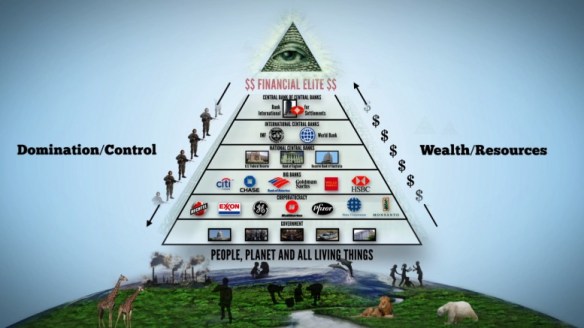
And the Beat Goes On: Mega-rich get richer. Society Crumbles

FollowTheMoney-Bank-Pyramid

By Robert De Filippis

(OpEdNews.com)

While most of us have been taking our kids to Little League games, betting on the Super Bowl, taking an occasional vacation and waiting for the American Dream to become a reality, we haven’t noticed something important happening all around us. Society has been crumbling at the edges for the last several decades.

This is not to say that lots of human beings haven’t already experienced the early stages of this societal disintegration. But they tend to be the people at the margins. People without a voice. People whose interests are not understood, let alone represented in the great debates of our times.

Think of the Mideast. Think ISIS here. Think of terrorism. Terrorists don’t attack us because of our freedoms. They attack out of desperation. Out of a frustration that comes with no future, and a feeling of impotence in the face of the continued economic violence committed in the name of corporate profits and greed. Corporations protected by the most powerful military in the history of the world. Ours!

Is it any mystery why we have over six hundred military installations in other countries around the world? We’re not under threat from anyone, but our corporation’s interests in those countries must be protected while they rape them of their labor and natural resources.

History is written by the victors and the popular public narratives are circumscribed by those whose interests they serve and not those who suffer. At the core of this phenomenon is complicity. A subconscious complicity made up of an ultra-resistant trifecta of human thinking — greed, ignorance, and certainty.

Greed now normalized has made the great American dream indistinguishable from having basic financial security to making everyone a billionaire-in-waiting. An inability to distinguish fact from opinion leads the wave of ignorance that engulfs us. Our arrogance disguised as fervent patriotism defends our ignorance and allows us to reject the knowledge we need to save ourselves.

Our generalized confusion of what constitutes a fact allows an individual’s certainty to form a resistance similar to the bacterial infections that threaten to make modern antibiotics useless. It continues to evolve. “If I can’t figure out who’s lying, I’ll believe the one who confirms my point of view. Of that I’m certain.”

Until we learn that having our beliefs validated by a media being paid to manipulate us for political gain, society will continue to disintegrate for larger and larger groups of people.

Seems like a stretch, I know. But think about how we’ve become polarized. How we are so sure of our positions that we just can’t have a conversation with those from the other side. The very conversation we need to have to figure out how we’re being duped. Then think about how our politicians use the greed, ignorance and certainty on both sides to work us up into an emotional lather. And finally, how they ignore our interests while they do the bidding of their owners keeping us distracted with our petty differences with each other.

This will come to an end. There will either be a major social revolution at the least or outright raw violence at the worst. As the authority structures lose the willing conformance of the masses, all that’s left to police them is force. And at some point – like is beginning now — the response will be violence in return. Think of the proliferation of guns in America. Think of people shooting police.

It doesn’t take much discernment to see that corporate structures are highly sophisticated mechanisms for funneling money upwards. That government collusion protects the interests of the owners of capital at the expense of the employees, customers, the general public. And the military protects their international interests.

The largest wealth producer in the world is the financial industry that simply makes money from money and produces nothing. It serves no interests but its own. Yes, some of us fortunate to have salvaged what’s left of our life savings after repeated financial crashes still enjoy the crumbs from the tables of the elite. I do mean crumbs.

Do the math. At the current rate of the upward movement of wealth, there is no other outcome but final disaster. The top 1/10th of 1 percent — not 1 percent — but 1/10th of 1 percent in America owns almost as much wealth as the bottom 90 percent in America, and it gets worse as you leave our shores.

At this rate, the world will eventually consist of gated enclaves of the mega-wealthy guarded by elite corps of paid mercenaries surrounded by billions of impoverished people.

This trajectory has increased dramatically for the last several decades. More and more of the world’s wealth is pouring into the coffers of the mega-rich. This is a zero sum game. When the masses have no wealth left, the game will be over. No matter how powerful the wealthy are, no matter how much wealth they possess, the game will be over.

How War Propaganda Keeps on Killing

071216fake

By Robert Parry

Source: Consortium News

A key reason why American foreign debacles have been particularly destructive mostly to the countries attacked but also to the United States is that these interventions are always accompanied by major U.S. government investments in propaganda. So, even when officials recognize a misjudgment has been made, the propaganda machinery continues to grind on to prevent a timely reversal.

In effect, Official Washington gets trapped by its own propaganda, which restricts the government’s ability to change direction even when the need for a shift becomes obvious.

After all, once a foreign leader is demonized, it’s hard for a U.S. official to explain that the leader may not be all that bad or is at least better than the likely alternative. So, it’s not just that officials start believing their own propaganda, it’s that the propaganda takes on a life of its own and keeps the failed policy churning forward.

It’s a bit like the old story of the chicken that continues to run around with its head cut off. In the case of the U.S. government, the pro-war or pro-intervention “group think” continues to run amok even after wiser policymakers recognize the imperative to change course.

The reason for that dilemma is that so much money gets spread around to pay for the propaganda and so many careers are tethered to the storyline that it’s easier to let thousands of U.S. soldiers and foreign citizens die than to admit that the policy was built on distortions, propaganda and lies. That would be bad for one’s career.

And, because of the lag time required for contracts to be issued and the money to flow into the propaganda shops, the public case for the policy can outlive the belief that the policy makes sense.

Need for Skeptics

Ideally, in a healthy democracy, skeptics both within the government and in the news media would play a key role in pointing out the flaws and weaknesses in the rationale for a conflict and would be rewarded for helping the leaders veer away from disaster. However, in the current U.S. establishment, such self-corrections don’t occur.

A current example of this phenomenon is the promotion of the New Cold War with Russia with almost no thoughtful debate about the reasons for this growing hostility or its possible results, which include potential thermonuclear war that could end life on the planet.

Instead of engaging in a thorough discussion, the U.S. government and mainstream media have simply flooded the policymaking process with propaganda, some of it so crude that it would have embarrassed Joe McCarthy and the Old Cold Warriors.

Everything that Russia does is put in the most negative light with no space allowed for a rational examination of facts and motivations – except at a few independent-minded Internet sites.

Yet, as part of the effort to marginalize dissent about the New Cold War, the U.S. government, some of its related “non-governmental organizations,” mainstream media outlets, and large technology companies are now pushing a censorship project designed to silence the few Internet sites that have refused to march in lockstep.

I suppose that if one considers the trillions of dollars in tax dollars that the Military Industrial Complex stands to get from the New Cold War, the propaganda investment in shutting up a few critics is well worth it.

Today, this extraordinary censorship operation is being carried out under the banner of fighting “fake news.” But many of the targeted Web sites, including Consortiumnews.com, have represented some of the most responsible journalism on the Internet.

At Consortiumnews, our stories are consistently well-reported and well-documented, but we do show skepticism toward propaganda from the U.S. government or anywhere else.

For instance, Consortiumnews not only challenged President George W. Bush’s WMD claims regarding Iraq in 2002-2003 but we have reported on the dispute within the U.S. intelligence community about claims made by President Barack Obama and his senior aides regarding the 2013 sarin gas attack in Syria and the 2014 shoot-down of Malaysia Airlines Flight 17 over Ukraine.

In those two latter cases, Official Washington exploited the incidents as propaganda weapons to justify an escalation of tensions against the Syrian and Russian governments, much as the earlier Iraqi WMD claims were used to rally the American people to invade Iraq.

However, if you question the Official Story about who was responsible for the sarin gas attack outside Damascus on Aug. 21, 2013, after President Obama, Secretary of State John Kerry and the mainstream media pronounced the Syrian government guilty, you are guilty of “fake news.”

Facts Don’t Matter

It doesn’t seem to matter that it’s been confirmed in a mainstream report by The Atlantic that Director of National Intelligence James Clapper advised President Obama that there was no “slam-dunk” evidence proving that the Syrian government was responsible. Nor does it matter that legendary investigative journalist Seymour Hersh has reported that his intelligence sources say the more likely culprit was Al Qaeda’s Nusra Front with help from Turkish intelligence.

By straying from the mainstream “group think” that accuses Syrian President Bashar al-Assad of crossing Obama’s “red line” on chemical weapons, you are opening yourself to retaliation as a “fake news” site.

Similarly, if you point out that the MH-17 investigation was put under the control of Ukraine’s unsavory SBU intelligence service, which not only has been accused by United Nations investigators of concealing torture but also has a mandate to protect Ukrainian government secrets, you also stand accused of disseminating “fake news.”

Apparently one of the factors that got Consortiumnews included on a new “black list” of some 200 Web sites was that I skeptically analyzed a report by the Joint Investigation Team (JIT) that while supposedly “Dutch-led” was really run by the SBU. I also noted that the JIT’s conclusion blaming Russia was marred by a selective reading of the SBU-supplied evidence and by an illogical narrative. But the mainstream U.S. media uncritically hailed the JIT report, so to point out its glaring flaws made us guilty of committing “fake news” or disseminating “Russian propaganda.”

The Iraq-WMD Case

Presumably, if the hysteria about “fake news” had been raging in 2002-2003, then those of us who expressed skepticism about Iraq hiding WMD would have been forced to carry a special marking declaring us to be “Saddam apologists.”

Back then, everyone who was “important” in Washington had no doubt about Iraq’s WMD. Washington Post editorial page editor Fred Hiatt repeatedly stated the “fact” of Iraq’s hidden WMD as flat fact and mocked anyone who doubted the “group think.”

Yet, even after the U.S. government acknowledged that the WMD allegations were a myth – a classic and bloody case of “fake news” – almost no one who had pushed the fabrication was punished.

So, the “fake news” stigma didn’t apply to Hiatt and other mainstream journalists who actually did produce “fake news,” even though it led to the deaths of 4,500 U.S. soldiers and hundreds of thousands of Iraqis. To this day, Hiatt remains the Post’s editorial-page editor continuing to enforce “conventional wisdoms” and to disparage those who deviate.

Another painful example of letting propaganda – rather than facts and reason – guide U.S. foreign policy was the Vietnam War, which claimed the lives of some 58,000 U.S. soldiers and millions of Vietnamese.

The Vietnam War raged on for years after Defense Secretary Robert McNamara and even President Lyndon Johnson recognized the need to end it. Part of that was Richard Nixon’s treachery in going behind Johnson’s back to sabotage peace talks in 1968, but the smearing of anti-war dissidents as pro-communist traitors locked many officials into support for the war well after its futility became obvious. The propaganda developed its own momentum that resulted in many unnecessary deaths.

A Special Marking

In the Internet era, there will now be new-age forms of censorship. Your Web site will be excluded from major search engines or electronically stamped with a warning about your unreliability.

Your guilt will be judged by a panel of mainstream media outlets, including some partially funded by the U.S. government, or maybe by some anonymous group of alleged experts.

With the tens of millions of dollars now sloshing around Official Washington to pay for propaganda, lots of entrepreneurs will be lining up at the trough to do their part. Congress just approved another $160 million to combat “Russian propaganda,” which will apparently include U.S. news sites that question the case for the New Cold War.

Along with that money, the House voted 390-30 for the Intelligence Authorization Act with a Section 501 to create an Executive Branch “interagency committee to counter active measures by the Russian Federation to exert covert influence,” an invitation to expand the  McCarthyistic witch hunt already underway to intimidate independent Internet news sites and independent-minded Americans who question the latest round of U.S. government propaganda.

Even if a President Trump decides that these tensions with Russia are absurd and that the two countries can work together in the fight against terrorism and other international concerns, the financing of the New Cold War propaganda — and the pressure to conform to Official Washington’s  “group think” — will continue.

The well-funded drumbeat of anti-Russian propaganda will seek to limit Trump’s decision-making. After all, this New Cold War cash cow can be milked for years to come and nothing – not even the survival of the human species – is more important than that.


Investigative reporter Robert Parry broke many of the Iran-Contra stories for The Associated Press and Newsweek in the 1980s. You can buy his latest book, America’s Stolen Narrative,either in print here or as an e-book (from Amazon and barnesandnoble.com).


A Nonviolent Strategy to Liberate Syria

_74590478_00e0aa73-8303-4224-89de-0029b5e5eae1

Editor’s note: While we do not completely agree with the author’s analysis of factors leading to the strife in Syria, we share his desire for greater peace, freedom and stability in the region.

By Robert J. Burrowes

In early 2011, as the Arab Spring was moving across North Africa and the
Middle East, small groups of nonviolent activists in Syria, which has
been under martial law since 1963, started protesting against the brutal
dictatorship of Bashar al-Assad and demanding democratic reforms, the
release of political prisoners, an increase in freedoms, abolition of
the emergency law and an end to corruption.

By mid-March these protests, particularly in cities such as Damascus,
Aleppo and Daraa, had escalated and the ‘Day of Rage’ protest on 15
March 2011 is considered by many to mark the start of the nationwide
uprising against the Assad dictatorship. The dictatorship’s reaction to
the protests became violent on 16 March and on 18 March, after Friday
prayers, activists gathered at the al-Omari Mosque in Daraa were
attacked by security forces with water cannons and tear gas, followed by
live fire; four nonviolent activists were killed.

Within months, as the nonviolent protests expanded and spread, the
regime had killed hundreds of activists and arbitrarily arrested
thousands, subjecting many of them to brutal torture in detention. This
pattern has continued unchecked. For the earliest of a succession of
reports that document this regime violence against nonviolent activists,
see the Human Rights Watch report ‘”We’ve Never Seen Such Horror” Crimes
against Humanity by Syrian Security Forces‘.

For the most recent report, see the UN Human Rights Council report ‘Out
of Sight, Out of Mind: Deaths in Detention in the Syrian Arab Republic‘.

In recent commentaries on the war in Syria, both long-time solidarity
activist Terry Burke – see ‘U.S. Peace Activists Should Start Listening
to Progressive Syrian Voices
– and long-term Middle East scholar Professor Stephen Zunes have
encouraged the anti-war movement to listen to Syrian voices in framing
their response, particularly given the tendency within some sections of
it to support ‘the extraordinarily brutal Assad regime – a family
dictatorship rooted in the anti-leftist military wing of the Baath
Party’. See ‘Anti-war movement must listen to voices within Syria’s
civil war’.

One such Syrian voice is that of scholar and nonviolent activist
Professor Mohja Kahf. In her account of the Syrian uprising against the
Assad dictatorship – see ‘Then and Now: The Syrian Revolution to Date. A
young nonviolent resistance and the ensuing armed struggle
– Professor Kahf offers the following introductory paragraphs:

‘The Syrian uprising sprang from the country’s grassroots, especially
from youth in their teens, and adults in their twenties and thirties.
They, not seasoned oppositionists, began the uprising, and are its core
population. They share, rather than a particular ideology, a
generational experience of disenfranchisement and brutalization by a
corrupt, repressive, and massively armed ruling elite in Syria.

‘The uprising began nonviolently and the vast majority of its populace
maintained nonviolence as its path to pursue regime change and a
democratic Syria, until an armed flank emerged in August 2011.

‘The Syrian Revolution has morphed. From midsummer to autumn 2011, armed
resistance developed, political bodies formed to represent the
revolution outside Syria, and political Islamists of various sorts
entered the uprising scene. Since then, armed resistance has
overshadowed nonviolent resistance in Syria.

‘…political bodies and support groups for the revolution’s militarized
wing, have become venues for internal power struggles among opposition
factions and individuals, and entry-points for foreign powers attempting
to push their own agendas into a revolution sprung from Syrian
grievances, grown from the spilling of Syrian blood on Syrian soil.

‘Many in the global peace community can no longer discern the Syrian
uprising’s grassroots population through the smoke of armed conflict and
the troubling new actors on the scene. Further, some in the global left
or anti-imperialist camp understand the Syrian revolution only through
the endgame of geopolitics. In such a narrative, the uprising population
is nothing but the proxy of U.S. imperialism.

‘Such critics may acknowledge that the Assad regime is brutal, but
maintain from their armchairs that Syrians must bear this cost, because
this regime has its finger in the dike of U.S. imperialism, Zionism, and
Islamism. Or, perhaps they agree that a revolution against a brutal
dictator is not a bad idea, but wish for a nicer revolution, with better
players. Eyes riveted to their pencils and rulers and idées fixés, such
critics abandon a grassroots population of disenfranchised human beings
demanding basic human freedoms in Syria. This is a stunning and cruel
failure of vision.

‘The voices of the original grassroots revolution of Syria are
nonviolent, nonsectarian, noninterventionist, for the fall of the Assad
regime, and for the rise of a democratic, human rights upholding Syria
that is bound by the rule of law. They are still present in this
revolution. Who will hear them now, after so much dear blood has been
spilled, so much tender flesh crushed under blasted blocks of cement, so
much rightful anger unleashed?’

Other Syrian voices offer a similar account. See, for example, the
recent book by Robin Yassin-Kassab and Leila al-Shami titled ‘Burning
Country: Syrians in Revolution and War’
reviewed in ‘Book Review: Burning Country‘.

If Syrians and their solidarity allies are to develop and implement a
successful nonviolent grassroots strategy to end the war in/on Syria and
remove the Assad dictatorship, then we need a sound strategic framework
that guides the comprehensive planning of our strategy. Obviously, there
is no point designing a strategy that is incomplete or cannot be
successful.

A sound strategic framework simply enables us to think and plan
strategically so that once our strategy has been elaborated, it can be
widely shared and clearly understood by everyone involved. It also means
that nonviolent actions can then be implemented because they are known
to have strategic utility and that precise utility is understood in
advance. There is little point taking action at random, especially if
our opponent is powerful and committed (even if that ‘commitment’ is
insane, which is frequently the case).

There is a simple diagram presenting a 12-point strategic framework
illustrated here in the form of the ‘Nonviolent Strategy Wheel‘.

In order to think strategically about nonviolently resolving a violent
conflict, a clearly defined political purpose is needed; that is, a
simple summary statement of ‘what you want’. However, given the
complexity of the multifaceted conflict in the case of Syria, it is
strategically simpler to identify two political purposes. These might be
stated thus: 1. To end the war in/on Syria, and 2. To establish a
democratic form of government in Syria (which, obviously, requires
removal of the dictatorship).

Once the political purpose has been defined, the two strategic aims
(‘how you get what you want’) of the strategy acquire their meaning.
These two strategic aims (which are always the same whatever the
political purpose) are as follows: 1. To increase support for your
campaign by developing a network of groups who can assist you. 2. To
alter the will and undermine the power of those groups who support the
war/dictatorship.

While the two strategic aims are always the same, they are achieved via
a series of intermediate strategic goals which are always specific to
each struggle. To keep this article reasonably straightforward, I have
only identified a set of strategic goals that would be appropriate in
the context of ending the war in/on Syria below. For a basic set of
strategic goals appropriate for ending the dictatorship, see ‘Strategic
Aims‘.

Before listing the strategic goals for ending the war, I wish to
emphasize that I have only briefly discussed two aspects of a
comprehensive strategy to end the war in/on Syria: its political purpose
and its two strategic aims (with its many subsidiary strategic goals).
For the strategy to be effective, all twelve components of the strategic
framework should be planned (and then implemented). See Nonviolent
Defense/Liberation Strategy.
This will require, for example, that tactics that will achieve the
strategic goals must be carefully chosen and implemented bearing in mind
the vital distinction between the political objective and strategic goal
of any such tactic. See ‘The Political Objective and Strategic Goal of
Nonviolent Actions‘.

Strategic goals to end the war in/on Syria

I have outlined a basic list of strategic goals below although, it
should be noted, the list would be considerably longer as individual
organizations should be specified separately.

Many of these strategic goals would usually be tackled by action groups
working in solidarity with Syria campaigning within their own country.
Ideally they would be undertaken by activist groups with existing
expertise in the relevant area (for example, experience in campaigning
against a weapons corporation) but this is not essential.

Of course, individual activist groups would usually accept
responsibility for focusing their work on achieving just one or a few of
the strategic goals (which is why any single campaign within the overall
strategy is readily manageable).

It is the responsibility of the struggle’s strategic leadership to
ensure that each of the strategic goals, which should be identified and
prioritized according to their precise understanding of the
circumstances in Syria, (so, not necessarily precisely as identified
below) is being addressed (or to prioritize if resource limitations
require this).

So here is a set of strategic goals to end the war in/on Syria:

(1) To cause the women in [women’s organizations WO1, WO2, WO…] in Syria
to join the liberation strategy by participating in [your nominated
nonviolent action(s)/campaign(s) and/or constructive program
activities]. For example, simple nonviolent actions would be to wear a
national symbol (such as a badge of the Syrian revolutionary flag and/or
ribbons in the national colors) and/or to boycott all media outlets
supporting the war. For this item and many items hereafter, see the list
of possible actions that can be taken here: ‘198 Tactics of Nonviolent Action‘.

(2) To cause the workers in [trade unions T1, T2, T…] in Syria to join
the liberation strategy by participating in [your nominated nonviolent
action(s)/campaign(s) and/or constructive program activities]. For
example, this might include withdrawing their labor from occupations
that support the Syrian military forces.

(3) To cause young people in Syria to resist conscription into the
Syrian military forces.

(4) To cause young people in Syria to refuse recruitment into the Free
Syrian Army, al-Qaeda and its affiliates/allies, the Islamic State
(Daesh) and its allies.

(5) To cause the members of [religious denominations R1, R2, R…] in
Syria to join the liberation strategy by participating in [your
nominated nonviolent action(s)/campaign(s) and/or constructive program
activities].

(6) To cause the members of [ethnic communities EC1, EC2, EC…] in Syria
to join the liberation strategy by participating in [your nominated
nonviolent action(s)/campaign(s) and/or constructive program
activities].

(7) To cause the activists, artists, musicians, intellectuals and other
key social groups in [organizations O1, O2, O…] in Syria to join the
liberation strategy by participating in [your nominated nonviolent
action(s)/campaign(s) and/or constructive program activities].

(8) To cause the students in [student organizations S1, S2, S…] in Syria
to join the liberation strategy by participating in [your nominated
nonviolent action(s)/campaign(s) and/or constructive program
activities].

(9) To cause the soldiers in [military units M1, M2, M…] to refuse to
obey orders from the dictatorship to arrest, assault, torture and shoot
nonviolent activists and the other citizens of Syria.

(10) To cause the police in [police units P1, P2, P…] to refuse to obey
orders from the dictatorship to arrest, assault, torture and shoot
nonviolent activists and the other citizens of Syria.

(11) To cause young people in [the US, NATO countries, Russia and other
countries fighting in Syria] to refuse recruitment into their respective
military forces.

(12) To cause conscripts into the military forces of [NATO countries,
Russia and other countries fighting in Syria] that still use
conscription to conscientiously refuse to perform military duties.

(13) To cause military personnel in the military forces of [the US, NATO
countries, Russia and other countries fighting in Syria] to refuse
deployment to the war in/on Syria.

(14) To cause young people in [your country] to refuse recruitment into
the Free Syrian Army, al-Qaeda and its affiliates/allies, the Islamic
State (Daesh) and its allies.

(15) To cause former soldiers in [your country] to refuse recruitment as
mercenaries by corporations that supply ‘military contractors’ to fight
in Syria.

(16) To cause the activists in [peace groups P1, P2, P…] in [your
town/city/country] to resist the war on Syria by encouraging their
members to boycott [all/specified nonmilitary products] of [weapons
corporations W1, W2, W…]. For example, this might include boycotting all
commercial flights that use Boeing and Airbus passenger aircraft given
the heavy involvement of these corporations in the production of
military aircraft.

(17) To cause the activists in [environment groups E1, E2, E…] in [your
town/city/country] to resist the war on Syria by encouraging their
members to boycott [all/specified nonmilitary products] of [weapons
corporations W1, W2, W…]. For example, this might including boycotting
all commercial products of General Electric given the heavy involvement
of this corporation in the production of military engines, systems and
services.

(18) To cause the workers in [trade unions or labor organizations T1,
T2, T….] in [your town/city/country] to resist the war on Syria by
encouraging their members to boycott [all/specified nonmilitary
products] of [weapons corporations W1, W2, W…].

(19) To cause the women in [women’s organizations WO1, WO2, WO…] in
[your town/city/country] to resist the war on Syria by encouraging their
members to boycott [all/specified nonmilitary products] of [weapons
corporations W1, W2, W…].

(20) To cause the members of [religious denominations R1, R2, R…] in
[your town/city/country] to resist the war on Syria by encouraging their
members to boycott [all/specified nonmilitary products] of [weapons
corporations W1, W2, W…].

(21) To cause the members of [ethnic communities EC4, EC5, EC…] in [your
town/city/country] to resist the war on Syria by encouraging their
members to boycott [all/specified nonmilitary products] of [weapons
corporations W1, W2, W…].

(22) To cause the artists, musicians, intellectuals and other key social
groups in [organizations O4, O5, O…] in [your town/city/country] to
resist the war on Syria by encouraging their members to boycott
[all/specified nonmilitary products] of [weapons corporations W1, W2,
W…].

(23) To cause the students in [student organizations S1, S2, S…] in
[your town/city/country] to resist the war on Syria by encouraging their
members to boycott [all/specified nonmilitary products] of [weapons
corporations W1, W2, W…].

(24) To cause the consumers in [your town/city/country] to resist the
war on Syria by boycotting [all/specified nonmilitary products] of
[weapons corporations W1, W2, W…].

(25) To cause more individuals in [your town/city/country] to resist the
war on Syria by conscientiously resisting paying [part/all] of their
taxes for war.

(26) To cause more organizations in [your town/city/country] to resist
the war on Syria by conscientiously resisting paying [part/all] of their
taxes for war.

(27) To cause [weapons corporations W4, W5, W…] to convert from the
manufacture of military weapons to [the specified/negotiated
socially/environmentally beneficial products].

(28) To cause [banks B1, B2, B…] to cease financing the weapons
industry.

(29) To cause bank customers to shift their deposits to ethical banks
and credit unions that do not finance (or are otherwise involved in) the
weapons industry.

(30) To cause [religious organizations R4, R5, R…] to divest from the
weapons industry.

(31) To cause [superannuation funds S1, S2, S…] to divest from the
weapons industry.

(32) To cause superannuation fund customers to shift their money to
ethical funds that do not finance (or are otherwise involved in) the
weapons industry.

(33) To cause [insurance companies I1, I2, I…] to divest from the
weapons industry.

(34) To cause insurance customers to shift their policies to ethical
insurance companies that do not finance (or are otherwise involved in)
the weapons industry.

(35) To cause [corporations C1, C2, C…] that provide
[services/components] for [weapons corporations W1, W2, W…] to cease
doing so.

(36) To cause the workers in [trade unions or labor organizations T4,
T5, T…] to withdraw their labor from [weapons corporations W1, W2, W…]
[partially/wholly], [temporarily/permanently].

(37) To cause the workers in [trade unions or labor organizations T7,
T8, T…] to withdraw their labor from [corporations C1, C2, C…]
[partially/wholly], [temporarily/permanently].

(38) To cause [corporations C4, C5, C…] that provides
[services/supplies] to [military bases MB1, MB2, MB…] to cease doing so.

(39) To cause the workers in [trade unions or labor organizations T10,
T11, T…] who work in/supply [military bases MB1, MB2, MB…] to withdraw
their labor [partially/wholly], [temporarily/permanently].

(40) To cause the workers in [trade unions or labor organizations T13,
T14, T…] to withdraw their labor from [corporations C4, C5, C…]
[partially/wholly], [temporarily/permanently].

(41) To cause [corporations C7, C8, C…] that manufacture and supply spy
satellites for military purposes to cease doing so.

(42) To cause the workers in [trade unions or labor organizations T16,
T17, T…] to withdraw their labor from [corporations C7, C8, C…]
[partially/wholly], [temporarily/permanently].

(43) To cause [corporations C10, C11, C…] that provide
[services/components] for the militarization of space to cease doing so.

(44) To cause the workers in [trade unions or labor organizations T19,
T20, T…] to withdraw their labor from [corporations C10, C11, C…]
[partially/wholly], [temporarily/permanently].

(45) To cause [corporations C13, C14, C…] that provide private military
contractors (mercenaries) to fight in wars to cease doing so.

(46) To cause the private military contractors (mercenaries) who fight
in wars to withdraw their labor from [corporations C13, C14, C…].

(47) To cause the soldiers in [military units M1, M2, M…] in [your
town/city/country] to refuse to obey orders to [arrest, assault, torture
and shoot, depending on your local circumstances] nonviolent activists
campaigning against the war.

(48) To cause the police in [police units P1, P2, P…] in [your
town/city/country] to refuse to obey orders to [arrest, assault, torture
and shoot, depending on your local circumstances] nonviolent activists
campaigning against the war.

(49) To cause individual members of the military forces at [Military
Base MB1/Drone Base DB1/Navy Ship NS1/Air Force Base AFB1/Army unit
AU1/Marines unit MU1] in [your town/city/country] to resign.

(50) To cause individual members of those corporations that
employ/supply private military contractors (mercenaries) to resign.

As you can see, the two strategic aims are achieved via a series of
intermediate strategic goals.

Not all of the strategic goals will need to be achieved for the strategy
to be successful but each goal is focused in such a way that its
achievement functionally undermines the power of those conducting the
war.

The difference between success and failure in any struggle is the
soundness of the strategy.


Biodata: Robert J. Burrowes has a lifetime commitment to understanding and ending human violence. He has done extensive research since 1966 in an effort to understand why human beings are violent and has been a nonviolent activist since 1981. He is the author of ‘Why Violence?‘ His email address is flametree@riseup.netand his website is at http://robertjburrowes.wordpress.com

Robert J. Burrowes
P.O. Box 68
Daylesford
Victoria 3460
Australia
Email: flametree@riseup.net

Websites:
Nonviolence Charter
Flame Tree Project to Save Life on Earth
‘Why Violence?’
Nonviolent Campaign Strategy
Nonviolent Defense/Liberation Strategy
Anita: Songs of Nonviolence
Robert Burrowes
Global Nonviolence Network

The Age of Disintegration

images

Neoliberalism, Interventionism, the Resource Curse, and a Fragmenting World

By Patrick Cockburn

Source: TomDispatch.com

We live in an age of disintegration. Nowhere is this more evident than in the Greater Middle East and Africa. Across the vast swath of territory between Pakistan and Nigeria, there are at least seven ongoing wars — in Afghanistan, Iraq, Syria, Yemen, Libya, Somalia, and South Sudan. These conflicts are extraordinarily destructive. They are tearing apart the countries in which they are taking place in ways that make it doubtful they will ever recover. Cities like Aleppo in Syria, Ramadi in Iraq, Taiz in Yemen, and Benghazi in Libya have been partly or entirely reduced to ruins. There are also at least three other serious insurgencies: in southeast Turkey, where Kurdish guerrillas are fighting the Turkish army, in Egypt’s Sinai Peninsula where a little-reported but ferocious guerrilla conflict is underway, and in northeast Nigeria and neighboring countries where Boko Haram continues to launch murderous attacks.

All of these have a number of things in common: they are endless and seem never to produce definitive winners or losers. (Afghanistan has effectively been at war since 1979, Somalia since 1991.) They involve the destruction or dismemberment of unified nations, their de facto partition amid mass population movements and upheavals — well publicized in the case of Syria and Iraq, less so in places like South Sudan where more than 2.4 million people have been displaced in recent years.

Add in one more similarity, no less crucial for being obvious: in most of these countries, where Islam is the dominant religion, extreme Salafi-Jihadi movements, including the Islamic State (IS), al-Qaeda, and the Taliban are essentially the only available vehicles for protest and rebellion. By now, they have completely replaced the socialist and nationalist movements that predominated in the twentieth century; these years have, that is, seen a remarkable reversion to religious, ethnic, and tribal identity, to movements that seek to establish their own exclusive territory by the persecution and expulsion of minorities.

In the process and under the pressure of outside military intervention, a vast region of the planet seems to be cracking open. Yet there is very little understanding of these processes in Washington. This was recently well illustrated by the protest of 51 State Department diplomats against President Obama’s Syrian policy and their suggestion that air strikes be launched targeting Syrian regime forces in the belief that President Bashar al-Assad would then abide by a ceasefire. The diplomats’ approach remains typically simpleminded in this most complex of conflicts, assuming as it does that the Syrian government’s barrel-bombing of civilians and other grim acts are the “root cause of the instability that continues to grip Syria and the broader region.”

It is as if the minds of these diplomats were still in the Cold War era, as if they were still fighting the Soviet Union and its allies. Against all the evidence of the last five years, there is an assumption that a barely extant moderate Syrian opposition would benefit from the fall of Assad, and a lack of understanding that the armed opposition in Syria is entirely dominated by the Islamic State and al-Qaeda clones.

Though the invasion of Iraq in 2003 is now widely admitted to have been a mistake (even by those who supported it at the time), no real lessons have been learned about why direct or indirect military interventions by the U.S. and its allies in the Middle East over the last quarter century have all only exacerbated violence and accelerated state failure.

A Mass Extinction of Independent States

The Islamic State, just celebrating its second anniversary, is the grotesque outcome of this era of chaos and conflict. That such a monstrous cult exists at all is a symptom of the deep dislocation societies throughout that region, ruled by corrupt and discredited elites, have suffered. Its rise — and that of various Taliban and al-Qaeda-style clones — is a measure of the weakness of its opponents.

The Iraqi army and security forces, for example, had 350,000 soldiers and 660,000 police on the books in June 2014 when a few thousand Islamic State fighters captured Mosul, the country’s second largest city, which they still hold. Today the Iraqi army, security services, and about 20,000 Shia paramilitaries backed by the massive firepower of the United States and allied air forces have fought their way into the city of Fallujah, 40 miles west of Baghdad, against the resistance of IS fighters who may have numbered as few as 900. In Afghanistan, the resurgence of the Taliban, supposedly decisively defeated in 2001, came about less because of the popularity of that movement than the contempt with which Afghans came to regard their corrupt government in Kabul.

Everywhere nation states are enfeebled or collapsing, as authoritarian leaders battle for survival in the face of mounting external and internal pressures. This is hardly the way the region was expected to develop. Countries that had escaped from colonial rule in the second half of the twentieth century were supposed to become more, not less, unified as time passed.

Between 1950 and 1975, nationalist leaders came to power in much of the previously colonized world. They promised to achieve national self-determination by creating powerful independent states through the concentration of whatever political, military, and economic resources were at hand. Instead, over the decades, many of these regimes transmuted into police states controlled by small numbers of staggeringly wealthy families and a coterie of businessmen dependent on their connections to such leaders as Hosni Mubarak in Egypt or Bashar al-Assad in Syria.

In recent years, such countries were also opened up to the economic whirlwind of neoliberalism, which destroyed any crude social contract that existed between rulers and ruled. Take Syria. There, rural towns and villages that had once supported the Baathist regime of the al-Assad family because it provided jobs and kept the prices of necessities low were, after 2000, abandoned to market forces skewed in favor of those in power. These places would become the backbone of the post-2011 uprising. At the same time, institutions like the Organization of Petroleum Exporting Countries (OPEC) that had done so much to enhance the wealth and power of regional oil producers in the 1970s have lost their capacity for united action.

The question for our moment: Why is a “mass extinction” of independent states taking place in the Middle East, North Africa, and beyond? Western politicians and media often refer to such countries as “failed states.” The implication embedded in that term is that the process is a self-destructive one. But several of the states now labeled “failed” like Libya only became so after Western-backed opposition movements seized power with the support and military intervention of Washington and NATO, and proved too weak to impose their own central governments and so a monopoly of violence within the national territory.

In many ways, this process began with the intervention of a U.S.-led coalition in Iraq in 2003 leading to the overthrow of Saddam Hussein, the shutting down of his Baathist Party, and the disbanding of his military. Whatever their faults, Saddam and Libya’s autocratic ruler Muammar Gaddafi were clearly demonized and blamed for all ethnic, sectarian, and regional differences in the countries they ruled, forces that were, in fact, set loose in grim ways upon their deaths.

A question remains, however: Why did the opposition to autocracy and to Western intervention take on an Islamic form and why were the Islamic movements that came to dominate the armed resistance in Iraq and Syria in particular so violent, regressive, and sectarian? Put another way, how could such groups find so many people willing to die for their causes, while their opponents found so few? When IS battle groups were sweeping through northern Iraq in the summer of 2014, soldiers who had thrown aside their uniforms and weapons and deserted that country’s northern cities would justify their flight by saying derisively: “Die for [then-Prime Minister Nouri] al-Maliki? Never!”

A common explanation for the rise of Islamic resistance movements is that the socialist, secularist, and nationalist opposition had been crushed by the old regimes’ security forces, while the Islamists were not. In countries like Libya and Syria, however, Islamists were savagely persecuted, too, and they still came to dominate the opposition. And yet, while these religious movements were strong enough to oppose governments, they generally have not proven strong enough to replace them.

Too Weak to Win, But Too Strong to Lose

Though there are clearly many reasons for the present disintegration of states and they differ somewhat from place to place, one thing is beyond question: the phenomenon itself is becoming the norm across vast reaches of the planet.

If you’re looking for the causes of state failure in our time, the place to start is undoubtedly with the end of the Cold War a quarter-century ago. Once it was over, neither the U.S. nor the new Russia that emerged from the Soviet Union’s implosion had a significant interest in continuing to prop up “failed states,” as each had for so long, fearing that the rival superpower and its local proxies would otherwise take over. Previously, national leaders in places like the Greater Middle East had been able to maintain a degree of independence for their countries by balancing between Moscow and Washington. With the break-up of the Soviet Union, this was no longer feasible.

In addition, the triumph of neoliberal free-market economics in the wake of the Soviet Union’s collapse added a critical element to the mix. It would prove far more destabilizing than it looked at the time.

Again, consider Syria. The expansion of the free market in a country where there was neither democratic accountability nor the rule of law meant one thing above all: plutocrats linked to the nation’s ruling family took anything that seemed potentially profitable. In the process, they grew staggeringly wealthy, while the denizens of Syria’s impoverished villages, country towns, and city slums, who had once looked to the state for jobs and cheap food, suffered. It should have surprised no one that those places became the strongholds of the Syrian uprising after 2011. In the capital, Damascus, as the reign of neoliberalism spread, even the lesser members of the mukhabarat, or secret police, found themselves living on only $200 to $300 a month, while the state became a machine for thievery.

This sort of thievery and the auctioning off of the nation’s patrimony spread across the region in these years. The new Egyptian ruler, General Abdel Fattah al-Sisi, merciless toward any sign of domestic dissent, was typical. In a country that once had been a standard bearer for nationalist regimes the world over, he didn’t hesitate this April to try to hand over two islands in the Red Sea to Saudi Arabia on whose funding and aid his regime is dependent. (To the surprise of everyone, an Egyptian court recently overruled Sisi’s decision.)

That gesture, deeply unpopular among increasingly impoverished Egyptians, was symbolic of a larger change in the balance of power in the Middle East: once the most powerful states in the region — Egypt, Syria, and Iraq — had been secular nationalists and a genuine counterbalance to Saudi Arabia and the Persian Gulf monarchies. As those secular autocracies weakened, however, the power and influence of the Sunni fundamentalist monarchies only increased. If 2011 saw rebellion and revolution spread across the Greater Middle East as the Arab Spring briefly blossomed, it also saw counterrevolution spread, funded by those oil-rich absolute Gulf monarchies, which were never going to tolerate democratic secular regime change in Syria or Libya.

Add in one more process at work making such states ever more fragile: the production and sale of natural resources — oil, gas, and minerals — and the kleptomania that goes with it. Such countries often suffer from what has become known as “the resources curse”: states increasingly dependent for revenues on the sale of their natural resources — enough to theoretically provide the whole population with a reasonably decent standard of living — turn instead into grotesquely corrupt dictatorships. In them, the yachts of local billionaires with crucial connections to the regime of the moment bob in harbors surrounded by slums running with raw sewage. In such nations, politics tends to focus on elites battling and maneuvering to steal state revenues and transfer them as rapidly as possible out of the country.

This has been the pattern of economic and political life in much of sub-Saharan Africa from Angola to Nigeria. In the Middle East and North Africa, however, a somewhat different system exists, one usually misunderstood by the outside world. There is similarly great inequality in Iraq or Saudi Arabia with similarly kleptocratic elites. They have, however, ruled over patronage states in which a significant part of the population is offered jobs in the public sector in return for political passivity or support for the kleptocrats.

In Iraq with a population of 33 million people, for instance, no less than seven million of them are on the government payroll, thanks to salaries or pensions that cost the government $4 billion a month. This crude way of distributing oil revenues to the people has often been denounced by Western commentators and economists as corruption. They, in turn, generally recommend cutting the number of these jobs, but this would mean that all, rather than just part, of the state’s resource revenues would be stolen by the elite. This, in fact, is increasingly the case in such lands as oil prices bottom out and even the Saudi royals begin to cut back on state support for the populace.

Neoliberalism was once believed to be the path to secular democracy and free-market economies. In practice, it has been anything but. Instead, in conjunction with the resource curse, as well as repeated military interventions by Washington and its allies, free-market economics has profoundly destabilized the Greater Middle East. Encouraged by Washington and Brussels, twenty-first-century neoliberalism has made unequal societies ever more unequal and helped transform already corrupt regimes into looting machines. This is also, of course, a formula for the success of the Islamic State or any other radical alternative to the status quo. Such movements are bound to find support in impoverished or neglected regions like eastern Syria or eastern Libya.

Note, however, that this process of destabilization is by no means confined to the Greater Middle East and North Africa. We are indeed in the age of destabilization, a phenomenon that is on the rise globally and at present spreading into the Balkans and Eastern Europe (with the European Union ever less able to influence events there). People no longer speak of European integration, but of how to prevent the complete break-up of the European Union in the wake of the British vote to leave.

The reasons why a narrow majority of Britons voted for Brexit have parallels with the Middle East: the free-market economic policies pursued by governments since Margaret Thatcher was prime minister have widened the gap between rich and poor and between wealthy cities and much of the rest of the country. Britain might be doing well, but millions of Britons did not share in the prosperity. The referendum about continued membership in the European Union, the option almost universally advocated by the British establishment, became the catalyst for protest against the status quo. The anger of the “Leave” voters has much in common with that of Donald Trump supporters in the United States.

The U.S. remains a superpower, but is no longer as powerful as it once was. It, too, is feeling the strains of this global moment, in which it and its local allies are powerful enough to imagine they can get rid of regimes they do not like, but either they do not quite succeed, as in Syria, or succeed but cannot replace what they have destroyed, as in Libya. An Iraqi politician once said that the problem in his country was that parties and movements were “too weak to win, but too strong to lose.” This is increasingly the pattern for the whole region and is spreading elsewhere. It carries with it the possibility of an endless cycle of indecisive wars and an era of instability that has already begun.


Patrick Cockburn is a Middle East correspondent for the Independent of London and the author of five books on the Middle East, the latest of which isChaos and Caliphate: Jihadis and the West in the Struggle for the Middle East(OR Books).

America’s War Party

war-criminals

By Steven Lendman

Source: SteveLendman Blog

America is a one-party state with two wings, each virtually identical to the other, differing only in style and rhetoric.

They’re in lockstep on issues mattering most – notably supporting endless wars at the expense of peace, equity and justice.

America’s so-called war of independence changed little, afforded no benefits for “we the people,” did nothing more than substitute new management for old.

Civil war had nothing to do with freeing slaves, everything to do with keeping the nation intact and serving dominant monied interests. War assures huge profits.

19th century wars were waged to steal land and resources from America’s native people, annex Texas, then half of Mexico, followed by Cuba, the Philippines, Guam, Samoa, Hawaii, Haiti, the Dominican Republic, Canal Zone, Puerto Rico and other territories.

Peace candidate Woodrow Wilson manipulated public sentiment in office, turned largely pacifist Americans into raging German haters and got the war he wanted.

Senator Robert La Follette/later 1924 Progressive Party presidential aspirant said at the time “(e)very nation has its war party.”

“It is not the party of democracy. It is the party of autocracy. It seeks to dominate absolutely.”

“It is commercial, imperialistic, ruthless. It tolerates no opposition. It is just as arrogant, just as despotic, in London, or in Washington, as in Berlin.”

“The American Jingo is twin to the German Junker. If there is no sufficient reason for war, the war party will make war on one pretext, then invent another.”

Yesteryear’s “Jingo” is today’s bipartisan neocon, the curse infesting Washington, waging endless wars on humanity at home and abroad – risking another global one with super-weapons able to extinguish life on earth.

Socialist leader Eugene Debs was imprisoned for opposing America’s involvement in WW I. Ahead of his ordeal, his Socialist Party called the war “a crime against the people of the United States.”

He said “(t)hey tell us that we live in a great free republic; that our institutions are democratic; that we are a free and self-governing people.”

“That is too much, even for a joke…Wars throughout history have been waged for conquest and plunder… And that is war in a nutshell. The master class has always declared the wars; the subject class has always fought the battles.”

During the war my dad was conscripted to fight in, about 900 people were imprisoned for opposing it. Tens of thousands declared themselves conscientious objectors and refused to serve.

True to its tradition, The New York Times supported America’s war party, urged its readers to inform authorities of “any evidence of sedition” instead of denouncing the great war preceding the greater one two decades later.

Endless others followed, raging today in multiple theaters, much more likely coming, possible nuclear war today more threatening than perhaps any previous time.

Monied interests support America’s war party – benefitting hugely at the expense of most others.

Resisting tyranny is a universal right and obligation. We have a choice – resist or perish.


War Pabulum: The Perils of War as a Master Narrative


photo posted on post-gazette.com

By W.J. Astore

Source: Bracing Views

I was reading the novelist Ursula K. Le Guin and came across the following commentary by her:

“A hero whose heroism consists of killing people is uninteresting to me, and I detest the hormonal war orgies of our visual media … War as a moral metaphor is limited, limiting, and dangerous.  By reducing the choices of action to ‘a war against’ whatever-it-is, you divide the world into Me or Us (good) and Them or It (bad) and reduce the ethical complexity and moral richness of our life to Yes/No, On/Off.  This is puerile, misleading, and degrading.  In stories, it evades any solution but violence and offers the reader mere infantile reassurance.  All too often the heroes of such fantasies behave exactly as the villains do, acting with mindless violence, but the hero is on the ‘right’ side and therefore will win.”

This passage is copyrighted 2012, and surely Le Guin is commenting in part on the American political and war scene, even if these comments came as an afterword to her novel “A Wizard of Earthsea.”

The stories we tell ourselves – our driving narratives and metaphors – are very powerful.  I learned this almost three decades ago from one of my professors at Johns Hopkins.  We were talking about the scientific revolution, the label applied after the fact by historians to the era of Copernicus, Kepler, Galileo, and Newton.  Did that era truly deserve the label of a “revolution” in thought?  On one level, yes.  A heliocentric vision replaced a geocentric one.  Newtonian physics replaced Aristotelian metaphysics.  But on another level, the label was misleading.  If you view this era only through a “revolutionary” lens, everything gets magnified and refracted through it.  You’re always looking for evidence of the “revolution” that you know is there.  The revolutionary narrative/metaphor, in other words, restricts and distorts your vision.  It also tends to answer questions before they’re even asked.  Certain historical figures get labeled as “revolutionaries,” others as “reactionaries,” some as winners, others as losers, almost without having to think about it.

That’s disturbing enough for a historian dealing with the “dead” past.  Think about how that distortion, that resort to easy categorization, applies to the living, to the present, in “wartime.”  Viewing everything through a war lens both restricts and distorts our vision.  We quickly force people to take sides, or we assign them a side regardless of their complexity (“You’re either for us or against us,” as George W. Bush noted in the aftermath of 9/11).  Just as quickly, the “heroes” adopt the violent methods of the bad guys (witness the bombing, the invasions, the use of torture, performed by the U.S. in the stated cause of “liberation”).  No ethical complexity is tolerated since “our” troops are on the right side (so we think).  Even when they embrace violence and lose control, deadly mistakes and even war crimes are readily excused as aberrations that should be forgotten, rare exceptions that do nothing to besmirch America’s exceptional and heroic nature.

The power of narratives is remarkable.  The United States continues to be driven by one that’s dominated by power, violence, and war.  Is it any wonder, then, that the two major party candidates for the presidency, Hillary Clinton and Donald Trump, fit so easily and readily into this narrative?  Hillary plans to continue to wage war even more aggressively than Obama has, and Trump is all about violent solutions and an “Us” versus “Them” mentality.  (Build a wall!  Biggest, baddest military!  Make America great again!  Punch the protesters!    Extreme vetting!  Throw the illegals out!)

Until we change our national narrative from one of constant war and violence to something more pacific and modulated, our political scene will continue to be, to borrow Le Guin’s words, puerile and misleading and degrading, with candidates serving up heroic violence as pabulum, as infantile reassurance.

America, the World’s Most Dangerous Dictatorship

american-imperialism-39-638

By Gordon Duff

Source: New Eastern Outlook

Though Russia doesn’t consider herself a superpower, other than the US, and just perhaps China, Russia is as close as we come. A very real problem is that Russia has a very poor understanding of America, how politics work, what Americans think and, more than anything else, Russia still thinks America is a democracy.

You see, at the same time America was tearing the Soviet Union apart, the same thing was being done to America. Neither nation survived, it wasn’t just the Soviet Union that fell to the New World Order, it was America as well. Let me explain as succinctly as possible.

During the Clinton years, powerful Nazi inspired elements in America plotted what has been the successful overthrow of America’s constitution. The movement was led by rogue “industrialist” John Mellon Scaife and lawyers Antonio Scalia and Newt Gingrich. Financing them all was the Rothschild owned and controlled Federal Reserve Corporation.

A secret society hidden in plain sight was set up called the Federalist Society. This Nazi controlled group, backed by the powerful Israel lobby, moved into every law school in America, recruiting top candidates based on skill sets needed.

This program was devised by the CIA and recruited thousands of budding sociopathic personality types, recruiting them into the Federalist Society and channeling them into top law firms or government agencies.

Adding to these recruits were senior lawyers with ties to organized and corporate crime, thousands of them in a major CIA operation.

There, they were pushed forward and after a decade ran the US Department of Justice, nearly every court in the nation, controlled the law schools, controlled the American Bar Association, the FBI and had put over 150 of their members into the Congress of the United States.

They also controlled every regulatory agency, environment, banking and finance, food and drug safety, you can see where this is going.

They also controlled 5 justices of the Supreme Court of the United States.

During the Clinton Administration, they managed to temporarily get control of the US House of Representatives through the help of the Contract with America and Newt Gingrich, financed by Zionist “black propaganda” moneyman Rupert Murdoch. In payment for this, “Newt” gave Murdoch an American broadcast network, Fox, though illegal. You see, non-Americans can’t control networks, or couldn’t. That’s ok, Gingrich eventually gave Murdoch illegal American citizenship as well.

Murdoch only had to publish Newt’s useless books and give his wife, and Newt traded them in with regularity, a highly paid “do nothing job” as a bribe.

Where things really paid off was 2000. During the Clinton administration, Scaife hired lawyer Ken Starr to investigate Clinton and get himself nominated as Special Prosecutor. Scaife paid Starr by naming him President of Pepperdine University, which Scaife controlled, for those who care about facts.

Clinton backer George Soros hired a former CIA agent named Steve Kangas to get dirt on Scaife. Kangas amassed enough evidence on Scaife and his deal with Starr to send them both to the electric chair. Scaife, Scalia and the Federalists had Kangas kidnapped and murdered in order to save Ken Starr who had been promised a seat on the US Supreme Court. Look into it.

The deal really came to life in 2000. The CIA and Diebold Corporation had contracted with a computer guru named Michael Connell who developed software that would simply flip votes done on electronic voting machines. Targeted would be the states of Ohio, Florida and Virginia only, piling up votes in key precincts just enough to guarantee control of the Electoral College.

Without this it is impossible for the Republican Party to get a president elected without staging an international incident such as the kidnapping of US diplomats in Tehran. We aren’t going to say the Ayatollah was an MI6 agent and was sent to Iran for exactly this purpose, even though it is true and we can prove it.

In 2000, even with millions of votes flipped, exit polls support Bush losing by 5 million votes, the election couldn’t be saved. Here, the Federalists stepped in and had their 5 Supreme Court justices step in and overthrow both the areas of equal protection and states’ rights of the US Constitution to place Bush in office.

2000 was important. This was a presidential election that also took place on a census year. You see, the census is a rationale for redistricting the US House of Representatives using State legislatures, which were largely taken over by the Federalist Society. Bribes and payoffs at state level are hard to control and organized crime easily got control of enough states to allow redistricting.

Here, the CIA developed a program for designing odd shaped congressional districts that would pile union workers and minorities into bizarre and often discontiguous shapes, taking districts away from democrats by joining them together and creating new republican only districts, often with almost no people living in them.

Additionally, problem representatives like Ohio’s Dennis Kucinich were eliminated entirely, their districts were simply erased, all of this, and it is called gerrymandering, is illegal.

By 2004 there were no more free elections for the House of Representatives, giving this house free rein to investigate anyone, any time and to quell any investigation as well, such as 9/11.

By 2005, by a 5/4 vote, the Supreme Court in the Citizens United case overturned for all time limitations on foreign and corporate spending on American elections, citing an end to democracy in America.

Mike Connell, GOP “guru” died in a mysterious plane crash in Ohio just before testifying about his role in CIA “vote flipping.”

This is as short and sweet as it could be put. For those who fail to understand the Federalist Society and the hold organized crime through the Republican Party has gained over American government, the new Cold War and the threat of a hot war as well is a total surprise.

For those who pay attention, we saw it coming all along.