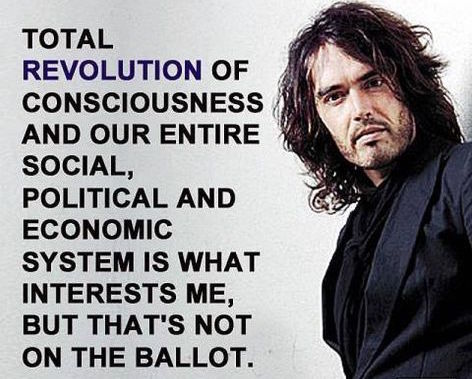
Your Awakening Counts More Than Your Vote

russell-brand-total-revolution-of-consciousness

By Dylan Charles

Source: Waking Times

We live in a world where illusions are held in higher esteem than verifiable truth. This is no accident, as the individual has for decades now been on the receiving end of social engineering programs, advanced political and corporate propaganda, fear programming and outright mind control.

The sum total of all this mass conditioning has been to convince otherwise good-natured and hard-working people to participate in their own enslavement and to willingly acquiesce to the ever-increasing rules, invasions of privacy, taxations, permissions and control schemes of a government and world elite who have long since left public interest in the dust.

The American dream is a mythic idea that was supposedly founded on the principle that public oversight of government is possible thanks to an electoral process which would give an informed citizenry the opportunity to replace undesirable politicians with better ones. Government itself, though, is a brutish and violent force that has time and again proven absolutely wild, reckless and untamable. It has never has obeyed its own laws, policies or regulations, and world history is a bloodstained chronicle of man’s failure to control himself when given power in the form of government.

Just as you cannot stop the tides from rising and falling, you cannot stop government from decaying into tyranny, especially so by following its very own rules and by participating in its token rituals.

This is truth, yet the illusion of so-called ‘democracy’ persists, seeming to grip people ever more feverishly with each passing election season. Even in the face of overt election fraud, party infighting, delegate rigging and widespread disenfranchisement. And so here we are again, facing the embarrassing spectacle of choosing between two undesirables when we all know the game is rigged.

For the powers the be, though, the repeating four-year cycle of presidential politics is the most effective device for keeping the masses high on the illusion of self-governance. It force feeds us on a regular schedule the false narrative that we the people can vote to reign in the power and corruption of the oligarchy of deep state, private and corporate influences that truly control the direction of this nation.

In this light, the purpose of national politics is not to perpetuate self-governance for the benefit of the common person, but rather to eat up personal energy and resources in order to suck the individual into a quagmire of false hope and endless patience with outrage after outrage. It is to make ineffectual action feel like action to the people being most screwed over by the corruption of the elite.

Sure, this may sound negative, cynical or apathetic to those who are over-invested emotionally in this game, but in order to move beyond the insanity of doing the same thing again and again while expecting different results, it’s imperative to be deadly honest about how this program works to enslave us, not to free us. Once we can think beyond the peer pressure, neighbor-hating, and mindless outrage that marks each election cycle, we make ourselves available to the possibility of real change. And real change always begins from within, and never forced from without.

There is no political leader who can make you stand fearlessly in this complex and dangerous world.There is no candidate that can give you the freedom that comes with a healthy mind and body. There is no political ruler who can manifest true and lasting happiness for you. There is no politician who can ensure that you enjoy the experience of your life everyday, under any and all circumstances. And there is no president that can empower you to be the best possible version of yourself so that you may give your best to others.

All of these qualities are vastly more critical to personal, community and planetary renewal than whichever new figurehead is selected to be the perceived front man of a morbidly corrupt American government.

The most effective way to change the world around you is to first focus on and create more value in yourself. This is why your awakening counts far more than your vote does. 

Hang onto your wallets: Negative interest, the war on cash, and the $10 trillion bail-in

global-economic-crisis

By Ellen Brown

Source: Intrepid Report

Remember those old ads showing a senior couple lounging on a warm beach, captioned “Let your money work for you”? Or the scene in Mary Poppins where young Michael is being advised to put his tuppence in the bank, so that it can compound into “all manner of private enterprise,” including “bonds, chattels, dividends, shares, shipyards, amalgamations . . .”?

That may still work if you’re a Wall Street banker, but if you’re an ordinary saver with your money in the bank, you may soon be paying the bank to hold your funds rather than the reverse.

Four European central banks—the European Central Bank, the Swiss National Bank, Sweden’s Riksbank, and Denmark’s Nationalbank—have now imposed negative interest rates on the reserves they hold for commercial banks; and discussion has turned to whether it’s time to pass those costs on to consumers. The Bank of Japan and the Federal Reserve are still at ZIRP (Zero Interest Rate Policy), but several Fed officials have also begun calling for NIRP (negative rates) [update: Bank of Japan implemented a negative interest rate 1/29/16].

The stated justification for this move is to stimulate “demand” by forcing consumers to withdraw their money and go shopping with it. When an economy is struggling, it is standard practice for a central bank to cut interest rates, making saving less attractive. This is supposed to boost spending and kick-start an economic recovery.

That is the theory, but central banks have already pushed the prime rate to zero, and still their economies are languishing. To the uninitiated observer, that means the theory is wrong and needs to be scrapped. But not to our intrepid central bankers, who are now experimenting with pushing rates below zero.

Locking the door to bank runs: The cashless society

The problem with imposing negative interest on savers, as explained in the UK Telegraph, is that “there’s a limit, what economists called the ‘zero lower bound.’ Cut rates too deeply, and savers would end up facing negative returns. In that case, this could encourage people to take their savings out of the bank and hoard them in cash. This could slow, rather than boost, the economy.”

Again, to the ordinary observer, this would seem to signal that negative interest rates won’t work and the approach needs to be abandoned. But not to our undaunted central bankers, who have chosen instead to plug this hole in their leaky theory by moving to eliminate cash as an option. If your only choice is to keep your money in a digital account in a bank and spend it with a bank card or credit card or checks, negative interest can be imposed with impunity. This is already happening in Sweden, and other countries are close behind. As reported on Wolfstreet.com:

The War on Cash is advancing on all fronts. One region that has hogged the headlines with its war against physical currency is Scandinavia. Sweden became the first country to enlist its own citizens as largely willing guinea pigs in a dystopian economic experiment: negative interest rates in a cashless society. As Credit Suisse reports, no matter where you go or what you want to purchase, you will find a small ubiquitous sign saying “Vi hanterar ej kontanter” (“We don’t accept cash”) . . .

The lesson of Gesell’s decaying currency

Whether negative interests will actually stimulate an economic recovery, however, remains in doubt. Proponents of the theory cite Silvio Gesell and the Wörgl experiment of the 1930s. As explained by Charles Eisenstein in Sacred Economics:

The pioneering theoretician of negative-interest money was the German-Argentinean businessman Silvio Gesell, who called it “free-money” (Freigeld). . . . The system he proposed in his 1906 masterwork, The Natural Economic Order, was to use paper currency to which a stamp costing a small fraction of the note’s value had to be affixed periodically. This effectively attached a maintenance cost to monetary wealth.

. . . [In 1932], the depressed town of Wörgl, Austria, issued its own stamp scrip inspired by Gesell. . . . The Wörgl currency was by all accounts a huge success. Roads were paved, bridges built, and back taxes were paid. The unemployment rate plummeted and the economy thrived, attracting the attention of nearby towns. Mayors and officials from all over the world began to visit Wörgl until, as in Germany, the central government abolished the Wörgl currency and the town slipped back into depression.

. . . [T]he Wörgl currency bore a demurrage rate [a maintenance charge for carrying money] of 1 percent per month. Contemporary accounts attributed to this the very rapid velocity of the currencies’ circulation. Instead of generating interest and growing, accumulation of wealth became a burden, much like possessions are a burden to the nomadic hunter-gatherer. As theorized by Gesell, money afflicted with loss-inducing properties ceased to be preferred over any other commodity as a store of value.

There is a critical difference, however, between the Wörgl currency and the modern-day central bankers’ negative interest scheme. The Wörgl government first issued its new “free money,” getting it into the local economy and increasing purchasing power, before taxing a portion of it back. And the proceeds of the stamp tax went to the city, to be used for the benefit of the taxpayers. As Eisenstein observes:

It is impossible to prove . . . that the rejuvenating effects of these currencies came from demurrage and not from the increase in the money supply. . . .

Today’s central bankers are proposing to tax existing money, diminishing spending power without first building it up. And the interest will go to private bankers, not to the local government.

Consumers today already have very little discretionary money. Imposing negative interest without first adding new money into the economy means they will have even less money to spend. This would be more likely to prompt them to save their scarce funds than to go on a shopping spree.

People are not keeping their money in the bank today for the interest (which is already nearly non-existent). It is for the convenience of writing checks, issuing bank cards, and storing their money in a “safe” place. They would no doubt be willing to pay a modest negative interest for that convenience; but if the fee got too high, they might pull their money out and save it elsewhere. The fee itself, however, would not drive them to buy things they did not otherwise need.

Is there a bigger threat than a sluggish economy?

The scheme to impose negative interest and eliminate cash seems so unlikely to stimulate the economy that one wonders if that is the real motive. Stopping tax evaders and terrorists (real or presumed) are other proposed justifications for going cashless. Economist Martin Armstrong goes further and suggests that the goal is to gain totalitarian control over our money. In a cashless society, our savings can be taxed away by the banks; the threat of bank runs by worried savers can be eliminated; and the too-big-to-fail banks can be assured that ample deposits will be there when they need to confiscate them through bail-ins to stay afloat.

And that may be the real threat on the horizon: a major derivatives default that hits the largest banks, those that do the vast majority of derivatives trading. On November 10, 2015, the Wall Street Journal reported the results of a study requested by Senator Elizabeth Warren and Rep. Elijah Cummings, involving the cost to taxpayers of the rollback of the Dodd-Frank Act in the “cromnibus” spending bill last December. As Jessica Desvarieux put it on the Real News Network, “the rule reversal allows banks to keep $10 trillion in swaps trades on their books, which taxpayers could be on the hook for if the banks need another bailout.”

The promise of Dodd-Frank, however, was that there would be “no more taxpayer bailouts.” Instead, insolvent systemically-risky banks were supposed to “bail in” (confiscate) the money of their creditors, including their depositors (the largest class of creditor of any bank). That could explain the push to go cashless. By quietly eliminating the possibility of cash withdrawals, the central bank can make sure the deposits are there to be grabbed when disaster strikes.

If central bankers are seriously trying to stimulate the economy with negative interest rates, they need to repeat the Wörgl experiment in full. They need to first get some new money into the economy, money that goes directly to the consumers and local businessmen who will spend it. This could be achieved in a number of ways: with a national dividend; or by using quantitative easing for infrastructure or low-interest loans to states; or by funding free tuition for higher education. Consumers will hit the malls when they have some new discretionary income to spend.

Ellen Brown is an attorney, founder of the Public Banking Institute, and author of twelve books including the best-selling Web of Debt. Her latest book, The Public Bank Solution, explores successful public banking models historically and globally. Her 300+ blog articles are at EllenBrown.com. Listen to “It’s Our Money with Ellen Brown” on PRN.FM.

Towards a Critical Public Pedagogy of Predatory Anthropocene

blogs_500x400_5619_695657_poll_xlarge

By Michael B. McDonald

Source: The Hampton Institute

In 2015, a group of scientists published ” The trajectory of the Anthropocene: The Great Acceleration “. They showed that rising consumption and increasing rates of impact on Earth Systems began after the Second World War. It was the expansion of economic activity charged by increasing resource use that created new technologies that expanded rates of consumption. This was a celebrated new socio-economic phase called the Great Acceleration that was supposed to lead to full employment and a bright future for all. It was also the beginning of a next phase of world capitalism accelerated by increasing urbanization. By 2008 humanity officially entered a new urban phase where 50% of the earth’s population lives in urban spaces. More cities will be built in the next thirty years than in all previous human history. Earth System scientists have shown that all of these changes are having unprecedented impacts on the Earth. Human life is changing the Earth, they call it anthropocene.

But the Great Acceleration did not lead to full employment nor a bright future. In fact, it has led to massive inequality created by a very small percentage of people controlling a staggering amount of wealth. In 2010, OECD countries had 18% of the earth’s population but accounted for 74% of GDP. But only .1% controlled this vast wealth through a system that I call predatory anthropocene.

The system of predatory anthropocene can be found in changes to the global economy and a fundamental shift in the way the economy works through its transformation of subjective, social and environmental ecologies, what Felix Guattari called the Three Ecologies. One aspect of this change has been called semiocapitalism, the blending of imagination, ideas, language and capital. Semiocapitalism works by capturing evolutionary life. Belonging, for instance, is now produced by the consumption of psycho-social products that gain economic value in consumption and are financed by increasing debt. The GDP of the United States is now 70% consumption.

Making community through mass consumption is eroding the anthropological basis upon which human life is built. We need a language for this. Perhaps we need to recognize that the communicative and biological systems of the human species have habitats. The biosphere sustains biological life while the ethnosphere sustains communicational life. The biosphere is quite well known but the ethnosphere less so. Wade Davis suggests that the ethnosphere is a global quilt of local cultures, a band of cultural life functioning in tandem with the biosphere for the creation, organization, and expression of human communicational life.[1] The ethnosphere is a collection of languages, ideas, and dreams. It is the anthropological rituals that have accompanied human evolution, has organized social reproduction, it is the institution of language [2] in all its complexity, but is also beyond language.[3] When people talk about humanity in general, they mean the biosphere and ethnosphere, the cultures of the world in their physical, expressive, subjective dimensions. But now ethnosphere complexity is reduced by global commodities, unique cultures consumed by Hollywood-hegemony, human imagination consumed by consumer products, dreams being replaced by corporate produced and globalized desires. A single system is producing hegemony in ways that no single system was ever before capable. It is necessary for us to see that our species is under threat by a monster system that we have created, a monsterous, cancerous, predatory system poisoning the Earth. Henry Giroux has argued that:

What makes American society distinct in the present historical moment are a culture and social order that have not only lost their moral bearings but produce levels of symbolic and real violence whose visibility and existence set a new standard for cruelty, humiliation, and mechanizations of a mad war machine, all of which serves the interest of the political and corporate walking dead-the new avatars of death and cruelty-that plunder the social order and wreak ecological devastation. We now live in a world overrun with flesh-eating zombies, parasites who have a ravenous appetite for global destruction and civic catastrophe. (2014, xi-xii)[4]

Because I follow Guattari’s cybernetic view I am less certain than Giroux appears to be, that is it possible to tell zombies from non-zombies in a period where a) agribusiness replaces agriculture and transforms all aspects of domestic life that b) creates stretches of suburbs that wipe out, without social discussion, the farmland that has laid the foundation of human flourishing, c) as mounting debt continues without slowing and without discourse in the public sphere, as d) waves of fellow humans are dislocated everyday due to military, economic, and environmental calamities. And none of this is news, we watch all of it studiously, staring at our displays unmoved by the misery and pain we see on the faces, and hear in the cries of fellow humans. Too many of us escape our responsibilities to confront this pain by fleeing to walled-in communities whose walls are maintained, not by bricks but by the capacity to carry the mortgage debt (that machinically contributes to predatory anthropocene) in the hopes of living in relative safety while the poor (who can not access debt) are left in decaying city centers. But as foreclosures swept across America after the housing bubble burst, suburban safety was shown to be precarious. It is important for us to take notice of the fact that we know all of this and collectively do very little to change it. We sign petitions on Facebook, but we still shop at malls that we built on farmland and we clearly have little access to empathy. And I am not saying this to be critical of you. I am truly stuck. After many years of being inspired by Adbusters and semio-politics and culture jamming I’m not sure what the next step is. I feel free space disappearing. I’m looking for options.

This difficulty of expressing empathy tells us something about hegemony under semiocapitalism. We now know that empathy is not something we develop, but something that we shut down. Vittorio Gallese in ” The Manifold Nature of Interpersonal Relations: The Quest for a Common Mechanism” has shown that for us to “know that another human being is suffering or rejoicing, is looking for food or shelter, is about to attack or kiss us, we do not need verbal language” (Virno 2008: 175) we only need the activation of what Gallese called mirror neurons a “class of premotor neurons [that] was discovered in the macaque monkey brain that discharged not only when the monkey executes goal-related hand actions like grasping objects, but also when observing other individuals (monkeys or humans) executing similar actions” (Gallese: 522). Experiments successfully illustrated that mirror neurons were also in the human brain “positioned in the ventral part of the inferior frontal lobe, consisting of two areas, 44 and 45, both of which belong to the Broca region” (Virno: 177). Mirror neurons allow us to experience what we see. When we see someone doing something that we’ve never done, our brain reacts as if we are doing it, what Gallese calls “embodied simulation.” This means that empathy is not something that we need to develop it is something that is functioning in our brains whether we like it or not. But as Paulo Virno points out, humans are clearly adept at seeing other humans as not-humans in order to override “embodied simulation”. We are constantly unmoved watching violent death in both fiction and non-fiction, and constantly enacting laws to restrict sexuality and eroticism in the social sphere. In this context there is little doubt that a public pedagogy of human negation is taking place that values violence and negates the erotic energy that produces new human life! What this means is that “every naturalist thinker must acknowledge one given fact: the human animal is capable of not recognizing another human animal as being on of its own kind.” How does this public pedagogy of negation occur? Virno argues that verbal language, “distinguishes itself from other communicative codes, as well as from cognitive prelinguistic performance, because it is able to negate any type of semantic content.”(176). Through language we are able to negate others as not-human, shutting down the empathy that is produced by mirror neurons. But all is not lost as Paulo Freire points out, pedagogies of dehumanization can be countered through critical pedagogy. That we might learn to negate dehumanization is our hope, to dissolve the oppressor-oppressed binary through the creation of new anti-predatorial segnifications. Virno suggests that while language introduced human-negation into communication it also provides us the technology to negate-negation. In this way critical pedagogy is the negation-of-negation. But only when it is used in this way. I make one amendment to Virno’s suggestion, that it is necessary to go beyond the notion of linguistic negation to identify the ways that negation is in the production of subjectivity, not just in the linguistic negation but in complex existential negations that occur within complex machinic semiotics. It is necessary to see the ways that the production of aesthetic systems produces collective subjectivities that produce We’ness as well as Other’ness.

Cultural technologies produce cultural workers who reproduce subjectivity-producing systems that produce subjects who reduce the ethnosphere and pollute the biosphere. Theodore Adorno was right to be concerned about the culture industry just as Walter Benjamin saw with clear sight the dangers of the absorption of aesthetics into politics. They both saw that the industrialization of the satisfaction of desire, what we might call affective-capitalism, has significant socio-political-economic impacts. There is a real danger when anthropological rituals developed for the social life are replaced by capitalist products. The production and satisfaction of desire on the marketplace is a constantly undermining of love of the local, a replacement of belonging with having the same mass manufactured private property, the replacement of environmentally-embedded anthropological bonds with capital resource consuming exchange. The production of subjectivity is consumed by the factory, negating living, thus extending the contractions of capitalism beyond the factory into all aspects of live time. Giroux has called this a “new kind of authoritarianism that does not speak in the jingoistic discourse of empowerment, exceptionalism, or nationalism. Instead, it defines itself in the language of cruelty, suffering, and fear, and it does so with a sneer and an unbridled disdain for those considered disposable. Neoliberal society mimics the search for purity we have seen in other totalitarian societies” (2014, xvii). And it does so through the production of subjectivity, in the distribution of social subjection and the institution of machinic enslavement. Together these form the contents of the public pedagogy of culture industry, the negation of lived time that blocks access to mirror neurons, limits our ability to negate the negations of the neoliberal culture industry, thus limiting our ability to resist through the production life affirming social machines, liberatory and collectively produced social subjectivations and life affirming machinic enslavements.
I, Terminator

Some people however, are arguing that the changes I call predatory anthropocene are a step forward for humanity. Luciano Floridi, for instance, imagines a new humanity as interconnected informational organisms (inforgs) active in “sharing with biological agents and engineered artifacts, a global environment ultimately made of information” (2011,9). Collectively these inforgs produce an infosphere that either replaces or contributes to the ethnosphere. But Floridi does not account for political economy and therefore misses that his dreams of the infosphere are enslaved by the algorithms of capitalism.

Franco ‘Bifo’ Berardi however, shows that inforgs are not liberated informational workers but are ‘cognitariate’ (exploited proletarians of information) controlled by the automatisms of machinic enslavements, no longer disciplined but under subjectively captured within the new means of control. Machinic enslavement is not discipline, but it is none-the-less controlling. No longer is there a need for an authority to hover over your shoulder to keep you in line. Machinic enslavement works to lead you into accepting the circuits of capture and control embedded cybernetically in modes of production, exchange and consumption. In the machinic enslavement of predatory anthropocene your only value is through economic consumption, and control is located in your desire to fulfill your consumptive role. Desire (libidinal, economic, social) is no longer a location of liberation, but a mechanism of discipline. This is power within predatory anthropocene.

Floridi’s infosphere and its cognitarians are colonizers machinically enslaving dreams and desires. Their colonization does not in fact produce the infosphere but instead a nightmarish mechanosphere. The mechanosphere converts the anthropological ethnosphere into capitalist products, cognitive capitalism “produces and domesticates the living on a scale never before seen” (Boutang 2011, 48). Felix Guattari and Franco Berardi “emphasize that entire circuits and overlapping and communicating assemblages integrate cognitive labor and the capitalistic exploitation of its content”[5] in a model they call semiocapitalism, that captures “the mind, language and creativity as its primary tools for the production of value”( Berardi 2009, 21). Our language is being transformed into capitalist value, our words, dreams, desires and subjectivities are lost to the mechanosphere, “the authoritarian disimagination machine that affirms everyone as a consumer and reduces freedoms to unchecked self-interest while reproducing subjects who are willingly complicit with the plundering of the environment, resources, and public goods by the financial elite” (Giroux 2014, xxi).

Predatory anthropocene not only massively increases earth system impacts but creates massive inequality. In early 2015 year Oxfam released Working for the Few a terrifying document that shows, “Almost half of the world’s wealth is now owned by just one percent of the population” and that, “The bottom half of the world’s population owns the same as the richest 85 people in the world,” and that this already extreme economic disparity is getting worse.

But we do not tell stories of predatory anthropocene to our children. Instead we tell myths of consumption, stories of gleeful elves happily working in non-unionized factories making toys for unproblematically good children, all the while supported by a covert group of elf spies that complicit parents move around their house for weeks. This is the childhood public pedagogy of predatory anthropocene where domestic life is machinically enslaved to global capitalism, domesticated to surveillance-of-consumption, young lives converted to effective consumer-citizens. Perhaps it’s time to start telling our children the very true story of predatory anthropocene, the killer system that we have created and released into our world but refuse to name, refuse to accept, and spend a great deal of money and words denying. There is no sense denying predatory anthropocene, we need to talk of the monster that is killing our planet, we need to develop a critical pedagogy of predatory anthropocene, to learn to negate the negation.

Notes


[1] Davis, Wade. (2007). Light at the Edge of the World: A Journey Through the Realm of Vanishing Cultures. Vancouver, BC: Douglas &McIntyre Ltd.

[2] Virno, Paolo. (2008). Multitude: Between Innovation and Negation. Los Angeles, California: Semiotext(e)Foreign Agents Series.

[3] Here I am thinking about post Spinozist philsophers that argue for a semiotics beyond language signification and even beyond logocentric significations and include Gilles Deleuze, Felix Guattari, Michel Foucault, Maurizio Lazzarato, Rosi Braidotti. Most compelling is the Deleuze and Guatarri suggestion that Lazzarato has picked up on in Signs and Machines and Governing by Debt that there is a machinic order as well as a logocentric order. My argument here is that predatory anthropocene functions through a machinic order that is little impacted by traditional semiotics, by political sloganeering, or even by radical critique. That there must be a politics of doing, or dropping out of predatory anthropocene in the way that Franco ‘Bifo’ Berrardi suggests in After the Future.

[4] Giroux, Henry (2014). Zombie Politics and Culture in the Age of Casino Capitalism New York: Peter Lang Press.

[5] Genosko, Gary. 2012. Remodeling Communication: From WWII to WWW. Toronto, Can: University of Toronto Press. (pg. 150)

Snowden’s Christmas Message to the World

Yesterday, NSA whistleblower Edward Snowden gave an “Alternative Christmas Message” on Britain’s Channel 4 television. It was short and concise, yet more substantial and important than a typical State of the Union Address. Though he makes the connection to Orwell’s 1984 that many of us have already made, it’s still a message more people need to become aware of or be reminded of. It’s also a call to action that all freedom loving people can rally behind regardless of nationality and political ideology.

This is the full transcript followed by the unedited video:

Hi, and Merry Christmas. I’m honored to have the chance to speak with you and your family this year.

Recently, we learned that our governments, working in concert, have created a system of worldwide mass surveillance, watching everything we do.

Great Britain’s George Orwell warned us of the danger of this kind of information. The types of collection in the book—microphones and video cameras, TVs that watch us—are nothing compared to what we have available today. We have sensors in our pockets that track us everywhere we go.

Think about what this means for the privacy of the average person. A child born today will grow up with no conception of privacy at all. They’ll never know what it means to have a private moment to themselves—an unrecorded, unanalyzed thought. And that’s a problem, because privacy matters. Privacy is what allows us to determine who we are and who we want to be.

The conversation occurring today will determine the amount of trust we can place both in the technology that surrounds us and the government that regulates it. Together, we can find a better balance. End mass surveillance. And remind the government that if it really wants to know how we feel, asking is always cheaper than spying.

For everyone out there listening, thank you, and Merry Christmas.

Nick Margerrison on Revolutionary Self-Help

meditation-6

Last week Nick Margerrison posted a follow-up to his inspiring essay, The Global Awakening published last year on Disinfo.com. In Improve Yourself First, he reminds us of the importance of inner development as a means to avoid violent revolutions which replace one form of tyranny with another. He also makes the connection between today’s internet-based self-improvement movement and how printed culture facilitated the age of enlightenment. In his words: “the most important revolutionary aspect of the printed page: it allowed people to learn how to improve themselves and change the way they thought. This is the driving force behind any meaningful long term social change ever experienced in any society“. For these reasons, authoritarians love censorship, controlling what people think and controlling how to think.

Based on trends he has observed, he writes “the entire notion of a hierarchical dictatorship is coming apart” in part because “leaders lead by controlling information and the communications revolution makes this impossible.” Furthermore, “victory in the oncoming ‘war on information’ is beyond their power, no matter how hard they try, just like the ‘war on drugs’. The Western World’s massive financial difficulties limit their ambitions for now but make no mistake, the internet is causing them to lose their grip on reality.

As an antidote, he encourages the practice of questioning ideas requiring others to follow orders and suggestions (even his own). In other words, thinking critically and independently, which an uncensored internet facilitates. The true path for a revolution in Margerrison’s view begins with self improvement and learning “not what to think but how to thinkThe biggest most important changes that you can make to your world are the ones you can make right now to yourself and the way you think.” In his long-term view, the more people who take up the challenge of self improvement, the less unlikely the wider changes needed in society will be. By making such personal efforts in myriad ways, “we might well all move in different directions but the definition of the word “revolution” will move away from something which involves violence and brings long term suffering.”