Steiner and the Blood Demons

Blood Demons original title artwork by Michael Cox – see his art on Instagram here

By Jason Happenstall

Source: Beyond the Wasteland

Is the human race under spiritual attack? And did the esoteric philosopher and clairvoyant Rudolf Steiner warn about it over a century ago when he said a ‘vaccine’ would be the delivery system for the defeat of humanity?

For many, the overly-authoritarian response by governments worldwide to Covid-19 pointed to some deeper, more sinister, driving force. But it hasn’t just been the governments that seemed to be acting strange. Over the last two years we’ve witnessed people across a broad spectrum of society meekly submit to draconian attacks on their freedoms, many even fiercely defending the assault. In the same way, we’ve seen politicians and parties who once ran on platforms of personal freedom and economic autonomy almost overnight turn into overbearing control freaks, intent on micromanaging every aspect of our lives. How has this happened?

Recently, the term ‘mass formation psychosis’ has been on everybody’s lips. It’s defined as a psychological phenomenon whereby a mass of people voluntarily go through a process of deindividuation and a herd mentality forms. Due to their contagious nature, the thoughtforms affecting these deindividuated people, catalysed by the positive feedback loops of news programmes, social media and peer interaction, spread like wildfire throughout the population. In the past, this used to be called mob psychology, or more plainly, the madness of crowds.

Psychology: from Science to the Occult

Someone for whom the events of the past couple of years would not have been so surprising was the Austrian esoteric philosopher and mystic Rudolf Steiner, who died almost a century ago. Throughout the course of his life Steiner wrote numerous books and delivered thousands of lectures on his theories, contributing greatly to diverse spheres from architecture to education, and agriculture to beekeeping. His highly unique – and sometimes controversial – insights and methods led to the founding of the spiritual movement known as Anthroposophy, which emphasises the existence of a boundless potential for human beings.

Unlike some esoteric thinkers, Steiner saw the great importance of materialistic science, but argued that it was vital to see it as only a single aspect of reality which should ideally be combined with what he called ‘spiritual science’ – gained by mystical experience – in order to present the full picture. After all, breakthroughs often occur when scientists receive insights from beyond the material realm, as in the famous case of James Watson, credited with the discovery of the double helix shape of DNA which came to him in a dream featuring two intertwined serpents. Similarly, Dmitri Mendeleev, created the period table after a dream of “… a table where all the elements fell into place as required.” These cases go to show that not all scientific discoveries are the result of logical deduction and experimentation.

In fact, Steiner, who had been on the receiving end of mystical insights since childhood, honed his clairvoyant skills to such an extent that the information he received from non-conventional sources became more than the occasional flash of insight, His quest became the establishment of methods for obtaining objective extrasensory perception – a task he considered of paramount importance for he believed an epic battle was being fought in the spiritual realm that would have disastrous consequences for humankind unless it was addressed head-on.

Spirits of Darkness

His clearest warnings about the future fate of humanity came in a series of lectures delivered towards the end of his life in Dornach, Switzerland; these lectures are reproduced in the book The Fall of the Spirits of Darkness. Although Steiner’s detractors say his prose can be leaden, his lectures meandering, and his concepts difficult to grasp, he is remarkably clear and straightforward when it comes to the fate that awaits humanity if our obsession with scientific materialism is allowed to reign free without being pulled back into balance by the counterbalancing forces of spirituality.

This is most clearly illustrated in the final two lectures in the series – 13 and 14 – which are respectively titled The Fallen Spirits’ Influence in the World and Into the Future. Steiner posits that an unseen battle took place in the early 19th century which certain ‘spirits of darkness’ lost. These spirits were duly ejected from their heavenly realms and cast down into a more material plane of existence i.e. here. He is remarkably precise about when this occurred: autumn 1879.

These newly arrived spirits joined those who were already here – the ones that have been existing alongside and influencing humanity since the mythological times associated with the Fall. Given that it takes time for these malign spirits to work their way through human societies, it wasn’t until 1914 when their malign influence manifested in human society in the form of the First World War – a disastrous event the cause of which still puzzles secular historians.

Lucifer and Ahriman – the Leaders of the Pack

The spirits Ahriman and Lucifer have been hacking humanity for thousands of years, says Steiner, with Lucifer being the ‘light bringer’ intent on making us more spiritual and granting us more free will, and Ahriman doing the opposite and making us more materialistic and easier to control. In simplistic terms, Lucifer is an ascending influence, which Ahriman is a descending one.

Why should they want to do this? Well, we just don’t know – it’s difficult for our human minds to figure out what makes angels and demons tick. But whenever there’s one of those periodic battles in the spirit world, Steiner said, it tends to result in a new batch of reinforcements being thrown down into the material realm to join forces with those already here.

Steiner told us that Ahriman – a demon first identified by the Zoroastrians in ancient Persia – has the upper hand right now. He had a personal beef with Ahriman and had seen his face in vision – in fact he was still carving a likeness of it out of wood at the time of his death. Ahriman’s main aim seems to be to drag humankind into a purely materialistic state devoid of any form of spirituality, removing even the impulse to connect with our souls. The method of attack would be through science and technology, and by taking possession of the minds of powerful and influential people in order to push through this agenda. These controlled people could be scientists, politicians, religious leaders, or anyone with any influence. Thus, demonic forces would work through these people, and the people themselves, blinded by all-too-human failings such as greed or a lust for power, would lack the basic awareness to recognise what was occurring.

A New Religion for a New Age

The background to this power grab was the rise of atheism and the worship of science and progress. Now, we have a situation in which a purely materialist perspective is presented as the only explanation for all creation. Atheism has, for some, become a de facto religion, while the rich traditions of native spirituality have been side-lined and crushed under its heel. People, animals and in fact all life is regarded in the same cold manner; merely receptacles of proteins and genetic code that can be exploited. The endgame of this play is presented as a bleak, monochrome world expunged of spirit and light, where humans – their minds and spirits broken – are herded together and monitored like lab animals.

We can see how this scenario is being expedited. The CEOs of tech corporations are viewed almost as saints or Bodhisattvas, dangling the carrot of eternal life in the form of uploading the ‘data’ contained within our brains onto microchips. At the same time, politicians, corporate scientists, civil servants and economists are regarded as technocratic engineers tasked with ensuring the smooth functioning of the juggernaut of the material economy. Free will? The implicit assumption is that this will be unnecessary once the AI powered algorithms – which know us better than we do – reach escape velocity. At this stage, human life would have no intrinsic value, and the shells of our former selves would be occupied by the demonic army that Steiner warned us was waiting for its moment.

In the Blood

Some people say that Rudolf Steiner predicted a vaccine would appear which would be the delivery system for the final defeat of humankind. In light of the clandestine efforts made over the last two years to inject almost everybody on the planet with a gene editing treatment, his prescience seems remarkable – but how true is it? Amazingly, Steiner was remarkably clear (by his own standards) about the physical process by which this takeover would occur. He states in his final lecture in The Fall of the Spirits of Darkness that the spiritual world where entities such as angels, demons and archangels dwell is within the human blood. He meant this quite literally, saying:

“Both the Archangels and the Angels had their dwelling place in the blood, as it were. Truly, the blood is not something merely for chemists to analyse; it is also the dwelling place of entities from higher worlds.”

To that end, he speculated that the delivery mechanism will be in the form of a vaccine, injected directly into our bodies.

“Today [in 1917] bodies are vaccinated against one thing and another; in future, children will be vaccinated with a substance which it will certainly be possible to produce, and this will make them immune so that they do not develop foolish inclinations connected with spiritual life – ‘foolish’ here, of course, in the eyes of the materialists.”

This ‘vaccine’, he goes on to say, would block off any communication from the spirit world, meaning no messages or impulses would be able to get through from the ‘spirits of light’ whose aim is always to help humanity progress and fulfil our destiny. Positive impulses which were once transmitted to us would be permanently locked out by the vaccine, and instead the hapless victims would only be able to receive the impulses coming to them from disruptive sources, which we can imagine today might include the media, the education system and even established religion. There would be great confusion, he says, and Ahrimanic forces will turn people’s thoughts upside down and inside out. Everything that once was good and sensible will appear evil and crazy, while everything that was once considered insane and evil will be presented as sensible and good.

Squid Games: From Wetiko to The Matrix

Does this all sound implausible, the ramblings of a long-dead mystic? Many will no doubt say that it does, and that there are more earthly and plausible explanations for the psychic epidemic which has gripped the world. Perhaps Steiner was speaking metaphorically after all, some may reason. Nevertheless, the phenomenon to which Steiner alluded bears striking similarities to the Native American concept of the demonic force they call wetiko. The author Paul Levy has written extensively about this, defining it as “a contagious psychospiritual disease of the soul, a parasite of the mind that is currently being acted out en masse on the world stage via a collective psychosis of titanic proportions.”

Listening to a recent Legalise Freedom podcast entitled Covid-19: War on Humanity, Emma Farrell, a plant healer who uses shamanic techniques to access inner realms, made the observation that she and others in the same field had seen a veritable horde of spiritual parasitic entities attached to people over the last two years – as if a floodgate had been opened and they had poured through it. These entities, she says, come in all shapes and sizes but there are two very common and recognisable ones, one of which is squid-like. These squid-like beings, she says, attach themselves to unprotected people and harvest their spiritual energy by causing division and discord among us.

This struck me as interesting as we’ve seen this squid archetype move into human consciousness over the past few years, not least becoming apparent through popular culture. Many people have reported having dreams of octopus or squid-like creatures, and artists such as Peter Yankowski have painted pictures of these visions. Indeed, the villainous machines that control humans and harvest their energies in the Matrix movies look like robotic squids, while one of the top Netflix series of 2021 was Squid Game, a grim and violent survival thriller that posits human nature as intrinsically barbaric. What’s more, the resurgence in popularity of H.P. Lovecraft’s supernatural tales of horrors from the deep adds another tentacled layer to this rugose cake.

And let’s not forget when Goldman Sachs, one of the world’s largest investment banks, was memorable described by Rolling Stone journalist Matta Taibbi as a “great vampire squid wrapped around the face of humanity, relentlessly jamming its blood funnel into anything that smells like money.” The description is apt, after all, what is the purpose of an investment bank other than to turn every aspect of the sacred world into a monetised asset that can be traded, exploited and leveraged?

The Path Back to Sanity

Could this manifestation of a squid/octopus archetype into human consciousness be what Steiner was warning us about? Are there really spiritual entities within our blood that could account for billionaire technocrats’ obsession with injecting substances into us that are said to contain nanoparticles we know very little about? And how does this sit with the psychospiritual disease of wetiko outlined by Paul Levy, and the concept of ‘mass formation psychosis’ being talked about in the alternative media?

Perhaps the truth lies somewhere in the nexus of these concepts, with the implicit suggestion that we should not rest in our deep enquiry into the manner of the affliction that is currently so prevalent across the world. Only by doing so can we hope to find the necessary tools and weapons to fight back against it.

Or maybe the Ahrimanic demons that Steiner warned us about, the wetiko mind parasites Paul Levy writes of, and the tentacled entities that have squirmed into our collective consciousness via popular culture are all playing on the same team. If so, what does our team look like? And how do we win this game? Perhaps the fight is a necessary one at this juncture in human development, and that by defeating these ‘spirits of darkness’ we can progress to a higher level.

Whatever the case, referring back to the old adage alluded to earlier, people it’s said, might go mad in crowds, but the path back to sanity happens one person at a time.
Virtual Beauty, Virtual Freedom, Virtual Love: Is the Metaverse Our Future?

By Robert J. Burrowes

When is the last time you were outside in the morning to experience a glorious dawn? Or sat watching the sun set across the ocean horizon?

How do you feel when you touch the skin of someone you love? A grandparent, parent, lover or child?

Have you ever seen a spider’s web full of morning dew, or after the rain, when the sun is shining through the droplets in the web to reveal the flashing diamonds, sapphires, rubies and emeralds hidden within?

Have you ever stood in a natural environment – a beach, desert, rainforest… – far from a city and noticed that strange and subtle feeling of freedom tremor through your body?

Have you ever marveled at the breath of wind that cools your face on a hot Summer’s day? Or been intoxicated by the smell of blossom in Spring?

Have you gaped in wonder at the birth of new life: a chick pecking out of its shell, a seed germinating or a baby being born?

Or paused to ponder the sheer magic of being alive yourself?

Or do you find life in the real physical world too constricting, painful, frightening and demanding: something from which you seek to escape, with some distraction or another (work, television, sport, a novel, a drug…), as often as you can?

Well, very soon now, we are promised, you will be able to escape reality far more effectively than those primitive means of distraction made possible previously. And far more effectively than even the outcomes promised in those dystopian novels.

So the fundamental questions we must ask ourselves are simple: Do you want real life, with all of the pains, sorrows, fear and fury that go along with beauty, freedom and love? Or do you believe what they tell us and want everything unpleasant to go away? Permanently. And to live in delusion thereafter, given synthetic versions of all of the pleasant feelings and experiences described above?

Remember the dialogue between the Savage and Mustapha Mond during the closing stages of Aldous Huxley’s dystopian novel Brave New World?

‘But I don’t want comfort. I want God, I want poetry, I want real danger, I want freedom, I want goodness. I want sin.’

‘In fact,’ said Mustapha Mond, ‘you’re claiming the right to be unhappy.’

‘All right then,’ said the Savage defiantly, ‘I’m claiming the right to be unhappy.’

‘Not to mention the right to grow old and ugly and impotent; the right to have syphilis and cancer; the right to have too little to eat; the right to be lousy; the right to live in constant apprehension of what may
happen to-morrow; the right to catch typhoid; the right to be tortured by unspeakable pains of every kind.’

There was a long silence.

‘I claim them all,’ said the Savage at last.

Well, after nearly one hundred years, the dystopian future described by Huxley is almost upon us and, if we are to defeat it, we need a lot more ‘savages’ willing to forego the promised ‘comforts’.

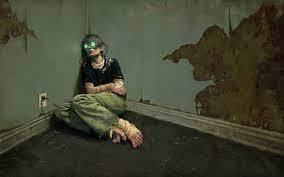
Because if those who see themselves as our global masters get their way, we are about to enter a virtual world that will become more complete by the day and from which there will be no escape.

The Metaverse

Based on many years of effort, the World Economic Forum (WEF) has recently launched its plan to create our new all-digital world, called the ‘metaverse’. See ‘Defining and Building the Metaverse’.

So if you find natural phenomena – ranging from rainforests, beaches and weather variations to ill-health, danger and unhappiness – annoying, you will soon be able to escape them, compliments of the metaverse. Or so we are promised. And you won’t be troubled by anything resembling what might be called ‘free will’ either. You will be content to do as you are told, even more than you are content to do already. See ‘Terrified of Freedom: Why Most Human Beings are Embracing the Global Elite’s Technotyranny’.

After all, your mind will no longer be your own. And while the usual descriptions, written by elite agents, fail to mention it, a quick flash of metaverse-induced fear will make sure that you comply, whatever you are required to do. The point is this: You won’t be escaping all of those unpleasant feelings after all. They can just be used to control you more directly, to fulfill an elite-determined purpose. But that is a fact they are not advertising.

In their iconic hit song ‘In the Year 2525’, written in 1964 by Rick Evans and later recorded by he and Denny Zager to become a No.1. hit around the world in 1969, Evans captured key elements of what is already upon us somewhat ahead of the schedule mapped out in the song.

[Chorus 2]
In the year 3535
Ain’t gonna need to tell the truth, tell no lies
Everything you think, do, and say
Is in the pills you took today

[Chorus 3]
In the year 4545
Ain’t gonna need your teeth, won’t need your eyes
You won’t find a thing to chew
Nobody’s gonna look at you

[Chorus 4]
In the year 5555
Your arms are hanging limp at your sides
Your legs got nothing to do
Some machine’s doing that for you

[Chorus 5]
In the year 6565
Ain’t gonna need no husband, won’t need no wife
You’ll pick your sons, pick your daughters too
From the bottom of a long glass tube
Whoa-oh-oh

So what is the Metaverse?

According to the WEF: ‘The metaverse is a future persistent and interconnected virtual environment where social and economic elements mirror reality. Users can interact with it and each other simultaneously across devices and immersive technologies while engaging with digital assets and property.’ See ‘Defining and Building the Metaverse’.

Moreover, ‘if technologists are right that 2022 will separate thinkers from builders, then last years’ technical advances will produce this year’s first steps towards making the metaverse a reality….

‘But from the perspective of the human experience, one development stands out above all others: extended reality (XR) technologies. These include virtual reality (VR), augmented reality (AR), and brain-computer interfaces (BCI), which together position themselves as the next computing platforms in their own right.’

Nevertheless, it is clear that a precise definition of the term ‘metaverse’ (for a start: is it a product, service, place or moment in time?), upon which there is broad agreement even among those who routinely use the term, is yet to emerge. See ‘3 technologies that will shape the future of the metaverse – and the human experience’.

Having written that, here is one definition elaborated in the article above that reveals just how far some of those heavily involved in this work have become disconnected from any sense of themselves and, hence, reality: ‘Specifically, the metaverse is the moment at which our digital lives – our online identities, experiences, relationships, and assets – become more meaningful to us than our physical lives.’ The original quotation can be read here: ‘Spheres of Self: Performativity and Parasociality in the Metaverse’.

And, as Cathy Li describes it, the metaverse is ‘most useful as a lens through which to view ongoing digital transformation. The belief is that virtual worlds, incorporating connected devices, blockchain and other tech, will be so commonplace that the metaverse will become an extension of reality itself.’ See ‘Who will govern the metaverse?

Let me reiterate two points from the paragraphs immediately above: ‘our digital lives… become more meaningful to us than our physical lives.’ And ‘the metaverse will become an extension of reality itself.’

Really?

While statements such as these reveal the breathtaking level of insanity that underpins this entire enterprise – see ‘The Global Elite is Insane Revisited’ – it does not mean that we are not under enormous threat. Just as vast arsenals of nuclear weapons, by some insane ‘logic’, are supposed to provide us with ‘security’ while actually threatening the existence of all life on Earth, the metaverse is part of a substantial package of measures that will reduce human life to one not worth living.

Why? Well, as noted by authors such as Tom Valovic: The metaverse is one element in the path to implementing technocratic governance over all of humanity.

‘As Planet Earth and our physical world continue to experience massive biospheric degradation and disruption, the elites that are now in many cases pulling the strings of governance at the country level are heading for the exit doors. Elon Musk and Jeff Bezos are exploring the realm of space and Musk has a Mars mission planned. Globally oriented elites… looked out for themselves which is what they do best….

‘Paralleling the notion of space flight as a form of existential escapism is the metaverse. So what if our cities are crumbling, infrastructures falling apart, and the biosphere is seriously degrading? So what if our wasteful consumer-driven lifestyle has created unprecedented levels of pollution so extensive that it’s now the number one cause of health problems globally? No problem… we’ll just kick back and don our Meta headsets (or worse get a brain implant) and escape into an artificially fabricated world that lets us turn our back on the massive ecological and environmental problems we now face.’ See ‘Why We Should Reject Mark Zuckerberg’s Dehumanizing Vision of a “Metaverse”’.

‘Education’ in the Metaverse

Of course, the metaverse is deeply interwoven with other components of their plan, such as those in relation to what they call ‘education’, which is more accurately described as the process by which young transhuman slaves are programmed to perform their function in the technocratic economy that is being imposed upon us. Of course, ‘education’ sounds better than ‘virtual programming of young transhuman slaves’ so, in the interests of not raising obvious concerns, the word ‘education’ has been used.

As noted by Dr. Michael Nevradakis, discussions on this subject at the recent gathering of the World Economic Forum emphasized the importance of virtual reality (VR) and artificial intelligence (AI) technologies with participants touting the purported educational and economic benefits that would derive from use of these technologies in the classroom by helping, according to Dr. Ali Saeed Bin Harmal Al Dhaheri & Dr. Mohamad Ali Hamade, to ‘increase accessibility, enhance quality and improve the affordability of education globally’. See ‘Experiential learning and VR will reshape the future of education’.

However, as Nevradakis also noted, these discussions had ‘little to say about the need to protect children’s data or digital identities – or, for that matter, providing the types of early-life experiences children require as part of their socialization.’ See ‘Future of Education? WEF’s Vision – Heavy on Virtual Reality and AI Technologies, Light on Privacy Concerns’.

Of course, there is no need for concern about the ‘early-life experiences’ of those young transhumans who are being programmed for decades of servitude prior to being terminated when they are no longer functional.

Beyond claimed educational and economic benefits, however, some authors argue that digitalizing education can play a role in easing pressures on the environment and climate. How so? Nevradakis again: ‘Indeed, the WEF said the use of “textbooks, notebooks and pencils as critical learning tools” is on the way out, due to “environmental pressures and COP26 goals (from the 2021 United Nations Climate Change Conference),” which “will drive the digitalizing of education streams.”’ See ‘Future of Education? WEF’s Vision – Heavy on Virtual Reality and AI Technologies, Light on Privacy Concerns’

But it is clearly delusional to suggest that the use of textbooks, notebooks and pencils has greater adverse impact on the environment and climate than the environmental cost and climate impact of producing sophisticated technology for each student. And despite claims of ‘improved affordability’ it is equally delusional to ignore the economic and social cost, for example, to the child ‘laborers’ in the Congo working in appalling conditions to extract strategic minerals to produce this technology. See ‘Humanity’s “Dirty Little Secret”: Starving, Enslaving, Raping, Torturing and Killing our Children’.

Besides, as touched on below, education is already a monstrous experience, destroying the Selfhood of the child so that they become submissively obedient. Removing the bulk of education’s remaining social component by technologizing it can only make it even worse.

Babies in the Metaverse

Then again, maybe ‘children’ will no longer be put through school. It simply won’t be necessary because children, for transhuman slaves at least, will no longer exist.

By 2070, the metaverse will offer you virtual babies, ‘environmentally-friendly digital children’, according to UK artificial intelligence (AI) expert Catriona Campbell. ‘Parents will see and interact with their offspring through next-generation AR [augmented reality] glasses and haptic gloves.’ The latter devices enable users to experience ‘a realistic sense of touch when handling virtual or holographic objects’. As a bonus, these children take up no space, cost nothing to feed and remain healthy, if that is what you want, for as long as they are programmed to ‘live’. A subscription might cost as little as $25 each month.

And if this seems like a monumental leap out of reality to you, Campbell also believes that ‘within 50 years technology will have advanced to such an extent that babies which exist in the metaverse are indistinct from those in the real world…. As the metaverse evolves, I can see virtual children becoming an accepted and fully embraced part of society in much of the developed world.’ See ‘“Virtual babies” who grow up in real time will be commonplace by 2070, expert predicts’.

That’s right, Campbell is claiming that ‘within 50 years… babies which exist in the metaverse are indistinct from those in the real world’! Pause a moment. How does that sound to you?

Just in case you cannot wait, you are welcome to start using early versions now. See, for example, Virtual Baby, Adopt a Virtual Baby and My Virtual Child.

Oh, and by the way, you won’t be having sex either, whether for reproductive purposes or otherwise. You will prefer virtual sex. See ‘Sex And Pornography Aim To Strike Gold In The Metaverse’.

Critiquing the Metaverse

Beyond the criticisms already noted above, there are a great many other criticisms of the metaverse and the role it will play in the overall elite program being implemented under what the WEF calls its ‘Great Reset’. This comprehensive program will transform human society and human life for those people left alive after the eugenics component has been fully implemented. See ‘The Final Battle for Humanity: It is “Now or Never” in the Long War Against Homo Sapiens’.

If you like, you can read a little more about what the masters of this metaverse intend for us, as well as critiques of it, by authors such as these.

Derrick Broze: While some people ‘may not intend for The Metaverse to become an all encompassing reality that supersedes physical reality, for the Zuckerbergs, Microsofts, and WEFs of the world, that is exactly what they intend for The Metaverse…. For the billionaire class and their puppet organizations, such as the WEF and the United Nations, the Metaverse offers up the potential to commandeer all life into digital prisons where the people can be charged for services and products in the digital realm…. With the people of the world safely tucked into their digital beds, the Technocrats could complete their total takeover of natural resources, the economy, and humanity itself.’ See ‘The Great Narrative And The Metaverse, Part 2: Will The Metaverse End Human Freedom?

Dr. Michael Nevradakis: ‘Who will govern the “metaverse”?… According to the WEF, “real-world governance models” represent one possible option for metaverse governance. However, far from referring to constitutionally defined institutions of governance, with checks and balances, the WEF cites Facebook’s “Oversight Board” as an example of such a “real-world governance model.”’ See ‘WEF Launches “Metaverse” Initiative, Predicts Digital Lives Will Become “More Meaningful to Us Than Our Physical Lives”’.

But an earlier World Economic Forum report from its Global Redesign Initiative was more blunt: ‘The report postulates that a globalized world is best managed by a coalition of multinational corporations, governments (including through the UN system) and select civil society organizations (CSOs).’ See Sustainable Development Goals and Human Rights p. 209, citing ‘Everybody’s Business: Strengthening International Cooperation in a More Interdependent World’.

So if you believe that you and I are destined to have a say in the metaverse that is unfolding, you would be wise to keep investigating. Elite proposals are invariably very distant from the type of governance models usually considered by ‘ordinary’ people in a multiplicity of contexts, where the emphasis is on facilitating widespread grassroots participation, not rule by technocrats.

You can read considerably more about what our technocratic overlords have in mind – including the existing trade in such things as virtual real estate, virtual clothing and virtual art – and what is wrong with it, in the articles on the metaverse published by Patrick Wood on ‘Technocracy News & Trends’: ‘Metaverse’. And there is more in articles such as these: ‘The Top 10 Creepiest and Most Dystopian Things Pushed by the World Economic Forum (WEF)’ and ‘How Our Lives Could Soon Look”: The World Economic Forum Posts An Insane Dystopian Video’.

And here’s another simple issue to ponder. Remember how I mentioned above that a quick flash of metaverse-induced fear would ensure that you complied with an elite-determined directive, how does the idea of eating bugs, processed sewage and human flesh appeal? Well, given that your mind will no longer be your own, what appeals now, or doesn’t, will be irrelevant once the metaverse is determining how you perceive things. See ‘Canadian Company Pledges To Produce TWO BILLION BUGS Per Year For Human Consumption’ and ‘Will You Eat Cultured Meat Grown From Human Cells?’

You will eat ‘Soylent Green’ because that is what the program tells you.

So why are people embracing the Metaverse?

In a recent article in which he described taking his son to watch a film through 3D glasses, Charles Eisenstein noted ‘The on-screen reality was so vivid, stimulating and intense that it made the real world seem boring by comparison.’ See ‘Transhumanism and the Metaverse’.

How can this happen?

Because we terrorize our children into submissive obedience, devoid of the unique and powerful individual Self they were gifted by evolution at birth. See ‘Why Violence?’,‘Fearless Psychology and Fearful Psychology: Principles and Practice’and ‘Do We Want School or Education?’ Why? Essentially to keep them performing tasks that bore them senseless throughout their school and working life.

Fundamentally, this terrorization works because it compels our children into suppressing awareness of how they feel. As a result, only the most intense experiences register emotionally: The capacity to experience a subtle feeling has been lost. And without this capacity, they cannot develop into the powerful, courageous Self-willed individuals that evolution intended. They are human relics. Ready and willing to be turned into a transhuman slave in the unconscious hope they will be finally able to experience, in the metaverse, what was taken from them in the real world as a child.

But they won’t get that experience, even in the metaverse. It is not what the elite has in mind for us.

Resisting the Metaverse

Of course, the metaverse is just one feature of the Global Elite agenda that is being imposed upon us. And it is not enough to resist individual features of the ‘Great Reset’ program. We must strategically resist its most fundamental elements so that the entire agenda is defeated.

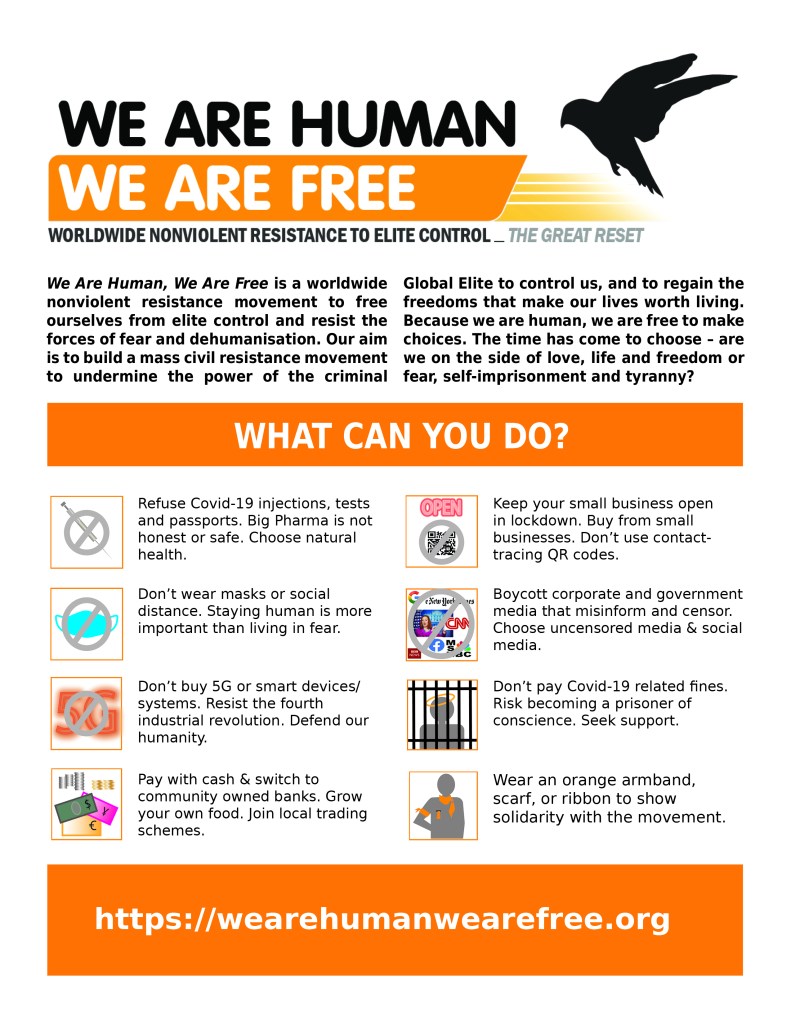
If you are inclined to join those strategically resisting the ‘Great Reset’ and its related agendas, you are welcome to participate in the ‘We Are Human, We Are Free’  campaign which identifies a list of 30 strategic goals for doing so.

In addition and more simply, you can download a one-page flyer that identifies a short series of crucial nonviolent actions that anyone can take. This flyer, now available in 17 languages (Czech, Danish, Dutch, English, Finnish, French, German, Greek, Hebrew, Hungarian, Italian, Polish, Romanian, Russian, Serbian, Spanish & Slovak) with more languages in the pipeline, can be downloaded from here: ‘The 7 Days Campaign to Resist the Great Reset’.

If strategically resisting the ‘Great Reset’ (and related agendas) appeals to you, consider joining the ‘We Are Human, We Are Free’ Telegram group (with a link accessible from the website).

And if you want a child who is powerfully able to perceive the dysfunctional lure of the metaverse, and is able to join you in resisting it, consider making ‘My Promise to Children’.

CONCLUSION

So, for just a little longer, the choice is yours.

You can live your life with all its challenges and problems, joys and achievements. Or you can live the virtual life that someone else programmed for you, including whatever comes with it that they didn’t tell you about.

In short, like Neo in the film ‘The Matrix’, you have a choice. You can choose the Blue Pill and proceed to live in a synthesized, fictional, computer-generated world. Or you take the Red Pill and, in this case, join the fight with those of us determined to defend the real world and avert descent into the metaverse.

But you must make that choice while you still have free will.

So you must make that choice soon.

Biodata: Robert J. Burrowes has a lifetime commitment to understanding and ending human violence. He has done extensive research since 1966 in an effort to understand why human beings are violent and has been a nonviolent activist since 1981. He is the author of ‘Why Violence?’ His email address is flametree@riseup.net and his website is here.

Déjà Vu All Over Again

The Matrix, resurrected

By John Semley

Source: The Baffler

MIDWAY THROUGH 1999’S THE MATRIX, Keanu Reeves’s hacker-cum-cyberpunk-messiah Neo sees a black cat shivering in a doorway. Then, he sees it again. “Woah,” he utters, in that trademark, flat Keanu Reeves way. “Déjà vu . . . ” The phenomenon, Trinity (Carrie-Anne Moss) tells him, means big trouble. In the titular world-scale digital simulation in which the bulk of the film unfolds, déjà vu signals a computer glitch: a case of the simulation tweaking its code in real time.

One can’t help but be reminded of this idea watching The Matrix Resurrections, a long-gap sequel to the original sci-fi trilogy, which ended with Reeves’s Neo striking a détente between the machine overlords that enslaved mankind within a counterfeit reality and the fleshy human resistors who opposed them. The new film opens as the original does, following a heavily-armed SWAT team as they swarm a seedy motel room where a leather-clad hacker is plonking away at a computer terminal. The scene expands to introduce a new character, Bugs (Jessica Henwick), who notes to her compatriot that this familiar scene is a training module, designed to hone the skills of the digital heavies who patrol the parameters of the matrix. Or rather, a version of it that exists within the original matrix. It’s sixty years after the events of the last film, and nearly twenty years after its release. Things have gotten deeper—if only slightly.

The simulation now includes a popular video game trilogy—called, of course, The Matrix—that re-stages the events of the original films. Neo, too, is back, in his guise as Thomas Anderson. This time he’s not a computer programmer but a video game designer, whose “great ambition was to make a game indistinguishable from reality.” He’s the chief architect of the Matrix game trilogy, which has just seen a sequel green-lit within the fiction of both the matrix and The Matrix. (Matrix Resurrections was itself promoted with a tie-in video game demo, The Matrix Awakens.) Like William James’s image of our world resting on an infinite regress of rocks, it seems like it’s matrixes all the way down.

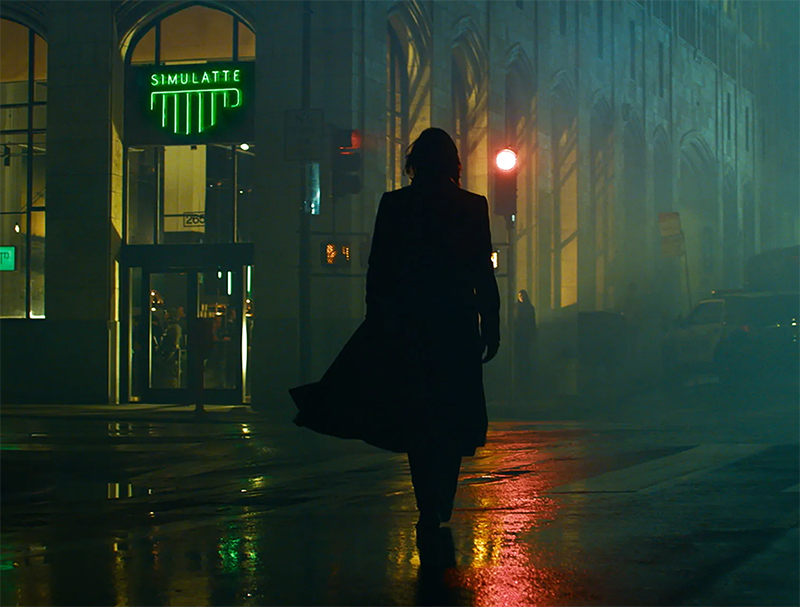
The planned game sequel prompts much hand-wringing. Characters bat ideas back and forth in an open-concept office, trying to get to the heart of what made the original Matrix work. Resurrections abounds with this sort of dorky meta-humor. There are jokes about the game design firm’s parent company being Warner Bros. (the actual film’s producer) and jokes about déjà vu. A fourth-wave coffee shop is called “Simulatte.” That kind of thing. It’s the sort of stuff that elicits barking, staccato guffaws from in-the-know audience members that quickly fade into barely bemused titters. It’s meant to be cute, but it’s mostly annoying.

Still, the film is not without its charms. Some of the early action scenes crack along reliably, playing with inversions of gravity and time, like a fleeter Christopher Nolan flick. And the notion of revisiting the world of the matrix is not without appeal. After all, the original film forecasted a world of digital disenfranchisement that is now, under the auspices of our current Silicon Valley overlords, regarded as aspirational. (In a telling touch, Resurrections moves the action from an implied Chicago to the Bay Area, explicitly marked by familiar landmarks and San Francisco PD cruisers.) And with its image of two pills representing diverging ideological bents, The Matrix provided a ready-made vocabulary that has been embraced in our real world, where everyone is redpilledblackpilledDanpilled, or Tedpilled. But Resurrections never manages to meaningfully intervene in the very conditions it seems to be diagnosing—and which the series had already diagnosed, decades ago. Like postmodernity itself, the state of digital dependency dramatized by The Matrix cannot be alleviated. It can only be mediated, with increasing levels of irony and winking self-awareness.

To wit: Resurrections is not about digitization, or the metaphysics of reality, or the broken promise of the cyberpunk genre. It is about movie reboots. Here, Neo must be liberated again, literally remaking his quest from the original film, with the obstacles re-skinned and old foes appearing in new guises (Jonathan Groff, playing the meddling computer program Smith, is a hunkier, paler imitation of the menacing Hugo Weaving). Characters snipe about how humanity is merely reframing the same handful of archetypal themes and ideas. “We’re still telling the same stories we’ve always told,” says one game designer, sounding like he’s been watching too many Jordan Peterson YouTubes. “Just with different names, different faces.” This may well be true. But it also feels like a cop-out. Especially because the original Matrix, as imagined by sororal duo Lilly and Lana Wachowski, felt genuinely inventive. It blended Terminator-styled dystopian sci-fi with Hong Kong wire-fu action and state-of-the-art special effects, all draped in the industrial liveries of a turn-of-the-millennium goth club. It may not have been wholly new. But it was thrilling remix. It spoke to the ennui of America at the “end of history.” It captured the soul-deadening, Dilbert-esque daily doldrums explored in films like Fight Club and Office Space. It also played straight to the anxiety around “Y2K” and the mounting cultural panic that home computers and toaster ovens might break down or turn against their owners. The Matrix felt like it was speaking to its time. Now, movies seem to chatter only among themselves.

There’s plenty of precedent here, of course: Ready Player Onethe recent Space Jam sequel; and the new Spider-Man movie, which draws together two decades worth of sticky narrative threads spun across three distinct franchises. Corporate wheeling-and-dealing is increasingly allegorized onscreen, to the point that many blockbusters are now about their own production. Within ten years, we’ll see Aaron Sorkin hoisting an Oscar overhead, rewarded by his peers for helming a chatty drama about the backroom legal finagling that saw a Star Wars-branded lightsaber licensed to the movie Free Guy. Hollywood is already lodged in the post-postmodern rabbit hole, with little to show for it. The culture is glitching, looping, stuck in some long, static interregnum, like a radio drifting between channels. If a new Matrix movie felt grimly inevitable in such a climate, it also had great potential.

And I suppose it’s nice that director Lana Wachowski (going solo this time) returned to wield some control over a story that would otherwise be expropriated however-which-way by the studio. But she has only a passing interest in the new convolutions of the simulation itself. Wachowski is more invested in revisiting Neo and Trinity’s wrenching, realities-spanning romance. Rather than the heady ideas at play in the premise—which have been by-and-large replaced by geeky in-jokes—she wants to explore (again) the profound power of love as some supernatural force. At its worst, the Wachowski worldview recalls that classic Simpsons joke: the secret ingredient is always capital-l Love.

This strain of touchy-feely sci-fi certainly has its admirers, and I sometimes count myself among them. But I find the Wachowskis’ sappiness (however earnest) more tolerable when enlivened by their stylistic and technical inventiveness. The rote, underdog rhythms of Speed Racer (2008) only work because they unfold within an aesthetic landscape that splits the difference between La Chinoise and Paper MarioThe Matrix’s heavy hooey about fate and choice and freeing one’s mind is leavened because, well, the movie is entertaining as hell. But now, the ideas are stale (2003’s The Matrix Reloaded already introduced the concept of its story being a remake), and the action settles into tedium: graceful bullet-time ballets are replaced by crunchy, John Wick-style fights and repetitive CGI set pieces that see Neo stopping hails of bullets with his hands, over and over and over again.

Perhaps there’s something modestly clever in the major meta-gesture of this newest Matrix—in its idea of the matrix reproducing its own destruction in the form of an interactive video game. After all, the notion that the very systems that delude us offer self-contained safe spaces for relieving those delusions is apt. Like capital, the matrix survives by evolving quicker than the forces that oppose it. If we take this message seriously, then the goodly thing to do is to ignore The Matrix Resurrections and all corporatized entertainments. To put down Twitter and TikTok and smooch our spouses; build a snowman with the kiddies; clink some beers with a gaggle of good buddies.

That we should all invest not in our virtual existences, but the fleshy, loving, contingent relationships of real life, is a perfectly decent message. That the Wachowskis have been repeating this tired line for two decades speaks despairingly to the conditions of our own, present-day dystopia. Resurrections is suspended between cyberpunk trappings that were already shopworn circa 1999 and the intellectual prison of high-concept meta-mongering. It is a movie of the interregnum, one that could have been auto-generated by it. In this way, The Matrix does manage to speak to the times. Again.

The Metaverse Is Big Brother in Disguise: Freedom Meted Out by Technological Tyrants

By By John W. Whitehead & Nisha Whitehead

Source: The Rutherford Institute

The term metaverse, like the term meritocracy, was coined in a sci fi dystopia novel written as cautionary tale. Then techies took metaverse, and technocrats took meritocracy, and enthusiastically adopted what was meant to inspire horror.”—Antonio García Martínez

Welcome to the Matrix (i.e. the metaverse), where reality is virtual, freedom is only as free as one’s technological overlords allow, and artificial intelligence is slowly rendering humanity unnecessary, inferior and obsolete.

Mark Zuckerberg, the CEO of Facebook, sees this digital universe—the metaverse—as the next step in our evolutionary transformation from a human-driven society to a technological one.

Yet while Zuckerberg’s vision for this digital frontier has been met with a certain degree of skepticism, the truth—as journalist Antonio García Martínez concludes—is that we’re already living in the metaverse.

The metaverse is, in turn, a dystopian meritocracy, where freedom is a conditional construct based on one’s worthiness and compliance.

In a meritocracy, rights are privileges, afforded to those who have earned them. There can be no tolerance for independence or individuality in a meritocracy, where political correctness is formalized, legalized and institutionalized. Likewise, there can be no true freedom when the ability to express oneself, move about, engage in commerce and function in society is predicated on the extent to which you’re willing to “fit in.”

We are almost at that stage now.

Consider that in our present virtue-signaling world where fascism disguises itself as tolerance, the only way to enjoy even a semblance of freedom is by opting to voluntarily censor yourself, comply, conform and march in lockstep with whatever prevailing views dominate.

Fail to do so—by daring to espouse “dangerous” ideas or support unpopular political movements—and you will find yourself shut out of commerce, employment, and society: Facebook will ban you, Twitter will shut you down, Instagram will de-platform you, and your employer will issue ultimatums that force you to choose between your so-called freedoms and economic survival.

This is exactly how Corporate America plans to groom us for a world in which “we the people” are unthinking, unresistant, slavishly obedient automatons in bondage to a Deep State policed by computer algorithms.

Science fiction has become fact.

Twenty-some years after the Wachowskis’ iconic film, The Matrix, introduced us to a futuristic world in which humans exist in a computer-simulated non-reality powered by authoritarian machines—a world where the choice between existing in a denial-ridden virtual dream-state or facing up to the harsh, difficult realities of life comes down to a blue pill or a red pill—we stand at the precipice of a technologically-dominated matrix of our own making.

We are living the prequel to The Matrix with each passing day, falling further under the spell of technologically-driven virtual communities, virtual realities and virtual conveniences managed by artificially intelligent machines that are on a fast track to replacing human beings and eventually dominating every aspect of our lives.

In The Matrixcomputer programmer Thomas Anderson a.k.a. hacker Neo is wakened from a virtual slumber by Morpheus, a freedom fighter seeking to liberate humanity from a lifelong hibernation state imposed by hyper-advanced artificial intelligence machines that rely on humans as an organic power source. With their minds plugged into a perfectly crafted virtual reality, few humans ever realize they are living in an artificial dream world.

Neo is given a choice: to take the red pill, wake up and join the resistance, or take the blue pill, remain asleep and serve as fodder for the powers-that-be.

Most people opt for the blue pill.

In our case, the blue pill—a one-way ticket to a life sentence in an electronic concentration camp—has been honey-coated to hide the bitter aftertaste, sold to us in the name of expediency and delivered by way of blazingly fast Internet, cell phone signals that never drop a call, thermostats that keep us at the perfect temperature without our having to raise a finger, and entertainment that can be simultaneously streamed to our TVs, tablets and cell phones.

Yet we are not merely in thrall with these technologies that were intended to make our lives easier. We have become enslaved by them.

Look around you. Everywhere you turn, people are so addicted to their internet-connected screen devices—smart phones, tablets, computers, televisions—that they can go for hours at a time submerged in a virtual world where human interaction is filtered through the medium of technology.

This is not freedom. This is not even progress.

This is technological tyranny and iron-fisted control delivered by way of the surveillance state, corporate giants such as Google and Facebook, and government spy agencies such as the National Security Agency.

So consumed are we with availing ourselves of all the latest technologies that we have spared barely a thought for the ramifications of our heedless, headlong stumble towards a world in which our abject reliance on internet-connected gadgets and gizmos is grooming us for a future in which freedom is an illusion.

Yet it’s not just freedom that hangs in the balance. Humanity itself is on the line.

If ever Americans find themselves in bondage to technological tyrants, we will have only ourselves to blame for having forged the chains through our own lassitude, laziness and abject reliance on internet-connected gadgets and gizmos that render us wholly irrelevant.

Indeed, we’re fast approaching Philip K. Dick’s vision of the future as depicted in the film Minority Report. There, police agencies apprehend criminals before they can commit a crime, driverless cars populate the highways, and a person’s biometrics are constantly scanned and used to track their movements, target them for advertising, and keep them under perpetual surveillance.

Cue the dawning of the Age of the Internet of Things (IoT), in which internet-connected “things” monitor your home, your health and your habits in order to keep your pantry stocked, your utilities regulated and your life under control and relatively worry-free.

The key word here, however, is control.

In the not-too-distant future, “just about every device you have—and even products like chairs, that you don’t normally expect to see technology in—will be connected and talking to each other.”

By the end of 2018, “there were an estimated 22 billion internet of things connected devices in use around the world… Forecasts suggest that by 2030 around 50 billion of these IoT devices will be in use around the world, creating a massive web of interconnected devices spanning everything from smartphones to kitchen appliances.”

As the technologies powering these devices have become increasingly sophisticated, they have also become increasingly widespread, encompassing everything from toothbrushes and lightbulbs to cars, smart meters and medical equipment.

It is estimated that 127 new IoT devices are connected to the web every second.

This “connected” industry has become the next big societal transformation, right up there with the Industrial Revolution, a watershed moment in technology and culture.

Between driverless cars that completely lacking a steering wheel, accelerator, or brake pedal, and smart pills embedded with computer chips, sensors, cameras and robots, we are poised to outpace the imaginations of science fiction writers such as Philip K. Dick and Isaac Asimov. (By the way, there is no such thing as a driverless car. Someone or something will be driving, but it won’t be you.)

These Internet-connected techno gadgets include smart light bulbs that discourage burglars by making your house look occupied, smart thermostats that regulate the temperature of your home based on your activities, and smart doorbells that let you see who is at your front door without leaving the comfort of your couch.

Nest, Google’s suite of smart home products, has been at the forefront of the “connected” industry, with such technologically savvy conveniences as a smart lock that tells your thermostat who is home, what temperatures they like, and when your home is unoccupied; a home phone service system that interacts with your connected devices to “learn when you come and go” and alert you if your kids don’t come home; and a sleep system that will monitor when you fall asleep, when you wake up, and keep the house noises and temperature in a sleep-conducive state.

The aim of these internet-connected devices, as Nest proclaims, is to make “your house a more thoughtful and conscious home.” For example, your car can signal ahead that you’re on your way home, while Hue lights can flash on and off to get your attention if Nest Protect senses something’s wrong. Your coffeemaker, relying on data from fitness and sleep sensors, will brew a stronger pot of coffee for you if you’ve had a restless night.

Yet given the speed and trajectory at which these technologies are developing, it won’t be long before these devices are operating entirely independent of their human creators, which poses a whole new set of worries. As technology expert Nicholas Carr notes, “As soon as you allow robots, or software programs, to act freely in the world, they’re going to run up against ethically fraught situations and face hard choices that can’t be resolved through statistical models. That will be true of self-driving cars, self-flying drones, and battlefield robots, just as it’s already true, on a lesser scale, with automated vacuum cleaners and lawnmowers.”

For instance, just as the robotic vacuum, Roomba, “makes no distinction between a dust bunny and an insect,” weaponized drones will be incapable of distinguishing between a fleeing criminal and someone merely jogging down a street. For that matter, how do you defend yourself against a robotic cop—such as the Atlas android being developed by the Pentagon—that has been programmed to respond to any perceived threat with violence?

Moreover, it’s not just our homes and personal devices that are being reordered and reimagined in this connected age: it’s our workplaces, our health systems, our government, our bodies and our innermost thoughts that are being plugged into a matrix over which we have no real control.

It is expected that by 2030, we will all experience The Internet of Senses (IoS), enabled by Artificial Intelligence (AI), Virtual Reality (VR), Augmented Reality (AR), 5G, and automation. The Internet of Senses relies on connected technology interacting with our senses of sight, sound, taste, smell, and touch by way of the brain as the user interface. As journalist Susan Fourtane explains:

Many predict that by 2030, the lines between thinking and doing will blur. Fifty-nine percent of consumers believe that we will be able to see map routes on VR glasses by simply thinking of a destination… By 2030, technology is set to respond to our thoughts, and even share them with others… Using the brain as an interface could mean the end of keyboards, mice, game controllers, and ultimately user interfaces for any digital device. The user needs to only think about the commands, and they will just happen. Smartphones could even function without touch screens.

In other words, the IoS will rely on technology being able to access and act on your thoughts.

Fourtane outlines several trends related to the IoS that are expected to become a reality by 2030:

1: Thoughts become action: using the brain as the interface, for example, users will be able to see map routes on VR glasses by simply thinking of a destination.

2: Sounds will become an extension of the devised virtual reality: users could mimic anyone’s voice realistically enough to fool even family members.

3: Real food will become secondary to imagined tastes. A sensory device for your mouth could digitally enhance anything you eat, so that any food can taste like your favorite treat.

4: Smells will become a projection of this virtual reality so that virtual visits, to forests or the countryside for instance, would include experiencing all the natural smells of those places.

5: Total touch: Smartphones with screens will convey the shape and texture of the digital icons and buttons they are pressing.

6: Merged reality: VR game worlds will become indistinguishable from physical reality by 2030.

This is the metaverse, wrapped up in the siren-song of convenience and sold to us as the secret to success, entertainment and happiness.

It’s a false promise, a wicked trap to snare us, with a single objective: total control.

George Orwell understood this.

Orwell’s masterpiece, 1984, portrays a global society of total control in which people are not allowed to have thoughts that in any way disagree with the corporate state. There is no personal freedom, and advanced technology has become the driving force behind a surveillance-driven society. Snitches and cameras are everywhere. And people are subject to the Thought Police, who deal with anyone guilty of thought crimes. The government, or “Party,” is headed by Big Brother, who appears on posters everywhere with the words: “Big Brother is watching you.”

As I make clear in my book Battlefield America: The War on the American People and in its fictional counterpart The Erik Blair Diaries, total control over every aspect of our lives, right down to our inner thoughts, is the objective of any totalitarian regime.

The Metaverse is just Big Brother in disguise.

Big Brother in Disguise: The Rise of a New, Technological World Order

By John Whitehead

Source: The Rutherford Institute

“You had to live—did live, from habit that became instinct—in the assumption that every sound you made was overheard, and, except in darkness, every movement scrutinized.”—George Orwell, 1984

It had the potential for disaster.

Early in the morning of Monday, December 15, 2020, Google suffered a major worldwide outage in which all of its internet-connected services crashed, including Nest, Google Calendar, Gmail, Docs, Hangouts, Maps, Meet and YouTube.

The outage only lasted an hour, but it was a chilling reminder of how reliant the world has become on internet-connected technologies to do everything from unlocking doors and turning up the heat to accessing work files, sending emails and making phone calls.

A year earlier, a Google outage resulted in Nest users being unable to access their Nest thermostats, Nest smart locks, and Nest cameras. As Fast Company reports, “This essentially meant that because of a cloud storage outage, people were prevented from getting inside their homes, using their AC, and monitoring their babies.”

Welcome to the Matrix.

Twenty-some years after the Wachowskis’ iconic film, The Matrix, introduced us to a futuristic world in which humans exist in a computer-simulated non-reality powered by authoritarian machines—a world where the choice between existing in a denial-ridden virtual dream-state or facing up to the harsh, difficult realities of life comes down to a blue pill or a red pill—we stand at the precipice of a technologically-dominated matrix of our own making.

We are living the prequel to The Matrix with each passing day, falling further under the spell of technologically-driven virtual communities, virtual realities and virtual conveniences managed by artificially intelligent machines that are on a fast track to replacing human beings and eventually dominating every aspect of our lives.

Science fiction has become fact.

In The Matrix, computer programmer Thomas Anderson a.k.a. hacker Neo is wakened from a virtual slumber by Morpheus, a freedom fighter seeking to liberate humanity from a lifelong hibernation state imposed by hyper-advanced artificial intelligence machines that rely on humans as an organic power source. With their minds plugged into a perfectly crafted virtual reality, few humans ever realize they are living in an artificial dream world.

Neo is given a choice: to take the red pill, wake up and join the resistance, or take the blue pill, remain asleep and serve as fodder for the powers-that-be.

Most people opt for the blue pill.

In our case, the blue pill—a one-way ticket to a life sentence in an electronic concentration camp—has been honey-coated to hide the bitter aftertaste, sold to us in the name of expediency and delivered by way of blazingly fast Internet, cell phone signals that never drop a call, thermostats that keep us at the perfect temperature without our having to raise a finger, and entertainment that can be simultaneously streamed to our TVs, tablets and cell phones.

Yet we are not merely in thrall with these technologies that were intended to make our lives easier. We have become enslaved by them.

Look around you. Everywhere you turn, people are so addicted to their internet-connected screen devices—smart phones, tablets, computers, televisions—that they can go for hours at a time submerged in a virtual world where human interaction is filtered through the medium of technology.

This is not freedom.

This is not even progress.

This is technological tyranny and iron-fisted control delivered by way of the surveillance state, corporate giants such as Google and Facebook, and government spy agencies such as the National Security Agency.

So consumed are we with availing ourselves of all the latest technologies that we have spared barely a thought for the ramifications of our heedless, headlong stumble towards a world in which our abject reliance on internet-connected gadgets and gizmos is grooming us for a future in which freedom is an illusion.

Yet it’s not just freedom that hangs in the balance. Humanity itself is on the line.

If ever Americans find themselves in bondage to technological tyrants, we will have only ourselves to blame for having forged the chains through our own lassitude, laziness and abject reliance on internet-connected gadgets and gizmos that render us wholly irrelevant.

Indeed, we’re fast approaching Philip K. Dick’s vision of the future as depicted in the film Minority Report. There, police agencies apprehend criminals before they can commit a crime, driverless cars populate the highways, and a person’s biometrics are constantly scanned and used to track their movements, target them for advertising, and keep them under perpetual surveillance.

Cue the dawning of the Age of the Internet of Things (IoT), in which internet-connected “things” monitor your home, your health and your habits in order to keep your pantry stocked, your utilities regulated and your life under control and relatively worry-free.

The key word here, however, is control.

In the not-too-distant future, “just about every device you have — and even products like chairs, that you don’t normally expect to see technology in — will be connected and talking to each other.”

By the end of 2018, “there were an estimated 22 billion internet of things connected devices in use around the world… Forecasts suggest that by 2030 around 50 billion of these IoT devices will be in use around the world, creating a massive web of interconnected devices spanning everything from smartphones to kitchen appliances.”

As the technologies powering these devices have become increasingly sophisticated, they have also become increasingly widespread, encompassing everything from toothbrushes and lightbulbs to cars, smart meters and medical equipment.

It is estimated that 127 new IoT devices are connected to the web every second.

This “connected” industry has become the next big societal transformation, right up there with the Industrial Revolution, a watershed moment in technology and culture.

Between driverless cars that completely lacking a steering wheel, accelerator, or brake pedal, and smart pills embedded with computer chips, sensors, cameras and robots, we are poised to outpace the imaginations of science fiction writers such as Philip K. Dick and Isaac Asimov. (By the way, there is no such thing as a driverless car. Someone or something will be driving, but it won’t be you.)

These Internet-connected techno gadgets include smart light bulbs that discourage burglars by making your house look occupied, smart thermostats that regulate the temperature of your home based on your activities, and smart doorbells that let you see who is at your front door without leaving the comfort of your couch.

Nest, Google’s suite of smart home products, has been at the forefront of the “connected” industry, with such technologically savvy conveniences as a smart lock that tells your thermostat who is home, what temperatures they like, and when your home is unoccupied; a home phone service system that interacts with your connected devices to “learn when you come and go” and alert you if your kids don’t come home; and a sleep system that will monitor when you fall asleep, when you wake up, and keep the house noises and temperature in a sleep-conducive state.

The aim of these internet-connected devices, as Nest proclaims, is to make “your house a more thoughtful and conscious home.” For example, your car can signal ahead that you’re on your way home, while Hue lights can flash on and off to get your attention if Nest Protect senses something’s wrong. Your coffeemaker, relying on data from fitness and sleep sensors, will brew a stronger pot of coffee for you if you’ve had a restless night.

Yet given the speed and trajectory at which these technologies are developing, it won’t be long before these devices are operating entirely independent of their human creators, which poses a whole new set of worries. As technology expert Nicholas Carr notes, “As soon as you allow robots, or software programs, to act freely in the world, they’re going to run up against ethically fraught situations and face hard choices that can’t be resolved through statistical models. That will be true of self-driving cars, self-flying drones, and battlefield robots, just as it’s already true, on a lesser scale, with automated vacuum cleaners and lawnmowers.”

For instance, just as the robotic vacuum, Roomba, “makes no distinction between a dust bunny and an insect,” weaponized drones—poised to take to the skies en masse this year—will be incapable of distinguishing between a fleeing criminal and someone merely jogging down a street. For that matter, how do you defend yourself against a robotic cop—such as the Atlas android being developed by the Pentagon—that has been programmed to respond to any perceived threat with violence?

Moreover, it’s not just our homes and personal devices that are being reordered and reimagined in this connected age: it’s our workplaces, our health systems, our government, our bodies and our innermost thoughts that are being plugged into a matrix over which we have no real control.

Indeed, it is expected that by 2030, we will all experience The Internet of Senses (IoS), enabled by Artificial Intelligence (AI), Virtual Reality (VR), Augmented Reality (AR), 5G, and automation. The Internet of Senses relies on connected technology interacting with our senses of sight, sound, taste, smell, and touch by way of the brain as the user interface. As journalist Susan Fourtane explains:

Many predict that by 2030, the lines between thinking and doing will blur. Fifty-nine percent of consumers believe that we will be able to see map routes on VR glasses by simply thinking of a destination… By 2030, technology is set to respond to our thoughts, and even share them with others… Using the brain as an interface could mean the end of keyboards, mice, game controllers, and ultimately user interfaces for any digital device. The user needs to only think about the commands, and they will just happen. Smartphones could even function without touch screens.

In other words, the IoS will rely on technology being able to access and act on your thoughts.

Fourtane outlines several trends related to the IoS that are expected to become a reality by 2030:

1: Thoughts become action: using the brain as the interface, for example, users will be able to see map routes on VR glasses by simply thinking of a destination.

2: Sounds will become an extension of the devised virtual reality: users could mimic anyone’s voice realistically enough to fool even family members.

3: Real food will become secondary to imagined tastes. A sensory device for your mouth could digitally enhance anything you eat, so that any food can taste like your favorite treat.

4: Smells will become a projection of this virtual reality so that virtual visits, to forests or the countryside for instance, would include experiencing all the natural smells of those places.

5: Total touch: Smartphones with screens will convey the shape and texture of the digital icons and buttons they are pressing.

6: Merged reality: VR game worlds will become indistinguishable from physical reality by 2030.

Unfortunately, in our race to the future, we have failed to consider what such dependence on technology might mean for our humanity, not to mention our freedoms.

Ingestible or implantable chips are a good example of how unprepared we are, morally and otherwise, to navigate this uncharted terrain. Hailed as revolutionary for their ability to access, analyze and manipulate your body from the inside, these smart pills can remind you to take your medication, search for cancer, and even send an alert to your doctor warning of an impending heart attack.

Sure, the technology could save lives, but is that all we need to know?

Have we done our due diligence in asking all the questions that need to be asked before unleashing such awesome technology on an unsuspecting populace?

For example, asks Washington Post reporter Ariana Eunjung Cha:

What kind of warnings should users receive about the risks of implanting chip technology inside a body, for instance? How will patients be assured that the technology won’t be used to compel them to take medications they don’t really want to take? Could law enforcement obtain data that would reveal which individuals abuse drugs or sell them on the black market? Could what started as a voluntary experiment be turned into a compulsory government identification program that could erode civil liberties?

Let me put it another way.

If you were shocked by Edward Snowden’s revelations about how NSA agents have used surveillance to spy on Americans’ phone calls, emails and text messages, can you imagine what unscrupulous government agents could do with access to your internet-connected car, home and medications? Imagine what a SWAT team could do with the ability to access, monitor and control your internet-connected home—locking you in, turning off the lights, activating alarms, etc.

While President Trump signed the Internet of Things Cybersecurity Improvement Act into law on Dec. 4, 2020, in order to establish a baseline for security protection for the billions of IoT devices flooding homes and businesses, the law does little to protect the American people against corporate and governmental surveillance.

In fact, the public response to concerns about government surveillance has amounted to a collective shrug.

After all, who cares if the government can track your whereabouts on your GPS-enabled device so long as it helps you find the fastest route from Point A to Point B? Who cares if the NSA is listening in on your phone calls and downloading your emails so long as you can get your phone calls and emails on the go and get lightning fast Internet on the fly? Who cares if the government can monitor your activities in your home by tapping into your internet-connected devices—thermostat, water, lights—so long as you can control those things with the flick of a finger, whether you’re across the house or across the country?

Control is the key here.

As I make clear in my book Battlefield America: The War on the American People, total control over every aspect of our lives, right down to our inner thoughts, is the objective of any totalitarian regime.

George Orwell understood this.

Orwell’s masterpiece, 1984, portrays a global society of total control in which people are not allowed to have thoughts that in any way disagree with the corporate state. There is no personal freedom, and advanced technology has become the driving force behind a surveillance-driven society. Snitches and cameras are everywhere. And people are subject to the Thought Police, who deal with anyone guilty of thought crimes. The government, or “Party,” is headed by Big Brother, who appears on posters everywhere with the words: “Big Brother is watching you.”

Make no mistake: the Internet of Things and its twin, the Internet of Senses, is just Big Brother in disguise.

Technotyranny: The Iron-Fisted Authoritarianism of the Surveillance State

By John W. Whitehead

Source: Activist Post

“There will come a time when it isn’t ‘They’re spying on me through my phone’ anymore. Eventually, it will be ‘My phone is spying on me.’” ― Philip K. Dick

Red pill or blue pill? You decide.

Twenty years after the Wachowskis’ iconic 1999 film, The Matrix, introduced us to a futuristic world in which humans exist in a computer-simulated non-reality powered by authoritarian machines—a world where the choice between existing in a denial-ridden virtual dream-state or facing up to the harsh, difficult realities of life comes down to a red pill or a blue pill—we stand at the precipice of a technologically-dominated matrix of our own making.

We are living the prequel to The Matrix with each passing day, falling further under the spell of technologically-driven virtual communities, virtual realities and virtual conveniences managed by artificially intelligent machines that are on a fast track to replacing us and eventually dominating every aspect of our lives.

Science fiction has become fact.

In The Matrixcomputer programmer Thomas Anderson a.k.a. hacker Neo is wakened from a virtual slumber by Morpheus, a freedom fighter seeking to liberate humanity from a lifelong hibernation state imposed by hyper-advanced artificial intelligence machines that rely on humans as an organic power source. With their minds plugged into a perfectly crafted virtual reality, few humans ever realize they are living in a dream world.

Neo is given a choice: to wake up and join the resistance, or remain asleep and serve as fodder for the powers-that-be. “You take the blue pill and the story ends. You wake in your bed and believe whatever you want to believe,” Morpheus says to Neo in The Matrix. “You take the red pill and you stay in Wonderland, and I show you how deep the rabbit hole goes.

Most people opt for the red pill.

In our case, the red pill—a one-way ticket to a life sentence in an electronic concentration camp—has been honey-coated to hide the bitter aftertaste, sold to us in the name of expediency and delivered by way of blazingly fast Internet, cell phone signals that never drop a call, thermostats that keep us at the perfect temperature without our having to raise a finger, and entertainment that can be simultaneously streamed to our TVs, tablets and cell phones.

Yet we are not merely in thrall with these technologies that were intended to make our lives easier. We have become enslaved by them.

Look around you. Everywhere you turn, people are so addicted to their internet-connected screen devices—smart phones, tablets, computers, televisions—that they can go for hours at a time submerged in a virtual world where human interaction is filtered through the medium of technology.

This is not freedom.

This is not even progress.

This is technological tyranny and iron-fisted control delivered by way of the surveillance state, corporate giants such as Google and Facebook, and government spy agencies such as the National Security Agency.

We are living in a virtual world carefully crafted to resemble a representative government, while in reality we are little more than slaves in thrall to an authoritarian regime, with its constant surveillance, manufactured media spectacles, secret courts, inverted justice, and violent repression of dissent.

So consumed are we with availing ourselves of all the latest technologies that we have spared barely a thought for the ramifications of our heedless, headlong stumble towards a world in which our abject reliance on internet-connected gadgets and gizmos is grooming us for a future in which freedom is an illusion.

It’s not just freedom that hangs in the balance. Humanity itself is on the line.

Indeed, while most people are busily taking selfies, Google has been busily partnering with the NSA, the Pentagon, and other governmental agencies to develop a new “human” species.

Essentially, Google—a neural network that approximates a global brain—is fusing with the human mind in a phenomenon that is called “singularity.” Google will know the answer to your question before you have asked it, said transhumanist scientist Ray Kurzweil. “It will have read every email you will ever have written, every document, every idle thought you’ve ever tapped into a search-engine box. It will know you better than your intimate partner does. Better, perhaps, than even yourself.”

But here’s the catch: the NSA and all other government agencies will also know you better than yourself. As William Binney, one of the highest-level whistleblowers to ever emerge from the NSA said, “The ultimate goal of the NSA is total population control.”

Cue the dawning of the Age of the Internet of Things, in which internet-connected “things” will monitor your home, your health and your habits in order to keep your pantry stocked, your utilities regulated and your life under control and relatively worry-free.

The key word here is control.

In the not-too-distant future, “just about every device you have — and even products like chairs, that you don’t normally expect to see technology in — will be connected and talking to each other.”

By 2020, there will be 152 million cars connected to the Internet and 100 million Internet-connected bulbs and lamps. By 2021, it is estimated there will be 240 million wearable devices such as smartwatches, keeping users connected it real time to their phones, emails, text messages and the Internet. By 2022, there will be 1.1 billion smart meters installed in homes, reporting real-time usage to utility companies and other interested parties.

This “connected” industry—estimated to add more than $14 trillion to the economy by 2020—is about to be the next big thing in terms of societal transformations, right up there with the Industrial Revolution, a watershed moment in technology and culture.

Between driverless cars that completely lacking a steering wheel, accelerator, or brake pedal and smart pills embedded with computer chips, sensors, cameras and robots, we are poised to outpace the imaginations of science fiction writers such as Philip K. Dick and Isaac Asimov. (By the way, there is no such thing as a driverless car. Someone or something will be driving, but it won’t be you.)

The aim of these internet-connected devices, as Nest proclaims, is to make “your house a more thoughtful and conscious home.” For example, your car can signal ahead that you’re on your way home, while Hue lights can flash on and off to get your attention if Nest Protect senses something’s wrong. Your coffeemaker, relying on data from fitness and sleep sensors, will brew a stronger pot of coffee for you if you’ve had a restless night.

Internet-connected techno gadgets as smart light bulbs can discourage burglars by making your house look occupied, smart thermostats will regulate the temperature of your home based on your activities, and smart doorbells will let you see who is at your front door without leaving the comfort of your couch.

Nest, Google’s $3 billion acquisition, has been at the forefront of the “connected” industry, with such technologically savvy conveniences as a smart lock that tells your thermostat who is home, what temperatures they like, and when your home is unoccupied; a home phone service system that interacts with your connected devices to “learn when you come and go” and alert you if your kids don’t come home; and a sleep system that will monitor when you fall asleep, when you wake up, and keep the house noises and temperature in a sleep-conducive state.

It’s not just our homes that are being reordered and reimagined in this connected age: it’s our workplaces, our health systems, our government and our very bodies that are being plugged into a matrix over which we have no real control.

Moreover, given the speed and trajectory at which these technologies are developing, it won’t be long before these devices are operating entirely independent of their human creators, which poses a whole new set of worries.

As technology expert Nicholas Carr notes, “As soon as you allow robots, or software programs, to act freely in the world, they’re going to run up against ethically fraught situations and face hard choices that can’t be resolved through statistical models. That will be true of self-driving cars, self-flying drones, and battlefield robots, just as it’s already true, on a lesser scale, with automated vacuum cleaners and lawnmowers.”

For instance, just as the robotic vacuum, Roomba, “makes no distinction between a dust bunny and an insect,” weaponized drones will be incapable of distinguishing between a fleeing criminal and someone merely jogging down a street.

For that matter, how do you defend yourself against a robotic cop—such as the Atlas android being developed by the Pentagon—that has been programmed to respond to any perceived threat with violence?

Unfortunately, in our race to the future, we have failed to consider what such dependence on technology might mean for our humanity, not to mention our freedoms.

Ingestible or implantable chips are a good example of how unprepared we are, morally and otherwise, to navigate this uncharted terrain. Hailed as revolutionary for their ability to access, analyze and manipulate your body from the inside, these smart pills can remind you to take your medication, search for cancer, and even send an alert to your doctor warning of an impending heart attack.

Sure, the technology could save lives, but is that all we need to know? Have we done our due diligence in dealing with the ramifications of giving the government and its cronies access to such intrusive programs? For example, asks reporter Ariana Eunjung Cha, “How will patients be assured that the technology won’t be used to compel them to take medications they don’t really want to take? Could what started as a voluntary experiment be turned into a compulsory government identification program that could erode civil liberties?

Let me put it another way.

If you were shocked by Edward Snowden’s revelations about how NSA agents have used surveillance to spy on Americans’ phone calls, emails and text messages, can you imagine what unscrupulous government agents could do with access to your internet-connected car, home and medications?

All of those internet-connected gadgets we just have to have (Forbes refers to them as “(data) pipelines to our intimate bodily processes”)—the smart watches that can monitor our blood pressure and the smart phones that let us pay for purchases with our fingerprints and iris scans—are setting us up for a brave new world where there is nowhere to run and nowhere to hide.

Imagine what a SWAT team could do with the ability to access, monitor and control your internet-connected home: locking you in, turning off the lights, activating alarms, etc.

Thus far, the public response to concerns about government surveillance has amounted to a collective shrug.

After all, who cares if the government can track your whereabouts on your GPS-enabled device so long as it helps you find the fastest route from Point A to Point B? Who cares if the NSA is listening in on your phone calls and downloading your emails so long as you can get your phone calls and emails on the go and get lightning fast Internet on the fly? Who cares if the government can monitor your activities in your home by tapping into your internet-connected devices—thermostat, water, lights—so long as you can control those things with the flick of a finger, whether you’re across the house or across the country?

It’s hard to truly appreciate the intangible menace of technology-enabled government surveillance in the face of the all-too-tangible menace of police shootings of unarmed citizens, SWAT team raids, and government violence and corruption.

However, both dangers are just as lethal to our freedoms if left unchecked.

Consider that on any given day, the average American going about his daily business is monitored, surveilled, spied on and tracked in virtually every way by both government and corporate eyes and ears.

Whether you’re walking through a store, driving your car, checking email, or talking to friends and family on the phone, you can be sure that some government agency, whether the NSA or some other entity, will be listening in and tracking your behavior.

This doesn’t even begin to touch on the corporate trackers that monitor your purchases, web browsing, Facebook posts and other activities taking place in the cyber sphere.

In other words, there is no form of digital communication that the government cannot and does not monitor: phone calls, emails, text messages, tweets, Facebook posts, internet video chats, etc., are all accessible, trackable and downloadable by federal agents.

The government and its corporate partners-in-crime have been bypassing the Fourth Amendment’s prohibitions for so long that this constitutional bulwark against warrantless searches and seizures has largely been rendered antiquated and irrelevant.

We are now in the final stage of the transition from a police state to a surveillance state.

Having already transformed local police into extensions of the military, the Department of Homeland Security, the Justice Department and the FBI are in the process of turning the nation’s police officers into techno-warriors, complete with iris scanners, body scanners, thermal imaging Doppler radar devices, facial recognition programs, license plate readers, cell phone Stingray devices and so much more.

Add in the fusion centers and real-time crime centers, city-wide surveillance networks, data clouds conveniently hosted overseas by Amazon and Microsoft, drones equipped with thermal imaging cameras, and biometric databases, and you’ve got the makings of a world in which “privacy” is reserved exclusively for government agencies.

In other words, the surveillance state that came into being with the 9/11 attacks is alive and well and kicking privacy to shreds in America. Having been persuaded to trade freedom for a phantom promise of security, Americans now find themselves imprisoned in a virtual cage of cameras, wiretaps, sensors and watchful government eyes.

Just about every branch of the government—from the Postal Service to the Treasury Department and every agency in between—now has its own surveillance sector, authorized to spy on the American people.

And of course that doesn’t even begin to touch on the complicity of the corporate sector, which buys and sells us from cradle to grave, until we have no more data left to mine. Indeed, Facebook, Amazon and Google are among the government’s closest competitors when it comes to carrying out surveillance on Americans, monitoring the content of your emails, tracking your purchases and exploiting your social media posts.

“Few consumers understand what data are being shared, with whom, or how the information is being used,” reports the Los Angeles Times. “Most Americans emit a stream of personal digital exhaust — what they search for, what they buy, who they communicate with, where they are — that is captured and exploited in a largely unregulated fashion.”

It’s not just what we say, where we go and what we buy that is being tracked.

We’re being surveilled right down to our genes, thanks to a potent combination of hardware, software and data collection that scans our biometrics—our faces, irises, voices, genetics, even our gait—runs them through computer programs that can break the data down into unique “identifiers,” and then offers them up to the government and its corporate allies for their respective uses.

For instance, imagine what the NSA could do (and is likely already doing) with voiceprint technology, which has been likened to a fingerprint. Described as “the next frontline in the battle against overweening public surveillance,” the collection of voiceprints is a booming industry for governments and businesses alike. As The Guardian reports, “voice biometrics could be used to pinpoint the location of individuals. There is already discussion about placing voice sensors in public spaces, and … multiple sensors could be triangulated to identify individuals and specify their location within very small areas.”

The NSA is merely one small part of a shadowy permanent government comprised of unelected bureaucrats who march in lockstep with profit-driven corporations that actually runs Washington, DC, and works to keep us under surveillance and, thus, under control. For example, Google openly works with the NSA, Amazon has built a massive $600 million intelligence database for CIA, and the telecommunications industry is making a fat profit by spying on us for the government.

In other words, Corporate America is making a hefty profit by aiding and abetting the government in its domestic surveillance efforts.

Control is the key here.

Total control over every aspect of our lives, right down to our inner thoughts, is the objective of any totalitarian regime.

George Orwell understood this. His masterpiece, 1984, portrays a global society of total control in which people are not allowed to have thoughts that in any way disagree with the corporate state. There is no personal freedom, and advanced technology has become the driving force behind a surveillance-driven society. Snitches and cameras are everywhere. And people are subject to the Thought Police, who deal with anyone guilty of thought crimes. The government, or “Party,” is headed by Big Brother, who appears on posters everywhere with the words: “Big Brother is watching you.”

Make no mistake: the Internet of Things is just Big Brother in a more appealing disguise.

Now there are still those who insist that they have nothing to hide from the surveillance state and nothing to fear from the police state because they have done nothing wrong. To those sanctimonious few, secure in their delusions, let this be a warning: the danger posed by the American police state applies equally to all of us, lawbreaker and law-abider alike.

In an age of too many laws, too many prisons, too many government spies, and too many corporations eager to make a fast buck at the expense of the American taxpayer, there is no safe place and no watertight alibi.

We are all guilty of some transgression or other.

Eventually, as I make clear in my book Battlefield America: The War on the American People, we will all be made to suffer the same consequences in the electronic concentration camp that surrounds us.

IS REALITY A HOLOGRAM?

By Jonathan Davis

Source: Waking Times

You may be aware of the fact that tech billionaire Elon Musk of Tesla and SpaceX is now publicly stating his belief that it is mathematically impossible in a practical sense, that we are not living in a computer simulation. His logic is surprisingly sensible.  In 1972 we had Pong, a rudimentary simulation of table tennis. Now we have games that are near photorealistic.  If we keep to this course, we will create simulations that are indistinguishable from reality, even if it takes us a few more thousands of years, it will happen. So if it will happen… how do we know it hasn’t already happened? How do we know we’re living in the base reality and are not already in a simulation?

There’s a one in billions chance we’re in base reality. – Elon Musk

Recently, a team of Japanese scientists also announced they have found ‘clearest evidence yet’ that the universe is a hologram. While this may be the most recent effort to prove the holographic universe theory among numerous others, science has been perplexed by the insubstantial nature of reality since well before holographic theory existed – not to mention the mystics and philosophers who have been suggesting the same thing (in less reductionist terms) for thousands of years.

From The Ancient East To Modern West

Eastern mysticism has long held the perspective that our physical reality is really the maya of illusion. First century buddhist philospoher-poet Aśvaghoṣa put it that ‘all phenomena in the world are nothing but the illusory manifestation of the mind and have no reality of their own, while 13th century sufi mystic Rumi suggested that ‘this place is a dream. Only a sleeper considers it real.’ Jump all the way forward to the 1960s, and a wave of eastern mysticism crashed on the shore of western culture thanks to public figures like Alan Watts. Perhaps out of everyone, his is the most captivatingly poetic rendering of the subject.  For the full experience, take a look at this beautiful new short film from Aaron Paradox.

Kensho from Aaron Paradox

Quantum Conundrum

Since the emergence of quantum mechanics in the 1920s, science has struggled to reconcile the conundrum of reality no longer being able to be identified as something in any way permanent or fixed, and it was with impermanence that the first echoes of eastern philosophy began ringing uncomfortably within the walls of science. Neils Bohr, one of the fathers of quantum theory is famously quoted as saying:

Everything we call real is made of things that cannot be regarded as real.  If quantum mechanics hasn’t profoundly shocked you, you haven’t understood it. – Neils Bhor

This sentiment was clearly understood by physicist Henry Stapp who said ‘There is no substantive physical world in the usual sense of this term. The conclusion here is not the weak conclusion that there may not be a substantive physical world, but rather that there definitely is not a substantive physical world.’  Einstein even described reality and an ‘optical delusion of consciousness’ and stated that ‘reality is merely an illusion, albeit a very persistent one’.

As eastern philosophy spread into the western world with the influence of figures like Alan Watts and Frijof Capra, author of  The Tao Of Physics (1975), the question began to spread as to whether quantum physicists were in fact observing phenomena with electron microscopes that had already been observed thousands of years before via mediation.  What has been even less known is that the founders of quantum physics were in fact students of the vedic texts, and were not just accidentally observing similarity.  They were looking for it, and found it. Neils Bhor stated that he would ‘go into the Upanishads to ask questions’. Werner Heisenberg shared that ‘quantum theory will not look ridiculous to people who have read Vedanta; and Irwin Schrödinger thought that ‘the unity and continuity of Vedanta are reflected in the unity and continuity of wave mechanics.  This is entirely consistent with the Vedanta concept of All in One.’

You are not a drop in the ocean. You are the entire ocean in a drop. – Rumi

From Recent History To The Not-Too-Distant Future

In the 90s, ‘dark poet’ comedian Bill Hicks helped awaken a generation with statements like his positive news story: ‘Today a young man on acid realised that all matter is merely energy condensed to a slow vibration, we are all one consciousness experiencing ourselves subjectively. There’s no such thing as a death, life is only a dream and we’re the imagination of ourselves… here’s Tom with the weather’, as well as his beautifully inspiring Just A Ride riff. Then, by the end of the 90s we had The Matrix.  Like no piece of media before it, The Matrix was a pop culture breakthrough causing the very question of whether reality is actually real to be considered at least once by the tens of millions of people who have now seen it.

In the years since the turn of the new century, science has gained the courage to openly explore topics like the holographic universe theory, the relationship between consciousness and matter and even the once banned subject of psychedelics as medicines. We may well be witnessing a generational change on the kind of scale that Thomas S Kuhn was referring to when he coined the phrase ‘paradigm shift’ in his seminal 1972 book The Structure Of Scientific Revolutions.

A scientific truth does not triumph by convincing its opponents and making them see the light, but rather because its opponents eventually die and a new generation grows up that is familiar with it. – Max Planck, one of the other fathers of quantum physics

Will this paradigm shift bring a full re-unification of science and spirit? Speaking on behalf of those who seek truth as much from outside the boundaries of rational reductionism as within it, I really hope so.  I know if I was a scientist, I’d have my mind on catching up with the the ideas of Nicola Tesla, (well known to have studied the Vedic texts); a man who like Copernicus, was born at least a hundred years before his time.


Society Is Made Of Narrative. Realizing This Is Awakening From The Matrix.

By Caitlin Johnstone

Source: CaitlinJohnstone.com

In the movie The Matrix, humans are imprisoned in a virtual world by a powerful artificial intelligence system in a dystopian future. What they take to be reality is actually a computer program that has been jacked into their brains to keep them in a comatose state. They live their whole lives in that virtual simulation, without any way of knowing that what they appear to be experiencing with their senses is actually made of AI-generated code.

Life in our current society is very much the same. The difference is that instead of AI, it’s psychopathic oligarchs who are keeping us asleep in the Matrix. And instead of code, it’s narrative.

Society is made of narrative like the Matrix is made of code. Identity, language, etiquette, social roles, opinions, ideology, religion, ethnicity, philosophy, agendas, rules, laws, money, economics, jobs, hierarchies, politics, government, they’re all purely mental constructs which exist nowhere outside of the mental noises in our heads. If I asked you to point to your knee you could do so instantly and wordlessly, but if I asked you to point to the economy, for example, the closest you could come is using a bunch of linguistic symbols to point to a group of concepts. To show me the economy, you’d have to tell me a story.

Anyone who has ever experienced a moment of mental stillness knows that without the chatter, none of those things are part of your actual present experience. There is no identity, language, etiquette, social roles, opinions, ideology, religion, ethnicity, philosophy, agendas, rules, laws, money, economics, jobs, hierarchies, politics or government in your experience without the mental chatter about those things. There’s not even a “you” anywhere to be found, because it turns out that that’s made of narrative, too.

Without mental narrative, nothing is experienced but sensory impressions appearing to a subject with no clear shape or boundaries. The visual and auditory fields, the sensation of air going in and out of the respiratory system, the feeling of the feet on the ground or the bum in the chair. That’s it. That’s more or less the totality of life minus narrative.

When you add in the mental chatter, however, none of those things tend to occupy a significant amount of interest or attention. Appearances in the visual and auditory field are suddenly divided up and labeled with language, with attention to them determined by whichever threatens or satisfies the various agendas, fears and desires of the conceptual identity construct known as “you”. You can go days, weeks, months or years without really noticing the feeling of your respiratory system or your feet on the ground as your interest and attention gets sucked up into a relationship with society that exists solely as narrative.

“Am I good enough? Am I doing the right thing? Oh man, I hope what I’m trying to do works out. I need to make sure I get all my projects done. If I do that one thing first it might save me some time in the long run. Oh there’s Ashley, I hate that bitch. God I’m so fat and ugly. If I can just get the things that I want and accomplish my important goals I’ll feel okay. Taxes are due soon. What’s on TV? Oh it’s that idiot. How the hell did he get elected anyway? Everyone who made that happen is a Nazi. God I can’t wait for the weekend. I hope everything goes as planned between now and then.”

On and on and on and on. Almost all of our mental energy goes into those mental narratives. They dominate our lives. And, for that reason, people who are able to control those narratives are able to control us.

And they do.

Most people try to exert some degree of control over those around them. They try to influence how those in their family, social and employment circles think of them by behaving and speaking in a certain way. Family members will spend their lives telling other family members over and over again that they’re not as smart/talented/good as they think they are to keep them from becoming too successful and moving away. Romantic partners will be persuaded that they can never leave because no one else will ever love them. To varying degrees, they manipulate the narratives of individuals.

Then there are the people who’ve figured out that they can actually take their ability to influence the way people think about themselves and their world and turn it into personal profit. Cult leaders convince followers to turn over their entire lives in service to them. Advertisers convince consumers that they have a problem or deficiency that can only be solved with This Exciting New Product™. Ambitious rat race participants learn how to climb the corporate ladder by winning favor with the right people and inflicting small acts of sabotage against their competing peers. Ambitious journalists learn that they progress much further in their careers by advancing narratives that favor the establishment upon which the plutocrats who own the big media companies have built their kingdoms. They manipulate the narratives of groups.

And then, there are the oligarchs. The master manipulators. These corporate kings of the modern world have learned the secret that every ruler since the dawn of civilization has known: whoever controls the narratives that are believed by a society is the controller of that society. Identity, language, etiquette, social roles, opinions, ideology, religion, ethnicity, philosophy, agendas, rules, laws, money, economics, jobs, hierarchies, politics, government: all mental constructs which only influence society to the extent that they are believed and subscribed to by a significant majority of the collective. If you have influence over the things that people believe about those mental constructs, you have influence over society. You rule it. The oligarchs manipulate the narratives of entire societies.

This is why there have been book burnings, heretic burnings, and executions for mocking the emperor throughout history: ideas which differ from the dominant narratives about what power is, how money works, who should be in charge and so on are threatening to a ruler’s power in the exact same way that an assassin’s dagger is. At any time, in any kingdom, the people could have decided to take the crown off of their king’s head and place it upon the head of any common beggar and treat him as the new king. And, in every meaningful way, he would be the new king. The only thing preventing this from happening was dominant narratives subscribed to by the society at the time about Divine Right, fealty, loyalty, noble blood and so on. The only thing keeping the crown on a king’s head was narrative.

The exact same thing remains true today; the only thing that has changed is the narratives the public subscribe to. Because of what they are taught in school and what the talking heads on their screens tell them about their nation and their government, most people believe that they live in a relatively free democracy where accountable, temporary power is placed in the hands of a select few based on a voting process informed by the unregulated debate of information and ideas. Completely separate from the government, they believe, is an economy whose behavior is determined by the supply and demand of consumers. In reality, economics, commerce and government are fully controlled by an elite class of plutocrats, who also happen to own the media corporations which broadcast the information about the world onto people’s screens.

Control the narratives of economics and commerce, and you control economics and commerce. Control the narratives about politics and government, and you control politics and government. This control is used by the controllers to funnel power to the oligarchs, in this way effectively turning society into one giant energy farm for the elite class.

But it is possible to wake up from that narrative Matrix.

It isn’t easy, and it doesn’t happen overnight. It takes work. Inner work. And humility. Nobody likes acknowledging that they’ve been fooled, and the depth and extent to which we’ve all been fooled is so deeply pervasive it can be tempting to decide that the work is complete far before one is actually free. Mainstream American liberals think they’re clear-eyed because they can see the propaganda strings being pulled by Fox and Donald Trump, and mainstream American conservatives think they’re clear-eyed because they can see the propaganda strings being pulled by MSNBC and the Democrats, but the propaganda strings on both trace back to the same puppet master. And seeing that is just the beginning.

But, through sincere, humble research and introspection, it is possible to break free of the Matrix and see the full extent to which you and everyone you know has been imprisoned by ideas which have been programmed into social consciousness by the powerful. Not just in our adult lives, but ever since our parents began teaching us how to speak, think and relate to the world. Not just in the modern world, but as far back as history stretches to when the power-serving belief systems of societal structure and religion were promoted by kings and queens of old. All of society, and all of ourselves, and indeed all of the thoughts in our heads, have been shaped by those in power to their benefit. This is the reality that we were born into, and our entire personality structure has been filtered through and shaped by it.

For this reason, escaping from the power-serving propaganda Matrix necessarily means becoming a new creature altogether. The ideas, mental habits and ways of relating to the world which were formed in the Matrix are only useful for moving around inside of it. In order to relate to life outside of the power-promulgated narratives which comprise the very fabric of society, you’ve got to create a whole new operating system for yourself in order to move through life independently of the old programming designed to keep you asleep and controlled.

So it’s hard work. You’ll make a lot of mistakes along the way, just like an infant slowly learning to walk. But, eventually, you get clear of the programming.

And then you’re ready to fight.

Because at some point in this process, you necessarily come upon a deep, howling rage within. Rage at the oligarchic manipulators of your species, yes, but also rage against manipulation in all its forms. Rage against everyone who has ever tried to manipulate your narrative, to make you believe things about yourself or make other people believe things about you. Rage against anyone who manipulates anyone else to any extent. When your eyes are clear manipulation stands out like a black fly on a white sheet of paper, and your entire system has nothing to offer it but revulsion and rejection.

So you set to work. You set to work throwing all attempts to manipulate you as far away from yourself as possible, and expunging anyone from your life who refuses to stop trying to control your narrative. Advertising, mass media propaganda, establishment academia, everything gets purged from your life that wants to pull you back into the Matrix.

And they will try to pull you back in. Because our narratives are so interwoven and interdependent with everyone else’s, and so inseparable from our sense of ourselves, your rejection of the narrative Matrix will present as an existential threat to many of your friends and loved ones. You will see many people you used to trust, many of them very close to you, suddenly transform into a bunch of Agent Smiths right in front of your eyes, and they will shame you, guilt you, throw every manipulation tool they have at you to get you to plug the jack back into your brain. But because your eyes are clear, you’ll see it all. You won’t be fooled.

And then all you’ll want is to tear down the Matrix from its very foundations and plunge its controllers into irrelevance. You will set to work bringing down the propaganda prison that they have built up around your fellow humans in any way you can, bolt by bolt if you have to, because you know from your own experience that we are all capable of so much more than the puny gear-turning existence they’ve got everyone churning away at. You will despise the oligarchs for the obscene sacrilege that they have inflicted upon human majesty out of greed and insecurity, and you will make a mortal enemy of the entire machine that they have used to enslave our species.

And, because their entire kingdom is built upon maintaining the illusion of freedom and democracy, all they will have to fight back against you is narrative. They’ll try to shame you into silence by calling you a conspiracy theorist, they’ll have their media goons and manipulators launch smear campaigns against you, but because your eyes are clear, none of that will work. They’ve got one weapon, and it doesn’t work on you.

And you will set to work waking up humanity from the lie factory, using whatever skills you have, weakening trust in the mass media propaganda machine and opening eyes to new possibilities. And while doing so, you will naturally shine big and bright so the others can find you. And together, we’ll not only smash the narratives that imprison us like a human caterpillar swallowing the narrative bullshit and forcing it into the mouth of the next slave, but we’ll also create new narratives, better narratives, healthier narratives, for ourselves and for each other, about how the world is and what we want it to be.

Because here’s the thing: since it’s all narrative, anything is possible. Those who see this have the ability to plunge toward health and human thriving without any regard for the made-up reasons why such a thing is impossible, and plant seeds of light which sprout in unprecedented directions that never could have been predicted by someone plugged into to establishment how-it-is stories. Together, we can determine how society will be. We can re-write the rules. We are re-writing the rules. It’s begun already.

Out of the white noise of a failing propaganda machine, a new world is being born, one that respects the autonomy of the individual and their right to self-determination. One that respects our right to collaborate on large scales to create beautiful, healthy, helpful systems without the constant sabotage and disruption of a few power-hungry psychopaths who would rather rule than live. One that respects our right to channel human ingenuity into harmony and human thriving instead of warfare and greed. One that respects our right to take what we need, not just to survive but to thrive, and return it to the earth for renewal. One that respects the sovereign boundaries of not just ourselves and each other, but of the planet spaceship that we live in.

Unjack your cortex fully from the fear-soaked narratives of insanity, and let the true beauty of our real world flood your senses. Let the grief of what we have unknowingly done send you crashing to your knees in sorrow. And when you’re ready, stand up. We have much work to do.