The Pentagon Budget as Corporate Welfare for Weapons Makers

By William Hartung (with introduction by TomDispatch)

Source: TomDispatch.com

What company gets the most money from the U.S. government? The answer: the weapons maker Lockheed Martin. As the Washington Post recently reported, of its $51 billion in sales in 2017, Lockheed took in $35.2 billion from the government, or close to what the Trump administration is proposing for the 2019 State Department budget. And which company is in second place when it comes to raking in the taxpayer dollars? The answer: Boeing with a mere $26.5 billion. And mind you, that’s before the good times even truly begin to roll, as TomDispatch regular and weapons industry expert William Hartung makes clear today in a deep dive into the (ir)realities of the Pentagon budget.  When it comes to the Department of Defense, though, perhaps we should retire the term “budget” altogether, given its connotation of restraint. Can’t we find another word entirely? Like the Pentagon cornucopia?

Sometimes, it’s hard to believe that perfectly sober reportage about Pentagon funding issues isn’t satire in the style of the New Yorker’s Andy Borowitz.  Take, for instance, a recent report in the Washington Examiner that Army Secretary Mark Esper and other Pentagon officials are now urging Congress to release them from a September 30th deadline for fully dispersing their operation and maintenance funds (about 40% of the department’s budget).  In translation, they’re telling Congress that they have more money than even they can spend in the time allotted.

It’s hard to be forced to spend vast sums in a rush when, for instance, you’re launching a nuclear arms “race” of one by “modernizing” what’s already the most advanced arsenal on the planet over the next 30 years for a mere trillion-plus dollars (a sum that, given the history of Pentagon budgeting, is sure to rise precipitously).  In that context, let Hartung usher you into the wondrous world of what, in the age of The Donald, might be thought of (with alliteration in mind) as the Plutocratic Pentagon. Tom

How the Pentagon Devours the Budget
Normalizing Budgetary Bloat
By William D. Hartung

Imagine for a moment a scheme in which American taxpayers were taken to the cleaners to the tune of hundreds of billions of dollars and there was barely a hint of criticism or outrage.  Imagine as well that the White House and a majority of the politicians in Washington, no matter the party, acquiesced in the arrangement.  In fact, the annual quest to boost Pentagon spending into the stratosphere regularly follows that very scenario, assisted by predictions of imminent doom from industry-funded hawks with a vested interest in increased military outlays.

Most Americans are probably aware that the Pentagon spends a lot of money, but it’s unlikely they grasp just how huge those sums really are.  All too often, astonishingly lavish military budgets are treated as if they were part of the natural order, like death or taxes.

The figures contained in the recent budget deal that kept Congress open, as well as in President Trump’s budget proposal for 2019, are a case in point: $700 billion for the Pentagon and related programs in 2018 and $716 billion the following year.  Remarkably, such numbers far exceeded even the Pentagon’s own expansive expectations.  According to Donald Trump, admittedly not the most reliable source in all cases, Secretary of Defense Jim Mattis reportedly said, “Wow, I can’t believe we got everything we wanted” — a rare admission from the head of an organization whose only response to virtually any budget proposal is to ask for more.

The public reaction to such staggering Pentagon budget hikes was muted, to put it mildly. Unlike last year’s tax giveaway to the rich, throwing near-record amounts of tax dollars at the Department of Defense generated no visible public outrage.  Yet those tax cuts and Pentagon increases are closely related.  The Trump administration’s pairing of the two mimics the failed approach of President Ronald Reagan in the 1980s — only more so.  It’s a phenomenon I’ve termed “Reaganomics on steroids.”  Reagan’s approach yielded oceans of red ink and a severe weakening of the social safety net.  It also provoked such a strong pushback that he later backtracked by raising taxes and set the stage for sharp reductions in nuclear weapons.

Donald Trump’s retrograde policies on immigration, women’s rights, racial justice, LGBT rights, and economic inequality have spawned an impressive and growing resistance.  It remains to be seen whether his generous treatment of the Pentagon at the expense of basic human needs will spur a similar backlash.

Of course, it’s hard to even get a bead on what’s being lavished on the Pentagon when much of the media coverage failed to drive home just how enormous these sums actually are. A rare exception was an Associated Press story headlined “Congress, Trump Give the Pentagon a Budget the Likes of Which It Has Never Seen.” This was certainly far closer to the truth than claims like that of Mackenzie Eaglen of the conservative American Enterprise Institute, which over the years has housed such uber-hawks as Dick Cheney and John Bolton.  She described the new budget as a “modest year-on-year increase.” If that’s the case, one shudders to think what an immodest increase might look like.

The Pentagon Wins Big

So let’s look at the money.

Though the Pentagon’s budget was already through the roof, it will get an extra $165 billion over the next two years, thanks to the congressional budget deal reached earlier this month.  To put that figure in context, it was tens of billions of dollars more than Donald Trump had asked for last spring to  “rebuild” the U.S. military (as he put it).  It even exceeded the figures, already higher than Trump’s, Congress had agreed to last December.  It brings total spending on the Pentagon and related programs for nuclear weapons to levels higher than those reached during the Korean and Vietnam wars in the 1950s and 1960s, or even at the height of Ronald Reagan’s vaunted military buildup of the 1980s. Only in two years of Barack Obama’s presidency, when there were roughly 150,000 U.S. troops in Iraq and Afghanistan, or about seven times current levels of personnel deployed there, was spending higher.

Ben Freeman of the Center for International Policy put the new Pentagon budget numbers in perspective when he pointed out that just the approximately $80 billion annual increase in the department’s top line between 2017 and 2019 will be double the current budget of the State Department; higher than the gross domestic products of more than 100 countries; and larger than the entire military budget of any country in the world, except China’s.

Democrats signed on to that congressional budget as part of a deal to blunt some of the most egregious Trump administration cuts proposed last spring.  The administration, for example, kept the State Department’s budget from being radically slashed and it reauthorized the imperiled Children’s Health Insurance Program (CHIP) for another 10 years.  In the process, however, the Democrats also threw millions of young immigrants under the bus by dropping an insistence that any new budget protect the Deferred Action for Childhood Arrivals, or “Dreamers,” program.  Meanwhile, the majority of Republican fiscal conservatives were thrilled to sign off on a Pentagon increase that, combined with the Trump tax cut for the rich, funds ballooning deficits as far as the eye can see — a total of $7.7 trillion worth of them over the next decade.

While domestic spending fared better in the recent congressional budget deal than it would have if Trump’s draconian plan for 2018 had been enacted, it still lags far behind what Congress is investing in the Pentagon.  And calculations by the National Priorities Project indicate that the Department of Defense is slated to be an even bigger winner in Trump’s 2019 budget blueprint. Its share of the discretionary budget, which includes virtually everything the government does other than programs like Medicare and Social Security, will mushroom to a once-unimaginable 61 cents on the dollar, a hefty boost from the already startling 54 cents on the dollar in the final year of the Obama administration.

The skewed priorities in Trump’s latest budget proposal are fueled in part by the administration’s decision to embrace the Pentagon increases Congress agreed to last month, while tossing that body’s latest decisions on non-military spending out the window.  Although Congress is likely to rein in the administration’s most extreme proposals, the figures are stark indeed — a proposed cut of $120 billion in the domestic spending levels both parties agreed to. The biggest reductions include a 41% cut in funding for diplomacy and foreign aid; a 36% cut in funding for energy and the environment; and a 35% cut in housing and community development.  And that’s just the beginning.  The Trump administration is also preparing to launch full-scale assaults on food stamps, Medicaid, and Medicare.  It’s war on everything except the U.S. military.

Corporate Welfare

The recent budget plans have brought joy to the hearts of one group of needy Americans: the top executives of major weapons contractors like Lockheed Martin, Boeing, Northrop Grumman, Raytheon, and General Dynamics. They expect a bonanza from the skyrocketing Pentagon expenditures. Don’t be surprised if the CEOs of these five firms give themselves nice salary boosts, something to truly justify their work, rather than the paltry $96 million they drew as a group in 2016 (the most recent year for which full statistics are available).

And keep in mind that, like all other U.S.-based corporations, those military-industrial behemoths will benefit richly from the Trump administration’s slashing of the corporate tax rate.  According to one respected industry analyst, a good portion of this windfall will go towards bonuses and increased dividends for company shareholders rather than investments in new and better ways to defend the United States.  In short, in the Trump era, Lockheed Martin and its cohorts are guaranteed to make money coming and going.

Items that snagged billions in new funding in Trump’s proposed 2019 budget included Lockheed Martin’s overpriced, underperforming F-35 aircraft, at $10.6 billion; Boeing’s F-18 “Super Hornet,” which was in the process of being phased out by the Obama administration but is now written in for $2.4 billion; Northrop Grumman’s B-21 nuclear bomber at $2.3 billion; General Dynamics’ Ohio-class ballistic missile submarine at $3.9 billion; and $12 billion for an array of missile-defense programs that will redound to the benefit of… you guessed it: Lockheed Martin, Raytheon, and Boeing, among other companies.  These are just a few of the dozens of weapons programs that will be feeding the bottom lines of such companies in the next two years and beyond.  For programs still in their early stages, like that new bomber and the new ballistic missile submarine, their banner budgetary years are yet to come.

In explaining the flood of funding that enables a company like Lockheed Martin to reap $35 billion per year in government dollars, defense analyst Richard Aboulafia of the Teal Group noted that “diplomacy is out; air strikes are in… In this sort of environment, it’s tough to keep a lid on costs. If demand goes up, prices don’t generally come down. And, of course, it’s virtually impossible to kill stuff. You don’t have to make any kind of tough choices when there’s such a rising tide.”

Pentagon Pork Versus Human Security

Loren Thompson is a consultant to many of those weapons contractors.  His think tank, the Lexington Institute, also gets contributions from the arms industry.  He caught the spirit of the moment when he praised the administration’s puffed-up Pentagon proposal for using the Defense Department budget as a jobs creator in key states, including the crucial swing state of Ohio, which helped propel Donald Trump to victory in 2016.  Thompson was particularly pleased with a plan to ramp up General Dynamics’s production of M-1 tanks in Lima, Ohio, in a factory whose production line the Army had tried to put on hold just a few years ago because it was already drowning in tanks and had no conceivable use for more of them.

Thompson argues that the new tanks are needed to keep up with Russia’s production of armored vehicles, a dubious assertion with a decidedly Cold War flavor to it.  His claim is backed up, of course, by the administration’s new National Security Strategy, which targets Russia and China as the most formidable threats to the United States.  Never mind that the likely challenges posed by these two powers — cyberattacks in the Russian case and economic expansion in the Chinese one — have nothing to do with how many tanks the U.S. Army possesses.

Trump wants to create jobs, jobs, jobs he can point to, and pumping up the military-industrial complex must seem like the path of least resistance to that end in present-day Washington.  Under the circumstances, what does it matter that virtually any other form of spending would create more jobs and not saddle Americans with weaponry we don’t need?

If past performance offers any indication, none of the new money slated to pour into the Pentagon will make anyone safer.  As Todd Harrison of the Center for Strategic and International Studies has noted, there is a danger that the Pentagon will just get “fatter not stronger” as its worst spending habits are reinforced by a new gusher of dollars that relieves its planners of making any reasonably hard choices at all.

The list of wasteful expenditures is already staggeringly long and early projections are that bureaucratic waste at the Pentagon will amount to $125 billion over the next five years.  Among other things, the Defense Department already employs a shadow work force of more than 600,000 private contractors whose responsibilities overlap significantly with work already being done by government employees.  Meanwhile, sloppy buying practices regularly result in stories like the recent ones on the Pentagon’s Defense Logistics Agency losing track of how it spent $800 million and how two American commands were unable to account for $500 million meant for the war on drugs in the Greater Middle East and Africa.

Add to this the $1.5 trillion slated to be spent on F-35s that the nonpartisan Project on Government Oversight has noted may never be ready for combat and the unnecessary “modernization” of the U.S. nuclear arsenal, including a new generation of nuclear-armed bombers, submarines, and missiles at a minimum cost of $1.2 trillion over the next three decades.  In other words, a large part of the Pentagon’s new funding will do much to fuel good times in the military-industrial complex but little to help the troops or defend the country.

Most important of all, this flood of new funding, which could crush a generation of Americans under a mountain of debt, will make it easier to sustain the seemingly endless seven wars that the United States is fighting in Afghanistan, Pakistan, Syria, Iraq, Libya, Somalia, and Yemen.  So call this one of the worst investments in history, ensuring as it does failed wars to the horizon.

It would be a welcome change in twenty-first-century America if the reckless decision to throw yet more unbelievable sums of money at a Pentagon already vastly overfunded sparked a serious discussion about America’s hyper-militarized foreign policy.  A national debate about such matters in the run-up to the 2018 and 2020 elections could determine whether it continues to be business-as-usual at the Pentagon or whether the largest agency in the federal government is finally reined in and relegated to an appropriately defensive posture.


William D. Hartung, a TomDispatch regular, is the director of the Arms and Security Project at the Center for International Policy and the author of Prophets of War: Lockheed Martin and the Making of the Military-Industrial Complex.
 

How false flag operations are carried out today

By Philip M. Giraldi

Source: Intrepid Report

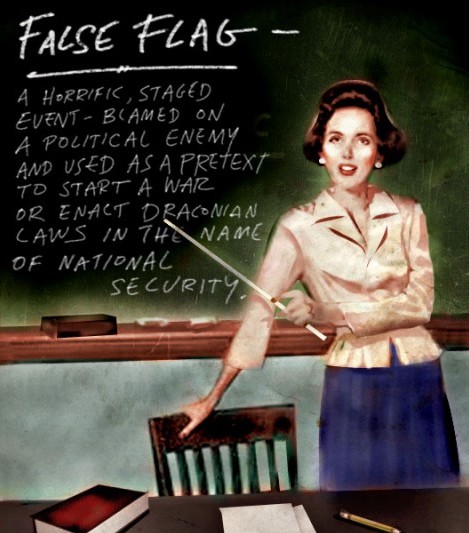
False Flag is a concept that goes back centuries. It was considered to be a legitimate ploy by the Greeks and Romans, where a military force would pretend to be friendly to get close to an enemy before dropping the pretense and raising its banners to reveal its own affiliation just before launching an attack. In the sea battles of the eighteenth century among Spain, France and Britain hoisting an enemy flag instead of one’s own to confuse the opponent was considered to be a legitimate ruse de guerre, but it was only “honorable” if one reverted to one’s own flag before engaging in combat.

Today’s false flag operations are generally carried out by intelligence agencies and non-government actors including terrorist groups, but they are only considered successful if the true attribution of an action remains secret. There is nothing honorable about them as their intention is to blame an innocent party for something that it did not do. There has been a lot of such activity lately and it was interesting to learn by way of a leak that the Central Intelligence Agency (CIA) has developed a capability to mimic the Internet fingerprints of other foreign intelligence services. That means that when the media is trumpeting news reports that the Russians or Chinese hacked into U.S. government websites or the sites of major corporations, it could actually have been the CIA carrying out the intrusion and making it look like it originated in Moscow or Beijing. Given that capability, there has been considerable speculation in the alternative media that it was actually the CIA that interfered in the 2016 national elections in the United States.

False flags can be involved in other sorts of activity as well. The past year’s two major alleged chemical attacks carried out against Syrian civilians that resulted in President Donald Trump and associates launching 160 cruise missiles are pretty clearly false flag operations carried out by the rebels and terrorist groups that controlled the affected areas at the time. The most recent reported attack on April 7 might not have occurred at all, according to doctors and other witnesses who were actually in Douma. Because the rebels succeeded in convincing much of the world that the Syrian government had carried out the attacks, one might consider their false flag efforts to have been extremely successful.

The remedy against false flag operations such as the recent one in Syria is, of course, to avoid taking the bait and instead waiting until a thorough and objective inspection of the evidence has taken place. The United States, Britain and France did not do that, preferring instead to respond to hysterical press reports by “doing something.” If the U.N. investigation of the alleged attack turns up nothing, a distinct possibility, it is unlikely that they will apologize for having committed a war crime.

The other major false flag that has recently surfaced is the poisoning of Sergei Skripal and his daughter Yulia in Salisbury, England, on March 4. Russia had no credible motive to carry out the attack and had, in fact, good reasons not to do so. The allegations made by British Prime Minister Theresa May about the claimed nerve agent being “very likely” Russian in origin have been debunked, in part through examination by the U.K.’s own chemical weapons lab. May, under attack even within her own party, needed a good story and a powerful enemy to solidify her own hold on power so false flagging something to Russia probably appeared to be just the ticket as Moscow would hardly be able to deny the “facts” being invented in London. Unfortunately, May proved wrong and the debate ignited over her actions, which included the expulsion of twenty-three Russian diplomats, has done her severe damage. Few now believe that Russia actually carried out the poisoning and there is a growing body of opinion suggesting that it was actually a false flag executed by the British government or even by the CIA.

The lesson that should be learned from Syria and Skripal is that if “an incident” looks like it has no obvious motive behind it, there is a high probability that it is a false flag. A bit of caution in assigning blame is appropriate given that the alternative would be a precipitate and likely disproportionate response that could easily escalate into a shooting war.

America’s ‘Unlimited Imperialists’


By Francis Boyle

Source: Consortium News

Historically the latest eruption of American militarism in the 21st Century is akin to that of America opening the 20th Century by means of the U.S.-instigated Spanish-American War in 1898.

The then Republican administration of President William McKinley grabbed their colonial empire from Spain in Cuba, Puerto Rico, Guam, and the Philippines; inflicted a near genocidal war against the Filipino people; while at the same time illegally annexing the Kingdom of Hawaii and subjecting the Native Hawaiian people (who call themselves the Kanaka Maoli) to genocidal conditions.

Additionally, McKinley’s military and colonial expansion into the Pacific was also designed to secure America’s economic exploitation of China pursuant to the euphemistic rubric of the “open door” policy.   But over the next four decades America’s aggressive presence, policies, and practices in the so-called “Pacific” Ocean would ineluctably pave the way for Japan’s attack at Pearl Harbor on Dec. 7, 1941, and thus America’s precipitation into the ongoing Second World War.

Today a century later, the serial imperial aggressions launched, waged, and menaced by the neoconservative Republican Bush Junior administration, then the neoliberal Democratic Obama administration and now the reactionary Trump administration threaten to set off World War III.

This Time the Stakes are Higher

By shamelessly exploiting the terrible tragedy of September 11, the Bush Junior administration set forth to steal a hydrocarbon empire from the Muslim states and peoples of color living in Central Asia, the Middle East and Africa under the bogus pretexts of (a) fighting a war against “international terrorism” or “Islamic fundamentalism”; and/or (b) eliminating weapons of mass destruction; and/or (c) promoting democracy; and/or (d) self-styled humanitarian intervention and its avatar “responsibility to protect” (R2P).

Only this time the geopolitical stakes are infinitely greater than they were a century ago:  control and domination of the world’s hydrocarbon resources and thus the very fundaments and energizers of the global economic system – oil and gas.

The Bush Junior and Obama administrations targeted the remaining hydrocarbon reserves of Africa, Latin America (e.g., the Pentagon’s reactivating the Fourth Fleet in 2008), and Southeast Asia for further conquest and domination, together with the strategic choke-points at sea and on land required for their transportation (e.g., Syria, Yemen, Somalia, Djibouti).  Today the U.S. Fourth Fleet threatens oil-rich Venezuela and Ecuador, along with Cuba.

Toward accomplishing that first objective, in 2007, the neoconservative Bush Junior administration announced the establishment of the U.S. Pentagon’s Africa Command (AFRICOM) in order to better control, dominate, steal, and exploit both the natural resources and the variegated peoples of the continent of Africa, the very cradle of our human species.

In 2011 Libya and the Libyans proved to be the first victims to succumb to AFRICOM under the neoliberal Obama administration, thus demonstrating the truly bi-partisan and non-partisan nature of U.S. imperial foreign policy decision-making. Let us put aside as beyond the scope of this article, the American conquest, extermination, and ethnic cleansing of the Native Americans from the face of the continent.

Since America’s instigation of the Spanish-American War in 1898, U.S. foreign policy decision-making has been alternatively conducted by reactionary imperialists, conservative imperialists, and liberal imperialists for the past 120 years and counting.

Trump is just another representative for U.S. imperialism and neoliberal capitalism. He forthrightly and proudly admitted that the United States is in the Middle East in order to steal their oil. At least he was honest about it. Unlike his predecessors who lied about the matter going back to President George Bush Sr. with his War for Persian Gulf oil against Iraq in 1991. Just recently, Trump publicly threatened illegal U.S. military intervention against oil-rich Venezuela and now he’s poised to strike Syria.

It’s About Power, Not Just Resources

But oil and other resources are not the only U.S. motive. Enforcing its global power and undermining or removing leaders who defy it are also at play.

As my teacher, mentor, and friend, the late, great Professor Hans Morgenthau, who coined the term “unlimited imperialism” in his seminal 1948 critique of U.S. foreign policy, Politics Among Nations, said:

          “The outstanding historic examples of unlimited imperialism are the expansionist policies of Alexander the Great, Rome, the Arabs in the seventh and eighth centuries, Napoleon I, and Hitler. They all have in common an urge toward expansion which knows no rational limits, feeds on its own successes and, if not stopped by a superior force, will go on to the confines of the political world. This urge will not be satisfied so long as there remains anywhere a possible object of domination–a politically organized group of men which by its very independence challenges the conqueror’s lust for power. It is, as we shall see, exactly the lack of moderation, the aspiration to conquer all that lends itself to conquest, characteristic of unlimited imperialism, which in the past has been the undoing of the imperialistic policies of this kind…”

Since September 11, 2001, it is the Unlimited Imperialists along the lines of Alexander, Rome, Napoleon, and Hitler who have been in charge of conducting American foreign policy decision-making.  The factual circumstances surrounding the outbreaks of both the First World War and the Second World War currently hover like twin Swords of Damocles over the heads of all humanity.


Francis Boyle is a professor of international law at the University of Illinois Urbana-Champaign. Among his many books is “Destroying World Order.”

Russia and the War Party

By Carl Boggs

Source: CounterPunch

The steady deterioration of American political discourse seems to have reached its lowest ebb in historical memory, visible in the rightward shift of both Democrats and Republicans.  One sign is the frenzied Democratic assault on Republicans from the right, especially in foreign policy.  Another is the resounding silence on the most crucial problems facing humanity: threat of catastrophic war, nuclear arms race, ecological crisis, health-care debacle, the worsening miseries of global capitalism.   Tabloid-style spectacles have increasingly filled media space.  Still another sign is the intensifying anti-Russia hysteria promoted by unhinged liberals in Congress and the corporate media, reminiscent of the worst McCarthyism.

Another example of this descent into absurdity is the book Russian Roulette, by liberals Michael Isikoff and David Corn – Beltway writers whose shrill anti-Russian crusade has received highest accolades by the New York Times and such promoters of the permanent warfare state as Rachel Maddow (whose gushing endorsement is on the back cover).  The subtitle – “The Inside Story of Putin’s War on America and the Election of Donald Trump” – reveals the political obsession of Democrats (and plenty of Republicans) for the past eighteen months, to the exclusion of most everything else.   More than anything, the volume illustrates the staggering level of ignorance in the U.S. about Russian history and politics, crude propaganda easily displacing coherent analysis.  (A more general – and devastating – review of Russian Routlette by Paul Street appeared earlier in CP.)

Russian Roulette is filled with 300 pages of meticulous detail – Trump’s (actual, planned, or failed) business dealings in Russia, endless goings and comings of shady characters and “operatives”, electronic transactions across the great divide, a litany of speeches, conferences, dinners and other activities, computer hacking and trolling schemes, breathless tales of lurid behavior, Russians clandestinely entering the U.S., reports on secret files, and of course the menacing specter of Russian “oligarchs”.  All this is believed to demonstrate Putin’s ruthless war against America, his supreme goal being to “destroy our democracy”, instill chaos, and neutralize U.S. as well as European geopolitical power.  As we have been ritually informed by CNN and kindred venues, cyber warfare (for now) is the Russians’ preeminent mode of combat – and it has been so devastatingly effective as to paralyze normal American politics.  It was cyber warfare, moreover, that delivered the 2016 presidential election to the Russia-loving Trump.

Trump, it turns out, was guilty of the most grievous sin: he went so far as to mention the possibility of cooperative relations with Russia, the idea being to help fight terrorism and better manage the nuclear threat. His other crime was to question the neocon/Democratic/Clintonite agenda of regime change in Syria – an agenda (still alive) that could bring military confrontation with a nuclear state. Trump’s fanciful hope meant that he had to be a willing “stooge” of Putin and his nefarious plots.

It turns out that the myriad claims, charges, and allegations set forth by Isikoff and Corn amount to little of substance – surely nothing to prove that Putin has been conducting warfare against the U.S., or that Russians had decisively influenced the 2016 presidential election.  Evidence that Trump conspired in any way with Putin or his imagined assemblage of henchmen, former KGB agents, cyberwarriors, and oligarchs is similarly lacking.   Yet, for the authors the only way Hillary Clinton could have lost the presidency that was rightfully hers was because the Russians intervened, with help from the treacherous Wikileaks, the authors writing: “Never before had a president’s election been so closely linked to the intervention of a foreign power.”

According to Isikoff and Corn, the scheming Russians managed to infiltrate party machinery, elections, and the Internet, deploying squads of cyberwarriors from the notorious Internet Research Agency and other sites.  They also placed ads in Facebook and other social-media sites.  How many American voters were even exposed to such fare, much less swayed by it, cannot be established, but vague popular awareness of this Russian skullduggery did not appear until the Mueller investigation called attention to it more than a year after the election.  No one denies the actuality of Russian trolling and hacking enterprises. The problem for the authors here is that such operations are so universally practiced as to be rather commonplace, while it has yet to be shown they can alter election outcomes in the U.S.. Moreover, in this area of intelligence work (as in so many others) the U.S. has long been unchallenged world champion.

The authors describe Putin as an “autocratic, repressive, and dangerous Russian leader” who routinely kills his political enemies and crushes dissent.  Such oversimplified descriptions of Putin and the Russian scene in general are set forth as established truths, no discussion or evidence needed.  Why a duly-elected leader (with 76 percent of the vote earlier this year) can be so ritually dismissed as a ruthless tyrant Isikoff and Corn never get around to explaining.  Were election irregularities or illegalities reported?   Were voters threatened or coerced?   Is Putin any more authoritarian than the vast majority of leaders around the world?  Would Netanyahu in Israel, Macron in France, or Merkel in Germany (all elected by much slimmer margins) be described as simple despots?

As for Trump, Russian Roulette seeks to demonstrate that the candidate and then president somehow “aided and abetted Moscow’s attack on American democracy.” That’s right: the White House served as a willing, secret accomplice in Putin’s criminal schemes.  So many Trump associates –Paul Manafort, General Michael Flynn, Carter Page, et. al. – had indeed previously traveled to Russia, talked and dined with Russians, and (gasp) seemed to want something of a cordial relationship with business and other interests there.  (Why this should have been shocking is hard to fathom, since in 2016 and 2017 the Russian Federation was still an integral part of the global capitalist economy and the U.S. has been doing plenty of business there since the early 1990s.)

The authors’ unfounded generalizations are based mainly on three sources, most crucially the all-important (but phony) Christopher Steele “dossier” that was said to implicate Trump in a variety of offenses and scandals that even Isikoff and Corn admit is comprised of “sensational and uncorroborated claims” – that is, fake news.  They argue, further, that Putin hacked DNC communications and passed along damning emails to Wikileaks, but investigation (by William Binney and others) suggests they were more likelyleaked than hacked; Julian Assange firmly denies that the files (never viewed by the FBI) came from any state actor.  The establishment media paid little attention to the damning content of these emails, so their impact on the election in any case could not have amounted to much.  Even the Mueller Committee report earlier this year, which indicted 13 Russian trolls and hackers, conceded they had no appreciable impact on the 2016 election results.

In Russian Roulette the authors seem infatuated with the American “intelligence community” – purported last word on the question of Russian interference — writing confidently but misleadingly: “The intelligence community has identified Moscow as the culprit in the hacks of Democrats in October [2016].”  One cannot help wondering what sort of “community” Isikoff and Corn have in mind.

By “intelligence community” do they include the NSA, an agency that has been spying on Americans and the world with impunity for years while a spokesperson (James Clapper) lied about it before Congress?  Could they be referring to the CIA, active for decades in clandestine and illegal operations such as unwarranted surveillance, sabotage, torture, drone strikes on civilians, and regime change (by military force, not just computer meddling) in Vietnam, Iran, Guatemala, Chile, Yugoslavia, Iraq, Libya, Ukraine, and too many other countries to list here, all aided and abetted by flagrant lies and cover-ups?  Perhaps they have in mind the FBI, an agency long dedicated to destroying popular movements (Civil Rights, anti-war, etc.) through COINTELPRO and other illegal operations.  Or the DEA (Drug Enforcement Administration), which for decades has squandered hundreds of billions of dollars on a futile but disastrous and racist War on Drugs, filling jails with people targeted, harassed, jailed, and ruined for the crime of using banned substances?

Can Isikoff and Corn actually take seriously the murky claims of the most Orwellian surveillance apparatus in history?  Do they believe that this “community” is subject to any meaningful oversight and accountability?  Their remarkably clueless account – basic to virtually every narrative in Russian Roulette – reveals an astonishing disconnect from postwar American (and world) history.

The central Isikoff/Corn thesis is not only devoid of factual support but is totally inverted: the present state of affairs is exactly the opposite of what they argue.  There has been no “Putin’s war on America”, but rather sustained U.S. (and NATO) warfare against Russia – political, economic, ideological, military – since 2000, if not earlier.  The Russians occupy the other, targetedend of the power spectrum, obvious to any serious observer.  Who has invoked harsh and repeated economic sanctions on whom?  Who has militarily encircled and targeted whom?  Who has deployed nuclear weapons at whose border?  Who has financed and orchestrated a hostile coup adjacent to whose territory?  Who has carried out non-stop ideological hysteria against whom?

In the world as it now exists, it is worth asking whether Russia could plausibly assume the role of imperial aggressor in its dealings with the world’s leading superpower?   Consider that in 2017 the total Russian GDP as barely 1.5 trillion dollars, roughly one-twelfth that of the U.S. ($19.5 trillion) and not even one-tenth that of the European Union ($14 trillion).  Military spending breaks down accordingly: nearly one trillion for the U.S. and $250 billion for NATO compared to $61 billion for Russia.  As for intelligence operations, the imbalance worsens – a budget of six billion dollars for the FSB and military GRU combined, compared to $75 billion for Washington not counting another $45 billion for the DEA and DHS (Department of Homeland Security) in tandem.

In fact Russia, despite its nuclear prowess, does not have the leverage and resources to threaten American (much less broader Western) geopolitical objectives – the real “threat” coming from the stubborn fact of Russian independence that was squelched during the Clintonite 1990s, when Washington used its power to reduce post-Soviet Russia to puppet status under Boris Yeltsin.   During the Yeltsin period the U.S. was never content with simple “meddling” in Russian affairs: it propped up a weak president, dismantled the public infrastructure, coddled an emergent stratum of oligarchs, and then spent $2.5 billion to sway the 1996 election in favor of a weak and unpopular Yeltsin.  Only with Putin’s emergence in 1999 did the nation regain a semblance of independence, restoring economic and political sovereignty, much to the disgust of Western ruling interests.

American intrusion into domestic Russian affairs is never explored by Isikoff and Corn, as it would undermine their one-sided tract. Nor do the authors have much to say about the post-Soviet eastward march of NATO, which allowed the U.S. and its allies to partially encircle Russia with both nuclear and conventional forces. The opening salvo of this strangulation gambit was President Bill Clinton’s “humanitarian” war against Serbia ending with the 1999 U.S./NATO bombings.   This was followed by President George W. Bush’s decision to scrap the crucial ABM Treaty with Russia in 2002 before invading Iraq in 2003.  CIA and State Department efforts to orchestrate regime change in Ukraine, ultimately achieved in 2014, came soon thereafter.

The ongoing Western campaign of economic warfare, media propaganda, and military provocations directed at Russia has only served to bolster Putin’s legitimacy, as shown by his overwhelming support in the 2018 election.  Yet Isikoff and Corn can write: “He [Putin] was a Russian nationalist to the core.  He wanted to extend Russian power. . . [as] an autocrat in the long tradition of Russian strongmen and had little interest in joining the club of Western liberal democracies – or winning its approval.”  Given the rampant imperial behavior of Washington and its European partners, Putin would have to be certifiably insane to respond in a manner that would permit further Western encroachments.

It is the expansionist U.S./NATO alliance that has maliciously targeted Russia, not the other way around.  Putin is surely a nationalist, but why not?  That just means he will fight for Russian national integrity against Western efforts to isolate and destabilize the country.  Any cyberwarfare activities launched by the Russians will appear to the rational observer as quite intelligible, a proven method to gain information about the plans of a vastly superior adversary overflowing with anti-Russia venom.

Like other Russia-bashing ideologues, Isikoff and Corn see terrible “oligarchs” everywhere, all naturally cozy with Putin. We have references to “Putin and his oligarch friends,” as if large-scale business interests could somehow have nothing to do with government.  They note that payments to IRA trolls “were being made through a holding company owned by Yevgeny Prigozhin, a Russian oligarch and restaurateur close to the Russian president and known as ‘Putin’s chef”.”  Along with this disturbing revelation we are told that a “clique of [oligarchic] hardliners was able to outgun Russian moderates – a group including Yury Kovalchuk, billionaire owner of Rossiya bank and friend of the president “known as Putin’s banker”.  It would be a mistake to overlook the infamous Aras Agalarov, a real-estate mogul identified as “Putin;s Builder”.  Left out was any reference to “Putin’s Gardener”.

The authors deftly uncover a clique of diabolical oligarchs colluding with Putin to launch attacks on the West.  It might be useful to clarify the meaning of “oligarch”. One generally held definition is that they are exceedingly wealthy and powerful business and financial elites – the same interests that Washington zealously supported in Russia during the 1990s. These would be aligned with the very corporate and banking interests that dominate the global capitalist system, everywhere seeming to enjoy close relations with their governments.  American oligarchs (multibillionaires) in fact far outnumber their Russian counterparts – 565 to 96 – and possess many times the wealth and influence.  Further, if Washington really despises oligarchs, why did it install billionaire Petro Poroshenko as Ukraine ruler after the 2014 coup?

For Isikoff and Corn, Hillary Clinton might have been a terribly flawed candidate, but her loss nonetheless would not have occurred in the absence of “Putin’s underhanded intervention”.  No one questions whether Russian trolls and hackers were active in 2016 – or that Facebook ads were placed – but no evidence of their actual effectiveness has been presented, much less their capacity to determine an election outcome.

As they righteously celebrate the virtues of multiculturalism, diversity, and tolerance, liberal Democrats – now more than ever a neocon party of war – have come to embrace just the opposite: fierce hostility against other nations and cultures, smug provincialism, a recycled McCarthyism that spews hatred at even the slightest dissent from super-patriotic orthodoxy.  They pretend victim status when they are the ones targeting, attacking, smearing, and warmongering.

Worse yet, to satisfy their narrow political agendas they are perfectly ready to risk military confrontation with a nuclear power – a conflict that could lead to unprecedented global catastrophe.  Nowhere in this parochial text do the authors express the slightest concern for the horrors that might result from years of U.S./European hostility toward Russia.  Despite an unlevel economic and political playing-field, it is worth remembering that in nuclear matters Russia has rough parity with the West.  This might deter the neocons of both parties or it might not, the sad reality being is that liberal Democrats exemplified by Isikoff and Corn have little to offer the world beyond continuous war shrouded in a flimsy, desperate identity politics.


Carl Boggs is the author of The Hollywood War Machine, with Tom Pollard (second edition, forthcoming), and Drugs, Power, and Politics, both published by Paradigm.     


Freedom Rider: Syria and Press Propaganda

By Margaret Kimberly

Source: Black Agenda Report

“Trump protects himself with war as Democrats and the rest of the ruling elite support his militarism.”

It is difficult for Americans to find out what is happening in their country and around the world. That is because corporate media outlets have nearly complete control over what they see and hear and because those interests are closely allied with the state. The promise of the internet, the hoped for level playing field for communication and information gathering, is also under corporate control. It is now part of a well coordinated censorship effort and attack against left wing sites such as Black Agenda Report.

The lies which allowed the United States, France and Britain to attack Syria are presented without contradiction. The people with knowledge and expertise who can counter these narratives are disappeared from access to newspapers or television stations. The close relationship between the deep state, the corporate media, and the establishment elite at home and abroad continues without hindrance.

“British prime minister Theresa May refused to allow a parliamentary vote on the Syrian missile strike.”

Donald Trump may be labeled a fascist but he attacked Syria with the help of France and Britain. Apparently every leader of a “free world” country is also a fascist. They certainly behave that way as they trample on the rights of millions of people. Far from being the “civilized” nations that Trump referred to in his televised address, these three countries are among the most criminal that have ever existed. They all grew rich on the slave trade, indigenous genocides, the plantation economies in the Americas, and the theft of resources all over the world. Now they run roughshod over their own people. British prime minister Theresa May refused to allow a parliamentary vote on the Syrian missile strike and showed the hollowness of claims that hers is a democratic nation. The same can be said of her partners in crime.

France impoverished Haiti with nearly 100 years of theft, murdered Algerians in the streets of Paris and keeps its former African colonies financially dependent. Former president Nicolas Sarkozy took millions of dollars from Muammar Gaddafi and then had him murdered, just like a mob boss would do. Now they have connived with the help of press propagandists in all three countries to fool millions of people as they try to continue their gangsterish aggression against Syria.

“Sarkozy took millions of dollars from Muammar Gaddafi and then had him murdered, just like a mob boss would do.”

If even mediocre journalists were allowed to report freely on this issue the crime would be obvious. Consider the timeline of events. On March 4, former Russian double agent Sergei Skripal and his daughter are poisoned with a chemical agent in Britain. The British government immediately blames Russia, which has no motive to harm a former spy they swapped eight years earlier. Saudi crown prince Mohammed bin Salman arrives in London for an official visit on March 7. On March 12 French president Emmanuel Macron states that France will attack Syria if any chemical weapons are used there. The next day the Russian military claims to have evidence that a chemical attack will be carried out against Syrian civilians as a pretext for war. On March 16 France warns French journalists to leave Syria. Mohammed bin Salman arrives in Washington on March 19. On April 8 he goes to Paris for yet another official visit. That same day Saudi funded jihadist groups and the White Helmets, who were created by a British intelligence officer, claim that a chemical weapons attack occurred in the city of Douma. On April 14 the United States, France and Britain join in the missile strike.

“They have connived with the help of press propagandists in all three countries to fool millions of people.”

The aggressors are very transparent. The plot was carried out in the open. But because they have a compliant media behind them they have no reason to worry. No journalist asked why Sergei Skripal and his daughter are in effect held hostage and denied access to Russian officials as a treaty between the two countries demands. No one questions a strangely worded statement allegedly from Yulia Skripal but issued by the London Metropolitan Police in which she said she didn’t want help from her government or contact with her own relatives.

Why shouldn’t Mohammed bin Salman openly plan with presidents and prime ministers? Who will question him? The New York Times and MSNBC and the Washington Post and the BBC and AFP certainly will not. We will probably never know the name of the person or persons who poisoned the Skripals but common sense tells us that the intended murders were ordered by someone with a motive to create a pretext for war.

“The plot was carried out in the open.”

The actual air strike was limited because of back channel negotiations between these countries. The danger may look like Kabuki theater but no one should assume that the peril is over. The criminals in Washington, London and Paris may yet go too far and provoke a major hot war.

All three heads of state have their own concerns. Macron was put into power to kill off his country’s welfare state and any remnants of left politics. May is struggling with Brexit negotiations and cruel austerity measures that have made her so unpopular she actively avoids voters. Trump may be impeached but he protects himself with war as Democrats and the rest of the ruling elite support his militarism.

Regardless of individual rationales these three people pose a threat to the entire planet. They are aided and abetted by corporate media who act as scribes and present war propaganda as fact. The Nuremberg trials after World War II established that planning aggressive war is a crime and so is the propaganda that promotes it. May, Trump and Macron are guilty but so-called journalists are as well. The criminals could not commit their dirty deeds without their help.


Margaret Kimberley’s Freedom Rider column appears weekly in BAR, and is widely reprinted elsewhere. She maintains a frequently updated blog as well at http://freedomrider.blogspot.com . Ms. Kimberley lives in New York City, and can be reached via e-Mail at Margaret.Kimberley(at)BlackAgendaReport.com.

How The Guardian Fulfills George Orwell’s Prediction of ‘Newspeak’

By Eric Zuesse

Source: Strategic Culture Foundation

On Sunday April 15th, Britain’s Guardian bannered “OPCW inspectors set to investigate site of Douma chemical attack” and pretended that there was no question that a chemical attack in Douma Syria on April 7th had actually occurred, and the article then went further along that same propaganda-line, to accuse Syria’s Government of having perpetrated it. This ‘news’ story opened [and clarificatory comments from me will added in brackets]:

UN chemical weapons investigators were set on Sunday to begin examining the scene of a chemical attack in the Syrian city of Douma, which had prompted the joint US, French and British strikes against military installations and chemical weapons facilities near the capital, Damascus.

The arrival of the delegation from the Organisation for the Prohibition of Chemical Weapons (OPCW) came as the Syrian military announced that it had “purified” [no source provided, but this — from 7 March 2018  is the only source that existed prior to the April 14th missiles-invasion of Syria, and its meaning is very differentthe region of eastern Ghouta, of which Douma is a part, after a two-month campaign that killed nearly 2,000 civilians [no source provided as regards either the number, or that all of them were ‘civilians’ and that none of them were jihadists or “terrorists”], following years of siege.

The propaganda-article continued directly:

“Units of our brave armed forces, and auxiliary and allied forces, completed the purification of eastern Ghouta, including all its towns and villages, of armed terrorist organisations,” the general command statement said.

No source was provided for that, but this sentence is a sly mind-manipulation, because here is what the Syrian Government’s General Command had actually said: “Statement of the Army General Command declaring Eastern Ghouta clear of terrorism” as headlined by the Syrian Government itself. In other words: the Guardian’s ‘journalist’ had substituted the word “clear” by the word “purify” and did this after having already asserted but not documented, that the Government had just completed “a two-month campaign that killed nearly 2,000 civilians.” When the Syrian Government announces that an area has been “cleared of terrorists (or of terrorism),” the US-allied propagandist uses the word “purify,” such as “purified the region of eastern Ghouta” or “the purification of eastern Ghouta, including all its towns and villages, of armed terrorist organisations.” But by the time that the reader gets there to “purification … of armed terrorist organisations,” the reader has already been indoctrinated to believe that Syria’s Government is trying to “purify” land, or perpetrate some type of ethnic-cleansing.

Later, the article asserts that, “The OPCW mission will arrive in Douma eight days after the chemical attack, and days after the area fell to the control of Russian military and Syrian government forces. That delay, along with the possibility of the tampering of evidence by the forces accused of perpetrating the attack, raises doubts about what the OPCW’s inspectors might be able to discover.” However, a fierce debate is being waged over whether this was not any real “chemical attack” but instead a staged event by the jihadists in order to draw Trump back into invading Syria. In other words: any journalistic reference yet, at this time, to the event as “the chemical attack” instead of as “the alleged chemical attack” is garbage, just as, prior to the guilty-verdict in a murder trial, no journalistic reference may legitimately be made to the defendant as “the murderer,” instead of as “the defendant.” That is lynch-mob ‘journalism’, which Joseph Goebbels championed.

The Joseph-Goebbels-following ‘journalist’ has thus opened by implying that the Russia-allied Syrian Government is trying to crush a democratic revolution, instead of the truth, that the US-allied Governments are trying to overthrow and replace the Russia-allied Syrian Government. It’s a big difference, between the lie, and the truth.

Another story in the April 15th Guardian was “Pressure grows on Russia to stop protecting Assad as US, UK and France press for inquiry into chemical weapons stockpiles” and this one pretended that the issue is for “Russia to stop protecting Assad,” who is the democratically electedand popular President of Syria, and not to stop the invasion of Syria since 2011 by US and Saudi backed foreign jihadists to overthrow him. Furthermore, as regards “press for inquiry into chemical weapons stockpiles,” the real and urgent issue right now is to allow the Organization for the Prevention of Chemical Weapons (OPCW) into Douma to hold an independent and authoritative investigation into the evidence there. Russia pressed for it at the U.N. Security Council and the US and its allies blocked it there. But the OPCW went anyway — even after the US-allied invasion on April 14th — and this courageous resistance by them against the US dictatorship can only be considered heroic.

That type of ‘news’-reporting is virtually universal in The West, among the US and its allied governments, which refer to themselves as ‘democracies’ and refer to any Government that they wish to overthrow and replace by their own selected dictator, as ‘dictatorships’, such as these regimes had referred to Iraq in 2003, Libya in 2011, Syria forever, and Ukraine in 2014.


The Art of War: The Western American Empire in Crisis

By Manlio Dinucci

Source: Global Research

The US tariff war against China and the new sanctions against Russia are signs of a trend that goes beyond current events.

To understand what it is, we should go back about thirty years ago. In 1991 the United States, winners of the Cold War and of the first war after the Cold War, waged in the Gulf, declared that “the United States remains the only state with truly global strength, reach and influence in every dimension – political, economic and military” and that “there is no substitute for American leadership ” in the world.

By relying on the dollar hegemony, on the global reach of its multinationals and its financial groups, on the control of international organizations (IMF, World Bank, WTO), the United States promotes “free trade” and “Free movement of capital” on a global scale, reducing or eliminating tariffs and rules. The other Western powers move in their wake.

The Russian Federation, in a profound crisis after the disintegration of the USSR, is considered by Washington as an easy land of conquest, to be dismembered to better control its great resources.  China, open to the market economy, also appears to be conquerable with US capital and products and exploitable as a large reservoir of low-cost labor.

Thirty years later, the “American dream” of the unchallenged domination of the world has vanished.

Russia, by putting up an internal front to defend national sovereignty, has overcome the crisis and regained the status of great power.

China, “the world’s factory” where also US multinationals produce, has become the world’s leading exporter of goods and makes increasing foreign investments. Today it challenges the technological supremacy of the United States.

The project of a new Silk Road – a road, rail and maritime network between China and Europe through 60 countries – places China at the forefront of the process of globalization, while the United States is perched erecting economic barriers.

Washington looks with growing concern at the economic and political partnership between Russia and China, which challenges the hegemony of the dollar.

Failing to oppose this process only through economic instruments, the United States resorts to the military ones. The putsch in Ukraine and the subsequent nuclear escalation in Europe, the strategic shift to Asia, the wars in Afghanistan and Syria, are part of the strategy with which the US and the other Western powers try to maintain the unipolar dominance in a world that is becoming multipolar.

However, this strategy is suffering a series of setbacks. Russia and China, under increasing military pressure, reacted by strengthening their strategic cooperation.

Russia has not been got on the ropes but, in a surprise move, intervened militarily in support of the Syrian State which, in the US / NATO plans, should have ended up like the Libyan State. In Afghanistan, US and NATO are mired in a war that has been going on for over 17 years.

As a reaction to these failures, the propaganda campaign is intensified to make Russia appear as a dangerous enemy, also using the false flag of chemical attacks in England and Syria.

The same technique was used in 2003 when, to justify the war against Iraq, Secretary of State Colin Powell presented to the UN the “evidence” that Iraq possessed weapons of mass destruction. Powell, in 2016, had to admit the non-existence of such weapons. In 15 years, however, the war has caused over a million deaths.

Video: English Subtitles  (wait 1.06 minutes for the English subtitles)

US, allies risk Russian retaliation in Syrian attack

By Editorial Board

Source: Global Times

US President Donald Trump announced on Friday he ordered strikes on the Syrian regime in response to a chemical attack last weekend. He said the strikes were in coordination with France and the United Kingdom. Syrian President Bashar al-Assad said his country is being “invaded” by the three countries. The Russian Embassy in the USA said in a statement that “insulting the President of Russia is unacceptable and inadmissible.”

In a sensational statement, Trump asserted the Bashar Assad government used chemical weapons on civilians. He said “The evil and the despicable attack left mothers and fathers, infants and children thrashing in pain and gasping for air. These are not the actions of a man. They are crimes of a monster instead.”Trump also warned “Russia must decide if it will continue down this dark path or if it will join with civilized nations as a force for stability and peace.”

The facts cannot be distorted. This military strike was not authorized by the UN, and the strikes targeted a legal government of a UN member state. The US and its European allies launched strikes to punish President Bashar al-Assad for a suspected chemical attack in Duma last weekend. However, it has not been confirmed if the chemical weapons attack happened or if it did, whether government forces or opposition forces launched it. International organizations have not carried out any authoritative investigation.

The Syrian government has repeatedly stressed that there is no need for it to use chemical weapons to capture the opposition-controlled Duma city and the use of chemical weapons has provided an excuse for Western intervention. The Syrian government’s argument or Trump’s accusations against the “evil” Assad regime, which one is in line with basic logic? The answer is quite obvious.

The US has a record of launching wars on deceptive grounds. The Bush government asserted the Saddam regime held chemical weapons before the US-British coalition troops invaded Iraq in 2003. However, the coalition forces didn’t find what they called weapons of mass destruction after overthrowing the Saddam regime. Both Washington and London admitted later that their intelligence was false.

Washington’s attack on Syria where Russian troops are stationed constitute serious contempt for Russia’s military capabilities and political dignity. Trump, like scolding a pupil, called on Moscow, one of the world’s leading nuclear powers, to abandon its “dark path.” Disturbingly, Washington seems to have become addicted to mocking Russia in this way. Russia is capable of launching a destructive retaliatory attack on the West. Russia’s weak economy is plagued by Western sanctions and squeezing of its strategic space. That the West provokes Russia in such a manner is irresponsible for world peace.

The situation is still fomenting. The Trump administration said it will sustain the strikes. But how long will the military action continue and whether Russia will fight back as it claimed previously remain uncertain. Western countries continue bullying Russia but are seemingly not afraid of its possible counterattack. Their arrogance breeds risk and danger.