Dystopia Disguised as Democracy: All the Ways in Which Freedom Is an Illusion

By John W. Whitehead & Nisha Whitehead

Source: The Rutherford Institute

“The illusion of freedom will continue as long as it’s profitable to continue the illusion. At the point where the illusion becomes too expensive to maintain, they will just take down the scenery, they will pull back the curtains, they will move the tables and chairs out of the way and you will see the brick wall at the back of the theater.”—Frank Zappa

We are no longer free.

We are living in a world carefully crafted to resemble a representative democracy, but it’s an illusion.

We think we have the freedom to elect our leaders, but we’re only allowed to participate in the reassurance ritual of voting. There can be no true electoral choice or real representation when we’re limited in our options to one of two candidates culled from two parties that both march in lockstep with the Deep State and answer to an oligarchic elite.

We think we have freedom of speech, but we’re only as free to speak as the government and its corporate partners allow.

We think we have the right to freely exercise our religious beliefs, but those rights are quickly overruled if and when they conflict with the government’s priorities, whether it’s COVID-19 mandates or societal values about gender equality, sex and marriage.

We think we have the freedom to go where we want and move about freely, but at every turn, we’re hemmed in by laws, fines and penalties that regulate and restrict our autonomy, and surveillance cameras that monitor our movements. Punitive programs strip citizens of their passports and right to travel over unpaid taxes.

We think we have property interests in our homes and our bodies, but there can be no such freedom when the government can seize your property, raid your home, and dictate what you do with your bodies.

We think we have the freedom to defend ourselves against outside threats, but there is no right to self-defense against militarized police who are authorized to probe, poke, pinch, taser, search, seize, strip and generally manhandle anyone they see fit in almost any circumstance, and granted immunity from accountability with the general blessing of the courts. Certainly, there can be no right to gun ownership in the face of red flag gun laws which allow the police to remove guns from people merely suspected of being threats.

We think we have the right to an assumption of innocence until we are proven guilty, but that burden of proof has been turned on its head by a surveillance state that renders us all suspects and overcriminalization which renders us all lawbreakers. Police-run facial recognition software that mistakenly labels law-abiding citizens as criminals. A social credit system (similar to China’s) that rewards behavior deemed “acceptable” and punishes behavior the government and its corporate allies find offensive, illegal or inappropriate.

We think we have the right to due process, but that assurance of justice has been stripped of its power by a judicial system hardwired to act as judge, jury and jailer, leaving us with little recourse for appeal. A perfect example of this rush to judgment can be found in the proliferation of profit-driven speed and red light cameras that do little for safety while padding the pockets of government agencies.

We have been saddled with a government that pays lip service to the nation’s freedom principles while working overtime to shred the Constitution.

By gradually whittling away at our freedoms—free speech, assembly, due process, privacy, etc.—the government has, in effect, liberated itself from its contractual agreement to respect the constitutional rights of the citizenry while resetting the calendar back to a time when we had no Bill of Rights to protect us from the long arm of the government.

Aided and abetted by the legislatures, the courts and Corporate America, the government has been busily rewriting the contract (a.k.a. the Constitution) that establishes the citizenry as the masters and agents of the government as the servants.

We are now only as good as we are useful, and our usefulness is calculated on an economic scale by how much we are worth—in terms of profit and resale value—to our “owners.”

Under the new terms of this revised, one-sided agreement, the government and its many operatives have all the privileges and rights and “we the people” have none.

Only in our case, sold on the idea that safety, security and material comforts are preferable to freedom, we’ve allowed the government to pave over the Constitution in order to erect a concentration camp.

The problem with these devil’s bargains, however, is that there is always a catch, always a price to pay for whatever it is we valued so highly as to barter away our most precious possessions.

We’ve bartered away our right to self-governance, self-defense, privacy, autonomy and that most important right of all: the right to tell the government to “leave me the hell alone.” In exchange for the promise of safe streets, safe schools, blight-free neighborhoods, lower taxes, lower crime rates, and readily accessible technology, health care, water, food and power, we’ve opened the door to militarized police, government surveillance, asset forfeiture, school zero tolerance policies, license plate readers, red light cameras, SWAT team raids, health care mandates, overcriminalization and government corruption.

In the end, such bargains always turn sour.

We asked our lawmakers to be tough on crime, and we’ve been saddled with an abundance of laws that criminalize almost every aspect of our lives. So far, we’re up to 4500 criminal laws and 300,000 criminal regulations that result in average Americans unknowingly engaging in criminal acts at least three times a day. For instance, the family of an 11-year-old girl was issued a $535 fine for violating the Federal Migratory Bird Act after the young girl rescued a baby woodpecker from predatory cats.

We wanted criminals taken off the streets, and we didn’t want to have to pay for their incarceration. What we’ve gotten is a nation that boasts the highest incarceration rate in the world, with more than 2.3 million people locked up, many of them doing time for relatively minor, nonviolent crimes, and a private prison industry fueling the drive for more inmates, who are forced to provide corporations with cheap labor.

We wanted law enforcement agencies to have the necessary resources to fight the nation’s wars on terror, crime and drugs. What we got instead were militarized police decked out with M-16 rifles, grenade launchers, silencers, battle tanks and hollow point bullets—gear designed for the battlefield, more than 80,000 SWAT team raids carried out every year (many for routine police tasks, resulting in losses of life and property), and profit-driven schemes that add to the government’s largesse such as asset forfeiture, where police seize property from “suspected criminals.”

We fell for the government’s promise of safer roads, only to find ourselves caught in a tangle of profit-driven red-light cameras, which ticket unsuspecting drivers in the so-called name of road safety while ostensibly fattening the coffers of local and state governments. Despite widespread public opposition, corruption and systemic malfunctions, these cameras are particularly popular with municipalities, which look to them as an easy means of extra cash. Building on the profit-incentive schemes, the cameras’ manufacturers are also pushing speed cameras and school bus cameras, both of which result in hefty fines for violators who speed or try to go around school buses.

We’re being subjected to the oldest con game in the books, the magician’s sleight of hand that keeps you focused on the shell game in front of you while your wallet is being picked clean by ruffians in your midst.

This is how tyranny rises and freedom falls.

With every new law enacted by federal and state legislatures, every new ruling handed down by government courts, and every new military weapon, invasive tactic and egregious protocol employed by government agents, “we the people” are being reminded that we possess no rights except for that which the government grants on an as-needed basis.

Indeed, there are chilling parallels between the authoritarian prison that is life in the American police state and The Prisoner, a dystopian television series that first broadcast in Great Britain more than 50 years ago.

The series centers around a British secret agent (played by Patrick McGoohan) who finds himself imprisoned, monitored by militarized drones, and interrogated in a mysterious, self-contained, cosmopolitan, seemingly idyllic retirement community known only as The Village. While luxurious and resort-like, the Village is a virtual prison disguised as a seaside paradise: its inhabitants have no true freedom, they cannot leave the Village, they are under constant surveillance, their movements are tracked by surveillance drones, and they are stripped of their individuality and identified only by numbers.

Much like the American Police State, The Prisoner’s Village gives the illusion of freedom while functioning all the while like a prison: controlled, watchful, inflexible, punitive, deadly and inescapable.

Described as “an allegory of the individual, aiming to find peace and freedom in a dystopia masquerading as a utopia,” The Prisoner is a chilling lesson about how difficult it is to gain one’s freedom in a society in which prison walls are disguised within the trappings of technological and scientific progress, national security and so-called democracy.

Perhaps the best visual debate ever on individuality and freedom, The Prisoner confronted societal themes that are still relevant today: the rise of a police state, the freedom of the individual, round-the-clock surveillance, the corruption of government, totalitarianism, weaponization, group think, mass marketing, and the tendency of mankind to meekly accept his lot in life as a prisoner in a prison of his own making.

The Prisoner is an operations manual for how you condition a populace to life as prisoners in a police state: by brainwashing them into believing they are free so that they will march in lockstep with the state and be incapable of recognizing the prison walls that surround them.

We can no longer maintain the illusion of freedom.

As I make clear in my book Battlefield America: The War on the American People and in its fictional counterpart The Erik Blair Diaries, “we the people” have become “we the prisoners.”
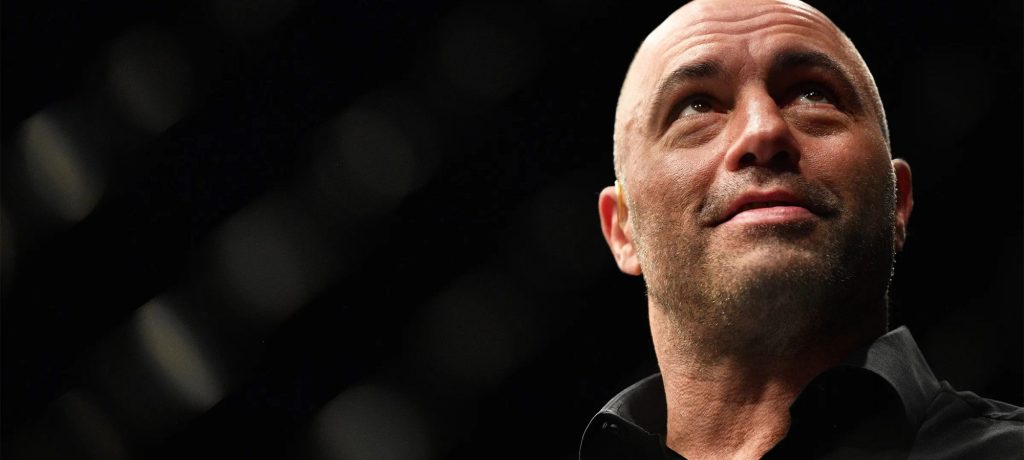
Joe Rogan shows us the real purpose of cancel culture

By Kit Knightly

Source: Off-Guardian

Joe Rogan has just been cancelled. Again. It’s not about covid “misinformation” this time.

No, now he’s a racist.

Some enterprising young mind combed through 13 years and hundreds of episodes of The Joe Rogan Experience, and cut together around twenty instances of Rogan using “the n-word”.

This video was shared by award-winning musician India Arie, and used to explain her pulling her music from Spotify’s platform in protest of Rogan’s continued presence there.

Rogan claims that these clips are all taken out of context in his recent apology video, and none were ever intended to be racist. This may well be true…we can’t check for ourselves, because Spotify removed all the episodes.

These important bits of context were, naturally, removed from the viral video. Besides, it has since been said that context doesn’t even matter.

And you know what, they’re right. The context doesn’t matter, perhaps the intention doesn’t even matter, what matters is “Why now?”

Some of these clips are over twelve years old, and yet there have never been any calls to boycott Spotify or cancel his show until just the last couple of days.

Were they not racist before? Or was everyone just OK with the racism? Could there be something else behind this?

…but why bother pausing the hate-fest to ask questions, right?

The only message that matters is – Joe Rogan is a racist now, and streaming giant Spotify have pulled over seventy episodes of his show from their platform as a result.

Of course the cyber-torches and internet-pitchforks coming for Joe Rogan is nothing new. Having preached the tenets of a healthy lifestyle, promoted alternate Covid treatments, and invited dissenting experts onto his show, Rogan has obviously been on the establishment’s hit list for a while.

This reached a peak in January when ageing rock royalty Neil Young gave Spotify an ultimatum: Remove Joe Rogan’s “misinformation”, or take my music down.

Despite adding a weasely disclaimer to the beginning of the podcast’s episodes, Spotify essentially sided with Rogan, probably because they couldn’t be seen to bow to that kind of pressure, and because they figured most people had forgotten Neil Young was still alive.

In short, and despite other musicians like Joni Mitchell adding their voices to Young’s, the gambit failed and Rogan remained on the air.

Then, just last week, White House Press Secretary Jen Psaki added fuel to the fire by announcing the President would like to see “more done” by tech companies to “limit the amount of misinformation” on their platforms.

Within days of that press conference, the viral video compilation of racial slurs had appeared, and Rogan is now a racist as well as an “anti-vax covidiot” or whatever they are calling us these days.

He’s also an object lesson in the entire purpose of cancel culture, and extreme identity politics in general.

I don’t know how many of our readers are gamers, or remember Half Life 2, but go with me here…

Around two-thirds of the way through the game you encounter giant insect-like aliens called Ant Lions, and soon afterwards get a special attack: The ability to “paint” enemies with pheromones which cause an unending swarm of Ant Lions to attack them.

Of course, the giant insects don’t know WHY they are attacking your enemies, they don’t sympathise with your aims and are not capable of understanding your plans, all they know is the chemical signals driving them to fits of rage.

You probably don’t need me to explain the metaphor.

This is the purpose of rampant, hysterical identity politics. You can paint your enemies as a target and watch the mindless swarm do its work.

As much as “cancel culture” is portrayed as a totally organic process, without any top-down control, this is simply not the case.

It is almost NEVER organic, and seemingly ALWAYS contrived.

If you need to be persuaded of that, simply look at who is immune to it.

Both Joe Biden and Justin Trudeau have got enough racist (or at least racist-seeming) scandals to get them cancelled if the process really was anything but a covert tool of maintaining the status quo. And yet still they stand.

To show how selective it is, we have examples of the same exact behaviour eliciting complete opposite responses depending on the person involved.

When Gina Carano compared the hatred of the unmasked and unvaccinated to the way Jews were treated in Nazi Germany, she lost her job and her agent.

When Margaret Hodge made similar comments about Corbyn’s Labour party, there was no rebuke at all.

It seems only people outside the establishment, or promoting the ‘wrong’ opinions, are ever in real danger of falling victim to ‘organic’ cancellation.

Indeed, one can be a totally white-bread member of the entertainment industry for years and be safe in the knowledge your racism/homophobia/misogyny etc will never really come to light, but step out of line on the wrong subject at the wrong time, and you will suddenly find yourself facing a tidal wave of past “sins” about to wash over you.

Look at Donald Trump, an insider to the bone when he was just a billionaire reality TV host, but then he ran against Hillary and became “literally Hitler” overnight.

Rogan is a perfect examplar of this phenomenon. Spend ten years going on about legalising weed, taking DMT and talking about martial arts and you can say “the n-word” as much as you want and nobody notices or cares. But the minute you even mildly interrogate an important media narrative, then the mob ‘organically’ remembers you were a racist the whole time.

The evidence of contrivance is obvious. Simply ask yourself: where did this video compilation of racial slurs actually come from? Who made it?

Rogan’s uses of “the n-word” are not new. They are all several years old and from 23 separate episodes, all multiple hours long. And there are almost 1800 episodes of the show to plough through if you decide to go searching. So making this video is at least two days’ work of simply watching the episodes – and that’s assuming you know where to start looking.

And that’s before editing or trying to make it “go viral”.

Was all this done on a whim by some bored pro-vaxxer?

Does that sound likely?

Far more likely is that it was created and deployed to discredit Rogan’s COVID-questioning without having to engage with the Covid sceptic evidence or arguments.

It’s even possible the video may even have already existed before the current controversy. After all, why create this climate of stifling sensitivity if you don’t have the tools to use it?

Perhaps most authors, actors, comedians etc. have a “tape” in the vault somewhere. A database of racism, homophobia or transphobia just waiting to be released when needed. A collection of neo-kompromat that works best as a deterrent, but is always ready to be loosed if needed.

Those people who do step too far out of their box are taken down, and act as an example to others. Ensuring everyone on the public stage is singing from the same hymn sheet.

Because that, it seems, is what cancel culture is for.

Totalitarian Paranoia Run Amok: Pandemics, Lockdowns & Martial Law

By John W. Whitehead & Nisha Whitehead

Source: The Rutherford Institute

Totalitarian paranoia runs deep in American society, and it now inhabits the highest levels of government.”—Professor Henry Giroux

Once upon a time, there was a government so paranoid about its hold on power that it treated everyone and everything as a threat and a reason to expand its powers. Unfortunately, the citizens of this nation believed everything they were told by their government, and they suffered for it.

When terrorists attacked the country, and the government passed massive laws aimed at paving the way for a surveillance state, the people believed it was done merely to keep them safe. The few who disagreed were labeled traitors.

When the government waged costly preemptive wars on foreign countries, insisting it was necessary to protect the nation, the citizens believed it. And when the government brought the weapons and tactics of war home to use against the populace, claiming it was just a way to recycle old equipment, the people believed that too. The few who disagreed were labeled unpatriotic.

When the government spied on its own citizens, claiming they were looking for terrorists hiding among them, the people believed it. And when the government began tracking the citizenry’s movements, monitoring their spending, snooping on their social media, and surveying them about their habits—supposedly in an effort to make their lives more efficient—the people believed that, too. The few who disagreed were labeled paranoid.

When the government allowed private companies to take over the prison industry and agreed to keep the jails full, justifying it as a cost-saving measure, the people believed them. And when the government started arresting and jailing people for minor infractions, claiming the only way to keep communities safe was to be tough on crime, the people believed that too. The few who disagreed were labeled soft on crime.

When the government hired crisis actors to take part in disaster drills, never alerting the public to which “disasters” were staged, the people genuinely believed they were under attack. And when the government insisted it needed greater powers to prevent such attacks from happening again, the people believed that too. The few who disagreed were told to shut up or leave the country.

When the government started carrying out covert military drills around the country, insisting it was necessary to train the troops for foreign combat, most of the people believed them. The few who disagreed, fearing that perhaps all was not what it seemed, were shouted down as conspiracy theorists and quacks.

When government leaders locked down the nation, claiming it was the only way to prevent an unknown virus from sickening the populace, the people believed them and complied with the mandates and quarantines. The few who resisted or voiced skepticism about the government’s edicts were denounced as selfish and dangerous and silenced on social media.

When the government expanded its war on terrorism to include domestic terrorists, the people believed that only violent extremists would be targeted. Little did they know that anyone who criticizes the government can be considered an extremist.

By the time the government began using nationalized police and the military to routinely lockdown the nation, the citizenry had become so acclimated to such states of emergency that they barely even noticed the prison walls that had grown up around them.

Now every fable has a moral, and the moral of this story is to beware of anyone who urges you to ignore your better instincts and blindly trust that the government has your best interests at heart.

In other words, if it looks like trouble and it smells like trouble, you can bet there’s trouble afoot.

Unfortunately, the government has fully succeeded in recalibrating our general distaste for anything that smacks too overtly of tyranny.

After all, like the proverbial boiling frogs, the government has been gradually acclimating us to the specter of a police state for years now: Militarized police. Riot squads. Camouflage gear. Black uniforms. Armored vehicles. Mass arrests. Pepper spray. Tear gas. Batons. Strip searches. Surveillance cameras. Kevlar vests. Drones. Lethal weapons. Less-than-lethal weapons unleashed with deadly force. Rubber bullets. Water cannons. Stun grenades. Arrests of journalists. Crowd control tactics. Intimidation tactics. Brutality.

This is how you prepare a populace to accept a police state willingly, even gratefully.

You don’t scare them by making dramatic changes. Rather, you acclimate them slowly to their prison walls. Persuade the citizenry that their prison walls are merely intended to keep them safe and danger out. Desensitize them to violence, acclimate them to a military presence in their communities, and persuade them that only a militarized government can alter the seemingly hopeless trajectory of the nation.

It’s happening already.

The sight of police clad in body armor and gas masks, wielding semiautomatic rifles and escorting an armored vehicle through a crowded street, a scene likened to “a military patrol through a hostile city,” no longer causes alarm among the general populace.

We’ve allowed ourselves to be acclimated to the occasional lockdown of government buildings, military drills in small towns so that special operations forces can get “realistic military training” in “hostile” territory, and  Live Active Shooter Drill training exercises, carried out at schools, in shopping malls, and on public transit, which can and do fool law enforcement officials, students, teachers and bystanders into thinking it’s a real crisis.

Still, you can’t say we weren’t warned.

Back in 2008, an Army War College report revealed that “widespread civil violence inside the United States would force the defense establishment to reorient priorities in extremis to defend basic domestic order and human security.” The 44-page report went on to warn that potential causes for such civil unrest could include another terrorist attack, “unforeseen economic collapse, loss of functioning political and legal order, purposeful domestic resistance or insurgency, pervasive public health emergencies, and catastrophic natural and human disasters.”

In 2009, reports by the Department of Homeland Security surfaced that called on the government to subject right-wing and left-wing activists and military veterans to full-fledged, pre-crime surveillance.

Meanwhile, the government has been amassing an arsenal of military weapons, including hollow point bullets, for use domestically and equipping and training their “troops” for war. Even government agencies with largely administrative functions such as the Food and Drug Administration, Department of Veterans Affairs, and the Smithsonian have been acquiring body armor, riot helmets and shields, cannon launchers and police firearms and ammunition. In fact, there are now at least 120,000 armed federal agents carrying such weapons who possess the power to arrest.

Rounding out this profit-driven campaign to turn American citizens into enemy combatants (and America into a battlefield) is a technology sector that has been colluding with the government to create a Big Brother that is all-knowing, all-seeing and inescapable. It’s not just the drones, fusion centers, license plate readers, stingray devices and the NSA that you have to worry about. You’re also being tracked by the black boxes in your cars, your cell phone, smart devices in your home, grocery loyalty cards, social media accounts, credit cards, streaming services such as Netflix, Amazon, and e-book reader accounts.

And then there are the military drills that have been taking place on American soil in recent years.

In the latest “unconventional warfare exercise,” dubbed “Robin Sage,” special forces soldiers will battle seasoned “freedom fighters” in a “realistic” guerrilla war across two dozen North Carolina counties.

Robin Sage follows on the heels of other such military drills, including Jade Helm, which involved U.S. Army Special Operations Command, the Navy Seals, Air Force Special Operations, Marine Special Operations Command, Marine Expeditionary Units, the 82nd Airborne Division, and other interagency partners.

According to the government, these planned military exercises are supposed to test and practice unconventional warfare including, but not limited to, guerrilla warfare, subversion, sabotage, intelligence activities, and unconventional assisted recovery.

The training, known as Realistic Military Training (RMT) because it will be conducted outside of federal property, are carried out on both public and private land, with locations marked as “hostile territory,” permissive, uncertain (leaning friendly), or uncertain (leaning hostile).

This is psychological warfare at its most sophisticated.

Add these military exercises onto the list of other troubling developments that have taken place over the past 30 years or more, and suddenly, the overall picture seems that much more sinister: the expansion of the military industrial complex and its influence in Washington DC, the rampant surveillance, the corporate-funded elections and revolving door between lobbyists and elected officials, the militarized police, the loss of our freedoms, the injustice of the courts, the privatized prisons, the school lockdowns, the roadside strip searches, the military drills on domestic soil, the fusion centers and the simultaneous fusing of every branch of law enforcement (federal, state and local), the stockpiling of ammunition by various government agencies, the active shooter drills that are indistinguishable from actual crises, the economy flirting with near collapse, the growing social unrest, the socio-psychological experiments being carried out by government agencies, etc.

And then you have the government’s Machiavellian schemes for unleashing all manner of dangers on an unsuspecting populace, then demanding additional powers in order to protect “we the people” from the threats. Almost every national security threat that the government has claimed greater powers in order to fight—all the while undermining the liberties of the American citizenry—has been manufactured in one way or another by the government.

What we’ve seen play out before us is more than mere totalitarian paranoia run amok.

What has unfolded over the past few years has been a test to see how well “we the people” have assimilated the government’s lessons in compliance, fear and police state tactics; a test to see how quickly “we the people” will march in lockstep with the government’s dictates, no questions asked; and a test to see how little resistance “we the people” will offer up to the government’s power grabs when made in the name of national security.

Most critically of all, this has been a test to see whether the Constitution—and our commitment to the principles enshrined in the Bill of Rights—could survive a national crisis and true state of emergency.

We have failed the test abysmally.

We have also made it way too easy for a government that has been working hard to destabilize to lockdown the nation.

Mark my words, there’s trouble brewing.

Better yet, take a look at “Megacities: Urban Future, the Emerging Complexity,” a Pentagon training video created by the Army for U.S. Special Operations Command.

The training video is only five minutes long, but it says a lot about the government’s mindset, the way its views the citizenry, and the so-called “problems” that the government must be prepared to address in the near future through the use of martial law.

Even more troubling, however, is what this military video doesn’t say about the Constitution, about the rights of the citizenry, and about the dangers of locking down the nation and using the military to address political and social problems.

The training video anticipates that all hell will break loose by 2030—that’s barely eight short years away—but we’re already witnessing a breakdown of society on virtually every front.

The danger signs are screaming out a message

The government is anticipating trouble (read: civil unrest), which is code for anything that challenges the government’s authority, wealth and power.

According to the Pentagon training video created by the Army for U.S. Special Operations Command, the U.S. government is grooming its armed forces to solve future domestic political and social problems.

What they’re really talking about is martial law, packaged as a well-meaning and overriding concern for the nation’s security.

The chilling five-minute training video, obtained by The Intercept through a FOIA request and made available online, paints an ominous picture of the future—a future the military is preparing for—bedeviled by “criminal networks,” “substandard infrastructure,” “religious and ethnic tensions,” “impoverishment, slums,” “open landfills, over-burdened sewers,” a “growing mass of unemployed,” and an urban landscape in which the prosperous economic elite must be protected from the impoverishment of the have nots.

And then comes the kicker. Three-and-a-half minutes into the Pentagon’s dystopian vision of “a world of Robert Kaplan-esque urban hellscapes—brutal and anarchic supercities filled with gangs of youth-gone-wild, a restive underclass, criminal syndicates, and bands of malicious hackers,” the ominous voice of the narrator speaks of a need to “drain the swamps.”

The government wants to use the military to drain the swamps of futuristic urban American cities of “noncombatants and engage the remaining adversaries in high intensity conflict within.” And who are these noncombatants, a military term that refers to civilians who are not engaged in fighting? They are, according to the Pentagon, “adversaries.” They are “threats.”

They are the “enemy.”

They are people who don’t support the government, people who live in fast-growing urban communities, people who may be less well-off economically than the government and corporate elite, people who engage in protests, people who are unemployed, people who engage in crime (in keeping with the government’s fast-growing, overly broad definition of what constitutes a crime).

In other words, in the eyes of the U.S. military, noncombatants are American citizens a.k.a. domestic extremists a.k.a. enemy combatants who must be identified, targeted, detained, contained and, if necessary, eliminated.

In the future imagined by the Pentagon, any walls and prisons that are built will be used to protect the societal elite—the haves—from the have-nots.

If you haven’t figured it out already, we the people are the have-nots.

Suddenly, the events of recent years begin to make sense: the invasive surveillance, the extremism reports, the civil unrest, the protests, the shootings, the bombings, the military exercises and active shooter drills, the color-coded alerts and threat assessments, the fusion centers, the transformation of local police into extensions of the military, the distribution of military equipment and weapons to local police forces, the government databases containing the names of dissidents and potential troublemakers.

The government is systematically locking down the nation and shifting us into martial law.

This is how you prepare a populace to accept a police state willingly, even gratefully.

As Nazi Field Marshal Hermann Goering remarked during the Nuremberg trials:

It is always a simple matter to drag people along whether it is a democracy, or a fascist dictatorship, or a parliament, or a communist dictatorship. Voice or no voice, the people can always be brought to the bidding of the leaders. This is easy. All you have to do is tell them they are being attacked, and denounce the pacifists for lack of patriotism and exposing the country to danger. It works the same in every country.

It does indeed work the same in every country.

It’s time to wake up and stop being deceived by government propaganda.

Mind you, by “government,” I’m not referring to the highly partisan, two-party bureaucracy of the Republicans and Democrats.

As I make clear in my book Battlefield America: The War on the American People and in its fictional counterpart The Erik Blair Diaries, I’m referring to “government” with a capital “G,” the entrenched Deep State that is unaffected by elections, unaltered by populist movements, and has set itself beyond the reach of the law. I’m referring to the corporatized, militarized, entrenched bureaucracy that is fully operational and staffed by unelected officials who are, in essence, running the country and calling the shots in Washington DC, no matter who sits in the White House.

Be warned: in the future envisioned by the government, we will not be viewed as Republicans or Democrats. Rather, “we the people” will all be enemies of the state.

Despotism Is the New Normal: Looming Threats to Freedom in 2022

Design by Robo Mega

By John W. Whitehead & Nisha Whitehead

Source: The Rutherford Institute

“Looking at the present, I see a more probable future: a new despotism creeping slowly across America. Faceless oligarchs sit at command posts of a corporate-government complex that has been slowly evolving over many decades. In efforts to enlarge their own powers and privileges, they are willing to have others suffer the intended or unintended consequences of their institutional or personal greed. For Americans, these consequences include chronic inflation, recurring recession, open and hidden unemployment, the poisoning of air, water, soil and bodies, and, more important, the subversion of our constitution.—Bertram Gross, Friendly Fascism: The New Face of Power in America

Despotism has become our new normal.

Digital tyranny, surveillance. Intolerance, cancel culture, censorship. Lockdowns, mandates, government overreach. Supply chain shortages, inflation. Police brutality, home invasions, martial law. The loss of bodily integrity, privacy, autonomy.

These acts of tyranny by an authoritarian government have long since ceased to alarm or unnerve us. We have become desensitized to government brutality, accustomed to government corruption, and unfazed by the government’s assaults on our freedoms.

This present trajectory is unsustainable. The center cannot hold.

The following danger points pose some of the greatest threats to our collective and individual freedoms now and in the year to come.

Censorship. The most controversial issues of our day—gay rights, abortion, race, religion, sexuality, political correctness, police brutality, et al.—have become battlegrounds for those who claim to believe in freedom of speech but only when it favors the views and positions they support. Thus, while on paper, we are technically free to speak, in reality, we are only as free to speak as the government and tech giants such as Facebook, Google or YouTube may allow. Yet it’s a slippery slope from censoring so-called illegitimate ideas to silencing truth. What we are witnessing is the modern-day equivalent of book burning which involves doing away with dangerous ideas—legitimate or not—and the people who espouse them. Unfortunately, censorship is just the beginning. Once you allow the government and its corporate partners to determine who is worthy enough to participate in society, anything goes.

The Emergency State. Now that the government has gotten a taste for flexing its police state powers by way of a bevy of lockdowns, mandates, restrictions, contact tracing programs, heightened surveillance, censorship, overcriminalization, etc., “we the people” may well find ourselves burdened with a Nanny State inclined to use its draconian pandemic powers to protect us from ourselves. Therein lies the danger of the government’s Machiavellian version of crisis management that justifies all manner of government tyranny in the so-called name of national security. This is the power grab hiding in plain sight.

Pre-crime. The government is about to rapidly expand its policing efforts to focus on pre-crime and thought crimes. Precrime, straight out of the realm of dystopian science fiction movies such as Minority Report, aims to prevent crimes before they happen by combining widespread surveillance, behavior prediction technologies, data mining, precognitive technology, and neighborhood and family snitch programs to enable police to capture would-be criminals before they can do any damage. The intent, of course, is for the government to be all-seeing, all-knowing and all-powerful in its preemptive efforts to combat domestic extremism, a broad label that can be applied to anything or anyone the government perceives to be a threat to its power.

The Surveillance State. This all-seeing fourth branch of government, comprised of a domestic army of government snitches, spies and techno-warriors, watches everything we do, reads everything we write, listens to everything we say, and monitors everywhere we go. Beware of what you say, what you read, what you write, where you go, and with whom you communicate, because it is all being recorded, stored, and catalogued, and will be used against you eventually, at a time and place of the government’s choosing. Even agencies not traditionally associated with the intelligence community are part of the government’s growing network of snitches and spies.

Genetic privacy. “Guilt by association” has taken on new connotations in the technological age. Yet the debate over genetic privacy—and when one’s DNA becomes a public commodity outside the protection of the Fourth Amendment’s prohibition on warrantless searches and seizures—is really only beginning. Get ready, folks, because the government—helped along by Congress (which adopted legislation allowing police to collect and test DNA immediately following arrests), the courts (which have ruled that police can routinely take DNA samples from people who are arrested but not yet convicted of a crime), and local police agencies (which are chomping at the bit to acquire this new crime-fighting gadget)—has embarked on a diabolical campaign to create a nation of suspects predicated on a massive national DNA database.

Bodily integrity. It doesn’t matter what your trigger issue is—whether it’s vaccines, abortion, crime, religion, immigration, terrorism or some other overtly politicized touchstone used by politicians as a rallying cry for votes—we should all be concerned when governments and businesses (i.e., the Corporate State) join forces to compel individuals to sacrifice their right to bodily integrity on the altar of so-called safety and national security. This debate over bodily integrity covers broad territory, ranging from abortion and forced vaccines to biometric surveillance and basic healthcare. Forced vaccinations, forced cavity searches, forced colonoscopies, forced blood draws, forced breath-alcohol tests, forced DNA extractions, forced eye scans, and forced inclusion in biometric databases are just a few ways in which Americans continue to be reminded that we have no control over what happens to our bodies during an encounter with government officials.

Gun control. After declaring more than a decade ago that citizens have a Second Amendment right to own a gun in one’s home for self-defense, the Supreme Court has now been tasked with deciding whether the Constitution also protects the right to carry a gun outside the home. Unfortunately, when it comes to gun rights in particular, and the rights of the citizenry overall, the U.S. government has adopted a “do what I say, not what I do” mindset. Nowhere is this double standard more evident than in the government’s attempts to arm itself to the teeth, all the while viewing as suspect anyone who dares to legally own a gun, let alone use one in self-defense. Indeed, while it still technically remains legal to own a firearm in America, possessing one can now get you pulled over, searched, arrested, subjected to all manner of surveillance, treated as a suspect without ever having committed a crime, shot at, and killed.

Show Your Papers Society. With every passing day, more and more private businesses and government agencies on both the state and federal level are requiring proof of a COVID-19 vaccination in order for individuals to work, travel, shop, attend school, and generally participate in the life of the country. By allowing government agents to establish a litmus test for individuals to be able to engage in commerce, movement and any other right that corresponds to life in a supposedly free society, it lays the groundwork for a “show me your papers” society in which you are required to identify yourself at any time to any government worker who demands it for any reason. Such tactics can quickly escalate into a power-grab that empowers government agents to force anyone and everyone to prove they are in compliance with every statute and regulation on the books.

Singularity. Welcome to the Matrix (i.e. the metaverse), where reality is virtual, freedom is only as free as one’s technological overlords allow, and artificial intelligence is slowly rendering humanity unnecessary, inferior and obsolete. Indeed, it’s no coincidence that Elon Musk has announced his intentions of implanting brain chips in humans sometime in 2022. The digital universe—the metaverse—is expected to be the next step in our evolutionary transformation from a human-driven society to a technological one. Remaining singularly human and retaining your individuality and dominion over yourself—mind, body and soul—in the face of corporate and government technologies that aim to invade, intrude, monitor, manipulate and control us may be one of the greatest challenges before us.

Despotism. Even in the face of militarism, fascism, technotyranny, surveillance, etc., the gravest threat facing us as a nation may well be despotism, exercised by a ruling class whose only allegiance is to power and money. The American kakistocracy (a government run by unprincipled career politicians and corporate thieves that panders to the worst vices in our nature and has little regard for the rights of the people) continues to suck the American people into a parallel universe in which the Constitution is meaningless, the government is all-powerful, and the citizenry are powerless to defend themselves against government agents who steal, spy, lie, plunder, kill, abuse and generally inflict mayhem and sow madness on everyone and everything in their sphere.

It is a grim outlook for a new year, but it is not completely hopeless.

If hope is to be found, it will be found with those of us who do their part, at their local levels, to right the wrongs and fix what is broken. I am referring to the builders, the thinkers, the helpers, the healers, the educators, the creators, the artists, the activists, the technicians, the food gatherers and distributors, and every other person who does their part to build up rather than destroy.

“We the people” are the hope for a better year.

Until we can own that truth, until we can forge our own path back to a world in which freedom means something again, as I make clear in my book Battlefield America: The War on the American People and in its fictional counterpart The Erik Blair Diaries, we’re going to be stuck in this wormhole of populist anger, petty politics and destruction that is pitting us one against the other.

In such a scenario, no one wins.

The Christmas Baby Born in a Police State: Then and Now

By John W. Whitehead & Nisha Whitehead

Source: The Rutherford Institute

“When the song of the angels is stilled, when the star in the sky is gone, when the kings and princes are home, when the shepherds are back with their flocks, the work of Christmas begins: to find the lost, to heal the broken, to feed the hungry, to release the prisoner, to rebuild the nations, to bring peace among the people, to make music in the heart.” ― Howard Thurman

The Christmas story of a baby born in a manger is a familiar one.

The Roman Empire, a police state in its own right, had ordered that a census be conducted. Joseph and his pregnant wife Mary traveled to the little town of Bethlehem so that they could be counted. There being no room for the couple at any of the inns, they stayed in a stable (a barn), where Mary gave birth to a baby boy, Jesus. Warned that the government planned to kill the baby, Jesus’ family fled with him to Egypt until it was safe to return to their native land.

Yet what if Jesus had been born 2,000 years later?

What if, instead of being born into the Roman police state, Jesus had been born at this moment in time? What kind of reception would Jesus and his family be given? Would we recognize the Christ child’s humanity, let alone his divinity? Would we treat him any differently than he was treated by the Roman Empire? If his family were forced to flee violence in their native country and sought refuge and asylum within our borders, what sanctuary would we offer them?

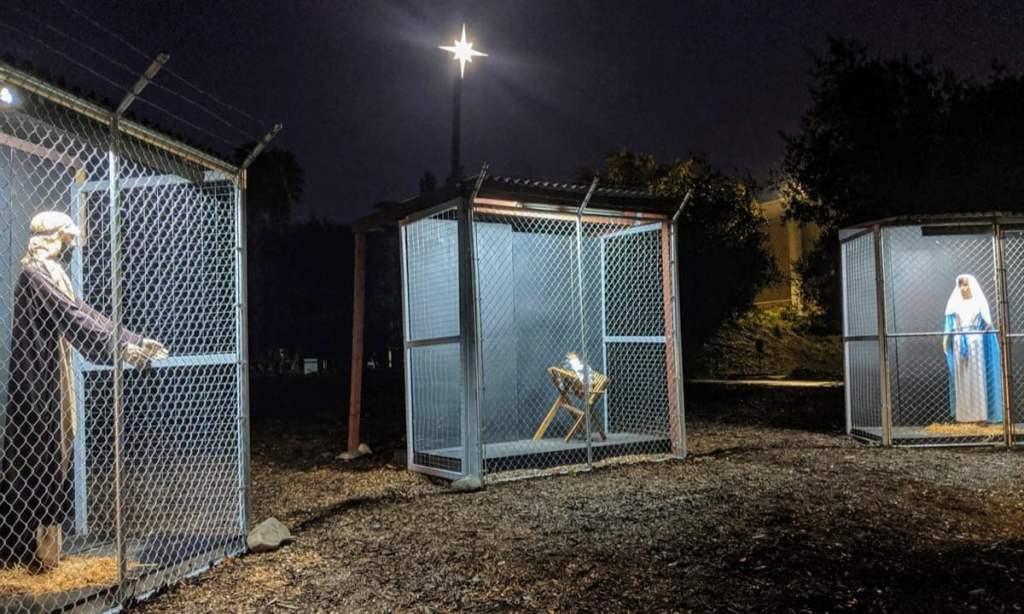
A singular number of churches across the country have asked those very questions in recent years, and their conclusions were depicted with unnerving accuracy by nativity scenes in which Jesus and his family are separated, segregated and caged in individual chain-link pens, topped by barbed wire fencing.

Those nativity scenes were a pointed attempt to remind the modern world that the narrative about the birth of Jesus is one that speaks on multiple fronts to a world that has allowed the life, teachings and crucifixion of Jesus to be drowned out by partisan politics, secularism, materialism and war, all driven by a manipulative shadow government called the Deep State.

The modern-day church has largely shied away from applying Jesus’ teachings to modern problems such as war, poverty, immigration, etc., but thankfully there have been individuals throughout history who ask themselves and the world: what would Jesus do?

What would Jesus—the baby born in Bethlehem who grew into an itinerant preacher and revolutionary activist, who not only died challenging the police state of his day (namely, the Roman Empire) but spent his adult life speaking truth to power, challenging the status quo of his day, and pushing back against the abuses of the Roman Empire—do about the injustices of our  modern age?

Dietrich Bonhoeffer asked himself what Jesus would have done about the horrors perpetrated by Hitler and his assassins. The answer: Bonhoeffer was executed by Hitler for attempting to undermine the tyranny at the heart of Nazi Germany.

Aleksandr Solzhenitsyn asked himself what Jesus would have done about the soul-destroying gulags and labor camps of the Soviet Union. The answer: Solzhenitsyn found his voice and used it to speak out about government oppression and brutality.

Martin Luther King Jr. asked himself what Jesus would have done about America’s warmongering. The answer: declaring “my conscience leaves me no other choice,” King risked widespread condemnation as well as his life when he publicly opposed the Vietnam War on moral and economic grounds.

Even now, despite the popularity of the phrase “What Would Jesus Do?” (WWJD) in Christian circles, there remains a disconnect in the modern church between the teachings of Christ and the suffering of what Jesus in Matthew 25 refers to as the “least of these.”

Yet this is not a theological gray area: Jesus was unequivocal about his views on many things, not the least of which was charity, compassion, war, tyranny and love.

After all, Jesus—the revered preacher, teacher, radical and prophet—was born into a police state not unlike the growing menace of the American police state. When he grew up, he had powerful, profound things to say, things that would change how we view people, alter government policies and change the world. “Blessed are the merciful,” “Blessed are the peacemakers,” and “Love your enemies” are just a few examples of his most profound and revolutionary teachings.

When confronted by those in authority, Jesus did not shy away from speaking truth to power. Indeed, his teachings undermined the political and religious establishment of his day. It cost him his life. He was eventually crucified as a warning to others not to challenge the powers-that-be.

Can you imagine what Jesus’ life would have been like if, instead of being born into the Roman police state, he had been born and raised in the American police state?

Consider the following if you will.

Had Jesus been born in the era of the America police state, rather than traveling to Bethlehem for a census, Jesus’ parents would have been mailed a 28-page American Community Survey, a mandatory government questionnaire documenting their habits, household inhabitants, work schedule, how many toilets are in your home, etc. The penalty for not responding to this invasive survey can go as high as $5,000.

Instead of being born in a manger, Jesus might have been born at home. Rather than wise men and shepherds bringing gifts, however, the baby’s parents might have been forced to ward off visits from state social workers intent on prosecuting them for the home birth. One couple in Washington had all three of their children removed after social services objected to the two youngest being birthed in an unassisted home delivery.

Had Jesus been born in a hospital, his blood and DNA would have been taken without his parents’ knowledge or consent and entered into a government biobank. While most states require newborn screening, a growing number are holding onto that genetic material long-term for research, analysis and purposes yet to be disclosed.

Then again, had Jesus’ parents been undocumented immigrants, they and the newborn baby might have been shuffled to a profit-driven, private prison for illegals where they first would have been separated from each other, the children detained in make-shift cages, and the parents eventually turned into cheap, forced laborers for corporations such as Starbucks, Microsoft, Walmart, and Victoria’s Secret. There’s quite a lot of money to be made from imprisoning immigrants, especially when taxpayers are footing the bill.

From the time he was old enough to attend school, Jesus would have been drilled in lessons of compliance and obedience to government authorities, while learning little about his own rights. Had he been daring enough to speak out against injustice while still in school, he might have found himself tasered or beaten by a school resource officer, or at the very least suspended under a school zero tolerance policy that punishes minor infractions as harshly as more serious offenses.

Had Jesus disappeared for a few hours let alone days as a 12-year-old, his parents would have been handcuffed, arrested and jailed for parental negligence. Parents across the country have been arrested for far less “offenses” such as allowing their children to walk to the park unaccompanied and play in their front yard alone.

Rather than disappearing from the history books from his early teenaged years to adulthood, Jesus’ movements and personal data—including his biometrics—would have been documented, tracked, monitored and filed by governmental agencies and corporations such as Google and Microsoft. Incredibly, 95 percent of school districts share their student records with outside companies that are contracted to manage data, which they then use to market products to us.

From the moment Jesus made contact with an “extremist” such as John the Baptist, he would have been flagged for surveillance because of his association with a prominent activist, peaceful or otherwise. Since 9/11, the FBI has actively carried out surveillance and intelligence-gathering operations on a broad range of activist groups, from animal rights groups to poverty relief, anti-war groups and other such “extremist” organizations.

Jesus’ anti-government views would certainly have resulted in him being labeled a domestic extremist. Law enforcement agencies are being trained to recognize signs of anti-government extremism during interactions with potential extremists who share a “belief in the approaching collapse of government and the economy.”

While traveling from community to community, Jesus might have been reported to government officials as “suspicious” under the Department of Homeland Security’s “See Something, Say Something” programs. Many states, including New York, are providing individuals with phone apps that allow them to take photos of suspicious activity and report them to their state Intelligence Center, where they are reviewed and forwarded to law-enforcement agencies.

Rather than being permitted to live as an itinerant preacher, Jesus might have found himself threatened with arrest for daring to live off the grid or sleeping outside. In fact, the number of cities that have resorted to criminalizing homelessness by enacting bans on camping, sleeping in vehicles, loitering and begging in public has doubled.

Viewed by the government as a dissident and a potential threat to its power, Jesus might have had government spies planted among his followers to monitor his activities, report on his movements, and entrap him into breaking the law. Such Judases today—called informants—often receive hefty paychecks from the government for their treachery.

Had Jesus used the internet to spread his radical message of peace and love, he might have found his blog posts infiltrated by government spies attempting to undermine his integrity, discredit him or plant incriminating information online about him. At the very least, he would have had his website hacked and his email monitored.

Had Jesus attempted to feed large crowds of people, he would have been threatened with arrest for violating various ordinances prohibiting the distribution of food without a permit. Florida officials arrested a 90-year-old man for feeding the homeless on a public beach.

Had Jesus spoken publicly about his 40 days in the desert and his conversations with the devil, he might have been labeled mentally ill and detained in a psych ward against his will for a mandatory involuntary psychiatric hold with no access to family or friends. One Virginia man was arrested, strip searched, handcuffed to a table, diagnosed as having “mental health issues,” and locked up for five days in a mental health facility against his will apparently because of his slurred speech and unsteady gait.

Without a doubt, had Jesus attempted to overturn tables in a Jewish temple and rage against the materialism of religious institutions, he would have been charged with a hate crime. Currently, 45 states and the federal government have hate crime laws on the books.

Had anyone reported Jesus to the police as being potentially dangerous, he might have found himself confronted—and killed—by police officers for whom any perceived act of non-compliance (a twitch, a question, a frown) can result in them shooting first and asking questions later.

Rather than having armed guards capture Jesus in a public place, government officials would have ordered that a SWAT team carry out a raid on Jesus and his followers, complete with flash-bang grenades and military equipment. There are upwards of 80,000 such SWAT team raids carried out every year, many on unsuspecting Americans who have no defense against such government invaders, even when such raids are done in error.

Instead of being detained by Roman guards, Jesus might have been made to “disappear” into a secret government detention center where he would have been interrogated, tortured and subjected to all manner of abuses. Chicago police have “disappeared” more than 7,000 people into a secret, off-the-books interrogation warehouse at Homan Square.

Charged with treason and labeled a domestic terrorist, Jesus might have been sentenced to a life-term in a private prison where he would have been forced to provide slave labor for corporations or put to death by way of the electric chair or a lethal mixture of drugs.

Indeed, as I make clear in my book Battlefield America: The War on the American People and in its fictional counterpart The Erik Blair Diaries, given the nature of government then and now, it is painfully evident that whether Jesus had been born in our modern age or his own, he still would have died at the hands of a police state.

Thus, as we draw near to Christmas with its celebration of miracles and promise of salvation, we would do well to remember that what happened in that manger on that starry night in Bethlehem is only the beginning of the story. That baby born in a police state grew up to be a man who did not turn away from the evils of his age but rather spoke out against it.

We must do no less.

The Metaverse Is Big Brother in Disguise: Freedom Meted Out by Technological Tyrants

By By John W. Whitehead & Nisha Whitehead

Source: The Rutherford Institute

The term metaverse, like the term meritocracy, was coined in a sci fi dystopia novel written as cautionary tale. Then techies took metaverse, and technocrats took meritocracy, and enthusiastically adopted what was meant to inspire horror.”—Antonio García Martínez

Welcome to the Matrix (i.e. the metaverse), where reality is virtual, freedom is only as free as one’s technological overlords allow, and artificial intelligence is slowly rendering humanity unnecessary, inferior and obsolete.

Mark Zuckerberg, the CEO of Facebook, sees this digital universe—the metaverse—as the next step in our evolutionary transformation from a human-driven society to a technological one.

Yet while Zuckerberg’s vision for this digital frontier has been met with a certain degree of skepticism, the truth—as journalist Antonio García Martínez concludes—is that we’re already living in the metaverse.

The metaverse is, in turn, a dystopian meritocracy, where freedom is a conditional construct based on one’s worthiness and compliance.

In a meritocracy, rights are privileges, afforded to those who have earned them. There can be no tolerance for independence or individuality in a meritocracy, where political correctness is formalized, legalized and institutionalized. Likewise, there can be no true freedom when the ability to express oneself, move about, engage in commerce and function in society is predicated on the extent to which you’re willing to “fit in.”

We are almost at that stage now.

Consider that in our present virtue-signaling world where fascism disguises itself as tolerance, the only way to enjoy even a semblance of freedom is by opting to voluntarily censor yourself, comply, conform and march in lockstep with whatever prevailing views dominate.

Fail to do so—by daring to espouse “dangerous” ideas or support unpopular political movements—and you will find yourself shut out of commerce, employment, and society: Facebook will ban you, Twitter will shut you down, Instagram will de-platform you, and your employer will issue ultimatums that force you to choose between your so-called freedoms and economic survival.

This is exactly how Corporate America plans to groom us for a world in which “we the people” are unthinking, unresistant, slavishly obedient automatons in bondage to a Deep State policed by computer algorithms.

Science fiction has become fact.

Twenty-some years after the Wachowskis’ iconic film, The Matrix, introduced us to a futuristic world in which humans exist in a computer-simulated non-reality powered by authoritarian machines—a world where the choice between existing in a denial-ridden virtual dream-state or facing up to the harsh, difficult realities of life comes down to a blue pill or a red pill—we stand at the precipice of a technologically-dominated matrix of our own making.

We are living the prequel to The Matrix with each passing day, falling further under the spell of technologically-driven virtual communities, virtual realities and virtual conveniences managed by artificially intelligent machines that are on a fast track to replacing human beings and eventually dominating every aspect of our lives.

In The Matrixcomputer programmer Thomas Anderson a.k.a. hacker Neo is wakened from a virtual slumber by Morpheus, a freedom fighter seeking to liberate humanity from a lifelong hibernation state imposed by hyper-advanced artificial intelligence machines that rely on humans as an organic power source. With their minds plugged into a perfectly crafted virtual reality, few humans ever realize they are living in an artificial dream world.

Neo is given a choice: to take the red pill, wake up and join the resistance, or take the blue pill, remain asleep and serve as fodder for the powers-that-be.

Most people opt for the blue pill.

In our case, the blue pill—a one-way ticket to a life sentence in an electronic concentration camp—has been honey-coated to hide the bitter aftertaste, sold to us in the name of expediency and delivered by way of blazingly fast Internet, cell phone signals that never drop a call, thermostats that keep us at the perfect temperature without our having to raise a finger, and entertainment that can be simultaneously streamed to our TVs, tablets and cell phones.

Yet we are not merely in thrall with these technologies that were intended to make our lives easier. We have become enslaved by them.

Look around you. Everywhere you turn, people are so addicted to their internet-connected screen devices—smart phones, tablets, computers, televisions—that they can go for hours at a time submerged in a virtual world where human interaction is filtered through the medium of technology.

This is not freedom. This is not even progress.

This is technological tyranny and iron-fisted control delivered by way of the surveillance state, corporate giants such as Google and Facebook, and government spy agencies such as the National Security Agency.

So consumed are we with availing ourselves of all the latest technologies that we have spared barely a thought for the ramifications of our heedless, headlong stumble towards a world in which our abject reliance on internet-connected gadgets and gizmos is grooming us for a future in which freedom is an illusion.

Yet it’s not just freedom that hangs in the balance. Humanity itself is on the line.

If ever Americans find themselves in bondage to technological tyrants, we will have only ourselves to blame for having forged the chains through our own lassitude, laziness and abject reliance on internet-connected gadgets and gizmos that render us wholly irrelevant.

Indeed, we’re fast approaching Philip K. Dick’s vision of the future as depicted in the film Minority Report. There, police agencies apprehend criminals before they can commit a crime, driverless cars populate the highways, and a person’s biometrics are constantly scanned and used to track their movements, target them for advertising, and keep them under perpetual surveillance.

Cue the dawning of the Age of the Internet of Things (IoT), in which internet-connected “things” monitor your home, your health and your habits in order to keep your pantry stocked, your utilities regulated and your life under control and relatively worry-free.

The key word here, however, is control.

In the not-too-distant future, “just about every device you have—and even products like chairs, that you don’t normally expect to see technology in—will be connected and talking to each other.”

By the end of 2018, “there were an estimated 22 billion internet of things connected devices in use around the world… Forecasts suggest that by 2030 around 50 billion of these IoT devices will be in use around the world, creating a massive web of interconnected devices spanning everything from smartphones to kitchen appliances.”

As the technologies powering these devices have become increasingly sophisticated, they have also become increasingly widespread, encompassing everything from toothbrushes and lightbulbs to cars, smart meters and medical equipment.

It is estimated that 127 new IoT devices are connected to the web every second.

This “connected” industry has become the next big societal transformation, right up there with the Industrial Revolution, a watershed moment in technology and culture.

Between driverless cars that completely lacking a steering wheel, accelerator, or brake pedal, and smart pills embedded with computer chips, sensors, cameras and robots, we are poised to outpace the imaginations of science fiction writers such as Philip K. Dick and Isaac Asimov. (By the way, there is no such thing as a driverless car. Someone or something will be driving, but it won’t be you.)

These Internet-connected techno gadgets include smart light bulbs that discourage burglars by making your house look occupied, smart thermostats that regulate the temperature of your home based on your activities, and smart doorbells that let you see who is at your front door without leaving the comfort of your couch.

Nest, Google’s suite of smart home products, has been at the forefront of the “connected” industry, with such technologically savvy conveniences as a smart lock that tells your thermostat who is home, what temperatures they like, and when your home is unoccupied; a home phone service system that interacts with your connected devices to “learn when you come and go” and alert you if your kids don’t come home; and a sleep system that will monitor when you fall asleep, when you wake up, and keep the house noises and temperature in a sleep-conducive state.

The aim of these internet-connected devices, as Nest proclaims, is to make “your house a more thoughtful and conscious home.” For example, your car can signal ahead that you’re on your way home, while Hue lights can flash on and off to get your attention if Nest Protect senses something’s wrong. Your coffeemaker, relying on data from fitness and sleep sensors, will brew a stronger pot of coffee for you if you’ve had a restless night.

Yet given the speed and trajectory at which these technologies are developing, it won’t be long before these devices are operating entirely independent of their human creators, which poses a whole new set of worries. As technology expert Nicholas Carr notes, “As soon as you allow robots, or software programs, to act freely in the world, they’re going to run up against ethically fraught situations and face hard choices that can’t be resolved through statistical models. That will be true of self-driving cars, self-flying drones, and battlefield robots, just as it’s already true, on a lesser scale, with automated vacuum cleaners and lawnmowers.”

For instance, just as the robotic vacuum, Roomba, “makes no distinction between a dust bunny and an insect,” weaponized drones will be incapable of distinguishing between a fleeing criminal and someone merely jogging down a street. For that matter, how do you defend yourself against a robotic cop—such as the Atlas android being developed by the Pentagon—that has been programmed to respond to any perceived threat with violence?

Moreover, it’s not just our homes and personal devices that are being reordered and reimagined in this connected age: it’s our workplaces, our health systems, our government, our bodies and our innermost thoughts that are being plugged into a matrix over which we have no real control.

It is expected that by 2030, we will all experience The Internet of Senses (IoS), enabled by Artificial Intelligence (AI), Virtual Reality (VR), Augmented Reality (AR), 5G, and automation. The Internet of Senses relies on connected technology interacting with our senses of sight, sound, taste, smell, and touch by way of the brain as the user interface. As journalist Susan Fourtane explains:

Many predict that by 2030, the lines between thinking and doing will blur. Fifty-nine percent of consumers believe that we will be able to see map routes on VR glasses by simply thinking of a destination… By 2030, technology is set to respond to our thoughts, and even share them with others… Using the brain as an interface could mean the end of keyboards, mice, game controllers, and ultimately user interfaces for any digital device. The user needs to only think about the commands, and they will just happen. Smartphones could even function without touch screens.

In other words, the IoS will rely on technology being able to access and act on your thoughts.

Fourtane outlines several trends related to the IoS that are expected to become a reality by 2030:

1: Thoughts become action: using the brain as the interface, for example, users will be able to see map routes on VR glasses by simply thinking of a destination.

2: Sounds will become an extension of the devised virtual reality: users could mimic anyone’s voice realistically enough to fool even family members.

3: Real food will become secondary to imagined tastes. A sensory device for your mouth could digitally enhance anything you eat, so that any food can taste like your favorite treat.

4: Smells will become a projection of this virtual reality so that virtual visits, to forests or the countryside for instance, would include experiencing all the natural smells of those places.

5: Total touch: Smartphones with screens will convey the shape and texture of the digital icons and buttons they are pressing.

6: Merged reality: VR game worlds will become indistinguishable from physical reality by 2030.

This is the metaverse, wrapped up in the siren-song of convenience and sold to us as the secret to success, entertainment and happiness.

It’s a false promise, a wicked trap to snare us, with a single objective: total control.

George Orwell understood this.

Orwell’s masterpiece, 1984, portrays a global society of total control in which people are not allowed to have thoughts that in any way disagree with the corporate state. There is no personal freedom, and advanced technology has become the driving force behind a surveillance-driven society. Snitches and cameras are everywhere. And people are subject to the Thought Police, who deal with anyone guilty of thought crimes. The government, or “Party,” is headed by Big Brother, who appears on posters everywhere with the words: “Big Brother is watching you.”

As I make clear in my book Battlefield America: The War on the American People and in its fictional counterpart The Erik Blair Diaries, total control over every aspect of our lives, right down to our inner thoughts, is the objective of any totalitarian regime.

The Metaverse is just Big Brother in disguise.

RESISTING TYRANNY DEPENDS ON THE COURAGE TO NOT CONFORM

By Barry Brownstein

Source: Waking Times

Social psychologist Roy Baumeister begins his book Evil: Inside Human Violence and Cruelty, with a proposition that will be counterintuitive to many: “Evil usually enters the world unrecognized by the people who open the door and let it in. Most people who perpetrate evil do not see what they are doing as evil.”

Dismissing evildoers as “insane” is an attempt to absolve both them and you of responsibility. Baumeister observes, “People do become extremely upset and abandon self-control, with violent results, but this is not insanity.” If only “insane” people commit “evil” acts, you might reason there is no need to strengthen spiritual and moral muscles. You might skip the reflection, study, and practice that builds spiritual and moral strength.

Would you, Baumeister asks, “obey orders to kill innocent civilians? Would you help torture someone? Would you stand by passively while the secret police hauled your neighbors off to concentration camps?” Baumeister writes, “Most people say no. But when such events actually happen, the reality is quite different.” Today, to the point, will you obey orders to fire upon people who refuse to comply with mandates?

In one of the most instructive books about Nazi Germany, Ordinary Men: Reserve Police Battalion 101 and the Final Solution in Poland, historian Christopher Browning explores why most people say yes and commit heinous acts even when given latitude to say no.

The men of Police Battalion 101 were not specially selected psychopathic killers. Initially, the Battalion was set up to enforce Nazi rule in occupied Poland. Eventually, their mission changed, bringing them to be the genocidal murderers of Jews they were charged with rounding up. Browning explains, “The bulk of the killers were not specially selected but drawn at random from a cross-section of German society, and they did not kill because they were coerced by the threat of dire punishment for refusing.” Mostly they were “middle-aged reserve policemen.” Battle had not driven these men to depravity, “they had not been fired on nor had they lost comrades.”

Browning explores one of their initial murderous actions, “shooting some 1,500 Jews in the Polish village of Józefów in the summer of 1942.” Major Wilhelm Trapp addressed his men before the shooting began: “Pale and nervous, with choking voice and tears in his eyes, Trapp visibly fought to control himself as he spoke. The Battalion, he said plaintively, had to perform a frightfully unpleasant task. This assignment was not to his liking; indeed, it was highly regrettable, but the orders came from the highest authorities.”

Trapp provided a “justification” for the coming slaughter—Jews were damaging Germany and threatening German troops—but then Trapp “made an extraordinary offer: if any of the older men among them did not feel up to the task that lay before him, he could step out.” The task, Trapp outlined, was the immediate killing of all women, children, and the elderly.

Only twelve of the approximately 500 in the Battalion initially took Trapp’s offer to “step out.” Browning estimated “10 to 20 percent of those actually assigned to the firing squads” extricated themselves “by less conspicuous methods or asked to be released from the firing squads once the shooting had begun.” Yet for most of the police, killing became second nature: “Many reserve policemen who were horrified in the woods outside Józefów… subsequently became casual volunteers for numerous firing squads and ‘Jew hunts.’”

Browning’s research provides insights into the mindsets that fueled obedience: “Who would have ‘dared,’ one policeman declared emphatically, to ‘lose face’ before the assembled troops.” Another said, “No one wants to be thought a coward.”

Not all who followed orders lacked moral consciousness: “Another policeman—more aware of what truly required courage—said quite simply, ‘I was cowardly.’”

Some rationalized their atrocities: “It was possible for me to shoot only children. My neighbor then shot the mother and I shot the child that belonged to her, because I reasoned with myself that after all without its mother the child could not live any longer.”

To escape moral culpability, others offered the excuse of what difference could they make: “Without me [shooting] the Jews were not going to escape their fate anyway.” How many managers are saying today, what difference can I make? If I don’t fire the unvaccinated, someone else will.

Browning explains, “The men’s concern for their standing in the eyes of their comrades was not matched by any sense of human ties with their victims. The Jews stood outside their circle of human obligation and responsibility.” Today, hospital administrators are firing workers with robust natural immunity who faithfully served during the pandemic and refuse the vaccine. Like the men in the Battalion, these administrators are just following orders.

What would have happened that terrible day in 1942 if more policemen recognized the humanity of the “other” and had the courage to not conform? Today, what would happen if more businesses, like In-N-Out Burger, refuse to obey government edicts? In October, Stephen Davis, a Florida fire battalion chief, “was fired for refusing to discipline department employees listed as unvaccinated.” What would happen if more managers had the courage of Chief Davis? Without obedience, tyranny fails.

During this time of Covid, we can learn lessons from Browning’s book about how we treat people who make choices different from our own. We can notice when we fail to see the humanity in others. We can become aware when we justify an us vs. them mindset. We can question our perceptions. To wait for Biden or Fauci to change first is to ignore our power of choice.

Lessons Learned

Browning reflects on the actions of the Battalion and asks, “If obedience to orders out of fear of dire punishment is not a valid explanation, what about ‘obedience to authority’ in the more general sense used by Stanley Milgram?”

Browning wonders if there is “a ’deeply ingrained behavior tendency’ to comply with the directives of those positioned hierarchically above, even to the point of performing repugnant actions in violation of ‘universally accepted’ moral norms.” Browning explains,

The notions of ‘loyalty, duty, discipline,’ requiring competent performance in the eyes of authority, become moral imperatives overriding any identification with the victim. Normal individuals enter an ‘agentic state’ in which they are the instrument of another’s will. In such a state, they no longer feel personally responsible for the content of their actions but only for how well they perform.

Browning recounts, “Milgram made direct reference to the similarities between human behavior in his experiments and under the Nazi regime. He concluded, ‘Men are led to kill with little difficulty.’”

Importantly, “Milgram himself notes that people far more frequently invoke authority than conformity to explain their behavior, for only the former seems to absolve them of personal responsibility.” Yet, in the Battalion case, “Many policemen admitted responding to the pressures of conformity—how would they be seen in the eyes of their comrades?—not authority.” Based on his research, Browning concludes, “Conformity assumes a more central role than authority at Józefów.”

The Covidocracy demands we all conform and shames those who make different choices. Browning explains the dangers of a culture of shame: “The shame culture, making conformity a prime virtue, impelled ordinary Germans in uniform to commit terrible crimes rather than suffer the stigma of cowardice and weakness and the ‘social death’ of isolation and alienation vis-à-vis their comrades.”

The segregation of Jews was an enabler of evil actions. Browning points to pervasive banishment of Jews from German society “and the resulting exclusion of the Jewish victims from any common ground with the perpetrators made it all the easier for the majority of the policemen to conform to the norms of their immediate community (the battalion) and their society at large (Nazi Germany).”

For some policemen who did not shoot, their commercial ties shaped their view of human beings. One said, “Through my business experience, especially because it extended abroad, I had gained a better overview of things. Moreover, through my earlier business activities I already knew many Jews.”

Harvard social psychologist Gordon Allport developed his famed contact hypothesis in the 1940s: “Increasing exposure to out-group members will improve attitudes toward that group and decrease prejudice and stereotyping.” Commercial ties bring people together.

Today, politicians work overtime demonizing, mocking, and punishing “out-group members” who won’t obey their dictates.

A Story of Nonconformity

Recently Tim, a reader and business owner from New Zealand, sent me his powerful testimony in an email:

Fifty odd years ago, as a young child I went to Ranui Primary School in suburban Auckland. There were two Māori boys in my class of 9-year-olds. Sometimes through the day they would make short comments to each other in Māori.

If the teacher heard them do it, he would keep our entire class in detention after school for 15 to 30 minutes. I always hated it because one of the boys was my friend, and a regular playmate of mine after school. The other one, used to walk home from school with me too, they were my friends.

But most of the class blamed these two Māori boys for us all being locked in after school. The majority of the kids disliked and bullied them in my class.

I couldn’t do it; I couldn’t dislike them because they were my friends. Perhaps even then as a boy I could see what our teacher was doing.

Our teacher was using the rest of the class as a weapon against those two young boys by encouraging the spiteful and discriminating attitudes towards them.

Tim’s choice to not conform to social pressure made all the difference to his Māori friends. Did Tim’s ability to see the humanity in others help him become a successful entrepreneur? After all, entrepreneurs succeed when they help serve the needs of others.

Tim continued his testimony:

Today, 50 years later, I am again feeling the same way as I did back in my Ranui Primary School class. The teacher is telling us all that we will continue to be locked in until 90% (or whatever) of the country is vaccinated. And further, we are told that it is the fault of the 20% (or so) that have so far chosen not to accept the two shots in the arm.

As a country, we are all encouraged to heap blame and hate towards anyone who has decided to not vaccinate.

Regardless of my own vaccination status, I have friends and family who I refuse to hate or blame.

I lay the blame exactly where it belongs. At the feet of my Primary School teacher for our detentions, not my two boyhood friends.

And at the feet of our Prime Minister for her lockdown rules, not my friends and family who have chosen to decline an injection that they don’t trust, rightly or wrongly.

Be like Tim. Be like the 10-20% of Battalion 101 who didn’t conform. Our scorn should be towards those who demand our obedience and split America into an in-group and an out-group. Become more aware when you allow your thinking to be hijacked by propaganda.

Many in the Battalion didn’t understand their crimes until decades after the war ended. Don’t wait to reflect until a future historian writes a book about how you supported tyranny by placing conformity above human rights.

Today Charles Eisenstein points out, “Many people trust the authorities and willingly comply with their rules. They face no dilemma, no initiatory moment, no self-defining world-creating choice point, not yet.”

Conforming, lacking courage, will not spare you from choices that life will demand of you. Eisenstein challenges us: “As the authorities’ narratives devolve into absurdity and their rules devolve into oppression, more and more of us face this choice: … To do what you know is right, or to cave in to the pressure, consoling yourself with words you don’t believe. ‘I had no choice.’”

We all have a personal responsibility for preserving freedom. The price of abdicating our responsibility is high. As Browning puts it, Germans paid a high price for “placing uncritical trust in the ‘firm leadership’ of seemingly well-intentioned political authority between 1933 and 1945.”

The Road to Fascism: Paved with Vaccine Mandates and Corporate Collusion

By John W. Whitehead & Nisha Whitehead

Source: The Rutherford Institute

“Man is born free but everywhere is in chains.”—Jean-Jacques Rousseau

We are moving fast down the road to fascism.

This COVID-19 pandemic has shifted us into high gear.

The heavy-handed collusion between the Techno-Corporate State and the U.S. government over vaccine mandates is merely the latest manifestation of the extent to which fascist forces are working to overthrow our constitutional republic and nullify the rights of the individual.

In early November 2021, the Biden Administration drew its line in the sand for more than 100 million American workers: get vaccinated against COVID-19 (by Nov. 22 for federal workers, and Jan. 4 for federal contractors and companies with more than 100 employees) or else.

Or else what?

For many individuals with sincere objections to the vaccine, either based on their religious beliefs or some other medical or philosophical concern, non-compliance with workplace vaccine mandates will mean losing their jobs and the possibility of no unemployment benefits.

One survey conducted by the Society for Human Resource Management estimated that 28% of employed Americans wouldn’t get a COVID vaccine even if it meant losing their jobs.

Although OSHA (the Occupational Safety and Health Administration) is requiring that employees be paid for the time it takes to get vaccinated and recover from any side effects, those who refuse to get vaccinated but keep their jobs will have to test negative for COVID weekly and could be made to shoulder the costs of those weekly tests. Healthcare workers are not being given an option for testing: it’s the vaccine or nothing.

To give the government’s arm-twisting some added strength, companies that violate the workplace mandate rules “can face fines of up to $13,653 per violation for serious violations and 10 times that for willful or repeated violations.”

In other words, as Katrina Trinko writes for USA Today, “the government is turning employers—who are not paid by, nor work for, the government—into an army of vaccine enforcers.”

You know who won’t suffer any harm as a result of these vaccine mandates? The Corporate State (manufacturers, distributors, and health care providers), which were given a blanket “get out of jail” card to insulate them from liability for any injuries or death caused by the vaccines.

While this vaccine mandate is being presented as a “targeted” mandate as opposed to a national mandate that impacts the entire population, it effectively leaves those with sincere objections to the COVID vaccine with very little options beyond total compliance or unemployment.

This has long since ceased to be a debate over how best to protect the populace at large against an unknown pandemic. Rather, it has become a massively intrusive, coercive and authoritarian assault on the right of individual sovereignty over one’s life, self and private property.

As such, these COVID-19 mandates have become the new battleground in the government’s tug-of-war over bodily autonomy and individual sovereignty.

Already, the legal challenges to these vaccine mandates are piling up before the courts. Before long, divided circuit court rulings will make their way to the U.S. Supreme Court, which will be asked to decide whether these mandates constitute government overreach or a natural extension of the government’s so-called emergency powers.

With every new court ruling that empowers corporations and the government to use heavy-handed tactics to bring about vaccine compliance, with every new workplace mandate that forces employees to choose between their right to bodily autonomy and economic livelihood, and with every new piece of legislation that insulates corporations and the government from being held accountability for vaccine injuries and deaths, our property interest in our bodies is diminished.

At a minimum, our right to individual sovereignty over our lives and our bodies is being usurped by power-hungry authoritarians; greedy, self-serving corporations; egotistical Nanny Staters who think they know what’s best for the rest of the populace; and a short-sighted but well-meaning populace which fails to understand the long-term ramifications of trading their essential freedoms for temporary promises of safety and security.

We are more vulnerable now than ever before.

This debate over bodily autonomy, which covers broad territory ranging from forced vaccinations, abortion and euthanasia to forced blood draws, biometric surveillance and basic healthcare, has far-reaching ramifications for who gets to decide what happens to our bodies during an encounter with government officials.

On a daily basis, Americans are already being made to relinquish the most intimate details of who we are—our biological makeup, our genetic blueprints, and our biometrics (facial characteristics and structure, fingerprints, iris scans, etc.)—in order to clear the nearly insurmountable hurdle that increasingly defines life in the United States: we are now guilty until proven innocent.

This merely pushes us one step further down that road towards a total control society in which the government in collusion with Corporate America gets to decide who is “worthy” of being allowed to take part in society.

Right now, COVID-19 vaccines are the magic ticket for gaining access to the “privileges” of communal life. Having already conditioned the population to the idea that being part of society is a privilege and not a right, such access could easily be predicated on social credit scores, the worthiness of one’s political views, or the extent to which one is willing to comply with the government’s dictates, no matter what they might be.

The government is litigating and legislating its way into a new framework where the dictates of petty bureaucrats carry greater weight than the inalienable rights of the citizenry.

When all that we own, all that we earn, all that we say and do—our very lives—depends on the benevolence of government agents and corporate shareholders for whom profit and power will always trump principle, we should all be leery and afraid.

As I make clear in my book Battlefield America: The War on the American People and in its fictional counterpart The Erik Blair Diaries, nothing good can come from totalitarian tactics—no matter how benevolent they appear—that are used to make us cower, fear and comply with the government’s dictates.