France never stopped looting Africa, now the tables are turning

As developments in West Africa demonstrate, the francophone countries are no longer willing to accept French neo-colonialism. With the fear factor finally removed, Africa’s quest for genuine independence is steadily coming to fruition.

By Brad Pearce

Source: TheCradle.co

The 26 July coup in the West African nation of Niger, which threatens to undermine French and US military presence in the region, has shed light on the historical exploitation and continued practices of Francafrique – the term used to describe the persistent exploitation by the former French Empire in Africa.

France heavily relies on nuclear energy, with 68 percent of its power coming from nuclear plants. It obtains 19 percent of the uranium required to run these plants from Niger. Despite this significant contribution toward France’s energy needs, only 14.3 percent of Nigeriens have access to a power grid, and even that is often unreliable. This stark contrast highlights the disparities and ongoing exploitation by rapine foreign powers throughout the African continent. 

The Legacy of Francafrique

Francafrique has been known for its exploitative systems designed to profit from African resources, using pressure, capital, and frequently outright force to maintain control over its former empire. As a result, many African states, including Niger, continue to face poverty and underdevelopment.

Burkina Faso’s young, charismatic leader Ibrahim Traore recently spoke at the Russia-Africa summit in St. Petersburg and decried the fact that Africa is resource-rich, but its people are poor, and criticized African leaders seeking hand-outs from the west, as they perpetuate dependency and poverty. He also described what is being imposed on Africa as a form of slavery, stating:

“As far as what concerns Burkina Faso today, for more than eight years we’ve been confronted with the most barbaric, the most violent form of imperialist neo-colonialism. Slavery continues to impose itself on us. Our predecessors taught us one thing: a slave who cannot assume his own revolt does not deserve to be pitied. We do not feel sorry for ourselves, we do not ask anyone to feel sorry for us.”

France’s inability to justify its presence in Africa with a coherent narrative further complicates the situation. Paris cannot openly confess its greed, feign a “civilizing mission,” or admit to any responsibility due to its past crimes. This lack of purpose weakens French power on the continent, leading to violence and poverty in its wake.

West Africa’s drive for further independence has left Atlanticists concerned about the opening this leaves for Eurasian powers like Russia and China to increase their influence in Africa. The west’s reaction reflects a lack of respect for the sovereignty of African countries, viewing the continent merely as a theater to maintain global dominance.

Since the Ukraine war’s onset in early 2022, Atlanticists have expressed alarm over the unwillingness of Global South states to support the west’s anti-Russia policies, a trend further amplified by the shift to multipolarism everywhere. This weakening of western hegemony has opened a path for many nations to avidly explore their geopolitical options and diversify their economies.

A report from the Munich Security Conference held in February highlighted this very real schism with the west:

“Many countries in Africa, Asia, and Latin America have steadily lost faith in the legitimacy and fairness of an international system which has neither granted them an appropriate voice in global affairs, nor sufficiently addressed their core concerns. To many states, these failures are deeply tied to the west. They find that the western-led order has been characterized by post-colonial domination, double standards, and neglect for developing countries’ concerns.”

Fleeced by the CFA Franc

The aftermath of the Second World War marked a significant shift in global power dynamics, and the victorious powers sought to establish a new world order that would maintain peace and promote economic balance. 

In the context of African colonies, where colonial troops played a major role in the allied victory, the victorious powers, including France, aimed to retain economic control and benefit from their former colonies even as the world moved towards decolonization.

This included the establishment of new currency systems, with French leader Charles De Gaulle creating two currencies collectively known as the CFA Franc in 1945 for former colonies in the Western and Central zone.

As the push for political independence grew stronger in the late 1950s, France organized referendums in its African colonies to vote on accepting a constitution drafted by the French. 

Guinea, led by former trade unionist Sekou Toure, opposed accepting the French constitution and voted overwhelmingly against it. In a furious response, De Gaulle’s government withdrew all French administrators from Guinea and took action to sabotage the country’s infrastructure and resources. The harsh measures by Paris aimed to serve as an example of what would happen to any former French colony that resisted France’s agenda.

During the Cold War, the Communist states exploited such actions by presenting themselves as liberators and allies of African countries that sought independence from European influence. This stance has led to some Africans viewing countries like Russia as more equitable partners compared to France.

Over the years, France has demonstrated a pattern of intervening militarily – over 50 times since 1960 – in African countries to secure governments that remain compliant with French economic interests, particularly related to the continued use of the CFA Franc.

The system by which the CFA Franc operates has historically been one of a fixed exchange rate where the currency has unlimited convertibility but is permanently pegged to the French currency, previously the Franc and then the Euro. 

African currency under French control

This means that African countries cannot influence the value of their own currency, and the difference in value makes it so that France can buy African products artificially cheap while Africans are able to buy fewer goods with the money they exchange.

Worse yet, France had requirements to store, and thus profit from, the foreign reserves owned by its former colonies, though the requirement of holding 50 percent of their foreign exchange reserves in a French-ran bank was dropped for the western zone in 2019. 

Under this scheme, African states received a nominal amount of interest, but the bank benefited from lending that capital out at higher rates and attaining massive profits off of African resources and labor. This is despite the fact that many countries in Francophone Africa are major gold exporters and thus have a multitude of options for storing wealth to back a currency in alternative central banks.

While the CFA Franc system has provided some benefits in terms of stability and preventing Zimbabwean-style hyperinflation, it has also come under scrutiny for imposing requirements on African countries that are not placed on more powerful nations. The lack of control over their own currency has hindered economic growth and made these countries vulnerable to global economic shocks.

Northern African states such as Tunisia, Algeria, and Morocco chose to leave the CFA Franc upon gaining independence and have experienced relatively higher prosperity. Similarly, Botswana’s success with its own national currency demonstrates that proper management can lead to stable democracy and economic growth, even for less developed nations.

Exclusive rights and privileges

The CFA Franc system has been the geopolitical equivalent of one’s father insisting he manages their savings while leaving them out of his will. There are benefits to having a trade and currency zone, such as the current ECOWAS union that covers the Western part of the continent, but by design under the CFA Franc system, independence has been an illusion by which France has fleeced these countries. 

France has been dependent on Africa for its status as a world power for more than a century. Among other privileges it has carved out for itself in post-colonial treaties, France has had the exclusive right to sell military equipment to former colonies, and enjoys the first right to any natural resources discovered. Paris makes great use of these privileges: as just one example, 36.4 percent of France’s gas is sourced from the African continent.

Moreover, a vast network of French business interests, which include major multinational companies, dominate industries such as energy, communications, and transportation in many African countries. France’s government also supports French businesses in Africa in several ways, including through an enormous public company called COFACE which guarantees French exports into these underdeveloped markets. 

Towards independence and self-reliance

This economic dependence has contributed to the perpetuation of a system where African states remain weak, pliant, and reliant on resource exports, primarily benefiting French companies and interests. Additionally, African states are obligated to ally with France in any major conflict, further eroding their national sovereignty. 

The African continent suffers from many ailments, but perhaps the most persistent and nefarious are a lack of sovereignty and access to capital. Meanwhile, much of Europe’s prosperity has been derived from looting the Global South for centuries. 

The case of Brussels, built on the wealth derived from the brutal exploitation of the Congo under Belgian King Leopold II, is a stark reminder of the deep-rooted impact of colonialism. When the monarch’s crimes against humanity were discovered, he was ultimately forced to bequeath the majority of his fortune to the Belgian state upon his death. 

Not wanting to do so, he embarked on an enormous series of public works to spend his ill-gotten gains, creating modern Brussels. Now the EU and NATO meet there and audaciously give disingenuous lectures about universal human rights while surrounded by the profits of some of the most brutal cases of oppression in human history. 

While military governments often face challenges in achieving their stated goals, it is evident that western-backed “civil democracies” have also struggled to significantly improve the security and well-being of the African public. 

The path to solving Africa’s problems lies in transformative leaders who can shrug off the legacy and remaining shackles of colonialism and enable the continent to carve out a genuine, homegrown path to independence and self-reliance.

Healing the Self, Healing The World – Ruminations About Humanity & Awakening

By Bernhard Guenther

Source: Veil of Reality

Introduction

Life is becoming increasingly more complex. With the rise of the internet, we have access to more information than at any other time in recorded history. The information keeps increasing in a world that has become more and more unstable through economic meltdown, climate change, loss of privacy, and the inevitable corruption of government and authoritarian institutions. Despite these incredible technological advancements, most people in our world still live in poverty – and even in ‘developed’ countries, life has become a struggle, with many individuals facing great uncertainties regarding their future. The evolution of consciousness has not yet caught up with our technological progress.

Most people are living on autopilot, just trying to get by and ‘survive’. Technological progress has provided many solutions, but created even more problems. Collectively, we seem to be at a breaking point. These are challenging times, but every challenge and struggle provides an opportunity to help awaken us from the collective slumber.

The resulting struggle and friction is pushing many of us into questioning our world and our habitual ways of living. We seek answers and solutions for the world’s problems on both a collective and individual level.

Some people are more focused on externalized social activism, protesting and fighting injustice, asking for (or suggesting) new social systems designed for the “common good of all” and striving towards the creation of sustainable conscious communities. Others suggest that the answers lie within us, and that an internal transformation – on an individual level – is necessary before the “outer” can change.

However, before we can provide solutions, we need to ask ourselves what the “problem” actually is, and what we are dealing with when it comes to fundamental realities. What I’ve noticed over the years is that many well-meaning people ask for (or provide solutions to) the world’s issues without actually understanding what the deeper “problem” is, and hence most often wind up focusing on cutting the branches of a tree, instead of tackling the issues at their roots. Like the characters in Plato’s allegory of the cave, who are transfixed with the shadows cast on the wall, those well-meaning individuals who offer solutions that are generated from the same level of conscious awareness that consented to the creation of the problems in the first place aren’t offering any viable alternative at all. Put succinctly: providing premature solutions are part of the problem.

To counteract this fundamental misapprehension, I’ll be briefly outlining three big topics which, in a nutshell, I feel are realities that need to be addressed and brought to  awareness in order to help us collectively understand what we are dealing with on both a macro (global/collective) and micro (individual) level, as well as from the perspective of the evolution of consciousness. These points are based on my work, which is, in turn, derived from over twenty years of research and personal experiences. As a disclaimer, I do not claim to “know it all”, nor have I “figured it all out”. Obviously, there is also more to the “story” than what I’m going to address here. Ultimately, it’s about Truth, but seeking truth is a process which eventually goes beyond intellectual understanding (and the limitations of the mind and thought processes). Under each summation point, I provide links to my articles and essays, which explore these subjects in more depth.

Some of what I’ll be sharing delves deeply into psychology, esotericism, the occult (which simply means “hidden), and what some people may call “conspiracy”. On that note, oftentimes the term “conspiracy theorist” is used in mainstream/official culture as an ad hominem attack (a logical fallacy). When somebody says “this is just conspiracy theory” with a negative, condescending tone, it usually indicates an attempt to dismiss topics that may challenge those peoples’ beliefs. The socially-constructed “fact” that they are taboo and off-limits solidifies into people’s minds, subconsciously cutting off comprehension and further inquiry. Nobody wants to be called a “conspiracy theorist.” It’s like calling somebody a “wacko.”

This dismissive programming reflex is due to the fact that many people simply don’t understand the true meaning of the word “conspiracy”, which represents “a secret plan by a group to do something unlawful or harmful.” As historian Richard Dolan wrote:

“The very label [conspiracy] serves as an automatic dismissal, as though no one ever acts in secret. Let us bring some perspective and common sense to this issue. The United States comprises large organizations – corporations, bureaucracies, “interest groups,” and the like – which are conspiratorial by nature. That is, they are hierarchical, their important decisions are made in secret by a few key decision-makers, and they are not above lying about their activities. Such is the nature of organizational behavior.

“Conspiracy,” in this key sense, is a way of life around the globeWithin the world’s military and intelligence apparatuses, this tendency is magnified to the greatest extreme. Anyone who has lived in a repressive society knows that official manipulation of the truth occurs daily. But societies have their many and their few. In all times and all places, it is the few who rule, and the few who exert dominant influence over what we may call official culture. All elites take care to manipulate public information to maintain existing structures of power. It’s an old game.”

Most of what we see on the word stage, the records of our official history, and what we have been taught (via ‘approved’ education channels) – as well as the information we get through government and the mainstream media about various topics and issues, present and past – is disinformation and a distortion of what is really going on, and that is by design. Whether it involves acts of terrorism (which are most often false flag attacks based on the Hegelian Dialect – ‘problem-reaction-solution’ – that’s designed to create a calculated reaction from the public), political subterfuge, and countless other atrocities, the ‘official narrative’ is a carefully constructed illusion.

We have been fed lies for thousands of years, conditioned and programed with beliefs about history, religion, science, and humanity itself (including our origins), which many of us don’t question. We have been conditioned to accept social and political systems of “order” and “control” which we gladly consent to without any hesitation, hypnotized and mind controlled like victims in a global Stockholm Syndrome set-up.

As an ironic example of this situation, the very term “conspiracy theory” was itself designed and unleashed onto the general public of the United States by the CIA in the late 1960s as a Psychological Operation initiative to malign, minimize, and discredit those researchers who were examining the many questions surrounding the Kennedy assassination (amongst other crimes and manipulations).

Before we can truly “heal” or “transform” the world, ourselves, or even just help others in their everyday lives, we need to take a deep look within ourselves and confront our own social/cultural (as well all religious/scientific) conditioning and de-program ourselves from those “official culture” beliefs which have been ingrained into many of us since birth. This process requires both inner and outer discipline, sincere self-work, and external study. This process can bring up a lot of unpleasant reactivity, especially when we realize that truth is oftentimes stranger than fiction, and the direct opposite of what we have been told and taught.

Hence, we need to watch out for the trap of “cognitive dissonance”, and act with humility and radical self-honesty when confronting the lies we have been telling ourselves…lies that we’ve been living with for most of our lives. Oftentimes, issues like self-importance, social status, career, public image concerns, and what others think of us (should we dare to acknowledge information that goes literally against the status quo and what the masses believe) can inhibit the process of questioning the world as we know it. Truth is usually not good for business. It can also isolate us from friends and family, and create all kinds of strident opposition and personal attacks, which I have experienced myself.

Having said all that, there is definitely an “awakening” happening. I witness more and more people starting to see through the illusion of “appearances”, engaging in sincere self-work, and questioning official culture/history and consensus reality. I’ve seen an exponential rise in awareness – especially within the past few years – of the topics I’m going to address.

1. Are “we” all the same?

There is often this talk about “we” and the “human family”. But who are “we”, really, and are we truly all the same inside? Externally, we all share the same human body (regardless of gender, ethnicity, or color). However, internally, an individual’s “inner wiring” – with regards to experiencing emotions, compassion, empathy, love, having a conscience – is vastly different, and is dependent upon that individual’s expression of Being (soul embodiment).

While most humans have access (in varying degrees) to these qualities, they all require engagement in order to be developed consciously, which includes the working through of false beliefs, wounds, trauma and shadow aspects…facets of personality that we all have. Without true love, compassion, and empathy on an embodied level (defined as feeling, experiencing and living it) – and not just as an intellectual acknowledgment – any head-centric “solution” we try to impose on the world will fail, no matter how well-meaning the intention (and lofty the ideal) may be.

To assume that we are all the same and that everyone has access to this higher love (or any form of love) is self-deceiving at best, and we can see those kinds of assumptions being expressed in the oversimplified idea that “we are all one!”. This assumption is one of the big reasons why virtually any external revolution in human history has failed to bring about any fundamentally-positive benefit to the human species as a whole…the changes have, in fact, been merely superficial and fleeting.

We are all one, but we are not all the same. There seems to be some major blind spots and oversimplifications around the metaphysical idea of “we”. This has nothing to do with an “us vs. them” binary position, but rather, it involves understanding how complex humanity actually is – what we choose to believe in and wish for, and what we avoid looking at and confronting, both within and without.

The biggest illusion many people seem to have is the assumption that we all have the potential to awaken in this lifetime and have access to love, empathy, conscience and higher values. It is assumed that because we’re collectively connected and look like “humans”, we are all are “equal” and the same. Another assumption is that everyone who is not “aware” is just misguided and can be “fixed” or “healed”. While this is true for the majority of humans, it can also result in projecting one’s own higher qualities (conscience, emotional intelligence) onto others who don’t possess these “humane” qualities, especially people who hold positions of power.

There exists a type of human who has no connection to the higher centers of universal love/awareness by nature of a birth ‘defect’. He/she is simply not genetically wired to embody empathic kindness; while not being able to access these qualities in this lifetime, he/she still possesses the ability to emulate and mimic these higher characteristics quite well, and can even distract us from our personal evolution by sapping our energy and feeding off them.

This type of “human” is the psychopath (comprising about 6 % of humanity, most often found in positions of power), who is hiding behind a mask of sanity, creating misery and chaos which he/she “feeds of off”. It goes way beyond mere greed and the pursuit of power. Psychopaths have no neuro-biological capability to experience anything close to love, compassion and empathy.

It’s not a psychological disposition but a genetic one. This is a very misunderstood and ignored topic, especially since most psychopaths can appear as “normal” through their “mask of sanity“ deception. They are not necessarily criminals housed in prisons (nor the Hollywood version of the “crazy serial killer”), but can be CEO’s, politicians, spiritual leaders, husbands, wives, or the child or the neighbor next door. They can tell you exactly what you want to hear, and appear compassionate, empathetic and understanding…without meaning or feeling one bit of it. They’re also pathological liars who never feel any guilt or remorse.

Becoming aware of the topic of psychopathy and educating oneself and others about it is one of the most crucial and important actions we can undertake to make this world a better place. It’s one of the underlying reasons why our world is in the state it’s in: our governing systems are being designed by – and run by – psychopaths. It affects everyone, since our society has become “ponerized” (meaning that normal people – and society as a whole – have taken on pathological traits that are then seen as normal)…in other words, it is pathology normalized.

It ties in with the general atrophy of critical thinking skills, and thus the failure to recognize pathological individuals as they are. I’m not just talking about average mainstream public awareness, but especially with regards to spiritually-inclined people and “social justice warriors” who deny/ignore this topic (usually without having done any sincere research into it). It’s of no use to envision solutions and create new social systems that focus on environmental issues if this topic is not acknowledged and addressed, for the virus of psychopathy will destroy any conscious communities and utopian visions eventually. I’m not saying to avoid focusing on such solutions, but the illusion that ‘all humans are equal and the same’ needs to be shattered in order for true change to happen.

“One phenomenon all ponerogenic groups and associations have in common is the fact that their members lose (or have already lost) the capacity to perceive pathological individuals as such, interpreting their behavior in fascinated, heroic, or melodramatic ways. When the habits of subconscious selection and substitution of thought-data spread to the macrosocial level, a society tends to develop contempt for factual criticism and to humiliate anyone sounding an alarm.”

– Andrew M. Lobaczewski, Political Ponerology

“Too many people hold the idea that psychopaths are essentially killers or convicts. The general public hasn’t been educated to see beyond the social stereotypes to understand that psychopaths can be entrepreneurs, politicians, CEOs and other successful individuals who may never see the inside of a prison….Psychopaths have what it takes to defraud and bilk others: They are fast-talking, charming, self-assured, at ease in social situations, cool under pressure, unfazed by the possibility of being found out, and totally ruthless. The psychopath can actually put themselves inside your skin intellectually, not emotionally. They can tell what you’re thinking, in a sense, they can look at your body language, they listen to what you’re saying, but what they don’t really do is feel what you feel. What this allows them to do is to use the words to manipulate and con and interact with you, without the baggage of this ‘I really feel your pain’ ”

– Dr. Robert Hare, Without Conscience

More on that topic here:

2. Government and Authoritarianism

Government is the most basic set up of what I call the Matrix Control System. It is entirely based on belief, no different than a religious belief. Government grants a few people rights and powers that the average person doesn’t have, and we gladly give our power away to authority in a blind show of faith that the powers that be will take care of us and make the best decisions for their citizens. For an overview of the dangers and illogical/illusory beliefs surrounding government/statism, I recommend watching this short video by Larken Rose: Statism: The Most Dangerous Religion .

The first step to truly heal the world (and the self) is to step into our own embodied sovereignty and stop giving our power away to authoritarian institutions, be they political, scientific, religious or spiritual in nature.

On the most basic level, you can only attain a personal expression of sovereign identity and true freedom if you don’t follow any external authority, nor let any external authority tell you what you should or shouldn’t do. By that definition, as long as we believe in government, we cannot be fully sovereign. In the final analysis, we are “citizens” of the earth, not of nations based on imaginary borders and illusory systems of government/national identification. No matter who is in charge or what system is being implemented, there has never been (nor will there ever be) a government that can bring true freedom to the individual/communities of individuals. Political systems and governments are not broken and don’t need “fixing” (as many people proclaim) – they are designed explicitly to be a means of social control/social engineering, and always have been.

It doesn’t matter what candidate or party or ‘system’ people support (left, right, middle, independent, Democrat, Republican, Libertarian, Green, Progressive, Liberal, Conservative…whatever). These are all labels of identification based on an illusory idea, creating more division and separation between us.

However, we’ve been living under these political systems and governments for so long that we don’t even question them anymore, but accept them like a franchised international Stockholm Syndrome network, idealizing them whilst not seeing reality for what it is. We are so conditioned and programmed that we don’t even question the need of having “government” to begin with. Most people are afraid of the “chaos” that they believe would ensue if there were no government or authority to ‘lead’ them/“maintain control”, which is ultimately rooted in the fear of true freedom, taking responsibility and claiming our individual power, creativity and sovereignty.

It also shows how removed people are from nature, the Divine and the feminine aspect of consciousness. The belief in government is based on the isolated male aspect of consciousness that needs to control through rules, regulations, and punishment (if you don’t obey); it is disconnected from – and (unconsciously) afraid of – the Feminine frequency. For example, when you vote, you are literally giving permission to be ruled/governed. From a metaphysical perspective, it also keeps you enslaved via a choice made of your own free will (trap of agreement), regardless of your good-hearted intentions. Voting is like changing the tapestry in a prison cell, without ever breaking out of the prison…or (for most voters) not even realizing that one is in a prison at all.

More on that topic here:

3. Hyperdimensional Realities

In my work, I write and talk extensively about the Hyperdimensional Matrix Control System (HMCS), i.e. the non-physical occult (hidden) hostile forces and their mechanisms which aim to keep us spiritually asleep. To recap this phenomenon in a nutshell: humanity is not on the top of the “food chain”, and humanity is not in control of its sovereign decisions on a ‘macro’ scale. The idea of “free will” is, in many aspects, an illusion. Most of what we see on the world stage is manipulated and designed to create this “food” frequency of scarcity-fueled fear and reactivity (suffering, drama, fear, chaos, externally projected negative emotions (hate, anger, anxiety), worship, idolizing, superstition, wars, conflict on a global scale and via interpersonal fighting)…to keep humanity in a frequency prison, governed by forces who operate outside of our five-sensory perception.

We’ve been cut off from our full DNA potential (original genetic blueprint before “the Fall”), locked into limited five-sensory perception, ego-consciousness, physical survival mode and habitual indulgences, keeping us on a lower fear-based frequency and disconnected from the deeper wisdom of our bodies (our inner “technology”) and our divinity within, our own inner authority and emancipated selves.

These forces work through us/others (including through the elite/controllers on a 3-D level, whom they use as portals/puppets to carry out their agenda) and distract us by projecting the shadows of separation consciousness onto the wall/world stage (divide & conquer) and official culture. “Government” (or any belief in external authority) is also an “archonic” creation; the perfect foundation to keep people stuck in an endless loop of conflict with each other, ensuring that we remain disempowered so as to produce all the “loosh” they require to keep well-fed.

“There are beings in the spiritual realms for whom anxiety and fear emanating from human beings offer welcome food. When humans have no anxiety and fear, then these creatures starve. People not yet sufficiently convinced of this statement could understand it to be meant comparatively only. But for those who are familiar with this phenomenon, it is a reality. If fear and anxiety radiates from people and they break out in panic, then these creatures find welcome nutrition and they become more and more powerful. These beings are hostile towards humanity.

Everything that feeds on negative feelings, on anxiety, fear and superstition, despair or doubt, are in reality hostile forces in supersensible worlds, launching cruel attacks on human beings, while they are being fed. Therefore, it is above all necessary to begin with that the person who enters the spiritual world overcomes fear, feelings of helplessness, despair and anxiety. But these are exactly the feelings that belong to contemporary culture and materialism; because it estranges people from the spiritual world, it is especially suited to evoke hopelessness and fear of the unknown in people, thereby calling up the above mentioned hostile forces against them.”

– Rudolf Steiner [Source (German): Rudolf Steiner – Die Erkenntnis der Seele und des Geistes – Berlin, 1907]

However, this is a “concept” that is really hard for most people to grasp and accept, and is most often ridiculed and laughed off as “sci-fi”, “conspiracy nonsense” or “mental/psychological delusion” because it’s so far out their conditioned beliefs and view of life (a perspective that is inserted into our minds by the same “force”).  And yet, despite the cynical skepticism, all of the ancient mystery schools, true shamanic insights, and esoteric teachings (much of which have been suppressed and/or distorted over thousands of years for obvious reasons) have conveyed this truth for ‘the ones with eyes to see and ears to hear’, using their own language and symbolism, be it “The General Law” (Esoteric Christianity), Archons (Gnostics), “Lords of Destiny” (Hermeticism), Predator/Fliers – “The topic of all topics” (Shamanism, Castaneda), “The Evil Magician” (Gurdjieff), The Shaitans (Sufism), The Jinn (Arabian mythology), Wetiko (Native American Spirituality), Occult Hostile Forces (Sri Aurobindo & The Mother, The Integral Yoga), etc.

It is not a “fairy tale” nor “superstition”. Our entire (modern) civilization is heavily influenced by this “force” – an “alien” construct, so to speak- which we have been led to accept as arising from “human nature”… a condition wherein pathology has become normalized.

This Knowledge won’t be brought to us via TED, Oprah, The NY Bestseller list, mainstream “science” – let alone any politician – anytime soon. This is a deep and complex topic that challenges virtually everything we’ve ever believed in with regards to our history and human origin. From personal experience, many people tend to ridicule/judge – or have an “opinion” about – this topic without ever having sincerely researched it …and have also avoided delving into the sincere esoteric self-work required in order to perceive these forces directly, to “see the unseen” beyond appearances.

“[Look] at what happened in 1914 – or for that matter at all that is and has been happening in human history – the eye of the Yogin sees not only the outward events and persons and causes, but the enormous forces which precipitate them into action. If the men who fought were instruments in the hands of rulers and financiers, these in turn were mere puppets in the clutch of those hidden [hyperdimensional] forces.

When one is habituated to see the things behind, one is no longer prone to be touched by the outward aspects – or to expect any remedy from political, institutional or social changes; the only way out is through the descent of an [embodied] consciousness which is not the puppet of these forces but is greater than they are.”

– Sri Aurobindo, The Hidden Forces of Life – The Integral Yoga

More on that topic here:

Embodiment, Individuality and Conscious Evolution 

As we wake up to the “horror of the situation” (as Gurdjieff described it) and realize the madness of the world – with sleeping people “dreaming to be awake”, as well as our own sleep state and conditioning – it can feel like we’re caught in a prison, and that analogy is correct in many ways. As a result of this “shock”, it can be natural at first to feel like a victim and blame the powers-that-be (the global elite on a 3D level, or their hyperdimensional puppeteers) for our situation. However, getting caught up in blame and victimhood is essentially a dis-empowering state that feeds the matrix. While the whole set-up feels like being in a prison, from a higher perspective, life on earth is a “school” for the evolution of consciousness, and all there is are essentially soul lessons.

The most important aspect to healing the world and the self is essentially about consciously engaging in the process of awakening and embodiment, establishing a conscious relationship to the Divine and our spiritual selves. The question of “God” and the Divine is a topic on its own, however, I’m not referring to any kind of religious “god” outside ourselves. I’m not a religious person and don’t follow any organized religion, nor am I an atheist, since I also don’t follow the church of scientism (which, in turn, doesn’t mean I dismiss science as a whole). The corruption of science – and how it has itself transformed into a dogmatic belief system – is also a topic unto itself.

When we talk about healing the world and healing the self, we are ultimately talking about awakening to our true nature (beyond the constructs of personality we identify ourselves with) and accessing the many layers of our conscious evolutionary design. This cannot be undertaken (or even understood) by the intellect alone. It is also a highly unique process that is different for each person, based upon his/her level of Being (soul embodiment) and the inherent lessons they are here to process on an individual level. There are over seven billion people on this planet, all of whom embody vast differences in terms (and levels) of consciousness, with wildly-dissimilar lessons to take on-board.

Hence, rather than trying to look for external solutions as a starting point, the work to be done starts first and foremost within ourselves.

In our disembodied society (where most people live in their heads, disconnected from their bodies, their Being, nature, and their own wholeness), people are fragmented inside. They approach the world (and their personal lives) in a “rationalized”, analytical, head-centric way, trying to “fix” the world while essentially projecting their own fragmentation onto their unbalanced surroundings, which is a mirror of their head-body split.

Hence, peoples’ “solutions” usually perpetuate this disconnection, as we fight “shadows on the wall” and create even more problems and fragmentations with our head-centric approach, despite our well-meaning intentions (whether they involve the world or our personal lives). This is the most basic set of the Matrix Control System, with occult forces (working through their human puppets in power) keeping us caught up in head-centric/fear-based ego-consciousness, disconnected from the intelligence and “technology” of our body as a conscious transducer/vessel for Divine Force.

This also ties into the compulsory need to “do” and “act”. Whether it be in our own daily lives, or whether it involves the role of “activists”, we have all been caught up at one time or another with this phenomenon. It usually involves a pressing need to “fight the system” / promote new “social solutions” / identify with a political party, movement/vote for someone who has the “answers” and can “fix the system”, all of which ties into the need for “authority” to save us which is a mirror of our own “supervisor/authority” in the head, telling us what we should/shouldn’t do.

We will not have any significant “positive” effect on the world as long as we approach the “problems” in the world from a disembodied fragmented place (a place which we are most often not even aware of because the head-body split has become so normalized within both ourselves and our society…a normalization that is heavily re-enforced with the rise of technology and all its distractions).

Having been disconnected from our body and the feminine aspect of Being (and essentially, from our own intuitive guidance system), we are being tricked into looking outside of ourselves for guidance, thus becoming followers rather than embodied sovereign individuals who remain connected to our guidance from within.

For example, a TRULY embodied politician would cease to be a politician, and would not attempt to run for office (the term “head of the state” says it all) or engage in this silly game of poly-tics. He/she would realize the madness of it all – the need to control with power, authority, rules, laws and regulations, borders, national identifications – all of which result in more and more fragmentation. All political “by-products” of the isolated head-centric male aspect (the “tyrant” within) are fundamentally disconnected from (and afraid of) the Feminine aspect of Being… they are divorced from the essential-ness of Nature and the Divine. There is no such thing as “conscious politics” or a “conscious politician”. It’s an oxymoron.

As long as we are not embodied (soul growth, connected to the Divine) – as long as we remain disconnected from Being (our own wholeness and divine nature) – our “solutions” and “doing” will come from the internal tyrant (which we project outwardly). This tyrant is the rampant male consciousness that is disconnected from the female within us all, regardless of gender. It is a fragment of the Self that needs to have fixed answers, needs to control, tries to predict the future (caught in linear time and 3-D thinking); it cannot surrender to “the flow”, nor even perceive the mystery, wholeness and perplexity of life and reality as it unfolds.

There is also spiritual sovereignty: this involves not giving away our power to a religious/spiritual “authority” – be it the church or any of the world religions, along with any priests, gurus or deities. Yes, there are benevolent spiritual forces (expressions of the One/Divine) “out there” that help and guide us, and we are not alone – but true positive higher forces know that we have to do the work ourselves in order for us to ignite our own spiritual evolutionary journey. We need to learn our lessons and become truly sovereign – to actualize our own unique expression of embodied soul potential in inter-relationship with all that is.

Spiritual sovereignty should not be mistaken for “independence” (which is the illusion of the male aspect of consciousness), but relates to being an individualized embodied soul who exists as a unique expression of the Divine (not identified with the personality of who we “think” we are), surrendering to the flow of Life (Tao) and letting go of the illusion of control.

In order to have a true shift in consciousness, we need to transcend (not to be mistaken with denial/avoidance/) these old systems of control, rather than attempting to fix them; to achieve this goal, we are called to do the inner work involved in becoming truly embodied sovereign human beings. On a metaphysical level, this self-work has powerful effects on reality, as our gradual process of embodied being (not just through thoughts and emotions, as is proclaimed in the many distorted/superficial versions of New Age-y “You Create Your Own Reality” concepts) “co-creates a new existence” through the complimentary/parallel shift in arising frequency.

The old needs to “die” before the “new” can emerge. This outer process is no different from our own inner process when it comes to spiritual evolution, and it is not an easy process! It entails disillusionment, facing our shadows, and working through our wounds (which are most often unconscious, and which we have buffered up with addictions and modern-life distractions). It also entails embracing discomforting realizations; hence, most people avoid this effort and look outside for someone to “lead the way”, “fix it” or “save us”.

In other words, Being first, then Doing. The more we heal ourselves and work on ourselves, the more we are becoming aligned with Divine Will and a much bigger process from the viewpoint of the evolution of consciousness (which we have no control over, but need to surrender to). Then, out of this state of holistic Being, the “right” action, doing and “solutions” emerge – ones that are uniquely tuned to who we truly are as embodied Individuals. We stop fighting shadows on the wall, and cease projecting our own inner fragmentation on to the world.

This is not a call to embrace ignorance, nor to resort to becoming a “passive couch potato” (that would be ‘black or white’ fallacious thinking, another product of the head-centric tyrant within); it isn’t about escaping the world and retreating into a “cave”. On the contrary, this process will result in fully embracing and engaging with life on all levels. This process does not involve a denunciation of the intellect; rather, it’s about understanding its limitations, using it as a “tool” but not making it the “master”.

Essentially, this is about the sacred alchemical marriage of the male and female within, grounded in Being; a place from which both “answers” and “actions” arise that are not a product of pure analytical thought, but are in fact aligned with “Divine Will” and our INDIVIDUAL role and purpose. In this sacred marriage, doing and being become one, as there is no separation.

More on that topic here:

We are in the midst of a very powerful “Time of Transition”, as both the dark and the light are becoming more readily apprehended so as to allow us to transmute and integrate their energies. It holds tremendous potential for the collective to truly rise to a higher level of consciousness, and to heal ourselves and the world. It’s like a re-birth into a new world. But any birth (as any mother can attest) is challenging, painful, and beautiful, all at the same time.


The Forever War Is So Normalized That Opposing It Is “Isolationism”

By Caitlin Johnstone

Source: CaitlinJohnstone.com

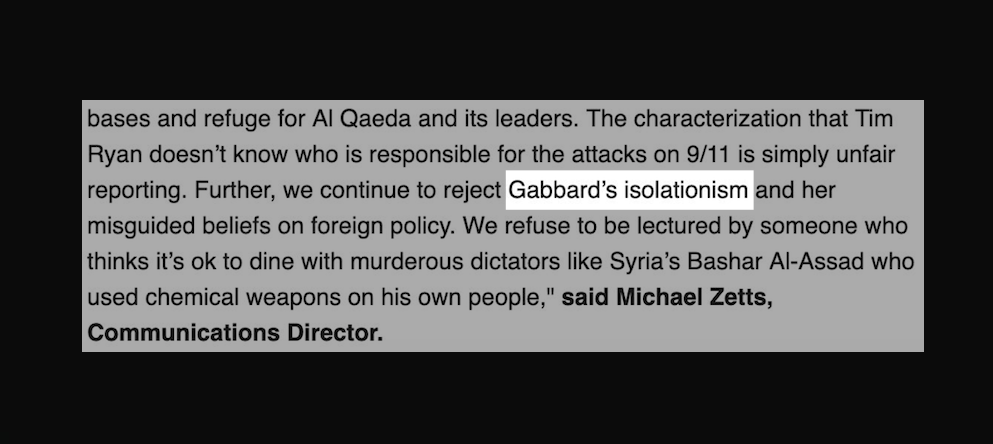
After getting curb stomped on the debate stage by Tulsi Gabbard, the campaign for Tim “Who the fuck is Tim Ryan?” Ryan posted a statement decrying the Hawaii congresswoman’s desire to end a pointless 18-year military occupation as “isolationism”.

“While making a point as to why America can’t cede its international leadership and retreat from around the world, Tim was interrupted by Rep. Tulsi Gabbard,” the statement reads. “When he tried to answer her, she contorted a factual point Tim was making— about the Taliban being complicit in the 9/11 attacks by providing training, bases and refuge for Al Qaeda and its leaders. The characterization that Tim Ryan doesn’t know who is responsible for the attacks on 9/11 is simply unfair reporting. Further, we continue to reject Gabbard’s isolationism and her misguided beliefs on foreign policy. We refuse to be lectured by someone who thinks it’s ok to dine with murderous dictators like Syria’s Bashar Al-Assad who used chemical weapons on his own people.”

Ryan’s campaign is lying. During an exchange that was explicitly about the Taliban in Afghanistan, Ryan plainly said “When we weren’t in there, they started flying planes into our buildings.” At best, Ryan can argue that when he said “they” he had suddenly shifted from talking about the Taliban to talking about Al Qaeda without bothering to say so, in which case he obviously can’t legitimately claim that Gabbard “contorted” anything he had said. At worst, he was simply unaware at the time of the very clear distinction between the Afghan military and political body called the Taliban and the multinational extremist organization called Al Qaeda.

More importantly, Ryan’s campaign using the word “isolationism” to describe the simple common sense impulse to withdraw from a costly, deadly military occupation which isn’t accomplishing anything highlights an increasingly common tactic of tarring anything other than endless military expansionism as strange and aberrant instead of normal and good. Under our current Orwellian doublespeak paradigm where forever war is the new normal, the opposite of war is no longer peace, but isolationism. This removal of a desirable opposite of war from the establishment-authorised lexicon causes war to always be the desirable option.

This is entirely by design. This bit of word magic has been employed for a long time to tar any idea which deviates from the neoconservative agenda of total global unipolarity via violent imperialism as something freakish and dangerous. In his farewell address to the nation, war criminal George W Bush said the following:

“In the face of threats from abroad, it can be tempting to seek comfort by turning inward. But we must reject isolationism and its companion, protectionism. Retreating behind our borders would only invite danger. In the 21st century, security and prosperity at home depend on the expansion of liberty abroad. If America does not lead the cause of freedom, that cause will not be led.”

A few months after Bush’s address, Antiwar‘s Rich Rubino wrote an article titled “Non-Interventionism is Not Isolationism“, explaining the difference between a nation which withdraws entirely from the world and a nation which simply resists the temptation to use military aggression except in self defense.

“Isolationism dictates that a country should have no relations with the rest of the world,” Rubino explained. “In its purest form this would mean that ambassadors would not be shared with other nations, communications with foreign governments would be mainly perfunctory, and commercial relations would be non-existent.”

“A non-interventionist supports commercial relations,” Rubino contrasted. “In fact, in terms of trade, many non-interventionists share libertarian proclivities and would unilaterally obliterate all tariffs and custom duties, and would be open to trade with all willing nations. In addition, non-interventionists welcome cultural exchanges and the exchange of ambassadors with all willing nations.”

“A non-interventionist believes that the U.S. should not intercede in conflicts between other nations or conflicts within nations,” wrote Rubino. “In recent history, non-interventionists have proved prophetic in warning of the dangers of the U.S. entangling itself in alliances. The U.S. has suffered deleterious effects and effectuated enmity among other governments, citizenries, and non-state actors as a result of its overseas interventions. The U.S. interventions in both Iran and Iraq have led to cataclysmic consequences.”

Calling an aversion to endless military violence “isolationism” is the same as calling an aversion to mugging people “agoraphobia”. Yet you’ll see this ridiculous label applied to both Gabbard and Trump, neither of whom are isolationists by any stretch of the imagination, or even proper non-interventionists. Gabbard supports most US military alliances and continues to voice full support for the bogus “war on terror” implemented by the Bush administration which serves no purpose other than to facilitate endless military expansionism; Trump is openly pushing regime change interventionism in both Venezuela and Iran while declining to make good on his promises to withdraw the US military from Syria and Afghanistan.

Another dishonest label you’ll get thrown at you when debating the forever war is “pacifism”. “Some wars are bad, but I’m not a pacifist; sometimes war is necessary,” supporters of a given interventionist military action will tell you. They’ll say this while defending Trump’s potentially catastrophic Iran warmongering or promoting a moronic regime change invasion of Syria, or defending disastrous US military interventions in the past like Iraq.

This is bullshit for a couple of reasons. Firstly, virtually no one is a pure pacifist who opposes war under any and all possible circumstances; anyone who claims that they can’t imagine any possible scenario in which they’d support using some kind of coordinated violence either hasn’t imagined very hard or is fooling themselves. If your loved ones were going to be raped, tortured and killed by hostile forces unless an opposing group took up arms to defend them, for example, you would support that. Hell, you would probably join in. Secondly, equating opposition to US-led regime change interventionism, which is literally always disastrous and literally never helpful, is not even a tiny bit remotely like opposing all war under any possible circumstance.

Another common distortion you’ll see is the specious argument that a given opponent of US interventionism “isn’t anti-war” because they don’t oppose all war under any and all circumstances. This tweet by The Intercept‘s Mehdi Hasan is a perfect example, claiming that Gabbard is not anti-war because she supports Syria’s sovereign right to defend itself with the help of its allies from the violent extremist factions which overran the country with western backing. Again, virtually no one is opposed to all war under any and all circumstances; if a coalition of foreign governments had helped flood Hasan’s own country of Britain with extremist militias who’d been murdering their way across the UK with the ultimate goal of toppling London, both Tulsi Gabbard and Hasan would support fighting back against those militias.

The label “anti-war” can for these reasons be a little misleading. The term anti-interventionist or non-interventionist comes closest to describing the value system of most people who oppose the warmongering of the western empire, because they understand that calls for military interventionism which go mainstream in today’s environment are almost universally based on imperialist agendas grabbing at power, profit, and global hegemony. The label “isolationist” comes nowhere close.

It all comes down to sovereignty. An anti-interventionist believes that a country has the right to defend itself, but it doesn’t have the right to conquer, capture, infiltrate or overthrow other nations whether covertly or overtly. At the “end” of colonialism we all agreed we were done with that, except that the nationless manipulators have found far trickier ways to seize a country’s will and resources without actually planting a flag there. We need to get clearer on these distinctions and get louder about defending them as the only sane, coherent way to run foreign policy.

How the West eats its children

By Thierry Meyssan

Source: VoltaireNet.org

The cause of Western recession

International relations experienced a profound change with the paralysis of the Soviet Union in 1986, when the State was unable to control the civilian nuclear incident in Tchernobyl [1], then with the revocation of the Warsaw Pact in 1989, when the East German Communist Party [2] destroyed the Berlin Wall, and finally, with the dissolution of the USSR in 1991.

At that time, the President of the United States, George Bush Sr., decided to demobilise one million soldiers and devote the efforts of his country to its own prosperity. He wanted to transform US hegemony within its zone of influence, and expand it into that of the leader of the world, the guarantor of world stability. With that, he laid the foundations for a « New World Order », first of all in the speech he gave side by side with British Prime Minister Margaret Thatcher, at the Aspen Institute (2 August 1990), then during his speech to Congress (11 September 1990), announcing operation « Desert Storm » [3].

The world of the après-Soviet Union is one of free circulation, not only of merchandise, but also world capital, under the unique control of the United States. In other words, the passage from capitalism to financialisation – not the triumphant culmination of free exchange, but an exacerbated form of colonial exploitation of the whole world, including the West. Within the space of a quarter of a century, the major US fortunes have multiplied many times, and the global wealth of the world has increased considerably.

By allowing capitalism to run wild, President Bush Sr. hoped to extend prosperity to the world. But capitalism is not a political project, it is simply a system of logic designed for creating profit. The logic of the US multinationals was to increase their profits by delocalising production to China, where it is now possible, and where workers are the lowest paid in the world.

Those who were prepared to measure the cost of this advance for the West were few and far between. New middle classes began to appear in the third world, and although they were, of course, far less wealthy than those in the West, they enabled new, mainly Asian states, to play a rôle on the world stage. But simultaneously, Western middle classes began to disappear [4], meaning that it became impossible for the democratic institutions they built to survive. Above all, the populations of entire regions were to be entirely crushed, starting with those of the African Great Lakes. This first regional war caused 6 million deaths, in Angola, Burundi, Namibia, Uganda, the Democratic Republic of Congo, Rwanda and Zimbabwe, and was met with general incomprehension and indifference. The aim was to continue to seize the natural resources of these countries, but to pay less and less for them, which meant dealing with gangs rather than with the States who had to feed their populations.

The sociological transformation of the world is happening very fast and is clearly without precedent, although we do not have the statistical tools available today to evaluate it with precision. However, everyone can witness the increase in power of Eurasia, (not in the Gaullist sense of « Brest to Vladivostok », but that of Russia and Asia without Western and Central Europe), which seeks liberty and prosperity, while the Western powers, including the United States, are slowly and progressively declining, limiting individual freedom and ejecting half of their population into zones of poverty.

Today, the percentage of imprisonment in China is four times inferior to that of the United States,while their purchasing power is slightly higher. Objectively therefore, with all its faults, Chine has become a freer and more prosperous country than the United States.

This process was predictable from the beginning. Its application was studied for a long time. So, on 1 September 1987, a US forty-year-old published a page of counter-current publicity in the New York Times, the Washington Post and the Boston Globe. He warned his compatriots about the rôle that President Bush Sr. was planning to allocate to the United States – to assume and finance out of their own pockets the responsibility for the developing « New World Order ». People read it and laughed. The author of these texts was real estate promoter, Donald Trump.

The application of the economic model to international relations

One month after the attacks of 11 September 2001, US Secretary of Defense Donald Rumsfeld nominated his friend Admiral Arthur Cebrowski as Director of the new Office of Force Transformation. He was tasked with changing the culture of the entire US military in order to enable it to respond to a complete change in its mission

There was no longer question of using US armies to defend principles or interests, but to use them for a reorganisation of the world by dividing it into two parts – one one side the states integrated into the globalised economy, and on the other, the others [5]. The Pentagon would no longer fight wars in order to steal natural resources, but to control access to those resources by the globalised nations. A division directly inspired by the process of globalisation which had already trashed half of the Western populations. This time, it was half of the world’s population which was to be excluded [6].

The reorganisation of the world began in the political zone known as the « Greater Middle East », that is to say stretching from Afghanistan to Morocco, with the exception of Israël, Lebanon and Jordan. This brought about the alleged epidemic of civil wars in Afghanistan, Iraq, Sudan, Libya, Syria and Yemen, which has already caused several million deaths.

Like a monster eating its own children, the global financial system based in the United States faced its first crisis in 2008, when the subprime bubble burst. Contrary to a commonly-held belief, this was absolutely not a global crisis, but a Western problem. For the first time, the NATO states experienced the first consequences of the policy they were supporting. Yet the upper Western classes changed nothing in their behaviour, as they witnessed with compassion the wreck of the middle classes. The only notable modification was the adoption of the « Volcker rule » [7], which forbade banks from profiting from information obtained from their clients in order to speculate against their interests. But while conflicts of interest enabled a number of crooks to get rich fast, they are not the root of the problem, which is far more wide-reaching.

The revolt of the Western populations

The revolt of the Western middle and working classes against the globalised upper class began two years ago.

Aware of the Western recession as compared with Asia, the people of the United Kingdom were the first to attempt to save its life-style by leaving the European Union and turning to China and the Commonwealth (referendum of 23 June 2016) [8]. Unfortunately, the leaders of the United Kingdom were unable to conclude the agreement they hoped for with China and experienced great difficulty in reactivating their links with the Commonwealth.

Then, witnessing the collapse of their civil industries, a part of the United States voted, on 8 November 2016, for the only Presidential candidate who was opposed to the New World Order, Donald Trump. He spoke of a return to the « American dream ». Unfortunately for his voters, although Donald Trump began to question the rules of globalised commerce, he had no team with him apart from his family, and was only able to modify, but not change, the military strategy of his country. Almost all of the general officers had adopted the Rumsfeld-Cebrowski ideology, and could no longer imagine themselves in any other role than defenders of financial globalisation.

Aware of the collapse of their national industry, and certain that they would be betrayed by their upper class, the Italians voted, on 4 March 2018, for an anti-system party composed of the Ligue and the 5-star Movement. These parties built an alliance in order to implement social policies. Unfortunately, they were rejected by the European Union [9]. In France, tens of thousands of SME’s (small and medium-sized enterprises), subcontractors of industry, had gone bankrupt over the last ten years, but their compulsory tax deductions, already among the highest in the world, increased by 30 % over the same period.

Several hundreds of thousands of French people suddenly took to the streets to demonstrate against abusive financial measures. Unfortunately for them, the French upper classes have been contaminated by the very idea that was rejected by the United States, and therefore did their best to adapt their policies to the popular revolt, but not to change its basic causes.

If we look at each of these four countries separately, we will find four different explanations for what is happening there. But if we analyse the situation as a single phenomenon affecting different cultures, we will discover the same mechanisms across the board. In these four countries, consecutive with the end of capitalism, the middle classes disappeared more or less rapidly, and with them the political system that they incarnated – Democracy.

So either the Western leaders abandon the financial system they have developed and return to the productive capitalism of the Cold War, or they will have to invent a different organisation that no-one has so far been able imagine. Failing that, the West, which has directed the world for five centuries, will sink into a long period of internal chaos.

The Syrians were the first non-globalised People capable of surviving and resisting the destruction of Rumsfeld-Cebrowski’s infra-world. The French were the first globalised people to rise up against the destruction of the West, even if they are not aware that they are fighting the same unique enemy of all of humanity. President Emmanuel Macron is not the man for the situation, not because he has any responsibility for the system that preceded him, but because he is pure product of that system. In response to the riots in his country, he spoke from the G20 in Buenos-Aires, declaring that the meeting was a success in his eyes, (which it was not), and that he intended to advance more efficiently than his predecessors – in the wrong direction.

How to save privilege

It appears that the British ruling class has its solution – if London in particular and the Western nations in general are no longer capable of ruling the world, it will be necessary to cut one’s losses and divide the world into two distinct zones. This is the policy implemented by Obama in the final months of his presidency [10], then by Theresa May, and now by Donald Trump, with their refusal to cooperate and their ready-made accusations, first of all against Russia and now against China.

It also seems that Russia and China, despite their historical rivalry, are aware that they will never be able to ally themselves with these Westerners who have never ceased trying to carve them up. This is the source of their project, the « Eurasian Economic Union » – if the world must be split in two, each participant will have to organise its own. In concrete terms, for Beijing, this means abandoning half of its « Silk Road » project and its redeployment with Moscow only in Greater Eurasia.

How to determine the line of demarcation

For the West and Greater Eurasia, it will be necessary to determine the split line as fast as possible. For example, what side will Ukraine choose? The construction by Russia of the Kertch bridge was aimed at separating the country, absorbing the Donbass and the Azov Sea basin, then Odessa and Transnistria. On the contrary, the incident at Kertch, organised by the Western powers, is aimed at enrolling all of Ukraine into NATO before the country fractures.

Since the ship of financial globalisation is sinking, many people are beginning to save their personal interests without any care for others. For example this is the source of the tension between the European Union and the United States. As far as this game is concerned, the Zionist movement has always had a length’s lead, which explains the mutation of Israëli strategy, which has abandoned Syria to Russia, and turned to both the Gulf States and East Africa.

Perspectives

Taking into account what is at play here, it is obvious that the insurrection in France is only the beginning of a much wider process which is going to spread to other Western countries.

It would be absurd to believe that at a time of financial globalisation, a government, whatever it might be, could resolve the problems of its country without first of all questioning international relations and at the same time regaining its capacity for action. But precisely, foreign policy has been kept on the sidelines of the democratic field since the dissolution of the Soviet Union. It is both necessary and urgent to resign from almost all of the treaties and engagements of the last thirty years. Only the states which are able to re-affirm their sovereignty can hope to recover.

Translation
Pete Kimberley

[1] According to Michaïl Gorbatchev, this was the event that made possible the dissolution of the Warsaw Pact and the Soviet Union in so far as it delegitimised the State.

[2] Contrary to a commonly-held belief in the West, it was the nationalists from the East-German Communist Party (and the Lutheran churches), and not the anti-Communists (and pro-US movements), who broke down the symbol of Soviet domination, the Wall.

[3] The main purpose of the invasion of Iraq was not to liberate Kuwaït, but to use this affair to build the strongest coalition possible under US command, including the USSR.

[4] Global Inequality. A New Approach for the Age of Globalization, Branko Milanovic, Harvard University Press, 2016.

[5] “The US military project for the world”, by Thierry Meyssan, Translation Pete Kimberley, Voltaire Network, 22 August 2017.

[6] It is obvious that the wars of Bush Jr. and Obama were never intended to expand the Empire. First of all because by definition, democracy can only come from the People, not imposed by bombs. And then because the United States was already a plutocracy.

[7] The ex-president of the US Federal Reserve, Paul Volcker, is on the other hand, one of the architects of global financialisation. It is Volcker who took legal action on behalf of the UNO against the people and entities who had helped Iraq to bypass the UN embargo (the « oil for food » affair). Volcker is one of the principal personalities of the Pilgrim’s Society, the trans-Atlantic club presided by Queen Elizabeth II. As such, he became the main economic advisor to President Barack Obama, and organised part of his cabinet.

[8] “The new British Foreign Policy”, by Thierry Meyssan, Translation Pete Kimberley, Voltaire Network, 4 July 2016.

[9] Replacing the European Common Market, which was originally a system for cooperation between states, the European Union, as defined by the Treaty of Maastricht, is a supranational

[10] “Two separate worlds”, by Thierry Meyssan, Translation Pete Kimberley, Al-Watan (Syria) , Voltaire Network, 8 November 2016.

Nonviolent Action: Why and How it Works

marcha_sal3

Nonviolent action is extremely powerful.

Unfortunately, however, activists do not always understand why
nonviolence is so powerful and they design ‘direct actions’ that are
virtually powerless.

I would like to start by posing two questions. Why is nonviolent action
so powerful? And why is using it strategically so transformative?

When an activist group is working on an issue – such as a national
liberation struggle, war, the climate catastrophe, violence against
women and/or children, nuclear weapons, drone killings, rainforest
destruction, encroachments on indigenous land – they will often plan an
action that is intended to physically halt an activity, such as the
activities of a military base, the loading of a coal ship, the work of a
bulldozer, the building of an oil pipeline. Their plan might also
include using one or more of a variety of techniques such as locking
themselves to a piece of equipment (‘locking-on’) to prevent it from
being used. Separately or in addition, they might use secrecy both in
their planning and execution so that they are able to carry out the
action before police or military personnel prevent them from doing so.

Unfortunately, the focus on physical outcomes (including actions such as
‘locking-on’ and its many equivalents), and the secrecy necessary to
carry out their plan, all functionally undermine the power of their
action. Why is this? Let me explain how and why nonviolent action works
so that it is clear why any nonviolent activist who understands the
dynamics of nonviolent action is unconcerned about the immediate
physical outcome of their action (and what is necessary to achieve
that).

If you think of your nonviolent action as a physical act, then you will
tend to focus your attention on securing a physical outcome from your
planned action: to prevent the military from occupying a location, to
stop a bulldozer from knocking down trees, to halt the work at an oil
terminal or nuclear power station, to prevent construction equipment
being moved on site. Of course, it is simple enough to plan a nonviolent
action that will do any of these things for a period of time and there
are many possible actions that might achieve it.

But if you pause to consider how your nonviolent action might have
psychological and political impact that leads to lasting or even
permanent change on the issue in question but also society as a whole,
then your conception of what you might do will be both expanded and
deepened. And you will be starting to think strategically about what it
means to mobilise large numbers of people to think and behave
differently.

After all, whatever the immediate focus of your action, it is only ever
one step in the direction of more profound change. And this profound
change must include a lasting change in prevailing ideas and a lasting
change in ‘normal’ behaviour by substantial (and perhaps even vast)
numbers of people. Or you will be back tomorrow, the day after and so on
until you get tired of doing something without result, as routinely
happens in campaigns that ‘go nowhere’ (as so many do).

So why does nonviolent action work?

Fundamentally, nonviolent action works because of its capacity to create
a favourable political atmosphere (because of, for example, the way in
which activist honesty builds trust), its capacity to create a
non-threatening physical environment (because of the nonviolent
discipline of the activists), and its capacity to alter the human
psychological conditions (both innate and learned) that make people
resist new ideas in the first place. This includes its capacity to
reduce or eliminate fear and its capacity to ‘humanise’ activists in the
eyes of more conservative sections of the community. In essence,
nonviolent activists precipitate change because people are inspired by
the honesty, discipline, integrity, courage and determination of the
activists – despite arrests, beatings or imprisonment – and are thus
inclined to identify with them. Moreover, as an extension of this, they
are inclined to change their behaviour to act in solidarity.

It is for this reason too that a nonviolent action should always make
explicit what behavioural change it is asking of people. Whether
communicated in news conferences or via the various media, painted on
banners or in other ways, a nonviolent action group should clearly
communicate powerful actions that individuals can take. For example, a
climate action group should consistently convey the messages to ‘Save
the Climate: Become a Vegan/Vegetarian’, ‘Save the Climate: Boycott
Cars’ and, like a rainforest action group, ‘Don’t Buy Rainforest
Timber’. A peace group should consistently convey such messages as
‘Don’t Pay Taxes for War’ and ‘Divest from the Weapons Industry’ (among
many other possibilities). Groups resisting the nuclear fuel cycle and
fossil fuel industry in their many manifestations should consistently
convey brief messages that encourage reduced consumption and a shift to
more self-reliant renewable energies. See, for example, ‘The Flame Tree
Project to Save Life on Earth’. Groups struggling to defend or reinstate indigenous sovereignty should convey compelling messages that explain what people can do in their particular context.

It is important that these messages require powerful personal action,
not token responses. And it is important that these actions should not
be directed at elites or lobbying elites. Elites will fall into line
when we have mobilized enough people so that they are compelled to do as
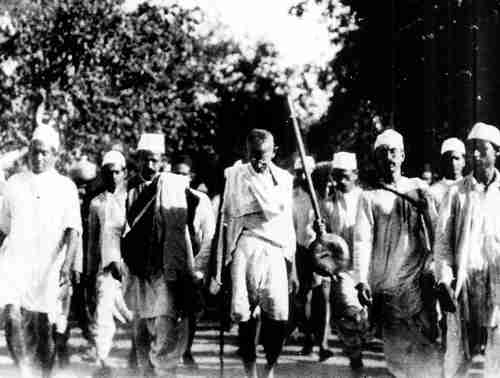
we wish. And not before. At the end of the Salt March in 1930 Gandhi
picked up a handful of salt on the beach at Dandi. This was the signal
for Indians everywhere to start collecting their own salt in violation
of British law. In subsequent campaigns Gandhi called for Indians to
boycott British cloth and make their own khadi (handwoven cloth). These
actions were strategically focused because they undermined the
profitability of British colonialism in India and nurtured Indian
self-reliance.

A key reason why Mohandas K. Gandhi was that rarest of combinations – a
master nonviolent strategist and a master nonviolent tactician – was
because he understood the psychology of nonviolence and how to make it
have political impact. Let me illustrate this point by using the
nonviolent raid on the Dharasana salt works, the nonviolent action he
planned as a sequel to the more famous Salt March in 1930.

On 4 May 1930 Gandhi wrote to Lord Irwin, Viceroy of India, advising his
intention to lead a party of nonviolent activists to raid the Dharasana
Salt Works to collect salt and thus intervene against the law
prohibiting Indians from collecting their own salt. Gandhi was
immediately arrested, as were many other prominent nationalist leaders
such as Jawaharlal Nehru and Vallabhbhai Patel.

Nevertheless, having planned for this contingency, under a succession of
leaders (who were also progressively arrested) the raid went ahead as
planned with hundreds of Indian satyagrahis (nonviolent activists)
attempting to nonviolently invade the salt works. However, despite
repeated attempts by these activists to walk into the salt works during
a three week period, not one activist got a pinch of salt! Moreover,
hundreds of satyagrahis were injured, many receiving fractured skulls or
shoulders, and two were killed.

But an account of the activists’ nonviolent discipline, commitment and
courage – under the steel-tipped lathi (baton) blows of the police – was
reported in 1,350 newspapers around the world. As a result, this
nonviolent action – which ‘failed’ to achieve the stated physical
objective of seizing salt – functionally undermined support for British
imperialism in India. For an account of the salt raids at Dharasana, see
Thomas Weber. ‘”The Marchers Simply Walked Forward Until Struck Down”:
Nonviolent Suffering and Conversion’

If the activists had been preoccupied with the physical seizure of salt
and, perhaps, resorted to the use of secrecy to get it, there would have
been no chance to demonstrate their honesty, integrity, courage and
determination – and to thus inspire empathy for their cause – although
they might have got some salt! (Of course, if salt had been removed
secretly, the British government could, if they had chosen, ignored it:
after all, who would have known or cared? However, they could not afford
to let the satyagrahis take salt openly because salt removal was illegal
and failure to react would have shown the salt law – a law that
represented the antithesis of Indian independence – to be ineffective.)

In summary, nonviolent activists who think strategically understand that
strategic effectiveness is unrelated to whether or not the action is
physically successful (provided it is strategically selected,
well-designed so that it elicits one or other of the intended responses,
and sincerely attempted). Psychological, and hence political, impact is
gained by demonstrating qualities that inspire others and move them to
act personally too. For this reason, among several others, secrecy (and
the fear that drives it) is counterproductive if strategic impact is
your intention.

If you are interested in planning effective nonviolent actions, a
related article also explains the vital distinction between ‘The
Political Objective and Strategic Goal of Nonviolent Actions’.

And if you are concerned about violent military or police responses,
have a look at ‘Nonviolent Action: Minimizing the Risk of Violent
Repression’.

For those of you who are interested in planning and acting strategically
in your nonviolent struggle, whatever its focus, you might be interested
in one or the other of these two websites: Nonviolent Campaign Strategy and Nonviolent Defense/Liberation Strategy.

And if you are interested in being part of the worldwide movement to end
all violence, you are welcome to sign the online pledge of ‘The People’s
Charter to Create a Nonviolent World’.

Struggles for peace, justice, sustainability and liberation often fail.
Almost invariably, this is due to the failure to understand the
psychology, politics and strategy of nonviolence. It is not complicated
but it requires a little time to learn.


Biodata: Robert J. Burrowes has a lifetime commitment to understanding and ending human violence. He has done extensive research since 1966 in an effort to understand why human beings are violent and has been a nonviolent activist since 1981. He is the author of ‘Why Violence?‘ His email address is flametree@riseup.netand his website is at http://robertjburrowes.wordpress.com

Robert J. Burrowes
P.O. Box 68
Daylesford
Victoria 3460
Australia
Email: flametree@riseup.net

Websites:
Nonviolence Charter
Flame Tree Project to Save Life on Earth
‘Why Violence?’
Nonviolent Campaign Strategy
Nonviolent Defense/Liberation Strategy
Anita: Songs of Nonviolence
Robert Burrowes
Global Nonviolence Network

Thanksgiving. A National Day Of Mourning.

By Mr. Militant Negro

Source: The Militant Negro

screenshot-318

This Thanksgiving, join me in celebrating but not in the traditional way you’re used to celebrating. In the video below, I suggest 2 ways of celebrating with The Standing Rock Sioux Nation, The Water Protectors and The Oceti Sakowin to show unity and solidarity.

Thanksgiving: A National Day Of Mourning.

Published on Nov 20, 2016


Unarmed #NoDAPL water protectors are currently being attacked by militarized police in North Dakota. They’re being sprayed with water in sub-freezing temperatures, hit with rubber bullets, and maced.

You can express outrage and demand cessation by calling any and all of the numbers below:

  • White House Situation Room – 202-456-9431
    • I was told they’re “monitoring the situation.” I asked that the White House actually intervene on behalf of water protectors.
  • Morton County Sherriff Department – 701-328-8118
    • I left a voicemail saying I’d encourage no one to ever visit North Dakota ever again if they keep attacking unarmed citizens.
  • Governor Dalrymple – 701-328-8118
    • Voicemail full; I was unable to leave a message
  • North Dakota National Guard – 701-333-2000
    • No answer outside of business hours
  • Army Corps of Engineers – 202-761-8700
    • I left a voicemail asking that they please take any and every action to ensure (1) no further harm to water protectors and (2) DAPL stop efforts to drill, for benefit of this land and all its people.

Please call. Please protest the abuse of people and earth for profit.

Your voice can make a difference.

Follow #NoDAPL on Twitter for up-to-the-minute information

https://twitter.com/MrNegroMilitant/status/800608499231236096

Standing Rock 11/20 LIVE Bridge Protest by Kevin Gilbertt Part VI #NoDAPL

From The Raw Story:

Broken treaties, cultural genocide and murder: Here are 5 ways the US has ‘given thanks’ to Native Americans

By 

The urban legend about Thanksgiving is that the Native Americans helped save the Pilgrims who had a rough start to their settlements. Once they had a bountiful harvest they invited their Native neighbors over for a nice dinner party to give thanks to them and to God. That story has been soundly refuted by actual accounts of the day, but for reasons passing in understanding, we still celebrate the holiday as we perceive it went down.

After that, however, the friendly relationship between Natives and white settlers was over, and what followed was 300 years of some of the most heartbreaking and disgraceful actions the United States has ever committed.

While there are hundreds, here are 5 huge ones:

1. Stolen Land

pipe

From the day we landed in 1492 until even today, Native Americans are still fighting over land rights.

A Proclamation was signed by King George III of England in 1763, prohibiting any English settlers from pushing further west than the Appalachian Mountains and anyone already there would be required to move back east. Even across the ocean the King knew there were tensions between Natives and settlers. Unfortunately, the King had no real way of enforcing it and 13 years later the Colonies filed the Declaration of Independence and the war with England was on.

One of the worst and most disgusting things happened in the 1829 decision by the Supreme Court in Johnson v. M’Intosh. The court ruled that the U.S. Government could sell Native American land to non-Native people out from under the tribes. Believe it or not, they were actually trying to.

The decision began a set of rulings under the Marshall Court that outlined what is now referred to as the “Doctrine of Discovery.” It’s basically a set of western laws that “allowed” the legal framework to take land from aboriginals living on it because it was “discovered” by a European Christian monarchs. The logical conclusion that you can’t discover something if someone already lives there was basically thrown out thanks to the Marshall Court.

Who knows why they even bothered with the paperwork, it isn’t like they were going to be stopped anyway.

2. Andrew Jackson

1b-002-ss-07-egander_lg

“This emigration should be voluntary, for it would be as cruel as unjust to compel the aborigines to abandon the graves of their fathers and seek a home in a distant land. But they should be distinctly informed that if they remain within the limits of the States they must be subject to their laws…” – President Andrew Jackson, State of the Union 1829

There were plenty of presidents that did horrific things to Native Americans, but for the most part Washington and Jefferson honored the idea of Native sovereignty. President Andrew Jackson did not.

On May 26, 1830 Congress passed the Indian Removal Act which gave the power to the President to “negotiate” the removal of all Native Americans and force them West of the Mississippi River. Jackson signed it into law and the farce of “negotiations” began.

In 1831, Georgia tried to pass a law that prevented Native Americans from being within the borders of their state. In 1833, Florida actually passed the same law. The Cherokees took Georgia to court and demanded an injunction to prevent the forced removal of the tribe from the state. In Cherokee v. Georgia The Supreme Court ruled that the tribal lands were not sovereign and were essentially a ward of the federal government.

But one year later in Worcester v. Georgia, a missionary working on Cherokee lands was arrested. He sued the State of Georgia claiming that the state had no legal authority on Native soil, that they were sovereign lands. The Supreme Court ruled that the tribes were sovereign and that Georgia had no legal authority.

You would have thought that the 1832 legal battle would have been the major way that the tribes were saved from governments violating laws and treaties left and right, but no. Jackson proposed to the Cherokees Tribe that they move to Oklahoma (then called Indian Territory). The Cherokee said no.

Jackson didn’t care. Between 1830 and 1850 he ordered the forced removal of the Cherokee, Chickasaw, Choctaw, Muskogee, Creek and Seminole people. It was called the Trail of Tears because so many people suffered from death, disease, starvation, exposure and more than 10,000 died on the way.

3. Re-Education and Cultural Genocide

Natives were considered savages when they fought back against the government attempting to steal their land, kill their people and force them to move. Those that were marched to what is now Oklahoma were considered the “5 Civilized Tribes” because they didn’t fight back the way many others did. They agreed to assimilate into some white culture for fear of being killed by the government.

But the U.S. government took it a step further when they started opening up boarding schools where Native children were sent and taught how to be Christian, relinquish their heritage, forget their traditions and act more “white.”

Richard Pratt was an Army Officer when he began building the schools that would teach Native children. He said he developed the idea while in “an Indian prison.” His philosophy, he described, was simple “Kill the Indian … Save the Man.” By killing the Native American traditions and upbringing in children, they hoped to begin ridding the country of what they considered to be the “savage” behavior.

Many of these children encountered what can only be described as abuse. They were beaten and put in isolation until they’d submit to the ways of white people.

4. Broken Treaties

Over 500 treaties were made with Native American tribes over the last several hundred years and over 370 of which had to do with land. All were broken or changed.

As CJ says in the video “How do you keep fighting these smaller injustices when they’re all from the mother of injustices?”

5. Murder

USA Committed Genocide Against Native Americans

Published on May 5, 2012

MICHAEL MOORE: It’s not envy, it’s war, and it is a class war, and it’s a war that has been perpetrated by the rich on to everybody else. I mean, the class war is one they started. The mistake they’ve made, just to deal with the racial part of this, is their boot has been on the necks of people of color since we began. This is a nation founded on genocide and built, built on the backs of slaves. Alright?
So, so we started with a racial problem. We went, we tried to actually eliminate one entire race, and then we used another race to build this country actually quite quickly as a new country into a world power. This country never would have had the wealth that it had had it not had slavery for a couple of hundred years. If it had had, if it had had to pay people, if it actually had to pay people to build America, you know, we might just be at that point in Utah where we’re joining the two rails together maybe at this point right now.

From the moment that Columbus “discovered” a place that already existed, Native Americans began to die. Whether from “Old World” diseases like small pox and measles, battles with government soldiers or outright murder, the population declined by 96 percent.

American historian David Stannard argued in his book American Holocaust that the annihilation of the Native Americans from 76 million on both American continents to just a quarter-million “in a string of genocide campaigns,” that killed “countless tens of millions” was by far the largest genocide in world history.

Sir Jeffrey Amherst, commander-in-chief of British forces in North America, wrote to Colonel Henry Bouquet at Fort Pitt:

“You will do well to try to inoculate the Indians [with smallpox] by means of blankets, as well as to try every other method, that can serve to extirpate this execrable race.”

The intentional use of “germ warfare” to “extirpate this execrable race” is nothing more than brutal, hateful and horrific mass murder. Our country should be ashamed.

Even hundreds of years later, tribes are still fighting many of these same battles. Just last month, the federal government raided a Native American university that was growing a legal hemp crop as part of a pilot project under the Farm Bill.

The Lakota Tribe has been particularly hard hit. They have been fighting to preserve their land against the threat of the Keystone XL pipeline which the tribe argues would have caused an increase in the number of health and safety problems.

They’ve also had run-ins with local law enforcement and liquor stores that locate just outside dry tribal lands. At the same time their children have experienced appalling and cruel racism and outright assault from fellow South Dakota residents.

What we owe the Native Americans is a more complicated question, but for sure it begins with a greater respect and extends well beyond the limited reparations we’ve given them over the years. Perhaps it begins with the reclaiming of holidays like Columbus Day and Thanksgiving which have done nothing but perpetuate stereotypes and gloss over the history of violence and broken promises.

Happy Native American Heritage Month!

Thank you  The Raw Story & 

picture-31

American Indian Activist Russell Means Powerful Speech, 1989

Published on Oct 22, 2013

Legendary Russell Means harshly criticizes the Bureau of Indian Affairs and Indian leadership of reservations. One of a kind, RIP November 10, 1939 — October 22, 2012

Russell was an Oglala Sioux activist for the rights of American Indian people. He became a prominent member of the American Indian Movement (AIM) after joining the organization in 1968, and helped organize notable events that attracted national and international media coverage.

Russell Means has lived a life like few others in this century — revered for his selfless accomplishments and remarkable bravery. He was born into a society and guided by a way of life that gently denies the self in order to promote the survival and betterment of family and community. His culture is driven by tradition, which at once links the past to the present.

Russell Means was once called the “biggest, baddest, meanest, angriest, most famous American Indian activist of the late 20th century.”

He led a 71-day armed standoff in 1973 against federal agents at Wounded Knee, a tiny hamlet in the heart of South Dakota’s Pine Ridge Reservation.

It is considered to be one of his most famous act of defiance, however, occurred at Wounded Knee on February 27, 1973. Responding to the numerous murders perpetrated by puppet tribal governments and the extreme conditions of oppression, the takeover at Wounded Knee revisited the sight of the American Indian massacre at the hands of U.S. soldiers in 1890.

Ever vigilant for his cause, Russell has been lauded by the international community for his tireless efforts.

Later, he used film as a vehicle for his advocacy, thus enabling him to use different means to communicate his vital truths. Through the power of media, his vision was to create peaceful and positive images celebrating the magic and mystery of his American Indian heritage.

In contemplating the fundamental issues about the world in which we live, he was committed to educating all people about our most crucial battle-the preservation on the earth.

Means joined “The Longest Walk” in 1978 to protest a new tide of anti-Indian legislation including the forced sterilization of Indian women. Following the walk, the U.S. House of Representatives passed a resolution saying that national policy was to protect the rights of Indians, “to believe, express and exercise their traditional religions, including but not limited to access to sites, use and possession of sacred objects, and the freedom to worship through ceremonials and traditional rites.”

Russell Means has been called the most famous American Indian since Sitting Bull and Crazy Horse by the Los Angeles Times and recognized as a natural leader with a fearless dedication and indestructible sense of pride.

He took pride in having instituted programs for the betterment of his people: notable, the Porcupine Health Clinic (the only non government funded clinic in Indian Country) and KILI radio, the first Indian owned radio station.

Today, one of his principle goals has been the establishment of a “Total Immersion School”, which is based on a concept created by the Maori people of New Zealand, where children are immersed in the language, culture, science, music and storytelling of their own people.

Russell wanted to adapt this total immersion concept to the Indian way of life and philosophy which is taught from a perspective that will nurture a new generation of proud children educated in the context of their own heritage.

Russell Means has devoted his life to eliminating racism of any kind, and in so doing he leaves a historical imprint as the most revolutionary Indian leader of the late twentieth century.

Russell’s commitment to uplift the plight of his people escalated when he served as director of Cleveland’s American Indian Center.

It was there he met Dennis Banks, co-founder of the American Indian Movement, and embarked upon a relationship that would rocket them both into national prominence.

“If I want my people to be free, Americans have to be free.” –Russell Means

‘America is a stolen country’

Published on Jan 2, 2015

Alcoholism, unemployment and suicide are problems associated with Native American reservations in the US. But a new generation of young activists are dedicating themselves to a brighter future. Benjamin Zand from the BBC’s Pop-Up team is on a reservation in South Dakota — in the heart of America’s midwest.

images amerikanska_folk american_holocaust_poster-p228161433202423678t5ta_400 5206879923_663d69d836 45fba1f5937b9e9d6c3d7a1105f0dfc6

Right now, here today, our Native American brothers & sisters are being persecuted for being who they are.

The Standing Rock Sioux And The Water Protectors

Published on Nov 20, 2016

The treatment of the Native American Tribes who are standing united to protect THEIR Tribal lands, THEIR drinking water supply AND THEIR sacred burial grounds, are unacceptable, disgusting, disappointing and inhumane.

For A History of Native Americans Protesting the Dakota Access Pipeline & A Timeline, visit….
http://www.motherjones.com/environmen…

It’s time we stand united with The Native American Tribal Nations. It’s time we stop celebrating Thanksgiving, a racists holiday that actually celebrates the massacre and genocide of 100 MILLION indigenous people.

https://twitter.com/MrNegroMilitant/status/799835277988610048

People Of Color all over The United States Of America should unite and stop celebrating a holiday that glorifies the massacre of human life.

Water Protectors. Black Friday. Charity. Kindness. Focus. Action.

Published on Nov 21, 2016

Welcome to My Monday morning rants, raves & concerns. This voice video contains My thoughts on a plethora of issues, all current events and subjects we SHOULD ALL be pondering.

This is a link to The Jedi Youtube Channel:
https://www.youtube.com/channel/UCBC3…

This is a link to the explanation where “Black Friday” comes from and what it means:
https://www.youtube.com/watch?v=N4O5_…

Stand In Solidarity With The Standing Rock Sioux, The Water Protectors and The Oceti Sakowin.

image3-1 themilitantblogheader

Government, Terrorism, Money, Education and Other Important Discussions

images

By Phillip J. Watt

Source: The Mind Unleashed

The elite power structure – which uses the monetary system, war, false flags and the monopolized media as their primary mechanisms of control – has infiltrated every major government of the Western World. How do we know this? It’s simple; if they hadn’t been hijacked, then governments would have already begun a process of revolutionizing the way in which our societies are organized so that it benefits all of us, not just a select few.

The US Presidential race and two of its candidates have shown a small amount of hope for real change in America, something that not just its citizens desperately need, but the entire world too. Once the game is changed in the US – so that the government no longer works for those in control of the multinational and banking corporations – it will undoubtedly reverberate around the world.

Clinton is obviously a mouthpiece of the status quo and therefore cannot be trusted to enact real change. After all, she is an oligarch. On the other hand, Sanders and Trump appear to be anti-establishment, but are they really? It’s difficult to really know, because they could be controlled opposition. Yet even if they are separate to the existing order, can we really trust that they’ll do the job that the world’s peoples, and the environment, truly need?

Actions always speak louder than words, so regardless of the rhetoric of Trump and Sanders, does their policy agenda actually align to the truths that have been exposed by the many independent social researchers who are doing a wonderful job for the betterment of humanity?

Read below and decide for yourself.

The Real Policies for Change

This list is by no means exhaustive, but it reflects the fundamental shifts that we should be implementing in the short term to move into a new era of health and prosperity for humanity, and the environment we inhabit. In other words, these changes are the first essential steps if we want to overcome the dysfunction and deception that plague the hearts and minds of the people, as well as the systems that guide our collective activity.

If a political party or politician does not discuss these topics in general, then they are not aligned to the changes that we need, and therefore true progress. This is most likely because of two reasons; ignorance and/or corruption.

In any case, the exact way forward in each area is of course open for debate, but there must be an open and transparent dialogue held among the people. Simply, we all need to understand not just the issues, but the potential solutions to them.

This is obviously happening within conscious circles and progressive movements, however it’s not yet active within the mainstream mentality. This is just more evidence which illustrates that our politicians have failed us; that’s because it’s their job to bring these issues to the light of day so that everybody can participate in their resolution, if they so choose.

1. Monetary Policy: The way the economy is designed must rid society from the saturation of debt, move beyond indebtment to the oligarchs, cease the creation of fake currency by banks, overcome economic slavery by making the currency supply one of value and guarantee that local economies prosper.

2. Taxation Policy: The tax burden put on the people and the evasion of tax by multinational corporations needs to be resolved. One such method is abolishing all taxes and implementing a 2% debit-transaction taxso that citizens pay less tax, all individuals and businesses pay their fair share and there is an abundance of revenue to heal the wounds of a decaying society.

3. Budgeting Policy: Government revenues must be effectively and efficiently utilized to ensure the development of robust social services, increased wealth equality, the eradication of poverty, widespread sustainable practices, appropriate national defense programs and necessary infrastructure.

4. Defense and Foreign Policy: With unjust wars and false flag terrorism being the norm of the 21st Century, any decision to go to war must be sanctioned by the people via referendum. The reasons must be transparentally documented and validated as based in truth. All events at home and abroad that impact the decision-making of defense and foreign relations must be subject to robust and open investigations. Because national security is the first priority, all international relations should be treated diplomatically as the first line of defense.

5. Media Policy: The way in which information is disseminated throughout society must not be managed by monopolies, or a government. Media must be an open source platform where independent investigations are implemented and presented without bias. Any monopoly on the media must be disassembled so that the populace has unrestricted access to all the information necessary for the health and well-being of each individual and the community as a whole.

6. Education Policy: The way in which our children are educated is an indoctrination into the status quo, particularly economically and politically. The education system must therefore ensure that all children exercise their right to gain access to information that will help them to grow into healthy, happy and honorable adults, as well as question the way in which we organize society so that we can evolve it in alignment with our needs.

7. Governmental Policy: The amalgamation of government and business needs to be dissected. Politicians and bureaucrats are servants of the people and therefore must be representative of the needs and wants of the people. Moreover, government intervention of individual liberty and the free market must be also reduced.

8. Energy Policy: There is no longer any need to rely on fossil fuels, so creating the energy that society needs must be replaced with renewable resources – such as solar, air, water, wave, plant and free-energy technologies. Energy must also be made cheaply available to the public.

9. Health Policy: All foods and so-called medicines which impact the long-term health of the people must be labelled appropriately. Health programs that support emotional, psychological, philosophical, physical, spiritual, social and behavioral vitality must also be deeply embedded into schooling and other educational platforms. Holistic and preventative approaches to dis-ease must also be brought to the forefront of health education instead of relying on a symptomatic and prescriptive medical framework.

10. Medicine Policy: The pharmaceutical monopolies must be transformed into meeting the needs of the people, not shareholders and their profits. All natural and cheap remedies to disease – such as plant-based medicines and meditation – must be fully documented and reincorporated back into health education.

11. Housing Policy: Every person has a right to live in safe, comfortable and affordable housing. No individual should be homeless, unless by choice. Employment and Housing Policy must also be designed to ensure that the purchase of land is affordable and achievable for all.

12. Food Policy: The damaging impacts of industrial agriculture on earth’s natural systems, as well as the erosion of local economies (which is the direct result of trade agreements that primarily benefit the multinationals), needs to be reversed. One such way is by replacing it with a localized/regionalized Permaculture model where individuals and communities are supported to grow their own produce. This will help to increase local employment, as well as reconnect people to nature, the food they eat and their health requirements. In addition, all foods must be properly labelled and contain no toxic ingredients. GMOs must also be abandoned and organic foods must be readily available.

13. Water Policy: All citizens have a right to access safe and clean water. They should be supported to capture their own water needs. Where this is not possible, no toxins such as fluoride will be added to the water supply.

14. Animal Policy: All animal agriculture systems must respect the health and happiness of those animals. They must not subject them to any conditions in which they consistently suffer. One particular approach would be to incorporate it into a widespread permaculture model, in which animals are treated humanely.

15. Environmental Policy: Any practice that is environmentally unsustainable and negatively impacts the health and diversity of our natural systems is to be transformed into the opposite. The increasing extinction of animal and plant life must be reversed, as well as the trends of deforestation, ocean acidification and desertification.

16. Drug Policy: The war-on-drugs has been an epic failure because it has generated more crime, addiction, mental health problems and sent the market underground. It has also stigmatized the natural right to explore one’s own body and consciousness. The therapeutic and developmental aspects of so-called illegal drugs must be holistically researched so that society can be educated on both their positive and negative impacts. All illegal substances must be made legal, as they have begun to do in some countries, and a thoroughly-informed society must have safe access to pure substances for their own therapeutic, developmental and leisurely needs.

17. Sovereignty Policy: All citizens have natural rights, some of which have eroded through the recent policies of Western Governments. One example is privacy and another is the right to protest. This stripping of our rights needs to immediately stop and all rights aligned with natural law are to be reintroduced. No flesh and blood person should be treated as a legal fiction that works for a corporation impersonating as a government. This means that no legislation can impede on the natural laws that all individuals have a right to exercise.

18. Immunization Policy: All vaccines must be robustly studied independent of the pharmaceutical industry and the results made available to the public. All previous disease and death resulting from vaccines must also be publicly available. None will contain any ingredients other than to immunize against a specific disease. In addition, no child or adult will be forced or coerced into taking vaccines; every person must have their natural right to choose intact.

19. Atmospheric Policy: All geoengineering and chemical spraying programs are to immediately cease. The impacts that these programs have already had on the health of humanity, as well as the environment, must be holistically investigated and reversed.

20. Social Security Policy: Pensioners, people with a disability and other persons who require financial support must be treated with respect and must be able to comfortably live above the poverty line. Where possible, they will be supported to increase their education, training and skills so that they reenter the workforce. There should also be widespread volunteering programs with inherent incentives so the knowledge, skills and services of the elderly can be utilized for the benefit of the community.

Further Thoughts

There are many more areas that need to evolve, but its important to focus on the priorities in such as short piece. No doubt, many of you reading this would have been shocked and confused by some of the information herein. You might have even rejected elements to it, because it might have seemed too conspiratorial or challenging to believe. That’s okay; every single one of us who have woken up to these realities felt the same the first time we heard them too.

In any case, if you’d like to do follow up research, the links provided above will help you to initiate the process. Go deep too; it’s only when we individually undertake our own independent and robust research that we can come to a solid understanding of the true state of the world. The tip of course is to not be fooled by the propaganda narratives of the matrix-media and ensure we undertake research through the independent channels and progressive social researchers.

Furthermore, the above plans of attack are designed for the short to mid term. This does not discount the deeper agenda of moving from an economy of scarcity, to one of abundance. There are many models to achieve this, such as several resource-based economies, but until we build the foundations and start moving in that direction we have to work with what’s in front of us, right now.

In addition, of course it’s necessary to build new systems outside of the existing model to make the old ones redundant, yet we still need to use the systems that we’ve got and aim to transform society from within. After all, a balanced and holistic approach, is always the right approach.

Final Thoughts

Never has a government exposed all of the above issues. They might touch on some of them to some degree, but unfortunately we don’t have so-called leaders who actually call out the real challenges that we collectively face. There’s no doubt that some politicians know about these actualities, but the reality is they don’t publicly disclose it in fear of losing their credibility, or their livelihood.

But things are changing. Not only are more and more people joining the awakening community by educating themselves and taking action in response to these dysfunctions, but there are also political parties forming who dare to expose these truths to their audience and design robust policies in response. One such group is The Australian Sovereignty Party (ASP); in fact, many of the links above will direct you to the policies they’ve designed to rectify the failures of past governments.

Many parties around the world could learn a thing or two from this political force.

If you’re Australian, I highly encourage you to read the policy material at their website and join if their ethos resonates with you. Any person from around the world can join as an affiliate member too, so anyone is more than welcome to sign up to learn about how a true political party works. In addition, share this article and the ASPs progressive policies among your friends and family so that the momentum builds to bring Australians (and others) up-to-date with a political outfit that actually represents the real needs of you, me and all of us.

If you also believe in transforming our world into a better place, then at the very least research their policies. I know you’ll be pleasantly surprised (view their website here and follow them on facebook here). Furthermore, following is an interview I did with the President of the ASP, Daniel Huppert. In it he discusses many of the issues found in this article and the ASPs policy response to them. Enjoy.


ABOUT THE AUTHOR

Phillip J. Watt lives in Australia. His written work deals with topics from ideology to society, as well as self-development. Follow him on Facebook or visit his website.

The Mechanics Of A Free Society

anarchism_defined_by_ztk2006-d3j3ga4

By Colin Turner

Source: Freeworlder

Most people who have given any consideration to a moneyless, ‘free world’ society are already aware that we have the technology today to create a world of abundance without the constraints and inequality of the traditional market system, owing to how much human labour can now be efficiently automated.

Without scarcity, and a massive reduction in the need for labour, money effectively becomes obsolete. That’s the theory. But it’s not the full story, nor does it convince everybody who comes into contact with the theory. In fact, it convinces surprisingly few indeed.

In my opinion, this kind of super-advanced “Star Trek” moneyless society is still quite a distance away – not because we lack the technology – but because we humans lack the openness and understanding required to make it work.

A truly free society should be just that – unlimited, self-determining and self-organising for the optimum benefit of all. Today it appears that, left to our own devices, humanity just can’t wait to blow itself to pieces. How can you de-regulate society and hope to achieve equilibrium against that backdrop?

Let us remind ourselves that today we share our world with people separated by walls to stop them killing each other, giant corporate agencies detached from the social and ecological effects of their business, people who kill animals for pleasure, and, worst of all, a population that has somehow programmed itself to consume recklessly to compensate for its own imagined insecurity.

To my mind, celebrity/brand worship, religious fervour, and xenophobic flag-waving are all here to remind us that – irrespective of our technological advances – we still have a long way to go before humanity can unite in the common purpose of sharing our world and its bounty equitably and sustainably for all.

As someone who has considered these ideas perhaps more than most, I have had plenty of time to critique and refine my own philosophy along the way. As a result of these self-inquiries, I have come up with a number of ideas that I believe can help us paint a fuller picture of what to expect in a free society, and some ways that we can enact it today.

Social Gravity

This is the glue that keeps society together. We are a social species. By and large, we prefer to do things together. We naturally gravitate into groups, teams, villages and cities.

This all stems from one basic human need –  the urge of individuals to belong to something greater. Everything from our cities, our cultures, our religions, even our great unwritten social contract of be-good-to-others – stems from this need.

Social Gravity is the force that naturally binds us – even keeping our unfair, outdated system together, with all its flaws. This is because most people prefer to accept the broader consensus rather than apply radical new thinking. The fact that it keeps our system together, in plain view of its injustices and suffering, tells you just how powerful a force Social Gravity is.

Now imagine how much more powerful this force could be in a society that positively promotes life, health, diversity and happiness for all. Social Gravity is the primary force that will bond a free society and make it work.

Currently, most free world advocates are fighting against Social Gravity as they meet peoples’ resistance to radically new ideas and change. But we know this is changing ever more by the day as these people are beginning to question the logic and injustice of the prevailing system themselves.

As more change their viewpoint, the more they ‘normalise’ the environment for others to do so too. This is why it’s important to let people know how you are thinking. Even if they disagree now, you will probably become a point of reference for them later as they too begin to change.

This natural social pressure is what will maintain order, balance and efficiency in a free society. The more people benefit from it, the stronger that force becomes.

Self-Determination

Most people do not understand the true meaning of anarchy – to the point that I’ve almost given up using the term. Over the years, the media and prevailing thought have suffused its meaning with disorder, chaos and violence. But this is not anarchy – this is usually just the collapse of oppression.

Our screens are often filled with views of young people rioting, throwing missiles or looting shops, with the strong suggestion that they have become ‘lawless’, or that ‘law and order’ need to be restored – but this is a deep and dangerous misunderstanding.

Scenes like this are, in fact, the backlash of oppression. Whatever happened before is what creates those scenes. This is anger, not anarchy.

The best way to describe anarchy is to look to the animal kingdom. By and large, animals are peaceful creatures and will happily co-exist with each other in a steady-state* environment. The only time an animal is ever violent is when it must kill to eat, or when threatened, and – crucially – no animal ever kills more than it needs.

This is self-determination – the default behaviour of all beings. When survival is not threatened, peaceful coexistence is the default state of all animals, including humans. It’s simply easier than violence.

History books and media are full of references to aggressive culture, heinous acts of violence and torture – man pitted against fellow man. This gives an abiding impression of a bloodthirsty homo sapiens, indiscriminately bludgeoning all in his path to get what he wants. But this is a false impression, and yet another dangerous misunderstanding of the world and of ourselves.

The reason for this is simple. Wars, conflict and aggression make for more interesting stories so are always reported on and read about in our history books and media. Whereas, peace and non-conflict is essentially boring and does not get written about – yet it probably accounts for 99.999% of all human behaviour.

For every lunatic who takes up a gun and starts killing people, there are millions and millions of other people who don’t, but we never hear about them. The reality is, our human experience, from a statistical point of view, is almost entirely peaceful.

A self-determining society doesn’t use or require laws. Laws were invented primarily to protect private interests and enforce the payment of taxes. In a world of abundance, open access and greater understanding of ourselves, these laws would become redundant.

Nor do we need laws to protect ourselves from each other, as that basic morality is already hard-wired into us. We are a social species. We want to get along. We all experience this spirit of humanity every day in the help we get from our work or student colleagues, our friends and families, and from strangers – even in times of crisis. When financial stress is gone, people are good to each other.

The ideological boundaries between us – culture, religion, nationality, etc – are purely superficial, and friction between differing views – much of which is inequality-based – can only diminish as the common ideals and benefits of a free society become apparent.

As long as we each have our survival needs met by society, there is nothing to compete for – at least nothing that is worth killing or dying for.

Of course, we cannot expect self-determination to automatically rule out all acts of senseless violence or anti-social behaviour, but once scarcity is not an object to peoples’ existence, we can certainly expect to reduce such incidences to a minimum.† (See Anti-Aggression Strategies)

* A steady state environment is an environment where scarcity and territories are not an issue. Technically, we humans have long since solved the problem of scarcity through the application of technology. We just have to work on our own ‘software’ to create a fair distribution system for it. Also, by doing so, we will regain sufficient trust between each other to render our territorial and cultural boundaries as meaningless as county lines.

† It’s worth pointing out that senseless violence and anti-social behaviour are already common daily occurences under our current law system – most of which can be related directly to scarcity and inequality. It seems wholly unreasonable to assume such behaviour would increase in a self-determining, abundant society.

Life Education Program

To give a free society any chance of succeeding or surviving, a radical overhaul of our current education system is essential. By and large, our current system prioritises reading, writing and arithmetic as core learning, but, in my opinion, these are far from the most important skills we need to acquire.

Children from the earliest age (even from 0) must have access to the most important information that can help them live a rich and fulfilling life, with all the skills for building great self, inter-personal and community relationships. This information can easily be compiled for children of all levels of cognisance.

Here are some examples of topic headings (though I’m sure many more could be extrapolated here):

  • Nature
    Introduction to our planet, our ecosystem, death and the cycle of life, appreciation of all life.
  • Environment
    Ecology, the food chain, water, weather, city and bio-systems, energy, sustainability, regeneration.
  • Community
    The mechanics of community, the purpose and benefits of sharing, respect, trust, empathy, being responsible, leadership, team-work, resolving disputes,  appreciating unfamiliar races and cultures.
  • Self
    Anatomy of self, basic hygiene, health, nutrition, hydration, oxygenation, meditation, massage, self-awareness, self-acceptance, self-respect.
  • Life Skills
    Interpersonal relationships, effective communication, empathy, understanding and coping with negative emotions, problem solving, critical thinking, creative expression, food growing and preparation, sex, parenting and family.

Of course, traditional learning still has enormous value and will continue to be taught in a free society, but relevant and practical lessons on life and life skills must have precedence in order to create better, happier communities.

By building Life Education as a modular program, we could even start introducing this vital new education in stages today.

Community Service

While many necessary jobs in the community will naturally be filled by those passionate and motivated enough to devote their time unconditionally to it, there will invariably be a shortfall in volunteers to participate in some of the less glamorous functions of modern society – like sweeping the roads, etc.

Community service is a concept that most of us are already familiar with – though we usually associate it with punishment for petty criminals. But the fact is, organised community service is undoubtedly the most efficient way to deliver essential services equitably within a large population.

In the enactment of a free society, every member of the community should be encouraged to contribute a reasonable minimum number of hours community service a month. Remember, for a society without conventional employment, this would be a trivial commitment for most people.

A monthly schedule of required services and tasks in the community could be published, where members would opt to participate in whichever tasks best suited their skills and availability at the time.

The number of recommended hours per month would obviously depend on local factors, ie. what needed to be done, population number, availability of skills, complexity of tasks, etc, but the idea is to keep peoples’ commitment to a minimum by spreading the community workload as widely as possible.

Children should also be actively encouraged to engage in their community’s projects from as young as possible – and in as many diverse tasks as possible. This would help them discover their own aptitude, engage with the community, and gain valuable life experience in the process.

Each service task would have a strong social aspect, where people are encouraged to work in teams, during the same hours, and towards common goals. There’s no reason why community work in a free world should ever be onerous, or could not even be carried out in entertaining ways.

For example, with a little imagination, some tasks could even be turned into sports events where teams compete to fulfil tasks, or see who can come up with the most innovative solutions. The overriding goal is that community service, while providing essential services, would be entirely opt-in, and a fulfilling and engaging experience that people would enjoy.

The Project Pledge Scheme

In any community, large projects always need to be undertaken – like building a new bridge, road, school or hospital. The current market system works quite well in this regard, as it monetarily ‘locks in’ the required personnel to complete large scale tasks uninterrupted for many months or years at a time.

In a moneyless world, rotating volunteer personnel from within local communities to help with long, complex projects may prove inefficient, or, in some cases unworkable.

A solution might be to create a Project Pledge scheme, where willing workers publicly pledge to see the project through until completion. It’s reasonable to assume that any large scale community project would find it easy to enlist local volunteers who would benefit directly from the project.

A project launch ceremony could be held where they each undertake their pledges. What’s important is that the project managers would seek the full commitment and pledge from participants at the outset, while the volunteers themselves become personally invested in the project’s success too.

As with all community service, large projects would also have a strong emphasis on creating an enjoyable social experience for the participants.

As technology gets better and more widely available, large intensive projects would obviously require fewer and fewer personnel, but a Project Pledge Scheme could be a viable interim solution.

Central Resources & Skills Database

A free society needs an effective information network to maintain its efficiency.  We can have a central information database relating to resource location and inventory, and a comprehensive directory of people and skills. Such a database would be maintained and moderated by users.

The resources section would be a map-based inventory and requisition facility for users to list, find and request the resources they require. By resources, I mean anything from raw iron ore to a wooden dining table. Whatever physical resources people have available for sharing, they can list it on the database.

Anyone looking for those resources would simply run a search on the database, find the nearest match, and place a requisition order. If necessary, resource requisitions could be weighted according to urgency and depth of benefit to the community. For example, a community urgently requiring concrete for re-construction of a well would have greater priority than an individual requiring concrete to build a garage.

Like the inventory, the requisition system would be entirely transparent, and a user making the request would be able to see where his request was positioned in the queue and read the other requests. A fully transparent system is the only way to avoid needless misunderstandings and conflicts.

Items that need to be delivered from one area to another could then come under the Community Service system in the despatching area to source a driver and truck to carry the requested goods – if possible on an already existing despatch route.

The skills section would be a map-based directory of people who wish to offer their labour or specialist skills to others. Users looking for those skills would be able to make contact with them directly.

It would seem logical for a company like Google who already have the established infrastructure and reputation to incorporate such a facility into their current portfolio, but of course, it could be any provider.

The HonorPay System

Obviously the notion of giving for reward is firmly embedded in our culture. It’s not entirely clear to me if we can ever fully transcend this essentially ego-based reward paradigm – or even if transcending this would be a good idea.

Many supporters of a free society believe we can surpass ego. I’m not so sure, since at its most base level, ego is part of our survival mechanism, and, in its highest form, embodies our individuality. Certainly in the interim period, moving from a market-based system to a free society, I believe it will be useful to maintain a symbolic reward or Honor system.

The HonorPay system, or something like it, may offer just such a symbolic payment system. It’s a free web utility that provides a means to award limited ‘Honors’ to any person you wish, aggregating their public reputation score.

The Honor awards have no useable value, and are simply tokens of appreciation. In a world powered purely by volunteerism, appreciation will be a valuable incentive.

The HonorPay system is already live (honorpay.org), and something that can be used today, providing people with a means of incentive and reward beyond physical or monetary tokens.

Open Proposals Platform

In matters relating to large numbers of people, it would make sense to have a an open platform where each person can vote on decisions that affect everybody, voice their own opinions, and propose motions of their own.

Relatively simple to implement, such a platform would seem to be a basic requisite for an open society. Though surprisingly, it may end up seeing little use, since a more conscious, abundant and creative society will likely have moved beyond reducing everything to binary choices and leaving an endless trail of disgruntled minorities! However, while still useful, there may be a far more interesting and potentially beneficial purpose for building such a system.

Today, even in supposedly democratic countries, most important decisions relating to things like budgets, laws, jobs or foreign conflict are never put to a public referendum. Most referenda are nothing more than democratic window-dressing that only address political ‘hot potatoes’ or moral hazards that politicians would rather avoid, and which usually have almost no relevance to how the country is actually run.

Implementing a public polling platform today would give people the opportunity to ‘vote’ on every issue that affects their lives. Even though their vote would not officially count, it would still give them a means for their collective voice to be heard. For example, it would be much more difficult for a country’s government to follow through on its own internal policy when the open polling platform is clearly showing a large majority of the population that don’t agree with it.

Such a platform could play a very important role in bringing about change, while also bringing the required technology for post-change society.

Organic Leadership

Just because a self-determining society doesn’t use governance doesn’t mean that we don’t need leaders and role models. Leaders are people who see further, who can envision greater possibilities, who can solve problems, or who have the courage and enthusiasm to inspire people during uncertain times.

In a free society, people will still seek leaders to inspire and help them. However this does not mean that we need rulers. Rulers do not necessarily help, they merely rule – and usually only when there is something to protect.

A truly free society does not require protection, as it is based on the understanding of nature and community first, not on private property. However, some kind of leadership structure is undoubtedly an efficient way of accomplishing complex tasks. (Think film director, for instance)

In Organic Leadership, leaders are nominated for specific tasks based on their ability through the common wishes of the group. Selection can happen in any way, but should be an organic process where the natural choice of the group is obvious.

A leader’s true role is merely to administrate the desires of others, or to adjudicate on which suggested course of action is the best one. Leadership in this form will only exist as and for when it is necessary, and based on the common understanding that, once chosen, the leader has final say on matters for which they are appointed.

Creative Arbitration

No matter how well we design and create the kind of world we want to see, there will always be disputes among people, whether over relationships, personal beliefs, or claims on land or property. That is just part of the deal with being human. We aren’t perfect – so it’s best to begin by accepting that fact!

By far the most crucial instrument in resolving disputes is speed. Unresolved problems create stress, animosity and compound fear. These are the explosive ingredients of aggression and war, so the sooner a solution is found, the better.

Where people are unable to find solutions themselves, it would seem reasonable for both parties to nominate an independent arbitrator whom they both trust to help them reach a solution. (The arbitrator can be anyone from the community who is willing to help)

But let’s define what we mean by ‘solution’. In today’s world, resolutions are usually reached using the law or courts to decide. It almost always come down to a binary choice where one side wins and the other loses. There’s nothing wrong with this in theory, but to create a lasting, stable society, no-one should ever need to be the loser.

For example, if two parties A and B are arguing over property rights, and an arbitrator – acting in the interest of the community – decides that A is the more deserving claimant, it may please A and the community, but still leaves B the loser. Even though B may accept that resolution, they are left with a sense of personal injustice and/or embarrassment that can ferment into one of the previously mentioned ingredients of aggression. This is unnecessary.

In a free society, we should never settle for a resolution that leaves even one person marginalised. This is a limited view. There is always a creative solution that brings an optimal – and preferably superior – outcome for everyone, and nothing should be considered solved until such a solution is found.

Once the limits of traditional society are lifted, much more solutions become available. For example, why would someone want to claim your house if they could readily organise an even better one for themselves elsewhere?

Creative Arbitration is about finding an amazing solution that makes all parties happier than before. We shouldn’t settle for less. The best persons to be elected to assist in dispute resolution ought not necessarily to be those most wise, but those most flexible and creative in problem-solving.

Anti-Aggression Strategies

Implementing a free and abundant society is undoubtedly the best way to reduce incidences and reasons-to-exist of socially aberrant behaviour, but, of course, we are not perfect and some incidences of violence and anti-social behaiour will still arise – albeit many times less than before.

Having a system of prescribed laws and measures to tackle ‘crime’ will not be possible nor desirable in a self-determining society, so what is the solution? How do we stop people perpetrating violence on others? How do we stop people who take unfair advantage? How do we punish people? Should we punish people at all?

The answer is simple: common sense.

Every situation is unique and should be handled using local information, with respect to the people involved, and the application of common sense. Creative Arbitration can be applied to resolve disputes and find an optimal outcome, but if it’s not possible and someone is continually making life miserable for others or being violent, then they need to be restrained. It’s that simple.

Common sense dictates that you don’t allow a gunman to continue his killing spree uninterrupted. He will obviously be restrained. How and in what measure would be determined by the situation. Drastic force may be required.

In the event that anyone does need to be restrained to prevent harming others, then every effort should be made to rehabilitate that person during that time, and to integrate them back to the community as early as possible.

In today’s world, a prison is merely a place to lock people up out of harm’s way, but it should be viewed more as a ‘timeout’ opportunity for someone with social or emotional problems to get the intensive help they need.

There are plenty of effective rehabilitation strategies and techniques available today that can be employed, but which are usually too expensive and labour intensive to be successfully implemented. A free society would have no such restrictions, and plenty of good councillers passionate enough about their work to put in the time.

Community Lighthouse

In order to prevent social decay, or regression back to our former imperial ways, a free society requires an early warning protection system. This could perhaps be incorporated into the Open Proposals platform and act like an immune system for the community at large.

If there are problems in some areas with resources or people where quality of life is becoming less than optimal, then members of that community should be able to raise alerts – anonymously if desired – to warn the greater community of the problem.

As previously stated, speed is the key to finding effective solutions, and applying a creative problem-solving approach. For example, say a remote village is being denied some vital resource due to the actions of a local farmer. A problem like this, if ignored, could end in some violent confrontation, which in turn could lead to repercussions, which in turn could become a larger tribal or familial conflict, etc.

A Community Lighthouse system could alert a neighbouring community who may be able to intervene quickly, impartially, and creatively arbitrate a solution, or, failing that, find an alternative means of providing that resource to the community.  It may even just suffice for the farmer himself to be alerted to how unpopular he is becoming.

All major problems spring from unresolved small problems. By resolving small problems early, we can avoid the larger ones. A Community Lighthouse system would be crucial to the ongoing stability and security of a free society.