SMARTPHONES, SOCIAL MEDIA AND SLEEP: THE INVISIBLE DANGERS OF OUR 24/7 CULTURE

cell-phone-addiction

By Martijn Schirp

Source: High Existence

If there is one book to read about our addictions to work, phones, consumption, and the current state of capitalism, it’s 24/7: Late Capitalism and the Ends of Sleep by Jonathan Crary, a professor of Modern Art & Theory at Columbia University. Crary argues that sleep is a standing affront to capitalism and while that seems grim, it highlights the very real dark sides of always having glowing LED screens clutched in our hands.

Technology has ushered us into a 24/7 state: we live in a world that never stops producing and is infinitely connected. We have digital worlds in our pockets, and we carry our phones and screens everywhere, feeding our dopamine addictions when we’re bored or lonely, cradling us before bed with endless scrolls of news and waking us up with notifications and emails.

The barrier between work and home life has disappeared, and most professionals are able to and choose to continue working all hours of the day in an increasingly competitive, winner-take-all environment.

Most of our time then, is either spent working or consuming (the upside of working so much is money, which is then used to consume): food, drugs, shopping, films, Youtube videos, Instagram feeds, news articles, updates from friends — even socializing-time has been reduced to a passive “Netflix & Chill”.

There are now very few significant interludes of human existence (with the colossal expectation of sleep) that have not been penetrated and taken over as work time, consumption time, or marketing time.

The social-world and the work-world are both digitized, which makes it increasingly difficult to distinguish between the two, and beyond the pop-ups and video ads, individuals have become their own marketers. Building a “personal brand” as a living is not uncommon.

It is only recently that the elaboration, the modeling of one’s personal and social identity, has been reorganized to conform to the uninterrupted operation of markets, information networks, and other systems. A 24/7 environment has the semblance of a social world, but it is actually a non-social model of machinic performance and a suspension of living that does not disclose the human cost required to sustain its effectiveness.

The average North American adult “now sleeps approximately six and a half hours a night, an erosion from eight hours a generation ago, and down from ten hours in the early twentieth century,” and what suffers most from this lack of sleep is our innate ability to dream. Most people tend to forget or don’t even think about their dreams, much less their extraordinary ability to control them. What is frightening about this is the prevalent attitude of accepting the current state of reality as it is:

The idea of technological change as quasi-autonomous, driven by some process of autopoiesis or self-organization, allows many aspects of contemporary social reality to be accepted as necessary, unalterable circumstances, akin to facts of nature. In the false placement of today’s most visible products and devices within an explanatory lineage that includes the wheel, the pointed arch, moveable type, and so forth, there is a concealment of the most important techniques invented in the last 150 years: the various systems for the management and control of human beings.

What may be the most important fact to remember: Nothing must be as it is. Here are a three ways to escape the never-ending 24/7 state:

Unplug Your Phone & Plug Into Your Imagination

Break your cell phone habit. The dopamine addiction is real. I keep my phone in a Faraday pouch, which blocks signals to my phone and keeps me to my rule of no cell phone or screen use one hour prior to sleeping and one hour after waking.

As “visual and auditory ‘content’ is most often ephemeral, interchangeable material that in addition to its commodity status, circulates to habituate and validate one’s immersion in the exigences of twenty-first-century capitalism,” it is important to focus on the power of our own imagination. The hierarchal and algorithm-driven fields of social media and newsfeeds tend to serve us things we already know or like, and keep us wanting.

Instead, we can explore the limitless field of our imagination. Write down your dreams in the morning and use them as a vehicle for self-exploration, or venture into lucid dreaming to manifest your own desires or to explore creative pursuits. And yet for most of us, when walking, during our daily commute, even sitting on the toilet or in any moment where it’s just us and our thoughts, we turn to our cell phones for comfort, to fill the silence:

One of the forms of disempowerment within 24/7 environments is the incapacitation of daydream or of any mode of absent-minded introspection that would otherwise occur in intervals of slow or vacant time.

Even when socializing with friends, it’s a common habit to check our phones again and again. I’ve found that when one person does this, it enables others:if I see someone sitting across from me at a dinner checking their Instagram feed, I’ll feel less guilty about doing the same. Make it can stop with you — turn off your phone.

Reevaluate Your Drug Habits & Addictions

Beyond digital dopamine, are you addicted to caffeine, sugar, alcohol, adderall, cocaine, Ambien, Lexapro, vicodin, etc., etc.? We live in a self-selecting society, where some drugs are perfectly acceptable as long as they are prescribed by a doctor and other drugs are deemed dangerous. I used to babysit for an eight-year-old who was fed Ritalin daily for his ADHD, and then at night, had to take a tranquilizer to help him fall asleep. He was speedballing throughout his childhood, and I’ve met others who had the same experience only to question the impact of these drugs on their personality and life-path.

There is a multiplication of the physical or psychological states for which new drugs are developed and then promoted as effective and obligatory treatments. As with digital devices and services, there is a fabrication of pseudo-necessities, or deficiencies for which new commodities are essential solutions… Over the last two decades, a growing range of emotional states have been increasingly pathologized in order to create vast new markets for previously unneeded products. The fluctuating textures of human affect and emotion that are only imprecisely suggested by the notions of shyness, anxiety, variable sexual desire, distraction, or sadness have been falsely converted into medical disorders to be targeted by hugely profitable drugs. Of the many links between the use of psychotropic drugs and communication devices, one is their parallel products of forms of social compliance.

Ritalin, adderall (and cocaine) not only make the takers compliant but fueled to tackle the 24/7 lifestyle, deadening empathy, increasing competitiveness and perhaps is linked to “destructive delusions about performance and self-aggrandizement”.

While methamphetamines are regularly fed to children, psychedelic drugs tend to be demonized as extreme and dangerous. Yet, refreshingly, there are organizations now like the Multidisciplinary Association of Psychedelic Studies (MAPS) and other studies looking into how psychedelics can not only treat addictions, anxiety, and disorders, but also how psychedelics can expand consciousness and leave lasting personality changes for the better.

Find Your Passion & Connect With Real Life Communities

Crary argues that “whatever remaining pockets of everyday life are not directed toward quantitative or acquisitive ends, or cannot be adapted to telematic participation, tend to deteriorate in esteem and desirability.” Our tendency to tie our social worth to digital networks takes the saying “if a tree falls in a forest and nobody is around to hear it, does it make a sound?” and turns it into “if you do something fun and meaningful and don’t post it to social media, does it matter?”

But those meaningful moments in real life do matter, as does having a strong community to participate in. After all, addictions are a result mostly of isolation and bad environments:

As stated earlier: it is much easier to fold to the insidious trap of looking at your cell phone or constantly working if the person across from you does so first. Find your passion beyond the screen. Find your source of dopamine, what drives you, what engages you and makes you want to get up every day.

Finding a real community centered around a meaningful activity can help tremendously. For me, rock climbing is a meditative activity that requires focus and attention, and is anchored in a community of people who are invested in your success as much as they are in their own. The nature of the sport is so individual because each person is unique; climbing is a niche that carves out time for people to participate in life without any social rules and concepts of winning over another. Climbing outdoors is a way to be connected to nature and to just hang out with friends.

I just returned from a week in New York City, the city that never sleeps, the capitol of the 24/7 world, and it took me two weeks just to be able to find the time to sit down and write this. It is not easy to accept the bleak claims in Crary’s book because it would be admitting our own addictions and how we play into this non-stop state. It’s just as hard to look away from our screens, but you can. Tonight, don’t put your phone or laptop into “sleep mode” — turn them off, and pay attention to your own dreams.

Further Study:


24/7: Late Capitalism and the Ends of Sleep
 by Jonathan Crary

24/7: Late Capitalism and the Ends of Sleep explores some of the ruinous consequences of the expanding non-stop processes of twenty-first-century capitalism. The marketplace now operates through every hour of the clock, pushing us into constant activity and eroding forms of community and political expression, damaging the fabric of everyday life.

Kind is the New Cool

heart_chakra_green-300x300

By Charles Eisenstein

Source: A New and Ancient Story

When I was in high school, I remember social banter consisting of a lot of subtle put-downs and one-upsmanship. The popular kids were generally not very nice, certainly not to us unpopular kids but not even to each other. I remember a few popular kids being nice to me on the sly, but in group settings even those nice ones would join in the dominating behavior, or, at best, surreptitiously divert attention away from the victims. If they were overtly kind, they risked being grouped in with the losers. Social status came from winning, from dominating. Kindness was a recessive gene in the social DNA.

Until recently, I thought this is just how teenagehood is in our culture. Not that kids are inherently cruel, but that deeply entrenched social conditions cast the majority into a state of insecurity from which bullying behavior inevitably arises. But over the last few years I am seeing more and more evidence of a profound sea-change in youth culture.

My first glimpse of it came from witnessing my teenage sons’ interactions with their friends. Almost never did I hear the kind of aggressive, belittling talk that was so common when I was that age. Granted, they may have been censoring themselves because “dad” was present, but if so the censorship was irrationally selective – I also overheard a lot of conversations that no teen in his right mind would let his friend’s father overhear. Moreover, it wasn’t just an absence of overt put-downs that I noticed. They rarely said anything unkind about people who were not present in the room. I almost never heard them label so-and-so as a dweeb, geek, bitch, loser, wimp, or anything like that. The exceptions were very few; in general, a normative ethic of gentleness prevailed.

These young people were not the math geeks and band nerds either. My eldest son Jimi in particular is socially confident and popular, as were many of his friends.

At the same time, I am aware of horror stories of social media bullying that drives some teens to suicide. It looks like things are getting simultaneously better and worse. In order to find out what’s going on, I’ve been asking Jimi and some other young people.

Jimi confirmed what I’d semi-consciously become aware of. There is a kind of split, he said, among his peers. Some are still clinging to the “old story” and all that goes along with it, but more and more are leaving that behind. “It is the opposite of how you describe your high school, dad,” he said. “For us, social status comes from being kind, and even authentic. If someone is mean, or boastful about a sexual conquest, we call him on it.”

I found his reference to sexual discourse particularly significant, since misogyny is perhaps the most primal expression of what Riane Eisler calls dominator culture. In my youth, women were a kind of social currency. If you “had” a pretty girlfriend, you were a winner, you were worthy, you were desirable. We men sought sex to prove our worth and demonstrate it to other men. Sexual intercourse was a “score,” a “touchdown,” a “home run.” I never saw any sign of that among my sons’ peers. I spent most of my adult life under the lingering shadow of an objectifying culture, seeing sex as proof of my worth. Maybe I’m still not completely free of it. Fortunately, from what I am seeing, what my generation struggled so hard to achieve imperfectly is becoming the new normal.

Misogyny, racism, intolerance, bullying, homophobia, disrespect, unkindness… these are becoming the recessive gene now, at least among a significant subculture of young people. Nothing gives me more optimism for the future than this.

Jimi also described (what was to me) an astonishing absence of bullying from the high school he attended before transferring to an art school. It wasn’t an elite school: sixty percent minority, it ranked well below average in terms of academic performance. Occasionally there were fights, he said, but not a lot of the strong picking on the weak. Racial comity and acceptance of LGBT students was the norm. Nor was there widespread labeling of various cliques as there had been at my school. The hicks, the jocks, the brains, the weirdos… none of that.

When we watched Breakfast Club together, a film that my peers and I revered as a consummate encapsulation of the high school experience, Jimi and his brother Matthew didn’t identify with its social milieu at all. I want my generation, the 30-somethings and 40-somethings, to know this. The world is changing. The nightmare that we took to be reality itself is coming to an end.

Perhaps the trend I’m describing here is not yet dominant; part of me feels naïve for even thinking it is real. But more and more, I hear teenagers and 20-somethings express thoughts that basically didn’t exist in my universe when I was that age. “I’ve noticed that my inner conflicts are reflected back to me through my relationships.” Holy crap, did I just hear a 21-year-old say that? These people are born into a place that took us decades of struggle to inhabit even part-time.

Maybe you are one of those young people, or maybe you are poised between two worlds. Either way, I’m sure you can feel the call to join the new cool of kindness, generosity, nonviolence, authenticity, emotional courage; to stop tolerating anything else; to join together in forging a new normal. If it isn’t quite here yet, it is very close at hand.

What will the world be like, when Jimi and his cohort move fully into adulthood? What social institutions, what politics, will come from people for whom kindness is the norm and not the exception? When unkindness is intolerable in social life, how will it be tolerable in ecological life, economic life, or political life?

As we celebrate the young, let us also offer thanks to those of the older generations who carried the flame of kindness through the dark times. Some names come to me of those popular, kind kids: Eric Heiser, Doug Edmunds, Jenny Gibson… and that angelic boy who died in a car crash. I’m sure you can think of some as well. Light them a candle in your heart. They sustained the field into which the new generation is born.

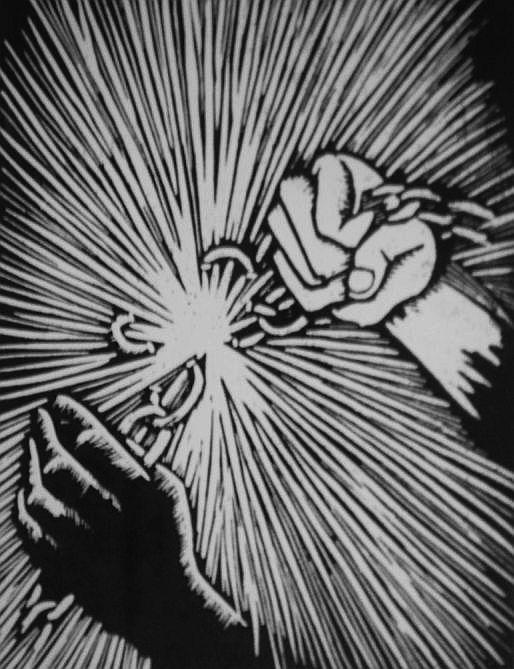
Breaking the chains: precarity in the Age of Anxiety

breaking-the-chainsBy Joseph Todd

Source: RoarMag.org

In our Age of Anxiety, society assaults us from every possible angle with an avalanche of uncertainty. How do we fight back under conditions of precarity?

­An Age of Anxiety is upon us, one where society assaults us from every possible angle with an avalanche of uncertainty, fear and alienation. We live with neither liberty nor security but instead precariousness. Our housing, our income and our play are temporary and contingent, forever at the whim of the landlord, policeman, bureaucrat or market. The only constant is that of insecurity itself. We are gifted the guarantee of perpetual flux, the knowledge that we will forever be flailing from one abyss to another, that true relaxation is a bourgeois luxury beyond our means.

Our very beings come to absorb this anxiety. We internalize society’s cruelty and contradiction and transform them into a problem of brain chemistry, one that is diagnosed and medicated away instead of being obliterated at root. All hope is blotted out. Authentic experience, unmediated conversation, distraction-free affection and truly relaxed association feel like relics of a bygone era, a sepia dream that perhaps never existed.

Instead we have the frenetic social arenas of late capitalism: the commodified hedonism of clubs and festivals, express lunches, binge culture and the escapist, dislocating experience of online video games, all underlined by either our desperate need to numb our anxieties or to create effective, time-efficient units of fun so we are available for work and worry.

This is assuming we have work, of course. Many of us are unemployed, or are instead held in constant precarity. Stuck on zero-hour contracts or wading through as jobbing freelancers in industries that used to employ but don’t anymore, we are unable to plan our lives any further than next week’s rota, unable to ever switch off as the search for work is sprawling and continuous.

And if we do have traditional employment, what then? We are imprisoned and surveilled in the office, coffee shop or back room, subject to constant assessment, re-assessment and self-assessment, tracked, monitored and looped in a perpetual performance review, one which even our managers think is worthless, but has to be done anyway because, hey, company policy.

Continuous is the effective probationary period and we are forever teetering on the edge of unemployment. We internalize the implications of our constant assessment, the knowledge that we’re always potentially being surveilled. We censor ourselves. We second-guess ourselves. We quash ourselves.

And thanks to the effective abolition of the traditional working day, work becomes unbearable and endless. The security of having delineated time — at work and then at play — has been eradicated. Often this is because individuals have to supplement their atrocious wages with work on the side. But it is also because traditional 9-to-5 jobs have suffered a continuous extension of working hours into out-of-office time, enabled and mediated by our laptops and smartphones. These gadgets demand immediacy and, when coupled with the knowledge that you are always reachable and thus available, they instill in us a frantic need to forever reply in the now.

And with this expectation comes obligation. Hyper-networked technologies gift our bosses the ability to demand action from us at any moment. Things that had to wait before become doable — and thus are done — in the now. If you are unwilling, then someone is ready to take your place. You must always be at their beck and call. From this, our only refuge is sleep, perhaps the last bastion of delineated time against frenetic capitalism, and one that is being gradually eroded and replaced.

For those that are out of work the situation is no better. They face the cruel bureaucracy of the Job Centre or the Atos assessment, institutions that have no interest in linking up job seekers with fulfilling employment but instead attempt only to lower the benefits bill through punitive, arbitrary sanctions and forcing the sick back to work. Insider accounts of these programs betray the mix of anxiety inducing micro-assessment and surveillance they employ.

Disabled claimants — always claimants, never patients, insists Atos — are assessed from the moment they enter the waiting room, noted as to whether they arrive alone, whether they can stand unassisted and whether they can hear their name when called. Compounding this is the hegemonic demonization of those that society has failed: if you are out of work, you are a scrounger, a benefit cheat and a liar. Utterly guilty of your failure, a situation individualized in its totality and attributable to no system, institution or individual but yourself.

We are surveilled, monitored and assessed from cradle to grave, fashioned by the demand that we must be empirical, computable and trackable, our souls transformed into a series of ones and zeros. This happens in the workplace, on the street and in various government institutions. But its ideological groundwork is laid in the nursery and the school.

These institutions bracket our imaginations while still in formation, normalizing a regime of continuous surveillance and assessment that is to last for the rest of our lives. Staff are increasingly taken away from educating and nurturing and instead are made to roam nurseries taking pictures and recording quotes, all to be computed and amalgamated so authorities can track, assess and predict a child’s trajectory.

It is true that this does not trouble the child in the same way traditional high intensity rote examination does. But what it instead achieves is the internalization of the surveillance/assessment nexus in our minds; laying the groundwork for an acquiescence to panoptical monitoring, a resignation to a private-less life and a buckling to regimes of continuous assessment.

Britain is particularly bad in this respect. Not only does our government have a fetish for closed-circuit television like no other, but also, GCHQ was at the heart of the Snowden revelations. Revelation, however, is slightly misleading — as what was most telling about the leaks wasn’t the brazen overstep by government institutions, but that few people were surprised. Although we didn’t know the details, we suspected such activity was going on. We acted as if we were being watched, tracked and monitored anyhow.

In this we see the paranoid fugitive of countless films, books and television dramas extrapolated to society writ large. We are all, to some extent, that person. Our growing distrust of governments, the knowledge that our technologically-integrated lives leave a heavy trace and the collection of “big” data for both commercial and authoritarian purposes contributes to our destabilized, anxious existence. An existence that impels us towards self-policing and control. One where we do the authority’s job for them.

Many individuals offer the amount of choice we have, or the amount of knowledge we can access at the click of a button, as the glorious consequences of late capitalist society. But our rampant choice society, one where we have to make an overwhelming number of choices — about the cereal we eat, the beer we drink, or the clothes we wear — is entirely one sided. While we have an incredible amount of choice over issues of little importance, we are utterly excluded from any choice about the things that matter; what we do with the majority of our time, how we relate to others or how society functions as a whole. Nearly always these choices are constricted by the market, the necessity of work, cultures of overwork and neoliberal ideology.

Again we find this ideology laid down in primary education. Over the years more and more “continuous” learning has been introduced whereby children, over a two week period or so, have to complete a set of tasks for which they can choose the order. This is an almost perfect example of how choice functions in our society, ubiquitous when insignificant but absent when important. The children can choose when they do an activity, which matters little as they will have to do it at some point anyway, but cannot choose not to do it, or to substitute one kind of activity with another.

Why does this matter? Because meaningful choices about our lives give us a sense of certainty and control. Avalanches of bullshit choices that still have to be made, as study after study has shown, make us incredibly anxious. Each of them takes mental effort. Each contains, implicitly, the multitude of choices that we didn’t make; all those denied experiences for every actual experience. This is fine if there are only one or two. But if there are hundreds, every act is riddled with disappointment, every decision shot with anxiety.

Compounding this orgy of choice, and in itself another root cause of anxiety, is the staggering amount of information that assaults us every day. Social media, 24-hour news, the encroachment of advertising into every crack — both spatially and temporally — and our cultures of efficiency that advocate consuming or working at every possible moment all combine to cause intense sensory overload. This world, for many, is just too much.

Although we’ve talked mostly about work, surveillance, assessment and choice, there are a multitude of factors one could add. The desolation of community due to the geographical dislocation of work, the increased transiency of populations and the growing privatization of previously public acts — drinking, eating and consuming entertainment are increasingly consigned to the home — shrinks our world to just our immediate families.

Camaraderie, extended community and solidarity are eroded in favor of mistrust, suspicion and competition. Outside of work our lives become little more than a series of privatized moments, tending to our property and ourselves rather than each other, flitting between the television shows, video games, home DIY and an incredible fetish for gardening with no hint towards the thought that perhaps these experiences would be better if they were held in common, if they appealed to the social and looked outward rather than in.

In the same way we could mention the ubiquity of debt — be it the mortgage, the credit card or the student loans — and the implicit moral judgment suffered by the debtor coupled with the anxiety-inducing knowledge that they could lose everything at any moment. Or we could consider the near-existential crises humanity faces, be it climate change, ISIS or the death throes of capitalism; all too abstract and total to comprehend, all contributing to a sense that there is no future, only a grainy, distant image of lawless brutality, flickering resolutely in our heads.

But the crux, and the reason anxiety could become a revolutionary battleground, is that neoliberal ideology has individualized our suffering, attributing it to imbalances in our brain chemistry, constructing it as a problem of the self, rather than an understandable human reaction to a myriad of cruel systemic causes. Instead of changing society the problem is medicalized and we change ourselves, popping pills to mold our subjectivities to late-capitalist structures, accepting the primacy of capitalism over humanity.

This is why “We Are All Very Anxious”, a pamphlet released by the Institute of Precarious Consciousness, is so explosively brilliant. Not only does it narrate the systemic causes of anxiety, but it situates the struggle within a revolutionary strategy, constructing a theory that is at once broad and personal, incorporating one’s own subjective experience into an explanatory framework, positing anxiety as a novel, contemporary revolutionary battleground, ripe for occupation.

It is, they claim, one of three eras spanning the last two-hundred years where we have progressed between different dominant societal affects. Until the postwar settlement we suffered from misery. The dominant narrative was that capitalism benefited everybody; while at the same time overcrowding, malnourishment and slum dwelling were rife. In response to this appropriate tactics such as strikes, mutual aid, cooperatives and formal political organization were adopted.

After the postwar settlement, until around the 1980s, a period of Fordist boredom ensued. Compared to the last era, most people had stable jobs, guaranteed welfare and access to mass consumerism and culture. But much of the work was boring, simple and repetitive. Life in the suburbs was beige and predictable. Capitalism, as they put it, “gave everything needed for survival, but no opportunities for life.” Again movements arose in opposition, positioned specifically against the boredom of the age. The Situationists and radical feminism can be mentioned, but also the counter-culture surrounding the anti-war movement in America and the flourishing DIY punk scene in the UK.

This period is now finished. Capitalism has co-opted the demand for excitement and stimulation both by appropriating formerly subversive avenues of entertainment — the festival, club and rave — while dramatically increasing both the amount and intensity of distractions and amusements.

In one sense we live in an age of sprawling consumerism that avoids superficial conformity by allowing you to ornament and construct your identity via hyper-customized, but still mass-produced products. But technological development also mean that entertainment is now more total, immersive and interactive; be it the video game or the full-color film watched on a widescreen, high-definition television.

Key to this linear conception is the idea of the public secret, the notion that anxiety, misery or boredom in these periods are ubiquitous but also hidden, excluded from public discourse, individualized and transformed into something unmentionable, a condition believed to be isolated and few because nobody really talked about it. Thus to even broach the subject in a public, systematic manner becomes not just an individual revelation but also a collective revolutionary act.

I’ve seen this first-hand when running workshops on the topic. Sessions, which were often argumentative and confrontational, became, when the subject was capitalism and anxiety, genuinely inquisitive and exploratory. Groups endeavored to broaden their knowledge of the subject, make theoretical links and root out its kernel rather than manning their usual academic ramparts and launching argument after rebuttal back and forth across the battlefield.

But more than this, there was a distinct edge of excitement, the feeling that we were onto something, a theory ripe with explosive newness, one that managed to combine our subjective experiences and situate them in a coherent theoretical framework.

However, we must be critical. To posit anxiety as a specifically modern affect, unique to our age, is contentious. What about the 1950s housewife, someone mentioned in one of the sessions, with her subjectivity rigidly dictated by the misogyny and overbearing cultural norms of the time? Didn’t this make her feel anxious?

Well, perhaps. But if we take anxiety to mean a general feeling of nervousness or unease about an uncertain outcome — with chronic anxiety being an actively debilitating form — then we can draw distinct differences. Although the housewife was oppressed, her oppression was codified and linear, her life depressingly mapped out with little room for choice or maneuver. Similarly with the slave — surely the universal symbol of oppression — hierarchies aren’t nebulous but explicit, domination is ensured by the whip and the gun, the master individualized and present.

This is in stark contrast to the current moment. While it is obvious that oppressions are distinct and incomparable, we can nevertheless see that the fug of the 21st century youth is of a different nature. Our only certainty is that of uncertainty. Our oppressor is not an individual but a diffuse and multiplicitous network of bureaucrats, institutions and global capital, hidden in its omnipotence and impossible to grasp.

We aren’t depressed by the inevitability of our oppression, but instead are baffled by its apparent (but unreal) absence, forever teetering on the brink, not knowing why, nor knowing who we should blame.

Similarly it is bold to claim that anxiety is the dominant affect of Western capitalism, tantamount to pitching it as the revolutionary issue of our age. Yet if we analyze the popular struggles of our time — housing, wages, work/life balance and welfare — they are often geared, in one way or another, towards promoting security over anxiety.

Housing for many is not about having a roof over their heads, but about security of tenure, be it via longer fixed-term tenancies or the guarantee that they won’t be priced out by rent rises that their precarious employment can’t possibly cover. In the same way struggles over welfare are often about material conditions, but what particularly strikes a chord is the cruel insecurity of a life on benefits, forever at the whim of sanction-wielding bureaucrats who are mandated to use any possible excuse to remove your only means of support.

Anxiety is also a struggle that unites diverse social strata, emanating from institutions such as the job center, loan shark, university, job market, landlord and mortgage lender, affecting the unemployed, precariously employed, office worker, indebted student and even the comparatively well-off. Again we find this unification in the near-universal adoption of the smartphone and other hyper-networked technologies. All of us, and especially our children, are beholden to a myriad of glowing screens, flitting between one identity and another, alienated and disconnected from our surroundings and each other.

This is not to say a movement against anxiety itself will ever arise. Such a rallying cry would be too abstract and fail to inspire. Instead, anxiety must be conceptualized both as an affect which underlies various different struggles, and a schema within which they can be assembled into a revolutionary strategy.

So, what is our tangible aim here? In part it must be to reduce the level of general anxiety so as to increase quality of life. Yet if we are to take a revolutionary rather than a mere humanitarian approach, this drop in anxiety must in some way translate into a rise in revolutionary disposition. In certain ways it obviously will. If there is a public realization that large swathes of the mentally ill are not as such because of their unfortunate brain chemistry but instead because of a misconfiguration of society, people are already thinking on an inherently challenging, systemic level.

Similarly, conflict with the state or capital — be it on the street, in the workplace or inside one’s own head — tends to be high-impact and anxiety-inducing. A drop in general anxiety will make it more likely that individuals will engage in such moments of conflict and, crucially, experience the intense radicalization and realization of hegemonic power that can only be achieved through such visceral moments. But a second part to this, hinted at already and integral to giving the struggle a revolutionary edge, is to emphasize that there is a public secret to be aired. As well as combating the sources of anxiety, we must say we are doing so; we must situate these struggles within larger frameworks and provide education on its systemic nature.

Thus, any strategy would need to be both abstract and practical. On one hand we must explode the public secret by raising consciousness. This would require a general onslaught of education, including, but not limited to, consciousness-raising sessions, participatory workshops, articles, books, pamphlets, leaflets, posters, YouTube videos and “subvertised” adverts. The emphasis would be to educate but also to listen, to intermingle theoretical understanding with subjective experience.

The second part would be to strategically support campaigns and make demands of politicians that specifically combat anxiety in its various different guises. When it comes to work, the abolition of zero-hour contracts, the raising of the minimum wage in line with the actual cost of living, and the tightening of laws on overwork as part of a broader campaign to assert the primacy of life over work, of love over pay, would be a good start.

For those out of work, underpaid or precarious, the introduction of a basic citizen’s income would represent a revolutionizing of the job market. In one move it would alleviate the cultural and practical anxieties of worklessness — ending the bureaucratic cruelty of the job center while removing the anxiety-inducing stigma associated with claiming benefits — while simultaneously allowing individuals to pursue culturally important and revolutionary activities such as art, music, writing or (dare I say it?) activism, without the crushing impossibility of trying to make them pay. When we look to housing obvious solutions include mandatory, secured five-year tenancies, capped rent increases and a guarantee of stable, suitable social housing for those who need it.

There are many more reforms I could list. You will notice, however, that these are indeed reforms; bread and butter social democracy. Does that mean such a program is counter-revolutionary? A mere placatory settlement between capital and the working class? No, it does not. Revolution does not emerge from the systematic subjection of individuals to increased misery, anxiety and hardship as accelerationist logic demands. Instead it flourishes when populations become aware of their chains, are given radical visions for the future and the means to achieve them. It is when leftists critique but also offer hope. It is when the population writ large are included in and are masters of their own liberation; not when they are viewed as a lumpen, otherly mass, of only instrumental importance in achieving the glorious revolution.

Look at the practicalities and this becomes obvious. How can we expect individuals to launch themselves into high-tension anxiety-inducing conflicts if the mere thought of such a situation causes them to have a panic attack? How can individuals, in the face of near panoptical surveillance and monitoring, combat the overwhelming desire to conform if they aren’t awarded some freedom from the practical anxieties of life? How are we to think and act in a revolutionary, and often abstract, manner if the very real and immediate anxieties of work, home and play fog our minds so totally?

This is not to say freedom will be given to us. It must always be taken, and we must not rely on electoral politics to hand us the revolution down from above. Nor will true struggle ever be an anxiety-free leisure pursuit. Genuine conflict with the state and capital will always entail danger, stress and the possibility of intensified precariousness.

Nevertheless, the dismissal of electoral politics in its totality represents abysmal revolutionary theory. The pursuit of reforms by progressive governments being bitten at the heels by sharp, vibrant social movements can produce real, tangible change.

It was what should have happened with Syriza, and it is what will hopefully happen with the new Labour leadership in the UK. And if, as individuals and communities, we are to puncture the distress, precariousness and general sense of cruel unknowing so particular to the moment in which we live, if we are to overcome the avalanche of bullshit and reclaim our confidence, if we to construct and disseminate a distinctly communal, hopeful revolutionary fervor, such changes are imminently needed.


Joseph Todd is a writer and an activist. Find more of his writings here or follow him on twitter.

The Dying Americans

1365203033_2628_auschwitz

By Chad Hill

Source: The Hipcrime Vocab

I’ve often used the term “the final solution for the working class,” in reference to the current American policy towards its vast intercoastal peasantry who, for reasons of circumstance or inclination, do not subject themselves to the decade or so of wildly expensive education that qualifies them for the remaining jobs on offer. It may be a reflection of my readership that I haven’t received any pushback. As someone who is in that same working class, I can clearly see what is happening around me, and I’m not alone. David J. Blacker, in his book, The Falling Rate of Learning and the Neoliberal Endgame, also broached the subject of eliminationism, going so far as to study the German holocaust literature of the 1930’s which calmly and rationally discussed how to deal with the problem of getting rid of the millions of excess people whom the elites determined were “undesirable” in the brave new world they were creating.

After last week, it’s hard to argue that this is hyperbole. The news that America’s white working class between the ages of 45-65 has dramatically falling life expectancy, alone against nearly the entire world, received a surprising (to me) bit of coverage. When I first read it, I assumed it would be just another footnote story that I would write about here, but would be ignored everywhere else. But it received a surprising amount of coverage: even Paul Krugman wrote about it. I suspect a large part of that was due to the fact that it was research by the most recent economics “Nobel” laureate Angus Deaton and his wife, so it was harder to ignore than if it had been from some unknown researcher.

Often times you hear about a “dieoff” due to our situation. I think this study confirms beyond a doubt that the dieoff is already happening. Yet, consider that, before this study became popularized, you would have never heard about it in the mainstream press. Still doubt the collapse is real?

It’s not people dying in the streets, though, unlike some of the more feverish TEOTWAKI peak oil predictions. From the research, elevated levels of suicide and drug abuse are the prime culprits. It’s the million little deaths that go unnoticed in the obituary columns of decaying communities all across this formerly prosperous nation. Someone overdosed in a back alley. Or a meth lab exploded. Or maybe they were killed in a car accident, or decapitated while driving their motorcycle too fast. Or they were shot by police. Or they are dying of liver failure by age 40. Or, increasingly, they are ground down slowly by the many chronic diseases such as diabetes that are symptomatic of the chronic stress and horrid (yet highly profitable) junk food diet of most Americans. It’s a dieoff all right, but it’s never framed as such. You can see it all around you: the overcrowded jails filled with unemployed people, the overcrowded hospitals filled with sick, obese people, the folks standing on the medians and freeway offramps with cardboard signs and living their cars, all while the media just goes on reporting about spectator sports and celebrity gossip as though nothing bad is happening. Ignorance really is bliss.

The obvious analogy here is Russia after the fall of the Soviet Union, as many people writing about the study have pointed out: The Dying Russians (New York Review of Books). But there was no “collapse” of the United States. Or was there? Instead, we’re told by the media and politicians that everything in every way is getting better and better for everyone. Just look at the latest iPhone! Television screens are huge! Even the very poor have indoor plumbing! And you can Google anything you like, so what are you complaining about, loser?

Everything is famed as personal failure, thus the dieoff is just a million stories of individual failure with no overall pattern. Nothing to see here, more along. Study and “work hard” (whatever that means), and you’ll be okay. Certainly that fear is behind the epidemic of overwork, presenteeism and grinding hours of unpaid overtime Americans are putting in at work in the hope of not being next. It’s like being the model prisoner in a concentration camp, though. Ask the turkeys this month if being a good turkey had any effect on their ultimate fate. The Parable of the Happy Turkey (Global Guerrillas)

Up until now, Americans have been happy turkeys. Thus, they cannot comprehend what is happening to them. In America it is taken for granted that the ultimate locus of control is on the individual, and that there is no such thing as society. That belief has been heavily promoted over the past thirty years, along with the “create your own reality” and other assorted positive thinking nonsense (thanks Oprah!), and I think we can see why.

And since we see this always as personal failure and are not allowed to see it as systemic failure, the poor and formerly middle classes take it out on themselves instead of the system. After all, America is the land of opportunity; if you don’t “make it’ (whatever that means), you have no one to blame but yourself! Of course it is not true; the musical chairs job market and winner-take-all economy means that only a tiny number of people even have a shot at the middle class anymore, and a lot of that is due to geography, pre-existing social connections and luck.

They don’t have to kill you if they can get you to kill yourself.

And although framed as a tragedy, I wonder if to some extent this behavior on the part of working class males is a logical response to living in the kind of society that the United States has become. In a society that has no use for them anymore and where they have no sense of purpose and no hope for the future, it seems like suicide is a rational response. After a certain age, you realize that you have been sorted to the “losers” pile. If you live in the vast suburban flatland of Middle America, you likely live in a decrepit house somewhere in the anonymous miasma of strip-mall suburbia, buy disposable plastic crap made in China from baleful fluorescent-lit Dollar Stores, drive an older model pickup truck or SUV with a bad muffler and bad brakes over potholed streets and under rusty bridges, while all the jobs around you aside from the hospital and the university (which are mainly female-staffed) are minimum wage, dead-end jobs where you have to smile and wear a uniform. You realize you’re never going to meet the girl of your dreams since hypergamy is still baked into female mating choice, despite what some feminists claim. You realize you will never get that that great job that will allow you to be upwardly mobile and live in relative ease and comfort, and life is a bitter, hard struggle relieved only by the occasional joint and video games. Or you’re divorced and paying child support to your former wife who’s managed to keep herself presentable enough to hook up with one of the few remaining alpha-males, and half your income goes to support the kids you never see. Or your deadbeat loser children have been working multiple McJobs and living in the basement for years with no hope of even affording a one-bedroom apartment, and between them and the wife you never speak to anymore, you can’t even get into your own damn bathroom. You realize that, like most Americans, you will never afford to retire and will have to work your boring, dead-end job under your asshole supervisor until you literally drop dead. So why wait?

I mean, who wouldn’t kill themselves or anesthetize themselves with drugs and booze in an environment like this?

I once read an online commenter say that the rich are the beta testers for the lifestyles we will all be living in the future (and thus no restraints must be put on their wealth accumulation if we are to experience that future). But that commenter had it wrong. Rather, it is the poor–those living on less than a few dollars a day; those who live in ghettos marred by gangs and drug abuse; those with their heat, water, and streetlights turned off, who are the beta testers for the lifestyles that most of us will be “enjoying” in the near future. As William Gibson said, the future is already here, just not evenly distributed.

Given the above, I can’t help but think of the “Rat Park” experiment. Rats in a cage, when given  a choice between water and drugs, would overdose themselves to death on the drugs, neglecting even basic self-maintenance. But a cage is a boring, repetitive, stressful environment for a rat, so you might expect the animals to anesthetize themselves with whatever was on offer. But rats living in an environment specifically designed to be pleasant and give the rats what they needed to thrive did not overdose themselves to death; they preferred healthier behaviors instead. It’s worth noting that most of the drugs we use today have been known for hundreds or even thousands of years, but were not abused by the native peoples who discovered them. That is reserved for modern, “advanced” societies. The Rat Park experiment (io9)

I once wrote that if you wanted to intentionally design a social environment to drive a primate insane, you would develop something pretty much identical to modern-day America (advertising, chronic stress, inequality, separation from nature and each other, boring, repetitive work, constant surveillance, and on and on…). It’s pretty obvious how Rat Park parallels life in twenty-first century America with its ubiquitous television, concentration-camp schools complete with metal detectors, freeways and cul-de-sacs and landscapes of Applebees™ and Walmarts; along with a steady diet of Pizza Hut and Taco Bell. It’s hardly an environment designed for human flourishing, is it? Rather, it is designed to maximize “economic growth” at all costs. The results of that experiment are as plain to see as they are predictable.

Most people who are still relatively comfortable are content to write off the people who are living in deprived circumstances among them right now, especially in the United States where so many of those poor are African-American. But more and more, whites are experiencing what they had previously dismissed as “black problems” due to their racist attitudes: the hopelessness and despair, the unemployment, the sociological pathologies; the drug abuse, divorces, domestic violence, youth gangs and so on. It’s not race, it’s environment, as Rat Park showed. Given a certain environment, an animal–any animal–will behave a certain way. Its totally predictable. We know this, but why do we pretend it is not true? Instead we reliably chalk it all up to “the Cult of Personal Failure.”

But this leads to an even larger question, one that gets to the heart of our modern predicament. We have to ask ourselves, what kind of society are we creating where so many people see death as preferable to living in such a society? In what kind of a society do people see life as so miserable that they prefer to kill themsleves, either slowly or immediately?  That is, why is this the end result of hundreds of years of supposed “progress?”

Fundamentally, how do you feel about this society? Do you feel good about this society? Do you feel good about the school-to-prison pipeline? Do you feel good that there are more prisoners than small yeoman farmers? Do you feel good that it is a felony to show us how our food is produced? Do you feel good about students mortgaging their future for jobs that won’t exist by the time the bill comes due? Do you feel good about hospitals treating chronic diseases taking the place of farming and making things as basis of the America’s rural economies? Do you feel good about police armed with body armor and and tear gas? Do you feel good about wall-to-wall advertising preying on our weakness and insecurities? Do you feel good about the atmosphere of incessant adversarial competition against everyone else for the shrinking pool of jobs on offer which pay enough to afford rent?

If so, why?

This puts a crimp on the Panglossian “everything in every way is getting better for everyone,” rhetoric that you hear so often in the media. What I find amusing is that this rhetoric used to come from the Left–that the welfare state would eliminate poverty, racism, that everything was under control and circles of cooperation would get larger and larger, and so on. But now, I mostly hear the Panglossian rhetoric coming primarily from the Right, whose preferred God is the unregulated “free” market. It’s in the Right-wing propaganda now that I constantly hear how wonderful everything is, and that those who are complaining are either delusional misfits or just jealous. Here is a prime example from the Right-wing National Review:

Good news abroad, and good news at home: In 1990, there were 2,245 murders in New York City. That number has fallen by 85 percent. Murders are down, often dramatically, in cities across the country. The overall rate of violent crime has fallen by about half in recent decades. U.S. manufacturing output per worker trebled from 1975 to 2005, and our total manufacturing output continues to climb. Despite the no-knowthings [sic] who go around complaining that “we don’t make things here anymore,” the United States continues to make the very best of almost everything and, thanks to our relatively free-trading ways, to consume the best of everything, too. General-price inflation, the bane of the U.S. economy for some decades, is hardly to be seen. Flexible and effective institutions helped ensure that we weathered one of the worst financial crises of modern times with surprisingly little disruption in the wider economy. Despite politicians who would usurp our rights, our courts keep reliably saying that the First Amendment and the Second Amendment pretty much mean what they say. I just filled up my car for $1.78 a gallon.

 The world isn’t ending.

The world is healthier, wealthier, and less hungry mainly because of the efforts of millions of unknown investors, entrepreneurs, farmers, workers, bankers, etc., all working without any central coordinating authority….There is much left to do: We have unsustainable fiscal situations in the Western welfare states, irreconcilable Islamist fanatics originating in points east but spread around the world, environmental challenges, and that tenth of the human race that still needs lifting out of hardcore poverty. But we have achieved a remarkable thing in that unless we mess things up really badly, in 50 years we’ll be having to explain to our grandchildren what a famine was, how it came to be that millions of people died every year for want of clean water — and they will look at us incredulously, wondering what it must have been like to live in the caveman times of the early 21st century.

Liberal Democracy and Free Markets, Take a Bow (National Review) Or better yet, strap on flight suit and hang up a “Mission Accomplished” banner.

Yes, for the folks on the Right, it truly is a Golden Age. There are a few flaws in the ointment like those pesky welfare states and all that but, hey, gas is cheap! Can’t you just feel the bright, shiny future ahead? Here’s a another sampling from The Wall Street Journal:

The trajectory of the world doesn’t justify this pessimism. People are living longer on every continent. They’re doing less arduous, backbreaking work. Natural disasters are killing fewer people. Fewer crops are failing. Some 100,000 people are being lifted out of poverty every day, according to World Bank data.

Life is also getting better in the U.S., on multiple measures, but the survey found that 55% of Americans think the “rich get richer” and the “poor get poorer” under capitalism. Sixty-five percent agree that most big businesses have “dodged taxes, damaged the environment or bought special favors from politicians,” and 58% want restrictions on the import of manufactured goods.

Has the World Lost Faith in Capitalism? (WSJ) Silly people, how dare they “lose faith!” Once we stamp out every last vestige of “socialism” we can restore that faith.

So what’s going on here? Listening to the Right, one gets the appearance that things have never been better, and that people are just totally irrational and determined to complain no matter how good they have it, despite voluminous scientific literature portraying optimism bias as the default cognitive condition for most people.

I think it stems from two areas – the Neoliberal experiment has clearly been an unmitigated disaster, so the literature constantly has to portray a rosy picture for those still living in the elite ideological bubble by cherry-picking data: Cheer – Inequality is Falling Globally!! (and similar nonsense) (Pieria). It’s much like the “happy peasant” literature that prevailed on the eve of the French Revolution and during early Industrialism to convince upper-class readers that their efforts were actually for the good of all, not just themselves; it’s just that the feckless peasants were too short-sighted to realize it. The elites, for some reason, have a need to believe, despite all the evidence to the contrary, that the free-market fundamentalism they subscribe to is making everyone–not just them–better off. Perhaps it is a remedy for cognitive dissonance and a guilty conscience.

The second agenda might be to cover up the agenda of eliminationism referred to above.
Going back to the original topic, it’s fairly clear that getting rid of the lower classes is, as The Joker put it in The Dark Knight, “all part of the plan.”

Now that might seem a bit paranoid, but consider this – the governors of many states are withdrawing basic social protections for their poorest citizens, and actually paying for the priviliege! Here’ Kevin Drum:

…the states that refuse to expand Medicaid are denying health care to the needy and paying about $2 billion for the privilege. Try to comprehend the kind of people who do this. 

The residents of every state pay taxes to fund Obamacare, whether they like it or not. Residents of the states that refuse to expand Medicaid are paying about $50 billion in Obamacare taxes each year, and about $20 billion of that is for Medicaid expansion. Instead of flowing back into their states, this money is going straight to Washington DC, never to be seen again. So they’re willing to let $20 billion go down a black hole and pay $2 billion extra in order to prevent Obamacare from helping the needy. It’s hard to fathom, isn’t it?

Red States Spent $2 Billion in 2015 to Screw the Poor (Mother Jones)

Last week, McClatchy documented the unnecessary pain being inflicted on red state residents by their elected Republican representatives…Roughly 260 million Americans (roughly 85 percent) already have health insurance provided by their employers, the government or through individual policies they purchased. In places like Oregon, Colorado, New York, California and other, mostly Democratic states, governors and state legislators accepted the expansion of Medicaid to provide free health insurance for those earning up to 138 percent of the federal poverty (FPL). For those earning between 138 and 400 percent of the FPL, the Affordable Care Act’s subsidies will help them purchase insurance in the private market. But in the states where Republicans said “no” to the expansion of Medicaid, the picture is much different. As the AP explained the coverage gap:

Nearly 2 in 3 uninsured people who would qualify for health coverage under an expansion of Medicaid live in states which won’t broaden the program or have not yet decided on expansion.

The resulting Republican body count is staggering. Thanks to the GOP’s rejection of Medicaid expansion, 1.3 million people in Texas, 1 million in Florida, 534,000 in Georgia and 267,000 in Missouri will be ensnared in the coverage gap.

Health Insurance “Coverage Gap” Coming To A Red State Near You (Crooks and Liars)

That’s right, Republican governors are blowing a hole in their budget just to remove social protections for the poor. Often times, “unaffordability” is cited as a justification, but clearly this is not at work here. It’s pure ideology. But what is that ideology? Here’s more detail:

American conservatives for the past several decades have shown a remarkable hostility to poor people in our country. The recent effort to slash the SNAP food stamp program in the House; the astounding refusal of 26 Republican governors to expand Medicaid coverage in their states — depriving millions of poor people from access to Medicaid health coverage; and the general legislative indifference to a rising poverty rate in the United States — all this suggests something beyond ideology or neglect.

The indifference to low-income and uninsured people in their states of conservative governors and legislators in Texas, Florida, and other states is almost incomprehensible. Here is a piece in Bustle that reviews some of the facts about expanding Medicaid coverage:

In total, 26 states have rejected the expansion, including the state of Mississippi, which has the highest rate of uninsured poor people in the country. Sixty-eight percent of uninsured single mothers live in the states that rejected the expansion, as do 60 percent of the nation’s uninsured working poor.

These attitudes and legislative efforts didn’t begin yesterday. They extend back at least to the Reagan administration in the early 1980s…

Most shameful, many would feel, is the attempt to reduce food assistance in a time of rising poverty and deprivation. It’s hard to see how a government or party could justify taking food assistance away from hungry adults and children, especially in a time of rising poverty. And yet this is precisely the effort we have witnessed in the past several months in revisions to the farm bill in the House of Representatives. In a recent post Dave Johnson debunks the myths and falsehoods underlying conservative attacks on the food stamp program in the House revision of the farm bill.

This tenor of our politics indicates an overt hostility and animus towards poor people. How is it possible to explain this part of contemporary politics on the right? What can account for this persistent and unblinking hostility towards poor people?

Why a war on poor people? (Understanding Society)

Let’s restate this to be clear to make sure the point is not lost: these states are willing to lose money in order to make sure their poor die quicker. Clear enough? And we’re not even talking about things like the outright cold-blooded murder of the homeless by police, the breaking up of homeless encampments, the mass incarceration, and return of debtors’ prisons, and so on. It’s expensive to be poor in  America. We do everything by the Matthew Effect from jobs to education, and wonder why class mobility is nonexistent. Yet we’re still told that everyone wants to be an American, that it’s the land of opportunity, and that things have literally never been better.

Thrown in jail for being poor: the booming for-profit probation industry (Guardian)

Much of the well-funded efforts of plutocrats and their allies has been to repeal the Affordable Care Act (which was designed by Right-wing think tanks), not to reform it or replace it with something more effective, but to return to the predatory status quo ante. Now, businessmen may be greedy, short-sighted and sociopathic, but they are not stupid. They surely know that the American System is wildly more expensive than any other place on earth, but they are willing to lose billions of dollars in profit just to make sure people don’t get health care! Think about that. A European friend said to me once that he didn’t understand why American businesses seemed to want sick, insecure employees who either don’t have access to health care, or are worried about going broke trying to pay for it. It seemed totally irrational to him. But it’s only irrational if you don’t understand the underlying ideology of eliminationism. Some societies actually want to kill off their own people, as Nazi Germany and other tragic examples have shown.

And it’s of a piece with the withdrawal of mass education that Blacker documents in his book. The elites are disinvesting from society in every way because they just don’t need us anymore. And their propaganda mills are dedicated to making sure the blame is squarely placed on individuals so that we will internalize learned helplessness which has prevented any effective resistance. Or their mills are insisting that it’s just not happening, and everybody is really better off, as we saw above, except for a few churlish losers who have no one to blame but themselves (and are probably looking for a handout).

Who turned my blue state red? (NYT). A great explanation of America’s crab mentality.

I’ve featured the analogy of horses that some economists use before. Human beings may have found other jobs (which is debatable), but the population of horses just went down in line with the work that was available for them to do. I think it’s obvious that this is a good analogy for what’s happening.

…Similarly, one could just as easily have said, a century ago, that: “Fundamental economic principles will continue to operate. Scarcities will still be with us…. Most horses will still have useful tasks to perform, even in an economy where the capacities of power sources and automation have increased considerably…”

Yet demand for the labor of horses today is vastly less than it was a century ago, even though horses are extremely strong, fast, capable and intelligent animals. “Peak horse” in the U.S. came in the 1910s, I believe. After that there was no economic incentive to keep the horse population of America from declining sharply, as at the margin the horse was not worth its feed and care. And in a marginal-cost pricing world, in which humans are no longer the only plausible source of Turing-level cybernetic control mechanisms, what will happen to those who do not own property should the same come to be true, at the margin, of the human? What would “peak human” look like? Or–a related but somewhat different possibility–even “peak male”?

Technological Progress Anxiety: Thinking About “Peak Horse” and the Possibility of “Peak Human” (Brad DeLong)

Off to the glue factory with the middle class, then. As long as it’s kept diffuse enough, it will never be picked up on; “Work Makes You Free” hangs in the air over our heads instead of over the entry gates. Perhaps we should just inscribe it on the Gateway Arch.

So, all told, the self-destructive habits of the middle-aged white poor are hardly irrational. Rather, it seems to be to be the most rational response to the type of world we’ve created. The only question is, why do so many of us apparently want to stay on this path?

The Reason You Work So Hard to Participate in the Rat Race

6a01116888abb7970c01a3fd366b75970b-800wi-800x425

By M.J. Higby

Source: Waking Times

Ralph Waldo Emerson once said, “A man in debt is so far a slave.” Money has no intrinsic value yet we spend our days damaging our health and spirit in order to obtain it. Why do we sacrifice our well-being for it? Is it the cliché that “we just want to provide a better life for our kids than we had?” Is it just way of the civilized world? The most important question to ask, however, is what power do we have to change this way of thinking and living? The reality is simple: money is a vehicle for social control. Debt makes us good, obedient workers and citizens.

The traditional workweek started in 1908 at The New England Cotton Mill in order to allow followers of the Jewish religion to adhere to Sabbath.  With the passage of The Fair Labor Standards Act in 1938, the 40-hour workweek became the norm. Data from the 2013 American Community Survey showed that the average commute time in America is about 26 minutes each way. According to a Gallup poll, the average workweek in America is 34.4 hours, however, when only taking into account full time workers, that average shoots up to 47, or 9.4 hours per day during a 5-day workweek. Keeping averages in mind then, between commuting, working and figuring in an hour for lunch (usually less), that puts us at approximately 11 hours and 40 minutes for the average full time worker. If you have a family with young kids, just add in another few hours for homework, baths, etc.

When the day is done, how much time do you have for yourself? To exercise, meditate or otherwise unwind the way that all the healthy living gurus preach? And how much of yourself, your presence of mind, is left to devote to family? We give the company the heat of our most intense mental fire while our families get the smoke. Yet Jeb Bush, the 2016 GOP presidential hopeful, says we need to work more.

The answer to why we put ourselves through this daily grind is multifaceted. The most pervasive reason is workplace and societal pressures. We are raised in a matrix of sorts. The cycle starts around the age of five when we are expected to adhere to a regimented 8-hour day of school. At this age, we don’t have the intellect to question why, so we mechanistically follow the path that’s laid out. This daily path becomes engraved in our minds and becomes as automatic as the sun’s daily journey. Our school system is adept at churning out working class individuals en masse.  We are taught along the way not to question authority, again adhering to the working class mentality.

On the opposite end of the spectrum are those in power. They are the ones that like to color outside the lines. Many books abound with titles such as The Wisdom of Psychopaths that illustrate how people with psychopathic traits, ones who don’t tend to follow rules, are often found in managerial roles such as CEOs all the way up to presidents of countries. With these rare manipulative, coldhearted personalities in place and the rest of us following like good sheeple without questioning, the stage is set for compliance.

If you have been in the working world long enough, then the following statement should ring true: if you work extra hours, you are a great worker; if you decline, you’re useless and apathetic. In the work world, there’s typically no in between. The pressure to succeed for the pride and benefit of the company unfortunately supersedes that of the pressure to be a good parent, sibling, son or daughter. According to a study done by the economic policy institute, between 1948 and 2013, productivity has grown 240% while income for non-managerial workers has grown by 108%. To make up for this discordance, pride of doing what’s best for the company has been employed as a motivational tactic. This tactic has been used as a sharp IV needle that’s been inserted into our veins and we have willingly ingested the contents that are injected through it. Pressure to conform toward achieving the company’s goals has overcome our will to be compensated accordingly.

The other side of this pressure comes from society as a whole outside the education/workplace. A close friend of mine works for a state court and makes about $40K/year. He is also a self-employed business owner on the off hours. I estimate that he works about 70-80 hours a week. He owns a home in a well-to do neighborhood and he drives a seventy thousand dollar luxury car. This crystallizes the saying ‘big hat, no cattle.’ But when a lie is told over and over, the lie becomes the truth.

When we look at someone who drives a luxury car and lives in an upscale part of town, we see this as success because of how often that visual of it has been pounded tirelessly into our minds. We fail to see that these are nothing but symbols of success and false ones at that. They appear real because as a society, we have been conditioned to see them this way by the advertising industry. In the book, The Millionaire Next Door, the authors annihilate this illusion. Numbers don’t lie and the statistics show that most true millionaires, those with a net worth of over one million dollars, do not own those luxuries that we typically associate with success and wealth. They view them as the reality of what they are: a depreciating liability. According to the book, the typical millionaire owns a home in the two to three hundred thousand dollar-range and a non-luxury automobile. If something goes wrong with either, they have the cash reserves to fix it. On the other hand, the commonplace owner of the luxury home and car can’t afford the roof and the tires respectively without going deeper into debt if they should need replacing.

Ownership of these symbols of wealth becomes a self-perpetuating illusion to satisfy the psychological need for acceptance. Unfortunately, human behavior dictates that emotional needs often override logical thinking. It’s been said that the borrower is slave to the debt-owner and with luxury items, debt is the rule, not the exception. Debt is healthy for those in power and contributes to a needy and thus obligated worker.

The current wisdom of slave, spend and save for retirement has only one destiny. That destiny can be summed up in three sentences. Spend your healthiest and most productive years working to support a life of materials and thus illusions of success while elevated stress damage your health. During this time, be sure to save enough money for retirement so you can enjoy those years of the subsequent poor health. And lastly, do it in the name of pride for your company and country.

I take pride in being American, as I’m sure most Americans do, however, if you’re reading this you’re likely smart enough to see the holes in the daily grind. It saps our creative potential and our physical, as well as our spiritual energy. We don’t need any studies to tell us how stressed we are and subsequently, how unhealthy we are. The physical manifestations of stress such as obesity, hypertension, heart disease, increased risk of cancer, depression, anxiety and many others tell us all we need to know. They tell us that we need a better work/life balance. They tell us that the pendulum has swung too much in the direction of work and away from life. Fortunately, there’s a way that we can take it back.

The most important way to restore this balance is to realize the power that we, as consumers, hold. Tyler Durden, the protagonist in the film, Fight Club said it best…

“…advertising has us chasing cars and clothes, working jobs we hate so we can buy shit we don’t need.”

The marketing and advertising industry know, more than anyone else, what motivates the human mind and how to tap into those instinctual drives. To defend against this industries seductiveness, we need to journey within ourselves and bring to light what’s really important to us. What most of us will find is that experiences and time well spent, not materials, are what makes us happy. In the book, aptly titled Well Being, the authors Tom Rath and Jim Harter discuss how experiences have been proven to make us happier than material posessions.

We revel in the anticipation of the experience, we enjoy the experience itself and we look back on it fondly for as long as we live. We do this while the expensive car or house that we borrowed money long ago to obtain falls apart causing us to borrow more money. If we live according to the rule that everything we purchase, with the exception of a home, is acquired by cash, then we fail to become slaves to debt and by extension, work. We no longer relinquish our power to creditors.

Oscar Wilde was famously quoted as saying that anyone who lives within their means suffers from a lack of imagination. Materialistically speaking, living by this notion will bind us with shackles to a life of debt servitude. When we rip those shackles of debt from our wrists, our minds become clear and we see what truly makes us happy. We spend more time with friends and family. We focus on our passions and hobbies. In essence, we get back to the foundation of what it means to be human. After all, none of us will ever arrive upon the mountain of our last moments of existence wishing we spent more time at the office. We will instead arrive wishing we completed that book, that painting or that experience with those we love most. For those can be purchased not with debt, but with time. And there is no more cunning, covert and deceitful thief of time as that villain we call debt.


About the Author

M.J. Higby practices medicine in Phoenix, AZ. He is passionate about martial arts, most notably Brazilian Jiu Jitsu. He enjoys writing about mental, spiritual and physical well being and questioning the methods by which we attain it. You can reach him on Facebook and Twitter @MJHigby

The Role of Dystopian Fiction in a Dystopian World

images

By Luther Blissett and J. F. Sebastian of Arkesoul

A few years ago, Neal Stephenson wrote a widely-shared article called Innovation Starvation for the World Policy Institute. He began the piece lamenting our inability to fulfill the hopes and dreams of mid-20th century mainstream American society. Looking back at the majority of sci-fi visions of the era, it’s clear many thought we’d be living in a utopian golden age and exploring other planets by now. In reality, the speed of technological innovation has seemingly declined compared to the first half of the 20th century which saw the creation of cars, airplanes, electronic computers, etc. Stephenson also mentions the Deepwater Horizon oil spill and Fukushima disasters as examples of how we’ve collectively lost our ability to “execute on the big stuff”.

Stephenson’s explanation for this predicament is two-fold; outdated bureaucratic structures which discourage risk-taking and innovation, and the failure of cultural creatives to provide “big visions” which dispute the notion that we have all the technology we’ll ever need. While there’s much to be said about archaic, inefficient (and corrupt) bureaucracies, there’s also a compelling argument invoked over the cultural importance of storytelling and art and how best to utilize it. One of the solutions offered by Stephenson, in this regard, is Project Hieroglyph which he describes as “an effort to produce an anthology of new SF that will be in some ways a conscious throwback to the practical techno-optimism of the Golden Age.”

While Project Hieroglyph may be a noble endeavor, one could argue that it’s based on a flawed premise. The role of science fiction has never been just about supplying grand visions for a better future, but to make sense of the present. There seems to be an assumption that the optimistic Golden Age had a causal relationship with a perceived technological golden age when it may have simply been a reflection of it— just as dystopian sci-fi reflects and strongly resonates with the world today. Stephenson may be correct in his view that much SF today is written in a “generally darker, more skeptical and ambiguous tone”, but this more nuanced perspective does not necessarily signify the belief that “we have all the technology we’ll ever need”. Rather, it reflects decades of collective experience and knowledge of unforeseen and cumulative effects of technologies. Nor does such fiction focus only on destructive effects of technology, as large a component of the narrative it may be simply because it makes for better drama and the subtext is often intended as a critique rather than celebration. For example, the archetypal hacker protagonists of technocratic cyberpunk dystopias employ technology for more positive ends (though some question whether good SF, as in speculative fiction, needs to involve new technology at all).

A particularly positive function for dystopian sci-fi is its use as rhetorical shorthand. It’s increasingly common in public discourse on major issues of the day to invoke dystopian references. Disastrous social effects of peak oil or post-collapse are often characterized as Mad Max scenarios. Various negative aspects of genetic modification and pharmaceutical development conjure Brave New World. Anxiety over out-of-control AI and resultant devaluing of human life brings to mind films as varied as Blade Runner, The Matrix and Terminator films. The expanding police/surveillance state is reminiscent of 1984 and numerous classics which have followed in its footsteps including V for Vendetta and Brazil. General fears of duplicitous, psychopathic power elites and social manipulation have elevated They Live from relatively obscure b-movie to cult classic. The entry of the term “zombie apocalypse” into the popular lexicon may in part stem from fear (and uncomfortable recognition) of images of viral social disintegration and martial law-enforced containment efforts depicted throughout various media. The burgeoning omnipotence of multinational corporations and hackers in Mr. Robot may have been the stuff of cyberpunk dystopias such as Neuromancer and Max Headroom 30 years ago, yet, it still has much to contribute to the public discourse as contemporary drama. Such visions may not prevent (or have not prevented) the scenarios they warn us of but have provided a vocabulary and framework for understanding such problems, and who’s to say how much worse it could be had such cautionary memes never existed?

The prophetic nature of storytelling, inasmuch as it derives from the minds of authors, artists and commentators that coexist with tensions and contexts particular to their epochs, resonate with the oughts, ifs, and whats inherent to our daily lives. As it were, the cautionary element of narrative is a natural product of the human mind, and the premium of what involves sharing our mental reserves to the world. To creatively dwelve and concoct problems and solutions from experience, is an axiom analogous to that of the categorical imperative—purely, and in abstract terms of what rationality involves. Yet, often times, we find material that is in favor of cultural malaise; of all things pathological in our society, such as censorship, conformity, bureaucracy, authoritarianism, militarism, and capital marketing; things which underpin issues that, if left untouched, can engulf the real brilliance of our spirit.

Stephenson fails to see this point. SF, as any form of intelligent culture, denounces and opposes systems of oppression, and even shows us the how, when, and why—the frameworks, the makings of apparent utopias into dystopias. Dystopian storytelling can serve the efforts of downtrodden creators with utopian ideals as effectively as utopian stories can reframe a societal trajectory led by beneficiaries of real world dystopia (though it may be experienced as utopia for a privileged few). SF does not only conjure visions of better futures. They lend us vocabularies and syntaxes to understand, and impede the fallenness of a confused, and ever increasingly isolated humanity. They are languages that pervade our interiorities, and that allow the exterior to change.

At the core, SF is prophecy through reasoned extrapolation and artistic intuition. This is what SF stands for when properly aligned with the subjectivities of the oppressed, and not with the voices of oppression: true testaments of a space and a time; visions of the future that carefully partake in not committing the mistakes of the past; and tools for our personal and collective flourishing.

Marrying robots, killing with drones, and making empty selfies

by Edward Curtin

Source: Intrepid Report

Today everything has become a spectacle, including writing. My title probably caught your eye, as it was intended. But now I would like to tell you a personal story about a man whose brilliant work foreshadowed and dissected the issues of my title before it existed. In this he was prophetic, and it is why his work is so important. He always insisted that true artists were able to uncover society’s conflicts before they emerged consciously. Though a psychologist by profession, he was in this sense an artist as well.

His name, Rollo May, has disappeared from public discourse in this era of biological psychology and psychiatry. This great American thinker and writer was the man who introduced existential psychology to the United States. And though he died twenty-one years ago, his prescient voice begs to be heard in our current conditions.

From his first important book in 1950—The Meaning of Anxiety—he examined key underlying issues that have plagued this country ever since: the worship of technology as a death cult; the loss of a genuine sense of self; sex obsessions leading to lovelessness and impotence; and violence yoked to a lack of compassion.

In book after book, he reiterated one of his central themes: that full passionate life is only possible when one refuses to block off from consciousness the frightful emotions of anxiety, guilt, and despair. In this, his life’s work ran against the grain of the emerging zeitgeist of happy pills, mood stabilizers, and the happiness industry. “After despair,” he wrote, “the one thing left is possibility.” For possibility (Latin, posse, to be able) means power, and true power only comes to those who dare to be weak and freely embrace their personal destinies and the truth of their political and cultural conditions. I think it is not an exaggeration to say that we are presently living in an era of despair, and to embrace that reality is a hard but necessary pill to swallow. May is a wonderful guide.

While topical, in many ways his message is timeless as well. But I would like to tell you about some things I learned from him years ago that speak to our current condition. And it seems fitting that I should begin these thoughts on a day when a prominent, mainstream website has published an article arguing that humans should be able to marry robots and the day of those blissful conjugal ties is in our not too distant future. So I will proceed with those lovely words ringing in my mind: “I now pronounce you robot and wife.”

It was during the closing years of the Cold War when he and I sat down for a long conversation about his thought. Cold War rhetoric and nuclear saber rattling dominated the news and a strong anti-nuclear movement was astir. I had been deeply impressed with May’s paradoxical thinking ever since I had read his award-winning Love and Will in 1969, a year in which I had been forced out of a college teaching position for “heretical” thinking and opposition to the Vietnam war. In his work, which was not openly political, I nevertheless found a voice of deep wisdom and prophetic power. He seemed to be unearthing hidden springs of the madness sweeping the country, and in so doing also addressing the future, and, of course, me. I was feeling particularly vulnerable, yet paradoxically intensely strong, as I had recently declared myself a conscientious objector from war and the Marine Corps. It was a time like today when death and destruction were in the air, and, as Yeats puts it: “Things fall apart; the center cannot hold/Mere anarchy is loosed upon the world/The blood-dimmed tide is loosed, and everywhere/The ceremony of innocence is drowned/The best lack all conviction, while the worst/Are full of passionate intensity.”

The first thing I noticed about May the day we met was that he seemed painfully vulnerable, as though he had so opened himself to existence that the slightest breeze could blow him away. Yet when he began talking I sensed a fierceness, as well, as I recalled a favorite quote of his from Beethoven: “I will seize fate by the throat.”

So I asked him, “In reading your works one of the things that strikes me is the vitality you draw from an awareness of death. Most people would call this morbid and depressing, and yet it seems to bring you joy. I wonder how this began for you?”

“Well,” he answered without hesitation but in his ruminative way, “I’ve had some long bouts with killing illnesses. I had tuberculosis for five or six years. I had malaria fever when I was in Greece. And I’ve had several other bouts with death. If most people would call the consciousness of death depressive, I think they are the ones who have the—what I would call—masochistic or neurotic viewpoint. All through human history mortality has been faced directly and out of it, and this especially true for the ancient Greeks, they got the sense of the value of life from the fact that we are mortal. Now our age is afraid of death and we repress it and we think the only wise thing is to think about living, which strikes me as itself very sick. It’s because we’ve wedded ourselves to technology, and technology is really a study of death. You say ‘vitality.’ You can’t speak of technology as having vitality. Vitality is the human beings contribution and he ought to use technology to make his life richer. But we have become identified with it.”

Presto! Back to the present/future! As if on cue, a refutation of May’s dismissal of machines having life walks in my door. I see the mailman deliver our mail, so I get up and fetch it. An invitation has arrived for a public lecture at the college where I teach—a lecture by the futurist Ray Kurzweil, the man of “Singularity” fame, the prognosticator of the day he says is coming when artificial intelligence will surpass human intelligence and human biology will disappear into the machine. Ray has a plan to never die, so he takes 130 plus supplements a day to keep himself alive until he is able to upload his consciousness onto a hard drive and become one with the machine for a happy immortality as bits of information. Sounds like a great hereafter. And Ray has a backup plan in case the pills don’t do the trick and keep him going until he impregnates the machine; he’ll be fresh frozen at the Alcor Life Extension Foundation where he expects to be defrosted like a frozen burrito in no more than fifty years.

May said to me, “I’m very much against the quantitative views of human life. You could live exceptionally as Pascal did and die in your middle forties. As Kierkegaard did also. The length of life I don’t think is relevant. The idea that we are going to prolong life for two hundred years seems to me to be the most misplaced goal in the whole technological, crazy scheme.”

It looks like Rollo had a point: the worship of technology as a death cult. He could see it then, and today it is carrying us to our doom unless we change course. “More and more,” he wrote, “the question is being asked whether society as a whole is psychotic, and the pause after the question is a sign that the answer could be yes as well as no.” There was, he then felt, a fear of psychosis on a very broad scale, and at the heart of this fear is a loss of faith in the reality of the self, as well as a widespread feeling that one can never be sure anything is real. This sense of unreality has increased exponentially since then, and the issue of self-identity has become a hall of mirrors in our reality-media funhouse. “As in a Kafka novel, everything is waiting for us, but we ourselves do not appear.” But what does appear today, as then, but in a slightly different guise, and grows larger and larger as people’s faith in themselves grows smaller and smaller and their sense of impotence increases, is the possibility of nuclear warfare and world destruction—a new cold war started by the United States by encircling Russia and setting Ukraine ablaze. The ultimate technological death cult is, of course, nuclear weapons .

May made the connections. Like the great sociologist C. Wright Mills, he knew that our destinies are personal and social, and to deny one is to deny the other. By being existential he meant understanding the individual, not as an atomized self, but as a person-in-the world. Mills called it the sociological imagination; May preferred the term paradoxical. But they were on the same page. One’s sense of self—self-identity—is rooted social and historical conditions.

Starting with Man’s Search for Himself in the 1950s and continuing until his death in 1994, May repeatedly explored the reasons why there was an increasing loss of a genuine sense of self resulting in widespread identity confusion and a growing apathy linked to a lack of compassion. He clearly described the anxiety and loneliness that ate at so many people who “not only do not know what they want; they often do not have any clear idea of what they feel.” Feeling only empty and bored and lacking a real sense of self, they conform to hollow cultural values and mores while consuming the goods and services that a consumer culture offers to fill them up. Consuming, they are consumed. This powerless dependency, rooted in a lack of self-identity and the need to be liked, leads to painful anxiety, despair, and powerlessness resulting in acquiescence to social ills. This is today’s selfie/media culture in a nutshell, what Christopher Lasch once called the culture of narcissism.

I obviously couldn’t ask him when we talked, but I can imagine his response to today’s trends of people marrying robots, selfie photos, Facebook, avatars and second lives in cyberspace, the growth of pornography, sex with machines, the sexual saturation of culture, electronic warfare, drone killings, etc.—a bemused laugh and a comment suggesting the tragedy of it all. In Love and Will he wrote that “the contemporary paradoxes in sex and love have one thing in common, namely the banalization of sex and love. By anesthetizing feeling in order to perform better, by employing sex as a tool to prove prowess and identity, by using sensuality to hide sensitivity, we have emasculated sex and left it vapid and empty. The banalization of sex is well-aided and abetted by our mass communication. . . . They oversimplify love and sex, treating the topic like a combination and learning to play tennis and buying life insurance. In this process, we have robbed sex of its power by sidestepping eros (the creative life force); and we have ended by dehumanizing both.” He predicted that this technical approach to sex would lead to sex obsessions, lovelessness, and increased sexual impotence. And here we are—Viagra, big butts, enhanced this and enhanced that—all in the service of sexual satisfaction produced by the cult of technique and devoid of passion.

“Shooting” yourself with a phone camera, sex with a robot or a machine, and killing with drones—this is life today. We have become separated from our humanity by our machines. We worship our images and in so doing can’t grasp the death and destruction caused by our drones and foreign wars. Others don’t exist in this solipsistic culture. May saw it coming and explained why. He saw that violence was yoked to a lack of compassion and that this lack of compassion (to suffer with others) was connected to our flight from death and emotions we consider negative. He saw this form of thinking as an effort to control life that was self-defeating and could only lead to more violence.

“Paradoxical thinking,” he told me, “seems to me to be the only kind that gets to the root of human existence. I don’t think analytical thinking does. It leaves out too much. You remember Heraclitus. I think he’s quite right that we always think in terms of positive/negative. We think like electricity, thus both the negative and positive pole and the oscillation back and forth, and human thinking is a play with opposites.”

Since he has written so much about the breakdown of our traditional myths and symbols, I asked him if there was any one word or symbol that he thought encompassed the body of his work.

After a long pause, he said, “No, I think that’s impossible for any person who writes to say. I think you could say it much better than I could because we’re so much in it. All I know is that I think paradoxically.” And without pause or any word from me, he continued. “Well, if you wanted to push me, I would say that what I think is the basic, well, the basic symbol of my life, I would say that it is compassion. That’s what matters most to me. I grew up in a rather difficult family, quite difficult. I did not have a good childhood. I was quite lonely as a child. And I did suffer a good deal.”

Out of this childhood pain, he learned early to be a therapist for his family, and felt that these experiences gave him an acute sensitivity to others’ feelings. In his memoir Paulus, about his friend, Paul Tillich, the great Protestant theologian, he wrote words that could equally apply to himself: “Someone has to mediate, to make a connection through his own life between opposites.” For out of his wounds, May has created a powerful body of writings, and out of a torn self, a paradox of wholeness.

For us today, in the era of apathy, depression, and indifference to the suffering and deaths of “others” everywhere, May’s work begs to be resurrected. He urges us to care again, and to let our care and compassion lead us to act to stop the violence that we are taught to ignore. Don’t look away, I can hear him say, face fully all dimensions of the human experience, the negative and positive; remember that despair and joy are linked to the possibility of freedom; reject the cult of death that hides within technological obsessiveness; and remember that love brings the intimation of our mortality but also our greatest joys and passions.

And if he were still sitting across from me—and you—today, he’d probably also say with a grin, “Above all, don’t marry a robot.”

Edward Curtin is a sociologist and writer who teaches at Massachusetts College of Liberal Arts and has published widely.

Terence McKenna’s Disillusioned Perspective on Mass-Consumerist Culture

Editor’s note: Since Terence McKenna’s passing on April 3 2000, his ideas have only grown in relevance and popularity largely because of their prescience and resonance to growing segments of internet culture. In commemoration of the 70th anniversary of his birthday we’re sharing this article which reflects an important yet often neglected aspect of McKenna’s worldview.

By Jordan Bates

Source: Refine the Mind

“We have to create culture, don’t watch TV, don’t read magazines, don’t even listen to NPR. Create your own roadshow.”

Terence McKenna is one of those cult-famous, societal-fringe figures of whom the majority of people have never heard. He’s also someone whose views probably have a polarizing effect on anyone who encounters them. At the very least, though, Terence was an exceptionally original thinker, and those who explore a fraction of his work will note his erudition and incredible ability to articulate his thoughts.

McKenna was an American philosopher and ethnobotanist who passed away in the year 2000. He was known for possessing expertise on a broad range of subjects including history, biology, geology, botany, and ecology. He toured and lectured extensively on everything from language and science to shamanism and extraterrestrials, developing a sizable and enthusiastic following.

His controversial status is in large part due to his vocal advocacy of  mind-altering substances. McKenna was a well-known psychonaut–one who explores consciousness through the ingestion of psychedelic hallucinogens–and a staunch proponent of the use of naturally occurring psychoactive compounds.

Obviously this latter aspect of McKenna’s legacy is an immediate turn-off to many. For a major sector of the population, the colossal stigma surrounding psychedelic substances is sufficient reason to lambaste the views of a well-known user. I, however, am not so quick to dismiss such a person, especially one as lucid, compelling, internally consistent, and dedicated to free inquiry as Terence McKenna.

McKenna’s Views on Mass-Consumerist Culture

I’ve delved into hours of McKenna’s lectures, and I am particularly interested in his ideas on culture. When McKenna speaks of culture, he seems to refer primarily to modern, mass-consumerist culture, so keep that in mind.

McKenna held a rather unfriendly position toward culture that can be summed up succinctly by one of his most famous quotations: “Culture is not your friend.” McKenna saw modern culture as a sort of engine detached from the interests of the individual and serving the manipulative, power-focused agendas of various institutions and wealthy individuals.

The following short video contains a portion of one of his lectures in which he addresses culture. I encourage you to watch it now (I will transcribe and elaborate on its central ideas below):

What Civilization is and What it Could be

McKenna certainly had a way of poetically articulating his ideas, and the video opens with what I feel is one of Terence’s most memorable metaphors:

“What civilization is is 6 billion people trying to make themselves happy by standing on each other’s shoulders and kicking each other’s teeth in. It’s not a pleasant situation. And yet you can stand back and look at this planet and see that we have the money, the power, the medical understanding, the scientific know-how, the love, and the community to produce a kind of human paradise.”

With this statement McKenna addresses the hyper-competitive environment that is symptomatic of the modern capitalistic socioeconomic paradigm. Our culture has a tendency to glorify competition, and many would argue that competition drives innovation and “progress” (a slippery word). I doubt McKenna would argue that competition has not been essential to the invention of our modern world, but he seems to step back and ask, “Yes, but when will it be enough?”

McKenna suggests that we’ve reached a stage of technological advancement and knowledge that would allow us to “produce a kind of human paradise.” This declaration sounds vague and idealistic, but based upon what I know of McKenna, I assume that by “human paradise” he envisioned something like a drastic change in the work paradigm, an elimination of poverty and starvation, a great reduction in disease and illness-related death, the end of war, and a much more palpable sense of a world community.

“Culture is Not Your Friend”

These items might sound far-fetched, but McKenna is not the first to suggest that such a situation is possible with our modern technology. R. Buckminster Fuller comes to mind as another prominent thinker who held similar views. After making this statement, McKenna elaborates on what he believes prevents us from attaining this state of affairs–namely, a lack of significant resistance to the poor leadership, dehumanizing values, and damaging cultural “control icons” that he perceives in the world. He states:

“Culture is not your friend. Culture is for other peoples’ convenience and the convenience of various institutions, churches, companies, tax collection schemes, what have you. It is not your friend. It insults you. It disempowers you. It uses and abuses you. None of us are well-treated by culture.”

[…]

But the culture is a perversion. It fetishizes objects. It creates consumer mania. It preaches endless forms of false happiness, endless forms of false understanding in the form of squirrelly religions and silly cults. It invites people to diminish themselves and dehumanize themselves by behaving like machines.”

Modern World as Dystopia?

McKenna holds that modern culture is centered around the agendas of those who are almost certainly not you. He believes that culture diminishes and dehumanizes the vast majority of the population by inviting them to unreflectively reinforce its models.

McKenna seems to suggest that instead of focusing on creating the type of world that is possible, we are caught up in a game of culture–a robotic pursuit of fetishized objects and false visions of a proverbial light at the end of the tunnel.

To some, this view may seem rather grim and dystopian. I don’t see it that way. I see it as a warning that remains pertinent in 2013 [and 2015]. The culture McKenna refers to does exist, and its effects are far-reaching and potentially insidious. However, I know that there are many, many people who are aware of this cultural game and do not conform to its status quo, who resolve to try to choose their own way of life and who see through the glitzy media-images.

Simply by being among this latter group of people, I think we’re doing the work that McKenna believed needed to be done–the work of resisting the damaging and dehumanizing aspects of modern consumerist culture. The mere realization that we are culturally conditioned to behave in certain ways is a sufficient catalyst to begin assuming a more active and reflective role in deciding how to live and act.

I see nothing wrong with being a cultural participant, but it should be our goal to develop a deeper awareness of the ideals our culture would have us pursue. When we understand the culture’s vision for our lives, we can continue to exist within our given society while challenging its flaws in subtle ways. We can deliberately express ourselves in forms that disrupt its norms, and we can consciously choose which aspects of it are worth partaking in. In this way, we become active constituents of culture, shifting and re-imagining its values, contributing to the gradual creation of a culture that we can call our “friend”.

McKenna Suggests We Must Create Culture

McKenna was certainly a vocal critic of mass culture, but to his credit, he was also quite vocal about offering alternatives. He believed strongly in the importance and utility of art, the primacy of felt experience, and the need to create our own values and alternative spaces for expression.

I’ll leave you with one last quote from another of Terence’s lectures that is especially poignant here. He was a frank and opinionated speaker, to be sure, but don’t let his style put you off. Terence was also always quick to check his own views and make light of his position. He didn’t want to insult people–he just wanted us to ask questions. This message from beyond the grave is valuable to each of us; ponder it with an open mind:

“We have to create culture, don’t watch TV, don’t read magazines, don’t even listen to NPR. Create your own roadshow. The nexus of space and time where you are now is the most immediate sector of your universe, and if you’re worrying about Michael Jackson or Bill Clinton or somebody else, then you are disempowered, you’re giving it all away to icons, icons which are maintained by an electronic media so that you want to dress like X or have lips like Y. This is shit-brained, this kind of thinking. That is all cultural diversion, and what is real is you and your friends and your associations, your highs, your orgasms, your hopes, your plans, your fears. And we are told ‘no’, we’re unimportant, we’re peripheral. ‘Get a degree, get a job, get a this, get a that.’ And then you’re a player, you don’t want to even play in that game. You want to reclaim your mind and get it out of the hands of the cultural engineers who want to turn you into a half-baked moron consuming all this trash that’s being manufactured out of the bones of a dying world.”
― Terence McKenna