Who Pressed the Great Reset Button?

By Dr. Joseph Mercola

Source: Global Research

What is this “Great Reset” we’re now hearing about? In a nutshell, the Great Reset refers to a global agenda to monitor and control the world through digital surveillance.

As explained by journalist James Corbett in his October 16, 2020, Corbett Report below,1 the Great Reset is a new “social contract” that ties every person to it through an electronic ID linked to your bank account and health records, and a social credit ID that will end up dictating every facet of your life.

It’s about “getting rid of capitalism” and free enterprise, and replacing them with so-called “sustainable development” and “stakeholder capitalism” — terms that belie their nefarious, anti-humanity intents. As noted in the book, “Technocracy: The Hard Road to World Order”:2

“… Sustainable Development is Technocracy … The Sustainable Development movement has taken careful steps to conceal its true identity, strategy and purpose, but once the veil is lifted, you will never see it any other way. Once its strategy is unmasked, everything else will start to make sense.”

The Grand Plan

In her blog post “The Great Reset for Dummies,” Tessa Lena summarizes the purpose behind the call for a global “reset”:3

“The mathematical reason for the Great Reset is that thanks to technology, the planet has gotten small, and the infinite expansion economic model is bust — but obviously, the super wealthy want to continue staying super wealthy, and so they need a miracle, another bubble, plus a surgically precise system for managing what they perceive as ‘their limited resources.’

Thus, they desperately want a bubble providing new growth out of thin air — literally — while simultaneously they seek to tighten the peasants’ belts, an effort that starts with ‘behavioral modification,’ a.k.a. resetting the western peasants’ sense of entitlement to high life standards and liberties (see awful ‘privilege’).

The psychological reason for the Great Reset is the fear of losing control of property, the planet. I suppose, if you own billions and move trillions, your perception of reality gets funky, and everything down below looks like an ant hill that exists for you. Just ants and numbers, your assets. Thus, the practical aim of the Great Reset is to fundamentally restructure the world’s economy and geopolitical relations based on two assumptions:

One, that every element of nature and every life form is a part of the global inventory (managed by the allegedly benevolent state, which, in turn, is owned by several suddenly benevolent wealthy people, via technology).

And two, that all inventory needs to be strictly accounted for: be registered in a central database, be readable by a scanner and easily ID’ed, and be managed by AI, using the latest ‘science.’

The goal is to count and then efficiently manage and control all resources, including people, on an unprecedented scale, with unprecedented digital … precision — all while the masters keep indulging, enjoying vast patches of conserved nature, free of unnecessary sovereign peasants and their unpredictability.”

Global Asset Reallocations Will Not Benefit ‘the People’

These new global “assets” can also be turned into brand new financial instruments that can then be traded. An example of this was given by Vandana Shiva, Ph.D., in my interview with her.

In it, she explained how India is headed toward Zero-Budget Natural Farming — a brand-new concept of farming in which farmers must trade the carbon rate in their soil on the global market if they want to make a living. They’ll get no money at all for the crops they actually grow.

There’s not a single area of life that is left out of this Great Reset plan. The planned reform will affect everything from government, energy and finance to food, medicine, real estate, policing and even how we interact with our fellow human beings in general.

Privacy protections, of course, are a major hurdle in this plan, which is why every effort is made to get people to loosen their views on the right for privacy. In the U.S., we also have the Constitution that stands in the way, which is why efforts to undermine, circumvent, ignore or nullify it are increasing.

“To sum it up, the desired end result is a giant, joyless, highly controlled global conveyor of everything and everybody where privacy is tremendously expensive, dissent is unthinkable, and spiritual submission is mandatory.

It’s like a 24/7 medicated reality, except the medications are both chemical and digital, and they are reporting you back to the mothership, which can then punish you for bad behavior by, say, blocking your access to certain places or by putting a hold on your digital bank account — perhaps without any human intervention at all,” Lena writes.4

Stakeholder Capitalism

An October 5, 2020, Winter Oak article5 addressed the “technocratic fascist vision” of professor Klaus Schwab, founder and executive chairman of the World Economic Forum who wrote the book on the Fourth Industrial Revolution. Schwab announced the World Economic Forum’s Great Reset Initiative in June 2020, which includes stripping all people of their privately owned assets.

In addition to being a staunch technocrat, Schwab also has a strong transhumanist bend, and he has spoken of a near future in which humans merge with machines and in which law enforcement will be able to read our mind.6

Winter Oak — a British nonprofit social justice organization — points out that Schwab and his globalist accomplices are using the COVID-19 pandemic “to bypass democratic accountability, to override opposition, to accelerate their agenda and to impose it on the rest of humankind against our will.”

Ultimately, the Great Reset will result in two tiers or people: The technocratic elite, who have all the power and rule over all assets, and the rest of humanity, who have no power, no assets and no say-so in anything.

This is no conspiracy theory. The plan is out in the open. As noted by Time magazine,7 “The COVID-19 pandemic has provided a unique opportunity to think about the kind of future we want.” The same statement has been delivered by a number of politicians and organizations around the world in recent months.

Schwab’s book,8,9 “COVID-19: The Great Reset” also urges industry leaders and decision makers to “make good use of the pandemic” and “not letting the crisis go to waste.” Incidentally, the owner of Time magazine and founder of Salesforce, Mark Benioff, is also a board member of the World Economic Forum,10 so he’s clearly familiar with the reset plan.

The problem is that while the plan is being sold as a way to, finally, make life fair and equitable for all people, the required sacrifices do not apply to the technocrats running the system. Ultimately, the Great Reset will result in two tiers or people: the technocratic elite, who have all the power and rule over all assets, and the rest of humanity, who have no power, no assets and no say-so in anything.

While technocracy is not a political system but an economic one, in practical terms it does resemble fascism. None of it is being sold under the banner of fascism, of course. Instead, they use financial terms like “stakeholder capitalism,” described by Forbes magazine11 as “the notion that a firm focuses on meeting the needs of all its stakeholders: customers, employees, partners, the community and society as a whole.”

In that same article, Forbes points out that this strategy has already been tried and failed. It failed because balancing conflicting stakeholder claims was near-impossible and only led to mass confusion and poor returns. The failure of this strategy is what led big businesses to focus on maximizing shareholder value instead.

Now, at a time when big business finds itself under attack for “single-mindedly shoveling money to its shareholders and its executives at the expense of customers, employees, the environment and society as a whole,” the answer, they say, is to return to stakeholder capitalism. But if it didn’t work before, what makes us think it will work now?

Great Reset Plan for Big Food

A November 9, 2020, article12 in The Defender, a new media platform by the Children’s Health Defense, also points out the problems with the World Economic Forum’s Great Reset plan for the food industry:

“The architects of the plan claim it will reduce food scarcity, hunger and disease, and even mitigate climate change. But a closer look at the corporations and think tanks the WEF is partnering with to usher in this global transformation suggests that the real motive is tighter corporate control over the food system by means of technological solutions.”

Aside from the food industry, partners13 include data mining giants, telecommunications, weapons manufacturers, finance, drug companies and the biotechnology industry.

Looking at that list, it should come as no surprise that the World Economic Forum insists the future of food and public health hinges on genetically modified organisms (GMOs), laboratory-grown protein, drugs and industrial chemicals.

The EAT Forum and the Rise of Food Imperialism

To further the fake food takeover, the World Economic Forum has partnered with the EAT Forum, which will set the political agenda for global food production. The EAT Forum was cofounded by the Wellcome Trust, which in turn was established with the financial help of GlaxoSmithKline.

EAT currently collaborates with nearly 40 city governments across Africa, Europe, Asia, North and South America and Australia, and maintains close relationships with imitation meat companies such as Impossible Foods, which was co-funded by Google, Jeff Bezos and Bill Gates.14

As noted by The Defender, the ultimate aim is to “replace wholesome nutritious foods with genetically modified lab creations.” To this end, EAT is working with the United Nations Children’s Fund (UNICEF) to establish global dietary guidelines and sustainable development initiatives.

The “Planetary Health Diet”15 developed by EAT is a diet that is supposed to replace all others. Federic Leroy, a food science and biotechnology professor at University of Brussels told The Defender:16

“The diet aims to cut the meat and dairy intake of the global population by as much as 90% in some cases and replaces it with lab-made foods, cereals and oil.”

Vandana Shiva, Ph.D., has raised harsh critique against the proposed diet saying it “is not about nutrition at all. It’s about big business and it’s about a corporate takeover of the food system.”17 The Defender adds:18

“According to EAT’s own reports, the big adjustments the organization and its corporate partners want to make to the food system are ‘unlikely to be successful if left up to the individual,’ and the changes they wish to impose on societal eating habits and food ‘require reframing at the systemic level with hard policy interventions that include laws, fiscal measures, subsidies and penalties, trade reconfiguration and other economic and structural measures.’

But Shiva said this is the wrong approach, because ‘all of the science’ shows that diets should be centered around regional and geographical biodiversity. She explained that ‘EAT’s uniform global diet will be produced with western technology and agricultural chemicals. Forcing this onto sovereign nations by multinational lobbying is what I refer to as food imperialism.’”

The Future of Food and Health Care

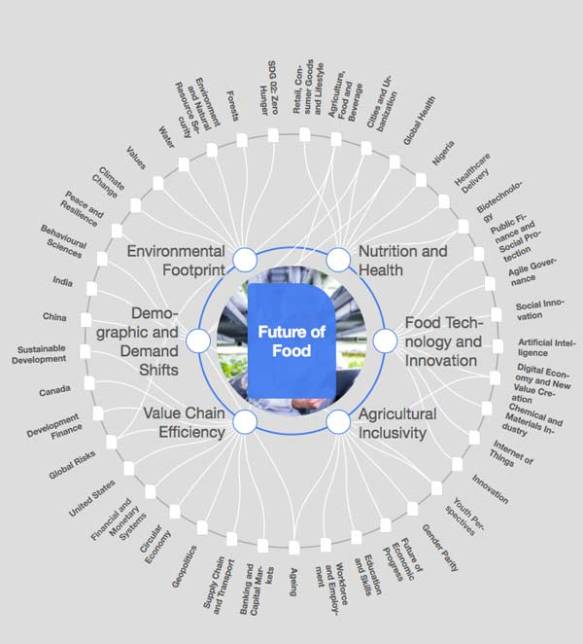
You can get a feel for where the future of food is headed by analyzing the World Economic Forum’s strategic intelligence map.19 As you can see, this top-down approach ties food production to a wide range of sectors, including biotech, the chemical industry, artificial intelligence, the internet of things and the digital economy.

For more details on Schwab and the World Economic Forum’s strategic intelligence plan, see Covert Geopolitic’s article,20 “Breaking Down the Global Elite’s Great Reset Master Plan.”
If any of this raises your concern, you’re probably not going to like what the World Health Economic Forum has in store for health care reform either. As detailed on their website:21

“Our current capital intensive, hospital-centric model is unsustainable and ineffective. The Platform for Shaping the Future of Health and Healthcare leverages a data-enabled delivery system and virtual care, integrated across the continuum of care from precision prevention to personalized care delivery …”

Aiding the World Economic Forum in this health care transformation are the biggest corporate criminals in the history of the modern world, including Bill Gates, AstraZeneca,22 Bayer,23 Johnson & Johnson,24 Merck,25 Pfizer,26 Novartis27 and a host of others.28

These companies have at various times been found guilty of all sorts of crimes that they have paid tens of billions of dollars in fines for. They are also loaded with conflicts of interest in nearly every venture they are involved with. Yet we’re now supposed to believe these companies are going to put aside their profit incentives and fix the whole system?

Build Back Better

As noted in a July 21, 2020, World Economic Forum article,29 the economic devastation caused by COVID-19 pandemic shutdowns “has the potential to hobble global prosperity for generations to come.” The answer is to come up with stimulus measures, such as infrastructure development, that can allow countries to move forward.

But while at it, countries are urged to make sure the economic system is “built back better.” Make no mistake, this catchy slogan is part and parcel of the Great Reset plan and cannot be separated from it, no matter how altruistic it may sound. As reported by Fox News:30

“A radical movement called the Great Reset embraced by some Democrats poses a grave threat to liberty and free markets in the United States and around the world … The Great Reset is perhaps the biggest danger to capitalism and individual rights since the collapse of the Soviet Union …

It would destroy the current capitalist system and replace it with progressive and modern socialist systems, with a special emphasis placed on eco-socialist policies … Policy ideas offered by ‘Great Reset’ advocates include government-provided basic income programs, universal health care, massive tax increases and the Green New Deal …

For example, at a campaign event on July 9, Biden said we need to end the ‘era of shareholder capitalism,’ a major part of the Great Reset proposal that would alter how companies are evaluated, elevating social justice causes and climate change concerns over property rights …

The Build Back Better plan comes straight from the Great Reset’s playbook … As recently as July 13, the World Economic Forum promoted ‘building back better’ through ‘green’ infrastructure programs as part of the Great Reset …”

Part of the “building back better” is to shift the financial system over to an all-digital currency system, which in turn is part of the system of social control, as it can easily be used to incentivize desired behaviors and discourage undesired ones.

An August 13, 2020, article31 on the Federal Reserve website discusses the supposed benefits of a central bank digital currency (CBDC). There’s general agreement among experts that most major countries will implement CBDC within the next two to four years.

Many uninformed people believe that these new CBDCs will be very similar to existing cryptocurrencies like Bitcoin, but they would be mistaken. Bitcoin is decentralized and a rational strategy to opt out of the existing central bank controlled system, while these CBDCs will be centralized and completely controlled by the central banks and will have smart contracts that allow the banks to surveil and control your life.

The Great Reset Psyops Guide

It goes without saying that to achieve the kind of radical transformation of every part of society has its challenges. No person in their right mind would agree to it if aware of the details of the whole plan. So, to roll this out, they had to use psychological manipulation, and fear is the most effective tool there is.

As explained by psychiatrist Dr. Peter Breggin, there’s an entire school of public health research that focuses on identifying the most effective ways to frighten people into accepting desired public health measures.

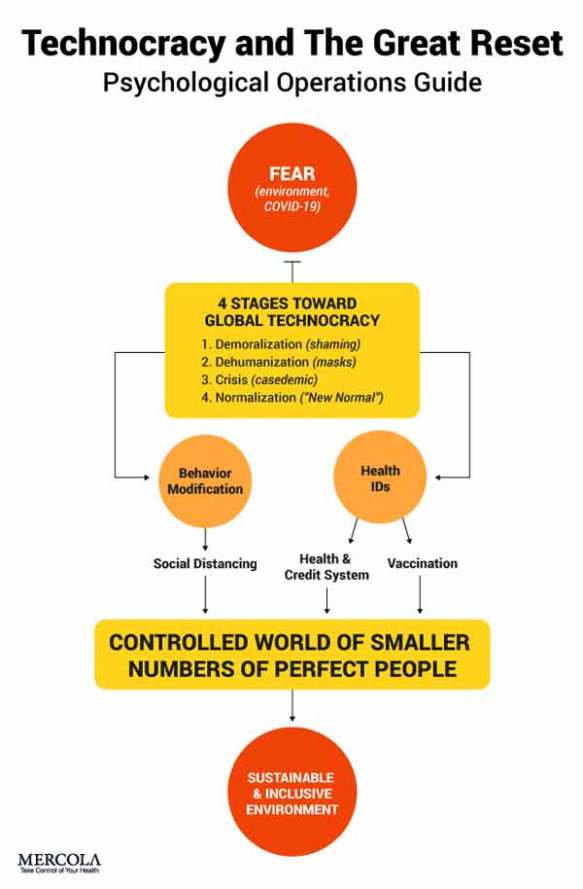
By adding confusion and uncertainty to the mix, you can bring an individual from fear to anxiety — a state of confusion in which you can no longer think logically — and in this state, you are more easily manipulated. The following graphic illustrates the central role of fearmongering for the successful rollout of the Great Reset.
Social Engineering Is Central to Technocratic Rule

In closing, keep in mind that technocracy is inherently a technological society run through social engineering. Fear is but one manipulation tool. The focus on “science” is another. Anytime someone dissents, they’re simply accused of being “anti-science,” and any science that conflicts with the status quo is declared “debunked science.”

The only science that matters is whatever the technocrats deem to be true, no matter how much evidence there is against it. We’ve seen this first hand during this pandemic, as Big Tech has censored and banned anything going against the opinions of the World Health Organization, which is just another cog in the technocratic machine.

If we allow this censorship to continue, the end result will be nothing short of devastating. We simply must keep pushing for transparency and truth. We must insist on medical freedom, personal liberty and the right to privacy.

One fight in particular that I don’t see us being able to evade is the fight against mandatory COVID-19 vaccinations. If we don’t take a firm stand against that and fight for the right to make our own choice, there will be no end to the medical tyranny that will follow. As noted in the Covert Geopolitics article:32

“As you might have guessed, ‘the most important anchor of recovery’ is for a COVID-19 vaccination … The implication is that without a vaccine the world will be unable to return to any sense of normality, particularly in terms of open interaction with your fellow man …

You can actually participate in the global efforts to cripple the Deep State organized criminal cabal’s ability for genocide, while enjoying healthcare freedom at the same time, by boycotting Big Pharma for good.”

*

Note to readers: please click the share buttons above or below. Forward this article to your email lists. Crosspost on your blog site, internet forums. etc.

Notes

1 Corbett Report October 16, 2020

2, 20, 32 Geopolitics August 29, 2020

3, 4 Tessa.substack.com October 28, 2020

5, 6 Winter Oak October 5, 2020

7 Time Magazine The Great Reset

8 COVID-19: The Great Reset

9 Steven Guiness September 3, 2020

10, 12, 14, 16, 17, 18 The Defender November 9, 2020

11 Forbes January 5, 2020

13, 28 Weforum.org Partners

15 Eatforum.com The Planetary Health Diet

19 World Economic Forum Strategic Intelligence Map, Future of Food

21 Weforum.org Shaping the Future and Health of Healthcare

22 Nordic Life Sciences October 14, 2014

23 Newspunch March 20, 2019

24 CBS News August 27, 2019

25 ABC.net.au August 20, 2005

26 Lawyers and Settlements Pfizer found guilty of Medicaid fraud

27 Medical Xpress July 2, 2020

29 World Economic Forum July 21, 2020

30 Fox News July 23, 2020

31 Federal Reserve August 13, 2020

Welcome To The Interregnum

Your unease has a name: Zozobra

By Chris Martensen

Source: Peak Prosperity

We’re between things.  It’s an uncomfortable place.

We are transitioning from an old story into a new one and that has folks feeling anxious.   By “we” I mean everyone on the planet.  If you find yourself with a deep sense of unease, yet unable to quite pin it down, you will find this article extremely helpful.

The old story of endless growth on a finite planet is winding down.  Whatever replaces it won’t be a continuation of the past.  Things are going to have to change, whether we like it or not.

Put more bluntly: the easy times are over, and a period of disruption has begun.

It may be many years or even decades before thing truly settle into a new equilibrium (of sorts – there really isn’t any such thing in this ever-changing universe).  The old will fall away even before the new has arrived. That process has already begun, hence the nervousness, anger, and fear.

My day job is serving as an information scout, an ambassador of the unknown, and because of that I’m acutely aware of the degree to which people are already worn down, burnt out, and unable to process any more.

Folks are so exhausted by the trials and tribulations dished up by the crazy-making machine fondly referred to as “2020,” that many are paralyzed.  Unable to take new actions because they are overwhelmed.

Yet, as I wrote recently, no choice IS a choice.  When so much is changing and so much is on the line, remaining frozen with anxiety is as much a determinant of your future prospects as taking swift action – each sets one down different paths promising different outcomes.

Truthfully, there is much that can be done that will contribute to a more resilient future for yourself and for the world.  But first we have to know where we are.  We have to sketch out the map as best we can, even if the edges remain blanks with little more than “there be monsters” scribed at the borders.

To orient properly, you must be aware of the idea that the Age of Growth is over.  We are now entering a Post-Growth era. Our task now is to settle into a very different existence – one with fewer ‘things’ and less ‘stuff’, but also offering more meaning and worthy challenges.

Like any good adventure, a little danger is involved.  But nothing quite so dangerous to your soul’s journey as wasting your life on trivial pursuits.

The Interregnum

The gap between reigns when the old king has died but the new successor has yet to be decided is called an interregnum.  It can also refer to the gap between first learning of something and then finally understanding its deeper significance:

in·ter·reg·num, noun

a period when normal government is suspended, especially between successive reigns or regimes.

– an interval or pause between two periods of office or other things. “the interregnum between the discovery of radioactivity and its detailed understanding”

I love this word because it perfectly matches our current state.

One feature of an interregnum, where power hangs in the balance, is that it’s a very uncertain time.  Anxiety rules the day because nobody knows how things might land.  It could be good for them personally, or very bad.  The old king was good.  His successor son is an already hated petty tyrant.  Perhaps a different, better successor will somehow manage to claim the throne instead…

This sort of uncertainty is a potent source of anxiety. Which is why an interregnum is the cradle of people’s most deep-seated fears.

The old king is gone.  Nobody knows who or what is in charge right now.  Is it humanity’s deep technological prowess or is it Mother Nature herself?

Does our destiny lie in our own hands or have the die already been cast and we’re simply awaiting to see how unfortunate of a roll it’s going to be?

Is there still time to sort out a decent solution to our many predicaments and problems, or have those moments already been wasted?

Nobody knows at this moment.  But the uncertainty is hanging thick.  Corrosive.  Emotional.  Explosive.

Welcome to the interregnum.  May the odds ever be in your favor.

Demoralization

Now while the above may sound depressing, as I’ve written before the better term is demoralizing, and there’s a very important distinction between the two terms.

Depression is a reaction to current circumstances. It can be treated with talk therapy to resolve an inner conflict, or temporary chemical rebalancing.

Demoralization, on the other hand, is what you experience when your cognitive map no longer aligns with the actual circumstances of life:

Rather than a depressive disorder, demoralization is a type of existential disorder associated with the breakdown of a person’s ‘cognitive map’. It is an overarching psycho-spiritual crisis in which victims feel generally disoriented and unable to locate meaning, purpose or sources of need fulfilment.

The world loses its credibility, and former beliefs and convictions dissolve into doubt, uncertainty and loss of direction.

Frustration, anger and bitterness are usual accompaniments, as well as an underlying sense of being part of a lost cause or losing battle. The label ‘existential depression’ is not appropriate since, unlike most forms of depression, demoralization is a realistic response to the circumstances impinging on the person’s life.

(Source)

Did you catch that? Demoralization is actually a realistic response under certain conditions.

Those conditions are manifesting themselves now. Which means that the waves of dispiriting statistics we’re seeing are not ‘bad’; they are telling us something important.

People are right to be deeply disturbed by the ways in which the main narrative of their culture no longer maps to reality.  Worse, the Endless Growth narrative is killing life on this planet and therefore harming each of us in ways both overt and subtle.

More and more people are detecting that, and that’s a good thing. Because that’s the necessary first step in crafting a new narrative and adopting a different model that hopefully serves us better.

We often say here at Peak Prosperity that if you’re feeling anxiety (or demoralization), it means that there’s a gap between what you know and what you’re doing.  Since you can’t unlearn something, your best course of action is to change your behavior.

To take action to better align what you know with what you do.

I totally get the frustration, anger and bitterness on display in politics all across the West right now, but these are almost universally misdirected at the wrong targets.  Whether by intent or accident, this is usually the case and heavily supported by a media system that actually promotes divisiveness over unity, and isolation over connection.

(Source – PeakProsperity – The End of Growth)

Bottom line: If you are demoralized there’s nothing wrong with you.  But there is definitely something wrong with the larger situation.

If you know someone who is demoralized, don’t try to ‘fix’ them by helping them fit back into their old lives better.  The problem isn’t with their ability to adapt.  The problem is they are already adapting to what is coming.  They’re ahead of the curve, not behind it.  They just see the new curve before you do.

With that critical framing for the word demoralization, we can now go a bit deeper.  But first, I want to introduce an important term relating to demoralization: Zozobra.  It describes a potent sensation one might experience during an interregnum, especially if demoralization is in play.

Zozobra

I came across this article very recently and have now read it a few times. It’s pitch perfect.

It neatly captures the context of demoralization.  By naming it we can begin to understand it, know its presence, and reduce its unconscious hold on us:

There’s a word for your overwhelming anxiety, and it’s “zozobra”

Nov 3rd, 2020

Ever had the feeling that you can’t make sense of what’s happening? One moment everything seems normal, then suddenly the frame shifts to reveal a world on fire, struggling with pandemic, recession, climate change, and political upheaval.

That’s “zozobra,” the peculiar form of anxiety that comes from being unable to settle into a single point of view, leaving you with questions like: Is it a lovely autumn day, or an alarming moment of converging historical catastrophes?

The word “zozobra” is an ordinary Spanish term for “anxiety” but with connotations that call to mind the wobbling of a ship about to capsize. The term emerged as a key concept among Mexican intellectuals in the early 20th century to describe the sense of having no stable ground and feeling out of place in the world.

This feeling of zozobra is commonly experienced by people who visit or immigrate to a foreign country: the rhythms of life, the way people interact, everything just seems “off” – unfamiliar, disorienting and vaguely alienating.

According to the philosopher Emilio Uranga (1921-1988), the telltale sign of zozobra is wobbling and toggling between perspectives, being unable to relax into a single framework to make sense of things. As Uranga describes it in his 1952 book “Analysis of Mexican Being”:

“Zozobra refers to a mode of being that incessantly oscillates between two possibilities, between two affects, without knowing which one of those to depend on … indiscriminately dismissing one extreme in favor of the other. In this to and fro the soul suffers, it feels torn and wounded.”

What makes zozobra so difficult to address is that its source is intangible. It is a soul-sickness not caused by any personal failing, nor by any of the particular events that we can point to.

Instead, it comes from cracks in the frameworks of meaning that we rely on to make sense of our world — the shared understanding of what is real and who is trustworthy, what risks we face and how to meet them, what basic decency requires of us and what ideals our nation aspires to.

(Source)

What ‘cracks in the framework of meaning’ could be more profound than facing the collapse of – well – everything?  Our many predicaments exist at all levels from top to bottom.  There’s no safe level on which to ride out the coming storm.  There’s nowhere to run.  There’s only right where you are.

When everything seems “off” – unfamiliar, disorienting and vaguely alienating, then you’re in some sort of foreign land.  You are out of bounds, off all of your known maps.  There’s no sense of place, nowhere to settle down. Zozobra.

When everything is wobbling and up for grabs, you wouldn’t be entirely human if you weren’t experiencing some sort of emotional unease.  AS with the adjustment reaction, an emotional arc is simply a part of the process.  Both unavoidable and necessary.

Those who navigate uncertainty best are those who process the quickest.  As always, having a good mental map, and the right terms, is helpful to that process.

Conclusion

If you are feeling nervous, angry or fearful – congratulations! – there’s nothing at all wrong with you.  In fact, your senses are operating normally, and your cognition is on the mark.  You are having an adjustment reaction, your cognitive map has a better grasp on reality than your culture, and zozobra is par for the course.

The most valuable part of naming and understanding these things is that they lose their ability to paralyze you with dread.

Our emotions are not “the truth”, but rather uncomfortable sensations that serve as an early warning system.  They are like a quantum processor able to parse through massively complex systems and situations way before our cortex can offer any guidance.

There’s also a comfort – a relief – that comes from understanding that our reactions are both perfectly normal and perfectly healthy.

There’s nothing that requires treatment. Nothing that requires medication. Nothing at all to be done about any of it.  Except knowing what it is, getting past whatever paralysis might exist as rapidly as possible, and then taking action.

Because you alone can’t alter the larger trends of ecological destruction, monetary printing, insane political responses, etc. and so forth, all that truly remains is for you to align your actions with what you know to be true.

And there’s so much to be done.  Soils need to be rebuilt.  Waste streams reformed into nutrient loops.  Energy efficiency to be built into the next generation of – everything.

The lists are as endless as they are exciting. And you can play a role, both at the individual level as well as contributing positively at the collective one.

Yes, there’s a “great reset” coming.  Whether it will be controlled and precise or a nature-driven chaotic mess remains to be seen.

But right now, you need to make a choice: You can either actively shape your future or wait to be shaped by it.

I’m all about controlling what I can and leaving the rest behind.  Maybe you are, too.

If so, then you’re part of our tribe here at Peak Prosperity.  We’re busying preparing for what is increasingly likely to consist of more macro chaos than control.

You know, to avoid being demoralized with an overwhelming sense of zozobra during this interregnum.

Why Do Most People Believe Propaganda and False Flag Attacks?

By Robert J. Burrowes

In his 1995 book The Demon-Haunted World Carl Sagan lamented as follows:

I have a foreboding of [a] time when… awesome technological powers are in the hands of a very few, and no one representing the public interest can even grasp the issues; when the people have lost the ability to set their own agendas or knowledgeably question those in authority; when, clutching our crystals and nervously consulting our horoscopes, our critical faculties in decline, unable to distinguish between what feels good and what’s true, we slide, almost without noticing, back into superstition and darkness.

The dumbing down… is most evident in the slow decay of substantive content in the enormously influential media… but especially a kind of celebration of ignorance…. The plain lesson is that study and learning – not just of science, but of anything – are avoidable, even undesirable.

We’ve arranged a global civilization in which most crucial elements… profoundly depend on science and technology. We have also arranged things so that almost no one understands science and technology. This is a prescription for disaster. We might get away with it for a while, but sooner or later this combustible mixture of ignorance and power is going to blow up in our faces. See The Demon-Haunted World: Science as a Candle in the Dark.

While it is 25 years since these words of Sagan’s were published a year before his death, one can only lament the ongoing decline of what might simply be labeled the capacity for critical thinking, whether in relation to society and politics, or the science and technology that so concerned Sagan.

At a time in human history when so much is at stake, why is it so difficult to engage most people in anything resembling a thoughtful investigation, consideration and analysis of what is taking place? Why is it that more people do not question what they are told, what they read and what they are shown? In short, why is it that most people do not seek out the evidence for themselves rather than simply believing what is presented to them?

In one sense, the answer to this question might seem simple. People are daily bombarded with ‘information’, in various guises, and a lifetime of submissively accepting what they are told leaves few with any inclination, or energy, to question anything. But let me offer a fuller explanation given the critical importance of this issue if we are to mobilize an effective response to the challenges confronting humanity.

So first: What is propaganda? A false flag attack? Why do most people simply believe what they are told without investigating, carefully, for themselves? And why are those who challenge the elite-driven narrative often labeled ‘conspiracy theorists’ or, depending on the issue, some other pejorative such as ‘peddling debunked science’, ‘anti-vaxxer’ or ‘anti-semitic’ for example?

What is Propaganda?

Propaganda is the deliberate and systematic effort, using a variety of means, to manipulate people into believing and behaving in accordance with something that is not true. For one comprehensive explanation of how this is done, see Trust Us, We’re Experts! How Industry Manipulates Science and Gambles with Your Future, a book which Robert F. Kennedy Jr. observes ‘shows how giant corporations employ sophisticated psychiatric techniques, unscrupulous public figures, junk science, tainted studies and clever PR mercenaries in a relentless effort to market products that routinely kill, maim, deform and poison consumers and our environment’. See ‘Trust Us, We’re Experts!: How Industry Manipulates Science and Gambles with Your Future’.

While some people argue that propaganda can be used for good, the fact is that something that is simply true should appeal to people anyway, even if it is unpleasant. This is because the truth is the only powerful place from which to start to address any circumstance, including unpleasant and difficult ones.

Propaganda is delivered by a variety of means. Aside from that issued, in various ways, by governments and corporations, propaganda is delivered by education systems as ‘knowledge’, by the corporate media as ‘news’ and by the entertainment industry as films, television programs, video games, music, literature and in other forms. But all propaganda is designed to instill and reinforce a limited set of fears, approved beliefs and endorsed behaviours so that the ‘individual’ responds submissively within the carefully managed system of elite political, social and economic control.

For example, education is designed to teach the individual a limited range of technical functions intended to help create, maintain but essentially serve the emerging technocratic tyranny (as it supersedes the existing version of industrial capitalism), make the individual a passive consumer and politically submissive, while ensuring that an intelligent mind capable of seeking out relevant evidence for themselves, critiquing society and responding powerfully does not develop. See ‘Do We Want School or Education?’

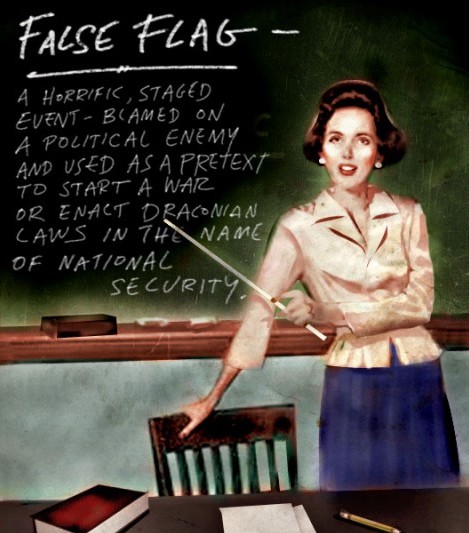
What is a False Flag Attack?

A false flag attack occurs when a government carries out a terror attack against its own population and then falsely blames an enemy to justify a political course of action, such as going to war against the country or countries it blames. While, again, those who question false flag attacks are often denounced by elite propagandists as ‘conspiracy theorists’, in fact the documentation of false flag attacks that have later been admitted is quite long. For one list, see ‘53 Admitted False Flag Attacks’. Of course, plenty of false flag attacks have not been admitted, even when the evidence is overwhelming, as in the case of 9/11 for example.

So Why Do Most People Believe Propaganda?

In an early book on propaganda written in 1928 by Sigmund Freud’s nephew, Edward Bernays, he opened with this paragraph:

The conscious and intelligent manipulation of the organized habits and opinions of the masses is an

important element in democratic society. Those who manipulate this unseen mechanism of society constitute an invisible government which is the true ruling power of our country. See Propaganda.

As Bernays makes clear from the outset, his preoccupation is the manipulation of people to do the bidding of others: clearly, a debased and cynical view of the human individual on which many of humanity’s less morally committed characters have capitalized since Bernays wrote the book.

For example, Joseph Goebbels, Nazi Minister of Propaganda from 1933 to 1945 and an avid reader of Bernays’ work, observed that ‘Propaganda works best when those who are being manipulated are confident they are acting on their own free will.’

But to understand why the approach of Bernays and his disciples such as Goebbels even works, we need to consider why it is that most people are so gullible in the first place. Why don’t more people ask deeper questions about what is taking place rather than simply accepting, without serious question, whatever is presented to them (whether by parents, teachers, religious figures, doctors, propagandists, marketing agents, governments or the corporate media)?

The fundamental problem is simply this: parents, teachers, religious figures and other significant adults in the child’s life require obedience. And obedience means that the child not only behaves as directed by the adult but also that the child believes what the adult believes. This latter point is easily overlooked but is actually the key issue. Why? Because a child who does not believe what the adult believes might think and behave in a way that scares the adult. And demanding obedience is essentially about eliminating beliefs (and their consequent behaviours) that would frighten the parent, teacher or other adult.

Parents require obedience virtually from the moment of birth, doing everything from comforting a child to stop them crying – see ‘Comforting a Baby is Violent’ – to punishing them for acting contrary to parental will once they start moving independently. Of course, once the child starts to think or believe differently, especially if this ‘difference’ is too far from a belief of the child’s parents, teachers or religious leaders (or a widely-accepted belief within their society), the child is quickly pulled back into line with some combination of inducements and/or violence. See ‘Punishment is Violent and Counterproductive’.

Despite legal conventions meaninglessly affirming versions of it – such as the Universal Declaration of Human Rights Article 18 declaring ‘Everyone has the right to freedom of thought…’ – the freedom to think for oneself is not a human right in any meaningful sense of the term and, even if it were, it would really only mean the freedom to think for oneself within certain clearly defined and narrow parameters. And only if you are an adult.

This is why, for example, a child who decides not to go to school does not emerge. Such a possibility would be frightening to virtually every parent, so no child is given that option, let alone allowed the opportunity to come up with, consider and act on that option for themself. Why? Because attendance at school, wherever it exists, is legally compulsory (meaning punishment will be inflicted for failure to comply), and only the rarest parent has the vaguest concept of freedom themselves, let alone the courage to defend their child’s freedom, including the freedom to choose how they spend the bulk of their time for the 8-13 years of ‘school age’.

Consequently, the freedom to think for oneself and act accordingly is strangled at a very young age and certainly by the time a child is compelled to attend a prison for children, also known as ‘school’. As a result the child’s concept of freedom, should they ever come across the notion, can only be a parody of the real thing. And the adult who emerges from this childhood is simply incapable of comprehending what freedom might mean for the obvious reason that to be meaningfully understood, freedom must be experienced.

Of course, is it not just parental authority and school that denies any child the experience of liberty. As Jean-Jacques Rousseau noted in his treatise The Social Contract in 1762, ‘Man is born free; and everywhere he is in chains’. Every institution in society is designed to circumscribe freedom, one way or another. It is just that a childhood spent living under the control of their parents and then teachers and religious figures leaves all children devoid of the experience of freedom and so any subsequent limits are not even noticed. In fact, they are expected and ‘taken for granted’.

So with parents, teachers and religious figures endlessly inflicting ‘visible’, ‘invisible’ and ‘utterly invisible’ violence on the child in the name of ‘socialization’ (which includes requiring obedience under threat of violence for non-compliance), the child progressively and rapidly loses several innate capacities, notably including a sense of their own Self-will, the capacities to think and feel for themselves, as well as conscience. See ‘Why Violence?’ and ‘Fearless Psychology and Fearful Psychology: Principles and Practice’. Anything that is too far from the dominant narrative simply becomes ‘unthinkable’ because the child’s innate capacity to perceive the truth is suppressed along with other mental capacities.

But soon it is not just parents, teachers and religious leaders that are the accepted ‘authority figures’ in the child’s life. No longer able to seriously question the imperatives of parents, teachers and religious figures because they have been terrorized out of doing so, the child has also unconsciously ‘learned’ that virtually any information with which they are presented must be true, even when the source is simply a government or corporate media outlet presenting elite propaganda. For the vast bulk of adult humans, the idea of questioning a dominant narrative does not even occur to them and it is certainly not something they can do with any intelligence, persistent research effort or courage.

So just as Hitler, ably supported by his Propaganda Minister Joseph Goebbels, was able to direct most Germans prior to and into World War II, it is quite straightforward for the global elite to be able to direct the bulk of the human population to believe, for example, that President John F. Kennedy was assassinated by the ‘lone gunman’ Lee Harvey Oswald, that the ‘Gulf of Tonkin incident’ justified the United States war on Vietnam, that a ‘virus’ labeled HIV caused a ‘disease’ labeled AIDS, that the three buildings 1,2 and 7 of the World Trade Center were destroyed by two aircraft flown by novice pilots into the top stories of the Twin Towers and justified the subsequently launched US ‘War on Terror’, that a ‘virus’ labeled SARS-Cov-2 exists and causes a ‘disease’ labeled Covid-19 that has justified the destruction of everything from a range of human rights to the global economy while accelerating four distinct paths to human extinction, that we live in a democracy in which each adult has a say in how they are governed, or even that ongoing effort is being made to bring a greater degree of shared prosperity to the people of the world.

For just a taste of the extensive evidence to debunk each of these propaganda-driven delusions, see these respective analyses of what the evidence actually demonstrates: On the Trail of the Assassins: One Man’s Quest to Solve the Murder of President Kennedy, the Pentagon PapersAIDS Inc.: Scandal of the CenturyArchitects & Engineers for 9/11 Truth‘Unmasking the Lies Around COVID-19: Facts vs Fiction of the Coronavirus Pandemic’‘The Elite’s COVID-19 Coup to Destroy Humanity that is also Fast-Tracking Four Paths to Human Extinction’‘America After the Election: A Few Hard Truths About the Things That Won’t Change’ and ‘The Federal Reserve Cartel: The Eight Families’.

In essence: my point is that is it is not the power of the propaganda, increasingly sophisticated though it has become, that makes people believe it, but a ‘socialization’ model designed to produce submissively obedient ‘individuals’ who gullibly interpret what is happening, and even their own ‘experience’, in terms of the information or scenario (that is, propaganda) with which they are presented. And because of the deeply-seated and unconscious fear of holding a divergent view, most people simply believe the widely-promulgated propaganda narrative with which they become familiar and, hence, comfortable. Moreover, those who challenge the elite-driven narrative frighten them, particularly when elite agents in government and the corporate media label them ‘conspiracy theorists’. For one explanation of why the term ‘conspiracy theorist’ emerged to denigrate those who challenge elite orthodoxy, see ‘In defence of conspiracy theories (and why the term is a misnomer)’.

And so this combination of dysfunctional parenting, education and religious exposure leaves the child devoid of their intuitive ‘truth register’ as well as the other mental faculties that would make them question explanations that obviously lack credibility while investigating and analyzing the evidence for themself. In fact, the idea of doing so never even occurs to them. Hence, a terrorized, gullible and easily manipulated individual enters adulthood. And, as the elite intends, galvanizing an effective response by such people to the truth hidden behind the propaganda is very difficult.

Resisting Propaganda

There is no point hoping that the global elite will discontinue their use of propaganda to shape the course of human events. This is largely because the global elite is insane. See ‘The Global Elite is Insane Revisited’. Moreover, attempts to curb the use of propaganda must inevitably run into the institutions and organizations that the elite controls. And while we can strategically resist these if we choose, the most powerful defence we have against elite propaganda is the human mind that can perceive and critique it. Hence, as a priority, I would profoundly alter our parenting model to achieve this outcome. See ‘My Promise to Children’.

If you are uncertain of your own capacity to critique propaganda, you can expand your capacity to do so by feeling the fear (to release it) that limits your mental faculties. See ‘Putting Feelings First’.

If you are interested in planning or participating in a strategy to achieve a peace, environmental or social justice outcome (particularly in relation to those issues that threaten human extinction), or to resist the elite coup currently taking place under cover of Covid-19, you can read sets of strategic goals for doing so in Campaign Strategic Aims or Coup Strategic Aims.

Moreover, if you wish to tackle the environmental threats to human existence while also strengthening your self-reliant capacity to resist the latest elite onslaught to take (much) greater control of your life, consider participating in ‘The Flame Tree Project to Save Life on Earth’. The greater your dependence on elite systems and processes of any kind, the less power you will have to resist as the noose tightens.

If you are interested in participating in the worldwide effort to resist elite and other violence, you are also welcome to sign the online pledge of ‘The People’s Charter to Create a Nonviolent World’.

More simply, if you like, you might consider committing to:

The Earth Pledge

Out of love for the Earth and all of its creatures, and my respect for their needs, from this day onwards I pledge that:

  1. I will listen deeply to children. See ‘Nisteling: The Art of Deep Listening’.
  2. I will not travel by plane
  3. I will not travel by car
  4. I will not eat meat and fish
  5. I will only eat organically/biodynamically grown food
  6. I will minimize the amount of fresh water I use, including by minimizing my ownership and use of electronic devices
  7. I will not own or use a mobile (cell) phone
  8. I will not buy rainforest timber
  9. I will not buy or use single-use plastic, such as bags, bottles, containers, cups and straws
  10. I will not use banks, superannuation (pension) funds or insurance companies that provide any service to corporations involved in fossil fuels, nuclear power and/or weapons
  11. I will not accept employment from, or invest in, any organization that supports or participates in the exploitation of fellow human beings or profits from killing and/or destruction of the biosphere
  12. I will not get news from the corporate media (mainstream newspapers, television, radio, Google, Facebook, Twitter…)
  13. I will make the effort to learn a skill, such as food gardening or sewing, that makes me more self-reliant
  14. I will gently encourage my family and friends to consider signing this pledge.

Conclusion

The world is complex: it is difficult to understand and requires enormous effort.

Propaganda is designed to give people information that is easy to understand (and sometimes frightening) while distracting them from the truth and offering a simple ‘choice’ (or command) designed to mobilize action in support of an elite-driven narrative.

For example, by telling people they are threatened by a virus, most will be scared into focusing their attention on the ‘virus’. They will pay no attention to the many more complex and dangerous things that are taking place under cover of the ‘virus’: a technocratic/transhumanist coup that is utterly transforming the very essence of human society, economy and even the human individual. See ‘Beware the Transhumanists: How “Being Human” is being Re-engineered by the Elite’s Covid-19 Coup’ and ‘Klaus Schwab and His Great Fascist Reset’.

Only a tiny proportion of the human population has even the vaguest idea of how the world actually works. But not even a tiny proportion of these people recognize that terrorizing children into obedience is the fundamental explanation of why the world works in the way that it does.

Unless we can mobilize greater recognition of our responsibility for giving the global elite the control over us that it has, and tackle this problem at its core – by fundamentally revising existing parenting and education models so that we produce powerful individuals – it will continue to be enormously difficult to mobilize sufficient strategic response to the challenges that confront humanity.

And while we are now fast-tracking four distinct paths to human extinction, there is an urgency about our predicament that accelerates daily.


Biodata: Robert J. Burrowes has a lifetime commitment to understanding and ending human violence. He has done extensive research since 1966 in an effort to understand why human beings are violent and has been a nonviolent activist since 1981. He is the author of ‘Why Violence?’ His email address is flametree@riseup.net and his website is here.

Why We’re Doomed: Our Delusional Faith in Incremental Change

By Charles Hugh Smith

Source: Of Two Minds

Better not to risk any radical evolution that might fail, and so failure is thus assured.

When times are good, modest reforms are all that’s needed to maintain the ship’s course. By “good times,” I mean eras of rising prosperity which generate bigger budgets, profits, tax revenues, paychecks, etc., eras characterized by high levels of stability and predictability.

Since stability has been the norm for 75 years, institutions and conventional thinking have both been optimized for incremental change. This is an analog of natural selection in Nature: when the organism’s environment is stable, there’s little pressure to favor random mutations, as these can be risky.

Why risk big changes when everything’s working fine as is?

Absent any big changes in their environment, organisms’ genetic programming remains stable. Unlike natural selection’s process of generating random mutations and testing their efficacy and advantages over the existing programming, human organizations quickly habituate to stable eras by institutionalizing incremental changes as the only available process for reform / change.

Radical reforms are not just frowned on as 1) unneccesary and 2) needlessly risky, there is no institutionalized process to propose, test and adopt radical changes because there is no need for such a process.

Nature has such a process: punctuated equilibirium. When faced with a rapidly changing environment, organisms face intense evolutionary pressure to adapt or die. Mutations which confer a significant advantage in the new environment become part of the species’ genetic programming as those with the adaptation bear offspring who carry the advantageous adaptation. Those without the advantageous adaptation die and those with the adaptation thrive and multiply.

Once the environment stabilizes in “the new normal,” the evolutionary pressure lets up and the species returns to the stability of relatively few changes in its genetic programming.

Organisms which have lost the ability to adapt to rapid change die off once they encounter instability. Species that constantly face instability and rapid change will selectively favor genetic traits which optimize rapid evolution.

Nature tends to retain a basement closet full of fast-evolution tricks just in case the organism faces novel challenges.

Alas, human organizations and conventional thinking have no such closet of fast-evolution tricks. Rather, human organizations and conventional thinking marshal formidable forces to suppress anything which threatens the status quo, because why risk upsetting the feeding trough unless it’s absolutely necessary?

Therein lies the fatal problem: radical adaptation is never absolutely necessary in human organizations and conventional thinking until it’s too late–and even then, the leadership and conventional thinking will fatalistically accept oblivion rather than opt for a risky strategy of testing every mutation and fast-tracking whatever has promise, even though the odds of failure are high since 1) the challenge is novel and therefore unpredictable and 2) most mutations will fail to provide the radical advantages needed to meet the challenge.

In other words, what’s absolutely necessary to human organizations and conventional thinking is the suppression of potentially dangerous novel ideas because the worst-case scenario is that the novel ideas upset the feeding trough all the insiders have come to depend on.

Unfortunately for human organizations and conventional thinking, novel challenges demand precisely what they’re incapable of: risky rapid evolution. The risks will never seem worth it because some insiders might lose their spot at the feeding trough.

Since this loss is viewed as catastrophic by those at risk, they will fight with everything they have to stymie any radical reforms. Ironically, their resistance to rapid evolution only guarantees the demise of the entire organization / status quo, including the spot at the trough they were so eager to defend at all costs.

As the crisis deepens, the default setting in organizations and conventional thinking is that incremental changes and reforms will be enough, because they’ve been enough for four generations. I call this entirely natural default setting the delusional faith in incremental change because this faith isn’t guided by history or the logic of causality; it’s simply convenient and easy.

Nobody gets fired or demoted for agreeing to do more of what’s failed spectacularly.

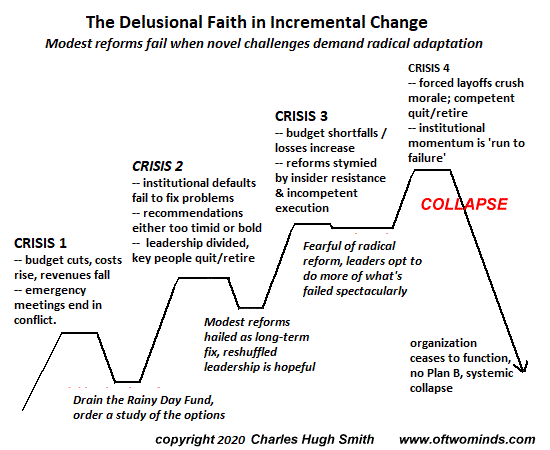
I’ve prepared a chart of the delusional faith in incremental change showing how each new crisis is met by incremental institutionalized defaults that are completely inadequate to the novel challenges that have arisen. The blindness to the need for radical adaption has been institutionalized as well: this is what worked in the past, so it will work nowWhy risk everything when we have procedures that have worked well?

Each stage of the crisis draws whatever conventional response causes the least pain. First, the “rainy day fund” is drained to keep everyone at the feeding trough. Studies of options are funded, and so on.

The recommendations are either too timid and clearly inadequate or they’re too bold and risky. So incremental policy and budget tweaks are adopted as acceptable institutional defaults.

But rifts open in the leadership as the farsighted few demand rapid, radical adaptations and the conventional risk-averse crowd digs in their heels. The farsighted few are pushed out or quit / retire, eliminating the only people who had the ability and experience to actually pull off a radical change of course.

A reshuffling of leadership evokes hope that the modest reforms will work magic. Alas, incremental tweaks only work in eras of stability. They fail miserably in unstable eras of rapidly-evolving challenges.

As everything runs to failure, the only acceptable path is to do more of what’s failed spectacularly, a default to low-risk incrementalism that only accelerates the final inevitable collapse.

The delusional faith in incremental change guarantees systemic failure. Better not to risk any radical evolution that might fail, and so failure is thus assured.

This is why our status quo is doomed:

MORE PEOPLE WERE ARRESTED FOR CANNABIS POSSESSION THAN ALL VIOLENT CRIMES PUT TOGETHER IN THE US LAST YEAR

By John Vibes

Source: Waking Times

With legal recreational and medical cannabis now available in so many different US states, it is easy to get the impression that the war on cannabis users is over.

However, cannabis users still represent a significant portion of the people who are filling jails and courthouses throughout the country.

According to the FBI’s recent Uniform Crime Report, more people were arrested for cannabis possession last year than for all violent crimes put together.

The data showed that 545,602 people were arrested in the US for cannabis-related crimes last year. Meanwhile, just 495,871 people were arrested for violent crimes.

Furthermore, the vast majority of the people who got arrested for cannabis were not accused of selling or trafficking the substance, but just for simple possession. 500,395 of the total cannabis arrests last year, or about 92%, were for possession, which is still more than the number of people who were arrested for violent crimes.

Erik Altieri, the Executive Director for cannabis advocacy group NORML, says that police across America are still making a cannabis-related arrest every 58 seconds.

“At a time when the overwhelming majority of Americans want cannabis to be legal and regulated, it is an outrage that many police departments across the country continue to waste tax dollars and limited law enforcement resources on arresting otherwise law-abiding citizens for simple m***juana possession,” Altieri told Forbes.

Overall, cannabis arrests have been going down nationwide due to the spread of legalization. Last year, cannabis arrests were down by 18% when compared with 2018.

As suspected, the FBI’s data showed that people were less likely to get arrested for cannabis in states where it was legal or available for medical use, with eastern states seeing far more arrests.

According to the report, roughly 53% of all cannabis arrests last year took place in the northeastern part of the country, where cannabis laws are still catching up with the west.

People of color are also at a greater risk of being targeted for cannabis arrests. According to a report from the ACLU, 2018 data showed that people of color were 3.6 times more likely to be arrested for cannabis possession than white people, despite using the substance at the same rates.

In some states that are known to be especially dangerous for people of color, such as Montana or Kentucky, they are close to ten times more likely to be arrested for cannabis. In a few particular US counties, people of color were 50 times more likely to be arrested for cannabis possession.

In some states where cannabis has been legalized, lawmakers are making efforts to introduce pardons for those who previously broke the law.

Earlier this year, Nevada Governor Steve Sisolak introduced a measure that will pardon more than 15,000 people who were convicted for low-level cannabis possession in the state.

The resolution was unanimously approved by the state’s Board of Pardons Commissioners shortly after it was introduced.

In Colorado, lawmakers passed a bill that will allow the state’s governor to unilaterally pardon people with past convictions for possession of up to two ounces.

Ireland: Thoughts on Wildness and Domestication

By Renzo Connors

Source: Anarchists Worldwide

“If I decide to break the chains of domestication, I can only do so because I feel the chains and suffer the effects of domestication on my own skin.” – Alfredo Bonanno

I

While out walking or cycling at night, foxes can always be seen roaming the housing estate. The glow of their eyes in darkness, appearing from dark alleyways suddenly visible under the street lights, they move around without a sound, hardly noticed. These lovely magnificent creatures are the embodiment of wildness. Leviathan towers all around but yet these wild beings live on freely from domestication. The foxes at times live off the scraps and waste that civilization throws away, but long after civilization crumbles these creatures will live on.

These wild beings will live on long after civilization kills itself because they are not dependent on civilization to provide the means of life. They remain wild and undomesticated, still equipped with the knowledge and skills to find food, build shelter, and survive independently for themselves.

The vast majority of humans on the other hand are totally domesticated and dependent on civilization and the vast majority would not be able to survive without shops and machines. Only a tiny percentage of humans that inhabit the earth still live wild, free, and living autonomously. The rest are imprisoned within the concrete and metal structures of techno-industrial society.

Domestication begins from birth, straight away an individual is given a birth certificate and social security number. These will be needed throughout life, to be recognised by whatever state an individual happens to be born into, to go to school, to work, to open a bank account and from there to get loans to buy shit, to get a passport, to register to vote, so the state knows who you are, what taxes you have paid or owe, your credit history: to be controlled and exploited. From birth, through childhood, into adulthood,an individual is moulded and taught how to behave, what is acceptable and what is not; through force and blackmail of collective and religious moralities created by the systems and institutions that make up civilization. The end result: a domesticated and a functional obedient citizen and wage slave.

Everything within the civilized culture is geared towards this. Education, children’s stories, TV shows, movies, books, games, and even songs are all exposure to the social norms and control of civilization. The soul purpose of the individual in civilization is to produce and reproduce the social structures, authoritarian institutions and daily subservience to civilized society. There is little room for escape from behind the computer screens and consumerism.

II

Tenalach
Irish – Used to describe a relationship one has with the land, air and water, a deep connection that one literally hears the Earth sing.

I’ve always felt an affinity and closeness with wild spaces. From childhood, playing in the fields and woodlands, fishing in the lake and swimming in the rivers that were close to the housing estate I grew up in. As a kid taking day trips to the Wicklow mountains seeing all the views, beauty of the trees and plants, rugged valleys, and at times what seems like inhospitable landscape of bog land and cliff drops.

Being in such spaces conjures up and stores feelings within me I wouldnt be able to adequately describe with words. Perhaps they could be described as something spiritual.

The landscape has been left scarred by civilization. Roads built long ago by the British colonists to flush out any hiding rebels, shells and ruins of buildings left over from the dawn of industrialism scattered across the landscape, electrical dams blocking up rivers, TV and radio transmitter masts, bog land robbed and left mutilated to feed industrial “progress”, forests cut down and replaced by animal agriculture and monocrop Sitka tree plantations poisoning the land, and the mass graves from pogroms and genocide of the religious and imperalist conquerers. There isn’t a place left on this island that civilization hasn’t left its mark.

******

In my early 20’s locked up in prison for taking part in the anti-imperialist struggle, I felt these feelings for the wild more intensely.

Not seeing any plants or trees, except the ones I could see from my cell window on the horizon. The urge to walk in grass and sand in my bare feet, wanting to roam in woodland to look up at the sky through the canopy.

For the years spent incarcerated I daydreamed about being in nature, being in the mountains, being by the sea.

After four years with eight months left I was granted temporary release for Christmas.

For the first time outside the concrete walls, iron bars and razor wire of prison there was only one thing I really wanted to do and that was to go to the ocean.

The beach was a short walk from where I was staying. To get there I’d first have to walk through a park. As I walked, even though it was winter there was still a lot of colour. A lot of the big tall trees in the park are evergreen trees so they still had their colour. Going through the park my head and eyes were darting around taking in the landscape, walking under the tall trees, their canopy blocking out the sky. It was an amazing feeling being hit in the face with so many different colours, different shades of green.

Sensory stimulation from the sounds of flowing water making its way down streams, birds chirping and singing, the wind blowing long grass and branches, colors of the landscape and the various shades of browns and greens of foliage was almost overwhelming to the senses.

When I reached the beach I walked for a little bit and then sat on a sand dune for about two hours looking out into the vast ocean of green, reflecting in my thoughts and finding some solace in my mind.

Are these feelings that rush around my mind and body urging me wildness, the inner primal anarchic instinct buried by years of domestication?

Or are they an individual desire and love within me for the wild?

37 Tips For Navigating A Society That Is Full Of Propaganda And Manipulation

By Caitlin Johnstone

Source: Axis of Logic

For as long as there has been human language, humans have been using it to manipulate one another. The fact that it is possible to skillfully weave a collection of symbolic mouth noises together in such a way as to extract favors, concessions, votes and consent from other humans has made manipulation so common that it now pervades our society from top to bottom, from personal relationships between two people to international relationships between government agencies and the public.

This has made it very difficult to figure out what’s going on, both in our lives and in the world. Here are some tips for navigating this complex manipulation-laden landscape, whether that be the manipulations you may encounter in your small-scale personal interactions or the large-scale manipulations which impact the entire world:

1 — Understand the fact that humans are storytelling animals, and that whoever controls the stories controls the humans. Mental narrative dominates human consciousness; thought is essentially one continuous, churning monologue about the self and what it reckons is going on in its world, and that monologue is composed entirely of mental stories. These stories can and will be manipulated, on an individual scale by people we encounter and on a mass scale by skillful propagandists. We base our actions on our mental assessments of what’s going on in the world, and those mental assessments can be manipulated by narrative control.

2 — Be humble and open enough to know that you can be fooled. Your cognitive wiring is susceptible to the same hacks as everyone else, and manipulators of all sorts are always looking to exploit those vulnerabilities. It’s not shameful to be deceived, it’s shameful to deceive people. Don’t let shame and cognitive dissonance keep you compartmentalized away from considering the possibility that you’ve been duped in some way.

3 — Watch people’s behavior and ignore the stories they tell about their behavior. This applies to people in your life, to politicians, and to governments. Narratives can be easily manipulated and distorted in many different ways, while behavior itself, when examined with as much objectivity as possible, cannot be. Pay attention to behavior in this way and eventually you’ll start noticing a large gap between what some people’s actions say and what their words say. Those people are the manipulators. Distrust them.

4 — Be suspicious of people who keep telling you what they are and how they are, because they’re trying to manipulate your narrative about them. Be doubly suspicious of people who keep telling you what you are and how you are, because they’re trying to manipulate your narrative about you.

5 — Learn to see how trust and sympathy are used by manipulators to trick people into subscribing to their narratives about what’s going on. Every manipulator uses trust and/or sympathy as a primer for their manipulations, because if you don’t have trust or sympathy for them, you’re not going to mentally subscribe to their stories. This is true of mass media outlets, it’s true of State Department press releases which implore you to have sympathy for the people of Nation X, and it’s true of family members and coworkers. Once you’ve spotted a manipulator, your task is to kill off all of your sympathy for them and your trust in them, no matter how hard they start playing the victim to suck you back in.

6 — Be suspicious of anyone who refuses to articulate themselves clearly. Word salading is a tactic notoriously used by abusive narcissists, because it keeps the victim confused and unable to figure out what’s going on. If they can’t get a clear handle on what the manipulative abuser is saying, they can’t form their own solid position in relation to it, and the abuser knows this. Insist on lucid communication, and if it’s refused to you, remove trust and sympathy. Apply this to people in your life, to government officials, and to 8chan propaganda constructs.

7 — Familiarize yourself with cognitive biases, the glitches in human cognition which cause us to perceive things in a way that is not rational. Pay special attention to confirmation bias, the backfire effect, and the illusory truth effect. Humans have an annoying tendency to seek out cognitive ease in their information-gathering and avoid cognitive dissonance, rather than seeking out what’s true regardless of whether it brings us cognitive ease or dissonance. This means we tend to choose what we believe based on whether believing it is psychologically comfortable, rather than whether it’s solidly backed by facts and evidence. This is a weakness in our cognitive wiring, and manipulators can and do exploit it constantly. And, again, be humble enough to know that this means you.

8 — Trust your own understanding above anyone else’s. It might not be perfect, but it’s a damn sight better than letting your understanding be controlled by narrative managers and dopey partisan groupthink, or by literally anyone else in a narrative landscape that is saturated with propaganda and manipulation. You won’t get everything right, but betting on your own understanding is the very safest bet on the table. It can be intimidating to stand alone and sort out the true from the false by yourself on an instance-by-instance basis, but the alternative is giving someone else authority over your understanding of the world. Abdicating your responsibility to come to a clear understanding of what’s going on in your world is a shameful, cowardly thing to do. Be brave enough to insist that you are right until such time as you yourself come to your own understanding that you were wrong.

9 — Understand that propaganda is the single most overlooked and under-appreciated aspect of our society. Everyone’s constantly talking about what’s wrong with the world, but hardly any of those discussions are centered around the fact that the public been manipulated into supporting the creation and continuation of those problems by mass media propaganda. The fact that powerful people are constantly manipulating the way we think, act and vote should be at the forefront of everyone’s awareness, not relegated to occasional discussions in fringe circles.

10 — Respect the fact that the science of modern propaganda has been in research and development for over a century. Think of all the military advancements that have been made in the last century to get an idea of how sophisticated this science must now be. They are far, far ahead of us in terms of research and understanding of the methods of manipulating the human psyche toward ends which benefit the powerful. If you ever doubt that the narrative managers could be advanced and cunning enough to pull off a given manipulation, you can lay that particular doubt to rest. Don’t underestimate them.

11 — Understand that western mass media propaganda rarely consists of full, outright lies. At most, such outlets will credulously publish the things that are told to them by government agencies which lie all the time. More often, the deception comes in the form of distortions, half-truths, and omissions. Pay more attention to discrepancies in things that are covered versus things that aren’t, and to what they’re not saying.

12 — Put effort into developing a good news-sense, a sense for what’s newsworthy and what’s not. This takes time and practice, but it lets you see which newsworthy stories are going unreported by the mass media and which non-stories are being overblown to shape an establishment-friendly narrative. When you’ve got that nailed down, you’ll notice “Why are they acting like this is a news story?” and “Why is nobody reporting this??” stories all the time.

13 — Be patient and compassionate with yourself when it comes to developing your narrative navigating skills. Like literally any skill set, you’ll suck at it for a while. If you learn you’ve been wrong about something, just take in the new information, adjust appropriately, and keep plugging away. Don’t expect to have mastered this thing before you’ve had time to master it. Like anything else, if you put in the hours you’ll get good at it.

14 — Find reliable news reporters who have a good sense for navigating the narrative matrix, and keep track of them to orient yourself and stay on top of what’s going on. Use individual reporters, not outlets; no outlet is 100 percent solid, but some reporters are pretty close on some specific subjects. Click this hyperlink for an article on one way to do build a customized and reliable news stream. Click this hyperlink for a list of all my favorite news reporters on Twitter right now.

15 — Don’t let paranoia be your primary or only tool for navigating the narrative matrix. Some people’s only means of understanding the world is to become intensely suspicious of everything and everyone, which is about as useful as a compass which tells you that every direction is north. Spend time in conspiracy and media criticism circles and you’ll run into many such people. Rejecting everything as false leaves you with nothing as true. Find positive tools for learning what’s true.

16 — Hold your worldview loosely enough that you can change it at any time in the light of new information, but not so loosely that it can be slapped out of your head by someone telling you what to think in a confident, authoritative tone. As Carl Sagan once said, “It pays to keep an open mind, but not so open your brains fall out.”

17 — Speaking of confident, authoritative tones, be suspicious of confident, authoritative tones. It’s amazing how much traction people can get with a narrative just by posturing as though they know that what they’re saying is true, whether they’re an MSNBC pundit or a popular conspiracy Youtuber. So many people are just plain faking it, because it works. You run into this all the time in debates on online political forums; people come at you with a supremely confident posture, but if you push them to present their knowledge on the subject and the strength of their arguments, there’s not actually anything there. They’re just accustomed to people assuming they know what they’re talking about and leaving their claims unchallenged, and it completely throws them off when someone doesn’t buy their feigned confidence shtick.

18 — Be aware that sociopaths exist. There are people who, to varying degrees, do not care what happens to others, and these are the types of people who will use manipulation to get their way whenever it serves them. If you don’t care about truth or other people beyond the extent to which you can use them, then there’s no disincentive to manipulating.

19 — Be aware of projection, and be aware of the fact that it cuts both ways: unhealthy people tend to project their wickedness onto others, while healthy people tend to project their goodness. Don’t let your goodness trick you into thinking there aren’t monsters who will deceive and manipulate you, and don’t let sociopaths project their own sinister motives onto you by telling you how rotten you are. This mixes a lot of good people up, especially in their personal lives. Not everyone is good, and not everyone is truthful. See this clearly.

20 — Be suspicious of those who excessively advocate civility, rules and politeness. Manipulators thrive on rules and civility, because they know how to manipulate them. Someone who’s willing to color outside the lines and get angry at someone noxious even when they’re acting within the rules makes a manipulator very uncomfortable. Often times those telling you to calm down and behave yourself when you are rightfully upset are manipulators who have a vested interest in getting you to adhere to the rules set they’ve learned to operate within.

21 — Meditation, mindfulness, self-inquiry and other practices are powerful tools which can help you understand your own inner processes, which in turn helps you understand how manipulators can manipulate you, and how they manipulate others. Just be sure that you are using them for this purpose, not for escapism as most “spiritual” types do. You’re trying to become fully aware of what makes you tick mentally, emotionally and energetically; you’re not trying to become some vapid spiritual bliss bunny. The goal isn’t to feel better, the goal is to get better at feeling. Better at consciously experiencing your own inner world.

22 — Be relentlessly honest with yourself about your own inner narratives and the various ways you engage in manipulation. You can’t navigate your way through the narrative control matrix if you aren’t clear on your own role in it. Look inside and consciously take an inventory.

23 — Understand that truth doesn’t generally move in a way that is pleasing to the ego, i.e. in a way Hollywood scripts are written to appeal to. Any narrative that points to a Hollywood ending where the bad guy gets karate kicked into lava and the hero gets the girl is manufactured. Russiagate and QAnon are both perfect examples of an egoically pleasing narrative with the promise of a Hollywood ending, either by Trump and his cohorts being dragged off in chains or by the “white hats” overcoming the Deep State and throwing all the Democrats and Never-Trumpers in prison for pedophilia. Ain’t gonna happen, folks.

24 — Try to view the world with fresh eyes rather than with your tired old grown-up eyes which have taught you to see all this as normal. Hold an image in your mind of what a perfectly healthy and harmonious world would look like; the sharp contrast between this image and the world we have now allows you see through the campaign of the propagandists to normalize things like war, poverty, ecocide, and impotent electoral systems which keep seeing the same government behavior regardless of who people vote for. None of this is normal.

25 — Know that the truth has no political party, and neither do the social engineers. All political parties are used to manipulate the masses in various ways, and nuggets of truth can and do emerge from any of them. Thinking along partisan lines is guaranteed to give you a distorted view. Ignore the imaginary lines between the parties. You may be certain that your rulers do.

26 — Remain always aware of this simple dynamic: the people who become billionaires are generally the ones who are sociopathic enough to do whatever it takes to get ahead. This class has been able to buy up near-total narrative control via media ownership/influence, corporate lobbying, think tank funding, and campaign finance, and are thus able to manipulate the public into consenting to agendas which benefit nobody but plutocrats and their lackeys. This explains pretty much every major problem that we are facing right now.

27 — Understand that nations are pure narrative constructs; they only exist to the extent that people agree to pretend that they do. The narrative managers know this, and they exploit the fact that most of us don’t. Take Julian Assange, perfect example: he was pried out of the embassy and imprisoned by an extremely obvious collaboration between the US, UK, Sweden, Ecuador, and Australia, yet they each pretended that they were acting as separate, sovereign nations completely independently of one another. Sweden pretended it was deeply concerned about rape allegations, the UK pretended it was deeply concerned about a bail violation, Ecuador pretended it was deeply concerned about skateboarding and embassy cat hygiene, the US pretended it was deeply concerned about the particulars of the way Assange helped Chelsea Manning cover her tracks, Australia pretended it was too deeply concerned about honoring the sovereign affairs of these other countries to intervene on behalf of its citizen, and it all converged in a way that just so happened to look exactly the same as imprisoning a journalist for publishing facts. You see this same dynamic constantly, whether it’s with military interventions, trade deals, or narrative-shaping campaigns against non-aligned governments.

28 — Understand that war is the glue which holds the US-centralized empire together. Without the carrot of military/economic alliance and the stick of military/economic violence, the US-centralized empire would cease to exist. This is why war propaganda is constant and sometimes so forced that glaring plot holes become exposed; it’s so important that they need to force it through, even if they can’t get the narrative matrix around it constructed just right. If they ceased manufacturing consent for the empire’s relentless warmongering, people would lose all trust in government and media institutions, and those institutions would lose the ability to propagandize the public effectively. Without the ability to propagandize the public effectively, our rulers cannot rule.

29 — Remember that when it comes to foreign policy, the neocons are always wrong. They’ve been so remarkably consistent in this for so long that whenever there’s a question about any narrative involving hostilities between the US-centralized power alliance and any other nation, you can just look at what Bill Kristol, Max Boot and John Bolton are saying about it and believe the exact opposite. They’re actually a very helpful navigation tool in this way.

30 — Notice how the manipulators like to split the population in two and then get them arguing over how they should serve the establishment. Arguing over whether it’s better to vote Democrat or Republican, arguing over whether it’s better to increase hostilities with Iran and Venezuela or with Syria and Russia, over whether you should support the US president or the FBI, arguing over how internet censorship should happen and whom should be censored rather than if censorship should happen in the first place. The longer they can keep us arguing over the best way to lick the imperial boot, the longer they keep us from talking about whether we want to lick it at all.

31 — Watch out for appeals to emotion. It’s much easier to manipulate someone by appealing to their feely bits rather than their capacity for rational analysis, which is why any time they want to manufacture support for military interventionism you see pictures of dead children on news screens everywhere rather than a logical argument for the advantages of using military violence based on a thorough presentation of facts and evidence. You see the same strategy used in the guilt trips they lay on third-party voters; it’s all emotional hyperbole that crumbles under any fact-based analysis, but they use it because it works. They go after your heart strings to
circumvent your head.

32 — Pay attention to how much propaganda goes into maintaining the propaganda machine itself. This is done this because propaganda is just that central to the maintenance of dominant power structures. Much effort is spent building trust in establishment narrative management outlets while sowing distrust in sources of dissent. You’ll see entire propaganda campaigns built around accomplishing solely this.

33 — Make a practice of asking “Who benefits from this narrative I’m being sold?” and “Who benefits from this belief I have?” Who benefits from your hating China or the Latest Official Bad Guy? Who benefits from the belief that the status quo is acceptable? Keep asking this about the narratives coming to you, and about the beliefs you already hold in your head.

34 — Learn the art of perceiving life without the perceptual filter of narrative. Mentally “mute” the narrative soundtrack and watch where all the resources are going, where the weapons are moving to and coming from, who’s being killed and imprisoned etc, to get a clear picture of what’s going on in the world.

35 — Whenever the mass media begin declaring that some dastardly deed has been committed which requires immediate military action, your default assumption should be that they’re lying, because they’ve got an extensively documented history of doing so. After lying so consistently about such things so many times, the burden of proof is always on the western power structures who are making the claim, and that burden requires mountains of independently verifiable evidence to be met.

36 — Dismiss all Latest Official Bad Guy narratives. The only ones who benefit from you hating a foreign government are the powerful people who are targeting that government and seeking to manufacture support for future actions against it. Don’t be a pro bono CIA propagandist.

37 — Be acutely aware that the only reason the status quo is accepted as “normal”, and its defenders regarded as “moderate”, is because vast fortunes are poured into making it seem that way. If we could see the status quo of this world with fresh eyes, we’d scream in horror.


THE SEVEN REASONS WE OBEY AUTHORITY

By Phillip Schneider

Source: Waking Times

Rebels are a very important part of society, but they rarely get the recognition they deserve. They help us break through old norms and keep us from falling into groupthink. However, human nature urges most of us to remain in our comfort zone even when it means less freedom or more difficult problems down the road.

Why is it the case that so many people ignore the outside world or pass it off as somebody else’s problem until it reaches their own doorstep? In a recent video, Brittany Sellner (Brittany Pettibone before she married) describes the seven reasons men obey authority, even when it is against their best interest.

#1 Habit

“As everybody knows, habits are extremely difficult to break and even if we have gripes about the state of things, accepting our imperfect reality seems better to us than taking on the daunting prospect of change. Conversely… habit ceases to be a reason for obedience in times of political crisis; kind of similar to what we are experiencing now as a consequence of Covid. Despite many of us not wanting to alter our habits, our habits were forcibly altered for us.”

#2 Moral Obligation

“The second reason for obedience is moral obligation which is obviously a motive that is very often found in religion, but politically speaking… some see it as a moral obligation to ‘1) obey for the good of society,’ 2) ‘due to the ruler having superhuman factors such as being a supernatural being or a deity,’ which isn’t something that I think applies to too many Americans… 3) People see it as a moral obligation to obey because they ‘perceive the command as being legitimate, owing to its source an issuer’. For example, a mayor or a police officer [would be considered under this reason], and 4) People see it as a moral obligation to obey due to ‘conformity of commands to accepted norms.’ For example, most people believe that a command such as not committing murder is a moral command and therefore, they obey it.”

#3 Self-Interest

“The third reason for obedience is self-interest and this is perhaps one of the more common motives nowadays. For example, most big corporations are immoral and seek to piggy-back off of current social and political trends in order to gain money, status, and approval. Just look at all the corporations that suddenly became ‘champions of social justice’ after the death of George Floyd; none of them gave a crap about police brutality and Black Lives Matter until it became in their interest to care.

This self-interest can of course also extend to individuals. Famous and non-famous people have a lot to gain by falling in line, or… there is also a negative self-interest wherein the person doesn’t obey simply because they’re going to gain something but so they won’t lose everything: their reputations, jobs, social standing and future career prospects.”

#4 Psychological Identification with the Ruler

“The fourth reason for obedience is psychological identification with the ruler, meaning that people have a close emotional connection with the ruler, regime, or the system. I imagine you would have encountered a lot of this in, for example, Communist Russia or Nazi Germany.”

#5 Zones of Indifference

“The fifth reason for obedience is an extremely common one today and that is ‘zones of indifference,’ meaning that even if people are not fully satisfied with the state of things, they have a margin of indifference or a margin of tolerance for the negative aspects of their society and government.”

#6 Fear of Sanctions

“The sixth reason for obedience is the most obvious reason… and that is ‘fear of sanctions,’ which generally involve the threat or the use of some form of physical violence against the disobedient subject and induce obedience by power merely coercive, a power really operating on people simply through their fears.”

#7 Absence of Self Confidence

“Lastly, the seventh and final reason for obedience is the absence of self confidence among subjects, meaning that many people simply don’t have sufficient confidence in themselves, their judgement, and their capacities to make themselves capable of disobedience and resistance.

Thanks to the internet, I observe this motive quite often. Thousands of people decry on the daily that they’re miserable with the state of things and yet they do nothing because they have no confidence in their personal ability to lead, to organize a peaceful protest, to start a movement and so on.”

Although authority can be legitimate and meaningful, resistance to unnecessary acts of violence or draconian government injustice is often better for the individual and his society and shows greater character than inaction. Although this is certainly not a comprehensive list, perhaps it will help you to better understand your own role in life and greater society.

Watch Brittany Sellner’s analysis on BitChute