To Conspiracy Theory or to Not Conspiracy Theory (That is the Question)

By Scott Owen

Source: CounterPunch

Ever since the words were first introduced, conspiracy theories have carried the weight and stigma of mysterious enigmas wrapped in multiple layers of intrigue, deception, black-ops and lies. The very notion of conspiracy theories is itself considered by some to be a conspiracy theory. There are those who maintain that the CIA invented the term or at least brought it into our common language as a way of ridiculing those who questioned the Warren Report account of the murder of president JFK.

Whether the CIA did or did not intentionally use those words, conspiracy theory, to discredit those who were non-believers of the official Warren Report line, we will never know. And that’s the thing about a conspiracy theory, as to its truth, we may never know. What should be known however, what we would be better to believe, is that in this world of intrigue, deception, black-ops and lies, that there are without a doubt conspiracies. If the CIA ever had the desire to de-legitimize someone or some entire group, then or especially now, this moment is certainly ripe for supplying them with all the necessary ingredients for pulling off a grand conspiracy of mass de-legitimization of those they see as being political rabble-rousers.

The group who stormed the capitol on Jan.6th is one such group who follow conspiracy theories but although they are unique in being the ones who stormed the capitol, they are not unique in their beliefs in conspiracy theories. It might be hard, if one were to look, to find someone who does not believe in some conspiracy theory or another and it would be right for that to be the case because surely, one or the other of those theories is true, based on facts and even provable if the right material evidence could be produced. In this world of intrigue, deception, black-ops and lies however, it is sometimes very hard, impossible even for most of us, to get our hands on the right material evidence and those shady CIA operators are loving it. Nothing produces the environment where conspiracy theories thrive like reams of hidden or redacted evidence.

Are many of the conspiracy theories we hear nothing but pure bunk made-up by who knows who for no other reason than to confuse and distract? Yes, many of them are. Are some of those theories the result of half understood notions that are used in an effort to understand hidden truth? Yes, many of them are. Are some of those theories true but only the tip of even greater conspiracies that we still haven’t even begun to suspect? It’s likely so. Would it be of some value to the public to keep an open mind where conspiracy theories are concerned? Yes, as it would be one of the tyrants greatest moments in  psy-op history if we were not keeping an open mind where conspiracy theories are concerned. Are conspiracy theories currently being down-played and ridiculed as being absurd and the domain of idiots and fools? Yes they are!

Is this treatment of conspiracy theories as some form of mental illness or instability, coupled with corporate and government censorship of things that they and they alone deem as being conspiracy theories with no redeeming even harmful value to the public, a smart way to go in societies hoping to retain some shred of truth and freedom? No it is not. Let us ask ourselves then, would we be wise to write off as unacceptable any theories that suggest conspiracy and to then allow government and corporate control of censorship of those theories? I think not. Would you then prefer to live in a society where people are allowed to freely suggest conspiracies where there may or may not be conspiracies or would you prefer to live in a society where no conspiracy theories are allowed even though they may or may not be true?

Do you wish to live in a society where you and you alone are allowed to discern truth from fiction according to the evidence you yourself are able to uncover or do you want corporations and government to do that for you?

Social Media’s Threat to Free Speech is Real

By Peter Van Buren

Source: We Meant Well

The interplay between the First Amendment and corporations like Twitter, Google, Amazon, Apple and Facebook is the most significant challenge to free speech in our lifetimes. Pretending a corporation with the reach to influence elections is just another place that sells stuff is to pretend the role of debate in a free society is outdated.

From the day the Founders wrote the 1A until very recently no entity existed that could censor at scale other than the government. It was difficult for one company, never mind one man, to silence an idea or promote a false story in America, never mind the entire world. That was the stuff of Bond villains.

The arrival of global technology controlled by mega-corporations like Twitter brought first the ability the control speech and soon after the willingness. The rules are their rules, so we see the permanent banning of a president for whom some 70 million Americans voted from tweeting to his 88 million followers (ironically the courts earlier claimed it was unconstitutional for the president to block those who wanted to follow him.) Meanwhile the same censors allowed the Iranian and Chinese governments (along with the president’s critics) to speak freely. For these companies violence in one form is a threat to democracy while similar violence is valorized under a different color flag.

The year 2020 also saw the arrival of a new tactic by global media, sending a story down the memory hole to influence an election. The contents of Hunter Biden’s laptop, which strongly suggest illegal behavior on his part and unethical behavior by his father the president, were purposefully and effectively kept from the majority of voters. It was no longer for a voter to agree or disagree, it was now know and judge yourself or remain ignorant and just vote anyway.

Try an experiment. Google “Peter Van Buren” with the quotes. Most of you will see on the first page of results articles I wrote four years ago for outlets like The Nation and Salon. Almost none of you will see the scores of columns I wrote for The American Conservative over the past four years. Google buries them.

The ability of a handful of people nobody voted for to control the mass of public discourse has never been clearer. It represents a stunning centralization of power. It is this power which negates the argument of “why not start your own web forum.” Someone did until Amazon withdrew its server support, and Apple and Google banned the Parler app.

The same thing happened to The Daily Stormer, driven offline through a coordinated effort by tech companies, and 8Chan, deplatformed by Cloudflare. Amazon partner GoDaddy deplatformed the world’s largest gun forum AR15. Tech giants have also killed off local newspapers and other forums by gobbling up ad revenues. The companies are not, in @jack’s words, “one small part of the larger public conversation.”

The tech companies’ logic in destroying Parler was particularly evil – either start censoring like we do (“moderation”) or we shut you down. Parler allowing ideas and people banned by the others is what brought its demise. Amazon, et al, brought their power to censor to another company. The tech companies also said while Section 230 says we are not publishers, we just provide the platform, if Parler did not exercise editorial control to tech’s satisfaction it was finished. Even if Parler comes back online it will live only at the pleasure of the powerful.

Since democracy was created it has required a public forum, from the Acropolis to the town square on down. That place exists today, for better or worse, across global media. It is this seriousness of the threat to free speech that requires us to move beyond platitudes like “it’s not a violation of free speech, just a breach of the terms of service!” People once said “I’d like to help you vote ladies, but the Constitution specifically refers to men, my hands are tied.” That’s the side of history some are standing on.

This new reality must be the starting point, not the end point of discussions on the First Amendment and global media. Facebook, et al, have evolved into something new which can reach beyond their own corporate borders, beyond the idea of a company that just sells soap or cereal. Never mind being beyond the vision of the Founders when they wrote the 1A, it is hard to imagine Thomas Jefferson endorsing having a college dropout determine what the president can say to millions of Americans. The magic game play of words – it’s a company so it does not matter – is no longer enough to save us from drowning.

Tech companies currently work in casual consultation with one another, taking turns being the first to ban something so the others can follow. The next step is when a decision by one company ripples instantly across to the others, and then down to their contractors and supplies as a requirement to continue business. The decision by AirBnB to ban users for their political stance could cross platforms automatically so that same person could not fly, use a credit card, etc., essentially a non-person unable to participate in society beyond taking a walk. And why not fully automate the task, destroying people who use a certain hashtag, or like an offending tweet? Perhaps create a youth organization called Twitter Jugend to watch over media 24/7 and report dangerous ideas? A nation of high school hall monitors.

Consider linkages to the surveillance technology we idolize when it helps arrest the “right” people. So with the Capitol riots we fetishize how cell phone data was used to place people on site, coupled with facial recognition run against images pulled off social media. Throw in the calls from the media for people to turn in friends and neighbors to the FBI, alongside amateur efforts across Twitter and even Bumble to “out” participants. The goal was to jail people if possible, but most loyalists seemed equally satisfied if they could cause someone to lose their job. Tech is blithely providing these tools to users it approves of, knowing full well how they will be used. Orwellian? Orwell was an amateur.

There are legal arguments to extend limited 1A protections to social media. Section 230 could be amended. However, given Democrats benefit disproportionately from corporate censorship and current Democratic control of the government, no legislative solution appears likely. Those people care far more for the rights of some of its citizens (trans people seem popular now, it used to be disabled folks) then the most basic right for all the people.

They rely on the fact it is professional suicide today to defend all speech on principle. It is easy in divided America to claim the struggle against fascism (racism, misogyny, white supremacy, whatever) overrules the old norms. And they think they can control the beast.

But imagine someone’s views, which today match @jack and Zuck’s, change. Imagine Zuck finds religion and uses all of his resources to ban legal abortion. Consider a change of technology which allows a different company, run by someone who thinks like the MyPillow Guy, replacing Google in dictating what you can read. As one former ACLU director explained “Speech restrictions are like poison gas. They seem like they’re a great weapon when you’ve got your target in sight. But then the wind shifts.”

The election of 2020, when they hid the story of Hunter Biden’s laptop from voters, and the election’s aftermath, when they banned the president and other conservative voices, was the coming-of-age moment, the proof of concept for media giants that they could operate behind the illusion of democracy.

Hope rests with the Supreme Court expanding the First Amendment to social media, as it did when it grew the 1A to cover all levels of government, down to the hometown mayor, even though the Constitution specifically only mentions Congress. The Court has long acknowledged the flexibility of the 1A in general, expanding it over the years to acts of “speech” as disparate as nudity and advertising. But don’t expect much change any time soon. Landmark decisions on speech, like those on other civil rights, tend to be more evolutionary in line with society’s changes than revolutionary.

It is sad that many of the same people who quoted that “First they came for…” poem over Trump’s Muslim Ban are now gleefully supporting social media’s censorship of conservative voices. The funny part is both Trump and Twitter claim what they did was for peoples safety. One day people will wake up and realize it doesn’t matter who is doing the censoring, the government or Amazon. It’s all just censoring.

What a sad little argument “But you violated the terms of service nyah nyah!” is going to be then.

YouTube Financially Deplatforms Swath Of Indie Media Accounts

By Caitlin Johnstone

Source: CaitlinJohnstone.com

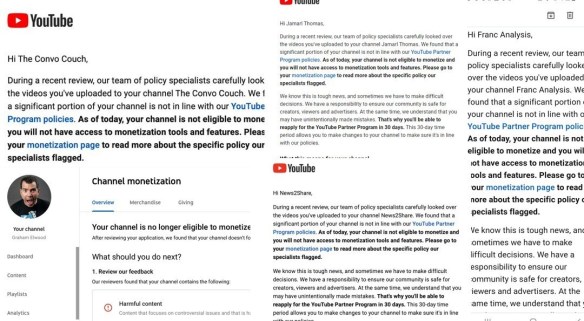
The Google-owned video sharing platform YouTube has demonetized numerous independent media accounts, a jarring escalation in the steadily intensifying campaign against alternative news outlets online.

Progressive commentators Graham ElwoodThe Progressive SoapboxThe Convo CouchFranc AnalysisHannah Reloaded and Cyberdemon531 have all received notifications from YouTube that their videos are no longer permitted to earn money through the platform’s various monetization features, as has Ford Fischer, a respected freelancer who films US political demonstrations. No explanation has been offered for this decision beyond the vague claim that “your channel is not in line with our YouTube Partner Program policies” due to “harmful content”.

Like all large online platforms, YouTube’s appeals process is notoriously opaque and unaccountable. These accounts could remain demonetized for months, or forever, without any clear explanation at all. Ford Fischer, who has been in this situation before, said on Twitter that his account was left demonetized for seven months before YouTube reversed its decision.

“Last time you demonetized my channel, I spoke out for seven months. I didn’t delete a single piece of content. You admitted you were wrong. I forgive you. Please don’t do this again,” Fischer tweeted.

“No superchats, no ad revenue, no YouTube premium money,” tweeted Elwood, who also said “I have a call with my lawyers later today.”

“You guys have destroyed my channel without legit explanation as to why,” tweeted Jamarl Thomas of Progressive Soapbox. “No videos are given – and frankly there is literally zero ‘harmful’ content on my channel. This is a radically bad error that needs to be corrected.”

The Convo Couch’s Jonathan Mayorca tweeted the notification he received from YouTube which gave the reason as “Harmful content: Content that focuses on controversial issues and that is harmful to viewers,” saying no specific video or subject was named. Nobody receiving these notifications appears to have any idea what is meant by “harmful” or “controversial” or why YouTube is mentioning them in the same breath as though these two things are connected or synonymous in some way.

YouTube has been providing template responses saying “We recommend making the needed changes to your content and reapply in 30 days” while refusing to specify what the “needed changes” even are.

Speaking for myself, I can say with absolute certainty that I would not be able to create content at anywhere near the pace I do were I not making enough money from it to do it full time. Life is far too demanding with far too much else going on for me to be able to maintain anything like daily output; being financially deplatformed and having to get another job would force me down to an essay a week in my spare time, if that. Anyone who works in independent media full time knows this, and so do the powerful people who are steadily ratcheting up the campaign to silence anyone who hasn’t passed through the gatekeepers of the plutocratic media.

Financial deplatforming is censorship. People were given an opportunity to devote themselves to the vocation of creating media outside the gatekeeping apparatus of billionaire news institutions, which is arguably the single most important vocation anyone can give themselves to in our world right now, and they built their lives around their ability to do this. Now it’s being ripped away from them; their literal jobs are being taken away. They were offered a reason to think they’d be able to make a living doing very important work, and then they were sucker punched with what amounts to political censorship.

This has been a continually escalating trend for years. The general population is herded onto huge monopolistic social media platforms offering democratization of information where your voice can be heard, and then those platforms proceed to censor an increasing amount of political speech in increasing coordination with the US government.

https://twitter.com/FordFischer/status/1357055942446223360

If the democratization of information online is successfully reversed and the mass media gatekeepers are again the sole authorities on what’s real and true, people will be locked into forming their ideas on how to think, act and vote based on what they are told by the same plutocratic media institutions which have been deceiving them into every war and manipulating them into accepting the status quo for generations.

If the door is locked to the possibility of a grassroots information rebellion against the narrative hegemony of our rulers, we will remain doomed to continue along the same ecocidal, omnicidal trajectory these bastards have us on until it reaches its inevitable conclusion. This must be resisted.

“At First I Thought it Was a Joke”: Academic Media Censorship Conference Censored by YouTube

The entire video record of the conference — estimated at around 24 hours of material — was mysteriously disappeared from YouTube say conference organizers.

By Alan Macleod

Source: Mint Press News

An academic critical media literacy conference warning of the dangers of media censorship has, ironically, been censored by YouTube. The Critical Media Literacy Conference of the Americas 2020 took place without incident online over two days in October and featured a number of esteemed speakers and panels discussing issues concerning modern media studies.

Weeks later, however, the entire video record of the conference — estimated at around 24 hours of material — disappeared from YouTube. Organizer Nolan Higdon of California State University East Bay, began receiving worried messages from other academics, some of which were shared with MintPress, who had been using the material in their classrooms, noting that it had all mysteriously disappeared.

“At first I thought it was a joke,” said Mickey Huff of Diablo Valley College, California. “My initial reaction was ‘that’s absurd;’ there must have been a mistake or an accident or it must have got swept under somehow. There is no violation, there was no reasoning, there was no warning, there was not an explanation, there was no nothing. The entire channel was just gone,” he told MintPress. Huff is also the director of Project Censored, an organization that sponsored the event.

Higdon suspected that it was the content critical of big tech monopolies like Google, YouTube, Facebook, and Twitter that was the reason why the channel was deleted. “Each video was a different panel and every panel had different people from the other ones, so it is not like there was one theme or person or copyrighted content in all of our videos; this seems to be an attack on the conference, not on a singular video,” he said.


“This wasn’t a keg party with Parler users”

The organizers were careful to avoid copyright infringement, with the large majority of their videos in lecture format, essentially a recorded Zoom call. Speakers included some of the best-known names in media studies, with the event sponsored by institutions like Stanford University and UCLA. “This wasn’t a keg party with Parler users: it was an academic conference,” Huff said.

These are pioneering figures in critical media literacy scholarship. It’s mind numbing that all of this was just disappeared from YouTube. The irony is writ large…This is part of a potentially algorithmic way of getting rid of more radical positions that criticize establishment media systems, including journalism.”

Higdon too, suspected YouTube’s action was politicized: “This is the same year we saw big tech trying to influence Prop 22 here in California, so I am not too surprised that they would be aggressive with folks like us who are critical of media corporations.”

Organizers say they attempted to contact YouTube but did not receive a reply.

MintPress spoke to representatives from Google, YouTube’s parent company, who strenuously denied that they would ever remove content from their platforms purely because it was critical of the company, noting that there is a wealth of videos on the website that challenge or attack them.After looking into the matter, Google said they could find only one video and reinstated it (although the video does not appear on the conference’s channel). As for the hours of other footage, that remains an enigma to them, with no record of its existence. Thus, it appears that there will be no closure or a definitive answer to this mystery.


Algorithms take aim

Media literacy, big tech power, and censorship are hot topics right now. In the wake of the dramatic storming of the Capitol Building earlier this month, a host of companies, including Google, Facebook, YouTube, Twitter, and Instagram, took actions against Donald Trump, limiting his and his supporters’ ability to communicate online. Perhaps most notably, however, Google, Apple, and Amazon Web Services launched a coordinated assault on “free speech app” Parler, a service popular with the far-right for its lax laws on racism. Together, the three effectively took the service offline around the world.

More recently, the Wall Street Bets subreddit, responsible for intentionally sinking a multi-billion dollar hedge fund, has endured retaliation, its communications channels cut by messaging app Discord, amid calls to immediately criminalize their behavior.

While the pros and cons of such decisions can, and have been, debated, the bigger question of should privately-owned companies be allowed to have the power to regulate who can and cannot speak online, has largely been downplayed.

“On the one hand I understand they have the right to deplatform people,” Huff told MintPress. “On a broader level though, I don’t think they should have achieved this kind of power over our communication systems in the first place, and these should be publicly run platforms regulated the same way our government regulates and enforces the First Amendment.”

Higdon was equally worried about the power amassed by the tech giants. “By empowering these tech companies to decide what is and is not appropriate, they are going to look out for their vested interests, and people who are critical of their business model and practices are going to be targets,” he said, predicting that,

These lefties right now who are advocating for censorship…the outcome of this is going to be on them.”

If history is any judge, he will be proven correct. In the wake of the 2016 election and the allegations that Russian disinformation swung the result in Trump’s favor, social media companies changed their algorithms to help halt the spread of fake news. The main result, however, was a throttling of traffic to high-quality alternative news sites and the promotion of corporate media like CNN and Fox News. Overnight, Consortium News’ Google traffic fell by 47%, Common Dreams’ by 37%, Democracy Now! By 36% and The Intercept by 19%. MintPress suffered similar, unrecoverable losses.

Likewise, Facebook CEO Mark Zuckerberg personally approved the deliberate choking of alternative media, admitting that his company deranked Mother Jones because of its left-wing persuasion (despite Facebook’s assurances that it was doing no such thing). Other, more radical outlets have suffered even greater reductions in traffic.


Anti-social media

Whatever decisions big tech companies make reverberate throughout society. 35, 24, and 17% of Americans get their news from Facebook, YouTube, and Twitter, respectively, with similar numbers worldwide. This enormous user base makes them by far the greatest and most influential news platforms on the planet, with the ability to highlight stories, bury others, and even swing elections. Huff was extremely worried about the power of these new media monopolies.

“We can’t get away from the fact that Google, Facebook, YouTube, Twitter, the whole corporate Alphabet soup of this big tech dystopia have gobbled up the public sphere. This is where people can go to congregate and share their information and it is also where invisible forces decide which voices get heard and which do not. Let’s also not forget that all of this tech was initially funded with taxpayer money.”

Worse still, although we now live in an online world, the public is hopelessly ill-equipped to navigate its waters, displaying a shocking lack of awareness and understanding of how they can be manipulated.

A 2016 study from Stanford University found that two-thirds of college-aged “digital natives” — people who grew up using the Internet — mistook native advertising for a genuine news story, even with the words “sponsored content” displayed prominently. “Overall, young people’s ability to reason about the information on the Internet can be summed up in one word: bleak,” the study concluded, leading to calls for more critical media literacy education in schools. “Since we are not teaching people how to use these technologies, or how these technologies use them, they are more susceptible to propaganda and to disinformation. And ironically our conference was designed to combat exactly that problem,” Huff added.

Perhaps more worrying of all is the increasingly close connections between Silicon Valley and the National Security State. “What Lockheed Martin was to the twentieth century…technology and cyber-security companies will be to the twenty-first,” wrote Google executives Eric Schmidt and Jared Cohen. Late last year, the CIA signed a partnership deal worth tens of billions of dollars with Microsoft, Google, Oracle, IBM, and Amazon Web Services. Meanwhile, Facebook has partnered with the NATO cutout organization the Atlantic Council to help them curate the world’s news feeds. Reddit has also hired Atlantic Council official Jessica Ashooh as its director of policy.

The Atlantic Council’s board of directors includes eight former CIA chiefs, multiple U.S. Army Generals, and high statespeople like Henry Kissinger and Condoleezza Rice, meaning that any decisions big tech companies make are only one step removed from the U.S. government. “This is actually [state] censorship by proxy,” Higdon warned.

“These companies, we know thanks to Edward Snowden and others, have contracts with the Federal government. There is a revolving door between particularly the Democratic Party and big tech, and there are also various loans and government protections given to this industry. So this is not some independent set of entities making this decision.”

“If 1984’s protagonist Winston Smith were a real character today he’d be a fact checker at Facebook or a content curator at YouTube, relegating to the dustbins of history whatever programmers are told to or whatever keywords our conference triggered,” Huff added.

Big tech has repeatedly acted at the behest of the U.S. government to silence its international opponents, suspending the accounts of foreign leaders like Venezuela’s Nicolas Maduro or Iran’s Ayatollah Khamenei or deranking foreign media outlets like RT and TeleSUR.

It is in this light that the deletion of the Critical Media Literacy Conference of the Americas can be seen; not as a deliberate decision by an angry Google employee intent on revenge, but as the result of a powerful and Byzantine algorithm designed by Silicon Valley executives who are intimately intertwined with both the government and the corporate world. There is little oversight of their power or recourse to their decisions, given their enormous influence over public life today.

Huff was particularly sardonic about the whole affair:

There are layers of irony here that are certainly not lost on us. But I don’t know if the public at large is realizing the attack that is happening against the very people that are the intellectual bulwark against such institutional censorship. I’m not trying to make us out to be martyrs here, but my point is that I think it has a particular irony when the very public intellectuals who try to educate the public about how these systems work are silenced,” he said.

Be Your Own Revolution

By Caitlin Johnstone

Source: CaitlinJohnstone.com

I made the mistake of involving myself in a sectarian Twitter spat when I was halfway through my morning coffee today and I instantly felt like an idiot.

People from the Left Twitter faction I’d offended rushed in to push back against the offense I’d caused them, and within minutes I felt it: the all-too familiar sensation of inspiration and creativity draining away from my body. Tension, coldness and defensiveness where previously there was playfulness and the crackling sensation of an exciting new day in which anything was possible.

If you’re active online, you’ve probably experienced this too. The days when you’re involved in sectarian bickering are the days when you are at your least creative, your least inspired, and your least effective at fighting against the machine. At best the drama gives your ego a tickle (as social media platforms are designed to do), after which you feel a bit yuck. The longer you engage in it, the lower the probability that you will produce something creative and inspired that day.

As a general rule, you may find that it works best to reject cliques and factions altogether. When you “belong” to any group you feel compelled to defend it, and to move with it wherever it goes even if that’s not where you feel like the energy is. You get invested in wanting the collective to move in a certain direction, and you get frustrated when it just wants to focus on silly nonsense and sectarian feuds.

So my advice to you here, which you of course can take or leave, is to just blast off on your own and fight your own revolution in your own way.

The unfortunate fact is that our society is insane, and its madness pervades literally every political faction to varying degrees. Marrying yourself to any group means marrying its madness. Instead, focus on becoming more sane, and then act based on that sanity.

Just blast off. Don’t wait for your comrades. Don’t try to pull them along with you before they are ready. Just blast forward into your own revolution, burning brightly and scorching the machine with your own light. If you shine brightly enough, the others may follow when they are ready.

One of the most frustrating things is seeing where we need to move and not being able to get the collective to come with you. You’re like, “It’s there! Let’s move!”, and they just want to bicker and ego spar. Just blast off into health yourself, and trust that the others will follow if and when they are able.

Be your own revolution. You have all the media access you need to help wake the world up with the power of your own inspired action. Reject cliques, factions and sectarianism, and have the courage to stand on your own two feet attacking the machine with your own unique abilities.

This doesn’t mean you can’t organize and work collectively; you absolutely can. If you see people doing something you want to uplift, uplift it. But when you’re done, don’t stay and become a member of the club. Move on and retain your self-sovereignty. If you’re doing something that people want to help uplift and amplify, let them do so. When they don’t want to anymore, let them go. Don’t try to manipulate them into staying.

You are free to collaborate with anyone on any issue at any time. You don’t actually need to be a member of the Blah Blah Whateverist Club to do this. And when nothing is happening that you want to collaborate with others on, you can attack the machine on your own, using your own unique set of tools based on your own inspiration. You are not owned or bound.

All these debates we’re seeing lately over who should be let into and kept out of the Revolution Club, how the Revolution Club should act, who should lead the Revolution Club etc are based on the assumption that there has to be a Revolution Club in the first place, and there just doesn’t. Organize and collaborate on a case-by-case, issue-by-issue basis while remaining sovereign.

Have the compassion to prioritize the needs of the collective and the courage to stand as an individual. Trying to impose your will on exactly how the collective revolution should and should not be moving is a doomed endeavor, because you cannot control the collective, you can only control yourself. So be your own revolution and attack the machine wherever you detect a weak point in its armor.

I’ve avoided all cliques and factions like the plague, and I’ve been far more effective in this fight than I would have been if I’d chosen to glom onto some faction and uphold all its -ists and -isms. It would have killed my ability to move with agility in whatever way is demanded by each present moment, because I would have been binding myself to the movements of a group that isn’t seeing what I’m seeing and can’t move the way I move.

This is just what’s worked for me, and of course your mileage may vary. But if you’re like me and you don’t see the various groups, organizations and factions getting us to where we need to go, consider stepping out of the vehicle, standing on your own two feet, and waging your own revolution.

Raskolnikov’s Dream Come True

By Edward Curtin

Source: Behind the Curtain

“Something is happening here,
But you don’t know what it is,
Do you, Mr. Jones?”
— 
Bob Dylan, Ballad of A Thin Man

It’s hard.

Life today seems like a dream, doesn’t it?  Surreal to the point where everything seems haunted and betwixt and between, or this against that, or that and this against us.

Something.

Or a Luis Buñuel film.  The logic of the irrational. Surrealistic.  A film made to draw us into an ongoing nightmare.  Hitchcock with no resolution. Total weirdness, as Hunter Thompson said was coming before he blew his brains out.  A life movie made to hypnotize in this darkening world where reality is created on screens, as Buñuel said of watching movies:

This kind of cinematographic hypnosis is no doubt due to the darkness of the theatre and to the rapidly changing scenes, lights, and camera movements, which weaken the spectator’s critical intelligence and exercise over him a kind of fascination.

Here we are in Weirdsville, USA where most people, whether of the left, right, or center, are hypnotized by the flickering screens.

That’s what movies do.

That’s what long planned psychological operations do.

That’s what digital technology allows corrupt rulers and the national security state with its Silicon Valley partners in crime to do.

We now live in a screen world where written words and logic are beside the point. Facts don’t matter. Personal physical experience doesn’t matter.  Clear thinking doesn’t matter. Hysterical reactions are what matter.  Manipulated emotions are what matter.  Saying “Fuck You” is now de rigueur, as if that were the answer to an argument.

It’s all a movie now with the latest theatrical performance having been the January 6, 2021 stage show filmed at the U.S. Capital.  A performance so obvious that it isn’t obvious for those hypnotized by propaganda, even when the movie clearly shows that the producers arranged for the “domestic terrorists” to be ushered into the Capital.  They let the “Nazis” in on Dr. Goebbels orders.  Thank God Almighty they were beaten back before they seized power in their Halloween costumes.

Now who could have given that order to the Capital and D.C. police, Secret Service, National Guard, and the vast array of militarized Homeland Security forces that knew well in advance of the January 6 demonstration?

Who gave the stand-down orders on September 11, 2001, events that were clearly anticipated and afterwards were described by so many as if they were a movie?  Surreal. Dreamlike.

As with the events of September 11, 2001 and the subsequent anthrax attacks, the recently staged show at the Capital that the mainstream media laughingly call an attempted coup d’état will result in a new “Patriot Act” aimed at the new terrorists – domestic ones – i.e. anyone who dissents from the authoritarian crackdown long planned and underway; anyone who questions the vast new censorship and the assault on the First Amendment; anyone who questions the official narrative of Covid-19 and the lockdowns; anyone who suggests that there are linkages between these events, etc.

Who, after all, introduced the Omnibus Counterterrorism Act in 1995 that became the template for the Patriot Act in 2001 that was passed into law after September 11, 2001?  None other than former Senator Joseph Biden. Remember Joe?  He has a new plan.

Of course, the massive Patriot Act had been written well before that fateful September day and was ready to be implemented by a Senate vote of 98-1, the sole holdout being Democratic Senator Russ Feingold of Wisconsin.  In the House of Representatives the vote was 357-66.

For those familiar (or unfamiliar)  with history and fabricated false flags, they might want also to meditate on the Gulf of Tonkin Resolution in 1964 that gave Lyndon Johnson his seal of approval to escalate the war against Vietnam that killed so many millions. The vote for that fake crisis was 416-0 in the House and 88-2 in the Senate.

In the words of Mark Twain:

Suppose you were an idiot, and suppose you were a member of Congress; but I repeat myself.

Harry Houdini, the magical performer who was able to escape from any trap, any nightmarish enclosure, any lockdown, once said, “It’s still an open question, however, as to what extent exposure really hurts a performer.”

The question has been answered.  It doesn’t hurt at all, for phony events still mesmerize millions who are eager to suspend their disbelief for the sake of a sad strand of hope that their chosen leaders – whether Biden or Trump – are levelling with them and are not playing them for fools. To accept that Trump and Biden are scripted actors in a highly sophisticated reality TV movie is a bit of “reality” too hard to bear.  Exposing them and their minions doesn’t hurt at all.  There’s no business but show business.

Houdini knew well the tricks used to deceive a gullible audience hypnotized by theatrics. “A magician is only an actor,” he said, “an actor pretending to be a magician.”  This is a perfect description of the charlatans who serve as presidents of the United States.

Life today seems like a dream, doesn’t it?

“Will wonders ever cease,” said Houdini, as he closed his shows.

When I was a child I had a repetitive dream that I was trapped in a maze.  Trying to escape, all I could hear as I tried desperately to find an exit was a droning sound.  Droning without end.  The only way I could escape the maze was to wake up – literally.  But this dream would repeat for many years to the point where I realized my dreams were connected to my actual family and life in the U.S.A.

Then, when I was later in the Marines and felt imprisoned and was attempting to get out as a conscientious objector, the dream changed to being trapped in the Marines, or the prison I was expecting if they didn’t let me go. Even when I got out of the Marines and was not in prison, the dreams that I was continued.

It took me years to learn how to escape.

I mention such dreams since they seem to encapsulate the feelings so many people have today. A sense of being trapped in a senseless social nightmare. Prisoners. Lost in a horror movie like Kafka’s novel The Castle in which the protagonist K futilely seeks to gain access to the rulers who control the world from their castle but can never reach his goal.

But these are dreams and The Castle is fiction.

On a conscious level, however, many people continue to rationalize their grasp of what is going on in the United States as if what they take to be reality is not fiction. Trump supporters –despite what are seen by them as his betrayals when he said on January 7 that “The demonstrators who infiltrated the Capitol have defiled the seat of American democracy….My focus now turns to ensuring a smooth, orderly and seamless transition of power. This moment calls for healing and reconciliation.” – still cling to the belief that he is the man they believe in and was going to “clean the swamp” but was sabotaged by the “deep state.” Biden supporters, driven by their obsessive hatred for Trump and the ongoing delusions that the Democratic Party, like the Republican, is not thoroughly corrupt, look forward to the Biden presidency and the new normal when he can “build back better.”  For both groups true faith never dies. It’s very touching.

As I have written before, if the Democrats and the Republicans are at war as is often claimed, it is only over who gets the larger share of the spoils. Trump and Biden work for the same bosses, those I call the Umbrella People (those who own and run the country through their intelligence/military/media operatives), who produce and direct the movie that keeps so many Americans on the edge of their seats in the hope that their chosen good guy wins in the end.

It might seem as if I am wrong and that because the Democrats and their accomplices have spent years attempting to oust Trump through Russia-gate, impeachment, etc. that what seems true is true and Trump is simply a crazy aberration who somehow slipped through the net of establishment control to rule for four years.  A Neo-Nazi billionaire who emerged from a TV screen and a golden tower high above the streets of New York.

This seems self-evident to the Democrats and the supporters of Joseph Biden, and even to many Republicans.

For Trump’s supporters, he seems to be a true Godsend, a real patriot who emerged out of political nowhere to restore America to its former greatness and deliver economic justice to the forgotten middle-Americans whose livelihoods have been devastated by neo-liberal economic policies and the outsourcing of jobs.

Two diametrically opposed perspectives.

But if that is so, why, despite Trump and Biden’s superficial differences – and Obama’s, Hillary Clinton’s and George W. Bush’s for that matter – have the super-rich gotten richer and richer over the decades and the war on terror continued as the military budget has increased each year and the armament industries and the Wall Street crooks continued to rake in the money at the expense of everyone else?  These are a few facts that can’t be disputed. There are many more. So what’s changed under Trump?  We are talking about nuances, small changes.  A clown with a big mouth versus traditional, “dignified” con men.

Trump’s followers were betrayed the day he was sworn in, as Biden’s will be shortly unless they support a crackdown on civil rights, the squelching of the First Amendment, and laws against dissent under the aegis of a war against domestic terrorism.

I’m afraid that is so.  Censorship of dissent that is happening now will increase dramatically under the Biden administration.

Now we have the “insurrection,” also known as an attempted “coup d’état,” with barbarians breaching the gates of the sacred abode of the politicians of both parties who have supported bloody U.S. coups throughout the world for the past seventy plus years. Here is another example of history beginning as tragedy and ending as farce.

But who is laughing?

If you were writing this script as part of long-term planning, and average people were getting disgusted from decades of being screwed and were sick of politicians and their lying ways, wouldn’t you stop the reruns and create a new show?

Come on, this is Hollywood where creative showmen can dazzle our minds with plots so twisted that when you leave the theater you keep wondering what it was all about and arguing with your friends about the ending. So create a throwback film where the good guy versus the bad guy was seemingly very clear, and while the system ground on, people would be at each other’s throats over the obvious differences, even while they were fabricated or were minor. This being the simple and successful age-old strategy of divide and conquer

I realize that it is very hard for many to entertain the thought that Trump and Biden are not arch-enemies but are players in a spectacle created to confound at the deepest psychological levels.  I am not arguing that the Democrats didn’t want Hillary Clinton to win in 2016.  I am saying they knew Trump was a better opponent, not only because they could probably defeat him and garner more of the spoils, but because if he possibly won he was easily controlled because he was compromised.  By whom?  Not the Democrats, but the “Deep State” forces that control Hillary Clinton and all the presidents.  A compromised and corrupt lot.

The Democrats and Republicans were not in charge in 2016 or in 2020.  Their bosses were.  The Umbrella people.  Biden will carry out their orders, and while everyone will conveniently forget what actually happened during Trump’s tenure, as I previously mentioned, they will only remember how the Democrats “tried” to oust this man in the black hat, while Biden will carry on Trump’s legacy with minor changes and a lot of PR. He will seem like a breath of fresh air as he continues and expands the toxic policies of all presidents.  So it goes.

Throughout these recent days that the corporate mainstream media have devoted to this Trump/Biden saga, Julian Assange, a truth teller if ever there were one, remains tortured and locked up in an English high-security prison cell.  His plight has been a minor note at best for the corporate media that is focused on the American “coup d’état.” The spectacle rolls on as an innocent journalist who exposed the vast murderous crimes of the American government is left to slowly die in a horrible prison cell. A man who, if free, could report the truth of this current charade and expose the bloody underside of this magic show.

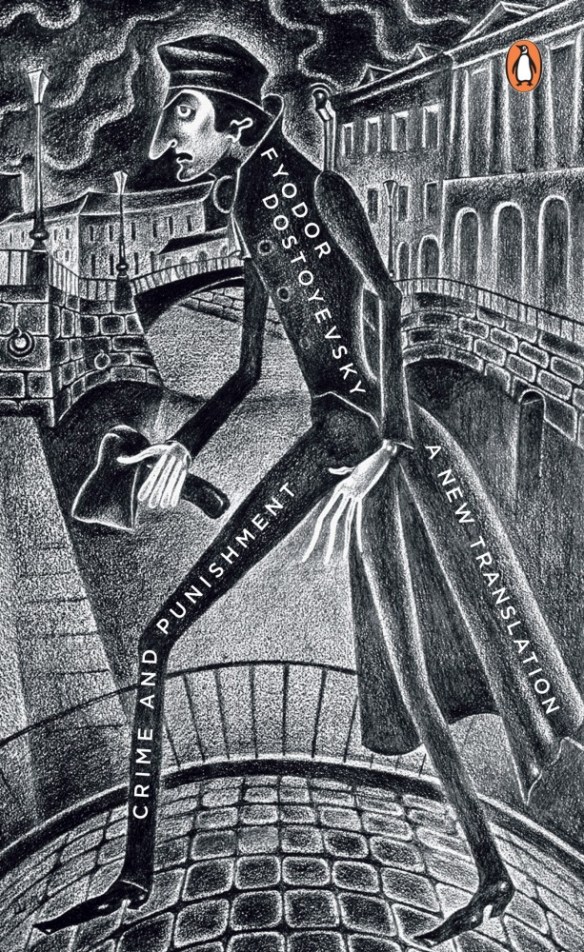
Long ago in Russia, another dissident, Fyodor Dostoevsky, was also sentenced on trumped up charges to prison and exile in Siberia for being “freethinking” and a socialist enemy of the state. When he was finally released, he wrote a novel that was published in 1866.  It was Crime and Punishment, a masterpiece about a man named Rodian Romanovich Raskolnikov who, like Dostoevsky, is sentenced to exile and imprisonment in Siberia.  In Raskolnikov’s case, it was for killing an old woman pawnbroker to see if he was “above the common ruck.” The story explores Raskolnikov’s dual consciousness and the right to murder; prideful intellect versus compassion; rationalism versus spiritual values; freedom versus determinism; the individual versus the state.

Like Nietzsche twenty years later, Dostoevsky sent out a warning long ago about the terrifying consequences that would follow in the wake of certain forms of thinking that would result in nihilism. To be “above the common ruck” and murder at will; to play with people as though they were what Raskolnikov calls the woman he murders – “louses”; to create divided minds in a game of social schizophrenia through antitheses that conceal the magician’s devious truths.

At the end of Crime and Punishment, Raskolnikov, while still in Siberian prison exile, feels that he, like Lazarus, has been raised from the dead.  He realizes that there is a solution to his split mind and that he has found it as he transitions “from one world into another…his initiation into a new, unknown life.”

But such a resolution that I will not divulge is preceded by a very strange dream, one that rings a bell today when life seems like a dream with something happening here but you don’t know what it is, do you, Mr. Jones?

When he [Raskolnikov] was better, he remembered the dreams he had had while he was feverish and delirious.  He dreamt that the whole world was condemned to a terrible strange new plague that had come to Europe from the depths of Asia.  Everyone was to be destroyed except a few chosen ones.  Some sort of new microbe was attacking people’s bodies, but these microbes were endowed with intelligence and will.  Men attacked by them became instantly furious and mad.  But never had men considered themselves so intellectual and so completely in possession of the truth as these sufferers, never had they considered their decisions, their scientific conclusions, their moral convictions so infallible.  Whole villages, whole towns and peoples were driven mad by the infection.  Everyone was excited and did not understand one another.  Each thought that he alone had the truth and was wretched looking at the others, beat himself on the breast, wept, and wrung his hands.  They did not know how to judge and could not agree what to consider evil and what good; they did not know who to blame, who to justify….The alarm bells kept ringing all day long in the towns; men rushed together, but why they were summoned and who was summoning them no one knew….The plague spread and moved further and further.  Only a few men could be saved in the whole world.  They were a pure chosen people, destined to found a new race and a new life, to renew and purify the earth, but no one had seen these men, no one had heard their words and their voices.

Have you?

Twitter’s ban on Trump will only deepen the US tribal divide

By Jonathan Cook

Source: Jonathan Cook Blog

Anyone who believes locking President Donald Trump out of his social media accounts will serve as the first step on the path to healing the political divide in the United States is likely to be in for a bitter disappointment.

The flaws in this reasoning need to be peeled away, like the layers of an onion.

Twitter’s decision to permanently ban Trump for, among other things, “incitement of violence” effectively cuts him off from 88 million followers. Facebook has said it will deny Trump access to his account till at least the end of his presidential term.

The act of barring an elected president, even an outgoing one, from the digital equivalent of the public square is bound to be every bit as polarising as allowing him to continue tweeting.

These moves threaten to widen the tribal divide between the Democratic and Republican parties into a chasm, and open up a damaging rift among liberals and the left on the limits of political speech.

Claims of ‘stolen’ election

The proximate cause of Facebook and Twitter’s decision is his encouragement of a protest march on Washington DC last week by his supporters that rapidly turned violent as several thousand stormed the Capitol building, the seat of the US government.

Five people are reported to have died, including a police officer struck on the head with a fire extinguisher and a woman who was shot dead inside the building, apparently by a security guard.

The protesters – and much of the Republican party – believe that Trump’s Democratic opponent, Joe Biden, “stole” November’s presidential election. The storming of the Capitol occurred on the day electoral college votes were being counted, marking the moment when Biden’s win became irreversible.

Since the November election, Trump has cultivated his supporters’ political grievances by implying in regular tweets that the election was “rigged”, that he supposedly won by a “landslide”, and that Biden is an illegitimate president.

The social networks’ immediate fear appears to be that, should he be allowed to continue, there could be a repetition of the turmoil at the Capitol when the inauguration – the formal transfer of power from Trump to Biden – takes place next week.

No simple solutions

Whatever we – or the tech giants who now dominate our lives – might hope, there are no simple solutions to the problems caused by extreme political speech.

To many, banning Trump from Twitter – his main megaphone – sounds like a proportionate response to his incitement and his narcissistic behaviour. It appears to accord with a much-cited restriction on free speech: no one should be allowed to shout “Fire!” in a crowded theatre.

But that comparison serves only to blur important distinctions between ordinary speech and political speech.

The prohibition on shouting “Fire!” reflects a broad social consensus that giving voice to a falsehood of this kind – a lie that can be easily verified as such and one that has indisputably harmful outcomes – is a bad thing.

There is a clear way to calculate the benefits and losses of allowing this type of speech. It is certain to cause a stampede that risks injury and death – and at no gain, apart from possibly to the instigator’s ego.

It is also easy to determine how we should respond to someone who shouts “Fire!” in a crowded theatre. They should be prosecuted according to the law.

Who gets to decide

Banning political speech, by contrast, is a more complicated affair because there is rarely consensus on the legitimacy of such censorship, and – as we shall see – any gains are likely to be outweighed by the losses.

Trump’s ban is just the latest instance in a growing wave of exclusions by Twitter and Facebook of users who espouse political views outside the mainstream, whether on the right or the left. In addition, the tech giants have been tinkering with their algorithms to make it harder to find such content – in what amounts to a kind of pre-censorship.

But the critical issue in a democracy is: who gets to decide if political speech is unreasonable when it falls short of breaching hate and incitement laws?

Few of us want state institutions – the permanent bureaucracy, or the intelligence and security services – wielding that kind of power over our ability to comment and converse. These institutions, which lie at the heart of government and need to be scrutinised as fully as possible, have a vested interest in silencing critics.

There are equally good grounds to object to giving ruling parties the power to censor, precisely because government officials from one side of the political aisle have a strong incentive to gag their opponents. Incitement and protection of public order are perfect pretexts for authoritarianism.

And leaving the democratic majority with the power to arbitrate over political speech has major drawbacks too. In a liberal democracy, the right to criticise the majority and their representatives is an essential freedom, one designed to curb the majority’s tyrranical impulses and ensure minorities are protected.

‘Terms of service’

In this case, however, the ones deciding which users get to speak and which are banned are the globe-spanning tech corporations, the wealthiest companies in human history.

Facebook and Twitter have justified banning Trump, and anyone else, on the grounds that he violated vague business “terms of service” – the small print on agreement forms we all sign before being allowed access to their platforms.

But barring users from the chief means of communication in a modern, digitised world cannot be defended simply on commercial or business grounds, especially when those firms have been allowed to develop their respective monopolies by our governments.

Social media is now at the heart of many people’s political lives. It is how we share and clarify political views, organise political actions, and more generally shape the information universe.

The fact that western societies have agreed to let private hands control what should be essential public utilities – turning them into vastly profitable industries – is a political decision in itself.

Political pressures

Unlike governments, which have to submit to intermittent elections, tech giants are accountable chiefly to their billionaire owners and shareholders – a tiny wealth elite whose interests are tied to greater wealth accumulation, not the public good.

But in addition to these economic imperatives, the tech companies are also increasingly subjected to direct and indirect political pressures.

Sometimes that occurs out in the open, when Facebook executives get hauled before congressional committees to explain their actions. And doubtless pressure is being exerted too out of sight, behind closed doors.

Facebook, Twitter, Google and Apple all want their respective, highly profitable tech monopolies to continue, and currying favour with the party in power – or the one coming into power – is the best strategy for avoiding greater regulation.

Either way, it means that, in their role as gatekeepers to the global, digital public square, the tech giants exercise overtly political powers. They regulate an outsourced public utility, but are not subject to normal democratic oversight or accountability because their relationship with the state is veiled.

Censorship backfires

Banning Trump from social media, whatever the intention, will inevitably look like an act of political suppression to his supporters, to potential supporters and even to some critics who worry about the precedent being set.

In fact, to many it will smack of vengeful retaliation by the “elites”.

Consider these two issues. They may not seem relevant to some opponents but we can be sure they will fuel his supporters’ mounting sense of righteous indignation and grievance.

First, both the department of justice and the federal trade commission under Trump have opened anti-trust investigations of the major tech corporations to break up their monopolies. Last month the Trump administration initiated two anti-trust lawsuits – the first of their kind – specifically against Facebook.

Second, these tech giants have chosen to act against Trump now, just as Biden prepares to replace him in the White House. Silicon Valley was a generous funder of Biden’s election campaign and quickly won for itself positions in the incoming administration. The new president will decide whether to continue the anti-trust actions or drop them.

Whether these matters are connected or not, whether they are “fake news” or not, is beside the point. The decision by Facebook and Twitter to bar Trump from its platforms can easily be spun in his supporters’ minds as an opportunistic reprisal against Trump for his efforts to limit the excesses of these overweening tech empires.

This is a perfect illustration of why curbs on political speech – even of the most irresponsible kind – invariably backfire. Censorship of major politicians will always be contested and are likely to generate opposition and stoke resentment.

Banning Trump won’t end conspiracy theories on the American right. It will intensify them, reinforce them, embolden them.

Obnoxious symptom

So in the cost-beneft calculus, censoring Trump is almost certain to further polarise an already deeply divided American society, amplify genuine grievances and conspiracy theories alike, sow greater distrust towards political elites, further fracture an already broken political system and ultimately rationalise political violence.

The solution is not to crack down on political speech, even extreme and irresponsible speech, if it does not break the law. Trump is not the cause of US political woes, he is one obnoxious symptom.

The solution is to address the real causes, and tackle the only too justified resentments that fuelled Trump’s rise and will sustain him and the US right in defeat. Banning Trump – just like labelling his supporters “a basket of deplorables” – will prove entirely counter-productive.

Fixing a broken system

Meaningful reform will be no simple task. The US political system looks fundamentally broken – and has been for a long time.

It will require a much more transparent electoral system. Big donor money will have to be removed from Congressional and presidential races. Powerful lobbies will need to be ousted from Washington, where they now act as the primary authors of Congressional legislation promoting their own narrow interests.

The old and new media monopolies – the latter our new public square – will have to be broken up. New, publicly funded and publicly accountable media models must be developed that reflect a greater pluralism of views.

In these ways, the public can be encouraged to become more democratically engaged, active participants in their national and local politics rather than alienated onlookers or simple-minded cheerleaders. Politicians can be held truly accountable for their decisions, with an expectation that they serve the public interest, not the interests of the most powerful corporations.

The outcome of such reforms, as surveys of the American public’s preferences regularly show, would be much greater social and economic equality. Joblessness, home evictions and loss of medical cover would not stalk so many millions of Americans as they do now, during a pandemic. In this environment, the wider appeal of a demagogue like Trump would evaporate.

If this all sounds like pie-in-the-sky idealism, that in itself should serve as a wake-up call, highlighting just how far the US political system is from the liberal democracy it claims to be.

After its own censorship spree, Twitter complains it’s getting censored in Uganda

A shocking lack of self-awareness.

By Tom Parker

Source: Reclaim the Net

Over the last week, Twitter has engaged in one of its largest-ever US censorship campaigns. Between Friday and Monday, it suspended a staggering 70,000 accounts with that number including the high profile suspension of the President of the United States.

But while Twitter’s sweeping US censorship campaign was garnering most of the attention in US media, another political censorship story was brewing.

Earlier this week, Facebook took down several accounts that were linked to Uganda’s Ministry of Information and Communications Technology for alleged “inauthentic behavior.” Twitter also took action against several accounts that it deemed to be “targeting the election in Uganda.”

Both of these Silicon Valley companies decided to take action against these accounts days before the 2021 Ugandan general election which takes place on January 14.

Ugandan government officials disputed the tech giants’ claims about these accounts and and said that they belonged to Ugandan government officials and celebrities that support the ruling National Resistance Movement (NRM) party.

Unlike in the US, Uganda’s government pushed back hard against the Silicon Valley giants’ removal of these accounts.

It accused the US tech giants of meddling in the Ugandan election and then shut down social media and messaging apps in the country two days before the election.

“If you want to take sides against the NRM, then that group should not operate in Uganda,” Ugandan President Yoweri Museveni said. “We cannot tolerate this arrogance of anybody coming to decide for us who is good and who is bad.”

President Museveni is a known supporter of social media censorship and has blocked both Facebook and Twitter on election day during the last election in 2016.

However, Twitter has decided to complain about the situation and warn about the harms of this online censorship in Uganda, without any reflection on the impact of Twitter’s mass censorship of political conversations and figures in the US.

“Ahead of the Ugandan election, we’re hearing reports that Internet service providers are being ordered to block social media and messaging apps,” Twitter’s Public Policy account wrote. “We strongly condemn internet shutdowns – they are hugely harmful, violate basic human rights and the principles of the # OpenInternet.”

In a follow-up tweet, the company added: “Access to information and freedom of expression, including the public conversation on Twitter, is never more important than during democratic processes, particularly elections.”

This statement is coming from the same company that heavily censored tweets about the 2020 US presidential election and from President Trump in the months leading up to the election.

Trump was censored hundreds of times, numerous memes about his opponent Joe Biden were removed, and countless tweets about mail-in voting were suppressed.

Then in October, less than three weeks before the election, Twitter censored a bombshell story from the New York Post about Joe Biden and his son Hunter Biden’s alleged corruption scandal.

If access to information is really so important to Twitter during democratic processes and elections, why did it suppress hundreds of messages from the President, hide criticism of his opponent, and block a major election-related news story from one of the country’s largest media outlets in the months leading up to the 2020 US presidential election?

If freedom of expression is so important to Twitter during democratic processes and election, why did it consistently hide, label, and editorialize those who were sharing their opinion on mail-in voting in the run up to the 2020 US presidential election?

Twitter had no problem clamping down on access to information or its own user’s freedom of expression in the 2020 US presidential election. It only seems to care about these principles now that its own freedom of expression and ability to share information has been cut off by the Ugandan government.