The Age of Tyrannical Surveillance: We’re Being Branded, Bought and Sold for Our Data

By John W. Whitehead

Source: The Rutherford Institute

“We know where you are. We know where you’ve been. We can more or less know what you’re thinking about… Your digital identity will live forever… because there’s no delete button.”—Former Google CEO Eric Schmidt

Uncle Sam wants you.

Correction: Big Brother wants you.

To be technically accurate, Big Brother—aided and abetted by his corporate partners in crime—wants your data.

That’s what we have been reduced to in the eyes of the government and Corporate America: data bits and economic units to be bought, bartered and sold to the highest bidder.

Those highest bidders include America’s political class and the politicians aspiring to get elected or re-elected. As the Los Angeles Times reports, “If you have been to a political rally, a town hall, or just fit a demographic a campaign is after, chances are good your movements are being tracked with unnerving accuracy by data vendors on the payroll of campaigns.”

Your phones, televisions and digital devices are selling you out to politicians who want your vote.

Have you shopped at Whole Foods? Tested out target practice at a gun range? Sipped coffee at Starbucks while surfing the web? Visited an abortion clinic? Watched FOX News or MSNBC? Played Candy Crush on your phone? Walked through a mall? Walked past a government building?

That’s all it takes for your data to be hoovered up, sold and used to target you.

This is the age of surveillance capitalism.

Incredibly, once you’ve been identified and tracked, data brokers can travel back in time, digitally speaking, to discover where you’ve been, who you’ve been with, what you’ve been doing, and what you’ve been reading, viewing, buying, etc.

Once you’ve been identified in this way, you can be tracked endlessly.

“Welcome to the new frontier of campaign tech — a loosely regulated world in which simply downloading a weather app or game, connecting to Wi-Fi at a coffee shop or powering up a home router can allow a data broker to monitor your movements with ease, then compile the location information and sell it to a political candidate who can use it to surround you with messages,” writes journalist Evan Halper.

No one is spared.

In this regard, we are all equals: equally suffering the indignity of having every shred of privacy stripped away and the most intimate details of one’s life turned into fodder for marketers and data profiteers.

This creepy new era of government/corporate spying—in which we’re being listened to, watched, tracked, followed, mapped, bought, sold and targeted—makes the NSA’s surveillance appear almost antiquated in comparison.

What’s worse, this for-profit surveillance capitalism scheme is made possible with our cooperation.

All those disclaimers you scroll though without reading them, the ones written in minute font, only to quickly click on the “Agree” button at the end so you can get to the next step—downloading software, opening up a social media account, adding a new app to your phone or computer—those signify your written consent to having your activities monitored, recorded and shared.

Think about it.

Every move you make is being monitored, mined for data, crunched, and tabulated in order to form a picture of who you are, what makes you tick, and how best to influence and/or control you.

On any given day, the average American going about his daily business will be monitored, surveilled, spied on and tracked in more than 20 different ways by both government and corporate eyes and ears. A byproduct of this new age in which we live, whether you’re walking through a store, driving your car, checking email, or talking to friends and family on the phone, you can be sure that some government agency is listening in and tracking your behavior.

With every smartphone we buy, every GPS device we install, every Twitter, Facebook, and Google account we open, every frequent buyer card we use for purchases—whether at the grocer’s, the yogurt shop, the airlines or the department store—and every credit and debit card we use to pay for our transactions, we’re helping Corporate America build a dossier for its government counterparts on who we know, what we think, how we spend our money, and how we spend our time.

The technology has advanced so far that marketers (political campaigns are among the worst offenders) can actually build “digital fences” around your homes, workplaces, friends and family’s homes and other places you visit in order to bombard you with specially crafted messages aimed at achieving a particular outcome.

If anyone else stalked us in this way—tailing us wherever we go, tapping into our calls, reading our correspondence, ferreting out our secrets, profiling and targeting us based on our interests and activities—we’d call the cops.

Unfortunately, the cops (equipped with Stingray devices and other Peeping Tom technologies) are also in on this particular scam.

It’s not just the surveillance and the buying and selling of your data that is worrisome.

The ramifications of a government—any government—having this much unregulated, unaccountable power to target, track, round up and detain its citizens is beyond chilling.

Imagine what a totalitarian regime such as Nazi Germany could have done with this kind of unadulterated power.

Imagine what the next police state to follow in Germany’s footsteps will do with this kind of power. Society is definitely rapidly moving in that direction.

We’ve made it so easy for the government to watch us.

Government eyes see your every move: what you read, how much you spend, where you go, with whom you interact, when you wake up in the morning, what you’re watching on television and reading on the internet.

Every move you make is being monitored, mined for data, crunched, and tabulated in order to form a picture of who you are, what makes you tick, and how best to control you when and if it becomes necessary to bring you in line.

If you’re an activist and you simply like or share this article on Facebook or retweet it on Twitter, you’re most likely flagging yourself as a potential renegade, revolutionary or anti-government extremist—a.k.a. terrorist.

Yet whether or not you like or share this particular article, simply by reading it or any other articles related to government wrongdoing, surveillance, police misconduct or civil liberties is enough to get you categorized as a particular kind of person with particular kinds of interests that reflect a particular kind of mindset that might just lead you to engage in a particular kinds of activities. The corporate state must watch and keep tabs on you if it is to keep you in line.

Chances are, as the Washington Post has reported, you have already been assigned a color-coded threat assessment score—green, yellow or red—so police are forewarned about your potential inclination to be a troublemaker depending on whether you’ve had a career in the military, posted a comment perceived as threatening on Facebook, suffer from a particular medical condition, or know someone who knows someone who might have committed a crime.

In other words, you might already be flagged as potentially anti-government in a government database somewhere—Main Core, for example—that identifies and tracks individuals (so they can be rounded up and detained in times of distress) who aren’t inclined to march in lockstep to the police state’s dictates.

The government has the know-how.

As The Intercept reported, the FBI, CIA, NSA and other government agencies are increasingly investing in and relying on corporate surveillance technologies that can mine constitutionally protected speech on social media platforms such as Facebook, Twitter and Instagram in order to identify potential extremists and predict who might engage in future acts of anti-government behavior.

It’s happening already in China.

Millions of Chinese individuals and businesses, blacklisted as “unworthy” based on social media credit scores that grade them based on whether they are “good” citizens, have now been banned from accessing financial markets, buying real estate or travelling by air or train. Among the activities that can get you labeled unworthy are taking reserved seats on trains or causing trouble in hospitals.

Get ready, because all signs point to China serving as the role model for our dystopian future.

When the government sees all and knows all and has an abundance of laws to render even the most seemingly upstanding citizen a criminal and lawbreaker, then the old adage that you’ve got nothing to worry about if you’ve got nothing to hide no longer applies.

Apart from the overt dangers posed by a government that feels justified and empowered to spy on its people and use its ever-expanding arsenal of weapons and technology to monitor and control them, there’s also the covert dangers associated with a government empowered to use these same technologies to influence behaviors en masse and control the populace.

In fact, it was President Obama who issued an executive order directing federal agencies to use “behavioral science” methods to minimize bureaucracy and influence the way people respond to government programs.

It’s a short hop, skip and a jump from a behavioral program that tries to influence how people respond to paperwork to a government program that tries to shape the public’s views about other, more consequential matters.

Add pre-crime programs into the mix with government agencies and corporations working in tandem to determine who is a potential danger and spin a sticky spider-web of threat assessments, behavioral sensing warnings, flagged “words,” and “suspicious” activity reports using automated eyes and ears, social media, behavior sensing software, and citizen spies, and you having the makings for a perfect dystopian nightmare.

This is the kind of oppressive pre-crime and pre-thought crime package foreshadowed by George Orwell, Aldous Huxley and Phillip K. Dick.

Remember, even the most well-intentioned government law or program can be—and has been—perverted, corrupted and used to advance illegitimate purposes once profit and power are added to the equation.

The war on terror, the war on drugs, the war on illegal immigration, asset forfeiture schemes, road safety schemes, school safety schemes, eminent domain: all of these programs started out as legitimate responses to pressing concerns and have since become weapons of compliance and control in the police state’s hands.

In the right (or wrong) hands, benevolent plans can easily be put to malevolent purposes.

Surveillance, digital stalking and the data mining of the American people—weapons of compliance and control in the government’s hands, especially when the government can listen in on your phone calls, monitor your driving habits, track your movements, scrutinize your purchases and peer through the walls of your home—add up to a society in which there’s little room for indiscretions, imperfections, or acts of independence.

This is the creepy, calculating yet diabolical genius of the American police state: the very technology we hailed as revolutionary and liberating has become our prison, jailer, probation officer, Big Brother and Father Knows Best all rolled into one.

It turns out that we are Soylent Green.

The 1973 film of the same name, starring Charlton Heston and Edward G. Robinson, is set in 2022 in an overpopulated, polluted, starving New York City whose inhabitants depend on synthetic foods manufactured by the Soylent Corporation for survival.

Heston plays a policeman investigating a murder, who discovers the grisly truth about the primary ingredient in the wafer, soylent green, which is the principal source of nourishment for a starved population. “It’s people. Soylent Green is made out of people,” declares Heston’s character. “They’re making our food out of people. Next thing they’ll be breeding us like cattle for food.”

Oh, how right he was.

Soylent Green is indeed people or, in our case, Soylent Green is our own personal data, repossessed, repackaged and used by corporations and the government to entrap us.

We, too, are being bred like cattle but not for food.

Rather, as I make clear in my book Battlefield America: The War on the American People, we’re being bred, branded, bought and sold for our data.

As the insidious partnership between the U.S. government and Corporate America grows more invasive and more subtle with every passing day, there’s virtually no way to opt out of these assaults on your digital privacy short of being a modern-day Luddite, completely disconnected from all technology.

Indeed, George Orwell’s description of the world of 1984 is as apt a description of today’s world as I’ve ever seen: “You had to live—did live, from habit that became instinct—in the assumption that every sound you made was overheard, and, except in darkness, every movement scrutinized.”

What we desperately lack and urgently need is an Electronic Bill of Rights that protects “we the people” from predatory surveillance and data-mining business practices.

Without constitutional protections in place to guard against encroachments on our rights in the electronic realm, it won’t be long before we find ourselves, much like Edward G. Robinson’s character in Soylent Green, looking back on the past with longing, back to an age where we could speak to whom we wanted, buy what we wanted, think what we wanted without those thoughts, words and activities being tracked, processed and stored by corporate giants such as Google, sold to government agencies such as the NSA and CIA, and used against us by militarized police with their army of futuristic technologies.

Facebook Wants You to Know if You’re Getting Your News From the Wrong Government

By Jim Naureckas

Source: FAIR

There’s a famous polling experiment that asked people in the Cold War-era US:

Do you think the United States should let Communist newspaper reporters from other countries come in here and send back to their papers the news as they see it?

When this question was posed on its own, only 36 percent of respondents said yes. But a separate sample was first asked:

Do you think a Communist country like Russia should let American newspaper reporters come in and send back to America the news as they see it?

When the questions were asked together—reminding people that restrictions on press freedom could be placed on their own country’s journalists, as well as on those of an official enemy—support for allowing access to Communist reporters doubled to 73 percent. (Ninety percent said that US reporters should be allowed to report freely from Russia—suggesting that only a relatively narrow slice of the population openly subscribed to the principle of free speech for me but not for thee.)

I thought of this experiment when Rania Khalek (who’s written for FAIR) told me that the viral video company she works for, In the Now, was taken off Facebook because of its indirect connection to the Russian government. (A majority stake in In the Now’s parent company, Maffick Media, is owned by a subsidiary of RT—a Moscow-based media group that, although organized as a private entity, is funded by the Russian government.)

Facebook suspended the page of In the Now, along with three other pages run by Maffick—the current affairs channel Soapbox, the environment-oriented Waste-Ed and the history-focused BackThen—after the social media giant was asked about the RT-connected pages by CNN. CNN (2/18/19), in turn, reported it was tipped off to the In the Now/RT connection by the Alliance for Securing Democracy, a group based at US government–funded German Marshall Fund.

In the Now is back on Facebook again—after a ten-day suspension—and returned with this rather user-unfriendly description:

In the Now is a brand of Maffick which is owned and operated by Anissa Naouai and Ruptly GmbH, a subsidiary of RT.

That’s not particularly helpful if you want to know what In the Now does, of course, but disclosure is good, right? For the goose but not the gander, apparently: Among the US-funded institutions with Facebook pages are, well, the German Marshall Fund. Its description just reads, “Strengthening Transatlantic Cooperation.” Will that page be taken down until the Fund acknowledges where its money comes from?

How about the PBS NewsHour, also funded by the US government? No mention of that on Facebook: Just, “On air and online, the PBS NewsHour provides in-depth analysis of the issues that matter to you.”

NPR’s Facebook page seems to go out of its way to conceal the fact that it’s US government–supported, calling itself “a privately supported, not-for-profit membership organization.” Maybe the P stands for “Private”?

Even straightforward propaganda outlets of the US government don’t have to identify themselves as such on Facebook. Take Radio Free Europe/Radio Liberty, set up at the height of the Cold War to broadcast the US government’s version of reality behind the Iron Curtain—and still going strong almost 70 years later. Its “About” on Facebook reads:

Uncensored news. Responsible and open debate. Specialized coverage of Russia, Ukraine, Central Asia, Caucasus, Iran, Balkans, South Asia, Eastern Europe.

For those who go the extra mile and click on “See More” under “Who We Are,” you do get this misleading semi-acknowledgement:

RFE/RL is registered with the IRS as a private, nonprofit Sec. 501(c)3 corporation, and is funded by a grant from the US Congress through the United States Agency for Global Media (USAGM) as a private grantee. RFE/RL‘s editorial independence is protected by US law.

Yes, RFE/RL is organized as a private entity—just like RT is. But just as the head of RT is also the head of the Russian state international news agency, the head of RFE/RL is appointed by the head of the USAGM—a government official picked by the president. That’s a funny kind of “independence.”

The Facebook page of Voice of America, the US government’s main broadcast outlet, is even squirrelier. There doesn’t seem to be any acknowledgement at all that VoA is connected to the US government—just the slogan, “The news may be good or bad. We shall tell you the truth”; the claim that it has “the world’s most interesting stories”; and information on how you can “have the best of VoA News delivered directly to your inbox each day.”

If you’re thinking that Facebook—90 percent of whose customers are not in the United States—should treat Russian-backed outlets differently than US-backed outlets because the US supports peace and democracy, or doesn’t use social media to try to manipulate other nations…. Well, this is why it’s important to get your information from a variety of sources.

But it’s not just US outlets that get to conceal their government funding on Facebook. The BBC doesn’t mention that it’s controlled and funded by the British government—only that its “mission is to enrich your life. To inform, educate and entertain.”

At Al Jazeera English’s Facebook page, you learn, “We are the voice of the voiceless”—not that they are owned by the monarchy of Qatar.

Facebook needs to have one rule for whether government-funded outlets need to disclose their connections. And it needs to apply that rule consistently.


How CNN Led Facebook To Censor Pages Of Russia-Backed Video Company And Manufactured News Story

Disclosure: Kevin Gosztola co-hosts the “Unauthorized Disclosure” podcast with Rania Khalek, who is a contributor for Maffick Media’s Soapbox. “Unauthorized Disclosure” is entirely listener-funded. Shadowproof is member-supported and funded by reader donations.

By Kevin Gosztola

Source: Shadowproof

CNN went in search for a story about a Russian-funded digital media project that produces viral videos aimed at undermining American democracy. When CNN journalists could not find what they were looking for, they effectively manufactured the news by giving Facebook a pretext for removing the project’s pages used to share videos. Now, the cable news network had their story.

Four CNN journalists worked on the report, “Russia is backing a viral video company aimed at American millennials.” It appeared online late in the day on February 15 and broke the news that Maffick Media had their Facebook pages for three video channels suspended.

Maffick also produces In The Now, which Facebook took down as well.

Facebook never required pages to include information about their parent companies nor has the social media company ever labeled state-sponsored media, which CNN acknowledged. Yet, since the project involves funding from Russian state media, CNN believed Facebook may want to require the pages to disclose such details.

CNN contacted Facebook on February 13, and Facebook informed CNN they were “contemplating doing something about labeling state-funded media,” according to Donie O’Sullivan, a CNN reporter who worked on the story. The media organization held their story until Facebook took action.

Maffick produces three video channels—Backthen, which explores the history of Western imperialism, Waste-Ed, which covers environmental issues, including climate change, and Soapbox, which covers politics and current events.

As O’Sullivan said during an interview on CNN, “The content was pretty critical of the U.S government, of U.S mainstream media, but nothing that would be totally out of the ordinary necessarily.” Videos made a “lot of legitimate arguments,” and they “weren’t necessarily really hiding their Russian ties.”

“If you were to start Googling these pages, you could quickly work it back to see,” O’Sullivan added.

Journalist Rania Khalek, who produces videos for Soapbox, was interviewed by CNN, along with Maffick Media chief operating officer J. Ray Sparks. The interview took place in Berlin on February 11. However, CNN did not initially contact them.

“CNN was contacting peripheral employees, some of the people in the U.S., one of the camera people that I worked with. They contacted her,” Khalek shared. “And they actually lied to [this person] and told her they had already spoken to me, when they had not.”

According to Khalek, CNN seemed to be interested in whether any Maffick employees were difficult to work with, whether employees or contractors were paid decently, and whether they were leery of the stories they were asked to cover.

J. Ray Sparks contacted CNN to inform them that they were aware the news network was attempting to dig up dirt. Maffick made CEO Anissa Naouai, Khalek, and Sparks available to CNN in the interest of transparency, even though it was clear journalists were looking for material for a hit piece on the project.

Shadowproof was provided with a copy of the unedited interview that CNN conducted with Khalek and Sparks.

More Like An Interrogation By Intelligence Agents Than An Interview

The interview was conducted by CNN correspondent Drew Griffin. In February 2018, Griffin went to the home of a woman in Florida, a private citizen who supported Donald Trump’s presidential campaign, and insisted she was duped by Russia when she ran the “Team Trump Broward County” Facebook page.

The page’s events were reportedly promoted by Russia’s Internet Research Agency, a Kremlin-linked troll farm operated out of St. Petersburg.

“I don’t go with Russians, c’mon, give me a break,” the woman insisted, while Griffin tried to take away her independence as a campaign supporter and shame her for something out of her control.

The questions asked by Griffin collectively amounted to an interrogation. He went out of his way not to engage with answers to his questions that conflicted with the story CNN was chasing.

Also, Griffin was fishing for very private details involving the business model of Maffick that would help CNN attack the project. Sparks provided answers, despite the fact that the questions were invasive, and the vast majority of U.S. news media outlets would probably refrain from sharing such information with the public.

CNN misquoted Sparks twice. In the print report, they said Sparks claimed it was “standard business practice” not to disclose who owned a Facebook page. That made it seem like Sparks was specifically referring to Maffick and that he was exhibiting a flippant attitude to the question of who funds Maffick. However, Sparks said “standard industry practice” and was making a general point about CNN holding Maffick to a standard most media organizations throughout the world do not follow.

Griffin asked why Maffick tells employees and contractors they are funded by the Russia government but not their audience. “There’s no mention of Russia or Ruptly on the Facebook pages. Why is that?”

“Because that’s standard industry practice,” Sparks replied. “We get this question a lot, and it’s a funny question to me because why does Great Big Story not put CNN on their Facebook page? Why does CNN not put Time Warner on their Facebook page? The audience is not interested in these things.”

Sparks added, “I worked for Comedy Central for many years. No one ever knew that Comedy Central was owned by MTV, and that MTV was owned by Viacom. These were things that you had to discover as a more esoteric audience within the industry. The general audience never is interested in these things, and the standard practice is to just simply not mention them because the audience is not interested.”

Whether Sparks is right or not is insignificant. CNN used a different word so it better suited their story.

[Note: CNN later issued a correction during the weekend after Shadowproof published this report:

“The original version of this article incorrectly quoted Sparks as saying it is ‘standard business practice’ for a media outlet not to disclose its ownership on its Facebook page. He actually referred to ‘standard industry practice’ and ‘standard practice.’”]

Baselessly Accused Of Boosting ‘Kremlin Narratives’

Although Khalek and Sparks detailed their editorial independence at Maffick extensively, Griffin remained incredulous at the reality that officials working at the Kremlin are not dictating what specific stories should be covered. CNN quoted Ben Nimmo, a “senior fellow for information defense at the Atlantic Council’s Digital Forensic Research Lab,” to undermine their assertions.

“They routinely boost Kremlin narratives, especially those which portray the West negatively,” Nimmo stated.

He added Maffick’s pages are “broadly anti-U.S. and anti-corporate. That’s strikingly similar to RT’s output. Maffick may technically be independent, but their tone certainly matches the broader Kremlin family.”

The Atlantic Council is a militaristic think tank that receives funding from the U.S. government. In particular, Nimmo holds himself out as some bot hunter, who is an expert at exposing “Kremlin influence networks.” Yet, as journalist Max Blumenthal highlighted in 2018, Nimmo misidentified “several living, breathing individuals as Russian bots or Kremlin ‘influence accounts.’ Nimmo’s victims included Mariam Susli, a well-known Syrian-Australian social media personality, the famed Ukrainian concert pianist Valentina Lisitsa, and a British pensioner named Ian Shilling.”

Khalek told Griffin why her journalism challenges U.S. foreign policy and the power of U.S. corporations.

“I’m an American, right? My priority and my responsibility is to challenge destructive policies [of] the government that I pay tax dollars to. And that’s what I focus on in my videos,” Khalek declared. “I challenge war. I challenge corporate ownership of our government and of our political system. And this is one of the few places that I have where I can actually do that with complete editorial control.”

“Now, if CNN would like to give me a job to spend my time challenging the war industry and corporations, I’d be happy to do that. But that’s just not the case.”

“I have complete editorial control over my work on Soapbox,” Khalek said, prior this comment. “I get to tell the truth about war and corporations, which you don’t get to hear much about in corporate outlets, like CNN, where people oftentimes even get fired for being antiwar. You know, I’d ask, you where was Marc Lamont Hill’s editorial freedom when CNN fired him for telling the truth about Israeli occupation of Palestine?”

Griffin plowed forward as if he was oblivious to what happened to the former CNN contributor, and at no point did Griffin offer any examples, where specific Russian policies were mindlessly championed by Khalek or other Maffick contractors to boost the Kremlin.

Succumbing To Russophobia

It was the German Marshall Fund, which brought records on the ownership of Maffick to the attention of CNN. They also were the source CNN used to back up the notion that Facebook should require Maffick to disclose its ownership.

Bret Schafer, a social media analyst at the German Marshall Fund, said “that he believes most people who see content from the pages on Facebook have no idea it could be tied to Russia.”

“It should be clearly labeled,” he told CNN, “and when they don’t label them, they need to be called out on that.”

The German Marshall Fund receives funds from the U.S. government, and as it states on its website, the fund was founded in 1972 as “a non-partisan, nonprofit organization through a gift from Germany as a permanent memorial to Marshall Plan assistance.”

“GMF maintains a strong presence on both sides of the Atlantic. In addition to its headquarters in Washington, D.C., GMF has offices in Berlin, Paris, Brussels, Belgrade, Ankara, Bucharest, and Warsaw. GMF also has smaller representations in Bratislava, Turin, and Stockholm.”

The Marshall Plan was a foreign policy strategy adopted in 1947 to expand American dominance in the world. It aimed to expand access to European markets for U.S. businesses and fend off the rise of communism in countries like Italy and France.

One of the German Marshall Fund’s projects is the Alliance For Securing Democracy. It was far more strident in its assessment of Maffick than CNN.

The project’s advisory council includes Michael Chertoff, former Homeland Security Department chief, Bill Kristol, who was a board member of the Project for the New American Century, which pushed for the invasion of Iraq, Rick Ledgett, former NSA deputy director, Mike McFaul, former U.S. ambassador to Russia, Mike Morell, former acting CIA director, John Podesta, former chairman of Hillary Clinton’s presidential campaign, Mike Rogers, former congressman and chair of the House Intelligence Committee, James Stavridis, a former admiral who led European Command, and Jake Sullivan, former national security advisor to Vice President Joe Biden. (Journalist Glenn Greenwald further detailed the “marriage of convenience” between establishment Democrats and neoconservatives.)

It is the Alliance For Securing Democracy that developed Hamilton 68, a “tracker” it claimed could unearth Russian influence operations. But the individuals involved with Hamilton 68 have refused to share their methodology. They follow accounts “run by people around the world who amplify pro-Russian themes either knowingly or unknowingly,” which means any dissent deemed to be “anti-American” can draw their attention to hashtags worth tracking.

James Carden, a contributor for The Nation, wrote, “Projects like Hamilton 68 are the opposite of what one would expect in an open society like the United States: In essence, it seeks to police and narrow the scope of acceptable political discourse. The implicit message is that Americans should ignore unpleasant news so long as it comes from foreign outlets, regardless of the veracity of the story.”

“That the well-regarded German Marshall Fund has succumbed to the Russophobia now so in vogue across the political spectrum is cause for both sadness and concern,” Carden added.

“Completely In Line With What We’re Hearing From The Kremlin”

Twice Griffin pressed Khalek on her views. He maintained they are “completely in line with what we’re hearing from the Kremlin, especially on Venezuela.”

“Okay, do you have a specific criticism about what I said about Venezuela?” Khalek replied. “The U.S. right now under Trump—the president that CNN is very much against—is currently attempting to launch a right-wing coup in Venezuela and what I see from the mainstream press in the U.S., across the board, is support for that.”

“What I’m interested in is accurate reporting in Venezuela about what’s happening and what the U.S. is doing there,” Khalek continued. “And you know, that might align with this entity or that entity, but that’s not what I care about. What I care about is telling the truth. And I would like to know why CNN isn’t telling the truth about what’s happening in Venezuela.”

Khalek further outlined why this notion of “views aligning with the Kremlin” is dangerous.

Say I’m antiwar. Say that Trump right now is threatening a military intervention against Venezuela. If I oppose that, which the Russian government I think does—and so do other governments in the world. They also oppose it. But if I oppose U.S. war, does that automatically mean I’m going to be accused of being aligned with the Kremlin? And with this Russia hysteria that we’re experiencing now, I feel like this is a very, very dangerous McCarthyist tactic to start saying that leftist views, antiwar views are just the Kremlin government’s talking points.

Immediately following this statement from Khalek, Griffin said, “Business model folks and others who think there’s so much negative publicity surrounding a Russian label, especially in the world of journalistic freedom, that your company is probably purposely distancing itself from any kind of public or branding related to Russia.”

“Is that true? In terms of trying to grow this company and grow these channels, it would be wise that you did not have any kind of connection with Russia available to the public?”

Either Griffin has a lot of gall or is plainly ignorant. Khalek, Naouai, and Sparks granted unprecedented access to their work. Because it did not conform to widespread notions of state-funded media bandied about in Russia investigation coverage, Griffin and others at CNN discounted what was shared.

Griffin stuck to hyping the danger of Russian-funded media so CNN can keep profiting off the panic. So, it is stories like this one that drive media and journalists with ties to Russia underground and pushes them to engage in secrecy for their survival.

***

The key issue, which CNN deliberately avoids, is one that has been prevalent since 2014, when Abby Martin was an anchor for RT America and spoke out against Russian military aggression in Crimea. She went on Piers Morgan’s show on CNN and told Morgan that RT was no different than any other corporate media station in America.

“We’re talking about six corporations that control 90 percent of what Americans see, hear, and read, lead up to the Iraq War parroting exactly what the establishment said. I mean, you could reflect the exact same criticism on all the corporate media channels,” Martin contended.

As she put it, “RT toes a perspective of the Russian foreign policy just as the entire corporate media apparatus toes the perspective of the U.S. establishment.”

“Why do I have to work for RT to tell the truth about corporations and the U.S. government?” Martin asked. “I mean, seriously, you guys are beholden to advertisers that you cannot criticize.” That is why Martin was working for RT, not CNN.

Until journalists at U.S. media outlets, like CNN, quit projecting images on the cave wall for citizens in order to help the U.S. government maintain its global dominance and insulate government officials from scrutiny, particularly on matters of war, there will always be Americans who seek out jobs with foreign media outlets. They will seek out companies like Maffick to produce dissident journalism, which establishment media organizations refuse to support.

UPDATE: The report was updated on February 18 to reflect details from an interview with Donie O’Sullivan on CNN’s “Reliable Sources,” and to include the correction CNN printed after Shadowproof published this report.

‘Highly Disturbing’: Facebook Blocks Viral Video Outlets Critical of US Foreign Policy and Corporate Media

Journalists and free speech advocates are calling out the social media giant for shuttering the pages after CNN inquired about Berlin-based media company Maffick’s funding from the Russian government

By Jessica Corbett

Source: Common Dreams

Journalists and advocates of press freedoms are once more directing outrage and criticism at Facebook for selectively censoring pages on its platform and refusing to explain the reason behind a decision that appears to many as a clear double standard applied to outlets critical of U.S. foreign policy and corporate interests.

Facebook is under fire for shuttering four pages managed by the Berlin-based news and media company Maffick, after CNN reporters asked the social media giant about Maffick not disclosing that it is partly funded by the Russian government.

CNN held its report—titled “Russia is backing a viral video company aimed at American millennials“—until Friday, when Facebook blocked Soapbox, Waste-Ed, Backthen, and In The Now.

American-Lebanese journalist Rania Khalek, a contributor to Soapbox and In The Now who was interviewed by CNN, outlined the controversy in a lengthy, widely shared series of tweets. Monday morning, Khalek added an update to the Twitter thread:

As CNN outlined in its report, which was updated and corrected on Monday:

Company records [for Maffick] in Germany show that 51 percent of the company is owned by Ruptly [a subsidiary of RT, which is funded by the Russian government]. The remaining 49 percent is controlled by former RT presenter Anissa Naouai, who is Maffick’s CEO. The records were first reported by the German outlet T-online and later by the Alliance for Securing Democracy, which brought it to CNN‘s attention. The Alliance for Securing Democracy is part of the German Marshall Fund, which receives funding from the U.S., German, and other governments. The Alliance for Securing Democracy says that while it is part of the German Marshall Fund, the ASD itself does not receive any funding from the GMF, and gets its money from private family funds and grants but not from government funding.

In the Now was originally a television show on RT, hosted by Naouai. It has more than 3 million followers on Facebook,” CNN noted. The other three pages “have more than 30 million video views, though they’ve only been operating for a few months.”

What kind of content did they produce? Khalek offered a number of examples, including:

In an interview with CNN, Maffick chief operating officer J. Ray Sparks emphasized that Maffick is editorially independent from RT—which the U.S. government has forced to register as a foreign agent—and pointed out that it is “standard industry practice” not to disclose ownership of a media producer on a Facebook page.

However, as Kevin Gosztola—who cohosts a podcast with Khalek—noted in an article published Saturday on Shadowproof, “Although Khalek and Sparks detailed their editorial independence at Maffick extensively, [CNN correspondent Drew] Griffin remained incredulous at the reality that officials working at the Kremlin are not dictating what specific stories should be covered.”

“Similarly to NPR, PBS, BBC, DW, CBC, AJ+, and many other media companies, Maffick is supported in part by government funding. Likewise while we haven’t posted funding details on our Facebook pages etc, neither have any of our international peers,” Maffick said in a statement that charges the company was singled out for “one reason and one reason only: The government that helps fund our company is Russia.”

“We did not violate any of Facebook’s policies whatsoever. None of our content promotes disinformation or fake news. Yet CNN pressured Facebook into unprecedented censorship in a desperate attempt to milk ratings by stoking hysteria over Russia,” the statement continues, calling on Facebook to reinstate its pages and “articulate clear, consistent policies and protocols regarding obligatory funding disclosures which will be applied evenly across all pages.”

Since Friday, Khalek and others who often linked to her initial thread have turned to another major social media platform—Twitter—to raise alarm about the role of the ASD and the communication CNN subsequently had with Facebook:

Although Facebook’s rules don’t require pages to disclose parent companies, a spokesperson told CNN in a statement that the social media company planned to reach out to Maffick page administrators “to ask that they disclose this additional information and their affiliation with their parent company to get back on the platform.”

The move by Facebook comes after the company temporarily took down one of Khalek’s videos for Soapbox—about “how Israel uses Palestine as a weapons testing laboratory”—in late December, and only restored it after public outcry. Facebook also was intensely criticized last year for censoring the left-leaning Latin American news network teleSUR English, funded by the Venezuelan government and others, as well as a video about Christopher Columbus’ brutal legacy produced by Double Down News.


Jacques Ellul: A Prophet for Our Tech-Saturated Times

Read his works to understand how we’ve been caught in technology’s nightmarish hold.

By Andrew Nikiforuk

Source: The Tyee

By now you have probably read about the so-called “tech backlash.”

Facebook and other social media have undermined what’s left of the illusion of democracy, while smartphones damage young brains and erode the nature of discourse in the family.

Meanwhile computers and other gadgets have diminished our attention spans along with our ever-failing connection to reality.

The Foundation for Responsible Robotics recently created a small stir by asking if “sexual intimacy with robots could lead to greater social isolation.”

What could possibly go wrong?

The average teenager now works about two hours of every day — for free — providing Facebook and other social media companies with all the data they need to engineer young people’s behaviour for bigger Internet profits.

Without shame, technical wonks now talk of building artificial scientists to resolve climate change, poverty and, yes, even fake news.

The media backlash against Silicon Valley and its peevish moguls, however, typically ends with nothing more radical than an earnest call for regulation or a break-up of Internet monopolies such as Facebook and Google.

The problem, however, is much graver, and it is telling that most of the backlash stories invariably omit any mention of technology’s greatest critic, Jacques Ellul.

The ascent of technology

Ellul, the Karl Marx of the 20th century, predicted the chaotic tyranny many of us now pretend is the good and determined life in technological society.

He wrote of technique, about which he meant more than just technology, machines and digital gadgets but rather “the totality of methods rationally arrived at and having absolute efficiency” in the economic, social and political affairs of civilization.

For Ellul, technique, an ensemble of machine-based means, included administrative systems, medical tools, propaganda (just another communication technique) and genetic engineering.

The list is endless because technique, or what most of us would just call technology, has become the artificial blood of modern civilization.

“Technique has taken substance,” wrote Ellul, and “it has become a reality in itself. It is no longer merely a means and an intermediary. It is an object in itself, an independent reality with which we must reckon.”

Just as Marx deftly outlined how capitalism threw up new social classes, political institutions and economic powers in the 19th century, Ellul charted the ascent of technology and its impact on politics, society and economics in the 20th.

My copy of Ellul’s The Technological Society has yellowed with age, but it remains one of the most important books I own. Why?

Because it explains the nightmarish hold technology has on every aspect of life, and also remains a guide to the perplexing determinism that technology imposes on life.

Until the 18th century, technical progress occurred slowly and with restraint. But with the Industrial Revolution it morphed into something overwhelming due in part to population, cheap energy sources and capitalism itself.

Since then it has engulfed Western civilization and become the globe’s greatest colonizing force.

“Technique encompasses the totality of present-day society,” wrote Ellul. “Man is caught like a fly in a bottle. His attempts at culture, freedom, and creative endeavour have become mere entries in technique’s filing cabinet.”

Ellul, a brilliant historian, wrote like a physician caught in the middle of a plague or physicist exposed to radioactivity. He parsed the dynamics of technology with a cold lucidity.

Yet you’ve probably never heard of the French legal scholar and sociologist despite all the recent media about the corrosive influence of Silicon Valley.

His relative obscurity has many roots. He didn’t hail from Paris, but rural Bordeaux. He didn’t come from French blue blood; he was a “meteque.”

He didn’t travel much, criticized politics of every stripe and was a radical Christian.

But in 1954, just a year before American scientists started working on artificial intelligence, Ellul wrote his monumental book, The Technological Society.

The dense and discursive work lays out in 500 pages how technique became for civilization what British colonialism was for parts of 19th-century Africa: a force of total domination.

In the book Ellul explains in bold and uncompromising terms how the logic of technological innovation conquered every aspect of human culture.

Ellul didn’t regard technology as inherently evil; he just recognized that it was a self-augmenting force that engineered the world on its terms.

Machines, whether mechanical or digital, aren’t interested in truth, beauty or justice. Their goal is to make the world a more efficient place for more machines.

Their proliferation combined with our growing dependence on their services inevitably led to an erosion of human freedom and unintended consequences in every sphere of life.

Ellul was one of the first to note that you couldn’t distinguish between bad and good effects of technology. There were just effects and all technologies were disruptive.

In other words, it doesn’t matter if a drone is delivering a bomb or book or merely spying on the neighbourhood, because technique operates outside of human morality: “Technique tolerates no judgment from without and accepts no limitations.”

Facebook’s mantra “move fast and break things” epitomizes the technological mindset.

But some former Facebook executives such as Chamath Palihapitiya belatedly realized they have engineered a force beyond their control. (“The short-term dopamine-driven feedback loops that we have created are destroying how society works,” Palihapitiya has said.)

That, argued Ellul, is what technology does. It disrupts and then disrupts again with unforeseen consequences, requiring more techniques to solve the problems created by latest innovations.

As Ellul noted back in 1954, “History shows that every technical application from its beginnings presents certain unforeseeable secondary effects which are more disastrous than the lack of the technique would have been.”

Ellul also defined the key characteristics of technology.

For starters, the world of technique imposes a rational and mechanical order on all things. It embraces artificiality and seeks to replace all natural systems with engineered ones.

In a technological society a dam performs better than a running river, a car takes the place of the pedestrians — and may even kill them — and a fish farm offers more “efficiencies” than a natural wild salmon migration.

There is more. Technique automatically reduces actions to the “one best way.” Technical progress is also self-augmenting: it is irreversible and builds with a geometric progression.

(Just count the number of gadgets telling you what to do or where to go or even what music to play.)

Technology is indivisible and universal because everywhere it goes it shows the same deterministic face with the same consequences. And it is autonomous.

By autonomous, Ellul meant that technology had become a determining force that “elicits and conditions social, political and economic change.”

The role of propaganda

The French critic was the first to note that technologies build upon each other and therefore centralize power and control.

New techniques for teaching, selling things or organizing political parties also required propaganda.

Here again Ellul saw the future.

He argued that propaganda had to become as natural as breathing air in a technological society, because it was essential that people adapt to the disruptions of a technological society.

“The passions it provokes — which exist in everybody — are amplified. The suppression of the critical faculty — man’s growing incapacity to distinguish truth from falsehood, the individual from the collectivity, action from talk, reality from statistics, and so on — is one of the most evident results of the technical power of propaganda.”

Faking the news may have been a common practice on Soviet radio during Ellul’s day, but it is now a global phenomenon leading us towards what Ellul called “a sham universe.”

We now know that algorithms control every aspect of digital life and have subjected almost aspect of human behaviour to greater control by techniques whether employed by the state or the marketplace.

But in 1954 Ellul saw the beast emerging in infant form.

Technology, he wrote, can’t put up with human values and “must necessarily don mathematical vestments. Everything in human life that does not lend itself to mathematical treatment must be excluded… Who is too blind to not see that a profound mutation is being advocated here.”

He, too, warned about the promise of leisure provided by the mechanization and automatization of work.

“Instead of being a vacuum representing a break with society,” our leisure time will be “literally stuffed with technical mechanisms of compensation and integration.”

Good citizens today now leave their screens at work only to be guided by robots in their cars that tell them the most efficient route to drive home.

At home another battery of screens awaits to deliver entertainments and distractions, including apps that might deliver a pizza to the door.

Stalin and Mao would be impressed — or perhaps disappointed — that so much social control could be exercised with such sophistication and so little bloodletting.

Ellul wasn’t just worried about the impact of a single gadget such as the television or the phone but “the phenomenon of technical convergence.”

He feared the impact of systems or complexes of techniques on human society and warned the result could only be “an operational totalitarianism.”

“Convergence,” he wrote, “is a completely spontaneous phenomenon, representing a normal stage in the evolution of technique.”

Social media, a web of behavioural and psychological systems, is just the latest example of convergence.

Here psychological techniques, surveillance techniques and propaganda have all merged to give the Russians and many other groups a golden opportunity to intervene in the political lives of 126 million North Americans.

Social media has achieved something novel, according to former Facebook engineer Sam Lessin.

For the first time ever a political candidate or party can “effectively talk to each individual voter privately in their own home and tell them exactly what they want to hear… in a way that can’t be tracked or audited.”

In China the authorities have gone one step further. Using the Internet the government can now track the movements of every citizen and rank their political trustworthiness based on their history of purchases and associations. It is, of course, a fantastic “counterterrorism” tool.

The Silicon Valley moguls and the digerati promised something less totalitarian. They swore that social media would help citizens fight bad governments and would connect all of us.

Facebook, vowed the pathologically adolescent Mark Zuckerberg, would help the Internet become “a force for peace in the world.”

But technology obeys its own rules and prefers “the psychology of tyranny.”

The digerati also promised that digital technologies would usher in a new era of decentralization and undo what mechanical technologies have already done: centralize everything into big companies, big boxes and big government.

Technology assuredly fragments human communities, but in the world of technique centralization remains the norm.

“The idea of effecting decentralization while maintaining technical progress is purely utopian,” wrote Ellul.

Towards ‘hypernormalization’

It is worth noting that the word “normal” didn’t come into currency until the 1940s along with technological society.

In many respects global society resembles the Soviet Union just prior to its collapse when “hypernormalization” ruled the day.

A recent documentary defined what hypernormalization did for Russia: it “became a society where everyone knew that what their leaders said was not real, because they could see with their own eyes that the economy was falling apart. But everybody had to play along and pretend that it was real because no one could imagine any alternative.”

In many respects technology has hypernormalized a technological society in which citizens exercise less and less control over their lives every day and can’t imagine anything different.

Throughout his life Ellul maintained that he was “neither by nature, nor doctrinally, a pessimist, nor have I pessimistic prejudices. I am concerned only with knowing whether things are so or not.”

He called a spade a spade, and did not sugarcoat his observations.

If you are growing more anxious about our hypernormalized existence and are wondering why you own a phone that tracks your every movement, then read The Technological Society.

Ellul believed that the first act of freedom a citizen can exercise is to recognize the necessity of understanding technique and its colonizing powers.

Resistance, which is never futile, can only begin by becoming aware and bearing witness to the totalitarian nature of technological society.

Ellul believed that Christians had a special duty to condemn the worship of technology, which has become society’s new religion.

To Ellul, resistance meant teaching people how to be conscious amphibians, with one foot in traditional human societies, and to purposefully choose which technologies to bring into their communities.

Only citizens who remain connected to traditional human societies can see, hear and understand the disquiet of the smartphone blitzkrieg or the Internet circus.

Children raised by screens and vaccinated only by technology will not have the capacity to resist, let alone understand, this world any more than someone born in space could appreciate what it means to walk in a forest.

Ellul warned that if each of us abdicates our human responsibilities and leads a trivial existence in a technological society, then we will betray freedom.

And what is freedom but the ability to overcome and transcend the dictates of necessity?

In 1954, Ellul appealed to all sleepers to awake.

Read him. He remains the most revolutionary, prophetic and dangerous voice of this or any century.

A New Narrative Control Firm Works To Destroy Alternative Media

By Caitlin Johnstone

Source: CaitlinJohnstone.com

The frenzied, hysterical Russia narrative being promoted day in and day out by western mass media has had two of its major stories ripped to shreds in the last three days.

A report seeded throughout the mainstream media by anonymous intelligence officials back in September claimed that US government workers in Cuba had suffered concussion-like brain damage after hearing strange noises in homes and hotels with the most likely culprit being “sophisticated microwaves or another type of electromagnetic weapon” from Russia. A recording of one such highly sophisticated attack was analyzed by scientists and turned out to be the mating call of the male indies short-tailed cricket. Neurologists and other brain specialists have challenged the claim that any US government workers suffered any neurological damage of any kind, saying test results on the alleged victims were misinterpreted. The actual story, when stripped of hyperventilating Russia panic, is that some government workers heard some crickets in Cuba.

Another report which dominated news headlines all of yesterday claimed that former Trump campaign manager Paul Manafort (the same Paul Manafort who the Guardian falsely claimed met with Julian Assange in the Ecuadorian embassy) had shared polling data with a Russian associate and asked him to pass it along to Oleg Deripaska, who is often labeled a “Russian oligarch” by western media. The polling data was mostly public already, and the rest was just more polling information shared in the spring of 2016, but Deripaska’s involvement had Russiagaters burning the midnight oil with breathless excitement. Talking Points Memo‘s Josh Marshall went so far as to publish an article titled “The ‘Collusion’ Debate Ended Last Night”, substantiating his click-generating headline with the claim that “What’s crystal clear is that the transfer to Kilimnik came with explicit instructions to give the information to Deripaska. And that’s enough.”

Except Manafort didn’t give any explicit instructions to share the polling data with Deripaska, but with two Ukrainian oligarchs (who are denying it). The New York Times was forced to print this embarrassing correction to the story it broke, adding in the process that Manafort’s motivation was likely not collusion, but money.

These are just the latest in a long, ongoing pattern of terrible mass media debacles as reporters eager to demonstrate their unquestioning fealty to the US-centralized empire fall all over themselves to report any story that makes Russia look bad without practicing due diligence. The only voices who have been questioning the establishment Russia narrative that is being fed to mass media outlets by secretive government agencies have been those which the mass media refuses to platform. Alternative media outlets are the only major platforms for dissent from the authorized narratives of the plutocrat-owned political/media class.

Imagine, then, how disastrous it would be if these last strongholds of skepticism and holding power to account were removed from the media landscape. Well, that’s exactly what a shady organization called NewsGuard is trying to do, with some success already.

A new report by journalist Whitney Webb for MintPress News details how NewsGuard is working to hide and demonetize alternative media outlets like MintPress, marketing itself directly to tech companies, social media platforms, libraries and schools. NewsGuard is led by some of the most virulently pro-imperialist individuals in America, and its agenda to shore up narrative control for the ruling power establishment is clear.

The product which NewsGuard markets to the general public is a browser plugin which advises online media consumers whether a news media outlet is trustworthy or untrustworthy based on a formula with a very pro-establishment bias which sees outlets like Fox News and the US propaganda outlet Voice of America getting trustworthy ratings while outlets like RT get very low ratings for trustworthiness. This plugin dominates the bulk of what comes up when you start researching NewsGuard, but circulating a plugin which individual internet users can voluntarily download to help their rulers control their minds is not one of the more nefarious agendas being pursued by this company. The full MintPress article gives a thorough breakdown of the yucky things NewsGuard has its fingers in, but here’s a summary of five of its more disturbing revelations:

1. The company has created a service called BrandGuard, billed as a “brand safety tool aimed at helping advertisers keep their brands off of unreliable news and information sites while giving them the assurance they need to support thousands of Green-rated [i.e., Newsguard-approved] news and information sites, big and small.” Popularizing the use of this service will attack the advertising revenue of unapproved alternative media outlets which run ads. NewsGuard is aggressively marketing this service to “ad tech firms, leading agencies, and major advertisers”.

2. NewsGuard’s advisory board reads like the fellowships list of a neocon think tank, and indeed one of its CEOs, Louis Gordon Crovitz, is a Council on Foreign Relations member who has worked with the American Enterprise Institute and Heritage Foundation. Members of the advisory board include George W Bush’s Secretary of Homeland Security Tom Ridge, deep intelligence community insider Michael Hayden, and the Obama administration’s Richard Stengel, who once publicly supported the need for domestic propaganda in the US. All of these men have appeared in influential think tanks geared toward putting a public smiley face on sociopathic warmongering agendas.

3. Despite one of its criteria for trustworthy sources being whether or not they are transparent about their funding, the specifics of NewsGuard’s financing is kept secret.

4. NewsGuard is also planning to get its news-ranking system integrated into social media outlets like Facebook and Twitter, pursuing a partnership which will make pro-establishment media consumption a part of your experience at those sites regardless of whether or not you download a NewsGuard app or plugin.

5. NewsGuard markets itself to state governments in order to get its plugin installed in all of that state’s public schools and libraries to keep internet users from consuming unauthorized narratives. It has already succeeded in accomplishing this in the state of Hawaii, with all of its library branches now running the NewsGuard plugin.

https://twitter.com/Daniel_Rubino/status/1081271640925921280

We may be absolutely certain that NewsGuard will continue giving a positive, trustworthy ranking to the New York Times no matter how many spectacular flubs it makes in its coverage of the establishment Russia narrative, because the agenda to popularize anti-Russia narratives lines up perfectly with the neoconservative, government agency-serving agendas of the powers behind NewsGuard. Any attempt to advance the hegemony of the US-centralized power establishment will be rewarded by its lackeys, and any skepticism of it will be punished.

Whoever controls the narrative controls the world. Ruling power’s desire to regulate people’s access to information is so desperate that it has become as clumsy and ham-fisted as a teenager pawing at his date in the back seat of a car, and it feels about as enjoyable. They’re barely even concealing their desire to control our minds anymore, so it shouldn’t be too difficult to wake everyone up to their manipulations. We need to use every inch of our ability to communicate with each other before it gets shut down for good.

Senate Report on Russian Interference Was Written By Disinformation Warriors Behind Alabama ‘False Flag Operation’

Hailed by Congress and the media as defenders of democracy, high-tech Russiagate hustlers Jonathon Morgan and Ryan Fox have been exposed for waging “an elaborate ‘false flag’ operation” to swing the 2017 Alabama senate race.

By Dan Cohen

Source: Gray Zone

On December 17, two reports detailing ongoing Russian interference operations commissioned by the Senate Intelligence Committee were made public. They generated a week’s worth of headlines and sent members of Congress and cable news pundits into a Cold War frenzy. According to the report, everything from the Green Party’s Jill Stein to Instagram to Pokemon Go to the African American population had been used and confused by the deceptive Facebook pages of a private Russian troll farm called the Internet Research Agency.

Nevermind that 56% of the troll farm’s pages appeared after the election, that 25% of them were seen by no one, or that their miniscule online presence paled in comparison to the millions of dollars spent on social media by the two major presidential campaigns and their supporters to sway voters. This was an act of war that demanded immediate government action.

According to Sen. Mark Warner, the Democratic chair of the Senate Intelligence Committee, the reports were “a wake up call” and a “bombshell” that was certain to bring “long-overdue guardrails when it comes to social media”. His Republican counterpart on the committee, North Carolina Senator Richard Burr, hailed the research papers as “proof positive that one of the most important things we can do is increase information sharing between the social media companies who can identify disinformation campaigns and the third-party experts who can analyze them.”

But the authors of one of the reports soon suffered a major blow to their credibility when it was revealed that they had engaged in what they called a “Russian style” online disinformation operation aimed to swing a hotly contested special senate election. The embarrassing revelation has already resulted in one of the authors having his Facebook page suspended.

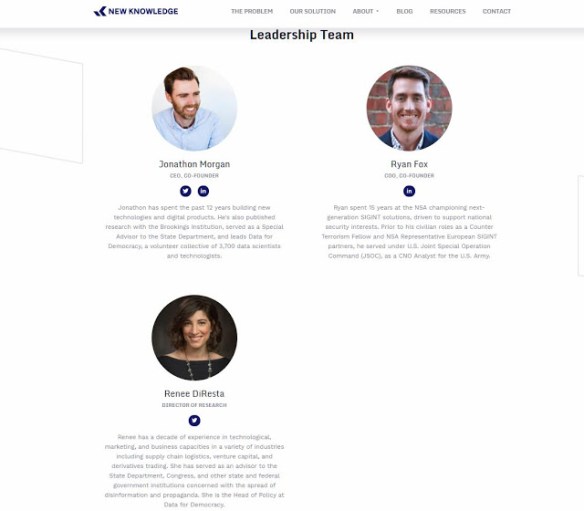
The well-funded deception was carried out by New Knowledge, a private cyber intelligence firm founded by two self-styled disinformation experts who are veterans of the Obama administration: Jonathon Morgan and Ryan Fox.

‘It may be designed to manipulate you’

Morgan began his career as a product manager at AOL before founding a series of start ups, some with funding from the United States Agency for International Development and Silicon Valley billionaire Pierre Omidyar’s Omidyar Network. Once a Brookings Institution researcher and special advisor to the Obama White House and State Department, Morgan founded Data for Democracy, a volunteer organization said to use “public data to monitor the election system for signs of fraud.” Morgan also developed technology for the Defense Advanced Research Projects Agency (DARPA), the arm of the Department of Defense created for basic, applied technological research, and futuristic war toys.

Rising through the ranks of the national security apparatus, Morgan ultimately emerged as a go-to source for credulous reporters seeking to blame Hillary Clinton’s loss to Donald Trump on Russian disinformation.

In an interview with the local CBS affiliate in Austin, Texas, Morgan told viewers that feelings of discontent were telltale signs that they had been duped by Russian disinformation. “If it makes you feel too angry or really provokes that type of almost tribal response, then it may be designed to manipulate you… People should be concerned about things that encourage them to change their behavior,” he warned.

Fox, for his part, is a 15-year veteran of the National Security Agency and was a computer analyst for the Joint Special Operations Command (JSOC) military unit. JSOC is notorious for its spree of atrocities across the Middle East including digging their bullets out of dead pregnant women’s bodies in Afghanistan. Comparatively little information is available about Fox’s background.

Since receiving an $11 million investment from venture capital firm, GGV Capital, in August 2017, New Knowledge has positioned itself as one of the leading private intelligence firms taking on the scourge of Russian disinformation. The outfit made its biggest splash on December 17th when it published one of the two Senate Intelligence Committee-commissioned reports.

The report, titled “The Tactics and Tropes of the Internet Research Agency,” was oversseen by Renee DiResta, a former Wall Street trader and tech specialist who was recruited by Obama’s State Department to devise strategies for combating online ISIS propaganda. The New York Times described DiResta as one among a small group of “hobbyists” who “meticulously logged data and published reports on how easy it was to manipulate social media platforms.”

The hobby lobby of online obsessives converged at New Knowledge this year to sound the alarm on supposed Russian disinformation. In a New York Times op-ed published as Americans went to cast their votes in the midterm elections, Morgan and Fox alleged that the Kremlin was secretly running hundreds of propaganda websites in an effort to swing the outcomes. That assertion ran counter to the narrative the two operatives had been spinning out just months before.

In an interview earlier in the year, Ryan Fox suggested that despite the Trump administration’s multiple rounds of sanctions against Russia, Vladimir Putin was so satisfied with the state of U.S. affairs that the Kremlin had actually cut back on its supposed interference. “Strategically, are they content with the way things are? Does it play in their favor to do anything right now? That’s a valid question,” Fox said. “Keep up the momentum, keep poking away. But do they have to implement drastic measures like hacking the DNC and exposing thousands of emails? Probably not.”

More recently, Fox claimed to have identified hundreds of Russian-controlled Facebook and Twitter accounts active in France’s Yellow Vest movement, which has raged against the country’s neoliberal leadership and sparked anxiety among centrist elites across the Atlantic.

However, Fox produced no evidence to support his incendiary accusation, prompting reporters to qualify his assertions as “very likely” and write that he merely “believes” Russian interference took place.

Drafting the dubious bot dashboard

Morgan is also one the developers of the Hamilton 68 dashboard, an online project dedicated to inflaming public outrage over online Russian bots. Funded by the German Marshall Fund’s Alliance for Securing Democracy – which is itself backed by NATO and USAID – Hamilton 68 claims to track hundreds of accounts supposedly linked to Russian influence operations. The effort has largely succeeded in drawing positive media attention despite one of its founders, Clint Watts, admitting that the Twitter accounts it follows may actually be real people who are not Russian at all.

When Morgan was asked what techniques Hamilton 68 uses to identify Russian influence operations, he offered a confident-sounding but ultimately empty answer: “We developed some techniques for determining who matters in a conversation… Using some of those techniques, we’ve identified a subset of accounts that we’re very confident are core to furthering the Russian narrative in response to mainstream events.”

Because Morgan and his colleagues have explicitly refused to name the accounts monitored by Hamilton 68, his claims can never be proven.

In a lengthy profile of the musicologist-turned-New Knowledge “online detective” Kris Shaffer, Foreign Policy described the supposed methodology he employed to identify Russian disinfo operations: “By working with massive datasets of tweets, Facebook posts, and online articles, he is able to map links between accounts, similarities in the messages they post, and shared computer infrastructure.”

The article added an extraordinarily revealing disclaimer: “This method of analysis is in its infancy, remains a fairly blunt instrument, and still requires human intervention. It sometimes mistakes real people who post anti-imperialist arguments about U.S. foreign policy for Kremlin trolls, for example.”

It may have been that New Knowledge had no knowledge at all of Kremlin botnets, but their reports were nonetheless treated as gospel by droves of credulous reporters eager to make their name in the frenzied atmosphere of Russiagate.

“We orchestrated an elaborate ‘false flag’ operation”

According to an internal New Knowledge report first seen by the New York Times, the firm carried out a multi-faceted influence operation designed to undermine a 2017 bid by right-wing Republican former state supreme court judge Roy Moore for an open Alabama senate seat. By its own admission, New Knowledge’s campaign capitalized on the the sexual assault allegations against Moore to “enrage and energize Democrats” and “depress turnout” among Republicans.

To accomplish this, the New Knowledge team created a Facebook page aimed at appealing to conservative Alabamians by encouraging them to endorse an obscure patio supply salesman-turned-write-in candidate named Mac Watson. They hoped the subterfuge would peel votes away from Moore. It was precisely the kind of tactic that New Knowledge claims Russian troll farms carry out to sow divisions among the American electorate.

Morgan told the New York Times the effort stopped there. But the New Knowledge report says the Facebook page “boosted” Watson’s campaign and even arranged interviews for him with The Montgomery Advertiser and the Washington Post. At the same time, Watson’s Twitter following mysteriously jumped from 100 to about 10,000.

Of the dozens of conservative Alabamian Facebook pages the Watson campaign messaged, the New Knowledge-run page was the only one that responded to it. “You are in a particularly interesting position and from what we have read of your politics, we would be inclined to endorse you”, they wrote. New Knowledge then “asked Mr. Watson whether he trusted anyone to set up a super PAC that could receive funding and offered advice on how to sharpen his appeal to disenchanted Republican voters.”

While Watson communicated with the deceptive Facebook page, the New Knowledge operators never revealed their identity, and the page disappeared the day after the vote. “It was weird,” Watson commented to the New York Times. “The whole thing was weird.”

New Knowledge then sought to manufacture a link between Roy Moore’s campaign and the Kremlin by claiming thousands of his Twitter followers were Russian bots. Mainstream media outlets credulously ran with the narrative, insinuating that the Christian theocrat Moore was secretly backed by Russia.

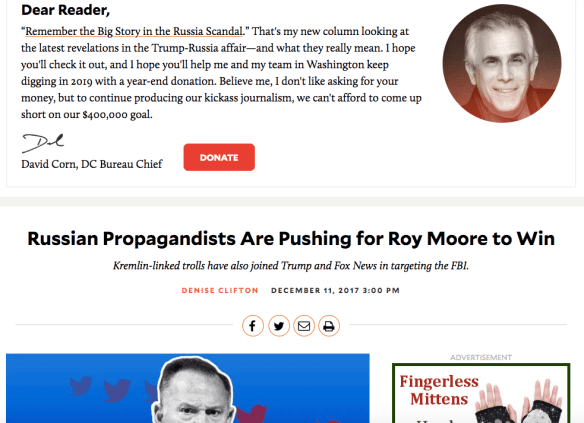
The Montgomery Observer first reported the alleged link: Russian invasion? Roy Moore sees spike in Twitter followers from land of Putin. From there, it was picked up by Mother Jones, whose headline read: Russian Propagandists Are Pushing for Roy Moore to Win. But there was no proof of any Russian connection to the accounts. To bolster its evidence-free claim, Mother Jones simply turned to Hamilton 68, the highly suspect Russian influence monitoring system that Morgan helped design.

Today, as can be seen below, Mother Jones is using a bogus story generated by a disinformation campaign to raise funds for more Russiagate coverage.

As the Russian bot narrative peaked, Moore blamed the Jones campaign for manufacturing the scare. “It’s not surprising that they’d choose the favorite topic of MSNBC and the Fake News outlets — the Russia conspiracy. Democrats can’t win this election on the issues and their desperation is on full display.”

Moore’s opponent, Jones, said he had no knowledge of the operation.

Moore was roundly mocked in liberal circles as a conspiratorial crank, but New Knowledge’s internal report contained a stunning admission: “We orchestrated an elaborate ‘false flag’ operation that planted the idea that the Moore campaign was amplified on social media by a Russian botnet,” its authors revealed.

While the New York Times says the internal report does not confirm that New Knowledge purchased the bot account themselves, the accounts’ flagrant use of Cyrillic language and profile pictures of famous singers including Britney Spears, Christina Aguilera and Avril Lavigne strongly suggest that whoever bought them went to extreme lengths to leave the appearance of a Russian hand.

Disinfo ops to “strengthen American democracy”

The Alabama disinformation campaign was carried out through a network of Silicon Valley tech entrepreneurs and former Obama administration officials who have joined the private sector to leverage liberal anti-Trump outrage into profits.

Billionaire Reid Hoffman, who co-founded the employment networking site LinkedIn, provided $100,000 for the black ops campaign. The money was then pipelined through American Engagement Technologies, which is headed by Mikey Dickerson, a former Google engineer who founded the United State Digital Service. Dickerson is also Executive Director of the New Data Project, an organization dedicated to “testing new approaches” and “serving as an advanced technology research lab for progressives.”

A colleague of Hoffman’s claimed the purpose of his investments was to “strengthen American democracy.”

Since the New York Times’ exposé, Facebook released a statement announcing its suspension of “five accounts run by a multiple individuals for engaging in coordinated inauthentic behavior,” including Morgan’s account. The social media platform has opened an investigation, though it has not revealed what the other pages are or who operated them.

The headline of the New York Times story about the Facebook suspensions appeared to have been crafted to keep the focus on Russia while deflecting scrutiny from the group of Democratic Party-linked hustlers that orchestrated the disinformation operation. It read: “Facebook Closes 5 Accounts Tied to Russia-Like Tactics in Alabama Senate Race.”

For his part, Sen. Jones has demanded an investigation. “I think we’ve all focused too much on just the Russians and not picked up on the fact that some nefarious groups, whether they’re right or left, could take those same playbooks and start interfering with the elections for their own benefit,” he said. “I’d like to see the Federal Election Commission and the Justice Department look at this to see if there were any laws being violated and, if there were, prosecute those responsible.”

Facing an inquiry for possible violations of election laws, Morgan issued a mealy-mouthed statement claiming he “did not participate in any campaign to influence the public and any characterization to the contrary misrepresents the research goals, methods and outcome of the project.”

https://twitter.com/jonathonmorgan/status/1075575821362958337

While the impact of the disinformation campaign on the Alabama senate race may never be quantified, the cynicism behind it is hard to understate. A group of Democratic Party operatives with close ties to the national security state waged a cynical campaign of online deception against the American public, while marketing themselves as the guardians against from foreign interference. Few, if any, Russian hackers could have done as much damage to the already worn fabric of American democracy as they have.


Washington’s Russiagate Conspiracy Theory on Life Support

By Tony Cartalucci

Source: Land Destroyer

The latest bid to keep Washington’s desperate Russiagate conspiracy theory alive has energized distilled segments of the public still convinced of Moscow’s global omniscience and its role in manipulating and undermining virtually every aspect of their daily lives.

But recent “revelations” are simply the same accusations made against a Russian-based click-bait farm, repackaged and respun.

The Washington Post’s article, “New report on Russian disinformation, prepared for the Senate, shows the operation’s scale and sweep,” would in fact present no new report. Instead, it would present repackaged narratives involving “Russia’s disinformation campaign around the 2016 election.” 

The Washington Post would claim:

The report, obtained by The Washington Post before its official release Monday, is the first to study the millions of posts provided by major technology firms to the Senate Intelligence Committee, led by Sen. Richard Burr (R-N.C.), its chairman, and Sen. Mark Warner (Va.), its ranking Democrat. The bipartisan panel also released a second independent report studying the 2016 election Monday. Lawmakers said the findings “do not necessarily represent the views” of the panel or its members.

The two reports were put out by Oxford University’s Computational Propaganda Project and New Knowledge. No information is provided by the Washington Post as to what either of these organizations are, who runs them, or who funds them.

Both reports rehash allegations claiming the Russia-based Internet Research Agency (IRA) conducted an extensive influence campaign through social media during the 2016 US elections.

The total amount of money spent on such operations amounted to approximately $100,000 in Facebook ads. To put this amount in context, the very same Washington Post would report in April 2017 that the total amount spent on the 2016 elections amounted to $6.5 billion – in other words – the amount allegedly spent on Facebook ads by IRA was about 0.001% of total US campaign spending.

Both reports cited by the Washington Post and presented to US Congress did not dispute this. Instead, they attempted to claim the impact of IRA’s activities far exceeded this $100,000 in ads.

The New Knowledge report would claim:

The Instagram and Facebook engagement statistics belie the claim that this was a small operation — it was far more than only $100,000 of Facebook ads, as originally asserted by Facebook executives,” the New Knowledge white paper said. “The ad engagements were a minor factor in a much broader, organically driven influence operation. 

And to unskeptical, untrained eyes, the figures presented by both Oxford and New Knowledge tabulating millions of views, shares, and likes do appear to “belie the claim that this was a small operation.”

Context is King 

But organically driven influence simply means whatever was posted by IRA was picked up by ordinary people and spread by them, not IRA. And while the numbers presented by Oxford and New Knowledge may seem impressive, how do they compare to the “scale and sweep” of the 2016 candidates’ efforts on Facebook?

Since neither group of “researches” bothered to provide this important context, it is fortunate that the Western media itself has, albeit deeply buried in older articles.

It stands to reason that the $81 million US President Donald Trump and presidential candidate Hillary Clinton spent on Facebook – according to TechCrunch – also translated into “organically driven influence.”

In fact, a 2017 Washington Post op-ed titled, “Why Russia’s Facebook ad campaign wasn’t such a success,” would explain:

…the Russian content was just a tiny share of the 33 trillion posts Americans saw in their Facebook news feeds between 2015 and 2017. Any success the ads had in terms of reach seems attributable largely to the sheer doggedness of the effort, with 80,000 Facebook posts in total. Facebook reported that a quarter of the ads were never seen by anyone. And — with the average Facebook user sifting through 220 news-feed posts a day — many of the rest were simply glanced at, scrolled past and forgotten. 

With $81 million spent on Facebook by the Trump and Clinton campaigns, mostly to mobilize core supporters to donate and volunteer, a low-six-figure buy is unlikely to have tipped the election.

In proper context, whatever IRA’s $100,000 bought them, Trump and Clinton’s $81 million bought them much more of.

So what is Oxford University’s Computational Propaganda Project and why is it publishing a 47-page report (.pdf) claiming, “Russia’s IRA launched an extended attack on the United States by using computational propaganda to misinform and polarize US voters,” when freely available facts reported on by the Western media itself proves exactly the opposite?

And what is New Knowledge and why is it publishing a 101-page report (.pdf) claiming $100,000 in Facebook ads constitutes a, “long-running and broad influence operation” when the Washington Post itself has featured experts depicting it as anything but?

Who is Keeping Russiagate on Life Support? 

Oxford University’s Computational Propaganda Project is funded by the US National Science Foundation and the European Research Council as well as by Oxford University itself.

The fact that the former two sponsors are supposedly dedicated to funding scientific pursuits yet are funding the Project’s role in buttressing Western propaganda – specifically that aimed at Russia and China – is particularly troubling.

New Knowledge is more interesting still. It poses as a business claiming to provide the service of, “protecting brands from social media disinformation attacks.” It explains further on its “Our Company” page that:

New Knowledge is a team of national security, digital media and machine learning experts with decades of experience who are dedicated to defending public discourse and providing brands with disinformation protection.

New Knowledge claims it provides clients with a “dashboard” to track and alert them to “disinformation attacks” on their brands. It is difficult to believe anyone would pay New Knowledge for their “services” when most companies already have marketing teams more than capable of minding their brand.

Further down on the same page is New Knowledge’s “Leadership Team.”

It includes CEO Jonathon Morgan who boasts of contributing to corporate-financier funded Brookings Institution – a pro-war policy think tank. He also claims to have served as a “Special Advisor to the State Department.”

There is also COO Ryan Fox, who claims he spent 15 years at the National Security Agency (NSA) focusing on signals intelligence and before that as an analyst for the US Army.

Renee DiResta –  New Knowledge’s director of research – also claims to have worked as an adviser to the US State Department as well as for Congress and other state and federal government institutions regarding “the spread of disinformation and propaganda.”

Both the Oxford operation and New Knowledge intentionally omitted context from their lengthy reports to deliberately portray a minuscule click-bait operation as a threat to American national security. If the $100,000 spent by IRA on Facebook ads was compared side-by-side to the gargantuan sums spent by Trump and Clinton during the 2016 campaign – and that fraction of 1% properly presented to the public – the Russiagate conspiracy theory would drop dead instantly.

No genuine researcher would have committed to reports of up to 100 pages long and failed to put IRA’s impact into proper context and provided a sense of proportion within the 2016 elections IRA supposedly attempted to influence.

But an Oxford-based team funded by the US government might. So might New Knowledge – lined by “advisers” to the US State Department and former employees of the NSA.

It is ironic that amid supposed efforts to expose Russia’s attempts to target the American public with propaganda, it is Oxford, New Knowledge, and the US Congress itself which requested and approved of deliberate propaganda – aimed at targeting the American public to keep the Russiagate conspiracy alive.

Why?

Because Russiagate serves as a central pillar in cultivating hatred across the West against Russia – serving as a pretext for continued expansion of NATO along Russia’s borders, creating leverage against Moscow regarding US wars of aggression across North Africa, the Middle East, and Central Asia, and the undermining of Russia’s position in global energy markets.

There hasn’t been a conflict of confrontation the US has elected to pursue that hasn’t included crude, baseless propaganda aimed at manipulating the American public. Iraq had “weapons of mass destruction.” Now Russia has “Facebook ads of mass persuasion.”


Update:

Facebook suspends account for “New Knowledge” CEO Jonathan Morgan


Related Video: